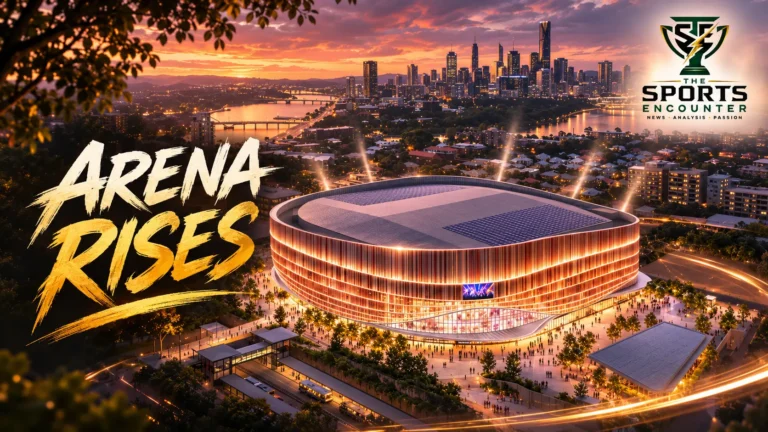
BRISBANE, Australia, November 18, 2026: Italian construction group Webuild has been selected to design and build a A$1.4 billion indoor sports and entertainment arena in Brisbane, advancing one of the city’s most significant infrastructure projects ahead of the 2032 Olympic and Paralympic Games. The proposed Gabba West Arena will accommodate 17,000 spectators for sporting events and up to 18,700 in concert configuration, with construction expected to begin in early 2027 and the venue targeted for completion in 2031.
The Brisbane 2032 arena development extends well beyond the construction of a new sporting venue. Webuild is part of the Gather Brisbane consortium, which has been selected by the Queensland Government to deliver a major entertainment and housing precinct in Woolloongabba. The broader arrangement includes plans to redevelop the existing Gabba Stadium site into almost 4,000 homes after the Olympics, creating a direct connection between Games infrastructure, private investment and Brisbane’s long-term urban development.
Key Takeaways
- The Brisbane 2032 arena development extends well beyond the construction of a new sporting venue.
- The venue’s proposed 17,000-seat sporting capacity would make it a major addition to Brisbane’s indoor event infrastructure.
- The new venue is being developed with Brisbane’s 2032 Olympic and Paralympic Games in mind, but its most significant purpose is to provide a long-lasting indoor sports and entertainment facility for the city.
- One of the project’s most unusual features is its relationship with Brisbane’s existing Gabba Stadium.
The selection represents an important step toward construction, although the consortium has not yet completed the remaining financial negotiations. Gather Brisbane has been named the successful proponent and will now work toward financial close with the Queensland Government.
Story at a glance
Brisbane 2032 Arena: What Webuild Will Construct
Gabba West Arena will be designed as a flexible indoor facility capable of hosting major sporting competitions, concerts and other entertainment events.
Who Is Behind the Gather Brisbane Consortium?
The project brings together four organizations with different responsibilities across infrastructure development, construction, entertainment and venue management.
Why the A$600 Million Government Contribution Matters
The financing arrangement is among the most consequential parts of the announcement.
What Role Will Gabba West Arena Play at the Olympics?
The new venue is being developed with Brisbane’s 2032 Olympic and Paralympic Games in mind, but its most significant purpose is to provide a long-lasting indoor sports and entertainment facility for the city.
The Gabba Stadium Will Give Way to Almost 4,000 Homes
One of the project’s most unusual features is its relationship with Brisbane’s existing Gabba Stadium.
Brisbane 2032 Arena: What Webuild Will Construct
Gabba West Arena will be designed as a flexible indoor facility capable of hosting major sporting competitions, concerts and other entertainment events.
The venue’s proposed 17,000-seat sporting capacity would make it a major addition to Brisbane’s indoor event infrastructure. Its ability to accommodate approximately 1,700 additional spectators in concert mode reflects the different floor layouts and seating arrangements required for entertainment performances.
Unlike a stadium designed primarily around a single sport, the arena is intended to accommodate different event configurations throughout the year.
| Project Component | Confirmed Plan |
|---|---|
| Project | Gabba Entertainment and Housing Precinct |
| Main venue | Gabba West Arena |
| Location | Woolloongabba, Brisbane, Queensland |
| Announced arena value | A$1.4 billion, approximately €860 million |
| Sporting capacity | 17,000 spectators |
| Concert capacity | Up to 18,700 spectators |
| Selected consortium | Gather Brisbane |
| Construction partner | Webuild |
| Anticipated construction start | Early 2027 |
| Targeted opening | 2031 |
| Proposed post-Games housing | Almost 4,000 homes |
The announced project value is approximately A$1.4 billion. That figure should not be confused with the Queensland Government’s separate A$600 million contribution or treated as the final cost of every component of the wider precinct redevelopment.
Webuild confirmed its role in the company’s official project announcement, identifying the arena as a major component of Brisbane’s Olympic-era development program.
Who Is Behind the Gather Brisbane Consortium?
The project brings together four organizations with different responsibilities across infrastructure development, construction, entertainment and venue management.
Webuild will lead the design and construction of the new arena. Plenary Group contributes infrastructure investment and development expertise, while Live Nation and Oak View Group bring experience in live entertainment and major venue operations.
The consortium’s proposed responsibilities extend across the design, construction, financing, maintenance and operation of the arena.
This combined structure is significant because the project’s success will ultimately depend on more than completing the building.
An indoor arena of this scale needs a viable long-term operating model, including major-event bookings, venue maintenance, public transport access and the ability to attract audiences outside the Olympic period.
Having entertainment and venue operators involved from the development stage may help align the building’s design with its intended commercial uses. However, their participation does not by itself guarantee future bookings or profitability.
Why the A$600 Million Government Contribution Matters
The financing arrangement is among the most consequential parts of the announcement.
Under the selected proposal, the Queensland Government has committed to a one-off A$600 million contribution after the arena is delivered, rather than making that payment during the initial construction phase.
The project also involves development rights connected to the existing Gabba Stadium site, which is intended to be transformed into housing and public space after 2032.
These arrangements are designed to attract private investment while retaining a significant public role in the project.
Importantly, the arena should not be described as entirely privately funded without qualification. Although the consortium is expected to finance construction, the planned post-delivery public contribution and associated land-development arrangements form part of the broader transaction.
The Queensland Government’s announcement identifies Gather Brisbane as the selected proponent and outlines the wider entertainment and housing precinct.
What the Brisbane 2032 Arena Deal Still Needs Before Construction
The announcement establishes the consortium’s preferred position, but it does not mean every financial and contractual condition has been completed.
Gather Brisbane must conclude exclusive negotiations with the Queensland Government and reach financial close before the full contractual arrangements are finalized.
That distinction matters when assessing the construction timetable.
The planned early-2027 start provides a target for delivery, but the schedule still depends on completing the required commercial arrangements and progressing through the remaining project requirements.
Similarly, the proposed 2031 opening represents the current delivery objective rather than a completed construction milestone.
For Brisbane, the period before work begins will be an important test of whether the financing structure, development rights and delivery obligations can be settled without altering the project’s central commitments.
What Role Will Gabba West Arena Play at the Olympics?
The new venue is being developed with Brisbane’s 2032 Olympic and Paralympic Games in mind, but its most significant purpose is to provide a long-lasting indoor sports and entertainment facility for the city.
The arena’s proposed configuration offers the flexibility needed for major indoor sporting competitions, with basketball and other arena-based sports among the potential uses discussed in project planning.
However, the latest consortium selection announcement does not independently establish a final sport-by-sport Olympic competition schedule for the venue.
That distinction is important. Being built ahead of the Games and intended to support Olympic-era events does not automatically confirm which specific Olympic or Paralympic sessions will take place inside the arena.
Final event allocations and venue operating arrangements remain matters for the relevant Games authorities and international sports organizations.
For athletes and spectators, the practical requirements will include reliable competition facilities, accessible seating, appropriate warm-up and operational areas, and efficient movement between the arena and the wider transport network.
The importance of venue readiness has featured extensively in TSE’s wider Olympics coverage. Our analysis of the seven countries pursuing the 2036 Olympic Games examined how infrastructure credibility, financial guarantees and long-term use are becoming increasingly important considerations in Olympic planning.
The Gabba Stadium Will Give Way to Almost 4,000 Homes
One of the project’s most unusual features is its relationship with Brisbane’s existing Gabba Stadium.
The stadium has been an important venue for Australian cricket and Australian rules football, but current Queensland planning calls for it to be decommissioned after the 2032 Olympics and Paralympics.
The stadium site would then be redeveloped into a new residential and public precinct.
The proposal includes almost 4,000 homes across different housing categories, including properties intended for sale, rental accommodation, co-living arrangements and purpose-built student housing.
New retail, hospitality, public space and green areas are also planned.
The proposed transformation changes how the new arena should be understood. Rather than simply replacing one sporting facility with another, the project would redistribute different functions across the surrounding area.
The indoor arena is intended to open before the Games, while the redevelopment of the existing Gabba Stadium land would follow after the venue is decommissioned.
That sequence allows the current stadium to remain available during the Olympic preparation period while the long-term residential precinct is developed later.
The number of planned homes is a project target, not a completed housing commitment. Actual delivery will depend on subsequent development stages, approvals and implementation.
How the Project Could Change Woolloongabba
Woolloongabba is located close to central Brisbane and already plays an important role in the city’s sporting and transport network.
The new arena is intended to benefit from public transport connections, including the Woolloongabba Cross River Rail station.
That accessibility is important because large indoor events generate intense but concentrated demand for transport before and after performances or matches.
A 17,000-person sporting crowd can place substantial pressure on surrounding roads, pedestrian routes and public transport services if access arrangements are poorly coordinated.
The proposed housing and entertainment precinct could also create activity beyond individual event days, with residents, local businesses and public spaces supporting more continuous use of the area.
These benefits remain prospective. Their eventual scale will depend on the detailed development design, transport capacity and commercial activity established after construction.
Major sporting events can provide an incentive to modernize infrastructure, but the strongest legacy projects are those that remain useful once the international spotlight moves elsewhere.
That distinction was central to TSE’s examination of Glasgow’s Commonwealth Games economic impact, which assessed the measurable effects of staging a major competition using established venues and infrastructure.
Brisbane’s approach involves a different investment model, with substantial new construction and an additional housing redevelopment program.
Brisbane’s Olympic Venue Strategy Is Changing
Gabba West Arena is one part of a broader restructuring of the city’s planned Olympic infrastructure.
Queensland’s updated venue strategy includes a new major stadium at Victoria Park, intended to become an important long-term venue for cricket, Australian rules football and major events.
The plans allow the existing Gabba Stadium to continue operating during the transition before its eventual decommissioning.
The combination of a new major stadium, a separate indoor arena and the redevelopment of existing sporting land makes Brisbane’s approach considerably more complex than constructing a single Olympic venue.
It also raises important questions about the balance between new facilities, public expenditure and the use of existing infrastructure.
Other Olympic-related projects offer contrasting approaches.
Los Angeles is preparing for its Games largely around established competition venues. TSE’s report on Los Angeles Olympic ticketing and venue capacity examined how the city’s existing infrastructure influences event planning and spectator demand.
Brisbane, by comparison, is using the 2032 preparation period to accelerate projects expected to serve different sporting and urban purposes after the Games.
That approach could create long-term benefits, but it also increases the importance of cost control, construction scheduling and credible post-Games operating plans.
What Happens if Construction Costs Increase?
The announced A$1.4 billion value provides a useful benchmark against which future changes can be assessed.
Continue the Athletics Story



However, major construction projects can encounter changes in material costs, labor availability, engineering requirements and delivery schedules.
The final arrangements between the government and consortium will determine how different categories of risk are allocated.
The timing of the public contribution is one important feature, but it should not be assumed that every potential cost escalation automatically becomes the responsibility of either the government or the consortium.
Those obligations depend on the final contractual terms.
Public reporting should therefore distinguish among the original announced value, any subsequent approved changes and the eventual completed-project cost.
For large-event infrastructure, that financial transparency can be as important as the stadium’s eventual appearance.
The issue is not unique to Brisbane. TSE’s analysis of the proposed New York and Lake Placid Winter Olympics bid examined how existing arenas, travel requirements and public financing influence the credibility of ambitious hosting plans.
Why Webuild’s International Experience Matters
Webuild has worked on major transport and sporting infrastructure projects in several international markets.
Its portfolio includes Al Bayt Stadium in Qatar, a venue used during the 2022 FIFA World Cup, and Bucharest’s National Arena, which hosted the 2012 UEFA Europa League final.
That experience gives the Italian company relevant expertise in complex sports facilities and infrastructure delivery.
Nevertheless, previous construction successes do not guarantee that the Brisbane project will remain on schedule or within its announced cost framework.
The Gabba West Arena will have its own technical requirements, construction constraints and commercial arrangements.
The project must also be designed for repeated use beyond international competition, rather than primarily for a short Olympic program.
The consortium’s combination of construction, venue operation and entertainment expertise is intended to address those different demands.
The Road to Opening and the Post-Games Transformation
The announced development program establishes two broad phases: construction of the indoor arena before the Olympics and redevelopment of the existing Gabba Stadium site afterward.
| Stage | Current Target or Status | Main Dependency |
|---|---|---|
| Consortium selection | Completed | Gather Brisbane named successful proponent |
| Financial close | Pending | Completion of government and consortium negotiations |
| Arena construction begins | Early 2027 | Final agreements and construction readiness |
| Planned arena opening | 2031 | Successful delivery and operational readiness |
| Brisbane Olympics and Paralympics | 2032 | Confirmed Games-time venue arrangements |
| Existing Gabba Stadium decommissioning | After the Games | Transition to the new sporting infrastructure |
| Housing and public-space redevelopment | Post-2032 | Further planning, approvals and staged construction |
The timeline reflects announced plans rather than guarantees that every future milestone has already been contractually secured.
Plenary’s project announcement confirms the consortium’s selection, the intended construction sequence and the work still required to achieve financial close.
A Major Olympic Investment With a Longer-Term Test
The immediate significance of Webuild’s selection is that Brisbane has identified the consortium expected to deliver one of its most important new indoor venues.
The proposed arena has a clear capacity target, an announced investment value, a construction timetable and an intended commercial function beyond the Games.
Yet the longer-term assessment will depend on outcomes that remain years away.
The venue must be completed, operate successfully as an indoor sports and entertainment center, and support the surrounding precinct without becoming dependent on occasional major events.
The associated housing project must also progress from a development proposal into actual homes and useful public spaces.
That is the central test for the Brisbane 2032 arena project. Its success will not be measured solely by whether spectators fill 17,000 seats during a major sporting event. The more meaningful question is whether the A$1.4 billion investment delivers a financially sustainable venue and a genuinely useful urban precinct for Brisbane long after the Olympic and Paralympic Games have ended.