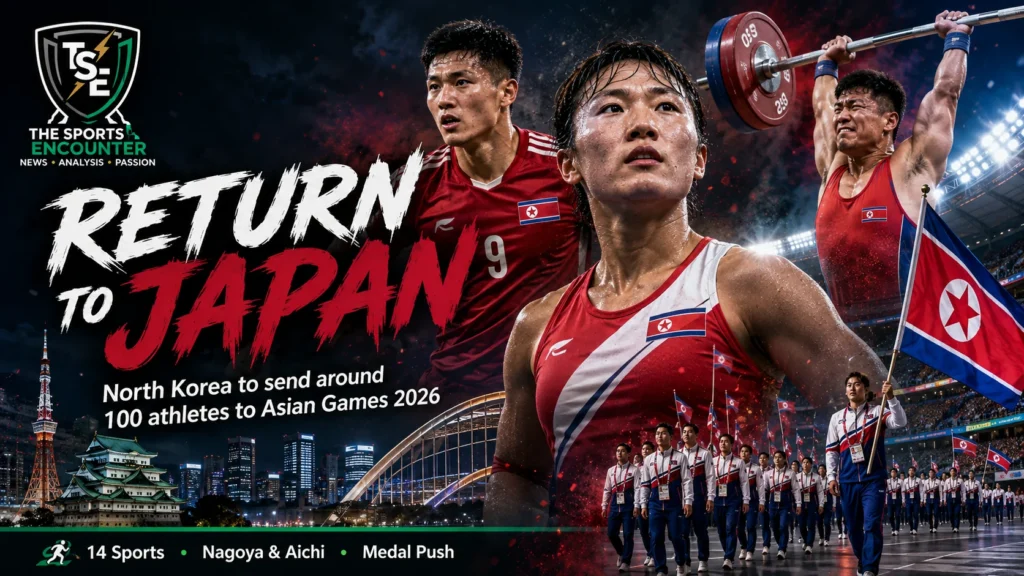
North Korea to Send 100 Athletes to Asian Games in Japan Despite Tense Relations
North Korea will send around 100 athletes across 14 sports to the Aichi-Nagoya Asian Games 2026 in Japan. The delegation is much smaller than the 185-athlete team that won 39 medals in Hangzhou, but Pyongyang still hopes to improve on that haul.
PYONGYANG: North Korea is preparing to send around 100 athletes to Japan for the 2026 Asian Games, taking a smaller team than it fielded three years ago while setting itself an even more demanding target: win more medals.
The Democratic People’s Republic of Korea plans to compete across 14 sports at the Aichi-Nagoya Asian Games, according to North Korean Olympic Committee Secretary General Ko Chol-ho.
The delegation is expected to include teams and athletes in football, weightlifting, boxing, wrestling, table tennis, karate, gymnastics, shooting, athletics, badminton and several other disciplines when Asia’s largest multi-sport competition begins in September.
North Korea won 39 medals at the previous Asian Games in Hangzhou, including 11 gold, 18 silver and 10 bronze. Its 185 athletes competed across 18 sports at an event officially titled Hangzhou 2022 but staged in September and October 2023 after a one-year postponement.
Ko says the smaller 2026 contingent is preparing to improve on that performance.
The announcement also carries wider significance. The Games will take place in Japan at a time when relations between Tokyo and Pyongyang remain deeply strained, while North Korea’s international sporting presence is still rebuilding after several years of restricted overseas competition during and after the COVID-19 pandemic.
For the athletes, however, the immediate challenge is competitive. Weightlifting produced more than half of North Korea’s gold medals in Hangzhou, its football teams have already learned their group-stage opponents, and several individual disciplines offer another opportunity for a relatively small delegation to produce a disproportionately large medal return.
North Korea at Asian Games 2026: What We Know
| Detail | Information |
|---|---|
| Competition | 20th Asian Games, Aichi-Nagoya 2026 |
| Host country | Japan |
| Main host region | Aichi Prefecture and Nagoya |
| Opening ceremony | September 19, 2026 |
| Closing ceremony | October 4, 2026 |
| North Korean athletes | Around 100 |
| Sports entered | 14 |
| Hangzhou 2023 delegation | 185 athletes across 18 sports |
| Hangzhou medals | 11 gold, 18 silver, 10 bronze |
| Total Hangzhou medals | 39 |
| 2026 medal target | More medals than Hangzhou |
| Total participating NOCs | 45 countries and regions |
| Expected athletes at Games | More than 11,000 |
| Total sports | 43 |
TL;DR
- North Korea plans to send around 100 athletes to the 2026 Asian Games in Japan.
- The delegation will compete across 14 sports.
- The sports include men’s and women’s football, weightlifting, boxing and wrestling.
- North Korea won 39 medals at the Hangzhou Asian Games staged in 2023.
- That haul included 11 gold, 18 silver and 10 bronze medals.
- North Korea is taking fewer athletes than the 185 it sent to Hangzhou.
- Secretary General Ko Chol-ho says the goal is still to win more medals than in 2023.
- Weightlifting will again be one of North Korea’s biggest medal opportunities after producing six gold medals in Hangzhou.
- Two Japan-based ethnic Korean athletes are expected to represent North Korea.
- Women’s footballer Ri Song-a and karate athlete Jong Se-ri are part of the planned delegation.
- North Korea’s women’s football campaign begins on September 14, five days before the opening ceremony.
- The men’s football team begins against China on September 16.
North Korea Has Reduced Its Delegation Dramatically From the Original Plan
The current size of the team is particularly interesting when compared with North Korea’s earlier planning.
At the first Chef de Mission meeting for Aichi-Nagoya in September 2025, DPRK National Olympic Committee attaché Song Su Il told the Olympic Council of Asia that North Korea was preparing to send nearly 300 athletes competing in more than 20 sports.
Less than a year later, the plan has changed substantially.
Ko now says around 100 athletes will travel for 14 sports.
The difference is significant.
| North Korea Asian Games Plan | Athletes | Sports |
|---|---|---|
| Initial 2025 planning figure | Nearly 300 | More than 20 |
| Current 2026 plan | Around 100 | 14 |
| Hangzhou 2023 actual delegation | 185 | 18 |
No official explanation has been provided for why the planned delegation became so much smaller.
It would therefore be premature to attribute the change to selection policy, logistics, politics, travel restrictions or any other factor without further evidence.
What can be established is that North Korea appears to have moved toward a more concentrated team while keeping an ambitious medal target.
Which 14 Sports Will North Korea Enter?
Choson Sinbo, the Tokyo-based newspaper that interviewed Ko and is closely associated with the pro-Pyongyang General Association of Korean Residents in Japan, has published a dedicated Asian Games section containing competition schedules for North Korea’s entries.
Those schedules identify the following 14 sports:
| Sport | North Korean Participation |
|---|---|
| Football | Men’s and women’s tournaments |
| Karate | Women’s kumite listed |
| Table tennis | Singles and doubles events listed |
| Soft tennis | Women’s singles listed |
| Boxing | Men’s and women’s weight divisions |
| Gymnastics | Women’s artistic events listed |
| Shooting | Pistol events listed |
| Canoe sprint | Women’s canoe events |
| Weightlifting | Men’s and women’s divisions |
| Athletics | Sprints and marathon events listed |
| Badminton | Women’s singles and doubles |
| Aquatics | Diving events listed |
| Wrestling | Greco-Roman, freestyle and women’s wrestling |
| Judo | Men’s and women’s divisions |
The published schedule is available through Choson Sinbo’s dedicated Aichi-Nagoya Asian Games section.
Weightlifting Gives North Korea Its Clearest Medal Blueprint
If North Korea expects a smaller delegation to win more medals, weightlifting provides the strongest evidence that such efficiency is possible.
Its lifters dominated Hangzhou.
North Korea won six weightlifting gold medals and 13 medals overall in the sport, finishing ahead of China in golds.
Several performances were internationally significant.
Ri Song-gum, Kang Hyon-gyong and Kim Il-gyong were among the North Korean lifters who produced world-record performances during the competition.
The International Weightlifting Federation later described the DPRK team as one of the defining forces of the Hangzhou event.
Six of North Korea’s 11 total Asian Games gold medals therefore came from one sport.
That matters when assessing the 2026 strategy.
A delegation does not have to be enormous if its athletes are concentrated in sports where multiple medal events are available and the country already possesses championship-level depth.
The same pattern can be seen at other multi-sport competitions. The Sports Encounter’s Glasgow 2026 Day 6 coverage showed how countries with established weightlifting programs could turn a limited number of elite entries into several medals within a short competition window.
North Korea Wants More Than 39 Medals
Ko’s target is ambitious because Hangzhou was already a strong return to international multi-sport competition.
North Korea finished with:
- 11 gold medals
- 18 silver medals
- 10 bronze medals
- 39 medals overall
It placed 10th in the overall medal table.
Those results were achieved after years in which many North Korean athletes had little or no regular international competition.
North Korea had withdrawn from the Tokyo Olympics, held in 2021, citing COVID-19 concerns.
The International Olympic Committee subsequently suspended the DPRK National Olympic Committee through the end of 2022 after North Korea failed to send a team to Tokyo.
That kept the country out of the Beijing 2022 Winter Olympics.
Hangzhou, delayed from 2022 until 2023, became North Korea’s major return to the continental multi-sport stage.
The country later competed at the Paris 2024 Olympics, continuing its return to international competition, although it was again absent from the Milano Cortina 2026 Winter Games.
The Aichi-Nagoya Asian Games will therefore provide another important measure of how far its elite sports system has reconnected with regular international competition.
A Smaller Team Does Not Automatically Mean a Smaller Medal Haul
Raw delegation size is an imperfect way to judge medal potential.
Large teams naturally create more opportunities, but medal efficiency often depends on where athletes are concentrated.
North Korea is entering several sports where one strong national program can generate multiple podium finishes.
Weightlifting is the clearest example.
Wrestling offers numerous weight categories.
Boxing creates multiple medal opportunities across men’s and women’s divisions.
Shooting, judo and table tennis can also allow technically strong programs to convert a limited group of athletes into several competitive entries.
Recent multi-sport competitions have repeatedly demonstrated this pattern. Our Glasgow 2026 Day 5 analysis highlighted how smaller nations and territories could reshape their entire Games through a handful of carefully developed athletes.
Nigeria’s Goodness Nwachukwu offered another version of the same phenomenon when she broke the F42 discus world record at Glasgow 2026.
North Korea’s strategy will be judged differently because it is pursuing a much larger total, but the underlying principle remains relevant.
Quality in medal-dense sports can narrow the gap created by a smaller delegation.
Women’s Football Begins Before the Opening Ceremony
North Korea will not have to wait until September 19 to begin competing.
Football starts early.
The official Aichi-Nagoya draw places North Korea’s women’s team in Group F with South Korea, Bangladesh and Myanmar.
The published schedule has the DPRK women opening against Bangladesh in Osaka on September 14 before facing Myanmar on September 17 and South Korea on September 21.
| Date | North Korea Women’s Fixture |
|---|---|
| September 14 | North Korea vs Bangladesh |
| September 17 | North Korea vs Myanmar |
| September 21 | North Korea vs South Korea |
The third fixture will naturally attract considerable attention because it brings North and South Korea together in international competition.
The sporting question is equally substantial.
North Korea has a deep tradition in women’s football and has repeatedly produced strong youth and senior national teams despite long periods of limited international access.
The official Aichi-Nagoya team draw confirms the women’s football groups.
North Korea Men’s Football Face a Difficult Group
The men’s team has been placed in Group B with China, the United Arab Emirates and Iran.
That is one of the stronger combinations in the tournament.
North Korea begin against China on September 16, meet the UAE four days later and finish the group stage against Iran on September 23.
| Date | North Korea Men’s Fixture |
|---|---|
| September 16 | China vs North Korea |
| September 20 | United Arab Emirates vs North Korea |
| September 23 | Iran vs North Korea |
China bring physical depth and major investment in their age-group programs, the UAE remain technically dangerous, and Iran traditionally possess one of Asia’s strongest football structures.
For readers following football across the continent, The Sports Encounter’s broader soccer coverage will track the major Asian Games football results once competition begins.
Two Japan-Based Koreans Are Expected in the DPRK Team
The delegation also contains an unusual local connection.
Ko said two ethnic Korean athletes based in Japan are expected to represent North Korea.
Women’s footballer Ri Song-a is one.
Karate athlete Jong Se-ri is the other.
Jong is scheduled for the women’s 61kg kumite competition, while Ri is part of the women’s football setup.
Their inclusion gives the delegation a link to the Korean community already living in Japan and adds another layer to a Games taking place amid difficult political relations between the two countries.
Japan-North Korea Relations Remain a Complicated Background
The Asian Games will take place against a political backdrop that cannot be completely separated from the logistics of North Korea competing in Japan.
Japan and North Korea do not have diplomatic relations.
Tokyo has maintained restrictions on the entry of North Korean citizens since 2016 as part of sanctions connected to North Korea’s nuclear and missile programs.
Japan has previously considered exceptions for international sporting events.
When North Korea first indicated in 2025 that it intended to participate at Aichi-Nagoya, Reuters reported that Japanese government departments were examining how the delegation would be handled under those restrictions.
The latest sources reviewed for this article confirm North Korea’s planned participation but do not provide a definitive new public Japanese government announcement explaining the precise entry exemption that will apply to the full delegation.
The political relationship remains active and difficult. Japan’s Ministry of Foreign Affairs has continued coordinating with the United States and South Korea over North Korean missile activity during August.
The current official Japanese position on relations with Pyongyang can be followed through the Japanese Ministry of Foreign Affairs.
That context should not obscure what the athletes themselves will be doing in Japan.
They are going there to compete.
North Korea’s International Sports Isolation Has Gradually Eased
The journey from Tokyo 2021 to Aichi-Nagoya 2026 has been uneven.
North Korea’s pandemic-era restrictions sharply reduced the ability of its athletes to compete overseas.
Its withdrawal from the Tokyo Olympics led to an IOC suspension.
The country then missed Beijing 2022 before returning at Hangzhou in 2023.
Paris 2024 brought North Korean athletes back to the Olympic stage.
The Aichi-Nagoya Games now place them inside another major international multi-sport environment, this time in a country with which Pyongyang has an especially difficult political relationship.
The sporting return is therefore becoming more regular even though North Korea remains selective in the events and delegations it sends overseas.
Aichi-Nagoya 2026 Will Be Enormous
North Korea’s contingent will form one small part of a much larger event.
The Olympic Council of Asia’s official Aichi-Nagoya 2026 event center lists 45 participating National Olympic Committees.
The OCA expects more than 11,000 athletes and around 6,000 officials.
The program contains 43 sports, 71 disciplines and approximately 470 medal events.
Japan will host the Asian Games for the third time after Tokyo in 1958 and Hiroshima in 1994.
The official motto is “Imagine One Asia.”
Competition will be spread across Aichi, Nagoya and other locations, with some events taking place outside the main host region.
Football begins before the opening ceremony, while other disciplines run through October 4.
Organizers Are Already Managing a Participation Challenge
The scale of the Games has created its own logistical pressure.
The OCA has reported approximately 17,000 athlete and official registrations, exceeding earlier planning estimates.
Organizers are discussing ways to manage the final number because Aichi-Nagoya will operate without a conventional centralized athletes’ village.
Accommodation plans include hotels, temporary housing and a cruise ship.
There is no evidence that those wider organizational issues caused North Korea to reduce its delegation, and the two developments should not be connected without confirmation.
They do show how large and complicated the 20th Asian Games have become.
What Would Count as Success for North Korea?
Ko has supplied the clearest benchmark himself.
More than 39 medals.
That is demanding for a team almost half the size of the one North Korea sent to Hangzhou.
The path probably requires another dominant weightlifting campaign, multiple medals from combat sports and useful contributions from shooting, gymnastics, table tennis and aquatics.
Football presents a different type of value because medal opportunities are limited to one per team, yet success carries much larger public visibility.
The women’s team in particular has the pedigree to become one of the delegation’s most closely watched entries.
North Korea therefore has two overlapping objectives.
It wants medal efficiency from its strongest individual sports.
It also wants visibility through team events capable of attracting wider attention.
Why Hangzhou Remains the Best Guide
North Korea’s 2023 performance gives us a useful baseline because the circumstances were unusual.
The country arrived after years of limited international exposure.
Its athletes nevertheless finished 10th on the medal table.
Weightlifting became a major statement.
Shooting produced medals.
Combat sports remained productive.
Several athletes competed at levels that immediately placed them among Asia’s best.
The question in Japan is whether those performances represented a temporary surge after years of closed-door preparation or evidence of a national elite-sport system capable of sustaining results through another cycle.
A smaller roster will make that answer easier to measure.
TSE Analysis: North Korea Is Betting on Concentration Rather Than Scale
The most interesting number in this announcement may eventually be 14.
North Korea could have tried to maximize visibility by entering a larger number of sports.
Instead, the current plan is considerably narrower than the one discussed publicly in 2025.
That creates a clear sporting test.
Can a team of around 100 athletes outperform a 185-athlete delegation that collected 39 medals?
Weightlifting suggests it is possible to generate extraordinary efficiency when a country has depth across several categories.
Wrestling, boxing, judo and shooting can offer similar opportunities on a smaller scale.
Football will provide the public-facing part of the campaign, particularly if the women’s team progresses deep into the tournament.
The final medal count will ultimately tell us whether North Korea’s confidence was justified.
If the team passes 39 medals with roughly 100 athletes, it would represent a significant improvement in medals per competitor and make the reduced delegation one of the more interesting performance stories of Aichi-Nagoya 2026.
If it falls well short, the difference between the original plan of nearly 300 athletes and the final contingent will become an even more important question.
Either way, North Korea’s participation gives the Asian Games another major sporting storyline before the opening ceremony has even begun.
More Multi-Sport and Asian Coverage From The Sports Encounter
- Glasgow 2026 Day 5: Records, Results and the Changing Medal Map
- Glasgow 2026 Day 6: Australia Passes 100 Medals
- Goodness Nwachukwu Breaks Discus World Record at Glasgow 2026
- Remembering Usain Bolt’s 9.69 Beijing Olympic Run
- How Teams Qualify for Flag Football at LA28
- Flag Football Stars to Know Before LA28, Including Japan’s Chihiro Iwata
- Al-Ahli vs Al-Ain Headlines Expanded AFC Champions League Elite Draw
Frequently Asked Questions
How many athletes will North Korea send to the 2026 Asian Games?
North Korea plans to send around 100 athletes to compete across 14 sports at the Aichi-Nagoya Asian Games.
When are the 2026 Asian Games?
The opening ceremony is scheduled for September 19 and the Games conclude on October 4, 2026. Some competitions, including football, begin before the opening ceremony.
Where will the 2026 Asian Games be held?
The Games are being hosted primarily by Aichi Prefecture and Nagoya in Japan, with competitions also taking place at venues in other areas.
How many medals did North Korea win at the last Asian Games?
North Korea won 39 medals at Hangzhou, including 11 gold, 18 silver and 10 bronze.
How many athletes did North Korea send to Hangzhou?
North Korea registered 185 athletes across 18 sports at the Hangzhou Asian Games staged in 2023.
Which sports will North Korea compete in at Aichi-Nagoya 2026?
Its published schedule covers football, karate, table tennis, soft tennis, boxing, gymnastics, shooting, canoe sprint, weightlifting, athletics, badminton, aquatics, wrestling and judo.
Why is weightlifting important for North Korea?
Weightlifting produced six of North Korea’s 11 gold medals at Hangzhou. The DPRK won 13 weightlifting medals overall and produced several world-record performances.
Who are North Korea’s football opponents?
The women’s team is grouped with South Korea, Bangladesh and Myanmar. The men’s team will face China, the United Arab Emirates and Iran.
When does North Korea’s Asian Games campaign begin?
The women’s football team is scheduled to play Bangladesh on September 14, five days before the opening ceremony.
Are any Japan-based athletes representing North Korea?
Yes. Women’s footballer Ri Song-a and karate athlete Jong Se-ri are expected to represent North Korea.
Did North Korea compete at the Tokyo Olympics?
No. North Korea withdrew from the Tokyo Olympics held in 2021, citing concerns related to the COVID-19 pandemic.
Did North Korea compete at Paris 2024?
Yes. North Korea returned to the Summer Olympic stage at Paris 2024 after resuming international multi-sport participation at the Hangzhou Asian Games in 2023.
How many athletes will compete at Aichi-Nagoya 2026 overall?
The Olympic Council of Asia expects more than 11,000 athletes representing 45 countries and regions.
How many sports are at the 2026 Asian Games?
The Aichi-Nagoya program contains 43 sports and 71 disciplines, with approximately 470 medal events.
What is North Korea’s medal target?
Olympic Committee Secretary General Ko Chol-ho has said the delegation hopes to improve on the 39 medals North Korea won in Hangzhou despite taking a smaller team to Japan.

Athletics
Keely Hodgkinson Withdraws From Zurich as Audrey Werro Takes Control of the 800m Rivalry
Keely Hodgkinson has withdrawn from the Zurich Diamond League after saying her body is not ready to race again following the European Championships. With Audrey Werro in dominant form and Georgia Hunter Bell and Femke Broeders-Bol still in the field, the women’s 800m hierarchy continues to shift.
Keely Hodgkinson was supposed to arrive in Zurich looking for an answer.
Audrey Werro had beaten her to European 800m gold in Birmingham. The Swiss star had then returned home and won again in Lausanne. Georgia Hunter Bell was waiting after an outstanding summer of her own, while Femke Broeders-Bol continued one of the most intriguing event transitions in athletics.
Instead, Hodgkinson has decided her body needs something more valuable than another high-profile race.
Recovery.
The Olympic 800m champion has withdrawn from Thursday’s Weltklasse Zurich Diamond League meeting, saying she is not physically ready to compete again following the European Athletics Championships.
“Unfortunately, the body isn’t quite ready to race again after the European championships, so we’ve made the decision to skip this race and get ready for the next one,” Hodgkinson said in announcing the decision.
The withdrawal removes the rematch Zurich had been built around.
It does not remove the larger story.
The women’s 800m has changed dramatically during 2026. Werro has gone from emerging challenger to European champion and one of the fastest women in history. Hunter Bell has added major championship success. Broeders-Bol has transformed herself from a world-class 400m hurdler into a genuine two-lap threat.
Hodgkinson remains the Olympic champion and one of the defining 800m runners of her generation.
What is less certain now is how aggressively she should chase a late-season rivalry when her body is asking for time.
Keely Hodgkinson Withdraws From Zurich: What We Know
| Detail | Information |
|---|---|
| Meeting | Weltklasse Zurich Diamond League |
| Date | August 27, 2026 |
| Event | Women’s 800m |
| Hodgkinson status | Withdrawn |
| Reason | Body not ready after European Championships |
| Major remaining contenders | Audrey Werro, Georgia Hunter Bell, Femke Broeders-Bol |
| Diamond League Final | Brussels, September 4-5 |
The official Weltklasse Zurich program confirms that the women’s 800m remains part of Thursday’s meeting at the Letzigrund Stadium.
Zurich Was Supposed to Be Hodgkinson vs Werro Again
When the Zurich organizers announced Hodgkinson for the meeting on August 17, the race immediately became one of the most compelling events of the late Diamond League season.
The reason was obvious.
Only days earlier, Werro had beaten Hodgkinson in one of the best women’s 800m finals Europe has produced in years.
The Swiss runner won the European title in Birmingham in 1:54.81.
Hodgkinson finished second in 1:55.01.
Broeders-Bol took bronze in 1:55.54.
The official World Athletics report from Birmingham confirmed Werro’s championship record and the quality of the race.
The Sports Encounter examined that final in depth in our analysis of Werro’s record-breaking European 800m victory over Hodgkinson.
Zurich was therefore supposed to answer the next obvious question.
Could Hodgkinson respond immediately?
That answer will have to wait.
Hodgkinson Is Choosing the Season Over One Race
That decision deserves more respect than disappointment.
Elite athletics constantly rewards athletes for racing.
Fans want rematches.
Organizers want stars.
Broadcasts want rivalries.
Sponsors want appearances.
The athlete has to live inside the body carrying all of it.
Hodgkinson has already dealt with hamstring and knee problems during recent seasons. She skipped the Commonwealth Games earlier this summer while prioritizing the European Championships and entered Birmingham knowing that the calendar had to be managed carefully.
She reached the European final and ran 1:55.01.
That is not the performance of an athlete suddenly out of form.
It is the performance of an Olympic champion who ran into an opponent producing an exceptional season.
The sensible response to physical warning signs is therefore not to chase revenge four days later because the storyline looks attractive.
It is to recover.
Audrey Werro Has Changed the Women’s 800m Hierarchy
Hodgkinson’s absence also changes how Zurich should be viewed.
Werro no longer needs Hodgkinson in the race to validate her status.
That was probably true before Birmingham.
It is certainly true now.
Werro arrived at the European Championships as one of the fastest women in the world and survived one of the strangest routes imaginable to the final.
She fell during her semifinal, finished last and initially appeared to be eliminated.
A successful Swiss appeal put her back into the final.
The Sports Encounter covered that extraordinary sequence in our report on Werro’s semifinal fall and reinstatement.
Less than 24 hours later, she became European champion.
That matters because adversity tests athletes differently from paced Diamond League racing.
Werro had to deal with uncertainty, recovery from the fall, championship pressure and Hodgkinson racing in front of a British crowd.
She still won.
Werro Backed Birmingham Up in Lausanne
The European title could have produced an emotional drop.
Instead, Werro went to Lausanne and won again.
She clocked 1:55.33, holding off Broeders-Bol, who finished only 0.08 seconds behind in 1:55.41.
That result matters as much as the time.
Championship peaks are difficult to reproduce immediately.
Werro did not need another 1:53 or 1:54 performance.
She needed to demonstrate that Birmingham had not consumed the rest of her season.
She did that.
Zurich now becomes another test of whether she can keep winning after becoming the athlete everyone else is trying to beat.
Hodgkinson Has Already Run Brilliantly Against Werro This Year
The rivalry should not be framed as though Hodgkinson has suddenly fallen away.
She has produced exceptional performances herself.
In Stockholm earlier this season, Hodgkinson ran a British record and personal best of 1:54.33.
She still lost.
Werro won in 1:53.98.
That result helped move the women’s 800m into territory rarely seen in the modern era.
The official Zurich organizers highlighted that race when announcing the proposed rematch and noted how rapidly the event’s standards have risen.
That is why Hodgkinson’s withdrawal should not be interpreted as evidence that she can no longer match Werro.
The available evidence says the opposite.
Hodgkinson remains fast enough to run performances that would have dominated most eras.
Werro has simply found another level during 2026.
Is There Really a Power Shift in the Women’s 800m?
Yes, but the phrase needs context.
A power shift does not mean Hodgkinson has disappeared.
It means she is no longer the only obvious reference point at the top of the event.
Werro has forced her way into that space.
Hunter Bell is increasingly relevant.
Broeders-Bol has created an entirely new competitive question.
World champion Lilian Odira remains part of the broader global picture even though she has also withdrawn from Zurich after recent illness and weakness.
The event is deeper than it was two years ago.
That should make Hodgkinson more cautious with her body, not less.
One forced late-season race is not worth compromising a career that should still have several championship cycles ahead of it.
Lilian Odira Has Also Withdrawn From Zurich
Hodgkinson is not the only major name missing from the original Zurich field.
World 800m champion Lilian Odira has also pulled out.
Reports indicate that the Kenyan has struggled with illness and weakness since the Commonwealth Games.
That removes another athlete who would have added world championship authority to an already extraordinary race.
The original field was promoted as a meeting of reigning champions.
Zurich will now look different.
It remains strong.
It is no longer the complete global showdown organizers initially hoped to stage.
Georgia Hunter Bell Now Has a Bigger Opportunity
Hunter Bell’s presence becomes much more significant without Hodgkinson and Odira.
She won Commonwealth Games 800m gold in Glasgow earlier this summer, controlling the final in 1:59.51.
The Sports Encounter covered that performance in our Glasgow 2026 Day 8 analysis, where Hunter Bell produced one of England’s strongest track performances of the Games.
She then shifted back to the 1,500m at the European Championships and won gold in Birmingham.
That range makes her particularly interesting.
Hunter Bell can race tactically.
She can survive physical 800m positioning.
She also possesses the endurance developed through the 1,500m.
What she has not yet done this season is consistently operate in the 1:54 to 1:55 territory Werro and Hodgkinson have made increasingly normal.
Zurich gives her another opportunity to find out how close she is.
Femke Broeders-Bol May Be the Most Fascinating Athlete in the Race
Even in an event filled with compelling stories, Broeders-Bol’s transition demands attention.
She built her reputation through the 400m hurdles.
Now she is running world-class 800m times.
Her bronze medal in Birmingham came in 1:55.54.
She followed that with 1:55.41 in Lausanne, finishing only eight hundredths behind Werro.
That is no longer experimentation.
That is elite 800m racing.
The intriguing part is how different her physical background is from most traditional two-lap specialists.
Years of 400m hurdle training gave her speed, strength and an ability to tolerate severe lactate accumulation.
The challenge is tactical efficiency.
Eight hundred meters requires positioning, pace judgment and the confidence to remain patient when another athlete makes an early move.
Broeders-Bol is learning those skills while already running times capable of winning major medals.
Zurich may therefore become less about Werro defending home territory and more about whether Broeders-Bol can close the remaining fraction of a second.
Birmingham Was the Race That Changed Everything
Hodgkinson’s withdrawal cannot be understood without returning to Birmingham.
The European final reshaped the event.
Werro took control.
Hodgkinson chased.
Broeders-Bol stayed close enough to threaten the top two.
The winning time of 1:54.81 broke a championship record that had stood since 1982.
Hodgkinson’s 1:55.01 would have won comfortably at most previous European Championships.
Instead, it earned silver.
The Sports Encounter’s full Birmingham record-night wrap placed Werro’s victory alongside major performances from Karsten Warholm, Gianmarco Tamberi and Nadia Battocletti.
That broader context matters.
Birmingham was not a weak championship where one athlete happened to produce a quick time.
It was an elite session filled with championship records and high-level performances.
Werro’s victory belonged at the center of it.
Hodgkinson Had Looked Strong Before the Final
Nothing in the preliminary rounds suggested a physical collapse was coming.
Hodgkinson controlled her European semifinal in 1:57.38.
She looked composed and qualified without the chaos Werro endured in the other semifinal.
Our Birmingham Day 4 report covered the contrasting routes both women took into the final.
That is another reason not to overstate the current withdrawal.
Hodgkinson was capable of running an elite championship final.
Her body is now telling her that another immediate high-intensity race is not the right decision.
That is different from being seriously injured or incapable of competing at the top level.
Should Hodgkinson Target the Brussels Diamond League Final?
That depends entirely on recovery.
Brussels hosts the Diamond League Final on September 4 and 5.
On paper, that gives Hodgkinson a little more than a week between Zurich and the final.
The calendar should not dictate the decision.
If she returns to full training, moves freely and can complete race-specific sessions without concern, Brussels becomes an attractive target.
If the body continues sending warning signs, she should skip that too.
The late-season temptation will be enormous because the women’s 800m rivalry has become commercially and competitively compelling.
But an Olympic champion does not need to prove her status through one September meeting.
Health has to win that argument.
Why This Matters Beyond Zurich
The women’s 800m is entering one of its strongest eras in decades.
Werro has approached one of the most controversial and long-standing world records in athletics.
Hodgkinson continues producing historically fast British performances.
Broeders-Bol is adding another world-class athlete to the event.
Hunter Bell is capable of moving between 800m and 1,500m at championship level.
Odira remains the reigning world champion.
This is precisely the kind of rivalry athletics needs.
It also increases the physical demands on every athlete involved because major races become harder to avoid.
Every meeting wants them.
Every organizer wants the rematch.
Every championship creates another rivalry narrative.
The athlete still has only one body.
British Athletics Should Want Hodgkinson Healthy, Not Constantly Available
There is also a national perspective.
British athletics currently has an unusually strong collection of female track athletes.
Hunter Bell is a major champion.
Amy Hunt completed a remarkable sprint double in Birmingham, a performance examined in The Sports Encounter’s analysis of her 100m and 200m titles.
Hodgkinson remains one of Britain’s biggest global athletics stars.
The long-term objective should be to have her healthy for Olympic and world championship cycles, not to squeeze another Diamond League appearance from an athlete who is telling her team she is not ready.
That becomes especially relevant as Britain continues trying to strengthen its position as a global athletics center. Our analysis of London’s bid for the 2029 World Athletics Championships examined how important the country’s current generation of stars could be to the sport’s domestic momentum.
Who Is the Zurich Favorite Now?
Audrey Werro.
There is very little reason to argue otherwise.
She has the fastest profile.
She is European champion.
She has just won Lausanne.
She is racing in Switzerland.
She has beaten Hodgkinson more than once this season.
And the two athletes most capable of carrying equal championship authority into Zurich, Hodgkinson and Odira, are no longer racing.
That does not make the result inevitable.
Broeders-Bol finished only 0.08 seconds behind her in Lausanne.
Hunter Bell brings tactical strength and championship confidence.
Eight hundred meters remains an event where positioning can destroy a favorite’s plan within seconds.
Werro should still start as the woman everyone else has to beat.
Zurich Women’s 800m: The Main Questions
| Question | Why It Matters |
|---|---|
| Can Werro win again? | Another victory would reinforce her position at the top of the 2026 hierarchy |
| Can Broeders-Bol close the Lausanne gap? | Only 0.08 seconds separated her from Werro |
| Can Hunter Bell run with the 1:55 group? | She has major titles but still has another level to find on pure time |
| How much does Hodgkinson’s absence change the race? | Zurich loses the athlete most likely to force Werro into another historically fast contest |
| Will the race become tactical? | Without Hodgkinson and Odira, athletes may be less willing to commit to an extreme early pace |
Hodgkinson’s Withdrawal May Actually Help the Rivalry
That sounds counterintuitive.
Fans wanted Zurich.
The organizers wanted Zurich.
Werro wanted the home rematch.
Hodgkinson herself had previously spoken about wanting to join such a strong field.
But rivalries become less interesting when one athlete races through physical problems and then disappears for months.
Hodgkinson and Werro are both young enough for this confrontation to continue across several seasons.
The better rivalry is the one that reaches another Olympic final, another World Championship and more Diamond League races with both athletes healthy.
Missing Zurich is disappointing.
Losing months to a preventable injury would be much worse.
The Wider European Championships Show Why Recovery Matters
Birmingham produced a demanding championship week for many of Europe’s leading athletes.
Some left with records.
Some left with medals.
Some left carrying the physical cost of multiple rounds.
Nadia Battocletti completed a historic 5,000m and 10,000m double-double, which The Sports Encounter covered after her remarkable distance achievement.
The point is not that Hodgkinson faced the same workload.
It is that championship athletics asks athletes to peak physically and emotionally within a narrow window.
Expecting another peak immediately afterward is not always realistic.
TSE Analysis: Hodgkinson Has More to Gain From Patience Than Zurich Revenge
The most tempting version of this story is the rivalry narrative.
Werro beats Hodgkinson in Birmingham.
Hodgkinson goes to Switzerland looking for revenge.
The home crowd chooses Werro.
Two of the fastest women of their generation settle it again over two laps.
That would have been excellent entertainment.
It is not worth racing if Hodgkinson does not believe her body is ready.
Her 2026 season has already established several important facts.
She remains capable of historically fast running.
She remains a championship-level athlete.
She can still produce 1:55 performances under enormous pressure.
The rise of Werro does not reduce Hodgkinson.
It gives her a stronger rival.
The smartest response is therefore not desperation.
It is durability.
What Would Count as a Successful End to Hodgkinson’s Season?
Not necessarily another win.
The priorities should be simpler.
- Resolve the physical issues left from Birmingham.
- Return to uninterrupted training.
- Race again only if full-speed sessions are pain-free.
- Avoid turning fatigue into another long-term injury.
- Finish 2026 with confidence rather than another rehabilitation program.
If that includes Brussels, excellent.
If it does not, Hodgkinson’s career will not be diminished by skipping another race.
The Sports Encounter Verdict
Keely Hodgkinson’s Zurich withdrawal removes the rematch athletics fans wanted.
It does not weaken the women’s 800m story.
It makes that story more complicated.
Audrey Werro now arrives at her home Diamond League meeting as European champion, Lausanne winner and the clear favorite.
Femke Broeders-Bol is rapidly becoming a genuine threat rather than an intriguing experiment.
Georgia Hunter Bell enters with major championship confidence and another opportunity to test herself against the event’s fastest athletes.
Lilian Odira’s withdrawal further changes the original field.
And Hodgkinson is left making a decision every elite athlete eventually has to make.
How much is one race worth?
In this case, probably not enough.
The Olympic champion has already shown that she can run with Werro.
She does not need Zurich to prove it.
What she needs is a body capable of doing it again when the stakes are even higher.
Werro may own Thursday night.
The larger rivalry remains unfinished.
Frequently Asked Questions
Why has Keely Hodgkinson withdrawn from the Zurich Diamond League?
Hodgkinson said her body is not ready to race again following the European Championships and that she and her team decided to skip Zurich and prepare for her next competition.
When is the Zurich Diamond League women’s 800m?
The race is scheduled for Thursday, August 27, 2026, at the Letzigrund Stadium.
Who beat Keely Hodgkinson at the 2026 European Championships?
Switzerland’s Audrey Werro won the European 800m title in a championship-record 1:54.81. Hodgkinson finished second in 1:55.01.
Who finished third in the European 800m final?
Femke Broeders-Bol of the Netherlands won bronze in 1:55.54.
Is Audrey Werro running in Zurich?
Yes. Werro remains in the Zurich field and enters as the leading favorite after winning the European title and the Lausanne Diamond League.
Is Lilian Odira racing in Zurich?
No. Odira has also withdrawn from the women’s 800m after reportedly dealing with illness and weakness since the Commonwealth Games.
Is Georgia Hunter Bell racing in Zurich?
Yes. Hunter Bell remains part of the field after a summer in which she won Commonwealth 800m gold and European 1,500m gold.
What did Audrey Werro run in Lausanne?
Werro won the Lausanne Diamond League 800m in 1:55.33, narrowly defeating Broeders-Bol, who ran 1:55.41.
Could Hodgkinson return for the Diamond League Final?
Potentially. The Diamond League Final is scheduled for Brussels on September 4-5, but Hodgkinson’s participation should depend on her recovery rather than the calendar.
Has Audrey Werro beaten Hodgkinson before Birmingham?
Yes. Werro also defeated Hodgkinson in Stockholm earlier in 2026, running 1:53.98 while Hodgkinson set a British record of 1:54.33.
Athletics
Audrey Werro Wins Lausanne Thriller as Tebogo and Wanyonyi Fire Budapest Warning Shots
Audrey Werro thrilled the home crowd with a 1:55.33 win in Lausanne, while Letsile Tebogo, Emmanuel Wanyonyi, Masai Russell and Winfred Yavi all delivered major statements ahead of Budapest.
LAUSANNE, Switzerland, August 22, 2026: Audrey Werro returned home as European champion and left Lausanne with another reminder that the women’s 800 meters has changed around her.
The 22-year-old Swiss star won the Athletissima women’s 800m in a meeting-record 1:55.33, surviving a furious late charge from Femke Broeders-Bol to continue a season that has already pushed her into the all-time elite of the event.
Werro’s victory was only one part of a Lausanne Diamond League meeting that doubled as an important form check before next month’s World Athletics Ultimate Championships in Budapest.
Letsile Tebogo won the men’s 200m in 19.87. Emmanuel Wanyonyi finally claimed his first 800m victory of the season in 1:42.19. Masai Russell extended her unbeaten run in the women’s 100m hurdles. Winfred Yavi beat world champion Faith Cherotich in the steeplechase. Kayla White won the women’s 200m, where Shericka Jackson pulled up with an apparent hamstring problem.
One night earlier, Mondo Duplantis had already turned Lausanne into one of the standout Diamond League meetings of the year by clearing 6.21m, with Emmanouil Karalis pushing him through a historic pole vault battle. World Athletics confirmed that Karalis cleared 6.16m, the highest ever non-winning mark in the event.
Friday’s main stadium program then shifted the conversation from records to championship momentum.
For Werro, Tebogo and Wanyonyi especially, Lausanne felt less like another stop on the circuit and more like a message to Budapest.
Lausanne Diamond League 2026: Key Results
| Event | Winner | Winning Mark | Main Story |
|---|---|---|---|
| Women’s 800m | Audrey Werro | 1:55.33 | Meeting record and home victory |
| Men’s 200m | Letsile Tebogo | 19.87 | Strong Budapest statement |
| Men’s 800m | Emmanuel Wanyonyi | 1:42.19 | First 800m win of the season |
| Women’s 200m | Kayla White | 22.18 | Shericka Jackson pulls up injured |
| Women’s 100m hurdles | Masai Russell | 12.27 | Ninth consecutive victory |
| Women’s 3000m steeplechase | Winfred Yavi | 9:00.04 | Beat Faith Cherotich |
The official World Athletics Diamond League hub provides the updated schedule, results and standings for the closing stages of the season.
Audrey Werro Finds Another Way to Win
Werro’s season has already been defined by speed.
Lausanne was more revealing because she won without producing anything close to her fastest performance.
She had run 1:53.98 in Stockholm earlier this season before improving to 1:53.80 in Paris, performances that established her among the fastest women in 800m history.
World Athletics identified her as one of Lausanne’s major attractions after she followed those performances by winning the European title in Birmingham.
The Sports Encounter has tracked that rise closely. Only days before Lausanne, Werro’s European Championship appeared to have disappeared when she fell during the 800m semifinal in Birmingham. A successful Swiss appeal restored her to the final, a remarkable sequence detailed in our report on Werro’s fall and reinstatement.
She then turned the reprieve into gold.
Lausanne asked a different question.
Could she recover quickly enough from the physical and emotional demands of Birmingham and still beat another world-class field?
She did.
Werro Went Out Hard and Almost Paid for It
Werro attacked the race aggressively and began to fade over the final 200 meters after a very fast opening lap.
That created an opportunity for Broeders-Bol.
The Dutch athlete, already a double world champion in the 400m hurdles before moving into the 800m this season, closed rapidly through the final straight.
Werro reached the line in 1:55.33.
Broeders-Bol finished in 1:55.41.
Eight hundredths separated them.
The Swiss victory also produced a Lausanne meeting record.
It was not Werro’s fastest race.
It may have been one of her most useful.
Why the 1:55.33 Matters More Than It Looks
A runner who has already gone 1:53 can make 1:55 look ordinary on paper.
Championship athletics works differently.
Budapest will not necessarily be paced perfectly. There may be contact, tactical hesitation or an opening lap that develops far differently from what the favorites want.
Werro has already shown this season that she can run historically fast times.
Lausanne showed she can still win after misjudging parts of a race and carrying fatigue from a major championship.
That ability may matter more in Budapest than another personal best.
Broeders-Bol Is Becoming a Serious 800m Threat
Broeders-Bol’s second place should not disappear beneath the Werro celebration.
Her transition from 400m hurdles to 800m has rapidly moved from experiment to legitimate global story.
She ran 1:55.41 in Lausanne, nearly stealing the race after Werro appeared to have established enough separation.
Her own assessment after the race was revealing. Broeders-Bol said the performance strengthened her belief that she belongs among the best and that she still needs to trust herself more after 500 meters.
That sounds like an athlete who believes there is significantly more available.
The Women’s 800m Is Becoming One of Budapest’s Best Events
Werro and Broeders-Bol are only part of the picture.
Keely Hodgkinson remains the Olympic champion. World champion Lilian Odira remains dangerous. Georgia Hunter Bell has produced major performances this summer.
Werro has now beaten elite opposition repeatedly, including Hodgkinson on her way to the European title.
The Sports Encounter’s Birmingham coverage of Werro showed how quickly the event has become less predictable than it appeared at the beginning of the season.
Lausanne reinforced that shift.
Letsile Tebogo Executes the Race He Wanted
There was far less drama in the men’s 200m.
Tebogo won in 19.87, only 0.03 outside his season best.
South Africa’s Sinesipho Dambile finished second in 19.98.
The most impressive element was the way Tebogo described the performance afterward.
His focus was on the bend and the first 150 meters rather than chasing a spectacular time.
That is exactly the kind of language expected from an Olympic champion entering the final phase before another major championship.
The work is becoming more specific.
The times are becoming secondary to execution.
Tebogo’s 19.87 Is a Warning Without Being a Peak
Running 19.87 in August is obviously fast.
The more significant point is that Tebogo does not appear to believe he has reached the end of his preparation.
He said the previous five weeks had focused heavily on gym work and acknowledged the difficulty of maintaining elite form throughout an entire season.
That matters ahead of Budapest.
Many championship favorites arrive at late-season meetings trying to protect their bodies while holding enough sharpness to remain competitive.
Tebogo appears to be doing both.
His 19.87 suggests the speed is there.
The rest becomes timing.
Mental Management Has Become Part of Tebogo’s Championship Plan
Tebogo also spoke openly about protecting his mental health through the final phase of the season.
That should not be dismissed as a casual post-race remark.
Letsile Tebogo 🇧🇼 wins the men’s 200m at the Lausanne Diamond League in 19.87s.
— SprintForge (@Tweeterfinger1) August 21, 2026
2nd Sinesipho Dambile 🇿🇦 in 19.98s.
3rd Makanakaishe Charamba 🇿🇼 in 20.14s. pic.twitter.com/Fhq8y5LhEy
Elite sprinting demands repeated peaks across championships, Diamond League meetings, travel and promotional obligations.
Tebogo said he now wants to enjoy racing rather than allow the final weeks of the season to become mentally draining.
The comment provides important context around his approach to Budapest.
He is trying to arrive fast without arriving exhausted.
Emmanuel Wanyonyi Finally Gets His 800m Win
The men’s 800m produced one of the strongest finishes of the meeting.
Wanyonyi powered through the final 20 meters to win in 1:42.19, securing his first 800m victory of the season.
Djamel Sedjati finished second in 1:42.31.
Brandon Miller took third in 1:42.55.
Marco Arop, who had controlled much of the race, faded to fourth.
The margin between Wanyonyi and Sedjati was only 0.12 seconds.
Why Wanyonyi Needed This Win
Wanyonyi is already an Olympic champion.
He does not need a Lausanne victory to establish his credentials.
He did need evidence that his closing power remained available before Budapest.
The final 20 meters provided it.
Wanyonyi admitted afterward that his legs were tightening over the final 100 meters, but he continued driving toward the line.
That is an important championship signal.
The 800m often becomes a strength contest in the closing straight, particularly when several athletes enter the final bend within striking distance.
Wanyonyi showed that he could still find another gear while under physical stress.
Lausanne Had Special Meaning for Wanyonyi
Wanyonyi was returning to the venue where he ran 1:41.11 in 2024, a performance that placed him among the fastest 800m runners in history.
He did not approach that mark on Friday.
He did not need to.
The victory was about re-establishing competitive rhythm rather than rewriting history.
Wanyonyi, Sedjati and Arop Are Heading Toward Another Battle
The men’s 800m continues to look like one of the deepest events in world athletics.
Wanyonyi owns Olympic authority.
Arop owns championship pedigree.
Sedjati remains one of the fastest athletes in the event and was only 0.12 behind in Lausanne.
Miller’s 1:42.55 further illustrated how little separation exists near the front.
One tactical error in Budapest could move an athlete from gold-medal contention to outside the podium.
Kayla White Wins as Shericka Jackson Pulls Up
The women’s 200m produced the most concerning moment of the night.
American Kayla White won in 22.18.
Amy Hunt finished second in 22.32, continuing an outstanding month after her historic European Championships.
Favour Ofili took third following a photo finish.
The result itself, however, was overshadowed by Shericka Jackson pulling up with an apparent hamstring injury coming off the bend.
The seriousness of the problem was not immediately clear.
With Budapest approaching, any muscular issue involving a two-time world 200m champion becomes significant.
Amy Hunt Keeps Producing After Birmingham
Hunt’s second place deserves attention because of what she had done only days earlier.
The British sprinter became the first athlete to win four gold medals at a single European Championships in Birmingham.
The Sports Encounter followed that rise from the beginning, including her opening-night European 100m title and the wider championship momentum that followed.
She arrived in Lausanne with very little recovery time and still ran 22.32 against a strong Diamond League field.
That is another encouraging indicator before Budapest.
Hunt’s Summer Has Changed Her Global Status
Earlier in the season, Hunt was still being evaluated primarily as one of Britain’s rising sprint talents.
Birmingham changed that.
She entered the European Championships having already produced major performances and left carrying four gold medals.
The Sports Encounter’s Birmingham Day 2 coverage showed how Britain’s sprint success kept accelerating, while Day 3 documented Hunt’s continued presence among the championship’s standout performers.
Lausanne now shows she has carried that level beyond the emotional lift of a home championship.
Masai Russell Extends Her Perfect Run
Olympic champion Masai Russell continued one of the most consistent seasons in athletics by winning the women’s 100m hurdles in 12.27.
It was her ninth consecutive victory of the season.
The American had not raced for a month, which made the result particularly useful as a Budapest indicator.
There was no obvious rust.
Russell controlled the race from the opening barrier and maintained her unbeaten sequence.
World Athletics had identified her as one of Lausanne’s headline performers after she ran 12.14 earlier this year, only 0.02 outside the world record.
Russell’s Consistency May Be Her Biggest Weapon
Hurdles races can collapse through one mistake.
A poor first barrier can destroy rhythm.
One clipped hurdle can change an entire final.
Russell has repeatedly avoided those problems this season.
Nine straight victories indicate more than speed.
They indicate reliability.
That quality becomes especially valuable at a championship requiring rounds before the final.
Winfred Yavi Beats Faith Cherotich
The women’s 3000m steeplechase produced another elite head-to-head.
Olympic champion Winfred Yavi won in 9:00.04.
Kenya’s world champion Faith Cherotich followed in 9:01.90.
Both athletes had already run 8:51 during the season, making Lausanne another important test before Budapest.
Yavi’s victory gives her another psychological edge before they potentially meet again in the championship final.
Duplantis Had Already Set the Tone One Night Earlier
Lausanne’s biggest performance may technically have happened before the main Friday program.
Duplantis cleared 6.21m during Thursday’s city pole vault competition.
Karalis responded with 6.16m.
Only Duplantis himself has ever cleared higher than 6.21m, according to World Athletics.
The contest provided an ideal opening to a meeting that repeatedly produced elite performances without requiring a world record on the second night.
Duplantis and Karalis showed what late-season championship preparation can look like when both athletes are already operating close to historic levels.
Lausanne Was About Budapest More Than Lausanne
The timing of Athletissima changes how every result should be interpreted.
The World Athletics Ultimate Championships are approaching.
Many athletes are carrying European Championship fatigue.
Others are returning from training blocks.
Some are trying to secure Diamond League Final positions.
The biggest names are also monitoring their own bodies, technical execution and recovery.
Winning still matters.
Qualification matters.
But late-season races increasingly become rehearsals for championship pressure.
Who Sent the Strongest Budapest Message?
| Athlete | Lausanne Result | Budapest Signal |
|---|---|---|
| Audrey Werro | 1st, 800m, 1:55.33 | Can win despite fatigue and late pressure |
| Letsile Tebogo | 1st, 200m, 19.87 | Speed and technical execution are already sharp |
| Emmanuel Wanyonyi | 1st, 800m, 1:42.19 | Closing strength returns at the right time |
| Masai Russell | 1st, 100m hurdles, 12.27 | Unbeaten consistency survives month-long break |
| Winfred Yavi | 1st, 3000m steeplechase, 9:00.04 | Another win over major rival Faith Cherotich |
| Amy Hunt | 2nd, 200m, 22.32 | European Championship form carries into Diamond League |
TSE Analysis: Werro’s Victory May Have Been the Most Valuable Performance
Tebogo ran faster relative to his event.
Wanyonyi produced one of the year’s strongest 800m times.
Russell remained unbeaten.
Yet Werro may have learned the most about herself.
She arrived tired.
She went out aggressively.
Broeders-Bol closed the gap.
The race became uncomfortable.
Werro still won.
That is championship information.
Her season had already established that she can run fast when conditions allow it.
Lausanne established that she can protect a race when those conditions begin moving against her.
After the chaos of Birmingham, where her semifinal fall nearly ended her European title bid, the progression is striking.
She has experienced the full range of middle-distance pressure in barely more than a week.
And she keeps winning.
The Women’s 800m Has a New Center of Gravity
For years, the event’s hierarchy was easy to frame around established Olympic and world champions.
Werro has complicated it.
Her 1:53 performances moved her into historic territory.
Her European title gave the speed championship credibility.
Her Lausanne win showed she can absorb fatigue and tactical imperfection.
Broeders-Bol’s continued improvement adds another problem for the rest of the field.
Hodgkinson remains dangerous.
Odira remains dangerous.
Budapest now looks less like a contest with one obvious favorite and more like an event that could be decided by positioning over the final 200 meters.
Zimbabwe’s Makanakaishe Charamba finished third place in the Diamond League 200m in Lausanne this evening🇿🇼 pic.twitter.com/75VjEPLca7
— Adam Theo🇿🇼🏏 (@AdamTheofilatos) August 21, 2026
Tebogo and Wanyonyi Are Approaching Budapest Differently
Tebogo appears focused on precision.
Wanyonyi appears focused on competitive strength.
Those approaches fit their events.
The 200m rewards technical execution through the bend and maintenance of speed into the straight.
The 800m often requires an athlete to survive contact, positioning changes and fatigue while still producing a final acceleration.
Lausanne gave both champions evidence that the necessary pieces are arriving at the right time.
Shericka Jackson’s Injury Is the Major Concern
Every major meeting produces winners.
Sometimes the most important development comes from somebody who does not finish.
Jackson’s apparent hamstring problem could significantly affect the women’s sprint picture if it proves serious.
There was no confirmed diagnosis immediately after the race.
Until one is provided, any projection about Budapest would be premature.
What is clear is that a hamstring issue only weeks before a major championship creates uncertainty for an athlete whose career has been built around explosive sprint mechanics.
What Comes Next on the Diamond League Circuit?
The Diamond League moves from Lausanne to Silesia on August 23, followed by Zurich on August 27 and the Brussels final on September 4-5.
Readers can follow the updated calendar, standings and qualification picture through the official World Athletics Diamond League schedule.
For athletes already carrying heavy championship workloads, the next two weeks become a balancing act.
Race enough to stay sharp.
Avoid accumulating unnecessary fatigue.
Protect injuries.
Secure qualification where necessary.
Final Verdict
Lausanne did not need a world record on Friday to tell us something important about the next month of athletics.
Audrey Werro remains one of the central names in the 800m conversation after surviving a race that became far more difficult than expected.
Letsile Tebogo looks fast without appearing fully peaked.
Emmanuel Wanyonyi rediscovered the closing power that makes him so dangerous over two laps.
Masai Russell remains perfect.
Winfred Yavi beat the world champion.
Amy Hunt continues to carry her European Championship form into the global circuit.
Shericka Jackson, meanwhile, leaves Lausanne with an injury question that could matter far more than one Diamond League result.
The meeting began with Duplantis flying over 6.21m and ended with several Olympic champions reminding the rest of the world that their own seasons are moving toward another peak.
Budapest is still weeks away.
Lausanne made it feel considerably closer.
Frequently Asked Questions
Who won the women’s 800m at the Lausanne Diamond League?
Audrey Werro won in 1:55.33, holding off Femke Broeders-Bol by 0.08 seconds.
Was Audrey Werro’s 1:55.33 a meeting record?
Yes. Werro’s winning performance established a Lausanne meeting record.
Who won the men’s 200m in Lausanne?
Olympic champion Letsile Tebogo won in 19.87 seconds, with South Africa’s Sinesipho Dambile second in 19.98.
Who won the men’s 800m?
Emmanuel Wanyonyi won in 1:42.19, ahead of Djamel Sedjati in 1:42.31 and Brandon Miller in 1:42.55.
What happened to Shericka Jackson?
Jackson pulled up with an apparent hamstring injury during the women’s 200m. No confirmed diagnosis was immediately available.
Who won the women’s 200m?
Kayla White won in 22.18 seconds, with Amy Hunt second in 22.32.
How many races has Masai Russell won in a row?
Russell’s 12.27 victory in Lausanne extended her winning streak to nine consecutive races this season.
Who won the women’s 3000m steeplechase?
Winfred Yavi won in 9:00.04 ahead of world champion Faith Cherotich, who finished in 9:01.90.
What did Mondo Duplantis clear in Lausanne?
Duplantis cleared 6.21m during the city pole vault competition, while Emmanouil Karalis cleared 6.16m.
When is the next Diamond League meeting?
The next Diamond League stop is Silesia on August 23, followed by Zurich on August 27 and the Brussels final on September 4-5.
Athletics
Athletics Gets a Makeover as Ultimate Championship Introduces Radical New Rules
World Athletics is using its inaugural Ultimate Championship in Budapest as a test lab for the future of track and field, introducing live 200m lane drafts, mandatory jump-offs, streamlined field events, augmented broadcasts and a $10 million prize pool.
Track and field has spent decades protecting its traditions.
In Budapest this September, World Athletics is going to start testing how many of them can change.
The inaugural World Athletics Ultimate Championship, scheduled for September 11-13, will introduce a series of competition and presentation innovations designed to make athletics faster, clearer and more attractive to modern audiences.
Sprinters in the men’s and women’s 200 metres will select their own semifinal heat and lane through a live draft. High jump and pole vault will no longer allow first-place ties. Field events will progressively eliminate athletes after early attempts. Television broadcasts will feature projected finishing positions and live win probabilities. The stadium itself will look different, with a black infield designed to focus attention on whichever event is taking place.
World Athletics is effectively using Budapest as a laboratory.
The results could influence how the sport is presented well beyond one three-night championship.
That makes the Ultimate Championship more significant than another addition to an already crowded athletics calendar.
It is a test of how far track and field can modernize without losing the qualities that made people care about it in the first place.
For more championship coverage, records, athlete stories and analysis, follow The Sports Encounter’s athletics coverage.
World Athletics Ultimate Championship 2026 at a Glance
| Detail | Information |
|---|---|
| Competition | World Athletics Ultimate Championship |
| Dates | September 11-13, 2026 |
| Host city | Budapest, Hungary |
| Format | Three-night elite championship |
| Events | 28 |
| Expected athletes | Approximately 400 |
| Total prize pool | $10 million |
| Individual winner prize | $150,000 |
| Major innovations | 200m lane draft, jump-offs, field-event cuts, augmented graphics, live fan feedback |
| Visual presentation | Black infield and event-focused stadium production |
The 200m Lane Draft May Be the Most Radical Change
The most eye-catching innovation comes before the starting gun.
In the men’s and women’s 200m, athletes will select their preferred semifinal heat and lane in a live draft held in front of media and fans the day before competition.
The order of selection will be determined by world ranking.
That turns something usually decided through competition procedures into a strategic decision made publicly by the athletes themselves.
Lane choice matters enormously over 200 metres.
A tight inside lane can make the bend more difficult.
An outside lane can leave an athlete running without visual reference points for much of the race.
Many sprinters prefer the middle lanes because they offer a balance between curve geometry and the ability to judge rivals.
Under the new system, the highest-ranked athletes gain the opportunity to decide which compromise they prefer.
The Lane Draft Adds Strategy Before the Race Even Begins
This is what makes the idea interesting beyond spectacle.
An athlete is no longer simply handed a lane.
He or she has to choose one.
That creates questions.
Does the favorite take the preferred middle lane immediately?
Does a sprinter choose a weaker semifinal instead?
Does an athlete deliberately place a major rival in the same heat?
Does someone choose an unconventional lane because personal data suggests it suits their running style?
The draft creates tactical information before the race.
It also creates television content.
World Athletics gets an additional moment to introduce athletes, discuss rivalries and build anticipation before anyone enters the blocks.
World Rankings Will Suddenly Have Another Practical Reward
Seeding already matters in athletics.
The Ultimate Championship gives ranking position another visible benefit.
The highest-ranked athletes choose first.
That creates an incentive beyond qualification itself.
A better ranking could mean a more favorable lane.
That is a small structural change with potentially significant competitive consequences.
It also makes rankings easier for casual viewers to understand because they influence something tangible on screen.
High Jump and Pole Vault Will Always Produce One Winner
World Athletics is also changing one of the most unusual traditions in the sport.
There will be no shared first place in the high jump or pole vault.
If athletes remain tied after the normal countback procedures, the title will be decided through a jump-off.
That guarantees one champion.
The logic is easy to understand.
Television likes definitive endings.
A championship event ending with two athletes sharing first place can be perfectly legitimate within the rules of athletics while feeling unresolved to viewers unfamiliar with the sport.
The Ultimate Championship removes that possibility.
The Tokyo Olympic High Jump Showed Why This Debate Is Complicated
Track and field fans will immediately think of Gianmarco Tamberi and Mutaz Barshim sharing Olympic high jump gold in Tokyo.
That became one of the most memorable emotional moments of the Games.
Both men had cleared the same height with identical records and chose to share gold rather than continue through a jump-off.
The moment became famous precisely because athletics allowed that choice.
The Ultimate Championship would not.
That creates an important philosophical question.
Does forcing a single winner improve sporting clarity?
Or does it remove the possibility of unusual human moments that make athletics special?
Budapest may provide the first real evidence.
Jump-Offs Could Produce Some of the Championship’s Best Drama
From a pure entertainment perspective, the potential is obvious.
Two pole vaulters tied after the normal competition.
One bar.
One attempt.
One champion.
The tension becomes immediately understandable even to somebody watching athletics for the first time.
That is exactly the type of clarity World Athletics appears to want.
Field Events Are Being Compressed Too
The horizontal jumps and throws will also operate differently.
All eight athletes initially receive two attempts.
The field is then reduced to six.
Later, it falls to four.
The objective is to concentrate the broadcast around athletes still genuinely competing for the title.
Traditional field-event formats can become difficult for casual viewers because eight competitors may each receive six attempts over a long period while other stadium events are happening simultaneously.
The Ultimate Championship is trying to reduce that complexity.
Two Attempts Create Immediate Pressure
The downside is obvious.
Field events often require adjustment.
A long jumper may foul the first attempt.
A discus thrower may misjudge the opening release.
A triple jumper may need several rounds to find the runway.
Under a more aggressive elimination system, there is less room for recovery.
That could make early rounds more exciting.
It could also remove major stars after one technical mistake.
Again, Budapest becomes the test.
The Format Rewards Athletes Who Start Fast
Championship athletics traditionally rewards survival.
An athlete can struggle early and improve as the competition progresses.
The Ultimate format places more value on immediate execution.
That changes preparation.
Warm-ups become more important.
The first competitive attempt becomes more important.
Psychological readiness becomes more important.
The format should create urgency from the opening round.
Television Will Show Live Win Probabilities
World Athletics is also borrowing ideas familiar from other sports broadcasts.
Viewers will see augmented graphics including projected finishing positions and live win probabilities.
That means a 1500m race could show how an athlete’s probability of winning changes as pace, position and remaining distance evolve.
A sprint broadcast could potentially display projected finishing order before athletes cross the line.
The technology is designed to make races easier to interpret for viewers who may not immediately understand tactical positioning or split times.
Win Probability Could Help New Fans Understand Tactics
Consider a championship 5000m.
An experienced athletics fan may recognize that an athlete sitting fifth with 600 metres remaining is in an excellent position because of superior finishing speed.
A casual viewer may simply see fifth place.
A probability graphic can translate hidden context.
Likewise, projected finishing positions during a sprint can help viewers understand how rapidly a race is changing.
The challenge is keeping those graphics informative rather than distracting.
There Is a Risk of Turning Athletics Into a Data Overlay
More information does not automatically improve a broadcast.
Athletics is visually simple at its best.
A runner chasing another runner.
A vaulter trying to clear a bar.
A javelin traveling through the air.
Too many graphics can compete with the action instead of explaining it.
The best implementation will use probabilities sparingly and allow the competition itself to remain visually dominant.
Live Fan Feedback Brings Another Layer of Interaction
World Athletics also plans to incorporate live audience feedback into broadcasts.
That reflects a broader shift in sports media.
Younger audiences increasingly consume events while interacting with polls, social media, fantasy platforms and live commentary.
The Ultimate Championship wants that participation inside the official product rather than outside it.
That could make broadcasts feel more immediate.
It could also create unnecessary noise if fan reactions begin competing with athletic performance.
Noah Lyles Helped Shape Athlete Presentation
The competition is not being redesigned entirely from a boardroom.
Olympic champion Noah Lyles has been involved in developing athlete introductions and presentation elements.
That makes sense.
Lyles has spent years arguing that track and field needs stronger personalities and better athlete promotion.
He understands that spectators often remember people before they remember times.
The Sports Encounter has repeatedly explored how modern athletics is becoming increasingly personality-driven through our broader track and field coverage.
World Athletics appears to be embracing that direction deliberately.
Athlete Introductions Could Finally Give Track Stars More Identity
One of athletics’ persistent marketing problems is that athletes sometimes appear on television only seconds before competing.
A graphic appears.
A name is announced.
The gun fires.
That is enough for established stars.
It does little for athletes casual viewers do not already know.
More developed introductions create room for personality, rivalry and context.
That is standard in boxing, combat sports, basketball and professional wrestling.
Track has historically been more restrained.
The Ultimate Championship wants to loosen that restraint.
Mondo Duplantis Has Even Created the Event Anthem
The experimentation extends into music.
Pole vault world-record holder Mondo Duplantis has created the championship anthem.
That may sound like a minor detail.
It reflects the same philosophy.
Athletes are being treated as cultural personalities rather than anonymous competitors appearing only during their event.
Duplantis is one of the biggest stars in global athletics.
Allowing him to contribute creatively strengthens his connection to the event.
The Black Infield Could Change How Athletics Looks on Television
The visual redesign may prove one of the smartest ideas.
The Budapest infield will be black.
Traditional athletics stadiums contain large areas of green grass surrounded by red or blue track surfaces.
World Athletics wants the darker infield to pull attention toward athletes and whichever competition is active.
That should increase contrast.
Bright uniforms.
White throwing circles.
Colored equipment.
Lighting.
All should stand out more clearly against black.
The Stadium Is Being Designed for Television First
This may be the most important underlying shift.
Track and field venues have traditionally been designed primarily around competition requirements.
The Ultimate Championship is also thinking about the screen.
How does the event look on a phone?
Where does the viewer’s eye go?
Can someone joining the broadcast immediately understand what matters?
Those questions are central to modern sports presentation.
One Field Event at a Time Could Solve an Old Athletics Problem
Major athletics championships can become chaotic.
A 400m semifinal is happening on the track.
A pole vault is approaching a decisive height.
A javelin favorite is taking a final throw.
A long jump leader is preparing for another attempt.
The stadium crowd enjoys the variety.
Television directors struggle with it.
The Ultimate Championship is being designed to reduce simultaneous competition and give individual events clearer windows.
That could significantly improve storytelling.
Traditionalists Will Ask Whether Athletics Needs Fixing
The answer depends on what problem you believe the sport has.
Athletics remains one of the central Olympic sports.
The 100m final remains one of the most watched events of every Games.
World Championships continue producing iconic performances.
Participation remains global.
The problem is maintaining that attention outside the Olympics and major championship moments.
World Athletics wants fans to follow the sport throughout the year rather than rediscovering it every four years.
Sebastian Coe Has Been Pushing Athletics Toward Entertainment
World Athletics President Sebastian Coe has repeatedly argued that the sport needs to modernize its presentation and become easier to consume.
The Ultimate Championship is probably the clearest expression of that strategy.
Shorter competition.
Elite fields.
More prize money.
Television graphics.
Clear winners.
Athlete personalities.
Stronger visual identity.
Each change targets the same problem: attention.
The $10 Million Prize Pool Gives the Experiment Credibility
World Athletics is backing the format financially.
The championship is expected to distribute $10 million in prize money.
Individual winners will receive $150,000.
That makes the event one of the richest competitions in track and field history.
The money matters because elite athletes are unlikely to treat an experimental championship seriously if the financial incentive feels secondary.
$150,000 changes that calculation.
Prize Money Also Helps the Championship Compete for Athlete Attention
The September date arrives late in a long season.
Many athletes will already have competed indoors, through Diamond League meetings and major championships.
Fatigue becomes real.
A substantial prize purse gives athletes another reason to maintain form through September.
That is necessary if World Athletics wants the Ultimate Championship to live up to its name.
Only Elite Fields Will Make the Experiment Work
New rules cannot compensate for weak competition.
The Ultimate Championship needs the best athletes.
If leading Olympic and world champions attend, viewers will care about lane drafts and jump-offs because the names matter.
If many stars skip Budapest, the innovations risk looking cosmetic.
World Athletics appears to understand this, which is why the championship is being built around elite qualification and substantial prize money.
Approximately 400 Athletes Will Compete Across 28 Events
The event is deliberately smaller than a traditional World Championships.
A normal global championship includes more events, larger fields and qualification rounds spread across many days.
Budapest will compress the product into three nights.
Approximately 400 athletes will contest 28 events.
That creates a denser concentration of elite competition.
There should be fewer preliminary rounds and fewer periods where casual viewers feel they are waiting for the main attraction.
The Mixed 4x100m Relay Adds Another Experiment
The Ultimate Championship will also feature the mixed 4x100m relay.
Mixed relays have become increasingly popular across athletics and swimming because they combine men’s and women’s performances within the same event.
The format creates tactical decisions around running order as well as national-team chemistry.
A mixed sprint relay also provides an easily understandable spectacle.
Four athletes.
Four exchanges.
One finish.
It fits the championship’s entertainment philosophy naturally.
Relay Order Could Become Fascinating
Countries will have to decide where to place their fastest male and female athletes.
Do you attack the opening leg?
Protect the bend?
Save the fastest athlete for the anchor?
Those decisions can produce enormous visual swings if men and women are matched differently on individual legs.
That makes the event tactically interesting even before baton exchanges enter the equation.
World Athletics Calls the Championship an Incubator
This is perhaps the most important context.
The governing body does not appear to be presenting every Budapest innovation as a permanent rewrite of athletics law.
The Ultimate Championship is being treated as an environment where ideas can be tested.
Some may work.
Some may not.
Successful elements could later influence other competitions.
Unsuccessful ideas can disappear without requiring the World Championships or Olympic Games to absorb the risk first.
That Experimental Approach Makes Sense
Sports often resist innovation because changes are introduced directly into prestigious competitions.
If the experiment fails, the damage becomes highly visible.
A dedicated championship creates insulation.
World Athletics can test:
- broadcast technology;
- competition formats;
- athlete introductions;
- venue design;
- fan interaction;
- and event scheduling
without immediately rewriting the World Championships.
The Phrase “Circus Athletics” Reveals the Fear Behind the Experiment
Competition director Jon Ridgeon has acknowledged that the challenge is creating something new without turning athletics into what critics might dismiss as a circus.
That fear is legitimate.
Sports can modernize so aggressively that presentation begins overwhelming competition.
Track and field does not need artificial drama.
A world-class 100m final already contains enough.
The challenge is helping more people understand why it matters.
The Best Innovations Will Make Athletics Easier to Follow, Not Harder to Recognize
This should be the standard used to judge Budapest.
Does a lane draft help viewers understand the 200m?
Probably.
Does a jump-off create a clearer ending?
Yes.
Do graphics explain tactics?
Potentially.
Does a black infield improve visual focus?
Likely.
If an innovation requires a five-minute explanation before anyone understands what is happening, it probably moves in the wrong direction.
World Athletics Is Competing With More Than Other Sports
The real competition is attention.
A teenager watching a championship has dozens of alternatives available immediately.
Football.
Basketball.
Combat sports.
Gaming.
YouTube.
TikTok.
Streaming platforms.
Track cannot assume Olympic prestige alone will keep younger audiences engaged.
That is why shorter formats and clearer storytelling matter.
Athletics Already Produces Perfect Short-Form Moments
Ironically, few sports are better suited to modern media.
A 100m race lasts under ten seconds.
A pole vault world record attempt can be understood instantly.
A javelin throw creates a spectacular visual.
A relay exchange produces immediate tension.
The raw material is excellent.
The challenge has been packaging those moments into a coherent event rather than allowing them to disappear inside multi-hour sessions.
The Recent European Championships Showed the Sport Still Has Huge Traditional Appeal
World Athletics is experimenting from a position of strength rather than desperation.
The recent European Championships in Birmingham produced packed sessions, national-team drama and record performances.
The Sports Encounter’s athletics coverage followed those championship storylines closely, including the medal races and standout performances that showed how compelling conventional track and field can still be.
The Ultimate Championship is therefore not replacing traditional championships.
It is trying to create another product beside them.
The Black Track Aesthetic Could Become Instantly Recognizable
Sports properties benefit from visual identity.
Wimbledon has grass and white clothing.
Roland Garros has red clay.
The Masters has Augusta’s green.
The Ultimate Championship wants viewers to recognize its black infield immediately.
If successful, that visual signature could help the competition establish its own brand quickly.
The Three-Night Format Is Built for Appointment Viewing
Traditional athletics championships can run for nine or ten days.
That rewards committed fans.
It creates a larger barrier for casual viewers.
Three nights are easier to understand.
Friday.
Saturday.
Sunday.
Each session can be marketed as a premium block of finals and elite races.
The format resembles how combat sports, major finals and playoff games create appointment viewing.
The Ultimate Championship Could Also Change Athlete Branding
Athletes currently build brands largely through social media, Olympic exposure and shoe-company marketing.
A championship that gives them longer introductions, distinct presentation and more personal storytelling could create additional opportunities.
That matters financially.
More recognizable athletes attract more sponsors.
More recognizable athletes create stronger rivalries.
Stronger rivalries produce audiences.
Noah Lyles Has Been Arguing This for Years
Lyles has repeatedly pushed athletics to market personalities rather than treating competitors as interchangeable names on a start list.
His involvement in the presentation process indicates that World Athletics has listened.
The governing body does not need every athlete to behave like Lyles.
It does need to give athletes enough space to show who they are.
Could These Rules Reach the World Championships?
That is the question Budapest will inevitably create.
World Athletics has not announced that the lane draft, jump-offs or field-event elimination system will automatically move elsewhere.
The championship is explicitly experimental.
Still, successful formats tend to travel.
If audiences respond positively, broadcasters like the presentation and athletes support the changes, some ideas could eventually influence Diamond League meetings or future championships.
The Olympics Would Be a Much Bigger Step
Olympic athletics operates within a different governance environment involving World Athletics and the International Olympic Committee.
Any major format change would require more consideration.
Tradition also carries additional weight at the Games.
That makes Budapest useful.
World Athletics can collect evidence before asking anybody to change Olympic competition.
What Should Be Measured After Budapest?
The success of the Ultimate Championship should not be judged only by television ratings.
World Athletics should examine:
- broadcast audience size;
- viewer retention;
- social-media engagement;
- athlete feedback;
- fan understanding of new formats;
- stadium attendance;
- commercial performance;
- international reach;
- and whether casual viewers return after the event.
The most important measure may be repeat interest.
A viral lane draft is useful.
A new fan who watches athletics again is more valuable.
TSE Analysis: Track and Field Does Need Experimentation
The dangerous response to any innovation is to assume tradition automatically equals quality.
Track and field contains brilliant traditions.
It also contains presentation habits developed for a media environment that no longer exists.
Viewers have changed.
Technology has changed.
Sports marketing has changed.
Broadcast expectations have changed.
Athletics should be capable of changing too.
But the Sport Should Protect What Makes It Special
The stopwatch still matters.
The tape measure still matters.
The bar still matters.
The athlete still has to execute.
No graphic can make someone run 9.70 seconds.
No musical introduction can clear six metres.
No fan poll can throw a javelin 90 metres.
That competitive purity is athletics’ greatest asset.
The Ultimate Championship succeeds if presentation makes that excellence easier to appreciate.
It fails if presentation begins replacing it.
The Lane Draft May Become the Breakout Idea
Among all the experiments, the 200m draft feels particularly promising.
It has competitive consequences.
It creates strategy.
It promotes athletes.
It builds anticipation.
And it is easy to understand.
Those are the characteristics sports innovations need if they are going to survive beyond one event.
Jump-Offs Will Be More Divisive
Track traditionalists may be less comfortable with mandatory jump-offs.
Shared victories are rare but meaningful.
Forcing resolution changes that culture.
The entertainment argument is strong.
The sporting argument will depend on how athletes themselves respond.
Field-Event Cuts Carry the Most Competitive Risk
The streamlined attempt system deserves careful evaluation.
Reducing downtime helps broadcasters.
Giving athletes only two early attempts increases the chance that elite contenders disappear because of one foul or technical error.
That may create drama.
It may also lower the quality of finals.
This is exactly the kind of idea that needs an experimental championship before wider adoption.
Final Verdict: Budapest Is Testing the Future of Athletics
The first World Athletics Ultimate Championship will produce champions.
Its more important result may come after the medals, trophies and prize checks have been distributed.
Which ideas worked?
Which ones felt forced?
Which improved television?
Which did athletes enjoy?
Which helped new viewers understand the sport?
Those answers will determine whether Budapest becomes a fascinating one-off experiment or the beginning of something larger.
World Athletics is making a calculated bet.
Track and field does not need to abandon its traditions.
It needs to identify which traditions protect the sport and which merely protect the way the sport has always been presented.
The Ultimate Championship gives Sebastian Coe and his team three nights to begin separating the two.
If they get it right, the championship may do more than crown a new group of winners.
It could show athletics what its next generation looks like.
FAQs
When is the World Athletics Ultimate Championship 2026?
The inaugural competition will be held in Budapest from September 11 to September 13, 2026.
What is the 200m lane draft?
Men’s and women’s 200m athletes will choose their preferred semifinal heat and lane in a live draft, with selection order determined by world ranking.
Can athletes share first place in high jump or pole vault?
No. The Ultimate Championship will require a jump-off when competitors remain tied for first place after the normal competition procedures.
How will field-event qualification work?
Outside the vertical jumps, eight athletes begin with two attempts before the field is progressively reduced to six competitors and then four.
Will broadcasts show win probabilities?
Yes. World Athletics plans augmented broadcast graphics featuring projected finishing positions and live win probabilities.
Why will the infield be black?
The black surface is intended to create greater visual contrast and direct spectator and television attention toward whichever event is active.
How much prize money is available?
The competition is expected to distribute a total prize pool of $10 million, with individual champions receiving $150,000.
How many events will be held?
The inaugural Ultimate Championship will feature 28 events and approximately 400 athletes.
Is there a mixed 4x100m relay?
Yes. The mixed 4x100m relay is part of the competition program.
Did Noah Lyles help design the championship?
Noah Lyles contributed to athlete introductions and event-presentation concepts, while Mondo Duplantis created the championship anthem.
Will these rules be used at future World Championships?
World Athletics has presented the Ultimate Championship as an experimental environment. Successful ideas could influence other competitions in the future, but no automatic transfer of these rules has been announced.
-
Cricket4 weeks agoIs The Hundred Losing Its Oomph Among English Cricket Fans?
-
Editor's Choice3 weeks agoPremier League 2026–27 Curtain Raiser: Fixtures, Teams, Title Contenders, Transfers and Season Predictions
-
Editor's Choice4 weeks agoUS Open 2026 Curtain-Raiser: Players, Schedule, Title Contenders, New York Storylines and Everything Fans Need to Know