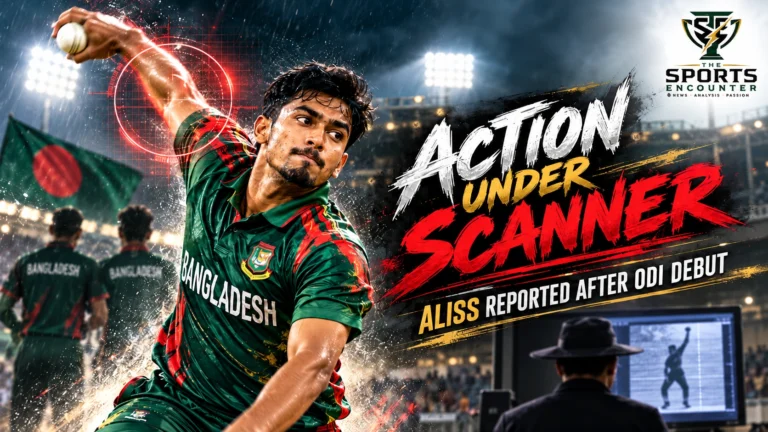
SHARJAH, United Arab Emirates, October 22, 2026: Bangladesh off-spinner Aliss Al Islam has been reported for a suspected illegal bowling action following his ODI debut against Afghanistan at Sharjah Cricket Stadium on Wednesday, bringing an unwelcome sense of familiarity to a career already interrupted by bowling-action scrutiny. The 29-year-old conceded 47 runs without taking a wicket in 8.3 overs as Bangladesh lost by seven wickets and crashed out of the UAE ODI Tri-Series. Match officials raised concerns about his action, and Aliss must now undergo an independent assessment at an ICC-accredited testing center.
The report arrived barely three weeks after Aliss made his T20I debut and more than seven years after a sensational Bangladesh Premier League hat-trick first brought him to prominence. His action was reported following that 2019 breakthrough and again during the 2025 BPL. The latest development represents a third documented episode of scrutiny, although no independent finding of an illegal action has been announced in the current case. For a bowler who spent years working toward international recognition, the timing is especially difficult.
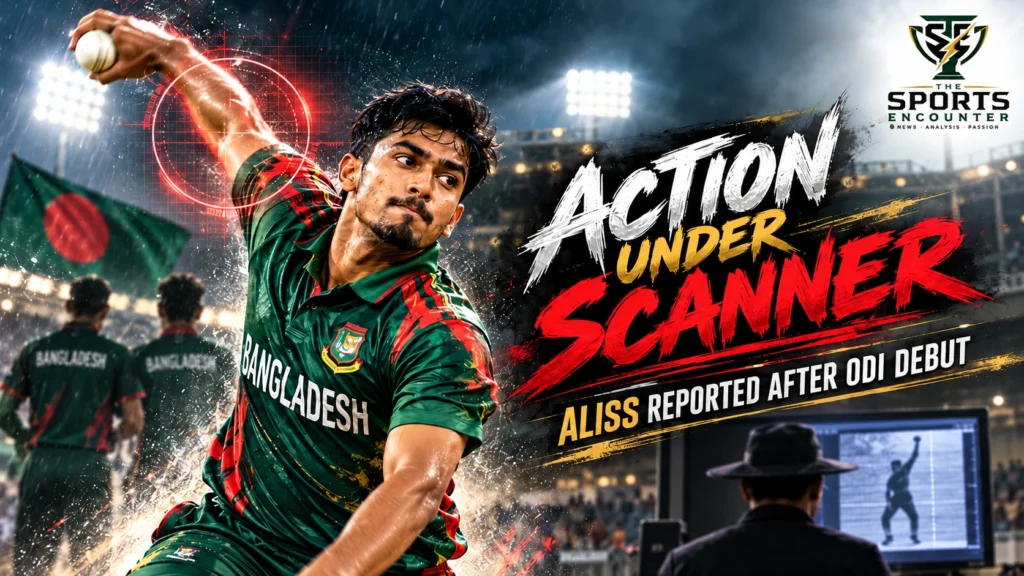
Why Has Aliss Al Islam Been Reported for a Suspect Bowling Action?
Match officials expressed concerns about the legality of Aliss’s bowling action during Bangladesh’s October 21 ODI against Afghanistan in Sharjah.
The subsequent October 22 announcement requires the spinner to undergo an independent assessment at an ICC-accredited testing center.
Story at a glance
Why Has Aliss Al Islam Been Reported for a Suspect Bowling Action?
Match officials expressed concerns about the legality of Aliss’s bowling action during Bangladesh’s October 21 ODI against Afghanistan in Sharjah.
From a Dream BPL Hat-Trick to Three Bowling-Action Reports
Aliss’s professional journey contains an extraordinary recurring pattern.
What Happened During Aliss’s ODI Debut Against Afghanistan?
Bangladesh’s encounter with Afghanistan had already become a difficult assignment before Aliss was introduced into the attack.
Aliss’s T20I and ODI Debuts Show Two Very Different Beginnings
The contrast between Aliss’s first two international appearances is another revealing detail.
What Does the ICC’s 15-Degree Bowling Rule Actually Mean?
Cricket allows a bowler’s elbow to bend naturally during the delivery action. The relevant restriction concerns the amount of elbow extension between the bowling arm reaching the horizontal position and the ball being released.
That procedure is designed to establish whether a bowler exceeds the permitted elbow-extension limit during delivery. The assessment examines the action using specialized equipment rather than relying solely on what umpires observed during the match.
The distinction between suspicion and confirmation is essential.
Aliss has been reported for examination. The available announcement does not establish that his action is illegal, that he has been suspended from bowling or that he deliberately breached the rules.
The ICC’s official explanation of illegal bowling actions sets out the 15-degree elbow-extension threshold and the process through which reported bowlers are independently assessed.
Neither the specific delivery that triggered officials’ concern nor an assessment appointment has been publicly confirmed in the reporting examined for this article.
Aliss Al Islam’s Bowling-Action Report: Key Facts
| Detail | Confirmed Information |
|---|---|
| Player | Aliss Al Islam |
| Country | Bangladesh |
| Age | 29 |
| Bowling style | Right-arm off-spin, including variations |
| Match concerned | Afghanistan vs Bangladesh, October 21, 2026 |
| Venue | Sharjah Cricket Stadium, United Arab Emirates |
| Performance | 0/47 from 8.3 overs |
| Action taken | Reported for suspected illegal bowling action |
| Required next step | Independent assessment at an ICC-accredited center |
| Current assessment finding | Not announced |
| Current international bowling suspension | None established by the report itself |
The process is especially important because a player’s bowling action can look unusual without necessarily being illegal. Mystery spinners frequently rely on changes of wrist position, finger movement and release technique to disguise their deliveries.
The legality question concerns the mechanics of the bowling arm, measured against the ICC’s prescribed limit, rather than whether a delivery looks deceptive or difficult to read.
From a Dream BPL Hat-Trick to Three Bowling-Action Reports
Aliss’s professional journey contains an extraordinary recurring pattern.
He first attracted national attention in January 2019 while representing Dhaka Dynamites against Rangpur Riders in the Bangladesh Premier League.
It was the sort of debut a young cricketer could hardly script.
After dropping two catches earlier in the contest, Aliss recovered to take a hat-trick, dismissing Mohammad Mithun, Mashrafe Mortaza and Farhad Reza in successive deliveries.
He finished with 4/26, including the wicket of Rilee Rossouw, whose 83 had threatened to take Rangpur to victory.
Dhaka survived by two runs, giving Aliss an unforgettable introduction to professional T20 cricket.
But within days, his bowling action was reported as suspect.
Instead of becoming an uncomplicated launching point for his career, the hat-trick was followed by remedial work and an extended struggle to establish himself in domestic cricket.
The ICC’s official player profile documents that remarkable debut, the subsequent action concerns and his eventual progress through Bangladesh’s domestic competitions.
Aliss later represented teams including Khulna Tigers, Comilla Victorians and Chittagong Kings, rebuilding his reputation through white-ball cricket.
He earned a Bangladesh T20I call-up in February 2024, although a finger injury delayed his international debut.
Then came another setback.
During the 2025 BPL, match officials again reported his bowling action, this time while he was representing Chittagong Kings against Rangpur Riders.
The January 17 report led to plans for another assessment under the Bangladesh Cricket Board’s domestic review procedures.
At the time, Aliss had taken 11 wickets in eight BPL matches, making the renewed scrutiny particularly frustrating from a sporting perspective.
Public reporting confirmed the scheduled assessment but did not establish every subsequent finding. The earlier report must therefore not be described as proof that his action was illegal.
Aliss Al Islam: The Career Timeline Behind the Latest Report
| Date | Development | Significance |
|---|---|---|
| January 11, 2019 | BPL debut for Dhaka Dynamites; 4/26 including a hat-trick | Extraordinary professional breakthrough |
| January 2019 | Bowling action reported as suspect | First documented scrutiny following his BPL debut |
| March 2020 | List A debut for Old DOHS Sports Club | Continued development in domestic cricket |
| February 2024 | First Bangladesh T20I squad call-up | International opportunity delayed by finger injury |
| January 17, 2025 | Reported during the BPL while playing for Chittagong Kings | Second documented action concern |
| October 3, 2026 | T20I debut against Sri Lanka at the Asian Games | First senior international appearance |
| October 10, 2026 | Named in Bangladesh’s UAE ODI Tri-Series squad | First ODI squad selection |
| October 21, 2026 | ODI debut against Afghanistan in Sharjah | Bowls 8.3 overs and concedes 47 runs |
| October 22, 2026 | Latest suspect bowling-action report emerges | Independent ICC assessment required |
The chronology explains why this case carries particular human significance.
Aliss spent more than seven years moving from a dramatic domestic breakthrough toward a senior ODI appearance.
Only 18 days separated his first T20I appearance on October 3 from his ODI debut on October 21.
The latest report emerged at precisely the point when those years of domestic cricket appeared to be producing sustained international opportunities.
There is no evidence that the three reports resulted from an identical technical issue or that previous concerns automatically establish a problem with his current action. That determination belongs to the independent assessment process.
What Happened During Aliss’s ODI Debut Against Afghanistan?
Bangladesh’s encounter with Afghanistan had already become a difficult assignment before Aliss was introduced into the attack.
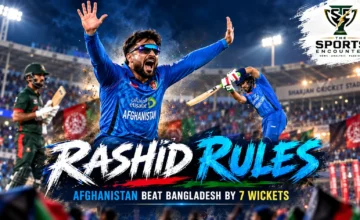
The Tigers collapsed to 28/4 inside seven overs after choosing to bat first. Parvez Hossain Emon’s 70 and Saif Hassan’s 41 then helped them recover, but Rashid Khan took 4/31 as Bangladesh were dismissed for 160 in 41.2 overs.
Afghanistan reached 161/3 in 35.3 overs to win by seven wickets, advancing to the October 23 final against Zimbabwe.
Aliss’s ODI debut therefore came under circumstances in which Bangladesh needed wickets rather than simply economical overs.
The mystery spinner conceded 47 runs from 51 legal deliveries without a breakthrough.
His economy rate was 5.53 runs per over, compared with Mehidy Hasan Miraz’s 3.13 from eight overs.
However, those figures cannot establish whether Aliss’s action was legal or illegal. The match result and the subsequent action report address different questions.
The Sports Encounter’s complete Afghanistan vs Bangladesh match report reconstructs the batting collapse, Rashid Khan’s four wickets and Afghanistan’s successful chase.
Bangladesh’s Bowling Scorecard Against Afghanistan
| Bowler | Overs | Maidens | Runs | Wickets | Economy |
|---|---|---|---|---|---|
| Taskin Ahmed | 8 | 2 | 36 | 2 | 4.50 |
| Shoriful Islam | 5 | 1 | 18 | 0 | 3.60 |
| Aliss Al Islam | 8.3 | 0 | 47 | 0 | 5.53 |
| Mustafizur Rahman | 6 | 1 | 32 | 1 | 5.33 |
| Mehidy Hasan Miraz | 8 | 0 | 25 | 0 | 3.13 |
TSE statistical finding: Aliss bowled 51 of Bangladesh’s 213 legal deliveries during Afghanistan’s chase. That represents approximately 23.9 percent of the deliveries bowled by Bangladesh, while he conceded 47 of the 158 runs charged to its bowlers, approximately 29.7 percent.
Calculation: 8.3 overs represents eight six-ball overs and three deliveries, or 51 balls. Bangladesh bowled 35.3 overs, equivalent to 213 legal deliveries. The combined bowling runs conceded were 158, excluding byes and leg-byes.
This comparison indicates that Aliss’s economy was expensive relative to the rest of the attack. It must also be understood in the context of a low target, modest scoreboard pressure and a controlled Afghanistan chase.
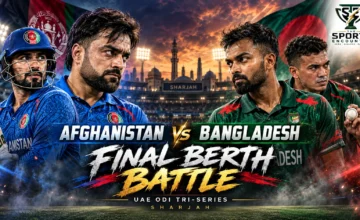
Bangladesh entered the match needing a victory to retain any hope of reaching the final.
The Sports Encounter’s pre-match analysis of Bangladesh’s net run rate predicament explains why its qualification position was already precarious.
Bangladesh ultimately lost both its league matches, making Aliss’s debut part of a disappointing tournament for the entire team.
The Afghanistan Cricket Board’s official match report confirms the seven-wicket result, Bangladesh’s elimination and Afghanistan’s qualification for the final.
Aliss’s T20I and ODI Debuts Show Two Very Different Beginnings
The contrast between Aliss’s first two international appearances is another revealing detail.
His senior international career began against Sri Lanka during the Asian Games cricket competition on October 3.
He claimed one wicket for 18 runs from four overs, demonstrating the controlled bowling that had helped him earn national selection.
Eighteen days later, his first ODI produced a wicketless spell against Afghanistan, followed by the suspect-action report.
Aliss Al Islam’s First Senior International Appearances
| Format | Opponent | Date | Overs | Runs | Wickets | Economy |
|---|---|---|---|---|---|---|
| T20I | Sri Lanka | Oct. 3, 2026 | 4 | 18 | 1 | 4.50 |
| ODI | Afghanistan | Oct. 21, 2026 | 8.3 | 47 | 0 | 5.53 |
Two matches represent a very small sample, especially across different formats and opponents.
The figures do, however, show how abruptly Aliss’s international circumstances have changed.
Bangladesh selected him because his domestic performances suggested that his variations could become an asset in white-ball cricket.
The bowling-action process now creates uncertainty over that opportunity, regardless of whether his next assessment ultimately clears him.
What Does the ICC’s 15-Degree Bowling Rule Actually Mean?
Cricket allows a bowler’s elbow to bend naturally during the delivery action. The relevant restriction concerns the amount of elbow extension between the bowling arm reaching the horizontal position and the ball being released.
Under ICC regulations, an action is illegal when the measured elbow extension exceeds 15 degrees within that phase.
The tolerance exists because bowling involves complex human movement, and visible arm position alone does not provide an accurate measurement of elbow extension.
Umpires may report an action that appears suspect, but the formal determination requires specialized analysis.
At an accredited testing center, biomechanical specialists assess the bowler’s deliveries, including any particular variations identified in the report.
The athlete must reproduce the relevant bowling action under testing conditions. The assessment also considers whether the tested action is materially consistent with the one observed in the match.
The results are reviewed under the ICC’s procedures before any finding is confirmed.
This framework protects the integrity of bowling regulations while allowing an athlete the opportunity to establish that the action falls within the permitted limits.
Can Aliss Al Islam Continue Bowling While Awaiting His Test?
Under the ICC’s ordinary reporting procedure, a player is generally permitted to continue bowling while the independent assessment is pending, subject to the applicable regulations and any separate on-field action or eligibility restriction.
Being reported does not automatically mean the bowler has failed a test.
The regulations normally call for an independent assessment within 14 days of the relevant notice reaching the player’s national federation, unless exceptional circumstances apply.
That period should not be mistaken for a confirmed October or November testing appointment for Aliss.
No specific assessment date has been established in the information available for this article.
What Happens After a Suspect Bowling-Action Report?
| Stage | Procedure | Possible Consequence |
|---|---|---|
| 1. Match officials’ report | Umpires or match referee raise concerns about an action | Formal review process begins |
| 2. Federation notified | ICC communicates the report to the player’s national board | Independent assessment arranged |
| 3. Independent testing | Accredited specialists measure relevant deliveries | Action evaluated against the 15-degree threshold |
| 4. Validated result | Assessment findings are reviewed and communicated | Bowler may be cleared or face bowling restrictions |
| 5. If action is legal | Bowling complies with the applicable limit | Bowler may continue in international cricket |
| 6. If standard action is illegal | Confirmed breach of ICC bowling-action limits | Suspension from international bowling until successfully reassessed |
| 7. If only a variation fails | Specific delivery type exceeds permitted limits | Restrictions may apply to that variation under the regulations |
The precise consequences depend on what the validated report establishes, including whether the concern involves the bowler’s standard delivery or a particular variation.
Earlier domestic reports do not automatically turn the October 2026 international report into a repeat international suspension. That would require establishing the relevant previous findings and applying the applicable ICC regulations.
The Sports Encounter’s analysis of the fastest ODI spinners to 200 wickets provides broader context on the demanding skills and sustained consistency required of successful international spin bowlers.
Could Bangladesh Lose a Useful White-Ball Bowling Option?
Bangladesh’s national selectors brought Aliss into the senior squad because his domestic development suggested that he could offer something different.
His combination of off-spin and mystery variations gives him a profile distinct from more conventional bowling options.
However, an uncertain action assessment complicates future planning, particularly when selectors are considering which players can fulfill specific roles in the powerplay or middle overs.
The immediate implications remain conditional.
If the assessment finds his action legal, Aliss can continue pursuing international selection without a bowling restriction arising from the current report.
If the assessment establishes an illegal action, he may need technical remedial work and successful reassessment before returning to international bowling.
Bangladesh has other spin options, including Mehidy Hasan Miraz, Rishad Hossain and Tanvir Islam, although their bowling styles and tactical roles are not interchangeable.
The value of spin depth has been apparent in Bangladesh’s earlier performances during 2026.
In July, Rishad Hossain and Mahedi Hasan combined for seven wickets against Zimbabwe in a T20I victory that brought Bangladesh level in its series.
Bangladesh went on to win the decider, as documented in The Sports Encounter’s account of the Bulawayo series comeback.
Those performances showed the importance of having different spin options available for particular conditions and match situations.
Aliss’s case creates another selection question, but it would be premature to conclude that Bangladesh has permanently lost his services.
Why the Latest Report Matters Beyond One Player
Bangladesh’s immediate tournament has already ended in disappointment.
The seven-wicket defeat against Afghanistan followed a 99-run loss to Zimbabwe, leaving the Tigers without a victory in the three-team competition.
The bowling-action issue now introduces a separate uncertainty into the team’s longer-term white-ball planning.
It also brings renewed attention to the route domestic players must navigate before becoming established internationals.
Aliss rebuilt his career through years of domestic competition after the original 2019 concerns. His selection in 2026 appeared to reward that persistence.
Continue the Cricket Story
 CricketAfghanistan vs Bangladesh: Tigers Need More Than Victory to Reach UAE ODI Tri-Series Final
 CricketAfghanistan Sweep UAE ODI Tri-Series Unbeaten as Zadran, Rashid Crush Zimbabwe’s Title Hopes
 Cricket4-Star Rashid Khan Helps Afghanistan Kick Bangladesh Out of UAE ODI Tri-Series as Zimbabwe Await in Final
The development invites a fair debate about the reporting system itself.
Some supporters may argue that players should remain eligible while independent testing determines whether a suspected action is legal. Others may favor greater precaution during the assessment period, particularly in international competition.
The ICC’s current framework generally permits continued bowling pending assessment while reserving sanctions for established findings and other circumstances specified in its regulations.
Neither position establishes anything about the legality of Aliss’s particular action.
For Bangladesh, the more useful question is how to support a rigorous assessment while preserving fair treatment for a player whose career has already been shaped by similar scrutiny.
What Earlier Bangladesh Performances Reveal About the Challenge Ahead
The national side has experienced a turbulent run across formats.
Against Afghanistan earlier in October, Bangladesh appeared on the verge of winning a one-off Test in Abu Dhabi before the hosts survived 142 overs in the fourth innings to secure a draw.
That contest, examined in The Sports Encounter’s report on Afghanistan’s remarkable escape, showed the difficulties Bangladesh can face when a competitive advantage is not converted into victory.
The subsequent ODI series ended with another disappointment, although the underlying causes differed.
Bangladesh’s earlier July visit to Zimbabwe also exposed problems with batting consistency before the team produced a consolation ODI victory through Tanzid Hasan’s 94.
Our report on Bangladesh’s narrow escape from an ODI whitewash provides context for the difficult period preceding its recent international assignments.
Aliss’s bowling-action report did not cause Bangladesh’s defeat against Afghanistan, and the available evidence provides no basis for connecting the two as cause and effect.
Nevertheless, it adds another unresolved personnel question at a time when Bangladesh is seeking greater consistency in international cricket.
Aliss Al Islam’s Bowling-Action Case: Frequently Asked Questions
Why Was Aliss Al Islam Reported?
Match officials raised concerns about the legality of his bowling action during Bangladesh’s October 21, 2026 ODI against Afghanistan in Sharjah.
Has Aliss Al Islam Been Banned From Bowling?
No immediate international bowling suspension has been established by the report. He must undergo independent assessment, and the eventual findings will determine whether restrictions are necessary.
Is This the First Time Aliss Has Been Reported?
No. His action was previously reported in the 2019 Bangladesh Premier League and again during the 2025 BPL.
What Happened During Aliss’s BPL Debut in 2019?
He took a hat-trick and finished with 4/26 for Dhaka Dynamites against Rangpur Riders, helping secure a two-run victory. His action came under scrutiny shortly afterward.
What Are Aliss Al Islam’s ODI Debut Bowling Figures?
He conceded 47 runs without taking a wicket in 8.3 overs against Afghanistan on October 21, 2026.
When Did Aliss Make His T20I Debut?
He made his T20I debut for Bangladesh against Sri Lanka at the Asian Games on October 3, 2026, taking 1/18 in four overs.
What Is the ICC’s 15-Degree Bowling-Action Rule?
The ICC permits a maximum of 15 degrees of elbow extension between the bowling arm reaching the horizontal position and ball release. An independently measured extension above that limit constitutes an illegal bowling action under the applicable regulations.
Can Aliss Continue Bowling While Awaiting Testing?
Generally, a player reported for a suspect action may continue bowling until the assessment result is received, subject to specific regulatory conditions and any separately imposed restrictions.
What Happens If His Bowling Action Is Found Illegal?
The consequence depends on whether the finding concerns the standard bowling action or particular variations. A confirmed illegal standard action normally results in suspension from international bowling until the player successfully completes remedial work and reassessment.
What Happens Next for Aliss Al Islam?
The immediate priority is an independent assessment conducted under ICC regulations.
The Bangladesh Cricket Board and ICC must complete the relevant procedural arrangements. No specific testing date or result has been verified as of October 22.
The assessment will determine whether Aliss’s deliveries remain within the permitted elbow-extension limit and whether any particular variation requires further attention.
If he is cleared, the latest report will become another episode in a career already marked by persistence and repeated uncertainty.
If the test identifies an illegal action, further technical work may be necessary before he can resume unrestricted international bowling.
Either way, the case should be judged by the independent evidence rather than assumptions drawn from his earlier reports.
In January 2019, Aliss announced himself with a hat-trick on his professional T20 debut. In October 2026, after years of perseverance, he finally earned an ODI opportunity.
His bowling figures in Sharjah were disappointing, but they were one performance in a long career.
The more consequential question now lies beyond the scorecard: whether an independent assessment will allow Bangladesh’s mystery spinner to continue building the international career he worked so long to reach.
Until that result arrives, a suspect-action report remains exactly that: a concern awaiting scientific examination, with no final judgment on the bowler’s action.