NAGOYA, Japan, September 26, 2026: Saturday at the Asian Games produced one of those days when a medal table alone could not explain what changed.
India successfully defended both kabaddi titles against Iran. Eighteen-year-old Anahat Singh came back from two games down against Japan’s Satomi Watanabe to become the first Indian woman to reach an Asian Games singles squash final. Sawan Barwal broke his own national marathon record while ending a 44-year Indian wait for a medal in the event. China reinforced its control of the shooting program with another gold and an individual one-two, while host Japan found home-road success through Ichitaka Yamashita.
The common thread was pressure. Some athletes were defending dynasties. Others were ending decades-long waits or reaching places their countries had never reached before.
The Sports Encounter’s Friday report on India’s kabaddi, squash and hockey surge had already identified Saturday as a potential conversion day. Several of those opportunities became medals, finals and history.
Story at a glance

How Did India Survive Iran to Retain the Women’s Kabaddi Gold?
The women’s final carried far more tension than India’s unbeaten campaign had suggested.
What Does India’s Men’s Kabaddi Gold Say About the Rivalry With Iran?
The second India-Iran final completed the story later on Saturday.
Why Anahat Singh’s Comeback Against Satomi Watanabe Was Bigger Than a Semifinal Win
Anahat Singh was two games down against the strongest player she had faced all week.
Why Abhay Singh Gives India a Second Squash Gold Opportunity
Abhay Singh needed far less time to secure his final place.
How Did Sawan Barwal End India’s 44-Year Asian Games Marathon Wait?
The day began on the roads of Nagoya with the host nation finding its own major story.
Asian Games 2026 September 26: The Defining Results
| Event | Result | Why It Mattered |
|---|---|---|
| Women’s Kabaddi Final | India beat Iran 37-34 | India retained the title and won a record-extending fourth women’s kabaddi gold |
| Men’s Kabaddi Final | India beat Iran | India retained the men’s crown and completed another kabaddi gold double |
| Women’s Squash Semifinal | Anahat Singh beat Satomi Watanabe 9-11, 11-13, 12-10, 11-6, 11-3 | Singh became the first Indian woman to reach an Asian Games singles final |
| Men’s Squash Semifinal | Abhay Singh beat Muhammad Irfan 11-3, 12-10, 11-6 | India will also contest the men’s singles gold-medal match |
| Men’s Marathon | Ichitaka Yamashita 2:10:49; Sawan Barwal 2:11:37 | Japan won home gold; Barwal ended India’s 44-year marathon medal drought |
| Women’s 50m Rifle 3 Positions | Han Jiayu gold; Zhang Liyuan silver; Kim Ji-eun bronze | Han won with an Asian continental record of 359.0 as China finished one-two |
| Women’s 50m Rifle 3P Team | China gold; India silver | China extended its shooting strength while India collected another rifle medal |
How Did India Survive Iran to Retain the Women’s Kabaddi Gold?
The women’s final carried far more tension than India’s unbeaten campaign had suggested.
India had beaten Iran 37-23 in the group stage, but the rematch developed into a different contest. Iran repeatedly dragged itself back into the final and reduced the gap to a single point at 27-26 after an all-out threatened to overturn India’s advantage.
India eventually regained control through the raiding and defensive contributions of players including Sanju Devi, Pooja and Bhavna Devi and closed the final 37-34.
The result gave India a fourth women’s kabaddi title from five Asian Games editions since the event entered the program in 2010. The only interruption came at Jakarta 2018, when Iran beat India in the final.
The wider importance was consistency. India went through Aichi-Nagoya unbeaten, beating Bangladesh, Iran and Japan in the group stage before overwhelming Nepal 48-24 in the semifinal.
That progression had been building throughout the week, and TSE’s Friday Asian Games analysis examined why women’s kabaddi increasingly resembles one of India’s most durable continental sporting systems.
What Does India’s Men’s Kabaddi Gold Say About the Rivalry With Iran?
The second India-Iran final completed the story later on Saturday.
India’s men defeated Iran to retain the title they regained in Hangzhou and complete another men’s and women’s Asian Games kabaddi double.
The matchup remains the defining rivalry in the sport.
India won the first seven men’s Asian Games titles from 1990 through 2014 before Iran broke the sequence at Jakarta 2018. India returned to the top at Hangzhou and have now successfully defended that crown in Japan.
The route to Saturday had been emphatic. India beat Japan 49-24, the Republic of Korea 63-31, Bangladesh 48-25 and Chinese Taipei 37-21 before crushing Thailand 66-28 in the semifinal.
Iran arrived with its own dominant record, including an 83-27 win over Thailand and a 59-21 semifinal victory over Chinese Taipei.
The final therefore restored the confrontation the tournament had been building toward from the opening group games.
The Asian Games kabaddi schedule and format documents how both defending champions progressed through separate men’s groups before meeting in the gold-medal match.
Why Anahat Singh’s Comeback Against Satomi Watanabe Was Bigger Than a Semifinal Win
Anahat Singh was two games down against the strongest player she had faced all week.
Watanabe, playing in front of a home crowd and carrying a world ranking of No. 6, won the first two games 11-9 and 13-11. Anahat then reached the point where one more lost game meant bronze.
The response changed the trajectory of Indian squash history.
She edged the third 12-10, took the fourth 11-6 and then overwhelmed Watanabe 11-3 in the decider.
The 18-year-old became the first Indian woman to reach an Asian Games singles squash final.
Her age makes the achievement more striking because the result is part of a larger transition. Anahat entered Aichi-Nagoya already carrying the profile of a world junior champion, but senior multi-sport competition introduces different demands: home crowds, medal consequences, compressed recovery and opponents with extensive professional experience.
Friday had shown the other side of her game when she beat Indian teammate Tanvi Khanna in just three games. Saturday required adaptation, patience and survival.
TSE’s previous Asian Games report identified Anahat as one of the most important tests of whether India’s emerging squash generation could convert junior achievement into senior continental success.
She is now one match from gold.
Why Abhay Singh Gives India a Second Squash Gold Opportunity
Abhay Singh needed far less time to secure his final place.
He defeated Pakistan’s Muhammad Irfan 11-3, 12-10, 11-6 in 35 minutes, controlling the semifinal after surviving the resistance of the second game.
India will therefore contest both singles finals.
That matters because no Indian man has won the Asian Games men’s singles squash title. Abhay now has the opportunity to change that on Sunday.
The day’s squash program also produced bronze for Joshna Chinappa and Velavan Senthilkumar in mixed doubles. The Indian pair lost a tight semifinal to Hong Kong, China’s Lee Ka Yi and Tang Ming Hong, 10-11, 11-2, 10-11.
The score captures how close that match was. Two of the three games were decided at 11-10, leaving India only a handful of points from putting a third squash entry into a final.
How Did Sawan Barwal End India’s 44-Year Asian Games Marathon Wait?
The day began on the roads of Nagoya with the host nation finding its own major story.
Japan’s Ichitaka Yamashita won the men’s marathon in 2:10:49, eventually separating himself from the leading group during the closing kilometers.
Behind him, Sawan Barwal ran the fastest marathon of his life.
The 28-year-old Indian finished in 2:11:37, breaking his own national record and taking silver. China’s Peiyou Feng completed the podium in 2:12:13.
Barwal’s medal was India’s first in the Asian Games men’s marathon since Hosur Kukkappa Seetharan won bronze in New Delhi in 1982.
That 44-year gap gives the performance a different weight from a normal silver medal.
Barwal remained among the leaders deep into the race, stayed with the decisive group until the closing stages and resisted the temptation to follow Yamashita beyond a pace he believed he could sustain.
The approach worked. Gold moved away, but silver and a national record remained secure.
The Games have already produced several athletics stories built around long waits and new formats. TSE’s earlier report on China’s sweep of the new half-marathon race-walk events showed how Aichi-Nagoya is reshaping parts of the traditional Asian Games athletics program.
Barwal added a more familiar event and a deeply personal breakthrough to that story.
China’s Rifle Depth Produces Another Gold and an Individual One-Two
China’s dominance of the medal table has been powered by breadth, but shooting continues to provide some of its most technically impressive performances.
The women’s 50m rifle 3 positions event added another example.
Han Jiayu won the individual gold with 359.0 points, an Asian continental record. Teammate Zhang Liyuan finished only 0.2 behind on 358.8, giving China the top two positions. South Korea’s Kim Ji-eun took bronze with 348.4.
India’s Tilottama Sen finished fourth and Vidarsa K Vinod fifth after both advanced from qualification.
The team competition had already gone China’s way, with India taking silver and Kazakhstan bronze.
The result fits a pattern that has run through the first week of these Games. China have repeatedly turned deep qualification fields into multiple podium positions.
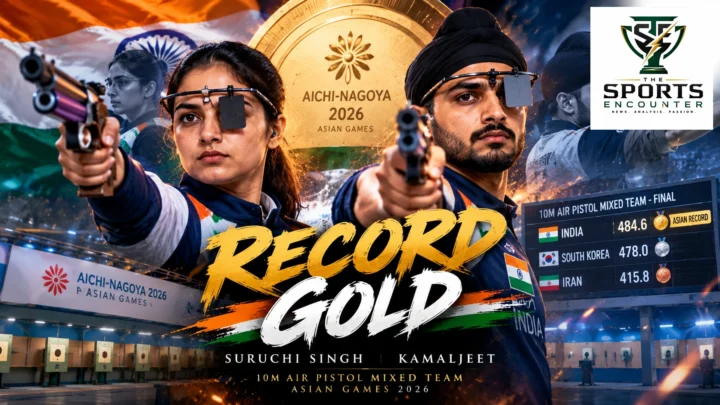
That pattern appeared earlier when Sheng Lihao led China’s men’s air-rifle world record and individual gold, and continued when TSE examined Suruchi Singh and Kamaljeet’s Asian-record mixed-pistol gold for India.
Saturday belonged to Han and Zhang.
What Happened to Lakshya Sen in Badminton?
One of India’s biggest disappointments came away from the medal events.
Lakshya Sen was eliminated by Singapore’s Loh Kean Yew after a three-game contest, ending his men’s singles campaign earlier than India would have wanted.
The result contrasted sharply with Lakshya’s earlier team-event contribution. He had produced one of the tournament’s most dramatic badminton recoveries against Japan’s Kodai Naraoka, winning seven consecutive points from 14-19 down in the deciding game.
TSE documented that comeback in its report on India’s team victory over Japan.
Singles competition offered no equivalent escape.
Continue the Asian Games 2026 Story



There was better news for Ayush Shetty, who beat Kazakhstan’s Makhsut Tajibullayev 21-7, 21-7 to move forward and set up a considerably tougher meeting with Chinese Taipei’s Chou Tien-chen.
Why September 26 Felt Different From the First Week of the Games
The opening days of Aichi-Nagoya were dominated by records and the scale of China’s early medal accumulation.
Yu Zidi became one of the faces of the Games by rewriting swimming standards at 13, including an Asian and world junior record in the 200m individual medley. TSE followed that breakthrough in its feature on Yu’s record-setting debut.
China also produced an Asian record in the men’s 4x200m freestyle relay after Zhang Zhanshuo erased Japan’s late lead, another of the week’s defining performances documented in TSE’s relay analysis.
Thursday then became a day of wider continental breakthroughs, with Shin Ohashi’s breaststroke world record and Carlos Yulo’s gymnastics success forming the core of TSE’s September 24 consolidated report.
Saturday had a different texture.
Several of its strongest stories involved athletes and teams converting long-term pressure into results: India’s kabaddi teams defending titles, Anahat and Abhay reaching unprecedented or potentially historic squash finals, Barwal ending a 44-year wait, and Yamashita delivering marathon gold for the host nation.
What Should Fans Watch on September 27?
Squash immediately becomes one of Sunday’s most important storylines.
Anahat Singh will play for the first Indian women’s singles gold in Asian Games history, while Abhay Singh has the chance to become India’s first men’s singles champion.
Late-stage athletics will continue to build toward more medal finals, and India’s campaign remains active across badminton, archery, hockey and other knockout events.
The broader medal race still runs through China. Its shooting depth on Saturday provided another reminder that rivals do not simply have to beat one Chinese contender. In several disciplines, they have to beat two or three.
The official Aichi-Nagoya 2026 results portal carries the live competition schedule and medal results, while the Olympic Council of Asia’s Aichi-Nagoya 2026 hub provides the official Games framework and sport program.
For continuing reporting, records and analysis, readers can follow TSE’s wider Asian Games coverage, including the opening medal-day report that first mapped China’s early surge and Japan’s home success.
Asian Games 2026 September 26 FAQs
Who Won the Women’s Kabaddi Gold at the Asian Games 2026?
India defeated Iran 37-34 to retain the women’s kabaddi title and win its fourth gold in the event.
Who Won the Men’s Kabaddi Gold?
India defeated Iran in the men’s final to successfully defend the Asian Games title and complete another kabaddi gold double.
Did Anahat Singh Reach the Asian Games Squash Final?
Yes. Anahat recovered from two games down to defeat Japan’s Satomi Watanabe 9-11, 11-13, 12-10, 11-6, 11-3 and became the first Indian woman to reach an Asian Games singles squash final.
Who Did Abhay Singh Beat in the Squash Semifinal?
Abhay Singh defeated Pakistan’s Muhammad Irfan 11-3, 12-10, 11-6 to advance to the men’s singles gold-medal match.
Who Won the Asian Games Men’s Marathon?
Japan’s Ichitaka Yamashita won gold in 2:10:49. India’s Sawan Barwal took silver in a national-record 2:11:37, with China’s Peiyou Feng third in 2:12:13.
Who Won the Women’s 50m Rifle 3 Positions Gold?
China’s Han Jiayu won with an Asian continental record score of 359.0, finishing 0.2 ahead of teammate Zhang Liyuan. South Korea’s Kim Ji-eun won bronze.
What Happened to Lakshya Sen?
Lakshya Sen was eliminated by Singapore’s Loh Kean Yew in a three-game men’s singles match.
Where Can Fans Follow Official Asian Games Results?
The Aichi-Nagoya 2026 official results portal provides schedules, live results and medal information throughout the Games.
China
- Asian Games 2026: Boonson Equals Asian Record as Korea Extends Dynasties and China Hits 119 Golds
- Asian Games 2026: Kabaddi Double, Anahat’s Escape and China’s Rifle Record Define Saturday
- Asian Games 2026: China Sweep Historic Race-Walk Debuts, Choo Ga-eun Breaks Asian Record
- Zhang Boheng Holds His Nerve as China Edge Japan for Third Straight Asian Games Gymnastics Team Gold
- Yu Zidi Completes Stunning Individual Gold-Medal Hat-Trick With Third Asian Games Record