NAGOYA, Japan, September 24, 2026: China kept collecting Asian Games gold medals on Thursday. Somehow, the day still belonged to everybody who found a way around them.
Japan’s 17-year-old Shin Ohashi shattered the men’s 200m breaststroke world record. Carlos Yulo finally won the Asian Games title missing from one of gymnastics’ most decorated active careers. Japan defeated China 3-2 to win its first men’s table tennis team gold in 60 years. Indonesia then recovered from 2-0 down to beat China 3-2 in the men’s badminton team final and claim its first gold of Aichi-Nagoya 2026.
Those breakthroughs did not slow China’s wider medal machine. Chinese rowers won nine of the 10 events they entered. China took four of seven swimming golds, set another world record in mixed skeet and retained the women’s table tennis team title.
That contrast gave Thursday its character.
Story at a glance

Shin Ohashi Produces the Performance Thursday Will Be Remembered For
There were gold medals all over Japan on Thursday.
China Still Win Four Swimming Golds Around Ohashi’s World Record
The world record belonged to Japan, but the broader pool session again showed China’s depth.
Carlos Yulo Finally Fills the Empty Space in His Trophy Cabinet
Carlos Yulo had won Olympic gold.
Japan End 60 Years of Waiting by Beating China in Table Tennis
Japan’s men’s table tennis victory was not a normal home gold.
China’s Women Immediately Restore the Familiar Order
The men’s final suggested the table tennis balance might be shifting.
China remained the Games’ deepest sporting power. The most memorable results, however, came from athletes and teams who created history around that dominance rather than simply becoming part of it.
The scale of that challenge has been visible since the opening medal days. The Sports Encounter’s complete Aichi-Nagoya 2026 preview identified China’s cross-sport depth and Japan’s home challenge as two of the Games’ central storylines. Thursday pushed both themes in unexpected directions.
TL;DR
- Japan’s Shin Ohashi broke the men’s 200m breaststroke world record with 2:04.83.
- Ohashi lowered Qin Haiyang’s previous world record of 2:05.48 by 0.65 seconds.
- Carlos Yulo won men’s floor exercise gold with 14.666, completing his collection of major Olympic, world and continental titles.
- Japan beat China 3-2 for its first Asian Games men’s table tennis team gold since 1966.
- Indonesia recovered from 2-0 down to defeat China 3-2 in the men’s badminton team final.
- Mohammad Zaki Ubaidillah won the deciding badminton match 23-21, 21-13 against Weng Hongyang.
- China won nine gold medals and one silver from the 10 rowing events it entered.
- China won four of Thursday’s seven swimming finals, with Zhang Zhanshuo collecting his sixth gold of the Games.
- Winfred Yavi won the women’s 10,000m before Bahrain broke the Asian Games record in the mixed 4x400m relay.
- China’s Lyu Jianlin and Jiang Yiting set a world record to win mixed team skeet gold.
Asian Games 2026 Thursday: Major Results at a Glance
| Sport / Event | Winner | Result | Why It Mattered |
|---|---|---|---|
| Swimming, Men’s 200m Breaststroke | Shin Ohashi, Japan | 2:04.83 | World record and second gold of the Games |
| Gymnastics, Men’s Floor Exercise | Carlos Yulo, Philippines | 14.666 | First Asian Games gold and completion of major-title collection |
| Table Tennis, Men’s Team | Japan | Beat China 3-2 | Japan’s first title in the event since 1966 |
| Badminton, Men’s Team | Indonesia | Beat China 3-2 | Recovered from 0-2 down; Indonesia’s first gold of the Games |
| Rowing | China | 9 gold, 1 silver from 10 entries | Near-total domination of the medal program |
| Athletics, Women’s 10,000m | Winfred Yavi, Bahrain | 32:39.18 | Beat Nozomi Tanaka after a late finishing surge |
| Athletics, Mixed 4x400m Relay | Bahrain | 3:12.87 | Asian Games record |
| Athletics, Women’s Triple Jump | Sharifa Davronova, Uzbekistan | 14.35m | Personal best and second Asian Games gold |
| Shooting, Mixed Team Skeet | China | 52 points | World record; Jiang Yiting’s third gold |
| Table Tennis, Women’s Team | China | Beat Japan 3-0 | Sixth consecutive Asian Games title |
Shin Ohashi Produces the Performance Thursday Will Be Remembered For
There were gold medals all over Japan on Thursday.
Ohashi produced something rarer.
The 17-year-old completed the men’s 200m breaststroke in 2 minutes 4.83 seconds at the Tokyo Aquatics Centre, cutting 0.65 seconds from the previous world record of 2:05.48 set by China’s Qin Haiyang at the 2023 World Championships in Fukuoka.
He did it little more than a week after contracting COVID-19.
“My target had always been to break the world record, and I’m so happy to have done it,” Ohashi said after the race.
The Olympic Council of Asia’s official race report confirmed that Kyrgyzstan’s Denis Petrashov took silver in 2:08.67 and South Korea’s Cho Sung-jae bronze in 2:08.76.
The margin between Ohashi and the rest of an Asian Games final was therefore almost four seconds.
That separation matters.
Ohashi had already shared the 100m breaststroke title with China’s Dong Zhihao earlier in the Games. Thursday converted an impressive home meet into a global-level statement.
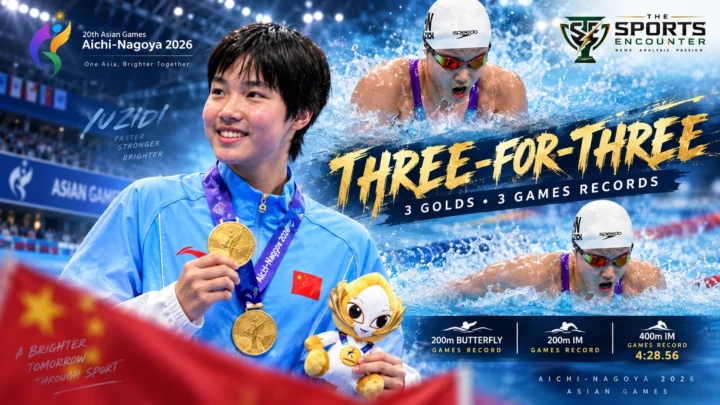
The progression also fits a wider pattern in the Aichi-Nagoya pool. China’s 13-year-old Yu Zidi had already broken the Asian and world junior records in the women’s 200m individual medley, a performance examined in TSE’s analysis of her 2:06.10 breakthrough.
She then completed three individual gold medals and three Asian Games records when she won the 400m individual medley.
Ohashi has now added the Games’ most important swimming number yet.
This one belongs in the world record book.
China Still Win Four Swimming Golds Around Ohashi’s World Record
The world record belonged to Japan, but the broader pool session again showed China’s depth.
China won four of Thursday’s seven swimming events.
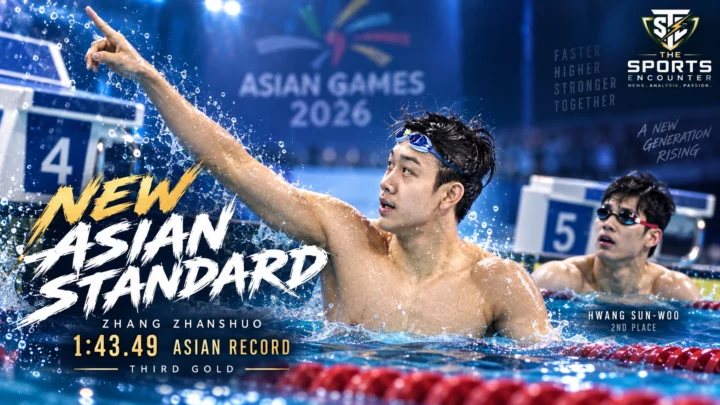
Wu Qingfeng took the women’s 50m freestyle in 23.98. Zhang Zhanshuo won the men’s 800m freestyle in 7:42.49. China then captured both the men’s 4x100m freestyle relay and women’s 4x200m freestyle relay.
Zhang’s involvement in the men’s relay delivered his sixth gold medal of the Games.
That haul follows one of the competition’s defining relay performances earlier in the week. China trailed Japan by 1.89 seconds before the final leg of the men’s 4x200m freestyle, only for Zhang to produce a 1:42.92 anchor and complete an Asian-record comeback. TSE broke down that race in its full analysis of China’s 7:00.17 relay victory.
Japan collected another Thursday swimming gold through Kotomi Kato in the women’s 200m breaststroke, while Bahrain’s Mikhail Arkhangelskiy won the men’s 50m butterfly.
The distribution tells an important story.
China remain capable of winning multiple titles in one session without producing the session’s biggest headline.
That is what depth looks like.
Carlos Yulo Finally Fills the Empty Space in His Trophy Cabinet
Carlos Yulo had won Olympic gold.
He had won world titles.
He had won at the Asian Championships and Southeast Asian Games.
The Asian Games remained unfinished business.
That ended on Thursday.
Yulo scored 14.666 in the men’s floor exercise final, edging Kazakhstan’s Milad Karimi, who finished on 14.600, and Japan’s Shoma Tsukiyama at 14.566.
The OCA described the victory as completing Yulo’s major championship collection.
The result carried another layer because of what happened eight years earlier.
Yulo entered the Jakarta 2018 floor final as the top qualifier, fell during a tumbling pass and finished seventh.
He did not compete at Hangzhou while prioritizing the World Championships and Olympic qualification.
Nagoya therefore represented his first opportunity in eight years to repair the Asian Games chapter of his career.
He took it.
Thursday’s gold also gave the Philippines its first title of these Games.
The 26-year-old will have further opportunities in the vault and parallel bars finals, but the floor result already changes his continental résumé.
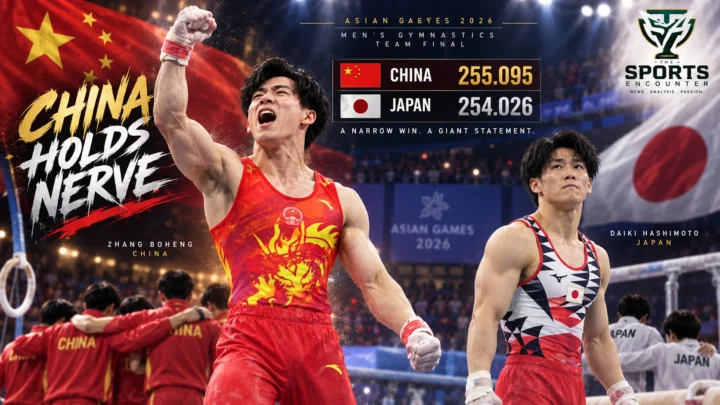
One of the strongest gymnastics stories entering Thursday had centered on China and Japan. Zhang Boheng and his teammates had beaten the hosts in the men’s team final, a contest covered in TSE’s analysis of China’s third consecutive men’s team gold.
Yulo gave the apparatus finals a different national center of gravity.
Japan End 60 Years of Waiting by Beating China in Table Tennis
Japan’s men’s table tennis victory was not a normal home gold.
It ended a wait stretching back to Bangkok 1966.
China had won the men’s team title at every Asian Games since 1974 except Seoul 1986, when South Korea prevailed.
Japan ended that history with a 3-2 victory at Sky Hall Toyota.
The match required five rubbers and two enormous performances from Tomokazu Harimoto.
Harimoto first defeated Wen Ruibo 3-1 to level the final at 1-1. China regained the lead when Lin Shidong beat Shinsuke Togami.
Harimoto then produced the performance that kept the final alive, defeating world No. 1 Wang Chuqin 3-0 in only 22 minutes.
That left the title to Sora Matsushima.
The 19-year-old had lost the opening match to Wang after surrendering a two-game advantage. Given a second chance with the entire final at 2-2, Matsushima defeated Wen 3-1.
The OCA confirmed Japan’s first men’s team title in six decades.
That makes the victory bigger than an upset.
Japan did not simply defeat China on home soil. It interrupted one of the Asian Games’ longest-running dynasties.
China’s Women Immediately Restore the Familiar Order
The men’s final suggested the table tennis balance might be shifting.
The women’s final provided the counterargument.
Sun Yingsha, Wang Manyu and Kuai Man defeated Japan 3-0, giving China its sixth consecutive women’s team gold and 12th title overall.
Five of the six players involved in the final were ranked inside the world’s top six.
China still did not drop a match.
The contrast between the two finals is useful because it prevents Thursday’s Japanese breakthrough from becoming an exaggerated claim about the entire sport.
Japan proved China can be beaten in the men’s team competition.
China’s women showed that one breakthrough does not automatically become a continental power shift.
Indonesia Go From 0-2 Down to Gold Against China
If Japan’s table tennis victory was built through five matches, Indonesia’s badminton gold required an even more dramatic change of direction.
China won the opening two rubbers.
Shi Yuqi defeated Jonatan Christie 21-13, 21-18.
Liang Weikeng and Wang Chang then beat Fajar Alfian and Muhammad Shohibul Fikri in three games.
China were one win from gold.
Indonesia responded with three consecutive victories.
Alwi Farhan started the comeback by beating Li Shifeng 23-21, 15-21, 21-16. Leo Rolly Carnando and Daniel Marthin then defeated He Jiting and Liu Yi 23-21, 21-10.
The final came down to Mohammad Zaki Ubaidillah against Weng Hongyang.
Zaki won 23-21, 21-13.
Indonesia had gone from 0-2 down to 3-2 champions.
The result delivered Indonesia’s first gold of Aichi-Nagoya 2026 and its first Asian Games men’s badminton team title since Bangkok 1998.
China had already won the women’s team title and entered the men’s final with an opportunity to complete the team-event double.
Indonesia stopped it one match from completion.
China’s Rowers Remind Everyone What the Medal Table Is Really Fighting Against
Japan and Indonesia found ways to defeat China in two of Thursday’s most visible team finals.
At the Nagaragawa International Regatta Course, there was almost no escape.
China entered 10 rowing events.
They won nine gold medals and one silver.
Chinese crews swept all five women’s categories they entered: single sculls, double sculls, quadruple sculls, coxless pair and coxless four.
The men added four titles and finished second only in the coxless pair.
The result becomes even more revealing when placed beside a rule designed to spread opportunity. China could enter only 10 of the 14 rowing categories and skipped the men’s and women’s lightweight events.
They still nearly swept every race available to them.
That is why a few major Chinese defeats do not translate into a shrinking overall challenge.
The Sports Encounter’s September 21 consolidated report had already identified the real source of China’s lead: gold medals arriving from unrelated performance systems rather than one dominant sport.
Rowing made that argument even stronger.
Winfred Yavi Begins an Ambitious Three-Gold Athletics Campaign
Thursday also moved track and field into a more central role at the Games.
Bahrain’s Olympic 3000m steeplechase champion Winfred Yavi opened her attempt at an extraordinary distance treble by winning the women’s 10,000m.
Japan’s Nozomi Tanaka stayed with her deep into the race before Yavi produced the decisive acceleration in the closing stages.
Yavi won in 32:39.18.
Tanaka took silver in 32:41.54, while India’s Seema secured bronze in 32:50.05, ending a long wait for an Indian women’s 10,000m Asian Games medal.
Yavi is also targeting the 5000m and her specialist 3000m steeplechase.
One title is secured.
Two remain if she is to complete the sweep.
Bahrain Break the Games Record as India Push Them in the Mixed Relay
The mixed 4x400m final provided one of Thursday’s strongest athletics races.
Bahrain’s Salwa Eid Naser, Alaa Sami, Musa Isah and Aisha Abdullah combined for 3:12.87, breaking the Asian Games record.
India stayed close enough to force the champions to keep racing and took silver in 3:14.46.
Vietnam finished only eight-hundredths further back in 3:14.54 for bronze.
The UAE crossed the line but were disqualified after dropping the baton, with a protest subsequently lodged.
For India, the silver added another medal on a day that also brought Seema’s 10,000m bronze and mixed team skeet bronze.
India had entered these Games with a growing multi-sport medal base after Smriti Mandhana’s 79 helped the women’s cricket team win gold earlier in the week.
Thursday broadened the source of those medals into athletics, rowing, shooting and wushu.
Sharifa Davronova Defends Her Triple Jump Title With a Personal Best
Uzbekistan’s Sharifa Davronova added another important athletics result by winning the women’s triple jump with 14.35 meters.
The mark was a personal best and delivered her second Asian Games title.
China took the other two podium positions. Huang Yingying won silver with 14.12m, equaling her personal best, while Li Yi claimed bronze at 13.83m.
Davronova is still only 19.
Winning a second Asian Games title at that age places her career on a very different timeline from athletes whose first continental breakthroughs arrive in their mid-20s.
China later swept the top two places in the men’s discus, with Abuduaini Tuergong winning through a 64.26m throw ahead of teammate Wu Nanjun.
China Add Another World Record at the Shooting Range
The record-setting theme extended beyond the pool.
Lyu Jianlin and Jiang Yiting combined for 52 points in the mixed team skeet final, establishing a world record and winning another Chinese gold.
South Korea’s Lee Jong-jun and Jang Kook-hee finished one point behind for silver.
India took bronze with 44.
The decisive sequence came at the end. China led South Korea 45-44 entering the final series. Lyu missed once, leaving Jiang needing to hit all four targets to avoid a shoot-off.
She hit all four.
The result gave Jiang her third gold medal of these Games after individual and women’s team victories.
Shooting has repeatedly become one of Aichi-Nagoya’s record-producing sports. Only a day earlier, South Korea’s Choo Ga-eun won the women’s 10m air pistol with an Asian-record 246.3, one of several stories examined in TSE’s report on the previous day’s record performances.
Thursday Did Not Reduce China’s Dominance, but It Changed How the Games Feel
That is the most useful conclusion from Thursday.
China were still winning almost everywhere.
Nine rowing golds.
Four swimming golds.
Mixed skeet gold with a world record.
Women’s table tennis team gold.
A one-two finish in women’s cross-country mountain biking.
The medal-table structure remains overwhelmingly favorable to China.
Yet Thursday also produced evidence that individual confrontations can move differently.
Japan beat China over five matches in men’s table tennis.
Indonesia beat China after losing the first two rubbers in badminton.
Ohashi replaced a Chinese world record with a Japanese one.
Yulo gave the Philippines its first gold.
These results do not overturn China’s continental supremacy.
They make the Games more competitive in the places where a single final or single performance can create its own history.
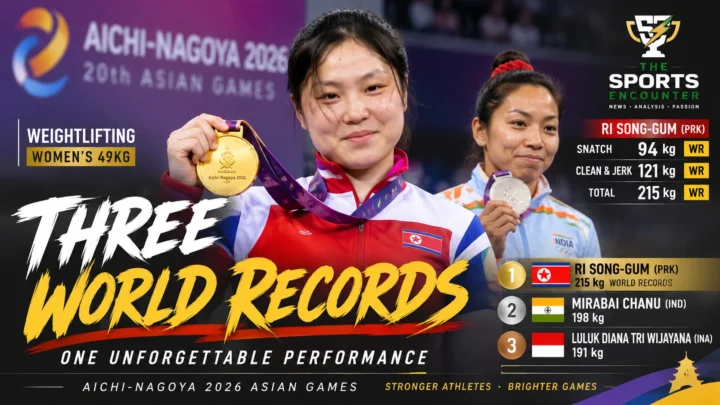
That distinction has been visible throughout the week. North Korea’s Ri Song-gum broke three weightlifting world records, while Yu Zidi turned her first Asian Games into a three-gold individual sweep.
Aichi-Nagoya is increasingly becoming a Games defined by more than which country finishes first.
It is becoming a competition over who can produce the performance nobody else expected.
What Comes Next at the Asian Games?
Friday offers several immediate continuations of Thursday’s biggest stories.
Yulo returns for the men’s vault and parallel bars finals.
The swimming program reaches its final day after a week already filled with Asian, world junior and world records.
Athletics moves deeper into the sprint program, with the 100m semifinals and finals approaching after Thailand’s Puripol Boonson ran 9.95 in the men’s heats.
Singapore’s Shanti Pereira also advanced from the women’s 100m heats in 11.43 and will continue her attempt to add another Asian Games sprint medal.
More importantly for the wider Games, China’s challengers now have fresh evidence that the favorite can be beaten in direct competition.
Japan and Indonesia proved it within hours of each other.
For continuing results, records and analysis from Japan, readers can follow The Sports Encounter’s wider Asian Games coverage, including the first full medal-day report and the continuing record progression across swimming, gymnastics, athletics and shooting.
Continue the Athletics Story



Frequently Asked Questions
Who produced the biggest performance at the Asian Games on Thursday?
Japan’s Shin Ohashi produced the day’s only swimming world record, winning the men’s 200m breaststroke in 2:04.83.
What world record did Shin Ohashi break?
Ohashi broke Qin Haiyang’s men’s 200m breaststroke world record of 2:05.48, lowering it by 0.65 seconds to 2:04.83.
Did Carlos Yulo win Asian Games gold?
Yes. Yulo won the men’s floor exercise with 14.666, earning the first Asian Games gold of his career and the Philippines’ first gold of Aichi-Nagoya 2026.
How did Japan beat China in men’s table tennis?
Japan won the men’s team final 3-2. Tomokazu Harimoto won both his matches, including a 3-0 victory over Wang Chuqin, before Sora Matsushima won the deciding fifth match against Wen Ruibo.
How long had Japan waited for the men’s table tennis team title?
Japan had not won the Asian Games men’s table tennis team event since 1966, ending a 60-year wait in Toyota.
How did Indonesia win the men’s badminton team gold?
Indonesia recovered from 2-0 down against China to win the final 3-2. Mohammad Zaki Ubaidillah secured the deciding match by beating Weng Hongyang 23-21, 21-13.
How dominant were China in rowing?
China entered 10 rowing events and won nine gold medals and one silver, including all five women’s events in which it competed.
Who won the women’s 10,000m?
Bahrain’s Winfred Yavi won in 32:39.18 ahead of Japan’s Nozomi Tanaka and India’s Seema.
Who won the Asian Games mixed 4x400m relay?
Bahrain won gold in an Asian Games record 3:12.87. India took silver and Vietnam bronze.
Who won mixed team skeet?
China’s Lyu Jianlin and Jiang Yiting won with a world-record score of 52 points, one ahead of South Korea.
World Record
- Ohashi Smashes World Record as Yulo, Japan and Indonesia End Long Asian Games Waits
- Ri Song-gum Breaks Three World Records to Win Third Straight Asian Games Gold
- Asian Games 2026: China Pull Away on a Day of New Records, Refreshed Rivalries, and Fine Margins
- Asian Games 2026: Yu Zidi Breaks Asian and World Junior Records at 13
- Asian Games 2026: China Smash Air Rifle World Record as Sheng Lihao Defends Gold