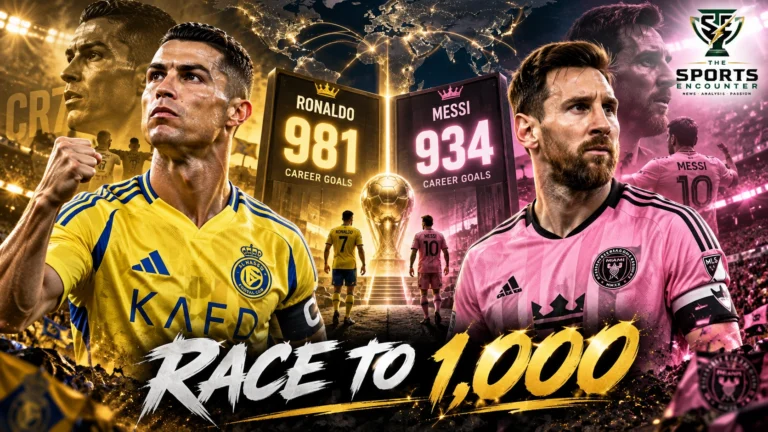
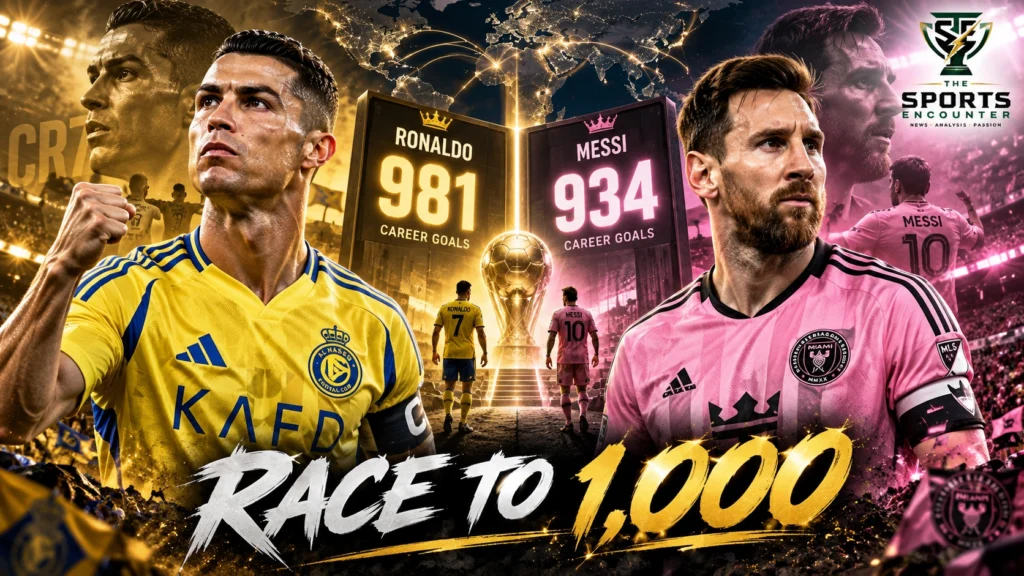
DUBAI, United Arab Emirates, October 16, 2026: Cristiano Ronaldo is just 19 goals away from reaching 1,000 official senior career goals after taking his tally to 981 during Al Nassr’s 3-1 AFC Champions League Elite victory over Uzbekistan’s Neftchi Fergana on October 12. Lionel Messi, meanwhile, has reached 934 career goals following his double for Inter Miami against D.C. United, leaving football’s two defining modern superstars separated by 47 goals as their extraordinary rivalry enters another remarkable chapter.
Ronaldo, 41, is closest to the four-figure milestone, but Messi, 39, continues to challenge the Portuguese forward’s scoring supremacy while maintaining a superior goals-per-appearance rate in widely tracked career comparisons. Ronaldo’s extraordinary longevity, Champions League record and ability to reinvent himself remain central to his case, while Messi’s creativity, efficiency, World Cup success and eight Ballon d’Or awards strengthen his own. The debate has returned to social media with familiar intensity, but the numbers reveal a more interesting story than another argument over which player deserves to be called football’s greatest.
Ronaldo’s 981st Goal Brings Football’s 1,000-Goal Countdown Into Sharp Focus
Cristiano Ronaldo’s latest contribution came in circumstances that extended well beyond his pursuit of a personal milestone.
Al Nassr faced Neftchi Fergana in Riyadh on October 12, with the AFC Champions League Elite encounter delayed by approximately an hour following a security alert.
Story at a glance
Ronaldo’s 981st Goal Brings Football’s 1,000-Goal Countdown Into Sharp Focus
Cristiano Ronaldo’s latest contribution came in circumstances that extended well beyond his pursuit of a personal milestone.
Messi Responds With Two Goals of His Own in Miami
Lionel Messi is approaching the same milestone from a different position.
Ronaldo vs Messi in October 2026: The Numbers Behind the Rivalry
The following comparison separates established scoring totals from statistics that depend on the methodology used by individual data providers.
Ronaldo Leads by 47 Goals, but Messi’s Efficiency Changes the Argument
The raw goals advantage belongs to Ronaldo.
At 41, Ronaldo Has Reinvented the Art of Scoring
Ronaldo’s development from an explosive winger into a specialized goal scorer has been one of the defining transformations of his career.
When play finally began, the Saudi club needed a response to its opening-round defeat against Al Ain.
Brazilian forward Angelo Gabriel put Al Nassr ahead in the 33rd minute before Ronaldo doubled the advantage in the 42nd.
Sadio Mane helped develop the attacking move, and Ronaldo completed it with the composure that has defined so much of his career.
The goal was his 981st in widely maintained senior club and international scoring records.
Neftchi reduced the deficit early in the second half through Alisher Odilov, but Al Nassr eventually completed a 3-1 victory.
The Asian Football Confederation’s official match report confirms the result and Ronaldo’s contribution.
His latest strike followed another milestone just three days earlier.
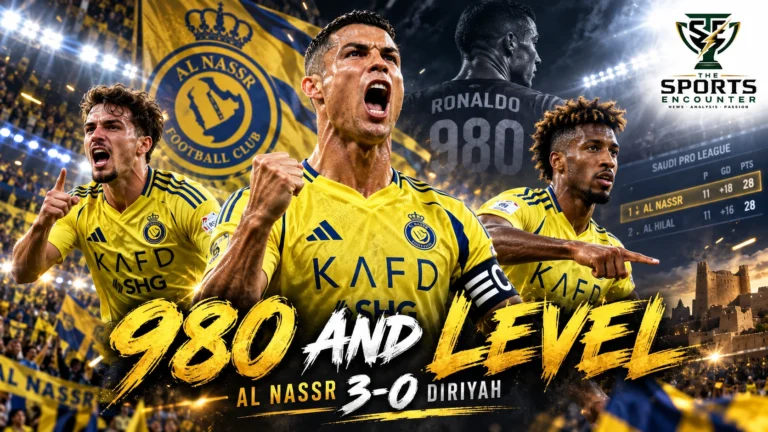
On October 9, Ronaldo scored his 980th career goal during Al Nassr’s 3-0 Saudi Pro League victory over Diriyah Club.
He reacted quickest after a shot from Kingsley Coman was saved, converting the rebound to put Al Nassr ahead.
The Sports Encounter’s report on Ronaldo’s 980th goal examined how his penalty-area anticipation remains effective even as his physical attributes evolve.
Two goals in consecutive club appearances have made the countdown increasingly compelling.
At 981, Ronaldo has completed 98.1 percent of the journey toward 1,000.
Only 19 goals remain.
That does not make the achievement inevitable. Availability, playing time, fitness, Al Nassr’s schedule and Ronaldo’s scoring rate will determine whether and when he reaches the milestone.
But he has brought the target close enough for every remaining appearance to attract unusual attention.
Messi Responds With Two Goals of His Own in Miami
Lionel Messi is approaching the same milestone from a different position.
The Argentine reached 934 official senior career goals after scoring twice in Inter Miami’s 4-0 victory over D.C. United on October 10.
It was another impressive performance from a player who continues to deliver decisive attacking contributions at 39.
Luis Suarez opened the scoring in the third minute and doubled Miami’s advantage in the 39th.
Messi then took control after halftime.
He scored his first goal in the 47th minute, converting a pass from Suarez with a first-time left-footed finish.
Thirteen minutes later, Messi completed his double through a more individual piece of attacking play.
Receiving possession from Rodrigo De Paul, he advanced through the defense before finishing into the bottom-right corner.
The goal brought his MLS regular-season tally for 2026 to 23.
The official Inter Miami match report confirms both Messi goals and the team’s dominant performance.
Messi subsequently played in Miami’s October 14 victory over New York City FC without adding to his personal goal total.
That leaves the widely reported career comparison at 981 for Ronaldo and 934 for Messi as of October 16.
The immediate distance is 47 goals.
However, Messi’s pursuit of Ronaldo is more complicated than simply closing that gap.
Every additional Ronaldo goal changes the target Messi must reach to draw level.
If both continue scoring regularly, Messi must outperform Ronaldo over time to eliminate the difference.
That makes the contest a moving statistical comparison rather than a conventional race toward a fixed finish line.
Ronaldo vs Messi in October 2026: The Numbers Behind the Rivalry
The following comparison separates established scoring totals from statistics that depend on the methodology used by individual data providers.
| Category | Cristiano Ronaldo | Lionel Messi |
|---|---|---|
| Age | 41 | 39 |
| Current club | Al Nassr | Inter Miami |
| Senior career goals | 981 | 934 |
| Goals needed for 1,000 | 19 | 66 |
| Lead in career goals | 47 | Trailing by 47 |
| Illustrative senior appearances* | 1,340 | 1,180 |
| Goals per appearance* | 0.73 | 0.79 |
| Champions League goals in UEFA’s historical player profiles | 140 | 129 |
| Champions League titles | 5 | 4 overall, including 3 finals played |
| Ballon d’Or awards | 5 | 8 |
| FIFA World Cup titles | 0 | 1 |
*Appearance totals and goals-per-game figures are drawn from a single independently maintained comparison dataset through October 14, 2026. They are useful for illustrating relative scoring efficiency but should not be treated as universally standardized official career records. Counting methods can differ between statistical providers.
The comparison highlights the unusual nature of their rivalry.
Ronaldo has scored more goals across a longer senior career.
Messi has recorded more goals per appearance under the stated comparison methodology.
Those are different sporting achievements.
Neither automatically cancels out the other.
Ronaldo Leads by 47 Goals, but Messi’s Efficiency Changes the Argument
The raw goals advantage belongs to Ronaldo.
His tally reflects more than two decades of prolific scoring across different clubs, competitions, tactical systems and stages of his career.
Messi’s comparatively higher goals-per-game average demonstrates that total volume and scoring efficiency do not necessarily identify the same leader.
Using the stated provider-specific appearance figures, Ronaldo averages approximately 0.73 goals per senior match and Messi approximately 0.79.
That difference may appear modest.
Across hundreds of matches, however, even a small improvement in scoring frequency can translate into a substantial number of additional goals.
Messi’s ability to combine high scoring production with substantial creative responsibility makes his record particularly distinctive.
Ronaldo’s record emphasizes a different achievement: maintaining world-class finishing across a longer career and adapting to changing physical demands.
The most useful comparison requires both sets of information.
Why Goals Per Game Cannot Settle the GOAT Debate
Averages depend on the competitive environment in which they are produced.
Two players can achieve similar scoring rates while operating in different leagues, positions, tactical systems and teams.
Ronaldo has played as a winger, wide forward and central striker.
Messi has operated as a right-sided forward, false nine, central playmaker and advanced attacker.
Those roles influence both scoring opportunities and attacking responsibilities.
A player spending more time creating opportunities for teammates may attempt fewer shots than a specialist center-forward.
Likewise, a forward tasked with finishing attacks can contribute decisively without touching the ball as frequently as a creative playmaker.
Goals per game therefore provide useful evidence about efficiency, but they do not measure every dimension of attacking performance.
They also do not account fully for the quality of opposition or the tactical responsibilities of each player.
That is why TSE’s earlier examination of the Messi-Ronaldo GOAT debate considered goals, international achievements, tactical influence and broader legacy rather than using a single number to declare a winner.
At 41, Ronaldo Has Reinvented the Art of Scoring
Ronaldo’s development from an explosive winger into a specialized goal scorer has been one of the defining transformations of his career.
At Manchester United during his first spell, he frequently attacked defenders through acceleration, dribbling and powerful runs from wide positions.
At Real Madrid, his attacking role evolved as he became an extraordinary penalty-area finisher.
His movement, heading ability, timing and finishing helped him produce hundreds of goals during one of the most prolific periods in European football history.
Later, at Juventus, during his second Manchester United spell and at Al Nassr, he adapted again.
The 41-year-old Ronaldo does not need to attempt the same number of dribbles or long carries that characterized his younger years.
Instead, he can influence matches through positioning, anticipation and decisive touches inside the box.
His goal against Diriyah provided a clear example.
Coman created the initial opportunity.
Ronaldo identified where the rebound would fall and reached it before the defenders.
Against Neftchi, the same underlying qualities appeared through a different attacking sequence.
That ability to remain productive while changing his game is a substantial part of Ronaldo’s longevity argument.
TSE’s analysis of his 979th career goal against Abha also examined how precise movement and finishing continue to define his late-career contributions.
The outstanding question is how long Ronaldo can maintain that effectiveness.
He has moved within 19 goals of 1,000, but reaching the milestone will still require regular appearances and continued production.
Messi’s Greatest Advantage May Lie in What Happens Before the Goal
Messi’s value has never depended entirely on finishing.
His career includes extraordinary goalscoring numbers, but his influence extends to the construction of attacking moves.
He can receive possession between defensive lines, attract multiple opponents and create openings that would otherwise remain unavailable.
His passing range allows him to release runners behind the defense, change the direction of an attack or establish a goalscoring opportunity through a relatively small movement.
That combination of scoring and creativity has defined his career at Barcelona, Paris Saint-Germain, Inter Miami and Argentina.
It also explains why his supporters resist comparisons based exclusively on goals.
Messi has often operated as both creator and finisher.
His performance against D.C. United demonstrated those qualities in a late-career setting.
The first goal involved intelligent movement to receive a pass from Suarez.
The second required him to recognize space, advance through defenders and finish accurately.
Those moments may not reproduce the physical explosiveness of his Barcelona peak, but they show how his understanding of space and timing remains effective.
The Sports Encounter’s 100-part tribute to Messi explores the full development of his playing style, achievements and influence across club and international football.
Why Viral Assist Totals Need Greater Scrutiny
Online discussions frequently accompany the Ronaldo-Messi goal comparison with career-assist figures.
Some circulating graphics claim Messi has 406 assists and Ronaldo has 391.
Those figures should not be presented as a verified like-for-like career comparison.
Independent statistical databases record materially different totals because they do not always define assists in the same way.
Some datasets count only the final pass directly preceding a goal.
Others include assists awarded under particular competition rules, rebounds, penalties won or deflections, depending on the provider’s methodology.
Coverage also varies across historical leagues, domestic cups, international matches and competitions with incomplete event-level records.
A reliable comparison therefore requires the same source, the same match scope and the same definition for both players.
Mixing assist totals from different websites can produce an impressive-looking graphic that fails a basic statistical audit.
What Can Be Said With Confidence About Their Creativity?
Messi’s career contains extensive evidence of elite chance creation, through balls, progressive passing, dribbling and direct assists.
Ronaldo also developed into a productive provider during his career, particularly when operating from wider attacking positions.
However, their primary roles have differed significantly.
Messi has more frequently functioned as the central organizer of attacking possession.
Ronaldo’s later career has emphasized positioning and finishing opportunities supplied by teammates.
Those distinctions are visible through their tactical responsibilities even without relying on uncertain all-career assist totals.
Champions League History Still Gives Ronaldo an Extraordinary Advantage
Ronaldo’s UEFA Champions League achievements remain among the strongest elements of his career.
He became the competition’s defining goal scorer during his time with Manchester United, Real Madrid and Juventus.
UEFA’s detailed historical player profiles list Ronaldo with 140 Champions League goals and Messi with 129, using their stated competition accounting.
UEFA’s dynamic historical rankings currently display 141 for Ronaldo, illustrating why the source and counting scope should be specified when publishing exact totals.
The important conclusion is unchanged: Ronaldo remains the competition’s leading historical goal scorer, ahead of Messi.
The official UEFA Champions League scoring review documents their extraordinary place in the competition’s history.
Ronaldo won the Champions League five times, once with Manchester United and four times with Real Madrid.
Messi won four Champions League titles with Barcelona, although he appeared in three of the club’s winning finals.
Both players produced remarkable knockout performances.
Ronaldo repeatedly delivered goals when Real Madrid faced elimination, while Messi’s creativity and individual brilliance helped shape Barcelona’s most successful European era.
The difference in their European achievements is meaningful, but comparing only their Champions League goal totals does not fully describe their contributions.
The World Cup Changed Messi’s Legacy, but It Did Not Erase Ronaldo’s Achievements
For much of their careers, the FIFA World Cup was the largest unresolved issue in Messi’s claim to football’s greatest individual legacy.
That changed in December 2022.
Messi captained Argentina to the World Cup title in Qatar after an extraordinary final against France.
The match finished 3-3 after extra time before Argentina prevailed 4-2 on penalties.
Messi scored twice in the final and received the tournament’s Golden Ball award.
It was the achievement that completed a remarkable international career.
Ronaldo, meanwhile, never won the World Cup with Portugal.
But his international legacy contains substantial achievements of its own, including Portugal’s Euro 2016 triumph, UEFA Nations League success and an exceptional international goalscoring record.
He also became the first male footballer to score in six different World Cup tournaments during the 2026 edition.
TSE’s comprehensive examination of Ronaldo’s World Cup career reconstructs his six appearances, scoring records and final tournament farewell.
One of the defining moments came when Ronaldo scored twice against Uzbekistan in Portugal’s 5-0 victory at the 2026 World Cup.
His tournament ultimately ended when Portugal lost 1-0 to Spain in the Round of 16.
Messi’s international career also reached its conclusion in 2026, with Argentina arranging a farewell appearance against Benin in Buenos Aires.
TSE documented the arrangements for Messi’s farewell at the Monumental, adding another chapter to a career that had already brought Argentina the sport’s greatest international prize.
Their national-team achievements reflect contrasting histories. Messi obtained the World Cup title that had eluded him for years. Ronaldo produced unmatched longevity across six World Cup appearances but finished without that particular trophy.
Can Ronaldo Reach 1,000 Goals Before the End of 2026?
Ronaldo needs 19 additional official goals to reach the milestone.
Whether he achieves it in 2026 depends on how many matches remain available and how frequently he scores.
At a rate of one goal per match, 19 further appearances would be sufficient.
At one goal every two matches, he would require approximately 38 appearances.
Neither scenario is a prediction.
They illustrate why even a seemingly small remaining total can demand a substantial amount of playing time.
Fixture disruptions introduce additional uncertainty.
Al Nassr’s scheduled October 15 match against Al Ahli was postponed, reducing the immediate opportunities available to Ronaldo.
His ability to reach the landmark therefore depends on circumstances beyond individual finishing quality.
He must remain fit, continue receiving sufficient minutes and maintain a productive attacking role.
Al Nassr must also create the opportunities required for him to score.
There is no verified basis for declaring an exact date on which Ronaldo will reach goal number 1,000.
Could Messi Eventually Reach 1,000 Career Goals Too?
Messi needs 66 additional goals to reach the same milestone.
That is a considerably larger remaining total than Ronaldo’s.
However, Messi has continued producing at an impressive rate in Major League Soccer.
His performances during the 2025 and 2026 seasons demonstrated that he can still combine regular scoring with playmaking and sustained attacking influence.
Reaching 1,000 would require more than one prolific season unless his goal production accelerated dramatically.
It would also depend on how long he chooses to continue playing and the number of matches available to him.
The important distinction is that Messi does not need to overtake Ronaldo to reach 1,000 himself.
Both players could theoretically reach the milestone.
Whether either does so is determined by future performance and availability, not by the current online debate.
Why Their Rivalry Still Dominates Football Conversations
The enduring appeal of Ronaldo versus Messi extends beyond statistical comparison.
The two players developed contrasting identities while competing for many of the same prizes.
Continue the Saudi Pro League Story
 Saudi Pro LeagueRonaldo’s 980th Goal Helps Al Nassr Crush Diriyah 3-0 and Draw Level With Al Qadsiah
 Saudi Pro LeagueSaudi Pro League: Retegui Recovers from Missed Penalty to Claim Top Spot as Al Qadsiah Hold Off Abha
 Saudi Pro LeagueAl Fateh Turn Bendebka’s Reunion Sour as Batna Seals Stunning 3-2 Stoppage-Time Escape at Al Hazem
Ronaldo became a symbol of relentless ambition, physical transformation and extraordinary goalscoring longevity.
Messi became associated with creative intelligence, close control, spatial awareness and an ability to organize entire attacking sequences.
They competed directly during their years at Real Madrid and Barcelona, helping elevate El Clasico into one of the most closely followed club rivalries in sporting history.
Their achievements repeatedly changed the standards by which other attackers were judged.
Winning 40 or 50 goals in a season became part of the conversation around elite forwards because Ronaldo and Messi had demonstrated how astonishingly high individual output could climb.
Their influence continued after they left Spanish football.
Ronaldo brought enormous global attention to the Saudi Pro League.
Messi transformed the international visibility of Inter Miami and Major League Soccer.
Their commercial and cultural impact also extended beyond football audiences.
But the current rivalry has an unusual additional quality: neither player needs to compete directly against the other for every performance to become part of the same discussion.
A Ronaldo goal in Riyadh immediately invites comparison with Messi’s record in Miami.
A Messi double in MLS brings fresh attention to the gap between their career totals.
That is why the argument continues even though they now compete in different leagues and at different stages of their careers.
What Does the Race to 1,000 Goals Really Tell Us?
The most revealing lesson is that goalscoring longevity and goalscoring efficiency are different achievements.
Ronaldo’s total of 981 demonstrates an extraordinary ability to sustain production across more than two decades.
Messi’s 934 goals, accumulated across fewer recorded appearances under the comparison methodology used here, demonstrate an equally remarkable combination of productivity and efficiency.
Ronaldo has repeatedly changed his playing style to remain a prolific finisher.
Messi has maintained substantial influence as both a scorer and a creator.
Their records also emphasize how difficult it is to compare careers spanning different competitions, roles and tactical systems.
A single statistic can establish who leads in a specific category.
It cannot establish an uncontested answer to every question about footballing greatness.
TSE’s broader examination of whether Messi belongs among the greatest athletes in history considers the importance of championship achievement, longevity, consistency and wider sporting influence.
Ronaldo’s pursuit of 1,000 provides another dimension to that debate.
If he reaches the milestone, it will stand as an extraordinary example of sustained goalscoring excellence.
It will not automatically settle the question of whether he was a more complete footballer than Messi.
Likewise, Messi’s creative superiority in certain categories does not diminish Ronaldo’s historic achievements as a goal scorer.
Ronaldo vs Messi: What Should Fans Watch Next?
| Development | Why It Matters |
|---|---|
| Ronaldo’s next official goal | Moves him closer to 1,000 and updates the historic countdown |
| Al Nassr fixture availability | Determines the number of scoring opportunities remaining in 2026 |
| Messi’s remaining MLS matches | Provides further opportunities to reduce his distance from 1,000 |
| Player fitness and selection | Influences minutes played and sustained scoring output |
| Goals per appearance | Offers a useful efficiency comparison when the same counting criteria are applied |
| Provider updates to historical statistics | May change appearance, assist or competition-specific totals depending on methodology |
These indicators will provide more meaningful evidence than predictions based solely on enthusiasm for either player.
Ronaldo vs Messi 1,000 Goals Race: Frequently Asked Questions
How Many Career Goals Has Cristiano Ronaldo Scored as of October 16, 2026?
Ronaldo has scored 981 widely counted official senior career goals for clubs and Portugal.
How Many Goals Does Ronaldo Need to Reach 1,000?
He needs 19 additional official senior goals.
How Many Career Goals Has Lionel Messi Scored?
Messi has 934 widely counted official senior career goals for Barcelona, Paris Saint-Germain, Inter Miami and Argentina.
How Many Goals Does Messi Need to Reach 1,000?
Messi needs 66 additional official senior goals.
Who Has Scored More Career Goals, Ronaldo or Messi?
Ronaldo leads Messi by 47 goals as of the figures verified for October 16, 2026.
Who Has the Better Career Goals-Per-Game Average?
Under one consistently applied senior-career statistical dataset, Messi averages approximately 0.79 goals per appearance, compared with Ronaldo’s 0.73. Exact rates can vary depending on how individual providers count appearances.
Who Has Scored More UEFA Champions League Goals?
Ronaldo is the competition’s historical leading scorer ahead of Messi. UEFA’s detailed player profiles cite 140 goals for Ronaldo and 129 for Messi, although some dynamic UEFA rankings display 141 for Ronaldo.
Who Has Won More Ballon d’Or Awards?
Messi has won eight Ballon d’Or awards, compared with Ronaldo’s five.
Has Ronaldo Won the FIFA World Cup?
No. Ronaldo represented Portugal at six World Cups but did not win the tournament. Portugal’s major international successes during his career include Euro 2016 and UEFA Nations League titles.
Has Messi Won the FIFA World Cup?
Yes. Messi captained Argentina to victory at the 2022 FIFA World Cup in Qatar.
Who Has More Career Assists, Ronaldo or Messi?
Messi is widely credited with a greater total under several independently maintained assist databases. However, exact career-assist figures differ significantly between providers, making methodology essential to any comparison.
Will Ronaldo Reach 1,000 Goals in 2026?
It remains possible but unconfirmed. His remaining fixtures, playing time, fitness and goalscoring rate will determine when he reaches the milestone.
Ronaldo Is Closing on 1,000, but Messi Keeps the Debate Alive
Cristiano Ronaldo has reached a stage that few players in football history could realistically imagine.
At 41, he is only 19 goals away from a four-figure career total.
The milestone reflects years of remarkable physical preparation, elite finishing, tactical adaptation and consistency.
Lionel Messi, two years younger, remains one of the most productive attackers in world football.
His combination of goalscoring efficiency, creativity and major championship achievements ensures that the rivalry remains relevant even without regular direct encounters between the two players.
Their careers have already changed what football considers possible.
Ronaldo has turned extraordinary longevity into a continuing pursuit of records.
Messi has demonstrated that an attacking player can combine historic scoring production with the responsibilities of an elite creator.
The goal totals may continue changing over the coming months.
Ronaldo could become the first of the pair to reach 1,000.
Messi could narrow the gap or eventually approach the same milestone.
Neither outcome is guaranteed.
What is already established is that the two players have given football one of its longest, most productive and most extraordinary individual rivalries.
Ronaldo has 981. Messi has 934. And after more than two decades, football’s most famous argument still has another chapter to write.