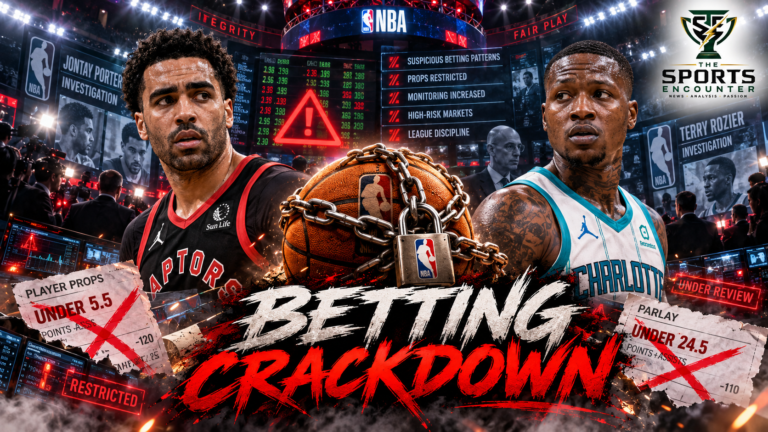
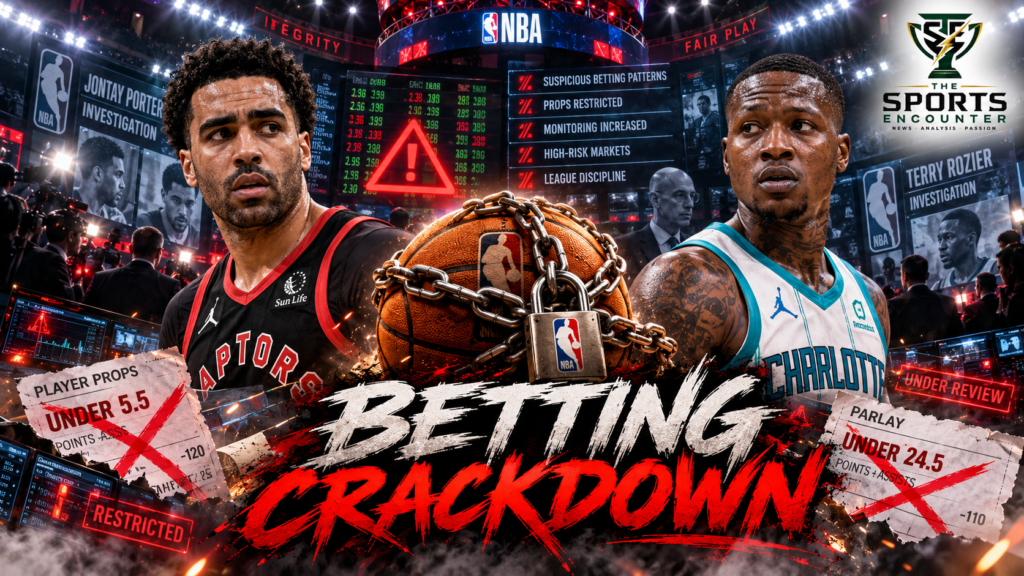
NEW YORK, United States, October 16, 2026: The NBA has ordered its authorized sportsbook partners to stop offering several high-risk betting markets, including parlays combining multiple statistical “under” wagers on the same player, after gambling investigations exposed how individual performances could be manipulated. The restrictions, outlined in league memorandums distributed Friday, also cover bets on opening tips, first statistical events, specific missed shots and certain wagers involving players expected to receive fewer than 12 minutes of playing time.
The changes come four days before the 2026-27 NBA regular season begins on October 20 and follow the Jontay Porter betting scandal and federal allegations involving Terry Rozier. DraftKings and FanDuel are among the operators affected, while the league is also introducing expanded betting surveillance, mandatory in-person education and stronger protections against bettor harassment. The measures address identifiable weaknesses in regulated betting markets, but they also raise a difficult question: how much protection can the NBA achieve when wagering activity outside its authorized partnerships remains beyond its direct contractual control?
Which NBA Bets Are Being Banned for the 2026-27 Season?
The NBA’s latest measures target specific wagers that league officials regard as particularly vulnerable to manipulation or misuse of confidential information.
ESPN journalists Shams Charania and David Purdum first reported the changes on October 16, citing a memorandum sent to sportsbook partners. The details were subsequently corroborated by other news organizations that obtained the league’s communications.
Story at a glance
Which NBA Bets Are Being Banned for the 2026-27 Season?
The NBA’s latest measures target specific wagers that league officials regard as particularly vulnerable to manipulation or misuse of confidential information.
Why Same-Player Under Parlays Became the NBA’s Biggest Concern
The most consequential restriction concerns parlays built around several under outcomes for one player.
The Jontay Porter Scandal Explains Why the NBA Acted
The Jontay Porter case provides the clearest documented example of the vulnerability the NBA is attempting to address.
Terry Rozier’s Federal Case Increased Pressure for Reform
The second major development involves allegations concerning Terry Rozier, who was playing for the Charlotte Hornets during the game examined by federal investigators.
What Exactly Changes for DraftKings, FanDuel and Other Sportsbooks?
The new restrictions were communicated to authorized NBA gaming operators, including DraftKings and FanDuel.
The Yahoo Sports report on the NBA’s betting restrictions identifies several of the principal markets being removed.
| Betting Market | New Restriction | Why the NBA Is Concerned |
|---|---|---|
| Same-player under parlays | Combining multiple under outcomes on one player’s statistics is prohibited | An unusually short appearance can affect several statistical outcomes simultaneously |
| Limited-minutes player unders | Under wagers on players expected to play fewer than 12 minutes are prohibited | A small change in playing time can determine the outcome |
| First-event markets | Wagers on the opening tip and specified first statistical events are prohibited | Single early-game actions may be especially sensitive to deliberate influence |
| Specific missed shots | Bets on whether a player misses an identified shot attempt are prohibited | The outcome depends on a narrowly defined individual action |
| High-payout alternate unders | Specified alternate under lines carrying unusually large payouts are restricted | Unusual statistical thresholds can create incentives for manipulation |
These restrictions apply to the NBA’s authorized sportsbook arrangements. They should not be described as a universal worldwide prohibition on every player prop wager.
The league has already restricted other categories in previous seasons, including certain bets involving players on two-way or 10-day contracts, turnovers, fouls and missed free throws.
Friday’s announcement adds further protections rather than creating the NBA’s first gambling integrity rules.
Why Same-Player Under Parlays Became the NBA’s Biggest Concern
The most consequential restriction concerns parlays built around several under outcomes for one player.
An under bet pays when a player finishes below a specified statistical threshold.
A parlay combines multiple outcomes, with the combined wager generally depending on every selected condition being satisfied.
The concern arises when several conditions depend on a single player’s opportunity to accumulate statistics.
If a player unexpectedly leaves a game after only a few minutes, that departure may reduce points, rebounds, assists and other totals simultaneously.
A single event can therefore affect several components of one combined wager.
Why Playing Time Matters More Than the Final Score
Consider a hypothetical reserve player whose normal role involves a limited number of minutes.
If that player remains on the bench longer than expected or exits shortly after entering, several personal statistical totals may finish below the projected figures.
The opposing team’s performance does not necessarily determine those outcomes.
Instead, the wager can depend heavily on the player’s availability, physical condition or time on court.
That creates a vulnerability when an individual has access to confidential information about participation or, in the most serious circumstances, deliberately influences his own involvement.
It does not follow that ordinary minutes restrictions, injury management or unexpected substitutions indicate wrongdoing.
Coaches legitimately change rotations for tactical, medical and performance reasons every night.
The NBA’s challenge is identifying abnormal betting behavior without treating normal basketball decisions as evidence of manipulation.
The Jontay Porter Scandal Explains Why the NBA Acted
The Jontay Porter case provides the clearest documented example of the vulnerability the NBA is attempting to address.
On April 17, 2024, the league announced that Porter, then associated with the Toronto Raptors, had received a lifetime NBA ban for violating its gambling rules.
The league’s investigation found that he had disclosed confidential information about his health to a person he knew was involved in betting.
Another individual subsequently placed an $80,000 parlay wager involving Porter underperforming in a March 20, 2024, game.
The potential payout was approximately $1.1 million.
Porter played only three minutes before leaving the game, saying he felt ill.
Because of suspicious betting activity and the circumstances surrounding his participation, the wager was frozen and never paid out.
The NBA’s official April 2024 disciplinary announcement documented those findings and confirmed that Porter had also placed bets on other NBA games.
Why Porter’s Three-Minute Appearance Changed the Debate
The case demonstrated how one player’s limited participation could affect numerous statistical betting outcomes without necessarily changing which team won the game.
That distinction is central to Friday’s restrictions.
Traditional match-fixing concerns often center on manipulating a final result.
Player prop markets create additional opportunities for misconduct involving much smaller parts of a contest.
Porter’s case also demonstrated that legal betting operators and integrity-monitoring organizations could help uncover suspicious activity.
The NBA received alerts about abnormal wagers, investigated the circumstances and eventually imposed its strongest disciplinary penalty.
The new measures attempt to reduce exposure to similar situations before they develop, rather than depending exclusively on detecting misconduct afterward.
Terry Rozier’s Federal Case Increased Pressure for Reform
The second major development involves allegations concerning Terry Rozier, who was playing for the Charlotte Hornets during the game examined by federal investigators.
In October 2025, federal prosecutors charged Rozier and several other defendants in an alleged scheme involving confidential information about NBA player availability and performance.
Prosecutors alleged that nonpublic information was used to place wagers connected to player statistics.
Rozier has pleaded not guilty and denied wrongdoing.
That legal distinction is essential.
Porter’s case involved confirmed NBA disciplinary findings and his admission of wrongdoing. The allegations against Rozier must not be treated as proven criminal conduct.
The U.S. Department of Justice’s October 23, 2025, announcement sets out the charges and the government’s allegations.
What Changed Between the Porter and Rozier Investigations?
The Porter case established that a player could exploit knowledge of his own participation and potentially influence betting outcomes.
The subsequent federal investigation involving Rozier broadened the league’s concerns about access to confidential player information and how that information could circulate among people outside the team.
The NBA is now responding by restricting the types of wagers most closely associated with these vulnerabilities.
The decision also reflects the difficulty of relying on punishment alone.
A lifetime ban can deter misconduct and demonstrate the consequences of violating league rules.
It cannot undo the uncertainty created when fans and betting operators begin questioning whether a player’s performance was genuine.
Reducing the availability of particularly vulnerable wagering markets offers a separate form of protection.
What Exactly Changes for DraftKings, FanDuel and Other Sportsbooks?
The new restrictions were communicated to authorized NBA gaming operators, including DraftKings and FanDuel.
The league can impose conditions on these operators through its commercial and data-related agreements.
That authority allows the NBA to influence which wagering markets its approved partners offer around league games.
DraftKings publicly expressed support for the measures and indicated that several restrictions were already reflected in its existing sportsbook practices.
Other approved operators will also need to align their NBA offerings with the updated guidance.
Will All NBA Player Prop Bets Disappear?
No.
The changes do not amount to a blanket prohibition on betting on points, rebounds or assists.
They concern specified combinations and markets that the league believes carry elevated manipulation risks.
The distinction matters because conventional player-statistical markets remain an established part of the sports betting industry.
The NBA has chosen targeted restrictions rather than attempting to eliminate the entire category.
What Happens to NBA Championship Odds?
Friday’s restrictions primarily concern individual game events and player-specific statistics.
They do not announce a ban on season-long NBA championship futures markets.
Those markets operate differently because they concern outcomes unfolding across an entire season rather than a single player’s immediate statistical performance.
Earlier this year, The Sports Encounter examined the 2026-27 NBA championship odds and why the defending champion Knicks were ranked behind the Spurs and Thunder.
That coverage illustrates the difference between broad championship projections and the narrowly defined statistical markets addressed by the new rules.
The latest announcement concerns the integrity of selected wagering products, not a wholesale withdrawal of the NBA from relationships with regulated sportsbooks.
The 12-Minute Rule Raises an Important Enforcement Question
One of the less obvious restrictions concerns under wagers involving players expected to receive fewer than 12 minutes in a game.
On its face, the threshold is straightforward.
In practice, projecting playing time introduces uncertainty.
Minutes depend on health, opposition matchups, fouls, game circumstances and coaching decisions.
A player who averages limited minutes may receive a larger role because of a teammate’s absence.
Another player might unexpectedly see fewer minutes because the score becomes one-sided.
The public reporting establishes the restriction but does not fully explain how every operator will determine or update its playing-time projections.
Why Regular Basketball Reporting Makes the Issue More Complicated
The Sports Encounter’s recent preseason coverage demonstrates how widely individual workloads can vary.
On October 14, Jalen Duren scored 24 points in only 15 minutes during Detroit’s victory over Minnesota.
Giannis Antetokounmpo produced 20 points, 15 rebounds and nine assists in approximately 23 minutes for Miami.
Those performances appeared in TSE’s detailed October 14 NBA preseason report.
Neither performance suggests improper conduct. They demonstrate why minutes and statistical production cannot be separated when evaluating player-specific wagers.
Preseason rotations are particularly experimental, although the NBA’s latest rules are intended for the upcoming competitive season.
The same principle applies to regular-season injuries and changes in availability.
Our analysis of Shaedon Sharpe’s injury and its implications for Portland examined how one player’s absence can alter the assignments and minutes of several teammates.
The challenge for betting operators is identifying which projections are dependable enough to support an approved market and which involve too much vulnerability to undisclosed information.
NBA Adds AI Monitoring and Mandatory Betting Education
The market restrictions form part of a broader integrity initiative.
In a separate communication to NBA teams, the league outlined additional steps involving monitoring, education and protection against gambling-related abuse.
Those measures include expanded data analysis designed to detect unusual betting activity.
The system can incorporate information about injuries, social media and wagering patterns when identifying events requiring further examination.
However, automated systems cannot independently establish criminal intent.
An unusual pattern may justify an investigation, but investigators still need evidence to determine whether misconduct occurred.
Former NFL Player Charles Tillman to Lead In-Person Training
The league has also arranged mandatory in-person education on sports betting rules for players, coaches and training personnel.
Former NFL defensive back and former FBI agent Charles Tillman is expected to help lead the program.
His involvement reflects the league’s emphasis on explaining both competitive obligations and the legal risks associated with sharing confidential information.
Education matters because integrity failures can involve several different forms of conduct.
A player might knowingly manipulate his own performance.
Someone else might improperly disclose injury information without directly participating in the game.
Other people may attempt to exploit private information obtained through personal relationships.
Clear training can help teams understand what information must remain confidential and how suspicious approaches should be reported.
Player Protection Becomes Part of the NBA’s Betting Crackdown
Friday’s developments extend beyond the integrity of statistical results.
The NBA is also strengthening measures against threats and harassment directed at players, coaches and other personnel over betting outcomes.
The league plans to update its fan conduct standards and expand reporting options for those subjected to abuse.
Players will also have access to additional tools intended to identify and remove abusive online content.
These protections address a separate consequence of the growth in sports betting.
An athlete can produce a legitimate performance and still face hostility because that performance does not match a bettor’s expectations.
Injuries, missed shots and coaching substitutions are ordinary parts of professional basketball.
They should not become grounds for threats or personal harassment.
Why an Injury Report Is More Than Betting Information
Medical information primarily serves basketball decisions and player health.
Coaches need to know whether an athlete can safely participate, while teammates must prepare for changes in rotations.
Sportsbooks also consider availability when setting statistical markets.
The problem begins when confidential details become valuable to people outside the legitimate medical, coaching and team-management process.
For example, The Sports Encounter’s assessment of LaMelo Ball’s role with Minnesota discusses how a player’s injury history affects team planning and competitive expectations.
That is legitimate sports analysis based on publicly available information.
It is materially different from using undisclosed medical information to gain an improper wagering advantage.
Maintaining that distinction is essential to both independent sports journalism and credible integrity monitoring.
Can the NBA Enforce the Restrictions Outside Authorized Sportsbooks?
This is the most significant unresolved issue in the new policy.
The NBA has substantial influence over sportsbooks that maintain authorized relationships with the league.
Those relationships provide mechanisms for removing specific betting markets and sharing information about suspicious activity.
However, not every entity offering basketball-related wagers or event contracts operates under an NBA authorization agreement.
Illegal offshore betting platforms and some other emerging markets sit outside the league’s direct commercial relationships.
The NBA cannot assume that every operator outside its partner network will voluntarily adopt identical restrictions.
Could Prohibited Bets Move to Less Transparent Markets?
That possibility creates an important trade-off.
Removing vulnerable wagers from authorized sportsbooks reduces their availability within the regulated partner network.
But bettors who continue seeking those markets may turn elsewhere.
If wagering activity moves to operators that provide limited transparency or poor cooperation with investigators, monitoring suspicious behavior may become more difficult.
The league therefore needs to balance market restrictions with continued cooperation among regulators, licensed operators and law enforcement.
The strongest integrity system would ideally combine responsible market design, rapid detection, credible disciplinary procedures and effective reporting channels.
The new restrictions address part of that challenge.
Continue the NBA Story
They do not eliminate every possible route through which betting-related misconduct could occur.
Why the NBA Is Acting Four Days Before Opening Night
The timing is deliberate and consequential.
The 2026-27 regular season begins Tuesday, October 20, leaving only a short period for sportsbook partners to align their markets with the updated restrictions.
That timing also means the measures can apply from the beginning of the new campaign instead of appearing as another midseason response to a fresh scandal.
The NBA has a crowded opening schedule featuring prominent championship contenders, major offseason changes and teams with substantially different projected lineups.
TSE’s complete 2026-27 NBA schedule guide explains the opening-night matchups and the broader league calendar.
Player availability and rotation decisions are already attracting attention.
In our October 15 preseason analysis, New York’s reversal against Toronto and Houston’s victory over Oklahoma City illustrated how changing personnel and tactical choices can produce dramatically different outcomes.
Those variations are ordinary basketball developments.
The league’s responsibility is to protect them from improper betting influence without discouraging legitimate coaching decisions.
NBA Betting Integrity Is Becoming a Wider Governance Test
The league’s response also carries a broader governance message.
Professional basketball depends on confidence that games are decided by genuine competition.
That confidence can be damaged when misconduct involves players, officials, team personnel or other individuals with privileged access.
Integrity controls therefore extend beyond sportsbooks.
They also require clear organizational accountability, enforceable rules and procedures for investigating suspected wrongdoing.
The Sports Encounter recently examined similar principles in a different NBA context when the Los Angeles Clippers appointed John S. Gibson as interim CEO during a separate league compliance crisis.
That matter concerned organizational governance rather than sports betting, and the cases should not be conflated.
They nevertheless illustrate why independent oversight and credible enforcement are increasingly important to the NBA’s wider business and competitive reputation.
What Should the NBA Measure to Judge Whether the New Rules Work?
The number of prohibited markets is only one measure of progress.
A more meaningful assessment would consider whether suspicious betting activity declines, whether operators identify concerning patterns quickly and whether investigations produce reliable findings.
The league should also examine how betting-related harassment changes and whether players feel adequately protected when reporting threats.
Another useful measure would be the extent to which licensed sportsbook partners comply consistently across jurisdictions.
These outcomes cannot be established on the day the new restrictions are announced.
They will require evaluation as the season develops.
NBA Betting Restrictions 2026: Frequently Asked Questions
What NBA Bets Are Banned for the 2026-27 Season?
The NBA is restricting same-player under parlays, certain wagers involving players expected to play fewer than 12 minutes, opening-tip outcomes, specified first-event markets, specific missed-shot bets and high-payout alternate unders at authorized sportsbook partners.
Are All NBA Player Prop Bets Banned?
No. The NBA has targeted particular player-statistical wagers and combinations considered vulnerable to manipulation. The announcement does not impose a universal ban on all player props.
Why Did the NBA Ban Same-Player Under Parlays?
The league is concerned that one player’s unexpectedly limited participation can affect several under outcomes simultaneously. The Jontay Porter scandal illustrated how such a vulnerability could be exploited.
What Happened in the Jontay Porter Betting Scandal?
The NBA banned Porter for life in April 2024 after finding that he disclosed confidential information, limited his participation for betting-related reasons and placed wagers on NBA games.
Was Terry Rozier Found Guilty of Gambling-Related Charges?
No. As of October 16, 2026, Rozier has pleaded not guilty to federal charges connected to an alleged sports betting scheme. The accusations must not be presented as proven criminal conduct.
Do the Restrictions Apply to DraftKings and FanDuel?
Yes. Both are among the authorized sportsbook partners covered by the NBA’s updated wagering restrictions.
Are NBA Championship Futures Bets Still Allowed?
The October 16 restrictions do not announce a ban on season-long NBA championship futures markets. They focus on specified individual-event and player-statistical wagers.
Will the Same Rules Apply to the WNBA?
According to reporting on the league’s October 16 memorandums, the new restrictions are also intended to apply to WNBA betting markets beginning in 2027.
What New Integrity Measures Is the NBA Introducing?
The league is expanding unusual-betting-pattern monitoring, requiring in-person education about gambling rules and improving tools and reporting procedures to protect players and personnel from bettor harassment.
When Does the 2026-27 NBA Season Begin?
The NBA regular season begins Tuesday, October 20, 2026.
The NBA Has Closed a Betting Loophole, but Its Integrity Test Is Only Beginning
The NBA’s latest betting restrictions represent a practical response to weaknesses exposed by previous investigations.
The Porter case demonstrated that manipulated participation could affect several statistical outcomes in the same wager.
The federal allegations involving Rozier increased scrutiny of confidential player information and the people who could exploit it.
Friday’s announcement addresses both concerns by removing selected wagering markets and expanding the systems used to identify suspicious activity.
The additional protections against harassment recognize another problem that has grown alongside sports betting: players should not face personal threats because a legitimate performance produces an unwanted betting result.
Yet the league still faces an enforcement challenge beyond its authorized sportsbook network.
Restricting vulnerable markets where cooperation is strongest is an important measure, but it does not establish complete control over every operator or betting channel.
The more important question is whether the NBA, licensed operators and regulators can maintain enough transparency to identify misconduct wherever it occurs.
With the regular season beginning October 20, the league has chosen to introduce the restrictions before another campaign gets underway.
How effectively those rules are enforced, how suspicious activity is investigated and whether players receive meaningful protection will determine whether this becomes a lasting integrity reform rather than another response to scandal.