ZURICH, Switzerland, October 7, 2026: Portugal left the World Cup three months ago with Cristiano Ronaldo’s final tournament ending in stoppage-time heartbreak and questions hanging over what the national team would look like next.
They have supplied an unexpectedly quick answer.
Portugal climbed two places to No. 5 in the latest FIFA/Coca-Cola Men’s World Ranking, passing Brazil and Morocco after winning all four of their opening UEFA Nations League matches under Jorge Jesus.
No other country inside the FIFA top 10 moved upward in the October ranking.
Story at a glance

What Is the New FIFA Men’s Top 10?
Spain have also increased their advantage over Argentina to almost 40 ranking points after continuing the form that made them world champions in July.
Why Did Portugal Jump From Seventh to Fifth?
Because they have not dropped a competitive point since the World Cup.
What Has Jorge Jesus Changed?
The ranking cannot answer that by itself. The football can.
Is Portugal’s Rise Really About Cristiano Ronaldo?
Not entirely, but Portugal cannot separate this run from the uncertainty around their most famous player.
How Different Is This Portugal From the Team Spain Eliminated?
The personnel overlap remains considerable.
That detail makes Portugal’s rise more interesting than a simple two-place jump. Spain remain first after winning the 2026 World Cup and beginning their own Nations League campaign with four victories. Argentina stay second, France third and England fourth. Portugal are now directly behind them, having moved from seventh following the World Cup to fifth.
The official FIFA ranking update identifies Portugal as the only climber among the top 10 and confirms that they have overtaken Brazil and Morocco.
What Is the New FIFA Men’s Top 10?
| Rank | Team | Change |
|---|---|---|
| 1 | Spain | No change |
| 2 | Argentina | No change |
| 3 | France | No change |
| 4 | England | No change |
| 5 | Portugal | Up 2 |
| 6 | Brazil | Down 1 |
| 7 | Morocco | Down 1 |
| 8 | Belgium | No change |
| 9 | Netherlands | No change |
| 10 | Mexico | No change |
Spain have also increased their advantage over Argentina to almost 40 ranking points after continuing the form that made them world champions in July.
TSE documented the foundation of that position when Ferran Torres scored the extra-time winner that gave Spain their second World Cup. Their subsequent Nations League form has reinforced rather than weakened that status.
The complete current ranking remains available through FIFA’s official men’s ranking table.
Why Did Portugal Jump From Seventh to Fifth?
Because they have not dropped a competitive point since the World Cup.
| Date | Match | Result |
|---|---|---|
| September 24 | Portugal vs. Wales | Portugal won 1-0 |
| September 27 | Norway vs. Portugal | Portugal won 2-1 |
| October 1 | Denmark vs. Portugal | Portugal won 4-2 |
| October 4 | Portugal vs. Norway | Portugal won 2-1 |
Four games. Four victories. Nine goals scored and four conceded.
Portugal have already qualified for the Nations League quarterfinals with two group matches remaining. TSE’s analysis of the decisive second Norway victory showed how Gonçalo Ramos’ late goal put them six points clear of Denmark and guaranteed a top-two finish.
The first victory over Norway had already provided an important tactical clue. João Félix and Ramos drove Portugal’s 2-1 win in Oslo, giving Jesus an early demonstration that the team’s attack could function through different players rather than one fixed centerpiece.
By Matchday 2, Portugal were one of only four League A teams with maximum points. TSE’s broader Nations League analysis identified Portugal alongside Spain, France and Greece as the early perfect starters in the top division.
What Has Jorge Jesus Changed?
The ranking cannot answer that by itself. The football can.
Portugal have become more aggressive without the ball and clearer once possession changes hands. Their pressing has regularly forced opponents into mistakes in areas from which Portugal can attack quickly instead of rebuilding every move from deep positions.
Ramos offered perhaps the clearest explanation after the 4-2 victory in Denmark.
“We have clearer ideas; we know exactly where each teammate is,” the striker said.
He also described the high pressing as a natural fit for his game. The official UEFA Denmark-Portugal match coverage recorded Jesus praising his players’ belief in his tactical vision after that third consecutive victory.
The numbers support the change in emphasis.
Portugal have scored in every Nations League game. Ramos has repeatedly appeared in decisive areas. Félix has contributed goals. João Cancelo has attacked from deep. Vitinha and Bruno Fernandes have supplied progression and creativity, while the midfield behind them has allowed Portugal to press without becoming completely exposed.
Jesus has therefore inherited a highly technical squad and given it a more visibly collective attacking structure.
Is Portugal’s Rise Really About Cristiano Ronaldo?
Not entirely, but Portugal cannot separate this run from the uncertainty around their most famous player.
Ronaldo’s sixth and final World Cup ended when Spain beat Portugal 1-0 in the Round of 16. TSE’s match analysis of that defeat highlighted the uncomfortable tension Portugal faced between respecting Ronaldo’s extraordinary status and building an attack capable of functioning independently of him.
His World Cup farewell itself was complicated.
Portugal’s tournament had contained both sides of late-career Ronaldo. They were held 1-1 by DR Congo in their opener, a result TSE examined when questions around Ronaldo’s role grew louder.
He responded spectacularly against Uzbekistan. Ronaldo scored twice as Portugal won 5-0, becoming the first man to score at six World Cups. That performance showed how dangerous he could still be when Portugal delivered the ball into the areas where he remained elite.
His complete World Cup story, including two decades of Portuguese football built around his presence, is documented in TSE’s retrospective on Ronaldo’s six tournaments, goals and records.
The Nations League has produced a different kind of evidence.
Portugal won their first two matches with Ronaldo still part of the wider international picture. He then left the squad before the Denmark game following a disagreement over his role and playing time.
Portugal responded by scoring four goals in Copenhagen.
Three days later, without him again, they beat Norway and secured qualification.
That does not prove Portugal are automatically better without Ronaldo. His scoring record and international experience remain extraordinary, and both the federation and Jesus have left open the possibility of a return.
It does prove something narrower and more important for the team’s future: Portugal can now win significant competitive matches without organizing the attack around him.
How Different Is This Portugal From the Team Spain Eliminated?
The personnel overlap remains considerable.
The hierarchy of responsibility looks different.
At the World Cup, Portugal’s attacking debate repeatedly returned to Ronaldo. Every selection decision around the center-forward position carried consequences larger than the tactical choice itself.
Jesus’ Portugal has produced goals through several routes.
Ramos offers pressing and penalty-area movement. Félix can move between lines rather than remain fixed to one channel. Bruno Fernandes and Vitinha have multiple forward targets. Cancelo and Nuno Mendes give the team width from deeper positions.
The result is an attack in which the identity of the final scorer matters less than the collective mechanism creating the opportunity.
That is a meaningful development after Spain eliminated Portugal through superior control and tactical patience.
Spain’s own evolution explains why remaining No. 1 carries credibility beyond the ranking formula. They followed the Portugal victory by eliminating Belgium and France before defeating Argentina in the final. TSE later examined how Spain rewarded Luis de la Fuente with a contract through 2032 after building the world’s most complete national team.
Portugal are not at that level yet.
Fifth place says they are getting closer.
Does FIFA No. 5 Mean Portugal Are the Fifth-Best Team in the World?
Not in the way a conventional power ranking would use the phrase.
FIFA’s men’s ranking uses an Elo-based calculation. Teams gain or lose points according to match results, opponent strength, match importance and the expected outcome.
That means the ranking rewards accumulated competitive performance. It does not attempt to predict exactly who would win a match tomorrow.
Portugal’s rise therefore tells us something concrete: their recent results have been stronger than those of the countries immediately around them.
It does not prove that Portugal would necessarily beat Brazil, Morocco, France or England in a knockout game.
That distinction matters because rankings often become shorthand for a judgment they were never designed to make.
Portugal have also been higher before. Their historical FIFA peak is third, so fifth place is evidence of recovery rather than an unprecedented national record.
Why Did Brazil and Morocco Drop?
Neither collapsed.
Both slipped one place as Portugal accumulated enough points to pass them.
Brazil and Morocco were held to draws during the recent international period, while Portugal kept winning competitive Nations League matches. The ranking system rewarded the difference.
That helps explain why Portugal’s perfect run was unusually valuable.
Winning four competitive games against European opposition carries more ranking momentum than simply avoiding defeat in lower-value fixtures.
The change is small numerically. It is meaningful competitively because fifth place restores Portugal to the group directly below the four nations currently occupying the highest positions.
Why Are Spain Still Clearly No. 1?
Because the World Cup title was followed by another perfect competitive window.
Spain beat Argentina 1-0 after extra time in July to become world champions for the second time. TSE’s World Cup final report detailed how La Roja controlled Argentina before Ferran Torres finally broke the resistance in the 106th minute.
The champions then won their first four Nations League matches.
That is why Spain have widened the gap over Argentina rather than simply holding first place on the strength of July’s trophy.
Portugal’s climb should therefore be read in context.
They have recovered quickly.
Spain have continued moving too.
Who Else Made Major Progress in the FIFA Ranking?
Portugal’s movement attracts the most attention near the top, but several teams farther down the table made larger jumps.
| Team | New Rank | Movement |
|---|---|---|
| Switzerland | 12 | Up 2 |
| Greece | 41 | Up 5 |
| Mali | 47 | Up 6 |
| South Africa | 48 | Up 6 |
| Rwanda | 119 | Up 9 |
Switzerland’s progress is particularly notable because their four consecutive Nations League victories have moved them above Germany and Croatia.
Germany are now 13th and Croatia 14th.
FIFA said 338 men’s internationals had been played since the World Cup ended on July 19, illustrating how quickly the ranking picture can change once multiple confederations return to competitive football.
What Happens Next for Portugal?
The next ranking update is scheduled for November 18.
Before then, Portugal complete their Nations League group campaign against Denmark at home on November 14 and Wales away on November 17.
Qualification for the quarterfinals is already secure, but first place still carries value because League A group winners receive seeding advantages in the knockout draw.
The November games will also reopen the Ronaldo question if he remains available for selection.
That creates two parallel tests for Jesus.
Portugal must preserve the structure that produced four wins.
They must also decide how Ronaldo fits into it if he returns.
Those are very different problems from the ones Portugal carried away from the World Cup.
In July, they were trying to understand how an era had ended.
By October, they are fifth in the world and trying to determine how high the next one can go.
Continue the UEFA Nations League Story
 UEFA Nations LeagueNations League: Spain Qualify, Kane Hits 91 as Switzerland Stay Perfect and Slovenia Sink Scotland
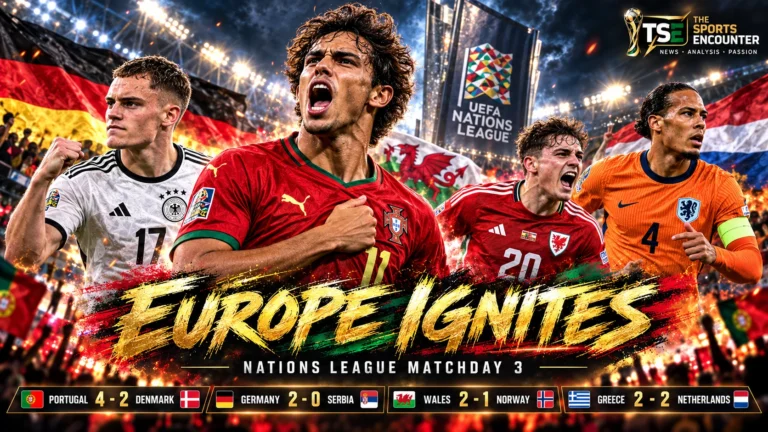 SoccerNations League: Portugal Pull Clear and Klopp Finally Wins Amid Norway’s Shocking Defeat Against Wales
 SoccerFrance’s 14-Minute Blitz, Gyökeres’ Streak and Hungary’s Late Strike Reshape Nations League
Frequently Asked Questions
What Is Portugal’s Current FIFA Ranking?
Portugal are fifth in the latest FIFA/Coca-Cola Men’s World Ranking released on October 7, 2026.
How Many Places Did Portugal Climb?
Portugal rose two positions from seventh to fifth.
Which Teams Did Portugal Overtake?
Portugal moved ahead of Brazil and Morocco, who dropped to sixth and seventh respectively.
Who Is No. 1 in the FIFA Men’s Ranking?
Spain remain No. 1 following their 2026 World Cup victory and four consecutive UEFA Nations League wins.
Who Are the Top Five Teams in the FIFA Ranking?
The current top five are Spain, Argentina, France, England and Portugal.
Why Did Portugal Move Up the FIFA Ranking?
Portugal won all four of their opening UEFA Nations League matches against Wales, Norway twice and Denmark, giving them a perfect competitive record during the ranking period.
Has Portugal Qualified for the Nations League Quarterfinals?
Yes. Portugal secured a top-two place in League A Group 4 after beating Norway 2-1 on October 4.
Did Portugal Win Without Cristiano Ronaldo?
Yes. Portugal beat Denmark 4-2 and Norway 2-1 after Ronaldo left the national-team camp. Those results showed the team could maintain its winning form without him.
What Is Portugal’s Highest-Ever FIFA Ranking?
Portugal’s historical high is third place.
When Is the Next FIFA Men’s Ranking Update?
The next official FIFA/Coca-Cola Men’s World Ranking is scheduled for November 18, 2026.
Portugal
- Portugal Climb to FIFA No. 5 as Four Wins Push World Cup Exit Into the Past
- Portugal Reach Nations League QFs, Netherlands Go Top, Germany Stall, But Denmark Punish Wales
- Nations League: Portugal Pull Clear and Klopp Finally Wins Amid Norway’s Shocking Defeat Against Wales
- Who Is Rodrigo Mora? Meet Portugal’s 19-Year-Old Star Behind That Bicycle Kick
- Portugal Beat Norway Without Ronaldo Starting as Félix and Ramos Take Over Nations League