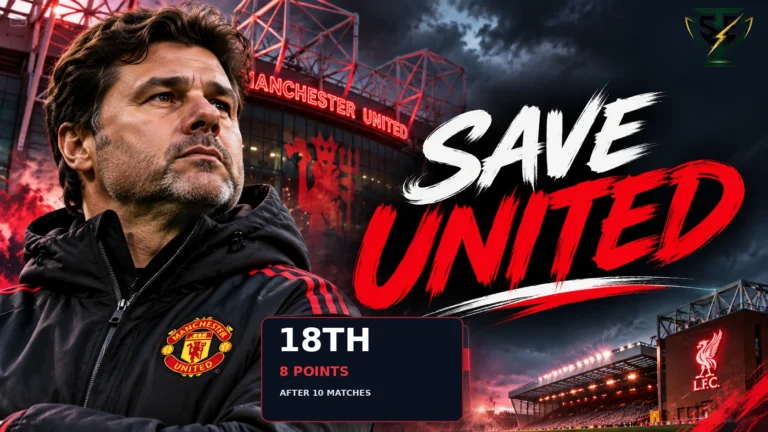
MANCHESTER, England, November 19, 2026: Mauricio Pochettino has inherited a Manchester United team facing a question that would have seemed unthinkable during its decades of domestic dominance: how many points will the club need to avoid relegation? The Argentine arrived at Carrington on Wednesday, less than a day after completing his responsibilities with the United States national team, to find the 20-time English champions 18th in the Premier League. United have won just once in ten matches, collected eight points from a possible 30 and dismissed Michael Carrick only months after he guided them to a third-place finish.
The Pochettino Manchester United appointment is therefore about survival before restoration. His first assignment comes on November 22 against Liverpool at Anfield, one of the most emotionally charged fixtures in English soccer. But the more revealing challenge lies beyond that rivalry. United have been outrun by their opponents in eight of ten league matches, their defensive organization has repeatedly failed, and another managerial change has left the club searching for consistency. Pochettino built his reputation on pressing, intensity and player development. He now has 28 league matches to establish whether those qualities can rescue a team that has lost its direction.
TL;DR: Pochettino’s Manchester United Relegation Challenge
- New manager: Mauricio Pochettino officially began work at Manchester United on November 18, 2026.
- Premier League position: United sit 18th after ten matches, with eight points.
- Managerial change: Michael Carrick was dismissed on November 12 after a disastrous start to the season.
- Immediate challenge: Liverpool host United at Anfield on Sunday, November 22.
- Preparation time: Pochettino arrived following his final two matches with the United States against Haiti.
- Tactical warning: United have been outrun in eight of their first ten league matches.
- Historical context: Their eight-point opening is the club’s worst start at this stage of a top-flight season since 1986-87.
- Survival mathematics: A hypothetical 40-point finish would require 32 points from the remaining 28 matches.
- Central question: Can Pochettino restore defensive stability and collective discipline before the club’s poor start becomes a sustained relegation fight?
Manchester United’s Relegation Crisis Is No Longer a Hypothetical Warning
Manchester United’s position after ten league matches provides the clearest evidence of the scale of the challenge.
The club has eight points from 30 available, averaging 0.8 points per match.
Story at a glance

Manchester United’s Relegation Crisis Is No Longer a Hypothetical Warning
Manchester United’s position after ten league matches provides the clearest evidence of the scale of the challenge.
Manchester United’s Survival Mathematics: What Eight Points From Ten Games Really Means
The Premier League season consists of 38 matches.
Why Pochettino’s Arrival at Carrington Came So Late
Manchester United announced Pochettino’s appointment on November 13, but the Argentine could not immediately begin work with his new players.
Liverpool at Anfield: The Worst Possible First Assignment or an Opportunity?
Pochettino begins his Manchester United tenure against Liverpool on November 22.
Manchester United Have Been Outrun in Eight of Ten Premier League Matches
One of the most interesting findings surrounding Pochettino’s appointment concerns United’s physical output.
That is not simply an underwhelming return for a team hoping to qualify for European competition. It is the kind of early-season performance associated with clubs fighting to remain in the Premier League.
United’s situation is especially startling because the team finished third under Carrick in 2025-26.
That achievement had suggested the organization was moving toward stability after years of expensive recruitment, managerial changes and disappointing league finishes.
Instead, the improvement has collapsed within months.
United’s 4-4 draw with Aston Villa before the November international break proved Carrick’s final match.
The result exposed familiar defensive vulnerabilities and left the club in the relegation zone.
Carrick’s dismissal on November 12 concluded another abbreviated chapter in United’s long search for a sustainable footballing identity.
The circumstances surrounding that decision were examined in The Sports Encounter’s report on Carrick’s dismissal.
Pochettino’s task is more complicated than immediately improving results.
He must determine which of United’s problems can be corrected through coaching and which require deeper organizational changes.
Manchester United’s Survival Mathematics: What Eight Points From Ten Games Really Means
The Premier League season consists of 38 matches.
United have completed ten, leaving 28 opportunities to collect points.
The club’s existing eight-point total means that reaching different survival benchmarks will require a substantial improvement in results.
There is no universal points total that guarantees safety in every season. The position of the 17th-place team and the results of competing clubs ultimately determine the relegation threshold.
However, examining several hypothetical totals illustrates the improvement United may need.
Manchester United Relegation Survival Scenarios
| Final points target | Additional points needed | Points per remaining match | Change from current pace |
|---|---|---|---|
| 35 points | 27 | 0.96 | 20.5% increase |
| 38 points | 30 | 1.07 | 33.9% increase |
| 40 points | 32 | 1.14 | 42.9% increase |
| 45 points | 37 | 1.32 | 65.2% increase |
| 50 points | 42 | 1.50 | 87.5% increase |
TSE original statistical insight: United would need to increase their average points return by approximately 43% over the remaining 28 matches to finish on 40 points.
That target could be reached through different combinations of wins and draws.
For example, ten wins and two draws would supply 32 additional points, although that would require winning ten of the remaining 28 league matches.
Another combination of eight wins and eight draws would also produce 32 points.
Neither outcome represents a prediction, and 40 points is not a guaranteed survival threshold.
The calculation demonstrates why the club cannot depend on reputation, historical success or a short emotional response to a new manager.
United need a measurable improvement in results over several months.
Why Pochettino’s Arrival at Carrington Came So Late
Manchester United announced Pochettino’s appointment on November 13, but the Argentine could not immediately begin work with his new players.
He had committed to completing the United States national team’s CONCACAF Nations League quarterfinal against Haiti.
The matches took place on November 14 and 17.
The United States advanced to the Nations League Finals after completing the tie with a 2-0 victory in Cincinnati in Pochettino’s last match in charge.
He then traveled across the Atlantic to begin work in Manchester.
United confirmed that their new manager reached Carrington on November 18, toured the training complex and met players and staff.
The club’s official arrival announcement confirmed the beginning of his tenure.
The delay creates an unusual preparation problem.
Pochettino has arrived during an international break, which ordinarily provides a new manager with an opportunity to organize training sessions and introduce tactical principles.
Instead, he has only a few days before one of the most demanding away fixtures in English soccer.
Some players will also have been returning from international duty, reducing the time available for full-squad preparation.
The significance of that compressed schedule is not that Pochettino cannot make changes.
It is that complex tactical changes may be difficult to implement immediately.
Liverpool at Anfield: The Worst Possible First Assignment or an Opportunity?
Pochettino begins his Manchester United tenure against Liverpool on November 22.
Kickoff is scheduled for 4:30 p.m. local time at Anfield.
United’s greatest domestic rivals provide a demanding introduction because the fixture carries expectations that extend far beyond the league table.
For supporters, a defeat to Liverpool can feel more consequential than an ordinary league loss.
For Pochettino, however, the primary objective must be establishing a more reliable competitive performance.
A new manager may be tempted to create an immediate impression through aggressive pressing, higher defensive positioning or major selection changes.
Those decisions carry risks when players have had limited time to adjust.
Anfield is not the ideal venue to introduce a complicated tactical system without sufficient preparation.
United’s coaching staff therefore faces a practical decision: prioritize immediate defensive stability or begin implementing the high-intensity approach associated with Pochettino’s previous teams.
The official Premier League analysis of the coming fixtures identifies Liverpool as Pochettino’s first major test and highlights opportunities for improvement in subsequent matches.
Pochettino’s First Match: Tactical Priorities Against Liverpool
| Priority | Immediate objective | Risk if neglected |
|---|---|---|
| Defensive spacing | Keep the back line and midfield connected | Large gaps for Liverpool to attack |
| Pressing discipline | Choose clear moments to press | Players pressing individually and exposing teammates |
| Transition defense | Protect central areas when possession is lost | Repeated counterattacks |
| Ball progression | Create reliable passing routes out of defense | Possession surrendered in dangerous areas |
| Set pieces | Clarify marking and second-ball responsibilities | Preventable scoring opportunities |
| Emotional control | Respond constructively to pressure and setbacks | Rushed decisions and unnecessary fouls |
These are TSE’s proposed tactical priorities, not an officially announced Pochettino game plan.
Manchester United Have Been Outrun in Eight of Ten Premier League Matches
One of the most interesting findings surrounding Pochettino’s appointment concerns United’s physical output.
Premier League analysis published this week found that United have been outrun by their opponents in eight of ten league matches.
The club averages approximately 112.5 kilometers per match.
Only Liverpool, averaging 111.2 kilometers, had covered less ground among the teams highlighted in that comparison.
That creates an apparent contradiction.
Liverpool can cover comparatively little total distance while remaining capable of competing at the highest level.
United’s low distance figures, meanwhile, coincide with a disastrous start to the campaign.
The lesson is that running farther does not automatically produce better results.
Good teams often reduce unnecessary movement through superior positioning, possession control and coordinated pressing.
But when a team struggles to maintain possession, defend transitions and control opponents, limited running output can become part of a broader tactical concern.
Pochettino must determine whether United’s problem is insufficient physical intensity, poor organization or a combination of both.
Manchester United’s Early-Season Performance Indicators
| Indicator | Verified figure | Interpretation |
|---|---|---|
| Premier League position | 18th | Inside relegation zone |
| Matches played | 10 | 28 league fixtures remain |
| Points | 8 | 0.8 points per match |
| Wins | 1 | Victory in only 10% of matches |
| Available points secured | 8 of 30 | 26.7% of possible points |
| Matches in which opponents outran United | 8 of 10 | Potential concern over physical and tactical organization |
| Average distance covered | 112.5 km per match | Among the league’s lowest totals |
| Comparison: Liverpool | 111.2 km per match | Demonstrates that distance alone does not determine success |
TSE’s original analytical finding: United’s biggest problem is not necessarily how far their players run. It is whether their movement serves a coherent tactical purpose.
A coordinated team can defend effectively while covering fewer kilometers than an opponent.
An uncoordinated team can exhaust itself without preventing chances.
The key measurement for Pochettino will be whether United become more difficult to play through, not simply whether their weekly running figures increase.
What Pochettino’s Tottenham Years Tell Us About His Methods
Pochettino’s managerial reputation was largely established during his work with Southampton and Tottenham Hotspur.
At Southampton, he developed a team recognized for aggressive pressing and an emphasis on younger players.
His Tottenham tenure between 2014 and 2019 brought sustained improvement and culminated in a Champions League final appearance in 2019.
His teams were often characterized by coordinated pressure, rapid transitions and a willingness to trust players capable of adapting to demanding physical and tactical instructions.
Harry Kane and Dele Alli were among those whose development became closely associated with that period.
However, Tottenham’s success was not simply the consequence of increased running.
The team developed established attacking combinations, consistent roles and defensive relationships that improved over time.
That is the difficult part of replicating his approach at Manchester United.
There is limited value in demanding relentless pressing if the players do not understand the positioning required behind the initial pressure.
Against strong opponents, poorly coordinated pressing can leave central defenders exposed.
United have already demonstrated difficulties protecting defensive spaces.
Pochettino’s success will therefore depend on how quickly he can simplify instructions and establish reliable collective behavior.
Why the Chelsea and PSG Chapters Matter to United’s New Manager
Pochettino’s managerial career also contains lessons about the limitations of coaching within complicated organizations.
At Paris Saint-Germain, he won the French league title but faced the demands of managing a squad dominated by some of the game’s most prominent personalities.
At Chelsea, he worked with a younger group undergoing substantial recruitment and organizational change.
His Chelsea side improved during the latter stages of the 2023-24 campaign, yet he departed after only one season.
The two experiences illustrate different challenges.
At PSG, the issue involved building collective cohesion around major established stars.
At Chelsea, the challenge involved developing consistency among younger players while navigating external pressure.
Manchester United’s situation contains elements of both.
The club has international stars, emerging players, intense media scrutiny and a long record of changing managers before a stable playing identity becomes established.
That context makes Pochettino’s appointment a test of organizational patience as well as tactical expertise.
The U.S. National Team Departure Adds Another Dimension to the Story
Pochettino’s return to club management follows a period leading the United States men’s national team.
He took charge in September 2024 and guided the program through the 2026 World Cup on home soil.
His tenure included 21 victories, 12 defeats and two draws across 35 matches, according to U.S. Soccer’s announcement of his departure.
The organization had extended his agreement through 2030 in August, making his decision to accept the Manchester United position particularly significant.
U.S. Soccer subsequently confirmed that his final assignment would be the Nations League quarterfinal against Haiti.
The official U.S. Soccer departure announcement provides his tenure record and the circumstances of the transition.
The timing leaves both organizations with major adjustments.
The United States must appoint a successor, while Pochettino must quickly move from international preparation cycles to the weekly demands of Premier League management.
At international level, coaches generally work with players during limited windows.
At club level, they can develop tactics through daily training, but they also face continuous match pressure and greater scrutiny of short-term results.
Pochettino’s ability to manage that transition will be an early feature of his Manchester United tenure.
Manchester United’s Real Problem Began Long Before Carrick Was Sacked
There is a danger that the focus on Pochettino’s appointment will obscure the longer history of United’s difficulties.
The club has changed managers repeatedly since Sir Alex Ferguson retired in 2013.
Different coaches have introduced different systems, recruitment priorities and expectations.
Some delivered trophies. Others achieved short periods of league improvement.
But the organization has struggled to maintain progress across successive seasons.
The latest collapse is particularly alarming because Carrick appeared to have established meaningful progress during the previous campaign.
Finishing third suggested that United had found a competitive structure.
Ten matches into 2026-27, that structure appears to have broken down.
The contradiction was examined in TSE’s investigation into United’s decline since Ferguson.
Another detailed analysis explored how Carrick’s tactical choices, injuries and fixture congestion contributed to the team’s problems.
The combined lesson is that replacing a manager may alter the immediate direction of a team without automatically resolving its structural weaknesses.
The Turning Point: From a Third-Place Finish to the Relegation Zone
The most revealing feature of United’s crisis is the speed of the deterioration.
In May, the club could reasonably approach the new season with expectations of building on a third-place finish.
By November, the discussion had changed from European qualification to avoiding relegation.
The club has not won the English league title since Ferguson’s final campaign in 2012-13.
But even during the difficult years since his retirement, United have generally operated with expectations of competing for European places.
The present situation represents a deeper threat to that identity.
For a club with United’s financial resources and global support, finishing in the bottom three would have substantial sporting, commercial and reputational consequences.
Those consequences are not yet inevitable.
Twenty-eight league matches remain, giving the club time to recover.
But the margin for treating disappointing performances as isolated incidents has narrowed considerably.
Five Tactical Changes Pochettino Should Prioritize
Pochettino cannot rebuild every element of Manchester United’s playing identity in his first week.
A more realistic approach would involve establishing a limited set of priorities and measuring progress against them.
United’s Proposed Recovery Plan
| Priority | Proposed intervention | Measurable performance indicator |
|---|---|---|
| 1. Defensive compactness | Reduce distances between midfield and defense | Opposition entries into central defensive areas |
| 2. Coordinated pressing | Use common triggers instead of isolated pressure | High turnovers won and chances conceded after unsuccessful presses |
| 3. Transition protection | Maintain covering players behind attacking moves | Counterattacks and shots conceded following possession losses |
| 4. Clearer attacking roles | Define passing and movement responsibilities | Progressive passes, box entries and chances created |
| 5. Physical load management | Balance intensity with recovery and squad availability | Player availability, high-intensity actions and training response |
These recommendations are original editorial analysis, not statements of Pochettino’s announced coaching plans.
They also provide a way to evaluate progress beyond final scores.
United might lose a difficult early fixture while showing improvements in positioning, pressing coordination and chance prevention.
Conversely, an isolated victory would not necessarily demonstrate that their underlying problems have been resolved.
Does Pochettino Need to Abandon High Pressing to Avoid Relegation?
The question creates a false choice.
Pochettino does not need to abandon the principles that helped establish his reputation.
He may, however, need to introduce them more gradually.
Teams fighting relegation often require immediate stability before attempting more complicated tactical changes.
United’s defenders have already struggled with the spaces created when attacking players lose possession.
Increasing the intensity of pressure without improving collective positioning could make those weaknesses worse.
A more controlled pressing structure would allow the team to choose moments when opponents are vulnerable.
The objective should be to force mistakes without leaving large gaps behind the first line of pressure.
That requires discipline from forwards, midfielders and defenders rather than simply asking players to run harder.
Pochettino’s Biggest Advantage May Be United’s Younger Players
One potential source of optimism is the age profile of the Manchester United squad.
Premier League analysis identified seven senior-squad players aged 22 or younger around the time of Pochettino’s appointment.
Young players can benefit from clear coaching, consistent roles and a manager willing to invest in their development.
That was an important feature of Pochettino’s work at Southampton and Tottenham.
However, youth is not automatically an advantage during a relegation battle.
Less experienced players may find it difficult to manage the emotional pressure of repeated defeats and intense public criticism.
Pochettino must therefore balance opportunities for younger players with the need for experienced leadership.
His task is to create an environment where development and immediate results support one another.
The First Five Matches Should Be Judged as a Recovery Sequence
A debut at Anfield will attract enormous attention, but it should not become the sole measure of Pochettino’s appointment.
United’s immediate league schedule includes Liverpool away, followed by matches against Brentford, Newcastle United, Coventry City and Crystal Palace.
Those fixtures present different tactical challenges and varying opportunities to collect points.
The manager’s first five league games will provide a more useful indication of whether the team is improving than the result of one rivalry match.
Pochettino’s Early Premier League Priorities
| Opponent | Venue | Primary test |
|---|---|---|
| Liverpool | Away | Defensive discipline and managing pressure |
| Brentford | Home | Control, chance creation and converting home advantage |
| Newcastle United | Away | Competing for second balls and transition control |
| Coventry City | Home | Breaking down resistance and maintaining concentration |
| Crystal Palace | Away | Physical balance, wide-area defense and consistency |
The sequence follows the fixtures identified in Premier League analysis. Specific dates beyond the confirmed Liverpool fixture should be checked against the latest schedule before publication or match-day updating.
The important distinction is between immediate results and sustainable improvement.
United need points urgently, but they also need performances that can be repeated.
An occasional victory followed by another defensive collapse would leave the club vulnerable.
Could Manchester United Really Be Relegated?
The possibility is real because United are currently inside the bottom three.
But it would be misleading to describe relegation as inevitable with more than two-thirds of the league campaign still to play.
The club has the time and player resources to recover.
The central uncertainty is whether Pochettino can establish sufficient consistency.
At their current rate of 0.8 points per match, United would finish with approximately 30 points over a full 38-game season.
That figure is a simple projection, not a prediction.
It demonstrates why continuing at the existing pace would be dangerous.
Improving to approximately 1.14 points per match over the remaining fixtures would produce a 40-point finish.
Maintaining 1.5 points per match would take United to 50 points, a much more comfortable total in typical Premier League seasons.
The difference between those scenarios is considerable.
It is also why the first several weeks of Pochettino’s tenure will be so important.
What Happens if Pochettino Cannot Reverse Manchester United’s Decline?
The consequences of failing to improve would extend well beyond the league table.
Relegation would affect United’s sporting income, recruitment strategy, commercial position and ability to retain leading players.
Even finishing comfortably above the bottom three without challenging for Europe would represent a disappointing season following last year’s third-place finish.
That creates two different standards of success.
The immediate standard is ensuring that the club remains in the Premier League.
The longer-term standard is rebuilding a team capable of competing consistently with the division’s leading clubs.
Pochettino cannot realistically be expected to complete both objectives in a few weeks.
But supporters will expect evidence that the club has stopped deteriorating.
TSE’s earlier investigation, Why Manchester United Keep Failing Despite Rebuilds, examined the repeated structural problems behind the club’s inconsistency.
Another report documented the widening contrast between Manchester United and Manchester City during their October setbacks.
Both provide important context for why another coaching appointment must be accompanied by organizational clarity.
Why This Appointment Is Different From United’s Previous Managerial Changes
The decisive difference is the immediate competitive threat.
Several previous Manchester United managers arrived with ambitions of restoring league titles, winning trophies or qualifying for the Champions League.
Pochettino arrives with the team 18th.
He cannot ignore the long-term expectations attached to one of the world’s biggest clubs, but he must first address the problem directly in front of him.
That means collecting points, protecting vulnerable defensive areas and rebuilding confidence after an extended run of disappointing results.
His appointment is not a guarantee of a revival.
It is an opportunity to establish a new competitive foundation.
The Sports Encounter covered the initial agreement in its November 13 report on Pochettino’s move from the United States to Manchester United.
Now that the manager has arrived, the debate must move beyond the appointment itself.
His performance should be assessed against tangible progress on the field.
Continue the Premier League Story



Frequently Asked Questions About Pochettino and Manchester United
When did Mauricio Pochettino officially start at Manchester United?
Pochettino began work at Manchester United on November 18, 2026, after completing his final responsibilities with the United States men’s national team.
Why did Manchester United sack Michael Carrick?
Carrick was dismissed on November 12 following a disastrous opening ten Premier League matches that left United 18th with eight points.
What position are Manchester United in the Premier League?
United are 18th after ten matches, with eight points from one win, five draws and four defeats.
Who is Pochettino’s first opponent as Manchester United manager?
Liverpool will host Manchester United at Anfield on Sunday, November 22, 2026.
When was Manchester United last relegated?
Manchester United were last relegated from England’s top division at the end of the 1973-74 season and returned to the First Division the following season.
How many points do Manchester United need to avoid relegation?
There is no fixed survival total. A hypothetical 40-point finish would require another 32 points from United’s remaining 28 matches, but the actual threshold depends on other clubs’ results.
What is Mauricio Pochettino’s preferred playing style?
His teams have commonly emphasized coordinated pressing, aggressive transitions, player development and organized movement without the ball. The system he adopts at United will depend on the squad and available preparation time.
Why did Pochettino leave the United States national team?
He accepted the Manchester United coaching position after the club approached him. He completed his final two matches against Haiti before leaving the U.S. national team.
Can Pochettino save Manchester United from relegation?
United have 28 league matches remaining, leaving time for recovery. Survival will depend on improving their points return, defensive organization and consistency. No outcome can be guaranteed at this stage.
Final Verdict: Pochettino Must Save the Present Before Rebuilding United’s Future
The Pochettino Manchester United appointment has created fresh optimism, but the club’s problems cannot be solved through reputation alone.
Eight points from ten matches is a serious warning for a team that finished third only months earlier.
The new manager brings experience in developing players, organizing aggressive pressing systems and improving teams over time.
But time is precisely the resource Manchester United cannot afford to waste.
Pochettino’s first match at Anfield may define the immediate headlines, yet his success will be determined by the weeks and months that follow.
The central objectives are clear: make United harder to beat, restore a consistent tactical identity and collect enough points to move decisively away from the relegation zone.
Winning a rivalry match would provide an encouraging start. Establishing a sustainable run of results would mean considerably more.
Manchester United have spent more than a decade trying to recreate the standards of their most successful era.
For now, Pochettino faces a much more urgent responsibility: ensuring that one of English soccer’s most decorated clubs does not experience the most humiliating collapse in its modern history.