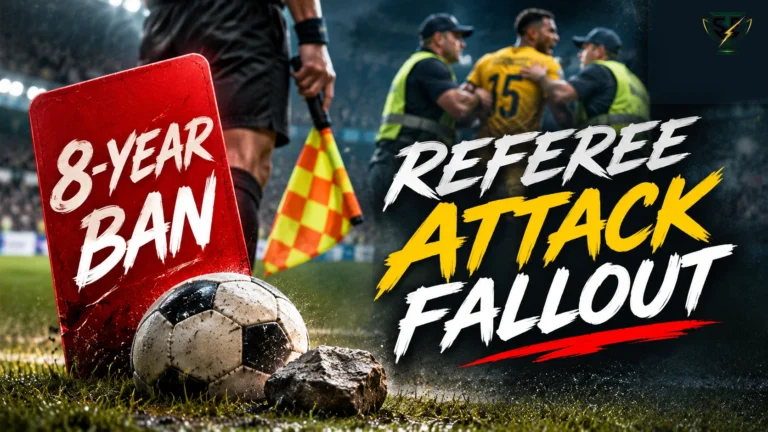
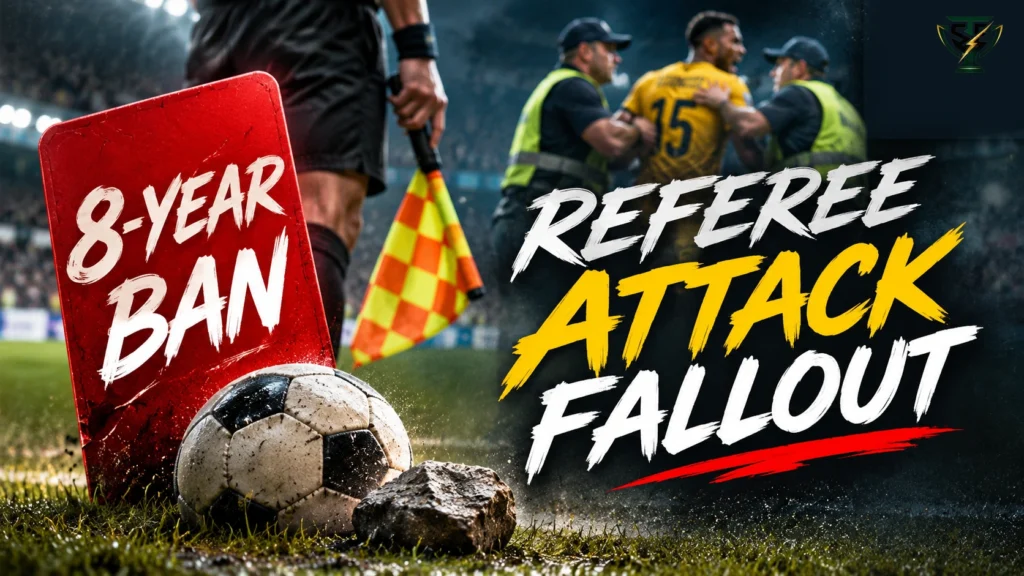
QUITO, Ecuador, November 20, 2026: Ecuador’s football federation has suspended Jhon Michel Perlaza Salas for eight years after finding him responsible for throwing a stone that struck assistant referee Lenin Giovanni Ojeda Núñez in the face during a third-tier match. The official required surgery and was assessed as needing 60 days to recover. Perlaza’s suspension runs until October 19, 2034, and the federation intends to ask FIFA to recognize it worldwide.
The Jhon Perlaza ban is only one part of a wider disciplinary decision. Club Ciudad de Yantzaza must pay a $2,000 fine and reimburse $4,369.73 in medical expenses, while losing the right to host its next three matches at Municipal de Yantzaza stadium. Taken together, those measures raise a more consequential question than whether one player deserved a lengthy suspension: what must a football organization do to protect officials before an incident turns into a medical emergency?
Key Takeaways
- Ecuador’s football federation has suspended Jhon Michel Perlaza Salas for eight years after finding him responsible for throwing a stone that struck assistant referee Lenin Giovanni Ojeda Núñez in the face during a third-tier match.
- The attack occurred in the 96th minute of the October 17 fixture between Ciudad de Yantzaza and Río Aguarico FC, part of Group D in the Ascenso Nacional competition.
- The federation issued its decision on November 18 under disciplinary file CD-035-2026.
- Ciudad de Yantzaza publicly apologized to referees and supporters on October 20, and said it had removed Perlaza from the club after identifying his responsibility.
Jhon Perlaza Ban: What Ecuador’s Disciplinary Committee Established
The attack occurred in the 96th minute of the October 17 fixture between Ciudad de Yantzaza and Río Aguarico FC, part of Group D in the Ascenso Nacional competition. According to the federation’s disciplinary findings, Perlaza threw a stone from his team’s substitutes’ bench. It struck assistant referee Ojeda Núñez in the face, and the match was abandoned.
Story at a glance
Jhon Perlaza Ban: What Ecuador’s Disciplinary Committee Established
The attack occurred in the 96th minute of the October 17 fixture between Ciudad de Yantzaza and Río Aguarico FC, part of Group D in the Ascenso Nacional competition. According to the federation’s disciplinary findings, Perlaza threw a stone from his team’s substitutes’ bench. It struck assistant referee Ojeda Núñez in the face, and the match was abandoned.
The Referee’s Injury Is the Central Fact, Not the Length of the Punishment
Ojeda Núñez required surgery after the stone struck his face. The federation reported a 60-day recovery period, making the physical harm central to its decision. That stated period is an assessment, not proof that the assistant referee has already recovered or that his longer-term condition is known.
Why the Club Was Punished Even After Removing the Player
Ciudad de Yantzaza publicly apologized to referees and supporters on October 20, and said it had removed Perlaza from the club after identifying his responsibility. That response came before the final federation sanction. Yet the club’s decision to part ways with him did not end its own disciplinary exposure.
Why a Red Card Would Never Have Been an Adequate Final Response
Football’s playing rules and disciplinary systems serve different purposes. The referee can punish violent conduct during a match, including by dismissing a player. A national federation can subsequently investigate serious misconduct and impose sanctions affecting future participation.
How Does an Eight-Year Ban Compare With Other Football Sanctions?
The number is extraordinary in ordinary match terms. Even serious red-card offenses more commonly result in suspensions measured in matches rather than years. But comparisons are only useful when the underlying conduct is alike.
The Jhon Perlaza ban turns on where and how the assault occurred. This was not a reckless tackle during a contest for possession or an accidental collision involving two players. The federation judged it to be physical aggression against a match official from the bench, outside the normal actions of play. That distinction is central to why the disciplinary response extended far beyond the usual punishment for a foul.
The federation issued its decision on November 18 under disciplinary file CD-035-2026. Ecuadorian reporting on the official FEF disciplinary announcement provides the ruling’s details, including the player’s ban, the club’s sanctions and the right to appeal. The decision is not described as a criminal conviction, and no separate criminal outcome should be inferred from it.
What the Jhon Perlaza Ban Actually Prevents
Perlaza’s eight-year exclusion covers football-related activity under Ecuador’s disciplinary jurisdiction, not merely appearances in competitive matches. Its stated end date is October 19, 2034. The federation has announced a further step: it will request that FIFA extend the sanction internationally.
That request does not mean FIFA has already approved worldwide recognition. International extension requires its own process. Until an official FIFA decision is established, it is inaccurate to describe the sanction as a completed global ban.
The distinction has practical consequences. A purely domestic suspension controls participation within the issuing association’s jurisdiction; international recognition can stop a sanctioned person from escaping that restriction simply by moving to another football association. FIFA’s disciplinary and ethics reporting confirms that requests for worldwide extension are an established part of its judicial workload.
The Referee’s Injury Is the Central Fact, Not the Length of the Punishment
Ojeda Núñez required surgery after the stone struck his face. The federation reported a 60-day recovery period, making the physical harm central to its decision. That stated period is an assessment, not proof that the assistant referee has already recovered or that his longer-term condition is known.
In reporting referee violence, the person injured must not disappear behind dramatic descriptions of the offender’s punishment. The immediate consequence here was the loss of an official’s ability to perform his duties and the need for medical treatment. An abandoned game, disciplinary hearing and years-long ban came afterward.
The case also highlights the particular vulnerability of assistant referees. Their work places them close to technical areas, substitutes, coaching staff and spectators while they monitor offside positions, boundary decisions and misconduct. They cannot simply retreat from those locations without abandoning their responsibilities.
Referee protection is therefore a matter of match organization as well as player behavior. The questions extend to supervision of the technical area, access to objects that can be thrown, rapid security intervention and procedures for removing endangered officials. None of those precautions excuses the individual act found by the disciplinary committee.
The Sports Encounter’s examination of the growing scrutiny of referees addressed the pressures officials face at the sport’s highest level. In Yantzaza, the issue was more basic: whether an official could carry out his work without being physically attacked.
Why the Club Was Punished Even After Removing the Player
Ciudad de Yantzaza publicly apologized to referees and supporters on October 20, and said it had removed Perlaza from the club after identifying his responsibility. That response came before the final federation sanction. Yet the club’s decision to part ways with him did not end its own disciplinary exposure.
The federation also held the club responsible for failures connected to its obligations as the home team. It imposed a $2,000 fine, required reimbursement of the assistant referee’s $4,369.73 medical expenses and barred the club from staging its next three home games at Municipal de Yantzaza stadium.
| Party | Measure | Purpose or effect |
|---|---|---|
| Jhon Michel Perlaza Salas | Eight-year suspension through October 19, 2034 | Individual disciplinary sanction |
| Ciudad de Yantzaza | $2,000 fine | Club-level accountability |
| Ciudad de Yantzaza | $4,369.73 medical reimbursement | Addresses the injured official’s reported expenses |
| Ciudad de Yantzaza | Three home matches away from Municipal de Yantzaza | Stadium-related restriction |
| FEF / FIFA | Worldwide extension to be requested | Not confirmed as internationally imposed |
The Jhon Perlaza ban did not exhaust the federation’s response. The club’s two monetary obligations total $6,369.73. That is a straightforward sum of the announced fine and medical reimbursement, not an estimate of all the losses caused by the incident. The referee’s pain, time away from work and any unreported expenses cannot be reduced to that figure.
The home-ground restriction also separates two issues that football debates often blur: misconduct by an individual participant and responsibility for providing a safe venue. The player is punished for the aggression; the club faces consequences relating to its own duties. Neither measure substitutes for the other.
That broader principle can be seen in TSE’s coverage of Rayo Vallecano’s stadium sanction, although that case involved objects thrown during a protest and should not be equated with a stone that seriously injured an official.
Why a Red Card Would Never Have Been an Adequate Final Response
Football’s playing rules and disciplinary systems serve different purposes. The referee can punish violent conduct during a match, including by dismissing a player. A national federation can subsequently investigate serious misconduct and impose sanctions affecting future participation.
The International Football Association Board’s Law 12 treats violent conduct against a match official as an offense warranting dismissal. It also addresses the throwing of objects at officials or other participants. Those provisions establish the on-field framework, but they do not themselves prescribe Ecuador’s eight-year disciplinary term.
The length of this suspension came from the national disciplinary process, taking account of the offense and the harm. Comparing it directly with a one-match dismissal for a dangerous challenge would ignore the difference between an incident arising in play and a deliberate attack from outside it.
TSE’s guide to fouls, misconduct and red cards explains these distinctions for readers. The Ecuador case demonstrates why a separate disciplinary process becomes necessary when misconduct exceeds what a referee can resolve within the normal course of a match.
How Does an Eight-Year Ban Compare With Other Football Sanctions?
The number is extraordinary in ordinary match terms. Even serious red-card offenses more commonly result in suspensions measured in matches rather than years. But comparisons are only useful when the underlying conduct is alike.
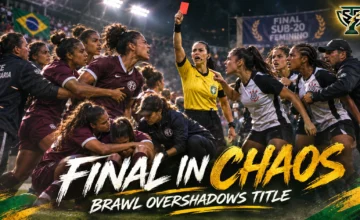
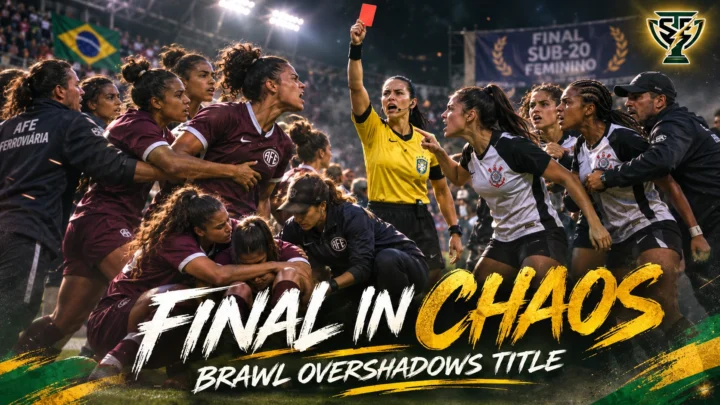
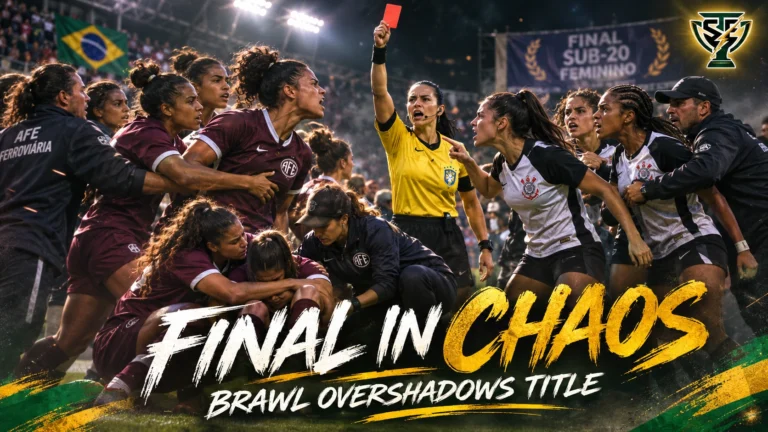
In recent TSE reporting, a brawl in Brazil’s women’s under-20 final raised questions about individual responsibility and possible disciplinary sanctions. That incident involved violent exchanges among participants. The Ecuador ruling concerns an object thrown at a match official that caused injuries requiring surgery. Different facts, proceedings and governing rules prevent a mechanical comparison of punishment lengths.
Continue the Soccer Story

Similarly, Vinícius Júnior’s dispute over referee treatment and a domestic suspension concerned the application of discipline to a player’s behavior, not an attack producing the documented injuries in Yantzaza.
A fair proportionality analysis asks what was proved, what harm occurred, what rules applied and whether the sanctioned party has an avenue to appeal. Under the federation’s published account, the decision can be challenged before the FEF appeals tribunal. A right of appeal matters even in cases involving disturbing conduct, because disciplinary authority also requires procedural safeguards.
Worldwide Recognition Is the Next Legal and Sporting Question
The FEF’s plan to seek worldwide extension is the largest unresolved consequence of the Jhon Perlaza ban. Without such recognition, the scope of the suspension remains a jurisdictional issue rather than a settled universal prohibition.
If FIFA extends the sanction, the implications could reach football activity under affiliated associations outside Ecuador. The precise reach would depend on FIFA’s decision and the terms it approves. That outcome should not be reported in advance.
There is also no confirmed basis in the material reviewed to state that the federation has imposed criminal punishment or that the referee’s medical outcome has been finalized. Sporting sanctions, possible proceedings outside sport and medical recovery are separate matters. Each requires its own evidence.
The case recalls a wider concern in TSE’s coverage of how new misconduct rules are enforced in Brazilian soccer: a disciplinary system must distinguish the rule breached, the person responsible and the consequences the authority has power to impose. The governing principle is consistent, even where the seriousness of the cases is dramatically different.
What Ecuadorian Football Must Learn From the Attack
A long suspension can remove an offender from the sport. It cannot by itself guarantee that the next assistant referee will be safer. The prevention question is whether organizers establish dependable security around technical areas, respond promptly to threatening behavior and create clear reporting channels for officials at lower levels of the game.
Those measures are especially important where match officials may work with fewer personnel and resources than their counterparts in major professional stadiums. The Ecuador ruling does not, on its own, demonstrate the prevalence of attacks across lower-division football. It does show how severe the consequences can become when protection fails in one match.
There are meaningful ways to evaluate a response without inventing a national trend: publish the final disciplinary reasoning, clarify the club’s breached security duties, confirm the status of any appeal, disclose FIFA’s decision on international recognition and provide verified updates about the injured official when appropriate and authorized.
The Jhon Perlaza ban is severe, but its lasting significance may rest on whether Ecuadorian football treats referee safety as an obligation to be enforced before an attack rather than only after one. Ojeda Núñez’s injury, the club’s financial liability and the proposed international sanction show three different consequences of the same incident. Preventing another official from facing them is the more demanding task.