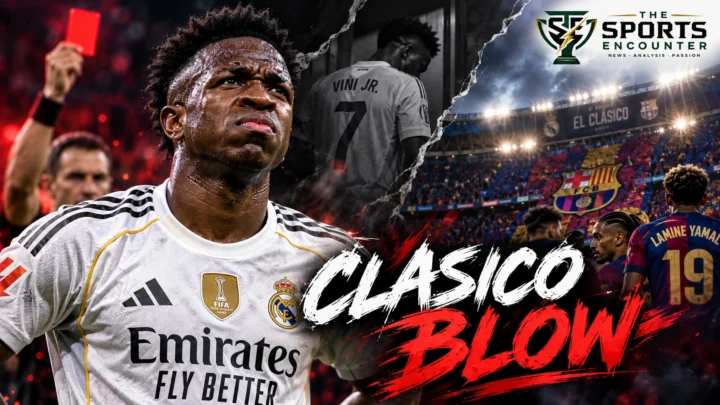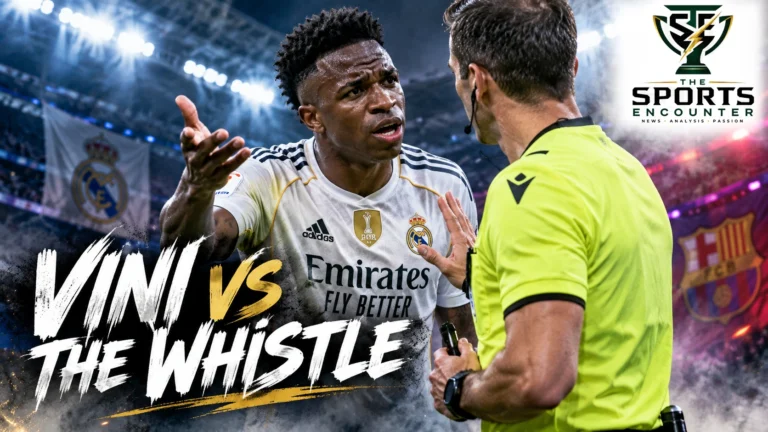
MADRID, Spain, October 15, 2026: Vinícius Júnior has accused referees of treating him unfairly and called for greater protection for attacking players, escalating his dispute with Spanish football officials a day after receiving a four-match La Liga suspension that will keep him out of Real Madrid’s October 25 Clásico against Barcelona. The Brazilian made his allegations following Madrid’s dramatic 4-3 Champions League victory over Roma on Wednesday, arguing that defenders repeatedly foul creative players while those same attackers are punished too readily for their reactions.
Vinícius defended his conduct during Madrid’s October 10 victory over Villarreal, when he pulled Nathan Saliba’s hair, had a goal disallowed and received a straight red card. His subsequent protests resulted in an additional disciplinary punishment. The forward also named Barcelona’s Lamine Yamal and Atlético Madrid’s Julián Álvarez as players deserving greater protection. José Mourinho criticized the timing of the suspension announcement, which arrived shortly before the Roma match, adding another dimension to a dispute already affecting Madrid’s preparation for El Clásico.
What Did Vinícius Júnior Say About Referees?
Vinícius believes the treatment he receives from referees differs from the protection afforded to defenders who repeatedly challenge him.
Speaking after the Champions League victory over Roma, the 26-year-old questioned both the length of his suspension and the wider disciplinary approach toward attacking players.
Story at a glance
What Did Vinícius Júnior Say About Referees?
Vinícius believes the treatment he receives from referees differs from the protection afforded to defenders who repeatedly challenge him.
What Does Vinícius’s Four-Match Suspension Actually Punish?
The Spanish Football Federation’s disciplinary decision concerns two separate incidents during Real Madrid’s 1-0 victory over Villarreal on October 10.
Vinícius Claims 500 Fouls Against Him Produced Only Five Red Cards
One of the most substantial claims in Vinícius’s remarks concerns the disciplinary consequences of repeated fouling.
Can Referees Protect Dribblers While Still Punishing Their Misconduct?
Vinícius’s complaint raises a question that applies to football beyond Spain.
José Mourinho Questions the Timing of the Suspension
Madrid coach José Mourinho raised a separate concern following the Champions League victory in Rome.
According to comments reported by the Associated Press on October 15, Vinícius argued that opposition defenders can commit repeated fouls while he risks receiving a yellow card for protesting.
He said the four-match punishment surprised him because he did not believe his conduct toward the referee warranted such a lengthy suspension.
His frustration was particularly evident when discussing the way officials respond to incidents involving him.
“But when it comes to Vini, it’s all too easy,” he said.
Vinícius also acknowledged that he has not been playing at his preferred level and expressed confidence that his best form will return.
The remarks indicate two concerns. One is the immediate punishment imposed after the Villarreal incident. The other is a broader belief that officials are inconsistent when assessing fouls committed against attacking players.
Those questions overlap, but they require separate examination.
Why Did He Mention Lamine Yamal and Julián Álvarez?
Vinícius extended his argument beyond Real Madrid by naming two prominent attacking players from rival clubs.
He identified Lamine Yamal of Barcelona and Julián Álvarez of Atlético Madrid as examples of footballers whose technical ability and willingness to attack defenders should receive appropriate protection.
By including players representing Madrid’s domestic rivals, the Brazilian presented the issue as a general refereeing concern rather than exclusively a dispute involving his own club.
His comments do not establish that either Yamal or Álvarez shares his assessment of Spanish referees.
They do, however, raise a legitimate sporting question: whether refereeing decisions consistently protect players who frequently carry the ball into areas where defenders must make difficult challenges.
TSE’s analysis of Yamal’s World Cup breakthrough examined how the teenager’s dribbling and creative movement regularly force opponents to reorganize their defensive positioning.
That style naturally produces physical contests, particularly when multiple defenders converge on the same attacker.
The important distinction is whether those challenges constitute legal defending, ordinary fouls, reckless offenses or more serious misconduct.
What Does Vinícius’s Four-Match Suspension Actually Punish?
The Spanish Football Federation’s disciplinary decision concerns two separate incidents during Real Madrid’s 1-0 victory over Villarreal on October 10.
The first involved Vinícius pulling Nathan Saliba’s hair during the buildup to a Madrid goal.
The second involved his reaction toward the match officials following his dismissal.
| Disciplinary Incident | Punishment | Basis |
|---|---|---|
| Hair pull involving Nathan Saliba | Two matches | Violent conduct outside a genuine challenge for the ball |
| Protests following the dismissal | Two matches | Separate misconduct toward match officials |
| Total suspension | Four matches | Two separately punished offenses |
The decision was announced on October 14, ruling Vinícius out of four domestic league fixtures.
The Sports Encounter’s detailed report on the suspension examined the disciplinary findings, the incident involving Saliba and the consequences for Mourinho’s team.
The distinction between the two punishments is important when considering Vinícius’s latest comments.
He argues that he did not use offensive language toward the referee. However, disciplinary misconduct does not necessarily depend on whether offensive words were spoken.
Conduct, gestures, persistent dissent and confrontation can also fall within football’s disciplinary framework.
What Do the Laws of the Game Say About Violent Conduct and Dissent?
The International Football Association Board’s Law 12 identifies violent conduct as a sending-off offense and recognizes dissent through words or actions as punishable misconduct.
It also distinguishes challenges made while genuinely contesting possession from certain acts committed away from a challenge for the ball.
That distinction was central to the assessment of Vinícius pulling Saliba’s hair.
The incident was reviewed by the video assistant referee before the on-field referee overturned Madrid’s apparent second goal and dismissed the Brazilian.
Real Madrid’s official Villarreal match report confirms the disallowed goal, the VAR intervention and the red card.
There is also an important difference between IFAB’s rules governing on-field disciplinary decisions and the Spanish federation’s subsequent process for determining the length of a suspension.
IFAB establishes the framework for identifying and punishing misconduct during matches. Competition-specific disciplinary regulations govern additional sanctions such as multi-match bans.
Therefore, Vinícius’s belief that a four-match suspension is excessive does not itself establish that the original red card was incorrect.
Vinícius Claims 500 Fouls Against Him Produced Only Five Red Cards
One of the most substantial claims in Vinícius’s remarks concerns the disciplinary consequences of repeated fouling.
He said he had been fouled approximately 500 times, with those incidents producing only five red cards for opposing players.
That statement deserves examination because it supplies a numerical basis for his argument.
However, the figures are attributed to Vinícius. An independently verified dataset establishing the period covered, the recorded fouls and the resulting disciplinary decisions was not available for this report.
Why the Numbers Alone Cannot Prove Refereeing Bias
Even if the figures are accurate, the relationship between total fouls and red cards requires care.
Most ordinary fouls do not meet the threshold for a sending-off.
A defender can concede a free kick through a careless challenge without necessarily committing a cautionable offense. A more dangerous challenge, persistent misconduct or a second bookable offense can produce a different disciplinary outcome.
Consequently, calculating the number of red cards against the total number of fouls would not, by itself, establish whether referees were applying the rules fairly.
There are several more useful questions:
- How many of the fouls against Vinícius involved reckless or excessive contact?
- How frequently did defenders receive yellow cards for those challenges?
- How many involved repeat offenders who had already been cautioned?
- Were similar incidents involving other attacking players punished differently?
- Did the same referees apply different disciplinary thresholds in comparable situations?
Answering those questions would require incident-level evidence, including match footage, the nature of each challenge, disciplinary records and meaningful comparisons across players.
Without that information, the allegation of inconsistent officiating remains a claim rather than an independently established finding.
Can Referees Protect Dribblers While Still Punishing Their Misconduct?
Vinícius’s complaint raises a question that applies to football beyond Spain.
Elite dribblers encourage defenders to attempt difficult challenges. They change direction quickly, draw opponents into physical contests and frequently receive contact while attempting to retain possession.
Those situations place considerable demands on referees.
Officials must distinguish genuine attempts to win the ball from reckless challenges and other prohibited conduct.
They must also apply disciplinary standards to the attacking players themselves.
That means it is possible for a forward to have a legitimate complaint about insufficient protection in one match while also committing an offense that warrants a dismissal in another.
Why Consistency Matters More Than Special Treatment
Vinícius’s argument is strongest when framed around comparable decisions rather than the reputation of individual players.
The Laws of the Game apply to every player, regardless of club, position, nationality or technical ability.
A dangerous challenge against Yamal should be assessed under the same standards as an equivalent challenge against Vinícius or Álvarez.
Likewise, a forward’s misconduct should not be excused simply because the player has previously been fouled repeatedly.
Consistency becomes especially difficult to assess when incidents are separated by different matches, referees and tactical circumstances.
Technology has added another dimension to those debates.
TSE’s investigation into VAR controversies at the 2026 World Cup examined how disputed interpretations and review procedures can undermine public confidence even when technology provides additional visual evidence.
The central principle applies here as well: consistent decisions depend on how officials interpret and enforce the rules, not simply on the availability of video replays.
José Mourinho Questions the Timing of the Suspension
Madrid coach José Mourinho raised a separate concern following the Champions League victory in Rome.
He questioned why the disciplinary decision was communicated so close to an important European fixture.
The coach said Madrid learned of the punishment approximately two hours before kickoff, while the team was traveling toward the stadium.
Describing the timing, Mourinho called it “disrespectful.”
His remarks appear in Real Madrid’s official postmatch press conference.
Mourinho’s objection concerned the announcement’s timing and its effect on preparations rather than establishing that the disciplinary judgment was legally invalid.
The distinction matters because the four-match punishment applies to La Liga.
Vinícius remained eligible for the Champions League match against Roma despite the domestic suspension.
Madrid won that contest 4-3 after trailing 3-1, with substitutes helping transform the second half.
TSE’s October 14 Champions League report reconstructed the comeback, including the contributions of Carlos Espí, Endrick and Antonio Rüdiger.
The European victory provided a welcome result, but it did not change Vinícius’s immediate domestic situation.
Vinícius Admits His Form Has Slipped as Madrid Prepare for Barcelona
The Brazilian’s complaints arrive during a period in which his performances have also attracted scrutiny.
Vinícius acknowledged after the Roma match that he has not been at his best and expressed confidence in his ability to recover his form.
That admission is important because Madrid’s current situation involves both player availability and attacking performance.
Earlier in the season, Vinícius delivered a goal and an assist as Real Madrid defeated Real Sociedad 4-1 at the Bernabéu.
TSE’s Real Sociedad match analysis explored how Vinícius, Kylian Mbappé and Jude Bellingham combined during Mourinho’s early months in charge.
Madrid also committed to Vinícius’s long-term future by extending his contract through 2032.
TSE’s report on that renewal examined his place in a changing attack and the positional competition created by Yan Diomande’s arrival.
Those developments provide context for the current uncertainty.
Vinícius remains an important player in Madrid’s long-term plans, but Mourinho must now prepare for several domestic fixtures without him.
Why the October 25 Clásico Raises the Stakes
Real Madrid are scheduled to face Barcelona on October 25 with the four-match suspension preventing Vinícius from participating unless the punishment is changed through the applicable disciplinary process.
Barcelona entered the latest round of reporting six points ahead of Madrid in the league standings.
Continue the La Liga Story
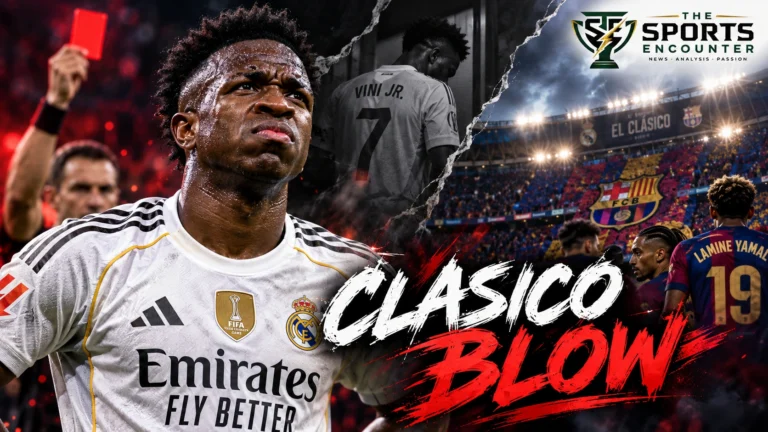

The absence of a direct, unpredictable winger could influence how Mourinho approaches transitions, counterattacks and wide attacking combinations.
Diomande has already shown his usefulness by scoring the winning goal against Villarreal.
However, one successful match does not establish that another player can reproduce Vinícius’s particular abilities over a sustained period.
Barcelona possess considerable attacking quality themselves.
During their September victory over Sevilla, Yamal supplied assists as Raphinha completed a hat trick, a performance examined in TSE’s analysis of Barcelona’s 3-1 win.
The Clásico therefore creates two immediate questions for Madrid: how to compensate for Vinícius’s absence and how to limit Barcelona’s own attacking threats.
Neither problem can be resolved through the refereeing debate alone.
What Would Establish Whether Vinícius Is Being Treated Unfairly?
The latest allegations create an opportunity for a more rigorous examination of officiating standards.
A credible assessment would require more than counting fouls committed against one player.
| Question | Evidence Required |
|---|---|
| Does Vinícius receive less protection? | Comparable fouls, severity, cautions and dismissals involving other attackers |
| Is he punished more often for dissent? | Recorded player conduct and sanctions for similar incidents |
| Was his four-match suspension unusually severe? | Comparable disciplinary rulings under the same regulations |
| Are referees applying inconsistent standards? | Video review of similar incidents and documented referee decisions |
| Does repeated fouling affect attacking performance? | Match context, foul locations, tactical changes and player involvement |
Such analysis would need to account for the context surrounding every incident.
A foul committed during an ordinary midfield challenge cannot automatically be compared with violent conduct away from the ball.
Likewise, a minor expression of frustration cannot be treated as identical to prolonged or aggressive confrontation with a match official.
The evidence currently available confirms the disciplinary punishment and Vinícius’s objections to it. It does not establish systematic bias by Spanish referees.
Vinícius Júnior Refereeing Controversy: Frequently Asked Questions
Why Is Vinícius Júnior Criticizing Referees?
Vinícius believes referees allow defenders to foul attacking players repeatedly while penalizing those attackers too readily when they react. He made the allegations after Real Madrid’s October 14 Champions League victory over Roma.
What Did Vinícius Say About Lamine Yamal and Julián Álvarez?
He identified both players as examples of creative attackers who deserve consistent protection from dangerous or illegal challenges.
Why Did Vinícius Receive a Four-Match Suspension?
The Spanish Football Federation imposed two matches for pulling Nathan Saliba’s hair during the Villarreal match and another two for his conduct toward officials after the dismissal.
Did Vinícius Claim Referees Are Targeting Him?
Yes. He alleged that decisions are more readily made against him and questioned the treatment he receives compared with opposing defenders. His allegation has not been independently established as a systematic pattern.
Did Vinícius Say He Had Been Fouled 500 Times?
He cited approximately 500 fouls against him and said those incidents had produced only five red cards. The figures and the relevant comparison period have not been independently verified for this report.
Will Vinícius Play Against Barcelona on October 25?
Under the four-match La Liga suspension announced on October 14, he is unavailable for El Clásico unless the ruling is changed.
Can Vinícius Play in the Champions League During His Suspension?
Yes. The domestic disciplinary punishment does not itself prevent him from participating in UEFA Champions League matches.
What Did José Mourinho Say About the Punishment?
Mourinho criticized the timing of the suspension announcement, saying Madrid learned of the decision approximately two hours before its Champions League match against Roma.
Vinícius Has Raised a Question That Requires More Than an Argument
The immediate facts of the Villarreal incident are established: Vinícius pulled Saliba’s hair, the goal was disallowed, he received a red card and his subsequent conduct contributed to a four-match suspension.
His latest comments concern a wider issue.
He believes football is failing to protect technically gifted attackers consistently, and he wants officials to examine how repeated challenges against those players are punished.
That concern can be evaluated without dismissing the disciplinary findings against him.
The most useful response would be transparent, comparable evidence about fouls, misconduct and disciplinary outcomes, rather than assumptions about referee motives or player reputations.
For Real Madrid, however, the immediate consequences are sporting.
Mourinho must prepare for Barcelona without one of his most influential attacking players, while Vinícius attempts to recover his best form and challenge a punishment he considers excessive.
The debate over refereeing fairness may continue well beyond October 25. The Clásico will arrive much sooner.