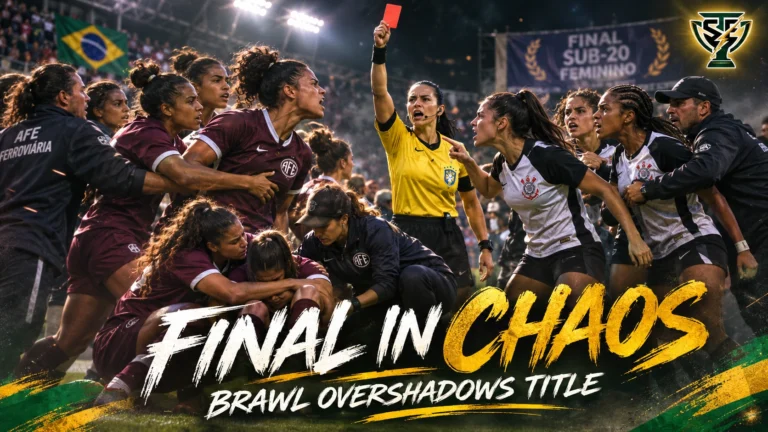
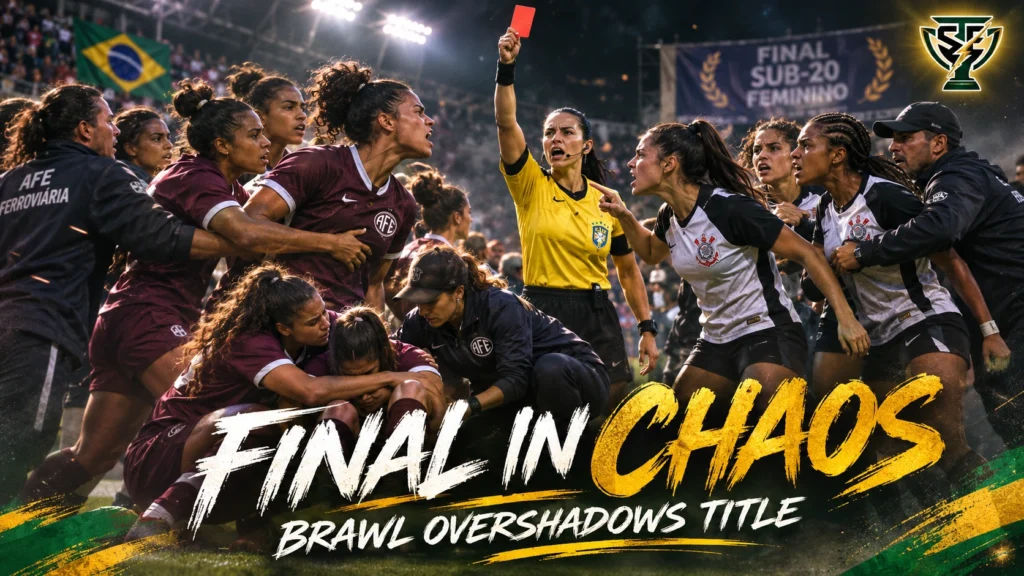
Araraquara, Brazil, November 17, 2026: What should have been a celebration of Ferroviária’s third São Paulo Women’s Under-20 Championship title became one of the most disturbing disciplinary controversies in Brazilian youth soccer. With Ferroviária leading Corinthians 2-0 in Sunday’s final, a confrontation involving substitute striker Ana Carla Vitória Vianna Lima, known as Miga, escalated into a violent brawl. Video footage shows players exchanging blows, while the referee’s report describes kicks, punches and hair-pulling. Corinthians midfielder Melissa Cruz de Paula, known as Mel, was struck in the face and required medical attention.
The Brazil women’s U20 final brawl has now moved beyond the pitch. Ferroviária has promised disciplinary measures against Miga, its No. 19, alongside medical and psychological support. Corinthians has condemned the violence and pursued further action, while the São Paulo Football Federation has referred the incident to the appropriate sports-justice authorities. Three dismissals were recorded during the disorder, including that of Corinthians coach Júlia Passero. Yet the underlying questions extend beyond one player’s behavior: why did the confrontation become so difficult to contain, what disciplinary consequences are justified, and how should youth soccer balance accountability with its responsibility to protect and develop young athletes?
TL;DR: What Happened in Brazil’s Women’s U20 Final?
- Ferroviária defeated Corinthians 2-0 on November 15, 2026, to win the São Paulo Women’s Under-20 Championship.
- Gabi Pusch scored both goals as Ferroviária secured its third title in the competition.
- The confrontation began around the 31st minute of the second half after a challenge involving Ferroviária’s Miga and Corinthians midfielder Gabi Jordi.
- The referee’s report describes retaliatory kicking, punches and hair-pulling during the subsequent disorder.
- Miga, Corinthians substitute Emy and Corinthians coach Júlia Passero received direct red cards.
- Corinthians player Mel was struck in the face and received medical attention.
- Ferroviária announced internal disciplinary measures and psychological support for Miga.
- The São Paulo Football Federation condemned the violence and referred the case for disciplinary examination. No final sanction has been established in the verified reporting.
Ferroviária vs Corinthians: Final Score and Incident Details
| Category | Verified Information |
|---|---|
| Competition | 2026 Campeonato Paulista Feminino Sub-20 |
| Match | Ferroviária vs Corinthians, Final |
| Date | November 15, 2026 |
| Venue | Arena Fonte Luminosa, Araraquara, São Paulo |
| Final score | Ferroviária 2-0 Corinthians |
| Goalscorer | Gabi Pusch, two goals |
| Incident | Approximately 76th minute |
| Principal player involved | Ana Carla Vitória Vianna Lima (Miga), Ferroviária No. 19 |
| Other identified players | Gabi Jordi, Mel and Emy of Corinthians |
| Referee | Jéssica Aparecida Milani |
| Dismissals | Miga, Emy and coach Júlia Passero |
| Disciplinary status | Federation referral; possible sanctions pending |
| Championship outcome | Ferroviária’s third title |
The São Paulo Football Federation’s official match report confirms Ferroviária’s 2-0 victory, Gabi Pusch’s contribution and the club’s third championship.
The trophy result remains official. The disciplinary investigation is a separate process, and there has been no verified ruling overturning the championship.
Story at a glance
Ferroviária vs Corinthians: Final Score and Incident Details
The São Paulo Football Federation’s official match report confirms Ferroviária’s 2-0 victory, Gabi Pusch’s contribution and the club’s third championship.
How the Violence Erupted in the 76th Minute
The match was approaching its conclusion with Ferroviária leading 2-0.
What the Video Shows and What It Cannot Prove
The widely circulated footage is disturbing because it captures repeated physical confrontations rather than one isolated reaction.
Why Miga’s Actions Are Being Scrutinized So Closely
Miga’s actions are central to the investigation because the referee’s account identifies her involvement in several physical confrontations.
Three Red Cards: Why the Referee’s Report Matters
Referee Jéssica Aparecida Milani recorded three dismissals arising from the incident.
How the Violence Erupted in the 76th Minute
The match was approaching its conclusion with Ferroviária leading 2-0.
Corinthians were attempting to recover from a difficult first half in which Pusch had scored twice. Ferroviária appeared positioned to complete its successful championship campaign.
MASSIVE BRAWL erupts during women’s youth final in BrazilNo. 19, Miga, faces disciplinary action after launching brutal attack on opposing playersShe punches, kicks and pulls players’ hair before chaos eruptsBut will also receive ‘psychological support’ https://t.co/iGFTM2oofD
— RT (@RT_com) November 17, 2026
A challenge involving Corinthians midfielder Gabi Jordi and Ferroviária striker Miga changed the atmosphere.
According to the referee’s account reported by Brazilian media, Miga kicked Jordi after the challenge. The two players then became involved in a physical confrontation.
What followed was not confined to the original pair.
Other players entered the dispute, some attempting to separate the participants and others becoming involved in additional altercations.
Video footage shows the confrontation spreading across several meters of the field as players and officials attempt to restore order.
During the disorder, Mel approached the confrontation and was struck in the face by Miga.
Mel fell to the ground and received medical attention.
The referee’s written account also describes further misconduct involving other participants, including hair-pulling.
The exact sequence of every action is more extensive than the short video clip circulating online. That is why the referee’s report and disciplinary investigation remain important evidence alongside the footage.
The Sequence That Turned a Final Into a Disciplinary Crisis
| Stage | What Happened | Evidence or Status |
|---|---|---|
| Before the incident | Ferroviária lead Corinthians 2-0 | Official federation result |
| Initial confrontation | Challenge between Gabi Jordi and Miga, followed by retaliation | Referee’s account and match footage |
| Escalation | Multiple players become involved; punches and other physical contact occur | Video and referee’s account |
| Mel struck | Corinthians midfielder is punched and falls to the turf | Referee’s report and video coverage |
| Intervention | Players, coaches and officials attempt to separate participants | Recorded footage and referee’s account |
| Disciplinary action | Three direct dismissals are recorded | Match report and referee’s account |
| Afterward | Clubs condemn incident; federation refers case to sports justice | Official statements |
The confrontation halted the match for several minutes before play resumed.
Ferroviária retained its advantage and completed the 2-0 victory.
What the Video Shows and What It Cannot Prove
The widely circulated footage is disturbing because it captures repeated physical confrontations rather than one isolated reaction.
Miga, wearing Ferroviária’s maroon No. 19 uniform, is visible during the confrontation.
Players wearing Corinthians’ black-and-white uniform approach, retreat and attempt to intervene at different points.
The footage also shows match officials trying to control the increasingly crowded situation.
These observations support the conclusion that the incident escalated beyond a normal disagreement following a foul.
However, short video excerpts have limitations.
They may omit the complete buildup, the location of every participant before the confrontation and actions occurring outside the camera’s frame.
They cannot establish a medical diagnosis simply because a player collapses.
Nor can they independently prove that every participant intended to cause injury.
Those distinctions matter when reporting allegations involving young athletes.
Clear evidence of physical misconduct should not be minimized. At the same time, disciplinary conclusions should follow the evidence rather than emotional reactions to viral footage.
Why Miga’s Actions Are Being Scrutinized So Closely
Miga’s actions are central to the investigation because the referee’s account identifies her involvement in several physical confrontations.
The 19-year-old forward had entered the match during the second half.
Her involvement was particularly damaging to Ferroviária’s public image because the club was leading and approaching another championship victory.
The team did not need an aggressive confrontation to preserve the result.
Ferroviária had already established its superiority through two goals and controlled much of the contest.
That context makes the decision to retaliate especially difficult to justify.
Even if a player believes an opponent committed an unfair or dangerous challenge, deliberately kicking or striking that opponent is not an acceptable response under soccer’s disciplinary rules.
The Sports Encounter’s guide to fouls, reckless challenges and red cards explains the distinction between ordinary physical contact and actions warranting dismissal.
In this case, the concern is not simply whether the original challenge should have been penalized.
It is how the subsequent reactions created danger for several participants.
Three Red Cards: Why the Referee’s Report Matters
Referee Jéssica Aparecida Milani recorded three dismissals arising from the incident.
Miga was sent off for her conduct during the confrontation.
Corinthians substitute Emy also received a direct red card.
Corinthians coach Júlia Passero was dismissed after becoming involved in the confrontation.
That final detail is important.
Coaches and staff members have additional responsibilities during a youth match. Their role includes protecting players, maintaining discipline and helping officials restore control.
Even when they believe their players have been attacked, physical confrontation with an opposing athlete can create further danger.
Ferroviária has criticized Passero’s involvement, while Corinthians has emphasized the original attacks on its players.
Those competing positions require the disciplinary authorities to examine the actions of each participant separately.
Why the Three Dismissals Must Be Assessed Individually
| Person | Role | Reported Incident | Confirmed Immediate Action |
|---|---|---|---|
| Miga | Ferroviária forward | Retaliatory kick and punches during confrontation | Direct red card |
| Emy | Corinthians substitute | Involvement in the disorder, as recorded by the referee | Direct red card |
| Júlia Passero | Corinthians coach | Physical intervention involving an opposing player | Direct red card |
A red card is an immediate match sanction.
Any additional suspension or disciplinary penalty depends on the applicable regulations and subsequent proceedings.
It would be premature to publish a specific suspension length or financial penalty before an authorized body announces its decision.
What Soccer’s Laws Say About Punches, Kicks and Hair-Pulling
The distinction between a legitimate challenge and violent conduct is fundamental to soccer’s rules.
Law 12 of the Laws of the Game covers fouls and misconduct.
It recognizes violent conduct as a sending-off offense when a player uses or attempts to use excessive force or brutality against another person outside a legitimate challenge for the ball.
Deliberately striking an opponent’s head or face is also covered by the violent-conduct provisions.
The rules do not excuse retaliation because another player committed the original foul.
A player who has been fouled may still be dismissed for responding violently.
Likewise, a substitute or team official can face disciplinary action for misconduct even without participating in normal play.
The International Football Association Board’s official Law 12 establishes these general principles.
However, the specific penalty beyond an on-field dismissal depends on competition regulations and the findings of the relevant disciplinary authority.
The Sports Encounter previously examined the distinction between physical misconduct and later disciplinary sanctions in its analysis of Vinícius Júnior’s disciplinary controversy.
The two cases involve different competitions and circumstances, but both illustrate why the precise classification of misconduct matters.
Why Ferroviária Is Offering Psychological Support Alongside Discipline
Ferroviária’s response has attracted attention because the club has promised both disciplinary action and psychological support for Miga.
Those measures are not mutually exclusive.
Discipline addresses conduct and accountability.
Psychological support addresses the athlete’s welfare, emotional regulation and development.
Ferroviária operates an established youth development system and has emphasized its responsibility to educate players beyond technical soccer skills.
That responsibility does not disappear when a player behaves unacceptably.
In fact, an incident involving serious misconduct may create a stronger need for professional assessment and structured support.
But psychological care must not be presented as evidence that a player has a mental health disorder.
No such diagnosis has been established publicly in this case.
Providing access to professional support is a welfare measure, not proof of a medical condition and not a substitute for an appropriate disciplinary decision.
Why Support and Accountability Must Work Together
| Response | Primary Purpose | What It Does Not Establish |
|---|---|---|
| Internal club discipline | Respond to breaches of team standards | Does not replace federation proceedings |
| Sports-justice review | Determine responsibility and appropriate sanctions | Does not automatically establish criminal guilt |
| Medical care | Assess and treat physical injuries | Does not establish intent behind the incident |
| Psychological support | Support athlete welfare and behavior development | Does not imply a psychiatric diagnosis |
| Safeguarding improvements | Reduce the risk of future incidents | Cannot guarantee that violence will never occur |
Effective management requires all these responsibilities to be distinguished clearly.
Suspending an athlete without addressing underlying behavioral and welfare concerns may provide an immediate response but leave developmental issues unresolved.
Offering support without meaningful accountability would create a different problem by weakening confidence in player protection.
The strongest response is one that takes both concerns seriously.
Corinthians Demand Accountability as Player Safety Becomes Central
Corinthians condemned the attacks and emphasized that such behavior is incompatible with the values of sport.
The club also sought further action following the confrontation.
Its response reflects the importance of ensuring that injured or threatened players receive appropriate protection.
Mel’s experience is particularly relevant.
The referee’s account states that she was struck in the face and required medical treatment.
However, the available verified reporting does not establish a definitive long-term diagnosis or recovery timetable.
Neither should be invented.
Protecting affected athletes requires a medical response, appropriate follow-up and a process that allows them to provide evidence without unnecessary public pressure.
The Sports Encounter explored the difference between disciplinary findings and actual player-safety consequences in its investigation into dangerous collisions and player protection in Spain’s Segunda División.
The physical circumstances were different, but the underlying principle is the same: authorities must establish what happened and respond proportionately to the risk and harm involved.
São Paulo Football Federation Refers the Incident to Sports Justice
The São Paulo Football Federation issued an official statement condemning the violence.
It said the incident would be referred to the competent sports-justice authorities for examination and possible sanctions.
The federation also emphasized the importance of respect, safety and safeguarding the progress of women’s soccer.
The FPF’s official statement dated November 15 confirms the referral and the federation’s position.
This is a meaningful procedural development.
The case is no longer solely a matter for Ferroviária or Corinthians to address internally.
The federation’s referral creates a route for an independent sports-disciplinary assessment.
That process must consider the referee’s report, available video, statements from participants and the applicable competition regulations.
No final ban length, fine or additional sanction should be treated as confirmed until a formal decision is announced.
What Could Happen Next in the Disciplinary Process?
The incident may involve several separate stages of examination.
| Stage | Current Position | Potential Next Development |
|---|---|---|
| On-field discipline | Three direct red cards recorded | Match sanctions reflected in official records |
| Ferroviária internal review | Disciplinary measures announced in principle | Club determines and communicates internal action |
| Federation referral | Confirmed | Sports-justice authorities examine the incident |
| Further sanctions | Not finally established | Possible suspensions or other penalties under regulations |
| Player welfare | Support promised; medical treatment reported | Follow-up care as appropriate |
| Club or competition safeguards | Need for review identified | Possible procedural improvements |
These are possible procedural developments, not predictions that a particular punishment will be imposed.
Any legal or criminal investigation must also be distinguished from the separate process of sports discipline.
The threshold, evidence and consequences can differ.
The Sports Encounter previously explained why disciplinary proceedings may continue after a major match in its analysis of sanctions following the 2026 World Cup final confrontation.
That comparison concerns procedure rather than the severity or precise nature of the incidents.
The Other Story: Gabi Pusch Won Ferroviária the Championship
The violence has dominated international attention, but the match also produced a substantial sporting achievement.
Ferroviária defeated Corinthians 2-0 through two goals from Gabi Pusch.
The first arrived in the sixth minute after Diana supplied the ball inside the penalty area.
Pusch finished into the corner to give the home side an early advantage.
She added another goal before halftime, placing Ferroviária firmly in control.
The victory secured the club’s third São Paulo Women’s Under-20 Championship.
Ferroviária won the first two editions in 2022 and 2023 before finishing runners-up to São Paulo in 2024 and 2025.
It has now reached every final since the competition began and stands alone as its most successful team.
Corinthians, meanwhile, were making their first appearance in the final.
Those achievements deserve recognition independently of the disciplinary controversy.
Ferroviária’s Record in the Competition
| Year | Ferroviária’s Finish | Championship Context |
|---|---|---|
| 2022 | Champions | Won inaugural edition |
| 2023 | Champions | Second consecutive title |
| 2024 | Runners-up | Lost final to São Paulo |
| 2025 | Runners-up | Lost final to São Paulo |
| 2026 | Champions | Defeated Corinthians 2-0 |
Ferroviária’s five consecutive final appearances demonstrate the strength of its women’s youth development program.
That is precisely why the incident creates such a difficult reputational challenge for the club.
A program known for developing talented players must also demonstrate that education, conduct and athlete welfare are integral parts of its success.
Why This Incident Matters Ahead of the 2027 Women’s World Cup in Brazil
Brazil is preparing to host the 2027 FIFA Women’s World Cup.
The tournament will provide a major international opportunity to showcase Brazilian women’s soccer, its clubs and its developing talent.
Youth competitions play an important part in that wider system.
They provide pathways for young players to progress toward senior club football and potentially international representation.
However, one violent incident should not be used to characterize an entire league or the wider women’s game.
Ferroviária and Corinthians are established clubs, and the championship itself produced a competitive final and a deserved winner.
The appropriate lesson is more specific.
As women’s soccer attracts greater attention, competition organizers must ensure that disciplinary procedures, safeguarding and player welfare develop alongside sporting opportunities.
The Sports Encounter previously examined the growing importance of Brazil 2027 in its report on Malawi’s historic qualification for its first Women’s World Cup.
That tournament will create new opportunities for players from many countries. Protecting the development environments from which those players emerge is part of the broader responsibility facing the sport.
Does Women’s Youth Soccer Need Stronger Matchday Safeguards?
One of the important questions raised by the confrontation concerns how quickly a dispute can spread when multiple players and team officials become involved.
Referees are responsible for applying the Laws of the Game, but they cannot physically separate every participant in a large confrontation.
Competition organizers and clubs therefore need clear procedures for managing incidents that extend beyond normal match discipline.
Those procedures may include designated staff responsibilities, medical readiness, access for authorized personnel and training in how to intervene without escalating conflict.
The aim should not be to eliminate competitive emotion.
High-stakes matches inevitably involve frustration, disappointment and physical contact.
The responsibility is to prevent those emotions from turning into violence.
Education should begin before a final rather than only after a confrontation.
Players and staff need a clear understanding of what is expected when they believe an opponent has committed a dangerous or unfair challenge.
They must also know how to protect teammates without becoming involved in further misconduct.
What the Final Exposes About Accountability in Youth Sport
The strongest response to the confrontation is not the most sensational one.
It is the response that establishes individual responsibility while protecting the people affected.
The referee’s report provides an important evidentiary foundation.
The video supplies additional context.
The clubs’ statements establish their positions.
The federation’s referral creates a formal route for disciplinary review.
Each part matters, but none should be confused with a final adjudication.
Miga’s conduct deserves serious scrutiny. So do the actions of any other participant whose behavior may have prolonged or escalated the confrontation.
Ferroviária’s promise of psychological support should be evaluated as part of its responsibility toward a developing athlete, not portrayed as a reason to overlook misconduct.
Corinthians’ demand for accountability should likewise be considered alongside the need for a fair process involving all participants.
Ultimately, the authorities must demonstrate that consequences are based on established conduct rather than the popularity of a video or the size of the public reaction.
Continue the Soccer Story
Frequently Asked Questions About the Brazil Women’s U20 Final Brawl
What happened during the Brazil women’s U20 final?
A confrontation involving Ferroviária striker Miga and Corinthians players escalated into a wider brawl during the second half of the São Paulo Women’s Under-20 Championship final on November 15, 2026.
Who is Miga?
Miga is the soccer nickname of Ana Carla Vitória Vianna Lima, a forward who wore No. 19 for Ferroviária during the final.
Which teams were involved?
The incident occurred during the final between Ferroviária and Corinthians at Arena Fonte Luminosa in Araraquara.
Who won the women’s U20 final?
Ferroviária won 2-0, with Gabi Pusch scoring both goals, securing the club’s third state championship.
Who was struck during the confrontation?
Corinthians midfielder Melissa Cruz de Paula, known as Mel, was struck in the face and required medical attention, according to the referee’s report.
How many people were sent off?
Three direct dismissals were recorded: Miga of Ferroviária, Corinthians substitute Emy and Corinthians coach Júlia Passero.
Has Miga been suspended?
Miga was sent off during the final. Ferroviária announced internal disciplinary measures, while the federation referred the matter for further review. A definitive additional suspension length has not been verified.
Why is Ferroviária offering psychological support?
The club has said it will provide medical and psychological support as part of its responsibilities toward developing athletes. Such support does not imply a psychiatric diagnosis or replace disciplinary accountability.
Will the incident be investigated?
Yes. The São Paulo Football Federation has referred the case to the competent sports-justice authorities for investigation and possible sanctions.
Could Ferroviária lose the championship?
No verified disciplinary ruling has overturned the 2-0 result or stripped Ferroviária of the title. The official championship outcome remains unchanged in the available reporting.
What Happens Next for Miga, Corinthians and Ferroviária?
Ferroviária leave the final as champions, but the club must now address an incident that has overshadowed its sporting achievement.
Corinthians have legitimate concerns about the protection of their players and the treatment of those affected.
The referee’s report identifies serious conduct that warrants careful examination.
The federation has promised to refer the matter to the appropriate authorities.
What remains unknown is the final extent of any additional sporting penalties and the outcome of the disciplinary process.
There is also a broader responsibility.
Youth soccer is expected to develop footballers, but development includes conduct, emotional maturity and respect for opponents.
Those values cannot be taught effectively through statements alone.
They require consistent standards, appropriate consequences and support systems that protect both those harmed and those whose behavior needs to change.
The controversy should not erase Gabi Pusch’s two goals or Ferroviária’s third championship.
Nor should that sporting success be used to diminish what happened during the final.
The trophy belongs to Ferroviária. The responsibility for establishing accountability now belongs to the clubs and football authorities. How they respond will matter long after the footage stops circulating.