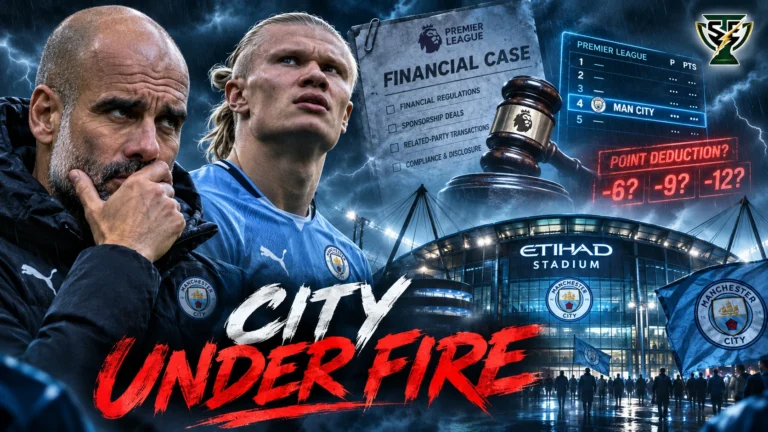
MANCHESTER, England, November 20, 2026: Manchester City’s legal battle has entered a phase in which its consequences are being felt before any final sporting punishment has been imposed. An independent Premier League commission found the club guilty of serious financial-rule breaches in September, City appealed in October, and a proposed $2 billion financing deal involving its parent company has now reportedly fallen apart. Meanwhile, the league’s clubs have voted to strengthen legal protections for their own board.
The Manchester City financial case is no longer only a question of how many points the club might lose. It now involves three separate forms of exposure: an unresolved appeal and possible sporting sanctions, uncertainty surrounding a major financing proposal, and the possibility of future scrutiny by England’s Independent Football Regulator. Those processes have different decision-makers and legal tests. Treating them as one inevitable collapse would be as misleading as ignoring the pressures they have created.
Key Takeaways
- The Manchester City financial case is no longer only a question of how many points the club might lose.
- On November 19, the Financial Times reported that Apollo Global Management had abandoned a planned $2 billion loan to City Football Group, citing people familiar with the matter.
- A separate development on November 19 concerned the league rather than City’s borrowing.
- David Kogan, chair of the Independent Football Regulator, said in October that the watchdog possesses powers to require a club owner to step away where the applicable fitness and propriety requirements are not met.
Manchester City Financial Case Now Has Three Separate Fronts
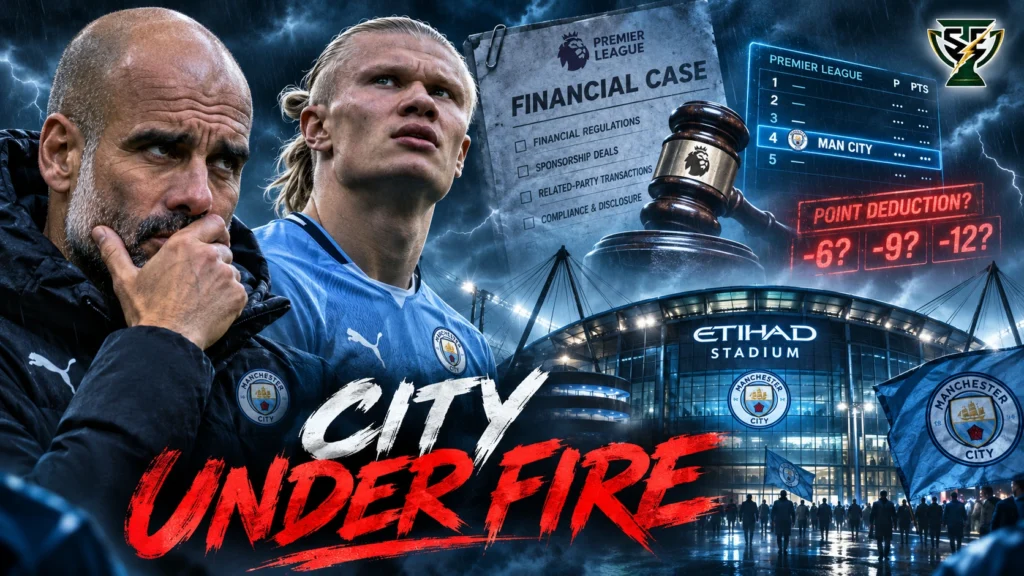
The sequence is important. On September 29, the Premier League announced that its independent commission had found City guilty of all charges concerning serious breaches of financial rules over nine seasons and most charges concerning failure to cooperate with the investigation. The league’s official statement of findings established an adverse first-stage decision, not a final, unappealable penalty.
Story at a glance
Manchester City Financial Case Now Has Three Separate Fronts
The sequence is important. On September 29, the Premier League announced that its independent commission had found City guilty of all charges concerning serious breaches of financial rules over nine seasons and most charges concerning failure to cooperate with the investigation. The league’s official statement of findings established an adverse first-stage decision, not a final, unappealable penalty.
What the Abandoned $2 Billion Loan Actually Means
On November 19, the Financial Times reported that Apollo Global Management had abandoned a planned $2 billion loan to City Football Group, citing people familiar with the matter. Reuters also reported the withdrawal, attributing the original disclosure to the Financial Times.
The Premier League Vote Reveals a Second Kind of Financial Risk
A separate development on November 19 concerned the league rather than City’s borrowing. Premier League clubs approved an extension of protection against legal expenses for board members, reportedly by 18 votes to two. The move followed the possibility of claims connected to criticism of commercial arrangements in the commission’s published findings.
Could City Really Lose 200 Points or Be Expelled?
The claim that a 200-point deduction has been imposed is unsupported by the decisions reviewed for this report. No official penalty figure has been issued. The commission’s findings are serious, but severity alone does not establish the number of points that might be removed or the season in which any deduction would apply.
Why Ownership Powers Do Not Mean Sheikh Mansour Must Sell
David Kogan, chair of the Independent Football Regulator, said in October that the watchdog possesses powers to require a club owner to step away where the applicable fitness and propriety requirements are not met. He also indicated that it would be premature to anticipate action against City’s ownership while the appeal remained unresolved.
City lodged an appeal, arguing that the commission’s conclusions contained material errors of law, principle and fact. The Premier League confirmed receipt of that appeal on October 2. As of this report, no 200-point deduction has been announced and there has been no order requiring Sheikh Mansour to sell the club.
TSE previously examined how the ruling affected supporters and the football team’s immediate environment in its report on City’s first major fixture after the verdict. The latest developments warrant a different article because financing and institutional risk have now joined the courtroom dispute.
Why the Manchester City Financial Case Is Not a Single Verdict
Three questions are often mixed together: whether the commission’s findings survive appeal, what sporting punishment should follow if they do, and whether separate regulators have grounds to act against any owner or executive. An outcome on one question does not automatically answer the others. The appeals panel must address the findings before a separate sanctions process can be considered definitive. Any ownership assessment would require an independent regulatory decision.
| Pressure point | Established position | What remains unresolved |
|---|---|---|
| Premier League proceedings | Adverse commission findings; City has appealed | Appeal outcome and any sanction |
| City Football Group financing | Financial Times reports Apollo withdrew from a proposed $2 billion loan | Alternative funding and any measurable liquidity effect |
| League governance | Clubs voted to strengthen protection for board members against legal costs | Whether threatened legal claims proceed |
| Ownership regulation | Regulator has powers to examine owner suitability | Whether it opens a case or orders any action |
What the Abandoned $2 Billion Loan Actually Means
On November 19, the Financial Times reported that Apollo Global Management had abandoned a planned $2 billion loan to City Football Group, citing people familiar with the matter. Reuters also reported the withdrawal, attributing the original disclosure to the Financial Times.
The financial distinction is critical: City Football Group is the ownership business associated with Manchester City and other clubs. A proposed loan to that group is not the same thing as cash already held in Manchester City’s operating account. Nor does the withdrawal of one proposed facility prove that the parent company is insolvent, unable to pay wages, or facing immediate administration.
For the Manchester City financial case, the key financing lesson is that an adverse regulatory finding can influence counterparties before the appeals process finishes. What the report does suggest is a change in the willingness of at least one potential lender to complete a very large financing arrangement in the shadow of regulatory uncertainty. Borrowers may seek replacement financing, restructure existing obligations, change the terms or defer planned transactions. None of those alternatives has been confirmed here as City Football Group’s chosen response.
That matters because financing is priced on risk. Even when a wealthy owner remains capable of supporting a business, lenders must consider repayment, security, reputational exposure and whether future revenue assumptions can withstand adverse regulatory outcomes. An abandoned proposal can therefore matter before a sporting penalty is issued, without making financial collapse inevitable.
The Premier League Vote Reveals a Second Kind of Financial Risk
A separate development on November 19 concerned the league rather than City’s borrowing. Premier League clubs approved an extension of protection against legal expenses for board members, reportedly by 18 votes to two. The move followed the possibility of claims connected to criticism of commercial arrangements in the commission’s published findings.
Reporting on the club vote said City was understood to be one of the opponents. The vote is not itself a finding against City, a court ruling on sponsors’ claims, or evidence that lawsuits will succeed. It is a measure intended to protect those governing the competition if litigation develops.
This is why the latest Manchester City financial case developments matter beyond the club. The Premier League is attempting to manage legal risk arising from its own regulatory decisions. Sponsors, directors, club owners and member clubs can have different interests even when they participate in the same football economy.
That creates a challenge for the league’s credibility: it must enforce its rules and defend its process without allowing the cost or threat of litigation to determine whether it pursues alleged misconduct. For City, the same situation creates a reputational issue with commercial partners separate from the prospect of dropped points.
Could City Really Lose 200 Points or Be Expelled?
The claim that a 200-point deduction has been imposed is unsupported by the decisions reviewed for this report. No official penalty figure has been issued. The commission’s findings are serious, but severity alone does not establish the number of points that might be removed or the season in which any deduction would apply.
Premier League disciplinary powers can include financial penalties, sporting deductions and, through the applicable procedures, the possibility of expulsion. These are potential sanctions, not interchangeable outcomes. An enormous deduction and expulsion would also create different questions about future league membership.
A simple example shows why sensational figures spread. A team that earns 80 points on the field and loses 20 would finish with 60; a 60-point deduction would leave 20. A hypothetical 200-point deduction would leave minus 120. Those are arithmetic illustrations, not forecasts. There is no credible basis here for applying one invented number to City’s case.
Sanctions also need to be distinguished from the possibility of compensation claims by other clubs. A rival claiming financial losses would still need a viable legal basis and evidence linking its losses to specific conduct. Published commission findings do not automatically calculate damages for other teams or reverse past league tables.
Why Ownership Powers Do Not Mean Sheikh Mansour Must Sell
David Kogan, chair of the Independent Football Regulator, said in October that the watchdog possesses powers to require a club owner to step away where the applicable fitness and propriety requirements are not met. He also indicated that it would be premature to anticipate action against City’s ownership while the appeal remained unresolved.
A power to order a sale is not an order to sell. A regulatory decision would require a process, evidence relevant to the owner and the statutory test. The club’s adverse commission ruling may prompt scrutiny, but it does not by itself establish that Sheikh Mansour has personally failed an owners’ test.
Football’s ownership questions extend beyond a single club. TSE explored the separate commercial and sporting considerations surrounding ownership change in its analysis of Leicester City’s potential sale. The circumstances are different, but both stories show that transfer of ownership involves much more than assigning a headline valuation to a football club.
For now, the responsible position is to say that Manchester City’s ownership faces a potential regulatory avenue of scrutiny, not a confirmed divestment order.
What the Case Could Change for City’s Squad Building
The timing is uncomfortable for a team that has recently undergone an expensive rebuild. TSE’s analysis of Premier League transfer spending estimated City’s summer investment at approximately £458 million, the highest among English clubs in that window. Those figures describe past transfer commitments, not an amount directly funded by Apollo’s proposed loan.
That difference matters. It would be wrong to claim that a $2 billion financing proposal was earmarked to purchase specific players without evidence. It is nevertheless reasonable to examine how uncertainty could influence future budgets, commercial negotiations, the timing of transfers or the willingness to enter new long-term obligations.
Continue the Premier League Story

The recruitment of Enzo Fernández was a major part of the rebuild. TSE’s report on his reported £125 million move detailed the level of investment made in Enzo Maresca’s midfield. A club capable of investing at that scale can still face financing and regulatory uncertainty; past spending does not prove that future cash requirements will be met in precisely the same way.
The departures of important players underline why a rigid freeze on recruitment could create sporting difficulties. Rodri’s transfer to Barcelona, examined in TSE’s assessment of the end of his City career, changed the balance of the midfield even before the verdict became the dominant off-field story.
But no confirmed transfer ban currently follows from the commission findings. Claims that Haaland or other players will automatically leave, or that contracts contain specific release clauses triggered by relegation, require separate documentary evidence. None should be presented as established.
Can City Keep Competing While the Appeal Continues?
The most immediate sporting question is one of continuity. City remain able to compete under their existing results and league position while the proceedings continue. The findings do not remove goals already scored or alter the table automatically.
That distinction was visible during their Champions League campaign, where the team continued to produce results under Maresca. TSE’s report on Haaland’s two goals against Porto showed what City could achieve on the pitch despite questions around the club’s institutional future.
There is no simple way to quantify the effect of an unresolved legal process on a dressing room. Players can perform well despite uncertainty; poor results would not prove that the case caused them. Claims about morale or transfer intentions would need testimony or other specific reporting.
What can be measured is the sequence of external decisions. The appeal is expected in mid-December according to November 13 reporting by the Financial Times, but that timing is not an official guarantee. A decision on the findings could be followed by a separate sanctions stage if the appeal fails, with punishment potentially not imposed until 2027.
Three Outcomes, Three Very Different Futures
The safest way to analyze the road ahead in the Manchester City financial case is to separate conditional outcomes instead of offering an invented prediction.
| Possible development | What it could mean | What it would not automatically mean |
|---|---|---|
| City succeeds on appeal | Original findings could be overturned or materially altered | All financing and reputational questions disappear immediately |
| Findings upheld, sporting sanction follows | Potential financial or competitive penalty after further process | A fixed 200-point deduction or automatic title removal |
| Regulator separately opens ownership inquiry | Possible examination under owner-suitability rules | Immediate compulsory sale without a distinct decision |
These outcomes are not equally likely simply because they are listed together. The available evidence does not support numerical probabilities. They identify different decision points that supporters, lenders and other clubs should monitor.
For the Premier League, the principle at stake is consistent enforcement that can survive legal challenge. For City, the task is to contest the findings while maintaining credible financial and sporting operations. For potential lenders, the question is whether a future transaction can be structured around uncertainty that is not yet resolved.
The Manchester City financial case now extends far beyond familiar arguments about 115 charges. A first-stage guilty finding, an active appeal, a reported withdrawn $2 billion loan and new legal protections within the league are separate events with connected consequences. None proves that City will lose 200 points or that Sheikh Mansour must sell. Together, they show why the eventual outcome could reshape more than a league table.
Manchester City
- Manchester City Financial Case: Three Risks Beyond Points
- Manchester United Face a Relegation Fight, Manchester City Lose Invincibility: One City, Two Different Crises
- Premier League: Brighton Hit Five, Haaland Keeps City Perfect as Arsenal Survive With One Shot on Target
- UEFA Champions League Returns: Man City vs. PSG Headlines Barcelona’s Istanbul Test Amid High Stakes
- Everyone Going Bonkers! Ronaldo Breaks Ranks, Messi Breaks Hearts, as the Game Itself Needs a Fix