Connect with us
Luke Edelman The Sports Encounter

Published

on

Jannik Sinner’s second Wimbledon title began with uncertainty and ended with authority.

The defending champion arrived at the All England Club after a damaging second-round exit at the French Open, no competitive grass-court warm-up event, and a first-round draw that pushed him to five sets. By the end of the fortnight, he had defeated Novak Djokovic in straight sets, outlasted French Open champion Alexander Zverev in a thunderous final, and secured the fifth Grand Slam title of his career.

Sinner beat Zverev 6-7(7), 7-6(2), 6-3, 6-4 on Centre Court, completing the victory after three hours and 46 minutes. The result made him the first Italian man to win two Wimbledon singles titles and one of only 10 men in the professional era to defend the championship successfully.

The final also delivered Sinner’s 100th Grand Slam match win.

His Wimbledon 2026 campaign demanded more than clean ball-striking. Sinner had to manage physical uncertainty, rebuild his confidence after Paris, resist Zverev’s best serving performance of the tournament, and remain composed when the final stayed balanced deep into the third set.

By the time he lifted the pineapple-topped Challenge Cup, Sinner had shown why he remains the world’s top-ranked player.

TL;DR

Jannik Sinner successfully defended his Wimbledon men’s singles title by beating Alexander Zverev in four sets.

The 24-year-old Italian:

  • Won his fifth Grand Slam title
  • Claimed his second consecutive Wimbledon crown
  • Recorded his 100th Grand Slam match victory
  • Beat Novak Djokovic in straight sets in the semifinal
  • Extended his winning run against Zverev to 10 matches
  • Became the 10th man in the professional era to retain the Wimbledon title
  • Recovered from a five-set struggle in the opening round
  • Finished the semifinal and final without losing a service game

Jannik Sinner at a Glance

CategoryDetail
Age24
NationItaly
ATP rankingNo. 1
Wimbledon seedingNo. 1
Wimbledon titles2025, 2026
Grand Slam titlesFive
Australian Open titles2024, 2025
US Open titles2024
Wimbledon titles2025, 2026
Final opponentAlexander Zverev
Final score6-7(7), 7-6(2), 6-3, 6-4
Grand Slam match wins100
Consecutive wins over Zverev10

The Road to the Wimbledon 2026 Title

RoundOpponentResult
First roundMiomir Kecmanovic4-6, 6-3, 6-7, 6-2, 6-3
Second roundNuno Borges7-6, 7-6, 6-4
Third roundJenson Brooksby6-4, 6-3, 6-4
Fourth roundShintaro Mochizuki6-3, 7-6, 6-3
QuarterfinalJan-Lennard Struff7-5, 7-6, 6-3
SemifinalNovak Djokovic6-4, 6-4, 6-4
FinalAlexander Zverev6-7(7), 7-6(2), 6-3, 6-4

Sinner dropped two sets in the opening round and one in the final. Every other opponent fell in straight sets.

That progression became the story of his championship. The tournament began with survival, moved into control, and ended with Sinner producing his most complete tennis when the title demanded it.

Paris Created the Doubt That Followed Him to London

Sinner entered Wimbledon with an unusual level of pressure for a player who had dominated most of the 2026 season.

He had won all five Masters 1000 tournaments he contested, becoming the first man to claim five consecutive Masters titles. Yet his Grand Slam results told a different story.

Two of his three defeats during the season came at the first two majors. His Australian Open campaign ended before the title match, while the French Open produced a far more surprising result.

Juan Manuel Cerundolo defeated Sinner in the second round in Paris, ending the Italian’s tournament far earlier than expected. The loss came in punishing heat and raised questions about his physical condition, preparation, and ability to reset quickly before Wimbledon.

Sinner responded by skipping the traditional grass-court warm-up tournaments.

Instead, he returned to Monaco for a demanding training block. Some sessions took place on hard courts as his team focused on preparing his body rather than chasing match practice.

“We put in a lot of workdays in Monaco, very, very long,” Sinner said after winning the Wimbledon title.

“Definitely sacrificing a lot of my time and everything to be in this position. Having this achievement, it means a lot to me. Yeah, it was an amazing day today.”

The decision appeared risky at the beginning of Wimbledon. Grass demands precise footwork, sharp reactions, and confidence in movement. Competitive preparation usually helps players adjust to the lower bounce and faster points.

Sinner accepted that risk because he believed physical preparation mattered more than tournament rhythm.

“Every Grand Slam is different,” he said. “Different story, different environment, different feelings before the tournament.”

“For me, this one means a lot, because it was tough after Paris. Last year was also tough. But coming here, I tried to put myself in the best position to be as competitive as possible.”

The first round tested that preparation immediately.

Miomir Kecmanovic Nearly Ended the Title Defense Before It Began

Sinner’s opening match became his greatest scare before the final.
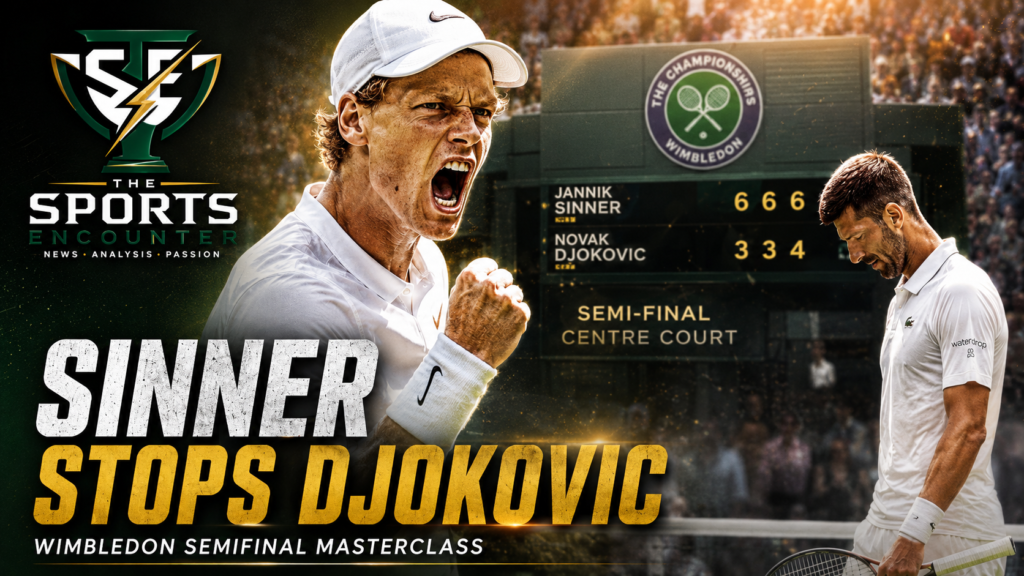
Miomir Kecmanovic took the first set and then won a third-set tiebreak, leaving the defending champion two sets to one down. Sinner struggled to control the rallies with his usual precision and briefly appeared concerned after slipping near the baseline.

Kecmanovic played with confidence and forced Sinner into a physical, uncomfortable contest.

The Italian eventually recovered to win 4-6, 6-3, 6-7, 6-2, 6-3.

The match showed that Sinner had arrived without his best rhythm. It also revealed the mental quality that later shaped the final.

He remained patient.

Sinner stopped forcing points, improved his return position, and gradually reduced his unforced errors. Once the fifth set began, he looked more secure than he had earlier in the match.

The defending champion escaped, but the performance gave his rivals reason to believe he remained vulnerable.

That impression did not last long.

Borges and Brooksby Help Sinner Find His Rhythm

Sinner’s second-round victory over Nuno Borges marked the beginning of a more controlled phase.

He won 7-6, 7-6, 6-4, handling two tight sets before closing the match without allowing it to develop into another long physical battle.

The match sharpened his serve and return patterns. Sinner began taking the ball earlier, protecting the baseline, and creating pressure without overhitting.

Jenson Brooksby presented a different challenge in the third round. The American’s movement, court craft, and ability to disrupt rhythm can frustrate aggressive baseliners.

Sinner stayed composed and won 6-4, 6-3, 6-4.

By this stage, the opening-round instability had begun to disappear. His movement looked cleaner, his first serve became more reliable, and he started controlling rallies with depth rather than chasing quick winners.

The tournament was beginning to move at his pace.

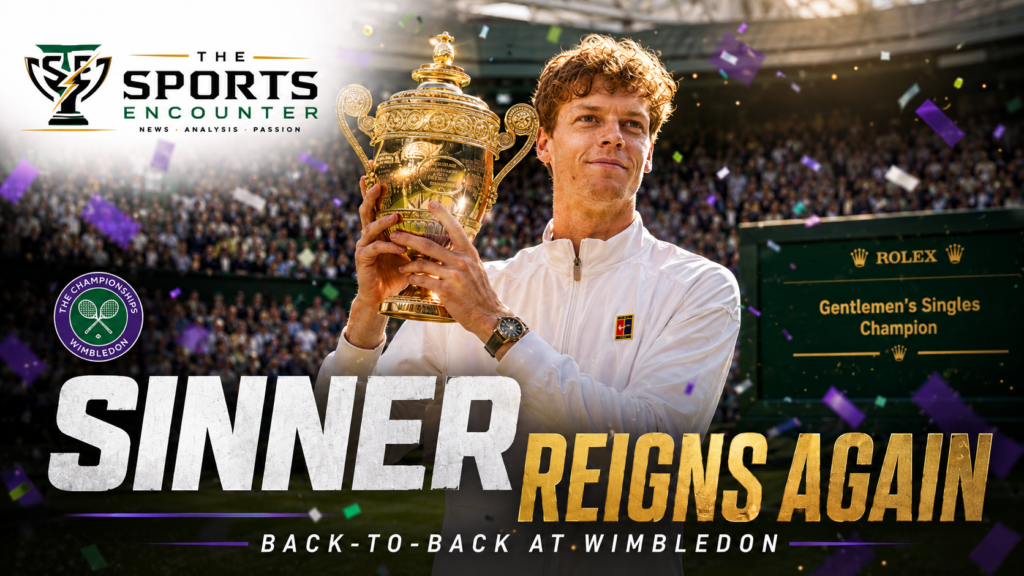
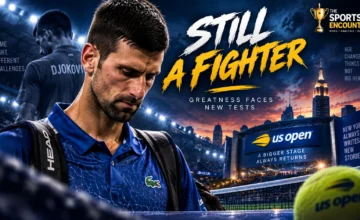
Jannik Sinner celebrates his straight-sets semifinal victory over Novak Djokovic at Wimbledon 2026 as Djokovic stands dejected in the background.

Mochizuki Tests Sinner’s Patience

Shintaro Mochizuki entered the fourth round with freedom and confidence.

His varied game, low ball trajectory, and willingness to change direction gave Sinner a different kind of problem. The Japanese player competed well during the second set and forced a tiebreak.

Sinner dominated that breaker without losing a point.

He won 6-3, 7-6, 6-3 and reached the quarterfinals without wasting energy.

The performance reflected his growing comfort on the surface. Sinner attacked when the opportunity appeared, but he did not become impatient when Mochizuki extended rallies or changed the pace.

The world No. 1 had moved beyond survival. He was now managing matches.

Struff Brings Power, but Sinner Controls the Important Points

Jan-Lennard Struff entered the quarterfinal as an experienced and dangerous grass-court opponent.

At 36, the German had reached his first Grand Slam quarterfinal. His serve, forehand, and aggressive court positioning offered the kind of direct tennis that can shorten points and remove rhythm from a favorite.

Sinner won 7-5, 7-6, 6-3.

The match remained competitive across the first two sets, but Sinner controlled the closing stages of each.

He broke late to take the opening set, then held his nerve during another tiebreak. Once he established a two-set lead, Struff could no longer sustain the pressure required to reverse the match.

Sinner’s return game did not overwhelm Struff from the first ball. It worked through accumulation.

He forced the German to play extra volleys, made him hit difficult first shots after serve, and waited for the small drop in accuracy that eventually arrived.

The victory sent Sinner into a semifinal against Novak Djokovic.

Sinner Solves Djokovic in Straight Sets

The semifinal carried more history than any other match in Sinner’s campaign.

Djokovic entered Wimbledon chasing an eighth men’s singles title and a 25th Grand Slam crown. His Centre Court record, experience, and ability to survive difficult matches made him the greatest threat remaining in the draw.

Sinner gave him almost no opportunity to change the contest.

He won 6-4, 6-4, 6-4.

The Italian served with exceptional control and did not lose a service game. His return position allowed him to attack Djokovic’s second serve, while his depth prevented the Serbian from controlling rallies through changes of direction.

Sinner also refused to allow the match to become emotionally complicated.

Djokovic often turns major matches by extending points, changing tempo, and creating doubt. Sinner stayed close to the baseline and kept striking through the court.

Each set followed a similar pattern. The rallies remained competitive, but Sinner produced the cleaner tennis when the decisive moment arrived.

The straight-set result placed him back in the Wimbledon final and reinforced the sense that the world No. 1 had found his highest level at the right time.

The Sports Encounter has followed the wider debate around whether Novak Djokovic can still win another Wimbledon title, and Sinner’s semifinal performance offered a clear answer about the current balance of power.

Djokovic remains capable of reaching the final stages. Sinner currently gives him almost no room for error.

Zverev Arrives With Momentum and Belief

Alexander Zverev reached the final in the strongest stretch of his career.

Jannik Sinner celebrates defeating Alexander Zverev in the Wimbledon 2026 final to claim his second consecutive title at the All England Club.

The German had finally won his first Grand Slam title at the French Open and arrived at Wimbledon with renewed confidence. Before 2026, he had never progressed beyond the fourth round at the All England Club.

Now he stood one win away from completing the French Open-Wimbledon double.

Zverev’s game had also changed.

He played closer to the baseline, trusted his forehand under pressure, and attacked rather than waiting for Sinner to dictate. His first serve became the central weapon of the final.

For much of the match, Zverev’s first-serve percentage remained close to 80 percent.

The quality of his serving allowed him to shorten points and protect his weaker second serve. His forehand, often vulnerable during the biggest moments of his career, became a weapon.

“That’s the tennis I want to play,” Zverev said after the final.

“That’s the game style I want to play. The more I do it, the better I’ll become hopefully.”

His level gave Sinner the most difficult test of the tournament.

A First Set Decided by Tiny Margins

The opening set lasted 65 minutes and featured intense, heavy ball-striking from both players.

Only one break point appeared across the first 12 games.

Sinner created it at 4-3 but framed a forehand wide. The miss became costly because Zverev continued moving through his service games with remarkable efficiency.

The German dropped only eight points on serve during the set.

The tiebreak remained just as tight.

Zverev reached set point but lost it when Sinner passed him after a drop-shot exchange. He then saved a set point with an ace before earning another opportunity.

This time, he attacked with his forehand and closed the breaker 9-7.

The set ended Sinner’s run of 14 consecutive sets won against Zverev.

It also placed the defending champion behind for the first time since his opening match.

Sinner Levels the Match Without Losing Control

Sinner’s frustration became visible early in the second set.

He struggled to make an impact on Zverev’s service games, while the German continued moving around the court with confidence.

The Italian could have tried to force the issue. Instead, he protected his own serve and waited.

The set reached another tiebreak.

Zverev’s level dropped for the first time, and Sinner responded immediately. He increased his return pressure, took control of the baseline, and won the breaker 7-2.

The final was level.

That outcome mattered psychologically. Zverev had played close to his highest level for two sets and still held only half the match.

Sinner had survived the strongest phase of his opponent’s performance without losing serve.

Zverev’s Fall Changes the Third Set

The third set remained balanced at 3-3.

After two hours and 42 minutes, Zverev earned his first break point of the match.

Sinner answered with a delicate drop shot. Zverev chased it, slipped behind the dusty baseline, and fell awkwardly.

The Italian walked around the net to check on him.

Zverev said he was fine, but his movement looked less comfortable afterward. Sinner held serve and then broke in the following game.

The German threw his racket across the grass in frustration.

Sinner closed the set 6-3.

The fall became an important moment, but it did not fully explain the shift. Zverev still had a break opportunity before the slip. Sinner saved it through skill, held his nerve, and then converted the first clear opening on the other side.

The contrast came down to execution.

Sinner Completes the Title Defense

Zverev recovered enough to compete strongly in the fourth set.

Sinner had already reached another level.

His serve remained secure, his movement became more assertive, and his groundstrokes pushed Zverev farther behind the baseline. At 3-3, Sinner broke again.

The final still needed a memorable finish.

Sinner produced one.

During a 23-shot rally, both players defended, attacked, changed direction, and tested every part of the court. Sinner ended it with a sharp angled touch that brought up match point.

A forehand winner completed the victory.

The final point became Sinner’s 100th win in Grand Slam competition.

He had also completed the semifinal and final without dropping serve.

“There’s No Better Place”

Sinner’s reaction after the match reflected how deeply he valued the moment.

“There’s no better place, honestly, to play tennis,” he said while holding the trophy.

“I’m standing here. You can feel the nerves in a Sunday morning when you wake up, that this is a very special day, and you never know how many times you can come back. So I never take things for granted.”

The quote captured the emotional weight of his title defense.

Sinner entered the tournament carrying the disappointment of Paris. He survived a five-set opening match, rebuilt his level across the middle rounds, defeated Djokovic, and then faced Zverev at his most aggressive.

The trophy had never felt inevitable.

“It always takes two players,” Sinner said.

“We try to give everything we have. I’m very happy about the win but mostly very happy also about the level we played.”

Why Sinner Rejected the Language of Failure

Sinner had gone 12 months without winning another Grand Slam, despite controlling the Masters circuit.

Wimbledon could have been described as relief.

He rejected that interpretation.

“Sometimes you have a tournament with a good outcome, and sometimes you just don’t,” Sinner said.

“There is no failure if you don’t win a Grand Slam.”

“Now I have five in my whole life. But it’s five days of so many other days. You just want to enjoy it. Today was a very tough day. If I lose, it’s still a great day.”

“I never take things for granted.”

That perspective helps explain his emotional stability.

Sinner did not treat defeat as a collapse of identity. The French Open result hurt, but it became part of the preparation for Wimbledon rather than a verdict on his season.

His words also reflected the discipline behind his success. The five Grand Slam title days represent only a small part of the work, training, travel, recovery, and sacrifice that built them.

Sinner Welcomes the Growing Competition

Zverev’s performance confirmed that the German has become a more dangerous major opponent.

Sinner welcomed that development.

“That’s exactly what’s good, because you have always someone who’s pushing you to the limit,” he said.

“We hope that Carlos Alcaraz is coming back from injury, as well, because tennis needs him. Having Novak Djokovic still around, having all the young players coming, it’s really nice.”

“At the same time, you always need to work hard and have moments like this.”

The men’s game now contains several overlapping eras.

Djokovic still competes for history. Zverev has finally become a Grand Slam champion. Alcaraz remains central to the future of the sport. A younger group continues to rise.

Sinner currently stands above them as world No. 1 and back-to-back Wimbledon champion.

From Skiing and Soccer to the Top of Tennis

Sinner’s path to Wimbledon greatness began in Innichen, a small town in northern Italy.

He started playing tennis at the age of seven, but the sport did not immediately become his main focus. Skiing and soccer interested him more during his childhood.

At 13, he committed fully to tennis.

That decision changed Italian sporting history.

Sinner began his professional career on the ITF circuit in 2018. His rise accelerated in 2019 when he won the Next Gen ATP Finals by defeating Alex de Minaur.

He finished that year ranked No. 78 and received the ATP Newcomer of the Year award.

In 2020, Sinner won the Sofia Open, becoming the youngest Italian man to claim a tour-level title during the Open Era. He ended the season ranked 37th.

His progress continued in 2021 with titles at the Great Ocean Road Open, Washington Open, Sofia Open, and European Open. By the end of the year, he had entered the world’s top 10.

Wimbledon 2023 Signals the Next Stage

Sinner reached his first Grand Slam semifinal at Wimbledon in 2023.

That run confirmed his potential on grass and marked the beginning of his development into a genuine major contender.

Later that year, he won his first Masters 1000 title at the Canadian Open and rose to world No. 4, becoming only the second Italian man to enter the ATP top five.

His impact extended beyond individual tournaments.

In November 2023, Sinner helped Italy win the Davis Cup for the first time in 47 years. His performances under national pressure strengthened his reputation as a player capable of delivering in emotionally demanding environments.

The following season brought the breakthrough.

The 2024 Season Changes Sinner’s Career

Sinner won his first Grand Slam title at the 2024 Australian Open, defeating Daniil Medvedev in the final.

He later reached the French Open semifinal and became the world No. 1 in June.

At the US Open, Sinner defeated Taylor Fritz to claim his second major title. He also won the Shanghai Masters and completed the year by capturing his first ATP Finals crown.

His 2024 season also included a complicated anti-doping case.

Sinner tested positive for clostebol in two samples taken in March. The International Tennis Integrity Agency accepted that the substance entered his system through contamination linked to treatment by a member of his support team and initially imposed no suspension.

The World Anti-Doping Agency later challenged that outcome. A settlement followed in 2025.

The case remained part of the public discussion around Sinner, but his competitive rise continued.

Australian Open Defense and the Alcaraz Rivalry

Sinner retained the Australian Open title in 2025, confirming that his first major victory had begun a sustained period of dominance.

The French Open that year brought disappointment when Carlos Alcaraz defeated him in the final.

Sinner answered weeks later at Wimbledon.

He beat Alcaraz in the 2025 final to win his first title at the All England Club, becoming the first Italian man to claim the Wimbledon singles championship.

That victory added another dimension to his rivalry with Alcaraz.

The Sports Encounter’s wider Wimbledon coverage has followed how Sinner, Alcaraz, Djokovic, and Zverev are reshaping the men’s game across different surfaces and major tournaments.

One year after beating Alcaraz, Sinner returned to Centre Court and defeated Zverev to retain the crown.

Five Grand Slam Titles by Age 24

Sinner’s major record now includes:

  • Australian Open 2024
  • US Open 2024
  • Australian Open 2025
  • Wimbledon 2025
  • Wimbledon 2026

The balance of those titles matters.

Sinner has won on hard courts and grass, defended two major championships, and defeated several of the strongest players of his generation in Grand Slam finals.

His Wimbledon defense also strengthened his case as the most complete active player across conditions.

He can overpower opponents from the baseline, serve with precision, defend with balance, and adjust his position when the match changes.

The 2026 final showed all of those qualities.

What Made Sinner’s Wimbledon Campaign Special

The defining feature of Sinner’s campaign was his ability to adapt without losing his identity.

Against Kecmanovic, he survived.

Facing Borges and Brooksby, he restored rhythm.

Mochizuki required patience.

Struff demanded precision against power.

Djokovic tested his ability to dominate an experienced champion.

Zverev forced him to absorb a first-set assault, manage two tiebreaks, and wait nearly three hours for the first break of serve.

Sinner answered every challenge.

He did not need the same version of his tennis in every round. His base level remained strong enough to survive the difficult days, while his highest level arrived for the semifinal and final.

That is the pattern of a mature champion.

Final Verdict

Jannik Sinner’s Wimbledon 2026 title defense strengthened his position at the top of men’s tennis.

The campaign began with a five-set escape and ended with a four-set victory over the reigning French Open champion.

Between those matches, Sinner won five consecutive contests in straight sets, including a controlled semifinal against Djokovic.

His fifth Grand Slam title carried the weight of his entire journey.

The child who preferred skiing and soccer became Italy’s first Wimbledon men’s singles champion. One year later, he returned and defended the title.

The player who left Paris disappointed committed to long training days in Monaco and arrived in London without a warm-up tournament.

The world No. 1 then survived the uncertainty, trusted his preparation, and produced his best tennis when Centre Court demanded it.

“There’s no better place,” Sinner said.

For the second consecutive year, there was no better player there either.

Jannik Sinner’s Wimbledon 2026 Campaign Scorecard

CategoryRatingAssessment
Mental resilience10/10Recovered from a five-set opening match and losing the first set of the final
Serving9.5/10Went unbroken across the semifinal and final
Return game9/10Increased pressure as matches developed
Baseline control9.5/10Dictated without forcing unnecessary risks
Tactical adjustment10/10Solved different styles across all seven rounds
Physical management9/10Recovered from a difficult opening match and sustained his level
Semifinal performance10/10Defeated Djokovic in straight sets
Final performance9.5/10Outlasted an inspired Zverev in four sets
Overall campaign9.8/10A complete title defense built through resilience, patience, and elite execution

FAQs

Who did Jannik Sinner beat in the Wimbledon 2026 final?

Sinner defeated Alexander Zverev 6-7(7), 7-6(2), 6-3, 6-4.

How many Wimbledon titles has Jannik Sinner won?

He has won two Wimbledon men’s singles titles, in 2025 and 2026.

How many Grand Slam titles does Sinner have?

The 2026 Wimbledon title gave him five Grand Slam singles championships.

Which Grand Slam titles has Jannik Sinner won?

Sinner won the Australian Open in 2024 and 2025, the US Open in 2024, and Wimbledon in 2025 and 2026.

Who did Sinner beat in the semifinal?

He defeated Novak Djokovic 6-4, 6-4, 6-4.

Did Sinner lose serve in the semifinal or final?

No. Djokovic and Zverev failed to break his serve across both matches.

How old was Sinner when he defended Wimbledon?

He was 24.

Where was Jannik Sinner born?

He was born in Innichen, a small town in northern Italy.

Which sports did Sinner prefer as a child?

He initially preferred skiing and soccer before committing fully to tennis at age 13.

What was Sinner’s first ATP title?

He won the Sofia Open in 2020.

When did Sinner become world No. 1?

He became the top-ranked men’s player after reaching the French Open semifinal in June 2024.

Why did the 2026 Wimbledon title mean so much to him?

Sinner said it carried extra meaning because of his early French Open defeat, the demanding preparation that followed, and his awareness that opportunities to play Wimbledon finals cannot be taken for granted.

Luke Edelman is a London-based sports psychologist and writer covering cricket, tennis, and major sporting events across Europe. His professional background gives him a specialist perspective on athlete mindset, pressure management, confidence, performance routines, decision-making, recovery from setbacks, and the mental demands of elite competition. At The Sports Encounter, Luke combines sports psychology with match analysis, tournament coverage, player performance, leadership, and the wider competitive factors that influence results. His work often looks beyond statistics to examine how athletes respond to expectation, fatigue, momentum shifts, public pressure, and decisive moments. Based in London, he also brings a European perspective to major cricket and tennis stories, including Grand Slam tournaments, international cricket, player development, coaching, and the evolving careers of elite athletes.

Breaking News

VfB Stuttgart 4-1 Köln: El Khannouss Leads Four-Goal Response Before Champions League Return

VfB Stuttgart bounced back from their 5-1 defeat at Bayern Munich with a convincing 4-1 home win over Köln. Bilal El Khannouss opened the scoring before Grischa Prömel, Ermedin Demirović and Josha Vagnoman completed a timely response ahead of Stuttgart’s Champions League return.

Published

on

Bilal El Khannouss and VfB Stuttgart celebrate a 4-1 Bundesliga victory over Köln at the MHPArena ahead of their UEFA Champions League return.

STUTTGART, Germany, September 4, 2026: VfB Stuttgart spent the opening week of the Bundesliga season carrying the weight of a 5-1 defeat at Bayern Munich.

Their first home game delivered a very different picture.

Bilal El Khannouss opened the scoring in the 39th minute, Grischa Prömel added a second after the break, Ermedin Demirović made it 3-0, and Josha Vagnoman completed a 4-1 victory over 1. FC Köln at the MHPArena.

Köln briefly reduced the deficit through a Ramon Hendriks own goal in the 81st minute, but Stuttgart never allowed the match to become genuinely uncomfortable. Vagnoman restored the three-goal margin in the 90th minute and gave the home crowd the finish a much-improved performance deserved.

The result gives Stuttgart their first points of the 2026-27 Bundesliga season and changes the atmosphere around Sebastian Hoeneß’ team only days before their return to the UEFA Champions League.

That timing matters.

Stuttgart’s 5-1 defeat at Bayern on opening night had exposed how quickly a competitive performance can collapse against elite opposition. Josha Vagnoman had equalized in Munich before Bayern scored four more and turned the match into a rout.

Against Köln, Stuttgart produced the opposite response.

They scored first, protected the advantage when the visitors improved, and punished the spaces that appeared later.

VfB Stuttgart 4-1 Köln: Match at a Glance

Match Detail Information
Competition Bundesliga 2026-27
Matchday 2
Venue MHPArena, Stuttgart
Date September 4, 2026
Result VfB Stuttgart 4-1 1. FC Köln
Stuttgart scorers Bilal El Khannouss 39′, Grischa Prömel 60′, Ermedin Demirović 75′, Josha Vagnoman 90′
Köln goal Ramon Hendriks own goal 81′
Attendance 60,000
Stuttgart next European match vs Viking, UEFA Champions League, September 9

Official match information, Bundesliga standings and fixture details are available through the Bundesliga match center.

The Scoreline Matters Because Stuttgart Had to Answer Bayern Quickly

Opening-week defeats can be absorbed.

Heavy defeats create different questions.

Bayern did not simply beat Stuttgart 5-1 at the Allianz Arena. They scored four times after Stuttgart had equalized, and the match exposed the danger of losing control after a setback.

The Sports Encounter’s full Bayern-Stuttgart report highlighted how Michael Olise, Aleksandar Pavlović and Luis Díaz turned a brief 1-1 contest into an emphatic opening-night warning.

Stuttgart therefore arrived home with an immediate need to show that Munich had been a bad result rather than an early-season trend.

Hoeneß made two changes to the starting lineup.

Bilal El Khannouss came in for his first competitive appearance of the season, while Chris Führich also returned to the starting XI. Tiago Tomás was unavailable through injury.

The choice to bring El Khannouss directly into the side proved decisive.

Bilal El Khannouss Gives Stuttgart the Breakthrough They Had Earned

Stuttgart controlled much of the first half and repeatedly pushed Köln backward.

They also hit the woodwork twice before the breakthrough arrived.

El Khannouss finally converted the pressure in the 39th minute.

The goal was more than a simple opener.

It rewarded Stuttgart for playing with the intensity Hoeneß had demanded before the match and ensured the home side did not carry frustration into halftime after dominating without scoring.

Köln had arrived with confidence after beating Hoffenheim 3-2 on opening weekend.

That momentum was already weakened by the absence of two important attacking players.

Said El Mala was ruled out through illness, while Thijs Dallinga, who had scored twice as a substitute against Hoffenheim, was also unavailable.

The visitors therefore entered the MHPArena without both of their opening-day goalscorers.

Stuttgart took advantage.

Grischa Prömel Scores on a Big Night for a Summer Signing

Köln emerged more aggressively after halftime and created several better attacking moments.

That made Stuttgart’s second goal particularly important.

Prömel struck in the 60th minute to make it 2-0 and restore the home side’s control at the point where Köln were beginning to look more dangerous.

The goal also carried personal significance.

Prömel joined Stuttgart during the summer and had already been confirmed as one of the club’s vice-captains behind Deniz Undav.

Scoring in the first home league match gave the midfielder an immediate connection with the crowd and provided Hoeneß with another source of goals beyond the established front line.

That kind of secondary scoring will matter throughout the season.

Stuttgart are preparing to compete domestically and in the Champions League, where attacking responsibility cannot sit entirely with Undav and Demirović.

Fabian Bredlow Protects the Lead When Köln Improve

The final score suggests Stuttgart controlled every phase comfortably.

Köln had their strongest spell after halftime.

That was where Fabian Bredlow became important.

The Stuttgart goalkeeper made several saves that prevented the visitors from cutting the deficit while the game was still within reach.

A goal at 1-0 or even shortly after Prömel made it 2-0 could have changed the emotional direction of the second half.

Bredlow prevented that.

His work gave Stuttgart enough stability for the attacking players to punish Köln later.

Ermedin Demirović Makes His Köln Record Even Better

Demirović entered from the bench and scored Stuttgart’s third goal in the 75th minute.

The timing ended most of the remaining uncertainty.

His record against Köln was already strong before kickoff.

Stuttgart’s official pre-match data showed that Demirović had been directly involved in seven Bundesliga goals against Köln before this match, including five goals and two assists.

He had also scored in both league meetings with Köln during the previous season.

The latest goal extends a pattern that Hoeneß will be happy to keep using.

Demirović gives Stuttgart another experienced central attacking option and allows the coach to change the shape of the front line without losing penalty-box threat.

Köln Get One Back Through Ramon Hendriks

Köln finally found a route onto the scoreboard in the 81st minute.

The goal came through an own goal by Ramon Hendriks.

At 3-1, the visitors briefly had a reason to attack the closing minutes aggressively.

The score also created an uncomfortable echo for Stuttgart.

A week earlier, Vagnoman had experienced both sides of the scoreboard in Munich, scoring Stuttgart’s equalizer before later putting through his own net during Bayern’s response.

This time, Stuttgart avoided any late collapse.

Josha Vagnoman Finishes the Night at the Other End

Vagnoman scored in the 90th minute to restore Stuttgart’s three-goal advantage and complete the 4-1 victory.

His goal carried a useful piece of symbolism after the Bayern match.

In Munich, he had been at the center of a three-minute swing that took Stuttgart from 1-1 to 3-1 down.

At home against Köln, he supplied the final goal of a victory rather than being caught inside the opponent’s surge.

That does not erase what happened at Bayern.

It does show how quickly football provides opportunities to reset.

VfB Stuttgart vs Köln: Goal Timeline

Minute Scorer Team Score
39′ Bilal El Khannouss VfB Stuttgart 1-0
60′ Grischa Prömel VfB Stuttgart 2-0
75′ Ermedin Demirović VfB Stuttgart 3-0
81′ Ramon Hendriks, own goal Köln 3-1
90′ Josha Vagnoman VfB Stuttgart 4-1

From 1-5 to 4-1 in Seven Days

The numbers create an obvious contrast.

Stuttgart Match Result Meaning
at Bayern Munich Lost 1-5 Heavy opening-day defeat against the defending champions
vs Köln Won 4-1 First league win and immediate home response

Stuttgart have therefore gone from losing by four goals to winning by three within one week.

That swing is useful without being definitive.

Bayern remain the Bundesliga benchmark and began their title defense with exactly the type of depth that made them so difficult to catch last season.

The Sports Encounter recently examined how Harry Kane’s 36-goal Bundesliga season earned him another European Golden Shoe, yet Bayern still scored five against Stuttgart without Kane finding the net.

Köln offered a different level of challenge.

Stuttgart handled it.

The next question is whether they can carry the same confidence into stronger fixtures.

Stuttgart’s Home Record Continues to Matter

The MHPArena has become an increasingly important source of points for Stuttgart.

They won 12 of 17 Bundesliga home matches last season, giving them one of the strongest home records in the division.

That made the first home game particularly valuable after the defeat in Munich.

A Champions League-qualified side needs its own stadium to remain a reliable advantage when the calendar becomes congested.

European weeks will reduce preparation time.

Rotation will increase.

Injuries will force changes.

Home matches provide some of the best opportunities to protect domestic momentum.

Stuttgart began that process with four goals.

Köln’s Missing Attack Changed the Test

Köln deserve some context for their performance.

They opened the season with a dramatic 3-2 victory over Hoffenheim and arrived in Stuttgart with considerable confidence.

They did so without Said El Mala and Dallinga.

Those absences removed the two players who had provided the decisive scoring in Matchday 1.

El Mala has been one of Germany’s most productive young forwards, while Dallinga had already made an immediate impact after his move.

That left Köln less dangerous in the penalty area even when they improved after halftime.

René Wagner’s side still created moments.

They simply lacked the finishing and attacking continuity required to turn those moments into sustained pressure.

Why El Khannouss Could Become More Important Than One Goal

El Khannouss’ contribution deserves more attention than the opening goal alone.

He gave Stuttgart another player capable of carrying the ball, connecting midfield to attack and creating disruption between lines.

That profile becomes particularly important in Europe.

Champions League opponents will not always give Stuttgart the spaces Köln eventually provided.

Hoeneß will need players capable of breaking structures through movement and individual quality.

El Khannouss provided an early example of that value on his first competitive appearance of the season.

Champions League Football Arrives Immediately

Stuttgart do not have much time to enjoy the victory.

They return to the UEFA Champions League on September 9 when Viking visit the MHPArena.

UEFA has confirmed that the match will be Stuttgart’s first league-phase fixture of the 2026-27 competition.

Viking are appearing in the Champions League proper for the first time.

The Norwegian club’s qualification was one of the stories highlighted in The Sports Encounter’s Champions League playoff wrap.

The official UEFA Champions League hub lists Stuttgart’s league-phase schedule, which also includes Atlético Madrid, Inter, Galatasaray, Lille, Club Brugge and PSV Eindhoven.

That fixture list explains why Friday’s result matters beyond three Bundesliga points.

Stuttgart needed rhythm before Europe began.

They found it.

The European Schedule Will Test Stuttgart’s Depth

September introduces a new challenge for Hoeneß.

Stuttgart play Viking on September 9, travel to Hoffenheim in the Bundesliga three days later and then host Borussia Dortmund on September 19.

The rhythm changes immediately.

Training time becomes recovery time.

Rotation becomes essential.

Players such as Demirović, Prömel, El Khannouss, Führich, Undav and Vagnoman will all need to contribute over different starting lineups.

That is why four different scorers against Köln provide a useful sign.

Stuttgart did not need one player to carry the entire attacking output.

German Football Is Entering Another Interesting Club Cycle

The Bundesliga season is also unfolding after a difficult World Cup summer for Germany.

The national team began the tournament explosively with a 7-1 victory over Curaçao and later needed a second-half response to defeat Côte d’Ivoire.

The campaign eventually ended in disappointment when Paraguay eliminated Germany on penalties.

That puts additional attention on the Bundesliga and Germany’s Champions League clubs as the domestic game moves into a new season.

Bayern remain the obvious standard.

Stuttgart’s task is to prove that finishing fourth last season and qualifying for Europe was part of a sustainable rise rather than a temporary peak.

Beating Köln 4-1 is a useful step in that argument.

Köln Still Have Reasons to Avoid Overreaction

One heavy away defeat should not erase everything Köln showed on opening weekend.

The visitors were missing important attackers and faced a Stuttgart side playing its first home match after a humiliating loss.

That was a difficult emotional combination.

The problem for Köln was how little resistance they offered once Stuttgart found the opening goal.

They improved after halftime but never fully changed the structure of the game.

Wagner will now need to restore the attacking sharpness that produced three goals against Hoffenheim.

Sebastian Hoeneß Gets the Response He Needed

Hoeneß had spoken before the match about staying calm and focused after Munich.

The performance reflected that message.

Stuttgart did not enter the game trying to erase five Bayern goals in the first 10 minutes.

They controlled the first half, kept creating chances after hitting the woodwork and eventually found the breakthrough through El Khannouss.

The second half then required a different quality.

Köln improved.

Stuttgart responded with goals.

That is a much healthier game pattern than the collapse seen at Bayern.

What Comes Next for Stuttgart?

The immediate focus moves to Europe.

Viking visit Stuttgart on September 9 for the opening Champions League league-phase fixture.

Three days later, VfB return to Bundesliga action away at Hoffenheim.

The club’s official fixture schedule then shows Dortmund visiting the MHPArena on September 19.

The next two weeks will therefore tell us much more about Stuttgart’s depth, recovery and ability to move between competitions.

The Sports Encounter Verdict

VfB Stuttgart needed more than three points against Köln.

They needed proof that the Bayern defeat had not damaged the confidence of a team preparing for Champions League football.

The response was convincing.

El Khannouss gave Stuttgart the lead after a dominant first half.

Prömel struck when Köln were beginning to improve.

Demirović added another goal from the bench.

Vagnoman completed the night after experiencing a difficult opening weekend in Munich.

Four scorers, four goals and three points give Hoeneß exactly the platform he wanted before Viking arrive.

The win does not suddenly place Stuttgart alongside Bayern as a title favorite.

It does restore the broader picture.

This is still a team that finished fourth last season, remains extremely strong at home and has enough attacking variety to trouble opponents when its structure holds.

Europe will ask harder questions.

Friday night ensured Stuttgart will answer them with considerably more confidence than they carried out of Munich.

For continuing Bundesliga, Champions League and international football coverage, visit The Sports Encounter Soccer Hub.


Frequently Asked Questions

What was the VfB Stuttgart vs Köln score?

VfB Stuttgart defeated 1. FC Köln 4-1 at the MHPArena on September 4, 2026.

Who scored for Stuttgart against Köln?

Bilal El Khannouss, Grischa Prömel, Ermedin Demirović and Josha Vagnoman scored Stuttgart’s four goals.

How did Köln score?

Köln’s goal came through an own goal by Stuttgart defender Ramon Hendriks in the 81st minute.

When did Bilal El Khannouss score?

El Khannouss opened the scoring for Stuttgart in the 39th minute.

Did Ermedin Demirović start against Köln?

No. Demirović came off the bench and scored Stuttgart’s third goal in the 75th minute.

Was this Stuttgart’s first Bundesliga win of the season?

Yes. Stuttgart lost 5-1 at Bayern Munich on Matchday 1 before beating Köln 4-1 in their first home league game.

Who do Stuttgart play next?

Stuttgart host Viking in the UEFA Champions League on September 9 before travelling to Hoffenheim in the Bundesliga on September 12.

Why were Said El Mala and Thijs Dallinga absent for Köln?

Both were unavailable because of illness, according to the official Bundesliga match information.

How did Stuttgart perform at home last season?

Stuttgart won 12 of their 17 Bundesliga home matches last season, giving them one of the strongest home records in the division.

Are Stuttgart playing in the Champions League this season?

Yes. Stuttgart return to the UEFA Champions League in 2026-27 and begin their league-phase campaign at home against Viking.

Continue Reading

Breaking News

Saudi Pro League: Al Ahli Hit Five, Al Hilal Keep Winning and Al Qadsiah Stay in the Hunt

Saudi Pro League Matchweek 5 delivered four very different wins. Al Ahli responded to back-to-back defeats with a 5-0 rout of Al Riyadh, Al Hilal kept the pressure on with a 2-0 win over Al Shabab, Al Qadsiah stayed in the hunt after beating Diriyah, and Al Ettifaq escaped Abha with a narrow away victory.

Published

on

Al Ahli, Al Hilal, Al Qadsiah and Al Ettifaq feature in The Sports Encounter’s Saudi Pro League Matchweek 5 wrap after important victories across the round.

SAUDI ARABIA, September 4, 2026: Matchweek 5 of the Saudi Pro League produced four very different kinds of victories across Thursday and Friday.

Al Ahli delivered the most emphatic result, crushing Al Riyadh 5-0 in Jeddah after entering the match under pressure from consecutive league defeats. Al Hilal maintained their own momentum with a 2-0 away victory over Al Shabab, while Al Ettifaq needed an 80th-minute own goal to escape Abha with a 1-0 win.

Twenty-four hours earlier, Al Qadsiah had already strengthened their position near the top by beating Diriyah 2-0 through second-half goals from Mateo Retegui and Julián Quiñones.

Together, those results sharpened several early-season themes.

Al Hilal continue to look like one of the strongest title contenders. Al Qadsiah are refusing to drift away from the leading group. Al Ahli have shown they can respond after two damaging defeats. Al Ettifaq are collecting points even when their football is less convincing.

The Sports Encounter has been tracking the league’s growing competitive depth throughout the opening month, including NEOM’s 3-0 response against Al Khaleej, Al Kholood’s unbeaten run surviving at Al Fayha and Al Qadsiah’s controlled win over Diriyah.

Saudi Pro League Matchweek 5 Results Covered in This Wrap

Match Result Key Impact
Diriyah vs Al Qadsiah 0-2 Al Qadsiah move to 12 points and remain firmly in the leading group
Abha vs Al Ettifaq 0-1 A late Donovan Léon own goal gives Al Ettifaq three valuable away points
Al Ahli vs Al Riyadh 5-0 Al Ahli produce a major response after back-to-back defeats
Al Shabab vs Al Hilal 0-2 Al Hilal maintain their winning momentum and title pressure

Official fixtures, standings and league information are available through the Saudi Pro League website and the Saudi Arabian Football Federation competition page.

Al Ahli 5-0 Al Riyadh: The Response Was More Important Than the Margin

Al Ahli needed a victory.

They received considerably more than that.

A 5-0 home win over Al Riyadh gave Marino Pušić’s side its biggest result of the early league campaign and, more importantly, stopped a sequence that was beginning to become uncomfortable.

Al Ahli had started the season with two victories.

Then came a 3-1 defeat against Al Kholood.

Three days later, Al Hilal beat them 3-0 in a postponed Matchweek 3 fixture.

Two straight defeats and six goals conceded had quickly shifted the conversation around a club carrying major domestic and continental expectations.

Friday’s five-goal response changes the mood again.

Why the clean sheet mattered as much as the five goals

The attacking number will dominate the result because five is five.

The zero at the other end may be just as useful to Al Ahli.

The defense had conceded three against Al Kholood and another three against Al Hilal. Returning immediately to a clean sheet gives the coaching staff something tangible to work with beyond the emotional lift of a big home victory.

Al Ahli’s squad still contains significant attacking quality through Ivan Toney, Galeno, Trincão, Eduard Spertsyan and others.

The larger issue after the two defeats was balance.

Could the team create enough without leaving itself vulnerable?

Against Al Riyadh, the answer was far more convincing.

Al Ahli needed this before the schedule became heavier

The club’s continental responsibilities make domestic recovery particularly important.

Al Ahli are back-to-back Asian champions and enter every league match carrying expectations beyond simply finishing inside the top four.

The Sports Encounter previously examined how Matthias Jaissle’s work helped turn Al Ahli into an Asian power.

That history raises the standard for the current team.

A two-game losing sequence can happen.

Allowing it to grow into three or four would change the championship picture considerably.

Al Ahli prevented that.

Al Shabab 0-2 Al Hilal: Another Result That Keeps the Pressure on Everyone Else

Al Hilal’s 2-0 away win over Al Shabab lacked the visual shock of Al Ahli’s five-goal victory.

Its title value may ultimately be greater.

Al Hilal entered Matchweek 5 carrying momentum from their 3-0 victory over Al Ahli earlier in the week.

Another clean sheet and another win means the Riyadh giants have now collected consecutive league victories against two established opponents without conceding a goal.

That is exactly the type of sequence capable of creating pressure on every other contender.

Five goals scored, none conceded across two major fixtures

Al Hilal’s week has been remarkably efficient.

They scored three against Al Ahli.

They scored two against Al Shabab.

The defense conceded nothing across the two matches.

This matters because title races are often shaped by the way strong teams handle short stretches against credible opposition.

A team does not need to dominate every 90 minutes.

It needs to keep leaving with points.

Al Hilal are doing that.

The squad is becoming stronger while the results remain strong

The timing is also notable because Al Hilal have continued adding attacking quality.

Ollie Watkins began his Saudi career with a goal against Al Ahli, while Gabriel Martinelli has now arrived from Arsenal to give the club another high-level attacking option.

The Saudi Pro League itself described Watkins’ debut as an “amazing start,” and Al Hilal’s attacking depth continues to increase.

That combination of results and recruitment makes them particularly dangerous.

The challenge for rivals such as Al Nassr, Al Qadsiah, Al Ittihad and Al Ahli is that Al Hilal are accumulating points while still improving their squad.

Diriyah 0-2 Al Qadsiah: Retegui and Quiñones Keep Brendan Rodgers’ Side Close

Al Qadsiah’s Thursday victory deserves to remain part of the weekend conversation because it kept Brendan Rodgers’ side firmly attached to the leading group.

The match remained scoreless through the opening 50 minutes.

Then Al Qadsiah settled it quickly.

Mateo Retegui converted a penalty in the 51st minute before Julián Quiñones doubled the lead in the 58th.

Seven minutes changed the entire night.

The 2-0 victory moved Al Qadsiah to 12 points and reinforced the view that they belong in the conversation immediately below, and potentially inside, the league’s traditional championship group.

The full tactical and statistical breakdown is available in The Sports Encounter’s Diriyah-Al Qadsiah match report.

Retegui continues to give Al Qadsiah a reliable focal point

Retegui’s goal adds another decisive contribution during the opening weeks.

His arrival gave Al Qadsiah a proven central striker capable of converting periods of control into goals.

That sounds obvious.

It is exactly the quality several ambitious teams struggle to find.

Al Qadsiah already possess midfield quality through Tijjani Reijnders and attacking support from Quiñones.

Retegui gives the structure a clear finishing point.

That combination had already been visible when Reijnders scored and Retegui converted a penalty in the 2-0 win over NEOM.

Al Qadsiah have recovered strongly from the Al Ittihad defeat

Their season has not been flawless.

Al Ittihad handed them an early defeat despite playing much of the second half with 10 men.

The Sports Encounter’s report on Al Ittihad’s 1-0 victory over Al Qadsiah highlighted the biggest early weakness in Rodgers’ side: possession and territorial control do not automatically produce goals.

Since then, the response has been encouraging.

Al Qadsiah have found greater efficiency.

The win at Diriyah is another example.

Abha 0-1 Al Ettifaq: One Own Goal Separates Two Imperfect Performances

The narrowest result of the group arrived in Abha.

Al Ettifaq won 1-0 through an 80th-minute own goal from Abha goalkeeper Donovan Léon.

The scoreline tells most of the truth about the match.

Neither attack found sustained fluency.

Al Ettifaq controlled more of the ball, finishing with roughly 61 percent possession, but managed only one shot on target from eight attempts.

Abha finished with nine shots and no effort on target.

A match with so little end product was eventually settled by an error rather than a clean attacking breakthrough.

The own goal changed a match heading toward 0-0

Léon’s own goal came after 80 minutes of resistance.

For Abha, the timing was brutal.

The hosts had defended long enough to believe a point was within reach despite creating almost nothing themselves.

One moment changed the result.

Al Ettifaq then thought they had doubled the advantage late through Moussa Dembélé, only for VAR to rule the goal out for offside.

The 1-0 score remained.

Al Ettifaq will take the points before worrying about the performance

There are occasions when a team needs to separate result from aesthetics.

This was one of them.

Al Ettifaq had already endured an uneven opening month.

Three points away from home matter more than whether the winner arrived from a constructed attacking move.

The broader concern is that one shot on target from 61 percent possession leaves considerable room for improvement.

Stronger opponents will punish that lack of incision.

Abha have a different problem.

Zero shots on target at home makes it extremely difficult to argue that they deserved more than the score gave them.

Matchweek 5 So Far Shows the League’s Different Layers

The first six completed fixtures of Matchweek 5 have already produced a revealing spread of results.

Fixture Result
Al Fayha vs Al Kholood 2-2
NEOM vs Al Khaleej 3-0
Diriyah vs Al Qadsiah 0-2
Abha vs Al Ettifaq 0-1
Al Ahli vs Al Riyadh 5-0
Al Shabab vs Al Hilal 0-2

The Al Fayha-Al Kholood draw showed how difficult Al Kholood have become to beat.

The NEOM-Al Khaleej result showed how quickly a team with serious investment can recover from consecutive defeats.

Al Qadsiah then showed another level of control.

Al Ahli brought the round’s biggest score.

Al Hilal brought another championship-level result.

That variety is exactly why this Saudi Pro League season is becoming difficult to reduce to one superstar or one club.

Al Ahli’s 5-0 Win Changes Their Immediate Narrative

Before Friday, Al Ahli’s last two results read 1-3 and 0-3.

Now the most recent score reads 5-0.

That matters psychologically.

Players do not stop seeing the previous defeats because one big win arrives.

They do gain evidence that the attacking structure still works.

The goal difference also receives an immediate repair after the six goals conceded across the previous two matches.

For a team expecting to compete near the top, that response was overdue.

Al Hilal’s 2-0 Win May Be the More Important Title Result

Al Ahli produced the largest margin.

Al Hilal may have produced the most meaningful championship result.

Away victories against Al Shabab are rarely treated as routine assignments.

Al Hilal took three points, kept another clean sheet and maintained the momentum created by beating Al Ahli.

The sequence forces the rest of the league to keep winning.

That is how early title pressure begins.

One contender reaches the finish line every week.

Everyone else knows dropped points will be punished immediately.

Al Qadsiah Are Becoming Harder to Describe as Outsiders

The term “outsider” becomes less useful every time Al Qadsiah win another match.

They possess major international players.

They have a coach with Premier League and European experience.

They have already beaten NEOM twice this season across competitive meetings and responded well after losing to Al Ittihad.

Twelve points after five matches is the type of return that demands attention.

The club’s progress also fits a broader Saudi Pro League trend that The Sports Encounter has been documenting.

Our analysis of Steven Bergwijn and Tijjani Reijnders shaping Round 3 showed how high-level European talent is now distributed more widely across the league rather than concentrated only among the four best-known clubs.

Al Qadsiah may become the clearest test of how far that competitive redistribution has gone.

Al Ettifaq Show the Value of Winning Without Playing Well

The elite teams are judged on performance and result.

Teams trying to establish themselves higher in the table sometimes need to take the result first.

Al Ettifaq’s win belongs in that category.

They lacked cutting edge.

They created very little relative to their possession.

They still left Abha with three points.

Those victories become useful later in the season when the table no longer remembers whether the winner came from an own goal.

The Bottom of the Table Is Already Becoming Uncomfortable for Abha

Abha’s defeat carries a different emotional weight.

They had an opportunity to take something from a low-event match.

They ended with nothing.

The larger concern is attacking output.

One can survive a difficult opening schedule with disciplined defending.

It becomes much harder when matches repeatedly pass without creating shots on target.

Abha now need more than defensive resilience.

They need a reliable route to goal.

Matchweek 5 Still Has Its Biggest Fixture to Come

The round is not finished.

Saturday brings Al Ittihad against defending champions Al Nassr, the fixture capable of changing the entire tone of the title race.

Al Nassr entered the round with a perfect league start, while Al Ittihad have shown considerable resilience without always playing their best football.

The Sports Encounter’s earlier analysis of Bergwijn’s hat-trick against Al Hazem highlighted how often Al Ittihad have relied on individual moments during the opening weeks.

Facing Al Nassr will provide a far more demanding test of whether that approach can continue producing results.

Saudi Pro League Matchweek 5: What We Have Learned So Far

Team Matchweek 5 Message
Al Hilal Winning momentum and defensive control continue
Al Ahli Strong immediate response after two defeats
Al Qadsiah Increasingly credible as a top-four and possible title challenger
Al Ettifaq Can collect points even without attacking fluency
Abha Attacking production is becoming a major concern
Al Riyadh Defensive vulnerability exposed by an elite opponent
Al Shabab Need stronger results against the league’s top teams
Diriyah Big-name recruitment has not removed the difficulty of adapting to the top flight

The Sports Encounter Verdict

Matchweek 5 is beginning to separate the teams capable of sustaining pressure from those still searching for stability.

Al Hilal look comfortable winning different types of matches.

Al Qadsiah continue collecting enough points to force their way into the leading conversation.

Al Ahli needed a result that changed the mood and found one in the most emphatic way possible.

Al Ettifaq showed that ugly wins still carry exactly three points.

The opposite side of those results is equally important.

Abha remain short of attacking threat.

Al Riyadh have now been exposed badly against one of the league’s strongest squads.

Al Shabab have another defeat to absorb.

Diriyah continue learning that investment does not automatically compress the adaptation period for a newly promoted side.

The biggest championship question remains unanswered because Al Nassr and Al Ittihad still have to meet.

What Friday did accomplish was narrow the room for error.

Al Hilal have won again.

Al Qadsiah are already on 12 points.

Al Ahli have recovered.

Every contender playing after them knows the pace required.

For continuing Saudi Pro League, Gulf and international football coverage, visit The Sports Encounter Soccer Hub.


Frequently Asked Questions

What were the main Saudi Pro League results on September 4, 2026?

Al Ahli beat Al Riyadh 5-0, Al Hilal defeated Al Shabab 2-0 and Al Ettifaq beat Abha 1-0. Al Qadsiah had also defeated Diriyah 2-0 on September 3 in Matchweek 5.

What was the Al Ahli vs Al Riyadh score?

Al Ahli defeated Al Riyadh 5-0 in Jeddah.

Why was Al Ahli’s win important?

The victory ended a two-match losing sequence after defeats to Al Kholood and Al Hilal and restored confidence before a demanding domestic and continental period.

What was the Al Shabab vs Al Hilal score?

Al Hilal beat Al Shabab 2-0 away from home.

How did Abha vs Al Ettifaq finish?

Al Ettifaq won 1-0 after Abha goalkeeper Donovan Léon scored an own goal in the 80th minute.

Did Moussa Dembélé score against Abha?

Dembélé had a late goal ruled out by VAR for offside, so the final score remained Abha 0-1 Al Ettifaq.

Who scored for Al Qadsiah against Diriyah?

Mateo Retegui scored from the penalty spot in the 51st minute before Julián Quiñones made it 2-0 in the 58th.

How many points do Al Qadsiah have after five matches?

Al Qadsiah moved to 12 points after beating Diriyah.

What is the biggest remaining fixture in Matchweek 5?

Al Ittihad host defending champions Al Nassr on September 5 in the final major fixture of the round.

Where can fans follow official Saudi Pro League results?

Official fixtures, standings and competition information are available through the Saudi Pro League and Saudi Arabian Football Federation websites.

Continue Reading

Breaking News

Clark, Hayashi, Meesseman, and Park Light Up Day 1 of FIBA Women’s World Cup 2026 in Berlin

The 2026 FIBA Women’s Basketball World Cup opened with records, statement victories and major individual performances. Saki Hayashi rewrote the three-point record book, Caitlin Clark posted a double-double on debut, Emma Meesseman dominated for Belgium, Park Ji-hyun powered Korea past Nigeria, and Spain, Australia and Italy all made important early moves in their groups.

Published

on

Caitlin Clark, Saki Hayashi, Emma Meesseman and Park Ji-hyun feature in The Sports Encounter’s Day 1 wrap of the 2026 FIBA Women’s Basketball World Cup in Berlin.

BERLIN, September 4, 2026: The expanded FIBA Women’s Basketball World Cup needed only one day to show why this tournament may be considerably deeper than a simple question about whether anyone can stop the United States.

Japan broke two World Cup three-point records while surviving Mali. Caitlin Clark produced a points-assists double-double on her senior World Cup debut. Emma Meesseman opened Belgium’s campaign with the highest-scoring World Cup performance of her career. Park Ji-hyun powered Korea past African champions Nigeria. Spain overwhelmed host nation Germany in front of a sold-out Berlin Arena. Australia found a way through a difficult Puerto Rican challenge, and Italy opened Group D with a valuable defensive victory over Czechia.

The United States still delivered the most emphatic message among the established favorites, beating China 94-61 and extending its extraordinary World Cup winning streak to 31 games. Yet opening day belonged to far more than one team.

Several individual performances immediately changed the shape of their groups, while the expanded 16-team format made first-place positioning important from the first possession. Under the 2026 competition system, each group winner advances directly to the quarterfinals, while the teams finishing second and third must survive an additional elimination game.

That makes victories such as Korea’s over Nigeria, Italy’s over Czechia and Japan’s comeback against Mali more valuable than an ordinary opening-round result.

For continuing tournament coverage, follow The Sports Encounter’s basketball and NBA hub, where the World Cup will be tracked through daily wraps, individual performances, records, qualification scenarios and knockout analysis.

FIBA Women’s Basketball World Cup 2026 Day 1 Results

Group Match Result Key Story
A Japan vs Mali Japan 102-97 Mali Saki Hayashi hit a World Cup-record nine three-pointers as Japan set a team record with 20
C Australia vs Puerto Rico Australia 70-54 Puerto Rico Steph Talbot scored 19 as Australia survived a third-quarter Puerto Rico push
D USA vs China USA 94-61 China Caitlin Clark recorded 14 points and 11 assists on her World Cup debut
B Korea vs Nigeria Korea 99-81 Nigeria Park Ji-hyun scored 27 as Korea pulled away with a 31-point fourth quarter
C Belgium vs Türkiye Belgium 89-75 Türkiye Emma Meesseman produced 27 points, nine rebounds and five assists
A Spain vs Germany Spain 83-53 Germany Awa Fam scored 17 as Spain spoiled the hosts’ opening night
D Czechia vs Italy Italy 63-54 Czechia Italy turned a one-point halftime deficit into an important Group D victory
B Hungary vs France Live at time of publication France had established a commanding advantage by the latest verified update

The official FIBA Women’s Basketball World Cup 2026 hub provides the full schedule, standings, team pages and official match information.

Japan 102-97 Mali: Saki Hayashi Changes the World Cup Record Book

Opening day began with the kind of game that immediately justified the expanded tournament.

Mali pushed Japan deep into the contest and held the advantage for significant stretches, but Japan eventually found a route through one of the most extreme perimeter shooting performances in Women’s World Cup history.

Saki Hayashi finished with 27 points and made nine three-pointers from 15 attempts.

Nine is a new single-game Women’s World Cup record.

The previous benchmark was eight, shared by Korea’s Beon Yeon-Ha and Cuba’s Gricel Herrera Mendez.

Japan went even further collectively.

The team made 20 three-pointers, breaking the previous World Cup team record of 18.

The Sports Encounter has already examined the performance in depth in our report on Saki Hayashi’s record-breaking shooting and Japan’s historic 20-three night.

Kokoro Tanaka gives Japan another major reason for optimism

Hayashi understandably owned the historical headline, but Kokoro Tanaka’s World Cup debut may prove equally important for Japan’s long-term tournament prospects.

Tanaka finished with 18 points, seven assists and three rebounds.

Her willingness to attack created openings for Japan beyond the three-point line and helped prevent the offense from becoming entirely dependent on Hayashi’s shooting.

That matters because opponents will adjust quickly.

Japan cannot reasonably expect to make 20 three-pointers every night. A guard capable of creating off the bounce provides another solution when the perimeter percentage falls back toward normal levels.

What the result means for Group A

Japan’s five-point victory becomes more valuable after Spain’s later destruction of Germany.

Spain and Japan now have early wins in a group where only the winner receives a direct quarterfinal berth.

Mali showed enough offensive quality to make future opponents uncomfortable, but dropping the opener places greater pressure on the games against Spain and Germany.

Australia 70-54 Puerto Rico: Steph Talbot Stops an Upset From Developing

Australia’s 16-point winning margin makes the opener look more comfortable than it felt during the third quarter.

The Opals led 31-24 at halftime, only for Puerto Rico to attack the game after the break and close within a single point at 37-36.

That was the moment Australia needed an experienced player to take control.

Steph Talbot did exactly that.

Talbot finished with 19 points, eight rebounds, three assists and two steals, shooting efficiently and making four of six attempts from three-point range.

Her timely scoring helped Australia answer Puerto Rico’s best run and rebuild a double-digit advantage.

Ezi Magbegor contributed 11 points and nine rebounds, while Jade Melbourne added 10.

Alanna Smith’s fitness becomes the concern

The victory came with an uncomfortable development.

Alanna Smith had 10 points and eight rebounds but did not return after halftime because of what appeared to be a lower-leg issue.

Her availability could become important quickly.

Australia still have to face Türkiye and European champions Belgium, and the Belgium game may ultimately determine who earns the direct quarterfinal berth from Group C.

The Opals therefore gained two things from the opener: two standings points and an early reminder that their margin for error may depend partly on Smith’s health.

USA 94-61 China: Caitlin Clark’s First Global Answer

The most scrutinized World Cup debut of the day delivered almost everything Team USA could have wanted.

Caitlin Clark scored 14 points and handed out 11 assists as the defending champions dismantled China by 33 points.

Rhyne Howard matched Clark with 14 points, Jackie Young added 12, and the Americans turned what briefly looked like an interesting tactical test against China’s enormous frontcourt into another comfortable World Cup victory.

China received 13 points from 7-foot-3 teenager Zhang Ziyu, while Han Xu finished with 11 points and 10 rebounds.

The Sports Encounter had framed Berlin as Clark’s first genuine global test with the senior national team.

Our full USA-China match analysis explains why the 11 assists may ultimately matter more than her scoring total.

Clark’s passing changes the shape of this USA team

Clark did not need to chase a huge scoring night.

She stretched China’s defense, moved the ball early and repeatedly created opportunities before China could organize its interior size.

That becomes particularly important because Team USA entered Berlin without A’ja Wilson and Kelsey Plum.

Their withdrawals, analyzed in The Sports Encounter’s report on the late USA roster changes, placed more creative responsibility on Clark, Paige Bueckers, Chelsea Gray and Jackie Young.

Opening day suggested the Americans have enough options to absorb that disruption.

31 consecutive World Cup wins

USA’s victory extended its Women’s World Cup winning streak to 31 games.

The last American defeat in the competition came against Russia in the 2006 semifinals.

The streak now spans several generations of players, and the first Berlin performance suggested that the current transition toward Clark, Bueckers, Angel Reese, Aliyah Boston and Rhyne Howard has not lowered the immediate championship standard.

That transition began before the tournament, when Clark and Bueckers were initially named to a star-heavy USA World Cup roster.

Korea 99-81 Nigeria: Park Ji-hyun Produces the First Major Group B Shift

South Korea’s win may carry the largest qualification consequence of any result from the first half of opening day.

Nigeria entered Berlin as the reigning African champion and a team with legitimate ambitions of reaching the knockout rounds.

Korea beat them by 18.

Park Ji-hyun produced one of the best individual performances of opening day with 27 points, six rebounds and six steals.

Leeseul Kang added 20 points and seven assists, while Isaem Choi scored 19.

Nigeria stayed close for three quarters.

Korea led only 68-62 entering the fourth.

Then the game changed completely.

The Koreans scored 31 points in the final period compared with Nigeria’s 19 and turned a six-point contest into a decisive victory.

Amy Okonkwo and Murjanatu Musa could not save Nigeria

Amy Okonkwo scored 22 points and added seven rebounds for Nigeria, while Murjanatu Musa produced a 15-point, 13-rebound double-double.

The individual output was not enough because Korea created too much damage through perimeter scoring and forced Nigeria into costly turnovers.

This result matters because France were widely expected to control Group B.

If that expectation holds, Korea’s victory over Nigeria gives the Asian side a major advantage in the fight for second or third place.

Nigeria now face Hungary with considerably less room for error.

Belgium 89-75 Türkiye: Emma Meesseman Starts With a Personal World Cup Best

Belgium entered Berlin as the reigning European champions and one of the teams most capable of challenging the traditional global powers.

Emma Meesseman wasted no time reinforcing that argument.

Meesseman scored 27 points, the highest total of her World Cup career and a new single-game World Cup scoring record for a Belgian player.

She also contributed nine rebounds, five assists and two blocks.

Her all-around performance produced an efficiency rating of 31 and earned her Player of the Game honors.

The third quarter separated Belgium from Türkiye

Türkiye actually led 45-44 at halftime.

Belgium then produced the game’s decisive stretch.

The European champions won the third quarter 27-9, and Meesseman scored nine points during the closing two minutes of the period.

That changed the game from a one-point Turkish advantage into a contest Belgium could control.

Kennedy Burke led Türkiye with 15 points, but the Turkish defense never found a sustainable answer once Meesseman began influencing almost every possession.

Belgium-Australia already looks enormous

Both Group C favorites now have opening victories.

Australia beat Puerto Rico by 16.

Belgium beat Türkiye by 14.

Their meeting on September 7 could become one of the most important games of the entire group stage because first place carries a direct route to the quarterfinals.

Meesseman’s performance suggests Belgium have arrived prepared to chase more than simple qualification.

Spain 83-53 Germany: Awa Fam Silences a Sold-Out Berlin Arena

The emotional centerpiece of the opening night belonged to the hosts.

A crowd of 12,550 packed Berlin Arena to watch Germany begin its home World Cup against Spain.

Spain removed the suspense quickly.

The Spanish won 83-53, shooting above 50 percent from the field while holding Germany below 30 percent.

Awa Fam led Spain with 17 points and four rebounds.

Leonie Fiebich was Germany’s leading scorer with 13.

Spain’s 30-point margin immediately matters

The result gives Spain the strongest point differential in Group A after one game.

Japan have two standings points after beating Mali 102-97, but Spain’s 30-point victory establishes an early tiebreak advantage should group positioning eventually reach deeper criteria.

The direct quarterfinal place therefore gives Spain an immediate incentive to protect that margin while continuing to win.

Germany, meanwhile, face Japan next.

That matchup has become considerably more dangerous after Hayashi and Tanaka’s opening-day performance.

Italy 63-54 Czechia: A Quiet Result With Major Group D Consequences

Italy’s 63-54 victory may receive less international attention than Clark’s debut or Spain’s destruction of Germany, but its effect on Group D could become enormous.

Czechia led 17-14 after the opening quarter and held a narrow 32-31 advantage at halftime.

Italy turned the game after the break.

The Italians won the third quarter 19-13 and then held Czechia to only nine points in the fourth.

Quarter Czechia Italy
Q1 17 14
Q2 15 17
Q3 13 19
Q4 9 13
Final 54 63

Italy are appearing at the Women’s World Cup for the first time in 32 years.

Starting that return with a victory becomes particularly useful in a group containing USA and China.

The Americans are expected to control the group. That makes the results among Italy, Czechia and China potentially decisive in determining who reaches the qualification round.

Italy have already banked the first of those head-to-head victories.

France Were Turning the Final Game Into Another Group B Warning

At the latest verified live update available during publication, France were in overwhelming control against Hungary.

Les Bleues had built a 61-20 halftime lead and moved further ahead early in the third quarter.

The final score had not yet been officially verified when this article was prepared, so it has deliberately not been presented as a completed result.

The early pattern nevertheless reinforced the pre-tournament expectation that France may be USA’s strongest challenger in Berlin.

France entered the competition ranked No. 2 in the world, carrying Gabby Williams, Marine Johannes, Dominique Malonga, Janelle Salaun and an unusually deep collection of guards and forwards.

If the second half confirms the direction of the first, Korea’s win over Nigeria becomes even more significant because France would immediately occupy the expected position at the top of Group B.

This section should be updated with the official final score and leading performers once FIBA confirms the result.

Opening-Day Performers Who Changed Their Team’s Tournament

Player Team Performance Why It Matters
Saki Hayashi Japan 27 points, World Cup-record 9 threes Powered Japan’s comeback and set an individual tournament record
Caitlin Clark USA 14 points, 11 assists Showed immediate senior World Cup playmaking impact
Emma Meesseman Belgium 27 points, 9 rebounds, 5 assists, 2 blocks Produced a Belgian World Cup scoring record and drove decisive third quarter
Park Ji-hyun Korea 27 points, 6 rebounds, 6 steals Helped Korea beat African champions Nigeria in a pivotal Group B result
Steph Talbot Australia 19 points, 8 rebounds, 3 assists Stopped Puerto Rico’s comeback when Australia were under pressure
Awa Fam Spain 17 points, 4 rebounds Led a 30-point win over the host nation
Kokoro Tanaka Japan 18 points, 7 assists, 3 rebounds Gave Japan a second creator beyond its record-breaking perimeter shooting
Murjanatu Musa Nigeria 15 points, 13 rebounds Produced a double-double despite Nigeria’s damaging opening defeat

What Day 1 Changed in Group A

Spain and Japan have immediately separated themselves from Germany and Mali.

Spain own the stronger scoring margin after beating the hosts by 30, while Japan possess the more difficult opening victory after surviving Mali’s challenge.

Saturday becomes important almost immediately.

Spain face Mali, while Germany meet Japan.

A second victory for Spain or Japan could put either team very close to securing at least a top-three finish and strengthen the race for the direct quarterfinal berth.

What Day 1 Changed in Group B

Korea’s victory over Nigeria is the result that matters most here before France’s opener is completed.

The Koreans entered the tournament ranked below Nigeria and without star center Park Ji-soo.

They still scored 99 points.

Nigeria now face Hungary knowing that another defeat could place the African champions in serious elimination danger before the final group game against France.

Korea, by contrast, have already gained the head-to-head advantage over one of their likely qualification rivals.

What Day 1 Changed in Group C

The expected contenders both won.

Australia survived Puerto Rico.

Belgium eventually broke Türkiye.

The margin between those victories was similar enough that the Belgium-Australia matchup already looks capable of deciding first place.

Australia’s concern is Smith.

Belgium’s encouragement is Meesseman.

The reigning European MVP looked entirely comfortable on the global stage.

What Day 1 Changed in Group D

USA immediately placed itself in control through a 33-point victory.

Italy then gained a valuable head-to-head win over Czechia.

That leaves China under considerably more pressure than the identity of its opening opponent might suggest.

Losing to the United States was hardly unexpected.

The important games for China may be Czechia and Italy.

Italy already have two standings points. Czechia have now lost one of the games they would have viewed as winnable.

USA’s next meeting with Italy therefore carries two different questions: whether the Americans can continue cruising toward first place, and whether Italy can remain competitive enough to strengthen its position behind them.

The 16-Team Format Already Looks Like a Good Decision

FIBA expanded the Women’s World Cup from 12 teams in Sydney 2022 to 16 in Berlin.

Opening day immediately produced evidence for why the larger field can improve the tournament.

Mali pushed Japan to 102-97.

Puerto Rico came within a point of Australia during the third quarter.

Korea beat the reigning African champions.

Italy returned after a 32-year absence and won its first game.

Only some of the favorites enjoyed uncomplicated afternoons.

The official FIBA competition guide confirms that group winners advance directly to the quarterfinals, while second- and third-place teams enter the qualification round.

That structure rewards dominance without making the rest of the group stage meaningless.

The World Cup Is Also Becoming a Showcase for Women’s Basketball’s New Audience

Clark, Bueckers and Reese brought enormous American attention into Berlin.

Opening day immediately broadened the conversation.

Hayashi became a global record-holder.

Tanaka introduced herself to a larger audience.

Park Ji-hyun produced one of the tournament’s best two-way games.

Meesseman reminded viewers why Belgium believe a first global medal is possible.

Fam gave Spain another emerging player to build around.

This is the larger opportunity for the competition.

The WNBA has already demonstrated how rapidly women’s basketball audiences can grow when recognizable stars, competitive games and compelling individual stories intersect. The Sports Encounter’s 2026 WNBA All-Star analysis documented the enormous fan interest surrounding Clark and Bueckers earlier this summer.

Berlin now allows that audience to discover an entire international player pool.

The Sports Encounter Verdict

The United States remains the team everyone must eventually solve.

Opening day made the road toward that challenge considerably more interesting.

Japan discovered that a record-breaking perimeter offense can rescue a difficult game.

Australia learned that Puerto Rico will punish sloppy stretches and that Smith’s fitness may matter later.

Korea produced a result that could reshape Group B before France had even completed its opener.

Belgium received exactly the type of performance it needs from Meesseman if a first global medal is going to become realistic.

Spain walked into a sold-out arena belonging to the host nation and won by 30.

Italy quietly collected one of the most strategically valuable victories of the day.

USA showed that its generational transition can work immediately, with Clark creating 11 assists in her first World Cup game.

And the tournament produced two major records before the first afternoon was finished.

That is a strong beginning for a competition expanded to 16 teams and entering a period of unprecedented attention around women’s basketball.

Day 1 gave us stars, records, tactical problems, emerging players and immediate qualification consequences.

The next round of games now has something opening day did not.

Pressure.


Frequently Asked Questions

What were the main results on Day 1 of the FIBA Women’s Basketball World Cup 2026?

Japan beat Mali 102-97, Australia defeated Puerto Rico 70-54, USA beat China 94-61, Korea defeated Nigeria 99-81, Belgium beat Türkiye 89-75, Spain defeated Germany 83-53 and Italy beat Czechia 63-54. Hungary vs France was still awaiting a verified final result at the time of publication.

Who was the best performer on opening day?

Several players produced major performances. Saki Hayashi scored 27 points and set a World Cup record with nine three-pointers, Emma Meesseman had 27 points, nine rebounds and five assists, and Park Ji-hyun scored 27 points with six rebounds and six steals.

How did Caitlin Clark perform in her first World Cup game?

Clark recorded 14 points and 11 assists as the United States beat China 94-61.

What record did Saki Hayashi break?

Hayashi made nine three-pointers against Mali, the most by any player in a single Women’s Basketball World Cup game.

What record did Japan set against Mali?

Japan made 20 three-pointers, establishing a new single-game team record at the Women’s World Cup.

How did Emma Meesseman perform against Türkiye?

Meesseman scored 27 points with nine rebounds, five assists and two blocks in Belgium’s 89-75 victory.

Who led Korea against Nigeria?

Park Ji-hyun led Korea with 27 points, six rebounds and six steals in the 99-81 victory.

Who led Australia against Puerto Rico?

Steph Talbot led Australia with 19 points, eight rebounds and three assists.

Who was Spain’s leading scorer against Germany?

Awa Fam scored 17 points as Spain defeated host nation Germany 83-53.

How does qualification work at the 2026 Women’s Basketball World Cup?

The winner of each four-team group advances directly to the quarterfinals. Teams finishing second and third play qualification games for the remaining quarterfinal places, while the fourth-place team is eliminated.

Continue Reading

FIFA World Cup 2026 Hub

Gianni Infantino and UEFA officials featured in a cinematic FIFA governance graphic highlighting the escalating legal and political fight over the abandoned FIFA Forward Enterprise plan. Gianni Infantino and UEFA officials featured in a cinematic FIFA governance graphic highlighting the escalating legal and political fight over the abandoned FIFA Forward Enterprise plan.
Breaking News1 day ago

FIFA Accuses UEFA of “Smear Campaign” as Infantino Fight Enters US Courts

FIFA has accused UEFA of using U.S. court proceedings as part of a smear campaign against Gianni Infantino as the...

Leandro Paredes and Argentina players during the fallout from the 2026 FIFA World Cup final as FIFA announces suspensions and disciplinary sanctions. Leandro Paredes and Argentina players during the fallout from the 2026 FIFA World Cup final as FIFA announces suspensions and disciplinary sanctions.
Breaking News2 weeks ago

FIFA Hits Argentina with Heavy World Cup Sanctions as Paredes Gets 10-Game Ban

FIFA has handed Argentina major disciplinary sanctions after the 2026 World Cup final brawl, including a 10-game suspension for Leandro...

Gianni Infantino at the center of a cinematic FIFA power struggle as UEFA, AFC and CONCACAF weigh a possible no-confidence move against the FIFA president. Gianni Infantino at the center of a cinematic FIFA power struggle as UEFA, AFC and CONCACAF weigh a possible no-confidence move against the FIFA president.
Breaking News2 weeks ago

Can FIFA Oust Gianni Infantino? Regional Powerhouses Now Weigh Historic No-Confidence Vote

Gianni Infantino is facing the most serious political challenge of his FIFA presidency as UEFA, the AFC and CONCACAF discuss...

AFC President Sheikh Salman and Qatar football officials depicted in a dramatic split-screen graphic as the Gianni Infantino crisis deepens divisions inside Asian football. AFC President Sheikh Salman and Qatar football officials depicted in a dramatic split-screen graphic as the Gianni Infantino crisis deepens divisions inside Asian football.
Editor's Choice2 weeks ago

AFC-Qatar Rift Deepens as Infantino Crisis Divides Asian Football

AFC President Sheikh Salman bin Ebrahim Al-Khalifa has hit back at Qatar after its football federation challenged the confederation’s stance...

Kevin Lamour and Gianni Infantino feature in a FIFA governance graphic highlighting Lamour’s departure after criticism of the abandoned World Cup investment plan. Kevin Lamour and Gianni Infantino feature in a FIFA governance graphic highlighting Lamour’s departure after criticism of the abandoned World Cup investment plan.
Breaking News3 weeks ago

Why FIFA COO Kevin Lamour Was Shown the Exit Way

FIFA COO Kevin Lamour has left the organization weeks after accusing staff of being deceived over the abandoned FIFA Forward...

Gianni Infantino pictured against an Ireland football backdrop as the FAI withdraws support for his FIFA re-election campaign. Gianni Infantino pictured against an Ireland football backdrop as the FAI withdraws support for his FIFA re-election campaign.
Breaking News3 weeks ago

Ireland Turns on Infantino as FIFA Election Revolt Spreads Beyond Europe’s Heavyweights

Ireland has withdrawn its support for Gianni Infantino’s re-election as FIFA president, adding another national association to a widening governance...

Donald Trump backs Gianni Infantino as UEFA, AFC and CONCACAF intensify pressure on the FIFA president ahead of the 2027 election. Donald Trump backs Gianni Infantino as UEFA, AFC and CONCACAF intensify pressure on the FIFA president ahead of the 2027 election.
Breaking News3 weeks ago

Donald Trump Comes to Gianni Infantino’s Rescue as FIFA Crisis Turns Political

Donald Trump has thrown his support behind Gianni Infantino as UEFA, AFC and CONCACAF deepen their challenge to the FIFA...

Gianni Infantino appears under intense scrutiny as UEFA, AFC and CONCACAF challenge his FIFA leadership over the abandoned World Cup commercial rights stake-sale plan. Gianni Infantino appears under intense scrutiny as UEFA, AFC and CONCACAF challenge his FIFA leadership over the abandoned World Cup commercial rights stake-sale plan.
Editor's Choice4 weeks ago

UEFA, AFC and CONCACAF Turn on Infantino as FIFA Crisis Becomes a Fight for His Presidency

UEFA, the AFC and CONCACAF have jointly accused FIFA President Gianni Infantino of breaking trust over the abandoned World Cup...

Gianni Infantino stands under intense scrutiny in a cinematic FIFA leadership crisis scene, surrounded by press cameras, officials, global football imagery, and the headline “Infantino Under Pressure.” Gianni Infantino stands under intense scrutiny in a cinematic FIFA leadership crisis scene, surrounded by press cameras, officials, global football imagery, and the headline “Infantino Under Pressure.”
Editor's Choice4 weeks ago

FIFA Says Infantino Is Being Undermined as Leadership Crisis Turns Into a Battle Over Legitimacy

FIFA has escalated its defense of Gianni Infantino, warning of a concerted effort to undermine its president as the fallout...

Lionel Messi raises both index fingers toward the sky in Argentina’s No. 10 jersey during a match, illustrating the uncertainty around when the 39-year-old legend will retire from international football. Lionel Messi raises both index fingers toward the sky in Argentina’s No. 10 jersey during a match, illustrating the uncertainty around when the 39-year-old legend will retire from international football.
Editor's Choice4 weeks ago

When Will Lionel Messi Retire? Argentina President Says Only Messi Has the Answer

Lionel Messi’s retirement remains an open question after his eight-goal 2026 World Cup. Argentina president Claudio Tapia says only Messi...

Cinematic FIFA governance graphic showing a somber football executive at a FIFA Congress podium, a glowing FA letter stamped “Support Withdrawn,” the headline “FA Turns Against Infantino,” international flags, a connected globe, and The Sports Encounter logo. Cinematic FIFA governance graphic showing a somber football executive at a FIFA Congress podium, a glowing FA letter stamped “Support Withdrawn,” the headline “FA Turns Against Infantino,” international flags, a connected globe, and The Sports Encounter logo.
Breaking News4 weeks ago

English FA Turns Its Back on Gianni Infantino, Withdraws Support for Re-Election

The English FA has formally withdrawn its support for Gianni Infantino’s bid for another term as FIFA president, adding major...

A suited FIFA official bows at a crisis meeting beneath a fractured world football graphic, surrounded by delegates, torn $4.2 billion deal papers and the headline “World Cup Not for Sale.” A suited FIFA official bows at a crisis meeting beneath a fractured world football graphic, surrounded by delegates, torn $4.2 billion deal papers and the headline “World Cup Not for Sale.”
Editor's Choice4 weeks ago

FIFA President Apologizes to Member Nations After FIFA World Cup Selloff Plan Fails to Inspire

FIFA has apologized to its member associations after abandoning a controversial plan to sell a 20% stake in a new...

Gianni Infantino stands under pressure as FIFA officials hold crisis talks in Morocco following the rejected World Cup commercial stake sale proposal. Gianni Infantino stands under pressure as FIFA officials hold crisis talks in Morocco following the rejected World Cup commercial stake sale proposal.
Breaking News1 month ago

Infantino in Survival Mode After World Cup Stake Sale Idea Results in Global Revolt

Gianni Infantino’s abandoned World Cup commercial rights proposal has triggered an internal FIFA revolt, lost European support, and drawn a...

Gianni Infantino stands isolated at a FIFA podium as Arsène Wenger, Mattias Grafstrom, Prince Ali and divided football officials surround him, with fractured blue-and-red VFX imagery, The Sports Encounter logo, and the headline “Allies Break Ranks.” Gianni Infantino stands isolated at a FIFA podium as Arsène Wenger, Mattias Grafstrom, Prince Ali and divided football officials surround him, with fractured blue-and-red VFX imagery, The Sports Encounter logo, and the headline “Allies Break Ranks.”
Editor's Choice1 month ago

Crisis Plagues FIFA as Wenger, Grafstrom and Federations Break Ranks

Gianni Infantino’s grip on FIFA is under growing pressure after senior officials, European federations and former allies distanced themselves from...

Gianni Infantino stands between representatives of smaller football nations and the rejected UEFA and CONCACAF blocs, with a glowing world map, voting imagery, and the headline “Small Nations, Big Power” beneath The Sports Encounter logo. Gianni Infantino stands between representatives of smaller football nations and the rejected UEFA and CONCACAF blocs, with a glowing world map, voting imagery, and the headline “Small Nations, Big Power” beneath The Sports Encounter logo.
Editor's Choice1 month ago

Infantino Looks to Smaller Nations After UEFA, CONCACAF Snub

Gianni Infantino’s FIFA future may depend on smaller and emerging nations after UEFA and CONCACAF lost confidence in his leadership....

Gianni Infantino appears under a fractured World Cup trophy as UEFA, AFC, and other football stakeholders reject FIFA’s failed private investment stake plan. Gianni Infantino appears under a fractured World Cup trophy as UEFA, AFC, and other football stakeholders reject FIFA’s failed private investment stake plan.
Editor's Choice1 month ago

FIFA’s World Cup Stake Plan Failed in Three Days. The Damage to Gianni Infantino May Last Much Longer

FIFA’s attempt to sell a 20% stake in a new World Cup commercial entity collapsed within days after a global...

Cinematic tribute to Cristiano Ronaldo’s World Cup career, showing his rise, record-breaking goals and six-tournament journey on one side, and his emotional final farewell with Portugal on the other, under the headline “Goals. Records. Farewell.” with The Sports Encounter logo. Cinematic tribute to Cristiano Ronaldo’s World Cup career, showing his rise, record-breaking goals and six-tournament journey on one side, and his emotional final farewell with Portugal on the other, under the headline “Goals. Records. Farewell.” with The Sports Encounter logo.
Editor's Choice1 month ago

Cristiano Ronaldo’s World Cup Career: Goals, Records and Final Farewell

Cristiano Ronaldo became the first man to score in six FIFA World Cups, but football’s greatest tournament never gave him...

Cinematic VFX featured image showing fictionalized World Cup legend silhouettes walking toward a glowing stadium tunnel, with farewell confetti, The Sports Encounter logo, and the headline “The Last Dance: World Cup Legends Say Goodbye.” Cinematic VFX featured image showing fictionalized World Cup legend silhouettes walking toward a glowing stadium tunnel, with farewell confetti, The Sports Encounter logo, and the headline “The Last Dance: World Cup Legends Say Goodbye.”
Editor's Choice1 month ago

The Golden Generation Saying Goodbye After the FIFA World Cup 2026

The 2026 World Cup did more than crown a champion. It marked the emotional farewell of a generation that shaped...

Cinematic tribute to Neymar Jr.’s World Cup journey, showing his Brazilian flair and rainbow-flick skill on one side and his pain, injuries and emotional heartbreak on the other, with the headline “Skill. Pain. Legacy.” and The Sports Encounter logo. Cinematic tribute to Neymar Jr.’s World Cup journey, showing his Brazilian flair and rainbow-flick skill on one side and his pain, injuries and emotional heartbreak on the other, with the headline “Skill. Pain. Legacy.” and The Sports Encounter logo.
Editor's Choice1 month ago

Neymar’s World Cup Career: Skill, Pain, and the Rainbow Flick Legacy

Neymar carried Brazil’s World Cup hopes across four tournaments, producing unforgettable goals while enduring injuries, criticism and elimination heartbreak. His...

Cinematic FIFA World Cup 2030 graphic showing the golden trophy at the center of a global football revolt, with protesting delegates, distressed executives, collapsing financial charts, torn investment documents, and the headline “World Cup 2030: Not for Sale?” alongside The Sports Encounter logo. Cinematic FIFA World Cup 2030 graphic showing the golden trophy at the center of a global football revolt, with protesting delegates, distressed executives, collapsing financial charts, torn investment documents, and the headline “World Cup 2030: Not for Sale?” alongside The Sports Encounter logo.
Editor's Choice1 month ago

Is the FIFA World Cup 2030 Not for Sale Anymore?

FIFA’s proposal to sell a minority stake in a $20 billion World Cup commercial company appears to have collapsed after...

ASEAN Championship 2026

English Premier League 2026

NHL 2026

The Hundred 2026

Wimbledon 2026

French Open 2026

Lanka Premier League 2026

Global Super League 2026

The World of LeBron James

NFL 2026-27

Boxing Gloves On

US Open 2026

Breaking News