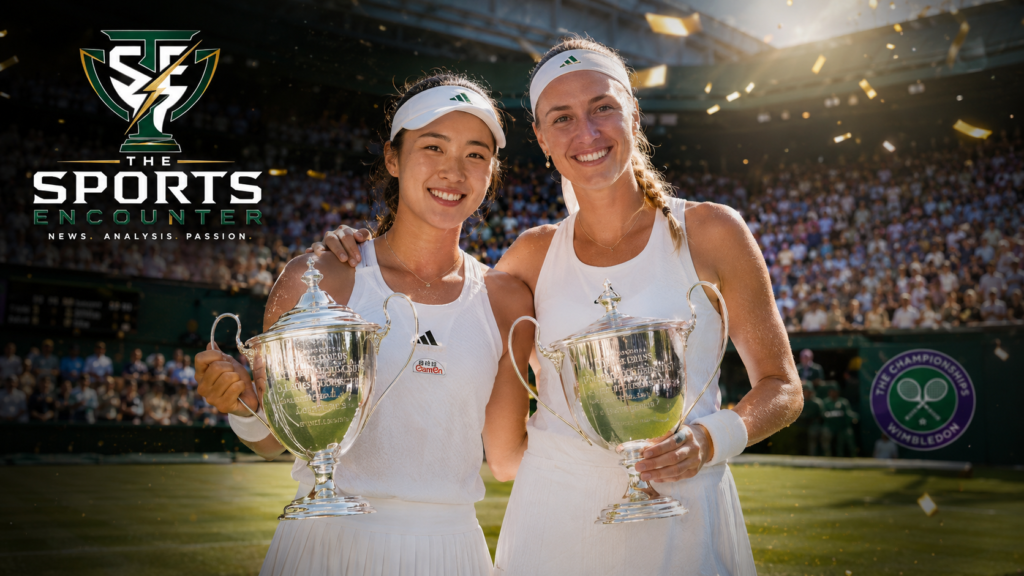
Guo Hanyu and Kristina Mladenovic Turn Trust Into Wimbledon 2026 Glory
Guo Hanyu and Kristina Mladenovic turned a new partnership into Wimbledon glory, defeating Gabriela Dabrowski and Luisa Stefani in a high-quality women’s doubles final.
Guo Hanyu arrived on Centre Court carrying the nerves of her first Grand Slam final. Kristina Mladenovic walked beside her with six women’s doubles majors, years of elite experience, and a body that had forced her to rebuild her career from crutches.
Ninety-two minutes later, they stood together as Wimbledon champions.
The No. 10 seeds defeated second-seeded Gabriela Dabrowski and Luisa Stefani 6-3, 7-5 in the Wimbledon 2026 women’s doubles final, completing a title run shaped by aggressive returning, sharp net instincts, and a partnership built on trust long before either player knew where it might lead.
Mladenovic secured her seventh women’s doubles major and her first Wimbledon title in the discipline. Guo became a Grand Slam champion in her first major final and joined Peng Shuai as only the second Chinese player in the Open Era to win the Wimbledon women’s doubles crown.
The final carried a deeper emotional weight for both champions.
Mladenovic, 34, had spent much of the previous year recovering from a serious injury. Her doubles ranking had disappeared during the layoff. Guo, then still searching for a breakthrough at the sport’s highest level, accepted her invitation to form a partnership without hesitation.
That decision produced an Auckland title in their first tournament together. Six months later, it produced Wimbledon.
“It feels like a dream,” Mladenovic said after the final. “I definitely cannot believe what just happened now.”
TL;DR
Guo Hanyu and Kristina Mladenovic defeated Gabriela Dabrowski and Luisa Stefani 6-3, 7-5 to win the Wimbledon 2026 women’s doubles title.
The No. 10 seeds:
- Won the final in one hour and 32 minutes
- Claimed their first Grand Slam title as a partnership
- Won their second title together after Auckland
- Defeated the No. 1 and No. 2 seeds during their title run
- Dropped only one set across six matches
- Won all three tiebreaks they played
- Handed Dabrowski and Stefani their first defeat after an 18-set winning streak
- Gave Guo her first major title
- Gave Mladenovic her seventh women’s doubles Grand Slam crown and 10th major overall
Wimbledon 2026 Women’s Doubles Final: Key Facts
| Match detail | Information |
|---|---|
| Champions | Guo Hanyu and Kristina Mladenovic |
| Runners-up | Gabriela Dabrowski and Luisa Stefani |
| Final score | 6-3, 7-5 |
| Match duration | 1 hour, 32 minutes |
| Champions’ seeding | No. 10 |
| Runners-up seeding | No. 2 |
| Guo’s achievement | First Grand Slam title |
| Mladenovic’s achievement | Seventh women’s doubles major |
| Partnership titles in 2026 | Auckland and Wimbledon |
| Decisive moment | Guo and Mladenovic broke at 5-5 in the second set |
| Tournament record | Six wins, one set lost |
The complete tournament results and official draw remain available through the official Wimbledon website. The latest movement among the champions and finalists can also be followed through the official WTA doubles rankings.
Five Straight Games Changed the Final Immediately
Dabrowski and Stefani entered Centre Court as the higher seeds and the more established partnership.
Their route into the final had been emphatic. They arrived on an 18-set winning streak, which included the Eastbourne title and five straight-set victories at Wimbledon. During their semifinal against Shuko Aoyama and Liang En-shuo, the second seeds did not lose serve or face a break point.
Guo and Mladenovic removed that confidence almost immediately.
They read Dabrowski’s early lobs, closed the net quickly, and attacked the space between their opponents. Mladenovic’s forehand carried weight from the baseline, while Guo reacted sharply around the service line.
The champions raced into a 5-0 lead.
That start mattered because women’s doubles finals can turn quickly once one team takes control of the court’s geometry. Guo and Mladenovic were not simply hitting harder. They were deciding where the exchanges happened.
Mladenovic pushed Dabrowski and Stefani backward with deep returns. Guo then stepped into the court, taking balls early and reducing the runners-up’ reaction time.
The Canadian-Brazilian pair finally settled and won three consecutive games. Their recovery made the first set more competitive, but the damage had already been done.
Guo and Mladenovic closed it 6-3.
The scoreboard showed one break of separation. The tactical gap had felt wider.
Dabrowski and Stefani Finally Find Their Shape
The second set looked more like the final many expected.
Dabrowski and Stefani improved their first-ball execution and became more secure on serve. Stefani’s movement at the net brought greater pressure, while Dabrowski varied her placement rather than relying as heavily on the lob.
Their cleaner positioning prevented Guo and Mladenovic from taking early control.
Break opportunities finally appeared for the second seeds. They created two chances, but Mladenovic’s crosscourt forehand repeatedly helped the champions escape.
Those saves proved vital.
Doubles pressure often arrives in clusters. One poor service game can alter an entire set because there is less time to recover than in singles. Guo and Mladenovic recognized those moments and played with greater clarity when the scoreboard tightened.
The teams remained level at 5-5.
At that stage, the final had entered its most delicate phase. Dabrowski and Stefani had overcome the poor start, found a more effective rhythm, and stood two games from forcing a deciding set.
Guo changed the match at the net.
Guo’s Backhand Creates the Championship Break
The 11th game became the defining passage of the final.
Guo attacked Stefani’s serve with confidence, meeting the ball early and redirecting pace rather than simply blocking returns back into play.
Her backhand work around the net created a break-point opportunity. The Chinese player then finished the game with a tightly angled crosscourt backhand, giving her team a 6-5 lead.
The WTA’s official report described a sequence of three return winners against Stefani’s serve, with Guo producing the final shot that secured the break.
It was a fitting contribution from a player contesting her first major final.
Guo had spent much of the match showing restraint. Mladenovic supplied much of the visible power, especially from the forehand side. When the title moved within reach, Guo became the aggressor.
She attacked the return, trusted her hands, and created the championship game.
Mladenovic Serves Out the Biggest Comeback of Her Career
Mladenovic had served for major titles before.
She understood that experience did not remove nerves. It gave her a method for handling them.
Guo produced a volley winner to help create championship point. Mladenovic then struck a firm forehand that Dabrowski and Stefani could only return into the net.
The match was over.
Guo raised her arms before turning toward her partner. Mladenovic’s reaction carried the release of someone who knew how far she had traveled to reach Centre Court again.
This was her first women’s doubles major since the 2022 French Open.
Her previous six titles had confirmed her status as one of the finest doubles players of her generation. Wimbledon 2026 carried a different meaning because the road back had offered no guarantees.
“I had no ranking, I had a tough injury last year, and she did not hesitate at all,” Mladenovic said of Guo. “I am very proud to be standing here with her.”
The victory brought Mladenovic’s career total to 31 WTA doubles titles. It also gave her a 10th Grand Slam trophy across women’s and mixed doubles. Her wider major record now includes seven women’s doubles championships and three mixed doubles titles.
Guo’s Gratitude Reveals the Foundation of the Partnership
Guo’s trophy presentation speech explained why the pair looked so connected during the final.
“I just feel so lucky to have you on my side and with this trophy now,” she told Mladenovic. “Thank you for choosing me, trusting me.”
Mladenovic immediately returned the praise.
She explained that she had approached Guo at the beginning of the season while rebuilding her career. Her ranking offered little security, and the injury created understandable doubts about what level she could reach.
Guo accepted.
“Hanyu said that she’s lucky that I picked her, but I would like to thank her for believing in me and wanting to play with me because I was the one who asked her to play with me at the beginning of the season,” Mladenovic said during the presentation.
That exchange separated their partnership from the usual language of convenience.
Doubles teams often form around ranking access, tournament entry, schedules, surface preferences, or short-term opportunity. Guo and Mladenovic began with professional uncertainty on both sides.
Mladenovic needed someone willing to believe her body and game could recover.
Guo needed an experienced partner who could help her see a bigger version of her own career.
Wimbledon became the result of both decisions.
From Auckland to the All England Club
The partnership produced evidence almost immediately.
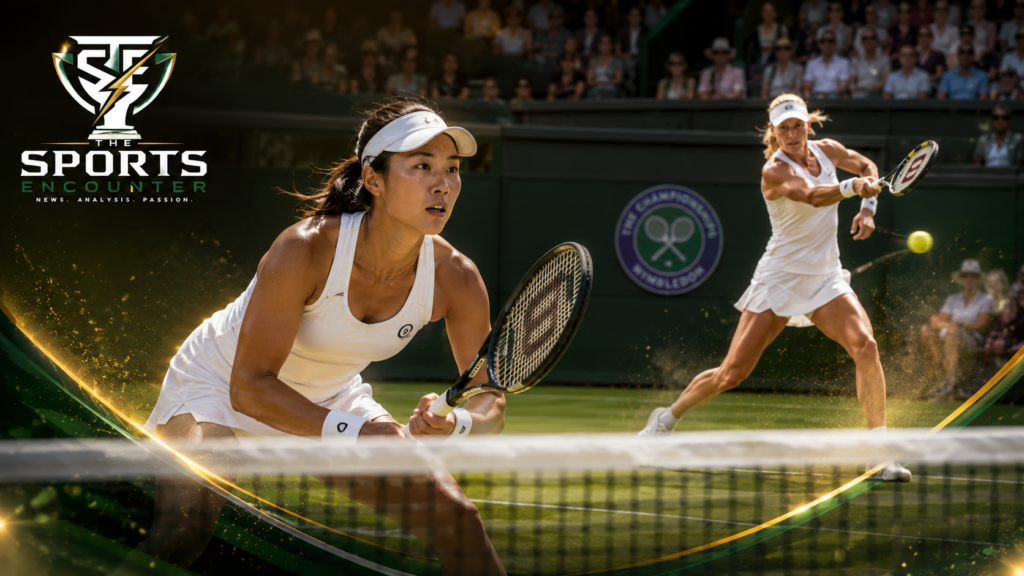
Guo and Mladenovic won the Auckland title in January during their first tournament together. They completed that event without losing a set and established the complementary style that later carried them through Wimbledon.
Mladenovic supplied experience, return quality, and the power to control crosscourt exchanges.
Guo brought fast reactions, movement, compact technique, and growing confidence around the net.
Their season still included setbacks. They lost in the fourth round of the Australian Open and fell narrowly in the Queen’s Club semifinals before Wimbledon, losing a deciding match tiebreak against Tereza Mihalikova and Olivia Nicholls.
Those results mattered because they exposed the pair to different kinds of pressure.
Australia tested their ability to manage a major draw together. Queen’s gave them grass-court preparation and showed how quickly a doubles match can turn in a deciding breaker.
At Wimbledon, they converted those lessons.
The One Match That Nearly Ended Their Run
Guo and Mladenovic dropped only one set across six matches.
Their greatest danger came in the third round against Anastasia Detiuc and Irina Khromacheva. The No. 10 seeds lost the opening set and fell a break behind in the second.
They were close to elimination.
Guo and Mladenovic recovered, survived a tiebreak, and won the deciding set. The official WTA account described it as the only significant disruption in an otherwise controlled title run. They finished the tournament having won all three tiebreaks they contested.
That escape strengthened the partnership before its biggest tests.
In the quarterfinals, they eliminated top seeds Katerina Siniakova and Taylor Townsend, one of the strongest and most decorated combinations in the draw.
Next came an all-Chinese semifinal battle against Jiang Xinyu and Xu Yifan. Guo and Mladenovic recovered from 3-0 down in the opening set and advanced in straight sets.
Their final opponent brought the No. 2 seeding and an 18-set winning streak.
Guo and Mladenovic completed the title run by beating both top-seeded teams.
Guo Becomes China’s New Grand Slam Doubles Champion
Guo entered Wimbledon ranked outside the established elite of women’s doubles.
She left as a Grand Slam champion and projected top-10 player.
The Wimbledon victory was Guo’s seventh career doubles title and her first above WTA 500 level. It also became her second trophy of 2026 and continued a run of multiple-title seasons stretching across three consecutive years.
Her ranking reward reflected the scale of the breakthrough.
The WTA projected Guo to rise to world No. 9, her first appearance inside the doubles top 10. Mladenovic was projected to jump to No. 13 as she continued rebuilding her position following injury. The partnership was also expected to rise to fourth in the season-long doubles race.
Guo also became the second Chinese player in the Open Era to win the Wimbledon women’s doubles title after Peng Shuai’s victory in 2013.
The achievement expands China’s modern doubles tradition.
Chinese women have produced major champions and Olympic medalists through intelligent positioning, disciplined return play, and technically strong net work. Guo’s victory carries that history forward while giving it a new personality.
Her game at Wimbledon looked modern and assertive. She defended well when necessary, but the decisive points came when she moved forward and trusted her attacking instincts.
“Another person I want to thank is Alan Ma,” Guo said. “He helped me to see lots of possibilities in my career and always helped me, giving me advice when I didn’t know what to do.”
“I will keep trying and keep building. Let’s see what’s going to happen next.”
Dabrowski and Stefani Leave With Progress Despite the Defeat
The final ended painfully for Dabrowski and Stefani, but their Wimbledon campaign represented a major step forward.
They entered the championship after winning Eastbourne and advanced to the final without dropping a set. Their semifinal performance was particularly dominant, with neither player losing serve or facing a break point.
Stefani also broke through a personal barrier by reaching her first Grand Slam final after losing her previous three major semifinals.
Dabrowski knew the disappointment more intimately. She had previously finished runner-up in the Wimbledon women’s doubles event in 2019 and 2024.
The 2026 loss became another near miss, but the Canadian remained focused on the partnership’s wider progress.
“The last few weeks have been absolutely amazing,” Dabrowski said during the trophy presentation.
“I couldn’t have imagined being in another position to fight for a Slam title, so I’m very grateful for all the weeks that we have together. I know it didn’t work out for us today, but we’ve put in a lot of good work and I’m still really proud of us.”
That assessment felt accurate.
Dabrowski and Stefani did not lose because their tournament had been poor. They lost because Guo and Mladenovic executed the biggest points more cleanly.
Why Guo and Mladenovic Won the Final
Three tactical factors separated the champions.
1. They controlled the return exchanges
Guo and Mladenovic placed sustained pressure on the second seeds’ service games. The first five games established that pattern, while the decisive break at 5-5 came through a sequence of aggressive returns.
“We were really clutch in important moments to get the break on their serve,” Mladenovic said.
“I think that’s what made the big difference in the second set, but also, throughout the match, we really put them under pressure on their service games.”
2. Mladenovic dictated with the forehand
Mladenovic’s crosscourt forehand prevented Dabrowski and Stefani from controlling the middle. It also saved her team during the second set when the runners-up created break chances.
Her ability to hit through the court gave Guo time to close forward.
3. Guo trusted her hands when the title tightened
Guo’s net play and backhand returns became most dangerous during the final two games.
A player in her first major final could easily have become conservative. Guo did the opposite. She took the ball early, attacked Stefani’s serve, and helped create championship point with a decisive volley.
A Different Kind of Wimbledon Partnership Story
Wimbledon 2026 produced several major tennis narratives across singles and doubles.
Jelena Ostapenko and Marcelo Arevalo came from behind to win the Wimbledon mixed doubles title. Karolina Muchova and Linda Noskova created a historic all-Czech women’s singles final. Novak Djokovic rewrote the men’s record book before his run ended, having earlier passed Roger Federer’s Wimbledon match-win record.
Guo and Mladenovic added a quieter but equally powerful story.
Their victory was built around belief exchanged in both directions.
Guo trusted a champion returning without a ranking.
Mladenovic trusted a partner who had never played a Grand Slam final.
The result looked polished on Centre Court, but its roots lay in uncertainty, rehabilitation, and the willingness to make a professional commitment before either player could promise an immediate reward.
Final Verdict
Guo Hanyu and Kristina Mladenovic won Wimbledon because their partnership performed best when the match became tight.
Their opening burst created control. Their resilience protected them during the second set. Guo’s return aggression secured the decisive break, and Mladenovic’s experience carried them through the final service game.
Yet the title will endure for more than its tactical quality.
For Guo, Wimbledon became the moment possibility turned into proof. She entered her first major final and played the closing games like someone who belonged there.
For Mladenovic, the trophy completed a return that had once looked uncertain. She moved from injury, crutches, and no meaningful ranking to a seventh women’s doubles major.
Their partnership started with one player asking and the other saying yes.
Centre Court supplied the answer.
Wimbledon 2026 Women’s Doubles Final Scorecard
| Category | Guo/Mladenovic | Dabrowski/Stefani |
|---|---|---|
| First-set start | 10/10 | 5/10 |
| Return pressure | 9.5/10 | 7.5/10 |
| Net execution | 9/10 | 8/10 |
| Break-point resilience | 9.5/10 | 7/10 |
| Tactical adjustment | 9/10 | 8/10 |
| Closing execution | 10/10 | 7/10 |
| Overall performance | 9.5/10 | 8/10 |
FAQs
Who won the Wimbledon 2026 women’s doubles title?
Guo Hanyu and Kristina Mladenovic won the title by defeating Gabriela Dabrowski and Luisa Stefani 6-3, 7-5.
How long did the final last?
The match lasted one hour and 32 minutes.
Was this Guo Hanyu’s first Grand Slam title?
Yes. Wimbledon 2026 was Guo’s first Grand Slam final and first major championship.
How many Grand Slam doubles titles has Kristina Mladenovic won?
Mladenovic now owns seven women’s doubles major titles. She has also won three mixed doubles majors, giving her 10 Grand Slam trophies overall.
Had Mladenovic won Wimbledon women’s doubles before?
No. She had previously finished runner-up in 2014. The 2026 victory gave her a first Wimbledon title in women’s doubles.
How did Guo and Mladenovic reach the final?
They dropped only one set during six matches. Their run included victories over top seeds Katerina Siniakova and Taylor Townsend in the quarterfinals and Jiang Xinyu and Xu Yifan in the semifinals.
How many titles have Guo and Mladenovic won together?
They won two titles during the first half of 2026, starting with Auckland and followed by Wimbledon.
What happened to Guo and Mladenovic in the third round?
They lost the opening set and fell behind by a break against Anastasia Detiuc and Irina Khromacheva before recovering to win. It was the only set they lost during the tournament.
What ranking did Guo reach after Wimbledon?
The WTA projected Guo to enter the doubles top 10 at a career-high world No. 9. Mladenovic was projected to rise to No. 13.
Where can readers find the official Wimbledon draw and WTA rankings?
Readers can check the official Wimbledon women’s doubles draw and the official WTA doubles rankings.

Breaking News
VfB Stuttgart 4-1 Köln: El Khannouss Leads Four-Goal Response Before Champions League Return
VfB Stuttgart bounced back from their 5-1 defeat at Bayern Munich with a convincing 4-1 home win over Köln. Bilal El Khannouss opened the scoring before Grischa Prömel, Ermedin Demirović and Josha Vagnoman completed a timely response ahead of Stuttgart’s Champions League return.
STUTTGART, Germany, September 4, 2026: VfB Stuttgart spent the opening week of the Bundesliga season carrying the weight of a 5-1 defeat at Bayern Munich.
Their first home game delivered a very different picture.
Bilal El Khannouss opened the scoring in the 39th minute, Grischa Prömel added a second after the break, Ermedin Demirović made it 3-0, and Josha Vagnoman completed a 4-1 victory over 1. FC Köln at the MHPArena.
Köln briefly reduced the deficit through a Ramon Hendriks own goal in the 81st minute, but Stuttgart never allowed the match to become genuinely uncomfortable. Vagnoman restored the three-goal margin in the 90th minute and gave the home crowd the finish a much-improved performance deserved.
The result gives Stuttgart their first points of the 2026-27 Bundesliga season and changes the atmosphere around Sebastian Hoeneß’ team only days before their return to the UEFA Champions League.
That timing matters.
Stuttgart’s 5-1 defeat at Bayern on opening night had exposed how quickly a competitive performance can collapse against elite opposition. Josha Vagnoman had equalized in Munich before Bayern scored four more and turned the match into a rout.
Against Köln, Stuttgart produced the opposite response.
They scored first, protected the advantage when the visitors improved, and punished the spaces that appeared later.
VfB Stuttgart 4-1 Köln: Match at a Glance
| Match Detail | Information |
|---|---|
| Competition | Bundesliga 2026-27 |
| Matchday | 2 |
| Venue | MHPArena, Stuttgart |
| Date | September 4, 2026 |
| Result | VfB Stuttgart 4-1 1. FC Köln |
| Stuttgart scorers | Bilal El Khannouss 39′, Grischa Prömel 60′, Ermedin Demirović 75′, Josha Vagnoman 90′ |
| Köln goal | Ramon Hendriks own goal 81′ |
| Attendance | 60,000 |
| Stuttgart next European match | vs Viking, UEFA Champions League, September 9 |
Official match information, Bundesliga standings and fixture details are available through the Bundesliga match center.
The Scoreline Matters Because Stuttgart Had to Answer Bayern Quickly
Opening-week defeats can be absorbed.
Heavy defeats create different questions.
Bayern did not simply beat Stuttgart 5-1 at the Allianz Arena. They scored four times after Stuttgart had equalized, and the match exposed the danger of losing control after a setback.
The Sports Encounter’s full Bayern-Stuttgart report highlighted how Michael Olise, Aleksandar Pavlović and Luis Díaz turned a brief 1-1 contest into an emphatic opening-night warning.
Stuttgart therefore arrived home with an immediate need to show that Munich had been a bad result rather than an early-season trend.
Hoeneß made two changes to the starting lineup.
Bilal El Khannouss came in for his first competitive appearance of the season, while Chris Führich also returned to the starting XI. Tiago Tomás was unavailable through injury.
The choice to bring El Khannouss directly into the side proved decisive.
Bilal El Khannouss Gives Stuttgart the Breakthrough They Had Earned
Stuttgart controlled much of the first half and repeatedly pushed Köln backward.
They also hit the woodwork twice before the breakthrough arrived.
El Khannouss finally converted the pressure in the 39th minute.
The goal was more than a simple opener.
It rewarded Stuttgart for playing with the intensity Hoeneß had demanded before the match and ensured the home side did not carry frustration into halftime after dominating without scoring.
Köln had arrived with confidence after beating Hoffenheim 3-2 on opening weekend.
That momentum was already weakened by the absence of two important attacking players.
Said El Mala was ruled out through illness, while Thijs Dallinga, who had scored twice as a substitute against Hoffenheim, was also unavailable.
The visitors therefore entered the MHPArena without both of their opening-day goalscorers.
Stuttgart took advantage.
Grischa Prömel Scores on a Big Night for a Summer Signing
Köln emerged more aggressively after halftime and created several better attacking moments.
That made Stuttgart’s second goal particularly important.
Prömel struck in the 60th minute to make it 2-0 and restore the home side’s control at the point where Köln were beginning to look more dangerous.
The goal also carried personal significance.
Prömel joined Stuttgart during the summer and had already been confirmed as one of the club’s vice-captains behind Deniz Undav.
Scoring in the first home league match gave the midfielder an immediate connection with the crowd and provided Hoeneß with another source of goals beyond the established front line.
That kind of secondary scoring will matter throughout the season.
Stuttgart are preparing to compete domestically and in the Champions League, where attacking responsibility cannot sit entirely with Undav and Demirović.
Fabian Bredlow Protects the Lead When Köln Improve
The final score suggests Stuttgart controlled every phase comfortably.
Köln had their strongest spell after halftime.
That was where Fabian Bredlow became important.
The Stuttgart goalkeeper made several saves that prevented the visitors from cutting the deficit while the game was still within reach.
A goal at 1-0 or even shortly after Prömel made it 2-0 could have changed the emotional direction of the second half.
Bredlow prevented that.
His work gave Stuttgart enough stability for the attacking players to punish Köln later.
Ermedin Demirović Makes His Köln Record Even Better
Demirović entered from the bench and scored Stuttgart’s third goal in the 75th minute.
The timing ended most of the remaining uncertainty.
His record against Köln was already strong before kickoff.
Stuttgart’s official pre-match data showed that Demirović had been directly involved in seven Bundesliga goals against Köln before this match, including five goals and two assists.
He had also scored in both league meetings with Köln during the previous season.
The latest goal extends a pattern that Hoeneß will be happy to keep using.
Demirović gives Stuttgart another experienced central attacking option and allows the coach to change the shape of the front line without losing penalty-box threat.
Köln Get One Back Through Ramon Hendriks
Köln finally found a route onto the scoreboard in the 81st minute.
The goal came through an own goal by Ramon Hendriks.
At 3-1, the visitors briefly had a reason to attack the closing minutes aggressively.
The score also created an uncomfortable echo for Stuttgart.
A week earlier, Vagnoman had experienced both sides of the scoreboard in Munich, scoring Stuttgart’s equalizer before later putting through his own net during Bayern’s response.
This time, Stuttgart avoided any late collapse.
Josha Vagnoman Finishes the Night at the Other End
Vagnoman scored in the 90th minute to restore Stuttgart’s three-goal advantage and complete the 4-1 victory.
His goal carried a useful piece of symbolism after the Bayern match.
In Munich, he had been at the center of a three-minute swing that took Stuttgart from 1-1 to 3-1 down.
At home against Köln, he supplied the final goal of a victory rather than being caught inside the opponent’s surge.
That does not erase what happened at Bayern.
It does show how quickly football provides opportunities to reset.
VfB Stuttgart vs Köln: Goal Timeline
| Minute | Scorer | Team | Score |
|---|---|---|---|
| 39′ | Bilal El Khannouss | VfB Stuttgart | 1-0 |
| 60′ | Grischa Prömel | VfB Stuttgart | 2-0 |
| 75′ | Ermedin Demirović | VfB Stuttgart | 3-0 |
| 81′ | Ramon Hendriks, own goal | Köln | 3-1 |
| 90′ | Josha Vagnoman | VfB Stuttgart | 4-1 |
From 1-5 to 4-1 in Seven Days
The numbers create an obvious contrast.
| Stuttgart Match | Result | Meaning |
|---|---|---|
| at Bayern Munich | Lost 1-5 | Heavy opening-day defeat against the defending champions |
| vs Köln | Won 4-1 | First league win and immediate home response |
Stuttgart have therefore gone from losing by four goals to winning by three within one week.
That swing is useful without being definitive.
Bayern remain the Bundesliga benchmark and began their title defense with exactly the type of depth that made them so difficult to catch last season.
The Sports Encounter recently examined how Harry Kane’s 36-goal Bundesliga season earned him another European Golden Shoe, yet Bayern still scored five against Stuttgart without Kane finding the net.
Köln offered a different level of challenge.
Stuttgart handled it.
The next question is whether they can carry the same confidence into stronger fixtures.
Stuttgart’s Home Record Continues to Matter
The MHPArena has become an increasingly important source of points for Stuttgart.
They won 12 of 17 Bundesliga home matches last season, giving them one of the strongest home records in the division.
That made the first home game particularly valuable after the defeat in Munich.
A Champions League-qualified side needs its own stadium to remain a reliable advantage when the calendar becomes congested.
European weeks will reduce preparation time.
Rotation will increase.
Injuries will force changes.
Home matches provide some of the best opportunities to protect domestic momentum.
Stuttgart began that process with four goals.
Köln’s Missing Attack Changed the Test
Köln deserve some context for their performance.
They opened the season with a dramatic 3-2 victory over Hoffenheim and arrived in Stuttgart with considerable confidence.
They did so without Said El Mala and Dallinga.
Those absences removed the two players who had provided the decisive scoring in Matchday 1.
El Mala has been one of Germany’s most productive young forwards, while Dallinga had already made an immediate impact after his move.
That left Köln less dangerous in the penalty area even when they improved after halftime.
René Wagner’s side still created moments.
They simply lacked the finishing and attacking continuity required to turn those moments into sustained pressure.
Why El Khannouss Could Become More Important Than One Goal
El Khannouss’ contribution deserves more attention than the opening goal alone.
He gave Stuttgart another player capable of carrying the ball, connecting midfield to attack and creating disruption between lines.
That profile becomes particularly important in Europe.
Champions League opponents will not always give Stuttgart the spaces Köln eventually provided.
Hoeneß will need players capable of breaking structures through movement and individual quality.
El Khannouss provided an early example of that value on his first competitive appearance of the season.
Champions League Football Arrives Immediately
Stuttgart do not have much time to enjoy the victory.
They return to the UEFA Champions League on September 9 when Viking visit the MHPArena.
UEFA has confirmed that the match will be Stuttgart’s first league-phase fixture of the 2026-27 competition.
Viking are appearing in the Champions League proper for the first time.
The Norwegian club’s qualification was one of the stories highlighted in The Sports Encounter’s Champions League playoff wrap.
The official UEFA Champions League hub lists Stuttgart’s league-phase schedule, which also includes Atlético Madrid, Inter, Galatasaray, Lille, Club Brugge and PSV Eindhoven.
That fixture list explains why Friday’s result matters beyond three Bundesliga points.
Stuttgart needed rhythm before Europe began.
They found it.
The European Schedule Will Test Stuttgart’s Depth
September introduces a new challenge for Hoeneß.
Stuttgart play Viking on September 9, travel to Hoffenheim in the Bundesliga three days later and then host Borussia Dortmund on September 19.
The rhythm changes immediately.
Training time becomes recovery time.
Rotation becomes essential.
Players such as Demirović, Prömel, El Khannouss, Führich, Undav and Vagnoman will all need to contribute over different starting lineups.
That is why four different scorers against Köln provide a useful sign.
Stuttgart did not need one player to carry the entire attacking output.
German Football Is Entering Another Interesting Club Cycle
The Bundesliga season is also unfolding after a difficult World Cup summer for Germany.
The national team began the tournament explosively with a 7-1 victory over Curaçao and later needed a second-half response to defeat Côte d’Ivoire.
The campaign eventually ended in disappointment when Paraguay eliminated Germany on penalties.
That puts additional attention on the Bundesliga and Germany’s Champions League clubs as the domestic game moves into a new season.
Bayern remain the obvious standard.
Stuttgart’s task is to prove that finishing fourth last season and qualifying for Europe was part of a sustainable rise rather than a temporary peak.
Beating Köln 4-1 is a useful step in that argument.
Köln Still Have Reasons to Avoid Overreaction
One heavy away defeat should not erase everything Köln showed on opening weekend.
The visitors were missing important attackers and faced a Stuttgart side playing its first home match after a humiliating loss.
That was a difficult emotional combination.
The problem for Köln was how little resistance they offered once Stuttgart found the opening goal.
They improved after halftime but never fully changed the structure of the game.
Wagner will now need to restore the attacking sharpness that produced three goals against Hoffenheim.
Sebastian Hoeneß Gets the Response He Needed
Hoeneß had spoken before the match about staying calm and focused after Munich.
The performance reflected that message.
Stuttgart did not enter the game trying to erase five Bayern goals in the first 10 minutes.
They controlled the first half, kept creating chances after hitting the woodwork and eventually found the breakthrough through El Khannouss.
The second half then required a different quality.
Köln improved.
Stuttgart responded with goals.
That is a much healthier game pattern than the collapse seen at Bayern.
What Comes Next for Stuttgart?
The immediate focus moves to Europe.
Viking visit Stuttgart on September 9 for the opening Champions League league-phase fixture.
Three days later, VfB return to Bundesliga action away at Hoffenheim.
The club’s official fixture schedule then shows Dortmund visiting the MHPArena on September 19.
The next two weeks will therefore tell us much more about Stuttgart’s depth, recovery and ability to move between competitions.
The Sports Encounter Verdict
VfB Stuttgart needed more than three points against Köln.
They needed proof that the Bayern defeat had not damaged the confidence of a team preparing for Champions League football.
The response was convincing.
El Khannouss gave Stuttgart the lead after a dominant first half.
Prömel struck when Köln were beginning to improve.
Demirović added another goal from the bench.
Vagnoman completed the night after experiencing a difficult opening weekend in Munich.
Four scorers, four goals and three points give Hoeneß exactly the platform he wanted before Viking arrive.
The win does not suddenly place Stuttgart alongside Bayern as a title favorite.
It does restore the broader picture.
This is still a team that finished fourth last season, remains extremely strong at home and has enough attacking variety to trouble opponents when its structure holds.
Europe will ask harder questions.
Friday night ensured Stuttgart will answer them with considerably more confidence than they carried out of Munich.
For continuing Bundesliga, Champions League and international football coverage, visit The Sports Encounter Soccer Hub.
Frequently Asked Questions
What was the VfB Stuttgart vs Köln score?
VfB Stuttgart defeated 1. FC Köln 4-1 at the MHPArena on September 4, 2026.
Who scored for Stuttgart against Köln?
Bilal El Khannouss, Grischa Prömel, Ermedin Demirović and Josha Vagnoman scored Stuttgart’s four goals.
How did Köln score?
Köln’s goal came through an own goal by Stuttgart defender Ramon Hendriks in the 81st minute.
When did Bilal El Khannouss score?
El Khannouss opened the scoring for Stuttgart in the 39th minute.
Did Ermedin Demirović start against Köln?
No. Demirović came off the bench and scored Stuttgart’s third goal in the 75th minute.
Was this Stuttgart’s first Bundesliga win of the season?
Yes. Stuttgart lost 5-1 at Bayern Munich on Matchday 1 before beating Köln 4-1 in their first home league game.
Who do Stuttgart play next?
Stuttgart host Viking in the UEFA Champions League on September 9 before travelling to Hoffenheim in the Bundesliga on September 12.
Why were Said El Mala and Thijs Dallinga absent for Köln?
Both were unavailable because of illness, according to the official Bundesliga match information.
How did Stuttgart perform at home last season?
Stuttgart won 12 of their 17 Bundesliga home matches last season, giving them one of the strongest home records in the division.
Are Stuttgart playing in the Champions League this season?
Yes. Stuttgart return to the UEFA Champions League in 2026-27 and begin their league-phase campaign at home against Viking.
Breaking News
Saudi Pro League: Al Ahli Hit Five, Al Hilal Keep Winning and Al Qadsiah Stay in the Hunt
Saudi Pro League Matchweek 5 delivered four very different wins. Al Ahli responded to back-to-back defeats with a 5-0 rout of Al Riyadh, Al Hilal kept the pressure on with a 2-0 win over Al Shabab, Al Qadsiah stayed in the hunt after beating Diriyah, and Al Ettifaq escaped Abha with a narrow away victory.
SAUDI ARABIA, September 4, 2026: Matchweek 5 of the Saudi Pro League produced four very different kinds of victories across Thursday and Friday.
Al Ahli delivered the most emphatic result, crushing Al Riyadh 5-0 in Jeddah after entering the match under pressure from consecutive league defeats. Al Hilal maintained their own momentum with a 2-0 away victory over Al Shabab, while Al Ettifaq needed an 80th-minute own goal to escape Abha with a 1-0 win.
Twenty-four hours earlier, Al Qadsiah had already strengthened their position near the top by beating Diriyah 2-0 through second-half goals from Mateo Retegui and Julián Quiñones.
Together, those results sharpened several early-season themes.
Al Hilal continue to look like one of the strongest title contenders. Al Qadsiah are refusing to drift away from the leading group. Al Ahli have shown they can respond after two damaging defeats. Al Ettifaq are collecting points even when their football is less convincing.
The Sports Encounter has been tracking the league’s growing competitive depth throughout the opening month, including NEOM’s 3-0 response against Al Khaleej, Al Kholood’s unbeaten run surviving at Al Fayha and Al Qadsiah’s controlled win over Diriyah.
Saudi Pro League Matchweek 5 Results Covered in This Wrap
| Match | Result | Key Impact |
|---|---|---|
| Diriyah vs Al Qadsiah | 0-2 | Al Qadsiah move to 12 points and remain firmly in the leading group |
| Abha vs Al Ettifaq | 0-1 | A late Donovan Léon own goal gives Al Ettifaq three valuable away points |
| Al Ahli vs Al Riyadh | 5-0 | Al Ahli produce a major response after back-to-back defeats |
| Al Shabab vs Al Hilal | 0-2 | Al Hilal maintain their winning momentum and title pressure |
Official fixtures, standings and league information are available through the Saudi Pro League website and the Saudi Arabian Football Federation competition page.
Al Ahli 5-0 Al Riyadh: The Response Was More Important Than the Margin
Al Ahli needed a victory.
They received considerably more than that.
A 5-0 home win over Al Riyadh gave Marino Pušić’s side its biggest result of the early league campaign and, more importantly, stopped a sequence that was beginning to become uncomfortable.
Al Ahli had started the season with two victories.
Then came a 3-1 defeat against Al Kholood.
Three days later, Al Hilal beat them 3-0 in a postponed Matchweek 3 fixture.
Two straight defeats and six goals conceded had quickly shifted the conversation around a club carrying major domestic and continental expectations.
Friday’s five-goal response changes the mood again.
Why the clean sheet mattered as much as the five goals
The attacking number will dominate the result because five is five.
The zero at the other end may be just as useful to Al Ahli.
The defense had conceded three against Al Kholood and another three against Al Hilal. Returning immediately to a clean sheet gives the coaching staff something tangible to work with beyond the emotional lift of a big home victory.
Al Ahli’s squad still contains significant attacking quality through Ivan Toney, Galeno, Trincão, Eduard Spertsyan and others.
The larger issue after the two defeats was balance.
Could the team create enough without leaving itself vulnerable?
Against Al Riyadh, the answer was far more convincing.
Al Ahli needed this before the schedule became heavier
The club’s continental responsibilities make domestic recovery particularly important.
Al Ahli are back-to-back Asian champions and enter every league match carrying expectations beyond simply finishing inside the top four.
The Sports Encounter previously examined how Matthias Jaissle’s work helped turn Al Ahli into an Asian power.
That history raises the standard for the current team.
A two-game losing sequence can happen.
Allowing it to grow into three or four would change the championship picture considerably.
Al Ahli prevented that.
Al Shabab 0-2 Al Hilal: Another Result That Keeps the Pressure on Everyone Else
Al Hilal’s 2-0 away win over Al Shabab lacked the visual shock of Al Ahli’s five-goal victory.
Its title value may ultimately be greater.
Al Hilal entered Matchweek 5 carrying momentum from their 3-0 victory over Al Ahli earlier in the week.
Another clean sheet and another win means the Riyadh giants have now collected consecutive league victories against two established opponents without conceding a goal.
That is exactly the type of sequence capable of creating pressure on every other contender.
Five goals scored, none conceded across two major fixtures
Al Hilal’s week has been remarkably efficient.
They scored three against Al Ahli.
They scored two against Al Shabab.
The defense conceded nothing across the two matches.
This matters because title races are often shaped by the way strong teams handle short stretches against credible opposition.
A team does not need to dominate every 90 minutes.
It needs to keep leaving with points.
Al Hilal are doing that.
The squad is becoming stronger while the results remain strong
The timing is also notable because Al Hilal have continued adding attacking quality.
Ollie Watkins began his Saudi career with a goal against Al Ahli, while Gabriel Martinelli has now arrived from Arsenal to give the club another high-level attacking option.
The Saudi Pro League itself described Watkins’ debut as an “amazing start,” and Al Hilal’s attacking depth continues to increase.
That combination of results and recruitment makes them particularly dangerous.
The challenge for rivals such as Al Nassr, Al Qadsiah, Al Ittihad and Al Ahli is that Al Hilal are accumulating points while still improving their squad.
Diriyah 0-2 Al Qadsiah: Retegui and Quiñones Keep Brendan Rodgers’ Side Close
Al Qadsiah’s Thursday victory deserves to remain part of the weekend conversation because it kept Brendan Rodgers’ side firmly attached to the leading group.
The match remained scoreless through the opening 50 minutes.
Then Al Qadsiah settled it quickly.
Mateo Retegui converted a penalty in the 51st minute before Julián Quiñones doubled the lead in the 58th.
Seven minutes changed the entire night.
The 2-0 victory moved Al Qadsiah to 12 points and reinforced the view that they belong in the conversation immediately below, and potentially inside, the league’s traditional championship group.
The full tactical and statistical breakdown is available in The Sports Encounter’s Diriyah-Al Qadsiah match report.
Retegui continues to give Al Qadsiah a reliable focal point
Retegui’s goal adds another decisive contribution during the opening weeks.
His arrival gave Al Qadsiah a proven central striker capable of converting periods of control into goals.
That sounds obvious.
It is exactly the quality several ambitious teams struggle to find.
Al Qadsiah already possess midfield quality through Tijjani Reijnders and attacking support from Quiñones.
Retegui gives the structure a clear finishing point.
That combination had already been visible when Reijnders scored and Retegui converted a penalty in the 2-0 win over NEOM.
Al Qadsiah have recovered strongly from the Al Ittihad defeat
Their season has not been flawless.
Al Ittihad handed them an early defeat despite playing much of the second half with 10 men.
The Sports Encounter’s report on Al Ittihad’s 1-0 victory over Al Qadsiah highlighted the biggest early weakness in Rodgers’ side: possession and territorial control do not automatically produce goals.
Since then, the response has been encouraging.
Al Qadsiah have found greater efficiency.
The win at Diriyah is another example.
Abha 0-1 Al Ettifaq: One Own Goal Separates Two Imperfect Performances
The narrowest result of the group arrived in Abha.
Al Ettifaq won 1-0 through an 80th-minute own goal from Abha goalkeeper Donovan Léon.
The scoreline tells most of the truth about the match.
Neither attack found sustained fluency.
Al Ettifaq controlled more of the ball, finishing with roughly 61 percent possession, but managed only one shot on target from eight attempts.
Abha finished with nine shots and no effort on target.
A match with so little end product was eventually settled by an error rather than a clean attacking breakthrough.
The own goal changed a match heading toward 0-0
Léon’s own goal came after 80 minutes of resistance.
For Abha, the timing was brutal.
The hosts had defended long enough to believe a point was within reach despite creating almost nothing themselves.
One moment changed the result.
Al Ettifaq then thought they had doubled the advantage late through Moussa Dembélé, only for VAR to rule the goal out for offside.
The 1-0 score remained.
Al Ettifaq will take the points before worrying about the performance
There are occasions when a team needs to separate result from aesthetics.
This was one of them.
Al Ettifaq had already endured an uneven opening month.
Three points away from home matter more than whether the winner arrived from a constructed attacking move.
The broader concern is that one shot on target from 61 percent possession leaves considerable room for improvement.
Stronger opponents will punish that lack of incision.
Abha have a different problem.
Zero shots on target at home makes it extremely difficult to argue that they deserved more than the score gave them.
Matchweek 5 So Far Shows the League’s Different Layers
The first six completed fixtures of Matchweek 5 have already produced a revealing spread of results.
| Fixture | Result |
|---|---|
| Al Fayha vs Al Kholood | 2-2 |
| NEOM vs Al Khaleej | 3-0 |
| Diriyah vs Al Qadsiah | 0-2 |
| Abha vs Al Ettifaq | 0-1 |
| Al Ahli vs Al Riyadh | 5-0 |
| Al Shabab vs Al Hilal | 0-2 |
The Al Fayha-Al Kholood draw showed how difficult Al Kholood have become to beat.
The NEOM-Al Khaleej result showed how quickly a team with serious investment can recover from consecutive defeats.
Al Qadsiah then showed another level of control.
Al Ahli brought the round’s biggest score.
Al Hilal brought another championship-level result.
That variety is exactly why this Saudi Pro League season is becoming difficult to reduce to one superstar or one club.
Al Ahli’s 5-0 Win Changes Their Immediate Narrative
Before Friday, Al Ahli’s last two results read 1-3 and 0-3.
Now the most recent score reads 5-0.
That matters psychologically.
Players do not stop seeing the previous defeats because one big win arrives.
They do gain evidence that the attacking structure still works.
The goal difference also receives an immediate repair after the six goals conceded across the previous two matches.
For a team expecting to compete near the top, that response was overdue.
Al Hilal’s 2-0 Win May Be the More Important Title Result
Al Ahli produced the largest margin.
Al Hilal may have produced the most meaningful championship result.
Away victories against Al Shabab are rarely treated as routine assignments.
Al Hilal took three points, kept another clean sheet and maintained the momentum created by beating Al Ahli.
The sequence forces the rest of the league to keep winning.
That is how early title pressure begins.
One contender reaches the finish line every week.
Everyone else knows dropped points will be punished immediately.
Al Qadsiah Are Becoming Harder to Describe as Outsiders
The term “outsider” becomes less useful every time Al Qadsiah win another match.
They possess major international players.
They have a coach with Premier League and European experience.
They have already beaten NEOM twice this season across competitive meetings and responded well after losing to Al Ittihad.
Twelve points after five matches is the type of return that demands attention.
The club’s progress also fits a broader Saudi Pro League trend that The Sports Encounter has been documenting.
Our analysis of Steven Bergwijn and Tijjani Reijnders shaping Round 3 showed how high-level European talent is now distributed more widely across the league rather than concentrated only among the four best-known clubs.
Al Qadsiah may become the clearest test of how far that competitive redistribution has gone.
Al Ettifaq Show the Value of Winning Without Playing Well
The elite teams are judged on performance and result.
Teams trying to establish themselves higher in the table sometimes need to take the result first.
Al Ettifaq’s win belongs in that category.
They lacked cutting edge.
They created very little relative to their possession.
They still left Abha with three points.
Those victories become useful later in the season when the table no longer remembers whether the winner came from an own goal.
The Bottom of the Table Is Already Becoming Uncomfortable for Abha
Abha’s defeat carries a different emotional weight.
They had an opportunity to take something from a low-event match.
They ended with nothing.
The larger concern is attacking output.
One can survive a difficult opening schedule with disciplined defending.
It becomes much harder when matches repeatedly pass without creating shots on target.
Abha now need more than defensive resilience.
They need a reliable route to goal.
Matchweek 5 Still Has Its Biggest Fixture to Come
The round is not finished.
Saturday brings Al Ittihad against defending champions Al Nassr, the fixture capable of changing the entire tone of the title race.
Al Nassr entered the round with a perfect league start, while Al Ittihad have shown considerable resilience without always playing their best football.
The Sports Encounter’s earlier analysis of Bergwijn’s hat-trick against Al Hazem highlighted how often Al Ittihad have relied on individual moments during the opening weeks.
Facing Al Nassr will provide a far more demanding test of whether that approach can continue producing results.
Saudi Pro League Matchweek 5: What We Have Learned So Far
| Team | Matchweek 5 Message |
|---|---|
| Al Hilal | Winning momentum and defensive control continue |
| Al Ahli | Strong immediate response after two defeats |
| Al Qadsiah | Increasingly credible as a top-four and possible title challenger |
| Al Ettifaq | Can collect points even without attacking fluency |
| Abha | Attacking production is becoming a major concern |
| Al Riyadh | Defensive vulnerability exposed by an elite opponent |
| Al Shabab | Need stronger results against the league’s top teams |
| Diriyah | Big-name recruitment has not removed the difficulty of adapting to the top flight |
The Sports Encounter Verdict
Matchweek 5 is beginning to separate the teams capable of sustaining pressure from those still searching for stability.
Al Hilal look comfortable winning different types of matches.
Al Qadsiah continue collecting enough points to force their way into the leading conversation.
Al Ahli needed a result that changed the mood and found one in the most emphatic way possible.
Al Ettifaq showed that ugly wins still carry exactly three points.
The opposite side of those results is equally important.
Abha remain short of attacking threat.
Al Riyadh have now been exposed badly against one of the league’s strongest squads.
Al Shabab have another defeat to absorb.
Diriyah continue learning that investment does not automatically compress the adaptation period for a newly promoted side.
The biggest championship question remains unanswered because Al Nassr and Al Ittihad still have to meet.
What Friday did accomplish was narrow the room for error.
Al Hilal have won again.
Al Qadsiah are already on 12 points.
Al Ahli have recovered.
Every contender playing after them knows the pace required.
For continuing Saudi Pro League, Gulf and international football coverage, visit The Sports Encounter Soccer Hub.
Frequently Asked Questions
What were the main Saudi Pro League results on September 4, 2026?
Al Ahli beat Al Riyadh 5-0, Al Hilal defeated Al Shabab 2-0 and Al Ettifaq beat Abha 1-0. Al Qadsiah had also defeated Diriyah 2-0 on September 3 in Matchweek 5.
What was the Al Ahli vs Al Riyadh score?
Al Ahli defeated Al Riyadh 5-0 in Jeddah.
Why was Al Ahli’s win important?
The victory ended a two-match losing sequence after defeats to Al Kholood and Al Hilal and restored confidence before a demanding domestic and continental period.
What was the Al Shabab vs Al Hilal score?
Al Hilal beat Al Shabab 2-0 away from home.
How did Abha vs Al Ettifaq finish?
Al Ettifaq won 1-0 after Abha goalkeeper Donovan Léon scored an own goal in the 80th minute.
Did Moussa Dembélé score against Abha?
Dembélé had a late goal ruled out by VAR for offside, so the final score remained Abha 0-1 Al Ettifaq.
Who scored for Al Qadsiah against Diriyah?
Mateo Retegui scored from the penalty spot in the 51st minute before Julián Quiñones made it 2-0 in the 58th.
How many points do Al Qadsiah have after five matches?
Al Qadsiah moved to 12 points after beating Diriyah.
What is the biggest remaining fixture in Matchweek 5?
Al Ittihad host defending champions Al Nassr on September 5 in the final major fixture of the round.
Where can fans follow official Saudi Pro League results?
Official fixtures, standings and competition information are available through the Saudi Pro League and Saudi Arabian Football Federation websites.
Breaking News
Clark, Hayashi, Meesseman, and Park Light Up Day 1 of FIBA Women’s World Cup 2026 in Berlin
The 2026 FIBA Women’s Basketball World Cup opened with records, statement victories and major individual performances. Saki Hayashi rewrote the three-point record book, Caitlin Clark posted a double-double on debut, Emma Meesseman dominated for Belgium, Park Ji-hyun powered Korea past Nigeria, and Spain, Australia and Italy all made important early moves in their groups.
BERLIN, September 4, 2026: The expanded FIBA Women’s Basketball World Cup needed only one day to show why this tournament may be considerably deeper than a simple question about whether anyone can stop the United States.
Japan broke two World Cup three-point records while surviving Mali. Caitlin Clark produced a points-assists double-double on her senior World Cup debut. Emma Meesseman opened Belgium’s campaign with the highest-scoring World Cup performance of her career. Park Ji-hyun powered Korea past African champions Nigeria. Spain overwhelmed host nation Germany in front of a sold-out Berlin Arena. Australia found a way through a difficult Puerto Rican challenge, and Italy opened Group D with a valuable defensive victory over Czechia.
The United States still delivered the most emphatic message among the established favorites, beating China 94-61 and extending its extraordinary World Cup winning streak to 31 games. Yet opening day belonged to far more than one team.
Several individual performances immediately changed the shape of their groups, while the expanded 16-team format made first-place positioning important from the first possession. Under the 2026 competition system, each group winner advances directly to the quarterfinals, while the teams finishing second and third must survive an additional elimination game.
That makes victories such as Korea’s over Nigeria, Italy’s over Czechia and Japan’s comeback against Mali more valuable than an ordinary opening-round result.
For continuing tournament coverage, follow The Sports Encounter’s basketball and NBA hub, where the World Cup will be tracked through daily wraps, individual performances, records, qualification scenarios and knockout analysis.
FIBA Women’s Basketball World Cup 2026 Day 1 Results
| Group | Match | Result | Key Story |
|---|---|---|---|
| A | Japan vs Mali | Japan 102-97 Mali | Saki Hayashi hit a World Cup-record nine three-pointers as Japan set a team record with 20 |
| C | Australia vs Puerto Rico | Australia 70-54 Puerto Rico | Steph Talbot scored 19 as Australia survived a third-quarter Puerto Rico push |
| D | USA vs China | USA 94-61 China | Caitlin Clark recorded 14 points and 11 assists on her World Cup debut |
| B | Korea vs Nigeria | Korea 99-81 Nigeria | Park Ji-hyun scored 27 as Korea pulled away with a 31-point fourth quarter |
| C | Belgium vs Türkiye | Belgium 89-75 Türkiye | Emma Meesseman produced 27 points, nine rebounds and five assists |
| A | Spain vs Germany | Spain 83-53 Germany | Awa Fam scored 17 as Spain spoiled the hosts’ opening night |
| D | Czechia vs Italy | Italy 63-54 Czechia | Italy turned a one-point halftime deficit into an important Group D victory |
| B | Hungary vs France | Live at time of publication | France had established a commanding advantage by the latest verified update |
The official FIBA Women’s Basketball World Cup 2026 hub provides the full schedule, standings, team pages and official match information.
Japan 102-97 Mali: Saki Hayashi Changes the World Cup Record Book
Opening day began with the kind of game that immediately justified the expanded tournament.
Mali pushed Japan deep into the contest and held the advantage for significant stretches, but Japan eventually found a route through one of the most extreme perimeter shooting performances in Women’s World Cup history.
Saki Hayashi finished with 27 points and made nine three-pointers from 15 attempts.
Nine is a new single-game Women’s World Cup record.
The previous benchmark was eight, shared by Korea’s Beon Yeon-Ha and Cuba’s Gricel Herrera Mendez.
Japan went even further collectively.
The team made 20 three-pointers, breaking the previous World Cup team record of 18.
The Sports Encounter has already examined the performance in depth in our report on Saki Hayashi’s record-breaking shooting and Japan’s historic 20-three night.
Kokoro Tanaka gives Japan another major reason for optimism
Hayashi understandably owned the historical headline, but Kokoro Tanaka’s World Cup debut may prove equally important for Japan’s long-term tournament prospects.
Tanaka finished with 18 points, seven assists and three rebounds.
Her willingness to attack created openings for Japan beyond the three-point line and helped prevent the offense from becoming entirely dependent on Hayashi’s shooting.
That matters because opponents will adjust quickly.
Japan cannot reasonably expect to make 20 three-pointers every night. A guard capable of creating off the bounce provides another solution when the perimeter percentage falls back toward normal levels.
What the result means for Group A
Japan’s five-point victory becomes more valuable after Spain’s later destruction of Germany.
Spain and Japan now have early wins in a group where only the winner receives a direct quarterfinal berth.
Mali showed enough offensive quality to make future opponents uncomfortable, but dropping the opener places greater pressure on the games against Spain and Germany.
Australia 70-54 Puerto Rico: Steph Talbot Stops an Upset From Developing
Australia’s 16-point winning margin makes the opener look more comfortable than it felt during the third quarter.
The Opals led 31-24 at halftime, only for Puerto Rico to attack the game after the break and close within a single point at 37-36.
That was the moment Australia needed an experienced player to take control.
Steph Talbot did exactly that.
Talbot finished with 19 points, eight rebounds, three assists and two steals, shooting efficiently and making four of six attempts from three-point range.
Her timely scoring helped Australia answer Puerto Rico’s best run and rebuild a double-digit advantage.
Ezi Magbegor contributed 11 points and nine rebounds, while Jade Melbourne added 10.
Alanna Smith’s fitness becomes the concern
The victory came with an uncomfortable development.
Alanna Smith had 10 points and eight rebounds but did not return after halftime because of what appeared to be a lower-leg issue.
Her availability could become important quickly.
Australia still have to face Türkiye and European champions Belgium, and the Belgium game may ultimately determine who earns the direct quarterfinal berth from Group C.
The Opals therefore gained two things from the opener: two standings points and an early reminder that their margin for error may depend partly on Smith’s health.
USA 94-61 China: Caitlin Clark’s First Global Answer
The most scrutinized World Cup debut of the day delivered almost everything Team USA could have wanted.
Caitlin Clark scored 14 points and handed out 11 assists as the defending champions dismantled China by 33 points.
Rhyne Howard matched Clark with 14 points, Jackie Young added 12, and the Americans turned what briefly looked like an interesting tactical test against China’s enormous frontcourt into another comfortable World Cup victory.
China received 13 points from 7-foot-3 teenager Zhang Ziyu, while Han Xu finished with 11 points and 10 rebounds.
The Sports Encounter had framed Berlin as Clark’s first genuine global test with the senior national team.
Our full USA-China match analysis explains why the 11 assists may ultimately matter more than her scoring total.
Clark’s passing changes the shape of this USA team
Clark did not need to chase a huge scoring night.
She stretched China’s defense, moved the ball early and repeatedly created opportunities before China could organize its interior size.
That becomes particularly important because Team USA entered Berlin without A’ja Wilson and Kelsey Plum.
Their withdrawals, analyzed in The Sports Encounter’s report on the late USA roster changes, placed more creative responsibility on Clark, Paige Bueckers, Chelsea Gray and Jackie Young.
Opening day suggested the Americans have enough options to absorb that disruption.
31 consecutive World Cup wins
USA’s victory extended its Women’s World Cup winning streak to 31 games.
The last American defeat in the competition came against Russia in the 2006 semifinals.
The streak now spans several generations of players, and the first Berlin performance suggested that the current transition toward Clark, Bueckers, Angel Reese, Aliyah Boston and Rhyne Howard has not lowered the immediate championship standard.
That transition began before the tournament, when Clark and Bueckers were initially named to a star-heavy USA World Cup roster.
Korea 99-81 Nigeria: Park Ji-hyun Produces the First Major Group B Shift
South Korea’s win may carry the largest qualification consequence of any result from the first half of opening day.
Nigeria entered Berlin as the reigning African champion and a team with legitimate ambitions of reaching the knockout rounds.
Korea beat them by 18.
Park Ji-hyun produced one of the best individual performances of opening day with 27 points, six rebounds and six steals.
Leeseul Kang added 20 points and seven assists, while Isaem Choi scored 19.
Nigeria stayed close for three quarters.
Korea led only 68-62 entering the fourth.
Then the game changed completely.
The Koreans scored 31 points in the final period compared with Nigeria’s 19 and turned a six-point contest into a decisive victory.
Amy Okonkwo and Murjanatu Musa could not save Nigeria
Amy Okonkwo scored 22 points and added seven rebounds for Nigeria, while Murjanatu Musa produced a 15-point, 13-rebound double-double.
The individual output was not enough because Korea created too much damage through perimeter scoring and forced Nigeria into costly turnovers.
This result matters because France were widely expected to control Group B.
If that expectation holds, Korea’s victory over Nigeria gives the Asian side a major advantage in the fight for second or third place.
Nigeria now face Hungary with considerably less room for error.
Belgium 89-75 Türkiye: Emma Meesseman Starts With a Personal World Cup Best
Belgium entered Berlin as the reigning European champions and one of the teams most capable of challenging the traditional global powers.
Emma Meesseman wasted no time reinforcing that argument.
Meesseman scored 27 points, the highest total of her World Cup career and a new single-game World Cup scoring record for a Belgian player.
She also contributed nine rebounds, five assists and two blocks.
Her all-around performance produced an efficiency rating of 31 and earned her Player of the Game honors.
The third quarter separated Belgium from Türkiye
Türkiye actually led 45-44 at halftime.
Belgium then produced the game’s decisive stretch.
The European champions won the third quarter 27-9, and Meesseman scored nine points during the closing two minutes of the period.
That changed the game from a one-point Turkish advantage into a contest Belgium could control.
Kennedy Burke led Türkiye with 15 points, but the Turkish defense never found a sustainable answer once Meesseman began influencing almost every possession.
Belgium-Australia already looks enormous
Both Group C favorites now have opening victories.
Australia beat Puerto Rico by 16.
Belgium beat Türkiye by 14.
Their meeting on September 7 could become one of the most important games of the entire group stage because first place carries a direct route to the quarterfinals.
Meesseman’s performance suggests Belgium have arrived prepared to chase more than simple qualification.
Spain 83-53 Germany: Awa Fam Silences a Sold-Out Berlin Arena
The emotional centerpiece of the opening night belonged to the hosts.
A crowd of 12,550 packed Berlin Arena to watch Germany begin its home World Cup against Spain.
Spain removed the suspense quickly.
The Spanish won 83-53, shooting above 50 percent from the field while holding Germany below 30 percent.
Awa Fam led Spain with 17 points and four rebounds.
Leonie Fiebich was Germany’s leading scorer with 13.
Spain’s 30-point margin immediately matters
The result gives Spain the strongest point differential in Group A after one game.
Japan have two standings points after beating Mali 102-97, but Spain’s 30-point victory establishes an early tiebreak advantage should group positioning eventually reach deeper criteria.
The direct quarterfinal place therefore gives Spain an immediate incentive to protect that margin while continuing to win.
Germany, meanwhile, face Japan next.
That matchup has become considerably more dangerous after Hayashi and Tanaka’s opening-day performance.
Italy 63-54 Czechia: A Quiet Result With Major Group D Consequences
Italy’s 63-54 victory may receive less international attention than Clark’s debut or Spain’s destruction of Germany, but its effect on Group D could become enormous.
Czechia led 17-14 after the opening quarter and held a narrow 32-31 advantage at halftime.
Italy turned the game after the break.
The Italians won the third quarter 19-13 and then held Czechia to only nine points in the fourth.
| Quarter | Czechia | Italy |
|---|---|---|
| Q1 | 17 | 14 |
| Q2 | 15 | 17 |
| Q3 | 13 | 19 |
| Q4 | 9 | 13 |
| Final | 54 | 63 |
Italy are appearing at the Women’s World Cup for the first time in 32 years.
Starting that return with a victory becomes particularly useful in a group containing USA and China.
The Americans are expected to control the group. That makes the results among Italy, Czechia and China potentially decisive in determining who reaches the qualification round.
Italy have already banked the first of those head-to-head victories.
France Were Turning the Final Game Into Another Group B Warning
At the latest verified live update available during publication, France were in overwhelming control against Hungary.
Les Bleues had built a 61-20 halftime lead and moved further ahead early in the third quarter.
The final score had not yet been officially verified when this article was prepared, so it has deliberately not been presented as a completed result.
The early pattern nevertheless reinforced the pre-tournament expectation that France may be USA’s strongest challenger in Berlin.
France entered the competition ranked No. 2 in the world, carrying Gabby Williams, Marine Johannes, Dominique Malonga, Janelle Salaun and an unusually deep collection of guards and forwards.
If the second half confirms the direction of the first, Korea’s win over Nigeria becomes even more significant because France would immediately occupy the expected position at the top of Group B.
This section should be updated with the official final score and leading performers once FIBA confirms the result.
Opening-Day Performers Who Changed Their Team’s Tournament
| Player | Team | Performance | Why It Matters |
|---|---|---|---|
| Saki Hayashi | Japan | 27 points, World Cup-record 9 threes | Powered Japan’s comeback and set an individual tournament record |
| Caitlin Clark | USA | 14 points, 11 assists | Showed immediate senior World Cup playmaking impact |
| Emma Meesseman | Belgium | 27 points, 9 rebounds, 5 assists, 2 blocks | Produced a Belgian World Cup scoring record and drove decisive third quarter |
| Park Ji-hyun | Korea | 27 points, 6 rebounds, 6 steals | Helped Korea beat African champions Nigeria in a pivotal Group B result |
| Steph Talbot | Australia | 19 points, 8 rebounds, 3 assists | Stopped Puerto Rico’s comeback when Australia were under pressure |
| Awa Fam | Spain | 17 points, 4 rebounds | Led a 30-point win over the host nation |
| Kokoro Tanaka | Japan | 18 points, 7 assists, 3 rebounds | Gave Japan a second creator beyond its record-breaking perimeter shooting |
| Murjanatu Musa | Nigeria | 15 points, 13 rebounds | Produced a double-double despite Nigeria’s damaging opening defeat |
What Day 1 Changed in Group A
Spain and Japan have immediately separated themselves from Germany and Mali.
Spain own the stronger scoring margin after beating the hosts by 30, while Japan possess the more difficult opening victory after surviving Mali’s challenge.
Saturday becomes important almost immediately.
Spain face Mali, while Germany meet Japan.
A second victory for Spain or Japan could put either team very close to securing at least a top-three finish and strengthen the race for the direct quarterfinal berth.
What Day 1 Changed in Group B
Korea’s victory over Nigeria is the result that matters most here before France’s opener is completed.
The Koreans entered the tournament ranked below Nigeria and without star center Park Ji-soo.
They still scored 99 points.
Nigeria now face Hungary knowing that another defeat could place the African champions in serious elimination danger before the final group game against France.
Korea, by contrast, have already gained the head-to-head advantage over one of their likely qualification rivals.
What Day 1 Changed in Group C
The expected contenders both won.
Australia survived Puerto Rico.
Belgium eventually broke Türkiye.
The margin between those victories was similar enough that the Belgium-Australia matchup already looks capable of deciding first place.
Australia’s concern is Smith.
Belgium’s encouragement is Meesseman.
The reigning European MVP looked entirely comfortable on the global stage.
What Day 1 Changed in Group D
USA immediately placed itself in control through a 33-point victory.
Italy then gained a valuable head-to-head win over Czechia.
That leaves China under considerably more pressure than the identity of its opening opponent might suggest.
Losing to the United States was hardly unexpected.
The important games for China may be Czechia and Italy.
Italy already have two standings points. Czechia have now lost one of the games they would have viewed as winnable.
USA’s next meeting with Italy therefore carries two different questions: whether the Americans can continue cruising toward first place, and whether Italy can remain competitive enough to strengthen its position behind them.
The 16-Team Format Already Looks Like a Good Decision
FIBA expanded the Women’s World Cup from 12 teams in Sydney 2022 to 16 in Berlin.
Opening day immediately produced evidence for why the larger field can improve the tournament.
Mali pushed Japan to 102-97.
Puerto Rico came within a point of Australia during the third quarter.
Korea beat the reigning African champions.
Italy returned after a 32-year absence and won its first game.
Only some of the favorites enjoyed uncomplicated afternoons.
The official FIBA competition guide confirms that group winners advance directly to the quarterfinals, while second- and third-place teams enter the qualification round.
That structure rewards dominance without making the rest of the group stage meaningless.
The World Cup Is Also Becoming a Showcase for Women’s Basketball’s New Audience
Clark, Bueckers and Reese brought enormous American attention into Berlin.
Opening day immediately broadened the conversation.
Hayashi became a global record-holder.
Tanaka introduced herself to a larger audience.
Park Ji-hyun produced one of the tournament’s best two-way games.
Meesseman reminded viewers why Belgium believe a first global medal is possible.
Fam gave Spain another emerging player to build around.
This is the larger opportunity for the competition.
The WNBA has already demonstrated how rapidly women’s basketball audiences can grow when recognizable stars, competitive games and compelling individual stories intersect. The Sports Encounter’s 2026 WNBA All-Star analysis documented the enormous fan interest surrounding Clark and Bueckers earlier this summer.
Berlin now allows that audience to discover an entire international player pool.
The Sports Encounter Verdict
The United States remains the team everyone must eventually solve.
Opening day made the road toward that challenge considerably more interesting.
Japan discovered that a record-breaking perimeter offense can rescue a difficult game.
Australia learned that Puerto Rico will punish sloppy stretches and that Smith’s fitness may matter later.
Korea produced a result that could reshape Group B before France had even completed its opener.
Belgium received exactly the type of performance it needs from Meesseman if a first global medal is going to become realistic.
Spain walked into a sold-out arena belonging to the host nation and won by 30.
Italy quietly collected one of the most strategically valuable victories of the day.
USA showed that its generational transition can work immediately, with Clark creating 11 assists in her first World Cup game.
And the tournament produced two major records before the first afternoon was finished.
That is a strong beginning for a competition expanded to 16 teams and entering a period of unprecedented attention around women’s basketball.
Day 1 gave us stars, records, tactical problems, emerging players and immediate qualification consequences.
The next round of games now has something opening day did not.
Pressure.
Frequently Asked Questions
What were the main results on Day 1 of the FIBA Women’s Basketball World Cup 2026?
Japan beat Mali 102-97, Australia defeated Puerto Rico 70-54, USA beat China 94-61, Korea defeated Nigeria 99-81, Belgium beat Türkiye 89-75, Spain defeated Germany 83-53 and Italy beat Czechia 63-54. Hungary vs France was still awaiting a verified final result at the time of publication.
Who was the best performer on opening day?
Several players produced major performances. Saki Hayashi scored 27 points and set a World Cup record with nine three-pointers, Emma Meesseman had 27 points, nine rebounds and five assists, and Park Ji-hyun scored 27 points with six rebounds and six steals.
How did Caitlin Clark perform in her first World Cup game?
Clark recorded 14 points and 11 assists as the United States beat China 94-61.
What record did Saki Hayashi break?
Hayashi made nine three-pointers against Mali, the most by any player in a single Women’s Basketball World Cup game.
What record did Japan set against Mali?
Japan made 20 three-pointers, establishing a new single-game team record at the Women’s World Cup.
How did Emma Meesseman perform against Türkiye?
Meesseman scored 27 points with nine rebounds, five assists and two blocks in Belgium’s 89-75 victory.
Who led Korea against Nigeria?
Park Ji-hyun led Korea with 27 points, six rebounds and six steals in the 99-81 victory.
Who led Australia against Puerto Rico?
Steph Talbot led Australia with 19 points, eight rebounds and three assists.
Who was Spain’s leading scorer against Germany?
Awa Fam scored 17 points as Spain defeated host nation Germany 83-53.
How does qualification work at the 2026 Women’s Basketball World Cup?
The winner of each four-team group advances directly to the quarterfinals. Teams finishing second and third play qualification games for the remaining quarterfinal places, while the fourth-place team is eliminated.
-
Editor's Choice4 weeks agoPremier League 2026–27 Curtain Raiser: Fixtures, Teams, Title Contenders, Transfers and Season Predictions
-
Editor's Choice4 weeks agoWhen Will Lionel Messi Retire? Argentina President Says Only Messi Has the Answer
-
Editor's Choice4 weeks agoWhich of Last Season’s Premier League Top 10 Can Actually Win the 2026-27 Title?