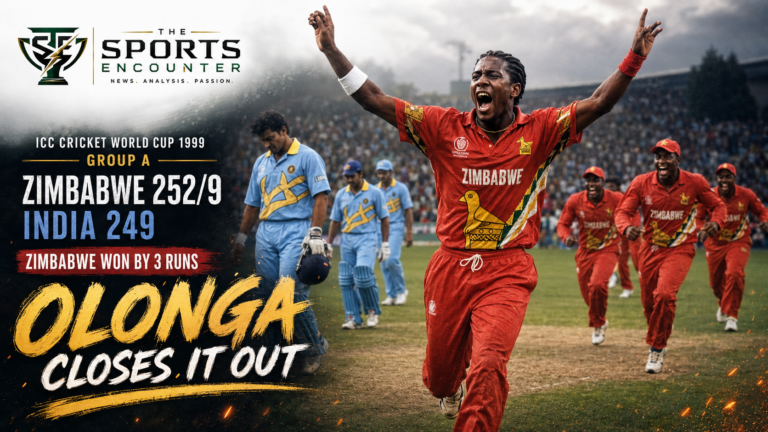
A Celebration of 5000 ODIs Match 16: Olonga Takes Three Wickets as India Fall Three Runs Short
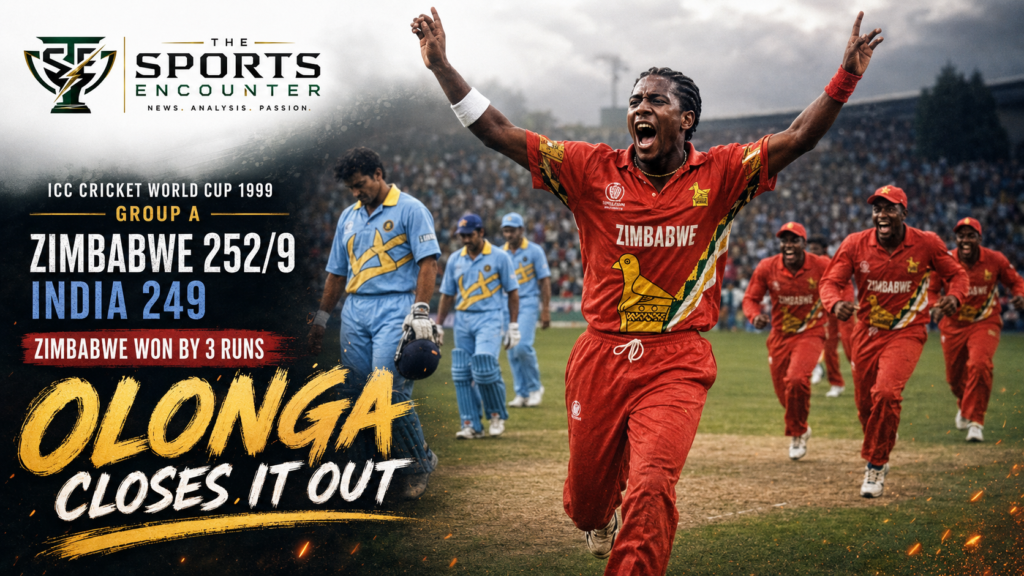
India needed nine runs from two overs with three wickets remaining. Henry Olonga then delivered six balls that transformed Zimbabwe’s World Cup campaign.
India needed nine runs from 12 balls. Robin Singh had survived the repair work, Javagal Srinath had already struck two sixes, and Zimbabwe were turning to a bowler who had struggled to control the ball earlier in the chase.
Henry Olonga had conceded six wides across three overs. His return for the 45th carried obvious risk. India held three wickets and still had another over available.
Six deliveries later, the match was over.
Olonga removed Robin, bowled Srinath and trapped Venkatesh Prasad lbw. India were dismissed for 249, three runs short of Zimbabwe’s 252/9, with six balls of their reduced allocation unused.
The ending alone earns this contest a place in A Celebration of 5000 ODIs. The path toward it adds several more reasons: 90 overs of fluctuating control, 90 extras, India’s costly slow-over-rate penalty, the absence of Sachin Tendulkar, and a match-winning performance from Grant Flower that extended far beyond the final score.
TL;DR
- Zimbabwe beat India by three runs at Grace Road during the 1999 World Cup.
- Andy Flower anchored Zimbabwe’s innings with 68 not out from 85 balls.
- Grant Flower made 45 and conceded only 33 runs from 10 overs to earn Player of the Match.
- India’s slow over rate reduced its chase from 50 overs to 46.
- Sadagoppan Ramesh top-scored for India with 55, while Ajay Jadeja made 43.
- Henry Olonga took three wickets in the 45th over to end India’s chase at 249.
Zimbabwe vs India 1999 World Cup: Match Information
| Detail | Information |
|---|---|
| Match | India vs Zimbabwe, Group A |
| Tournament | 1999 Cricket World Cup |
| Date | May 19, 1999 |
| Venue | Grace Road, Leicester |
| Toss | India won the toss and fielded |
| Zimbabwe | 252/9 in 50 overs |
| India | 249 all out in 45 overs |
| Result | Zimbabwe won by three runs |
| Player of the Match | Grant Flower, 45 and 1/33 |
| Zimbabwe’s top scorer | Andy Flower, 68 not out |
| India’s top scorer | Sadagoppan Ramesh, 55 |
| Best bowling figures | Heath Streak, 3/36; Henry Olonga, 3/22 |
| Turning point | Olonga took three wickets in the 45th over |
| Tournament impact | Zimbabwe earned its second win; India suffered a second consecutive defeat |
Complete Match Scorecard
Zimbabwe Innings: 252/9 in 50 Overs
| Batter | Dismissal | Runs | Balls | 4s | 6s |
|---|---|---|---|---|---|
| Neil Johnson | c Mongia b Srinath | 7 | 10 | 1 | 0 |
| Grant Flower | c Mongia b Jadeja | 45 | 89 | 4 | 0 |
| Paul Strang | b Agarkar | 18 | 26 | 1 | 0 |
| Murray Goodwin | c Robin Singh b Ganguly | 17 | 40 | 3 | 0 |
| Andy Flower | Not out | 68 | 85 | 2 | 0 |
| Alistair Campbell | st Mongia b Kumble | 24 | 29 | 3 | 0 |
| Guy Whittall | b Kumble | 4 | 8 | 0 | 0 |
| Stuart Carlisle | b Srinath | 1 | 2 | 0 | 0 |
| Heath Streak | c Mongia b Prasad | 14 | 18 | 2 | 0 |
| Eddo Brandes | c Mongia b Prasad | 2 | 5 | 0 | 0 |
| Henry Olonga | Not out | 1 | 4 | 0 | 0 |
| Extras | 14 leg byes, 21 wides, 16 no-balls | 51 | |||
| Total | Nine wickets in 50 overs | 252 |
Fall of wickets: 12/1, 45/2, 87/3, 144/4, 204/5, 211/6, 214/7, 244/8, 250/9.
India Bowling
| Bowler | Overs | Maidens | Runs | Wickets |
|---|---|---|---|---|
| Javagal Srinath | 10 | 1 | 35 | 2 |
| Venkatesh Prasad | 10 | 1 | 37 | 2 |
| Ajit Agarkar | 9 | 0 | 70 | 1 |
| Sourav Ganguly | 5 | 0 | 22 | 1 |
| Robin Singh | 2 | 0 | 11 | 0 |
| Anil Kumble | 10 | 0 | 41 | 2 |
| Ajay Jadeja | 4 | 0 | 22 | 1 |
India Innings: 249 All Out in 45 Overs
| Batter | Dismissal | Runs | Balls | 4s | 6s |
|---|---|---|---|---|---|
| Sourav Ganguly | c Brandes b Johnson | 9 | 8 | 2 | 0 |
| Sadagoppan Ramesh | c Goodwin b Grant Flower | 55 | 77 | 3 | 1 |
| Rahul Dravid | c Grant Flower b Streak | 13 | 14 | 2 | 0 |
| Mohammad Azharuddin | c Campbell b Streak | 7 | 11 | 1 | 0 |
| Ajay Jadeja | lbw b Streak | 43 | 76 | 3 | 0 |
| Robin Singh | c Campbell b Olonga | 35 | 47 | 1 | 0 |
| Ajit Agarkar | Run out (Goodwin) | 1 | 5 | 0 | 0 |
| Nayan Mongia | b Whittall | 28 | 24 | 2 | 1 |
| Javagal Srinath | b Olonga | 18 | 12 | 0 | 2 |
| Anil Kumble | Not out | 1 | 1 | 0 | 0 |
| Venkatesh Prasad | lbw b Olonga | 0 | 1 | 0 | 0 |
| Extras | 1 bye, 4 leg byes, 24 wides, 10 no-balls | 39 | |||
| Total | All out in 45 overs | 249 |
Fall of wickets: 13/1, 44/2, 56/3, 155/4, 174/5, 175/6, 219/7, 246/8, 249/9, 249/10.
Zimbabwe Bowling
| Bowler | Overs | Maidens | Runs | Wickets |
|---|---|---|---|---|
| Eddo Brandes | 3 | 0 | 27 | 0 |
| Neil Johnson | 7 | 0 | 51 | 1 |
| Heath Streak | 9 | 0 | 36 | 3 |
| Henry Olonga | 4 | 0 | 22 | 3 |
| Guy Whittall | 4 | 0 | 26 | 1 |
| Paul Strang | 8 | 0 | 49 | 0 |
| Grant Flower | 10 | 0 | 33 | 1 |
India’s 51 Extras Change the Shape of the Match
Zimbabwe’s recognized batters scored only 200 runs between them. India supplied the remaining 51 through 21 wides, 16 no-balls and 14 leg byes.
Ajit Agarkar conceded 70 from nine overs, including five no-balls and four wides. Srinath bowled five no-balls, while almost every frontline option contributed to the extras column.
Those mistakes also slowed the innings. Match officials penalized India four overs for its slow over rate, leaving the team 46 overs to chase 253. In a match decided by three runs, the missing 24 deliveries became impossible to ignore.
Andy Flower Holds Zimbabwe Together
Zimbabwe reached 87/3 before Andy Flower began building the innings around control and placement.
Grant Flower’s 45 had occupied India’s bowlers for 89 deliveries, but his dismissal left Zimbabwe 144/4. Andy then added 60 with captain Alistair Campbell, who contributed 24 from 29 balls.
Three wickets fell for 10 runs after Campbell departed. Andy stayed unbeaten, pushed the total beyond 250 and finished with 68 from 85 balls.
His innings continued a remarkable family contribution to Zimbabwe cricket. The ICC’s history of Zimbabwe’s cricketing brothers identifies the Flower siblings as central figures in the country’s strongest World Cup campaign.
Grant Flower Delivers the Complete Match
Grant’s 45 was slower than Andy’s unbeaten innings, but it gave Zimbabwe stability after Neil Johnson and Paul Strang fell inside the first 10 overs.
His greater influence emerged during India’s chase.
Ramesh and Jadeja had rebuilt from 56/3 with a 99-run fourth-wicket partnership. Grant ended it by dismissing Ramesh for 55, then completed his 10 overs for only 33 runs.
That economy mattered in a chase requiring more than five runs per over. His combined batting and bowling contribution earned him Player of the Match, even though Olonga produced the unforgettable finish.
Heath Streak Breaks India’s Top Order
India played without Sachin Tendulkar, who had returned home following his father’s death. His absence placed greater pressure on Ganguly, Dravid and captain Azharuddin.
All three were gone by the ninth over.
Neil Johnson dismissed Ganguly before Heath Streak removed Dravid and Azharuddin. Streak later trapped Jadeja lbw for 43, finishing with 3/36 from nine overs.
India had recovered from 56/3 to 155/3, but Streak’s third wicket prevented Jadeja from carrying the chase into its closing phase.
Tendulkar returned in India’s next game and scored an emotional unbeaten 140 against Kenya, an innings documented in the ICC’s account of his finest World Cup performances.
Ramesh, Robin and Srinath Take India Within Reach
Ramesh’s 55 gave India its first substantial innings. Jadeja supported him with 43, but their dismissals and Agarkar’s run-out left India 175/6.
Robin Singh then rebuilt with Mongia. After Mongia fell for 28, Srinath attacked, striking two sixes in his 12-ball 18.
India moved to 246/7 and needed seven runs from 10 deliveries. Zimbabwe appeared to have lost control despite repeatedly creating winning positions.
Campbell brought Olonga back.
Henry Olonga Wins the Match in Five Balls
Olonga’s second delivery removed Robin for 35, with Campbell completing the catch.
Srinath survived two more balls before Olonga bowled him with the fifth delivery. Prasad faced the last ball and was trapped lbw for a duck.
Olonga had taken three wickets in five balls. His final figures read 3/22 from four overs, an extraordinary return considering the six wides he had delivered earlier.
The ICC ranks Zimbabwe’s victory among the greatest World Cup upsets, while its review of Zimbabwe’s classic World Cup matches highlights Olonga’s ability to recover from his earlier problems and attack India’s final three wickets.
Why Match 16 Belongs in A Celebration of 5000 ODIs
This match asked both teams to recover repeatedly.
Zimbabwe survived early wickets, India’s middle order rebuilt from 56/3, and Robin and Srinath brought the chase back after it slipped to 175/6. Olonga then turned a likely defeat into victory within one over.
The three-run margin connects the game with Zimbabwe’s earlier World Cup surprises, including Eddo Brandes defending 134 against England in Match 10. It also provides a very different counterpoint to Kapil Dev’s rescue against Zimbabwe in 1983.
The contest followed the two Australia-South Africa classics from the same tournament: Steve Waugh’s survival at Headingley and the tied semifinal at Edgbaston.
Readers can explore every published installment through the A Celebration of 5000 ODIs collection and follow wider historical and current reporting through The Sports Encounter’s cricket coverage hub.
What Happened Next
Zimbabwe later defeated South Africa and reached the Super Six stage for the first time. India recovered to win its next three group matches, but the points carried forward from this defeat damaged its position in the following round.
Grace Road produced the result through accumulated mistakes and small interventions rather than a dominant century or five-wicket haul. India conceded 51 extras, lost four overs and still reached the final nine runs with three wickets available.
Olonga needed one over to make every earlier detail decisive.
A Celebration of 5000 ODIs
A Celebration of 5000 ODIs Match 15: One Run, Two Stranded Batters and South Africa’s World Cup Collapse
Lance Klusener carried South Africa within one run of the 1999 World Cup final before confusion with Allan Donald completed cricket’s most painful tie.
Lance Klusener had already struck the first two balls of the final over for four. The scores were level, South Africa had four deliveries left, and Australia appeared to have exhausted every escape route.
Then time seemed to slow down at Edgbaston.
Klusener drove Damien Fleming’s fourth delivery toward mid-off and ran. Allan Donald remained at the non-striker’s end, watching the ball instead of his partner. By the time Donald reacted, Klusener had reached the same end and Australia had transferred the ball to Adam Gilchrist.
The wicketkeeper broke the stumps. Donald dropped his bat. South Africa’s World Cup ended with both batters stranded at the wrong end and one winning run still unclaimed.
Australia and South Africa had scored 213 each, but the tie sent Australia into the final because they had finished higher in the Super Six standings. That combination of pressure, confusion and irreversible consequence makes the 1999 semifinal an essential part of A Celebration of 5000 ODIs.
TL;DR
- Australia and South Africa tied after both teams were dismissed for 213.
- Australia advanced to the World Cup final because they finished higher in the Super Six table.
- Michael Bevan scored 65 and Steve Waugh made 56 after Australia slipped to 68/4.
- Shaun Pollock took 5/36, while Allan Donald claimed 4/32.
- Shane Warne earned Player of the Match honors after taking 4/29.
- Lance Klusener struck 31 not out from 16 balls before Allan Donald was run out with the scores level.
Australia vs South Africa 1999 Semifinal: Match Information
| Detail | Information |
|---|---|
| Match | Australia vs South Africa, second semifinal |
| Tournament | 1999 Cricket World Cup |
| Date | June 17, 1999 |
| Venue | Edgbaston, Birmingham |
| Toss | South Africa won the toss and fielded |
| Australia | 213 all out in 49.2 overs |
| South Africa | 213 all out in 49.4 overs |
| Result | Match tied; Australia advanced |
| Player of the Match | Shane Warne, 4/29 |
| Top Australia batter | Michael Bevan, 65 |
| Top South Africa batter | Jacques Kallis, 53 |
| Best bowling figures | Shaun Pollock, 5/36 |
| Turning point | Klusener and Donald’s run-out with the scores level |
| Tournament impact | Australia advanced to face Pakistan in the final |
The official ICC review of the 1999 World Cup confirms that Australia progressed because of its higher Super Six position.
Complete Match Scorecard
Australia Innings: 213 All Out in 49.2 Overs
| Batter | Dismissal | Runs | Balls | 4s | 6s |
|---|---|---|---|---|---|
| Adam Gilchrist | c Donald b Kallis | 20 | 39 | 1 | 1 |
| Mark Waugh | c Boucher b Pollock | 0 | 4 | 0 | 0 |
| Ricky Ponting | c Kirsten b Donald | 37 | 48 | 3 | 1 |
| Darren Lehmann | c Boucher b Donald | 1 | 4 | 0 | 0 |
| Steve Waugh | c Boucher b Pollock | 56 | 76 | 6 | 1 |
| Michael Bevan | c Boucher b Pollock | 65 | 101 | 6 | 0 |
| Tom Moody | lbw b Pollock | 0 | 3 | 0 | 0 |
| Shane Warne | c Cronje b Pollock | 18 | 24 | 1 | 0 |
| Paul Reiffel | b Donald | 0 | 1 | 0 | 0 |
| Damien Fleming | b Donald | 0 | 2 | 0 | 0 |
| Glenn McGrath | Not out | 0 | 1 | 0 | 0 |
| Extras | 1 bye, 6 leg byes, 3 wides, 6 no-balls | 16 | |||
| Total | All out in 49.2 overs | 213 |
Fall of wickets: 3/1, 54/2, 58/3, 68/4, 158/5, 158/6, 207/7, 207/8, 207/9, 213/10.
South Africa Bowling
| Bowler | Overs | Maidens | Runs | Wickets |
|---|---|---|---|---|
| Shaun Pollock | 9.2 | 1 | 36 | 5 |
| Steve Elworthy | 10 | 0 | 59 | 0 |
| Jacques Kallis | 10 | 2 | 27 | 1 |
| Allan Donald | 10 | 1 | 32 | 4 |
| Lance Klusener | 9 | 1 | 50 | 0 |
| Hansie Cronje | 1 | 0 | 2 | 0 |
South Africa Innings: 213 All Out in 49.4 Overs
| Batter | Dismissal | Runs | Balls | 4s | 6s |
|---|---|---|---|---|---|
| Gary Kirsten | b Warne | 18 | 42 | 1 | 0 |
| Herschelle Gibbs | b Warne | 30 | 36 | 6 | 0 |
| Daryll Cullinan | Run out (Bevan) | 6 | 30 | 0 | 0 |
| Hansie Cronje | c Mark Waugh b Warne | 0 | 2 | 0 | 0 |
| Jacques Kallis | c Steve Waugh b Warne | 53 | 92 | 3 | 0 |
| Jonty Rhodes | c Bevan b Reiffel | 43 | 55 | 2 | 1 |
| Shaun Pollock | b Fleming | 20 | 14 | 1 | 1 |
| Lance Klusener | Not out | 31 | 16 | 4 | 1 |
| Mark Boucher | b McGrath | 5 | 10 | 0 | 0 |
| Steve Elworthy | Run out (Reiffel/McGrath) | 1 | 1 | 0 | 0 |
| Allan Donald | Run out (Mark Waugh/Fleming/Gilchrist) | 0 | 0 | 0 | 0 |
| Extras | 1 leg bye, 5 wides | 6 | |||
| Total | All out in 49.4 overs | 213 |
Fall of wickets: 48/1, 53/2, 53/3, 61/4, 145/5, 175/6, 183/7, 196/8, 198/9, 213/10.
Australia Bowling
| Bowler | Overs | Maidens | Runs | Wickets |
|---|---|---|---|---|
| Glenn McGrath | 10 | 0 | 51 | 1 |
| Damien Fleming | 8.4 | 1 | 40 | 1 |
| Paul Reiffel | 8 | 0 | 28 | 1 |
| Shane Warne | 10 | 4 | 29 | 4 |
| Mark Waugh | 8 | 0 | 37 | 0 |
| Tom Moody | 5 | 0 | 27 | 0 |
The figures and dismissals have been checked against the archived ESPNcricinfo scorecard.
Michael Bevan and Steve Waugh Rescue Australia
South Africa’s attack created the first crisis of the semifinal.
Mark Waugh fell for a duck, while Donald removed Ricky Ponting and Darren Lehmann. Kallis dismissed Gilchrist to leave Australia 68/4.
Steve Waugh and Michael Bevan responded with a 90-run partnership. Their approach suited the conditions: cautious against Donald and Pollock, selective against the supporting bowlers, and willing to preserve wickets while rebuilding the innings.
Waugh made 56 from 76 balls before Pollock removed him. Bevan remained until the final delivery of the innings, scoring 65 from 101 balls. Those runs gave Warne and Australia’s seamers a total they could defend.
The innings continued Australia’s survival story from Match 14, when Waugh’s unbeaten 120 kept their World Cup alive against South Africa.
Shaun Pollock and Allan Donald Take Nine Wickets
Pollock and Donald gave South Africa almost complete control of Australia’s innings.
Pollock claimed 5/36, dismissing both Waugh and Bevan while also removing Mark Waugh, Moody and Warne. Donald’s pace brought him 4/32, including three wickets during Australia’s two major collapses.
Australia fell from 158/4 to 158/6 and later from 207/6 to 207/9. South Africa’s bowlers had done enough to make 214 appear manageable, but their batters would face an equally influential spell.
Shane Warne Changes the Semifinal in Eight Deliveries
South Africa reached 48 without loss. Gibbs had struck six boundaries and appeared ready to continue the form that brought him a century against Australia four days earlier.
Warne bowled him for 30.
Eight deliveries later, South Africa were 53/3. Warne had also bowled Kirsten and removed Cronje for a duck. The chase that had begun with confidence suddenly required reconstruction.
Warne later dismissed Kallis for 53, completing figures of 4/29 with four maidens. His ability to attack while suppressing runs earned him Player of the Match and recalled his earlier knockout intervention in Australia’s 1996 semifinal escape against West Indies.
Jacques Kallis and Jonty Rhodes Rebuild the Chase
Kallis absorbed the pressure created by Warne and gradually repaired South Africa’s innings. Jonty Rhodes then brought urgency, making 43 from 55 balls during an 84-run fifth-wicket partnership.
Their stand lifted South Africa from 61/4 to 145/4.
Reiffel removed Rhodes before Warne claimed Kallis. Pollock’s 20 from 14 balls kept the chase moving, but another series of wickets left South Africa at 198/9.
Only Klusener and Donald remained.
Lance Klusener Brings South Africa to the Brink
Klusener had dominated the tournament’s closing overs and approached the semifinal with the same aggression.
He struck 31 from 16 balls, including four fours and a six. South Africa needed nine from Fleming’s final over. Klusener hammered the first two deliveries through the field, leveling the scores immediately.
The third ball produced no run and nearly caused a run-out when Donald wandered from his crease. Australia missed that chance.
On the fourth, Klusener drove toward mid-off and committed to the single. Donald did not respond until it was too late. The ICC’s reconstruction of the final over preserves the chaos that followed.
Why Match 15 Belongs in A Celebration of 5000 ODIs
The final run-out remains unforgettable, but the match deserves inclusion for much more than its last four deliveries.
Both teams recovered from four-wicket collapses. South Africa’s two leading fast bowlers shared nine wickets. Bevan and Waugh constructed a partnership under elimination pressure. Warne overturned a stable chase, Kallis repaired it, and Klusener nearly finished it.
The semifinal also deepened South Africa’s painful World Cup history. Rain had destroyed their opportunity in the 1992 semifinal against England, while Brian Lara ended their unbeaten 1996 campaign.
Readers can follow the complete sequence through the dedicated A Celebration of 5000 ODIs collection or explore current matches and historical analysis through The Sports Encounter’s cricket coverage hub.
What Happened Next
Australia faced Pakistan at Lord’s three days later. Warne took another four wickets as Pakistan were dismissed for 132, and Australia won by eight wickets to claim its second men’s World Cup title.
South Africa left Edgbaston without technically losing the semifinal. Ninety-nine overs had failed to separate the teams, yet a previous defeat to Australia determined who advanced.
That is the cruelty at the center of Match 15. South Africa reached the same score, stood one run from the final and still went home.
A Celebration of 5000 ODIs
A Celebration of 5000 ODIs Match 14: Waugh Survives Gibbs and Keeps Australia Alive at Headingley
Australia were 48/3 and facing World Cup elimination before Steve Waugh’s unbeaten 120, a crucial Herschelle Gibbs reprieve and a two-ball-to-spare chase changed everything.
Australia’s World Cup was 224 runs from extinction when Steve Waugh walked into the middle at Headingley.
The scoreboard read 48/3. South Africa had made 271/7. Adam Gilchrist, Mark Waugh and Damien Martyn were already gone, and defeat meant Australia would miss the semifinals.
Then came the moment that has followed Herschelle Gibbs for more than a quarter of a century.
Waugh, on 56, clipped Lance Klusener toward midwicket. Gibbs reached the ball and appeared to have completed the catch, but lost control as he began celebrating. Waugh stayed. He eventually walked off unbeaten on 120, Australia reached 272/5 with two deliveries remaining, and four days later these teams would meet again in an even more astonishing semifinal.
That sequence explains why this Headingley contest is Match 14 in A Celebration of 5000 ODIs. The series was created to preserve games where pressure, individual brilliance and one decisive moment changed ODI history. Few matches fit those criteria more completely.
TL;DR
- South Africa scored 271/7, led by Herschelle Gibbs’ 101 from 134 balls.
- Australia collapsed to 48/3 while chasing 272 in a game they needed to win to reach the semifinals.
- Steve Waugh rebuilt the chase with Ricky Ponting before finishing unbeaten on 120 from 110 balls.
- Gibbs failed to complete a catch when Waugh was on 56, creating the match’s most famous turning point.
- Ponting contributed a crucial 69 from 110 balls in a 126-run fourth-wicket partnership with Waugh.
- Australia won by five wickets with two balls remaining, securing a semifinal rematch against South Africa.
Australia vs South Africa 1999 World Cup: Match Information
| Detail | Information |
|---|---|
| Match | Australia vs South Africa, Super Six |
| Tournament | 1999 Cricket World Cup |
| Date | June 13, 1999 |
| Venue | Headingley, Leeds |
| Toss | South Africa won the toss and batted |
| South Africa | 271/7 in 50 overs |
| Australia | 272/5 in 49.4 overs |
| Result | Australia won by five wickets |
| Player of the Match | Steve Waugh, 120* from 110 balls |
| South Africa top scorer | Herschelle Gibbs, 101 from 134 balls |
| Australia top scorer | Steve Waugh, 120* |
| Best bowling figures | Damien Fleming, 3/57 |
| Turning point | Gibbs failed to complete Waugh’s catch on 56 |
| Tournament impact | Australia qualified for the semifinals |
The complete archived scorecard confirms Australia reached the target after 49.4 overs, while Waugh received the Player of the Match award.
Why Match 14 Belongs in A Celebration of 5000 ODIs
The context makes the chase far heavier than 272 normally sounds.
South Africa had already secured a semifinal place. Australia had not. Contemporary reporting described the equation in the simplest possible terms: victory sent Australia through, defeat sent them home.
Australia had already produced extraordinary World Cup escapes, including the recovery revisited in Match 12, when Shane Warne overturned West Indies at Mohali. Headingley demanded something different. This time their captain had to rebuild a large chase after the top order disappeared.
It also added another chapter to South Africa’s growing World Cup history of brutal turning points, following their rain-damaged 1992 semifinal in Match 11 of this series and Brian Lara’s knockout century against them in Match 13.
Herschelle Gibbs Builds South Africa’s 271
Gibbs spent almost the entire South African innings constructing the platform.
Gary Kirsten fell for 21, but Gibbs and Daryll Cullinan added 95 for the second wicket. Cullinan’s 50 from 62 balls gave the partnership enough tempo without forcing Gibbs away from his method.
Shane Warne then intervened.
Shane Warne Stops South Africa From Breaking Away
Warne removed Cullinan and Hansie Cronje within three deliveries, turning 140/1 into 141/3.
His 10 overs cost only 33 runs and brought two wickets, giving Australia control during a phase when South Africa appeared ready to push well beyond 280.
Gibbs eventually reached 101, with 10 fours and a six, before Glenn McGrath bowled him at 219/4.
Klusener and Rhodes Supply the Finish
Jonty Rhodes made 39 from 36 balls before Lance Klusener did what he had been doing throughout the tournament.
Klusener smashed 36 from only 21 deliveries, including four fours and a six. South Africa reached 271 despite Damien Fleming taking three late wickets.
Klusener would finish the tournament with 281 runs at an average of 140.5 and 17 wickets, earning Player of the Tournament honors.
Australia Collapse to 48/3
Steve Elworthy bowled Gilchrist for five. Mark Waugh was run out for five. Martyn fell for 11.
Australia had lost three wickets before reaching 50.
The chase now required two things: survival against Allan Donald, Shaun Pollock and Elworthy, followed by enough acceleration to keep the required rate under control.
Ricky Ponting and Steve Waugh managed both.
Ricky Ponting’s 69 Gives Waugh Somewhere to Build
Ponting’s 69 from 110 balls looks restrained beside Waugh’s eventual strike rate.
In context, it was exactly what Australia required.
The pair added 126 for the fourth wicket, taking Australia from 48/3 to 174/4. Ponting absorbed pressure while Waugh gradually began attacking the gaps.
Without that partnership, the famous dropped chance probably never becomes historically important.
Steve Waugh: 120* With Australia’s Tournament on the Line
Waugh reached 50 from 47 deliveries.
Then Gibbs gave him the life that became inseparable from the match.
The official ICC retrospective records Waugh on 56 when he flicked Klusener toward midwicket. Gibbs gathered the ball but released it before completing control while attempting to celebrate.
A famous story later claimed Waugh told Gibbs that he had “dropped the World Cup.” The line became cricket folklore, but both men subsequently denied that exchange happened.
The innings itself needs no embellishment.
Waugh reached his century from 91 deliveries and finished with 120 not out from 110, hitting 10 fours and two sixes.
Michael Bevan and Tom Moody Finish the Chase
Ponting departed at 174, but Michael Bevan kept Waugh company with 27 from 33 balls.
South Africa found another opening when Cronje removed Bevan at 247/5.
Twenty-five remained.
Tom Moody joined Waugh and scored 15 from 16 deliveries. Australia finally reached 272 from the fourth ball of the final over.
Two balls remained.
Their World Cup remained alive.
Complete Match Scorecard
South Africa Innings: 271/7 in 50 Overs
| Batter | Dismissal | Runs | Balls | 4s | 6s |
|---|---|---|---|---|---|
| Gary Kirsten | c Ponting b Reiffel | 21 | 46 | 3 | 0 |
| Herschelle Gibbs | b McGrath | 101 | 134 | 10 | 1 |
| Daryll Cullinan | b Warne | 50 | 62 | 4 | 1 |
| Hansie Cronje | lbw b Warne | 0 | 3 | 0 | 0 |
| Jonty Rhodes | c Mark Waugh b Fleming | 39 | 36 | 2 | 2 |
| Lance Klusener | c Warne b Fleming | 36 | 21 | 4 | 1 |
| Shaun Pollock | b Fleming | 3 | 4 | 0 | 0 |
| Mark Boucher | not out | 0 | 0 | 0 | 0 |
| Nicky Boje | did not bat | ||||
| Steve Elworthy | did not bat | ||||
| Allan Donald | did not bat |
Extras: 21
Total: 271/7 in 50 overs
Fall of wickets: 45/1, 140/2, 141/3, 219/4, 250/5, 271/6, 271/7.
Australia Bowling
| Bowler | Overs | Maidens | Runs | Wickets |
|---|---|---|---|---|
| Glenn McGrath | 10 | 0 | 49 | 1 |
| Damien Fleming | 10 | 0 | 57 | 3 |
| Paul Reiffel | 9 | 0 | 47 | 1 |
| Tom Moody | 8 | 1 | 56 | 0 |
| Shane Warne | 10 | 1 | 33 | 2 |
| Michael Bevan | 3 | 0 | 22 | 0 |
Australia Innings: 272/5 in 49.4 Overs
| Batter | Dismissal | Runs | Balls | 4s | 6s |
|---|---|---|---|---|---|
| Mark Waugh | run out (Boje/Boucher) | 5 | 9 | 0 | 0 |
| Adam Gilchrist | b Elworthy | 5 | 7 | 1 | 0 |
| Ricky Ponting | c Donald b Klusener | 69 | 110 | 5 | 2 |
| Damien Martyn | c Boje b Elworthy | 11 | 20 | 1 | 0 |
| Steve Waugh | not out | 120 | 110 | 10 | 2 |
| Michael Bevan | c Cullinan b Cronje | 27 | 33 | 2 | 0 |
| Tom Moody | not out | 15 | 16 | 2 | 0 |
| Shane Warne | did not bat | ||||
| Paul Reiffel | did not bat | ||||
| Damien Fleming | did not bat | ||||
| Glenn McGrath | did not bat |
Extras: 20
Total: 272/5 in 49.4 overs
Fall of wickets: 6/1, 20/2, 48/3, 174/4, 247/5.
South Africa Bowling
| Bowler | Overs | Maidens | Runs | Wickets |
|---|---|---|---|---|
| Shaun Pollock | 9.4 | 0 | 45 | 0 |
| Steve Elworthy | 10 | 1 | 46 | 2 |
| Allan Donald | 10 | 0 | 43 | 0 |
| Lance Klusener | 10 | 0 | 53 | 1 |
| Hansie Cronje | 7 | 0 | 50 | 1 |
| Nicky Boje | 3 | 0 | 29 | 0 |
The Turning Points
Warne Removes Cullinan and Cronje
South Africa were 140/1 before Warne dismissed Cullinan and Cronje within three balls. It prevented the first innings from escaping Australia.
Australia Fall to 48/3
Elworthy’s opening spell placed Australia close to elimination before Waugh and Ponting began rebuilding.
Ponting and Waugh Add 126
The fourth-wicket partnership restored control and forced South Africa to search for wickets instead of simply defending 271.
Gibbs Gives Waugh a Life on 56
No single moment carries more historical weight. Waugh had already begun counterattacking, but South Africa had the opportunity to remove Australia’s captain with more than 200 runs still on the board.
They did not get another chance.
Man of the Match: Steve Waugh
There was no realistic alternative.
Gibbs made a century. Warne bowled superbly. Ponting played the innings Australia needed beside his captain.
Waugh carried the tournament.
His unbeaten 120 came with Australia staring directly at elimination, against one of the strongest bowling attacks of the era, after three early wickets and through a chase that lasted until the final over.
The ICC still ranks the innings among Australia’s greatest World Cup centuries.
Four Days Later, the Story Became Even Bigger
Australia’s victory pushed them into the semifinals.
Their opponent?
South Africa.
At Edgbaston, the teams produced a tie that remains one of the defining matches in World Cup history. Australia advanced because they had finished higher in the Super Six standings, a position secured by what happened at Headingley.
That makes Match 14 inseparable from what followed.
Australia would eventually beat Pakistan at Lord’s and win the World Cup, beginning an era of dominance that stretched through the 2003 and 2007 tournaments. Readers following the evolution of Australian ODI cricket can also revisit their first World Cup triumph in Match 7 and the extraordinary one-run escape against India in Match 6.
For the complete historical collection, visit the A Celebration of 5000 ODIs hub or follow current matches, features and analysis through The Sports Encounter Cricket Hub.
FAQs
Who won Australia vs South Africa in the 1999 World Cup Super Six?
Australia won by five wickets, reaching 272/5 with two balls remaining.
How many runs did Steve Waugh score?
Steve Waugh scored an unbeaten 120 from 110 balls with 10 fours and two sixes.
What happened with Herschelle Gibbs’ catch?
Gibbs appeared to take Waugh’s catch when the Australian captain was on 56 but lost control of the ball while beginning his celebration, so the dismissal was not completed.
Did Steve Waugh really tell Gibbs, “You’ve just dropped the World Cup”?
The line became famous cricket folklore, but both Waugh and Gibbs later denied that the exchange occurred.
Who scored a century for South Africa?
Herschelle Gibbs scored 101 from 134 balls.
Who was Player of the Match?
Steve Waugh was named Player of the Match for his unbeaten 120.
Why was the match so important for Australia?
Australia needed victory to qualify for the semifinals. Defeat would have eliminated them from the tournament.
What happened after Australia won?
Australia met South Africa again four days later in the semifinal at Edgbaston. The match ended in a tie, but Australia advanced because of their superior Super Six position and later won the World Cup.
A Celebration of 5000 ODIs
A Celebration of 5000 ODIs Match 13: Lara Turns South Africa’s Perfect Run Into a Karachi Exit
South Africa entered the 1996 World Cup quarterfinal unbeaten. Brian Lara’s 111 and a ruthless West Indian spin attack turned their perfect tournament into a sudden Karachi exit.
South Africa had done almost everything right before arriving in Karachi. They had won all five of their 1996 World Cup group matches, carried a 10-game ODI winning streak into the quarterfinal, and looked equipped to make a serious run at their first global cricket title.
West Indies arrived carrying very different baggage. Their defeat to Kenya had exposed a team struggling for stability, their opening combination remained unsettled, and South Africa’s disciplined, modern approach appeared a terrible matchup for a side still searching for itself.
Then South Africa left Allan Donald out.
Then Brian Lara walked in.
By the time the day ended, Lara had made 111 from 94 balls, West Indies had defended 264, and one of the tournament’s strongest teams was heading home after its first defeat of the World Cup.
That collision between form, selection, individual brilliance and knockout pressure is exactly why this quarterfinal belongs in A Celebration of 5000 ODIs, The Sports Encounter’s journey through 100 matches that explain why ODI cricket can punish certainty so quickly.
TL;DR
- West Indies beat South Africa by 19 runs in the 1996 World Cup quarterfinal in Karachi.
- Brian Lara scored 111 from 94 balls, including 16 fours, and was named Player of the Match.
- Shivnarine Chanderpaul made 56 and shared a crucial 138-run second-wicket stand with Lara.
- South Africa had won all five group matches but omitted fast bowler Allan Donald for an extra spinner.
- Daryll Cullinan top-scored for South Africa with 69, while Andrew Hudson made 54 and Hansie Cronje 40.
- Jimmy Adams took 3/53 before Roger Harper’s 4/47 ripped through the middle and lower order.
West Indies vs South Africa 1996 World Cup: Match Information
| Detail | Information |
|---|---|
| Match | West Indies vs South Africa, third quarterfinal |
| Tournament | 1996 Cricket World Cup |
| Date | March 11, 1996 |
| Venue | National Stadium, Karachi |
| Toss | West Indies won the toss and batted |
| West Indies | 264/8 in 50 overs |
| South Africa | 245 all out in 49.3 overs |
| Result | West Indies won by 19 runs |
| Player of the Match | Brian Lara, 111 from 94 balls |
| Top South Africa batter | Daryll Cullinan, 69 from 78 balls |
| Best bowler | Roger Harper, 4/47 |
| Major turning point | South Africa slid from 186/3 to 198/7 |
| Tournament impact | West Indies advanced to the semifinals |
| Wider significance | South Africa suffered its first defeat of the tournament |
The ICC’s official overview of the 1996 World Cup records a tournament eventually won by Sri Lanka, but South Africa’s quarterfinal exit remains one of its great knockout reversals.
Why Match 13 Belongs in A Celebration of 5000 ODIs
The 19-run margin only tells us where the contest finished.
Everything before it made the match special.
South Africa had swept through the group stage and appeared to possess the balance, fielding standards and tactical organization required for knockout cricket. West Indies had already suffered the humiliation of losing to Kenya and were still experimenting with their batting order.
The selection of Paul Adams ahead of Allan Donald became one of the match’s defining decisions. South Africa expected the Karachi surface to reward spin. Instead, Lara attacked Pat Symcox and Adams, while West Indies later extracted far more value from Jimmy Adams, Roger Harper and Keith Arthurton.
There is also a broader South African World Cup story here. Four years earlier, their campaign had ended in the infamous rain-rule semifinal against England, revisited in Match 11 of this series.
Karachi produced a different kind of heartbreak. This time, weather had nothing to do with it.
Brian Lara: 111 Runs That Changed the Quarterfinal
Lara Takes Apart South Africa’s Spin Gamble
Courtney Browne’s brisk 26 helped West Indies reach 42 before Lara joined Shivnarine Chanderpaul.
Lara initially took time to settle. Once his timing arrived, South Africa lost control.
The decisive acceleration came against Pat Symcox. Lara struck five boundaries in one over, attacking both sides of the wicket and turning what had been a calculated innings into a sustained assault.
He reached his first World Cup century from 83 balls and eventually fell for 111 from 94, having struck 16 fours.
South African captain Hansie Cronje later described Lara as the difference between winning and losing, while coach Bob Woolmer called the innings “simply brilliant.”
Shivnarine Chanderpaul: The Partner Lara Needed
Lara supplied the violence. Chanderpaul supplied the stability.
Promoted to open after West Indies changed their combination again, Chanderpaul made 56 from 93 balls and added 138 with Lara for the second wicket.
That partnership carried West Indies from 42/1 to 180/2.
Chanderpaul’s restraint mattered because it allowed Lara to dictate terms without the innings becoming reckless. West Indies later lost momentum, slipping from 210/3 to 230/7, which gave South Africa a route back into the contest.
Without the Lara-Chanderpaul partnership, 264 would never have existed.
Chanderpaul would feature prominently again three days later when West Indies suffered their own brutal knockout reversal against Australia, a match revisited in A Celebration of 5000 ODIs Match 12.
Daryll Cullinan Keeps South Africa in the Chase
South Africa lost Gary Kirsten for three when he hit his own wicket against Curtly Ambrose, but Andrew Hudson and Daryll Cullinan repaired the innings with a 97-run partnership.
Cullinan looked the most capable South African batter against West Indies’ varied attack.
His 69 from 78 balls included three fours and three sixes, while Hudson contributed 54.
At that point, the chase remained manageable.
The problem was that West Indies gradually forced South Africa to take greater risks against spin.
Jimmy Adams Breaks the Top Order
Jimmy Adams entered the match as a supporting bowling option.
He became one of its central figures.
His left-arm spin removed Hudson for 54, Cullinan for 69 and Cronje for 40. Those three wickets dismantled the part of South Africa’s batting order most capable of controlling the chase.
Cronje’s dismissal left South Africa at 186/4.
The target was still reachable.
Roger Harper made sure it stopped looking that way.
Roger Harper: 4/47 Turns Pressure Into Collapse
Harper attacked precisely when South Africa needed composure.
Jonty Rhodes fell for 13. Brian McMillan followed without adding another run to the total. Steve Palframan was gone at 198.
A chase that had reached 186/3 suddenly stood at 198/7.
Harper eventually finished with 4/47 from 10 overs, while Jimmy Adams claimed 3/53. Arthurton added another wicket, meaning West Indies’ slow bowlers accounted for eight of South Africa’s 10 dismissals.
That created the sharpest tactical irony of the match.
South Africa had dropped Donald partly to strengthen its spin resources.
West Indies won the game with spin.
Complete Match Scorecard
West Indies Innings: 264/8 in 50 Overs
| Batter | Dismissal | Runs | Balls | 4s | 6s | SR |
| Shivnarine Chanderpaul | c Cullinan b McMillan | 56 | 93 | 4 | 0 | 60.22 |
| Courtney Browne | c Cullinan b Matthews | 26 | 18 | 3 | 0 | 144.44 |
| Brian Lara | c Pollock b Symcox | 111 | 94 | 16 | 0 | 118.09 |
| Richie Richardson | c Kirsten b Symcox | 10 | 27 | 0 | 0 | 37.04 |
| Roger Harper | lbw b McMillan | 9 | 15 | 1 | 0 | 60.00 |
| Roland Holder | run out (Adams) | 5 | 9 | 0 | 0 | 55.56 |
| Keith Arthurton | c Hudson b P Adams | 1 | 5 | 0 | 0 | 20.00 |
| Jimmy Adams | not out | 13 | 17 | 1 | 0 | 76.47 |
| Ian Bishop | b P Adams | 17 | 22 | 1 | 1 | 77.27 |
| Curtly Ambrose | not out | 0 | 1 | 0 | 0 | 0.00 |
| Courtney Walsh | did not bat |
Extras: 16
Total: 264/8 in 50 overs
Fall of wickets: 42/1, 180/2, 210/3, 214/4, 227/5, 230/6, 230/7, 254/8
South Africa Bowling
| Bowler | Overs | Maidens | Runs | Wickets | Economy |
| Shaun Pollock | 9 | 0 | 46 | 0 | 5.11 |
| Craig Matthews | 10 | 0 | 42 | 1 | 4.20 |
| Hansie Cronje | 3 | 0 | 17 | 0 | 5.67 |
| Brian McMillan | 10 | 1 | 37 | 2 | 3.70 |
| Pat Symcox | 10 | 0 | 64 | 2 | 6.40 |
| Paul Adams | 8 | 0 | 45 | 2 | 5.62 |
South Africa Innings: 245 All Out in 49.3 Overs
| Batter | Dismissal | Runs | Balls | 4s | 6s | SR |
| Andrew Hudson | c Walsh b J Adams | 54 | 80 | 8 | 0 | 67.50 |
| Gary Kirsten | hit wicket b Ambrose | 3 | 14 | 0 | 0 | 21.43 |
| Daryll Cullinan | c Bishop b J Adams | 69 | 78 | 3 | 3 | 88.46 |
| Hansie Cronje | c Arthurton b J Adams | 40 | 47 | 2 | 2 | 85.11 |
| Jonty Rhodes | c J Adams b Harper | 13 | 24 | 0 | 0 | 54.17 |
| Brian McMillan | lbw b Harper | 6 | 7 | 0 | 0 | 85.71 |
| Shaun Pollock | c J Adams b Harper | 6 | 7 | 0 | 0 | 85.71 |
| Steve Palframan | c and b Harper | 1 | 2 | 0 | 0 | 50.00 |
| Pat Symcox | c Harper b Arthurton | 24 | 20 | 1 | 2 | 120.00 |
| Craig Matthews | not out | 8 | 12 | 0 | 0 | 66.67 |
| Paul Adams | b Walsh | 10 | 14 | 0 | 0 | 71.43 |
Extras: 11
Total: 245 all out in 49.3 overs
Fall of wickets: 21/1, 118/2, 140/3, 186/4, 196/5, 196/6, 198/7, 227/8, 228/9, 245/10
West Indies Bowling
| Bowler | Overs | Maidens | Runs | Wickets | Economy |
| Curtly Ambrose | 10 | 0 | 29 | 1 | 2.90 |
| Courtney Walsh | 8.3 | 0 | 51 | 1 | 6.00 |
| Ian Bishop | 5 | 0 | 31 | 0 | 6.20 |
| Roger Harper | 10 | 0 | 47 | 4 | 4.70 |
| Jimmy Adams | 10 | 0 | 53 | 3 | 5.30 |
| Keith Arthurton | 6 | 0 | 29 | 1 | 4.83 |
The Turning Points That Decided the Match
Lara Attacks Symcox
Five boundaries in one Symcox over changed the tempo of West Indies’ innings and placed South Africa’s spin-heavy selection under immediate pressure.
West Indies Stall After Lara
West Indies reached 210/3 but slipped to 230/7. South Africa had prevented the total from moving beyond control and entered the chase believing 265 was attainable.
Adams Removes South Africa’s Three Set Batters
Hudson, Cullinan and Cronje all fell to Jimmy Adams. Instead of one of them batting through the chase, all three were gone by 186.
Harper Turns 186/3 Into 198/7
The chase broke here. South Africa went from having wickets and established batting to exposing its lower order against a West Indian attack growing in confidence.
What the Result Said About Both Teams
West Indies played with greater adaptability.
They changed their opening combination, trusted Chanderpaul in a new role, allowed Lara to attack the matchup he wanted, and then recognized that spin rather than pace would decide the chase.
South Africa remained competitive for long stretches but paid for several lost moments. Their fielding standards slipped during Lara’s partnership, their spinners absorbed heavy punishment, and nobody converted the Hudson-Cullinan recovery into the innings required to finish a knockout chase.
The result also continued a painful World Cup pattern already visible in South Africa’s 1992 semifinal heartbreak.
For West Indies, the victory briefly revived memories of the side that had dominated the first two World Cups, a history explored through Clive Lloyd’s 1975 champions and the eventual end of their reign when India defended 183 in the 1983 final.
What Happened Next
West Indies advanced to face Australia in Mohali.
For much of that semifinal, another World Cup final appeared within reach. They reached 165/2 chasing 208 before Shane Warne and Australia produced one of ODI cricket’s great knockout recoveries.
That collapse is the subject of A Celebration of 5000 ODIs Match 12.
South Africa went home having lost only once in the tournament.
That one defeat was enough.
Final Takeaway: Knockout Cricket Found South Africa’s Weak Point
South Africa entered Karachi with the stronger tournament record. West Indies entered with Lara.
On March 11, 1996, that proved enough.
Lara’s century forced South Africa to chase a demanding total, Chanderpaul gave him the partnership the innings required, and Adams and Harper turned a competitive chase into a succession of desperate shots.
The quarterfinal also exposed the danger of preparing too precisely for what you expect a knockout match to become. South Africa backed additional spin. Lara attacked it. West Indies then used their own slower bowlers far more effectively.
A team that had won every World Cup match suddenly had nowhere left to go.
That is why Karachi belongs among the defining contests in the A Celebration of 5000 ODIs series and why readers can continue exploring historical and current cricket through The Sports Encounter Cricket Hub.
FAQs
Who won the West Indies vs South Africa 1996 World Cup quarterfinal?
West Indies won by 19 runs after scoring 264/8 and dismissing South Africa for 245 in 49.3 overs.
Who was Player of the Match?
Brian Lara was named Player of the Match after scoring 111 from 94 balls with 16 fours.
Why did South Africa leave Allan Donald out?
South Africa selected an additional spinner for the Karachi conditions, choosing Paul Adams as part of a spin-heavy strategy. The decision became one of the enduring selection debates from the 1996 World Cup.
How many runs did Brian Lara score?
Lara scored 111 from 94 deliveries at a strike rate of 118.09.
Who was South Africa’s highest scorer?
Daryll Cullinan top-scored with 69 from 78 balls.
Who took the most wickets for West Indies?
Roger Harper took 4/47 from 10 overs, while Jimmy Adams claimed 3/53.
What was the biggest turning point?
South Africa’s collapse from 186/3 to 198/7 transformed a competitive chase into a survival battle.
What happened to West Indies after beating South Africa?
West Indies reached the semifinal against Australia but lost by five runs after collapsing from 165/2 to 202 all out.
-
Editor's Choice4 weeks agoPremier League 2026–27 Curtain Raiser: Fixtures, Teams, Title Contenders, Transfers and Season Predictions
-
Editor's Choice4 weeks agoWhen Will Lionel Messi Retire? Argentina President Says Only Messi Has the Answer
-
Editor's Choice4 weeks agoWhich of Last Season’s Premier League Top 10 Can Actually Win the 2026-27 Title?