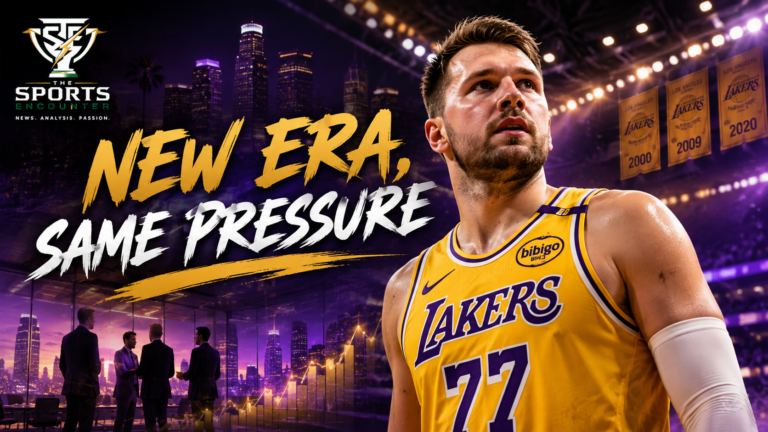
The Los Angeles Lakers have changed owners twice, traded for Luka Dončić, watched LeBron James leave, and reached a reported $12.5 billion valuation in little more than a year.
For a franchise built around continuity, recognizable ownership and generational superstars, that is an extraordinary amount of upheaval compressed into 14 months.
Now comes the part that matters most.
The Lakers have to prove that all of this change has actually moved them closer to another championship.
Story at a glance
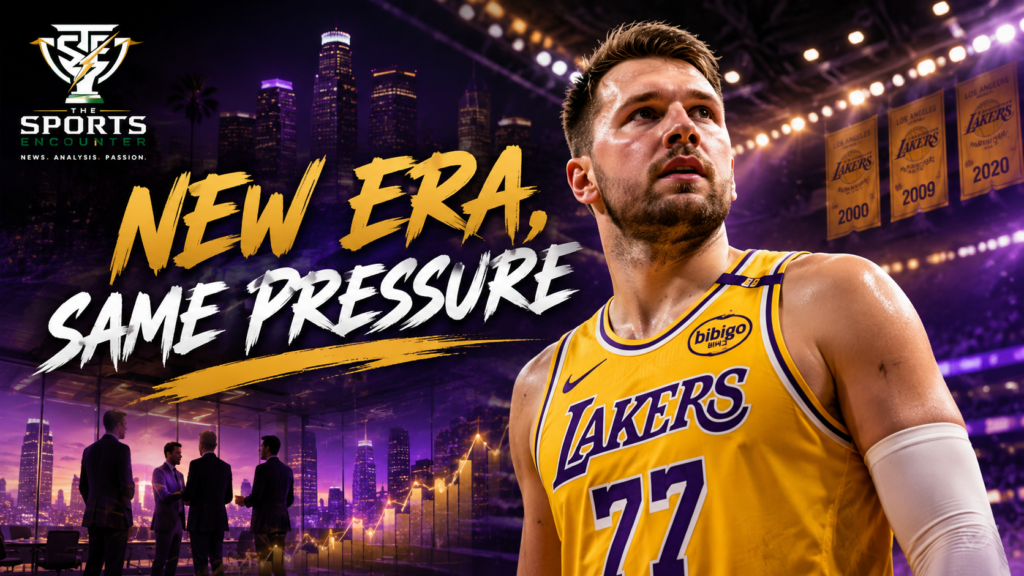
The Lakers Have Changed Everything Except the Standard
Ownership has changed.
The Buss Family Defined the Lakers for Nearly Half a Century
The ownership transition is significant because the Buss family had become almost inseparable from the organization itself.
A $2.5 Billion Increase in Less Than a Year Tells Its Own Story
The reported numbers are as striking as the frequency of ownership change.
Luka Dončić Is No Longer the Future. He Is the Lakers’ Present
The February 2025 trade that brought Dončić from Dallas changed the Lakers before the ownership turnover did.
LeBron’s Departure Closed More Than a Player Chapter
James was not simply another superstar leaving in free agency.
Mark Walter’s agreement to sell controlling ownership to former Disney chief Bob Iger and investor Joshua Kushner is the latest break with the Lakers’ recent past. Walter had only completed his own takeover from the Buss family in October 2025 after a transaction that valued the franchise at $10 billion.
Less than a year later, the Lakers are changing hands again at a reported $12.5 billion valuation.
The Sports Encounter has already examined why Iger and Kushner are prepared to pay a record price for the Lakers. The broader story is now becoming even more interesting because ownership, basketball leadership and star hierarchy are all changing at the same time.
The Lakers’ New Era at a Glance
| Previous controlling family | Buss family |
| Buss ownership began | 1979 |
| Mark Walter takeover completed | October 2025 |
| Walter-era valuation | Approximately $10 billion |
| New proposed owners | Bob Iger and Joshua Kushner-led group |
| Reported new valuation | $12.5 billion |
| Franchise centerpiece | Luka Dončić |
| LeBron James | Departed for Philadelphia 76ers |
| Dončić acquired | February 2025 |
The Lakers Have Changed Everything Except the Standard
Ownership has changed.
The face of the franchise has changed.
The timeline has changed.
The expectations have not.
The Lakers do not operate like a franchise where competitiveness is considered enough.
Second-round exits are not celebrated as progress.
Play-In qualification is not treated as success.
Relevance is assumed.
Championship contention is the real benchmark.
That pressure will follow Iger and Kushner from the moment the sale is completed because buying the Lakers does not mean acquiring an ordinary sports property.
It means inheriting one of professional basketball’s most demanding identities.
The Buss Family Defined the Lakers for Nearly Half a Century
The ownership transition is significant because the Buss family had become almost inseparable from the organization itself.
Jerry Buss bought the Lakers in 1979 and oversaw the beginning of the Showtime era built around Magic Johnson and Kareem Abdul-Jabbar.
The franchise later moved through the Shaquille O’Neal and Kobe Bryant championship years before returning to the top with LeBron James and Anthony Davis in 2020.
The Lakers changed coaches, stars and playing styles repeatedly during that period.
The ownership identity remained remarkably consistent.
That ended when Walter acquired control.
Now Walter’s brief tenure is giving way to another ownership group before the organization has fully settled into its first post-Buss structure.
A $2.5 Billion Increase in Less Than a Year Tells Its Own Story
The reported numbers are as striking as the frequency of ownership change.
Walter’s controlling purchase valued the Lakers at approximately $10 billion.
The Iger-Kushner transaction is reportedly built around a $12.5 billion valuation.
That represents a $2.5 billion increase in less than a year.
The jump reflects how aggressively elite sports franchises are being valued, particularly teams with international audiences, strong media visibility and scarcity value.
The Lakers sit near the extreme end of that market.
The brand reaches well beyond Southern California.
Magic, Kareem, Kobe, Shaq and LeBron turned generations of fans around the world into Lakers supporters.
Dončić now gives the franchise another global superstar through which to extend that reach.
Luka Dončić Is No Longer the Future. He Is the Lakers’ Present
The February 2025 trade that brought Dončić from Dallas changed the Lakers before the ownership turnover did.
Los Angeles sent Anthony Davis in the opposite direction and acquired a player capable of carrying the franchise through his prime years.
At the time, the Lakers still had to balance two timelines.
LeBron remained the immediate championship engine.
Dončić represented what came next.
That tension no longer exists.
James has left.
Dončić is now the center of the organization.
The shift became increasingly obvious as questions grew around whether LeBron would return to the Lakers for the 2026-27 season.
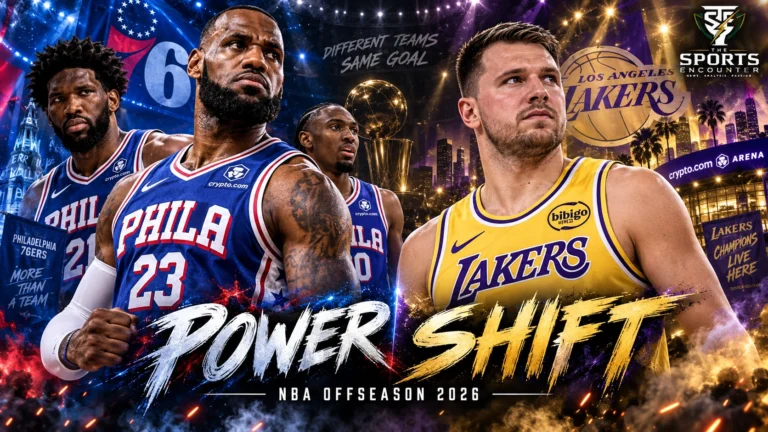
He eventually chose Philadelphia, ending eight seasons in Los Angeles and allowing the Lakers to move fully into the Dončić era.
LeBron’s Departure Closed More Than a Player Chapter
James was not simply another superstar leaving in free agency.
He represented the bridge between the Lakers’ previous championship era and the current transition.
He arrived in 2018.
He helped deliver the 2020 championship.
He became the NBA’s all-time leading scorer while wearing purple and gold.
His time in Los Angeles also produced the unusual final chapter of sharing an NBA roster with his son Bronny.
By joining Philadelphia for his 24th NBA season, James closed the part of the Lakers’ story in which every major decision had to account for his remaining championship window.
The Sports Encounter covered that shift when LeBron officially joined the 76ers.
Los Angeles can now plan around the next five years rather than the next one or two.
The Lakers’ Christmas Game Will Make the Transition Impossible to Ignore
The emotional reality of that change will become unavoidable on Christmas Day.
Philadelphia visits Los Angeles on December 25, sending James back to face the Lakers as an opponent while Dončić leads the franchise he left behind.
The matchup was already one of the defining dates in The Sports Encounter’s coverage of LeBron’s 76ers debut and Lakers return.
By then, the symbolism will be difficult to miss.
James will represent the completed Lakers era.
Dončić will represent the one being built.
The new owners may already be sitting courtside.
Few regular-season games will capture an organizational transition more clearly.
Dončić Gives the New Owners Something Most Buyers Never Get
Ownership transitions often begin with uncertainty around the basketball product.
The Lakers have the opposite situation.
Their foundational player is already in place.
Dončić is 27.
He is an established global star.
He can carry elite offensive usage.
He is young enough to anchor multiple roster cycles.
That dramatically simplifies the first major basketball decision for Iger and Kushner.
They do not need to find the next face of the Lakers.
They need to build correctly around the one already there.
The Hardest Question Is What the Lakers Put Around Dončić
Star acquisition has rarely been Los Angeles’ problem.
Team construction around those stars has been much less consistent.
Dončić’s offensive brilliance is established.
The challenge is creating the right defensive, athletic and shooting infrastructure around him.
The Lakers have to decide which players complement his ball dominance, which contracts preserve future flexibility and how aggressively they should trade draft capital to accelerate the timeline.
Austin Reaves remains one of the important existing pieces.
Beyond him, almost every roster decision now has to be filtered through the same question.
Does this player make Dončić more dangerous in May and June?
Iger Brings a Different Kind of Lakers Profile
Bob Iger’s involvement gives the proposed ownership group an unusually recognizable public face.
His career at Disney placed him at the center of global entertainment, media, intellectual property and large-scale consumer brands.
Those skills are relevant because the Lakers already operate as much more than a basketball team.
They are a global entertainment property.
The organization’s commercial identity touches media, celebrity culture, merchandise, sponsorship, international fandom and the broader Los Angeles entertainment ecosystem.
That does not automatically translate into basketball success.
It does suggest that the new group understands the scale of the asset it is buying.
Joshua Kushner Adds the Investment Side of the Equation
Kushner brings a different profile.
He is the co-founder of Thrive Capital and managing partner of Thrive Eternal, a newer investment strategy designed around long-term capital deployment.
That combination with Iger creates an ownership structure built around entertainment experience and investment expertise.
The Lakers therefore appear to be moving from family ownership into a more institutional form of control.
That shift mirrors a broader transformation across elite professional sports.
Franchises that were once inherited, family-run or locally controlled are increasingly becoming global financial assets.
The Lakers Are Becoming More Valuable While Becoming Less Familiar
That is the unusual tension inside the current moment.
The Lakers have never been worth more.
They may never have felt less structurally familiar.
The Buss family is gone from controlling ownership.
Walter’s period of control is ending almost as quickly as it began.
LeBron is gone.
Anthony Davis is gone.
Dončić is the centerpiece.
A new ownership group is coming.
The franchise identity is being rebuilt in real time.
The Dončić Era Is Already Bigger Than a Roster Decision
It is tempting to frame the Lakers simply as Dončić’s team now.
The reality is larger.
The franchise is reorganizing around his competitive prime at the same time that its financial structure changes.
The new owners will almost certainly be judged on whether they maximize that window.
A global superstar in his late 20s is one of the rarest assets in professional basketball.
The Lakers cannot afford to spend several seasons slowly experimenting.
The franchise’s own history makes patience difficult.
The NBA Schedule Immediately Puts the New Lakers Under the Spotlight
The recently released 2026-27 NBA schedule ensures Los Angeles will remain central to the national conversation.
The Lakers’ Christmas matchup with Philadelphia is already one of the season’s marquee events.
The full schedule also reinforces how much the NBA landscape has changed after an extraordinary offseason.
LeBron is in Philadelphia.
Giannis Antetokounmpo is in Miami.
New York enters as defending champion.
San Antonio and Oklahoma City are rising.
The Lakers now have to establish where the Dončić-led version of the franchise fits within that order.
Relevance Has Never Been the Lakers’ Problem
This is where the Lakers differ from almost every other franchise.
A rebuild does not remove them from the conversation.
An ownership change does not reduce attention.
A superstar leaving simply creates a different headline.
The Lakers remain one of the NBA’s central stories because the combination of history, market, celebrity, brand power and expectation makes obscurity almost impossible.
The Sports Encounter’s NBA coverage reflects that same reality. Few teams generate as many overlapping stories involving ownership, player movement, commercial value and championship expectations.
The $12.5 Billion Price Tag Raises the Pressure on Basketball Decisions
A valuation of that size changes the way every basketball decision is viewed.
New ownership does not need immediate financial justification from wins and losses alone.
The Lakers’ global brand already supports enormous commercial value.
But spending $12.5 billion on the franchise inevitably raises questions about ambition.
Will the new group spend aggressively?
How much luxury-tax pain will it tolerate?
Will front-office decision-making become more modern and data-driven?
Will basketball operations receive greater autonomy?
How will the owners balance immediate contention around Dončić with long-term asset management?
Those answers will matter much more than the symbolism of the transaction itself.
The Lakers Have Reinvented Themselves Before
The current upheaval feels extreme because so much of it has happened at once.
Reinvention itself is not new.
The franchise moved from Minneapolis to Los Angeles in 1960.
Magic Johnson and Kareem Abdul-Jabbar defined Showtime.
Shaquille O’Neal and Kobe Bryant created another dynasty.
Kobe later led a second championship version of the team.
LeBron and Davis brought the Lakers back to the summit in 2020.
The stars changed.
The basketball changed.
The expectation survived.
This Is the First Lakers Era Built Entirely Around Luka Dončić
That is what makes the present moment different from the period immediately after the 2025 trade.
Dončić is no longer sharing the future with LeBron’s present.
There is no ambiguity about hierarchy.
This is his team.
The incoming owners know it.
The front office knows it.
The league knows it.
Opponents know it.
The most important Lakers question is therefore no longer who will inherit the franchise after LeBron.
That question has been answered.
The question is whether Los Angeles can build a championship roster around Dončić before his prime begins to disappear.
The Walter Sale Is the End of One Transition and the Start of Another
Walter’s ownership was expected to represent the end of the Buss era and the beginning of a new institutional phase.
Instead, it became another bridge.
Iger and Kushner now stand to inherit a franchise that has already undergone the most difficult symbolic changes.
The family ownership has ended.
LeBron has left.
Dončić has been established as the centerpiece.
The valuation has reached unprecedented territory.
The next ownership group therefore arrives with fewer identity questions and more performance questions.
TSE Analysis: The Lakers’ Real New Era Is Not About Ownership
The sale will dominate headlines because $12.5 billion is an enormous number.
The deeper transition is happening on the basketball court.
The Lakers are moving from an era built around extending LeBron James’ championship window into one centered on maximizing Luka Dončić’s prime.
Ownership change matters because the people financing that transition will determine how aggressively the franchise can act.
The price tag matters because it shows how valuable the Lakers have become.
Yet neither guarantees success.
The franchise still has to solve the same basketball problems every contender faces.
Defense.
Depth.
Shooting.
Health.
Roster flexibility.
Playoff adaptability.
The Lakers’ history does not exempt them from those requirements.
The Only Constant Left Is Championship Pressure
The Lakers have spent 14 months becoming almost unrecognizable from an organizational standpoint.
Buss ownership gave way to Walter.
Walter is preparing to give way to Iger and Kushner.
Anthony Davis was traded.
Dončić arrived.
LeBron departed.
The franchise valuation surged.
Everything moved.
One standard stayed exactly where it was.
The Lakers are still expected to contend for championships.
That is the inheritance Iger and Kushner are really buying.
Official roster, ticket and team information is available through the Los Angeles Lakers, while league schedules, standings and official NBA information are available through NBA.com.
Readers can follow the broader basketball landscape through The Sports Encounter’s NBA hub, including trades, schedules, title-race analysis, player stories and the biggest developments shaping the 2026-27 season.
Continue the NBA Story
Frequently Asked Questions
Who is buying the Los Angeles Lakers?
Former Disney chief Bob Iger and investor Joshua Kushner are leading the group that has agreed to acquire controlling ownership of the Lakers from Mark Walter.
What is the reported Lakers sale valuation?
The proposed transaction reportedly values the Lakers at approximately $12.5 billion.
When did Mark Walter buy the Lakers?
Walter completed his controlling purchase in October 2025 after the Buss family agreed to sell its controlling interest earlier that year.
How much were the Lakers valued at when Walter bought the team?
The Walter transaction valued the franchise at approximately $10 billion.
Who owns the Lakers now?
Mark Walter remains the controlling owner while the proposed sale to the Iger-Kushner group moves through the transaction process.
Who is the Lakers’ franchise player after LeBron James?
Luka Dončić is now the clear centerpiece of the Lakers after LeBron James left to join the Philadelphia 76ers.
When did Luka Dončić join the Lakers?
The Lakers acquired Dončić from the Dallas Mavericks in February 2025 in the blockbuster trade that sent Anthony Davis to Dallas.
Where is LeBron James playing in 2026-27?
James is playing for the Philadelphia 76ers after ending his eight-season run with the Lakers.
When will LeBron return to Los Angeles?
Philadelphia is scheduled to visit the Lakers on Christmas Day, December 25, 2026.
Why is the Lakers ownership change significant?
It would mark the second change in controlling ownership in less than a year and comes during a wider transition from the LeBron James era to a franchise built around Luka Dončić.
What is the biggest challenge facing the new Lakers owners?
The central basketball challenge is building a championship-level roster around Dončić while maintaining enough financial and roster flexibility to sustain contention through his prime.
The Sports Encounter’s NBA coverage follows game analysis, player performances, trades, ownership developments, schedules, playoff stories, records, rankings and the biggest basketball storylines across the league.