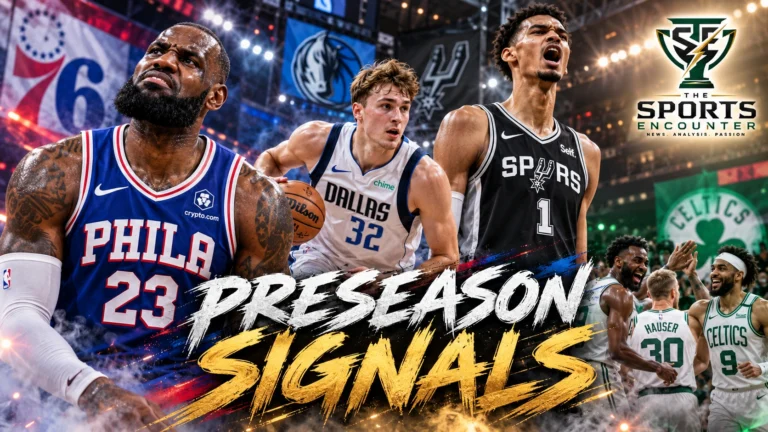
NEW YORK, United States, October 17, 2026: Boston Celtics players fighting for roster spots delivered the most revealing result of Friday’s 12-game NBA preseason finale, overcoming a Philadelphia 76ers lineup featuring LeBron James, Joel Embiid, Tyrese Maxey and Jaylen Brown to win 125-120 in overtime. Boston’s bench outscored Philadelphia’s 77-36, exposing a potential weakness in one of the league’s most ambitious championship projects just four days before the 2026-27 regular season begins.
Elsewhere, Cooper Flagg recorded 26 points and 12 rebounds for Dallas but could not prevent a 135-111 defeat against Atlanta. San Antonio overwhelmed Sacramento 126-97 while refining a three-guard system around Victor Wembanyama. Orlando beat Miami 136-115 behind Paolo Banchero and Desmond Bane, while Milwaukee and New Orleans survived one-point finishes.
The results offered coaches their final substantial opportunity to evaluate rotations, offensive combinations and defensive shortcomings before opening night on October 20. Some performances strengthened expectations surrounding established contenders. Others raised questions that victories alone could not answer.
For a complete perspective, the most useful approach is to examine what each result revealed about the teams involved rather than assume that a preseason score predicts regular-season success.
Story at a glance
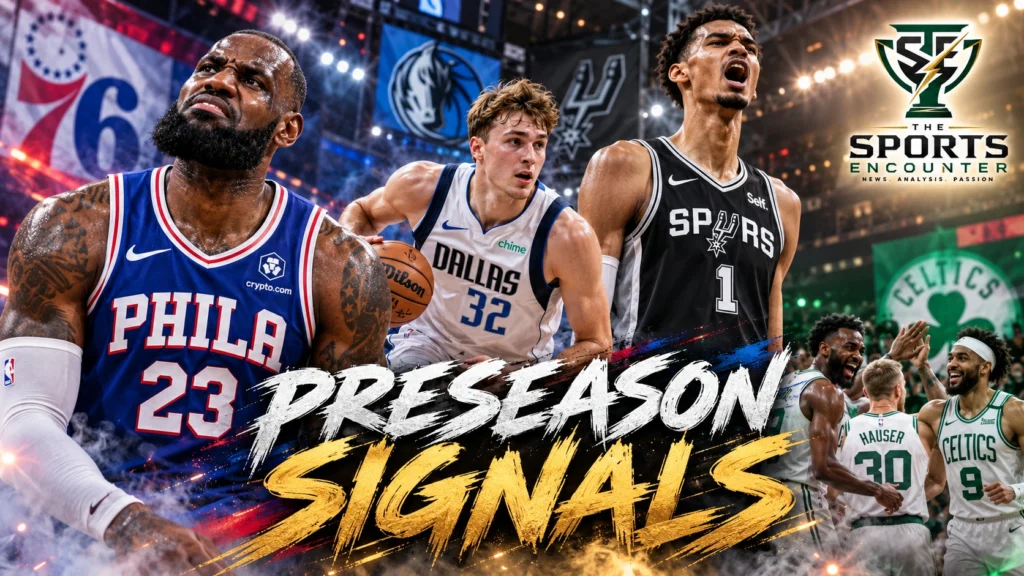
NBA Preseason Results: All 12 Games From October 16, 2026
Friday’s games took place in the United States on October 16, with the late contests concluding during the morning of October 17 in Pakistan.
Boston’s 77-Point Bench Exposes Philadelphia’s Biggest Unanswered Question
Boston Celtics 125, Philadelphia 76ers 120 (Overtime)
Cooper Flagg’s 26 Points Cannot Hide Dallas’ Defensive Problems Against Atlanta
Atlanta Hawks 135, Dallas Mavericks 111
San Antonio’s Three-Guard Experiment Makes the Spurs More Difficult to Defend
San Antonio Spurs 126, Sacramento Kings 97
Orlando’s 136-Point Performance Reveals a Different Threat to the Eastern Conference
Orlando Magic 136, Miami Heat 115
NBA Preseason Results: All 12 Games From October 16, 2026
Friday’s games took place in the United States on October 16, with the late contests concluding during the morning of October 17 in Pakistan.
| Away Team | Home Team | Final Score | Key Storyline |
|---|---|---|---|
| Miami Heat | Orlando Magic | 115-136 | Banchero and Bane strengthen Orlando’s attacking options |
| Boston Celtics | Philadelphia 76ers | 125-120 (OT) | Boston’s reserves overcome Philadelphia’s star-heavy lineup |
| Toronto Raptors | Detroit Pistons | 125-129 | Detroit survives a close, high-scoring contest |
| Milwaukee Bucks | Indiana Pacers | 128-127 (OT) | Herro leads Milwaukee’s comeback |
| Sacramento Kings | San Antonio Spurs | 97-126 | Spurs’ three-guard combination receives another test |
| Atlanta Hawks | Dallas Mavericks | 135-111 | Flagg shines individually as Dallas struggles defensively |
| Minnesota Timberwolves | Chicago Bulls | 116-133 | Chicago finishes with an impressive offensive performance |
| Washington Wizards | New Orleans Pelicans | 106-107 | New Orleans survives a one-point finish |
| Charlotte Hornets | Memphis Grizzlies | 98-116 | Memphis takes control while Charlotte commits 24 turnovers |
| Utah Jazz | Phoenix Suns | 119-116 | Utah erases Phoenix’s fourth-quarter advantage |
| Portland Trail Blazers | Golden State Warriors | 118-128 | Curry and Niang provide encouraging veteran contributions |
| Denver Nuggets | Los Angeles Lakers | 121-106 | Denver’s interior scoring exposes a Lakers concern |
All 12 games belonged to the 2026-27 preseason. Their outcomes do not affect regular-season standings.
Boston’s 77-Point Bench Exposes Philadelphia’s Biggest Unanswered Question
Boston Celtics 125, Philadelphia 76ers 120 (Overtime)
The most significant development of Friday’s NBA schedule came in Philadelphia, where the contrast between the two starting lineups was difficult to ignore.
The 76ers fielded LeBron James, Joel Embiid, Tyrese Maxey, Jaylen Brown and Kentavious Caldwell-Pope. Their combined experience, scoring ability and championship pedigree made Philadelphia one of the major attractions of the final preseason night.
Boston approached the contest differently.
With its established stars resting, the Celtics started Milos Uzan, Hayden Gray, Tucker DeVries, Gabe McGlothan and Chris Cenac Jr. Assistant coach Sam Cassell directed the team from the bench as Boston used the game to evaluate players competing for opportunities.
The difference in personnel made the eventual result particularly interesting.
Philadelphia led by 10 points during the fourth quarter, but Boston recovered to force overtime. The Celtics then outscored the hosts 10-5 in the additional period to secure their fourth consecutive preseason victory.
Hugo González led Boston with 21 points, while the supporting cast delivered enough scoring and energy to prevent Philadelphia from controlling the closing minutes.
According to the NBA’s official Boston-Philadelphia game summary, the Celtics received 77 bench points compared with Philadelphia’s 36.
That 41-point difference tells a more useful story than the five-point final margin.
Philadelphia’s Stars Produced, but Boston’s Supporting Cast Finished Stronger
The 76ers received meaningful contributions from their principal players.
Embiid finished with 27 points, eight rebounds and five assists. Maxey scored 22 points, while Brown contributed 20 points and eight rebounds.
James recorded eight points, eight rebounds and seven assists, concentrating more heavily on facilitating the offense than leading the scoring.
Those performances showed that Philadelphia has several legitimate ways to create points.
But the result also demonstrated how quickly that advantage can disappear when opponents sustain their intensity and a team’s supporting rotation struggles to maintain control.
There is an important limitation to the comparison. Philadelphia’s stars did not play their normal regular-season minutes, and Boston’s late comeback unfolded amid preseason substitutions.
The game cannot establish that Boston possesses a superior full-strength roster.
It does, however, identify an issue Philadelphia must address: whether its bench can provide enough defensive reliability, ball movement and scoring to support an unusually expensive concentration of star talent.
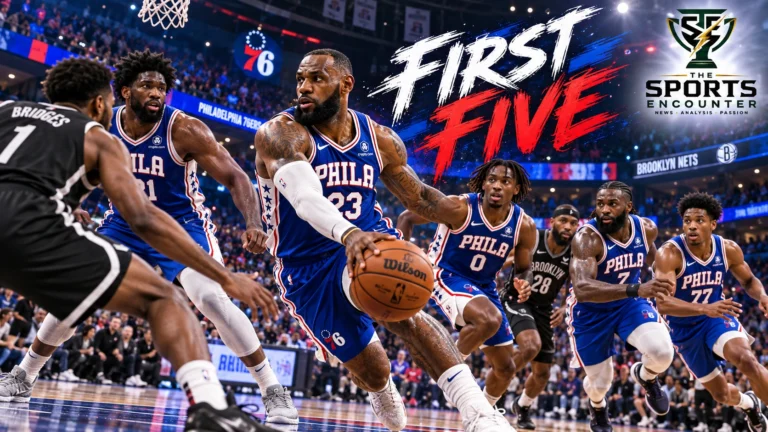
The Sports Encounter previously examined these concerns in its analysis of Philadelphia’s projected starting five and the challenges of integrating LeBron, Embiid, Brown and Maxey.
Friday supplied another reason to keep monitoring that question.
Boston’s Depth Could Become More Important Than Its Perfect Preseason Record
Boston finished the preseason 4-0, but the unbeaten record is less informative than the number of players who contributed to the final victory.
The Celtics entered the game without several established starters and still found enough offense to beat an opponent featuring multiple All-NBA-level performers.
González’s scoring, the contributions of the reserve guards and the team’s ability to recover from a fourth-quarter deficit offered useful evidence of preparation and competitive resilience.
For Boston’s coaching staff, the result provides information about who can contribute when injuries, foul trouble or rotation changes create unexpected opportunities.
For Philadelphia, it provides another reminder that an exceptional starting lineup cannot resolve every problem during an 82-game season.
The 76ers have assembled their roster to pursue a championship, a strategy that became even more aggressive when LeBron James joined Philadelphia for his record-extending 24th NBA season.
Opening night will begin revealing whether the team can turn that extraordinary collection of talent into a reliable collective system.
Cooper Flagg’s 26 Points Cannot Hide Dallas’ Defensive Problems Against Atlanta
Atlanta Hawks 135, Dallas Mavericks 111
Cooper Flagg produced one of the strongest individual performances of the night, but his contribution was insufficient to prevent Dallas from suffering a 24-point defeat.
The Mavericks forward finished with 26 points, 12 rebounds, four assists, two steals and one block in 30 minutes.
He made eight of his 20 field-goal attempts and converted eight of nine free throws.
Those figures show why Dallas continues to regard Flagg as a major part of its long-term plans. He contributed as a scorer, rebounder, passer and defender rather than relying on one area of his game.
But Atlanta repeatedly exposed weaknesses elsewhere in the Mavericks’ performance.
Nickeil Alexander-Walker led the Hawks with 25 points, and Atlanta generated consistent scoring opportunities against a Dallas defense that struggled to contain penetration and close out possessions.
Kyrie Irving scored 18 points and made five of seven three-point attempts for Dallas, providing another encouraging individual contribution.
Even with those performances, the Mavericks lost comfortably.
The result is an important reminder that productive performances by a team’s leading players do not automatically translate into an effective team structure.
The official NBA Hawks-Mavericks game page provides the complete match record, while Flagg’s final statistics underline the contrast between his individual production and the team result.
The Real Concern for Dallas Is What Happens Around Flagg
Dallas has enough established scoring talent to threaten opponents when its principal offensive players are available.
Flagg can attack mismatches, rebound at both ends and create additional opportunities through his passing.
Irving remains an exceptional perimeter scorer.
The concern is whether Dallas can maintain sufficient defensive organization while those players operate within the same lineup.
Atlanta punished the Mavericks’ inability to consistently protect vulnerable areas of the floor and limit second opportunities.
A 135-point concession in a preseason game should not be treated as a definitive assessment of Dallas’ regular-season defense, particularly with minutes and rotations still changing.
However, the manner of the defeat gives the coaching staff specific areas to examine.
Defensive communication, transition recovery and avoiding unnecessary fouls will matter more than another impressive individual stat line if Dallas intends to compete consistently against the Western Conference’s strongest teams.
The Mavericks open their regular-season campaign against Houston on October 21, creating an immediate test of whether those issues have been addressed.
San Antonio’s Three-Guard Experiment Makes the Spurs More Difficult to Defend
San Antonio Spurs 126, Sacramento Kings 97
The Spurs delivered the most convincing victory among the Western Conference contenders competing Friday.
San Antonio defeated Sacramento by 29 points, building a commanding advantage during the first half before controlling the remainder of the contest.
Dylan Harper scored a team-high 19 points. De’Aaron Fox added 16, while Victor Wembanyama contributed 14 points, eight rebounds and two blocks.
Keldon Johnson also supplied 15 points.
Coach Mitch Johnson used the final preseason game to reinforce a lineup featuring Fox, Stephon Castle and Harper alongside Devin Vassell and Wembanyama.
That arrangement places three players with significant ball-handling ability around a center whose size, shooting touch and defensive presence already demand extraordinary attention.
It also represents an interesting tactical decision.
Why Three Ball Handlers Could Change How Teams Defend Wembanyama
Opponents frequently attempt to slow dominant interior players by pressuring the ball before it reaches them.
San Antonio’s multiple-guard approach could make that strategy more difficult.
Fox offers speed and experience initiating offense. Castle supplies physicality and attacking ability. Harper adds another creator who can penetrate, distribute and generate scoring opportunities when the first action fails.
With several credible ball handlers available, the Spurs can vary their point of attack and make defensive assignments less predictable.
Wembanyama benefits when opponents must defend more than one source of dribble penetration.
Help defenders may have to choose between protecting driving lanes and staying close enough to prevent Wembanyama from receiving the ball in favorable positions.
The arrangement also introduces defensive questions.
San Antonio must determine how effectively its smaller combinations can handle physical wings, protect defensive rebounds and defend switches against larger opponents.
Sacramento’s preseason performance did not provide a complete answer.
But the 126-97 victory showed why Johnson believes the experiment deserves further attention.
The NBA’s official Spurs-Kings game record confirms the result.
The Spurs’ continued development follows an offseason in which they strengthened an already successful roster, as examined in TSE’s analysis of the moves shaping the 2027 NBA championship race.
San Antonio begins its regular season against Oklahoma City on October 20, one of the opening week’s most consequential matchups.
Orlando’s 136-Point Performance Reveals a Different Threat to the Eastern Conference
Orlando Magic 136, Miami Heat 115
Orlando produced the highest score among Friday’s winning teams, but the most interesting part of the performance was how the Magic generated their offense.
Paolo Banchero scored 24 points, while Desmond Bane connected on seven three-pointers.
Orlando also made 31 free throws compared with Miami’s 12.
The combination of perimeter shooting, foul pressure and attacking versatility made the Magic particularly difficult to contain.
Miami led 36-34 after the opening quarter, but Orlando outscored the Heat in each of the final three periods.
The Magic led 70-65 at halftime, increased their advantage to 108-95 after three quarters and finished with a 21-point victory.
Bane’s Shooting Gives Banchero More Space to Attack
The seven three-pointers from Bane represent more than an impressive shooting performance.
Banchero is most dangerous when he has room to attack defenders, establish favorable positions and use his strength around the basket.
Opponents naturally want to commit additional defenders to slow those actions.
A dangerous perimeter shooter changes that calculation.
When defenders remain attached to Bane, they have fewer opportunities to collapse into the paint. When they leave him open, Orlando gains another efficient scoring option.
The Magic’s 31 made free throws also suggest that Miami struggled to contain their attacks without committing fouls.
Free-throw totals can vary considerably from game to game, and one preseason performance does not establish a sustainable offensive identity.
Nevertheless, the combination of outside shooting and physical scoring pressure is exactly what Orlando needs to become less predictable.
Miami has its own challenges as it adjusts to a revamped roster built around Giannis Antetokounmpo and Bam Adebayo.
Those changes were among the major offseason developments TSE previously evaluated in its coverage of the league’s increasingly competitive Eastern Conference.
For Orlando, Friday provided an encouraging demonstration of how its principal scorers could complement each other.
Milwaukee’s Overtime Escape Offers a Lesson in Second-Chance Basketball
Milwaukee Bucks 128, Indiana Pacers 127 (Overtime)
Milwaukee recovered from a substantial halftime deficit to defeat Indiana in one of Friday’s two overtime contests.
Tyler Herro led the Bucks with 25 points, while Pascal Siakam scored 24 for Indiana in fewer than 20 minutes.
The Pacers established an early advantage behind their established scorers before resting several principal players during the second half.
Milwaukee used the opportunity to work its way back into the game.
Kel’el Ware produced a late dunk that helped force overtime, while Milwaukee completed its recovery during the additional period.
But the most revealing statistical difference concerned rebounding.
The Bucks collected 19 offensive rebounds and generated 26 second-chance points.
Those extra possessions were particularly valuable in a game decided by a single point.
Why Milwaukee’s Offensive Rebounding Matters More Than the Final Score
Preseason rotations can make fourth-quarter results difficult to interpret.
A team may recover because the opposition removes its best players rather than because its regular rotation has discovered a sustainable tactical advantage.
That was an important consideration in Milwaukee’s comeback.
However, offensive rebounding remains a measurable contribution regardless of the players involved.
Nineteen offensive rebounds represent repeated opportunities to extend possessions, create additional shots and punish defensive opponents who fail to finish plays with a rebound.
Milwaukee’s supporting rotation demonstrated the value of persistence around the basket.
The challenge will be producing similar contributions against full-strength opponents rather than relying on preseason lineup differences.
For Indiana, the lesson is equally straightforward: protecting the defensive glass matters even when the offense is producing efficiently.
Golden State’s Veterans Answer Questions in Victory Over Portland
Golden State Warriors 128, Portland Trail Blazers 118
Stephen Curry scored 20 points as Golden State concluded its preseason with a victory at Chase Center.
The Warriors also received an encouraging contribution from Georges Niang, whose early scoring burst helped change the direction of the game.
Niang scored 13 points during a five-minute stretch of the opening quarter, turning an early 10-2 deficit into a more competitive contest.
His performance carried added significance because he had missed extended time following a foot injury.
Golden State subsequently established a substantial lead, extending its advantage to as many as 25 points before Portland reduced the deficit.
Draymond Green contributed eight rebounds and 10 assists, reflecting his continuing importance as an offensive organizer.
Curry’s scoring remains the easiest contribution to recognize, but Green’s passing and Niang’s movement without the ball offered additional evidence of how Golden State intends to generate offense.
Niang’s Movement May Be More Valuable Than His Shooting Burst
Players returning from long injury absences often attract attention through scoring totals.
For Niang, the more revealing question concerns how naturally he can function within Golden State’s system.
The Warriors rely heavily on movement, screening, passing and players recognizing opportunities before defenses establish their preferred positions.
Niang demonstrated that he can contribute through those actions as well as conventional perimeter shooting.
The challenge will be maintaining that effectiveness over longer stretches of competitive basketball.
Golden State finished the preseason 4-2, while Portland suffered its first defeat of the exhibition schedule.
The Warriors’ next test arrives against the Lakers on October 21.
Denver’s Interior Advantage Leaves the Lakers With a Defensive Problem
Denver Nuggets 121, Los Angeles Lakers 106
Denver closed its preseason with a 15-point victory over Los Angeles, establishing an early lead and preventing the Lakers from sustaining a meaningful comeback.
The Nuggets scored 36 points in the opening quarter compared with the Lakers’ 22.
Los Angeles improved during the middle periods but could not erase the deficit.
Austin Reaves scored 19 points, while Luka Dončić contributed 15 in approximately 18 minutes.
The Lakers received 45 bench points, a slightly higher total than Denver’s 43.
Yet that supporting production could not compensate for the difference in interior scoring.
Denver finished with 56 points in the paint compared with just 30 for Los Angeles.
That 26-point disparity identifies a specific area of concern.
The Lakers Need More Than Another Productive Night From Their Guards
Los Angeles has enough perimeter talent to create offense through ball handling, passing and individual shot-making.
Dončić can organize possessions against almost any defensive structure, while Reaves provides another experienced scoring option.
But those strengths become less valuable when opponents repeatedly establish favorable positions around the basket.
Denver’s interior scoring advantage suggests the Lakers must improve their ability to protect the lane, contest shots and prevent opponents from creating easy opportunities near the rim.
The difference may reflect experimental preseason lineups, limited minutes for key players or temporary defensive confusion.
Even so, the coaching staff should not ignore it.
The Nuggets possess enough physicality and experience to expose defensive weaknesses, and Friday’s result showed why Los Angeles needs stronger collective protection inside.
The Lakers begin their regular season against Golden State on October 21, offering an immediate test against an opponent with a very different offensive structure.
Six Other NBA Results Reveal Important Rotation and Defensive Questions
Friday’s remaining games may not carry the same immediate championship implications, but several still produced useful observations for teams finalizing their rosters.
Detroit Pistons 129, Toronto Raptors 125
Detroit survived a four-point contest against Toronto, recording another victory before its regular-season opener against Boston.
The score reflects an entertaining offensive game, but conceding 125 points should also encourage Detroit to examine its defensive organization.
Toronto has already demonstrated how dangerous it can become when its offense finds rhythm.
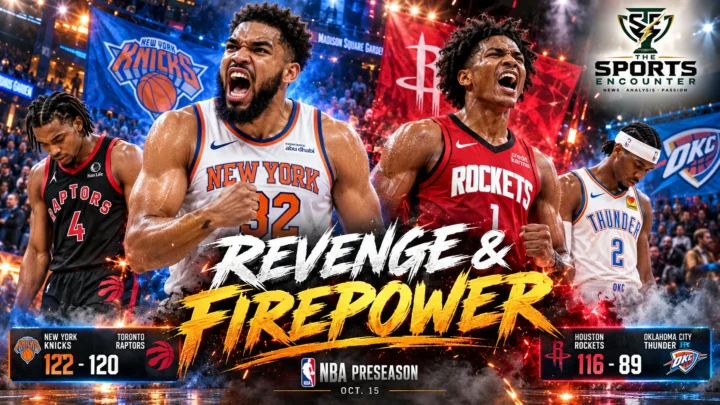
Earlier in the week, the Raptors defeated the New York Knicks 148-98 before losing the return contest 122-120. TSE examined those contrasting performances in its NBA preseason report on New York’s recovery and Houston’s 53-three-point experiment.
Detroit’s latest result adds another example of how preseason games can produce dramatically different outcomes without establishing a team’s definitive competitive level.
Chicago Bulls 133, Minnesota Timberwolves 116
Chicago defeated Minnesota by 17 points in a game that exposed defensive concerns for the visitors.
The Timberwolves entered the new season with a substantially reshaped roster, including LaMelo Ball alongside Anthony Edwards.
Integrating new offensive creators while preserving a reliable defensive structure requires time.
The result does not establish that Minnesota’s offseason changes have failed, but it reinforces the need for consistent communication and defensive rotations.
Chicago, meanwhile, can take encouragement from producing 133 points, provided its offensive efficiency remains effective against regular-season opponents.
New Orleans Pelicans 107, Washington Wizards 106
New Orleans edged Washington by a single point in one of the evening’s closest finishes.
Such results can be particularly useful for evaluating players who receive limited opportunities during the regular season.
Close finishes require decisions under pressure, including defensive assignments, shot selection and possession management.
However, preseason substitution patterns mean the result should not automatically be interpreted as evidence that either team’s established closing lineup is superior.
Memphis Grizzlies 116, Charlotte Hornets 98
Memphis beat Charlotte by 18 points, building an advantage that reached 30 during the game.
The Hornets committed 24 turnovers, giving Memphis repeated opportunities to create easier offensive possessions.
The Grizzlies recorded 21 fast-break points compared with Charlotte’s 13.
The turnover difference was an important part of the performance.
For Charlotte, the principal concern is ball security. For Memphis, the result provided evidence that defensive pressure and transition play can remain productive parts of its identity.
Utah Jazz 119, Phoenix Suns 116
Utah recovered from a five-point deficit entering the fourth quarter to defeat Phoenix.
The Suns led 95-90 after three periods but managed only 21 points in the final quarter compared with Utah’s 29.
Phoenix received 18 points apiece from Dillon Brooks and Jalen Green, while Devin Booker contributed 16 points and six assists.
Utah’s comeback was encouraging, although the result also reflected changing rotations late in the game.
For Phoenix, the more important assessment concerns the encouraging stretches produced by its principal players before the fourth-quarter decline.
What the Smaller Stories Have in Common
Detroit’s narrow escape, Chicago’s offensive success, New Orleans’ one-point victory, Memphis’ pressure defense and Utah’s comeback all demonstrate why preseason analysis should focus on individual developments rather than only final scores.
A team can lose while discovering a useful lineup combination.
Another can win while exposing weaknesses that become much more costly during the regular season.
The strongest conclusions emerge when specific patterns appear repeatedly rather than during one unusually successful evening.
What Friday’s NBA Preseason Games Actually Tell Us About the 2026-27 Season
Across the 12 games, several themes deserve attention as the league prepares for opening night.
1. Roster Depth Can Matter More Than Star Power on a Particular Night
Boston’s victory over Philadelphia was the clearest example.
LeBron, Embiid, Maxey and Brown produced enough individual quality to build a meaningful lead, but Boston’s supporting players delivered the stronger collective performance during the closing stages.
Over a full season, championship contenders must survive injuries, difficult schedules, foul trouble and nights when their stars struggle.
The Celtics demonstrated why a dependable supporting cast can become an important competitive advantage.
2. Young Players Need Team Structure Around Them
Cooper Flagg’s 26-point, 12-rebound performance offered Dallas plenty of encouragement.
The 24-point defeat showed the limitations of relying on individual brilliance without sufficient defensive consistency.
San Antonio demonstrated a potentially more complete approach by surrounding Wembanyama with several players capable of initiating offense.
Those contrasting performances should interest coaches evaluating how their leading young players fit within the wider team.
3. Offensive Versatility Is Becoming More Important
Orlando combined three-point shooting with frequent trips to the free-throw line.
Golden State generated offense through movement, passing and veteran decision-making.
San Antonio experimented with several ball handlers sharing creation responsibilities.
These systems differ, but each seeks to make the offense less dependent on a single method of creating shots.
4. Preseason Defensive Weaknesses Deserve Attention
Dallas conceded 135 points, Miami allowed 136, Minnesota gave up 133 and Philadelphia surrendered 125 in overtime.
Those figures do not provide complete assessments of regular-season defenses.
They do, however, identify problems that coaching staffs can investigate through film review, lineup adjustments and more disciplined execution.
TSE’s previous NBA preseason analysis of Giannis Antetokounmpo, Jalen Duren and Victor Wembanyama also highlighted how individual performances can reveal both tactical strengths and deficiencies.
The lesson remains relevant as the preseason ends.
NBA Opening Night 2026: Three Matchups That Will Test the Preseason Lessons
The 2026-27 regular season begins Tuesday, October 20, with three games involving several of the teams featured in Friday’s results.
| Opening-Night Matchup | Time (ET) | Primary Storyline |
|---|---|---|
| Boston Celtics at Detroit Pistons | 3:00 PM | Boston’s depth meets a Detroit team seeking greater defensive consistency |
| Philadelphia 76ers at New York Knicks | 7:00 PM | LeBron begins his Philadelphia regular-season career against the defending champions |
| Oklahoma City Thunder at San Antonio Spurs | 9:30 PM | San Antonio tests its developing lineup against an established Western contender |
Boston will face a Detroit team that finished Friday with a narrow victory over Toronto.
Philadelphia’s opening assignment carries far greater pressure.
James, Embiid, Brown and Maxey must immediately face the defending champion Knicks at Madison Square Garden.
TSE previously examined the significance of LeBron’s Philadelphia debut against New York and his scheduled Christmas return to Los Angeles.
The Celtics’ Friday victory makes Philadelphia’s opening game even more interesting because it exposed the difference between an exceptional starting lineup and a fully reliable rotation.
San Antonio’s contest against Oklahoma City may provide the strongest early test of a new tactical experiment.
Fox, Castle, Harper and Wembanyama will face an opponent with the personnel, preparation and defensive discipline to challenge their developing combinations.
The complete opening-night calendar and major national television matchups are available in The Sports Encounter’s 2026-27 NBA schedule guide.
Continue the NBA Story
Frequently Asked Questions About the October 16, 2026 NBA Preseason Games
How Many NBA Preseason Games Were Played on October 16, 2026?
Twelve NBA preseason games were played on Friday, October 16, 2026, in the United States. The late West Coast games concluded on October 17 in Pakistan and other Asian time zones.
Did the Boston Celtics Beat the Philadelphia 76ers?
Yes. Boston defeated Philadelphia 125-120 in overtime. The Celtics received 77 bench points compared with 36 from the 76ers, despite Philadelphia using a lineup featuring LeBron James, Joel Embiid, Tyrese Maxey and Jaylen Brown.
How Many Points Did Cooper Flagg Score Against the Atlanta Hawks?
Cooper Flagg scored 26 points and collected 12 rebounds, four assists, two steals and one block. Dallas nevertheless lost 135-111 to Atlanta.
What Was the San Antonio Spurs vs Sacramento Kings Score?
San Antonio defeated Sacramento 126-97. Dylan Harper led the Spurs with 19 points, while Victor Wembanyama contributed 14 points, eight rebounds and two blocks.
Who Won the Orlando Magic vs Miami Heat Preseason Game?
Orlando beat Miami 136-115. Paolo Banchero scored 24 points, Desmond Bane made seven three-pointers, and the Magic converted 31 free throws compared with Miami’s 12.
Who Won the Milwaukee Bucks vs Indiana Pacers Game?
Milwaukee defeated Indiana 128-127 in overtime. Tyler Herro scored 25 points as the Bucks recovered from a substantial deficit.
How Did the Los Angeles Lakers Finish Their Preseason?
The Lakers lost their final preseason game 121-106 to Denver. Austin Reaves scored 19 points and Luka Dončić contributed 15. The Nuggets outscored Los Angeles 56-30 in the paint.
When Does the 2026-27 NBA Regular Season Begin?
The regular season starts Tuesday, October 20, 2026, with Boston at Detroit, Philadelphia at New York and Oklahoma City at San Antonio.
Boston Delivered the Biggest Surprise, but San Antonio and Orlando May Have Offered the Strongest Clues
The Celtics’ overtime victory will attract the most attention because it challenged the assumption that Philadelphia’s extraordinary star power should automatically overwhelm less experienced opposition.
Boston’s reserves earned that victory through sustained effort, useful contributions across the rotation and more effective execution during the decisive minutes.
Yet the evening’s most significant developments may extend beyond that result.
San Antonio demonstrated why adding multiple creators around Victor Wembanyama could change the problems opponents face. Orlando showed how Paolo Banchero and Desmond Bane can stretch defensive structures through a combination of physical scoring and perimeter shooting.
Dallas received another exceptional contribution from Cooper Flagg but exposed weaknesses that could undermine its strongest individual performances. Milwaukee found value in offensive rebounding, while Golden State saw encouraging contributions from veterans whose movement and experience remain important.
Philadelphia and Los Angeles, meanwhile, finished the preseason with identifiable questions about supporting depth and defensive reliability.
These observations cannot replace evidence collected over the first several weeks of the regular season.
Preseason games involve experimental lineups, unequal minutes and priorities that often differ from winning at any cost.
But they can still identify useful patterns.
Boston’s 77-point bench, Flagg’s production without a Dallas victory, San Antonio’s multiple-guard system and Orlando’s combination of shooting and foul pressure all deserve attention when the games begin counting on October 20.
The NBA’s preseason is finished. The next step is determining which of these developments can survive full-strength opposition, consistent rotations and the pressure of an 82-game season.
Follow The Sports Encounter’s NBA Hub for continuing coverage of the 2026-27 season, including opening-night reports, player performances, tactical analysis and the evolving championship race.