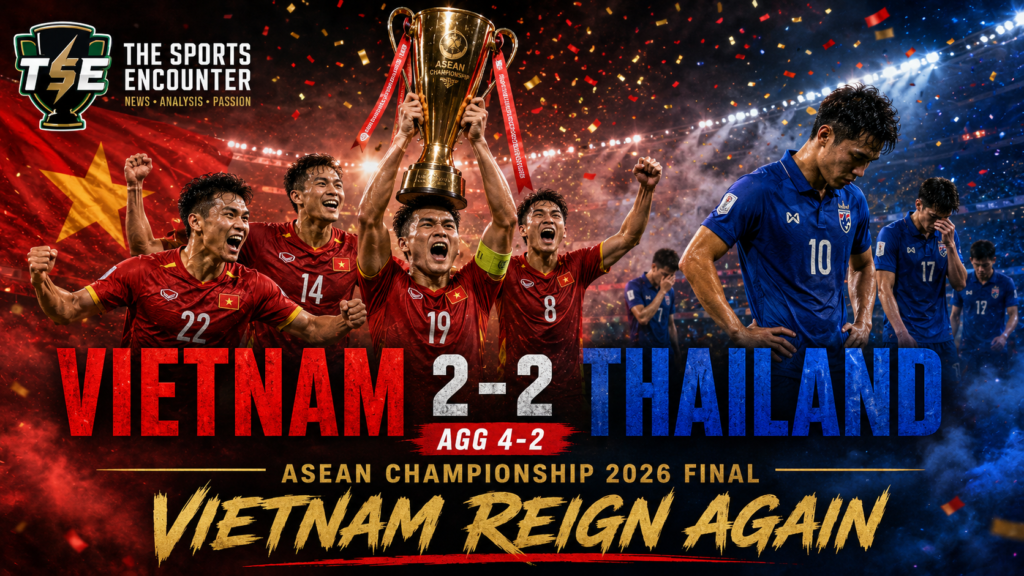
Vietnam Survive Thailand’s Best Fightback to Retain ASEAN Championship 2026
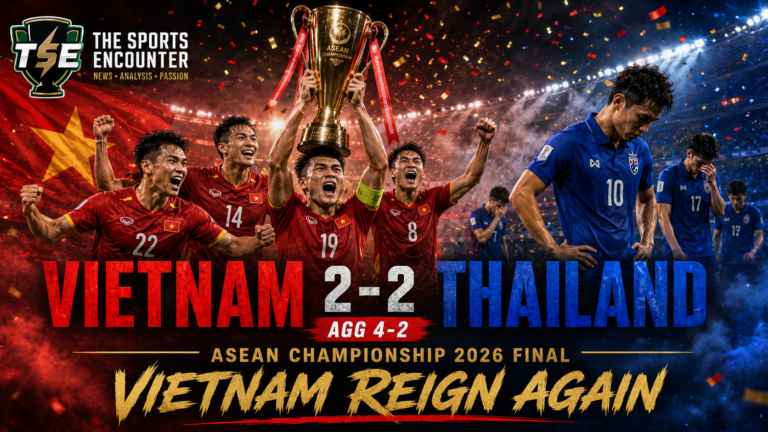
Thailand pushed Vietnam into their most uncomfortable night of the tournament, but a missed penalty and two own goals helped the hosts draw 2-2 and retain the ASEAN title.
For a few minutes after halftime at Mỹ Đình, Vietnam’s two-goal cushion from Bangkok was almost gone.
Thailand had scored early, gone into the break leading 1-0 and then won a penalty that could have drawn the final level on aggregate. Kakana Khamyok stood over the ball with the chance to turn a 2-0 first-leg deficit into a completely different championship contest.
He sent the penalty over the crossbar.
Three minutes later, the ball was in Thailand’s own net.
That sequence decided a final in which Thailand produced the response Anthony Hudson had demanded, Vietnam were forced into long stretches of uncomfortable defending, and the defending champions ultimately survived a frantic 2-2 draw to win the ASEAN Championship 2026 final 4-2 on aggregate.
Vietnam therefore become ASEAN champions for the fourth time after their previous triumphs in 2008, 2018 and 2024. More significantly, Kim Sang-sik’s team successfully defended the title for the first time in the country’s history.
The result completes a tournament journey The Sports Encounter has followed from Vietnam’s seven-goal opening statement against Timor-Leste through the knockout rounds and into a third consecutive Vietnam-Thailand final.
TL;DR
- Vietnam drew 2-2 with Thailand in Hanoi and won the final 4-2 on aggregate.
- Yotsakon Burapha gave Thailand a 12th-minute lead and reduced Vietnam’s aggregate advantage to one goal.
- Kakana Khamyok missed a penalty early in the second half that would have made it 2-2 on aggregate.
- Chatchai Bootprom’s own goal restored Vietnam’s two-goal aggregate cushion in the 52nd minute.
- Substitute Wanchai Jarunongkran scored for Thailand in the 85th minute before putting through his own net in stoppage time.
- Đỗ Hoàng Hên was named the Hyundai Player of the Match.
- Waris Choolthong received a late yellow card. No red card was recorded in the accessible match feeds.
Vietnam vs Thailand Final Second Leg: Key Information
| Detail | Information |
|---|---|
| Competition | ASEAN Hyundai Cup 2026 Final |
| Match | Vietnam vs Thailand, second leg |
| Date | August 26, 2026 |
| Venue | Mỹ Đình National Stadium, Hanoi |
| Second-Leg Result | Vietnam 2-2 Thailand |
| Aggregate Result | Vietnam won 4-2 |
| Thailand Goals | Yotsakon Burapha 12’, Wanchai Jarunongkran 85’ |
| Vietnam Goals | Chatchai Bootprom own goal 52’, Wanchai Jarunongkran own goal 90+4’ |
| Missed Penalty | Kakana Khamyok, Thailand, 49’ |
| Player of the Match | Đỗ Hoàng Hên, Vietnam |
| Yellow Card | Waris Choolthong, Thailand, 87’ |
| Red Cards | None |
| Champion | Vietnam |
| Historical Impact | Vietnam win fourth ASEAN title and defend the championship for the first time |
Thailand Finally Turn the Pressure Into a Goal
Thailand had already shown during the first leg in Bangkok that they could create chances against Vietnam. Their problem had been finishing them.
That changed after 12 minutes in Hanoi.
Seksan Ratree created the opening down the right and Yotsakon Burapha attacked the space before driving a dipping effort toward goal. Patrik Lê Giang managed to get a hand to it, but the shot carried enough power to find the net.
The mathematics immediately changed.
Vietnam still led 2-1 on aggregate, but Thailand had achieved the one thing required to make the second leg psychologically dangerous: they scored early enough to leave plenty of time for another.
Thailand’s approach deserved credit. They pressed higher, attacked the channels more aggressively and forced Vietnam to spend more time reacting than controlling.
The performance looked far more like the side that had dominated Group B than the team that lost the semifinal second leg to Singapore before advancing on aggregate.
Vietnam Lose Văn Vĩ and Spend the First Half Under Pressure
Vietnam’s evening became more complicated almost immediately.
Nguyễn Văn Vĩ suffered an injury during an early sprint and had to leave the field, forcing Phan Tuấn Tài into the game after only nine minutes.
Thailand used that disruption well.
Seksan repeatedly looked for shooting positions from distance, while Vietnam protected their aggregate advantage with a more cautious defensive structure than they had shown during much of the tournament.
The hosts still carried threat on the break. Their best first-half opportunity came in the 43rd minute when Tuấn Tài delivered from the left and Nguyễn Xuân Son rose to head against the frame of the goal.
At halftime, Thailand led 1-0.
For a team that began the night two goals behind, Hudson could hardly have asked for a better first 45 minutes.
Kakana Khamyok’s Miss Changes the Final
The biggest moment arrived immediately after the restart.
Kakana Khamyok turned away from Phạm Xuân Mạnh inside the penalty area and drew the foul. Referee Ahmed Eisa Darwish pointed to the spot.
This was Thailand’s opportunity.
Score, and the aggregate score becomes 2-2.
Vietnam would then have been defending their championship without any numerical protection, with Thailand carrying momentum and an entire half still available.
Kakana fired over.
It was the sort of miss that can stay attached to a final for years because of what happened next.
Thailand had spent more than a match and a half trying to erase Vietnam’s advantage. The chance to do it had finally arrived from 12 yards.
They failed to take it.
Đỗ Hoàng Hên Punishes Thailand Three Minutes Later
Vietnam responded with brutal efficiency.
Tuấn Tài delivered from the left and Đỗ Hoàng Hên struck first time. His effort hit the base of the post, rolled across the goalmouth and rebounded off goalkeeper Chatchai Bootprom before crossing the line.
Officially, it went down as a Chatchai own goal.
Functionally, it belonged to Hoàng Hên.
The midfielder had already been one of Vietnam’s important tournament contributors, and this was his most consequential intervention of the final. He also continued to threaten from distance before leaving in the 67th minute.
His performance earned him the official Hyundai Player of the Match award.
The goal restored Vietnam’s two-goal aggregate advantage at 3-1 and transformed Thailand’s missed penalty from a painful moment into the defining error of their comeback attempt.
Nguyễn Xuân Son Keeps Thailand’s Defense Occupied
Xuân Son did not score, but Thailand never became comfortable against him.
His first-half header struck the woodwork. After the break, he continued to occupy central defenders and create space around the penalty area, while Vietnam gradually regained attacking confidence.
The striker had already scored five times before the final and had been central to Vietnam’s semifinal success. His two goals in Hanoi against Malaysia completed the 4-0 aggregate semifinal victory.
His influence throughout the tournament helps explain why he featured prominently in The Sports Encounter’s ranking of the ASEAN Championship’s leading performers.
Hai Long and Quang Hải Nearly Finish It Again
Kim Sang-sik made a familiar double substitution after 67 minutes.
Nguyễn Hai Long and Nguyễn Quang Hải entered together.
Those names already carried enormous significance in the final. Both had come off the bench in Bangkok, where Hai Long scored after 62 minutes and Quang Hải followed seven minutes later to produce the 2-0 first-leg advantage Vietnam eventually needed. The first-leg score and scorers were confirmed by both ASEAN and AFC reporting.
Hai Long nearly struck again after entering, finding the woodwork as Vietnam threatened to settle the championship.
Quang Hải also joined the attacking exchanges as Thailand increasingly committed players forward.
Wanchai Gives Thailand One Last Chance
Thailand refused to disappear.
Wanchai Jarunongkran came from the bench and needed barely a minute to make an impact. After Vietnam failed to deal with Waris Choolthong’s delivery, Wanchai finished from close range in the 85th minute.
Thailand led the match 2-1.
Vietnam’s aggregate advantage had shrunk to 3-2.
One more Thai goal would force the final into another phase, and suddenly the final minutes became as tense as anything Vietnam had encountered during their title defense.
Thailand threw players forward. Vietnam dropped deeper. Mỹ Đình waited for the clock.
Waris received the match’s confirmed yellow card in the 87th minute following a heavy challenge. No red card appears in the accessible event feeds.
Wanchai’s Stoppage-Time Own Goal Ends the Comeback
The cruelest moment of Thailand’s night belonged to the same player who had restored their hope.
Deep into stoppage time, Vietnam attacked as Thailand searched desperately for the equalizer at the other end. Under pressure while trying to prevent Xuân Son from reaching the ball, Wanchai attempted to clear.
His clearance went into his own net.
The score became 2-2.
The aggregate became 4-2.
Seconds later, the championship was over.
Thailand Played Their Best Final Football Too Late
Thailand’s performance deserves a better assessment than the aggregate score suggests.
Hudson’s team created enough chances across both legs to make Vietnam uncomfortable. They were especially convincing during the first half in Hanoi, when their pressing, speed through the wide areas and willingness to shoot forced the champions backward.
Yotsakon delivered the early goal they needed.
Seksan helped drive the attack.
Kakana found spaces between Vietnam’s defensive lines and earned the penalty that could have changed everything.
Wanchai arrived from the bench and scored.
The central failure was conversion.
Thailand had opportunities in Bangkok and failed to score. They had the biggest chance imaginable in Hanoi and Kakana missed from the spot.
That gap between creation and execution ultimately separated the finalists.
It was also a recurring feature of Thailand’s knockout campaign. Their 3-1 semifinal victory over Singapore showed how dangerous they could become when chances turned into goals. The final showed the cost when they did not.
Vietnam’s Title Was Built Across Two Legs
Vietnam did not dominate this second leg.
They did not need to.
The championship was won through the accumulation of good decisions and decisive moments across 180 minutes.
Their defense survived Thailand’s strongest first-leg pressure before Hai Long and Quang Hải struck in Bangkok. In Hanoi, Vietnam survived an early goal, an injury, a penalty concession and Thailand’s late surge.
Kim’s side had already shown similar composure during the semifinal, where a difficult first leg in Kuala Lumpur ended with a 2-0 victory over Malaysia before another 2-0 win at home.
That capacity to manage two-legged football became one of Vietnam’s strongest qualities.
Vietnam Complete Their First Successful ASEAN Title Defense
Vietnam finish the tournament as champions for the fourth time, joining their triumphs from 2008, 2018 and 2024.
They have also now beaten Thailand in consecutive ASEAN Championship finals after winning the 2024 decider 5-3 on aggregate.
For Nguyễn Quang Hải, this championship brings another piece of personal history. He becomes the first Vietnamese player to win three Southeast Asian titles, having also been part of the victorious teams in 2018 and 2024.
Thailand remain the competition’s record seven-time champions, and their response in Hanoi showed why they remain Southeast Asian football’s most persistent title threat. The Sports Encounter explored that history before the knockout stage in its analysis of what ASEAN Championship history told us about the 2026 semifinalists.
Vietnam now own the present.
Their opening 7-0 victory suggested they had arrived ready to defend the crown. A month later, after surviving Thailand’s strongest attempt to take it away, they leave Mỹ Đình with the trophy still in their hands.
Breaking News
First Brydon Carse, Now Raheem Sterling: What’s Wrong with English Sportsmen?
Brydon Carse ended up in police handcuffs while Raheem Sterling now faces dangerous-driving and other charges. Their cases are legally different, but together they raise a wider question about whether professionalism among elite English sportsmen is carrying far enough beyond the playing arena.
LONDON: Brydon Carse should have been preparing for England’s second Test against Pakistan at Lord’s. Instead, images of the 31-year-old fast bowler in police handcuffs outside a Derby nightclub became one of the biggest stories surrounding the team.
Three days later, another 31-year-old English sports star appeared in a very different kind of headline.
Former England footballer Raheem Sterling was charged with dangerous driving, possession of nitrous oxide for wrongful inhalation and failing to provide a specimen following a single-vehicle collision involving a Lamborghini on the M3 in May.
No injuries were reported in Sterling’s crash. Carse was released without charge after the Derby incident. Their legal situations are therefore very different and must be treated that way.
The professional question connecting them is harder to avoid.
Two high-profile English sportsmen, both old enough and experienced enough to understand the consequences of their actions, have within days become the subject of serious off-field stories that raise legitimate questions about judgment, personal responsibility and what professionalism actually means once an athlete leaves the stadium.
Carse ended a celebration in handcuffs and lost his place in an England Test squad while the Cricket Regulator investigates. Sterling now faces three criminal charges and a court appearance on September 15.
These are not academy teenagers learning how fame works.
They are established international sportsmen who have spent years inside some of the most sophisticated professional environments in world sport.
That is precisely why the question deserves asking.
Brydon Carse and Raheem Sterling: Two Very Different Cases, One Professional Question
| Issue | Brydon Carse | Raheem Sterling |
|---|---|---|
| Age | 31 | 31 |
| Sport | Cricket | Football |
| Latest incident | Seen in police handcuffs outside a Derby nightclub | Charged following an M3 motorway collision |
| Legal status | Released without charge | Charged with three offences, not convicted |
| Professional consequence | Removed from England squad for second Pakistan Test | Faces court hearing while currently without a club |
| Next step | Cricket Regulator investigation | Basingstoke Magistrates’ Court on September 15 |
Carse Managed to Turn an England Victory Into Another Conversation About Behaviour
The timing of the Carse episode made it especially damaging.
England had just beaten Pakistan by an innings and 103 runs at Headingley, giving Joe Root a commanding victory at the beginning of his second spell as permanent Test captain.
The cricket should have dominated the build-up to Lord’s.
Instead, Root found himself answering questions about another late-night incident involving an England player.
Carse had been released from the England group to represent Durham against Derbyshire in the County Championship. Durham won comfortably, and the players went out afterward.
Footage then emerged showing Carse outside a Derby nightclub with his hands cuffed behind his back while police officers surrounded him.
Reports subsequently confirmed that he was released without charge.
The ECB responded by referring the matter to the Cricket Regulator and making Carse unavailable for the second Test against Pakistan while the facts are established. Sonny Baker replaced him in the squad.
That response matters.
Carse may ultimately face no criminal consequences from what happened in Derby. England still decided that the circumstances were serious enough to remove a centrally contracted international player from Test selection.
Professional sport has standards that extend beyond criminal law.
A player does not have to be convicted of an offence before an employer or governing body decides that his conduct has become damaging, distracting or inconsistent with the standards expected of an international representative.
Joe Root Said What Many Supporters Were Already Thinking
Root’s reaction stripped away any attempt to treat Carse’s situation as a harmless night out that simply attracted too much attention.
The England captain said he was “hacked off” and disappointed.
More importantly, he identified the wider problem.
“We continually keep making stupid mistakes away from the game and it’s detracting from what we’re doing on the field.”
That sentence should sit at the center of this discussion.
Root was not complaining about hostile journalists, social media or intrusive cameras.
He was talking about the decisions being made by his own players.
England had already spoken internally about standards. Root had publicly emphasized the importance of building a culture people could respect. The team had entered the Pakistan series attempting to reset after the turmoil that ended the previous leadership era.
The Sports Encounter’s England vs Pakistan series preview framed Root’s return around the need to restore judgment and stability after England’s cricket had become increasingly chaotic.
Our Headingley first-Test analysis made the same point more directly: England had enough talent, but could no longer afford to waste credibility.
They then won emphatically.
Within hours, Carse gave Root another off-field problem.
Being Off Duty Does Not Remove Professional Responsibility
One defense has appeared repeatedly around the Carse incident: he was not representing England when it happened.
That is factually true.
He had played for Durham and was celebrating a county victory.
It does not make the professional issue disappear.
Carse remains an England international and centrally contracted cricketer whose next scheduled assignment was an international Test match.
The standards attached to elite sport cannot realistically switch on at the dressing-room door and disappear when a player changes clothes.
A doctor remains responsible for serious professional misconduct outside a hospital. A senior executive can damage a company through behavior that happens away from the office. A politician does not become completely detached from public standards because Parliament has finished for the evening.
Elite athletes occupy a similar space.
They deserve private lives. They deserve holidays, dinners, celebrations and nights out.
Personal freedom still carries consequences when private choices develop into police involvement, disciplinary investigations or headlines that drag teammates and national organisations into the story.
Carse’s loss of selection demonstrates that reality more clearly than any lecture on professionalism could.
Carse Had Already Received One Serious Lesson About Responsibility
The Derby incident also carries extra weight because Carse has previously been through a formal disciplinary process.
In 2024, he received a 16-month suspension, with 13 months suspended, after admitting to placing 303 bets on cricket between 2017 and 2019.
The regulator found no evidence that he bet on matches in which he participated and found no wider integrity concerns. Carse cooperated with the investigation and served three months away from cricket.
The Cricket Regulator’s official ruling made clear that his cooperation and remorse were considered in determining the sanction.
The betting case has no factual connection to what happened in Derby and should not be presented as though it does.
It remains relevant to the question of professional judgment.
Carse already knows what it feels like for an off-field decision to remove cricket from his life.
He rebuilt his standing, returned to the England side and developed into an important bowler.
Only weeks ago, Carse was producing one of The Hundred’s strongest bowling performances for SunRisers Leeds.
Now another non-cricket episode has again removed him from an England squad.
At some point, experience has to become judgment.
Carse Is Hardly the First Warning England Cricket Has Received
This would be easier to dismiss if Carse’s case existed by itself.
England cricket has spent much of the past year discussing behaviour away from the field.
Harry Brook was fined around £30,000 and placed on a final warning after an incident involving a nightclub bouncer in Wellington during England’s tour of New Zealand.
Brook later acknowledged that he had stayed out too late and accepted responsibility for putting himself in the situation.
Ben Stokes and Gus Atkinson were subsequently suspended after breaking England’s midnight curfew following another nightclub episode during the New Zealand Test series.
The ECB later introduced additional player-behaviour guidelines covering curfews, public intoxication and the requirement to inform management when players remain away from the hotel late at night.
Stokes himself has acknowledged the wider cultural issue. Speaking after his retirement, he argued that cricket has retained a deeply embedded relationship with alcohol even as almost every other aspect of the game has become more professional.
That is a significant admission from someone who spent years leading England.
Our recent look at Stokes’ potential future as an England coach focused heavily on leadership and responsibility because those questions have become impossible to separate from England’s next era.
The end of his playing career had already arrived alongside wider questions over direction and discipline, as explored when New Zealand completed its series comeback at Trent Bridge.
Carse’s handcuffs therefore landed in a dressing room that had already been warned, disciplined, briefed and given new rules.
That makes the incident harder to excuse as simple naivety.
Then Raheem Sterling Put English Football Into the Same Conversation
Sterling’s situation is legally more serious.
Hampshire and Isle of Wight Constabulary said the former England forward has been charged following a single-vehicle collision involving a Lamborghini on the M3 southbound near the Minley Interchange on May 28.
The 31-year-old faces charges of dangerous driving, possession of nitrous oxide for wrongful inhalation and failing to provide a specimen.
No other vehicle was involved and no injuries were reported.
Sterling is due to appear at Basingstoke Magistrates’ Court on September 15.
Those remain allegations until the court process determines otherwise. Sterling has not been convicted of the offences.
The reported police charges against Sterling nevertheless create a legitimate professionalism issue before any verdict is reached.
Dangerous driving is not a football mistake.
Failing to provide a specimen is not a tactical decision.
Possession of nitrous oxide for wrongful inhalation has nothing to do with a poor first touch or a badly timed run.
These are allegations concerning an adult’s choices away from football.
That is exactly why the case belongs in a broader discussion about athletes and personal responsibility.
Sterling Has Spent Most of His Adult Life Inside Elite Football
Sterling has experienced professional sport at its highest level since he was a teenager.
He came through Queens Park Rangers, made his senior Liverpool debut at 17, moved to Manchester City and developed into one of the Premier League’s leading attackers under Pep Guardiola.
He won four Premier League titles with City and became one of Gareth Southgate’s most important England players.
Sterling earned 82 senior England caps and scored 20 international goals. He played a major role in England’s run to the 2018 World Cup semifinal and the Euro 2020 final.
His career later took him to Chelsea, Arsenal and Feyenoord.
He is now without a club.
Few footballers have spent more time surrounded by elite-level support systems.
Premier League players receive access to coaches, doctors, nutritionists, psychologists, analysts, security advisers, player-liaison staff and professional guidance that would have been unimaginable a generation ago.
The modern competition itself has become an enormous global operation. Our 2026-27 Premier League curtain-raiser reflects the scale, wealth and sophistication now surrounding England’s leading clubs.
Yet all of that professional structure eventually reaches a limit.
A club can provide advice.
It cannot make every adult decision for a player.
These Men Are 31, and That Matters
Age should be part of this discussion because the usual explanation of young athletes struggling with sudden fame does not comfortably fit either case.
Carse and Sterling are both 31.
They have each spent years inside professional sport.
They have travelled internationally, operated in dressing rooms full of senior players, worked with coaches and media teams, signed professional contracts and lived through the intense scrutiny attached to representing England.
They know cameras exist.
They know police involvement becomes news.
They know national-team selection and commercial reputations can be affected by what happens away from competition.
They also know that athletes are judged differently because their careers come with extraordinary visibility and privilege.
None of that means they should live like prisoners inside their homes.
It does mean that the excuse of youthful inexperience becomes increasingly difficult to sustain.
Elite Athletes Show Extraordinary Discipline When Sport Demands It
This is perhaps the strangest contradiction in professional sport.
An elite cricketer will spend months strengthening hamstrings, monitoring workload, analysing bowling footage, weighing meals and altering sleep patterns to gain a tiny competitive advantage.
A Premier League footballer will structure an entire week around recovery, hydration, tactical preparation and physical output.
These athletes understand discipline.
They understand delayed gratification.
They understand that small decisions can produce enormous consequences.
Then some step outside the sporting environment and appear capable of abandoning exactly those principles.
The issue is therefore deeper than education alone.
Professional athletes have already demonstrated that they can live disciplined lives when performance requires it.
The challenge is carrying the same judgment into ordinary adult situations where nobody is timing a sprint, checking a GPS vest or preparing a recovery plan.
Professionalism Cannot End at the Stadium Gate
Sport has traditionally separated the athlete from the person.
Supporters care about goals, wickets, records and trophies. What happens away from competition is often treated as irrelevant unless it affects performance.
That separation becomes impossible once off-field conduct begins affecting the sport itself.
Carse is missing a Test match because of an incident that happened outside cricket.
Root has had to spend preparation time discussing behaviour instead of Pakistan.
The ECB has had to open another disciplinary process.
Sterling’s legal proceedings will inevitably become part of the public conversation around a player whose career already sits at a crossroads.
These consequences have entered their professional lives because personal decisions created them.
That is why “what players do in their own time” cannot become an automatic shield against criticism.
Private life deserves privacy.
Conduct that ends with police handcuffs, criminal charges or disciplinary investigations has already crossed into a different category.
Fame and Money Can Create a Dangerous Buffer From Ordinary Consequences
Elite athletes live inside unusually protected environments.
Someone arranges travel.
Someone books accommodation.
Someone manages media.
Someone handles contracts.
Someone schedules medical treatment.
Someone can often solve logistical problems before the player even realizes they exist.
That support is necessary because professional sport demands enormous amounts of time and focus.
It can also create insulation.
The more successful an athlete becomes, the more people appear around him whose professional interest is keeping him available, comfortable and performing.
That creates a risk if sporting importance begins to feel like immunity from ordinary standards.
The overwhelming majority of athletes handle that environment responsibly.
The ones who do not can cause damage far beyond themselves because their visibility turns individual mistakes into institutional problems.
English Cricket’s Relationship With Alcohol Needs More Than Another Curfew
Carse’s case makes the cricket issue particularly difficult because the ECB has already tried rules.
England introduced a midnight curfew.
Players were told they should not appear publicly intoxicated.
Management expected to know when players stayed out late.
Disciplinary action followed previous breaches.
Carse still ended up in handcuffs outside a nightclub.
A curfew can establish a boundary.
It cannot provide judgment.
Stokes’ comments about cricket’s wider drinking culture deserve serious attention here. The sport has modernised almost everything around performance while retaining a social relationship with alcohol that belongs to another era.
That does not mean every post-match beer creates a problem.
It means cricket has to decide whether the old romantic image of players drinking hard after competing hard still belongs inside a game that otherwise treats professional preparation almost scientifically.
Root clearly wants his players to make adult decisions without being permanently controlled.
Carse has just shown why that approach requires the players to meet him halfway.
English Football Moved Away From the Old “Bad Boy” Culture for a Reason
Football has undergone its own cultural change.
Stories about drinking, nightclubs and reckless behaviour once formed a routine part of the mythology surrounding English footballers.
The modern Premier League largely demands something different.
Players compete more often, cover greater distances, follow detailed recovery schedules and operate inside a global commercial environment where clubs protect multimillion-pound assets.
Diet, sleep and conditioning are now career issues.
The old sporting idea that exceptional performance could excuse almost anything away from the pitch has gradually lost credibility.
Sterling belongs to the generation that benefited from that professional evolution.
That makes the allegations against him more striking.
A player who spent his career inside Liverpool, Manchester City, Chelsea and Arsenal cannot reasonably claim ignorance of the standards surrounding elite football.
The case will decide whether he committed the offences alleged against him.
The broader question of professional judgment already exists.
Personal Problems Can Explain Behaviour Without Excusing It
Elite athletes are human beings dealing with pressure, injuries, career uncertainty, family issues, mental-health challenges and the psychological difficulty of watching sporting status disappear.
Sterling’s career has changed dramatically since his Manchester City peak.
Carse has experienced injury setbacks and a previous suspension.
Those circumstances deserve empathy when they are relevant.
They cannot become automatic explanations for every poor decision.
Understanding why somebody makes a mistake and holding that person responsible for making it are compatible positions.
Professional sport sometimes becomes uncomfortable with that balance.
Criticism can become cruel and personal very quickly. The opposite extreme treats athletes as permanently vulnerable figures whose choices must always be explained through pressure or fame.
Neither approach helps.
Adult athletes deserve support.
Adult athletes also carry responsibility.
Teams Pay the Price for Individual Decisions
Carse’s case provides the clearest example.
England selected him because he could help win Test matches.
His pace and bounce gave Root another option against Pakistan. Our pre-series analysis identified England’s pace depth as one of its biggest advantages.
Carse is now unavailable for reasons unrelated to fitness, form or cricketing ability.
Sonny Baker receives the opportunity.
Root loses an option.
The coaching staff modifies plans.
The captain answers questions.
The governing body investigates.
Supporters debate culture instead of bowling.
One person’s night out becomes everybody else’s problem.
That is why professional teams care about off-field conduct.
It is not primarily about controlling private lives.
It is about preventing avoidable personal decisions from disrupting collective objectives.
England’s Young Players Are Watching How Senior Men Are Treated
There is another reason consistency matters.
Every dressing room teaches through example.
A young player watches what senior teammates do, what coaches tolerate and what consequences follow when standards are breached.
If established internationals receive endless exceptions because they are useful, the written code of conduct becomes meaningless.
If every mistake leads to public humiliation and career destruction, players learn to hide problems instead of seeking help.
The right standard sits between those extremes.
Clear expectations.
Real support.
Proportionate consequences.
No special immunity for star performers.
Root’s response to Carse suggests he understands that balance. England removed the bowler while the investigation proceeds, rather than pretending nothing happened or publicly deciding the outcome before the evidence is complete.
Role Model May Be an Uncomfortable Phrase, but Influence Is Real
Some athletes reject the idea that they should be role models.
They did not become professional sportsmen to raise strangers’ children.
That argument has some merit.
No footballer or cricketer should be expected to live a flawless life because a child owns his shirt.
Influence still exists whether the athlete asks for it or not.
Millions of young supporters watch how elite players train, celebrate, dress, speak and behave.
National teams actively use players to promote participation, community values and sporting ideals.
Clubs build marketing campaigns around personalities.
Sponsors pay for association with reputation as well as athletic skill.
Once sport commercialises a player’s public image, conduct naturally becomes part of that image.
English Sport Has Too Much Professional Infrastructure to Keep Calling These Things Naive Mistakes
This is the larger frustration.
English sport is among the best-resourced sporting systems on earth.
The Premier League generates extraordinary wealth.
The ECB runs professional pathways from academy cricket through domestic competitions and international teams.
Players receive media training.
They receive welfare support.
They receive security advice.
They receive education on gambling, drugs, anti-corruption rules and public conduct.
They work with experienced coaches and senior professionals who have already seen careers damaged by off-field choices.
The information is available.
The support is available.
What no system can manufacture is personal judgment.
That part eventually belongs to the athlete.
English Sportsmen Do Not Need More Parenting
The instinct after every controversy is to create another restriction.
Earlier curfews.
Alcohol bans.
More chaperones.
Additional conduct clauses.
Mandatory check-ins.
Some safeguards may be useful, particularly on international tours.
There is a limit to how far professional organisations should go in supervising grown adults.
Carse and Sterling are 31.
If elite sportsmen approaching the later stages of their careers require somebody to monitor every social decision, the system has already failed at a more basic level.
Professionalism should eventually become internal.
The athlete understands the standard and acts accordingly because he recognizes consequences, not because a team manager is checking his location.
The Standard Should Be Simple: Freedom, Responsibility and Consequences
English sport does not need puritanism.
Players should celebrate victories.
They should have social lives.
They should enjoy the money they have earned.
They should be free to spend time away from sport without every photograph becoming evidence of misconduct.
That freedom works only when responsibility travels with it.
When decisions bring police, courts or disciplinary bodies into the picture, sporting organisations have every right to respond.
When the same type of problem keeps returning, leaders have every right to question culture.
When senior athletes create avoidable distractions, supporters have every right to ask why professionalism appears to stop once competition ends.
What English Sport Should Learn From Carse and Sterling
The first lesson is that behavioural education has to begin early and continue after players become established.
The second is that consequences should remain consistent regardless of status.
The third is that player welfare must continue during injury, deselection, transfers and career decline, periods when athletes can lose much of the structure that once organized their lives.
The fourth is that sporting culture should stop romanticizing recklessness as personality.
The fifth is the most important.
Players themselves have to own the final decision.
No academy curriculum can stop every bad night.
No captain can control every teammate.
No club can occupy the passenger seat of every car.
The purpose of professional development should be to produce adults capable of making decisions after the institutional support disappears from view.
The Final Word: Professionalism Has to Follow the Athlete Home
First Brydon Carse.
Now Raheem Sterling.
Two sports.
Two very different legal situations.
Two experienced English internationals whose actions away from competition have become bigger stories than anything they were doing inside it.
Carse was shown in handcuffs after a late-night incident and has been removed from England’s Test squad while the Cricket Regulator investigates. He was released without charge, and the final facts still matter.
Sterling faces charges of dangerous driving, possession of nitrous oxide for wrongful inhalation and failing to provide a specimen. He has not been convicted, and the court will decide the case.
The professional lesson does not require us to prejudge either process.
English sport invests enormous sums teaching athletes how to make the right decision under pressure.
A bowler learns when to attack the stumps and when to pull his length back.
A footballer learns when to accelerate, when to release the ball and when to manage the game.
Those same men eventually step outside the arena, where the decisions become more important than a scoreboard.
That is where professionalism is being tested.
Joe Root has already identified the damage when players repeatedly make “stupid mistakes away from the game.” His frustration should resonate well beyond the England cricket dressing room.
Sporting talent creates opportunity, money and status.
It does not remove ordinary adult responsibility.
Carse and Sterling are the latest reminders that an athlete’s personal life remains his own until his choices begin affecting police, courts, teammates, employers and the reputation of the sport that made him famous.
At that point, the question becomes entirely legitimate.
What is the value of behaving like a consummate professional for 90 minutes or five days if the discipline disappears once the playing arena is left behind?
English sport has become extraordinarily good at producing elite performers.
It now needs more of them to carry elite judgment with them when they go home.
Follow The Sports Encounter’s football coverage and our wider reporting across cricket and global sport for the stories shaping competition both inside and outside the arena.
Frequently Asked Questions
What happened to Brydon Carse?
Brydon Carse was shown in police handcuffs outside a nightclub in Derby following Durham’s County Championship victory over Derbyshire. He was subsequently released without charge. The Cricket Regulator is investigating the incident.
Why was Brydon Carse dropped by England?
The ECB made Carse unavailable for England’s second Test against Pakistan while the Cricket Regulator investigates the Derby incident and establishes the full facts.
Has Brydon Carse been charged by police?
No charge was brought against Carse following the Derby incident.
What has Raheem Sterling been charged with?
Sterling has been charged with dangerous driving, possession of nitrous oxide for wrongful inhalation and failing to provide a specimen following a single-vehicle collision on the M3 on May 28, 2026.
Was anyone injured in Raheem Sterling’s motorway collision?
Police said no other vehicle was involved and no injuries were reported.
Has Raheem Sterling been convicted?
No. Sterling has been charged and is due to appear at Basingstoke Magistrates’ Court on September 15. The allegations remain to be determined by the court.
Why are the Carse and Sterling incidents being discussed together?
The legal circumstances are different, but both involve experienced England internationals becoming the subject of serious off-field incidents within days of each other. That creates a wider discussion around professionalism, judgment and personal responsibility among elite athletes.
Breaking News
Calvin Austin Torn ACL: Giants Receiver Expected to Miss 2026 Season
New York Giants wide receiver Calvin Austin III is expected to miss the 2026 NFL season after reportedly tearing the ACL in his right knee during practice. His absence reshapes the receiver battle around Jaxson Dart, Malik Nabers and several veterans competing for larger roles.
EAST RUTHERFORD: Calvin Austin III arrived in New York with a modest one-year contract, elite speed and a genuine opportunity to become an important part of Jaxson Dart’s second season as the Giants quarterback.
That opportunity appears to have ended before the regular season began.
Austin tore the ACL in his right knee during Tuesday’s practice and is expected to miss the entire 2026 NFL season, according to a person with knowledge of the injury who spoke to The Associated Press. NFL.com subsequently listed Austin as out for the season with the torn ACL.
The New York Giants had not publicly announced the full medical diagnosis at the time of publication, so the injury should remain attributed to those reports until the club provides its own formal update.
What is already clear is the impact.
Austin had been enjoying one of the strongest training camps among New York’s receivers, had developed a productive connection with Dart and appeared to be earning a meaningful role in an offense that already entered the summer managing Malik Nabers’ return from his own ACL reconstruction.
Losing Austin therefore affects considerably more than one place on the depth chart. It changes the competition for slot snaps, removes another vertical speed option, affects punt-return depth and creates additional pressure on a receiver group that the Giants spent much of the offseason rebuilding.
For continuing roster, injury and preseason coverage from across the league, readers can follow The Sports Encounter’s NFL coverage.
Calvin Austin ACL Injury: What We Know
| Detail | Latest Information |
|---|---|
| Player | Calvin Austin III |
| Team | New York Giants |
| Position | Wide receiver |
| Age | 27 |
| Injury | Reported torn ACL in right knee |
| How it happened | Non-contact injury during a 1-on-1 practice drill |
| Reported prognosis | Expected to miss the 2026 season |
| Giants status | Team had not formally announced the diagnosis at publication |
| Contract | One-year deal signed during 2026 free agency |
| Previous team | Pittsburgh Steelers |
| 2025 receiving | 31 catches, 372 yards, 3 touchdowns |
| Giants season opener | September 13 vs Dallas Cowboys |
TL;DR
- Calvin Austin III reportedly tore the ACL in his right knee during Giants practice on Tuesday.
- The 27-year-old wide receiver is expected to miss the entire 2026 NFL season.
- The Giants had not formally announced the diagnosis at the time of publication.
- Austin suffered the injury without contact during a 1-on-1 drill and was carted from the field.
- He had been one of the strongest performers in Giants training camp and developed chemistry with quarterback Jaxson Dart.
- Austin caught two passes for 24 yards during New York’s preseason victory over Miami.
- He joined the Giants this offseason after three active seasons with Pittsburgh.
- Austin recorded 84 regular-season receptions for 1,100 yards and eight touchdowns with the Steelers.
- His absence creates more opportunity for Darnell Mooney, Braxton Berrios, Odell Beckham Jr., Malachi Fields and other Giants receivers.
- New York has also signed rookie wide receiver Kobe Prentice as roster decisions approach.
- Malik Nabers continues working back from the ACL injury that ended his 2025 season.
- The Giants open the regular season against the Dallas Cowboys on September 13.
A Non-Contact Practice Rep Changed Austin’s Season
The injury occurred during a 1-on-1 drill at the Giants’ training facility on Tuesday.
Austin went down without contact while working against cornerback Deonte Banks. Practice stopped as teammates and staff gathered around him, and he was eventually taken from the field on a cart.
Offensive coordinator Matt Nagy acknowledged afterward that the situation looked serious and spoke warmly about both Austin’s character and the quality of the camp he had produced.
The following day brought the news the Giants had feared.
NFL.com’s August 26 injury roundup listed Austin with a torn ACL and said he would miss the 2026 season.
For Austin, the timing makes the injury especially cruel because his summer had been building toward a larger role.
Austin Was Winning His Place Rather Than Simply Filling a Roster Spot
When New York signed Austin in March, the move carried relatively little attention compared with the Giants’ larger offseason additions.
He arrived after three active seasons with Pittsburgh as a 5-foot-9, 162-pound receiver whose speed could stretch defenses vertically and create separation from several alignments.
The Giants’ official announcement of Austin’s signing highlighted 84 regular-season catches for 1,100 yards and eight touchdowns across 48 games with the Steelers.
He also brought established special-teams value. Austin returned 72 punts for 639 yards and a touchdown during his Pittsburgh career, including a 73-yard score against the Giants in 2024.
That combination made him useful in several different ways.
New York did not need Austin to become its No. 1 receiver. The roster already contained players with larger offensive profiles.
The Giants needed him to create speed, spacing, favorable matchups and reliable depth behind them.
Training camp suggested he was capable of doing considerably more than simply surviving the final roster cut.
Jaxson Dart Was Developing Trust With Austin
The most consequential part of Austin’s summer may have been his work with Dart.
AP reported that Austin had become one of the second-year quarterback’s most frequent targets during team periods.
That chemistry matters because NFL passing offenses depend heavily on timing established through repetition.
A receiver can understand the playbook and still require weeks of work with a quarterback to establish when a route will break, where a pass should arrive against different coverage leverage and how each player reacts when the original route changes after the snap.
Austin had spent the spring and summer accumulating those repetitions.
His preseason work offered further evidence. He caught two passes for 24 yards against Miami and also produced a 21-yard rushing gain as the Giants beat the Dolphins 26-3.
The wider NFL preseason has already demonstrated how quickly these August opportunities can reshape depth charts. The Sports Encounter’s Week 1 preseason analysis examined several players who used live game repetitions to strengthen their cases before roster decisions.
Austin appeared to be doing the same.
The ACL tear removes those accumulated gains from New York’s immediate plans.
Why Austin’s Speed Mattered to the Giants Offense
Speed becomes most valuable when it changes what a defense is willing to do.
Austin possesses enough of it to force defensive backs to respect vertical routes even when he is not the primary target.
That can create space underneath for tight ends, running backs and possession receivers.
It can discourage safeties from cheating aggressively toward another side of the field.
It can also create opportunities through motion, jet sweeps and manufactured touches because defenders cannot afford to lose leverage before Austin reaches full speed.
The Giants have other fast players.
Replacing Austin’s exact combination of speed, experience, slot capability and return value is harder.
This is the broader roster problem created by late-summer injuries. Teams rarely replace one injured player’s entire role with one healthy player.
They redistribute it.
That same pattern has appeared throughout August, something TSE examined in its recent NFL injury and signing roundup. A significant injury changes practice repetitions, roster probabilities and the acceptable level of risk elsewhere on the depth chart.
New York is now making those calculations at receiver.
The Malik Nabers Situation Makes the Timing More Important
The Giants were already approaching the regular season with one major receiver health story.
Nabers tore his ACL during New York’s Week 4 victory over the Los Angeles Chargers in September 2025, ending his second NFL season after only four games.
His rehabilitation has progressed throughout the summer.
Nabers returned to team periods in August while wearing a red non-contact jersey, and John Harbaugh said he looked good during that stage of the recovery.
The Giants have remained careful about attaching a firm date to his full return. Harbaugh has publicly expressed hope that Nabers can play in the September 13 opener against Dallas while emphasizing that the process will depend on how his knee continues responding.
That caution now becomes more relevant.
Austin’s injury should not change the medical timetable for Nabers. The Giants have every reason to continue managing their star receiver according to his own rehabilitation rather than accelerating the process because another player is unavailable.
It does, however, remove insurance around him.
If Nabers experiences any delay or workload limitation early in the season, New York now has one fewer experienced receiver available to absorb those snaps.
Darnell Mooney Could Gain More Responsibility
Mooney was already one of the important additions to the Giants offense.
His experience, speed and ability to work from different alignments give Nagy several options when replacing Austin’s snaps.
Mooney has played both outside and inside during his NFL career, which makes him a logical candidate for increased slot work depending on how New York structures its personnel.
The advantage is flexibility.
The disadvantage is that moving Mooney around can affect another role elsewhere in the offense.
Every redistribution creates a second decision.
If Mooney takes more inside snaps, somebody else must handle more work outside. If the Giants keep him primarily in his intended role, another receiver must win Austin’s slot opportunities.
This is why preseason injuries become questions of roster architecture rather than simple replacement.
Braxton Berrios Now Has an Obvious Opening
Berrios may have one of the clearest paths to additional work.
The veteran has extensive experience operating from the slot and brings his own return background.
Those traits overlap with two areas where Austin’s absence creates uncertainty.
Berrios also understands what an ACL rehabilitation requires after suffering the injury himself in 2024.
His place in the receiver competition therefore becomes more valuable than it appeared 48 hours earlier.
He does not need to reproduce Austin’s vertical speed to help New York.
Reliable route execution, short-area separation and special-teams usefulness could be enough to earn a meaningful role.
Odell Beckham Jr. Has Another Opportunity in a Crowded Room
Odell Beckham Jr.’s return to the Giants already carried obvious history.
The more important question during August has been how much he can still contribute to the current offense.
Austin’s injury creates more available snaps but does not automatically hand them to Beckham.
The veteran still has to demonstrate that he can separate consistently, stay healthy and provide enough weekly value to justify his place on the 53-man roster.
His experience does give New York an alternative few teams would possess this late in the preseason.
Beckham has played through almost every type of coverage and high-pressure environment an NFL receiver can encounter.
If his body allows him to contribute, the Giants now have an additional reason to keep exploring how he fits alongside Nabers, Mooney and Darius Slayton.
Malachi Fields May Be the Biggest Developmental Beneficiary
Rookie Malachi Fields enters a different stage of the competition.
He has shown enough during camp to suggest he can contribute earlier than some young receivers normally would.
Austin’s absence creates more practice opportunities and potentially more game snaps for the rookie.
That can accelerate development quickly.
Young receivers improve by seeing NFL coverage at full speed, learning how physical defensive backs become at the top of routes and discovering how small the throwing windows become once regular-season game plans are installed.
Fields now has a clearer route toward those experiences.
The situation resembles other receiver competitions around the league where injuries have increased opportunities for younger players. TSE recently examined how a training-camp injury to Saints rookie Jordyn Tyson affected New Orleans’ receiver planning.
New York now faces its own version of that calculation.
The Giants Have Already Added Kobe Prentice
New York did not wait long to reinforce the room.
The Giants announced Wednesday that they had signed rookie wide receiver Kobe Prentice along with veteran tight end Josiah Deguara.
The team did not state that Prentice was signed specifically because of Austin’s injury, so the two developments should not be presented as an officially confirmed cause-and-effect transaction.
The timing nevertheless gives New York another receiver for the final days of preseason and the closing roster evaluation.
According to the Giants’ official transaction announcement, Prentice is a 5-foot-10, 184-pound undrafted rookie who spent his final college season at Baylor after three years at Alabama.
He recorded 26 catches for 380 yards and six touchdowns in 11 games during his senior season.
Prentice had most recently been with New England after the Patriots claimed him from Carolina, and he became available when the Patriots released him Monday.
His arrival gives the coaching staff another body to evaluate.
It does not replace the chemistry Austin had already established with Dart.
The Punt-Return Competition Changes Too
Austin’s special-teams history should not disappear from the analysis.
He returned 72 punts during his three active Steelers seasons and averaged 8.9 yards per return.
His 73-yard touchdown in 2024 demonstrated the explosive possibility he could provide when space opened.
That role may not have been the primary reason New York signed him, but special-teams versatility helps determine the bottom of NFL rosters.
Berrios has extensive return experience and becomes an obvious option.
Other receivers and defensive backs could also receive more opportunities as the Giants decide how many players they can carry primarily for special teams.
The broader league has dealt with similar August depth questions throughout camp. Our NFL injury roundup on Josh Jacobs, Kenyon Sadiq and Elic Ayomanor highlighted how apparently isolated injuries often create secondary decisions elsewhere on a roster.
Austin Had Already Experienced a Lost Season
The rehabilitation challenge carries another layer for Austin because this will not be the first NFL season taken away by injury.
Pittsburgh selected him in the fourth round of the 2022 NFL Draft out of Memphis.
A foot injury prevented him from playing during his entire rookie season.
He eventually made his NFL debut in 2023 and gradually expanded his role over the following three years.
The 2024 season became his most productive as a receiver, when he recorded career highs of 36 receptions, 548 receiving yards and four touchdowns.
He followed with 31 catches for 372 yards and three touchdowns in 2025 before entering free agency.
New York represented a fresh opportunity.
Another long rehabilitation process now stands between Austin and the next stage of his career.
Why the Injury Hurts Austin Beyond 2026
The immediate consequence is the lost season.
The longer-term issue is contractual timing.
Austin joined the Giants on a one-year agreement, reportedly worth $1.5 million.
This season therefore represented an opportunity to establish his value inside a new offense before returning to free agency.
A productive year could have strengthened his case for a larger role or another contract in 2027.
The injury removes that platform.
His next negotiation may now depend heavily on rehabilitation progress, medical evaluations and whether teams believe his speed has fully returned.
ACL surgery and rehabilitation have become common across professional football, and many receivers return to high-level play. Speed-based players still face an especially important physical question because acceleration, cutting and sudden changes of direction sit at the center of their value.
Austin’s recovery will therefore matter far beyond simply receiving clearance to practice again.
The Giants Have Seen How Quickly ACL Injuries Reshape Plans
New York does not need a reminder of the disruption created by major knee injuries.
Nabers’ 2025 ACL tear changed Dart’s rookie season almost immediately.
The quarterback lost his most dangerous receiver during his first NFL start.
New York then spent months planning for Nabers’ rehabilitation while adding Mooney, Austin, Beckham and Berrios to strengthen the position.
Now one of those additions is gone before Week 1.
That sequence reflects the harsh side of NFL roster building.
Front offices can improve depth during free agency and the draft, yet every plan remains exposed to the physical nature of the sport.
The Sports Encounter has followed that reality throughout this preseason, including Atlanta losing Jalon Walker for the season with another ACL tear.
Those injuries affect different positions and teams, but the roster consequence is familiar.
A carefully designed rotation has to be rebuilt almost overnight.
New York’s Final Preseason Game Now Carries More Weight at Receiver
The Giants close their preseason against the New York Jets on Friday at MetLife Stadium.
Preseason finales often become evaluation games for players fighting over the final few roster places.
Austin’s absence raises the stakes considerably for the receivers behind the established names.
Berrios, Beckham, Fields and the other depth options now have more than roster survival at stake.
They are competing for snaps that may exist when the regular season begins.
Prentice has only just arrived and faces the difficult task of learning enough of the offense to make an impression quickly.
The coaching staff also has to determine which receivers provide enough special-teams value to dress on game day.
August football regularly produces this kind of compressed evaluation. Our wider training-camp coverage has tracked teams making similar depth adjustments as injuries force new players into larger roles.
The 53-Man Roster Decision Just Became More Complicated
The timing could hardly be more consequential.
New York’s initial 53-man roster must be finalized shortly after the preseason finale.
Before Austin’s injury, the receiver competition involved determining which players offered enough offensive and special-teams value behind the leading group.
The equation now includes a missing player who had been expected to contribute.
The Giants have to decide how many receivers they need, which skill sets overlap, whether younger players are ready and how much special-teams coverage they can preserve.
Those decisions become especially difficult when Nabers is still completing his return to full contact.
A healthy receiver room offers coaches the luxury of choosing complementary skill sets.
An injured one forces them to protect against scenarios they hope never occur.
What Austin’s Absence Means for Jaxson Dart
Dart remains the player through whom all of these decisions eventually connect.
The second-year quarterback needs a receiver group that gives him reliable answers against different defensive structures.
Nabers can become the focal point when healthy.
Slayton provides established vertical experience.
Mooney adds speed and positional flexibility.
Isaiah Likely strengthens the passing game from tight end.
Fields represents developmental upside, while Beckham and Berrios offer veteran alternatives.
Austin had been creating another useful layer within that group.
His loss does not leave Dart without weapons.
It reduces the margin for something else to go wrong.
That distinction becomes important during a 17-game NFL season, when receiver rooms are rarely completely healthy from September through January.
The Cowboys Opener Will Provide the First Real Answer
New York opens its regular season against Dallas at MetLife Stadium on September 13.
By then, the Giants expect to have a much clearer picture of Nabers’ availability and the hierarchy behind him.
The Cowboys will provide an immediate test because regular-season defenses disguise coverages and pressure quarterbacks in ways preseason games rarely reproduce.
Dart will need receivers who understand sight adjustments and can separate when his first read disappears.
Austin appeared to be developing toward precisely that type of trust.
The Giants now have a little more than two weeks to redistribute that responsibility.
The Final Word: Austin’s Injury Changes More Than One Line on the Depth Chart
The easiest interpretation of Calvin Austin’s injury is that New York lost a depth receiver.
His summer suggests the consequences go further.
Austin was developing into a player Dart trusted, offered legitimate vertical speed, could work from multiple receiving alignments and carried meaningful punt-return experience.
Those responsibilities now have to be divided among several teammates at exactly the point when the Giants are finalizing their regular-season roster.
Mooney can absorb some offensive work. Berrios has a clearer route into slot and return snaps. Fields receives an opportunity to develop faster. Beckham’s experience becomes more useful. Prentice arrives with a chance that did not exist earlier in the week.
The Giants have enough options to adjust.
The real question is whether those options can collectively replace the role Austin was creating for himself.
There is also a human cost behind the depth-chart discussion.
Austin had already lost his rookie season to injury, worked his way into a productive three-year run in Pittsburgh and came to New York attempting to establish the next stage of his career. A strong camp suggested he was doing exactly that.
Now another rehabilitation begins.
For the Giants, the season moves forward without one of the players who had done the most this summer to earn a place in it.
For more NFL injury developments, roster moves and preseason analysis, readers can also revisit The Sports Encounter’s broader training-camp coverage.
Frequently Asked Questions
What happened to Calvin Austin III?
Austin reportedly tore the ACL in his right knee after going down without contact during a 1-on-1 drill at New York Giants practice on August 25.
Will Calvin Austin play during the 2026 NFL season?
He is expected to miss the entire season, according to AP and subsequent NFL reporting. The Giants had not formally announced the full diagnosis at the time this article was prepared.
When did Calvin Austin join the Giants?
Austin signed with New York during free agency in March 2026 after spending his first four NFL years with the Pittsburgh Steelers organization.
What were Calvin Austin’s career numbers with Pittsburgh?
He recorded 84 receptions for 1,100 yards and eight touchdowns across 48 regular-season games. Including postseason play, AP lists his Pittsburgh totals at 89 catches, 1,140 yards and nine touchdowns in 51 games.
How did Calvin Austin perform during Giants preseason?
Austin caught two passes for 24 yards against Miami and had impressed throughout training camp while building chemistry with quarterback Jaxson Dart.
Who could replace Calvin Austin in the Giants offense?
Darnell Mooney, Braxton Berrios, Odell Beckham Jr., rookie Malachi Fields and other receivers could receive additional snaps. New York has also signed rookie Kobe Prentice.
Is Malik Nabers healthy?
Nabers is continuing his return from the ACL injury that ended his 2025 season. He has returned to team periods in a non-contact jersey, but the Giants have not guaranteed that he will play in Week 1.
When do the Giants begin the 2026 regular season?
New York opens its season at home against the Dallas Cowboys on September 13.
Who is the Giants quarterback in 2026?
Jaxson Dart enters his second NFL season as the central quarterback in the Giants offense after showing encouraging signs during his rookie campaign.
Did the Giants sign another receiver after Austin’s injury?
The Giants announced the signing of rookie wide receiver Kobe Prentice on August 26. The team did not officially state that the move was made specifically because of Austin’s injury.
Breaking News
Bruno Fernandes Wins PFA Player of the Year After Record-Breaking Manchester United Season
Bruno Fernandes has been named the 2026 PFA Men’s Players’ Player of the Year after producing a historic 21-assist Premier League season. The Manchester United captain also scored nine goals, created 136 chances and helped Michael Carrick’s side finish third and return to the Champions League.
MANCHESTER: Bruno Fernandes spent years carrying more creative responsibility at Manchester United than almost any midfielder in the Premier League. In 2025-26, the structure around him finally caught up with the talent.
The reward has now come from the people who played against him.
Fernandes has been named the 2026 PFA Men’s Players’ Player of the Year after a remarkable season in which the Manchester United captain produced a Premier League-record 21 assists, scored nine goals and helped Michael Carrick’s side finish third to secure a return to the UEFA Champions League.
The Professional Footballers’ Association confirmed the award on Tuesday after votes from fellow professionals across the Premier League.
That distinction matters.
Fernandes had already been named the Premier League Player of the Season, won the league’s Playmaker award and collected the Football Writers’ Association Footballer of the Year honor. The PFA award adds the judgment of the players who had to defend against him.
It also provides the clearest recognition yet of a season that changed the way Fernandes’ Manchester United career should be evaluated.
For years, his numbers were often discussed alongside United’s instability.
Last season, the individual production became part of a functioning team.
Bruno Fernandes PFA Player of the Year: 2025-26 Season at a Glance
| Category | Bruno Fernandes |
|---|---|
| Club | Manchester United |
| PFA award | Men’s Players’ Player of the Year 2026 |
| Premier League assists | 21 |
| Premier League goals | 9 |
| Goal involvements | 30 |
| Chances created | 136 |
| Premier League finish | 3rd |
| Qualification | UEFA Champions League |
| Premier League Player of the Season | Winner |
| Premier League Playmaker | Winner |
| FWA Footballer of the Year | Winner |
| PFA Team of the Year | Selected |
TL;DR
- Bruno Fernandes has won the 2026 PFA Men’s Players’ Player of the Year award.
- The award is decided by fellow professional footballers.
- Fernandes registered 21 Premier League assists in 2025-26, setting a new single-season competition record.
- He passed the previous record of 20 shared by Thierry Henry and Kevin De Bruyne.
- Fernandes also scored nine league goals, finishing with 30 goal involvements.
- He created 136 chances, matching the highest total by a player in one of Europe’s major five leagues since Kevin De Bruyne in 2019-20.
- Manchester United finished third and qualified for the Champions League.
- Fernandes also won the Premier League Player of the Season, Playmaker and FWA Footballer of the Year awards.
- He was selected alongside Declan Rice and Rayan Cherki in the PFA Premier League Team of the Year midfield.
- Manchester City’s Nico O’Reilly won the Men’s PFA Young Player of the Year award.
Why the PFA Award Carries a Different Weight
Football has more individual awards than ever.
Some are decided by journalists. Others combine public voting with expert panels. Statistical awards measure goals, assists or clean sheets.
The PFA Players’ Player of the Year is different because the vote comes from professional footballers.
The PFA confirmed Fernandes as its 2026 men’s winner after he emerged from a six-player shortlist containing Rayan Cherki, Erling Haaland, Gabriel Magalhães, David Raya and Declan Rice.
These were players who had seen his season from inside the competition rather than from a television studio or statistics dashboard.
They had pressed him.
They had tried to prevent him receiving possession between the lines.
They had defended his corners and free kicks.
They had watched him find passes through spaces that looked closed.
That peer recognition adds something meaningful to a season already full of awards.
The 21st Assist Took Fernandes Beyond Henry and De Bruyne
The headline statistic from Fernandes’ season will survive long after the individual trophies are placed in cabinets.
Twenty-one assists.
No player had previously produced that many in a single Premier League campaign.
Thierry Henry created 20 for Arsenal in 2002-03.
Kevin De Bruyne matched him for Manchester City in 2019-20.
Fernandes moved beyond both on the final day of the 2025-26 season when his corner created Patrick Dorgu’s goal against Brighton.
The Premier League officially confirmed Fernandes’ 21-assist record after its Goal Accreditation Panel upheld Dorgu as the scorer.
| Player | Club | Season | Assists |
|---|---|---|---|
| Bruno Fernandes | Manchester United | 2025-26 | 21 |
| Thierry Henry | Arsenal | 2002-03 | 20 |
| Kevin De Bruyne | Manchester City | 2019-20 | 20 |
| Mesut Özil | Arsenal | 2015-16 | 19 |
| Mohamed Salah | Liverpool | 2024-25 | 18 |
The record becomes even more impressive when the timing is considered.
Fernandes did not register his first Premier League assist of the season until October 19.
He effectively built a record-breaking creative campaign after spending the opening weeks without one.
Fernandes Was Producing More Than the Final Pass
Assists can sometimes exaggerate creativity because finishing quality plays a major role in whether a chance becomes a goal.
Fernandes’ wider numbers remove much of that concern.
He created 136 chances in the Premier League.
According to the league, that was the most produced by a player in any of Europe’s big five leagues since De Bruyne also created 136 for Manchester City in 2019-20.
Eleven of Fernandes’ assists came from set-piece situations, equalling Steven Gerrard’s Premier League single-season mark from 2013-14.
His distribution of assists also reveals how widely United benefited.
Casemiro, Benjamin Sesko, Matheus Cunha, Bryan Mbeumo, Mason Mount, Harry Maguire, Dorgu and others all scored from Fernandes deliveries during the campaign.
That matters because the strongest playmakers do more than form a partnership with one prolific forward.
They make an entire attacking structure more productive.
Michael Carrick Put Fernandes Back Where He Could Hurt Teams
The most important tactical development of Fernandes’ season arrived in January.
Michael Carrick replaced Ruben Amorim and immediately changed the Portuguese midfielder’s role.
Fernandes had spent stretches under Amorim operating deeper inside a 3-4-2-1 structure.
He could still influence games from there, but receiving the ball farther from goal forced him to spend more energy progressing possession before reaching the areas where his final pass becomes most dangerous.
Carrick restored him as the primary No. 10.
The change gave Fernandes greater freedom behind the striker and reduced the amount of defensive territory he had to cover before attacking.
Carrick explained the logic in February.
“Bruno can just create moments. He’s bright. I think that little bit of freedom suits him.”
The Premier League’s tactical analysis of Carrick’s first weeks at United noted the same change, with Fernandes pushed higher and allowed to operate closer to the areas where he could combine with United’s forwards.
The effect was substantial.
Fernandes registered 12 assists in 16 Premier League matches after Carrick took charge.
That tactical liberation became one of the central themes in The Sports Encounter’s analysis of Carrick’s Manchester United rebuild. The important shift was not simply giving Fernandes freedom. United created enough structure behind and around him for that freedom to become sustainable.
Carrick Did Not Make Fernandes Great, He Made the Team Fit His Greatness Better
There is an important distinction here.
Fernandes did not suddenly become an elite creator when Carrick arrived.
He had already been Manchester United’s most consistently productive attacking player across several managers.
His career at Old Trafford includes seasons where the team struggled badly while he continued generating goals and assists.
The tactical improvement under Carrick was about context.
Kobbie Mainoo could help control central areas.
Casemiro handled more defensive responsibility.
Mbeumo offered intelligent movement.
Sesko threatened the penalty area.
Cunha could receive and carry possession in advanced spaces.
Fernandes no longer had to solve every stage of an attack himself.
That is why the record belongs to the player while the improvement also says something about the team.
The Numbers Changed Manchester United’s Season
Manchester United finished third.
That represented a major recovery after a period in which Champions League qualification had become uncertain and questions around the club’s direction were growing again.
Carrick ultimately earned the permanent managerial position.
The Sports Encounter’s ranking of the 2026-27 Premier League title contenders placed United immediately behind Arsenal and Manchester City largely because last season finally produced evidence of a sustainable competitive structure.
Fernandes was the attacking center of that improvement.
His nine goals and 21 assists meant he directly contributed to 30 league goals.
On a team trying to close the gap to a championship level, that production carried enormous value.
The Award Completes an Extraordinary Individual Sweep
The PFA trophy is not an isolated honor.
It completes one of the most decorated individual seasons a Manchester United player has produced in recent years.
| 2025-26 Individual Recognition | Result |
|---|---|
| PFA Men’s Players’ Player of the Year | Winner |
| Premier League Player of the Season | Winner |
| Premier League Playmaker | Winner |
| Football Writers’ Association Footballer of the Year | Winner |
| Sir Matt Busby Player of the Year | Winner, fifth time |
| PFA Premier League Team of the Year | Selected |
The Premier League had already named Fernandes its Player of the Season, while Manchester United confirmed that he won the Sir Matt Busby award for an unprecedented fifth time.
The PFA recognition now provides the player vote.
Writers saw the best player.
The league saw the best player.
His own supporters saw their best player.
His professional peers have now reached the same conclusion.
Fernandes Joins Cristiano Ronaldo in Portuguese PFA History
Fernandes becomes only the second Portuguese footballer to win the PFA Men’s Players’ Player of the Year award.
The first was Cristiano Ronaldo.
Ronaldo won consecutive awards in 2007 and 2008 during the period when Manchester United were becoming champions of England and Europe.
The comparison should not turn into an attempt to place Fernandes’ career beside Ronaldo’s.
Their roles, eras and teams are too different.
What matters is the rarity of the recognition.
Portugal has produced several elite Premier League footballers.
Only Ronaldo and Fernandes have been voted the competition’s outstanding player by their fellow professionals.
For more on Ronaldo’s wider legacy, The Sports Encounter’s detailed review of Cristiano Ronaldo’s World Cup career traces how his Manchester United years helped create the player who later became one of international football’s defining figures.
Fernandes Has Already Reached 200 Manchester United Goal Involvements
The PFA award also arrives after another milestone that helps place his United career in perspective.
Fernandes reached 200 goals and assists for the club in his 314th appearance.
In the Premier League era, only Wayne Rooney reached 200 United goal involvements faster, doing so in 295 matches.
Fernandes achieved the milestone during Carrick’s early winning run in February when he scored against Tottenham.
He has since moved beyond that mark.
Reuters reports his United totals at 110 goals and 106 assists.
For an attacking midfielder who joined the club in January 2020, the volume is substantial.
It also challenges one of the more persistent narratives surrounding him.
Fernandes has sometimes been treated as a player whose output is inflated by penalties, set pieces or risk-heavy passing.
Six years of sustained goal creation make that explanation increasingly difficult to defend.
His Availability Has Been Almost as Important as His Creativity
Elite performance loses value when it is rarely available.
Fernandes has built much of his Manchester United career around the opposite trait.
He has played through difficult schedules, managerial changes and periods when the club lacked depth around him.
Manchester United’s own player profile highlights how few matches he has missed since arriving from Sporting CP.
That reliability gave Carrick something invaluable during the 2025-26 recovery.
The coach did not need to construct a system hoping his central creator would stay healthy for a few weeks.
He could build around someone accustomed to being available.
United’s Summer Recruitment Has Been About Reducing the Burden on Bruno
The next stage of Manchester United’s rebuild should not involve asking Fernandes to repeat 21 assists simply to keep the team competitive.
The summer recruitment strategy suggests Carrick understands that.
Youri Tielemans and Andrey Santos were added to give United more control and progression through midfield.
Carlos Baleba subsequently arrived to strengthen the defensive and physical side of the central unit, a move examined in our analysis of why the Baleba deal matters to Carrick’s structure.
The objective is clear.
Fernandes should receive the ball after United have established control rather than constantly being responsible for creating that control himself.
That distinction could determine whether his 2025-26 season becomes an individual peak or the beginning of Manchester United’s next competitive phase.
Rashford’s Return Gives Fernandes Another Attacking Option
Marcus Rashford has also returned to the first-team picture after an extended period away on loan.
Carrick has praised his physical condition and attitude, and the forward is again training and competing inside the senior squad.
The Sports Encounter recently examined Rashford’s revival under Carrick, including how his speed could complement a team that now possesses greater midfield control.
For Fernandes, another runner capable of attacking space behind defenses creates more possibilities.
His best passes often begin before the receiver appears free.
A forward willing to make aggressive early runs can therefore turn Fernandes’ vision into chances before defenders have time to adjust.
Preseason Already Showed Carrick Trying to Build More Than a Bruno-Dependent Attack
United’s preparation for 2026-27 repeatedly showed Carrick searching for additional ways to create.
The 5-0 victory over Rosenborg featured Joshua Zirkzee dropping between lines, young players combining confidently and attacks developing without Fernandes needing to touch every possession.
Our report from that match identified Zirkzee’s ability to connect midfield and attack as particularly useful against deeper defensive blocks.
United later faced a very different test against Leeds and needed penalties after a 1-1 draw, covered in The Sports Encounter’s Croke Park match report.
The lesson across those games was consistent.
Carrick wants a team capable of creating through several routes.
That should help Fernandes rather than reduce his influence.
The New Season Has Already Delivered a Reminder
Individual awards celebrate what happened.
Football immediately asks what comes next.
Manchester United opened the 2026-27 Premier League season with a 2-0 defeat at promoted Hull City.
The result stripped away some of the optimism generated by last season and reminded Carrick’s team that a third-place finish provides no points in the new table.
United controlled possession but struggled to turn it into enough high-quality chances.
Fernandes acknowledged afterward that the team needed to improve.
That makes the timing of his PFA award interesting.
Tuesday night confirmed how extraordinary his previous season was.
The weekend showed why Manchester United cannot simply ask him to reproduce it and expect the same trajectory to continue automatically.
A Record Season Cannot Become United’s Excuse
The danger for Manchester United would be treating Fernandes’ historic numbers as a formula.
Twenty-one assists is an exceptional total.
It should not become a minimum requirement for the team to function.
The best version of Carrick’s United would allow Fernandes to remain decisive even if his assist total falls.
More goals should come from Mbeumo, Cunha, Sesko, Rashford and the supporting midfielders.
More progression should come through Tielemans, Santos and Baleba.
United’s buildup should become less dependent on Fernandes dropping toward the halfway line simply to move the ball forward.
The 2026-27 season preview from The Sports Encounter identified that issue as one of the central questions around United’s title ambitions.
A championship-level team can have an outstanding creator.
It cannot require that creator to rescue every difficult afternoon.
Fernandes Makes the PFA Premier League Team of the Year
The individual award was accompanied by another piece of recognition.
Fernandes was selected in the PFA Premier League Team of the Year.
| Position | Players |
|---|---|
| Goalkeeper | David Raya |
| Defenders | Gabriel Magalhães, Nico O’Reilly, William Saliba, Jurriën Timber |
| Midfielders | Bruno Fernandes, Declan Rice, Rayan Cherki |
| Forwards | Erling Haaland, Antoine Semenyo, Igor Thiago |
Arsenal’s title-winning defense dominates the side, while Manchester City contribute O’Reilly, Cherki, Haaland and Semenyo.
Fernandes is Manchester United’s representative.
The midfield selection is particularly revealing.
Rice represented control, defensive authority and progression for Arsenal.
Cherki brought invention to Manchester City.
Fernandes produced the most decisive creative output in the league.
Nico O’Reilly Wins the Young Player Award
Manchester City’s Nico O’Reilly was named the Men’s PFA Young Player of the Year after his breakthrough campaign.
The 21-year-old also won the Premier League Young Player of the Season award and made 53 appearances across all competitions, scoring nine goals.
His rise formed part of a strong individual year for Manchester City players even though Arsenal ultimately won the Premier League title.
O’Reilly’s progress had also been visible internationally, with The Sports Encounter’s World Cup analysis identifying him among the young players who emerged strongly during 2026.
Bunny Shaw Completes Manchester City’s PFA Double
Khadija “Bunny” Shaw won the Women’s PFA Players’ Player of the Year award for the second time after scoring 21 Women’s Super League goals for Manchester City.
Her award deserves its own treatment rather than becoming a footnote to Fernandes’ night.
The Sports Encounter’s dedicated Bunny Shaw feature examines how the Jamaican striker combined the WSL Golden Boot with another season of historic scoring production.
Arsenal’s Olivia Smith won the Women’s Young Player of the Year award for the second consecutive season.
What This Award Changes About Bruno Fernandes’ Manchester United Legacy
Fernandes’ reputation at United has always contained tension.
His supporters see relentless production, availability, risk-taking and leadership.
Critics have pointed to emotional reactions, turnovers created by ambitious passing and the absence of a Premier League title during his years at Old Trafford.
The 2025-26 season does not erase every criticism.
It does strengthen the evidence on the other side.
This was no longer a case of the best player in an inconsistent team accumulating respectable numbers.
Fernandes became the best player, as judged by his peers, in a team that finished third and returned to the Champions League.
He broke a league record held by Henry and De Bruyne.
He won the major individual awards attached to the campaign.
He did it at 31, more than six years after joining Manchester United.
That season now belongs permanently to his Old Trafford résumé.
TSE Analysis: The Biggest Achievement Was Making Creativity Repeatable
The obvious way to describe Fernandes’ season is through 21 assists.
The more interesting achievement was how often Manchester United put him in positions where those assists became possible.
That had not always happened.
Earlier versions of United frequently asked Fernandes to collect possession too deep, force the first progressive pass, chase the second ball and then somehow appear near the penalty area for the final action.
His risk-taking became easier to criticize because the team had few alternative routes forward.
Carrick changed the environment.
Fernandes received more possessions near the final third.
Runners moved ahead of him.
Midfielders protected the spaces behind.
Set pieces became another deliberate weapon.
The result was creativity that could be repeated rather than moments that had to be invented from chaos.
That is the lasting lesson of his PFA-winning season.
United did not finally discover that Bruno Fernandes was creative.
They built a team that allowed one of the Premier League’s best creators to spend more of the match creating.
The record followed.
The Next Challenge Is Bigger Than Another Individual Award
Fernandes has almost completed the individual recognition available for an outstanding Premier League campaign.
The next step is collective.
Manchester United are back in the Champions League.
They have invested again.
Carrick has been given the permanent job.
The attacking depth is greater.
The midfield has been rebuilt.
Expectations have moved accordingly.
A third-place finish represented progress last season.
The same result may feel different after another year of development and spending.
Fernandes does not need another 21 assists to prove his quality.
Manchester United need to prove they can turn the best season of his career into the foundation of something larger.
The opening defeat at Hull showed that process will not be simple.
The PFA trophy shows exactly what United have at the center of it.
Follow The Sports Encounter’s soccer coverage for Premier League news, Manchester United analysis, match reports, transfers and the biggest stories from football around the world.
Frequently Asked Questions
Who won the 2026 PFA Men’s Players’ Player of the Year award?
Manchester United captain Bruno Fernandes won the award after being voted the outstanding Premier League player of the 2025-26 season by his fellow professionals.
How many assists did Bruno Fernandes make in 2025-26?
Fernandes recorded 21 Premier League assists, setting a new competition record for a single season.
Whose assist record did Bruno Fernandes break?
He surpassed the previous record of 20 assists shared by Thierry Henry for Arsenal in 2002-03 and Kevin De Bruyne for Manchester City in 2019-20.
How many goals did Bruno Fernandes score in the Premier League last season?
Fernandes scored nine Premier League goals, taking his total to 30 goal involvements when combined with his 21 assists.
Where did Manchester United finish in the 2025-26 Premier League?
Manchester United finished third and qualified for the UEFA Champions League.
What other awards did Bruno Fernandes win for 2025-26?
He also won the Premier League Player of the Season, Premier League Playmaker, Football Writers’ Association Footballer of the Year and Manchester United’s Sir Matt Busby Player of the Year awards.
Who was the previous Portuguese winner of the PFA award?
Cristiano Ronaldo was the first Portuguese winner, taking the award in both 2007 and 2008 while playing for Manchester United.
Why did Bruno Fernandes improve under Michael Carrick?
Carrick moved Fernandes higher into his preferred No. 10 role and gave him greater freedom around the final third, while other midfielders handled more of the defensive and buildup responsibility.
How many chances did Fernandes create?
The Premier League credits Fernandes with 136 chances created during the 2025-26 campaign.
Who won the 2026 PFA Young Player of the Year?
Manchester City’s Nico O’Reilly won the men’s award after a breakthrough season for club and country.
Who won the Women’s PFA Players’ Player of the Year?
Manchester City striker Khadija “Bunny” Shaw won the women’s award after scoring 21 Women’s Super League goals.
Who was in the PFA Premier League Team of the Year midfield?
Bruno Fernandes was selected alongside Arsenal’s Declan Rice and Manchester City’s Rayan Cherki.
-
Cricket4 weeks agoIs The Hundred Losing Its Oomph Among English Cricket Fans?
-
Editor's Choice3 weeks agoPremier League 2026–27 Curtain Raiser: Fixtures, Teams, Title Contenders, Transfers and Season Predictions
-
Editor's Choice4 weeks agoUS Open 2026 Curtain-Raiser: Players, Schedule, Title Contenders, New York Storylines and Everything Fans Need to Know