


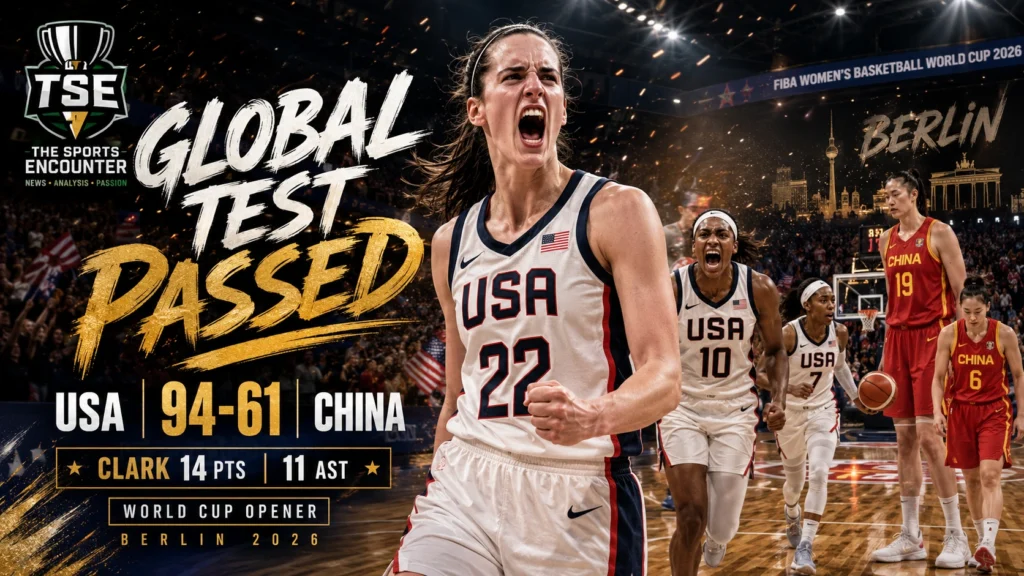
BERLIN, September 4, 2026: Caitlin Clark arrived at her first FIBA Women’s Basketball World Cup carrying one of the most interesting questions surrounding the United States in Berlin.
Could the most visible member of USA Basketball’s next generation turn domestic stardom into immediate production on the biggest international stage?
Her first answer was emphatic.
Clark delivered 14 points and 11 assists as the United States overwhelmed China 94-61 at Max-Schmeling-Halle, extending its extraordinary Women’s World Cup winning streak to 31 games and opening the defense of its title with a 33-point victory over the team it defeated in the 2022 final.
Rhyne Howard also scored 14 points, Jackie Young added 12, and the Americans used their depth, speed and passing to gradually break down a Chinese team built around some of the most imposing size in international women’s basketball.
China’s 7-foot-3 teenager Zhang Ziyu finished with 13 points in her World Cup debut, while 6-foot-10 Han Xu recorded 11 points and 10 rebounds. Their presence briefly forced the United States into uncomfortable half-court possessions, particularly when China paired both centers in the third quarter.
The Americans adjusted rather than panicked.
Clark, Paige Bueckers and Angel Reese helped drive a decisive 17-5 surge late in the third quarter, and a game that had threatened to become an intriguing tactical examination quickly returned to American control.
The Sports Encounter had framed Clark’s arrival in Berlin as the first genuine global test of the next stage of her career. Her World Cup debut supplied an important early answer because she affected the game without needing to dominate the shot count.
Fourteen points were useful.
Eleven assists told the bigger story.
USA 94-61 China: World Cup Opener at a Glance
| Match Detail | Information |
|---|---|
| Competition | FIBA Women’s Basketball World Cup 2026 |
| Stage | Group D |
| Venue | Max-Schmeling-Halle, Berlin |
| Date | September 4, 2026 |
| Result | USA beat China 94-61 |
| USA First Quarter | 27 points |
| China First Quarter | 14 points |
| Halftime | USA 49-29 China |
| Caitlin Clark | 14 points, 11 assists |
| Rhyne Howard | 14 points |
| Jackie Young | 12 points |
| Zhang Ziyu | 13 points |
| Han Xu | 11 points, 10 rebounds |
| USA World Cup Winning Streak | 31 games |
Official match information, historical meetings and tournament data are available through the FIBA USA-China match center.
The 33-Point Margin Only Tells Part of the Story
A 94-61 final score suggests a routine performance by the defending champions.
The context makes the victory considerably more revealing.
USA Basketball arrived in Berlin only days after losing two players who had originally been expected to provide major championship experience. A’ja Wilson withdrew from the World Cup, while Kelsey Plum was also ruled out, forcing Sonia Citron and Kiki Iriafen into the final roster.
The Sports Encounter examined how those changes accelerated USA Basketball’s generational transition before the opening tip.
Wilson’s absence removed the most dominant interior player from the original roster construction. Plum’s absence reduced the amount of experienced perimeter creation available to head coach Kara Lawson.
That placed greater responsibility on Clark, Bueckers, Howard, Reese, Aliyah Boston, Iriafen and the other younger players.
China provided exactly the sort of opponent capable of exposing any uncertainty.
The 2022 World Cup runners-up brought extraordinary size, experienced international players and a young center in Zhang whose 7-foot-3 frame changes the geometry around the basket.
Instead, the American rotation looked comfortable enough to turn a potentially awkward first game into a convincing opening statement.
Caitlin Clark’s 11 Assists Were More Important Than Her 14 Points
Clark’s first World Cup performance showed why judging her international contribution primarily through scoring could miss much of her value.
She scored 14 points, tying Howard for the team lead, but her 11 assists revealed how quickly she found passing windows against a defense designed to shrink the paint.
China’s size made direct interior attacks difficult at various stages. Zhang could remain close to the basket and discourage drives simply through her reach. Han added another enormous defensive presence when the two shared the floor.
That type of structure creates a choice for opposing guards.
They can force difficult shots into length, or they can move the defense until a cleaner opportunity appears somewhere else.
Clark repeatedly chose the second option.
Her passing helped USA attack before China could organize its half-court size, while her ability to create from the perimeter prevented the game from becoming a slow sequence of possessions directed into the Chinese frontcourt.
That performance followed a strong qualifying campaign earlier this year, when Clark averaged 11.6 points and a tournament-best 6.4 assists while earning MVP honors in San Juan.
Our earlier analysis of the original USA World Cup roster featuring Clark and Bueckers identified playmaking as one of the skills capable of translating most naturally from Clark’s WNBA game into international basketball.
Berlin immediately supplied evidence.
USA’s First Quarter Put China Under Pressure Immediately
The United States did not give China the slow opening the Asian side needed.
USA controlled the first quarter 27-14, establishing pace before Zhang and Han could fully impose themselves around the rim.
Clark, Bueckers and Reese all began the game outside the starting lineup, another sign of the extraordinary depth available to Lawson.
The three were eventually on the floor together to close the opening quarter.
That lineup carried symbolism as well as tactical value.
Clark, Bueckers and Reese entered professional basketball through different paths and already occupy enormous spaces within American women’s basketball culture. Their presence together in a World Cup game gave USA Basketball an early view of a combination that could remain relevant deep into the 2028 Olympic cycle.
The trio had already become central to American basketball discussion before Berlin. The Sports Encounter’s 2026 WNBA All-Star analysis showed just how heavily Clark, Bueckers, Reese and the rest of this generation are beginning to shape league interest and fan attention.
The World Cup now gives them a different responsibility.
Popularity can bring people into an arena or toward a television.
International basketball still demands execution.
The opening quarter suggested USA’s younger group is ready to provide both.
Zhang Ziyu Gave China a Different Kind of Weapon
For all the attention surrounding Clark, one of the most fascinating players on the floor was wearing China’s colors.
Zhang Ziyu stands 7-foot-3 and entered the tournament at only 19 years old.
Her first World Cup basket pulled China within 33-25 during the second quarter, and her physical dimensions immediately changed the way USA attacked the paint.
Zhang could remain near the basket defensively and obstruct finishing angles without travelling far from the rim. On offense, the Americans frequently sent additional defensive attention toward her whenever she received the ball in scoring position.
She finished with 13 points and converted nine of her 10 free throws.
Those numbers do not suggest domination, but they demonstrate that Zhang could still produce while receiving significant defensive attention.
China’s challenge will involve building enough perimeter creation around her to prevent opponents from collapsing inward whenever she catches the ball.
Against the United States, that supporting pressure was inconsistent.
The 16-4 Run Before Halftime Changed the Direction of the Game
China’s best stretch of the first half arrived when Zhang began influencing possessions at both ends.
Her first basket helped reduce the deficit to 33-25 with 6:21 remaining before halftime.
An eight-point margin gave China life.
USA answered immediately.
The Americans closed the half on a 16-4 run, turning 33-25 into a 49-29 halftime lead.
Jackie Young contributed a three-point play during the surge, while Breanna Stewart scored the final four points before the break.
That sequence showed the primary problem opponents face when trying to stay with the United States.
Stopping one player rarely stops the offense.
Howard can score.
Young can attack.
Stewart can take over individual possessions.
Clark can organize.
Chelsea Gray can control tempo.
Bueckers provides another creator, while Reese, Boston and Iriafen add athleticism, rebounding and interior pressure.
A team can defend several of those options correctly and still find another one creating the next run.
China Tried the Zhang-Han Twin-Tower Lineup
The third quarter produced one of the most interesting tactical moments of the game.
China paired Zhang with 6-foot-10 Han Xu.
The combination created a huge defensive wall around the basket and forced USA to reconsider how directly it wanted to attack the interior.
Han brought far more experience to the partnership. She finished with 11 points and 10 rebounds, completing a double-double and giving China one of its more reliable performers.
For a period, the lineup worked.
China cut the American advantage to 53-37.
The deficit had fallen to 16, and the game briefly regained competitive tension.
USA then found the answer.
Clark, Bueckers and Reese Powered the Run That Ended China’s Challenge
The younger American group drove a 17-5 run to close the third quarter.
That burst took the score from 53-37 to 70-42 and effectively removed China’s realistic path back into the game.
The significance goes beyond the points.
USA Basketball entered Berlin facing legitimate questions about how quickly a roster containing so many World Cup newcomers could establish roles.
The original roster already represented a generational transition. Late withdrawals accelerated it.
Clark, Bueckers and Reese then found themselves responsible for one of the decisive stretches of the first game.
They responded by widening the lead against one of the most physically unusual lineups in the tournament.
That gives Lawson something useful to build on.
Quarter-by-Quarter: How USA Built the 94-61 Win
| Quarter | USA | China | Game State |
|---|---|---|---|
| First | 27 | 14 | USA established pace and early control |
| Second | 22 | 15 | China cut deficit before USA closed half with 16-4 run |
| Third | 21 | 13 | Zhang-Han lineup created problems before USA’s 17-5 finish |
| Fourth | 24 | 19 | USA protected and extended a commanding advantage |
| Final | 94 | 61 | USA won by 33 |
Rhyne Howard Quietly Matched Clark’s Scoring
Clark naturally generated much of the attention, but Rhyne Howard provided another indication of USA’s depth.
Howard scored 14 points, matching Clark for the team lead.
Her contribution matters because this roster cannot become dependent on one perimeter creator, especially after Plum’s withdrawal.
Howard gives Lawson another player capable of scoring without requiring the offense to revolve around her for long stretches.
That balance is valuable during international tournaments where rotations can change quickly based on foul trouble, defensive matchups and compressed schedules.
Jackie Young Gave USA Exactly What an Experienced Guard Should
Young contributed 12 points and helped drive the important surge before halftime.
She belongs to the experienced side of this transitional roster.
While Clark, Bueckers, Reese and several others are making their first senior World Cup appearances, Young has already operated inside major championship environments.
Her presence allows Lawson to place younger players around a guard who understands how quickly international games can swing.
That mixture of established players and newcomers was always supposed to define USA’s tournament.
The withdrawals before Berlin simply moved more responsibility toward the younger half of the roster.
USA Have Now Won 31 Consecutive World Cup Games
The victory extends one of the most remarkable streaks in international team sport.
The United States entered Berlin with 30 consecutive Women’s World Cup victories.
Its previous loss came against Russia in the 2006 semifinal.
USA then defeated Brazil in the bronze-medal game and has not lost a World Cup contest since.
China becomes the 31st consecutive opponent to fall during that run.
The streak spans multiple generations of players, coaching changes and entirely different versions of USA Basketball.
This latest version may eventually become one of the most interesting because the roster is being forced to transition while protecting the same historical standard.
USA-China Has Become a Measuring Stick for Both Programs
The matchup also carries important historical context.
USA had won all 15 previous FIBA meetings with China entering Friday’s opener.
The most recent game before Berlin was the 2022 World Cup final in Sydney.
USA won that championship game 83-61.
Four years later, China once again finished on exactly 61 points.
The difference came at the other end.
The Americans scored 94 this time, 11 more than they managed in the 2022 final.
| World Cup Meeting | USA | China | Margin |
|---|---|---|---|
| 2022 Final | 83 | 61 | USA by 22 |
| 2026 Group D | 94 | 61 | USA by 33 |
China has changed significantly since Sydney, particularly with Zhang entering its frontcourt structure.
USA has changed too.
Clark, Bueckers, Reese and Howard represent a generation that was not central to the 2022 championship team.
The score suggests that the balance of power remains heavily American even as the personnel evolves.
The Win Gives USA an Important Early Advantage in Group D
The 2026 World Cup format makes group position particularly valuable.
Sixteen teams are divided into four groups of four. Every team plays the other three countries in its group.
The group winner advances directly to the quarterfinals.
The teams finishing second and third must play an additional qualification game, while the fourth-place team is eliminated.
The official FIBA competition guide confirms that structure.
That gives USA a clear incentive to win Group D rather than simply qualify.
A direct quarterfinal place removes an entire elimination game from the route to the title.
For a roster already affected by late withdrawals, reducing tournament risk wherever possible has obvious value.
Group D After USA’s Opening Statement
USA shares Group D with China, Italy and Czechia.
The 33-point victory gives the defending champions an excellent first result, although two group games remain and first place has not been decided.
| Team | Opening Situation | What Matters Next |
|---|---|---|
| USA | Beat China 94-61 | Can build toward direct quarterfinal qualification |
| China | Lost to USA by 33 | Needs response against Czechia and Italy |
| Italy | Group campaign continues in Berlin | USA matchup could influence top-three order |
| Czechia | Group campaign continues in Berlin | China matchup becomes immediately important |
USA’s Roster Transition Passed Its First Real Examination
The result is particularly encouraging because USA Basketball had to alter its roster immediately before the tournament.
Sonia Citron and Kiki Iriafen were added after Wilson and Plum became unavailable.
The official USA Basketball roster update confirmed both additions before Berlin.
Late replacements can affect rotations, chemistry, defensive assignments and offensive spacing.
Against China, USA looked deeper than the disruption suggested.
That does not mean the Wilson problem has disappeared.
Knockout games against Belgium, Australia, France or another elite opponent could create much harder situations around the rim.
The opener simply showed that USA possesses enough collective talent to redistribute responsibility.
Clark’s World Cup Debut Also Points Toward LA28
Berlin is a championship event in its own right, but every meaningful performance by this American generation also influences the conversation around the 2028 Los Angeles Olympics.
Clark will be 26.
Bueckers will be 26.
Reese and Boston will also be entering years normally associated with athletic prime.
Howard should remain firmly within her own prime window.
The Sports Encounter has already examined how basketball is emerging as one of the major audience stories around LA28.
The players proving themselves in Berlin will arrive in Los Angeles with something training camps cannot provide: experience in games where national expectations and elimination pressure are real.
Clark has taken the first step.
The Clark-Boston Connection Still Gives USA a Built-In Shortcut
One of USA Basketball’s structural advantages is the amount of existing WNBA familiarity within the roster.
Clark and Aliyah Boston already understand each other through Indiana.
Clark knows Boston’s screening angles and preferred timing around the rim. Boston understands where Clark wants space and how quickly she can turn a defensive rebound into transition offense.
Those relationships matter because national teams receive far less preparation time than club teams.
Clark’s WNBA season has also repeatedly demonstrated how productive she can be when the offense flows through both scoring and passing.
Her 26-point, 11-assist performance against Chicago earlier this season was another example of that dual-threat profile.
Against China, the scoring total fell to 14.
The passing impact remained enormous.
Women’s Basketball Is Entering a Different Visibility Era
The World Cup opener also arrived during a period of extraordinary growth around women’s professional basketball.
Clark, Bueckers and Reese bring large individual audiences.
The WNBA continues adding markets, events and commercial attention.
The Sports Encounter recently examined how San Francisco landing the 2027 WNBA All-Star Game reflects the league’s expanding footprint.
Berlin now gives international basketball access to the same audience growth.
A fan who arrives because of Clark may leave having discovered Zhang.
Another may become interested in China, Belgium, France, Australia or one of the many other teams attempting to break USA’s hold on the tournament.
That is one reason this World Cup carries significance beyond the medal table.
What China Can Take From the Defeat
A 33-point loss creates obvious concerns, particularly in a format where every group result carries weight.
China still found useful evidence inside the defeat.
Zhang showed she can score at senior World Cup level despite constant defensive attention.
Han produced a double-double.
The twin-tower lineup briefly disrupted the American offense and helped China reduce the gap during the third quarter.
The next step involves finding more reliable perimeter scoring and enough defensive mobility to prevent opponents from escaping whenever the interior matchup becomes favorable.
China remains capable of progressing from Group D.
The response after this defeat will tell us considerably more about its tournament than the final minutes of a game that had already slipped away.
What USA Can Take From the Victory
The Americans learned several things in one afternoon.
- Clark’s passing translates immediately against elite international size.
- The young lineup can create decisive runs rather than simply preserve veteran-built leads.
- Howard can provide substantial scoring without dominating possession.
- Young remains an important bridge between generations.
- China’s extreme size can be attacked through pace, movement and decision-making.
- The roster still has enough depth to function after losing Wilson and Plum.
Much tougher challenges may arrive later in Berlin.
The first test, however, went far better than USA could reasonably have demanded.
The Sports Encounter Verdict
Caitlin Clark’s first World Cup game will be remembered as a double-double.
The more interesting part of the performance was how naturally it fitted what USA Basketball currently needs.
She did not have to score 30 points.
She did not need every possession.
She created, moved the defense, accelerated the game and helped other elite players find easier opportunities.
That is the version of Clark that could make this American roster especially difficult to stop.
China entered the opener with the size to ask uncomfortable questions. Zhang Ziyu and Han Xu briefly did exactly that.
USA answered through depth.
Howard scored.
Young attacked.
Stewart provided veteran control.
Clark, Bueckers and Reese drove the decisive third-quarter run.
The result became 94-61, extending the United States’ World Cup winning streak to 31 games and moving the defending champions into an early position of strength in Group D.
Two days before the tournament began, Clark’s Berlin challenge was still theoretical.
Now she has a World Cup stat line beside her name: 14 points, 11 assists and a 33-point victory over the 2022 runners-up.
The global test has started.
Her first answer was very good.
Follow continuing international basketball, WNBA and major player coverage through The Sports Encounter Basketball and NBA Hub.
Frequently Asked Questions
Who won USA vs China at the 2026 FIBA Women’s Basketball World Cup?
The United States defeated China 94-61 in their Group D opener in Berlin on September 4, 2026.
How many points did Caitlin Clark score against China?
Caitlin Clark scored 14 points in her senior FIBA Women’s Basketball World Cup debut.
How many assists did Caitlin Clark have against China?
Clark recorded 11 assists, completing a points-assists double-double with her 14 points.
How did Zhang Ziyu perform against Team USA?
The 7-foot-3 Chinese center scored 13 points in her first Women’s World Cup appearance and made nine of her 10 free throws.
How did Han Xu perform against USA?
Han Xu recorded 11 points and 10 rebounds for China.
Who led Team USA in scoring against China?
Caitlin Clark and Rhyne Howard shared the team scoring lead with 14 points each. Jackie Young added 12.
How many consecutive World Cup games has Team USA won?
The win over China extended the United States’ Women’s World Cup winning streak to 31 games. USA’s last World Cup defeat came against Russia in the 2006 semifinals.
When did USA last play China at the Women’s World Cup before 2026?
The teams met in the 2022 World Cup final, when USA defeated China 83-61 to win the championship.
How does the 2026 Women’s Basketball World Cup group format work?
Each of the four group winners advances directly to the quarterfinals. Teams finishing second and third play qualification games for the remaining quarterfinal places, while fourth-place teams are eliminated.
Who are USA’s other Group D opponents?
The United States is in Group D with China, Italy and Czechia.