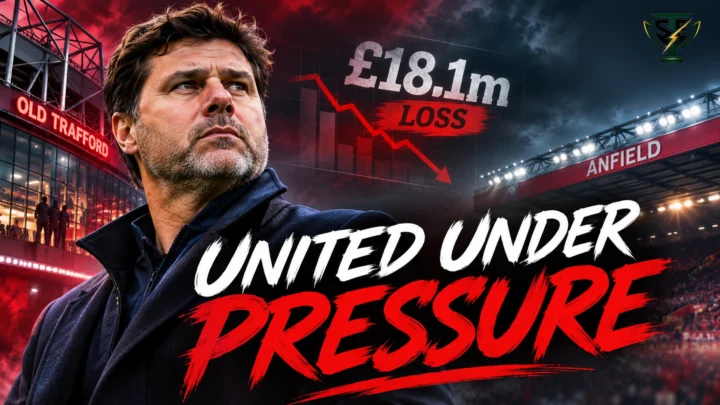
MANCHESTER, England, November 23, 2026: Mauricio Pochettino has defended Manchester United’s players after a crushing 4-0 defeat to Liverpool, insisting they possess the determination to recover despite beginning his managerial reign with the club trapped in the Premier League relegation zone.
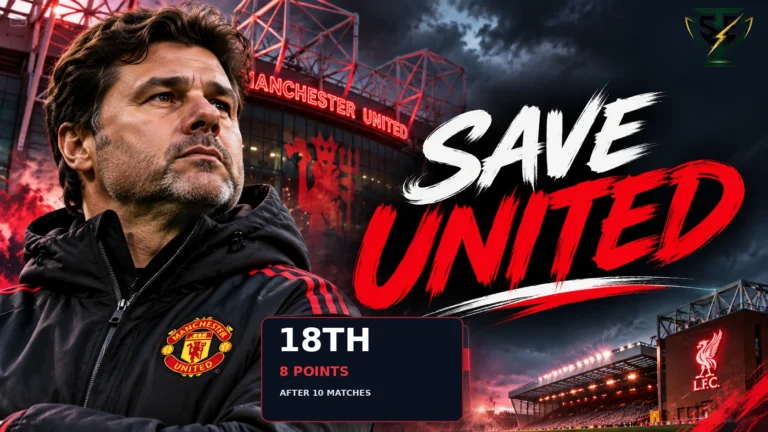
The Argentine’s decision to support his squad publicly was understandable after an extraordinary afternoon at Anfield, where Leny Yoro’s eighth-minute dismissal left United playing almost the entire match with 10 men. Yet the Manchester United relegation threat cannot be explained by that red card alone. The club has collected just eight points from 11 league matches, won only once and conceded 23 goals.
Key Takeaways
- The Argentine’s decision to support his squad publicly was understandable after an extraordinary afternoon at Anfield, where Leny Yoro’s eighth-minute dismissal left United playing almost the entire match with 10 men.
- Pochettino inherited those problems from Michael Carrick, but his opening defeat reinforced how urgently United must improve.
- Although he acknowledged the pain of losing by four goals, he emphasized the commitment shown by a team forced to play with 10 men for more than 80 minutes.
- United’s next league match is against Brentford at Old Trafford on November 28.
Pochettino inherited those problems from Michael Carrick, but his opening defeat reinforced how urgently United must improve. Liverpool exposed weaknesses in defensive positioning, concentration and the ability to respond when matches turn against them.
Story at a glance

Manchester United Relegation Crisis Demands More Than Public Reassurance
Pochettino’s response to the defeat was notably protective of his players.
Eight Minutes at Anfield Exposed United’s Defensive Fragility
The opening minutes of Pochettino’s first match provided an exceptionally difficult introduction to his new job.
Why Matthijs de Ligt’s Selection Deserves Tactical Scrutiny
One of the most consequential decisions came before kickoff.
Liverpool’s Four Goals Revealed the Scale of the Recovery Required
Liverpool took full advantage of United’s early loss of discipline.
Pochettino’s Debut Equals a Manchester United Record From 1926
The scale of the defeat also placed Pochettino in an unwanted chapter of the club’s history.
The new manager faces two immediate responsibilities: rebuilding confidence in a struggling dressing room and establishing standards that produce results. His public statements addressed the first. His next fixtures will reveal whether he can deliver the second.
Manchester United Relegation Crisis Demands More Than Public Reassurance
Pochettino’s response to the defeat was notably protective of his players.
Although he acknowledged the pain of losing by four goals, he emphasized the commitment shown by a team forced to play with 10 men for more than 80 minutes.
Speaking after the match, Pochettino said: “There are still a lot of games to play.”
His comments were consistent with a manager attempting to prevent an already fragile squad from losing further confidence.
The official Manchester United post-match press conference confirms that Pochettino focused on his players’ commitment while acknowledging the difficult circumstances created by the early dismissal.
There is a managerial logic behind that approach. Publicly condemning individual players after one match could create unnecessary friction before the new coaching staff has established its methods.
But the league table provides a separate assessment.
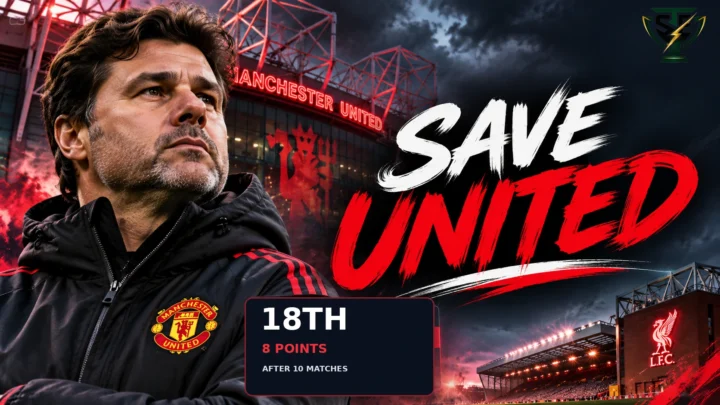
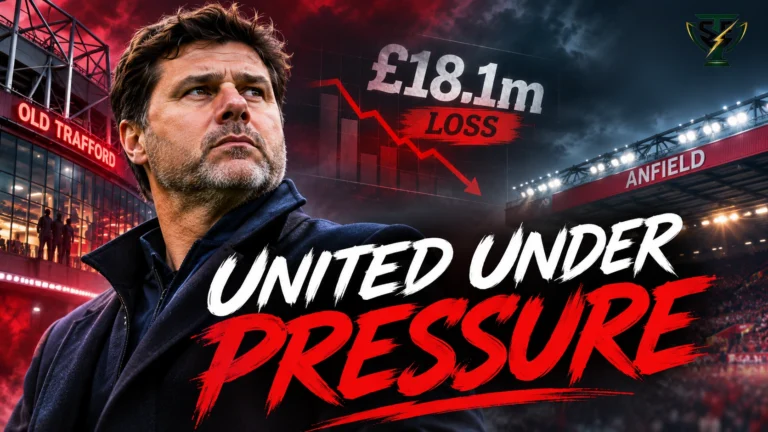
United occupy 19th place, with eight points from a possible 33. Their return of approximately 0.73 points per game would amount to fewer than 28 points across a full 38-match season if maintained.
That projection is a straightforward illustration of their current pace, not a prediction of their final total. Pochettino has 27 league matches remaining to change the trajectory.
Why the Manchester United Relegation Numbers Matter
United’s position is particularly alarming because their problems have developed over several months rather than emerging from one damaging result.
After 11 league games, they have recorded one victory, five draws and five defeats. Their 14 goals scored and 23 conceded produce a goal difference of minus nine.
The defensive record is particularly significant. Conceding more than two goals per league match places considerable pressure on an attack that has not consistently compensated for mistakes at the other end.
As The Sports Encounter’s earlier analysis of Pochettino’s survival challenge established, the manager inherited a team already requiring a substantial improvement in its points-earning rate.
The Liverpool result has made the problem more visible. The underlying mathematics had already made it urgent.
Eight Minutes at Anfield Exposed United’s Defensive Fragility
The opening minutes of Pochettino’s first match provided an exceptionally difficult introduction to his new job.
Yoro was sent off after bringing down Alexander Isak outside United’s penalty area while the Liverpool forward was advancing toward goal.
The referee judged that the defender had denied an obvious goalscoring opportunity. The decision was reviewed and confirmed by the video assistant referee.
The Premier League’s official VAR explanation confirmed the basis of the dismissal.
Pochettino disputed the severity of the punishment, but the sending-off immediately changed the tactical circumstances.
With United reduced to 10 men, Liverpool took advantage of the resulting free kick. Dominik Szoboszlai scored before Florian Wirtz doubled the advantage just three minutes later.
United were two goals behind almost immediately after losing a defender, forcing Pochettino to abandon much of his original plan.
He responded by introducing Harry Maguire for Bryan Mbeumo in an attempt to restore defensive cover.
The adjustment illustrated the challenge. A team already short of confidence had to sacrifice attacking options while trying to contain an opponent capable of exploiting additional space.
However, the red card should not absolve United of every subsequent defensive failure. Ten-man teams can still protect central areas, reduce space between their defensive lines and limit the quality of chances conceded.
United struggled to do those things consistently enough.
Why Matthijs de Ligt’s Selection Deserves Tactical Scrutiny
One of the most consequential decisions came before kickoff.
Pochettino selected Matthijs de Ligt for his first Premier League appearance since November 2025, restoring the defender to the starting lineup after an extended absence from league football.
The Dutch international started alongside Yoro, with Lisandro Martínez and Diogo Dalot completing the defensive unit.
De Ligt’s return offered experience, but it also introduced a question about match sharpness against one of the Premier League’s most dangerous attacking teams.
The Premier League’s tactical assessment identified an error from De Ligt in the passage that led to Yoro’s dismissal.
That sequence does not establish that the selection was necessarily wrong. A defender’s availability, training performances and tactical understanding are considerations that cannot be fully judged from outside the coaching staff.
Nevertheless, the incident demonstrated the risk of introducing a player after a prolonged league absence into such a demanding fixture.
For Pochettino, future selection decisions must balance experience against mobility, current conditioning and the ability of defensive partnerships to function under pressure.
The challenge is familiar from TSE’s examination of Carrick’s tactical difficulties, injuries and fixture congestion, which identified instability across United’s defensive structure before the managerial change.
Pochettino has inherited those selection complications, but responsibility for resolving them now belongs to him.
Liverpool’s Four Goals Revealed the Scale of the Recovery Required
Liverpool took full advantage of United’s early loss of discipline.
Szoboszlai’s free kick and Wirtz’s quick follow-up established control before Rio Ngumoha and substitute Victor Muñoz added second-half goals.
The scoring pattern illustrated how Liverpool maintained attacking pressure rather than settling for their early advantage.
United goalkeeper Senne Lammens prevented the defeat from becoming even heavier with important saves as Liverpool repeatedly created opportunities.
The Premier League’s official match report details the four scorers and the decisive moments of Pochettino’s debut.
For United, the most important defensive lesson is that their problems extend beyond the identity of the back four.
Protecting a defense requires midfield support, coordinated pressing, reliable recovery runs and clearer decisions about when to challenge an opponent.
A defender left exposed by poor positioning elsewhere in the team may be forced into high-risk situations. Conversely, individual errors can undermine an otherwise coherent defensive structure.
Both possibilities require investigation because a managerial change cannot automatically repair them.
Pochettino’s Debut Equals a Manchester United Record From 1926
The scale of the defeat also placed Pochettino in an unwanted chapter of the club’s history.
According to Opta’s historical records, the 4-0 loss equaled the heaviest defeat suffered by a Manchester United manager in his first game in charge.
The previous example occurred in October 1926, when Lal Hilditch began his managerial tenure with a 4-0 defeat against Bolton Wanderers.
The coincidence is striking because the two matches took place exactly a century apart.
It would be misleading, however, to treat the identical results as proof that Pochettino will follow the same managerial trajectory.
A debut is a limited measure of managerial ability, particularly when a coach has taken charge immediately before facing an established rival away from home.
Still, the historical comparison illustrates the extraordinary circumstances surrounding United’s latest attempt at reconstruction.
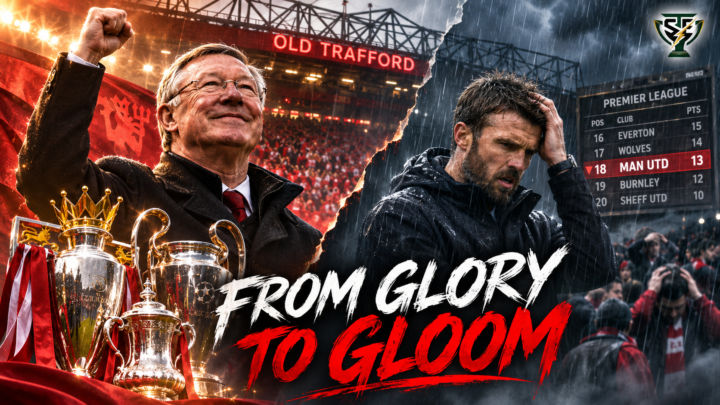
The club’s problems have persisted through successive appointments and tactical approaches. The Sports Encounter’s historical assessment of United’s decline since Sir Alex Ferguson explored how repeated managerial changes have failed to deliver sustained improvement.
Pochettino now becomes the latest coach required to address failures that have survived numerous changes in personnel and leadership.
Defending Players Publicly Can Help, but United Need Measurable Improvement
Pochettino’s handling of the aftermath reveals an important distinction between leadership communication and competitive accountability.
Supporting players after a humiliating result can help preserve trust, particularly when the new manager has had limited time to work with them.
That support must be accompanied by demanding standards in training and selection.
The Argentine built his managerial reputation partly on intensive physical preparation, coordinated pressing and creating clearly defined responsibilities within his teams.
At Southampton and Tottenham Hotspur, those methods helped produce competitive sides capable of challenging stronger and more financially powerful opponents.
His Tottenham team reached the Champions League final in 2019, losing to Liverpool in Madrid. The achievement demonstrated his ability to develop a coherent collective identity over time.
United’s immediate circumstances are different. Pochettino has inherited a team already in trouble, with little room to experiment while results continue to deteriorate.
His early priorities should be measurable:
Continue the Premier League Story
- Defensive stability: Reduce the number and quality of chances conceded, especially through the center.
- Discipline: Prevent avoidable dismissals and unnecessary fouls in dangerous positions.
- Midfield protection: Improve the distances between defenders and midfielders when possession is lost.
- Attacking efficiency: Create more reliable opportunities without leaving the defensive structure exposed.
- Results: Convert improved performances into points before the gap to safety becomes more difficult to close.
Those are more meaningful measures of progress than whether individual players appear encouraged after a difficult defeat.
The Relegation Threat Also Carries Financial Consequences
United’s predicament has implications beyond league position and sporting reputation.
The club entered the season with significant financial commitments and the expectation of competing across domestic and European competitions.
Its recent financial disclosures underline the importance of maintaining commercial performance while addressing the problems on the field.
As TSE’s investigation into Manchester United’s finances and Pochettino’s appointment explained, prolonged sporting decline introduces financial uncertainty for a club carrying major operating obligations.
Premier League relegation would have particularly serious consequences because it changes the distribution of broadcast income and the commercial environment in which a club operates.
That possibility remains far from inevitable. There are 27 league matches left, and United have sufficient time to recover.
But the potential consequences make it increasingly important for the club to treat its league position as an immediate competitive problem rather than a temporary embarrassment.
Brentford Will Provide a Fairer Test of Pochettino’s Manchester United
United’s next league match is against Brentford at Old Trafford on November 28.
Unlike the trip to Liverpool, this fixture gives Pochettino an opportunity to prepare his team with the benefit of experience from his first match and without immediately confronting the same extraordinary conditions.
That does not guarantee a straightforward contest. Brentford have regularly demonstrated the ability to exploit opponents through direct attacks, set pieces and organized defensive work.
The match will nevertheless offer a more useful indication of Pochettino’s influence.
United must demonstrate greater control of defensive transitions, more disciplined positioning and clearer coordination when moving from attack to defense.
The manager will also have to assess the consequences of Yoro’s dismissal for team selection.
The timing matters because United’s problems have already created considerable uncertainty surrounding the club’s sporting direction.
Even before Pochettino arrived, his departure from the United States national team and United’s decision to replace Carrick reflected the urgency of the situation.
A strong response against Brentford would provide the first concrete evidence that the managerial change can produce results.
Pochettino Cannot Talk Manchester United Out of Relegation Trouble
There are sound reasons for Pochettino to defend his players after the Liverpool defeat. He has inherited a squad struggling for confidence, and publicly criticizing individuals before establishing relationships could deepen the problems he is trying to solve.
The early red card also makes it difficult to draw definitive conclusions about his preferred tactics from one match.
Yet the Manchester United relegation danger is real because it is supported by 11 league results, a poor defensive record and a points return that would leave the club in serious difficulty if sustained.
His immediate challenge is to prevent the psychological consequences of another humiliation from becoming another sequence of damaging results.
The players have received their manager’s public support. They must now respond by showing the discipline, organization and competitive resilience that United have lacked.
For Pochettino, the next meaningful statement will come through the team’s performance rather than another press conference.
Manchester United have enough matches remaining to change their season. Whether they possess the consistency and collective responsibility to do so is the question their new manager must answer.