Connect with us

Published

on

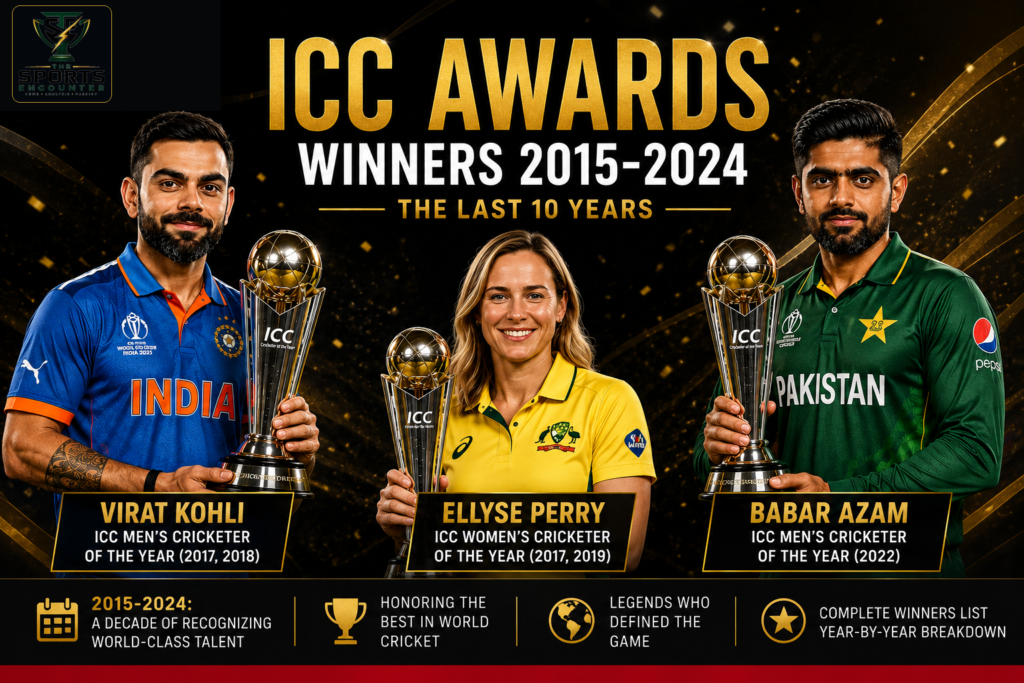
The ICC Awards have become cricket’s annual record of individual excellence. Over the past decade, the list of winners has included generational batters, world-class fast bowlers, transformative all-rounders, emerging stars, Associate cricket trailblazers, elite umpires, and moments that captured the spirit of the sport.

Yet comparing one ICC Awards edition with another is not as straightforward as it appears.

The award structure has changed significantly. Women’s cricket received fewer individual categories in the middle of the 2010s. The ICC later expanded its women’s awards, created annual men’s and women’s T20I awards, introduced separate Emerging and Associate honors for women, and retired some older categories.

There is another important complication. There was no conventional ICC Awards 2020 edition. Instead, the International Cricket Council staged the ICC Awards of the Decade, honoring performances across the previous 10 years. The ICC’s annual awards archive therefore moves from 2019 directly to 2021.

For that reason, this guide covers the complete 2015–2024 ten-year period, including nine regular annual ICC Awards editions and the special Awards of the Decade presented in 2020. Readers looking for more international cricket records, analysis, history, and player features can also explore The Sports Encounter’s Cricket coverage.

TL;DR: ICC’s Top Cricketers Across the Decade

YearMen’s Top AwardCountryWomen’s Top/Leading AwardCountry
2015Steve SmithAustraliaMeg Lanning, Women’s ODIAustralia
2016Ravichandran AshwinIndiaSuzie Bates, Women’s ODI & T20INew Zealand
2017Virat KohliIndiaEllyse PerryAustralia
2018Virat KohliIndiaSmriti MandhanaIndia
2019Ben StokesEnglandEllyse PerryAustralia
2020Virat Kohli, Cricketer of the DecadeIndiaEllyse Perry, Cricketer of the DecadeAustralia
2021Shaheen Shah AfridiPakistanSmriti MandhanaIndia
2022Babar AzamPakistanNat SciverEngland
2023Pat CumminsAustraliaNat Sciver-BruntEngland
2024Jasprit BumrahIndiaAmelia KerrNew Zealand

The table shows how dramatically the center of cricketing excellence shifted during the period. Steve Smith began the decade at the top, Virat Kohli dominated its middle years, Pakistan produced consecutive men’s winners through Shaheen Shah Afridi and Babar Azam, Pat Cummins followed Australia’s World Cup-winning 2023 with the Sir Garfield Sobers Trophy, and Jasprit Bumrah became the outstanding men’s international cricketer of 2024.

The trophy itself carries enormous historical weight. The Sports Encounter recently examined that legacy in its tribute to Sir Garfield Sobers and his place among cricket’s greatest all-rounders.

ICC Awards 2015 Winners

Steve Smith owned the 2015 men’s awards. The Australian batter won both the Sir Garfield Sobers Trophy as ICC Cricketer of the Year and the Test Cricketer of the Year award.

AB de Villiers was recognized as the leading ODI player, while Australia’s Meg Lanning took the Women’s ODI award and West Indies captain Stafanie Taylor won the Women’s T20I honor.

Complete ICC Awards 2015 Winners

AwardWinnerCountry
Sir Garfield Sobers Trophy, ICC Cricketer of the YearSteve SmithAustralia
ICC Test Cricketer of the YearSteve SmithAustralia
ICC ODI Cricketer of the YearAB de VilliersSouth Africa
ICC Women’s ODI Cricketer of the YearMeg LanningAustralia
ICC Women’s T20I Cricketer of the YearStafanie TaylorWest Indies
ICC Emerging Cricketer of the YearJosh HazlewoodAustralia
ICC Associate/Affiliate Cricketer of the YearKhurram KhanUnited Arab Emirates
ICC Umpire of the YearRichard KettleboroughEngland
ICC Spirit of Cricket AwardBrendon McCullumNew Zealand
ICC T20I Performance of the YearFaf du PlessisSouth Africa

Du Plessis won the T20I performance award for his 119 from 56 balls against West Indies in Johannesburg, while McCullum’s leadership and sportsmanship during New Zealand’s emotionally charged 2015 World Cup campaign earned him the Spirit of Cricket Award.

ICC Awards 2016 Winners

Ravichandran Ashwin became the central figure of the 2016 ICC Awards. The Indian off-spinner won both the Sir Garfield Sobers Trophy and Test Cricketer of the Year award. The ICC later formally presented him with both honors, completing one of the finest award years by a spin bowler in the modern era.

New Zealand’s Suzie Bates produced a rare double in women’s cricket, becoming the first player to win both the ICC Women’s ODI and Women’s T20I awards in the same edition.

Complete ICC Awards 2016 Winners

AwardWinnerCountry
Sir Garfield Sobers Trophy, ICC Cricketer of the YearRavichandran AshwinIndia
ICC Test Cricketer of the YearRavichandran AshwinIndia
ICC ODI Cricketer of the YearQuinton de KockSouth Africa
ICC Women’s ODI Cricketer of the YearSuzie BatesNew Zealand
ICC Women’s T20I Cricketer of the YearSuzie BatesNew Zealand
ICC Emerging Cricketer of the YearMustafizur RahmanBangladesh
ICC Associate/Affiliate Cricketer of the YearMohammad ShahzadAfghanistan
ICC Umpire of the YearMarais ErasmusSouth Africa
ICC Spirit of Cricket AwardMisbah-ul-HaqPakistan
ICC T20I Performance of the YearCarlos BrathwaiteWest Indies

Brathwaite’s award came from one of the most famous finishes in T20 history. His unbeaten 34 from only 10 balls in the 2016 Men’s T20 World Cup final included four consecutive sixes off Ben Stokes that carried West Indies past England in Kolkata.

Misbah-ul-Haq, meanwhile, received the Spirit of Cricket Award, adding another distinction to a career strongly associated with Pakistan’s recovery and leadership during a difficult period for the national side.

ICC Awards 2017 Winners

The 2017 edition marked an important point in the evolution of the awards.

Virat Kohli won the Sir Garfield Sobers Trophy and Men’s ODI Cricketer of the Year, while Steve Smith took the Test award. Hasan Ali’s breakthrough year brought Pakistan another major honor through the Emerging Cricketer category.

The ICC’s official announcement of the 2017 men’s awards confirmed Kohli’s first Sir Garfield Sobers Trophy, alongside Smith, Hasan Ali, Rashid Khan and Yuzvendra Chahal among the leading winners.

More significantly for the women’s game, Australian all-rounder Ellyse Perry became the first recipient of the Rachael Heyhoe Flint Award for ICC Women’s Cricketer of the Year. The ICC described Perry as the inaugural winner of the newly named honor.

Complete ICC Awards 2017 Winners

AwardWinnerCountry
Sir Garfield Sobers Trophy, ICC Men’s Cricketer of the YearVirat KohliIndia
Rachael Heyhoe Flint Award, ICC Women’s Cricketer of the YearEllyse PerryAustralia
ICC Men’s Test Cricketer of the YearSteve SmithAustralia
ICC Men’s ODI Cricketer of the YearVirat KohliIndia
ICC Women’s ODI Cricketer of the YearAmy SatterthwaiteNew Zealand
ICC Women’s T20I Cricketer of the YearBeth MooneyAustralia
ICC Men’s Emerging Cricketer of the YearHasan AliPakistan
ICC Women’s Emerging Cricketer of the YearBeth MooneyAustralia
ICC Men’s Associate Cricketer of the YearRashid KhanAfghanistan
ICC Umpire of the YearMarais ErasmusSouth Africa
ICC Spirit of Cricket AwardAnya ShrubsoleEngland
ICC Men’s T20I Performance of the YearYuzvendra ChahalIndia
ICC Fans’ Moment of the YearPakistan defeating India in the Champions Trophy finalPakistan

Beth Mooney was one of the edition’s biggest winners, taking both the Women’s T20I and Women’s Emerging Player awards. Rashid Khan’s Associate award also foreshadowed his rise into one of the defining limited-overs bowlers of his generation. His continuing importance to Afghanistan can be seen in The Sports Encounter’s recent coverage of Rashid Khan leading Afghanistan toward the 2027 ODI World Cup.

Pakistan’s victory over India in the 2017 Champions Trophy final was selected as the inaugural ICC Fans’ Moment of the Year.

ICC Awards 2018 Winners

If one edition belonged overwhelmingly to one player, it was 2018.

Virat Kohli completed an extraordinary sweep of the principal men’s honors, winning ICC Men’s Cricketer of the Year, Test Cricketer of the Year and ODI Cricketer of the Year.

Smriti Mandhana led the women’s awards, taking both the Rachael Heyhoe Flint Trophy and Women’s ODI award.

Complete ICC Awards 2018 Winners

AwardWinnerCountry
Sir Garfield Sobers Trophy, ICC Men’s Cricketer of the YearVirat KohliIndia
Rachael Heyhoe Flint Award, ICC Women’s Cricketer of the YearSmriti MandhanaIndia
ICC Men’s Test Cricketer of the YearVirat KohliIndia
ICC Men’s ODI Cricketer of the YearVirat KohliIndia
ICC Women’s ODI Cricketer of the YearSmriti MandhanaIndia
ICC Women’s T20I Cricketer of the YearAlyssa HealyAustralia
ICC Emerging Men’s Cricketer of the YearRishabh PantIndia
ICC Emerging Women’s Cricketer of the YearSophie EcclestoneEngland
ICC Men’s Associate Cricketer of the YearCalum MacLeodScotland
ICC Umpire of the YearKumar DharmasenaSri Lanka
ICC Spirit of Cricket AwardKane WilliamsonNew Zealand
ICC Men’s T20I Performance of the YearAaron FinchAustralia
ICC Fans’ Moment of the YearIndia winning the Under-19 World CupIndia

Kohli’s three-award sweep made 2018 one of the strongest individual ICC Awards performances of the modern era. Mandhana’s double further turned the edition into a remarkable year for Indian cricket.

ICC Awards 2019 Winners

England’s unforgettable 2019 season placed Ben Stokes at the top of world cricket.

His influence on England’s first Men’s ODI World Cup victory and his extraordinary unbeaten 135 against Australia at Headingley during the Ashes helped him win the Sir Garfield Sobers Trophy.

Ellyse Perry dominated the women’s awards, taking both Women’s Cricketer of the Year and Women’s ODI Cricketer of the Year.

Complete ICC Awards 2019 Winners

AwardWinnerCountry
Sir Garfield Sobers Trophy, ICC Men’s Cricketer of the YearBen StokesEngland
Rachael Heyhoe Flint Award, ICC Women’s Cricketer of the YearEllyse PerryAustralia
ICC Men’s Test Cricketer of the YearPat CumminsAustralia
ICC Men’s ODI Cricketer of the YearRohit SharmaIndia
ICC Women’s ODI Cricketer of the YearEllyse PerryAustralia
ICC Women’s T20I Cricketer of the YearAlyssa HealyAustralia
ICC Emerging Men’s Cricketer of the YearMarnus LabuschagneAustralia
ICC Emerging Women’s Cricketer of the YearChanida SutthiruangThailand
ICC Men’s Associate Cricketer of the YearKyle CoetzerScotland
ICC Umpire of the YearRichard IllingworthEngland
ICC Spirit of Cricket AwardVirat KohliIndia
ICC Men’s T20I Performance of the YearDeepak ChaharIndia

Deepak Chahar won the T20I Performance award after taking 6 for 7 against Bangladesh, while Kohli’s decision to ask Indian supporters to stop booing Australia’s Steve Smith during the World Cup earned him the Spirit of Cricket Award.

Marnus Labuschagne’s Emerging Player award followed a remarkable breakthrough in Test cricket. He scored 1,104 Test runs during the year and rose rapidly through the batting rankings.

ICC Awards 2020: Awards of the Decade

The ICC did something completely different in 2020.

Rather than stage a conventional annual awards program, it celebrated the best international performers of the previous decade. More than 1.5 million fans participated in voting, casting 5.3 million votes.

Virat Kohli claimed the Sir Garfield Sobers Award for Male Cricketer of the Decade, while Ellyse Perry dominated the women’s honors.

ICC Awards of the Decade Winners

AwardWinnerCountry
Sir Garfield Sobers Award, ICC Male Cricketer of the DecadeVirat KohliIndia
Rachael Heyhoe Flint Award, ICC Female Cricketer of the DecadeEllyse PerryAustralia
ICC Men’s Test Cricketer of the DecadeSteve SmithAustralia
ICC Men’s ODI Cricketer of the DecadeVirat KohliIndia
ICC Women’s ODI Cricketer of the DecadeEllyse PerryAustralia
ICC Men’s T20I Cricketer of the DecadeRashid KhanAfghanistan
ICC Women’s T20I Cricketer of the DecadeEllyse PerryAustralia
ICC Men’s Associate Cricketer of the DecadeKyle CoetzerScotland
ICC Women’s Associate Cricketer of the DecadeKathryn BryceScotland
ICC Spirit of Cricket Award of the DecadeMS DhoniIndia

Kohli’s overall award reflected 20,396 international runs during the performance period, more than any other player considered by the ICC. Smith’s 7,040 Test runs at an average of 65.79 secured the Test award.

Perry’s achievement was even broader. She won Female Cricketer of the Decade, Women’s ODI Cricketer of the Decade and Women’s T20I Cricketer of the Decade.

Rashid Khan’s 89 T20I wickets from 48 matches at an average of 12.62 helped him take the men’s T20I honor despite his international career beginning only in 2015.

MS Dhoni won the Spirit of Cricket Award of the Decade for recalling England’s Ian Bell after a controversial run-out at Trent Bridge in 2011.

ICC Awards 2021 Winners

When the normal annual awards returned, Pakistan produced one of its greatest years in ICC Awards history.

Shaheen Shah Afridi won the Sir Garfield Sobers Trophy as Men’s Cricketer of the Year, while Babar Azam took the ODI award and Mohammad Rizwan won the Men’s T20I honor.

Smriti Mandhana was named Women’s Cricketer of the Year.

Complete ICC Awards 2021 Winners

AwardWinnerCountry
Sir Garfield Sobers Trophy, ICC Men’s Cricketer of the YearShaheen Shah AfridiPakistan
Rachael Heyhoe Flint Trophy, ICC Women’s Cricketer of the YearSmriti MandhanaIndia
ICC Men’s Test Cricketer of the YearJoe RootEngland
ICC Men’s ODI Cricketer of the YearBabar AzamPakistan
ICC Women’s ODI Cricketer of the YearLizelle LeeSouth Africa
ICC Men’s T20I Cricketer of the YearMohammad RizwanPakistan
ICC Women’s T20I Cricketer of the YearTammy BeaumontEngland
ICC Emerging Men’s Cricketer of the YearJanneman MalanSouth Africa
ICC Emerging Women’s Cricketer of the YearFatima SanaPakistan
ICC Men’s Associate Cricketer of the YearZeeshan MaqsoodOman
ICC Women’s Associate Cricketer of the YearAndrea-Mae ZepedaAustria
ICC Umpire of the YearMarais ErasmusSouth Africa
ICC Spirit of Cricket AwardDaryl MitchellNew Zealand

Pakistan therefore won four individual player categories in the same edition: Afridi, Babar, Rizwan and Fatima Sana.

The Test award went to Joe Root, whose ability to remain among the world’s elite deep into his career has continued. The Sports Encounter recently examined Root’s return to No. 1 in the ICC Test batting rankings and what his sustained excellence means for his historical standing.

The 2021 edition also marked the arrival of the annual Men’s T20I Cricketer of the Year award, replacing the older single-performance approach used during the previous era.

ICC Awards 2022 Winners

Pakistan stayed at the center of the men’s awards in 2022.

Babar Azam succeeded Shaheen Afridi as Sir Garfield Sobers Trophy winner and retained the Men’s ODI Cricketer of the Year award. His broader career and place within Pakistan’s batting history have also been explored in The Sports Encounter’s in-depth Babar Azam career tribute and legacy analysis.

England’s Nat Sciver won the Rachael Heyhoe Flint Trophy and the Women’s ODI award.

Complete ICC Awards 2022 Winners

AwardWinnerCountry
Sir Garfield Sobers Trophy, ICC Men’s Cricketer of the YearBabar AzamPakistan
Rachael Heyhoe Flint Trophy, ICC Women’s Cricketer of the YearNat SciverEngland
ICC Men’s Test Cricketer of the YearBen StokesEngland
ICC Men’s ODI Cricketer of the YearBabar AzamPakistan
ICC Women’s ODI Cricketer of the YearNat SciverEngland
ICC Men’s T20I Cricketer of the YearSuryakumar YadavIndia
ICC Women’s T20I Cricketer of the YearTahlia McGrathAustralia
ICC Emerging Men’s Cricketer of the YearMarco JansenSouth Africa
ICC Emerging Women’s Cricketer of the YearRenuka SinghIndia
ICC Men’s Associate Cricketer of the YearGerhard ErasmusNamibia
ICC Women’s Associate Cricketer of the YearEsha OzaUnited Arab Emirates
ICC Umpire of the YearRichard IllingworthEngland
ICC Spirit of Cricket AwardAasif SheikhNepal

Suryakumar Yadav’s T20I award followed an extraordinary 1,164-run year, while Ben Stokes’ transformation of England’s Test team helped earn him the Test Cricketer of the Year honor.

Associate cricket also gained greater visibility. Namibia’s Gerhard Erasmus and UAE’s Esha Oza won the men’s and women’s Associate awards respectively.

ICC Awards 2023 Winners

Few players entered 2023 carrying more responsibility than Pat Cummins.

He captained Australia to the World Test Championship title and the Men’s Cricket World Cup while also delivering with the ball and in several crucial situations. The ICC rewarded that year by naming him Men’s Cricketer of the Year.

Nat Sciver-Brunt retained the Rachael Heyhoe Flint Trophy, giving her consecutive Women’s Cricketer of the Year awards.

Complete ICC Awards 2023 Winners

AwardWinnerCountry
Sir Garfield Sobers Trophy, ICC Men’s Cricketer of the YearPat CumminsAustralia
Rachael Heyhoe Flint Trophy, ICC Women’s Cricketer of the YearNat Sciver-BruntEngland
ICC Men’s Test Cricketer of the YearUsman KhawajaAustralia
ICC Men’s ODI Cricketer of the YearVirat KohliIndia
ICC Women’s ODI Cricketer of the YearChamari AthapaththuSri Lanka
ICC Men’s T20I Cricketer of the YearSuryakumar YadavIndia
ICC Women’s T20I Cricketer of the YearHayley MatthewsWest Indies
ICC Emerging Men’s Cricketer of the YearRachin RavindraNew Zealand
ICC Emerging Women’s Cricketer of the YearPhoebe LitchfieldAustralia
ICC Men’s Associate Cricketer of the YearBas de LeedeNetherlands
ICC Women’s Associate Cricketer of the YearQueentor AbelKenya
ICC Umpire of the YearRichard IllingworthEngland
ICC Spirit of Cricket AwardZimbabwe CricketZimbabwe

Kohli’s outstanding ODI year brought him another ICC ODI award after 1,377 runs during the performance period. Suryakumar Yadav retained his T20I title after scoring 733 runs, while Rachin Ravindra’s breakthrough World Cup campaign contributed to his Emerging Men’s award.

The women’s awards were notably global. Sciver-Brunt represented England, Athapaththu Sri Lanka, Matthews West Indies, Litchfield Australia and Queentor Abel Kenya.

The continued importance of ODI cricket also provides useful context for these awards. The Sports Encounter is currently revisiting the format’s history through A Celebration of 5000 ODIs, a series examining the matches and performances that shaped the format.

ICC Awards 2024 Winners

The latest completed ICC Awards edition belonged largely to two players.

Jasprit Bumrah won both the Sir Garfield Sobers Trophy and Men’s Test Cricketer of the Year, while New Zealand all-rounder Amelia “Melie” Kerr won both the Rachael Heyhoe Flint Trophy and Women’s T20I Cricketer of the Year.

Kerr became the first New Zealander to win the Rachael Heyhoe Flint Trophy after playing a central role in New Zealand’s first Women’s T20 World Cup title.

The official ICC Awards 2024 results provide the governing body’s complete record of the edition, including Bumrah, Kerr, Azmatullah Omarzai, Smriti Mandhana, Arshdeep Singh, Kamindu Mendis, Annerie Dercksen, Gerhard Erasmus, Esha Oza and Richard Illingworth.

Complete ICC Awards 2024 Individual Winners

AwardWinnerCountry
Sir Garfield Sobers Trophy, ICC Men’s Cricketer of the YearJasprit BumrahIndia
Rachael Heyhoe Flint Trophy, ICC Women’s Cricketer of the YearAmelia KerrNew Zealand
ICC Men’s Test Cricketer of the YearJasprit BumrahIndia
ICC Men’s ODI Cricketer of the YearAzmatullah OmarzaiAfghanistan
ICC Women’s ODI Cricketer of the YearSmriti MandhanaIndia
ICC Men’s T20I Cricketer of the YearArshdeep SinghIndia
ICC Women’s T20I Cricketer of the YearAmelia KerrNew Zealand
ICC Emerging Men’s Cricketer of the YearKamindu MendisSri Lanka
ICC Emerging Women’s Cricketer of the YearAnnerie DercksenSouth Africa
ICC Men’s Associate Cricketer of the YearGerhard ErasmusNamibia
ICC Women’s Associate Cricketer of the YearEsha OzaUnited Arab Emirates
ICC Umpire of the YearRichard IllingworthEngland

The ICC handed out 12 individual awards in the 2024 edition alongside five Teams of the Year. Unlike several previous editions, there was no separate Spirit of Cricket winner in the ICC’s official 2024 winners list.

Bumrah finished 2024 with 65 Test wickets and also played a decisive role in India’s T20 World Cup triumph. Arshdeep Singh won the T20I award after taking 36 wickets in 18 T20 internationals during the year.

Bumrah’s rise also illustrates how dramatically India’s fast-bowling tradition has developed. That evolution is explored in The Sports Encounter’s feature on Kapil Dev’s legacy and his role in establishing India’s pace-bowling standard.

Who Dominated the ICC Awards From 2015 to 2024?

The tables reveal several broader patterns that disappear when each year’s awards are viewed separately.

Virat Kohli Defined the Middle of the Decade

Kohli’s award record during this period is exceptional.

He won the Sir Garfield Sobers Trophy in 2017 and 2018, swept the men’s overall, Test and ODI awards in 2018, received the 2019 Spirit of Cricket Award, and was then named both ICC Male Cricketer of the Decade and Men’s ODI Cricketer of the Decade in 2020.

He returned to the individual winners’ list by taking the Men’s ODI Cricketer of the Year award for 2023.

Kohli’s importance also stretches far beyond annual awards. His place within the evolution of modern white-ball cricket remains visible across historical ODI and T20 records, including The Sports Encounter’s examination of the leading run-scorers in T20 cricket history.

Ellyse Perry Built One of the Greatest Women’s Award Records

Perry won the inaugural Rachael Heyhoe Flint Trophy in 2017 and reclaimed Women’s Cricketer of the Year in 2019.

Her 2020 Awards of the Decade performance went further. Perry took the overall women’s award plus both the ODI and T20I awards, producing a clean sweep of the three major women’s player categories.

Pakistan Enjoyed a Historic 2021–2022 Run

Shaheen Shah Afridi became Men’s Cricketer of the Year for 2021. Babar Azam won the same prize in 2022.

During the 2021 awards alone, Pakistan also supplied the Men’s ODI winner Babar Azam, Men’s T20I winner Mohammad Rizwan and Emerging Women’s winner Fatima Sana.

Babar then retained the ODI award in 2022 while becoming the overall men’s winner.

Fast Bowlers Broke Through at the Very Top

The Sir Garfield Sobers Trophy has often favored players whose batting gives them opportunities to influence more matches, but the recent period produced a remarkable fast-bowling sequence.

Shaheen Shah Afridi won in 2021, while Jasprit Bumrah took the award in 2024.

Pat Cummins, another elite fast bowler, won the 2023 award, although his case also included an extraordinary year as Australia’s captain.

That means three of the four Men’s Cricketer of the Year winners from 2021 through 2024 were frontline fast bowlers, with Babar Azam in 2022 the only specialist batter to interrupt the sequence.

The growing recognition of fast bowling fits a wider historical debate about how the role has changed across generations, something The Sports Encounter has also explored through its analysis of Pakistan’s fast-bowling heritage and why it still carries such cultural power.

How the ICC Awards Changed Over the Decade

The award tables also document cricket’s structural evolution.

In 2015 and 2016, women’s recognition centered primarily on separate ODI and T20I awards. The Rachael Heyhoe Flint Trophy for the overall Women’s Cricketer of the Year was introduced in 2017, with Ellyse Perry becoming its first winner.

A Women’s Emerging Player award also appeared in 2017, with Beth Mooney its first winner.

The men’s T20I category evolved differently. For years, the ICC recognized one outstanding T20I Performance of the Year, producing winners such as Faf du Plessis, Carlos Brathwaite, Yuzvendra Chahal, Aaron Finch and Deepak Chahar.

The modern annual Men’s T20I Cricketer of the Year award replaced that approach from 2021.

Separate women’s Associate recognition later became part of the regular awards structure as well, expanding the ICC’s ability to recognize performances beyond its Full Member nations.

Which Players Won the Most Prestigious ICC Award During the Period?

Looking only at the Sir Garfield Sobers Trophy for the leading men’s cricketer, the winners across the period were:

Award YearWinnerCountry
2015Steve SmithAustralia
2016Ravichandran AshwinIndia
2017Virat KohliIndia
2018Virat KohliIndia
2019Ben StokesEngland
2020Virat Kohli, Cricketer of the DecadeIndia
2021Shaheen Shah AfridiPakistan
2022Babar AzamPakistan
2023Pat CumminsAustralia
2024Jasprit BumrahIndia

Kohli is the only player in this period to win consecutive regular Sir Garfield Sobers Trophies, doing so in 2017 and 2018. His Cricketer of the Decade honor in 2020 strengthens his position as the defining individual men’s ICC Awards performer of this ten-year window.

Which Women Dominated the ICC Awards?

The women’s awards show a more distributed pattern.

Ellyse Perry stands out because of her overall titles in 2017 and 2019 and her three Awards of the Decade victories in 2020.

Smriti Mandhana won the overall women’s award in 2018 and 2021, then added the Women’s ODI title in 2024.

Nat Sciver-Brunt won consecutive Rachael Heyhoe Flint Trophies in 2022 and 2023. Amelia Kerr followed with the 2024 award.

That sequence captures the remarkable depth of women’s international cricket during the period, from Australia’s dominance through Perry and Alyssa Healy to the rise of Mandhana, Sciver-Brunt, Kerr, Chamari Athapaththu, Hayley Matthews and other stars from across the international game.

Why There Is No Standard ICC Awards 2020 Winners List

This is one of the biggest sources of confusion when searching ICC Awards history.

The ICC’s official annual archive contains 2019 and then jumps to 2021. Rather than presenting regular awards for the 2020 calendar year, the governing body announced the ICC Awards of the Decade on December 28, 2020.

Any historical list that simply inserts regular 2020 annual winners alongside 2019 and 2021 therefore creates a false impression.

The correct approach is to identify 2020 as an exceptional year and list the decade awards separately.

What the Last Decade of ICC Awards Tells Us About World Cricket

Awards are imperfect measures of greatness. They depend on performance windows, formats played, competition, voting systems and the categories available in a particular year.

Taken together, though, these ten years tell a compelling story.

Smith opened the period as Test cricket’s dominant batter. Ashwin followed with an all-round year built around spin and lower-order runs. Kohli then produced one of the strongest sustained stretches of all-format batting in the modern game.

Stokes’ 2019 victory showed how decisive performances in cricket’s biggest moments could outweigh simple statistical accumulation. Afridi and Bumrah demonstrated that elite fast bowling could still command cricket’s highest individual prize. Babar represented Pakistan’s batting resurgence, while Cummins combined world-class bowling with championship-winning leadership.

Women’s cricket experienced an even more visible transformation. Lanning and Bates were recognized within a narrower award structure early in the period. Perry then became the first Rachael Heyhoe Flint Trophy winner before Mandhana, Sciver-Brunt and Kerr carried the honor into a new generation.

The Associate awards tell another part of the same story. Winners came from the UAE, Afghanistan, Scotland, Oman, Austria, Namibia and Kenya, showing how far international cricket’s individual recognition has expanded beyond its traditional powers.

Frequently Asked Questions

Who won the most ICC Men’s Cricketer of the Year awards from 2015 to 2024?

Virat Kohli was the only player to win the regular Sir Garfield Sobers Trophy twice during this period, taking the award in 2017 and 2018. He was also named ICC Male Cricketer of the Decade in 2020.

Who won the ICC Men’s Cricketer of the Year award in 2024?

India fast bowler Jasprit Bumrah won the Sir Garfield Sobers Trophy for 2024. He also won the ICC Men’s Test Cricketer of the Year award.

Who won the ICC Women’s Cricketer of the Year award in 2024?

New Zealand all-rounder Amelia Kerr, also known as Melie Kerr, won the Rachael Heyhoe Flint Trophy. She also won the Women’s T20I Cricketer of the Year award.

Who won the ICC Awards in 2020?

There was no conventional annual ICC Awards 2020 program. The ICC instead presented the Awards of the Decade. Virat Kohli won Male Cricketer of the Decade and Ellyse Perry won Female Cricketer of the Decade.

Which player dominated the ICC Awards of the Decade?

Ellyse Perry won three major awards: Female Cricketer of the Decade, Women’s ODI Cricketer of the Decade and Women’s T20I Cricketer of the Decade. Virat Kohli won Male Cricketer of the Decade and Men’s ODI Cricketer of the Decade.

Which Pakistan players won major ICC Awards during this period?

Among Pakistan’s notable winners were Misbah-ul-Haq, Hasan Ali, Shaheen Shah Afridi, Babar Azam, Mohammad Rizwan and Fatima Sana. Afridi won Men’s Cricketer of the Year in 2021, while Babar succeeded him in 2022.

Has an Afghanistan player won an ICC annual award?

Yes. Rashid Khan won the Men’s Associate Cricketer of the Year award for 2017 and later became ICC Men’s T20I Cricketer of the Decade in 2020. Azmatullah Omarzai won the ICC Men’s ODI Cricketer of the Year award for 2024.

Final Word

The ICC Awards from 2015 through 2024 record a decade in which Virat Kohli built an extraordinary all-format legacy, Ellyse Perry established herself among women’s cricket’s defining players, Pakistan produced consecutive winners of cricket’s leading men’s award, Associate nations gained greater recognition, and fast bowlers returned to the very top of the individual honors.

They also show how international cricket itself changed.

Women’s categories became broader. T20I cricket developed from rewarding isolated performances to recognizing complete seasons. Associate cricket gained dedicated men’s and women’s honors. The sport’s biggest individual awards gradually became a much wider reflection of the international game.

At the end of the latest completed edition, two very different cricketers stood at the summit: Jasprit Bumrah, a fast bowler whose precision and control defined India’s 2024, and Amelia Kerr, an all-rounder at the heart of New Zealand’s historic women’s T20 World Cup triumph.
Serina Ramgopallan is a Sri Lanka-based sports writer and physical education graduate from the University of Colombo, covering cricket, athlete development, tournament competition, and major sporting events across South Asia and the wider international stage. Her academic background gives her a strong understanding of athletic performance, preparation, movement, and the physical demands placed on elite competitors. At The Sports Encounter, Serina contributes match reports, breaking news, tournament analysis, player-focused features, and in-depth cricket coverage, with particular attention to Sri Lanka, India, Bangladesh, and major franchise competitions. Her work combines regional insight with match context, performance analysis, and clear reporting, helping readers understand both the immediate result and the broader sporting implications behind it.

Breaking News

Brandon Nakashima Beats Jodar to Reach First Masters 1000 Final

Brandon Nakashima held off Rafael Jodar 7-6(3), 6-4 to reach the first Masters 1000 final of his career at the 2026 National Bank Open in Montreal.

Marcos Wetherfield | The Sports Encounter

Published

on

Brandon Nakashima celebrates reaching his first ATP Masters 1000 final after defeating Rafael Jodar 7-6(3), 6-4 at the 2026 National Bank Open in Montreal, setting up an all-American championship match against Ben Shelton or Learner Tien.

Brandon Nakashima is into the biggest final of his career after holding off 19-year-old Rafael Jodar 7-6(3), 6-4 in Montreal to reach his first ATP Masters 1000 championship match at the 2026 National Bank Open.

The 25-year-old American had never progressed beyond the fourth round of a Masters 1000 event before this week.

Now he is one win away from the title.

Nakashima needed two hours and two minutes to end Jodar’s remarkable run on Center Court, taking a tense opening set in a tiebreak before finding the decisive break in the second.

The result also guarantees an all-American men’s final in Montreal, with Ben Shelton and Learner Tien contesting the second semifinal later on Wednesday.

For Nakashima, this tournament has become a career reset in real time.

He survived a weather-interrupted three-set battle with Arthur Rinderknech, swept aside Luciano Darderi in the quarterfinals, and then met one of the hottest young players in tennis with a place in a Masters final at stake.

He never blinked.

Follow The Sports Encounter’s tennis coverage for the National Bank Open, ATP Tour, WTA Tour and major championship stories.

Nakashima vs Jodar: Montreal Semifinal at a Glance

Match DetailInformation
TournamentNational Bank Open presented by Rogers
RoundMen’s Singles Semifinal
VenueCenter Court, Montreal
WinnerBrandon Nakashima
Score7-6(3), 6-4
Match Duration2 hours, 2 minutes, 49 seconds
Nakashima SeedNo. 28
Jodar SeedNo. 20
SignificanceNakashima reaches first ATP Masters 1000 final

The official result is confirmed by the ATP Tour results center.

The First Set Was the Match

There was very little between them early.

Jodar arrived with confidence, aggression and the fearless timing of a teenager who has spent most of 2026 climbing through levels that were supposed to slow him down.

Nakashima brought something different.

Experience.

Patience.

A serve built for hard courts.

The opening set became a test of who would give away the first cheap game.

Neither wanted to.

Jodar attacked returns and tried to get Nakashima moving laterally before the American could dictate with his first strike.

Nakashima responded by protecting his service games and refusing to overplay from neutral positions.

No player created enough separation to avoid the tiebreak.

That was where the match changed.

Nakashima Takes Control in the Tiebreak

A close set can disappear in a few points once a tiebreak begins.

Nakashima understood that immediately.

He played the breaker with more clarity than Jodar, controlling the early exchanges and taking away the Spaniard’s opportunity to build momentum.

The 7-3 tiebreak score gave Nakashima the opening set and placed Jodar in unfamiliar territory.

The teenager had been one of Montreal’s most dangerous frontrunners.

Now he had to chase.

That difference mattered.

Jodar’s attacking style works best when he can play freely and force the opponent to react.

Nakashima made him operate with scoreboard pressure instead.

Jodar Refuses to Go Quietly

The second set did not become easy.

Jodar continued attacking and kept the semifinal competitive deep into the set.

That should surprise nobody who has followed his season.

The Spaniard reached Montreal after one of the fastest rises on the ATP Tour, having already made major noise in Washington and beaten established players throughout the summer.

He entered the semifinal with 34 wins in 2026 and a live ranking that had pushed him toward the edge of the Top 10.

His route through Montreal had been equally impressive.

Jodar defeated Lorenzo Musetti 6-4, 6-3, beat Jiri Lehecka 6-3, 6-3, and then eliminated Arthur Fils 7-6(5), 6-3 in the quarterfinals.

The teenager had also led the tournament in return games won heading into the semifinal.

Nakashima therefore knew one loose service game could reopen the entire match.

Nakashima Finds the Break That Matters

Pressure eventually created the opening.

Nakashima found the decisive break in the second set and protected it through the finish.

There was no wild celebration before the final ball.

No attempt to rush the ending.

He continued serving with discipline, stayed inside the patterns that had carried him through the tournament, and made Jodar earn every chance.

At 6-4, the breakthrough was complete.

For the first time in his career, Brandon Nakashima was an ATP Masters 1000 finalist.

Montreal Has Changed Nakashima’s Career in Five Matches

Nakashima arrived in Montreal with an unusual résumé for a player of his quality.

He had reached ATP finals.

He had beaten Top 10 players.

He had established himself as a dangerous hard-court opponent.

Masters 1000 tournaments had repeatedly stopped him earlier than expected.

Before this week, Nakashima had gone 0-5 in Masters 1000 fourth-round matches.

That barrier finally disappeared against Arthur Rinderknech.

The match itself tested almost everything.

Nakashima won the opening set 7-6(4), lost the second 5-7, and reached 4-4 in the third before bad weather suspended play.

After a delay of one hour and 46 minutes, he returned and completed a 7-5 final set.

That victory sent him into his first Masters 1000 quarterfinal.

The Sports Encounter has repeatedly seen how breakthrough tournaments can change rapidly once one psychological barrier disappears.

Nakashima looks like a perfect example.

Darderi Never Gets a Chance to Build Pressure

The quarterfinal was completely different.

Nakashima dismantled Luciano Darderi 6-2, 6-3 in only 77 minutes.

He served with authority, struck 11 aces and repeatedly took control of rallies before Darderi could establish rhythm.

The victory sent Nakashima into his first Masters semifinal.

It also showed an important change from the Rinderknech match.

Survival had become aggression.

By the time he reached Jodar, Nakashima was no longer simply enjoying a breakthrough run.

He looked comfortable being there.

Jodar’s Run Still Confirms a Major Arrival

Defeat should not diminish what Jodar accomplished in Montreal.

At 19, he reached his first Masters 1000 semifinal during a season in which his ranking and expectations have changed almost monthly.

He had already reached an ATP 500 final in Washington earlier in August.

Then he arrived in Montreal and kept beating established players.

Jodar’s combination of return aggression, early ball striking and willingness to attack from inside the baseline makes him difficult to contain when he gains momentum.

The semifinal exposed one of the next challenges in his development.

When an opponent protects serve well and refuses to give away neutral points, Jodar has to create openings without forcing them.

Nakashima made that lesson expensive.

Two Former College Players Meet on a Much Bigger Stage

There was also a subtle connection between the semifinalists.

Both players spent one season competing for the University of Virginia before moving fully into professional tennis.

The paths after college could hardly have been more different.

Nakashima took the slower route into the established ATP middle class.

Jodar has exploded upward as a teenager.

Montreal brought those paths together for the first time.

The older player won.

The younger one made sure he had to earn it.

Nakashima Is Doing This With His Serve First

The most important weapon in Nakashima’s run has been obvious.

His serve.

He does not possess the raw left-handed violence of Ben Shelton or the towering delivery of some of the Tour’s biggest servers.

What Nakashima does extremely well is locate.

He changes direction.

He protects second serves.

He uses the first shot after the serve to establish the rally rather than simply hoping for aces.

That makes the serve particularly effective on North American hard courts.

The Darderi match provided the clearest example when Nakashima fired 11 aces and controlled most of his service games.

Against Jodar, he needed the same discipline rather than spectacular numbers.

The American Final Is Already Guaranteed

Nakashima will face an American in the final.

Ben Shelton and Learner Tien meet in the second semifinal, giving the United States three of the final four players in Montreal.

That itself is historic.

Three American men had not reached the Montreal semifinals together since 1992.

The final now guarantees another piece of American tennis history.

Whether it is Nakashima vs. Shelton or Nakashima vs. Tien, the championship match will feature two U.S. players.

The last all-American Masters 1000 final came more than two decades ago.

If It Is Shelton, Nakashima Gets the Power Test

Shelton would provide the more explosive matchup.

He enters the semifinal as the defending Montreal champion and one of the most dangerous servers on Tour.

The left-hander also destroyed Jakub Mensik 6-3, 6-1 in the quarterfinals, committing only three unforced errors in a performance that lasted just 72 minutes.

A Nakashima-Shelton final would therefore become a battle between two different versions of American hard-court tennis.

Shelton creates chaos.

Nakashima creates order.

If It Is Tien, the Match Becomes a Problem-Solving Contest

Learner Tien would present a completely different challenge.

The 20-year-old has reached his first Masters 1000 semifinal by using elite return skills, defense and counterpunching intelligence.

Tien dismantled Daniel Merida 6-3, 6-2 in the quarterfinals.

He also owns a strong record against Shelton, making the second semifinal far less predictable than the rankings suggest.

A Nakashima-Tien final would likely produce longer exchanges and greater pressure on Nakashima’s second serve.

Either opponent creates a compelling final.

Why This Run Matters Beyond One Tournament

Nakashima turned 25 on August 3.

That places him at an interesting point in his career.

He is too experienced to be framed as a prospect.

He is young enough to move his career into a completely different tier.

Montreal may be the tournament that does it.

Masters 1000 finals carry major ranking points, prize money and, more importantly, evidence that a player can survive six matches against elite fields.

That changes future draws.

It changes seeding.

It changes expectations.

Nakashima has already moved beyond his previous ceiling regardless of what happens in the final.

His 2026 Season Had Been Building Toward Something

The Montreal breakthrough did not come from nowhere.

Nakashima reached the Brisbane final in January before losing to Daniil Medvedev.

He later defeated world No. 6 Alex de Minaur at Queen’s Club, one of the biggest wins of his season.

In Washington, he reached another semifinal before falling to Taylor Fritz.

Those results showed consistency.

Montreal has added scale.

The difference between reaching ATP 250 or ATP 500 semifinals and a Masters 1000 final is substantial.

Nakashima has crossed it.

Turning Points in Nakashima vs Jodar

The first-set tiebreak

Neither player created enough separation through the opening set. Nakashima played the breaker with greater control and won it 7-3, forcing Jodar to chase the match.

Nakashima refuses to give Jodar easy return pressure

Jodar entered as one of Montreal’s leading returners. Nakashima protected enough service games to prevent the teenager from turning the semifinal into a momentum match.

The second-set break

Once Nakashima found his opening, he did not hand it back. The match shifted from competitive balance to scoreboard pressure almost immediately.

Nakashima closes without panic

First Masters finals can make players tighten near the finish. Nakashima stayed inside his patterns and completed the second set 6-4.

TSE Verdict: Nakashima Has Stopped Waiting for His Breakthrough

For years, Brandon Nakashima looked like a player capable of making this kind of run.

Montreal is where capability finally became reality.

The route has required everything.

A weather delay.

A three-set survival battle.

A dominant quarterfinal.

A semifinal against one of the hottest teenagers in tennis.

Nakashima has solved each problem differently.

That may be the most encouraging part.

He did not reach the final because one opponent collapsed or because the draw opened completely.

He earned it through adaptability.

Against Rinderknech, he survived.

Against Darderi, he attacked.

Against Jodar, he stayed composed.

The final now brings the biggest pressure yet.

Nakashima will face another American, either the defending champion Shelton or the rapidly rising Tien.

The opponent will change.

The opportunity will not.

One match remains between Brandon Nakashima and the biggest title of his career.

Montreal has already changed his season.

Thursday could change considerably more.

Follow The Sports Encounter’s tennis coverage for the National Bank Open final, ATP results, tactical analysis and major tournament stories.

Frequently Asked Questions

Who won Brandon Nakashima vs Rafael Jodar?

Brandon Nakashima defeated Rafael Jodar 7-6(3), 6-4 in the National Bank Open semifinal in Montreal.

Is this Nakashima’s first Masters 1000 final?

Yes. Montreal 2026 is the first ATP Masters 1000 final of Nakashima’s career.

How long did the semifinal last?

The match lasted 2 hours, 2 minutes and 49 seconds.

Who will Nakashima play in the final?

He will face the winner of the second semifinal between Ben Shelton and Learner Tien.

How old is Brandon Nakashima?

Nakashima is 25. He celebrated his birthday on August 3.

How did Nakashima reach the semifinal?

He defeated Arthur Rinderknech 7-6(4), 5-7, 7-5 in the Round of 16 and Luciano Darderi 6-2, 6-3 in the quarterfinals.

How far had Nakashima previously gone at a Masters 1000?

Before Montreal, Nakashima had never reached a Masters 1000 quarterfinal and had lost all five of his previous fourth-round matches at this level.

How old is Rafael Jodar?

Jodar is 19 and was playing his first ATP Masters 1000 semifinal.

Is the Montreal final guaranteed to be all-American?

Yes. Nakashima is American, and the other semifinal features Americans Ben Shelton and Learner Tien.

Continue Reading

Breaking News

Lionel Messi Back on Inter Miami Duty Four Days After Father’s Death

Lionel Messi returned to Inter Miami’s matchday squad against Club León only four days after the death of his father, Jorge Messi, while still processing a loss that has made him question his football future.

Published

on

Lionel Messi sits on the Inter Miami bench four days after the death of his father, Jorge Messi, with a tribute display in the background and Leagues Cup imagery reflecting his emotional return to the squad.

Lionel Messi has returned to an Inter Miami matchday squad just four days after the death of his father, Jorge Messi, with the Argentine captain named among the substitutes for Wednesday night’s Leagues Cup game against Club León at Nu Stadium.

The 39-year-old had returned to Argentina after his father died in Rosario following a long illness and missed Inter Miami’s 2-1 defeat to Monterrey over the weekend.

His return to the bench against León does not signal a normal football comeback.

It comes during one of the most difficult periods of his life, only hours after Messi publicly described the depth of his grief and admitted that his father’s death had left him questioning how much longer he wants to continue playing.

Inter Miami therefore named Messi among the substitutes rather than asking him to start, while Rodrigo De Paul and Casemiro were included in the midfield for a crucial Leagues Cup Phase One game.

The Sports Encounter has already examined the importance of Jorge Messi’s role in his son’s life and career in our tribute to Lionel Messi’s father and longtime adviser.

Lionel Messi Returns to the Inter Miami Bench

Match DetailInformation
Competition2026 Leagues Cup
MatchInter Miami vs Club León
DateAugust 12, 2026
VenueNu Stadium, Miami
Messi statusNamed among the substitutes
Previous match missedInter Miami 1-2 Monterrey
Reason for absenceDeath of his father, Jorge Messi
Inter Miami midfieldRodrigo De Paul, Casemiro, Telasco Segovia, Yannick Bright

Official squad information, fixtures and club updates are available through Inter Miami CF.

Four Days That Changed the Context Around Messi

Jorge Messi died at the age of 68 in Rosario after a prolonged illness.

For Lionel Messi, the loss was deeply personal and also inseparable from his football life.

Jorge had been present from the earliest stages of his son’s career, supporting the move from Rosario to Barcelona and later acting as an adviser and representative during many of the major decisions that shaped Messi’s professional journey.

Messi has spoken repeatedly over the years about how much his father’s opinion mattered to him.

That relationship gives Wednesday’s return a very different emotional meaning.

He is back with his club.

That does not mean the grief has passed.

Messi Missed the Monterrey Match While Inter Miami Paid Tribute

Inter Miami played Monterrey without Messi on Saturday.

The club honored Jorge Messi with a moment of silence, while players wore black armbands.

Rodrigo De Paul then produced one of the most emotional moments of the night.

After scoring from distance in the first half, De Paul revealed a Messi shirt beneath his own and pointed toward the No. 10 as a tribute to his teammate and friend.

Monterrey eventually came back to win 2-1, leaving Inter Miami under pressure in the Leagues Cup standings.

The gesture mattered more than the result in the moment.

De Paul has shared some of the biggest stages of Messi’s recent career with Argentina, including the 2022 World Cup triumph and the 2026 final.

His tribute showed how strongly the loss was felt inside the dressing room.

Messi’s Own Words Changed the Story Again

Before returning to the matchday squad, Messi published an emotional tribute to his father that extended beyond mourning.

He admitted that Jorge’s death had left him with serious doubts about continuing his football career for much longer.

That statement matters because retirement discussions around Messi had previously been based largely on age, contracts and tournament cycles.

The Sports Encounter recently examined those questions in our analysis of when Lionel Messi might retire.

The context is different now.

Messi’s uncertainty comes from grief rather than a tactical or physical calculation.

He also revealed that his father’s wish had been one of the reasons he pushed himself to play at the 2026 World Cup despite the emotional strain surrounding Jorge’s declining health.

The 2026 World Cup Had Already Carried a Hidden Emotional Weight

Argentina reached another World Cup final this summer before losing 1-0 to Spain after extra time.

Messi scored eight goals and recorded four assists during the tournament, producing another extraordinary campaign at the age of 39.

The Sports Encounter covered the scale of that run in our Argentina vs Spain World Cup final coverage and later included Messi among the defining players of the tournament in the 2026 fan-voted World Cup Dream Team.

What the public did not fully understand during much of the competition was how heavily Messi was carrying his father’s illness.

He later explained that he had been waiting for messages from Jorge after matches and that the World Cup was the first major tournament his father could not attend.

That makes his performances in North America look different in retrospect.

Why a Bench Role Makes Sense

From a football perspective, naming Messi among the substitutes is logical.

He had spent time away from the team and traveled to Argentina under extraordinary emotional circumstances.

Starting him immediately would have asked for much more than simply match fitness.

A bench role gives Inter Miami flexibility.

Messi can remain part of the squad without the expectation of carrying the team from kickoff.

Coach Guillermo Hoyos can decide later whether the match situation and Messi’s own readiness justify using him.

That distinction is important.

Availability and readiness are not always the same thing.

Inter Miami Start De Paul and Casemiro Without Messi

Inter Miami began the game with Rocco Ríos Novo in goal and a midfield featuring Telasco Segovia, Casemiro, Rodrigo De Paul and Yannick Bright.

Lovend’s Delinois and Daniel Pinter started in attack.

That setup gives Miami more defensive structure through Casemiro and greater progression through De Paul while Messi waits on the bench.

The broader Inter Miami squad has changed significantly during 2026, with the arrival of both De Paul and Casemiro giving the club more experience around its older attacking core.

Messi remains the central creative figure when available.

His absence forces others to carry more of the possession and final-third responsibility.

The Leagues Cup Stakes Still Matter

Inter Miami entered the Club León game under pressure.

They had opened the tournament with a 4-2 victory over Atlético San Luis, a match in which Messi scored twice and added an assist after returning from the World Cup.

The defeat to Monterrey changed the qualification picture.

Only the leading teams advance to the knockout phase, leaving Miami needing a strong result against a León side that had won its first two matches.

León therefore arrived with greater control over its own qualification path.

Miami entered needing both performance and composure.

That is the football backdrop to Messi’s return.

It should remain the secondary story.

Messi’s Presence Changes the Atmosphere Even From the Bench

There is no need to exaggerate what Messi’s presence means to his teammates.

His importance is already obvious.

He remains the captain, the most accomplished player in the squad and the figure around whom Inter Miami have built much of their identity since his arrival in MLS.

The Sports Encounter explored that wider influence in our feature asking whether Lionel Messi belongs among the greatest athletes in sports history.

Seeing him back with the squad so soon after his father’s death inevitably changes the emotional atmosphere around the group.

That does not mean teammates should expect him to solve the match.

It means he has chosen, for now, to be present.

There Is No Need to Rush the Retirement Question

Messi’s comments about his future will naturally fuel another wave of retirement speculation.

That conversation deserves patience.

He remains contracted to Inter Miami and has not announced his retirement from club or international football.

Earlier this month, Argentine Football Association president Claudio Tapia made clear that the timing of any retirement decision belongs to Messi.

That position feels even more appropriate now.

Messi is processing the death of the person who accompanied virtually every stage of his football life.

Any decision about what comes next should be understood in that context.

A Career Built With His Father Beside Him

Jorge Messi’s influence stretched far beyond contract negotiations.

He was part of the decision to move the family’s football future toward Barcelona when Lionel was still a child.

He remained involved as his son became the defining player of the club’s greatest era.

Later came Paris Saint-Germain, Inter Miami and the final stages of Messi’s Argentina career.

That is why Lionel’s recent statement carried such weight.

Football had always been something he experienced with his father nearby.

Returning to an Inter Miami bench without that connection is a new reality.

The Human Side of Returning to Elite Sport

Athletes are often expected to move quickly between personal grief and professional responsibility.

Sport schedules do not stop.

Fixtures remain on calendars.

Teams still travel.

Qualification scenarios still exist.

The individual experiencing the loss has to decide when returning feels possible.

There is no standard timeline.

For Messi, that timeline has been only a few days.

The fact that he is on the bench should be understood as his decision to rejoin the group, rather than evidence that the emotional process is complete.

TSE Verdict: The Important Part Is That Messi Chose to Be There

Lionel Messi’s return against Club León should be treated carefully.

There will be questions about whether he comes on.

There will be questions about how many minutes he plays.

There will be questions about whether he can help Inter Miami qualify.

Those questions belong to the match.

The larger story belongs somewhere else.

Four days after losing his father, Messi has returned to the Inter Miami squad.

He has done so after publicly admitting that the loss has made him question the future of the career Jorge helped build from the beginning.

That makes Wednesday night unusually significant, regardless of whether Messi ever leaves the bench.

The football world has spent more than two decades watching him score, create, win trophies and rewrite records.

This moment asks for something different from the audience.

Restraint.

Messi has returned to the stadium.

For now, that is enough.

Follow The Sports Encounter’s soccer coverage for Inter Miami, Leagues Cup, international football and Lionel Messi developments.

Frequently Asked Questions

Is Lionel Messi playing against Club León?

Messi was named among Inter Miami’s substitutes for the Leagues Cup match against Club León. He did not start.

Why did Messi miss Inter Miami’s previous match?

Messi returned to Argentina following the death of his father, Jorge Messi, and missed the 2-1 defeat to Monterrey.

How old was Jorge Messi?

Jorge Messi was 68 when he died in Rosario after a long illness.

Did Inter Miami honor Messi’s father?

Yes. The club observed a moment of silence and players wore black armbands during the Monterrey match.

How did Rodrigo De Paul pay tribute?

After scoring against Monterrey, De Paul revealed a Lionel Messi shirt underneath his Inter Miami jersey and pointed toward the No. 10.

Has Lionel Messi announced his retirement?

No. Messi has not announced his retirement, although he has said his father’s death has left him with doubts about how much longer he wants to continue playing.

Who started in Inter Miami’s midfield against Club León?

Rodrigo De Paul, Casemiro, Telasco Segovia and Yannick Bright were included in the starting midfield.

Where was Inter Miami vs Club León played?

The Leagues Cup match was played at Nu Stadium in Miami.

Continue Reading

Breaking News

Curtis Breaks World Record as Popovici, Sjöström, Walshe, and Liebmann Strike Gold on Day 3 of Paris 2026

Sara Curtis shattered the women’s 50m backstroke world record as Popovici survived a 100m thriller, Sjöström returned with gold and Walshe led a memorable Irish night in Paris.

Published

on

Sara Curtis leads a Paris 2026 swimming Day 3 graphic after breaking the women’s 50m backstroke world record, with David Popovici, Sarah Sjöström and Ellen Walshe also featured among the session’s major European Aquatics champions.

Paris produced the kind of swimming session that refuses to settle around one headline. Sara Curtis broke the women’s 50m backstroke world record before even reaching the final, David Popovici survived a spectacular 100m freestyle challenge, Sarah Sjöström returned to the top of a European podium after becoming a mother, Johannes Liebmann lowered his own European record, and Ellen Walshe delivered Ireland a dramatic 400m individual medley gold.

Day 3 of swimming at the 2026 European Aquatics Championships turned the Olympic Aquatic Centre into a record-breaking stage on Wednesday, August 12.

Seven titles were decided.

Some champions controlled their races. Others had to find something in the final meters.

The most extraordinary performance did not even come in a final.

Italy’s 19-year-old Sara Curtis blasted 26.63 seconds in the women’s 50m backstroke semifinals, breaking the world record before returning later in the evening to help Italy win silver in the women’s 4x100m freestyle relay.

Romania’s Popovici needed almost every centimeter of the pool to secure his third consecutive European 100m freestyle crown. Sweden’s Sjöström added another chapter to one of European swimming’s greatest careers. Germany’s Liebmann moved the continental 800m freestyle standard forward again.

Hungary’s Hubert Kós added European gold to his global backstroke credentials, Britain’s Angharad Evans produced another championship record in the women’s 100m breaststroke, and Walshe gave Ireland one of its biggest moments of Paris 2026.

The Netherlands then closed the evening with a championship record in the women’s 4x100m freestyle relay.

Paris 2026 Swimming Day 3 Gold Medalists

EventChampionNationWinning TimeSignificance
Men’s 200m BackstrokeHubert KósHungary1:53.08First European title in the event
Women’s 50m ButterflySarah SjöströmSweden25.0518th European gold
Men’s 100m FreestyleDavid PopoviciRomania46.56 CRThird consecutive European title
Women’s 100m BreaststrokeAngharad EvansGreat Britain1:04.87 CRThird championship record across the rounds
Women’s 400m Individual MedleyEllen WalsheIreland4:34.32Late surge earns European gold
Men’s 800m FreestyleJohannes LiebmannGermany7:37.59 EREuropean record
Women’s 4x100m FreestyleNetherlandsNetherlands3:31.89 CRChampionship record

Official schedules and complete results are available through European Aquatics.

Sara Curtis Produces the Performance of the Night Before the Finals Are Over

Sara Curtis arrived in Paris as one of Italy’s most exciting young swimmers.

By Wednesday night, she was a world-record holder.

Curtis entered the women’s 50m backstroke semifinals having already established a European record of 27.07 earlier this summer.

She took the event somewhere entirely different in Paris.

The Italian touched in 26.63 seconds.

That erased the previous world record of 26.68 set by Australia’s Kaylee McKeown.

The performance becomes even more striking when placed in context.

Curtis is only 19.

She broke the world record in a semifinal.

The European title itself is still to be decided.

That leaves Thursday’s final with a rare dynamic: Curtis enters as the fastest woman in history rather than simply the fastest qualifier at these championships.

Her night was still not finished.

Curtis later produced a 52.29 relay leg as Italy challenged for the women’s 4x100m freestyle title.

The Netherlands ultimately denied them gold, but Curtis had already transformed the evening.

Popovici Finds the Final Strokes He Needs

David Popovici’s third consecutive European 100m freestyle title looked anything but inevitable with only a few meters remaining.

Egor Kornev attacked the first length aggressively and turned in 22.06, giving him a 0.30-second advantage over the Romanian.

Popovici had work to do.

He gradually reduced the gap through the second 50 meters, but Kornev remained in front deep into the finish.

Then came the decisive strokes.

Popovici touched first in 46.56 seconds.

Kornev finished only 0.18 behind in 46.74.

Hungary’s Kristóf Milák took bronze in 46.87.

PositionSwimmerNationTime
1David PopoviciRomania46.56 CR
2Egor KornevNAB46.74
3Kristóf MilákHungary46.87

Popovici also lowered the championship record he had established in the semifinals by another 0.16 seconds.

The result gives him three straight European titles in the event.

What made this one memorable was the pressure.

Popovici could see the race disappearing.

His response came when the margin for correction had almost vanished.

Sjöström Returns and Immediately Starts Winning Again

Sarah Sjöström’s 50m butterfly victory carried a different kind of significance.

The Swedish great had been absent from championship racing for 20 months.

She became a mother during that period before returning to competition in April.

Paris was therefore testing more than speed.

It was testing whether one of the defining swimmers of her generation could return to a major championship and immediately compete for titles again.

The answer arrived in 25.05 seconds.

Sjöström had already qualified fastest through the heats and semifinals. She improved again in the final, holding off Belgium’s Roos Vanotterdijk.

PositionSwimmerNationTime
1Sarah SjöströmSweden25.05
2Roos VanotterdijkBelgium25.12
3Sara JunevikSweden25.51

The victory brought Sjöström’s collection to 18 European gold medals.

Her comeback therefore moved almost immediately from a story about returning to competition into another story about winning.

Liebmann Breaks His Own European Record

Johannes Liebmann is also 19.

His breakthrough came across 800 meters rather than 50.

The German produced 7:37.59 to win a high-quality men’s 800m freestyle final and lower his own European record.

Germany made the result even stronger when Sven Schwarz took silver in 7:41.16.

Hungary’s Zalan Sarkany completed the podium in 7:41.75.

PositionSwimmerNationTime
1Johannes LiebmannGermany7:37.59 ER
2Sven SchwarzGermany7:41.16
3Zalan SarkanyHungary7:41.75
4Daniel WiffenIreland7:43.30

Daniel Wiffen finished fourth in 7:43.30.

For Ireland, that was one of the evening’s few frustrations, especially given Wiffen’s Olympic pedigree.

For Germany, it was an emphatic demonstration of distance depth.

Liebmann had already broken Schwarz’s European record earlier in 2026.

Paris showed he was capable of moving his own standard again under championship pressure.

Ellen Walshe Refuses to Let Amalie Smith Get Away

Ireland’s biggest celebration came in the women’s 400m individual medley.

For much of the decisive closing phase, Great Britain’s 16-year-old Amalie Smith appeared capable of completing a remarkable senior European breakthrough.

Ellen Walshe kept coming.

The Irish swimmer attacked the final freestyle leg and finally moved past Smith inside the last 25 meters.

Walshe touched in 4:34.32.

Smith followed for silver, while Poland’s Justina Kozan claimed bronze in 4:36.47.

The result completed an excellent evening for Ireland after Mona McSharry had already won silver in the women’s 100m breaststroke.

Walshe’s race also demonstrated why the individual medley can produce some of swimming’s best finishes.

A lead built through butterfly, backstroke or breaststroke can disappear quickly when two athletes reach freestyle with very different amounts of energy remaining.

Walshe judged that final transition better.

She still needed the finish of her life to turn it into gold.

Angharad Evans Keeps Getting Faster

Angharad Evans did something unusual during the women’s 100m breaststroke competition.

She kept rewriting the championship record.

Her final performance of 1:04.87 represented the third consecutive championship record of her Paris campaign.

Italy’s Benedetta Pilato reached the turn 0.30 seconds ahead.

Evans remained patient.

Her final 25 meters changed the race completely.

The British swimmer surged clear and secured European gold after winning two Commonwealth titles for Scotland earlier this summer.

Mona McSharry gave Ireland another medal by finishing second in 1:05.41.

Pilato held on for bronze in 1:05.89.

PositionSwimmerNationTime
1Angharad EvansGreat Britain1:04.87 CR
2Mona McSharryIreland1:05.41
3Benedetta PilatoItaly1:05.89

Defending champion Eneli Jefimova finished fourth in 1:05.94.

Evans’ progression through the rounds made the result particularly convincing.

She did not simply arrive at one exceptional swim.

She became faster as the championship demanded more.

Hubert Kós Turns Semifinal Speed Into 200m Backstroke Gold

Hubert Kós had already delivered a warning before the men’s 200m backstroke final.

The Hungarian qualified in 1:52.30, setting European and championship records in the semifinal.

That performance put Aaron Peirsol’s long-standing 1:51.92 world record within the wider conversation entering the final.

Kós did not reproduce his semifinal time when the medals were decided.

He did not need to.

The world and Olympic champion controlled the final sufficiently to win in 1:53.08.

Defending European champion Apostolos Siskos took silver in 1:53.81, with Italy’s Thomas Ceccon third in 1:53.96.

PositionSwimmerNationTime
1Hubert KósHungary1:53.08
2Apostolos SiskosGreece1:53.81
3Thomas CecconItaly1:53.96

It was Kós’ first European title in the 200m backstroke.

The larger point is what happened across the two rounds.

He demonstrated world-record-level ambition in the semifinal and enough control to finish the job in the final.

Netherlands Ends the Night With Another Championship Record

The final title of Day 3 went to the Netherlands.

Italy made the women’s 4x100m freestyle relay competitive, with Curtis contributing her 52.29 split after the emotional high of her world record.

Marrit Steenbergen settled the race.

The Dutch world champion produced a 51.34 anchor leg to carry the Netherlands home in 3:31.89.

That established another championship record.

Italy finished second in 3:33.19, while NAB took bronze in 3:33.69.

PositionNationTime
1Netherlands3:31.89 CR
2Italy3:33.19
3NAB3:33.69

Steenbergen’s anchor was another reminder that relay races are often decided by which team can keep its strongest swimmer within striking distance for the final exchange.

The Netherlands did exactly that.

Ireland Leaves Day 3 With Gold, Silver and a Painful Fourth

Few nations experienced as many different emotions Wednesday as Ireland.

Walshe won the 400m individual medley.

McSharry collected silver in the 100m breaststroke.

Wiffen finished fourth in the 800m freestyle.

Those results represent three very different championship experiences.

Walshe produced the late attack required to become European champion.

McSharry added another major international medal to her résumé.

Wiffen found himself on the wrong side of one of swimming’s most unforgiving positions, close enough to the podium to see exactly what was missing.

Collectively, however, Ireland showed significant depth across medley, breaststroke and distance freestyle.

Day 3 Belonged to Different Generations

Perhaps the most interesting feature of Wednesday was the age range of the athletes shaping it.

Curtis is 19.

Liebmann is 19.

Amalie Smith is 16 and came within the closing meters of a European title.

At the other end of the spectrum, Sjöström is 32 and returned from becoming a mother to win another major championship gold.

That creates a compelling picture of European swimming in 2026.

The next generation is already breaking world and continental records.

Some of the defining champions of the previous generation remain fast enough to beat them.

Three Different Records Fell in One Evening

The times also explain why Day 3 deserves more than a standard results recap.

Curtis produced a world record.

Liebmann produced a European record.

Popovici and the Netherlands lowered championship records in their finals.

Evans completed a remarkable sequence of championship records across the women’s 100m breaststroke rounds.

Kós had already broken the European 200m backstroke record in qualifying for his final.

Paris is therefore producing fast swimming across very different disciplines.

There is sprint speed.

There is distance speed.

There is backstroke speed.

The depth of those records matters more than one isolated spectacular swim.

Noe Ponti Responds After His 50m Butterfly Frustration

Wednesday also created important stories for Thursday.

Switzerland’s Noe Ponti had endured a frustrating men’s 50m butterfly final when his goggles became dislodged.

His response in the 100m butterfly semifinals was emphatic.

Ponti qualified fastest in 50.21.

Kristóf Milák followed at 50.50, with France’s Maxime Grousset at 50.78.

That gives Thursday a high-quality final involving three swimmers capable of changing the race in very different ways.

Ponti now has an immediate opportunity to turn one championship disappointment into a title challenge.

Filip Nowacki Leads the 200m Breaststroke Finalists

Great Britain’s Filip Nowacki provided another glimpse of Europe’s younger generation.

The 18-year-old world junior champion qualified fastest for the men’s 200m breaststroke final in 2:08.60.

Austria’s Luka Mladenovic followed in 2:08.85.

The final therefore gives Nowacki an opportunity to translate junior success onto the senior European stage.

After Evans’ victory in the women’s 100m breaststroke, British breaststroke enters Thursday with considerable momentum.

What to Watch on Paris 2026 Swimming Day 4

Thursday’s schedule continues immediately with another strong medal program.

The men’s 100m butterfly final brings Ponti, Milák and Grousset together.

Curtis returns for the women’s 50m backstroke final as the new world-record holder.

The men’s 200m breaststroke final gives Nowacki his first major senior title opportunity.

The women’s 200m freestyle final will add another major test of European middle-distance depth.

The men’s 4x100m freestyle relay closes the evening.

Morning competition also begins new paths toward medals in the men’s 200m freestyle, women’s 100m butterfly, men’s 50m backstroke, women’s 200m breaststroke and women’s 1500m freestyle.

That makes Curtis particularly fascinating.

Breaking the world record created history Wednesday.

Thursday asks her to reset emotionally and win the actual European title.

TSE Verdict: Paris Produced Its First Truly Extraordinary Swimming Night

The opening days established the championship.

Wednesday accelerated it.

A 19-year-old broke a world record.

Another 19-year-old broke a European record.

Popovici needed a furious finish to preserve his European 100m freestyle reign.

Sjöström returned from motherhood and a 20-month championship absence with another gold medal.

Walshe chased down a 16-year-old rising star in the final 25 meters.

Evans kept rewriting the championship record every time the pressure increased.

Kós backed up a European-record semifinal with gold.

Steenbergen closed the evening with a relay anchor worthy of a championship record.

That variety made Day 3 special.

Paris did not give the evening to one swimmer, one nation or one generation.

Established champions survived.

Young swimmers arrived.

Records disappeared.

Several Thursday finals became considerably more interesting because of what happened Wednesday.

And Sara Curtis still has to swim the final of the event in which she has already become the fastest woman in history.

That may be the best measure of how quickly Paris 2026 has come alive.

Frequently Asked Questions

Who broke the world record at Paris 2026 on August 12?

Italy’s Sara Curtis broke the women’s 50m backstroke world record with 26.63 seconds in the semifinals.

Who won the men’s 100m freestyle?

David Popovici won in a championship-record 46.56, narrowly beating Egor Kornev’s 46.74.

How many consecutive European 100m freestyle titles has Popovici won?

Popovici has now won three consecutive European titles in the men’s 100m freestyle.

Who won the women’s 50m butterfly?

Sarah Sjöström won in 25.05 seconds, earning her 18th European gold medal.

Who won the women’s 400m individual medley?

Ireland’s Ellen Walshe won in 4:34.32 after passing Great Britain’s Amalie Smith during the closing stages.

Who won the women’s 100m breaststroke?

Great Britain’s Angharad Evans won in a championship-record 1:04.87, with Ireland’s Mona McSharry taking silver.

Who broke the men’s 800m freestyle European record?

Germany’s Johannes Liebmann lowered his own European record to 7:37.59 while winning gold.

Where did Daniel Wiffen finish?

The Irish Olympic champion finished fourth in the men’s 800m freestyle in 7:43.30.

Who won the men’s 200m backstroke?

Hungary’s Hubert Kós won in 1:53.08 after setting a European record of 1:52.30 in the semifinals.

Who won the women’s 4x100m freestyle relay?

The Netherlands won in a championship-record 3:31.89, ahead of Italy and NAB.

When does swimming at Paris 2026 finish?

The pool swimming program continues through Sunday, August 16.

Continue Reading

FIFA World Cup 2026 Hub

Donald Trump backs Gianni Infantino as UEFA, AFC and CONCACAF intensify pressure on the FIFA president ahead of the 2027 election. Donald Trump backs Gianni Infantino as UEFA, AFC and CONCACAF intensify pressure on the FIFA president ahead of the 2027 election.
Breaking News2 days ago

Donald Trump Comes to Gianni Infantino’s Rescue as FIFA Crisis Turns Political

Donald Trump has thrown his support behind Gianni Infantino as UEFA, AFC and CONCACAF deepen their challenge to the FIFA...

Gianni Infantino appears under intense scrutiny as UEFA, AFC and CONCACAF challenge his FIFA leadership over the abandoned World Cup commercial rights stake-sale plan. Gianni Infantino appears under intense scrutiny as UEFA, AFC and CONCACAF challenge his FIFA leadership over the abandoned World Cup commercial rights stake-sale plan.
Editor's Choice3 days ago

UEFA, AFC and CONCACAF Turn on Infantino as FIFA Crisis Becomes a Fight for His Presidency

UEFA, the AFC and CONCACAF have jointly accused FIFA President Gianni Infantino of breaking trust over the abandoned World Cup...

Gianni Infantino stands under intense scrutiny in a cinematic FIFA leadership crisis scene, surrounded by press cameras, officials, global football imagery, and the headline “Infantino Under Pressure.” Gianni Infantino stands under intense scrutiny in a cinematic FIFA leadership crisis scene, surrounded by press cameras, officials, global football imagery, and the headline “Infantino Under Pressure.”
Editor's Choice4 days ago

FIFA Says Infantino Is Being Undermined as Leadership Crisis Turns Into a Battle Over Legitimacy

FIFA has escalated its defense of Gianni Infantino, warning of a concerted effort to undermine its president as the fallout...

Lionel Messi raises both index fingers toward the sky in Argentina’s No. 10 jersey during a match, illustrating the uncertainty around when the 39-year-old legend will retire from international football. Lionel Messi raises both index fingers toward the sky in Argentina’s No. 10 jersey during a match, illustrating the uncertainty around when the 39-year-old legend will retire from international football.
Editor's Choice5 days ago

When Will Lionel Messi Retire? Argentina President Says Only Messi Has the Answer

Lionel Messi’s retirement remains an open question after his eight-goal 2026 World Cup. Argentina president Claudio Tapia says only Messi...

Cinematic FIFA governance graphic showing a somber football executive at a FIFA Congress podium, a glowing FA letter stamped “Support Withdrawn,” the headline “FA Turns Against Infantino,” international flags, a connected globe, and The Sports Encounter logo. Cinematic FIFA governance graphic showing a somber football executive at a FIFA Congress podium, a glowing FA letter stamped “Support Withdrawn,” the headline “FA Turns Against Infantino,” international flags, a connected globe, and The Sports Encounter logo.
Breaking News6 days ago

English FA Turns Its Back on Gianni Infantino, Withdraws Support for Re-Election

The English FA has formally withdrawn its support for Gianni Infantino’s bid for another term as FIFA president, adding major...

A suited FIFA official bows at a crisis meeting beneath a fractured world football graphic, surrounded by delegates, torn $4.2 billion deal papers and the headline “World Cup Not for Sale.” A suited FIFA official bows at a crisis meeting beneath a fractured world football graphic, surrounded by delegates, torn $4.2 billion deal papers and the headline “World Cup Not for Sale.”
Editor's Choice7 days ago

FIFA President Apologizes to Member Nations After FIFA World Cup Selloff Plan Fails to Inspire

FIFA has apologized to its member associations after abandoning a controversial plan to sell a 20% stake in a new...

Gianni Infantino stands under pressure as FIFA officials hold crisis talks in Morocco following the rejected World Cup commercial stake sale proposal. Gianni Infantino stands under pressure as FIFA officials hold crisis talks in Morocco following the rejected World Cup commercial stake sale proposal.
Breaking News1 week ago

Infantino in Survival Mode After World Cup Stake Sale Idea Results in Global Revolt

Gianni Infantino’s abandoned World Cup commercial rights proposal has triggered an internal FIFA revolt, lost European support, and drawn a...

Gianni Infantino stands isolated at a FIFA podium as Arsène Wenger, Mattias Grafstrom, Prince Ali and divided football officials surround him, with fractured blue-and-red VFX imagery, The Sports Encounter logo, and the headline “Allies Break Ranks.” Gianni Infantino stands isolated at a FIFA podium as Arsène Wenger, Mattias Grafstrom, Prince Ali and divided football officials surround him, with fractured blue-and-red VFX imagery, The Sports Encounter logo, and the headline “Allies Break Ranks.”
Editor's Choice1 week ago

Crisis Plagues FIFA as Wenger, Grafstrom and Federations Break Ranks

Gianni Infantino’s grip on FIFA is under growing pressure after senior officials, European federations and former allies distanced themselves from...

Gianni Infantino stands between representatives of smaller football nations and the rejected UEFA and CONCACAF blocs, with a glowing world map, voting imagery, and the headline “Small Nations, Big Power” beneath The Sports Encounter logo. Gianni Infantino stands between representatives of smaller football nations and the rejected UEFA and CONCACAF blocs, with a glowing world map, voting imagery, and the headline “Small Nations, Big Power” beneath The Sports Encounter logo.
Editor's Choice1 week ago

Infantino Looks to Smaller Nations After UEFA, CONCACAF Snub

Gianni Infantino’s FIFA future may depend on smaller and emerging nations after UEFA and CONCACAF lost confidence in his leadership....

Gianni Infantino appears under a fractured World Cup trophy as UEFA, AFC, and other football stakeholders reject FIFA’s failed private investment stake plan. Gianni Infantino appears under a fractured World Cup trophy as UEFA, AFC, and other football stakeholders reject FIFA’s failed private investment stake plan.
Editor's Choice1 week ago

FIFA’s World Cup Stake Plan Failed in Three Days. The Damage to Gianni Infantino May Last Much Longer

FIFA’s attempt to sell a 20% stake in a new World Cup commercial entity collapsed within days after a global...

Cinematic tribute to Cristiano Ronaldo’s World Cup career, showing his rise, record-breaking goals and six-tournament journey on one side, and his emotional final farewell with Portugal on the other, under the headline “Goals. Records. Farewell.” with The Sports Encounter logo. Cinematic tribute to Cristiano Ronaldo’s World Cup career, showing his rise, record-breaking goals and six-tournament journey on one side, and his emotional final farewell with Portugal on the other, under the headline “Goals. Records. Farewell.” with The Sports Encounter logo.
Editor's Choice2 weeks ago

Cristiano Ronaldo’s World Cup Career: Goals, Records and Final Farewell

Cristiano Ronaldo became the first man to score in six FIFA World Cups, but football’s greatest tournament never gave him...

Cinematic VFX featured image showing fictionalized World Cup legend silhouettes walking toward a glowing stadium tunnel, with farewell confetti, The Sports Encounter logo, and the headline “The Last Dance: World Cup Legends Say Goodbye.” Cinematic VFX featured image showing fictionalized World Cup legend silhouettes walking toward a glowing stadium tunnel, with farewell confetti, The Sports Encounter logo, and the headline “The Last Dance: World Cup Legends Say Goodbye.”
Editor's Choice2 weeks ago

The Golden Generation Saying Goodbye After the FIFA World Cup 2026

The 2026 World Cup did more than crown a champion. It marked the emotional farewell of a generation that shaped...

Cinematic tribute to Neymar Jr.’s World Cup journey, showing his Brazilian flair and rainbow-flick skill on one side and his pain, injuries and emotional heartbreak on the other, with the headline “Skill. Pain. Legacy.” and The Sports Encounter logo. Cinematic tribute to Neymar Jr.’s World Cup journey, showing his Brazilian flair and rainbow-flick skill on one side and his pain, injuries and emotional heartbreak on the other, with the headline “Skill. Pain. Legacy.” and The Sports Encounter logo.
Editor's Choice2 weeks ago

Neymar’s World Cup Career: Skill, Pain, and the Rainbow Flick Legacy

Neymar carried Brazil’s World Cup hopes across four tournaments, producing unforgettable goals while enduring injuries, criticism and elimination heartbreak. His...

Cinematic FIFA World Cup 2030 graphic showing the golden trophy at the center of a global football revolt, with protesting delegates, distressed executives, collapsing financial charts, torn investment documents, and the headline “World Cup 2030: Not for Sale?” alongside The Sports Encounter logo. Cinematic FIFA World Cup 2030 graphic showing the golden trophy at the center of a global football revolt, with protesting delegates, distressed executives, collapsing financial charts, torn investment documents, and the headline “World Cup 2030: Not for Sale?” alongside The Sports Encounter logo.
Editor's Choice2 weeks ago

Is the FIFA World Cup 2030 Not for Sale Anymore?

FIFA’s proposal to sell a minority stake in a $20 billion World Cup commercial company appears to have collapsed after...

A cinematic World Cup 2030 graphic compares a 48-team format with a proposed 64-team expansion, surrounded by national teams, global flags, the trophy, and contrasting calls to grow or protect the tournament. A cinematic World Cup 2030 graphic compares a 48-team format with a proposed 64-team expansion, surrounded by national teams, global flags, the trophy, and contrasting calls to grow or protect the tournament.
Editor's Choice2 weeks ago

FIFA Explores 64-Nation World Cup for 2030: Is Another Expansion Worth It?

FIFA is examining whether the 2030 World Cup should expand from 48 to 64 teams. The proposal could increase global...

Gianni Infantino faces mounting internal opposition at FIFA as Carlos Cordeiro resigns and Kevin Lamour publicly challenges the proposed World Cup stake sale. Gianni Infantino faces mounting internal opposition at FIFA as Carlos Cordeiro resigns and Kevin Lamour publicly challenges the proposed World Cup stake sale.
Editor's Choice2 weeks ago

FIFA Revolt Moves Inside Infantino’s Office as Cordeiro Quits and Kevin Lamour Condemns World Cup Selloff

FIFA’s World Cup stake crisis has moved inside the organization. Carlos Cordeiro has resigned in protest, while chief operating officer...

Gianni Infantino faces mounting opposition to FIFA’s proposed World Cup stake sale as UEFA officials threaten a boycott and private investors circle the tournament’s commercial future. Gianni Infantino faces mounting opposition to FIFA’s proposed World Cup stake sale as UEFA officials threaten a boycott and private investors circle the tournament’s commercial future.
Editor's Choice2 weeks ago

Infantino’s World Cup Selloff Crisis Deepens as Adviser Quits and UEFA Backs FIFA Boycott

Gianni Infantino’s plan to bring private investors into a $20 billion FIFA commercial company has triggered a global soccer revolt....

Cinematic VFX-style featured image showing a cracked FIFA World Cup trophy chained at the center beneath a fractured globe as CONCACAF rejects FIFA’s World Cup stake sale proposal. A CONCACAF flag with a red “Rejected” stamp faces a FIFA flag in a storm-lit stadium, with the headline “CONCACAF Rejects FIFA Stake Plan” and the official The Sports Encounter logo in the top-left. Cinematic VFX-style featured image showing a cracked FIFA World Cup trophy chained at the center beneath a fractured globe as CONCACAF rejects FIFA’s World Cup stake sale proposal. A CONCACAF flag with a red “Rejected” stamp faces a FIFA flag in a storm-lit stadium, with the headline “CONCACAF Rejects FIFA Stake Plan” and the official The Sports Encounter logo in the top-left.
Editor's Choice2 weeks ago

CONCACAF Rejects FIFA’s World Cup Stake Plan as Infantino Faces a Global Governance Revolt

CONCACAF has unanimously rejected FIFA’s proposal to bring private investors into a new company controlling the commercial business of the...

Cinematic graphic showing a cracked World Cup trophy between UEFA and FIFA, symbolizing Europe’s boycott threat and the possibility of a rival international tournament. Cinematic graphic showing a cracked World Cup trophy between UEFA and FIFA, symbolizing Europe’s boycott threat and the possibility of a rival international tournament.
Breaking News2 weeks ago

Could UEFA Create Its Own World Cup? Kaveh Solhekol’s Warning Shows How Far the FIFA Crisis Could Go

UEFA’s threat to boycott FIFA competitions has opened a much bigger question for world soccer: if Europe walks away from...

European football representatives confront FIFA’s World Cup investment proposal across a fractured stadium pitch, with the headline “Europe Draws the Line.” European football representatives confront FIFA’s World Cup investment proposal across a fractured stadium pitch, with the headline “Europe Draws the Line.”
Breaking News2 weeks ago

UEFA Votes 55-0 for FIFA Boycott as Infantino’s World Cup Plan Sparks Open Revolt

UEFA’s 55 member associations have unanimously threatened to withdraw their national teams from FIFA competitions unless Gianni Infantino abandons plans...

ASEAN Championship 2026

English Premier League 2026

NHL 2026

The Hundred 2026

Wimbledon 2026

French Open 2026

Lanka Premier League 2026

Global Super League 2026

The World of LeBron James

NFL 2026-27

Boxing Gloves On

US Open 2026

Breaking News