Key Takeaways
- Novak Djokovic returned to the Paris Masters for the first time since winning his seventh title in 2023.
- Valentin Vacherot had beaten Djokovic in the 2025 Shanghai Masters semifinals and arrived in Nanterre after winning the Basel title.
- Casper Ruud’s 6-3, 6-4 victory over ninth seed Rafael Jodar lasted just one hour and 18 minutes, but its consequences extended beyond the two players.
- Ben Shelton continued his strong season with a 6-3, 6-4 victory over Cameron Norrie, completing the match in one hour and 11 minutes.
NANTERRE, France, November 4, 2026: Novak Djokovic survived a bruising three-set encounter at the Rolex Paris Masters on Tuesday, defeating Valentin Vacherot 6-7(5), 7-5, 6-1 to keep his ATP Finals hopes alive. Yet the day’s most consequential result came from Casper Ruud, whose 6-3, 6-4 victory over ninth seed Rafael Jodar secured Flavio Cobolli’s qualification for Turin. Ben Shelton also reached the round of 16, beating Cameron Norrie 6-3, 6-4, while the remaining seven featured winners advanced from the first round.
The November 3 results produced three successful comebacks from an opening-set deficit, two deciding-set tiebreaks and a significant shift in the season-ending qualification race. Djokovic, Taylor Fritz and Tommy Paul remained in contention for Turin, while Matteo Berrettini survived two match points against Brandon Nakashima and Tomas Martin Etcheverry eliminated Andrey Rublev. With six of the nine featured matches lasting three sets, the final ATP Masters 1000 tournament of 2026 is already testing both the endurance of its contenders and their ability to respond under pressure.
Paris Masters 2026: All Nine Results From November 3
Tuesday’s action at the Plenitude Arena featured seven first-round matches and two second-round contests. Shelton and Ruud became the first players to qualify for the round of 16, while Djokovic, Fritz, Paul and other contenders earned places in Wednesday’s second round.
Story at a glance

Paris Masters 2026: All Nine Results From November 3
Tuesday’s action at the Plenitude Arena featured seven first-round matches and two second-round contests. Shelton and Ruud became the first players to qualify for the round of 16, while Djokovic, Fritz, Paul and other contenders earned places in Wednesday’s second round.
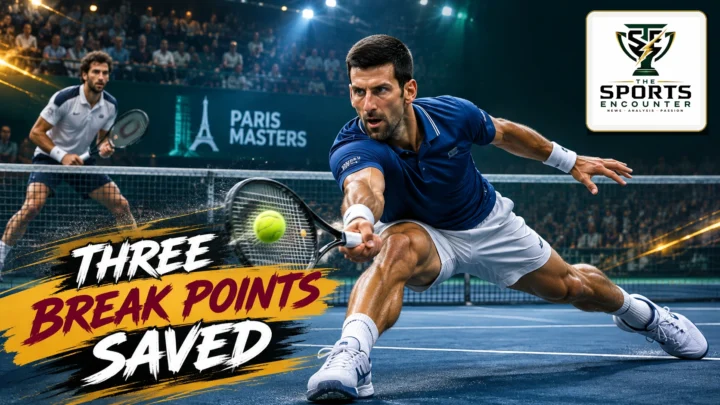
Djokovic’s Paris Comeback: Three Saved Break Points Keep Turin Hopes Alive
Novak Djokovic returned to the Paris Masters for the first time since winning his seventh title in 2023. His opening opponent was hardly an inviting prospect.
Casper Ruud Defeats Rafael Jodar and Sends Flavio Cobolli to Turin
Casper Ruud’s 6-3, 6-4 victory over ninth seed Rafael Jodar lasted just one hour and 18 minutes, but its consequences extended beyond the two players.
Ben Shelton Reaches the Round of 16 With Victory Over Cameron Norrie
Ben Shelton continued his strong season with a 6-3, 6-4 victory over Cameron Norrie, completing the match in one hour and 11 minutes.
Matteo Berrettini Saves Two Match Points Against Brandon Nakashima
Matteo Berrettini’s 6-4, 3-6, 7-6(8) victory over 14th seed Brandon Nakashima was among the most dramatic results of the session.
Read next Alcaraz Predicts a Three-Way Battle for ATP 2027 Title Alongside Zverev and Shelton
| Winner | Opponent | Final Score | Round |
|---|---|---|---|
| Novak Djokovic | Valentin Vacherot | 6-7(5), 7-5, 6-1 | First |
| Ben Shelton | Cameron Norrie | 6-3, 6-4 | Second |
| Casper Ruud | Rafael Jodar | 6-3, 6-4 | Second |
| Taylor Fritz | Benjamin Bonzi | 3-6, 6-3, 6-4 | First |
| Tommy Paul | Holger Rune | 7-5, 6-4 | First |
| Alex Michelsen | Jiri Lehecka | 6-7(5), 6-2, 6-4 | First |
| Matteo Berrettini | Brandon Nakashima | 6-4, 3-6, 7-6(8) | First |
| Tomas Martin Etcheverry | Andrey Rublev | 6-4, 6-7(4), 7-6(3) | First |
| Learner Tien | Adolfo Daniel Vallejo | 6-3, 5-7, 7-5 | First |
The completed scores and round classifications are recorded in the official Paris Masters results center.
The results reveal a distinction that is easily missed in a conventional roundup. Seven players were still trying to reach the last 16 after Tuesday’s victories. Shelton and Ruud had already arrived there.
Djokovic’s Paris Comeback: Three Saved Break Points Keep Turin Hopes Alive
Novak Djokovic returned to the Paris Masters for the first time since winning his seventh title in 2023. His opening opponent was hardly an inviting prospect.
Valentin Vacherot had beaten Djokovic in the 2025 Shanghai Masters semifinals and arrived in Nanterre after winning the Basel title.
The 39-year-old Serbian therefore faced an opponent with recent evidence that he could defeat him, rather than an unfamiliar challenger hoping for an unlikely breakthrough.
Vacherot Wins the Opening Set Despite Djokovic’s Escape
Neither player dropped serve in the first set, although Djokovic needed to save three consecutive set points in the 12th game.
He forced a tiebreak and reached 5-4 with two service points available. Vacherot recovered, took the remaining points and secured the opener 7-6(5).
Djokovic was then broken early in the second set, creating an even more uncomfortable position for the seven-time champion.
Vacherot’s serving was a major obstacle. The Monegasque finished with 22 aces, repeatedly denying Djokovic opportunities to establish his preferred returning rhythm.
Why the Second Set Turned at 4-4
The most important passage came when Djokovic served at 4-4 in the second set.
Already trailing by a set, he faced three break points. Losing that game would have allowed Vacherot to serve for the match.
Djokovic saved all three opportunities, survived the game and eventually broke Vacherot at 6-5 to take the second set.
That sequence transformed the match. Vacherot had been within reach of another victory over Djokovic, but the Serbian’s resistance kept him alive long enough to turn defensive survival into attacking control.
The deciding set was far less competitive. Djokovic broke twice and won it 6-1, completing victory after two hours and 35 minutes.
He became the oldest player to win a match at the Paris Masters, extending a tournament record that already includes seven singles titles.
The match also required physical resilience. Djokovic received treatment for a shoulder problem, while Vacherot required attention for an ankle issue. Neither incident justifies a prediction about future availability without further medical information.
Our detailed analysis of Djokovic’s comeback against Vacherot examines the saved break points, historical implications and the challenge awaiting him in Turin qualification.
Why Is Djokovic Still Fighting for ATP Finals Qualification?
Djokovic entered Paris outside the automatic qualification positions. His victory over Vacherot kept him in contention but did not secure a place at the season-ending tournament.
Qualification depends on his remaining results and those of other contenders. A deep Paris run could strengthen his position, but progression through the first round alone is insufficient.
His immediate opponent is Australian qualifier Rinky Hijikata.
The wider question is whether Djokovic can sustain the demanding physical performances required to progress through consecutive matches. Our assessment of Djokovic’s pursuit of a 25th Grand Slam title explores that challenge in the context of his 2026 season.
Casper Ruud Defeats Rafael Jodar and Sends Flavio Cobolli to Turin
Casper Ruud’s 6-3, 6-4 victory over ninth seed Rafael Jodar lasted just one hour and 18 minutes, but its consequences extended beyond the two players.
Ruud controlled the contest against the rising Spaniard, closing the first set with a love service game and finishing the second with an ace.
It was an important victory for the former world No. 2, who had suffered a frustrating defeat to Nuno Borges in Basel the previous week.
Yet the most immediate beneficiary was another player entirely.
How Did Ruud’s Victory Qualify Cobolli for the ATP Finals?
Ruud’s defeat of Jodar removed a result that could have threatened Flavio Cobolli’s position in the ATP Race to Turin.
The Paris Masters confirmed after the match that Cobolli, then sixth in the Race, was guaranteed an ATP Finals berth.
That is the central qualification consequence of Tuesday’s second-round results.
Ruud advanced to the Paris round of 16. Cobolli secured a separate place in Turin. Jodar’s elimination ended his opportunity to collect further points at this tournament.
The qualification development is documented in the Paris Masters’ official report on Ruud and Shelton.
Ruud’s success also represented a reversal of his recent Basel experience. He had recovered from a set down against Dominic Stricker before losing to Borges after winning the opening set.
Those changing fortunes were examined in our Basel report on Djokovic, Borges and Ruud.
What Changed From Basel to Paris for Ruud?
The key contrast lies in match control.
Against Borges in Basel, Ruud won the first set 6-1 but lost the next two sets 3-6, 4-6. He had established an overwhelming early advantage without converting it into victory.
Against Jodar in Paris, he maintained his superiority throughout both sets.
| Ruud’s Match | First Set | Second Set | Third Set | Outcome |
|---|---|---|---|---|
| vs. Borges, Basel | 6-1 | 3-6 | 4-6 | Lost |
| vs. Jodar, Paris | 6-3 | 6-4 | Not required | Won |
Ruud won more total games than Borges in Basel only in the opening set, and the players finished level at 13 games apiece across that match. Against Jodar, Ruud won 12 games to seven.
The comparison does not prove a permanent improvement in Ruud’s form, but it illustrates why preserving control across sets matters more than producing one dominant stretch.
His earlier Basel recovery against Stricker was covered in our report on Rune’s return and Ruud’s opening-round victory.
Ben Shelton Reaches the Round of 16 With Victory Over Cameron Norrie
Ben Shelton continued his strong season with a 6-3, 6-4 victory over Cameron Norrie, completing the match in one hour and 11 minutes.
The American third seed broke for a 3-1 advantage in the opening set and protected that lead.
Norrie responded in the second set and drew level at 4-4, but Shelton immediately recovered control, breaking again before closing out the match.
His victory placed him alongside Ruud as the first two players to qualify for the round of 16.
Shelton has already qualified for the ATP Finals, which changes the immediate stakes of his remaining Paris matches. Unlike Djokovic, Fritz and Paul, he does not need a late qualification rescue.
His objective is to advance deeper into the Masters draw and strengthen his position ahead of Turin.
Matteo Berrettini Saves Two Match Points Against Brandon Nakashima
Matteo Berrettini’s 6-4, 3-6, 7-6(8) victory over 14th seed Brandon Nakashima was among the most dramatic results of the session.
The Italian won the opening set before Nakashima fought back to force a decider.
Neither player established the decisive advantage before the third-set tiebreak.
Berrettini then faced two match points but survived both, eventually winning the breaker 10-8.
That completed his first career match victory at the Paris Masters and gave him at least one match win at all nine ATP Masters 1000 events.
His next opponent is France’s Ugo Humbert.
The result presents an immediate recovery challenge. Berrettini must prepare for another indoor match after surviving a contest decided by the narrowest of margins.
Taylor Fritz Recovers Against Benjamin Bonzi to Keep His Season Alive
Taylor Fritz had a difficult beginning against French qualifier Benjamin Bonzi, who moved ahead 4-1 in the opening set before taking it 6-3.
The American 11th seed responded by winning the second set 6-3 and the decider 6-4, completing his recovery in one hour and 41 minutes.
The victory maintained Fritz’s chance of collecting valuable ranking points in the final Masters 1000 event of the year.
He now faces Slovak qualifier Alex Molcan.
For Fritz, the significance extends beyond another tournament victory. Every remaining match contributes to the final shape of the qualification race, particularly with several rivals still competing in Paris.
Tommy Paul Ends Holger Rune’s Campaign After Emotional Basel Return
Tommy Paul defeated Holger Rune 7-5, 6-4 in a first-round encounter lasting approximately 80 minutes.
Paul secured the opening set on his fourth set point. He then established a two-break advantage in the second set, although he initially failed to serve out the contest.
The American eventually converted his fifth match point to complete the victory.
For Rune, the result interrupted a comeback that had gained momentum in Basel, where he secured his first tour-level victory in 373 days.
Paul’s next opponent is Daniel Merida.
The American remains among the players competing for the remaining ATP Finals places. However, his qualification depends on a sufficiently deep run and results elsewhere in the draw.
Alex Michelsen Recovers Against Jiri Lehecka and Earns Carlos Alcaraz Test
Alex Michelsen recovered from losing the first-set tiebreak to defeat Jiri Lehecka 6-7(5), 6-2, 6-4 in two hours and 17 minutes.
The Czech player won the opening set, but Michelsen responded by taking the second 6-2.
Lehecka failed to convert a break-point opportunity in the second set and did not create one in the decider.
Michelsen closed the match with an ace, earning a second-round meeting against Carlos Alcaraz.
That encounter provides one of the most interesting next-round tests among Tuesday’s winners.
Alcaraz arrives after winning the Vienna Open and is the second seed in Paris. Michelsen has demonstrated his ability to recover from a setback, but facing Alcaraz will require another level of consistency.
Our Paris Masters preview examining Alcaraz, Zverev and Musetti outlines the tournament’s leading contenders and the significance of their early-round matchups.
Tomas Martin Etcheverry Eliminates Andrey Rublev in Deciding Tiebreak
Tomas Martin Etcheverry secured an important first-round victory over Andrey Rublev, winning 6-4, 6-7(4), 7-6(3).
The Argentine took the opening set before Rublev recovered in the second-set tiebreak.
Neither player managed to settle the final set before another breaker became necessary.
Etcheverry won that tiebreak 7-3, eliminating Rublev and advancing to face eighth seed Alex de Minaur.
The result was another example of how small differences in deciding moments can outweigh the broader competitiveness of a match.
Etcheverry now faces a considerably different tactical challenge against De Minaur, whose court coverage and defensive consistency can extend rallies and test an opponent’s patience.
Learner Tien Survives Vallejo’s Comeback to Advance
Learner Tien defeated Adolfo Daniel Vallejo 6-3, 5-7, 7-5 after the Paraguayan recovered from losing the opening set.
Tien began strongly but could not close the contest in straight sets.
Vallejo took the second set 7-5, forcing a decider in which neither player established a comfortable lead.
The American eventually won the final set by the same scoreline, earning a meeting with French wildcard Luca Van Assche.
Tien’s victory completed a strong selection of results for American players, with Shelton, Fritz, Paul and Michelsen also advancing.
The Sports Encounter Data Discovery: Why Six Three-Set Matches Tell a Different Story
Six of the nine featured encounters required a deciding set, but the paths to victory differed substantially.
Djokovic, Fritz and Michelsen recovered after losing the opening set. Berrettini, Etcheverry and Tien won their opening sets, lost the second and recovered in the decider.
These are different types of resistance, and the distinction becomes clearer when their results are examined together.
| Winner | Opening Set | Deciding Set | Type of Recovery |
|---|---|---|---|
| Djokovic | Lost 6-7(5) | Won 6-1 | Recovered from opening-set deficit |
| Fritz | Lost 3-6 | Won 6-4 | Recovered from opening-set deficit |
| Michelsen | Lost 6-7(5) | Won 6-4 | Recovered from opening-set deficit |
| Berrettini | Won 6-4 | Won 7-6(8) | Recovered after losing second set |
| Etcheverry | Won 6-4 | Won 7-6(3) | Recovered after losing second set |
| Tien | Won 6-3 | Won 7-5 | Recovered after losing second set |
The Sports Encounter’s statistical finding: Across the nine selected results, 66.7% of matches went to three sets, and exactly half of those three-set victories were achieved by players who lost the opener.
The calculation uses six three-set matches divided by nine total matches. Three of the six winners recovered from an opening-set deficit.
Those percentages describe the selected matches only. They are not presented as tournament-wide statistics.
The results also featured two deciding-set tiebreaks, won by Berrettini and Etcheverry.
What Changed in the ATP Finals Race After November 3?
Tuesday’s results affected the qualification picture in different ways.
The clearest confirmed development was Cobolli securing his place in Turin following Jodar’s elimination.
Djokovic, Fritz and Paul remained in contention but still needed further results. Shelton had already qualified and could focus on his Paris campaign.
| Player | November 3 Development | ATP Finals Consequence |
|---|---|---|
| Flavio Cobolli | Jodar eliminated by Ruud | Qualification secured |
| Novak Djokovic | Defeated Vacherot | Qualification hopes remain alive |
| Taylor Fritz | Defeated Bonzi | Remains in contention |
| Tommy Paul | Defeated Rune | Remains in contention |
| Ben Shelton | Defeated Norrie | Already qualified |
| Rafael Jodar | Lost to Ruud | Cannot gain further Paris points |
Three qualification places remained unclaimed according to the tournament’s post-match report on November 3. Those available places should not be confused with the number of players still mathematically eligible to qualify.
The distinction is especially important with several contenders competing in the same tournament. One player’s progress can change another player’s position without those two players meeting directly.
Earlier developments in the qualification race were covered in our report on Daniil Medvedev’s ATP Finals qualification.
Paris Masters Draw: Who Plays Next and What Is at Stake?
The confirmed second-round opponents are more useful than speculative predictions about the eventual champion.
Continue the Tennis Story
 TennisDjokovic Saves Three Break Points, Makes Paris Masters History at 39 and Keeps Turin Dream Alive
 TennisCarlos Alcaraz Returns to Paris as Musetti Survives Tiebreak Thriller to Challenge World No. 1 Zverev
 TennisHas Novak Djokovic Still Got It? The Battle for Grand Slam No. 25 Against Tennis’s New Generation
They establish each first-round winner’s immediate route forward while distinguishing confirmed fixtures from possible later matchups.
| Player | Confirmed Next Match or Status | Consequence |
|---|---|---|
| Djokovic | Rinky Hijikata | Must win to reach round of 16 |
| Fritz | Alex Molcan | Must win to reach round of 16 |
| Paul | Daniel Merida | Must win to reach round of 16 |
| Michelsen | Carlos Alcaraz | Must win to reach round of 16 |
| Berrettini | Ugo Humbert | Must win to reach round of 16 |
| Etcheverry | Alex de Minaur | Must win to reach round of 16 |
| Tien | Luca Van Assche | Must win to reach round of 16 |
| Shelton | Round of 16, opponent pending | Already advanced |
| Ruud | Round of 16, opponent pending | Already advanced |
The fixtures reflect the officially confirmed draw and November 3 results. Later opponents depend on the outcomes of matches still to be played.
Could Djokovic Face a Leading Seed Later in Paris?
Djokovic’s immediate challenge is Hijikata. Any subsequent meeting depends on the progression of the other players in his section of the draw.
It would be premature to describe a later marquee matchup as guaranteed before the relevant earlier rounds are completed.
The same principle applies to Michelsen’s meeting with Alcaraz. The American must defeat the second seed before any possible later opponent becomes relevant.
The tournament’s draw contains several major contenders, including new world No. 1 Alexander Zverev.
Zverev’s ascent is examined in our report on the German’s rise to the top of the ATP rankings.
Why the Paris Masters Is Testing the Leading Contenders Before Turin
Paris occupies a particularly demanding position in the tennis calendar.
It is the final Masters 1000 event of the year, with the ATP Finals scheduled to begin in Turin on November 15.
Players still seeking qualification have little opportunity to recover from an early defeat.
Those already qualified face a different challenge: advancing far enough to maintain momentum without compromising their physical preparation for the season-ending championship.
Djokovic’s match showed how demanding that balance can become. He needed three sets, faced significant break-point pressure and received treatment during the contest.
Berrettini survived a deciding-set tiebreak after saving match points. Etcheverry also needed a final-set breaker, while Fritz, Michelsen and Tien had to complete three-set victories.
With several difficult second-round matches ahead, Tuesday’s extended contests could become relevant to the physical preparation of the players involved.
However, match duration alone cannot establish injury risk or predict future performance.
The Sports Encounter Verdict: Survival in Paris Is Already Changing Turin
Djokovic’s victory supplied the day’s most compelling individual story. His record, age and history against Vacherot made the comeback an absorbing contest, with three saved break points at 4-4 in the second set proving decisive.
Yet Ruud’s defeat of Jodar had the most immediate effect beyond the Paris draw.
It confirmed Cobolli’s ATP Finals qualification and reduced the number of remaining places available in Turin.
Shelton continued his progress without a qualification burden, while Fritz and Paul extended their opportunities to collect essential points.
Berrettini’s survival and Etcheverry’s upset were reminders that favorable rankings and previous success provide little protection when matches reach deciding tiebreaks.
For Djokovic, the next requirement is straightforward: defeat Hijikata and continue advancing.
For the broader ATP Finals race, the situation is more complicated. Each surviving contender must consider the results of other players as well as his own progression.
Paris has already demonstrated how quickly the qualification picture can change.
The next round will determine which contenders remain capable of changing it further.
Paris Masters 2026: Frequently Asked Questions
Who Won Djokovic vs. Vacherot at the Paris Masters?
Novak Djokovic defeated Valentin Vacherot 6-7(5), 7-5, 6-1 on November 3, 2026.
What Was the Turning Point in Djokovic’s Victory?
Djokovic saved three break points while serving at 4-4 in the second set. He later broke Vacherot at 6-5 and dominated the deciding set.
Who Did Casper Ruud Defeat?
Ruud defeated ninth seed Rafael Jodar 6-3, 6-4 in the second round.
Why Did Flavio Cobolli Qualify for the ATP Finals?
Jodar’s defeat to Ruud eliminated a qualification threat, mathematically securing Cobolli’s place in Turin according to the official tournament report.
Did Ben Shelton Reach the Round of 16?
Yes. Shelton defeated Cameron Norrie 6-3, 6-4 to advance to the last 16.
Did Matteo Berrettini Save Match Points?
Yes. Berrettini saved two match points before defeating Brandon Nakashima 6-4, 3-6, 7-6(8).
Who Eliminated Andrey Rublev?
Tomas Martin Etcheverry defeated Rublev 6-4, 6-7(4), 7-6(3).
Who Will Alex Michelsen Play Next?
Michelsen is scheduled to face second seed Carlos Alcaraz in the second round.
Where Is the Paris Masters Taking Place?
The 2026 tournament is being held at the Plenitude Arena in Nanterre, France.
When Does the ATP Finals Begin?
The 2026 ATP Finals are scheduled for November 15-22 in Turin, Italy.
For continuing coverage, readers can explore The Sports Encounter’s tennis hub and the latest reports in our tennis news section.