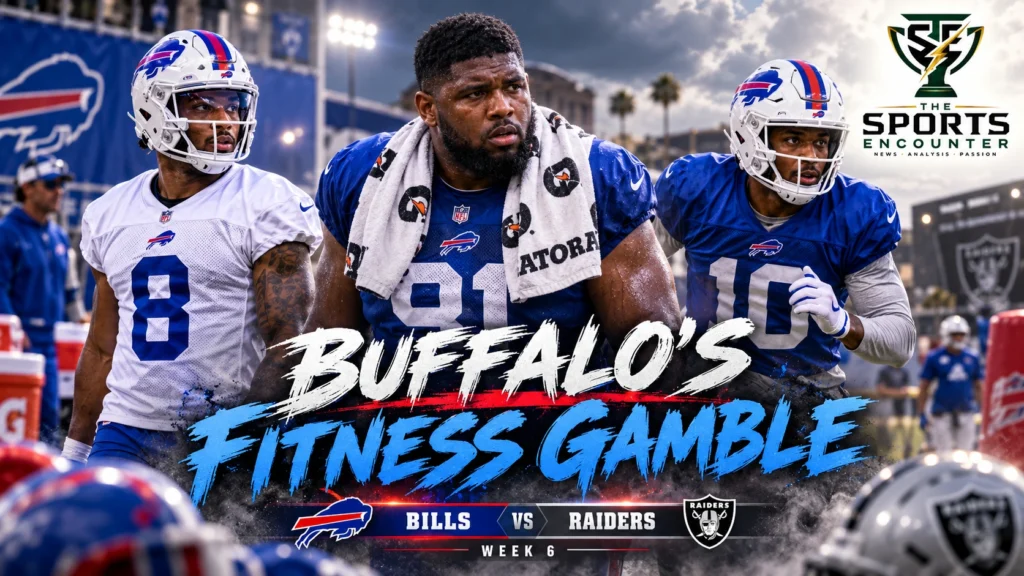
IRVINE, United States, October 15, 2026: The Buffalo Bills are facing another difficult injury decision before Sunday’s road game against the Las Vegas Raiders, with wide receiver DJ Moore and defensive tackle Ed Oliver still unable to resume normal practice activity and Joshua Palmer working through a separate shoulder problem. Thursday’s practice account from UC Irvine described Moore and Oliver as sidelined while Palmer participated in a red non-contact jersey. Buffalo’s officially accessible Wednesday injury report had already listed Moore and Oliver as non-participants and Palmer as limited, leaving head coach Joe Brady with three important availability questions before the Bills enter their Week 7 bye.
The timing is particularly uncomfortable. Buffalo survived a 37-34 overtime thriller against the Los Angeles Rams on Monday, improving to 4-1 despite playing without Moore, Oliver and Palmer. The Bills now face a Raiders team that has lost two consecutive games but possesses attacking weapons capable of exposing Buffalo’s defensive vulnerabilities. With another recovery week available after Sunday’s contest, the coaching staff must decide whether the immediate benefits of returning injured players outweigh the risk of delaying their full recovery.
Buffalo Bills Injury Report: Moore, Oliver and Palmer Remain the Biggest Questions
The official Raiders-Bills Week 6 injury report identifies Moore’s shoulder injury, Oliver’s knee problem and Palmer’s shoulder issue among Buffalo’s principal concerns.
The Bills conducted a walkthrough on Wednesday after their physically demanding overtime victory in Los Angeles.
Story at a glance
Buffalo Bills Injury Report: Moore, Oliver and Palmer Remain the Biggest Questions
The official Raiders-Bills Week 6 injury report identifies Moore’s shoulder injury, Oliver’s knee problem and Palmer’s shoulder issue among Buffalo’s principal concerns.
DJ Moore’s Shoulder Creates Another Problem for Josh Allen’s Passing Attack
Moore’s recovery remains one of Buffalo’s most significant offensive concerns.
Joshua Palmer’s Limited Work Offers Buffalo a More Encouraging Signal
Palmer’s situation is different from Moore’s, although both receivers are dealing with shoulder injuries.
Can Keon Coleman and Khalil Shakir Carry the Receiving Load?
Buffalo has already demonstrated that its offense can function without Moore and Palmer.
Ed Oliver’s Knee Injury Leaves Buffalo’s Defense With Another Difficult Decision
Oliver’s continued absence represents a different problem.
That distinction matters because Wednesday’s participation classifications were estimates of what players could have completed in a normal practice rather than measurements of a full training session.
Thursday’s account provided a further indication that Buffalo was continuing to manage the three players cautiously.
| Player | Position | Injury | Official Wednesday Status | Thursday Development Reported |
|---|---|---|---|---|
| DJ Moore | Wide receiver | Shoulder | Did not participate | Remained off to the side |
| Ed Oliver | Defensive tackle | Knee | Did not participate | Continued recovery away from normal drills |
| Joshua Palmer | Wide receiver | Shoulder | Limited participation | Reportedly wore a red non-contact jersey |
| Spencer Brown | Offensive tackle | Back | Limited participation | Further assessment required |
| Dee Alford | Cornerback | Ankle | Limited participation | Availability remains under evaluation |
| T.J. Sanders | Defensive lineman | Shoulder | Limited participation | Additional practice evaluation required |
Wednesday classifications are from the official team injury report. Thursday developments reflect the reported practice observations; the complete official Thursday participation table was not independently confirmed at the time of this report. A practice absence is not equivalent to a final game designation.
DJ Moore’s Shoulder Creates Another Problem for Josh Allen’s Passing Attack
Moore’s recovery remains one of Buffalo’s most significant offensive concerns.
The receiver has been managing a shoulder injury sustained earlier in the season and aggravated again during the Week 4 defeat against New England.
The injury has been described in reporting as an aggravated acromioclavicular joint sprain, commonly called an AC joint sprain, although Buffalo’s public injury reports identify the condition more generally as a shoulder problem.
The available information does not establish the precise severity of the latest aggravation or a confirmed return date.
Moore was listed as questionable before Monday’s game against the Rams but ultimately did not play.
His continued restrictions leave Buffalo uncertain about the availability of a receiver acquired to strengthen its passing game.
Why Moore’s Absence Matters Beyond His Receiving Statistics
Moore joined Buffalo from the Chicago Bears during the offseason.
His arrival was part of an effort to provide Josh Allen with another experienced receiver capable of challenging defenders at different levels of the field.
The trade also changed Chicago’s offensive depth chart, creating additional opportunities for younger receivers.
The Sports Encounter’s examination of DJ Moore’s departure from Chicago explored how Luther Burden’s responsibilities were expected to increase following the trade.
For Buffalo, Moore’s value extends beyond his individual receiving totals.
An experienced receiver can influence defensive coverage even without being targeted on every play.
Defenders must account for his routes, creating potential space for teammates operating elsewhere in the formation.
Without Moore, opponents may be able to redistribute their coverage responsibilities toward Buffalo’s remaining weapons.
That possibility becomes more important when another established receiver is also dealing with an injury.
Moore’s Early Season Has Already Been Interrupted
Before the latest absence, Moore had recorded 12 receptions for 178 yards and one touchdown during the 2026 season.
His production has been limited by the recurring shoulder problem.
However, the numbers alone do not establish how much the injury has affected his performance when available.
What is confirmed is that his availability has become inconsistent.
He missed Buffalo’s overtime victory against the Rams and has not yet demonstrated a complete return to unrestricted practice.
The Bills must now determine whether he is sufficiently recovered to contribute against Las Vegas or whether additional time away from contact is preferable.
Joshua Palmer’s Limited Work Offers Buffalo a More Encouraging Signal
Palmer’s situation is different from Moore’s, although both receivers are dealing with shoulder injuries.
Palmer suffered his problem during a practice session before the Rams game.
Brady subsequently ruled him out of Monday’s contest while the team continued evaluating the injury.
The receiver was listed as limited on Wednesday’s estimated injury report.
Thursday’s account described him participating in a red non-contact jersey.
If confirmed by the subsequent official participation reports, that would represent a useful step toward a normal practice workload.
However, non-contact activity does not establish that a player has been cleared for the physical demands of an NFL game.
Palmer’s status remains dependent on further evaluation.
Buffalo Has Already Seen What Palmer Can Add
Palmer provided one of Buffalo’s most explosive plays during the team’s Week 2 victory against Detroit.
He caught a 43-yard touchdown pass from Allen as the Bills opened a commanding lead in the first regular-season game at the new Highmark Stadium.
That touchdown demonstrated the vertical threat Buffalo hoped to develop through its receiving group.
TSE’s detailed report on Buffalo’s 41-31 victory over Detroit examined how Palmer, Dalton Kincaid, Dawson Knox and Keon Coleman contributed to Allen’s five-touchdown performance.
Buffalo’s offensive strength has often come from forcing defenses to account for several different types of attacking options.
Palmer’s speed and ability to threaten deeper areas of the field form part of that structure.
If he cannot play against Las Vegas, Brady must find other ways to create comparable opportunities.
Can Keon Coleman and Khalil Shakir Carry the Receiving Load?
Buffalo has already demonstrated that its offense can function without Moore and Palmer.
The Bills scored 37 points against the Rams despite both receivers being unavailable.
However, the circumstances of that victory are important.
Allen generated significant offense with his legs, while James Cook III provided another productive rushing performance.
Buffalo did not depend exclusively on a conventional passing attack.
Coleman, Khalil Shakir, rookie Skyler Bell and the team’s tight ends supplied alternatives.
Keon Coleman’s Growing Responsibility
Coleman has already demonstrated his ability to make important catches in difficult situations.
Against New England in Week 4, he caught six passes for 116 yards and a touchdown.
That performance came during Buffalo’s 29-26 defeat, when Allen repeatedly attempted to bring the Bills back into contention.
Our analysis of Buffalo’s loss to the Patriots examined Coleman’s receiving performance and the late sequence that decided the contest.
Coleman also caught a touchdown against the Rams.
His role could become even more important if Moore and Palmer remain unavailable.
However, increasing one receiver’s target share does not automatically replace everything supplied by two missing teammates.
Buffalo must still create favorable matchups and maintain enough offensive variety to prevent Las Vegas from concentrating its coverage on a small group of players.
Dalton Kincaid and Buffalo’s Tight Ends Provide Another Option
The Bills can also use their tight ends to create opportunities in intermediate areas of the field.
Kincaid’s performances during the opening weeks demonstrated his ability to move the chains and provide Allen with a reliable target.
Buffalo may need to expand that approach if the receiving group remains depleted.
The tactical tradeoff is that heavier use of tight ends can change the personnel available for blocking and pass protection.
Brady will need to determine how best to balance those responsibilities against the Raiders.
Ed Oliver’s Knee Injury Leaves Buffalo’s Defense With Another Difficult Decision
Oliver’s continued absence represents a different problem.
The defensive tackle injured his knee during Buffalo’s Week 4 defeat against New England.
He subsequently missed the Rams game and remained listed as a non-participant in Wednesday’s injury report.
Thursday’s practice update indicates the Bills were still managing his recovery cautiously.
There has been no publicly established timetable guaranteeing his return against Las Vegas.
Oliver has recorded nine tackles, one fumble recovery and half a sack during his appearances this season.
Those statistics capture part of his contribution but do not fully describe his importance to Buffalo’s defensive structure.
Why Losing Oliver Can Affect the Entire Defensive Front
Interior defensive linemen influence both the running game and passing situations.
They must occupy blockers, disrupt offensive-line movement and create pressure through the middle of the formation.
Effective interior pressure can prevent quarterbacks from stepping forward to avoid edge rushers.
It can also affect the timing of running plays before ball carriers reach the second level.
Oliver’s absence therefore places greater responsibility on Buffalo’s other defensive linemen.
That includes Deone Walker, Greg Rousseau and the surrounding defensive rotation.
Buffalo will need those players to compensate through disciplined positioning, pressure and coordinated assignments.
The Rams Game Showed Both the Strength and Vulnerability of Buffalo’s Defense
Buffalo allowed 34 points to Los Angeles on Monday.
Matthew Stafford threw for 383 yards and three touchdowns.
Puka Nacua caught 17 passes for 138 yards and a touchdown.
Those figures reveal how difficult the night became for Buffalo’s pass defense.
However, the Bills also delivered the decisive defensive play in overtime.
Rousseau blocked a field-goal attempt, giving Buffalo the opportunity to complete the winning possession.
Tyler Bass eventually converted a 45-yard field goal to secure the 37-34 victory.
The result demonstrated how a defense can struggle for extended periods yet still influence a game through a decisive play.
It also showed why Buffalo cannot rely on one late intervention to compensate for persistent defensive problems.
Jim Leonhard’s Defense Has Allowed Too Many Explosive Performances
Defensive coordinator Jim Leonhard entered the season with the responsibility of improving Buffalo’s reliability against dangerous offenses.
The first five games have provided uneven results.
The Bills have conceded at least 29 points in four of those contests.
They have also allowed opposing receivers and quarterbacks to produce substantial offensive numbers.
That trend matters because Buffalo’s championship ambitions depend on more than Allen’s ability to rescue high-scoring games.
TSE’s Week 5 NFL power rankings identified Buffalo’s defensive inconsistency as a concern despite the team’s strong early record.
The Rams game reinforced that assessment.
Buffalo won, but it required overtime, an important blocked kick and another major individual performance from Allen.
Oliver returning would give the defense an important additional option.
However, his availability alone cannot resolve every problem in the secondary or eliminate the need for better communication and tackling.
Raiders vs Bills: Why Brock Bowers Could Exploit Buffalo’s Defensive Problems
Las Vegas enters Sunday’s contest with a 3-2 record after losing to Kansas City and New England.
The Raiders suffered a 45-17 defeat against the Patriots in Week 5.
However, tight end Brock Bowers remained productive.
He caught eight passes for 110 yards and a touchdown.
That performance demonstrates why Buffalo must take the Raiders’ passing game seriously despite the team’s recent defeats.
Bowers is capable of creating difficult coverage assignments because of his ability to operate across different areas of the field.
He can attack intermediate zones, exploit mismatches against linebackers and challenge defensive backs after the catch.
Buffalo’s recent problems containing productive receivers make the matchup especially relevant.
Las Vegas Could Use Multiple Tight Ends to Stress Buffalo’s Coverage
Michael Mayer provides another receiving option for the Raiders.
Las Vegas may attempt to involve both Mayer and Bowers more extensively following the defeat against New England.
That would create additional decisions for Buffalo’s linebackers and safeties.
Defenders must account for the possibility of runs while remaining prepared for passes into intermediate areas.
If Buffalo commits too many resources toward the line of scrimmage, it could leave opportunities behind the linebackers.
If the defense prioritizes coverage, Las Vegas may attempt to establish its running game.
That is where Oliver’s absence could become especially relevant.
Kirk Cousins and Ashton Jeanty Give the Raiders Two Ways to Attack
Veteran quarterback Kirk Cousins remains central to Las Vegas’ offensive plans.
The Raiders selected Fernando Mendoza with the first overall pick in the 2026 NFL Draft but chose to begin the season with Cousins as their starter.
TSE’s analysis of the Raiders’ quarterback decision explained why the franchise initially favored veteran experience while allowing Mendoza more time to develop.
Cousins has experienced mixed results through the opening weeks.
Against Buffalo, his ability to recognize coverage and deliver the ball quickly could become important if the Raiders struggle to protect him.
Las Vegas also has an important rushing weapon in Ashton Jeanty.
Jeanty began the season with 102 rushing yards and two receiving touchdowns in the Raiders’ 27-13 victory over Miami.
Our complete analysis of NFL Week 1 examined how Jeanty’s versatility helped Las Vegas control possession and generate offense.
His ability to contribute as both a runner and receiver creates another assignment for Buffalo’s defense.
Whether the Raiders can exploit those options will depend partly on their offensive-line performance.
Buffalo’s Pass Rush Still Has a Potential Advantage
Even without Oliver, the Bills possess defenders capable of creating significant pressure.
Rousseau has been particularly productive during the opening weeks.
Deone Walker has also emerged as an important interior presence.
Las Vegas’ offensive line has experienced difficulties in pass protection, creating opportunities for opponents to disrupt Cousins before longer-developing routes become available.
That gives Buffalo a possible defensive advantage.
However, the Bills must convert pressure into effective coverage and prevent Cousins from finding quick passing options.
Generating pressure is useful only when the rest of the defense responds appropriately.
The Week 7 Bye Changes How Buffalo Can Manage Its Injuries
The most consequential scheduling detail is that Buffalo has a bye immediately after Sunday’s game.
The Bills will not play in Week 7.
That creates an additional recovery period before their next scheduled contest.
For Moore, Oliver and Palmer, the timing introduces a legitimate strategic question.
Would returning for one game provide enough competitive value to justify the physical demands, or would additional recovery offer a better chance of sustained availability afterward?
The answer depends on the injury, the individual player’s progress and the team’s medical assessment.
No publicly available information establishes that all three players will be treated the same way.
Resting a Player Does Not Guarantee a Faster Recovery
It would be misleading to assume that missing the Raiders game automatically guarantees full health after the bye.
Different injuries recover at different rates, and individual progress cannot be determined solely from a team’s practice report.
The Bills will need to evaluate each player separately.
Moore’s recurring shoulder problem may require a different workload plan from Palmer’s more recent practice injury.
Oliver’s knee recovery involves different physical demands from those faced by a wide receiver.
The appropriate return timeline remains a medical and team decision.
The available reporting establishes that Buffalo has additional recovery time approaching, not that any particular player will definitely be ready afterward.
Joe Brady Has Already Had to Adjust to Injury Disruption
Brady entered his first season as head coach with substantial expectations.
Continue the NFL Story

Buffalo had promoted him after several seasons in which strong regular-season performances failed to produce a Super Bowl appearance.
TSE’s 2026 NFL championship outlook identified his promotion as one of the major coaching decisions capable of reshaping the AFC.
Five games into the season, Buffalo is 4-1.
The record is encouraging.
However, maintaining that success while managing injuries on both sides of the ball creates a more complicated challenge.
The immediate objective is beating Las Vegas.
The larger objective is preserving enough roster strength for the difficult schedule that follows the bye.
What Other Injuries Could Affect Buffalo’s Week 6 Lineup?
Moore, Oliver and Palmer are not the only players on Buffalo’s injury report.
Starting offensive tackle Spencer Brown was listed as limited on Wednesday because of a back problem.
Cornerback Dee Alford was limited with an ankle injury.
Running back Ty Johnson was also limited because of a hamstring issue.
Defensive lineman T.J. Sanders appeared on the report with a shoulder injury.
By contrast, several players were listed as full participants, including Keon Coleman, Terrel Bernard, Christian Benford, Bradley Chubb and Landon Jackson.
Those classifications are useful indicators, but they do not substitute for the final injury designations.
Roster management has been a recurring NFL theme throughout the 2026 season.
TSE’s preseason injury and roster analysis examined how teams were already adjusting personnel plans before the opening games.
Buffalo’s current situation demonstrates how those decisions continue affecting teams once the regular season begins.
Raiders vs Bills: The Matchups That Could Decide Sunday’s Game
| Matchup | Key Question | Potential Consequence |
|---|---|---|
| Josh Allen vs Raiders secondary | Can Buffalo create enough separation without Moore and possibly Palmer? | May influence passing efficiency and offensive balance |
| Brock Bowers vs Bills coverage | Can Buffalo contain Las Vegas’ most productive receiving weapon? | Could determine third-down success and explosive passing plays |
| Ashton Jeanty vs Buffalo defensive front | Can the Bills limit rushing lanes without Oliver? | May influence possession control and play-action opportunities |
| Greg Rousseau and Deone Walker vs Raiders offensive line | Can Buffalo consistently pressure Cousins? | Could prevent extended passing possessions |
| James Cook vs Raiders run defense | Can Buffalo maintain offensive balance? | May reduce dependence on its injured receiving group |
These matchups are tactical possibilities based on the teams’ existing personnel and recent performances, not guarantees of how Sunday’s contest will unfold.
When Do the Buffalo Bills Play the Las Vegas Raiders?
The Bills visit the Raiders on Sunday, October 18, 2026.
Kickoff is scheduled for 4:25 p.m. Eastern Time at Allegiant Stadium in Las Vegas.
CBS is scheduled to broadcast the game.
Buffalo enters at 4-1.
Las Vegas enters at 3-2.
The Bills’ official Week 6 matchup preview examines the team’s defensive concerns and the challenges presented by the Raiders.
Buffalo will release further injury information before the game, with the final designations determining which players are officially ruled out, doubtful or questionable.
What Should Bills Fans Watch Before Sunday’s Kickoff?
Three developments will be especially important.
- DJ Moore’s next participation report: Any return to practice would provide a more useful indication of progress than the earlier estimated walkthrough status.
- Ed Oliver’s medical clearance and game designation: The Bills need to know whether their defensive front will have another established interior contributor available.
- Joshua Palmer’s progression from non-contact work: The critical question is whether he can complete more demanding football activity without a setback.
Buffalo will also need to monitor Spencer Brown’s back and the status of other players who were listed as limited.
These updates will establish whether Brady can approach the Raiders game with a stronger lineup than the one he used against the Rams.
Buffalo’s Bigger Challenge Is Winning Without Compromising the Weeks Ahead
The Bills have already demonstrated that they can win difficult games without several important starters.
The overtime victory against Los Angeles provided clear evidence.
Allen accounted for substantial offensive production.
Cook contributed another strong rushing performance.
Rousseau made one of the game’s decisive defensive plays.
However, Buffalo also conceded 34 points and required overtime to secure the result.
The victory reinforced the team’s resilience while exposing problems that remain unresolved.
Moore and Palmer could help restore offensive variety.
Oliver could strengthen the defensive rotation.
But none of those potential benefits automatically establishes that the players are ready to return.
With the Raiders waiting and a bye week immediately afterward, Buffalo faces a decision that extends beyond one Sunday.
The Bills must determine which players are sufficiently healthy to help them win now while protecting their ability to compete through the remainder of the season.
The final injury report will provide the next concrete answers.
Buffalo Bills Injury Report Week 6: Frequently Asked Questions
Did DJ Moore Practice Before the Raiders Game?
Moore was listed as a non-participant in Buffalo’s Wednesday estimated injury report. Thursday’s practice account described him as remaining off to the side. His final game status had not been confirmed at the time of this report.
What Injury Is DJ Moore Dealing With?
Moore is managing a shoulder injury that has affected his availability during the season. The injury has been described in reporting as an aggravated AC joint sprain, while the team’s public injury reports list it simply as a shoulder injury.
Will Ed Oliver Play Against the Raiders?
Oliver’s availability remains uncertain. He has been recovering from a knee injury suffered in Week 4 and was listed as a non-participant in Wednesday’s estimated practice report.
Is Joshua Palmer Returning From His Shoulder Injury?
Palmer was listed as limited on Wednesday and reportedly participated in non-contact work Thursday. Those developments do not establish that he has been cleared to play Sunday.
Why Are the Bills Practicing at UC Irvine?
Buffalo remained in Southern California after Monday’s game against the Los Angeles Rams to prepare for its second consecutive West Coast road game, against Las Vegas.
When Is the Bills vs Raiders Game?
The teams are scheduled to play Sunday, October 18, 2026, at 4:25 p.m. Eastern Time at Allegiant Stadium in Las Vegas.
When Is Buffalo’s Bye Week?
The Bills have a bye in Week 7, immediately following their game against the Raiders.
What Are the Bills’ and Raiders’ Records?
Buffalo enters Week 6 with a 4-1 record, while Las Vegas stands at 3-2.
What Is the Difference Between Limited Practice and Being Ruled Out?
Limited participation means a player did not complete a full practice workload. A player is ruled out only after receiving that game designation, or otherwise being formally declared unavailable for the contest.