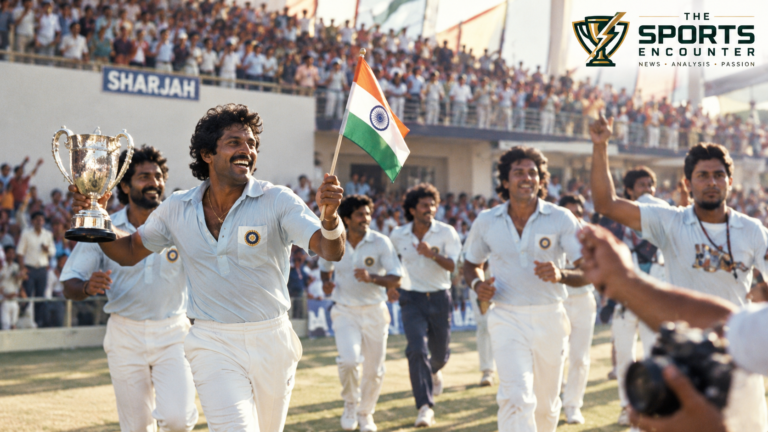
SHARJAH, United Arab Emirates, March 22, 1985: Pakistan needed just 126 runs to defeat India and reach the Rothmans Four-Nations Cup final. Imran Khan had delivered a devastating 6/14, reducing India to 34/5 before the defending world champions were eventually dismissed for 125 in 42.4 overs. With Javed Miandad, Ramiz Raja, Saleem Malik and Imran himself in the batting lineup, Pakistan appeared overwhelmingly favored. Instead, Kapil Dev and India’s bowlers produced an extraordinary reversal, dismissing Pakistan for just 87 in 32.5 overs to claim a stunning 38-run semifinal victory at Sharjah Cricket Stadium.
The result turned Imran’s outstanding individual achievement into one of cricket’s most remarkable losing performances. Mohammad Azharuddin’s painstaking 47 and Kapil’s attacking 30 had earlier prevented India from collapsing completely, but the decisive transformation came after Pakistan lost three wickets for six runs to slump from 35/2 to 41/5. Kapil finished with 3/17, Ravi Shastri conceded only 17 runs from ten overs, and Laxman Sivaramakrishnan removed two crucial batters. Remarkably, Imran still received the official Player of the Match award despite Pakistan’s defeat.
This extraordinary contest is Match 66 in The Sports Encounter’s A Celebration of 5000 ODIs, our special series revisiting 100 of the most memorable One-Day Internationals.
The match deserves its inclusion because it challenged one of cricket’s most persistent assumptions: once a bowling attack has demolished an opponent for 125, the difficult work is finished.
Story at a glance
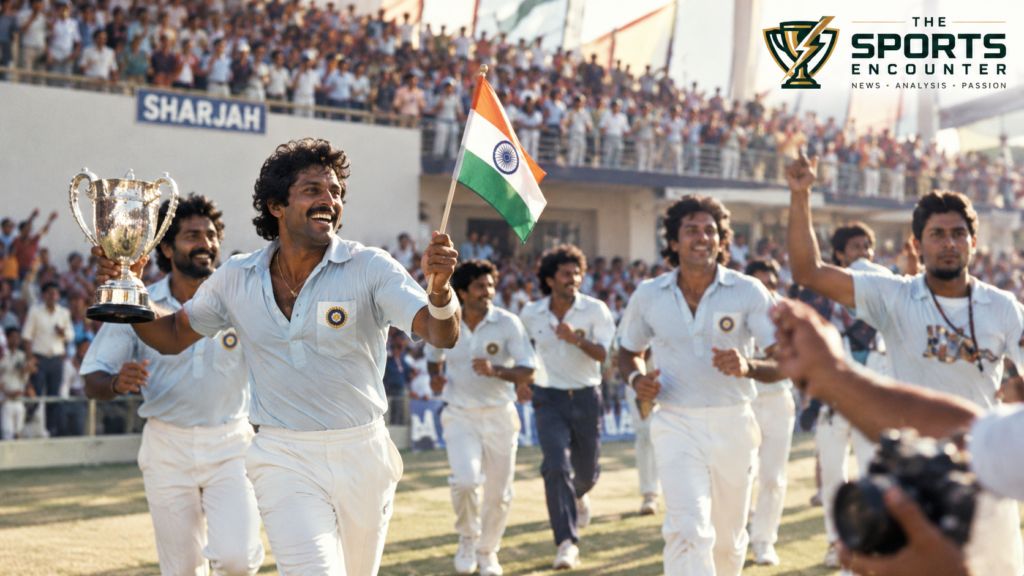
India vs Pakistan 1985 Rothmans Cup: Match Summary
The match unfolded in an era when totals around 200 could still represent competitive ODI cricket, particularly on slower pitches.
Imran Khan’s 6/14: A Bowling Masterclass That Somehow Ends in Defeat
Imran Khan delivered one of the outstanding spells of his ODI career.
Mohammad Azharuddin’s 47 Prevents India’s Innings From Ending at 75
Mohammad Azharuddin produced the innings that gave India a chance to fight back.
Kapil Dev’s 30 Gives India the Runs Pakistan Cannot Chase
Kapil Dev’s batting contribution was equally important.
Tauseef Ahmed’s 2/27 Completes Pakistan’s Bowling Domination
Imran’s six wickets understandably commanded attention, but Pakistan’s supporting bowlers also played important roles.
Pakistan discovered otherwise.
India vs Pakistan 1985 Rothmans Cup: Match Summary
| Match detail | Information |
|---|---|
| Tournament | Rothmans Four-Nations Cup 1984-85 |
| Stage | Semifinal |
| Date | March 22, 1985 |
| Venue | Sharjah Cricket Stadium, UAE |
| Toss | Pakistan won and elected to field |
| India | 125 all out, 42.4 overs |
| Pakistan | 87 all out, 32.5 overs |
| Result | India won by 38 runs |
| Player of the Match | Imran Khan, Pakistan |
| Imran Khan’s bowling | 6/14 in 10 overs |
| India’s top scorer | Mohammad Azharuddin, 47 |
| Pakistan’s top scorer | Ramiz Raja, 29 |
| India’s leading bowler | Kapil Dev, 3/17 |
| Tournament consequence | India qualified for the final |
The match unfolded in an era when totals around 200 could still represent competitive ODI cricket, particularly on slower pitches.
Even by those standards, however, 125 was an extremely modest total.
Pakistan required just 2.52 runs per over across its allotted 50 overs.
India had little room for error.
Imran Khan’s 6/14: A Bowling Masterclass That Somehow Ends in Defeat
Imran Khan delivered one of the outstanding spells of his ODI career.
The Pakistan captain took six wickets for just 14 runs in ten overs, including two maidens.
His economy rate was a remarkable 1.40.
Against an Indian batting order containing Sunil Gavaskar, Kris Srikkanth, Dilip Vengsarkar, Mohinder Amarnath and Mohammad Azharuddin, Imran’s control was exceptional.
He needed only one delivery to remove Ravi Shastri for a duck.
Srikkanth fell for six.
Vengsarkar made one.
Gavaskar scored two.
Amarnath contributed five.
Within the early stages of the innings, India’s experienced batting lineup had been dismantled.
Imran’s first five wickets helped reduce India to 34/5.
He later returned to dismiss Madan Lal for 11 and complete his six-wicket haul.
The performance was extraordinary because Imran combined wicket-taking effectiveness with relentless economy.
India could neither establish partnerships nor score freely against him.
Imran Khan’s Six-Wicket Performance
| Statistic | Figure |
|---|---|
| Overs bowled | 10 |
| Maidens | 2 |
| Runs conceded | 14 |
| Wickets | 6 |
| Economy rate | 1.40 |
| Wickets as a share of India’s innings | 60% |
| Runs per wicket | 2.33 |
| Result | Pakistan lost by 38 runs |
| Official award | Player of the Match |
Imran accounted for 60% of India’s dismissals.
He conceded only 14 runs across one-fifth of India’s possible 50-over innings.
His six victims collectively contributed just 29 runs.
Yet none of those figures guaranteed Pakistan victory.
Imran had performed the task expected of a world-class fast bowler. His batting lineup then failed to capitalize.
Mohammad Azharuddin’s 47 Prevents India’s Innings From Ending at 75
Mohammad Azharuddin produced the innings that gave India a chance to fight back.
He scored 47 from 93 balls, striking three boundaries.
Azharuddin arrived during an exceptionally difficult phase, with Imran repeatedly breaking through India’s batting order.
Once India slipped to 34/5, the immediate objective was survival.
The pitch and Pakistan’s bowling made free scoring difficult, but India could not afford to surrender the remaining wickets without resistance.
Azharuddin responded through disciplined batting and careful strike rotation.
He found important support from captain Kapil Dev, who attacked more aggressively.
Their sixth-wicket partnership added 46 runs.
The stand helped India recover from 34/5 to 80/6.
Although the score remained modest, the partnership made a considerable difference.
Had India lost another wicket immediately after reaching 34, Pakistan might have been chasing fewer than 100.
Azharuddin remained at the crease as the lower order attempted to extend the innings.
He eventually fell to off-spinner Tauseef Ahmed for 47.
India were 121/9.
The innings ended four runs later when Wasim Akram dismissed Laxman Sivaramakrishnan.
Azharuddin had contributed 37.6% of India’s total.
His patient innings was the foundation of a total that eventually proved sufficient.
Kapil Dev’s 30 Gives India the Runs Pakistan Cannot Chase
Kapil Dev’s batting contribution was equally important.
The Indian captain scored 30 from 44 deliveries, striking four boundaries.
His innings arrived when India urgently needed a change in momentum.
Azharuddin had stabilized the batting, but Pakistan’s bowlers continued controlling the scoring rate.
Kapil approached the situation more aggressively.
He attacked opportunities when available and prevented Pakistan from completely dominating the middle overs.
The partnership between Kapil and Azharuddin added 46 runs, taking India to 80/6.
Kapil was eventually bowled by Tauseef Ahmed.
His 30 would later prove crucial to the final result.
India won by 38 runs, which means Kapil’s personal contribution was equivalent to almost 79% of the eventual winning margin.
That comparison does not suggest India would necessarily have lost without him. Cricket innings are not simple exercises in subtracting one player’s runs.
It does illustrate how valuable every scoring contribution became in such a low-total defense.
India’s Batting Rescue
| Performance | Runs | Balls | Importance |
|---|---|---|---|
| Mohammad Azharuddin | 47 | 93 | Anchored the innings |
| Kapil Dev | 30 | 44 | Counterattacked after 34/5 |
| Madan Lal | 11 | 39 | Extended the lower-order resistance |
| Roger Binny | 8 | 19 | Added useful runs |
| Extras | 11 | Helped India reach 125 | |
| India total | 125 | Won by 38 runs |
Azharuddin and Kapil scored 77 of India’s 125 runs, or 61.6% of the total.
Their partnership and individual resistance transformed the innings from a potential disaster into a defendable score.
Tauseef Ahmed’s 2/27 Completes Pakistan’s Bowling Domination
Imran’s six wickets understandably commanded attention, but Pakistan’s supporting bowlers also played important roles.
Tauseef Ahmed claimed 2/27 from ten overs.
He dismissed Kapil Dev and Azharuddin, the two batters responsible for India’s most substantial contributions.
His wickets prevented India from building a larger total after surviving Imran’s opening spell.
Mudassar Nazar also contributed a wicket, dismissing Roger Binny for eight.
Wasim Akram, still at an early stage of his international career, claimed the final wicket when he removed Sivaramakrishnan.
Pakistan’s bowlers had successfully dismissed India with more than seven overs remaining.
They required only 126 runs to reach the final.
The bowling unit had done everything necessary to place Pakistan in a commanding position.
Pakistan’s Chase: From 35/2 to 41/5 in a Devastating Collapse
Pakistan began the chase knowing that preserving wickets was more important than scoring quickly.
The required scoring rate was just 2.52 runs per over.
Mudassar Nazar and Mohsin Khan initially scored positively.
Mohsin made ten from nine deliveries before being run out.
Mudassar contributed 18 from 18 before Roger Binny dismissed him.
Pakistan reached 35/2.
Although two wickets had fallen, the remaining requirement was only 91 runs.
Ramiz Raja was still at the crease, with Javed Miandad, Imran Khan and Saleem Malik among the available batters.
India desperately needed more wickets.
Ravi Shastri and Laxman Sivaramakrishnan provided them.
Miandad fell for a 15-ball duck, caught by Gavaskar off Shastri.
Pakistan were 40/3.
Wicketkeeper Ashraf Ali also failed to score and was dismissed by Sivaramakrishnan.
Pakistan slipped to 41/4.
Imran Khan then departed for a four-ball duck, stumped by Sadanand Viswanath off Sivaramakrishnan.
Pakistan were 41/5.
The match had changed almost beyond recognition.
Pakistan had lost three wickets for six runs.
The target remained small, but India had removed several of the batters best equipped to complete the chase.
Pakistan’s Collapse: How the Chase Unraveled
| Wicket | Pakistan Score | Batter Dismissed | Runs Still Needed |
|---|---|---|---|
| 1 | 13/1 | Mohsin Khan | 113 |
| 2 | 35/2 | Mudassar Nazar | 91 |
| 3 | 40/3 | Javed Miandad | 86 |
| 4 | 41/4 | Ashraf Ali | 85 |
| 5 | 41/5 | Imran Khan | 85 |
| 6 | 74/6 | Saleem Malik | 52 |
| 7 | 85/7 | Ramiz Raja | 41 |
| 8 | 87/8 | Tahir Naqqash | 39 |
| 9 | 87/9 | Manzoor Elahi | 39 |
| 10 | 87 all out | Tauseef Ahmed | India won by 38 runs |
The remaining-runs column is calculated against Pakistan’s winning target of 126, using the historical fall-of-wickets scores.
The decisive feature of Pakistan’s collapse was that wickets became more important than the required scoring rate.
At 41/5, Pakistan still had ample time.
However, India had gained access to the lower order far earlier than expected.
The chase had become a battle of survival.
Ravi Shastri’s 2/17 Turns Defensive Bowling Into an Attacking Weapon
Ravi Shastri produced one of the match’s most economical spells.
He bowled ten overs, conceded just 17 runs and claimed two wickets.
Five of his overs were maidens.
His economy rate was 1.70.
Those figures were particularly impressive given the low target.
Pakistan did not need boundaries.
They needed singles, partnerships and patience.
Shastri denied them easy scoring opportunities.
His dismissal of Javed Miandad was one of the most important moments of the chase.
Miandad was among Pakistan’s most experienced batters and had the temperament to complete a difficult low-scoring chase.
Removing him for a duck increased the pressure on the remaining lineup.
Shastri also dismissed Saleem Malik for 17.
Malik’s wicket ended a 33-run sixth-wicket partnership with Ramiz Raja, Pakistan’s most substantial recovery after falling to 41/5.
Pakistan were reduced to 74/6.
Shastri’s figures reflected the value of sustained pressure.
He did not need to attack recklessly because Pakistan’s earlier batting failures had already created opportunities.
His control allowed the other Indian bowlers to maintain attacking fields and search for wickets.
Laxman Sivaramakrishnan Removes Ashraf Ali and Imran Khan
Laxman Sivaramakrishnan played a crucial role in Pakistan’s middle-order collapse.
He claimed 2/16 from seven overs, including two maidens.
His wickets were Ashraf Ali and Imran Khan.
Both batters failed to score.
The dismissals came at the most damaging stage of Pakistan’s chase.
Miandad had just departed, and Pakistan needed someone to settle the innings.
Instead, Sivaramakrishnan removed two more batters before Pakistan could rebuild.
Ashraf Ali was caught by Vengsarkar.
Imran was stumped by Viswanath.
That second wicket carried particular significance.
Imran had dominated India’s batting innings with the ball.
Pakistan now needed him to contribute in the chase.
His four-ball duck completed an extraordinary reversal.
He had taken six Indian wickets for 14 runs but could not survive four deliveries when his team needed a substantial batting contribution.
Sivaramakrishnan’s spell was instrumental in ensuring Pakistan could not recover.
Ramiz Raja’s 29 Provides Resistance but Cannot Rescue Pakistan
Ramiz Raja was Pakistan’s leading scorer with 29 from 71 deliveries.
His innings contained only one boundary.
The slow scoring reflected the difficult circumstances of the chase.
Pakistan had lost five wickets for 41 runs, and another immediate dismissal would have exposed the lower order.
Ramiz attempted to rebuild alongside Saleem Malik.
Their sixth-wicket partnership added 33 runs.
Pakistan advanced to 74/5.
At that stage, the target remained reachable.
Pakistan needed another 52 runs, and both batters had spent sufficient time at the crease to understand the conditions.
However, Shastri dismissed Malik for 17.
Ramiz remained, but Kapil Dev then removed him for 29.
Pakistan were 85/7.
The dismissal effectively ended any realistic chance of recovery.
Pakistan still needed 41 runs, with only three wickets standing.
The remaining batters could add just two more runs.
Ramiz’s innings was Pakistan’s most substantial contribution, but it lacked the support required to finish the chase.
Kapil Dev’s 3/17 Completes India’s Extraordinary Victory
Kapil Dev had already contributed 30 crucial runs.
He returned with the ball to finish Pakistan’s innings.
The Indian captain claimed 3/17 from 6.5 overs, including one maiden.
His early dismissal of Ramiz Raja was pivotal.
Ramiz had been Pakistan’s leading scorer and remained the only established batter capable of completing the chase.
Kapil removed him for 29.
Pakistan were 85/7.
He then dismissed Tahir Naqqash for one.
Tauseef Ahmed became his third victim, bowled for a duck.
Pakistan were all out for 87.
Kapil’s contribution was decisive because he performed in both innings.
His batting helped India reach 125.
His bowling removed Pakistan’s final established batter and ended the chase.
The performance provided a powerful response to Imran’s earlier six-wicket spell.
Imran had dominated India’s batting.
Kapil ensured Pakistan could not turn that advantage into victory.
The Two Captains: Contrasting Performances
| Statistic | Imran Khan | Kapil Dev |
|---|---|---|
| Team | Pakistan | India |
| Batting runs | 0 | 30 |
| Balls faced | 4 | 44 |
| Bowling overs | 10 | 6.5 |
| Runs conceded | 14 | 17 |
| Wickets | 6 | 3 |
| Match result | Lost by 38 runs | Won by 38 runs |
| Player of the Match | Yes | No |
Imran produced the more remarkable individual bowling figures.
Kapil made the greater all-round contribution to the winning team’s performance.
That contrast is central to understanding the match.
Why Imran Khan Was Player of the Match Despite Pakistan Losing
The official historical scorecard records Imran Khan as Player of the Match.
The decision might surprise readers who remember India winning by 38 runs.
However, the award reflected the exceptional quality of his bowling.
Imran claimed six wickets for 14 runs.
At one stage, he had reduced India to 34/5.
His figures were among the most extraordinary returns in the history of India-Pakistan ODI contests.
The award recognized an individual performance that remained outstanding regardless of the final result.
Kapil Dev, Azharuddin, Shastri and Sivaramakrishnan all contributed significantly to India’s victory.
However, Imran’s six-wicket haul remained the match’s most spectacular individual statistical achievement.
The distinction between Player of the Match and the winning team’s most influential performer is important.
Imran’s bowling deserved recognition.
India’s collective response deserved the victory.
Five Turning Points That Defined the Sharjah Semifinal
1. Imran Reduces India to 34/5
Imran’s devastating opening spell removed Shastri, Srikkanth, Vengsarkar, Gavaskar and Amarnath.
India appeared unlikely to post a competitive total.
2. Azharuddin and Kapil Add 46 Runs
The sixth-wicket partnership stabilized India’s innings.
Their combined 77 runs ultimately represented more than 60% of the team total.
3. Miandad Falls for a Duck
Shastri dismissed Javed Miandad for zero.
Pakistan were reduced to 40/3, creating pressure that had scarcely existed at the start of the chase.
4. Sivaramakrishnan Removes Ashraf Ali and Imran
Pakistan slipped to 41/5.
The wickets transformed a manageable target into a dangerous chase.
5. Kapil Dismisses Ramiz Raja and Cleans Up the Tail
Ramiz fell for 29 with Pakistan at 85/7.
Kapil subsequently removed Tahir Naqqash and Tauseef Ahmed, completing India’s 38-run victory.
Why Did Pakistan Fail to Chase Just 126?
The failure cannot be explained by a demanding required scoring rate.
Pakistan needed only 2.52 runs per over.
Instead, the match turned on three connected problems.
First, Pakistan lost wickets in clusters.
The collapse from 35/2 to 41/5 removed Miandad, Ashraf Ali and Imran before the middle order could establish control.
Second, India’s bowlers maintained exceptional discipline.
Shastri bowled five maidens.
Sivaramakrishnan conceded just 16 runs from seven overs.
Kapil combined wicket-taking deliveries with economical bowling.
Third, Pakistan’s established batters could not convert time at the crease into a match-winning partnership.
Ramiz faced 71 balls but scored only 29.
Malik made 17 from 39.
The pair briefly repaired the innings, but their partnership ended before Pakistan could approach the target.
The result was a classic example of how wickets, rather than runs, can become the decisive currency of a low-scoring ODI.
Why Match 66 Belongs in A Celebration of 5000 ODIs
India’s victory over Pakistan in the 1985 Rothmans Four-Nations Cup is one of ODI cricket’s most remarkable low-total defenses.
The ingredients were extraordinary.
Pakistan’s captain claimed six wickets for just 14 runs.
India were dismissed for 125.
Pakistan needed only 126 to reach a tournament final.
Yet India defended that total by 38 runs.
The contest also illustrated the changing nature of ODI tactics during the 1980s.
Teams increasingly recognized that limited-overs cricket required more than simply surviving the available overs.
Bowling partnerships, fielding pressure and controlled run rates could overturn situations that appeared settled.
India’s victory showed how a team could compensate for a poor batting performance through sustained discipline in the field.
It also demonstrated the importance of lower-order runs.
Azharuddin and Kapil were responsible for the majority of India’s score.
Without their contributions, Pakistan might have been chasing an even smaller target.
This match also forms an intriguing historical comparison with Match 65, India’s remarkable two-run defense against South Africa in the 1993 Hero Cup semifinal.
Eight years separated the two contests, but both demonstrated India’s ability to defend totals that appeared insufficient.
In Sharjah, Kapil, Shastri and Sivaramakrishnan completed the turnaround.
At Eden Gardens in 1993, Sachin Tendulkar delivered the famous final over.
Both matches deserve their places in The Sports Encounter’s collection of 100 unforgettable ODIs.
India vs Pakistan 1985 Rothmans Cup: Complete Match Scorecard
India Innings: 125 All Out in 42.4 Overs
| Batter | Dismissal | R | B | 4s | 6s | SR |
|---|---|---|---|---|---|---|
| Ravi Shastri | lbw b Imran Khan | 0 | 1 | 0 | 0 | 0.00 |
| Kris Srikkanth | c Saleem Malik b Imran Khan | 6 | 5 | 1 | 0 | 120.00 |
| Mohammad Azharuddin | b Tauseef Ahmed | 47 | 93 | 3 | 0 | 50.54 |
| Dilip Vengsarkar | c Ashraf Ali b Imran Khan | 1 | 4 | 0 | 0 | 25.00 |
| Sunil Gavaskar | c Ashraf Ali b Imran Khan | 2 | 9 | 0 | 0 | 22.22 |
| Mohinder Amarnath | b Imran Khan | 5 | 10 | 1 | 0 | 50.00 |
| Kapil Dev (c) | b Tauseef Ahmed | 30 | 44 | 4 | 0 | 68.18 |
| Roger Binny | c Javed Miandad b Mudassar Nazar | 8 | 19 | 1 | 0 | 42.11 |
| Madan Lal | c Ashraf Ali b Imran Khan | 11 | 39 | 1 | 0 | 28.21 |
| Sadanand Viswanath (wk) | Not out | 3 | 28 | 0 | 0 | 10.71 |
| Laxman Sivaramakrishnan | c Saleem Malik b Wasim Akram | 1 | 6 | 0 | 0 | 16.67 |
| Extras | 5 byes, 4 leg-byes, 2 wides | 11 | ||||
| Total | All out, 42.4 overs | 125 |
Fall of wickets: 1-0 (Shastri), 2-12 (Srikkanth), 3-20 (Vengsarkar), 4-28 (Gavaskar), 5-34 (Amarnath), 6-80 (Kapil Dev), 7-95 (Binny), 8-113 (Madan Lal), 9-121 (Azharuddin), 10-125 (Sivaramakrishnan).
Pakistan Bowling
| Bowler | Overs | Maidens | Runs | Wickets | Economy |
|---|---|---|---|---|---|
| Imran Khan | 10 | 2 | 14 | 6 | 1.40 |
| Wasim Akram | 7.4 | 0 | 27 | 1 | 3.52 |
| Tahir Naqqash | 5 | 0 | 12 | 0 | 2.40 |
| Mudassar Nazar | 10 | 1 | 36 | 1 | 3.60 |
| Tauseef Ahmed | 10 | 0 | 27 | 2 | 2.70 |
Pakistan Innings: 87 All Out in 32.5 Overs
| Batter | Dismissal | R | B | 4s | 6s | SR |
|---|---|---|---|---|---|---|
| Mudassar Nazar | c Gavaskar b Binny | 18 | 18 | 2 | 0 | 100.00 |
| Mohsin Khan | run out | 10 | 9 | 1 | 0 | 111.11 |
| Ramiz Raja | c Gavaskar b Kapil Dev | 29 | 71 | 1 | 0 | 40.85 |
| Javed Miandad | c Gavaskar b Shastri | 0 | 15 | 0 | 0 | 0.00 |
| Ashraf Ali (wk) | c Vengsarkar b Sivaramakrishnan | 0 | 11 | 0 | 0 | 0.00 |
| Imran Khan (c) | st Viswanath b Sivaramakrishnan | 0 | 4 | 0 | 0 | 0.00 |
| Saleem Malik | c Gavaskar b Shastri | 17 | 39 | 1 | 0 | 43.59 |
| Manzoor Elahi | c & b Madan Lal | 9 | 24 | 0 | 0 | 37.50 |
| Tahir Naqqash | c Viswanath b Kapil Dev | 1 | 2 | 0 | 0 | 50.00 |
| Tauseef Ahmed | b Kapil Dev | 0 | 7 | 0 | 0 | 0.00 |
| Wasim Akram | Not out | 0 | 0 | 0 | 0 | — |
| Extras | 1 leg-bye, 1 wide, 1 no-ball | 3 | ||||
| Total | All out, 32.5 overs | 87 |
Fall of wickets: 1-13 (Mohsin Khan), 2-35 (Mudassar Nazar), 3-40 (Javed Miandad), 4-41 (Ashraf Ali), 5-41 (Imran Khan), 6-74 (Saleem Malik), 7-85 (Ramiz Raja), 8-87 (Tahir Naqqash), 9-87 (Manzoor Elahi), 10-87 (Tauseef Ahmed).
India Bowling
| Bowler | Overs | Maidens | Runs | Wickets | Economy |
|---|---|---|---|---|---|
| Kapil Dev | 6.5 | 1 | 17 | 3 | 2.49 |
| Roger Binny | 3 | 0 | 24 | 1 | 8.00 |
| Laxman Sivaramakrishnan | 7 | 2 | 16 | 2 | 2.29 |
| Ravi Shastri | 10 | 5 | 17 | 2 | 1.70 |
| Madan Lal | 6 | 2 | 12 | 1 | 2.00 |
Match result: India won by 38 runs.
Player of the Match: Imran Khan (Pakistan), 6/14 in ten overs.
Tournament consequence: India advanced to the Rothmans Four-Nations Cup final.The batting figures, bowling returns, extras, fall of wickets, official award and match result have been reconciled against the Pakistan Cricket Board’s official match record and contemporary scorecard archive.

PCB
+2
What Happened After India’s Extraordinary Sharjah Victory?
India’s victory qualified them for the Rothmans Four-Nations Cup final against Australia on March 29, 1985.
Australia were dismissed for 139 in 42.3 overs.
India then chased the target, reaching 140/7 in 39.2 overs to win by three wickets.
Mohinder Amarnath was named Player of the Match in the final, while Sunil Gavaskar received the Player of the Series award.
The victory completed a remarkable tournament for India.
The team had survived a semifinal in which it scored only 125 and then defeated Australia in another low-scoring contest.
It also followed India’s triumph in the Benson & Hedges World Championship of Cricket in Australia earlier that March.
India’s success demonstrated the strength of its limited-overs bowling attack and the growing confidence of a team that had won the 1983 World Cup.
Pakistan, meanwhile, failed to reach the Rothmans Cup final despite Imran’s remarkable six-wicket performance.
The 38-run defeat became one of the most astonishing failures to chase a small target in ODI cricket.
PCB
+1
Continue A Celebration of 5000 ODIs
 A Celebration of 5000 ODIsA Celebration of 5000 ODIs Match 65: South Africa Need Six, Tendulkar Concedes Three as India Steal the 1993 Hero Cup Semifinal
 A Celebration of 5000 ODIsA Celebration of 5000 ODIs Match 64: Shaheen’s Double Strike Almost Saves Pakistan Before Asalanka Breaks Their Hearts
 A Celebration of 5000 ODIsA Celebration of 5000 ODIs Match 63: Shoaib Malik Breaks Afghanistan’s Hearts With a Last-Over Escape
Frequently Asked Questions
Who won the India vs Pakistan match at Sharjah on March 22, 1985?
India defeated Pakistan by 38 runs in the Rothmans Four-Nations Cup semifinal.
How many runs did India score?
India were dismissed for 125 in 42.4 overs.
What were Imran Khan’s bowling figures?
Imran claimed six wickets for 14 runs from ten overs, including two maidens.
Why was Imran Khan Player of the Match despite Pakistan losing?
His exceptional six-wicket performance was recognized as the match’s outstanding individual bowling achievement, although India won through its collective response.
Who scored the most runs for India?
Mohammad Azharuddin scored 47 from 93 deliveries, while Kapil Dev contributed 30 from 44 balls.
Why did Pakistan fail to chase 126?
Pakistan lost three wickets for six runs while collapsing from 35/2 to 41/5. India’s bowlers then maintained tight control, eventually dismissing Pakistan for 87.
Who was India’s best bowler?
Kapil Dev returned the best wicket tally with 3/17. Ravi Shastri’s 2/17 and Laxman Sivaramakrishnan’s 2/16 were equally important to the middle-order collapse.
What happened after India won the semifinal?
India advanced to the final against Australia, winning by three wickets on March 29, 1985, to capture the Rothmans Four-Nations Cup.
The Sports Encounter Verdict: Imran Won the Individual Contest, India Won the Match
The lasting significance of this encounter lies in its extraordinary contradiction.
Imran Khan produced a bowling performance that should have given Pakistan an overwhelming advantage.
Six wickets for 14 runs is the kind of spell that usually settles an ODI.
India managed only 125.
Pakistan needed just 126.
Yet the chase never developed into the routine victory Pakistan expected.
Kapil Dev, Ravi Shastri and Laxman Sivaramakrishnan dismantled the batting lineup, while Azharuddin’s earlier resistance gave India just enough runs to defend.
For Pakistan, the match remains a painful example of how quickly superiority can disappear when a batting lineup fails to manage pressure.
For India, it was another demonstration of the resilience that characterized its strongest ODI performances of the mid-1980s.
Imran’s six wickets deserved the official award.
Kapil and his teammates deserved the victory.
Match 66 belongs in A Celebration of 5000 ODIs because it proved that cricket’s most dangerous target is sometimes the one everybody assumes has already been chased.
Explore more remarkable finishes and unlikely victories in A Celebration of 5000 ODIs: The 100 Most Thrilling Men’s One-Day Internationals.
A Celebration of 5000 ODIs
- A Celebration of 5000 ODIs Match 66: Imran Khan Takes 6/14, Pakistan Collapse for 87 as India Defend the Impossible
- A Celebration of 5000 ODIs Match 65: South Africa Need Six, Tendulkar Concedes Three as India Steal the 1993 Hero Cup Semifinal
- A Celebration of 5000 ODIs Match 64: Shaheen’s Double Strike Almost Saves Pakistan Before Asalanka Breaks Their Hearts
- A Celebration of 5000 ODIs Match 63: Shoaib Malik Breaks Afghanistan’s Hearts With a Last-Over Escape
- A Celebration of 5000 ODIs Match 62: Afghanistan Deny India Victory With Rashid Khan’s Last-Over Drama