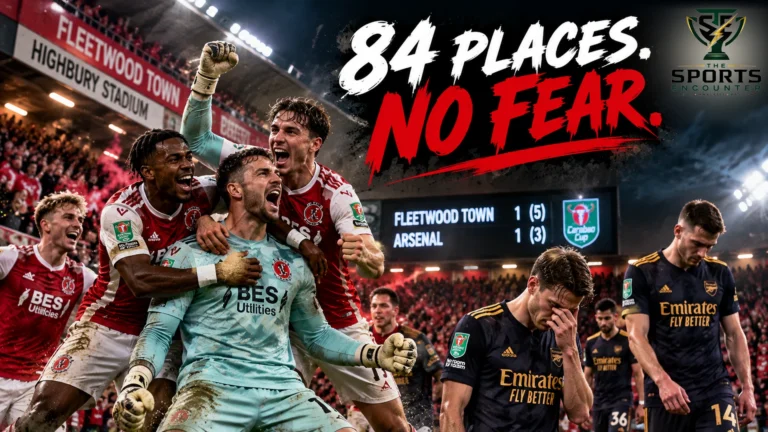
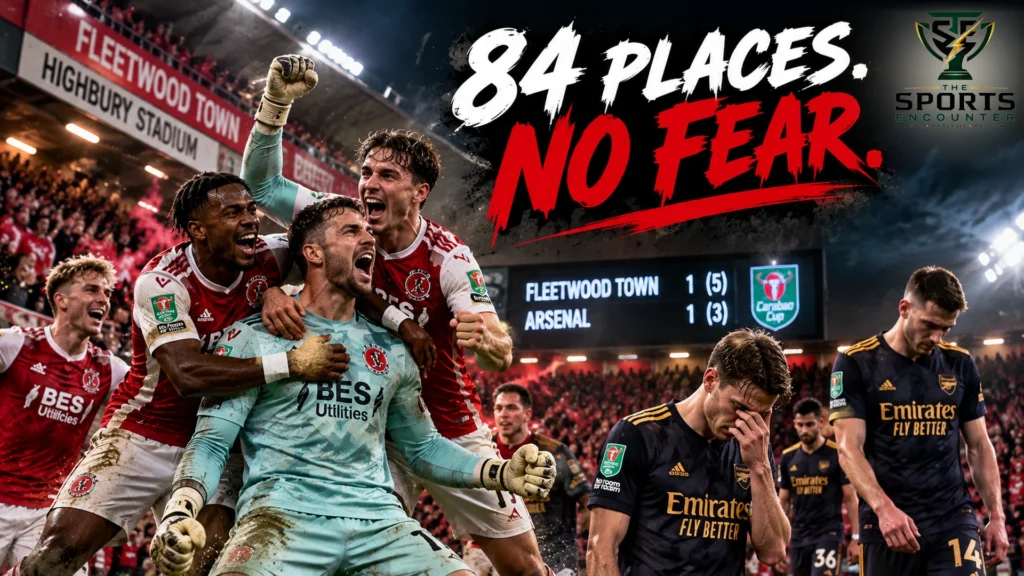
FLEETWOOD, England, October 27, 2026: Eighty-four places separated Fleetwood Town and Arsenal in the English football pyramid. On Tuesday night, that enormous gulf counted for nothing. League Two Fleetwood eliminated the reigning Premier League champions from the Carabao Cup, winning a remarkable penalty shootout 5-3 after a 1-1 fourth-round draw at Highbury Stadium. Goalkeeper Jay Lynch denied Bruno Guimarães before 19-year-old Conor Haughey converted the decisive spot kick, sending the Lancashire club into the competition’s quarterfinals for the first time in its history.
Aaron Loupalo-Bi had stunned Mikel Arteta’s side with a 21st-minute opener before Viktor Gyökeres equalized five minutes after halftime. Arsenal introduced experienced players, increased their attacking pressure and created opportunities to win, but Lynch repeatedly frustrated them. Max Dowman’s late dismissal further complicated the champions’ evening. Fleetwood then converted all five penalties to complete an extraordinary upset against a team that had won the English title only months earlier.
Fleetwood vs Arsenal: Carabao Cup Result and Key Facts
The result belongs among the most remarkable upsets of the 2026-27 English football season. Fleetwood, struggling in the lower reaches of League Two, eliminated a club competing near the top of the Premier League and in the UEFA Champions League.
| Match Detail | Verified Information |
|---|---|
| Competition | 2026-27 Carabao Cup |
| Round | Fourth Round (Last 16) |
| Date | October 27, 2026 |
| Venue | Highbury Stadium, Fleetwood, England |
| Full-Time Result | Fleetwood Town 1-1 Arsenal |
| Penalty Shootout | Fleetwood won 5-3 |
| Fleetwood Goalscorer | Aaron Loupalo-Bi, 21′ |
| Arsenal Goalscorer | Viktor Gyökeres, 50′ |
| Red Card | Max Dowman, Arsenal, 85′ |
| Decisive Save | Jay Lynch denied Bruno Guimarães |
| Winning Penalty | Conor Haughey |
| Fleetwood Manager | Matt Lawlor |
| Arsenal Manager | Mikel Arteta |
| Outcome | Fleetwood advance to their first Carabao Cup quarterfinal |
The English Football League’s official match report confirms the result, the decisive penalty incidents and the historic qualification.
Story at a glance
Fleetwood vs Arsenal: Carabao Cup Result and Key Facts
The result belongs among the most remarkable upsets of the 2026-27 English football season. Fleetwood, struggling in the lower reaches of League Two, eliminated a club competing near the top of the Premier League and in the UEFA Champions League.
How Did Fleetwood Take the Lead Against the Premier League Champions?
Arsenal arrived at Highbury Stadium with considerably greater resources, technical quality and experience. Arteta’s starting team included Viktor Gyökeres, Kai Havertz and Max Dowman, the teenager who had scored twice during Arsenal’s previous Carabao Cup victory.
Jay Lynch’s Saves Turn Arsenal’s Pressure Into Frustration
Arsenal’s equalizer appeared to restore the natural order.
Max Dowman’s Red Card: A Costly Ending to Arsenal’s Cup Campaign
For Max Dowman, the defeat represented a particularly painful reversal.
Five Perfect Penalties: How Fleetwood Completed the Upset
When the referee ended normal time, Fleetwood had achieved something Arsenal had failed to prevent: they had extended the contest into a penalty shootout.
How Did Fleetwood Take the Lead Against the Premier League Champions?
Arsenal arrived at Highbury Stadium with considerably greater resources, technical quality and experience. Arteta’s starting team included Viktor Gyökeres, Kai Havertz and Max Dowman, the teenager who had scored twice during Arsenal’s previous Carabao Cup victory.
Indeed, our report on Arsenal’s 4-2 victory over Ipswich Town documented how Dowman’s early double helped the Gunners take command of that third-round encounter.
Fleetwood had no intention of allowing the champions a similarly comfortable start.
After an unusual early interruption caused by a drone above the stadium, the home side settled into its defensive shape and looked for opportunities to attack the spaces Arsenal left behind.
The breakthrough arrived in the 21st minute.
Harrison Neal helped create the opening, and Aaron Loupalo-Bi, on loan from Fulham, finished past Arsenal goalkeeper Illan Meslier.
The goal changed the immediate demands of the contest. Arsenal could no longer expect Fleetwood to chase an opening. The hosts already possessed something worth protecting.
Fleetwood’s response was to defend compactly, challenge Arsenal’s attacking movement and make the visitors work for every opening.
Arsenal controlled significant stretches of possession, but the home side reached halftime with a 1-0 advantage.
The Decisive Moments That Changed the Match
| Time | Incident | Why It Mattered |
|---|---|---|
| Early first half | Play interrupted by a drone above the stadium | The unusual stoppage disrupted the opening rhythm before Fleetwood established their lead. |
| 21′ | Aaron Loupalo-Bi scores | Fleetwood take a surprise 1-0 lead and force Arsenal to chase the match. |
| Halftime | Martin Ødegaard is introduced | Arsenal add experience and creativity to their attacking play. |
| 50′ | Viktor Gyökeres equalizes | Arsenal restore parity with most of the second half remaining. |
| Final five minutes | Max Dowman receives a red card | Arsenal must finish the match with 10 players. |
| Late second half | Jay Lynch denies Ben White and Martin Ødegaard | Fleetwood survive Arsenal’s late pressure and force penalties. |
| Penalty shootout | Lynch saves Bruno Guimarães’ attempt | Fleetwood gain the decisive advantage. |
| Final penalty | Conor Haughey scores | Fleetwood win 5-3 and advance to the quarterfinals. |
The most revealing aspect of this sequence is how Fleetwood survived two different forms of pressure. First came the challenge of protecting an unexpected lead. Then came the far more difficult task of containing Arsenal after the champions had equalized and strengthened their lineup.
Jay Lynch’s Saves Turn Arsenal’s Pressure Into Frustration
Arsenal’s equalizer appeared to restore the natural order.
Arteta introduced captain Martin Ødegaard at halftime, giving the visitors another source of creativity. Five minutes after the restart, Gyökeres forced the ball home to make it 1-1, scoring his first goal of the season.
The goal rewarded Arsenal’s improved attacking approach and threatened to open the match completely.
Fleetwood’s defensive work became increasingly important as Arsenal pushed for another goal.
Jay Lynch emerged as the central figure in the home side’s resistance. The goalkeeper produced crucial late saves from Ben White and Ødegaard, preventing Arsenal from converting attacking pressure into the winning goal.
Those interventions deserve as much attention as his later penalty save.
Without them, there might never have been a shootout.
Lynch also understood the demands of a cup upset against stronger opposition. His side would inevitably spend periods without the ball. The goalkeeper needed to remain alert despite long stretches in which Arsenal controlled the attacking initiative.
Fleetwood’s earlier 1-0 victory over Sheffield United had already demonstrated the value of this approach. In that match, Fleetwood survived despite having only 35% possession.
Against Arsenal, the defensive challenge grew considerably, but the principle remained familiar: protect dangerous areas, prevent repeated clear opportunities and make the opponent convert its advantages under increasing pressure.
Max Dowman’s Red Card: A Costly Ending to Arsenal’s Cup Campaign
For Max Dowman, the defeat represented a particularly painful reversal.
Only weeks earlier, the Arsenal teenager had been one of the team’s outstanding performers in the third round, scoring twice against Ipswich.
At Fleetwood, his evening ended with a dismissal.
Referee Michael Salisbury showed Dowman a red card after the youngster kicked out following a challenge involving Fleetwood’s Harrison Neal in the closing minutes.
Arsenal were reduced to 10 men with the match still level.
The dismissal narrowed Arteta’s remaining tactical options and placed additional responsibility on the experienced players still on the field.
It would be too simple, however, to blame Arsenal’s elimination entirely on the red card.
The visitors had enjoyed sufficient time, possession and attacking opportunities to establish a winning position before the incident. Their failure to take those chances had already allowed Fleetwood to remain competitive.
That makes the dismissal part of a broader explanation rather than the sole cause of the defeat.
Five Perfect Penalties: How Fleetwood Completed the Upset
When the referee ended normal time, Fleetwood had achieved something Arsenal had failed to prevent: they had extended the contest into a penalty shootout.
Matt Lawlor’s players then produced five successful attempts under enormous pressure.
Harrison Neal, Ronan Coughlan, Will Davies and Andy Cannon converted Fleetwood’s opening four penalties. Martin Ødegaard, Kai Havertz and Viktor Gyökeres scored Arsenal’s first three.
The decisive intervention arrived when Bruno Guimarães stepped forward for Arsenal’s fourth attempt.
Jay Lynch saved it.
That left Fleetwood teenager Conor Haughey with an opportunity to complete one of the most memorable victories in the club’s history.
Haughey converted, and Highbury Stadium erupted.
Fleetwood vs Arsenal: Complete Penalty Shootout
| Round | Fleetwood Taker | Outcome | Arsenal Taker | Outcome |
|---|---|---|---|---|
| 1 | Harrison Neal | Scored | Martin Ødegaard | Scored |
| 2 | Ronan Coughlan | Scored | Kai Havertz | Scored |
| 3 | Will Davies | Scored | Viktor Gyökeres | Scored |
| 4 | Andy Cannon | Scored | Bruno Guimarães | Saved by Jay Lynch |
| 5 | Conor Haughey | Scored | Not required | Fleetwood had already won |
Fleetwood’s five successful penalties from five attempts represent a 100% conversion rate. Arsenal scored three of their four attempts, a 75% success rate.
Those percentages are straightforward calculations from the completed shootout, but they underline the night’s decisive difference. Fleetwood remained perfect when the pressure reached its highest point.
Lawlor subsequently revealed in his postmatch comments that his team had not practiced penalties together before the match.
That admission made the achievement even more striking. The home side demonstrated composure when the outcome depended entirely on a sequence of individual actions.
Haughey, a 19-year-old defender, was entrusted with the fifth attempt. His finish showed extraordinary confidence for a player competing against the reigning champions of England.
Fleetwood’s Historic Cup Run Began With Three Clean Sheets
The Arsenal victory did not come from nowhere.
Fleetwood’s 2026-27 Carabao Cup campaign had already produced three victories and three clean sheets before Tuesday night’s fourth-round tie.
The journey began with a narrow 1-0 success against Chesterfield, part of the opening-round action covered in our Carabao Cup Round One North report.
Fleetwood followed that result with a 4-0 victory over Shrewsbury Town. The competition was already producing other lower-league success stories, including Bradford City’s elimination of Burnley, examined in The Sports Encounter’s second-round analysis.
The third round brought Fleetwood a major test against Championship opposition.
Sheffield United controlled 65% possession, but Fleetwood won 1-0 through Rhys Norrington-Davies’ own goal.
The EFL’s official third-round report documents the victory that sent Fleetwood into the last 16 for the first time.
Then came Arsenal.
Fleetwood’s Road to the 2026-27 Carabao Cup Quarterfinals
| Round | Opponent | Result | Key Significance |
|---|---|---|---|
| First | Chesterfield | 1-0 win | Opened the campaign with a clean sheet. |
| Second | Shrewsbury Town | 4-0 win | Recorded their most convincing victory of the run. |
| Third | Sheffield United | 1-0 win | Eliminated Championship opposition to reach the last 16 for the first time. |
| Fourth | Arsenal | 1-1 draw, won 5-3 on penalties | Eliminated the Premier League champions to reach the quarterfinals for the first time. |
The Sports Encounter statistical finding: Fleetwood have scored seven goals and conceded just once in normal playing time across four Carabao Cup matches. That works out to 1.75 goals scored and 0.25 goals conceded per game, with three clean sheets from four appearances.
The calculations exclude penalty shootouts, which do not count toward match goals.
The progression is especially revealing because Fleetwood’s opponents became progressively more demanding. The team maintained its defensive effectiveness against Sheffield United, then survived Arsenal despite finally conceding a goal.
This was Fleetwood’s fourth consecutive successful knockout tie of the campaign.
What Went Wrong for Mikel Arteta and Arsenal?
Arsenal’s exit raises legitimate questions about finishing, squad rotation, discipline and their response to opponents who defend deep.
Arteta had sufficient individual quality available to win the match. His selection included established attacking players, and he strengthened the side during the second half rather than accepting the possibility of elimination.
Ødegaard’s introduction helped Arsenal impose greater attacking pressure, while Gyökeres provided the equalizer that should have offered a platform for victory.
Instead, Fleetwood survived.
The contrast with Arsenal’s previous cup appearance was considerable. Against Ipswich, the Gunners scored four times and built an overwhelming advantage before their opponent could recover.
At Fleetwood, they never established a lead.
There is also an important distinction between Arsenal’s broader season and one disastrous cup result. The Gunners entered the campaign as defending Premier League champions after ending their 22-year wait for the English title.
Our analysis of Arteta’s attempt to build an Arsenal dynasty examined the club’s ambitions following that breakthrough.
Another earlier assessment explored the managerial continuity and tactical familiarity that had become important strengths of Arteta’s team.
Those advantages have not disappeared because of one result. But the Fleetwood defeat exposes an uncomfortable vulnerability: against an organized opponent determined to keep the contest close, Arsenal’s technical superiority did not translate into sufficient finishing efficiency.
Arteta will also need to address Dowman’s dismissal, particularly because the teenager had previously demonstrated his value in the competition.
For Bruno Guimarães, the missed penalty brought a different sort of disappointment.
Earlier this season, the midfielder had helped preserve Arsenal’s perfect Premier League start by scoring shortly after David Raya saved a penalty against Sunderland. That decisive contribution featured in our detailed Arsenal-Sunderland report.
Against Fleetwood, Guimarães experienced the other side of the penalty drama.
Neither moment defines his overall quality, but together they capture how quickly knockout football can turn a match-winning player into the center of a painful elimination.
Was Fleetwood’s Victory Mainly Arsenal’s Failure or an Outstanding Underdog Performance?
Both interpretations have supporting evidence.
Arsenal supporters can reasonably point toward missed chances, a costly dismissal and a failure to finish a match against a much lower-ranked opponent.
Fleetwood supporters have an equally compelling response. Their side defended with discipline, remained competitive after conceding an equalizer, received outstanding goalkeeping and converted every penalty.
Arsenal’s failure to win was inseparable from the resistance they encountered.
The broader Carabao Cup campaign offers a useful comparison. Peterborough United also needed penalties to survive a dramatic third-round encounter against Barnsley, winning 7-6 following a 3-3 draw. That match, covered in our Peterborough-Barnsley report, demonstrated how little a team’s territorial or statistical advantage can mean when the contest reaches a shootout.
Fleetwood’s achievement was different in scale because the opponent was the reigning Premier League champion.
The competitive gap was extraordinary, but Lawlor’s team found a way to remain within reach of victory for the entire evening.
The result should not be reduced to Arsenal’s mistakes. Fleetwood earned the opportunity to win and executed the decisive moments better.
What Does Arsenal’s Carabao Cup Elimination Mean for the Rest of the Season?
Arsenal can no longer compete for the Carabao Cup this season, removing one potential route to domestic silverware.
However, the Premier League and UEFA Champions League remain separate competitions with their own demands.
The immediate challenge is psychological and tactical.
Arteta must ensure that the disappointment does not disrupt the team’s league form or become another example of wasteful finishing against an organized defense.
Arsenal’s most recent Premier League victory came against Everton, a 2-0 result discussed alongside Manchester City’s defeat at Aston Villa in our latest Premier League results analysis.
That domestic context matters. Arsenal remain involved in a championship race in which the leading clubs have already dropped points.
Our preseason Premier League title contender assessment placed Arsenal among the strongest teams in England. One cup exit does not automatically invalidate that judgment, but the manner of the defeat gives Arteta specific problems to examine.
The next major test comes on Sunday, November 1, when Arsenal face Liverpool at Anfield in the Premier League.
That match will reveal whether the defeat at Fleetwood remains an isolated cup failure or begins to affect Arsenal’s execution in another high-pressure fixture.
What Happens Next for Fleetwood Town?
Fleetwood have secured a place among the final eight clubs in the 2026-27 Carabao Cup.
The quarterfinal draw is scheduled for Wednesday, October 28, following Liverpool’s fourth-round meeting with Chelsea.
According to the EFL’s official quarterfinal draw announcement, the last-eight ties will take place during the week beginning December 14, 2026.
For Fleetwood, the draw will determine the next chapter of a campaign that has already delivered unprecedented progress.
Before that occasion, however, the club returns to League Two action against Bristol Rovers on Saturday, October 31.
That presents Lawlor with a very different problem.
His players have just eliminated the champions of England, but their domestic league position still requires attention. Carrying the confidence, organization and discipline from this cup victory into league competition could be more important to Fleetwood’s season than another glamorous opponent.
Their league difficulties have not vanished, but the achievement against Arsenal provides evidence of what this group can accomplish collectively.
Continue the Soccer Story

Frequently Asked Questions
Who won Fleetwood Town vs Arsenal in the Carabao Cup?
Fleetwood Town defeated Arsenal 5-3 on penalties after a 1-1 draw in the fourth round on October 27, 2026.
Who scored the goals in Fleetwood vs Arsenal?
Aaron Loupalo-Bi scored for Fleetwood in the 21st minute. Viktor Gyökeres equalized for Arsenal in the 50th minute.
Who missed Arsenal’s penalty against Fleetwood?
Bruno Guimarães had Arsenal’s fourth shootout penalty saved by Fleetwood goalkeeper Jay Lynch.
Who scored the winning penalty for Fleetwood?
Conor Haughey, a 19-year-old defender, converted Fleetwood’s fifth penalty to complete the 5-3 shootout victory.
Why was Max Dowman sent off against Fleetwood?
The Arsenal teenager received a red card late in the second half after kicking out following a challenge involving Fleetwood’s Harrison Neal.
How far apart were Fleetwood and Arsenal in the English football pyramid?
According to the EFL, Fleetwood entered the match 84 league positions below Arsenal.
Have Fleetwood Town ever reached the Carabao Cup quarterfinals before?
No. Their victory over Arsenal secured the club’s first appearance in the competition’s quarterfinals.
When is the Carabao Cup quarterfinal draw?
The draw is scheduled for Wednesday, October 28, 2026, following Liverpool’s match against Chelsea.
When will the Carabao Cup quarterfinals take place?
The 2026-27 quarterfinal matches are scheduled for the week commencing December 14, 2026.
Final Analysis: Fleetwood’s Historic Night Belongs to More Than One Hero
Jay Lynch will rightly receive enormous credit for his saves, and Conor Haughey’s winning penalty will remain one of the defining moments in Fleetwood Town’s history.
But the achievement began long before the shootout.
Aaron Loupalo-Bi gave Fleetwood the advantage. Harrison Neal contributed to the opening goal and remained involved in the match’s most consequential incidents. The defensive unit survived Arsenal’s improved second-half performance, while Lawlor’s substitutes and penalty takers handled the pressure of the closing stages.
Arsenal had the greater reputation, superior individual resources and a squad built to compete for major honors.
Fleetwood had a match to manage, a goal to protect, a goalkeeper in outstanding form and five players prepared to take responsibility from the penalty spot.
For one night at Highbury Stadium, that was enough to overcome an 84-place difference.
Arsenal leave the Carabao Cup searching for explanations. Fleetwood advance with a result that will remain part of the club’s history long after the final penalty has been replayed.
Arsenal
- Fleetwood Humiliate Arsenal: Jay Lynch Denies the Champions as League Two Underdogs Overturn 84-Place Gap
- Premier League: Brighton Hit Five, Haaland Keeps City Perfect as Arsenal Survive With One Shot on Target
- From Chelsea’s Swagger to Arsenal’s Control: How a London Rivalry Flipped in a Decade
- Premier League: Man City Take Control as Isak Delivers and Manchester United Stumble Again
- Smilla Holmberg Saves Arsenal at 95 Minutes as Manchester United’s Defensive Reset Falls Seconds Short