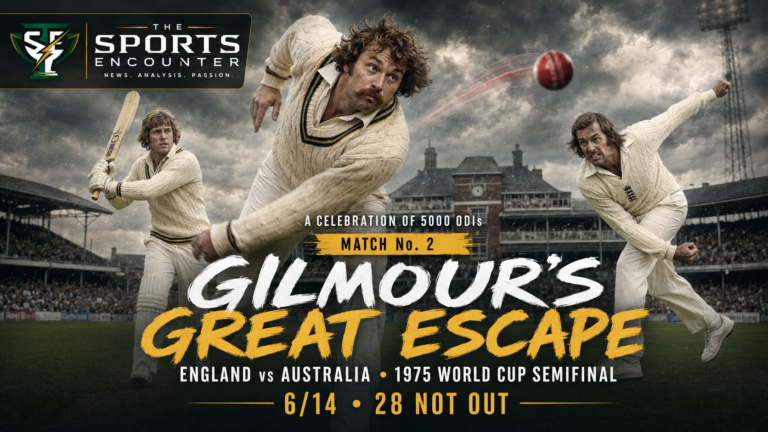
A Celebration of 5000 ODIs Match 2: Gary Gilmour Rescues Australia From the Edge Against England
Gary Gilmour dismantled England with six wickets, then rescued Australia from 39 for six in a remarkable 1975 World Cup semifinal at Headingley.
Australia needed 94 runs to reach the first men’s Cricket World Cup final. By the time half their batting lineup had disappeared for 39, that modest target had become a trap.
England’s bowlers sensed an escape. Headingley responded to every wicket. Australia, having dismissed the hosts for 93, suddenly faced the possibility of wasting one of the most devastating bowling performances the young ODI format had witnessed.
Gary Gilmour had already taken six wickets for 14 runs. Now he had to save the chase with his bat.
His unbeaten 28, supported by Doug Walters’ 20 not out, carried Australia through a frightening collapse and into the final. The semifinal became a rare international match in which the same player tore apart one innings and then repaired another.
This is Match No. 2 in A Celebration of 5000 ODIs, The Sports Encounter’s series revisiting 100 matches that reveal why one-day cricket continues to command attention across generations.
TL;DR
- Australia defeated England by four wickets at Headingley on June 18, 1975.
- England were bowled out for 93 after Gary Gilmour claimed 6 for 14 from 12 overs.
- England fought back and reduced Australia to 39 for six while defending only 94.
- Gilmour scored 28 not out and added an unbeaten 55 with Doug Walters.
- Gilmour received the Player of the Match award for one of World Cup cricket’s finest all-round performances.
- Australia advanced to the inaugural World Cup final against West Indies.
England vs Australia 1975 Match Information
| Detail | Information |
|---|---|
| Match | England vs Australia, first semifinal, Prudential World Cup 1975 |
| Date | June 18, 1975 |
| Venue | Headingley, Leeds |
| Toss | Australia won the toss and fielded |
| England | 93 all out in 36.2 overs |
| Australia | 94/6 in 28.4 overs |
| Result | Australia won by four wickets with 188 balls remaining |
| Player of the Match | Gary Gilmour, 6/14 and 28 not out |
| Top England batter | Mike Denness, 27 |
| Best England bowler | Chris Old, 3/29 |
| Turning point | Gilmour survived an early chance and added an unbeaten 55 with Doug Walters |
| Tournament impact | Australia advanced to the inaugural men’s World Cup final |
Complete England Scorecard
| Batter | Dismissal | Runs | Balls | 4s | 6s |
|---|---|---|---|---|---|
| Dennis Amiss | lbw b Gilmour | 2 | 7 | 0 | 0 |
| Barry Wood | b Gilmour | 6 | 19 | 1 | 0 |
| Keith Fletcher | lbw b Gilmour | 8 | 45 | 0 | 0 |
| Tony Greig | c Marsh b Gilmour | 7 | 25 | 1 | 0 |
| Frank Hayes | lbw b Gilmour | 4 | 6 | 1 | 0 |
| Mike Denness | b Walker | 27 | 60 | 1 | 0 |
| Alan Knott | lbw b Gilmour | 0 | 5 | 0 | 0 |
| Chris Old | c Greg Chappell b Walker | 0 | 3 | 0 | 0 |
| John Snow | c Marsh b Lillee | 2 | 14 | 0 | 0 |
| Geoff Arnold | not out | 18 | 30 | 2 | 0 |
| Peter Lever | lbw b Walker | 5 | 13 | 0 | 0 |
| Extras | 14 | ||||
| Total | All out in 36.2 overs | 93 |
Australia Bowling
| Bowler | Overs | Maidens | Runs | Wickets | Economy |
|---|---|---|---|---|---|
| Dennis Lillee | 9 | 3 | 26 | 1 | 2.88 |
| Gary Gilmour | 12 | 6 | 14 | 6 | 1.16 |
| Max Walker | 9.2 | 3 | 22 | 3 | 2.35 |
| Jeff Thomson | 6 | 0 | 17 | 0 | 2.83 |
Complete Australia Scorecard
| Batter | Dismissal | Runs | Balls | 4s | 6s |
|---|---|---|---|---|---|
| Alan Turner | lbw b Arnold | 7 | 20 | 0 | 0 |
| Rick McCosker | b Old | 15 | 50 | 0 | 0 |
| Ian Chappell | lbw b Snow | 2 | 19 | 0 | 0 |
| Greg Chappell | lbw b Snow | 4 | 9 | 1 | 0 |
| Doug Walters | not out | 20 | 43 | 2 | 0 |
| Ross Edwards | b Old | 0 | 3 | 0 | 0 |
| Rod Marsh | b Old | 5 | 8 | 0 | 0 |
| Gary Gilmour | not out | 28 | 28 | 5 | 0 |
| Extras | 13 | ||||
| Total | Six wickets in 28.4 overs | 94 |
Did not bat: Dennis Lillee, Max Walker, Jeff Thomson
England Bowling
| Bowler | Overs | Maidens | Runs | Wickets | Economy |
|---|---|---|---|---|---|
| Geoff Arnold | 7.4 | 2 | 15 | 1 | 1.95 |
| John Snow | 12 | 0 | 30 | 2 | 2.50 |
| Chris Old | 7 | 2 | 29 | 3 | 4.14 |
| Peter Lever | 2 | 0 | 7 | 0 | 3.50 |
Gary Gilmour Turns Headingley Into His Stage
Gilmour entered Australia’s lineup for the semifinal after spending the group stage outside the XI. Conditions at Headingley rewarded swing bowling, and the left-armer exploited them with exceptional control.
He removed England’s first six dismissed batters, reducing the hosts to 36 for six. His 12-over spell contained six maidens and cost only 14 runs. England struggled to distinguish between deliveries that would hold their line and those that would swing late into the pads or stumps.
The International Cricket Council’s account of the 1975 tournament records that Gilmour was playing only his third ODI. The scale of the performance becomes even clearer in that context. He entered a World Cup semifinal with almost no international one-day experience and controlled it from his opening spell.
Gilmour later finished the tournament with 11 wickets from only two matches, making him its leading wicket-taker.
Mike Denness Gives England Something to Defend
England’s captain could not reverse the collapse, but his 27 from 60 balls prevented the innings from ending before it had acquired any substance.
Denness watched wickets fall throughout the top and middle order before building small partnerships with the tail. Geoff Arnold’s unbeaten 18 also proved valuable, helping England recover from 37 for seven to 93.
That total appeared hopeless on paper. In the damp, bowler-friendly conditions, however, every run carried unusual weight.
England’s response showed why low-scoring ODIs can create a different kind of pressure. Recent power-hitting feats, including Toby Albert’s six consecutive sixes, illustrate how far one-day batting has developed. Headingley offered the opposite spectacle. Survival, movement and defensive technique shaped every passage.
Chris Old Brings England Back From 32 for Three
Geoff Arnold began the resistance by removing Alan Turner. John Snow then trapped Ian and Greg Chappell lbw, leaving Australia at 32 for three.
Chris Old pushed the chase toward genuine crisis. He dismissed Rick McCosker and Ross Edwards without another run being added, then bowled Rod Marsh at 39.
Old finished with 3 for 29, while Snow claimed 2 for 30. England had transformed a target of 94 into a semifinal emergency.
The collapse exposed Australia’s technical problems against the moving ball. Several batters became trapped on the crease, uncertain whether to play forward or wait. England attacked the stumps and refused to let the small target weaken their intensity.
Doug Walters Provides the Control Australia Needed
Walters’ unbeaten 20 lacked the drama of Gilmour’s performance, but his judgment held the partnership together.
Australia could not afford another reckless stroke. Walters defended carefully, rotated the strike when possible and allowed Gilmour to attack loose deliveries. Their roles complemented each other. Walters reduced risk while Gilmour prevented England from dictating every over.
The pair added 55 without separation, more than half the target. That partnership remains the match’s decisive passage.
The Turning Point: England Miss Their Chance at Gilmour
According to the ICC’s historical review, Gilmour survived an early dropped chance after arriving at 39 for six.
Had England completed it, Australia would have been seven wickets down with 55 still required. Lillee, Walker and Thomson remained, but none offered the same combination of composure and attacking ability.
The missed opportunity changed the emotional balance. Gilmour began finding boundaries, Walters settled, and England’s belief gradually weakened as the target came within reach.
Why This Match Belongs in A Celebration of 5000 ODIs
This semifinal earned its place because it turned 94 into a dangerous chase and asked one cricketer to win the match twice.
Gilmour’s 6 for 14 appeared sufficient to decide the contest. England’s bowlers then created a second match inside the first, reducing Australia to 39 for six and placing the semifinal back in doubt.
The structure resembles the remarkable recovery explored in Match No. 1, West Indies vs Pakistan. Both contests showed that early ODI cricket already possessed the uncertainty and pressure that would later define the format.
Readers can follow every installment through the A Celebration of 5000 ODIs series hub and explore current reports, historical features and analysis through The Sports Encounter’s cricket coverage.
What Happened Next
Australia advanced to face West Indies at Lord’s, where Gilmour took another five wickets. Clive Lloyd’s century and West Indies’ sharp fielding ultimately delivered a 17-run victory in the inaugural World Cup final.
The semifinal still belongs to Gilmour. Across 12 overs and 28 balls, he produced a performance that rescued Australia from both sides of the contest.
More than five decades later, England’s 93 and Australia’s 39 for six remain enough to restore the tension. That is precisely why this match deserves another telling.
Frequently Asked Questions
Who won the England vs Australia 1975 World Cup semifinal?
Australia won by four wickets after reaching 94 for six in 28.4 overs at Headingley.
Who was the Player of the Match?
Gary Gilmour received the award after taking 6 for 14 and scoring an unbeaten 28.
What was the decisive partnership?
Gilmour and Doug Walters added an unbeaten 55 for the seventh wicket after Australia had collapsed to 39 for six.
Why was the match historically significant?
It sent Australia into the first men’s Cricket World Cup final and produced one of the finest all-round performances in ODI history.
A Celebration of 5000 ODIs
A Celebration of 5000 ODIs Match 9: Inzamam Silences Eden Park and Sends Pakistan Into the 1992 World Cup Final
New Zealand appeared headed for a home World Cup final until 22-year-old Inzamam-ul-Haq produced 37 balls of fearless hitting that transformed Pakistan’s destiny.
New Zealand had controlled the tournament, filled Eden Park with expectation and placed 263 runs between Pakistan and a first World Cup final. With Pakistan needing 123 from fewer than 16 overs and four wickets already gone, the co-hosts appeared ready to complete their journey.
Then Inzamam-ul-Haq walked into the pressure.
The 22-year-old had contributed little during Pakistan’s erratic campaign. Few outside the dressing room knew what he could become. Thirty-seven balls later, New Zealand knew his name and Pakistan had found the innings that would change its World Cup history.
Inzamam hammered 60, Javed Miandad finished unbeaten on 57 and Moin Khan completed the chase with six balls remaining. Pakistan won by four wickets and advanced to the final, where Imran Khan’s team would defeat England.
That sudden transformation earns this semifinal its position as Match 9 in A Celebration of 5000 ODIs, The Sports Encounter’s collection of the matches that defined one-day international cricket.
TL;DR
- Pakistan chased 263 to defeat New Zealand by four wickets at Eden Park.
- Inzamam-ul-Haq changed the chase with 60 from only 37 balls.
- Javed Miandad anchored Pakistan with an unbeaten 57 from 69 deliveries.
- Martin Crowe led New Zealand’s 262 for seven with a brilliant 91.
- Crowe’s hamstring injury prevented him from fielding and deprived New Zealand of its captain during Pakistan’s chase.
- The victory sent Pakistan into its first men’s Cricket World Cup final.
Pakistan vs New Zealand 1992 Semifinal: Match Information
| Detail | Information |
|---|---|
| Match | New Zealand vs Pakistan, first semifinal |
| Competition | 1992 Cricket World Cup |
| Date | March 21, 1992 |
| Venue | Eden Park, Auckland |
| Toss | New Zealand won the toss and batted |
| New Zealand | 262/7 in 50 overs |
| Pakistan | 264/6 in 49 overs |
| Result | Pakistan won by four wickets with six balls remaining |
| Player of the Match | Inzamam-ul-Haq, 60 from 37 balls |
| Turning Point | Inzamam attacked after Pakistan slipped to 140/4 |
| Tournament Impact | Pakistan reached its first World Cup final |
Complete Match Scorecard
New Zealand Batting
| Batter | Dismissal | Runs | Balls | 4s | 6s |
|---|---|---|---|---|---|
| Mark Greatbatch | b Aaqib Javed | 17 | 22 | 0 | 2 |
| John Wright | c Ramiz Raja b Mushtaq Ahmed | 13 | 44 | 1 | 0 |
| Andrew Jones | lbw b Mushtaq Ahmed | 21 | 53 | 2 | 0 |
| Martin Crowe | Run out | 91 | 83 | 7 | 3 |
| Ken Rutherford | c Moin Khan b Wasim Akram | 50 | 68 | 5 | 1 |
| Chris Harris | st Moin Khan b Iqbal Sikander | 13 | 12 | 1 | 0 |
| Ian Smith | Not out | 18 | 10 | 3 | 0 |
| Dipak Patel | lbw b Wasim Akram | 8 | 6 | 1 | 0 |
| Gavin Larsen | Not out | 8 | 6 | 1 | 0 |
| Danny Morrison | Did not bat | ||||
| Willie Watson | Did not bat | ||||
| Extras | 23 (b 4, lb 7, nb 4, w 8) | ||||
| Total | 262/7 in 50 overs |
Fall of wickets: 35/1, 39/2, 87/3, 194/4, 214/5, 221/6, 244/7.
Pakistan Bowling
| Bowler | Overs | Maidens | Runs | Wickets |
|---|---|---|---|---|
| Wasim Akram | 10 | 0 | 40 | 2 |
| Aaqib Javed | 10 | 2 | 45 | 1 |
| Mushtaq Ahmed | 10 | 0 | 40 | 2 |
| Imran Khan | 10 | 0 | 59 | 0 |
| Iqbal Sikander | 9 | 0 | 56 | 1 |
| Aamer Sohail | 1 | 0 | 11 | 0 |
Pakistan Batting
| Batter | Dismissal | Runs | Balls | 4s | 6s |
|---|---|---|---|---|---|
| Aamer Sohail | c Jones b Patel | 14 | 20 | 1 | 0 |
| Ramiz Raja | c Morrison b Watson | 44 | 55 | 6 | 0 |
| Imran Khan | c Larsen b Harris | 44 | 93 | 1 | 2 |
| Javed Miandad | Not out | 57 | 69 | 4 | 0 |
| Saleem Malik | c substitute b Larsen | 1 | 2 | 0 | 0 |
| Inzamam-ul-Haq | Run out | 60 | 37 | 7 | 1 |
| Wasim Akram | b Watson | 9 | 8 | 1 | 0 |
| Moin Khan | Not out | 20 | 11 | 2 | 1 |
| Mushtaq Ahmed | Did not bat | ||||
| Iqbal Sikander | Did not bat | ||||
| Aaqib Javed | Did not bat | ||||
| Extras | 15 (b 4, lb 10, w 1) | ||||
| Total | 264/6 in 49 overs |
Fall of wickets: 30/1, 84/2, 134/3, 140/4, 227/5, 238/6.
New Zealand Bowling
| Bowler | Overs | Maidens | Runs | Wickets |
|---|---|---|---|---|
| Dipak Patel | 10 | 1 | 50 | 1 |
| Danny Morrison | 9 | 0 | 55 | 0 |
| Willie Watson | 10 | 2 | 39 | 2 |
| Gavin Larsen | 10 | 1 | 34 | 1 |
| Chris Harris | 10 | 0 | 72 | 1 |
Martin Crowe Builds a Total Worth Defending
New Zealand’s aggressive tournament strategy had made them the strongest side of the round-robin stage. Seven victories from eight matches earned the co-hosts first place, with Pakistan providing their only defeat.
Pakistan struck early in the semifinal, reducing New Zealand to 39 for two and later 87 for three. Crowe responded with the innings his team needed.
The captain made 91 from 83 deliveries, combining careful placement with controlled aggression. His 107-run partnership with Ken Rutherford, who scored 50, carried New Zealand to 194 for three. Ian Smith, Dipak Patel and Gavin Larsen then added useful late runs as the hosts reached 262 for seven.
Crowe’s innings came at a physical cost. A hamstring injury kept him off the field during Pakistan’s chase, leaving John Wright to manage the defense. New Zealand lost its sharpest tactical mind at the moment it needed him most.
Mushtaq Ahmed and Wasim Akram Limit the Damage
Pakistan’s bowling performance contained enough discipline to keep 263 within reach.
Mushtaq Ahmed claimed two for 40, removing Wright and Andrew Jones before Crowe could fully control the innings. Wasim Akram also finished with two for 40, dismissing Rutherford and Patel during New Zealand’s push through the closing overs.
The hosts still scored 68 from their final eight overs, but Pakistan avoided the kind of complete late collapse that would have pushed the target closer to 290.
Javed Miandad Holds the Chase Together
Pakistan’s reply moved unevenly. Ramiz Raja supplied early momentum with 44, while Imran Khan occupied 93 balls for his 44. The captain’s cautious approach preserved wickets but allowed the required rate to climb.
Imran departed at 134, and Saleem Malik followed six runs later. Pakistan stood at 140 for four in the 35th over, needing 123 from 95 deliveries.
Miandad kept the innings connected. His unbeaten 57 from 69 balls gave Inzamam the freedom to attack without carrying the entire chase. The veteran’s judgment became especially important after New Zealand briefly reopened the contest with late wickets.
Inzamam-ul-Haq Announces Himself to the World
Inzamam began with the clarity of a batter who saw opportunity where others saw danger. He struck seven fours and one six, reaching scoring areas New Zealand had protected effectively throughout the tournament.
His 60 came at a strike rate of 162.16, extraordinary for that era and even more striking under semifinal pressure. The partnership with Miandad added 87 and reduced a demanding equation to 36 runs from five overs.
A direct hit from Chris Harris eventually ran Inzamam out, but his work had changed the emotional and mathematical balance of the chase. The Player of the Match award was inevitable.
The ICC’s history of the 1992 World Cup identifies Inzamam’s innings as the performance that carried Pakistan into its first final.
Moin Khan Finishes What Inzamam Started
Wasim Akram’s dismissal left Pakistan at 238 for six, giving New Zealand a final opening. Moin Khan closed it quickly.
The wicketkeeper struck an unbeaten 20 from 11 balls, including two fours and a six. With four required from the final over, Moin pulled Chris Harris to the boundary and completed the chase with six deliveries unused.
His finishing burst deserves recognition alongside Inzamam and Miandad. Inzamam transformed the equation, Miandad protected the chase, and Moin completed it before pressure could return.
Why Match 9 Belongs in the 5,000 ODIs Collection
This semifinal changed several careers and two nations’ World Cup histories. New Zealand lost despite producing the tournament’s most consistent cricket. Crowe finished as the competition’s leading run-scorer with 456, but injury and Inzamam’s assault denied him a home final.
Pakistan carried the victory into Melbourne and won the World Cup four days later. That triumph became the defining achievement of Imran Khan’s playing career and the foundation of Inzamam’s long international journey.
The match also continues a recurring theme across The Sports Encounter’s 5000 ODIs collection: great one-day contests often turn on a short, violent change in tempo. Steve Waugh’s final-over assault in Lahore carried similar weight, while Australia’s one-run escape against India showed how narrow margins can redirect a tournament.
Other defining World Cup performances include Kapil Dev’s 175 against Zimbabwe, India’s defense of 183 in the 1983 final and Australia’s seven-run victory in the 1987 final.
Eden Park expected to celebrate New Zealand’s first appearance in a World Cup final. Instead, it witnessed the arrival of a young Pakistan batter whose 37-ball intervention changed the direction of the tournament.
A Celebration of 5000 ODIs
A Celebration of 5000 ODIs Match 8: Australia Break Pakistan’s World Cup Dream in Lahore
Steve Waugh transformed the final over before Craig McDermott dismantled Pakistan’s chase, sending Australia into the 1987 World Cup final by the narrowest of margins.
Eighteen runs separated Pakistan from a home World Cup final. Australia had collected exactly 18 from the last over of its innings.
That symmetry still defines the 1987 semifinal in Lahore. Pakistan recovered from 38 for three through Javed Miandad and Imran Khan, giving a packed Gaddafi Stadium reason to believe. Yet the runs Steve Waugh extracted at the end of Australia’s innings became a burden Pakistan could never shed.
Craig McDermott then took five wickets, including four during the closing stages, as Australia dismissed Pakistan for 249 to win by 18 runs.
That combination of late-innings calculation, a courageous recovery and ruthless fast bowling earns the semifinal its place as Match 8 in A Celebration of 5000 ODIs, The Sports Encounter’s journey through the matches that shaped one-day international cricket.
TL;DR
- Australia defeated Pakistan by 18 runs in the 1987 World Cup semifinal.
- Steve Waugh’s unbeaten 32 helped Australia score 18 from the final over and reach 267 for eight.
- Pakistan fell to 38 for three before Javed Miandad and Imran Khan added 112.
- Craig McDermott claimed five for 44 and won the Player of the Match award.
- Pakistan conceded 34 extras, a costly loss of control in a tight knockout match.
- Australia advanced to the final and secured its first World Cup title by beating England.
Match Information
| Detail | Information |
|---|---|
| Match | Australia vs Pakistan, 1987 World Cup semifinal |
| Date | November 4, 1987 |
| Venue | Gaddafi Stadium, Lahore |
| Toss | Australia won the toss and batted |
| Australia | 267/8 in 50 overs |
| Pakistan | 249 all out in 49 overs |
| Result | Australia won by 18 runs |
| Player of the Match | Craig McDermott, 5/44 |
| Turning Point | Australia scored 18 runs from the final over |
| Tournament Impact | Australia advanced to the World Cup final |
Complete Match Scorecard
Australia Batting
| Batter | Dismissal | Runs | Balls | 4s | 6s |
|---|---|---|---|---|---|
| Geoff Marsh | Run out | 31 | 57 | 2 | 0 |
| David Boon | St Javed Miandad b Saleem Malik | 65 | 91 | 4 | 0 |
| Dean Jones | b Tauseef Ahmed | 38 | 45 | 3 | 0 |
| Allan Border | Run out | 18 | 22 | 2 | 0 |
| Mike Veletta | b Imran Khan | 48 | 50 | 2 | 0 |
| Steve Waugh | Not out | 32 | 28 | 4 | 1 |
| Simon O’Donnell | Run out | 0 | 2 | 0 | 0 |
| Greg Dyer | b Imran Khan | 0 | 1 | 0 | 0 |
| Craig McDermott | b Imran Khan | 1 | 3 | 0 | 0 |
| Tim May | Not out | 0 | 2 | 0 | 0 |
| Bruce Reid | Did not bat | ||||
| Extras | 34 (b 1, lb 19, nb 1, w 13) | ||||
| Total | 267/8 in 50 overs |
Fall of wickets: 73, 155, 155, 215, 236, 236, 241, 249.
Pakistan Bowling
| Bowler | Overs | Maidens | Runs | Wickets |
|---|---|---|---|---|
| Imran Khan | 10 | 1 | 36 | 3 |
| Saleem Jaffar | 6 | 0 | 57 | 0 |
| Wasim Akram | 10 | 0 | 54 | 0 |
| Abdul Qadir | 10 | 0 | 39 | 0 |
| Tauseef Ahmed | 10 | 1 | 39 | 1 |
| Saleem Malik | 4 | 0 | 22 | 1 |
Pakistan Batting
| Batter | Dismissal | Runs | Balls | 4s | 6s |
|---|---|---|---|---|---|
| Ramiz Raja | Run out | 1 | 1 | 0 | 0 |
| Mansoor Akhtar | b McDermott | 9 | 19 | 0 | 0 |
| Saleem Malik | c McDermott b Waugh | 25 | 31 | 3 | 0 |
| Javed Miandad | b Reid | 70 | 103 | 4 | 0 |
| Imran Khan | c Dyer b Border | 58 | 84 | 4 | 0 |
| Wasim Akram | b McDermott | 20 | 13 | 0 | 2 |
| Ijaz Ahmed | c Jones b Reid | 8 | 7 | 1 | 0 |
| Saleem Yousuf | c Dyer b McDermott | 21 | 15 | 2 | 0 |
| Abdul Qadir | Not out | 20 | 16 | 2 | 0 |
| Saleem Jaffar | c Dyer b McDermott | 0 | 2 | 0 | 0 |
| Tauseef Ahmed | c Dyer b McDermott | 1 | 3 | 0 | 0 |
| Extras | 16 (lb 6, w 10) | ||||
| Total | 249 all out in 49 overs |
Fall of wickets: 2, 37, 38, 150, 177, 192, 212, 236, 247, 249.
Australia Bowling
| Bowler | Overs | Maidens | Runs | Wickets |
|---|---|---|---|---|
| Craig McDermott | 10 | 0 | 44 | 5 |
| Bruce Reid | 10 | 2 | 41 | 2 |
| Steve Waugh | 9 | 1 | 51 | 1 |
| Simon O’Donnell | 10 | 1 | 45 | 0 |
| Tim May | 6 | 0 | 36 | 0 |
| Allan Border | 4 | 0 | 26 | 1 |
David Boon Gives Australia Its Platform
David Boon’s 65 provided the control Australia needed after choosing to bat. His partnership with Geoff Marsh settled the innings, while Dean Jones maintained the tempo with 38.
Pakistan fought back when Jones and Boon departed at 155. Mike Veletta responded with 48 from 50 balls, keeping Australia above a run-a-ball trajectory without taking reckless risks.
Imran Khan led Pakistan’s attack superbly, conceding only 36 runs and taking three wickets. However, the support bowling lacked the same discipline. Pakistan conceded 34 extras, including 13 wides and 19 leg byes. In a match decided by 18 runs, those concessions were damaging.
Steve Waugh Turns One Over Into the Winning Margin
Australia slipped from 215 for three to 249 for eight as Imran attacked the lower order. Pakistan appeared to have limited the damage, but Waugh changed the shape of the contest in the final six deliveries.
His unbeaten 32 from 28 balls drove Australia to 267. The last over, delivered by Saleem Jaffar, cost 18 runs. Waugh’s calm, clean striking gave Australia a total that demanded an exceptional chase under semifinal pressure.
It echoed the composure Australia had shown in its one-run victory over India in Chennai. Once again, a handful of late runs proved decisive.
Javed Miandad and Imran Khan Rescue Pakistan
Pakistan’s chase began disastrously. Ramiz Raja was run out before McDermott removed Mansoor Akhtar. Waugh then dismissed Saleem Malik, leaving the hosts 38 for three.
Miandad and Imran refused to let the occasion collapse around them. Their 112-run partnership restored order through controlled rotation, selective aggression and a clear understanding of the required rate.
Imran made 58 before Allan Border dismissed him at 150. Miandad continued to 70, but Bruce Reid bowled him with Pakistan still needing 56 runs. Wasim Akram, Saleem Yousuf and Abdul Qadir attacked bravely, though Australia retained just enough control.
Craig McDermott Owns the Semifinal
McDermott delivered the performance that separated the teams. After removing Mansoor early, he returned to stop Pakistan’s lower-order charge.
Wasim Akram had struck two sixes in a rapid 20 when McDermott bowled him. Saleem Yousuf followed after making 21 from 15 balls. McDermott then dismissed Saleem Jaffar and Tauseef Ahmed to complete figures of five for 44.
The spell earned him the Player of the Match award and carried Australia into the final. Pace mattered, but so did his ability to attack the stumps when Pakistan’s batters had no time to settle.
Why This Semifinal Belongs in the 5,000 ODIs Collection
The match captured the unforgiving mathematics of knockout cricket. Australia’s final-over acceleration, Pakistan’s 34 extras and McDermott’s closing spell all contributed directly to an 18-run result.
Pakistan had enjoyed a powerful home campaign, winning five of its six group matches. The semifinal offered Imran’s team the chance to reach a World Cup final on home soil. Instead, Australia absorbed the atmosphere and survived Pakistan’s strongest partnership.
The victory also prepared the way for Australia’s seven-run win over England in the 1987 final, which secured the country’s first men’s World Cup title.
Readers can explore more landmark matches through The Sports Encounter’s Celebration of 5000 ODIs collection, including India’s 1983 final triumph and Kapil Dev’s rescue against Zimbabwe.
Pakistan found courage after losing three early wickets, but Australia owned the smaller moments. Waugh won the final over, McDermott won the closing passage, and those two interventions ended a nation’s dream within sight of the final.
A Celebration of 5000 ODIs
A Celebration of 5000 ODIs Match 7: Australia Punish Gatting’s Reverse Sweep to Win the 1987 World Cup Final
England appeared positioned to win its first World Cup until Mike Gatting’s reverse sweep opened the door for Allan Border and Australia at Eden Gardens.
England were 135/2 and moving steadily toward a first World Cup title when Mike Gatting attempted the shot that would follow him for the rest of his career.
Allan Border was bowling his occasional left-arm spin. Gatting moved across his crease and tried to reverse-sweep the Australian captain. The ball struck the top edge, looped behind the wicket and dropped into Greg Dyer’s gloves.
A partnership worth 69 runs had ended. Australia finally had an opening.
England remained in the chase until the last over, but the control established by Gatting and Bill Athey never fully returned. Australia defended 253/5, won by seven runs and lifted the World Cup for the first time at Eden Gardens on November 8, 1987.
The final earns its place as Match 7 in A Celebration of 5000 ODIs because one adventurous shot changed the emotional direction of a global final. David Boon supplied the innings, Mike Veletta transformed the total, and Border intervened precisely when England appeared ready to take command.
TL;DR
- Australia scored 253/5 after winning the toss at Eden Gardens.
- David Boon made 75 from 125 balls and received the Player of the Match award.
- Mike Veletta’s unbeaten 45 from 31 deliveries powered Australia’s late acceleration.
- Bill Athey scored 58, while Mike Gatting and Allan Lamb made 41 and 45.
- Gatting’s failed reverse sweep against Allan Border changed the direction of the chase.
- England finished on 246/8, leaving Australia with a seven-run victory and its first World Cup title.
Australia vs England 1987 World Cup Final: Key Information
| Detail | Information |
|---|---|
| Match | Australia vs England, 1987 World Cup final |
| Date | November 8, 1987 |
| Venue | Eden Gardens, Calcutta, now Kolkata |
| Toss | Australia won the toss and batted |
| Australia | 253/5 in 50 overs |
| England | 246/8 in 50 overs |
| Result | Australia won by seven runs |
| Player of the Match | David Boon, 75 from 125 balls |
| Leading England batter | Bill Athey, 58 from 103 balls |
| Leading bowlers | Eddie Hemmings 2/48; Steve Waugh 2/37; Allan Border 2/38 |
| Turning point | Mike Gatting’s reverse sweep against Border at 135/2 |
| Tournament impact | Australia won its first men’s Cricket World Cup |
The match and tournament history are documented by the International Cricket Council.
Complete Match Scorecard
Australia Innings: 253/5 in 50 Overs
| Batter | Dismissal | Runs | Balls | 4s | 6s |
|---|---|---|---|---|---|
| David Boon | c Downton b Hemmings | 75 | 125 | 7 | 0 |
| Geoff Marsh | b Foster | 24 | 49 | 3 | 0 |
| Dean Jones | c Athey b Hemmings | 33 | 57 | 1 | 1 |
| Craig McDermott | b Gooch | 14 | 8 | 2 | 0 |
| Allan Border | Run out | 31 | 31 | 3 | 0 |
| Mike Veletta | Not out | 45 | 31 | 6 | 0 |
| Steve Waugh | Not out | 5 | 4 | 0 | 0 |
| Simon O’Donnell | Did not bat | ||||
| Greg Dyer | Did not bat | ||||
| Tim May | Did not bat | ||||
| Bruce Reid | Did not bat | ||||
| Extras | 1 bye, 13 leg byes, 5 wides, 7 no-balls | 26 | |||
| Total | Five wickets, 50 overs | 253 |
England Bowling
| Bowler | Overs | Maidens | Runs | Wickets |
|---|---|---|---|---|
| Phil DeFreitas | 6 | 1 | 34 | 0 |
| Gladstone Small | 6 | 0 | 33 | 0 |
| Neil Foster | 10 | 0 | 38 | 1 |
| Eddie Hemmings | 10 | 1 | 48 | 2 |
| John Emburey | 10 | 0 | 44 | 0 |
| Graham Gooch | 8 | 1 | 42 | 1 |
England Innings: 246/8 in 50 Overs
| Batter | Dismissal | Runs | Balls | 4s | 6s |
|---|---|---|---|---|---|
| Graham Gooch | lbw b O’Donnell | 35 | 57 | 4 | 0 |
| Tim Robinson | lbw b McDermott | 0 | 1 | 0 | 0 |
| Bill Athey | Run out | 58 | 103 | 2 | 0 |
| Mike Gatting | c Dyer b Border | 41 | 45 | 3 | 1 |
| Allan Lamb | b Waugh | 45 | 55 | 4 | 0 |
| Paul Downton | c O’Donnell b Border | 9 | 8 | 1 | 0 |
| John Emburey | Run out | 10 | 16 | 0 | 0 |
| Phil DeFreitas | c Reid b Waugh | 17 | 10 | 2 | 1 |
| Neil Foster | Not out | 7 | 6 | 0 | 0 |
| Gladstone Small | Not out | 3 | 3 | 0 | 0 |
| Eddie Hemmings | Did not bat | ||||
| Extras | 1 bye, 14 leg byes, 2 wides, 4 no-balls | 21 | |||
| Total | Eight wickets, 50 overs | 246 |
Australia Bowling
| Bowler | Overs | Maidens | Runs | Wickets |
|---|---|---|---|---|
| Craig McDermott | 10 | 1 | 51 | 1 |
| Bruce Reid | 10 | 0 | 43 | 0 |
| Steve Waugh | 9 | 0 | 37 | 2 |
| Simon O’Donnell | 10 | 1 | 35 | 1 |
| Tim May | 4 | 0 | 27 | 0 |
| Allan Border | 7 | 0 | 38 | 2 |
David Boon Anchors Australia’s Innings
Boon’s 75 lacked the rapid scoring associated with modern finals, but the conditions demanded patience. He batted for 125 deliveries, absorbed England’s most disciplined periods and provided stability after Geoff Marsh departed with the score at 75.
Dean Jones added 33, while the unusual promotion of Craig McDermott produced 14 from eight balls. Australia then lost Jones, McDermott and Boon within 17 runs, slipping from 151/1 to 168/4.
Boon had given Australia a foundation. The innings still required someone to convert that foundation into a competitive final total.
His control and endurance earned him Player of the Match, completing a tournament in which he scored 447 runs.
Mike Veletta Changes the Value of Australia’s Total
Veletta arrived with Australia needing urgency and struck an unbeaten 45 from 31 balls. His six boundaries allowed Australia to collect 65 runs from the final six overs.
Border supported him with 31 from 31 deliveries before being run out at 241/5. Waugh added five from four balls, taking the total to 253.
Veletta’s innings became increasingly valuable as England’s pursuit tightened. Without his late acceleration, Gatting’s dismissal may have caused only a temporary interruption rather than a decisive shift.
Australia’s earlier ability to survive pressure had already appeared in the one-run group victory over India, which prepared Border’s side for another close finish.
Mike Gatting’s Reverse Sweep Opens the Final
Tim Robinson fell to McDermott from the first ball he faced, but England recovered through Gooch and Athey.
Gatting then changed the pace of the pursuit. His 41 came from 45 balls, and the partnership with Athey placed England at 135/2. The required rate remained manageable, both batters were settled, and Australia needed to create a mistake.
Border brought himself into the attack and Gatting supplied the opportunity.
The reverse sweep carried an obvious cost because of what followed. Athey was run out for 58 at 170/4, while Paul Downton managed nine. England had moved from a controlled chase into a sequence of new batters facing a rising required rate.
Allan Lamb Keeps England Alive
Lamb made 45 from 55 deliveries and carried England to 220/6. His innings prevented Australia from closing the final immediately after Athey’s departure.
Waugh then bowled Lamb, leaving England seven wickets down and still needing 34 runs. DeFreitas attacked with 17 from ten balls, including a six, but Waugh removed him at 235/8.
England required 17 from the final over and scored ten. Neil Foster and Gladstone Small remained unbeaten, yet the chase ended at 246/8.
Border finished with 2/38, while Waugh’s 2/37 gave Australia control during the closing overs.
Why Match 7 Belongs in A Celebration of 5000 ODIs
The seven-run margin tells only part of the story.
Australia entered the tournament as an unfancied side after a difficult period in its cricket history. Border’s team then survived the one-run match against India, defeated host Pakistan in the semifinal and held its nerve against England.
The final also marked a major change in World Cup geography and structure. India and Pakistan became the first countries outside England to host the tournament, while the competition adopted the 50-over innings that defines ODI cricket today.
This series previously revisited India’s 1983 final victory over West Indies, Kapil Dev’s rescue against Zimbabwe, the chaotic 1975 final and Gary Gilmour’s remarkable semifinal.
Readers can explore more historical match reports through The Sports Encounter Cricket Hub.
England had enough time, enough wickets and two established batters when Gatting shaped for the reverse sweep. Australia recognized the opening, controlled the next passage and completed the victory that began its rise as ODI cricket’s most successful World Cup nation.
-
Cricket3 weeks agoIs The Hundred Losing Its Oomph Among English Cricket Fans?
-
Editor's Choice2 weeks agoPremier League 2026–27 Curtain Raiser: Fixtures, Teams, Title Contenders, Transfers and Season Predictions
-
Editor's Choice3 weeks agoUS Open 2026 Curtain-Raiser: Players, Schedule, Title Contenders, New York Storylines and Everything Fans Need to Know