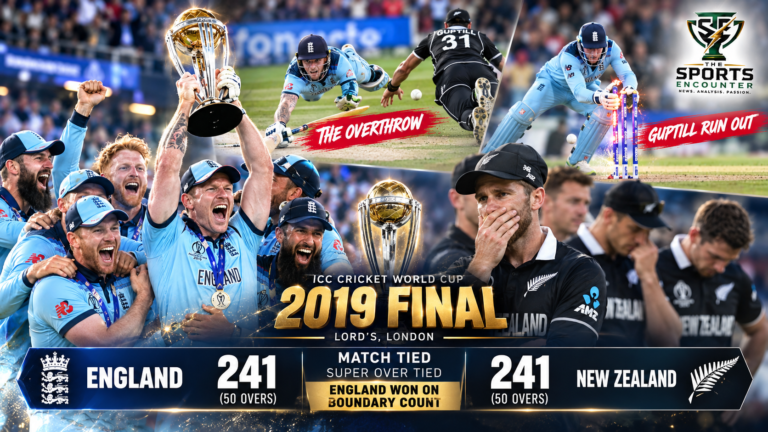
LONDON, England, July 14, 2019: New Zealand scored 241.
England scored 241.
They played a Super Over.
England scored 15.
Story at a glance
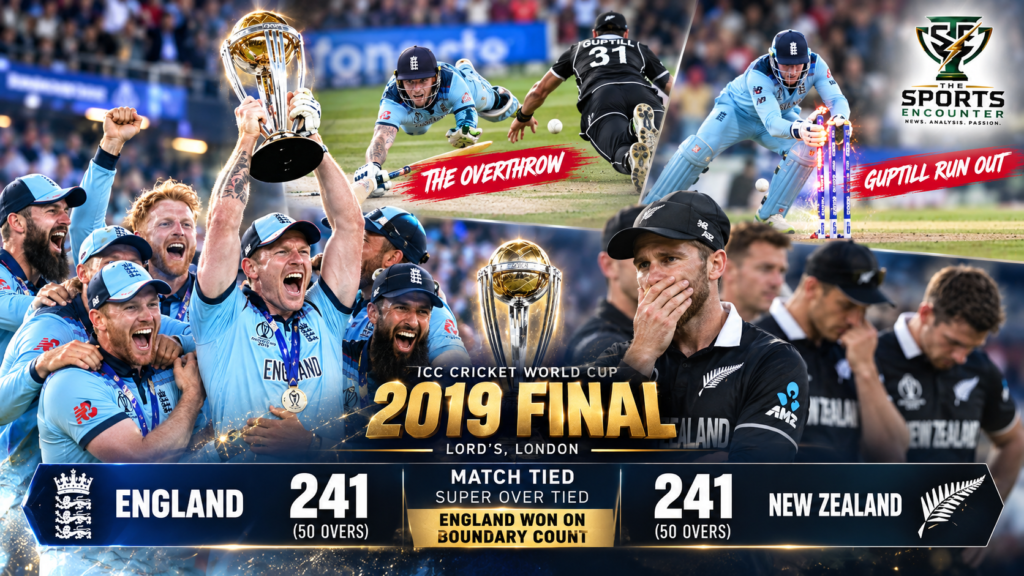
Why Match 39 Belongs in A Celebration of 5000 ODIs
Most great matches eventually provide separation.
New Zealand Choose a Total They Believe They Can Defend
Kane Williamson won the toss and chose to bat.
Martin Guptill Gives New Zealand a Faster Start
Guptill scored 19 from 18.
Henry Nicholls Produces New Zealand’s Only Fifty
Nicholls made 55 from 77 balls.
Liam Plunkett Breaks New Zealand’s Middle Order
Plunkett’s inclusion in England’s World Cup strategy had always been based on one particular strength.
New Zealand scored 15.
One hundred overs had failed to separate them. Two more could not do it either.
Yet somebody had to leave Lord’s holding the World Cup.
England finally did, not because they scored more runs than New Zealand, and not because they won the Super Over, but because the playing conditions moved to another tiebreaker: boundaries.
England had 26 across the match and Super Over.
New Zealand had 17.
Eoin Morgan’s team were world champions.
Kane Williamson’s side had somehow reached the end of a World Cup final without being outscored and still lost the trophy.
Even that extraordinary description leaves out half the story.
England had been 86/4 chasing 242.
Ben Stokes and Jos Buttler rebuilt the innings with 110.
Trent Boult then appeared to catch Stokes near the boundary, only to step on the rope.
Martin Guptill’s throw later struck Stokes’ bat as the England all-rounder dived to complete a second run and raced away for four overthrows.
England needed two from the last ball of regulation play.
Mark Wood was run out attempting the second.
Tie.
The Super Over followed.
Tie again.
Then Guptill, whose throw had been involved in the strangest moment of the regulation innings, came back for the final delivery of the Super Over needing two runs to win the World Cup.
He got one.
Jos Buttler broke the stumps.
England erupted.
New Zealand stood motionless.
That is why this final is Match 39 in A Celebration of 5000 ODIs.
The original series roadmap describes it as perhaps the strongest candidate for the most dramatic ODI ever played.
It is difficult to argue otherwise.
TL;DR
- New Zealand won the toss and batted first.
- New Zealand scored 241/8 in 50 overs.
- Henry Nicholls top-scored with 55 from 77 balls.
- Tom Latham made 47 from 56.
- Liam Plunkett and Chris Woakes took three wickets each.
- England fell to 86/4 chasing 242.
- Ben Stokes and Jos Buttler added 110 for the fifth wicket.
- Buttler scored 59 from 60 balls.
- Stokes finished unbeaten on 84 from 98.
- Trent Boult stepped on the boundary after taking what appeared to be a catch off Stokes late in the chase.
- Martin Guptill’s throw then deflected off Stokes’ bat and reached the boundary in the final over.
- England finished 241 all out from 50 overs.
- The match was tied.
- England scored 15 in the Super Over.
- New Zealand also scored 15.
- The Super Over was tied.
- England were declared winners on boundary count, 26-17.
- Ben Stokes was named Player of the Match.
- England won their first men’s ODI World Cup title.
- The ICC subsequently abandoned boundary count as the knockout tiebreak procedure, with tied Super Overs in semifinals and finals to be repeated until a winner emerges.
England vs New Zealand 2019 World Cup Final: Match at a Glance
| Detail | Information |
|---|---|
| Competition | ICC Cricket World Cup 2019 |
| Match | Final |
| Date | July 14, 2019 |
| Venue | Lord’s, London |
| Toss | New Zealand won and batted |
| New Zealand | 241/8 in 50 overs |
| England | 241 all out in 50 overs |
| Regulation result | Match tied |
| England Super Over | 15 |
| New Zealand Super Over | 15 |
| Super Over result | Tied |
| Final tiebreak | Boundary count |
| Boundary count | England 26, New Zealand 17 |
| Official winner | England |
| Player of the Match | Ben Stokes |
| England top scorer | Ben Stokes, 84* |
| New Zealand top scorer | Henry Nicholls, 55 |
| Best England bowling | Liam Plunkett 3/42, Chris Woakes 3/37 |
| Best New Zealand bowling | Lockie Ferguson 3/50, Jimmy Neesham 3/43 |
| Key partnership | Stokes and Buttler, 110 |
| Tournament consequence | England won their first men’s ODI World Cup |
Why Match 39 Belongs in A Celebration of 5000 ODIs
Most great matches eventually provide separation.
This one refused.
New Zealand could not score more than England.
England could not score more than New Zealand.
England could not score more in the Super Over.
New Zealand could not score more in the Super Over.
After 102 overs of cricket, the teams remained level.
The trophy therefore passed to England through a secondary condition that had barely entered public consciousness before the match: boundary count.
That alone makes this ODI unique.
But the number of events required to produce that ending makes it almost impossible to replicate.
Boult’s foot touched the boundary.
Guptill’s throw hit Stokes’ bat.
England were run out from the last ball.
Neesham hit Archer for six in the Super Over.
Guptill came back for a second run.
Buttler completed another run-out.
Every one of those moments could have produced a different world champion.
That is precisely why this final belongs at the heart of A Celebration of 5000 ODIs.
New Zealand Choose a Total They Believe They Can Defend
Kane Williamson won the toss and chose to bat.
The decision reflected the conditions and New Zealand’s tournament identity.
This was not a side built around overwhelming teams with 350.
New Zealand had reached the final by reading surfaces well, putting defendable totals on the board and trusting one of the competition’s strongest attacks.
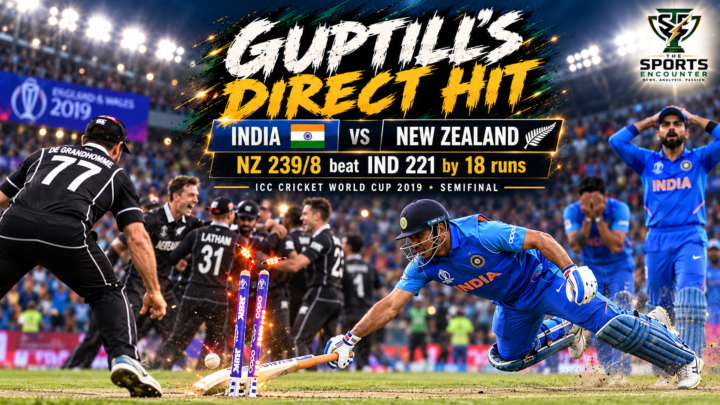
They had done exactly that four days earlier when 239 proved enough to eliminate India in the semifinal.
That extraordinary escape is revisited in Match 38: India Rise From 5/3, but Guptill’s Direct Hit Sends New Zealand Back to the World Cup Final.
At Lord’s, New Zealand followed the same logic.
They made 241.
The number looked modest.
The pitch made it dangerous.
Martin Guptill Gives New Zealand a Faster Start
Guptill scored 19 from 18.
Two fours.
One six.
It was not a substantial innings, but it briefly gave New Zealand momentum before Chris Woakes trapped him lbw.
New Zealand were 29/1.
That brought Williamson together with Henry Nicholls.
The pair were not interested in forcing the pace.
They understood that wickets carried greater value than early acceleration.
Henry Nicholls Produces New Zealand’s Only Fifty
Nicholls made 55 from 77 balls.
Four boundaries.
No sixes.
His strike rate of 71.43 reflected the conditions.
The innings was valuable because New Zealand never established complete command.
Someone needed to bat long enough to provide structure.
Nicholls did.
He added 74 with Williamson.
At 103/1, New Zealand were beginning to build something substantial.
Then Liam Plunkett intervened.
Liam Plunkett Breaks New Zealand’s Middle Order
Plunkett’s inclusion in England’s World Cup strategy had always been based on one particular strength.
Middle-over wickets.
The final became a perfect demonstration.
He removed Williamson for 30.
Four overs later, he bowled Nicholls for 55.
Later, he dismissed Jimmy Neesham.
His final figures were:
10 overs
42 runs
3 wickets
Economy: 4.20
New Zealand never completely recovered the momentum they had at 103/1.
Plunkett deserves considerable credit for that.
Kane Williamson’s Final Is About Captaincy More Than Runs
Williamson made 30 from 53 balls.
By his standards, it was a modest innings.
But his tournament had already been exceptional.
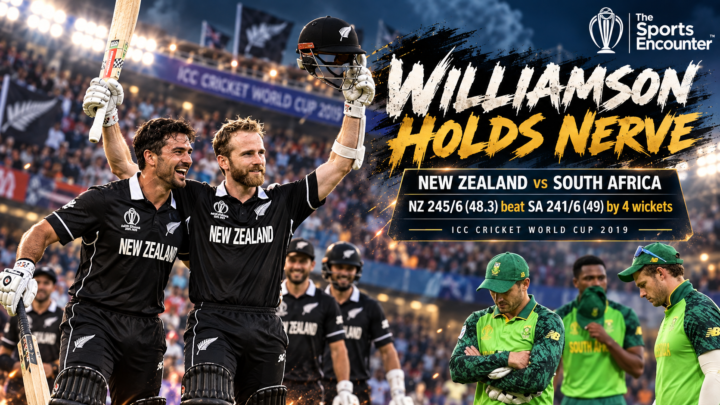
He had rescued New Zealand against South Africa with an unbeaten century in Match 35.
He made 148 against West Indies before New Zealand survived Carlos Brathwaite’s astonishing pursuit in Match 32.
And he had managed the Indian semifinal brilliantly.
In the final, his greatest contribution came later.
With 241 to defend, Williamson squeezed England through field placements, bowling changes and pressure.
England were 86/4.
The World Cup was beginning to move toward New Zealand.
Tom Latham Pushes New Zealand to 241
Tom Latham made 47 from 56 deliveries.
Two fours.
One six.
His innings became increasingly important as New Zealand lost wickets around him.
Ross Taylor managed 15.
Neesham made 19.
Colin de Grandhomme contributed 16.
Latham provided the late innings with enough substance to move beyond 220 and eventually toward 240.
When Woakes removed him at 232/7, New Zealand had nine balls left.
They squeezed out another nine runs.
Final total: 241/8.
Nobody knew then how perfectly precise that number would become.
Chris Woakes Gives England Three Crucial Wickets
Woakes finished with 3/37 from nine overs.
He removed Guptill.
He later dismissed de Grandhomme.
Then he removed Latham.
Those wickets helped prevent New Zealand from accelerating beyond England’s reach.
Combined with Plunkett’s 3/42, England took six wickets through two bowlers who attacked very different phases of the innings.
The target was 242.
England had chased larger totals routinely during their transformation under Eoin Morgan.
This one would become harder than any of them.
New Zealand’s 241 Becomes Much Bigger Once England Start Batting
England had built their modern ODI reputation through aggression.
New Zealand refused to feed it.
Matt Henry removed Jason Roy for 17.
Colin de Grandhomme conceded almost nothing.
Joe Root became trapped in an innings of seven from 30 deliveries before de Grandhomme removed him.
Jonny Bairstow made 36 but never fully escaped the pressure.
Lockie Ferguson bowled him.
England were 71/3.
Then Eoin Morgan fell for nine.
Ferguson produced an outstanding catch off Neesham.
England were 86/4.
The hosts were halfway toward the point where their batting depth would no longer matter.
Colin de Grandhomme Bowls One of the Quiet Masterpieces of the Final
De Grandhomme took only one wicket.
His spell was still extraordinary.
10 overs
2 maidens
25 runs
1 wicket
Economy: 2.50
In a World Cup final.
Against England.
He removed Root and denied the middle order the easy release England usually found through its depth.
Those 10 overs helped turn 241 into a serious target.
The spell also complemented New Zealand’s faster bowlers perfectly.
Henry attacked.
Ferguson attacked.
Neesham took wickets.
De Grandhomme squeezed.
Lockie Ferguson Removes Bairstow and Later Breaks the Big Partnership
Ferguson finished with 3/50.
His first major wicket was Bairstow for 36.
His most important came much later.
By then, Stokes and Buttler had dragged England back into the game.
Ferguson dismissed Buttler for 59.
That wicket reopened everything.
He later removed Woakes as well.
The final changed every few overs.
Ferguson was repeatedly involved when it did.
Ben Stokes and Jos Buttler Begin at 86/4
This is where England’s World Cup could have ended quietly.
They needed another 156.
New Zealand had removed four of their most important batters.
The required rate was climbing.
The bowling was disciplined.
Stokes and Buttler responded without treating the situation like an emergency.
They accumulated.
They ran hard.
They waited for poorer balls.
Then the boundaries began to arrive.
The partnership grew.
Fifty.
Seventy-five.
One hundred.
England were alive again.
Jos Buttler’s 59 Restores England’s Belief
Buttler made 59 from 60 balls.
Six fours.
His innings was almost perfectly suited to the situation.
He did not attempt to become the destructive finisher who could score 100 from 60.
England needed survival first.
Buttler gave them that.
Then he accelerated.
The partnership with Stokes reached 110.
England had moved from 86/4 to 196/4.
The World Cup looked as if it might finally be shifting toward the hosts.
Ferguson removed Buttler.
The argument reopened.
Player of the Match Ben Stokes Refuses to Let England Lose
Stokes finished unbeaten on:
84 runs
98 balls
5 fours
2 sixes
Those numbers alone explain only part of his afternoon.
He arrived with England 71/3.
He saw Morgan fall at 86.
He rebuilt with Buttler.
He watched Buttler leave.
Then Woakes.
Then Plunkett.
Then Archer.
He entered the last over needing 15 with England eight wickets down.
And somehow remained there when the innings ended tied.
Stokes then returned for the Super Over.
He helped England make another 15.
The official Player of the Match award was inevitable.
No player carried more of England’s final.
Boult Steps on the Rope and the World Cup Changes Again
Before the famous overthrow came another moment that could have ended England’s chase.
Stokes attacked Ferguson.
Boult took the ball near the boundary.
For a moment, New Zealand appeared to have their wicket.
Then Boult’s foot touched the rope.
Six.
Instead of Stokes being dismissed for 63 with England needing 22 from eight balls, he remained at the crease.
Boult knew immediately what had happened.
The margins were already becoming absurd.
The strangest one was still coming.
England Need 15 From the Final Over
Boult had the ball.
Stokes had the strike.
England needed 15.
The first ball produced no run.
The second produced no run.
Fifteen from four.
Stokes then hit the third ball for six.
Nine from three.
And then came the delivery that would be discussed for years.
Guptill’s Throw Hits Stokes’ Bat
Stokes struck toward the leg side.
He and Adil Rashid ran.
Guptill collected in the deep and threw toward the wicket.
Stokes dived to complete the second.
The ball struck his outstretched bat.
It deflected past the fielders.
It kept going.
Boundary.
The umpires awarded six runs in total from the play.
Stokes immediately raised his hands in apology.
He had not intentionally redirected the throw.
None of that changed the score.
England now needed three from two balls.
The incident remains one of cricket’s most discussed pieces of accidental fortune.
The law governing overthrow boundaries subsequently became central to debate over whether the correct number of runs had been awarded.
But on the field, the decision stood.
Three from two.
World Cup still alive.
Two Run-Outs Produce the First Tie
England could not find a boundary from either of the final two deliveries.
On the fifth ball, they attempted two.
Rashid was run out.
One completed run.
England needed two from the final ball.
Stokes struck again.
He and Mark Wood ran the first.
They turned for the second because they had no alternative.
Wood was run out.
England finished on 241.
Exactly New Zealand’s score.
One hundred overs had produced no winner.
Complete Match Scorecard
New Zealand Batting: 241/8 in 50 Overs
| Batter | Dismissal | R | B | 4s | 6s | SR |
|---|---|---|---|---|---|---|
| Martin Guptill | lbw b Chris Woakes | 19 | 18 | 2 | 1 | 105.56 |
| Henry Nicholls | b Liam Plunkett | 55 | 77 | 4 | 0 | 71.43 |
| Kane Williamson (c) | c Jos Buttler b Liam Plunkett | 30 | 53 | 2 | 0 | 56.60 |
| Ross Taylor | lbw b Mark Wood | 15 | 31 | 0 | 0 | 48.39 |
| Tom Latham (wk) | c sub (James Vince) b Chris Woakes | 47 | 56 | 2 | 1 | 83.93 |
| Jimmy Neesham | c Joe Root b Liam Plunkett | 19 | 25 | 3 | 0 | 76.00 |
| Colin de Grandhomme | c sub (James Vince) b Chris Woakes | 16 | 28 | 0 | 0 | 57.14 |
| Mitchell Santner | not out | 5 | 9 | 0 | 0 | 55.56 |
| Matt Henry | b Jofra Archer | 4 | 2 | 1 | 0 | 200.00 |
| Trent Boult | not out | 1 | 2 | 0 | 0 | 50.00 |
Did not bat: Lockie Ferguson
Extras: 30 (12 leg byes, 17 wides, 1 no-ball)
Total: 241/8 in 50 overs
Run rate: 4.82
Fall of wickets: 29/1 Guptill (6.2), 103/2 Williamson (22.4), 118/3 Nicholls (26.5), 141/4 Taylor (33.1), 173/5 Neesham (38.6), 219/6 de Grandhomme (46.5), 232/7 Latham (48.3), 240/8 Henry (49.3).
England Bowling
| Bowler | O | M | R | W | Econ |
|---|---|---|---|---|---|
| Chris Woakes | 9 | 0 | 37 | 3 | 4.11 |
| Jofra Archer | 10 | 0 | 42 | 1 | 4.20 |
| Liam Plunkett | 10 | 0 | 42 | 3 | 4.20 |
| Mark Wood | 10 | 1 | 49 | 1 | 4.90 |
| Adil Rashid | 8 | 0 | 39 | 0 | 4.88 |
| Ben Stokes | 3 | 0 | 20 | 0 | 6.67 |
England Batting: 241 All Out in 50 Overs
| Batter | Dismissal | R | B | 4s | 6s | SR |
|---|---|---|---|---|---|---|
| Jason Roy | c Tom Latham b Matt Henry | 17 | 20 | 3 | 0 | 85.00 |
| Jonny Bairstow | b Lockie Ferguson | 36 | 55 | 7 | 0 | 65.45 |
| Joe Root | c Tom Latham b Colin de Grandhomme | 7 | 30 | 0 | 0 | 23.33 |
| Eoin Morgan (c) | c Lockie Ferguson b Jimmy Neesham | 9 | 22 | 0 | 0 | 40.91 |
| Ben Stokes | not out | 84 | 98 | 5 | 2 | 85.71 |
| Jos Buttler (wk) | c sub (Tim Southee) b Lockie Ferguson | 59 | 60 | 6 | 0 | 98.33 |
| Chris Woakes | c Tom Latham b Lockie Ferguson | 2 | 4 | 0 | 0 | 50.00 |
| Liam Plunkett | c Trent Boult b Jimmy Neesham | 10 | 10 | 1 | 0 | 100.00 |
| Jofra Archer | b Jimmy Neesham | 0 | 1 | 0 | 0 | 0.00 |
| Adil Rashid | run out (Boult/Santner) | 0 | 0 | 0 | 0 | 0.00 |
| Mark Wood | run out (Boult/Neesham) | 0 | 0 | 0 | 0 | 0.00 |
Extras: 17 (2 byes, 3 leg byes, 12 wides)
Total: 241 all out in 50 overs
Run rate: 4.82
Fall of wickets: 28/1 Roy (5.4), 59/2 Root (16.3), 71/3 Bairstow (19.3), 86/4 Morgan (23.1), 196/5 Buttler (44.5), 203/6 Woakes (46.1), 220/7 Plunkett (48.3), 227/8 Archer (48.6), 240/9 Rashid (49.5), 241/10 Wood (49.6).
New Zealand Bowling
| Bowler | O | M | R | W | Econ |
|---|---|---|---|---|---|
| Trent Boult | 10 | 0 | 67 | 0 | 6.70 |
| Matt Henry | 10 | 2 | 40 | 1 | 4.00 |
| Colin de Grandhomme | 10 | 2 | 25 | 1 | 2.50 |
| Lockie Ferguson | 10 | 0 | 50 | 3 | 5.00 |
| Jimmy Neesham | 7 | 0 | 43 | 3 | 6.14 |
| Mitchell Santner | 3 | 0 | 11 | 0 | 3.67 |
England’s Super Over: Stokes and Buttler Find 15
The World Cup now became a six-ball contest.
England batted first.
Stokes and Buttler returned.
Boult bowled.
| Ball | Outcome | England Score |
|---|---|---|
| 0.1 | Stokes, 3 runs | 3 |
| 0.2 | Buttler, 1 run | 4 |
| 0.3 | Stokes, FOUR | 8 |
| 0.4 | Stokes, 1 run | 9 |
| 0.5 | Buttler, 2 runs | 11 |
| 0.6 | Buttler, FOUR | 15 |
England Super Over: 15/0
New Zealand needed 16 to win outright.
Fifteen would produce another tie.
Because of the playing conditions then in force, a tied Super Over would favor England on boundary count.
Jimmy Neesham Almost Wins the World Cup in Six Balls
Jofra Archer took responsibility for England.
Neesham and Guptill walked out for New Zealand.
Archer’s first delivery was wide.
Then Neesham took two.
Then came the shot that made Lord’s freeze.
Six.
New Zealand suddenly needed seven from four.
Two.
Two.
One.
Guptill took strike for the final ball.
Two runs required to win.
One would tie the Super Over.
| Ball | Outcome | New Zealand Score |
|---|---|---|
| Wide | 1 wide | 1 |
| 0.1 | Neesham, 2 runs | 3 |
| 0.2 | Neesham, SIX | 9 |
| 0.3 | Neesham, 2 runs | 11 |
| 0.4 | Neesham, 2 runs | 13 |
| 0.5 | Neesham, 1 run | 14 |
| 0.6 | Guptill, 1 run and run out attempting second | 15 |
New Zealand Super Over: 15
Tie.
Again.
Guptill Runs for the World Cup
Guptill clipped Archer toward deep midwicket.
The first run was comfortable.
The second had to be attempted.
Jason Roy collected.
His throw reached Buttler.
Guptill dived.
Buttler removed the bails.
Guptill was short.
New Zealand had 15.
England had 15.
No winner on runs.
Lord’s waited for the rulebook.
Boundary Count Makes England World Champions
England had struck more boundaries across the match and Super Over.
England: 26
New Zealand: 17
Under the playing conditions then in force, England therefore won the World Cup.
They had not outscored New Zealand.
New Zealand had not outscored them.
Boundary count separated them.
England had finally won the men’s ODI World Cup after losing the finals of 1979, 1987 and 1992.
New Zealand had reached consecutive finals and still remained without the trophy.
The ICC later changed the knockout procedure so that a tied Super Over in a semifinal or final would lead to further Super Overs until one team scored more runs. The boundary-count method that settled Lord’s would not decide another World Cup knockout in the same way.
Eight Turning Points That Created the Most Extraordinary Finish
1. Plunkett Removes Williamson and Nicholls
New Zealand had reached 103/1.
Plunkett dismissed both set batters and prevented a major total from developing.
2. Latham Pushes New Zealand to 241
His 47 gave the lower middle order enough structure to establish a defendable target.
Without those runs, there may never have been a Super Over.
3. England Collapse to 86/4
New Zealand turned a modest target into a crisis.
Morgan’s dismissal left England with their World Cup resting largely on Stokes and Buttler.
4. Stokes and Buttler Add 110
The final stopped being a New Zealand defense and became a genuine contest again.
5. Ferguson Removes Buttler
England were 196/4.
Buttler’s dismissal reopened the tail and forced Stokes to finish almost alone.
6. Boult Steps on the Boundary
What appeared to be Stokes’ dismissal became six runs instead.
New Zealand lost one of their clearest opportunities to end the chase.
7. Guptill’s Throw Deflects off Stokes
England were running out of deliveries.
The accidental deflection brought six runs from the play and left three required from two.
8. Buttler Runs Out Guptill
New Zealand needed two from the final Super Over delivery.
They completed one.
The second disappeared in Buttler’s gloves.
The scores remained tied.
The World Cup moved to boundary count.
Jos Buttler’s 59 Was the Partnership England Could Not Win Without
Stokes understandably owns the enduring image of England’s chase.
But Buttler’s innings cannot be treated as support work.
He entered with England under severe pressure.
He scored 59 from 60.
He added 110 with Stokes.
Then, after his dismissal, he returned for the Super Over and struck the final delivery of England’s six balls for four.
Finally, he completed the run-out that ended New Zealand’s Super Over.
His fingerprints were on every major phase of England’s recovery.
Jimmy Neesham Nearly Becomes New Zealand’s World Cup Hero
Neesham had already taken three wickets.
Morgan.
Plunkett.
Archer.
He then came out to bat in the Super Over.
A wide.
Two.
Six.
Two.
Two.
One.
Neesham personally supplied 13 runs from five legal deliveries.
For several seconds, it looked as though New Zealand had found their hero.
Only one run separated that performance from a World Cup-winning one.
Lockie Ferguson’s 3/50 Keeps New Zealand in Control
Ferguson removed Bairstow.
Then Buttler.
Then Woakes.
Each wicket arrived at a useful point.
The Buttler dismissal mattered most because England’s 110-run fifth-wicket recovery had started to change the final.
Ferguson stopped it.
He had already played a central role in New Zealand reaching the final and finished the tournament as one of its leading wicket-takers.
His final deserved better than the outcome suggests.
New Zealand Lost Without Being Outscored
This is what makes Match 39 different from almost every other great final in ODI history.
In 1975, West Indies survived Australia’s frantic resistance.
In 1983, India defended 183 to end West Indies’ reign.
In 2007, Adam Gilchrist’s 149 overwhelmed Sri Lanka.
Those finals ultimately produced a conventional distinction.
One team scored enough.
The other did not.
Lord’s produced no such answer.
That is why it remains so difficult to describe New Zealand simply as having “lost.”
Officially, England won.
Numerically, after 102 overs, the teams remained level.
New Zealand Had Been Building Toward This for Four Years
The heartbreak also needs the context of 2015.
New Zealand had never reached a World Cup final before Grant Elliott struck Dale Steyn for six in Auckland.
That breakthrough is revisited in Match 29: Elliott’s Six Breaks New Zealand’s Semifinal Barrier and South African Hearts.
Australia then overwhelmed them in the final.
Four years later, New Zealand came back.
This time they lasted every ball.
They matched the host nation.
They tied the game.
They tied the Super Over.
And they still watched somebody else lift the trophy.
That makes the 2019 defeat far more painful than 2015.
England Complete a Four-Year Reinvention
England’s victory also carried enormous institutional significance.
Their 2015 World Cup campaign had ended in humiliation.
The response was a complete transformation of their ODI identity.
England became more aggressive.
They expanded batting depth.
They embraced higher scoring rates.
They built toward a home World Cup.
By 2019, they entered as favorites.
Then they nearly missed the semifinals.
Sri Lanka beat them.
Australia beat them.
England recovered.
They eventually defeated India and New Zealand in must-win group matches, destroyed Australia in the semifinal and reached Lord’s.
Four years of rebuilding ended with a trophy decided by the narrowest mechanism imaginable.
Why the Overthrow Remains So Controversial
The deflection from Stokes’ bat was accidental.
That is important.
Stokes immediately apologized.
The controversy concerns the scoring of the play, not his conduct.
Cricket’s overthrow law ties the number of runs awarded to the boundary allowance plus completed runs and, in relevant circumstances, whether the batters had crossed at the instant of the throw.
Replays produced intense debate over whether England should have received five rather than six runs.
The umpires awarded six.
That remained the official score.
It cannot be separated from the history of the final because one run was exactly the margin that did not exist at the end of regulation play.
Yet reducing the entire game to that single decision would also ignore everything else that happened.
New Zealand had other opportunities.
England had other setbacks.
The final required dozens of small moments to arrive at 241-241.
The Boundary-Count Rule Became Part of the Match’s Legacy
England did nothing wrong by winning under the playing conditions.
The rule existed.
It was applied.
They were world champions.
But the method immediately became part of the debate because the teams had twice finished level on runs.
A few months later, the ICC changed its procedure.
For knockout matches, tied Super Overs would be repeated until one side finished with more runs.
That later change strengthened the historical uniqueness of Lord’s.
The same finish could happen again.
The same tiebreak would not decide it.
Kane Williamson’s Reaction Became Part of the Story
Williamson had every reason to feel devastated.
New Zealand had done almost everything necessary to become world champions.
His reaction instead became widely admired.
He acknowledged the rules.
He recognized the tiny moments that could have moved the game either way.
And New Zealand accepted a result few teams would ever have imagined needing to process.
That response became part of Williamson’s reputation as much as his runs and captaincy during the tournament.
England’s First World Cup Came by the Smallest Possible Margin
England had reached three previous men’s ODI World Cup finals.
They lost all three.
Their fourth appearance lasted 100 regulation overs.
Still no winner.
Then two Super Overs.
Still no separation on runs.
Only the final tiebreak finally gave them the trophy.
For a nation that had helped create the game, becoming men’s ODI world champions took until 2019.
It could hardly have happened more dramatically.
Why Match 39 May Never Be Repeated
Cricket can produce another tie.
It can produce another tied Super Over.
It can produce another accidental deflection.
A fielder can step on another boundary rope.
A final can again reach the last ball.
What is unlikely is that all of those things happen in the same match.
The rule that ultimately separated England and New Zealand no longer operates in the same knockout situation.
That makes this final both repeatable in theory and impossible to reproduce in precisely the same form.
For a series celebrating 5,000 ODIs, few matches demonstrate the format’s capacity for chaos better.
Continue A Celebration of 5000 ODIs
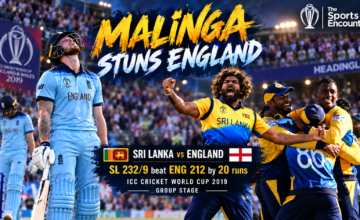
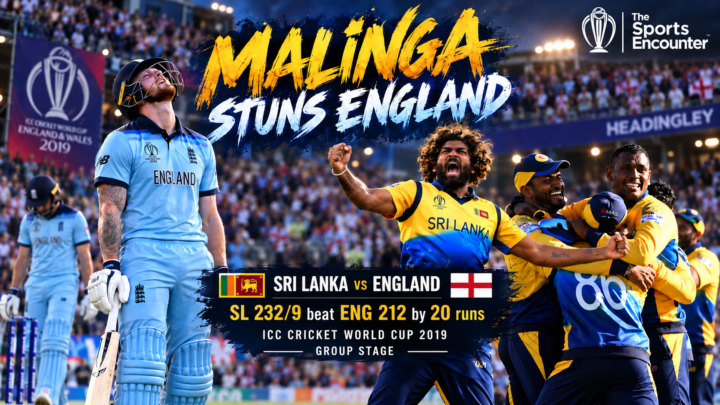
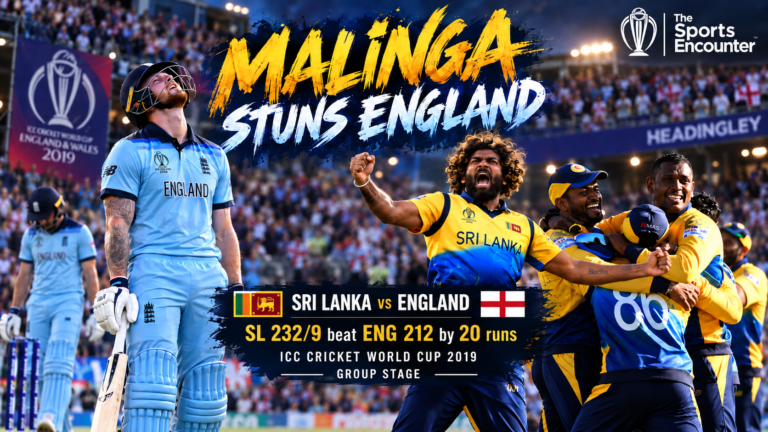 A Celebration of 5000 ODIsA Celebration of 5000 ODIs Match 36: Malinga Turns 232 Into a Trap as England’s World Cup Certainty Suddenly Cracks
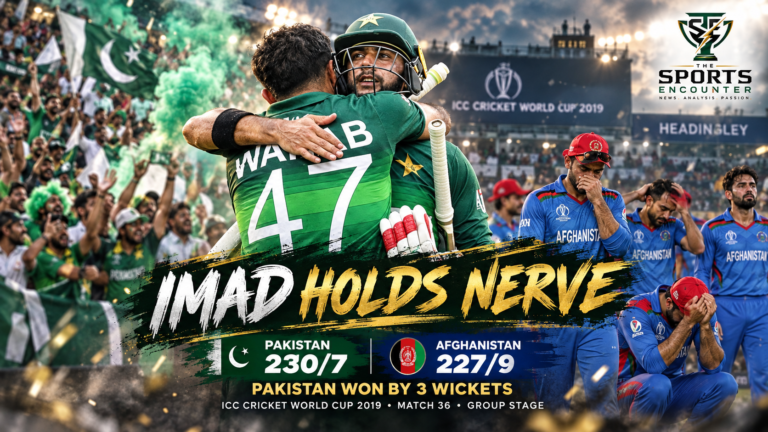 A Celebration of 5000 ODIsA Celebration of 5000 ODIs Match 33: Imad Wasim Drags Pakistan From 156/6 to a Two-Ball Escape Against Afghanistan
 A Celebration of 5000 ODIsA Celebration of 5000 ODIs Match 40: Maharaj Saves South Africa After Pakistan Turn 271 Into a One-Wicket World Cup Trap
Frequently Asked Questions
Who Won the 2019 Cricket World Cup Final?
England were declared winners of the 2019 ICC Cricket World Cup final against New Zealand after the match and Super Over were both tied. England won under the boundary-count tiebreak rule.
What Was the Score in the 2019 World Cup Final?
New Zealand made 241/8 from 50 overs. England were all out for 241 from their 50 overs.
What Happened in the Super Over?
England scored 15. New Zealand also scored 15.
Why Did England Win if the Super Over Was Tied?
The playing conditions used boundary count as the next tiebreaker. England had struck more boundaries across the match and Super Over.
What Was the Boundary Count?
England led the boundary count 26-17.
Who Was Player of the Match?
Ben Stokes was Player of the Match after scoring an unbeaten 84 from 98 balls and then contributing again in England’s Super Over.
What Was the Stokes Overthrow Incident?
Martin Guptill’s throw from the deep struck Stokes’ bat while Stokes was diving to complete a run and deflected to the boundary. Six runs were awarded from the play.
Did the Boundary-Count Rule Change After the Final?
Yes. The ICC subsequently changed the procedure so that tied Super Overs in semifinals and finals would be repeated until one team scored more runs.
What Partnership Saved England?
Ben Stokes and Jos Buttler added 110 for the fifth wicket after England had fallen to 86/4.
Who Were New Zealand’s Best Bowlers?
Lockie Ferguson took 3/50, Jimmy Neesham took 3/43, and Colin de Grandhomme produced an exceptional control spell of 1/25 from 10 overs.
Why Is This Match Included in A Celebration of 5000 ODIs?
Because neither 100 regulation overs nor the Super Over separated England and New Zealand. The final also contained Stokes’ 84, Buttler’s 59, the Boult boundary incident, the extraordinary overthrow deflection, two last-ball run-outs and the boundary-count tiebreak that crowned England world champions.
World Cup
- A Celebration of 5000 ODIs Match 40: Maharaj Saves South Africa After Pakistan Turn 271 Into a One-Wicket World Cup Trap
- A Celebration of 5000 ODIs Match 39: England Win the World Cup on Boundary Count After New Zealand Tie Them Twice
- Tim Ream Comes Home for USMNT Farewell as St. Louis Honors 86-Cap World Cup Captain
- A Celebration of 5000 ODIs Match 38: India Rise From 5/3, but Guptill’s Direct Hit Sends New Zealand Back to the World Cup Final
- A Celebration of 5000 ODIs Match 36: Malinga Turns 232 Into a Trap as England’s World Cup Certainty Suddenly Cracks