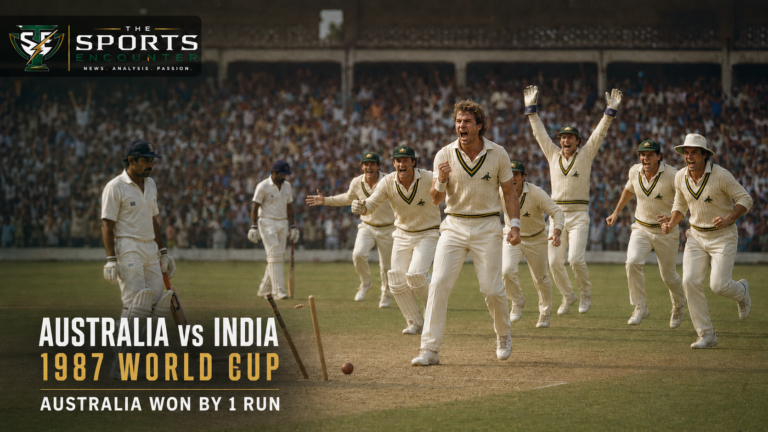
A Celebration of 5000 ODIs Match 6: Australia Beat India by One Run After Chennai Chase Turns Into Final-Over Agony
SEO Meta Title: India vs Australia 1987 World Cup Thriller
Meta Description: Australia edged India by one run in Chennai after Geoff Marsh’s century, Craig McDermott’s four wickets and a dramatic final-over collapse.
Suggested Slug: australia-india-1987-world-cup-one-run-thriller
Focus Keyphrase: Australia vs India 1987 World Cup
Excerpt: Geoff Marsh’s century gave Australia control, but India carried the chase to the final delivery before Steve Waugh secured a one-run World Cup escape in Chennai.
India needed two runs to tie when Maninder Singh faced Steve Waugh with one delivery left. Kiran More stood unbeaten at the other end, the Chennai crowd could barely process the tension, and a chase that had once appeared under control had reached its narrowest possible margin.
Waugh bowled straight. Maninder swung, missed and lost his stumps. Australia had won by one run.
The ending alone earns this match a place in A Celebration of 5000 ODIs, but the complete story carries even greater intrigue. Australia’s total had increased from 268 to 270 after a Dean Jones boundary was corrected from four to six during the innings break. India later finished on 269.
Geoff Marsh’s painstaking century, Navjot Sidhu’s five sixes, Craig McDermott’s middle-order intervention and Waugh’s final delivery produced a World Cup match in which every run acquired historical weight.
TL;DR
- Australia scored 270/6 after India chose to field in Chennai.
- Geoff Marsh made 110 from 141 balls and received the Player of the Match award.
- Kris Srikkanth scored 70 and Navjot Sidhu struck 73 during India’s chase.
- Craig McDermott took 4/56, including three wickets during a decisive middle-order spell.
- Steve Waugh bowled Maninder Singh from the penultimate delivery to complete a one-run victory.
- A Dean Jones boundary, initially recorded as four, was corrected to six during the innings break.
Australia vs India 1987 World Cup: Match Information
| Detail | Information |
|---|---|
| Match | India vs Australia, third match, 1987 World Cup |
| Date | October 9, 1987 |
| Venue | MA Chidambaram Stadium, Chennai |
| Toss | India won the toss and fielded |
| Australia | 270/6 in 50 overs |
| India | 269 all out in 49.5 overs |
| Result | Australia won by one run |
| Player of the Match | Geoff Marsh, 110 from 141 balls |
| Top Indian performers | Navjot Sidhu 73, Kris Srikkanth 70 |
| Leading bowler | Craig McDermott, 4/56 |
| Final turning point | Steve Waugh bowled Maninder Singh with one ball remaining |
| Tournament stage | Group A |
| ODI number | ODI No. 453 |
Match details can also be checked through the official ICC cricket platform.
Complete Match Scorecard
Australia Innings: 270/6 in 50 Overs
| Batter | Dismissal | Runs | Balls | 4s | 6s |
|---|---|---|---|---|---|
| David Boon | lbw b Shastri | 49 | 68 | 5 | 0 |
| Geoff Marsh | c Azharuddin b Prabhakar | 110 | 141 | 7 | 1 |
| Dean Jones | c Sidhu b Maninder Singh | 39 | 35 | 2 | 2 |
| Allan Border | b Binny | 16 | 22 | 0 | 0 |
| Tom Moody | c Kapil Dev b Prabhakar | 8 | 13 | 1 | 0 |
| Steve Waugh | Not out | 19 | 17 | 0 | 0 |
| Simon O’Donnell | Run out | 7 | 10 | 0 | 0 |
| Greg Dyer | Did not bat | ||||
| Peter Taylor | Did not bat | ||||
| Craig McDermott | Did not bat | ||||
| Bruce Reid | Did not bat | ||||
| Extras | 18 leg byes, 2 wides, 2 no-balls | 22 | |||
| Total | Six wickets, 50 overs | 270 |
India Bowling
| Bowler | Overs | Maidens | Runs | Wickets |
|---|---|---|---|---|
| Kapil Dev | 10 | 0 | 41 | 0 |
| Manoj Prabhakar | 10 | 0 | 47 | 2 |
| Roger Binny | 7 | 0 | 46 | 1 |
| Maninder Singh | 10 | 0 | 48 | 1 |
| Ravi Shastri | 10 | 0 | 50 | 1 |
| Mohammad Azharuddin | 3 | 0 | 20 | 0 |
India Innings: 269 All Out in 49.5 Overs
| Batter | Dismissal | Runs | Balls | 4s | 6s |
|---|---|---|---|---|---|
| Sunil Gavaskar | c Reid b Taylor | 37 | 32 | 6 | 1 |
| Kris Srikkanth | lbw b Waugh | 70 | 83 | 7 | 0 |
| Navjot Sidhu | b McDermott | 73 | 79 | 4 | 5 |
| Dilip Vengsarkar | c Jones b McDermott | 29 | 45 | 2 | 0 |
| Mohammad Azharuddin | b McDermott | 10 | 14 | 1 | 0 |
| Kapil Dev | c Boon b O’Donnell | 6 | 10 | 0 | 0 |
| Ravi Shastri | c and b McDermott | 12 | 11 | 1 | 0 |
| Kiran More | Not out | 12 | 14 | 2 | 0 |
| Roger Binny | Run out | 0 | 3 | 0 | 0 |
| Manoj Prabhakar | Run out | 5 | 7 | 0 | 0 |
| Maninder Singh | b Waugh | 4 | 5 | 0 | 0 |
| Extras | 2 byes, 7 leg byes, 2 wides | 11 | |||
| Total | All out, 49.5 overs | 269 |
Australia Bowling
| Bowler | Overs | Maidens | Runs | Wickets |
|---|---|---|---|---|
| Craig McDermott | 10 | 0 | 56 | 4 |
| Bruce Reid | 10 | 2 | 35 | 0 |
| Simon O’Donnell | 9 | 1 | 32 | 1 |
| Peter Taylor | 5 | 0 | 46 | 1 |
| Steve Waugh | 9.5 | 0 | 52 | 2 |
| Allan Border | 6 | 0 | 39 | 0 |
Geoff Marsh Gives Australia Its Foundation
Marsh batted through most of Australia’s innings and refused to let Chennai’s heat, spin or slow surface separate him from his method.
His 110 from 141 balls included seven fours and one six. The pace appears restrained beside modern ODI scoring, but Australia needed an anchor while adjusting to unfamiliar conditions. Marsh added 110 for the opening wicket with David Boon, who contributed 49.
Dean Jones then accelerated with 39 from 35 deliveries. Steve Waugh’s unbeaten 19 helped Australia reach 270, a strong total in the first World Cup played under the now-familiar 50-over format.
Marsh deserved the Player of the Match award because his innings gave every later Australian contribution its value.
The Boundary Correction That Became Part of the Result
Jones struck Maninder Singh toward the long boundary during his 39. The umpires initially awarded four, but Australia argued that the ball had cleared the rope.
During the innings break, the decision was corrected to six, with Indian captain Kapil Dev accepting the amendment. Australia’s score moved from 268 to 270.
The revision did not single-handedly defeat India. The chase still contained 299 legal deliveries, ten wickets and several moments India could have controlled. Yet the final margin ensured those two corrected runs would remain attached to the match forever.
Kapil’s career and sporting influence extend far beyond that painful incident, as explored in The Sports Encounter’s profile of the all-rounder who transformed Indian cricket.
Kris Srikkanth and Navjot Sidhu Put India Ahead
India began with aggression. Gavaskar made 37 from 32 balls before Srikkanth settled into a more substantial innings of 70.
Sidhu then attacked Australia’s spinners, hitting five sixes in his 73 from 79 balls. India reached 207/2 and appeared capable of controlling the remaining 64 runs.
That position made the collapse more damaging. India had wickets, established batters and a required rate within reach. Australia needed a bowler to disrupt the chase before India could coast through the final overs.
Craig McDermott Changes the Match
McDermott supplied Australia’s decisive spell.
He bowled Sidhu for 73, removed Azharuddin and then dismissed Vengsarkar, reducing India from 207/2 to 232/5. His fourth wicket came when he caught Shastri from his own bowling.
McDermott finished with 4/56. Bruce Reid went wicketless but conceded only 35 from ten overs, giving Australia the control required to survive Peter Taylor’s expensive spell.
Steve Waugh Owns the Final Delivery
India entered the final stages with More trying to guide the lower order home. Run-outs removed Binny and Prabhakar, but Maninder struck four and kept the chase alive.
Two runs were required from two balls. Waugh needed one wicket.
His straight delivery defeated Maninder and hit the stumps. Australia escaped with the smallest winning margin available in ODI cricket.
Waugh’s figures of 2/52 carried more importance than their economy rate suggests. He dismissed Srikkanth and then ended the match himself.
Why Match 6 Belongs in A Celebration of 5000 ODIs
The one-run margin supplies an obvious answer, but this match offers much more.
It featured a century, an aggressive Indian chase, a middle-order collapse, two late run-outs, a final-delivery wicket and a corrected boundary that exactly matched the eventual difference between the teams.
The result also introduced the resilience that would define Australia’s tournament. Allan Border’s side eventually lifted its first World Cup, beginning the country’s rise toward ODI dominance.
Readers can revisit India’s previous World Cup triumph through Match 5, the 1983 final against West Indies, Kapil Dev’s rescue against Zimbabwe and the chaotic 1975 World Cup final.
For more historical reports and current analysis, visit The Sports Encounter Cricket Hub.
India had controlled significant portions of the chase. Australia controlled its final delivery. In Chennai, that was enough to separate 270 from 269 and victory from one of India’s most painful World Cup defeats.

A Celebration of 5000 ODIs
A Celebration of 5000 ODIs Match 17: Inzamam and Wasim Deny Australia in a Headingley Thriller
Inzamam-ul-Haq rebuilt Pakistan’s innings before Wasim Akram and Saqlain Mushtaq stopped Michael Bevan’s pursuit, sealing a tense 10-run World Cup victory at Headingley.
Australia still needed 62 runs when Michael Bevan watched Steve Waugh’s off stump fly out of the ground. The target remained possible, but Pakistan had released Shoaib Akhtar at precisely the moment when the chase appeared ready to turn.
Bevan carried on. Australia reached 265 with seven deliveries available, leaving 11 runs between Pakistan and a victory that had repeatedly threatened to escape.
Wasim Akram settled the argument himself. Damien Martyn fell to the fourth ball of the final over, and Glenn McGrath lost his stumps two deliveries later. Pakistan had defended 275 by 10 runs after a contest shaped by recoveries, counterattacks and a constant sense that either team could seize control.
The tension and quality on both sides explain why Pakistan versus Australia at Headingley is Match 17 in A Celebration of 5000 ODIs.
TL;DR
- Pakistan beat Australia by 10 runs in their 1999 World Cup group match at Headingley.
- Inzamam-ul-Haq scored 81 after Pakistan slipped to 46/3 and earned Player of the Match.
- Abdul Razzaq supported Inzamam with 60 in a match-defining 118-run partnership.
- Moin Khan’s 31 from 12 balls lifted Pakistan to 275/8.
- Michael Bevan made 61 and kept Australia alive deep into the final over.
- Wasim Akram finished with 4/40, including the final two wickets.
Pakistan vs Australia 1999 World Cup Match Information
| Detail | Information |
|---|---|
| Match | Pakistan vs Australia, 16th match, Group B |
| Tournament | 1999 ICC Cricket World Cup |
| Date | May 23, 1999 |
| Venue | Headingley, Leeds |
| Toss | Australia won the toss and fielded |
| Pakistan | 275/8 in 50 overs |
| Australia | 265 all out in 49.5 overs |
| Result | Pakistan won by 10 runs |
| Player of the Match | Inzamam-ul-Haq, 81 from 104 balls |
| Best bowling | Wasim Akram, 4/40 |
| Turning point | Australia fell from 214/4 to 251/8 |
| Tournament impact | Pakistan strengthened its Group B position; Australia slipped to a second defeat |
The ICC’s World Cup history of Headingley also identifies Inzamam and Razzaq’s recovery as the foundation of Pakistan’s victory.
Complete Match Scorecard
Pakistan Batting
| Batter | Dismissal | Runs | Balls | 4s | 6s |
|---|---|---|---|---|---|
| Wajahatullah Wasti | c Steve Waugh b McGrath | 9 | 31 | 1 | 0 |
| Saeed Anwar | c Gilchrist b Reiffel | 25 | 23 | 5 | 0 |
| Abdul Razzaq | c Fleming b Warne | 60 | 99 | 3 | 1 |
| Ijaz Ahmed | lbw b Fleming | 0 | 6 | 0 | 0 |
| Inzamam-ul-Haq | run out (Fleming) | 81 | 104 | 6 | 1 |
| Yousuf Youhana | run out (Warne/Lehmann) | 29 | 16 | 4 | 1 |
| Wasim Akram | c Gilchrist b Fleming | 13 | 12 | 1 | 0 |
| Moin Khan | not out | 31 | 12 | 2 | 3 |
| Azhar Mahmood | run out (Martyn/McGrath) | 1 | 1 | 0 | 0 |
| Saqlain Mushtaq | not out | 0 | 0 | 0 | 0 |
| Shoaib Akhtar | did not bat | ||||
| Extras | 1 bye, 5 leg byes, 15 wides, 5 no-balls | 26 | |||
| Total | 8 wickets, 50 overs | 275 |
Fall of wickets: 32/1, 44/2, 46/3, 164/4, 216/5, 230/6, 262/7, 265/8.
Australia Bowling
| Bowler | Overs | Maidens | Runs | Wickets |
|---|---|---|---|---|
| Damien Fleming | 10 | 3 | 37 | 2 |
| Paul Reiffel | 10 | 1 | 49 | 1 |
| Glenn McGrath | 10 | 1 | 54 | 1 |
| Shane Warne | 10 | 0 | 50 | 1 |
| Steve Waugh | 6 | 0 | 37 | 0 |
| Damien Martyn | 2 | 0 | 25 | 0 |
| Darren Lehmann | 2 | 0 | 17 | 0 |
Australia Batting
| Batter | Dismissal | Runs | Balls | 4s | 6s |
|---|---|---|---|---|---|
| Adam Gilchrist | b Wasim Akram | 0 | 3 | 0 | 0 |
| Mark Waugh | c Moin Khan b Razzaq | 41 | 49 | 6 | 0 |
| Ricky Ponting | c Saeed Anwar b Saqlain | 47 | 60 | 7 | 0 |
| Darren Lehmann | c Moin Khan b Saqlain | 5 | 9 | 1 | 0 |
| Steve Waugh | b Shoaib Akhtar | 49 | 65 | 2 | 1 |
| Michael Bevan | c Ijaz Ahmed b Wasim Akram | 61 | 80 | 3 | 1 |
| Damien Martyn | b Wasim Akram | 18 | 25 | 0 | 0 |
| Shane Warne | run out (Ijaz Ahmed) | 1 | 6 | 0 | 0 |
| Paul Reiffel | c Wasim Akram b Saqlain | 1 | 4 | 0 | 0 |
| Damien Fleming | not out | 4 | 3 | 0 | 0 |
| Glenn McGrath | b Wasim Akram | 0 | 2 | 0 | 0 |
| Extras | 7 byes, 10 leg byes, 14 wides, 7 no-balls | 38 | |||
| Total | All out, 49.5 overs | 265 |
Fall of wickets: 0/1, 91/2, 100/3, 101/4, 214/5, 238/6, 248/7, 251/8, 265/9, 265/10.
Pakistan Bowling
| Bowler | Overs | Maidens | Runs | Wickets |
|---|---|---|---|---|
| Wasim Akram | 9.5 | 1 | 40 | 4 |
| Shoaib Akhtar | 10 | 0 | 46 | 1 |
| Azhar Mahmood | 10 | 0 | 61 | 0 |
| Saqlain Mushtaq | 10 | 1 | 51 | 3 |
| Abdul Razzaq | 10 | 0 | 50 | 1 |
Inzamam-ul-Haq Rebuilds Pakistan From 46/3
Pakistan’s innings threatened to unravel when Ijaz Ahmed’s dismissal left the score at 46/3. Australia had removed both openers and found enough movement to challenge every new batter.
Inzamam responded with patience rather than panic. He absorbed pressure, picked off loose deliveries and allowed Pakistan to rebuild without letting the required acceleration disappear from view.
His partnership with Razzaq added 118 for the fourth wicket. Inzamam eventually scored 81 from 104 balls, with six fours and a six. It was the highest score of the match and earned him the Player of the Match award.
He later described the 81 as his best World Cup score while reflecting on Pakistan’s 1999 campaign for the ICC.
Abdul Razzaq Gives Pakistan the Stability It Needed
Razzaq was only 19, yet he handled Australia’s experienced attack with striking maturity.
His 60 from 99 deliveries gave Inzamam a reliable partner during the innings’ most vulnerable phase. The scoring rate remained measured, but Pakistan could afford that restraint because both batters preserved wickets for the final assault.
Razzaq also removed Mark Waugh after Australia had recovered from Gilchrist’s first-over duck. That all-around contribution made him one of the match’s most valuable performers.
Moin Khan Changes the Value of Pakistan’s Total
Pakistan reached 230/6 with 22 deliveries remaining. A finish around 255 would have given Australia a far less demanding chase.
Moin Khan transformed the equation.
The wicketkeeper struck three sixes and two fours in an unbeaten 31 from 12 balls. Pakistan collected 45 from the final 22 deliveries, turning a respectable innings into a total capable of surviving Bevan’s expertise.
His late acceleration was the difference between making Australia uncomfortable and forcing them to chase aggressively until the final over.
Michael Bevan Brings Australia Back From 101/4
Australia’s reply began with Wasim bowling Gilchrist for a duck. Mark Waugh and Ponting repaired the damage, but Saqlain removed Ponting and Lehmann in the space of three deliveries.
At 101/4, Australia needed another recovery.
Steve Waugh and Bevan provided it through a 113-run fifth-wicket stand. Bevan controlled the required rate while Waugh worked through a demanding spell from Pakistan’s fast bowlers.
The partnership carried Australia to 214/4. With 62 required from 51 balls and six wickets available, the chase had tilted toward the batting side.
Wasim Akram and Saqlain Mushtaq Close the Door
Shoaib’s dismissal of Steve Waugh for 49 reopened the contest. Wasim then removed Bevan for 61, denying Australia the specialist finisher they wanted at the crease for the final overs.
Saqlain’s contribution was equally important. His 3/51 included Ponting, Lehmann and Reiffel, while Warne’s run-out intensified Australia’s late collapse.
Martyn took the chase to the final over, but Wasim retained control. Two wickets in three balls gave the Pakistan captain figures of 4/40 and completed the 10-run victory.
Pakistan and Australia Performance Analysis
Pakistan won because its players answered each setback with the right type of response. Inzamam and Razzaq repaired the top-order damage. Moin supplied the acceleration. Wasim and Saqlain then attacked when Australia’s chase entered its decisive phase.
Australia’s bowlers performed well early and Fleming conceded only 37 from his 10 overs. However, the fifth and sixth options proved expensive, while Moin’s closing assault added runs that became increasingly significant.
The batting effort contained three substantial partnerships, but Australia repeatedly lost wickets in clusters. The collapse from 214/4 to 251/8 left Martyn with too much responsibility and too little support.
Why Match 17 Belongs in the Celebration
A 10-run finish would already merit attention. The deeper value lies in how many times control changed hands.
Pakistan recovered from 46/3. Australia rebuilt from 101/4. Bevan and Waugh appeared to have positioned the chase for a composed finish before Pakistan’s attack struck again.
The result also created an intriguing contrast with the teams’ next meeting. Pakistan reached the Lord’s final, where Australia reversed the outcome emphatically to become world champion.
That wider journey connects Match 17 with Pakistan’s 1987 semifinal defeat to Australia, Inzamam’s breakthrough in the 1992 semifinal and Australia’s extraordinary 1999 semifinal escape.
Readers can also revisit Steve Waugh’s Headingley rescue against South Africa and Henry Olonga’s late intervention against India.
Every installment is available through the A Celebration of 5000 ODIs collection, alongside wider reporting and analysis in The Sports Encounter’s cricket coverage hub.
Final Takeaway
Headingley offered an early look at two teams whose paths would converge again at Lord’s. On this afternoon, Pakistan possessed the stronger middle-order recovery, the more destructive late surge and the bowlers capable of surviving Bevan’s challenge.
Inzamam built the victory. Moin enlarged it. Wasim finished it.
A Celebration of 5000 ODIs
A Celebration of 5000 ODIs Match 16: Olonga Takes Three Wickets as India Fall Three Runs Short
India needed nine runs from two overs with three wickets remaining. Henry Olonga then delivered six balls that transformed Zimbabwe’s World Cup campaign.
India needed nine runs from 12 balls. Robin Singh had survived the repair work, Javagal Srinath had already struck two sixes, and Zimbabwe were turning to a bowler who had struggled to control the ball earlier in the chase.
Henry Olonga had conceded six wides across three overs. His return for the 45th carried obvious risk. India held three wickets and still had another over available.
Six deliveries later, the match was over.
Olonga removed Robin, bowled Srinath and trapped Venkatesh Prasad lbw. India were dismissed for 249, three runs short of Zimbabwe’s 252/9, with six balls of their reduced allocation unused.
The ending alone earns this contest a place in A Celebration of 5000 ODIs. The path toward it adds several more reasons: 90 overs of fluctuating control, 90 extras, India’s costly slow-over-rate penalty, the absence of Sachin Tendulkar, and a match-winning performance from Grant Flower that extended far beyond the final score.
TL;DR
- Zimbabwe beat India by three runs at Grace Road during the 1999 World Cup.
- Andy Flower anchored Zimbabwe’s innings with 68 not out from 85 balls.
- Grant Flower made 45 and conceded only 33 runs from 10 overs to earn Player of the Match.
- India’s slow over rate reduced its chase from 50 overs to 46.
- Sadagoppan Ramesh top-scored for India with 55, while Ajay Jadeja made 43.
- Henry Olonga took three wickets in the 45th over to end India’s chase at 249.
Zimbabwe vs India 1999 World Cup: Match Information
| Detail | Information |
|---|---|
| Match | India vs Zimbabwe, Group A |
| Tournament | 1999 Cricket World Cup |
| Date | May 19, 1999 |
| Venue | Grace Road, Leicester |
| Toss | India won the toss and fielded |
| Zimbabwe | 252/9 in 50 overs |
| India | 249 all out in 45 overs |
| Result | Zimbabwe won by three runs |
| Player of the Match | Grant Flower, 45 and 1/33 |
| Zimbabwe’s top scorer | Andy Flower, 68 not out |
| India’s top scorer | Sadagoppan Ramesh, 55 |
| Best bowling figures | Heath Streak, 3/36; Henry Olonga, 3/22 |
| Turning point | Olonga took three wickets in the 45th over |
| Tournament impact | Zimbabwe earned its second win; India suffered a second consecutive defeat |
Complete Match Scorecard
Zimbabwe Innings: 252/9 in 50 Overs
| Batter | Dismissal | Runs | Balls | 4s | 6s |
|---|---|---|---|---|---|
| Neil Johnson | c Mongia b Srinath | 7 | 10 | 1 | 0 |
| Grant Flower | c Mongia b Jadeja | 45 | 89 | 4 | 0 |
| Paul Strang | b Agarkar | 18 | 26 | 1 | 0 |
| Murray Goodwin | c Robin Singh b Ganguly | 17 | 40 | 3 | 0 |
| Andy Flower | Not out | 68 | 85 | 2 | 0 |
| Alistair Campbell | st Mongia b Kumble | 24 | 29 | 3 | 0 |
| Guy Whittall | b Kumble | 4 | 8 | 0 | 0 |
| Stuart Carlisle | b Srinath | 1 | 2 | 0 | 0 |
| Heath Streak | c Mongia b Prasad | 14 | 18 | 2 | 0 |
| Eddo Brandes | c Mongia b Prasad | 2 | 5 | 0 | 0 |
| Henry Olonga | Not out | 1 | 4 | 0 | 0 |
| Extras | 14 leg byes, 21 wides, 16 no-balls | 51 | |||
| Total | Nine wickets in 50 overs | 252 |
Fall of wickets: 12/1, 45/2, 87/3, 144/4, 204/5, 211/6, 214/7, 244/8, 250/9.
India Bowling
| Bowler | Overs | Maidens | Runs | Wickets |
|---|---|---|---|---|
| Javagal Srinath | 10 | 1 | 35 | 2 |
| Venkatesh Prasad | 10 | 1 | 37 | 2 |
| Ajit Agarkar | 9 | 0 | 70 | 1 |
| Sourav Ganguly | 5 | 0 | 22 | 1 |
| Robin Singh | 2 | 0 | 11 | 0 |
| Anil Kumble | 10 | 0 | 41 | 2 |
| Ajay Jadeja | 4 | 0 | 22 | 1 |
India Innings: 249 All Out in 45 Overs
| Batter | Dismissal | Runs | Balls | 4s | 6s |
|---|---|---|---|---|---|
| Sourav Ganguly | c Brandes b Johnson | 9 | 8 | 2 | 0 |
| Sadagoppan Ramesh | c Goodwin b Grant Flower | 55 | 77 | 3 | 1 |
| Rahul Dravid | c Grant Flower b Streak | 13 | 14 | 2 | 0 |
| Mohammad Azharuddin | c Campbell b Streak | 7 | 11 | 1 | 0 |
| Ajay Jadeja | lbw b Streak | 43 | 76 | 3 | 0 |
| Robin Singh | c Campbell b Olonga | 35 | 47 | 1 | 0 |
| Ajit Agarkar | Run out (Goodwin) | 1 | 5 | 0 | 0 |
| Nayan Mongia | b Whittall | 28 | 24 | 2 | 1 |
| Javagal Srinath | b Olonga | 18 | 12 | 0 | 2 |
| Anil Kumble | Not out | 1 | 1 | 0 | 0 |
| Venkatesh Prasad | lbw b Olonga | 0 | 1 | 0 | 0 |
| Extras | 1 bye, 4 leg byes, 24 wides, 10 no-balls | 39 | |||
| Total | All out in 45 overs | 249 |
Fall of wickets: 13/1, 44/2, 56/3, 155/4, 174/5, 175/6, 219/7, 246/8, 249/9, 249/10.
Zimbabwe Bowling
| Bowler | Overs | Maidens | Runs | Wickets |
|---|---|---|---|---|
| Eddo Brandes | 3 | 0 | 27 | 0 |
| Neil Johnson | 7 | 0 | 51 | 1 |
| Heath Streak | 9 | 0 | 36 | 3 |
| Henry Olonga | 4 | 0 | 22 | 3 |
| Guy Whittall | 4 | 0 | 26 | 1 |
| Paul Strang | 8 | 0 | 49 | 0 |
| Grant Flower | 10 | 0 | 33 | 1 |
India’s 51 Extras Change the Shape of the Match
Zimbabwe’s recognized batters scored only 200 runs between them. India supplied the remaining 51 through 21 wides, 16 no-balls and 14 leg byes.
Ajit Agarkar conceded 70 from nine overs, including five no-balls and four wides. Srinath bowled five no-balls, while almost every frontline option contributed to the extras column.
Those mistakes also slowed the innings. Match officials penalized India four overs for its slow over rate, leaving the team 46 overs to chase 253. In a match decided by three runs, the missing 24 deliveries became impossible to ignore.
Andy Flower Holds Zimbabwe Together
Zimbabwe reached 87/3 before Andy Flower began building the innings around control and placement.
Grant Flower’s 45 had occupied India’s bowlers for 89 deliveries, but his dismissal left Zimbabwe 144/4. Andy then added 60 with captain Alistair Campbell, who contributed 24 from 29 balls.
Three wickets fell for 10 runs after Campbell departed. Andy stayed unbeaten, pushed the total beyond 250 and finished with 68 from 85 balls.
His innings continued a remarkable family contribution to Zimbabwe cricket. The ICC’s history of Zimbabwe’s cricketing brothers identifies the Flower siblings as central figures in the country’s strongest World Cup campaign.
Grant Flower Delivers the Complete Match
Grant’s 45 was slower than Andy’s unbeaten innings, but it gave Zimbabwe stability after Neil Johnson and Paul Strang fell inside the first 10 overs.
His greater influence emerged during India’s chase.
Ramesh and Jadeja had rebuilt from 56/3 with a 99-run fourth-wicket partnership. Grant ended it by dismissing Ramesh for 55, then completed his 10 overs for only 33 runs.
That economy mattered in a chase requiring more than five runs per over. His combined batting and bowling contribution earned him Player of the Match, even though Olonga produced the unforgettable finish.
Heath Streak Breaks India’s Top Order
India played without Sachin Tendulkar, who had returned home following his father’s death. His absence placed greater pressure on Ganguly, Dravid and captain Azharuddin.
All three were gone by the ninth over.
Neil Johnson dismissed Ganguly before Heath Streak removed Dravid and Azharuddin. Streak later trapped Jadeja lbw for 43, finishing with 3/36 from nine overs.
India had recovered from 56/3 to 155/3, but Streak’s third wicket prevented Jadeja from carrying the chase into its closing phase.
Tendulkar returned in India’s next game and scored an emotional unbeaten 140 against Kenya, an innings documented in the ICC’s account of his finest World Cup performances.
Ramesh, Robin and Srinath Take India Within Reach
Ramesh’s 55 gave India its first substantial innings. Jadeja supported him with 43, but their dismissals and Agarkar’s run-out left India 175/6.
Robin Singh then rebuilt with Mongia. After Mongia fell for 28, Srinath attacked, striking two sixes in his 12-ball 18.
India moved to 246/7 and needed seven runs from 10 deliveries. Zimbabwe appeared to have lost control despite repeatedly creating winning positions.
Campbell brought Olonga back.
Henry Olonga Wins the Match in Five Balls
Olonga’s second delivery removed Robin for 35, with Campbell completing the catch.
Srinath survived two more balls before Olonga bowled him with the fifth delivery. Prasad faced the last ball and was trapped lbw for a duck.
Olonga had taken three wickets in five balls. His final figures read 3/22 from four overs, an extraordinary return considering the six wides he had delivered earlier.
The ICC ranks Zimbabwe’s victory among the greatest World Cup upsets, while its review of Zimbabwe’s classic World Cup matches highlights Olonga’s ability to recover from his earlier problems and attack India’s final three wickets.
Why Match 16 Belongs in A Celebration of 5000 ODIs
This match asked both teams to recover repeatedly.
Zimbabwe survived early wickets, India’s middle order rebuilt from 56/3, and Robin and Srinath brought the chase back after it slipped to 175/6. Olonga then turned a likely defeat into victory within one over.
The three-run margin connects the game with Zimbabwe’s earlier World Cup surprises, including Eddo Brandes defending 134 against England in Match 10. It also provides a very different counterpoint to Kapil Dev’s rescue against Zimbabwe in 1983.
The contest followed the two Australia-South Africa classics from the same tournament: Steve Waugh’s survival at Headingley and the tied semifinal at Edgbaston.
Readers can explore every published installment through the A Celebration of 5000 ODIs collection and follow wider historical and current reporting through The Sports Encounter’s cricket coverage hub.
What Happened Next
Zimbabwe later defeated South Africa and reached the Super Six stage for the first time. India recovered to win its next three group matches, but the points carried forward from this defeat damaged its position in the following round.
Grace Road produced the result through accumulated mistakes and small interventions rather than a dominant century or five-wicket haul. India conceded 51 extras, lost four overs and still reached the final nine runs with three wickets available.
Olonga needed one over to make every earlier detail decisive.
A Celebration of 5000 ODIs
A Celebration of 5000 ODIs Match 15: One Run, Two Stranded Batters and South Africa’s World Cup Collapse
Lance Klusener carried South Africa within one run of the 1999 World Cup final before confusion with Allan Donald completed cricket’s most painful tie.
Lance Klusener had already struck the first two balls of the final over for four. The scores were level, South Africa had four deliveries left, and Australia appeared to have exhausted every escape route.
Then time seemed to slow down at Edgbaston.
Klusener drove Damien Fleming’s fourth delivery toward mid-off and ran. Allan Donald remained at the non-striker’s end, watching the ball instead of his partner. By the time Donald reacted, Klusener had reached the same end and Australia had transferred the ball to Adam Gilchrist.
The wicketkeeper broke the stumps. Donald dropped his bat. South Africa’s World Cup ended with both batters stranded at the wrong end and one winning run still unclaimed.
Australia and South Africa had scored 213 each, but the tie sent Australia into the final because they had finished higher in the Super Six standings. That combination of pressure, confusion and irreversible consequence makes the 1999 semifinal an essential part of A Celebration of 5000 ODIs.
TL;DR
- Australia and South Africa tied after both teams were dismissed for 213.
- Australia advanced to the World Cup final because they finished higher in the Super Six table.
- Michael Bevan scored 65 and Steve Waugh made 56 after Australia slipped to 68/4.
- Shaun Pollock took 5/36, while Allan Donald claimed 4/32.
- Shane Warne earned Player of the Match honors after taking 4/29.
- Lance Klusener struck 31 not out from 16 balls before Allan Donald was run out with the scores level.
Australia vs South Africa 1999 Semifinal: Match Information
| Detail | Information |
|---|---|
| Match | Australia vs South Africa, second semifinal |
| Tournament | 1999 Cricket World Cup |
| Date | June 17, 1999 |
| Venue | Edgbaston, Birmingham |
| Toss | South Africa won the toss and fielded |
| Australia | 213 all out in 49.2 overs |
| South Africa | 213 all out in 49.4 overs |
| Result | Match tied; Australia advanced |
| Player of the Match | Shane Warne, 4/29 |
| Top Australia batter | Michael Bevan, 65 |
| Top South Africa batter | Jacques Kallis, 53 |
| Best bowling figures | Shaun Pollock, 5/36 |
| Turning point | Klusener and Donald’s run-out with the scores level |
| Tournament impact | Australia advanced to face Pakistan in the final |
The official ICC review of the 1999 World Cup confirms that Australia progressed because of its higher Super Six position.
Complete Match Scorecard
Australia Innings: 213 All Out in 49.2 Overs
| Batter | Dismissal | Runs | Balls | 4s | 6s |
|---|---|---|---|---|---|
| Adam Gilchrist | c Donald b Kallis | 20 | 39 | 1 | 1 |
| Mark Waugh | c Boucher b Pollock | 0 | 4 | 0 | 0 |
| Ricky Ponting | c Kirsten b Donald | 37 | 48 | 3 | 1 |
| Darren Lehmann | c Boucher b Donald | 1 | 4 | 0 | 0 |
| Steve Waugh | c Boucher b Pollock | 56 | 76 | 6 | 1 |
| Michael Bevan | c Boucher b Pollock | 65 | 101 | 6 | 0 |
| Tom Moody | lbw b Pollock | 0 | 3 | 0 | 0 |
| Shane Warne | c Cronje b Pollock | 18 | 24 | 1 | 0 |
| Paul Reiffel | b Donald | 0 | 1 | 0 | 0 |
| Damien Fleming | b Donald | 0 | 2 | 0 | 0 |
| Glenn McGrath | Not out | 0 | 1 | 0 | 0 |
| Extras | 1 bye, 6 leg byes, 3 wides, 6 no-balls | 16 | |||
| Total | All out in 49.2 overs | 213 |
Fall of wickets: 3/1, 54/2, 58/3, 68/4, 158/5, 158/6, 207/7, 207/8, 207/9, 213/10.
South Africa Bowling
| Bowler | Overs | Maidens | Runs | Wickets |
|---|---|---|---|---|
| Shaun Pollock | 9.2 | 1 | 36 | 5 |
| Steve Elworthy | 10 | 0 | 59 | 0 |
| Jacques Kallis | 10 | 2 | 27 | 1 |
| Allan Donald | 10 | 1 | 32 | 4 |
| Lance Klusener | 9 | 1 | 50 | 0 |
| Hansie Cronje | 1 | 0 | 2 | 0 |
South Africa Innings: 213 All Out in 49.4 Overs
| Batter | Dismissal | Runs | Balls | 4s | 6s |
|---|---|---|---|---|---|
| Gary Kirsten | b Warne | 18 | 42 | 1 | 0 |
| Herschelle Gibbs | b Warne | 30 | 36 | 6 | 0 |
| Daryll Cullinan | Run out (Bevan) | 6 | 30 | 0 | 0 |
| Hansie Cronje | c Mark Waugh b Warne | 0 | 2 | 0 | 0 |
| Jacques Kallis | c Steve Waugh b Warne | 53 | 92 | 3 | 0 |
| Jonty Rhodes | c Bevan b Reiffel | 43 | 55 | 2 | 1 |
| Shaun Pollock | b Fleming | 20 | 14 | 1 | 1 |
| Lance Klusener | Not out | 31 | 16 | 4 | 1 |
| Mark Boucher | b McGrath | 5 | 10 | 0 | 0 |
| Steve Elworthy | Run out (Reiffel/McGrath) | 1 | 1 | 0 | 0 |
| Allan Donald | Run out (Mark Waugh/Fleming/Gilchrist) | 0 | 0 | 0 | 0 |
| Extras | 1 leg bye, 5 wides | 6 | |||
| Total | All out in 49.4 overs | 213 |
Fall of wickets: 48/1, 53/2, 53/3, 61/4, 145/5, 175/6, 183/7, 196/8, 198/9, 213/10.
Australia Bowling
| Bowler | Overs | Maidens | Runs | Wickets |
|---|---|---|---|---|
| Glenn McGrath | 10 | 0 | 51 | 1 |
| Damien Fleming | 8.4 | 1 | 40 | 1 |
| Paul Reiffel | 8 | 0 | 28 | 1 |
| Shane Warne | 10 | 4 | 29 | 4 |
| Mark Waugh | 8 | 0 | 37 | 0 |
| Tom Moody | 5 | 0 | 27 | 0 |
The figures and dismissals have been checked against the archived ESPNcricinfo scorecard.
Michael Bevan and Steve Waugh Rescue Australia
South Africa’s attack created the first crisis of the semifinal.
Mark Waugh fell for a duck, while Donald removed Ricky Ponting and Darren Lehmann. Kallis dismissed Gilchrist to leave Australia 68/4.
Steve Waugh and Michael Bevan responded with a 90-run partnership. Their approach suited the conditions: cautious against Donald and Pollock, selective against the supporting bowlers, and willing to preserve wickets while rebuilding the innings.
Waugh made 56 from 76 balls before Pollock removed him. Bevan remained until the final delivery of the innings, scoring 65 from 101 balls. Those runs gave Warne and Australia’s seamers a total they could defend.
The innings continued Australia’s survival story from Match 14, when Waugh’s unbeaten 120 kept their World Cup alive against South Africa.
Shaun Pollock and Allan Donald Take Nine Wickets
Pollock and Donald gave South Africa almost complete control of Australia’s innings.
Pollock claimed 5/36, dismissing both Waugh and Bevan while also removing Mark Waugh, Moody and Warne. Donald’s pace brought him 4/32, including three wickets during Australia’s two major collapses.
Australia fell from 158/4 to 158/6 and later from 207/6 to 207/9. South Africa’s bowlers had done enough to make 214 appear manageable, but their batters would face an equally influential spell.
Shane Warne Changes the Semifinal in Eight Deliveries
South Africa reached 48 without loss. Gibbs had struck six boundaries and appeared ready to continue the form that brought him a century against Australia four days earlier.
Warne bowled him for 30.
Eight deliveries later, South Africa were 53/3. Warne had also bowled Kirsten and removed Cronje for a duck. The chase that had begun with confidence suddenly required reconstruction.
Warne later dismissed Kallis for 53, completing figures of 4/29 with four maidens. His ability to attack while suppressing runs earned him Player of the Match and recalled his earlier knockout intervention in Australia’s 1996 semifinal escape against West Indies.
Jacques Kallis and Jonty Rhodes Rebuild the Chase
Kallis absorbed the pressure created by Warne and gradually repaired South Africa’s innings. Jonty Rhodes then brought urgency, making 43 from 55 balls during an 84-run fifth-wicket partnership.
Their stand lifted South Africa from 61/4 to 145/4.
Reiffel removed Rhodes before Warne claimed Kallis. Pollock’s 20 from 14 balls kept the chase moving, but another series of wickets left South Africa at 198/9.
Only Klusener and Donald remained.
Lance Klusener Brings South Africa to the Brink
Klusener had dominated the tournament’s closing overs and approached the semifinal with the same aggression.
He struck 31 from 16 balls, including four fours and a six. South Africa needed nine from Fleming’s final over. Klusener hammered the first two deliveries through the field, leveling the scores immediately.
The third ball produced no run and nearly caused a run-out when Donald wandered from his crease. Australia missed that chance.
On the fourth, Klusener drove toward mid-off and committed to the single. Donald did not respond until it was too late. The ICC’s reconstruction of the final over preserves the chaos that followed.
Why Match 15 Belongs in A Celebration of 5000 ODIs
The final run-out remains unforgettable, but the match deserves inclusion for much more than its last four deliveries.
Both teams recovered from four-wicket collapses. South Africa’s two leading fast bowlers shared nine wickets. Bevan and Waugh constructed a partnership under elimination pressure. Warne overturned a stable chase, Kallis repaired it, and Klusener nearly finished it.
The semifinal also deepened South Africa’s painful World Cup history. Rain had destroyed their opportunity in the 1992 semifinal against England, while Brian Lara ended their unbeaten 1996 campaign.
Readers can follow the complete sequence through the dedicated A Celebration of 5000 ODIs collection or explore current matches and historical analysis through The Sports Encounter’s cricket coverage hub.
What Happened Next
Australia faced Pakistan at Lord’s three days later. Warne took another four wickets as Pakistan were dismissed for 132, and Australia won by eight wickets to claim its second men’s World Cup title.
South Africa left Edgbaston without technically losing the semifinal. Ninety-nine overs had failed to separate the teams, yet a previous defeat to Australia determined who advanced.
That is the cruelty at the center of Match 15. South Africa reached the same score, stood one run from the final and still went home.
-
Editor's Choice4 weeks agoWhich of Last Season’s Premier League Top 10 Can Actually Win the 2026-27 Title?
-
CPL 20264 days agoCan TKR Still Qualify for the 2026 Playoffs? Qualification Scenarios Explained
-
Editor's Choice4 weeks agoRon Duguay Walks Without a Walker as Stage 4 Cancer Fight Enters a New Treatment Phase