SOUTHAMPTON, England, September 25, 2026: Sixteen runs separated Afghanistan from one of the biggest victories in their cricket history.
Mohammad Nabi was still there. India had only 224 runs to defend. Afghanistan had reached 209/7 with six balls remaining, and an Indian team that had entered the match unbeaten was suddenly staring at a finish nobody expected when the day began.
Mohammed Shami ran in for the final over.
Nabi drove the first ball for four.
Story at a glance
India vs Afghanistan 2019 World Cup: Match at a Glance
The official result, Player of the Match and match details are recorded in the ICC’s contemporary match report and the archived match scorecard.
Why Match 34 Belongs in A Celebration of 5000 ODIs
The original series list selected India vs Afghanistan because India managed only 224 and Afghanistan carried the pursuit into the final over before Shami completed his hat-trick.
Afghanistan’s Spinners Turn India’s Batting Strength Against Them
The first surprise arrived before India had reached double figures.
Virat Kohli Plays at a Different Tempo
One Indian batter appeared capable of escaping the squeeze.
Kedar Jadhav Turns Survival Into Something India Can Defend
MS Dhoni and Kedar Jadhav added 57 for the fifth wicket, but Afghanistan continued to dictate the tempo.
Twelve from five.
The upset was alive.
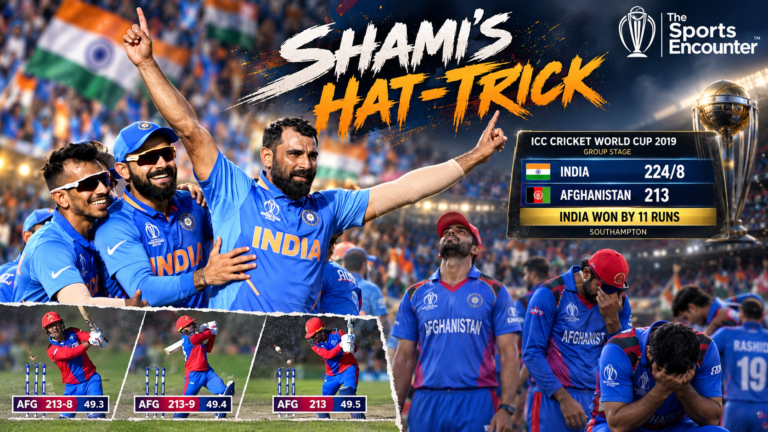
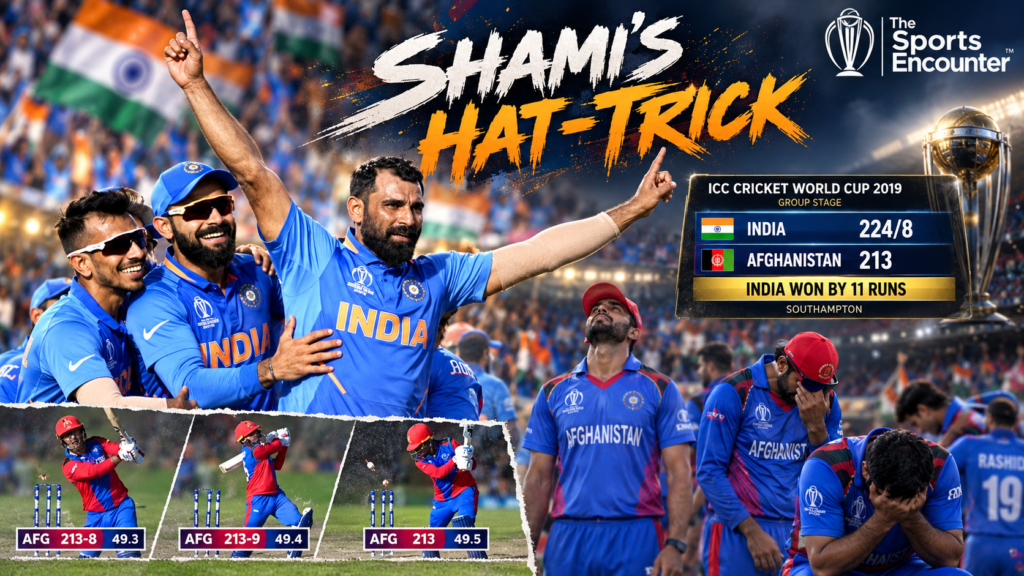
Five deliveries later, Afghanistan were all out, Shami had completed a World Cup hat-trick, and India had escaped with an 11-run victory.
The scoreboard says India defended 224.
The real story is how close Afghanistan came to taking it away from them, how Jasprit Bumrah changed the chase before the final over, and how Shami transformed a dangerous finish into cricket history with three consecutive wickets.
That is why India vs Afghanistan at Southampton is Match 34 in A Celebration of 5000 ODIs, The Sports Encounter’s series revisiting 100 ODIs in which pressure, individual brilliance and sudden reversals made the scorecard impossible to forget.
TL;DR
- India won the toss and chose to bat at the Rose Bowl in Southampton.
- Afghanistan’s spinners restricted India to 224/8 from 50 overs.
- Virat Kohli top-scored with 67 from 63 balls.
- Kedar Jadhav made 52 from 68 and helped India recover enough runs to remain competitive.
- Mohammad Nabi took 2/33 while Mujeeb Ur Rahman conceded only 26 runs from his 10 overs.
- Afghanistan reached 106/2 before Jasprit Bumrah dismissed Rahmat Shah and Hashmatullah Shahidi in the same over.
- Mohammad Nabi kept Afghanistan alive with 52 from 55 balls.
- Afghanistan needed 16 runs from the final over with three wickets remaining.
- Nabi struck the first ball for four.
- Mohammed Shami then dismissed Nabi, Aftab Alam and Mujeeb Ur Rahman from consecutive deliveries to complete the hat-trick.
- Shami finished with 4/40.
- India won by 11 runs.
- Jasprit Bumrah was named Player of the Match for his match-changing 2/39 from 10 overs.
- The victory was India’s 50th in men’s World Cup cricket.
India vs Afghanistan 2019 World Cup: Match at a Glance
| Detail | Information |
|---|---|
| Competition | ICC Cricket World Cup 2019 |
| Match | India vs Afghanistan, Match 28 |
| Date | June 22, 2019 |
| Venue | The Rose Bowl, Southampton |
| Toss | India won the toss and batted |
| India | 224/8 in 50 overs |
| Afghanistan | 213 all out in 49.5 overs |
| Result | India won by 11 runs |
| Player of the Match | Jasprit Bumrah |
| India top scorer | Virat Kohli, 67 from 63 |
| Afghanistan top scorer | Mohammad Nabi, 52 from 55 |
| Best India bowling | Mohammed Shami, 4/40 |
| Best Afghanistan bowling | Mohammad Nabi, 2/33 |
| Decisive middle-overs moment | Bumrah dismissed Rahmat Shah and Hashmatullah Shahidi in the same over |
| Final-over equation | Afghanistan needed 16 runs from six balls |
| Final twist | Shami completed a hat-trick from balls 49.3, 49.4 and 49.5 |
The official result, Player of the Match and match details are recorded in the ICC’s contemporary match report and the archived match scorecard.
Why Match 34 Belongs in A Celebration of 5000 ODIs
The original series list selected India vs Afghanistan because India managed only 224 and Afghanistan carried the pursuit into the final over before Shami completed his hat-trick.
That explanation is accurate, but it only captures the ending.
This match belongs here because almost every pre-match assumption was overturned.
India arrived with an elite batting lineup and were expected to control a winless Afghanistan side. Instead, Afghanistan’s spinners dictated the rhythm of the first innings.
India had Rohit Sharma, KL Rahul, Virat Kohli, MS Dhoni, Kedar Jadhav and Hardik Pandya in their batting order. They produced only one six between them.
Afghanistan did not need a miraculous chase.
They needed 225.
Then, after reaching 106/2, they suddenly lost two wickets without adding a run. India appeared to have taken the match back.
Nabi refused to allow that conclusion.
He rebuilt with Najibullah Zadran, then Rashid Khan, then Ikram Alikhil. Afghanistan reached the final over needing 16 rather than 30 or 40.
When Nabi struck Shami’s opening delivery for four, the match arrived at its most dangerous point for India.
Shami responded by conceding nothing from the second ball and then taking three wickets in three deliveries.
This was an ODI in which Afghanistan controlled long sections of the game, India repeatedly found a way back, and the apparent favorite required one of the most dramatic final-over spells in World Cup history to survive.
That combination of improbability, pressure and individual intervention fits exactly what the A Celebration of 5000 ODIs series was built to capture.
Afghanistan’s Spinners Turn India’s Batting Strength Against Them
The first surprise arrived before India had reached double figures.
Mujeeb Ur Rahman bowled Rohit Sharma for one at 7/1, beating the opener with a delivery that turned past his defense and struck the top of off stump.
Rohit had entered the tournament as one of India’s most important run scorers. Afghanistan removed him for one from 10 balls.
KL Rahul and Virat Kohli rebuilt, but Afghanistan did not allow the innings to accelerate naturally.
Rahul needed 53 balls for his 30 before attempting a reverse sweep against Nabi and offering Hazratullah Zazai the catch.
India were 64/2 after 14.2 overs.
Afghanistan had already forced one of the strongest batting teams in the tournament to play at their pace.
Mujeeb Ur Rahman Gives Afghanistan Control From the Start
Mujeeb’s final figures were 10 overs, 26 runs and one wicket.
The wicket was Rohit.
The economy rate was 2.60.
In a 50-over World Cup match against India, that level of control was almost as important as taking several wickets.
Mujeeb conceded only one four and no sixes in his spell. His accuracy helped Afghanistan create the kind of innings India rarely wanted to play: one in which boundary opportunities were scarce and rotation became the primary route forward.
Afghanistan’s spin performance looks even stronger when placed alongside the rest of the attack.
Nabi took 2/33.
Rashid Khan returned 1/38 after having conceded 110 runs against England in Afghanistan’s previous match.
Rahmat Shah contributed 1/22 from five overs.
Between them, Afghanistan’s spin options made India work for almost everything.
Virat Kohli Plays at a Different Tempo
One Indian batter appeared capable of escaping the squeeze.
Virat Kohli scored 67 from 63 deliveries at a strike rate of 106.34, hitting five fours.
Nobody else in India’s innings who faced more than two balls finished with a strike rate above 80.
That contrast matters because Kohli was not simply India’s highest scorer. He was the batter preventing Afghanistan’s bowling control from turning into complete domination.
He first rebuilt with Rahul and then shared a 58-run partnership with Vijay Shankar.
India reached 122/3 when Shankar was dismissed for 29.
Thirteen runs later, Afghanistan removed the man they most needed.
Nabi produced extra bounce, Kohli attempted the cut, and Rahmat Shah completed the catch at point.
India were 135/4 after 30.3 overs.
At that moment, 250 was no longer the obvious destination.
Even 225 required work.
Kedar Jadhav Turns Survival Into Something India Can Defend
MS Dhoni and Kedar Jadhav added 57 for the fifth wicket, but Afghanistan continued to dictate the tempo.
Dhoni made 28 from 52 deliveries before Rashid Khan drew him out of his crease and Ikram Alikhil completed the stumping.
India were 192/5 in the 45th over.
Jadhav therefore became responsible for ensuring a difficult innings did not collapse completely.
His 52 came from 68 balls with three fours and the only six of India’s innings.
Hardik Pandya managed only seven from nine.
Shami made one.
Jadhav fell at 223/8 with one ball remaining.
India finished on 224/8.
It looked short.
Afghanistan captain Gulbadin Naib later said his side had at one stage believed India could be restricted to around 170 or 180, which underlines why the Dhoni-Jadhav partnership mattered even though neither batter scored quickly.
India had not escaped Afghanistan’s bowling attack.
They had survived it.
Mohammad Nabi Produces Afghanistan’s Complete All-Round Performance
Before Nabi became Afghanistan’s last major hope with the bat, he had already helped create the opportunity.
His nine overs cost only 33 runs.
He dismissed Rahul and Kohli.
Those were not peripheral wickets.
Rahul’s dismissal broke India’s first recovery.
Kohli’s dismissal removed the only Indian batter consistently scoring above a run a ball.
Nabi then returned later in the day and made 52 from 55 balls, striking four fours and one six.
Afghanistan lost the match, which prevented his performance from receiving the official Player of the Match award, but his influence stretched across almost the entire contest.
The ICC later identified Nabi’s half-century against India as one of Afghanistan’s significant positives from the tournament, particularly because it brought them so close to a major upset.
Afghanistan Refuse to Chase 225 Like Underdogs
Afghanistan did not approach 225 as if survival itself represented success.
They were patient.
Hazratullah Zazai made only 10 from 24 before Shami bowled him, leaving Afghanistan 20/1.
Gulbadin Naib and Rahmat Shah then added 44.
Naib fell for 27, but Afghanistan reached 64/2 rather than collapsing.
Rahmat and Hashmatullah Shahidi built again.
At 106/2, Afghanistan needed another 119.
They had seven wickets available and more than 21 overs remaining.
The match was no longer following the expected script.
Then Bumrah returned.
Player of the Match Jasprit Bumrah Breaks Afghanistan’s Best Platform
Shami took the four wickets.
Shami produced the hat-trick.
Yet Jasprit Bumrah received the Player of the Match award.
The decision makes sense when the match is examined by timing rather than spectacle.
Afghanistan were 106/2.
Rahmat Shah had reached 36 from 63 balls and Shahidi 21 from 45. Their partnership had added 42.
India needed something more than economy.
Bumrah provided it.
Rahmat attempted the hook and was caught by Yuzvendra Chahal.
Two balls later, Shahidi offered Bumrah a return catch.
Afghanistan had gone from 106/2 to 106/4 inside the same over.
Bumrah finished with 2/39 from ten overs, including a maiden.
His final over was equally important. Afghanistan entered it needing 21 from 12. Bumrah conceded only five, leaving Shami 16 to defend.
The hat-trick ended the game.
Bumrah created the final-over equation that made the hat-trick possible.
That distinction explains the Player of the Match decision.
Bumrah himself said afterward that India’s plan was not to chase wickets recklessly but to raise the required rate until chances appeared. That approach captured exactly how India recovered control.
Mohammad Nabi Keeps Rebuilding the Chase
Afghanistan were 130/5 when Asghar Afghan was bowled by Chahal.
Nabi remained.
Najibullah Zadran joined him and scored 21 from 23.
Their 36-run partnership moved Afghanistan to 166 before Hardik Pandya removed Najibullah.
Rashid Khan then contributed 14 from 16.
Another 24 runs disappeared from the target.
Afghanistan reached 190/7.
Rashid was stumped off Chahal, but Nabi still refused to surrender the chase.
With Ikram Alikhil supporting him, Afghanistan added another 23.
The target moved from improbable to dangerous.
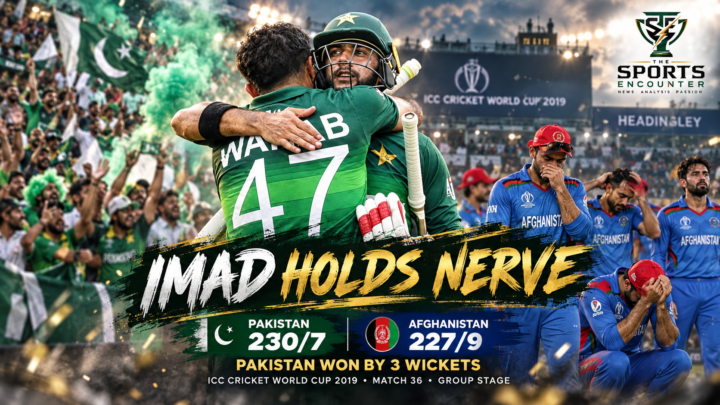
This pattern would become familiar in Afghanistan’s World Cup campaign. One week later, they would again push an established Asian side almost to breaking point in Match 33 of A Celebration of 5000 ODIs, when Pakistan needed Imad Wasim to rescue a chase at Headingley.
Afghanistan were still learning how to finish these games.
They already knew how to create them.
The Final Over: Shami Turns 16 Runs Into a Hat-Trick
Afghanistan began the 50th over on 209/7.
They needed 16.
Nabi was 48 not out.
Shami took the ball.
49.1: Nabi hits four
Shami misses the yorker.
Nabi drives straight down the ground for four and reaches his half-century.
Afghanistan now need 12 from five.
For perhaps the first time in the final few overs, India have no margin for another major error.
49.2: Nabi refuses the single
Shami goes full again.
Nabi hits toward deep midwicket but turns down the run.
The logic is obvious.
Nabi wants the strike.
Afghanistan still need 12 from four.
49.3: Nabi falls
Shami follows Nabi as he creates room.
Nabi attempts the lofted drive.
Hardik Pandya takes the catch at long-on.
Nabi is gone for 52 from 55.
Afghanistan are 213/8.
49.4: Aftab Alam bowled
Shami goes full and straight.
Aftab backs away.
The yorker crashes into middle and leg stump.
213/9.
49.5: Mujeeb bowled, hat-trick complete
Another full, fast delivery.
Mujeeb cannot stop it.
The ball hits the stumps.
Three deliveries.
Three wickets.
Afghanistan 213 all out.
India win by 11 runs.
Shami completes only the second World Cup hat-trick by an Indian bowler after Chetan Sharma’s achievement against New Zealand in 1987.
It is difficult to design a more decisive finish.
Mohammed Shami Turns an Injury Opportunity Into World Cup History
Shami was not even part of India’s original starting combination at the tournament.
Bhuvneshwar Kumar’s hamstring injury created the opportunity against Afghanistan. The ICC’s pre-match assessment identified Shami as the likely replacement.
He finished his first appearance of the tournament with:
9.5 overs, 1 maiden, 40 runs, 4 wickets.
His first wicket removed Zazai.
His final three completed the hat-trick.
The symmetry matters.
Shami provided India’s first breakthrough and its final three.
What looked like a forced selection change became one of India’s defining individual performances of the tournament.
Where India Won the Match
India did not win this game through batting superiority.
Afghanistan largely won that phase.
India won because their bowlers handled pressure better at the exact moments when a partnership threatened to tilt the chase.
The clearest examples were:
- Shami removing Zazai at 20/1, preventing Afghanistan from building an untouched opening platform.
- Hardik dismissing Gulbadin at 64/2, breaking the 44-run second-wicket stand.
- Bumrah’s double strike at 106, which removed both settled batters without conceding another run.
- Chahal removing Asghar and Rashid, denying Nabi longer partnerships.
- Bumrah conceding only five in the 49th, leaving Afghanistan 16 rather than a single-digit requirement.
- Shami’s final-over response after Nabi’s boundary.
The pattern is more important than the final margin.
India kept breaking partnerships just before Afghanistan could convert control into inevitability.
That ability to defend a modest score connects this match to earlier Indian World Cup victories in the series, particularly India’s defense of 183 against West Indies in the 1983 World Cup final.
The circumstances were different.
The principle was similar.
A total becomes enough only when the bowling side repeatedly forces the chasing team to restart.
Where India Nearly Lost the Match
India’s batting exposed a vulnerability Afghanistan deserved credit for finding.
Only Kohli scored with sustained freedom.
Rohit made one.
Rahul occupied 53 balls for 30.
Dhoni needed 52 for 28.
Hardik produced seven.
India scored only 224 despite losing just eight wickets.
That means wickets were not the only problem.
Tempo was.
Afghanistan denied India the boundary rate required to build the 260-plus total Kohli later suggested had initially appeared achievable.
India’s escape should therefore not obscure the warning.
Their batting had been successfully disrupted.
A side with better finishing could have punished them.
The series has repeatedly shown how little separates survival from defeat in such matches. India themselves finished one run short against Australia in the 1987 World Cup thriller in Chennai and suffered another narrow World Cup defeat when Henry Olonga destroyed their tail in Match 16 against Zimbabwe.
Southampton almost became another entry in that category.
What Afghanistan Did Right
Afghanistan’s greatest success was tactical discipline.
They recognized that the surface rewarded spin and forced India into low-risk, low-tempo cricket.
Mujeeb attacked the stumps.
Nabi changed pace and angle.
Rashid recovered impressively after a brutal previous match against England.
Rahmat provided five useful overs.
Afghanistan conceded only seven extras, all wides.
Then, with the bat, they refused to panic because the target was small.
Their top and middle order repeatedly produced 20s and 30s.
That was enough to keep the chase alive.
Nabi finally provided the half-century Afghanistan needed.
The result resembles Afghanistan’s performance against Pakistan one week later, another game in which their spin attack dragged an established opponent into a finish that should have been far less complicated.
Those near-misses formed part of the foundation for the Afghanistan team that would later mature into a more established ODI force. TSE has continued following that development, including Rashid Khan leading Afghanistan toward qualification for the 2027 ODI World Cup.
Where Afghanistan Lost the Match
Gulbadin Naib summarized Afghanistan’s main problem afterward: too many batters reached 20 or 30, but nobody in the top order converted that start into the innings required to finish a chase against India.
Rahmat made 36.
Gulbadin made 27.
Shahidi made 21.
Najibullah made 21.
Each contribution helped.
None removed enough pressure from Nabi.
The most damaging passage came at 106/2.
Afghanistan had spent almost 29 overs constructing that position.
Bumrah destroyed it in three deliveries.
From that point onward, every partnership became a repair job.
Nabi came extraordinarily close to completing enough repairs.
Afghanistan needed one more established batter to stay with him.
That batter never arrived.
Complete Match Scorecard
The complete batting and bowling figures below have been cross-checked against the archived scorecard.
India Batting: 224/8 in 50 Overs
| Batter | Dismissal | R | B | 4s | 6s | SR |
|---|---|---|---|---|---|---|
| KL Rahul | c Hazratullah Zazai b Mohammad Nabi | 30 | 53 | 2 | 0 | 56.60 |
| Rohit Sharma | b Mujeeb Ur Rahman | 1 | 10 | 0 | 0 | 10.00 |
| Virat Kohli (c) | c Rahmat Shah b Mohammad Nabi | 67 | 63 | 5 | 0 | 106.34 |
| Vijay Shankar | lbw b Rahmat Shah | 29 | 41 | 2 | 0 | 70.73 |
| MS Dhoni (wk) | st Ikram Alikhil b Rashid Khan | 28 | 52 | 3 | 0 | 53.84 |
| Kedar Jadhav | c sub (Noor Ali Zadran) b Gulbadin Naib | 52 | 68 | 3 | 1 | 76.47 |
| Hardik Pandya | c Ikram Alikhil b Aftab Alam | 7 | 9 | 0 | 0 | 77.77 |
| Mohammed Shami | b Gulbadin Naib | 1 | 2 | 0 | 0 | 50.00 |
| Kuldeep Yadav | not out | 1 | 1 | 0 | 0 | 100.00 |
| Jasprit Bumrah | not out | 1 | 1 | 0 | 0 | 100.00 |
Did not bat: Yuzvendra Chahal
Extras: 7 wides
Total: 224/8 in 50 overs
Run rate: 4.48
Fall of wickets: 7/1 Rohit Sharma (4.2), 64/2 KL Rahul (14.2), 122/3 Vijay Shankar (26.1), 135/4 Virat Kohli (30.3), 192/5 MS Dhoni (44.3), 217/6 Hardik Pandya (48.4), 222/7 Mohammed Shami (49.3), 223/8 Kedar Jadhav (49.5).
Afghanistan Bowling
| Bowler | O | M | R | W | Econ |
|---|---|---|---|---|---|
| Mujeeb Ur Rahman | 10 | 0 | 26 | 1 | 2.60 |
| Aftab Alam | 7 | 1 | 54 | 1 | 7.71 |
| Gulbadin Naib | 9 | 0 | 51 | 2 | 5.66 |
| Mohammad Nabi | 9 | 0 | 33 | 2 | 3.66 |
| Rashid Khan | 10 | 0 | 38 | 1 | 3.80 |
| Rahmat Shah | 5 | 0 | 22 | 1 | 4.40 |
Afghanistan Batting: 213 All Out in 49.5 Overs
| Batter | Dismissal | R | B | 4s | 6s | SR |
|---|---|---|---|---|---|---|
| Hazratullah Zazai | b Mohammed Shami | 10 | 24 | 1 | 0 | 41.66 |
| Gulbadin Naib (c) | c Vijay Shankar b Hardik Pandya | 27 | 42 | 2 | 0 | 64.28 |
| Rahmat Shah | c Yuzvendra Chahal b Jasprit Bumrah | 36 | 63 | 3 | 0 | 57.14 |
| Hashmatullah Shahidi | c & b Jasprit Bumrah | 21 | 45 | 2 | 0 | 46.66 |
| Asghar Afghan | b Yuzvendra Chahal | 8 | 19 | 0 | 0 | 42.10 |
| Mohammad Nabi | c Hardik Pandya b Mohammed Shami | 52 | 55 | 4 | 1 | 94.54 |
| Najibullah Zadran | c Yuzvendra Chahal b Hardik Pandya | 21 | 23 | 2 | 0 | 91.30 |
| Rashid Khan | st MS Dhoni b Yuzvendra Chahal | 14 | 16 | 1 | 0 | 87.50 |
| Ikram Alikhil | not out | 7 | 10 | 0 | 0 | 70.00 |
| Aftab Alam | b Mohammed Shami | 0 | 1 | 0 | 0 | 0.00 |
| Mujeeb Ur Rahman | b Mohammed Shami | 0 | 1 | 0 | 0 | 0.00 |
Extras: 17, including four byes, four leg byes and nine wides
Total: 213 all out in 49.5 overs
Fall of wickets: 20/1 Hazratullah Zazai, 64/2 Gulbadin Naib, 106/3 Rahmat Shah, 106/4 Hashmatullah Shahidi, 130/5 Asghar Afghan, 166/6 Najibullah Zadran, 190/7 Rashid Khan, 213/8 Mohammad Nabi, 213/9 Aftab Alam, 213/10 Mujeeb Ur Rahman.
India Bowling
| Bowler | O | M | R | W | Econ |
|---|---|---|---|---|---|
| Mohammed Shami | 9.5 | 1 | 40 | 4 | 4.06 |
| Jasprit Bumrah | 10 | 1 | 39 | 2 | 3.90 |
| Yuzvendra Chahal | 10 | 0 | 36 | 2 | 3.60 |
| Hardik Pandya | 10 | 1 | 51 | 2 | 5.10 |
| Kuldeep Yadav | 10 | 0 | 39 | 0 | 3.90 |
The Turning Points That Decided India vs Afghanistan
1. Mujeeb removes Rohit for one
Afghanistan needed immediate evidence that India could be made uncomfortable.
Mujeeb supplied it.
The dismissal prevented India’s opening pair from controlling the powerplay and allowed Afghanistan to introduce spin pressure before the innings had momentum.
2. Nabi dismisses Kohli at 135/4
Kohli was batting at a completely different tempo from the rest of India’s lineup.
Removing him before the final 20 overs changed India’s scoring ceiling dramatically.
3. Dhoni and Jadhav add 57
It was not spectacular.
It was necessary.
Without this partnership, India could easily have finished considerably below 224.
4. Bumrah turns 106/2 into 106/4
This was arguably the match’s most important over.
Afghanistan were not chasing recklessly.
They had built a genuine winning platform.
Bumrah removed both set batters before another run was scored.
5. Nabi carries Afghanistan to 209/7
India kept taking wickets.
Nabi kept rebuilding.
By the end of the 49th over, he had forced India to defend 16 runs rather than celebrate early.
6. Bumrah concedes only five in the 49th
Death bowling is often remembered through wickets.
Sometimes the decisive contribution is simply removing scoring options.
Bumrah did exactly that.
7. Shami responds to Nabi’s boundary
Nabi’s four from the first ball reduced the target to 12 from five.
The upset had suddenly become realistic.
Shami did not concede another run.
Three wickets followed.
Match over.
Why the Player of the Match Was Bumrah, Not Shami
A hat-trick naturally dominates memory.
Player of the Match awards are supposed to measure influence across the contest.
Bumrah’s spell changed Afghanistan’s strongest position.
At 106/2, they possessed wickets, time and a manageable equation.
After Bumrah’s double strike, they had to rebuild again.
Then his 49th over ensured Shami began the final over with 16 runs to defend.
Shami produced the unforgettable finish.
Bumrah repeatedly created the conditions in which India could still win.
That is why the official award went to him.
The Bigger Picture: Afghanistan Were Closer Than the Result Suggests
An 11-run victory can sound reasonably secure.
This one was not.
Afghanistan reached 209/7.
Nabi was set.
India had six deliveries left to defend 15 runs rather than 30.
One boundary immediately reduced the gap further.
The final margin grew only because Shami removed the last three batters without another run being scored.
That distinction matters when judging Afghanistan’s performance.
They did not spend 50 overs making the favorite nervous.
They reached a position from which the favorite genuinely could have lost.
A week later, Afghanistan created another extraordinary World Cup finish against Pakistan, only for Imad Wasim to rescue the chase with two balls remaining. That Pakistan-Afghanistan thriller is Match 33 in this series.
The two matches belong together as evidence of where Afghanistan stood in 2019.
They were close enough to trouble major teams.
They were not yet consistently finishing them.
How This Match Fits the Wider 2019 World Cup Story
The 2019 World Cup produced several matches in which the favorite survived only after losing control.
One of the finest came on the same day, when Carlos Brathwaite took West Indies from 164/7 to within one six of beating New Zealand. TSE revisited that extraordinary finish in Match 32, Brathwaite Falls One Swing Short as New Zealand Escape by Five Runs.
The World Cup repeatedly demonstrated how modest margins could hide enormous shifts in control.
That same pattern appears throughout this series.
Pakistan defended a vulnerable total against South Africa in Match 30 after Sarfaraz Ahmed’s six catches and a sustained fast-bowling assault.
India’s cricket history contains its own famous examples of surviving impossible positions, from Kapil Dev’s 175 after India collapsed to 17/5 against Zimbabwe in 1983 to the defense of 183 in the final one week later.
Southampton belongs to the same family of matches.
Nothing about the final score tells you how close the game came to choosing another winner.
Why Shami’s Hat-Trick Is Only Half the Story
History naturally remembers the image at the end.
Shami running in.
Stumps breaking.
Three wickets in succession.
India celebrating.
That is how cricket memory works.
Yet the hat-trick becomes more impressive when everything before it is restored.
Afghanistan had bowled brilliantly enough to make 224 possible.
Nabi had produced an all-round performance strong enough to threaten India for almost the entire day.
Bumrah had been required to dismantle Afghanistan’s best partnership and then control the penultimate over.
India had entered the final six deliveries without complete control of the result.
Shami then ended the uncertainty in three balls.
If Afghanistan had needed 30 from the final over, this match would probably have disappeared into the statistical archive.
They needed 16.
After one delivery, they needed 12 from five.
That is why the hat-trick mattered.
And that is why India vs Afghanistan in Southampton belongs among the 100 matches in A Celebration of 5000 ODIs.
Continue A Celebration of 5000 ODIs
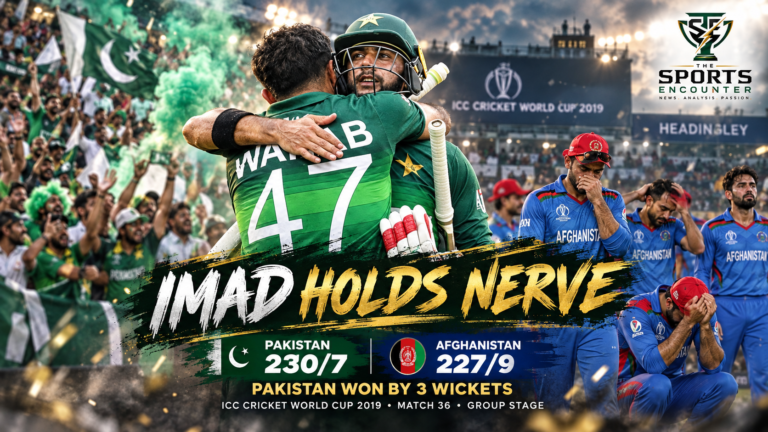 A Celebration of 5000 ODIsA Celebration of 5000 ODIs Match 33: Imad Wasim Drags Pakistan From 156/6 to a Two-Ball Escape Against Afghanistan
 A Celebration of 5000 ODIsA Celebration of 5000 ODIs Match 36: Malinga Turns 232 Into a Trap as England’s World Cup Certainty Suddenly Cracks
 A Celebration of 5000 ODIsA Celebration of 5000 ODIs Match 35: Williamson Holds His Nerve as South Africa Let Another World Cup Escape Slip Away
Frequently Asked Questions
Who won India vs Afghanistan at the 2019 Cricket World Cup?
India won by 11 runs at the Rose Bowl in Southampton. India scored 224/8 before dismissing Afghanistan for 213 in 49.5 overs.
Who was Player of the Match?
Jasprit Bumrah was named Player of the Match after taking 2/39 from 10 overs. His double-wicket over removed Rahmat Shah and Hashmatullah Shahidi when Afghanistan had reached 106/2.
Who took the hat-trick?
Mohammed Shami dismissed Mohammad Nabi, Aftab Alam and Mujeeb Ur Rahman from consecutive deliveries in the final over. He finished with 4/40.
How many runs did Afghanistan need from the final over?
Afghanistan needed 16 runs from six balls. Nabi hit the first delivery for four, reducing the requirement to 12 from five.
Who scored the most runs for India?
Virat Kohli top-scored with 67 from 63 balls, including five fours.
Who scored the most runs for Afghanistan?
Mohammad Nabi scored 52 from 55 balls with four fours and one six. He also took 2/33 with the ball.
How well did Afghanistan’s spinners bowl?
Mujeeb Ur Rahman took 1/26 from 10 overs, Mohammad Nabi 2/33 from nine, Rashid Khan 1/38 from 10 and Rahmat Shah 1/22 from five. Their control restricted India to 224/8.
Was Shami the first Indian to take a World Cup hat-trick?
No. Chetan Sharma became the first Indian and first bowler overall to take a men’s World Cup hat-trick in 1987. Shami became the second Indian to achieve the feat when he did it against Afghanistan in 2019.
Why is India vs Afghanistan 2019 included in A Celebration of 5000 ODIs?
Afghanistan restricted one of the tournament’s strongest batting lineups to 224, reached the final over of the chase needing 16 with Mohammad Nabi still batting, and forced India to rely on elite death bowling before Shami completed a hat-trick. The match combined an unexpected tactical battle, several momentum reversals and a finish that remained alive until the final three deliveries.
Where can readers follow more cricket coverage?
Readers can explore match reports, historical features, player analysis and tournament coverage through The Sports Encounter Cricket Hub.
India
- India-Afghanistan Rematch, Pakistan’s First Test and Nepal’s Upset Run Highlight Asian Games QFs
- A Celebration of 5000 ODIs Match 34: Shami’s Hat-Trick Saves India After Afghanistan Drag 224 to the Final Over
- Indians Revel in a Three-Sport Statement at Asian Games 2026
- Last-Minute Pairing, Asian Record, Gold: How Suruchi and Kamaljeet Rescued India’s Pistol Campaign