NAGOYA, Japan, September 27, 2026: Puripol Boonson needed less than 20 seconds to turn an already exceptional Asian Games into something historic.
The 20-year-old Thai sprinter powered through the men’s 200 meters in 19.88 seconds on Sunday, matching the Asian record and completing a sprint double after his Games-record 9.90 in the 100m two nights earlier.
He was only one part of an extraordinary day across Aichi-Nagoya.
China’s Yan Ziyi launched a Games-record 70.46m in the women’s javelin. Singapore’s Shanti Pereira defended her 200m title. Winfred Yavi completed a 10,000m and 3000m steeplechase double for Bahrain. South Korea beat host Japan 3-1 to win a fifth consecutive baseball gold. Wang Manyu defeated Sun Yingsha in an all-Chinese table tennis final. Malaysia swept both squash singles titles. Seventeen-year-old Kang Jun-i became South Korea’s first Asian Games skateboarding champion.
Story at a glance

How Did Puripol Boonson Turn the Asian Games Into His Sprint Championship?
Sunday confirmed that Boonson’s 100m victory was not the end of his breakthrough.
Why Was Yan Ziyi’s 70.46m Javelin Throw So Dominant?
If Boonson supplied speed, Yan Ziyi supplied distance.
How Did Shanti Pereira Defend Her Asian Games 200m Title?
Singapore’s Shanti Pereira did not get the fastest start in the women’s 200m final.
How Did Winfred Yavi Complete Another Golden Double?
Winfred Yavi had already won the women’s 10,000m.
Which Other Athletics Results Changed Sunday’s Medal Picture?
The athletics program produced enough major performances to stand as a Games within the Games.
And while individual stories kept pulling attention in different directions, the medal table kept returning to one familiar reality: China ended Sunday with 119 gold medals and 205 overall.
It was the latest escalation in a tournament whose competitive shape has developed almost daily since The Sports Encounter’s complete Aichi-Nagoya 2026 preview.
Saturday had been defined by India’s kabaddi double, Anahat Singh’s remarkable squash escape and another Chinese shooting statement. Sunday changed the conversation again.
What Were the Biggest Asian Games Results on Sunday?
| Event | Winner | Result | Why It Mattered |
|---|---|---|---|
| Men’s 200m | Puripol Boonson, Thailand | 19.88 | Equaled the Asian record and completed the 100m-200m double |
| Women’s 200m | Shanti Pereira, Singapore | 22.78 | Successfully defended her Asian Games title |
| Women’s Javelin | Yan Ziyi, China | 70.46m | Asian Games record and nearly eight meters clear of silver |
| Women’s 3000m Steeplechase | Winfred Yavi, Bahrain | 9:04.36 | Games record and second distance gold of the Games |
| Baseball Final | South Korea | Beat Japan 3-1 | Fifth consecutive Asian Games baseball title |
| Women’s Table Tennis Singles | Wang Manyu, China | Beat Sun Yingsha 4-2 | Confirmed Wang’s return to the continental singles throne |
| Women’s Squash Singles | Sivasangari Subramaniam, Malaysia | Beat Anahat Singh 3-0 | Part of a Malaysian singles sweep |
| Men’s Squash Singles | Ng Eain Yow, Malaysia | Beat Abhay Singh 3-0 | Successfully defended his title |
| Women’s Sabre Team | South Korea | Beat Japan 45-31 | Korea finished fencing with four gold medals |
| Men’s Street Skateboarding | Kang Jun-i, South Korea | 180.85 points | First Korean Asian Games skateboarding title |
How Did Puripol Boonson Turn the Asian Games Into His Sprint Championship?
Sunday confirmed that Boonson’s 100m victory was not the end of his breakthrough.
It was the beginning.
He had already run 9.90 in the 100m final on Friday, breaking the Asian Games record and becoming Thailand’s first champion in the event in 48 years.
The 200m presented a different problem. Boonson was not explosive out of the blocks in the final, but he accelerated aggressively through the bend and separated himself from the field down the home straight.
The clock stopped at 19.88.
That matched the Asian record set by China’s Xie Zhenye in 2019 and improved on the Games record Boonson had already established with 20.10 during the preliminary round.
China’s Huang Youwen finished a distant second in 20.45. Japan’s Soshi Mizukubo took bronze in 20.56.
The World Athletics report from Sunday’s program placed Boonson at the center of a session packed with championship and Games records.
The broader significance is now difficult to miss. Boonson leaves the individual sprint events with two gold medals, a Games record over 100m and a share of the continental 200m record.
Why Was Yan Ziyi’s 70.46m Javelin Throw So Dominant?
If Boonson supplied speed, Yan Ziyi supplied distance.
The Chinese teenager won the women’s javelin with 70.46m, breaking the Asian Games record and producing one of the largest winning margins of the athletics program.
Japan’s Olympic champion Haruka Kitaguchi took silver with 62.70m.
The gap was 7.76 meters.
Yan had already announced herself as one of the world’s most dangerous throwers earlier in 2026 when she produced an Asian record of 71.74m. Sunday’s performance did not require another continental record, but it demonstrated something equally important: her extraordinary best is no longer looking like an isolated performance.
China’s dominance across unrelated disciplines has been a recurring theme since the opening weekend. TSE identified that pattern in its September 21 consolidated Asian Games report, when swimming, shooting and gymnastics were already combining to pull China away.
Yan added athletics to that machinery.
How Did Shanti Pereira Defend Her Asian Games 200m Title?
Singapore’s Shanti Pereira did not get the fastest start in the women’s 200m final.
She produced the strongest finish.
China’s 100m champion Chen Yujie attacked the first half of the race, but Pereira closed rapidly over the final 100 meters and won in a season-best 22.78.
Chen took silver in 22.93. India’s Harita Bhadra claimed bronze in 23.20.
The victory gave Pereira a second consecutive Asian Games 200m championship and Singapore its second gold medal of Aichi-Nagoya 2026.
The Olympic Council of Asia also highlighted Pereira’s title defense in its official account of Singapore’s second gold.
How Did Winfred Yavi Complete Another Golden Double?
Winfred Yavi had already won the women’s 10,000m.
On Sunday, the Olympic and world steeplechase champion returned to her specialist event and completed the double.
Yavi won the women’s 3000m steeplechase in a Games-record 9:04.36, holding off Kazakhstan’s former world champion Norah Jeruto, who ran 9:06.82.
India’s Parul Chaudhary finished third in 9:08.67.
Bahrain’s strength in athletics extended beyond Yavi. The country’s middle-distance and sprint program has repeatedly added medals throughout the week, reinforcing how much the athletics medal table can alter the overall standings late in a multi-sport Games.
Which Other Athletics Results Changed Sunday’s Medal Picture?
The athletics program produced enough major performances to stand as a Games within the Games.
Japan’s Mako Fukube won the women’s 100m hurdles in 12.74, with teammate Hitomi Nakajima second in 12.78.
China’s Chen Yuanjiang claimed the men’s 110m hurdles in 13.15, ahead of Japan’s Rachid Muratake.
Chinese Taipei’s Fu Chao-Hsuan won the men’s high jump after clearing 2.25m, beating India’s Sarvesh Anil Kushare on countback. South Korea’s Woo Sanghyeok took bronze at 2.22m after Asian record-holder Mutaz Essa Barshim withdrew.
China’s Huang Yingying produced one of Sunday’s most dramatic field-event finishes in the women’s long jump. India’s Ancy Sojan had moved into the lead with 6.53m on her fifth attempt. Huang answered with 6.55m on her final jump to take gold by two centimeters.
Japan’s Yuma Maruyama won the decathlon with 8,123 points. China’s Chen Xinghua took silver with 8,012 and India’s Tejaswin Shankar finished third with 7,934.
The result added to a strong but frustrating day for India. Seven medals were added on Sunday, but none were gold.
That followed the emotional high of Saturday, when India successfully defended both kabaddi titles.
Why Does South Korea’s Fifth Straight Baseball Gold Matter?
Some Asian Games dynasties are built around one generation.
South Korea’s baseball dominance has survived several.
Korea defeated host Japan 3-1 in Sunday’s gold-medal game at Toyohashi Municipal Baseball Stadium to win the title for a fifth consecutive Asian Games.
Kim Do-yeong delivered the go-ahead hit as Korea denied Japan a championship on home soil.
The streak now extends through five editions, giving South Korea one of the longest active team-sport runs at the Games.
Japan had entered the medal round in excellent position and was trying to turn home support into another major championship after its men’s table tennis team had already produced one of the Games’ biggest upsets.
That table tennis breakthrough formed part of TSE’s record-heavy Thursday report, when Japan ended China’s 60-year hold over the men’s team title.
Baseball offered no repeat.
How Did China Answer Its Table Tennis Team Defeat?
China had already experienced a rare team-event shock when Japan won the men’s table tennis team title.
Sunday gave the Chinese program two opportunities to answer in individual competition.
It took both.
Wang Manyu defeated compatriot and defending champion Sun Yingsha 4-2 in the women’s singles final, reclaiming the title she had won at Jakarta 2018.
The final arrived only days after Wang displaced Sun at the top of the world rankings, adding another layer to what has become one of the defining internal rivalries in Chinese table tennis.
China also won men’s doubles as Huang Youzheng and Lin Shidong defeated Japan’s Tomokazu Harimoto and Hiroto Shinozuka 4-2.
So while Japan’s team victory proved China can be beaten, Sunday demonstrated that the Chinese depth which has defined this Games remains extremely difficult to suppress across multiple events.
How Did Malaysia Sweep the Asian Games Squash Singles Titles?
India began Sunday with two chances to win an individual squash gold.
Malaysia ended both.
Defending men’s champion Ng Eain Yow defeated Abhay Singh 11-9, 11-5, 11-5.
Women’s world No. 5 Sivasangari Subramaniam then beat 18-year-old Anahat Singh 11-4, 11-4, 11-7.
The results completed a Malaysian sweep of the men’s and women’s singles championships.
Anahat’s defeat should not obscure the scale of her week. She became the first Indian woman to reach an Asian Games singles squash final after recovering from two games down against Japan’s Satomi Watanabe in Saturday’s semifinal.
TSE documented that five-game comeback as one of Saturday’s defining performances.
Friday had already shown how quickly Anahat was moving through the draw when she needed only 15 minutes to reach the semifinals, part of India’s three-sport surge in kabaddi, squash and hockey.
Gold did not arrive, but the progression is difficult to ignore.
Why Was Kang Jun-i’s Skateboarding Gold Historic for South Korea?
South Korea found a completely different kind of breakthrough through 17-year-old Kang Jun-i.
Kang scored 180.85 points to win the men’s street skateboarding title, defeating Japanese pair Toa Sasaki, who scored 172.35, and Ginwoo Onodera, who finished on 168.11.
The victory made Kang the first South Korean skateboarder to win an Asian Games gold medal.
Skateboarding has only been part of the Asian Games since 2018, which makes each new national breakthrough part of a still-developing continental history.
South Korea’s Games have increasingly included that mixture of established and emerging disciplines. Earlier in the week, Cho Gwang-hee and Kim Hyo-bin produced another Korean gold-medal story in canoe sprint.
How Did South Korea Finish the Fencing Program?
Korea also closed the fencing competition with another gold.
Choi Se-bin, Jeon Ha-young, Seo Ji-yeon and Kim Jeong-mi defeated Japan 45-31 in the women’s sabre team final.
The performance was particularly striking because none of the four Koreans had won an individual medal earlier in the competition.
As a team, they became champions.
South Korea finished the entire fencing program with four gold medals, four silver and two bronze.
The men’s épée final produced much greater tension. Kazakhstan defeated South Korea 43-42, denying Korea another title. Hong Kong and Japan shared bronze after losing their semifinals.
Why Does China’s Diving Depth Keep Producing the Same Result?
The diving program provided another familiar image: Chinese athletes on the top step.
World champions Chen Jia and Chen Yiwen dominated the women’s synchronized 3m springboard, scoring 328.56 points.
South Korea’s Kim Na-hyun and Kim Su-ji took silver with 254.70. Malaysia’s Lee Yiat Qing and Ong Ker Ying won bronze on 243.72.
The margin between gold and silver was 73.86 points.
Later, Yang Hao and Lian Junjie won the men’s synchronized 10m platform with 465.54 points. Malaysia took silver through Enrique Harold and Elvis Priestly Clement, while Korea’s Shin Jung-whi and Kim Yeong-taek earned bronze.
The Olympic Council of Asia documented Chen and Chen’s dominant springboard victory, which extended China’s perfect start to the diving competition.
It follows a wider Chinese pattern TSE has tracked throughout these Games. The country’s shooters broke world and Asian records early in the Games, while the men’s 4x200m freestyle team produced an Asian-record comeback against Japan.
The sports change. The depth does not.
Continue the Asian Games 2026 Story
 Asian Games 2026Asian Games 2026: Kabaddi Double, Anahat’s Escape and China’s Rifle Record Define Saturday
 Asian Games 2026Asian Games 2026: China Sweep Historic Race-Walk Debuts, Choo Ga-eun Breaks Asian Record
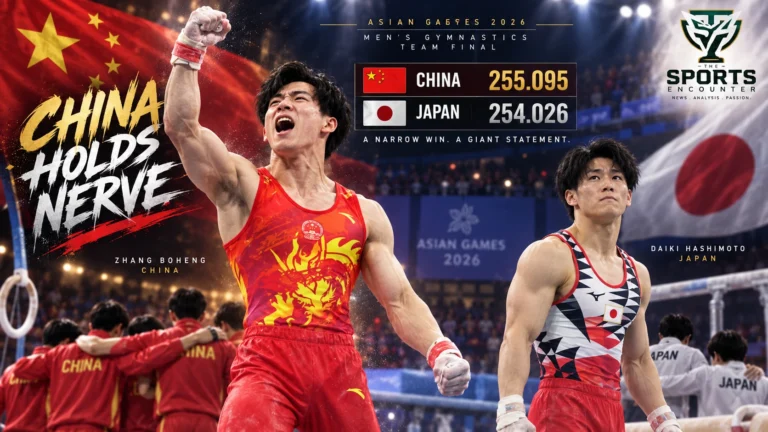 Asian Games 2026Zhang Boheng Holds His Nerve as China Edge Japan for Third Straight Asian Games Gymnastics Team Gold
What Happened in the Asian Games Marathon Race Walk Debut?
Sunday also brought the Asian Games debut of the marathon race walk.
Japan’s Hayato Katsuki won the men’s event in 3:03:36, finishing more than three minutes ahead of China’s Zhou Yingcheng. Japan’s Motofumi Suwa took bronze.
Kazakhstan’s Yasmina Toxanbayeva crossed first in the women’s race in 3:22:20, ahead of China’s Danzengquzong and Ma Li.
World Athletics reported that the women’s result remained subject to a protest concerning shoe specifications, so any final classification should be treated with that qualification until the protest process is formally resolved.
What Did Sunday Do to the Asian Games Medal Table?
China did not merely stay first. It widened an already enormous gap.
| Rank | Nation | Gold | Silver | Bronze | Total |
|---|---|---|---|---|---|
| 1 | China | 119 | 48 | 38 | 205 |
| 2 | Japan | 37 | 62 | 58 | 157 |
| 3 | South Korea | 21 | 23 | 39 | 83 |
| 4 | Uzbekistan | 10 | 17 | 11 | 38 |
| 5 | Kazakhstan | 9 | 10 | 21 | 40 |
| 6 | Thailand | 9 | 7 | 10 | 26 |
| 7 | Bahrain | 8 | 2 | 3 | 13 |
| 8 | Iran | 7 | 14 | 8 | 29 |
| 9 | North Korea | 6 | 5 | 4 | 15 |
| 10 | Malaysia | 6 | 2 | 8 | 16 |
| 11 | Hong Kong, China | 5 | 12 | 15 | 32 |
| 12 | India | 4 | 16 | 17 | 37 |
The day-to-day movement is revealing.
China entered Sunday on 107 golds and 176 medals. It ended with 119 and 205, meaning Sunday’s program alone added 12 gold medals and 29 medals overall.
Japan added six golds and 28 total medals. South Korea added five golds and 10 medals.
India added seven medals, four silver and three bronze, but remained on four golds and slipped outside the top 10 as Malaysia’s squash success helped lift it to sixth gold.
India’s Sunday therefore illustrated the difference between medal accumulation and medal-table movement. Silver and bronze can build an impressive total, but rankings at the Asian Games are determined first by gold medals.
India had demonstrated the opposite effect only two days earlier when Suruchi Singh and Kamaljeet converted their pistol opportunity into shooting gold.
What Did Asian Games Super Sunday Really Tell Us?
The most interesting part of Sunday was that there was no single model for success.
Boonson is transforming Thailand’s sprint history through individual brilliance.
Pereira retained a championship for Singapore through experience and late-race composure.
Korea’s baseball team defended a title that has survived five editions and multiple generations. Its teenage skateboarder created an entirely new national first on the same day.
Malaysia used established world-class squash players to sweep both singles titles.
China continued winning through an almost impossible range of systems: athletics, diving, table tennis and numerous other medal events.
That diversity explains why the medal table alone can never tell the entire Asian Games story.
But the medal table does tell one story extremely clearly.
Eight days into the main competition, China has already crossed 200 medals.
Everyone else is competing for history of their own.
Asian Games 2026 Sunday FAQs
Who Won the Men’s 200m at the 2026 Asian Games?
Thailand’s Puripol Boonson won the men’s 200m in 19.88 seconds, equaling the Asian record and completing the sprint double after winning the 100m.
What Asian Record Did Puripol Boonson Equal?
Boonson matched the men’s 200m Asian record of 19.88 seconds originally set by China’s Xie Zhenye in 2019.
Who Won the Women’s 200m at the Asian Games?
Singapore’s Shanti Pereira successfully defended her title in a season-best 22.78 seconds.
Who Won the Women’s Javelin at the 2026 Asian Games?
China’s Yan Ziyi won with an Asian Games record of 70.46m. Japan’s Haruka Kitaguchi took silver with 62.70m.
Who Won the Asian Games Baseball Final?
South Korea defeated Japan 3-1 to win its fifth consecutive Asian Games baseball gold medal.
Who Won the Women’s Table Tennis Singles Title?
China’s Wang Manyu defeated compatriot Sun Yingsha 4-2 to win the women’s singles championship.
Who Won the Asian Games Squash Singles Titles?
Malaysia swept both singles titles. Ng Eain Yow beat India’s Abhay Singh in the men’s final, while Sivasangari Subramaniam defeated India’s Anahat Singh in the women’s final.
How Many Medals Did China Have After Sunday?
China ended September 27 with 119 gold, 48 silver and 38 bronze medals for 205 overall.
How Many Medals Did India Win on Sunday?
India added seven medals on Sunday, four silver and three bronze, taking its overall total to 37.
Who Won South Korea’s First Asian Games Skateboarding Gold?
Seventeen-year-old Kang Jun-i won the men’s street competition with 180.85 points to become South Korea’s first Asian Games skateboarding champion.
China
- Asian Games 2026: Boonson Equals Asian Record as Korea Extends Dynasties and China Hits 119 Golds
- Asian Games 2026: Kabaddi Double, Anahat’s Escape and China’s Rifle Record Define Saturday
- Asian Games 2026: China Sweep Historic Race-Walk Debuts, Choo Ga-eun Breaks Asian Record
- Zhang Boheng Holds His Nerve as China Edge Japan for Third Straight Asian Games Gymnastics Team Gold
- Yu Zidi Completes Stunning Individual Gold-Medal Hat-Trick With Third Asian Games Record