MIYOSHI, Japan, September 25, 2026: The difference between another Asian Games silver medal and a place in South Korean sporting history was 0.317 seconds.
Cho Gwang-hee and Kim Hyo-bin found those fractions on Friday.
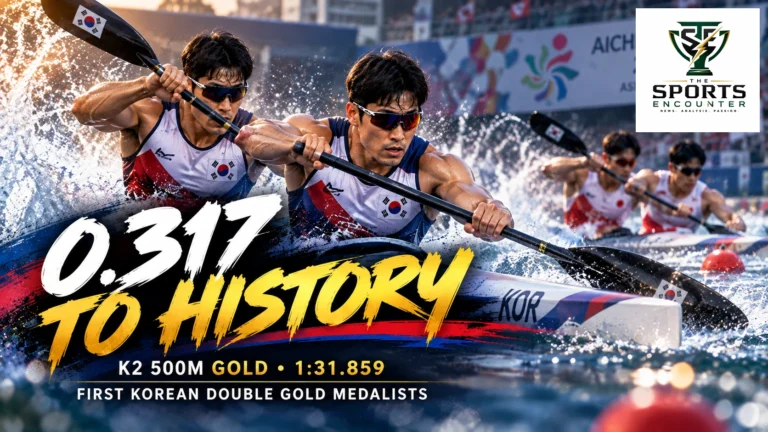
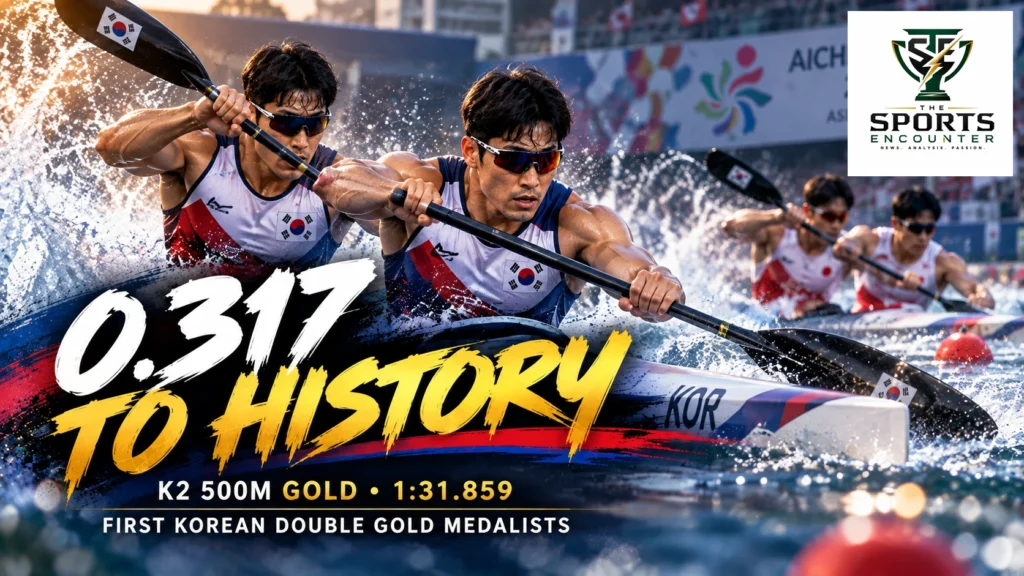
The Korean pair won the men’s kayak double 500m final in 1:31.859 at the Miyoshi Lake Canoe Course, holding off host Japan in a race that remained alive deep into the final meters.
The victory made Cho and Kim the first members of South Korea’s delegation to win two gold medals at Aichi-Nagoya 2026.
Story at a glance
Men’s Kayak Double 500m Final: The Margin That Decided Gold
The Yonhap report from Friday’s final confirmed the winning time, the narrow margin over Japan and the significance of Cho and Kim becoming Korea’s first two-time gold medalists of these Games.
Korea Did Not Control the Race From the Start
The final became more interesting because Cho and Kim did not simply seize an early lead and disappear.
Thursday’s K4 Gold Made Friday Possible
Friday’s result makes more sense when placed beside what happened 24 hours earlier.
Cho Gwang-hee Has Built an Asian Games Career Across Different Boats
Cho’s medal history is an important part of Friday’s story.
Kim Hyo-bin Turned One Breakthrough Into Two
Cho brought the longer Asian Games history into the boat.
They had stood on the top step only one day earlier as part of Korea’s victorious men’s kayak four 500m crew alongside Jang Sang-won and Choi Min-kyu.
Twenty-four hours later, the four-man breakthrough became a two-man landmark.
Japan finished only 0.317 seconds behind the Korean boat. Iran was 1.010 seconds behind the winners in third.
The gold also ended South Korea’s 36-year wait for an Asian Games men’s kayak double 500m title and gave Cho a fourth Asian Games gold medal across a career stretching back to Incheon 2014.
TL;DR: Why Cho Gwang-hee and Kim Hyo-bin’s Gold Matters
- Cho Gwang-hee and Kim Hyo-bin won the men’s kayak double 500m in 1:31.859.
- Japan finished only 0.317 seconds behind them.
- Iran took bronze, 1.010 seconds behind Korea.
- Cho and Kim became South Korea’s first double gold medalists of Aichi-Nagoya 2026.
- Both had already won the men’s kayak four 500m gold on September 24.
- That K4 victory was South Korea’s first ever Asian Games gold in the event.
- Friday’s K2 title was Korea’s first in the event since the 1990 Beijing Asian Games.
- Cho now owns four Asian Games gold medals.
Men’s Kayak Double 500m Final: The Margin That Decided Gold
| Position | Nation | Athletes | Result |
|---|---|---|---|
| Gold | South Korea | Cho Gwang-hee / Kim Hyo-bin | 1:31.859 |
| Silver | Japan | Host nation crew | 0.317 seconds behind |
| Bronze | Iran | Iranian crew | 1.010 seconds behind |
The Yonhap report from Friday’s final confirmed the winning time, the narrow margin over Japan and the significance of Cho and Kim becoming Korea’s first two-time gold medalists of these Games.
Korea Did Not Control the Race From the Start
The final became more interesting because Cho and Kim did not simply seize an early lead and disappear.
They crossed 250 meters in 43.73 seconds, slightly behind Kyrgyzstan.
That left the medals to be decided over the second half of the course.
Japan then produced the fastest final 250 meters of the leading boats, turning the home challenge into a genuine sprint to the line.
Korea still had enough.
Cho and Kim held their shape under pressure and reached the finish 0.317 seconds ahead.
In a 500-meter race, three-tenths of a second can disappear through one mistimed stroke, one poor synchronization sequence or one small loss of boat speed.
There was almost no room for any of them.
Thursday’s K4 Gold Made Friday Possible
Friday’s result makes more sense when placed beside what happened 24 hours earlier.
Cho, Kim, Jang Sang-won and Choi Min-kyu won the men’s kayak four 500m in 1:22.587.
That race was nearly as tight.
South Korea beat China by only 0.255 seconds.
The quartet reached halfway in 40.44 seconds with the lead and then resisted China through the closing half of the race.
It was Korea’s first Asian Games gold in the men’s K4 500m, an event previously controlled by China and Kazakhstan.
The report on Korea’s historic K4 victory also noted that Cho entered the following day’s K2 race with the opportunity to win his fourth career Asian Games gold.
He converted it.
Cho Gwang-hee Has Built an Asian Games Career Across Different Boats
Cho’s medal history is an important part of Friday’s story.
He first became an Asian Games champion in 2014, winning the men’s K1 200m in Incheon.
Four years later, he defended that title in Jakarta-Palembang.
The event later disappeared from the Asian Games medal program, forcing Cho to adjust rather than simply chase a third title in the same discipline.
He moved toward longer team events.
That transition brought silver medals in K4 competition before Thursday finally produced gold.
Friday’s K2 victory added another event to his Asian Games championship résumé.
That adaptability gives Cho’s fourth gold more meaning than the total alone suggests.
He has won across different distances, different crew sizes and different stages of his career.
Kim Hyo-bin Turned One Breakthrough Into Two
Cho brought the longer Asian Games history into the boat.
Kim brought the opportunity to establish a new one.
He had already joined Cho, Jang and Choi in ending Korea’s wait for a K4 title on Thursday.
Returning the following morning meant resetting almost immediately.
Canoe sprint may appear simple from outside the sport because every race is short and the objective is obvious. The physical and technical demands tell a different story.
The athletes need explosive acceleration, sustained power and near-perfect rhythm while controlling a narrow racing kayak at high speed.
Moving from a four-man boat to a two-man boat also changes the balance of responsibility.
Each paddler accounts for far more of the boat’s propulsion and synchronization.
Kim handled that adjustment well enough to leave Miyoshi with two gold medals in two days.
South Korea’s First Double Champions Arrived From Canoe Sprint
That distinction would have been difficult to predict before the Games.
South Korea entered Aichi-Nagoya with major medal expectations in fencing, swimming, shooting, taekwondo and several team sports.
The broader Korean campaign had already produced major performances.
Kim Young-beom broke the men’s 50m freestyle Asian Games record twice in one day and won Korea’s first swimming gold, a performance examined in The Sports Encounter’s full analysis of his 21.66-second victory.
South Korea’s early medal position was also tracked in TSE’s September 21 Asian Games report, when the country sat third behind China and host Japan.
Then Choo Ga-eun produced an Asian-record 246.3 to win the women’s 10m air pistol title, part of TSE’s September 23 record-breaking Asian Games coverage.
Yet the first Korean athletes to reach two gold medals did not come from those higher-profile disciplines.
They came from a racing kayak on Miyoshi Lake.
The 36-Year Wait Makes the K2 Gold Bigger
Friday also closed a historical gap.
South Korea had not won the men’s kayak double 500m at the Asian Games since Beijing 1990.
Cho himself had come close at Hangzhou, taking silver in the event with a different teammate.
That history changes how Friday’s result should be understood.
This was not simply the strongest Korean boat at the 2026 Games beating the field.
It was a country returning to the top of an event after more than three decades.
The difference between that breakthrough and another silver medal was 0.317 seconds.
Japan Made Korea Earn Every Meter
The host nation deserves more than a passing mention.
Japan entered Aichi-Nagoya under the pressure that comes with competing at home across 43 sports and 469 medal events, the scale outlined in TSE’s complete Asian Games 2026 preview.
Home advantage does not always produce medals, but the Japanese boat turned it into a serious challenge on Friday.
Japan’s speed through the closing 250 meters ensured Korea could not relax.
The Asian Games have repeatedly produced races settled by fractions during the opening week.
TSE’s coverage of the 100m breaststroke dead heat and other fine-margin finals showed how little has separated champions from rivals across multiple sports.
Friday’s kayak final belonged in the same category.
Korea’s Canoe Sprint Revival Has Happened Fast
Before Thursday, South Korea had never won the Asian Games men’s K4 500m title.
By Friday lunchtime, the same program had produced two gold medals.
That is a dramatic change in 24 hours.
The official Aichi-Nagoya 2026 canoe sprint schedule placed the K4 final on September 24 and the men’s K2 final on September 25, giving Cho and Kim almost no competitive breathing room between their two championship races.
They converted both opportunities.
This Is Another Example of South Korea Finding Gold Outside One Sport
The Korean delegation’s campaign has not depended on one dominant discipline.
The Sports Encounter’s first full medal-day report documented South Korea’s early golds while China and Japan established themselves at the top of the table.
South Korea had also shown strength before the medal rush properly began. TSE’s opening-day coverage followed Korean success across handball and teqball as competition expanded across Nagoya.
The Opening Ceremony analysis framed Korea as one of the traditional continental powers attempting to protect its place near the top of the Asian sporting hierarchy.
Canoe sprint has now contributed directly to that objective.
Two Days, Two Margins Below 0.32 Seconds
Perhaps the most revealing number from Korea’s canoe sprint breakthrough is not 1:31.859.
It is the combined pressure of the two winning margins.
South Korea won Thursday’s K4 final by 0.255 seconds.
Cho and Kim won Friday’s K2 final by 0.317.
Neither gold came from overwhelming superiority.
Both required Korea to execute while a rival remained close enough to punish almost any mistake.
That makes the back-to-back victories more impressive from a performance perspective.
Korea did not need to be several seconds better than the field.
It needed to be slightly better at precisely the right moments.
Cho and Kim Have Changed Korea’s Canoe Story in 24 Hours
A day earlier, South Korea had never won the Asian Games men’s K4 500m.
Now it has that title, a K2 championship after a 36-year wait and the first two double gold medalists of its Aichi-Nagoya delegation.
Cho has moved from established Korean paddling star to four-time Asian Games champion.
Kim has moved from team-event breakthrough to double champion in the space of two races.
Their results also arrive during an Asian Games increasingly defined by athletes repeating excellence rather than producing isolated victories.
China’s Lin Xinyu won two triathlon golds within 24 hours. Teenager Yu Zidi has repeatedly rewritten swimming records. South Korea’s own medal campaign has produced new standards in shooting and swimming.
TSE’s September 24 consolidated report showed how Thursday became one of the most record-heavy days of the Games.
Cho and Kim followed it with a different kind of history.
No world record was required.
Only 0.317 seconds.
Continue the Asian Games 2026 Story
 AthleticsOhashi Smashes World Record as Yulo, Japan and Indonesia End Long Asian Games Waits
 SoccerAsian Games: North Korea Turn Elimination Night Into a Rout as Iran Crash Out and Japan Stay Perfect
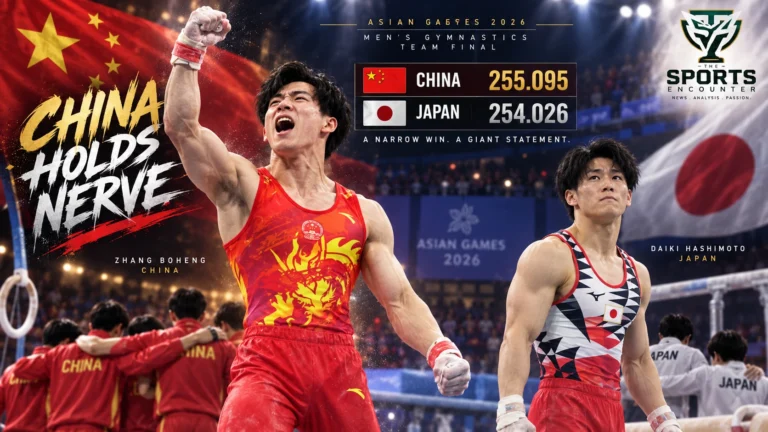 Asian Games 2026Zhang Boheng Holds His Nerve as China Edge Japan for Third Straight Asian Games Gymnastics Team Gold
Frequently Asked Questions
Who won the men’s kayak double 500m at the 2026 Asian Games?
South Korea’s Cho Gwang-hee and Kim Hyo-bin won the gold medal in 1 minute 31.859 seconds.
How close was Japan to winning?
Japan finished only 0.317 seconds behind South Korea in the final.
Who won bronze in the men’s K2 500m?
Iran finished third, 1.010 seconds behind the Korean champions.
Why are Cho Gwang-hee and Kim Hyo-bin’s gold medals historic?
They became the first South Korean athletes to win two gold medals at the 2026 Aichi-Nagoya Asian Games.
What was their first gold medal?
Cho and Kim were part of the South Korean men’s kayak four 500m crew that won gold on September 24 alongside Jang Sang-won and Choi Min-kyu.
What time did Korea record in the K4 500m final?
The South Korean quartet won in 1:22.587, beating China by 0.255 seconds.
When did South Korea last win the men’s K2 500m Asian Games title?
Before Friday, South Korea’s previous gold in the event had come at the 1990 Beijing Asian Games, making the wait 36 years.
How many Asian Games gold medals does Cho Gwang-hee have?
Friday’s victory was Cho’s fourth Asian Games gold. He previously won the K1 200m in 2014 and 2018 and the K4 500m on Thursday.
Where was the kayak final held?
The race was held at the Miyoshi Lake Canoe Course in Miyoshi, Aichi Prefecture, Japan.
What is canoe sprint?
Canoe sprint is a flatwater racing discipline involving canoe and kayak events over set distances. The 2026 Asian Games program includes individual, double, four-person and mixed events.