
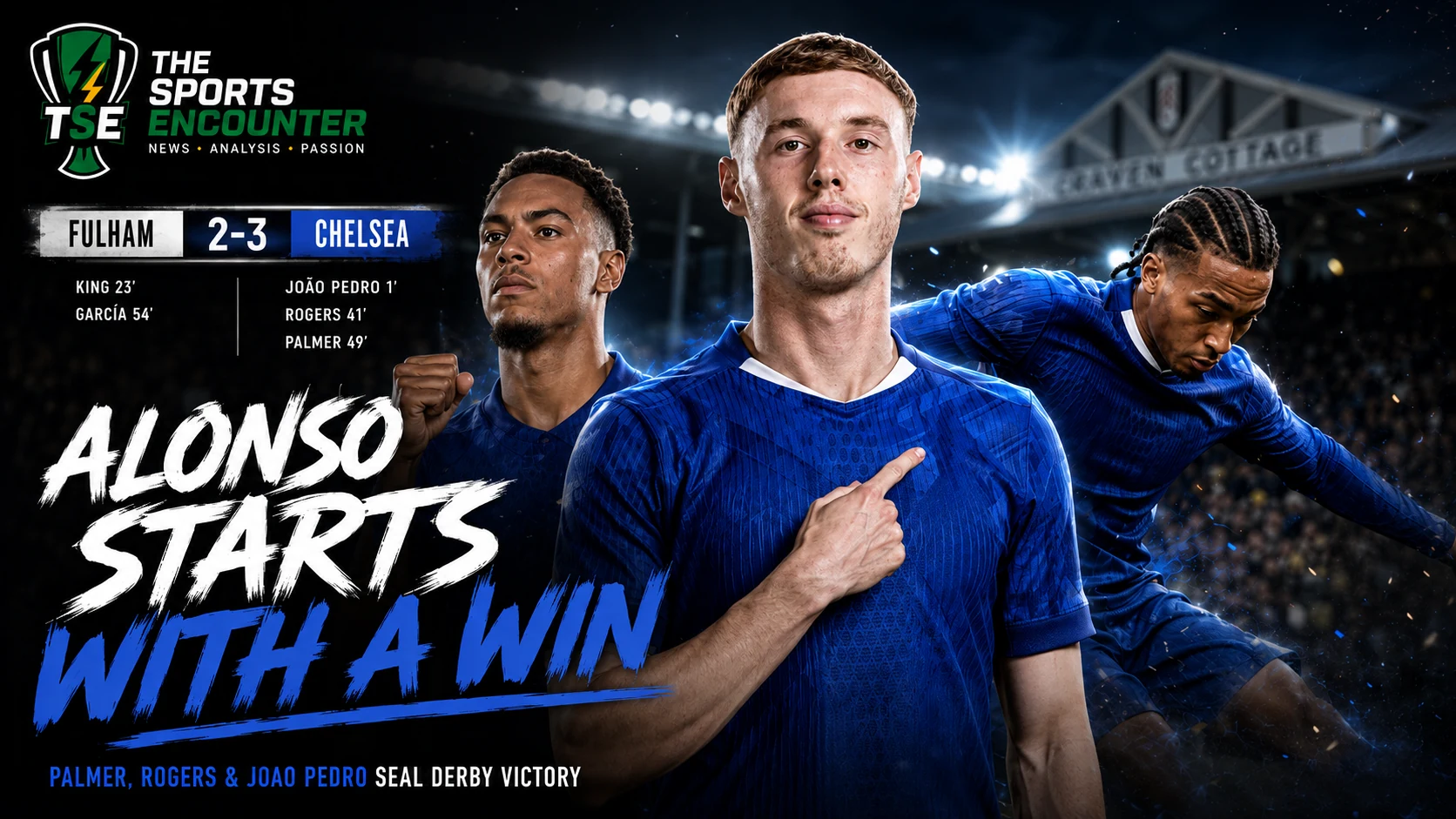
Chelsea Beat Fulham 3-2 as Palmer, Rogers and João Pedro Launch Xabi Alonso Era
Chelsea opened the Xabi Alonso era with a dramatic 3-2 win at Fulham as João Pedro scored inside the first minute, Morgan Rogers struck on debut and Cole Palmer added the decisive third.

Chelsea have opened the Xabi Alonso era with three points after surviving a furious Fulham response to win 3-2 at Craven Cottage in a dramatic west London derby that completed the first Premier League matchweek of 2026-27.
João Pedro scored inside the opening minute, Morgan Rogers marked his competitive Chelsea debut with a goal before halftime, and Cole Palmer produced the decisive attacking performance as Alonso’s side repeatedly cut through Fulham before being forced to defend a one-goal lead through the closing stages.
Fulham refused to let the game disappear.
Josh King equalized in the 23rd minute after an error from Robert Sánchez, while Gonzalo García scored on his Premier League debut shortly after Palmer had made it 3-1.
That left Chelsea protecting a 3-2 advantage for more than half an hour as Alvaro Arbeloa’s Fulham pushed for an equalizer that never came.
The final score was enough to move Chelsea into sixth place after Matchweek 1 and ensure Alonso begins his first Premier League campaign with a victory.
The larger significance lies in how Chelsea won.
The relationship between Palmer, Rogers and João Pedro was one of the biggest questions surrounding the club after another expensive summer rebuild.
Against Fulham, all three immediately affected the score.
That is the first meaningful evidence that Chelsea’s attacking reconstruction may have genuine substance.
Fulham 2-3 Chelsea: Match at a Glance
| Competition | Premier League 2026-27 |
| Venue | Craven Cottage |
| Final score | Fulham 2-3 Chelsea |
| Fulham scorers | Josh King 23′, Gonzalo García 54′ |
| Chelsea scorers | João Pedro 1′, Morgan Rogers 41′, Cole Palmer 49′ |
| Chelsea manager | Xabi Alonso |
| Fulham manager | Alvaro Arbeloa |
| Chelsea position after Matchweek 1 | 6th |
Chelsea’s own official Fulham 2-3 Chelsea match report confirms the five-goal sequence and Alonso’s winning start at Craven Cottage.
João Pedro Needed Seconds to Put Chelsea Ahead
Chelsea did not ease into Alonso’s first Premier League match.
They attacked immediately.
João Pedro scored after roughly 30 seconds, giving Chelsea the fastest possible confirmation that the attacking chemistry developed during preseason had carried into competitive football.
The Brazilian entered the opener after signing a new Chelsea contract through 2034 and after a preseason in which he had already looked increasingly comfortable inside Alonso’s structure.
That early goal gave Chelsea exactly what an away team wants in a derby.
It quietened Craven Cottage.
It allowed Alonso’s side to dictate more of the early possession.
It also forced Fulham to abandon any idea of spending the opening phase simply feeling their way into Arbeloa’s first Premier League game.
João Pedro continued threatening after the goal and went close again around the half-hour mark.
His performance was more important than the finish alone.
He repeatedly protected possession with his back to goal, linked with Palmer and Rogers, and helped Chelsea move through Fulham rather than simply around them.
Josh King Punishes Sánchez and Gives Fulham a Way Back
Chelsea’s control did not last uninterrupted.
Fulham equalized in the 23rd minute after Robert Sánchez made the type of mistake that turns an otherwise controlled away performance into a nervous contest.
Josh King punished it.
The goal immediately changed the emotional temperature of the derby.
Fulham began playing with greater freedom, while Chelsea suddenly had to rebuild the authority established by the early opener.
King remained one of Fulham’s most dangerous players throughout the match.
He later went close again in the second half, and his direct running repeatedly tested Maxence Lacroix and Chelsea’s defensive structure.
For Arbeloa, King’s performance was one of the clearest positives from a defeat that contained considerably more promise than the result suggests.
Cole Palmer Starts Running the Match
If the opening goal belonged to João Pedro, the first half increasingly belonged to Cole Palmer.
Palmer became the player connecting almost every dangerous Chelsea attack.
He drifted into central areas.
He carried the ball beyond Fulham’s first pressure line.
He repeatedly forced defenders to commit before releasing the next pass.
Chelsea’s second goal came directly from that influence.
Palmer beat his defender and found Maxence Lacroix after the center-back had advanced unusually high into Fulham territory.
Lacroix continued the move, worked his way into the area and sent a low ball across the face of goal.
Morgan Rogers arrived to finish.
It was his first competitive goal for Chelsea.
The timing could hardly have been better.
Morgan Rogers Scores on Debut and Immediately Justifies the Attention
Rogers entered the season carrying a level of scrutiny that few summer signings escape.
Chelsea paid a reported £117 million to bring him from Aston Villa, making him one of the most expensive British footballers ever.
The Sports Encounter examined that pressure before the season in our analysis of why Alonso has very few excuses after Chelsea’s investment in Rogers.
The concern was never whether Rogers possessed Premier League quality.
He had already demonstrated that at Villa.
The question was how quickly his game would fit alongside Palmer without forcing both players into the same spaces.
The first competitive answer arrived in the 41st minute.
Rogers attacked the area while Palmer operated deeper and wider in the build-up.
That separation is exactly what Chelsea need.
Two creators can become redundant if both constantly demand the same ball.
Against Fulham, Palmer and Rogers frequently occupied different zones and attacked at different moments.
The second goal was the clearest reward.
The relationship was not entirely unexpected. Before the season, the Premier League’s official coverage of Alonso’s plans for Rogers and Palmer highlighted the Chelsea manager’s belief that the two England internationals could thrive together rather than compete for the same role.
Palmer Makes It 3-1 With Chelsea’s Best Move of the Night
The third goal came four minutes into the second half and may have been the best example yet of what Alonso wants Chelsea’s attack to become.
João Pedro received possession on the left side of the box and protected it rather than forcing an immediate action.
Palmer continued his run outside him.
João Pedro waited.
Then he reversed a perfectly weighted pass into Palmer’s path.
Palmer finished first time through Bernd Leno’s legs.
Three players were involved in the combination.
No unnecessary touch slowed it down.
The movement was coordinated rather than improvised.
That matters because Chelsea’s recent problem has often been having talented attackers without enough shared understanding.
The Sports Encounter highlighted that issue in our preseason analysis of Alonso’s unusual preparation advantage.
Chelsea have no European football this season.
That gives Alonso more full training weeks than most of his direct rivals.
The Palmer-Rogers-João Pedro combination is precisely the kind of relationship those extra sessions are supposed to improve.
At Craven Cottage, the early returns were excellent.
Gonzalo García Refuses to Let Chelsea Relax
At 3-1, the match looked close to being finished.
Fulham changed that almost immediately.
Gonzalo García scored in the 54th minute on his debut to bring the home side back within one goal.
Timothy Castagne’s low attempt was saved by Sánchez, but the goalkeeper could only push the ball into a dangerous area.
García reacted quickest and headed the rebound into the ground and over the recovering goalkeeper.
It was an opportunistic striker’s goal.
It also exposed a weakness Chelsea had hoped Alonso would remove.
The visitors had produced brilliant attacking moments and still found themselves only one mistake away from losing their lead.
That tension remained for the rest of the match.
Fulham Had Chances to Make It 3-3
Arbeloa’s side did not spend the final half-hour simply hoping for one opportunity.
They created several.
Oscar Bobb carried the ball dangerously into Chelsea’s defensive third.
King drove narrowly wide after beating Lacroix near the edge of the area.
Antonee Robinson then produced Fulham’s clearest late opportunity.
He ran onto a long forward pass with Sánchez caught away from his goal but sent the attempted lob wide.
That miss was enormous.
A 3-3 equalizer would have completely changed the interpretation of Chelsea’s night.
Instead, Alonso’s team survived.
Pedro Neto, Enzo Fernández and Pep Chavarría were among those introduced as Chelsea attempted to regain control and close the game.
The final phase became less about attacking fluency and more about game management.
Chelsea managed just enough.
Xabi Alonso Gets the Result but Also Gets His First Warning
Away wins in London derbies should never be dismissed.
Winning the first competitive match under a new manager is even more useful.
Still, Alonso will know the 3-2 scoreline contains both encouragement and warning.
The attacking structure looked excellent at times.
Chelsea scored three goals through three different attackers.
João Pedro linked play effectively.
Rogers attacked space.
Palmer looked like the most influential player on the pitch.
Romeo Lavia also impressed before being replaced in the second half.
The defensive side was far less convincing.
Sánchez contributed to Fulham’s first goal and could only parry the ball into García’s path for the second.
Chelsea also allowed King and Robinson significant opportunities after taking a two-goal lead.
Against stronger finishing, this could have become a draw.
That is the work Alonso now takes back to Cobham.
Palmer Looks Healthy Again, and That Could Change Chelsea’s Ceiling
The most important individual development may have been Palmer.
He endured an injury-disrupted 2025-26 season and entered this campaign after a full summer of conditioning under Alonso.
The Chelsea manager said before the opener that Palmer had worked extensively on injury prevention and had returned in a much better physical position.
Against Fulham, he looked liberated.
He created Chelsea’s second goal.
He scored the third.
He repeatedly dribbled through pressure and nearly scored again from the edge of the area.
This version of Palmer changes the scale of Chelsea’s ambitions.
The Sports Encounter ranked Chelsea among the outsiders in our Premier League title contender assessment because their squad quality is much stronger than last season’s 10th-place finish suggests.
A healthy Palmer is the player most capable of closing that gap quickly.
João Pedro’s New Contract Already Looks Like More Than Paperwork
Only two days before the derby, Chelsea announced that João Pedro had extended his contract through 2034.
The decision was another major commitment to a forward who scored 20 goals in all competitions during his first season at Stamford Bridge.
His performance against Fulham showed why Chelsea moved early.
The goal will take the headlines.
The assist for Palmer may be the more useful indication of how Alonso sees him.
João Pedro is not being asked to operate as a penalty-box striker disconnected from the build-up.
He is being used as a reference point who can receive, protect possession and bring Palmer and Rogers into the game.
That role may make Chelsea more difficult to defend than a conventional front three.
Fulham Lose but Arbeloa Has Reasons to Be Encouraged
There is a temptation after a 3-2 home defeat to focus exclusively on defensive failures.
Fulham showed enough going forward to avoid that conclusion.
King scored.
García scored on debut.
Bobb carried a genuine threat from the right.
Robinson continued providing dangerous forward runs.
Fulham also kept Chelsea under pressure after falling 3-1 behind rather than allowing the scoreline to widen.
The problem was timing.
They conceded in the opening minute.
They conceded again shortly before halftime.
They conceded Palmer’s goal almost immediately after the restart.
Three defensive lapses at three psychologically important moments left Arbeloa’s side chasing the match almost continuously.
That is difficult against a squad with Chelsea’s attacking quality.
Fulham’s official first-team fixtures and results page provides the club’s current Premier League schedule as Arbeloa’s side moves on from the opening derby.
The Alonso-Arbeloa Managerial Subplot Delivered
The match carried an unusual managerial connection.
Alonso and Arbeloa were teammates for Liverpool, Real Madrid and Spain.
Both coached Real Madrid during 2025-26.
Now they begin Premier League projects on opposite sides of west London.
Chelsea’s official Fulham-Chelsea match center and pre-match guide noted that this was the first time a manager’s Premier League debut had come against a former teammate from his own playing career in the competition.
Alonso won the first chapter.
Arbeloa may still leave encouraged by how often Fulham troubled Chelsea after the visitors appeared to have taken control.
Chelsea Complete Matchweek 1 in Sixth Place
The victory gives Chelsea three points and a +1 goal difference after one match.
They finish the opening round sixth in the table after a weekend in which Brighton, Arsenal, Brentford, Everton, Hull, Ipswich, Manchester City and Leeds also collected victories.
The Sports Encounter’s complete Premier League season preview identified Chelsea as one of the most difficult major clubs to project because their ceiling is high but their recent consistency has been poor.
One win does not settle that argument.
It gives Alonso the best possible starting point.
Matchweek 1 Now Has a Complete Story
Before Chelsea kicked off, the opening weekend had already produced several major results.
Arsenal started their title defense with a 3-0 win.
Manchester United were shocked 2-0 by promoted Hull City.
Brighton beat Aston Villa 4-0.
Manchester City needed late goals to defeat Bournemouth.
Liverpool rescued a 2-2 draw at Newcastle.
Chelsea have now added another important result to that first-week picture.
They did not dominate Fulham for 90 minutes.
They showed enough attacking quality to suggest that their preseason optimism was not empty.
That distinction matters.
Morgan Rogers’ Goal Makes Chelsea’s Summer Gamble Immediately More Interesting
Rogers’ transfer was one of the defining moves of the Premier League summer.
His reported £117 million fee placed extraordinary expectations on a player who had developed into one of Aston Villa’s most valuable attackers.
Our analysis of the Premier League’s most expensive signings examined why Chelsea were willing to make such a large investment.
The answer is versatility.
Rogers can carry the ball through midfield pressure.
He can operate between the lines.
He can attack the box.
He can play alongside Palmer rather than forcing Alonso to choose between them.
His debut goal did not prove the transfer fee correct.
It showed why Chelsea believe the fit can work.
Chelsea’s Long-Term Squad Strategy Is Starting to Meet Immediate Pressure
Chelsea have spent several seasons building around young players on long contracts.
Geovany Quenda’s arrival is another example, covered in The Sports Encounter’s report on Chelsea’s long-term plan for the Portuguese winger.
The difference this season is expectation.
The club is no longer being judged only on whether individual prospects improve.
It is being judged on whether the collective team wins.
The £10 million fine and suspended transfer ban imposed over historical agent-payment breaches have also added another layer of scrutiny around the club’s recruitment governance, as detailed in our report on Chelsea’s FA punishment.
Results now matter more than future promises.
Monday night provided one.
What Chelsea Can Take From the Win
| Positive | Why It Matters |
|---|---|
| Palmer looked sharp | Goal, major creative influence and strong movement throughout |
| Rogers scored on debut | Immediate evidence that his attacking relationship with Palmer can work |
| João Pedro linked the attack | Scored early and assisted Palmer’s decisive third goal |
| Three different scorers | Chelsea were not dependent on one player for goals |
| Won under late pressure | Important emotional test after Fulham reduced the deficit to 3-2 |
What Alonso Still Has to Fix
| Concern | Why It Matters |
|---|---|
| Goalkeeper errors | Sánchez was involved in both Fulham goals |
| Game management | Chelsea allowed Fulham back into the match after leading 3-1 |
| Defensive transitions | King and Robinson found dangerous spaces late |
| Control after substitutions | Attacking rhythm dropped once Chelsea began protecting the lead |
TSE Analysis: Chelsea’s Ceiling Looks Higher Than Its Floor
That may be the most accurate conclusion after Alonso’s first league game.
Chelsea’s best football was outstanding.
Palmer, Rogers and João Pedro combined with speed and intelligence.
Lavia gave the midfield composure.
Alonso’s positional ideas were visible.
Then Fulham scored twice and came close to a third.
This is why Chelsea remain fascinating rather than predictable.
Their ceiling looks capable of Champions League qualification and perhaps something more ambitious if the attacking structure develops quickly.
Their floor remains much lower whenever concentration drops.
No European football gives Alonso more time to fix that inconsistency than most rival managers possess.
The Sports Encounter argued before the opener that Chelsea’s free midweeks could become one of their biggest competitive advantages.
The Fulham game immediately showed exactly what those training weeks need to address.
The Sports Encounter Verdict
Xabi Alonso could have asked for a cleaner defensive performance.
He could not have asked for a much better attacking introduction.
João Pedro scored almost immediately.
Morgan Rogers scored on his Premier League debut.
Cole Palmer created, dribbled, dictated and finished.
Those were the players Chelsea spent the summer trying to build the new attack around.
They needed one competitive match to appear together on the scoresheet.
Fulham ensured the night did not become an easy celebration.
King punished Chelsea’s first mistake.
García punished the second.
Robinson nearly completed the comeback.
Chelsea survived.
That survival matters because new managerial projects need points while the details are still being corrected.
Alonso leaves Craven Cottage with three of them.
He also leaves with a very clear training agenda.
Chelsea’s attack looks ready to create problems immediately.
The question now is whether their defense can stop creating problems of its own.
Frequently Asked Questions
What was the Fulham vs Chelsea score?
Chelsea defeated Fulham 3-2 at Craven Cottage in the final match of Premier League Matchweek 1.
Who scored for Chelsea against Fulham?
João Pedro scored in the first minute, Morgan Rogers scored in the 41st minute and Cole Palmer made it 3-1 in the 49th minute.
Who scored for Fulham?
Josh King scored in the 23rd minute and Gonzalo García scored in the 54th minute.
Did Morgan Rogers score on his Chelsea debut?
Yes. Rogers scored Chelsea’s second goal in his first competitive appearance for the club.
How did Cole Palmer perform?
Palmer was Chelsea’s most influential attacker, helping create Rogers’ goal before scoring the third himself early in the second half.
Who is Chelsea’s manager?
Xabi Alonso is Chelsea’s manager for the 2026-27 season and began his Premier League tenure with a 3-2 victory.
Who is Fulham’s manager?
Former Real Madrid defender Alvaro Arbeloa is Fulham’s head coach.
Where are Chelsea in the Premier League table?
Chelsea finished Matchweek 1 in sixth place with three points.
What is Chelsea’s next major challenge?
Alonso’s immediate priority will be tightening Chelsea’s defensive control while continuing to develop the promising attacking relationship between Palmer, Rogers and João Pedro.




Breaking News
Calvin Austin Torn ACL: Giants Receiver Expected to Miss 2026 Season
New York Giants wide receiver Calvin Austin III is expected to miss the 2026 NFL season after reportedly tearing the ACL in his right knee during practice. His absence reshapes the receiver battle around Jaxson Dart, Malik Nabers and several veterans competing for larger roles.

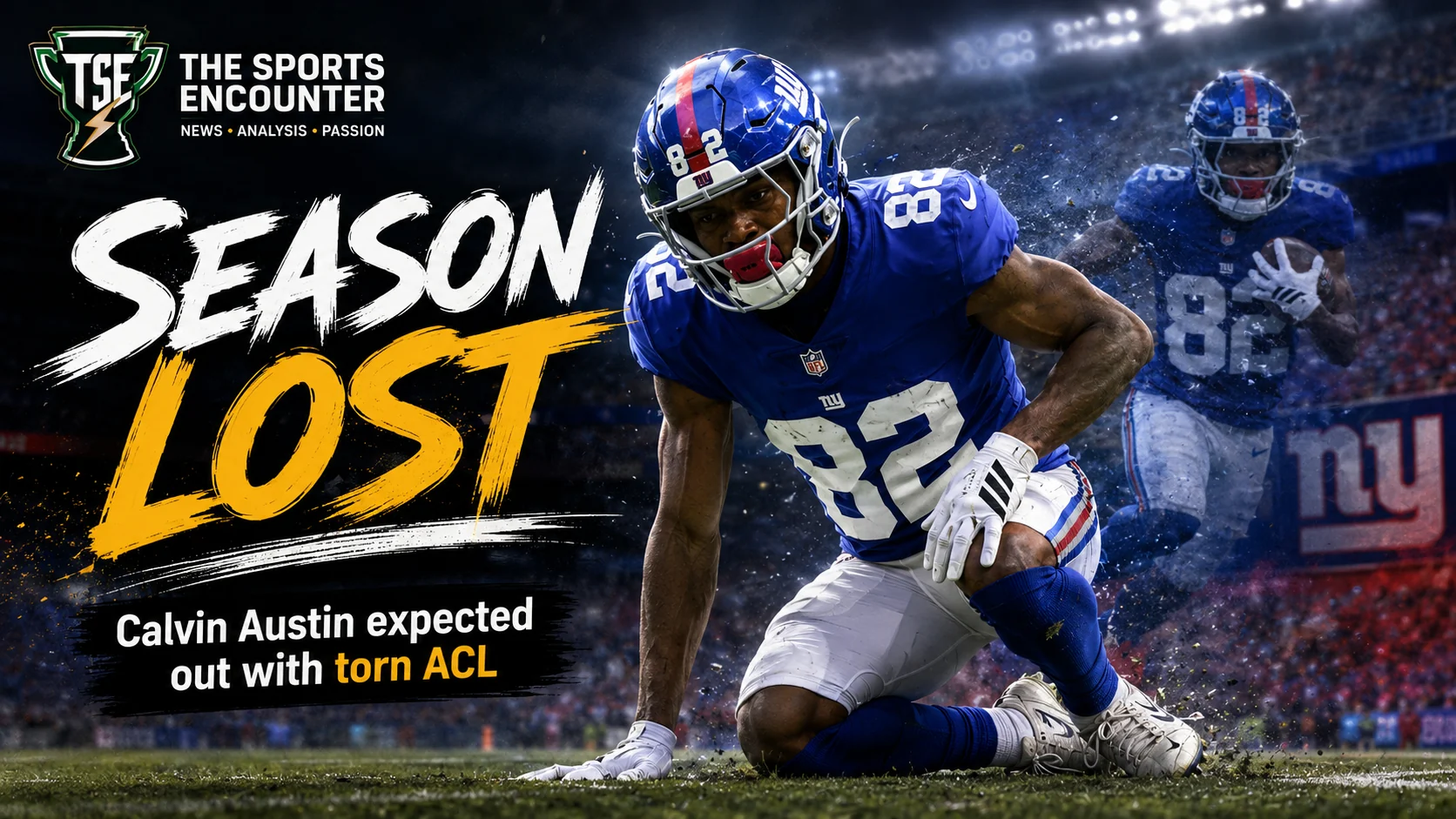
EAST RUTHERFORD: Calvin Austin III arrived in New York with a modest one-year contract, elite speed and a genuine opportunity to become an important part of Jaxson Dart’s second season as the Giants quarterback.
That opportunity appears to have ended before the regular season began.
Austin tore the ACL in his right knee during Tuesday’s practice and is expected to miss the entire 2026 NFL season, according to a person with knowledge of the injury who spoke to The Associated Press. NFL.com subsequently listed Austin as out for the season with the torn ACL.
The New York Giants had not publicly announced the full medical diagnosis at the time of publication, so the injury should remain attributed to those reports until the club provides its own formal update.
What is already clear is the impact.
Austin had been enjoying one of the strongest training camps among New York’s receivers, had developed a productive connection with Dart and appeared to be earning a meaningful role in an offense that already entered the summer managing Malik Nabers’ return from his own ACL reconstruction.
Losing Austin therefore affects considerably more than one place on the depth chart. It changes the competition for slot snaps, removes another vertical speed option, affects punt-return depth and creates additional pressure on a receiver group that the Giants spent much of the offseason rebuilding.
For continuing roster, injury and preseason coverage from across the league, readers can follow The Sports Encounter’s NFL coverage.
Calvin Austin ACL Injury: What We Know
| Detail | Latest Information |
|---|---|
| Player | Calvin Austin III |
| Team | New York Giants |
| Position | Wide receiver |
| Age | 27 |
| Injury | Reported torn ACL in right knee |
| How it happened | Non-contact injury during a 1-on-1 practice drill |
| Reported prognosis | Expected to miss the 2026 season |
| Giants status | Team had not formally announced the diagnosis at publication |
| Contract | One-year deal signed during 2026 free agency |
| Previous team | Pittsburgh Steelers |
| 2025 receiving | 31 catches, 372 yards, 3 touchdowns |
| Giants season opener | September 13 vs Dallas Cowboys |
TL;DR
- Calvin Austin III reportedly tore the ACL in his right knee during Giants practice on Tuesday.
- The 27-year-old wide receiver is expected to miss the entire 2026 NFL season.
- The Giants had not formally announced the diagnosis at the time of publication.
- Austin suffered the injury without contact during a 1-on-1 drill and was carted from the field.
- He had been one of the strongest performers in Giants training camp and developed chemistry with quarterback Jaxson Dart.
- Austin caught two passes for 24 yards during New York’s preseason victory over Miami.
- He joined the Giants this offseason after three active seasons with Pittsburgh.
- Austin recorded 84 regular-season receptions for 1,100 yards and eight touchdowns with the Steelers.
- His absence creates more opportunity for Darnell Mooney, Braxton Berrios, Odell Beckham Jr., Malachi Fields and other Giants receivers.
- New York has also signed rookie wide receiver Kobe Prentice as roster decisions approach.
- Malik Nabers continues working back from the ACL injury that ended his 2025 season.
- The Giants open the regular season against the Dallas Cowboys on September 13.
A Non-Contact Practice Rep Changed Austin’s Season
The injury occurred during a 1-on-1 drill at the Giants’ training facility on Tuesday.
Austin went down without contact while working against cornerback Deonte Banks. Practice stopped as teammates and staff gathered around him, and he was eventually taken from the field on a cart.
Offensive coordinator Matt Nagy acknowledged afterward that the situation looked serious and spoke warmly about both Austin’s character and the quality of the camp he had produced.
The following day brought the news the Giants had feared.
NFL.com’s August 26 injury roundup listed Austin with a torn ACL and said he would miss the 2026 season.
For Austin, the timing makes the injury especially cruel because his summer had been building toward a larger role.
Austin Was Winning His Place Rather Than Simply Filling a Roster Spot
When New York signed Austin in March, the move carried relatively little attention compared with the Giants’ larger offseason additions.
He arrived after three active seasons with Pittsburgh as a 5-foot-9, 162-pound receiver whose speed could stretch defenses vertically and create separation from several alignments.
The Giants’ official announcement of Austin’s signing highlighted 84 regular-season catches for 1,100 yards and eight touchdowns across 48 games with the Steelers.
He also brought established special-teams value. Austin returned 72 punts for 639 yards and a touchdown during his Pittsburgh career, including a 73-yard score against the Giants in 2024.
That combination made him useful in several different ways.
New York did not need Austin to become its No. 1 receiver. The roster already contained players with larger offensive profiles.
The Giants needed him to create speed, spacing, favorable matchups and reliable depth behind them.
Training camp suggested he was capable of doing considerably more than simply surviving the final roster cut.
Jaxson Dart Was Developing Trust With Austin
The most consequential part of Austin’s summer may have been his work with Dart.
AP reported that Austin had become one of the second-year quarterback’s most frequent targets during team periods.
That chemistry matters because NFL passing offenses depend heavily on timing established through repetition.
A receiver can understand the playbook and still require weeks of work with a quarterback to establish when a route will break, where a pass should arrive against different coverage leverage and how each player reacts when the original route changes after the snap.
Austin had spent the spring and summer accumulating those repetitions.
His preseason work offered further evidence. He caught two passes for 24 yards against Miami and also produced a 21-yard rushing gain as the Giants beat the Dolphins 26-3.
The wider NFL preseason has already demonstrated how quickly these August opportunities can reshape depth charts. The Sports Encounter’s Week 1 preseason analysis examined several players who used live game repetitions to strengthen their cases before roster decisions.
Austin appeared to be doing the same.
The ACL tear removes those accumulated gains from New York’s immediate plans.
Why Austin’s Speed Mattered to the Giants Offense
Speed becomes most valuable when it changes what a defense is willing to do.
Austin possesses enough of it to force defensive backs to respect vertical routes even when he is not the primary target.
That can create space underneath for tight ends, running backs and possession receivers.
It can discourage safeties from cheating aggressively toward another side of the field.
It can also create opportunities through motion, jet sweeps and manufactured touches because defenders cannot afford to lose leverage before Austin reaches full speed.
The Giants have other fast players.
Replacing Austin’s exact combination of speed, experience, slot capability and return value is harder.
This is the broader roster problem created by late-summer injuries. Teams rarely replace one injured player’s entire role with one healthy player.
They redistribute it.
That same pattern has appeared throughout August, something TSE examined in its recent NFL injury and signing roundup. A significant injury changes practice repetitions, roster probabilities and the acceptable level of risk elsewhere on the depth chart.
New York is now making those calculations at receiver.
The Malik Nabers Situation Makes the Timing More Important
The Giants were already approaching the regular season with one major receiver health story.
Nabers tore his ACL during New York’s Week 4 victory over the Los Angeles Chargers in September 2025, ending his second NFL season after only four games.
His rehabilitation has progressed throughout the summer.
Nabers returned to team periods in August while wearing a red non-contact jersey, and John Harbaugh said he looked good during that stage of the recovery.
The Giants have remained careful about attaching a firm date to his full return. Harbaugh has publicly expressed hope that Nabers can play in the September 13 opener against Dallas while emphasizing that the process will depend on how his knee continues responding.
That caution now becomes more relevant.
Austin’s injury should not change the medical timetable for Nabers. The Giants have every reason to continue managing their star receiver according to his own rehabilitation rather than accelerating the process because another player is unavailable.
It does, however, remove insurance around him.
If Nabers experiences any delay or workload limitation early in the season, New York now has one fewer experienced receiver available to absorb those snaps.
Darnell Mooney Could Gain More Responsibility
Mooney was already one of the important additions to the Giants offense.
His experience, speed and ability to work from different alignments give Nagy several options when replacing Austin’s snaps.
Mooney has played both outside and inside during his NFL career, which makes him a logical candidate for increased slot work depending on how New York structures its personnel.
The advantage is flexibility.
The disadvantage is that moving Mooney around can affect another role elsewhere in the offense.
Every redistribution creates a second decision.
If Mooney takes more inside snaps, somebody else must handle more work outside. If the Giants keep him primarily in his intended role, another receiver must win Austin’s slot opportunities.
This is why preseason injuries become questions of roster architecture rather than simple replacement.
Braxton Berrios Now Has an Obvious Opening
Berrios may have one of the clearest paths to additional work.
The veteran has extensive experience operating from the slot and brings his own return background.
Those traits overlap with two areas where Austin’s absence creates uncertainty.
Berrios also understands what an ACL rehabilitation requires after suffering the injury himself in 2024.
His place in the receiver competition therefore becomes more valuable than it appeared 48 hours earlier.
He does not need to reproduce Austin’s vertical speed to help New York.
Reliable route execution, short-area separation and special-teams usefulness could be enough to earn a meaningful role.
Odell Beckham Jr. Has Another Opportunity in a Crowded Room
Odell Beckham Jr.’s return to the Giants already carried obvious history.
The more important question during August has been how much he can still contribute to the current offense.
Austin’s injury creates more available snaps but does not automatically hand them to Beckham.
The veteran still has to demonstrate that he can separate consistently, stay healthy and provide enough weekly value to justify his place on the 53-man roster.
His experience does give New York an alternative few teams would possess this late in the preseason.
Beckham has played through almost every type of coverage and high-pressure environment an NFL receiver can encounter.
If his body allows him to contribute, the Giants now have an additional reason to keep exploring how he fits alongside Nabers, Mooney and Darius Slayton.
Malachi Fields May Be the Biggest Developmental Beneficiary
Rookie Malachi Fields enters a different stage of the competition.
He has shown enough during camp to suggest he can contribute earlier than some young receivers normally would.
Austin’s absence creates more practice opportunities and potentially more game snaps for the rookie.
That can accelerate development quickly.
Young receivers improve by seeing NFL coverage at full speed, learning how physical defensive backs become at the top of routes and discovering how small the throwing windows become once regular-season game plans are installed.
Fields now has a clearer route toward those experiences.
The situation resembles other receiver competitions around the league where injuries have increased opportunities for younger players. TSE recently examined how a training-camp injury to Saints rookie Jordyn Tyson affected New Orleans’ receiver planning.
New York now faces its own version of that calculation.
The Giants Have Already Added Kobe Prentice
New York did not wait long to reinforce the room.
The Giants announced Wednesday that they had signed rookie wide receiver Kobe Prentice along with veteran tight end Josiah Deguara.
The team did not state that Prentice was signed specifically because of Austin’s injury, so the two developments should not be presented as an officially confirmed cause-and-effect transaction.
The timing nevertheless gives New York another receiver for the final days of preseason and the closing roster evaluation.
According to the Giants’ official transaction announcement, Prentice is a 5-foot-10, 184-pound undrafted rookie who spent his final college season at Baylor after three years at Alabama.
He recorded 26 catches for 380 yards and six touchdowns in 11 games during his senior season.
Prentice had most recently been with New England after the Patriots claimed him from Carolina, and he became available when the Patriots released him Monday.
His arrival gives the coaching staff another body to evaluate.
It does not replace the chemistry Austin had already established with Dart.
The Punt-Return Competition Changes Too
Austin’s special-teams history should not disappear from the analysis.
He returned 72 punts during his three active Steelers seasons and averaged 8.9 yards per return.
His 73-yard touchdown in 2024 demonstrated the explosive possibility he could provide when space opened.
That role may not have been the primary reason New York signed him, but special-teams versatility helps determine the bottom of NFL rosters.
Berrios has extensive return experience and becomes an obvious option.
Other receivers and defensive backs could also receive more opportunities as the Giants decide how many players they can carry primarily for special teams.
The broader league has dealt with similar August depth questions throughout camp. Our NFL injury roundup on Josh Jacobs, Kenyon Sadiq and Elic Ayomanor highlighted how apparently isolated injuries often create secondary decisions elsewhere on a roster.
Austin Had Already Experienced a Lost Season
The rehabilitation challenge carries another layer for Austin because this will not be the first NFL season taken away by injury.
Pittsburgh selected him in the fourth round of the 2022 NFL Draft out of Memphis.
A foot injury prevented him from playing during his entire rookie season.
He eventually made his NFL debut in 2023 and gradually expanded his role over the following three years.
The 2024 season became his most productive as a receiver, when he recorded career highs of 36 receptions, 548 receiving yards and four touchdowns.
He followed with 31 catches for 372 yards and three touchdowns in 2025 before entering free agency.
New York represented a fresh opportunity.
Another long rehabilitation process now stands between Austin and the next stage of his career.
Why the Injury Hurts Austin Beyond 2026
The immediate consequence is the lost season.
The longer-term issue is contractual timing.
Austin joined the Giants on a one-year agreement, reportedly worth $1.5 million.
This season therefore represented an opportunity to establish his value inside a new offense before returning to free agency.
A productive year could have strengthened his case for a larger role or another contract in 2027.
The injury removes that platform.
His next negotiation may now depend heavily on rehabilitation progress, medical evaluations and whether teams believe his speed has fully returned.
ACL surgery and rehabilitation have become common across professional football, and many receivers return to high-level play. Speed-based players still face an especially important physical question because acceleration, cutting and sudden changes of direction sit at the center of their value.
Austin’s recovery will therefore matter far beyond simply receiving clearance to practice again.
The Giants Have Seen How Quickly ACL Injuries Reshape Plans
New York does not need a reminder of the disruption created by major knee injuries.
Nabers’ 2025 ACL tear changed Dart’s rookie season almost immediately.
The quarterback lost his most dangerous receiver during his first NFL start.
New York then spent months planning for Nabers’ rehabilitation while adding Mooney, Austin, Beckham and Berrios to strengthen the position.
Now one of those additions is gone before Week 1.
That sequence reflects the harsh side of NFL roster building.
Front offices can improve depth during free agency and the draft, yet every plan remains exposed to the physical nature of the sport.
The Sports Encounter has followed that reality throughout this preseason, including Atlanta losing Jalon Walker for the season with another ACL tear.
Those injuries affect different positions and teams, but the roster consequence is familiar.
A carefully designed rotation has to be rebuilt almost overnight.
New York’s Final Preseason Game Now Carries More Weight at Receiver
The Giants close their preseason against the New York Jets on Friday at MetLife Stadium.
Preseason finales often become evaluation games for players fighting over the final few roster places.
Austin’s absence raises the stakes considerably for the receivers behind the established names.
Berrios, Beckham, Fields and the other depth options now have more than roster survival at stake.
They are competing for snaps that may exist when the regular season begins.
Prentice has only just arrived and faces the difficult task of learning enough of the offense to make an impression quickly.
The coaching staff also has to determine which receivers provide enough special-teams value to dress on game day.
August football regularly produces this kind of compressed evaluation. Our wider training-camp coverage has tracked teams making similar depth adjustments as injuries force new players into larger roles.
The 53-Man Roster Decision Just Became More Complicated
The timing could hardly be more consequential.
New York’s initial 53-man roster must be finalized shortly after the preseason finale.
Before Austin’s injury, the receiver competition involved determining which players offered enough offensive and special-teams value behind the leading group.
The equation now includes a missing player who had been expected to contribute.
The Giants have to decide how many receivers they need, which skill sets overlap, whether younger players are ready and how much special-teams coverage they can preserve.
Those decisions become especially difficult when Nabers is still completing his return to full contact.
A healthy receiver room offers coaches the luxury of choosing complementary skill sets.
An injured one forces them to protect against scenarios they hope never occur.
What Austin’s Absence Means for Jaxson Dart
Dart remains the player through whom all of these decisions eventually connect.
The second-year quarterback needs a receiver group that gives him reliable answers against different defensive structures.
Nabers can become the focal point when healthy.
Slayton provides established vertical experience.
Mooney adds speed and positional flexibility.
Isaiah Likely strengthens the passing game from tight end.
Fields represents developmental upside, while Beckham and Berrios offer veteran alternatives.
Austin had been creating another useful layer within that group.
His loss does not leave Dart without weapons.
It reduces the margin for something else to go wrong.
That distinction becomes important during a 17-game NFL season, when receiver rooms are rarely completely healthy from September through January.
The Cowboys Opener Will Provide the First Real Answer
New York opens its regular season against Dallas at MetLife Stadium on September 13.
By then, the Giants expect to have a much clearer picture of Nabers’ availability and the hierarchy behind him.
The Cowboys will provide an immediate test because regular-season defenses disguise coverages and pressure quarterbacks in ways preseason games rarely reproduce.
Dart will need receivers who understand sight adjustments and can separate when his first read disappears.
Austin appeared to be developing toward precisely that type of trust.
The Giants now have a little more than two weeks to redistribute that responsibility.
The Final Word: Austin’s Injury Changes More Than One Line on the Depth Chart
The easiest interpretation of Calvin Austin’s injury is that New York lost a depth receiver.
His summer suggests the consequences go further.
Austin was developing into a player Dart trusted, offered legitimate vertical speed, could work from multiple receiving alignments and carried meaningful punt-return experience.
Those responsibilities now have to be divided among several teammates at exactly the point when the Giants are finalizing their regular-season roster.
Mooney can absorb some offensive work. Berrios has a clearer route into slot and return snaps. Fields receives an opportunity to develop faster. Beckham’s experience becomes more useful. Prentice arrives with a chance that did not exist earlier in the week.
The Giants have enough options to adjust.
The real question is whether those options can collectively replace the role Austin was creating for himself.
There is also a human cost behind the depth-chart discussion.
Austin had already lost his rookie season to injury, worked his way into a productive three-year run in Pittsburgh and came to New York attempting to establish the next stage of his career. A strong camp suggested he was doing exactly that.
Now another rehabilitation begins.
For the Giants, the season moves forward without one of the players who had done the most this summer to earn a place in it.
For more NFL injury developments, roster moves and preseason analysis, readers can also revisit The Sports Encounter’s broader training-camp coverage.
Frequently Asked Questions
What happened to Calvin Austin III?
Austin reportedly tore the ACL in his right knee after going down without contact during a 1-on-1 drill at New York Giants practice on August 25.
Will Calvin Austin play during the 2026 NFL season?
He is expected to miss the entire season, according to AP and subsequent NFL reporting. The Giants had not formally announced the full diagnosis at the time this article was prepared.
When did Calvin Austin join the Giants?
Austin signed with New York during free agency in March 2026 after spending his first four NFL years with the Pittsburgh Steelers organization.
What were Calvin Austin’s career numbers with Pittsburgh?
He recorded 84 receptions for 1,100 yards and eight touchdowns across 48 regular-season games. Including postseason play, AP lists his Pittsburgh totals at 89 catches, 1,140 yards and nine touchdowns in 51 games.
How did Calvin Austin perform during Giants preseason?
Austin caught two passes for 24 yards against Miami and had impressed throughout training camp while building chemistry with quarterback Jaxson Dart.
Who could replace Calvin Austin in the Giants offense?
Darnell Mooney, Braxton Berrios, Odell Beckham Jr., rookie Malachi Fields and other receivers could receive additional snaps. New York has also signed rookie Kobe Prentice.
Is Malik Nabers healthy?
Nabers is continuing his return from the ACL injury that ended his 2025 season. He has returned to team periods in a non-contact jersey, but the Giants have not guaranteed that he will play in Week 1.
When do the Giants begin the 2026 regular season?
New York opens its season at home against the Dallas Cowboys on September 13.
Who is the Giants quarterback in 2026?
Jaxson Dart enters his second NFL season as the central quarterback in the Giants offense after showing encouraging signs during his rookie campaign.
Did the Giants sign another receiver after Austin’s injury?
The Giants announced the signing of rookie wide receiver Kobe Prentice on August 26. The team did not officially state that the move was made specifically because of Austin’s injury.
Breaking News
Bruno Fernandes Wins PFA Player of the Year After Record-Breaking Manchester United Season
Bruno Fernandes has been named the 2026 PFA Men’s Players’ Player of the Year after producing a historic 21-assist Premier League season. The Manchester United captain also scored nine goals, created 136 chances and helped Michael Carrick’s side finish third and return to the Champions League.


MANCHESTER: Bruno Fernandes spent years carrying more creative responsibility at Manchester United than almost any midfielder in the Premier League. In 2025-26, the structure around him finally caught up with the talent.
The reward has now come from the people who played against him.
Fernandes has been named the 2026 PFA Men’s Players’ Player of the Year after a remarkable season in which the Manchester United captain produced a Premier League-record 21 assists, scored nine goals and helped Michael Carrick’s side finish third to secure a return to the UEFA Champions League.
The Professional Footballers’ Association confirmed the award on Tuesday after votes from fellow professionals across the Premier League.
That distinction matters.
Fernandes had already been named the Premier League Player of the Season, won the league’s Playmaker award and collected the Football Writers’ Association Footballer of the Year honor. The PFA award adds the judgment of the players who had to defend against him.
It also provides the clearest recognition yet of a season that changed the way Fernandes’ Manchester United career should be evaluated.
For years, his numbers were often discussed alongside United’s instability.
Last season, the individual production became part of a functioning team.
Bruno Fernandes PFA Player of the Year: 2025-26 Season at a Glance
| Category | Bruno Fernandes |
|---|---|
| Club | Manchester United |
| PFA award | Men’s Players’ Player of the Year 2026 |
| Premier League assists | 21 |
| Premier League goals | 9 |
| Goal involvements | 30 |
| Chances created | 136 |
| Premier League finish | 3rd |
| Qualification | UEFA Champions League |
| Premier League Player of the Season | Winner |
| Premier League Playmaker | Winner |
| FWA Footballer of the Year | Winner |
| PFA Team of the Year | Selected |
TL;DR
- Bruno Fernandes has won the 2026 PFA Men’s Players’ Player of the Year award.
- The award is decided by fellow professional footballers.
- Fernandes registered 21 Premier League assists in 2025-26, setting a new single-season competition record.
- He passed the previous record of 20 shared by Thierry Henry and Kevin De Bruyne.
- Fernandes also scored nine league goals, finishing with 30 goal involvements.
- He created 136 chances, matching the highest total by a player in one of Europe’s major five leagues since Kevin De Bruyne in 2019-20.
- Manchester United finished third and qualified for the Champions League.
- Fernandes also won the Premier League Player of the Season, Playmaker and FWA Footballer of the Year awards.
- He was selected alongside Declan Rice and Rayan Cherki in the PFA Premier League Team of the Year midfield.
- Manchester City’s Nico O’Reilly won the Men’s PFA Young Player of the Year award.
Why the PFA Award Carries a Different Weight
Football has more individual awards than ever.
Some are decided by journalists. Others combine public voting with expert panels. Statistical awards measure goals, assists or clean sheets.
The PFA Players’ Player of the Year is different because the vote comes from professional footballers.
The PFA confirmed Fernandes as its 2026 men’s winner after he emerged from a six-player shortlist containing Rayan Cherki, Erling Haaland, Gabriel Magalhães, David Raya and Declan Rice.
These were players who had seen his season from inside the competition rather than from a television studio or statistics dashboard.
They had pressed him.
They had tried to prevent him receiving possession between the lines.
They had defended his corners and free kicks.
They had watched him find passes through spaces that looked closed.
That peer recognition adds something meaningful to a season already full of awards.
The 21st Assist Took Fernandes Beyond Henry and De Bruyne
The headline statistic from Fernandes’ season will survive long after the individual trophies are placed in cabinets.
Twenty-one assists.
No player had previously produced that many in a single Premier League campaign.
Thierry Henry created 20 for Arsenal in 2002-03.
Kevin De Bruyne matched him for Manchester City in 2019-20.
Fernandes moved beyond both on the final day of the 2025-26 season when his corner created Patrick Dorgu’s goal against Brighton.
The Premier League officially confirmed Fernandes’ 21-assist record after its Goal Accreditation Panel upheld Dorgu as the scorer.
| Player | Club | Season | Assists |
|---|---|---|---|
| Bruno Fernandes | Manchester United | 2025-26 | 21 |
| Thierry Henry | Arsenal | 2002-03 | 20 |
| Kevin De Bruyne | Manchester City | 2019-20 | 20 |
| Mesut Özil | Arsenal | 2015-16 | 19 |
| Mohamed Salah | Liverpool | 2024-25 | 18 |
The record becomes even more impressive when the timing is considered.
Fernandes did not register his first Premier League assist of the season until October 19.
He effectively built a record-breaking creative campaign after spending the opening weeks without one.
Fernandes Was Producing More Than the Final Pass
Assists can sometimes exaggerate creativity because finishing quality plays a major role in whether a chance becomes a goal.
Fernandes’ wider numbers remove much of that concern.
He created 136 chances in the Premier League.
According to the league, that was the most produced by a player in any of Europe’s big five leagues since De Bruyne also created 136 for Manchester City in 2019-20.
Eleven of Fernandes’ assists came from set-piece situations, equalling Steven Gerrard’s Premier League single-season mark from 2013-14.
His distribution of assists also reveals how widely United benefited.
Casemiro, Benjamin Sesko, Matheus Cunha, Bryan Mbeumo, Mason Mount, Harry Maguire, Dorgu and others all scored from Fernandes deliveries during the campaign.
That matters because the strongest playmakers do more than form a partnership with one prolific forward.
They make an entire attacking structure more productive.
Michael Carrick Put Fernandes Back Where He Could Hurt Teams
The most important tactical development of Fernandes’ season arrived in January.
Michael Carrick replaced Ruben Amorim and immediately changed the Portuguese midfielder’s role.
Fernandes had spent stretches under Amorim operating deeper inside a 3-4-2-1 structure.
He could still influence games from there, but receiving the ball farther from goal forced him to spend more energy progressing possession before reaching the areas where his final pass becomes most dangerous.
Carrick restored him as the primary No. 10.
The change gave Fernandes greater freedom behind the striker and reduced the amount of defensive territory he had to cover before attacking.
Carrick explained the logic in February.
“Bruno can just create moments. He’s bright. I think that little bit of freedom suits him.”
The Premier League’s tactical analysis of Carrick’s first weeks at United noted the same change, with Fernandes pushed higher and allowed to operate closer to the areas where he could combine with United’s forwards.
The effect was substantial.
Fernandes registered 12 assists in 16 Premier League matches after Carrick took charge.
That tactical liberation became one of the central themes in The Sports Encounter’s analysis of Carrick’s Manchester United rebuild. The important shift was not simply giving Fernandes freedom. United created enough structure behind and around him for that freedom to become sustainable.
Carrick Did Not Make Fernandes Great, He Made the Team Fit His Greatness Better
There is an important distinction here.
Fernandes did not suddenly become an elite creator when Carrick arrived.
He had already been Manchester United’s most consistently productive attacking player across several managers.
His career at Old Trafford includes seasons where the team struggled badly while he continued generating goals and assists.
The tactical improvement under Carrick was about context.
Kobbie Mainoo could help control central areas.
Casemiro handled more defensive responsibility.
Mbeumo offered intelligent movement.
Sesko threatened the penalty area.
Cunha could receive and carry possession in advanced spaces.
Fernandes no longer had to solve every stage of an attack himself.
That is why the record belongs to the player while the improvement also says something about the team.
The Numbers Changed Manchester United’s Season
Manchester United finished third.
That represented a major recovery after a period in which Champions League qualification had become uncertain and questions around the club’s direction were growing again.
Carrick ultimately earned the permanent managerial position.
The Sports Encounter’s ranking of the 2026-27 Premier League title contenders placed United immediately behind Arsenal and Manchester City largely because last season finally produced evidence of a sustainable competitive structure.
Fernandes was the attacking center of that improvement.
His nine goals and 21 assists meant he directly contributed to 30 league goals.
On a team trying to close the gap to a championship level, that production carried enormous value.
The Award Completes an Extraordinary Individual Sweep
The PFA trophy is not an isolated honor.
It completes one of the most decorated individual seasons a Manchester United player has produced in recent years.
| 2025-26 Individual Recognition | Result |
|---|---|
| PFA Men’s Players’ Player of the Year | Winner |
| Premier League Player of the Season | Winner |
| Premier League Playmaker | Winner |
| Football Writers’ Association Footballer of the Year | Winner |
| Sir Matt Busby Player of the Year | Winner, fifth time |
| PFA Premier League Team of the Year | Selected |
The Premier League had already named Fernandes its Player of the Season, while Manchester United confirmed that he won the Sir Matt Busby award for an unprecedented fifth time.
The PFA recognition now provides the player vote.
Writers saw the best player.
The league saw the best player.
His own supporters saw their best player.
His professional peers have now reached the same conclusion.
Fernandes Joins Cristiano Ronaldo in Portuguese PFA History
Fernandes becomes only the second Portuguese footballer to win the PFA Men’s Players’ Player of the Year award.
The first was Cristiano Ronaldo.
Ronaldo won consecutive awards in 2007 and 2008 during the period when Manchester United were becoming champions of England and Europe.
The comparison should not turn into an attempt to place Fernandes’ career beside Ronaldo’s.
Their roles, eras and teams are too different.
What matters is the rarity of the recognition.
Portugal has produced several elite Premier League footballers.
Only Ronaldo and Fernandes have been voted the competition’s outstanding player by their fellow professionals.
For more on Ronaldo’s wider legacy, The Sports Encounter’s detailed review of Cristiano Ronaldo’s World Cup career traces how his Manchester United years helped create the player who later became one of international football’s defining figures.
Fernandes Has Already Reached 200 Manchester United Goal Involvements
The PFA award also arrives after another milestone that helps place his United career in perspective.
Fernandes reached 200 goals and assists for the club in his 314th appearance.
In the Premier League era, only Wayne Rooney reached 200 United goal involvements faster, doing so in 295 matches.
Fernandes achieved the milestone during Carrick’s early winning run in February when he scored against Tottenham.
He has since moved beyond that mark.
Reuters reports his United totals at 110 goals and 106 assists.
For an attacking midfielder who joined the club in January 2020, the volume is substantial.
It also challenges one of the more persistent narratives surrounding him.
Fernandes has sometimes been treated as a player whose output is inflated by penalties, set pieces or risk-heavy passing.
Six years of sustained goal creation make that explanation increasingly difficult to defend.
His Availability Has Been Almost as Important as His Creativity
Elite performance loses value when it is rarely available.
Fernandes has built much of his Manchester United career around the opposite trait.
He has played through difficult schedules, managerial changes and periods when the club lacked depth around him.
Manchester United’s own player profile highlights how few matches he has missed since arriving from Sporting CP.
That reliability gave Carrick something invaluable during the 2025-26 recovery.
The coach did not need to construct a system hoping his central creator would stay healthy for a few weeks.
He could build around someone accustomed to being available.
United’s Summer Recruitment Has Been About Reducing the Burden on Bruno
The next stage of Manchester United’s rebuild should not involve asking Fernandes to repeat 21 assists simply to keep the team competitive.
The summer recruitment strategy suggests Carrick understands that.
Youri Tielemans and Andrey Santos were added to give United more control and progression through midfield.
Carlos Baleba subsequently arrived to strengthen the defensive and physical side of the central unit, a move examined in our analysis of why the Baleba deal matters to Carrick’s structure.
The objective is clear.
Fernandes should receive the ball after United have established control rather than constantly being responsible for creating that control himself.
That distinction could determine whether his 2025-26 season becomes an individual peak or the beginning of Manchester United’s next competitive phase.
Rashford’s Return Gives Fernandes Another Attacking Option
Marcus Rashford has also returned to the first-team picture after an extended period away on loan.
Carrick has praised his physical condition and attitude, and the forward is again training and competing inside the senior squad.
The Sports Encounter recently examined Rashford’s revival under Carrick, including how his speed could complement a team that now possesses greater midfield control.
For Fernandes, another runner capable of attacking space behind defenses creates more possibilities.
His best passes often begin before the receiver appears free.
A forward willing to make aggressive early runs can therefore turn Fernandes’ vision into chances before defenders have time to adjust.
Preseason Already Showed Carrick Trying to Build More Than a Bruno-Dependent Attack
United’s preparation for 2026-27 repeatedly showed Carrick searching for additional ways to create.
The 5-0 victory over Rosenborg featured Joshua Zirkzee dropping between lines, young players combining confidently and attacks developing without Fernandes needing to touch every possession.
Our report from that match identified Zirkzee’s ability to connect midfield and attack as particularly useful against deeper defensive blocks.
United later faced a very different test against Leeds and needed penalties after a 1-1 draw, covered in The Sports Encounter’s Croke Park match report.
The lesson across those games was consistent.
Carrick wants a team capable of creating through several routes.
That should help Fernandes rather than reduce his influence.
The New Season Has Already Delivered a Reminder
Individual awards celebrate what happened.
Football immediately asks what comes next.
Manchester United opened the 2026-27 Premier League season with a 2-0 defeat at promoted Hull City.
The result stripped away some of the optimism generated by last season and reminded Carrick’s team that a third-place finish provides no points in the new table.
United controlled possession but struggled to turn it into enough high-quality chances.
Fernandes acknowledged afterward that the team needed to improve.
That makes the timing of his PFA award interesting.
Tuesday night confirmed how extraordinary his previous season was.
The weekend showed why Manchester United cannot simply ask him to reproduce it and expect the same trajectory to continue automatically.
A Record Season Cannot Become United’s Excuse
The danger for Manchester United would be treating Fernandes’ historic numbers as a formula.
Twenty-one assists is an exceptional total.
It should not become a minimum requirement for the team to function.
The best version of Carrick’s United would allow Fernandes to remain decisive even if his assist total falls.
More goals should come from Mbeumo, Cunha, Sesko, Rashford and the supporting midfielders.
More progression should come through Tielemans, Santos and Baleba.
United’s buildup should become less dependent on Fernandes dropping toward the halfway line simply to move the ball forward.
The 2026-27 season preview from The Sports Encounter identified that issue as one of the central questions around United’s title ambitions.
A championship-level team can have an outstanding creator.
It cannot require that creator to rescue every difficult afternoon.
Fernandes Makes the PFA Premier League Team of the Year
The individual award was accompanied by another piece of recognition.
Fernandes was selected in the PFA Premier League Team of the Year.
| Position | Players |
|---|---|
| Goalkeeper | David Raya |
| Defenders | Gabriel Magalhães, Nico O’Reilly, William Saliba, Jurriën Timber |
| Midfielders | Bruno Fernandes, Declan Rice, Rayan Cherki |
| Forwards | Erling Haaland, Antoine Semenyo, Igor Thiago |
Arsenal’s title-winning defense dominates the side, while Manchester City contribute O’Reilly, Cherki, Haaland and Semenyo.
Fernandes is Manchester United’s representative.
The midfield selection is particularly revealing.
Rice represented control, defensive authority and progression for Arsenal.
Cherki brought invention to Manchester City.
Fernandes produced the most decisive creative output in the league.
Nico O’Reilly Wins the Young Player Award
Manchester City’s Nico O’Reilly was named the Men’s PFA Young Player of the Year after his breakthrough campaign.
The 21-year-old also won the Premier League Young Player of the Season award and made 53 appearances across all competitions, scoring nine goals.
His rise formed part of a strong individual year for Manchester City players even though Arsenal ultimately won the Premier League title.
O’Reilly’s progress had also been visible internationally, with The Sports Encounter’s World Cup analysis identifying him among the young players who emerged strongly during 2026.
Bunny Shaw Completes Manchester City’s PFA Double
Khadija “Bunny” Shaw won the Women’s PFA Players’ Player of the Year award for the second time after scoring 21 Women’s Super League goals for Manchester City.
Her award deserves its own treatment rather than becoming a footnote to Fernandes’ night.
The Sports Encounter’s dedicated Bunny Shaw feature examines how the Jamaican striker combined the WSL Golden Boot with another season of historic scoring production.
Arsenal’s Olivia Smith won the Women’s Young Player of the Year award for the second consecutive season.
What This Award Changes About Bruno Fernandes’ Manchester United Legacy
Fernandes’ reputation at United has always contained tension.
His supporters see relentless production, availability, risk-taking and leadership.
Critics have pointed to emotional reactions, turnovers created by ambitious passing and the absence of a Premier League title during his years at Old Trafford.
The 2025-26 season does not erase every criticism.
It does strengthen the evidence on the other side.
This was no longer a case of the best player in an inconsistent team accumulating respectable numbers.
Fernandes became the best player, as judged by his peers, in a team that finished third and returned to the Champions League.
He broke a league record held by Henry and De Bruyne.
He won the major individual awards attached to the campaign.
He did it at 31, more than six years after joining Manchester United.
That season now belongs permanently to his Old Trafford résumé.
TSE Analysis: The Biggest Achievement Was Making Creativity Repeatable
The obvious way to describe Fernandes’ season is through 21 assists.
The more interesting achievement was how often Manchester United put him in positions where those assists became possible.
That had not always happened.
Earlier versions of United frequently asked Fernandes to collect possession too deep, force the first progressive pass, chase the second ball and then somehow appear near the penalty area for the final action.
His risk-taking became easier to criticize because the team had few alternative routes forward.
Carrick changed the environment.
Fernandes received more possessions near the final third.
Runners moved ahead of him.
Midfielders protected the spaces behind.
Set pieces became another deliberate weapon.
The result was creativity that could be repeated rather than moments that had to be invented from chaos.
That is the lasting lesson of his PFA-winning season.
United did not finally discover that Bruno Fernandes was creative.
They built a team that allowed one of the Premier League’s best creators to spend more of the match creating.
The record followed.
The Next Challenge Is Bigger Than Another Individual Award
Fernandes has almost completed the individual recognition available for an outstanding Premier League campaign.
The next step is collective.
Manchester United are back in the Champions League.
They have invested again.
Carrick has been given the permanent job.
The attacking depth is greater.
The midfield has been rebuilt.
Expectations have moved accordingly.
A third-place finish represented progress last season.
The same result may feel different after another year of development and spending.
Fernandes does not need another 21 assists to prove his quality.
Manchester United need to prove they can turn the best season of his career into the foundation of something larger.
The opening defeat at Hull showed that process will not be simple.
The PFA trophy shows exactly what United have at the center of it.
Follow The Sports Encounter’s soccer coverage for Premier League news, Manchester United analysis, match reports, transfers and the biggest stories from football around the world.
Frequently Asked Questions
Who won the 2026 PFA Men’s Players’ Player of the Year award?
Manchester United captain Bruno Fernandes won the award after being voted the outstanding Premier League player of the 2025-26 season by his fellow professionals.
How many assists did Bruno Fernandes make in 2025-26?
Fernandes recorded 21 Premier League assists, setting a new competition record for a single season.
Whose assist record did Bruno Fernandes break?
He surpassed the previous record of 20 assists shared by Thierry Henry for Arsenal in 2002-03 and Kevin De Bruyne for Manchester City in 2019-20.
How many goals did Bruno Fernandes score in the Premier League last season?
Fernandes scored nine Premier League goals, taking his total to 30 goal involvements when combined with his 21 assists.
Where did Manchester United finish in the 2025-26 Premier League?
Manchester United finished third and qualified for the UEFA Champions League.
What other awards did Bruno Fernandes win for 2025-26?
He also won the Premier League Player of the Season, Premier League Playmaker, Football Writers’ Association Footballer of the Year and Manchester United’s Sir Matt Busby Player of the Year awards.
Who was the previous Portuguese winner of the PFA award?
Cristiano Ronaldo was the first Portuguese winner, taking the award in both 2007 and 2008 while playing for Manchester United.
Why did Bruno Fernandes improve under Michael Carrick?
Carrick moved Fernandes higher into his preferred No. 10 role and gave him greater freedom around the final third, while other midfielders handled more of the defensive and buildup responsibility.
How many chances did Fernandes create?
The Premier League credits Fernandes with 136 chances created during the 2025-26 campaign.
Who won the 2026 PFA Young Player of the Year?
Manchester City’s Nico O’Reilly won the men’s award after a breakthrough season for club and country.
Who won the Women’s PFA Players’ Player of the Year?
Manchester City striker Khadija “Bunny” Shaw won the women’s award after scoring 21 Women’s Super League goals.
Who was in the PFA Premier League Team of the Year midfield?
Bruno Fernandes was selected alongside Arsenal’s Declan Rice and Manchester City’s Rayan Cherki.
Breaking News
Serena, Venus Get Another Run at US Open Women’s Doubles Event
Serena and Venus Williams are returning to the US Open women’s doubles draw after receiving a 2026 wildcard. The 14-time Grand Slam doubles champions will compete together in New York 27 years after winning their first US Open doubles title.
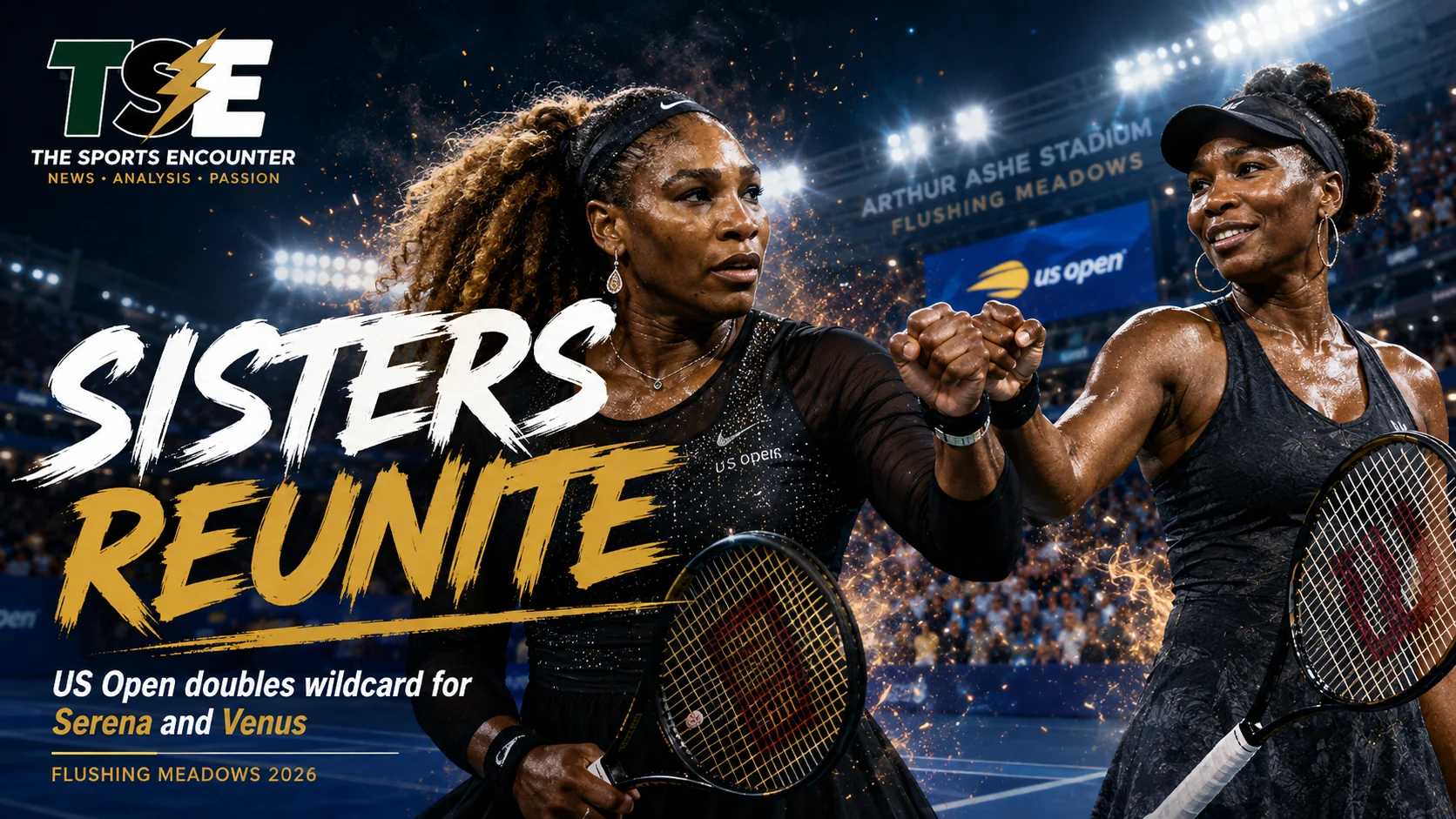
NEW YORK: Serena and Venus Williams are going back into a Grand Slam doubles draw together, 27 years after they first became US Open champions as a team.
The Williams sisters have received a wildcard into the 2026 US Open women’s doubles tournament, giving New York another chapter in a partnership that has produced 14 Grand Slam titles, three Olympic gold medals and some of the most influential doubles tennis of the modern era.
The USTA confirmed the wildcard on Wednesday, adding Serena and Venus to a women’s doubles field that begins competition on September 3. Their opening match will be played on September 3 or 4, while the final is scheduled for September 11 at Arthur Ashe Stadium.
The announcement comes only days after Serena returned to the US Open alongside Carlos Alcaraz in mixed doubles, winning one match before Belinda Bencic and Flavio Cobolli eliminated them in the quarterfinals. Venus, meanwhile, is already preparing for another singles appearance after receiving a main-draw wildcard at age 46.
Now the sisters get the reunion New York has not seen since 2022.
There is plenty of history attached to the decision, but the 2026 version of Serena and Venus is also a genuine competitive story. They reunited in Cincinnati earlier this month, took the opening set against Marta Kostyuk and Peyton Stearns and pushed the match all the way to a deciding tiebreak before losing 2-6, 6-1, 10-8.
For two players aged 44 and 46, competing against opponents who have spent the season playing regular tour tennis, that match offered enough evidence to make their US Open wildcard more than a ceremonial invitation.
Serena and Venus Williams at the 2026 US Open: Key Details
| Detail | Information |
|---|---|
| Players | Serena Williams and Venus Williams |
| Entry | Women’s doubles wildcard |
| Serena’s age | 44 |
| Venus’ age | 46 |
| Grand Slam doubles titles together | 14 |
| US Open doubles titles | 1999 and 2009 |
| Olympic doubles gold medals | 3 |
| Last major together | 2022 US Open |
| Most recent tournament together | 2026 Cincinnati Open |
| US Open doubles first round | September 3 or 4 |
| Women’s doubles final | September 11, Arthur Ashe Stadium |
TL;DR
- Serena and Venus Williams have received a wildcard for the 2026 US Open women’s doubles draw.
- They will play together at a Grand Slam for the first time since the 2022 US Open.
- The sisters won the US Open doubles championship in 1999 and 2009.
- They have won 14 Grand Slam women’s doubles titles together.
- They are unbeaten in 14 Grand Slam doubles finals.
- Serena and Venus also won Olympic doubles gold medals in 2000, 2008 and 2012.
- They reunited at the Cincinnati Open earlier this month for their first match together in nearly four years.
- Serena has already competed at the 2026 US Open in mixed doubles with Carlos Alcaraz.
- Venus also has a wildcard into the 2026 US Open singles draw.
- The women’s doubles competition begins September 3, with the final scheduled for September 11.
Twenty-Seven Years After Their First US Open Doubles Title, They Are Back
The number that gives this wildcard its historical scale is 27.
Serena and Venus won their first US Open women’s doubles championship together in 1999.
Serena was 17 when that tournament began. Venus was 19.
The sisters were still near the beginning of careers that would eventually reshape women’s tennis through power, athleticism, serving, movement, longevity and an ability to turn major tournaments into global sporting events.
They returned to win the New York doubles title again in 2009.
Now, in 2026, they are entering the same championship as a 44-year-old and a 46-year-old.
The official US Open announcement confirms that their two Flushing Meadows doubles titles came in 1999 and 2009, correcting an erroneous date that appeared in some early coverage of Wednesday’s wildcard announcement.
The return creates an unusually long competitive bridge between two eras of the sport.
Players in the current doubles field were not born when Serena and Venus first lifted the trophy together in New York.
The sisters are still preparing to stand across the net from them.
The Williams Sisters Built One of Tennis’ Greatest Doubles Records
Serena and Venus are remembered primarily as two of the greatest singles players in tennis history, which can occasionally obscure how exceptional they were as a doubles team.
The numbers leave very little room for debate.
| Grand Slam | Williams Sisters Doubles Titles |
|---|---|
| Australian Open | 2001, 2003, 2009, 2010 |
| Roland Garros | 1999, 2010 |
| Wimbledon | 2000, 2002, 2008, 2009, 2012, 2016 |
| US Open | 1999, 2009 |
| Total | 14 |
They have won every Grand Slam tournament at least twice.
Even more strikingly, they are 14-0 in Grand Slam women’s doubles finals.
When Serena and Venus reached the championship match together at a major, they always won it.
The WTA’s official review of their doubles career also credits them with 22 doubles titles overall and places their 14 majors among the greatest team records of the Open Era.
Their last major title together came at Wimbledon in 2016.
That remains their most recent Grand Slam final as a partnership.
Three Olympic Gold Medals Add Another Layer to Their Partnership
The Grand Slam record tells only part of the story.
Serena and Venus also won Olympic women’s doubles gold together three times.
They were champions at Sydney 2000, Beijing 2008 and London 2012.
That means the partnership succeeded across hard courts and grass, at majors and at the Olympics, across more than a decade of international tennis.
They also jointly reached world No. 1 in doubles in 2010.
The Williams sisters therefore return to New York with the credentials of an established all-time doubles team rather than two singles legends being paired together because their names generate attention.
That difference is important when assessing the wildcard.
Cincinnati Finally Gave Serena and Venus Their Reunion
The sisters had already tried to make this reunion happen earlier in the summer.
Wimbledon gave them a doubles wildcard in June, setting up what was supposed to be their first tournament together since the 2022 US Open.
Serena’s body changed those plans.
She injured her knee during her three-set Wimbledon singles defeat to Maya Joint and subsequently withdrew from doubles before she and Venus could play their opening match.
The Sports Encounter followed the Williams reunion story throughout the grass-court season, when Serena’s comeback had already made another partnership with Venus one of Wimbledon’s biggest potential attractions.
The reunion eventually happened in Ohio.
Serena and Venus received another wildcard for the Cincinnati Open and stepped onto court together on August 17.
Our Cincinnati Open report covered their first competitive doubles match together since 2022, where they faced Marta Kostyuk and Peyton Stearns.
The Americans won the first set 6-2.
Kostyuk and Stearns responded 6-1 in the second.
The deciding match tiebreak became much tighter than it initially appeared. Serena and Venus fell 6-0 behind before fighting back into contention, eventually losing 10-8.
The result was a defeat.
The performance gave them useful evidence before New York.
Cincinnati Showed Why the US Open Wildcard Has Competitive Logic
No responsible analysis should pretend that Serena and Venus are entering the US Open as the same physical force that dominated doubles at their peak.
Age changes movement, recovery, reaction time and the ability to sustain high-intensity tennis over multiple rounds.
The modern doubles game also contains specialists who play together throughout the season and understand positioning, return patterns and net movement at a level that can punish even small moments of hesitation.
Yet Cincinnati showed the Williams sisters can still create uncomfortable tennis.
Their serves remain dangerous.
Their return positions put immediate pressure on opponents.
Both understand doubles geometry instinctively after decades of competing together.
They can also shorten points, which becomes increasingly important as physical endurance becomes a larger consideration.
Taking a current tour-level team to a 10-8 match tiebreak after nearly four years without playing together is hardly evidence that Serena and Venus will win the US Open.
It is enough evidence to make their presence competitively credible.
Serena Has Already Shown New York This Comeback Is Real
Serena arrives in women’s doubles having already completed one US Open comeback this week.
She partnered defending men’s singles champion Carlos Alcaraz in the redesigned mixed doubles championship at Arthur Ashe Stadium.
The pairing defeated Erin Routliffe and Lloyd Glasspool 5-3, 4-1 in the opening round before losing 5-4(4), 4-1 to Belinda Bencic and Flavio Cobolli in the quarterfinals.
The Sports Encounter’s report on Serena’s US Open return highlighted one moment in particular: a 120 mph serve that immediately reminded the Arthur Ashe Stadium crowd how much power remains in her game.
That mixed doubles run mattered because Serena had not played competitively at Flushing Meadows since 2022.
She returned four years later and won a match.
Now she gets another New York opportunity with the partner who knows her game better than anyone.
Serena’s 2026 Return Has Developed Faster Than Anyone Expected
When Serena stepped away from tennis after the 2022 US Open, the occasion felt like an ending.
Her return began almost four years later at Queen’s Club in June.
She partnered Canadian teenager Victoria Mboko and immediately won her first professional match back, defeating Nicole Melichar-Martinez and Erin Routliffe 7-6(2), 6-2.
Mboko’s knee injury ended their tournament before the next doubles match.
Serena then played in Berlin, returned to singles at Wimbledon and later reunited with Venus in Cincinnati.
Her Wimbledon singles wildcard turned the comeback into a much larger competitive experiment, because singles demanded movement and physical coverage that doubles could not fully test.
She lost to Maya Joint in three sets and hurt her knee during the match, but the appearance made clear that Serena had not returned simply for exhibitions.
New York has now continued that pattern.
Venus Arrives With Her Own US Open Story
Serena’s return naturally attracts enormous attention, but Venus has been the more continuously active of the two sisters.
The 46-year-old has competed selectively throughout 2026 and has also received a wildcard into the US Open singles championship.
Our analysis of Venus’ singles wildcard examined the difficult balance between her extraordinary history at Flushing Meadows and the competitive reality of facing modern players more than two decades younger.
Doubles presents a different calculation.
Venus does not have to cover the entire court.
Her first serve can create quick points.
Her reach remains useful around the net.
And she demonstrated only last year that she can still make a Grand Slam doubles run.
Venus Reached the US Open Doubles Quarterfinals Last Year
Venus partnered Canada’s Leylah Fernandez at the 2025 US Open after receiving a wildcard only days before the doubles draw began.
The pairing quickly became one of the tournament’s most popular teams.
They defeated seeded opponents and reached the quarterfinals before their run ended.
The official US Open report from last year noted that it was Venus’ first Flushing Meadows doubles quarterfinal since 2014.
That run matters now because it provides recent evidence of Venus competing successfully in this exact tournament format.
She is returning with a partner whose résumé and familiarity are considerably greater than any temporary pairing could offer.
New York Has Seen Almost Every Version of the Williams Sisters
The US Open occupies a unique place in the Williams family story.
Venus reached the singles final on her tournament debut in 1997.
Serena won her first Grand Slam singles championship there in 1999.
Venus won consecutive singles titles in 2000 and 2001.
Serena eventually collected six US Open singles crowns.
The sisters contested two singles finals against each other in New York, with Venus winning in 2001 and Serena responding in 2002.
They won doubles together.
Serena appeared to finish her career there in 2022.
Four years later, they are both back.
That is why the 2026 tournament increasingly feels like an unusual collision between tennis history and the present tour.
The broader field remains dominated by current champions, rising players and contenders with far stronger rankings, a dynamic explored in The Sports Encounter’s complete US Open 2026 preview.
The Williams sisters add something that rankings cannot create.
Continuity.
The Wildcard Does Not Guarantee an Easy Draw
The US Open invitation gives Serena and Venus access to the tournament.
It does not protect them once competition starts.
Doubles specialists are especially dangerous in major tournaments because established partnerships understand how to expose teams that rely too heavily on individual brilliance.
Returns arrive quickly.
Net exchanges can turn in fractions of a second.
Second serves are attacked.
Positioning mistakes are punished immediately.
The Williams sisters will therefore need to establish clean service patterns and avoid allowing opponents to drag them into repeated long exchanges.
Their first-round draw will matter significantly.
A specialist seeded partnership could make the opening match difficult immediately. A less established team could provide more time for Serena and Venus to restore the instincts that Cincinnati only began rebuilding.
The 2026 US Open Has Made Doubles a Major Part of Its Story
Doubles has already occupied an unusually prominent position at this year’s tournament.
The redesigned mixed doubles championship brought leading singles stars into Arthur Ashe Stadium during Fan Week and produced some of the tournament’s first major upsets.
Novak Djokovic and Aryna Sabalenka entered as one of the biggest celebrity pairings in the field, while Serena’s partnership with Alcaraz created another major attraction.
The results quickly reminded everyone that doubles chemistry can matter more than individual singles ranking.
Specialists and established teams repeatedly disrupted the headline partnerships.
The Williams sisters offer something different because their fame and doubles pedigree exist together.
They are global stars who also happen to own 14 major doubles titles.
Could Serena and Venus Actually Make Another Deep Run?
The answer depends heavily on what standard we use.
Expecting a championship would ignore the physical reality of their ages and the quality of the modern doubles field.
Dismissing them as a nostalgia act would ignore their history, their Cincinnati performance and Venus’ run in New York last year.
The reasonable expectation lies somewhere between those extremes.
A first-round victory would immediately make the partnership one of the major stories of the doubles tournament.
Two wins would place them close to the business end of the draw and force opponents to deal with increasingly intense crowd support.
A quarterfinal or semifinal appearance would become one of the most remarkable doubles achievements of the season given their ages.
The title remains improbable.
With Serena and Venus, improbable has never meant irrelevant.
The Crowd Could Become Part of the Match
US Open doubles is normally played on courts where atmosphere can vary considerably depending on the matchup.
Any Serena and Venus match will be different.
Cincinnati already demonstrated their drawing power.
New York will amplify it.
The sisters will enter matches with spectators carrying decades of memory into the stands, and opponents will have to manage an environment in which routine points can generate major reactions.
Crowds cannot compensate for missed returns or slow movement.
They can influence momentum.
The Williams sisters understand that relationship better than almost anyone who has played at Flushing Meadows.
Twenty-Seven Years Is the Story, but Competition Is Why This Matters
The easiest way to market the wildcard is through nostalgia.
Serena and Venus won together in 1999.
They are back in 2026.
That alone produces a remarkable image.
The more interesting question begins once the match starts.
How much of their old doubles understanding still exists?
Can Serena’s serve create enough free points?
Can Venus continue the doubles form she showed in New York last year?
Can they move efficiently enough to survive against younger specialist teams?
And if the first match becomes close, can decades of experience still become an advantage rather than simply part of the storyline?
Those questions turn the wildcard into sport rather than ceremony.
TSE Analysis: The US Open Has Given History a Competitive Test
There will always be arguments about Grand Slam wildcards.
Every place given to an established star is a place unavailable to another player who may be younger, higher ranked or trying to break into the sport’s biggest tournaments.
The Williams sisters present a particularly strong case because their value is supported by more than reputation.
They are 14-time Grand Slam doubles champions.
They have never lost a major doubles final.
They won three Olympic gold medals together.
Venus reached this tournament’s doubles quarterfinals last year.
Serena has already won a match at this US Open after returning from nearly four years away.
And Cincinnati showed that the sisters can still make a current doubles team work for every point.
The 2026 wildcard therefore does something a good wildcard should do.
It places a compelling player or team into the draw and then leaves the rest to competition.
No trophy is being presented for what Serena and Venus achieved in 1999.
No opponent will stand aside because they changed tennis.
They have been given a place in the bracket.
Twenty-seven years after winning their first US Open doubles title, they have to earn everything that comes next.
For Serena and Venus Williams, that may be the most fitting way New York could welcome them back.
Follow The Sports Encounter Tennis Hub for US Open 2026 match reports, player stories, results, analysis and breaking news throughout the tournament.
Frequently Asked Questions
Are Serena and Venus Williams playing doubles at the 2026 US Open?
Yes. Serena and Venus Williams have received a wildcard into the 2026 US Open women’s doubles main draw.
When will Serena and Venus Williams play?
Their first-round match will be scheduled for either September 3 or September 4, 2026.
When is the US Open women’s doubles final?
The women’s doubles final is scheduled for September 11 at Arthur Ashe Stadium.
How many US Open doubles titles have Serena and Venus won together?
They have won two US Open women’s doubles championships, in 1999 and 2009.
Did Serena and Venus win the US Open doubles title in 2019?
No. Their US Open doubles titles came in 1999 and 2009. The official US Open record confirms both years.
How many Grand Slam doubles titles have the Williams sisters won?
Serena and Venus have won 14 Grand Slam women’s doubles titles together.
Have Serena and Venus ever lost a Grand Slam doubles final?
No. They have a perfect 14-0 record in Grand Slam women’s doubles finals.
How many Olympic doubles gold medals did Serena and Venus win?
They won three Olympic women’s doubles gold medals together, at Sydney 2000, Beijing 2008 and London 2012.
When did Serena and Venus last play a Grand Slam together?
Their previous Grand Slam doubles appearance together came at the 2022 US Open.
When did Serena and Venus last play doubles together?
They reunited at the Cincinnati Open in August 2026, losing a close first-round match to Marta Kostyuk and Peyton Stearns.
Why did Serena and Venus not play Wimbledon doubles together in 2026?
They received a Wimbledon doubles wildcard but withdrew before their opening match after Serena suffered a knee injury during her singles match against Maya Joint.
Is Serena Williams playing singles at the 2026 US Open?
The confirmed Serena Williams entries discussed here are mixed doubles and women’s doubles. She reached the mixed doubles quarterfinals with Carlos Alcaraz before receiving the women’s doubles wildcard with Venus.
Is Venus Williams playing singles at the 2026 US Open?
Yes. Venus has also received a wildcard into the women’s singles main draw.
How far did Venus Williams go in US Open doubles last year?
Venus reached the 2025 US Open women’s doubles quarterfinals with Leylah Fernandez.

FIFA Hits Argentina with Heavy World Cup Sanctions as Paredes Gets 10-Game Ban
FIFA has handed Argentina major disciplinary sanctions after the 2026 World Cup final brawl, including a 10-game suspension for Leandro...


Can FIFA Oust Gianni Infantino? Regional Powerhouses Now Weigh Historic No-Confidence Vote
Gianni Infantino is facing the most serious political challenge of his FIFA presidency as UEFA, the AFC and CONCACAF discuss...


AFC-Qatar Rift Deepens as Infantino Crisis Divides Asian Football
AFC President Sheikh Salman bin Ebrahim Al-Khalifa has hit back at Qatar after its football federation challenged the confederation’s stance...

Why FIFA COO Kevin Lamour Was Shown the Exit Way
FIFA COO Kevin Lamour has left the organization weeks after accusing staff of being deceived over the abandoned FIFA Forward...


Ireland Turns on Infantino as FIFA Election Revolt Spreads Beyond Europe’s Heavyweights
Ireland has withdrawn its support for Gianni Infantino’s re-election as FIFA president, adding another national association to a widening governance...


Donald Trump Comes to Gianni Infantino’s Rescue as FIFA Crisis Turns Political
Donald Trump has thrown his support behind Gianni Infantino as UEFA, AFC and CONCACAF deepen their challenge to the FIFA...


UEFA, AFC and CONCACAF Turn on Infantino as FIFA Crisis Becomes a Fight for His Presidency
UEFA, the AFC and CONCACAF have jointly accused FIFA President Gianni Infantino of breaking trust over the abandoned World Cup...


FIFA Says Infantino Is Being Undermined as Leadership Crisis Turns Into a Battle Over Legitimacy
FIFA has escalated its defense of Gianni Infantino, warning of a concerted effort to undermine its president as the fallout...


When Will Lionel Messi Retire? Argentina President Says Only Messi Has the Answer
Lionel Messi’s retirement remains an open question after his eight-goal 2026 World Cup. Argentina president Claudio Tapia says only Messi...


English FA Turns Its Back on Gianni Infantino, Withdraws Support for Re-Election
The English FA has formally withdrawn its support for Gianni Infantino’s bid for another term as FIFA president, adding major...


FIFA President Apologizes to Member Nations After FIFA World Cup Selloff Plan Fails to Inspire
FIFA has apologized to its member associations after abandoning a controversial plan to sell a 20% stake in a new...


Infantino in Survival Mode After World Cup Stake Sale Idea Results in Global Revolt
Gianni Infantino’s abandoned World Cup commercial rights proposal has triggered an internal FIFA revolt, lost European support, and drawn a...


Crisis Plagues FIFA as Wenger, Grafstrom and Federations Break Ranks
Gianni Infantino’s grip on FIFA is under growing pressure after senior officials, European federations and former allies distanced themselves from...


Infantino Looks to Smaller Nations After UEFA, CONCACAF Snub
Gianni Infantino’s FIFA future may depend on smaller and emerging nations after UEFA and CONCACAF lost confidence in his leadership....


FIFA’s World Cup Stake Plan Failed in Three Days. The Damage to Gianni Infantino May Last Much Longer
FIFA’s attempt to sell a 20% stake in a new World Cup commercial entity collapsed within days after a global...


Cristiano Ronaldo’s World Cup Career: Goals, Records and Final Farewell
Cristiano Ronaldo became the first man to score in six FIFA World Cups, but football’s greatest tournament never gave him...


The Golden Generation Saying Goodbye After the FIFA World Cup 2026
The 2026 World Cup did more than crown a champion. It marked the emotional farewell of a generation that shaped...


Neymar’s World Cup Career: Skill, Pain, and the Rainbow Flick Legacy
Neymar carried Brazil’s World Cup hopes across four tournaments, producing unforgettable goals while enduring injuries, criticism and elimination heartbreak. His...


Is the FIFA World Cup 2030 Not for Sale Anymore?
FIFA’s proposal to sell a minority stake in a $20 billion World Cup commercial company appears to have collapsed after...


FIFA Explores 64-Nation World Cup for 2030: Is Another Expansion Worth It?
FIFA is examining whether the 2030 World Cup should expand from 48 to 64 teams. The proposal could increase global...

Vietnam Survive Thailand’s Best Fightback to Retain ASEAN Championship 2026
Thailand pushed Vietnam into their most uncomfortable night of the tournament, but a missed penalty and two own goals helped...


Vietnam Hold the Lead, but Thailand Still Have 90 Minutes to Change the ASEAN Final
Vietnam carry a 2-0 lead into the ASEAN Championship final second leg, but Thailand still have attacking weapons capable of...


ASEAN Championship 2026 Top 10 Players: The Performers Who Shaped the Road to the Final
From Nguyễn Xuân Son’s semifinal goals to Ilhan Fandi’s decisive strikes and Ubaidullah Shamsul’s defensive work, these 10 players have...
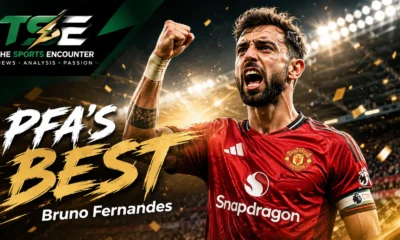

Bruno Fernandes Wins PFA Player of the Year After Record-Breaking Manchester United Season
Bruno Fernandes has been named the 2026 PFA Men’s Players’ Player of the Year after producing a historic 21-assist Premier...


Bunny Shaw Wins PFA Players’ Player of the Year After Historic Manchester City Season
Khadija “Bunny” Shaw has been named the 2025/26 PFA Women’s Players’ Player of the Year after another dominant Manchester City...

Manchester United Sign Carlos Baleba From Brighton as Carrick’s Midfield Rebuild Accelerates
Manchester United have completed the signing of Carlos Baleba from Brighton, adding the 22-year-old Cameroon midfielder to Michael Carrick’s rebuilt...
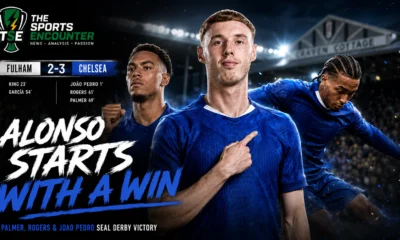

Chelsea Beat Fulham 3-2 as Palmer, Rogers and João Pedro Launch Xabi Alonso Era
Chelsea opened the Xabi Alonso era with a dramatic 3-2 win at Fulham as João Pedro scored inside the first...

Premier League Opening Weekend: Arsenal Start Strong, United Stumble, and Brighton Set the Early Pace
The Premier League’s opening weekend delivered 25 goals across nine matches, with Arsenal starting strongly, Hull stunning Manchester United, Brighton...


Draisaitl and Peterka Are Going Home as NHL Expands Germany Push
The NHL is expanding its push into Germany with four regular-season games in 2027-28. The Edmonton Oilers will play in...


Ron Duguay Walks Without a Walker as Stage 4 Cancer Fight Enters a New Treatment Phase
Ron Duguay has reached an encouraging rehabilitation milestone after his recent hospitalization, walking without a walker as his Stage 4...


Anze Kopitar Becomes Immortal in Los Angeles as Kings Retire No. 11 and Build His Statue
The Los Angeles Kings will retire Anze Kopitar’s No. 11 and unveil a bronze statue outside Crypto.com Arena, cementing the...


Ville Koivunen’s Eight-Year, $32M Penguins Deal Is a Bet on Pittsburgh’s Next Era
The Pittsburgh Penguins have committed to their future by signing 23-year-old forward Ville Koivunen to an eight-year, $32 million contract...


Tommy Novak’s $13.95M Penguins Extension Reveals Pittsburgh’s Plan Beyond the Crosby Era
The Pittsburgh Penguins have secured versatile forward Tommy Novak on a three-year, $13.95 million extension. After recording 42 points in...


Tim Seifert Sets the Stage Before Liam Dawson Seals The Hundred 2026 Final
Tim Seifert powered Manchester Super Giants toward the title before Mohammad Amir’s late burst created panic and Liam Dawson settled...


Crawley’s Costly Blunder Helps Super Giants Reach The Hundred Final
Paul Walter and Heinrich Klaasen powered Manchester Super Giants to 186 before Josh Tongue’s four wickets and Zak Crawley’s costly...


MI London Beat Birmingham Phoenix by Two Runs but Miss Hundred Eliminator on Net Run Rate
MI London survived a remarkable Birmingham Phoenix comeback to win by two runs at Edgbaston, but the victory was nowhere...


Tim Seifert Blows Sunrisers Leeds Away as Manchester Super Giants Surge Toward Hundred Eliminator
Tim Seifert hammered an unbeaten 80 from 40 balls as Manchester Super Giants chased 128 in just 67 legal deliveries,...

Stubbs Spoils Trent Rockets’ Lord’s Party as Southern Brave Win by Six Wickets
Tristan Stubbs hit an unbeaten 52 from 28 balls as Southern Brave chased 159 in 97 balls to beat Trent...

Wimbledon 2026 Withstands FIFA World Cup Clash, Breaks Attendance Record
Wimbledon attracted a record 550,151 spectators and generated 4.8 billion social media impressions in 2026. Dry weather, Arthur Fery’s semifinal...

Wimbledon Men’s Singles Champions: How Triumph on Grass Changed Their Careers
From Spencer Gore and William Renshaw to Roger Federer, Novak Djokovic, Carlos Alcaraz, and Jannik Sinner, discover how every Wimbledon...

Guo Hanyu and Kristina Mladenovic Turn Trust Into Wimbledon 2026 Glory
Guo Hanyu and Kristina Mladenovic turned a new partnership into Wimbledon glory, defeating Gabriela Dabrowski and Luisa Stefani in a...


Jannik Sinner’s Wimbledon Defense Against Novak Djokovic and Alexander Zverev
Jannik Sinner’s Wimbledon 2026 defense began with a five-set escape and ended with victories over Novak Djokovic and Alexander Zverev....


Muchova, Noskova Turn Wimbledon Women’s Singles Final Into an All-Czech Affair
Karolina Muchova saved match point to beat Coco Gauff in a Centre Court thriller, while Linda Noskova handled Marta Kostyuk...

Swiatek Sweeps Aside Rybakina to Claim Toronto Crown Ahead of US Open
Iga Swiatek swept aside Elena Rybakina 6-2, 6-3 to claim the 2026 National Bank Open title in Toronto, securing her...

Brandon Nakashima Beats Jodar to Reach First Masters 1000 Final
Brandon Nakashima held off Rafael Jodar 7-6(3), 6-4 to reach the first Masters 1000 final of his career at the...

National Bank Open: Iga Swiatek, Elina Svitolina Reach Semifinals as Montreal Enters QF Stage
Iga Swiatek and Elina Svitolina became the first confirmed National Bank Open 2026 semifinalists in Toronto, while Montreal’s men’s draw...


When Paris Welcomed Two New French Open Champions
Paris, France – June 9, 2026: There are days at Roland Garros when tennis feels like a sport. Then there...


French Open 2026: Mirra Andreeva Becomes a Grand Slam Reality
Mirra Andreeva relived the memories of Monica Seles on Super Sunday at Roland Garros to lift her maiden French Open...


Galle Gallants Are LPL 2026 Champions After 5-Wicket Revenge Win Over Jaffna Kings
Galle Gallants are the 2026 Lanka Premier League champions after defeating Jaffna Kings by five wickets, chasing 124 in 15.5...


LPL 2026 Final Preview: Galle Seek Revenge as Jaffna Chase a Fifth Crown
Galle Gallants and Jaffna Kings meet in the Lanka Premier League 2026 final after three dramatic clashes this season, with...


Harper and Asalanka Punish Colombo’s Chaos as Galle Reach LPL Final
Sam Harper’s commanding 77 and Charith Asalanka’s composed 59 carried Galle Gallants past Colombo Kaps and into the LPL 2026...


McDermott and Neesham Set the Trap Before Sahan Ends Kandy’s LPL Run
Colombo Kaps eliminated Kandy Royals by 68 runs after McDermott and Neesham powered them past 200 before Sahan and Dahani...


Mishara’s Unbeaten 108 Sends Jaffna Kings Into LPL Final After 470-Run Assault
Kamil Mishara’s unbeaten century carried Jaffna Kings into the LPL 2026 final after Galle Gallants fell 14 runs short in...


Guyana Amazon Warriors Defend 85 to Break San Francisco Hearts and Retain Global Super League Title
Guyana Amazon Warriors recovered from 29 for eight, defended a total of 85, and defeated San Francisco Unicorns by six...


Tim Robinson Explodes as Unicorns Thump Vipers to Enter the Global Super League Final
Tim Robinson struck an unbeaten 68 as San Francisco Unicorns defeated Desert Vipers by eight wickets in the Global Super...


Perth Find Their Missing Finish as Spin Silences Guyana
Brody Couch rescued Perth Scorchers XI with 43 before five spin options dismantled Guyana Amazon Warriors for 121 in a...


Akeal Hosein Nearly Steals It, but Desert Vipers Escape in Final Over
Rilee Rossouw mastered a difficult Providence pitch before Desert Vipers survived Akeal Hosein’s four-wicket fightback to beat Perth Scorchers XI...


Shadab Khan and Zachary Carter Rescue Desert Vipers’ GSL Campaign
Shadab Khan dismantled San Francisco’s middle order before 19-year-old Zachary Carter launched a fearless chase, helping Desert Vipers secure their...


LeBron James Partners With PGA Tour for Akron Golf Event as Firestone Gets New Life
LeBron James is bringing professional golf back to Akron through a new PGA Tour-backed Invitational at Firestone Country Club, combining...


Lakers’ $12.5B Sale Confirms a New Reality: This Is Luka Dončić’s Team Now
The Lakers are entering another major transition, with a reported $12.5 billion ownership deal arriving as LeBron James departs and...

NBA 2026-27 Schedule Is Here: Opening Night, Christmas Games and Biggest Dates to Watch
The NBA has released its full 2026-27 schedule, with LeBron James opening his 76ers career against the defending champion Knicks,...

LeBron James to Challenge NBA Champions Knicks to Kick Off His 76ers Era
LeBron James will begin his Philadelphia 76ers era against the defending champion New York Knicks at Madison Square Garden before...


LeBron James Says No to LA 2028, but Team USA Is Reportedly Saving Him a Seat
LeBron James says he plans to watch the 2028 Los Angeles Olympics, but USA Basketball is reportedly prepared to give...
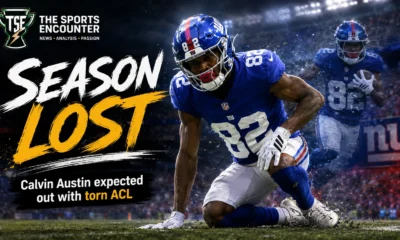

Calvin Austin Torn ACL: Giants Receiver Expected to Miss 2026 Season
New York Giants wide receiver Calvin Austin III is expected to miss the 2026 NFL season after reportedly tearing the...

NFL 2026: Trey Moore Set for Surgery, Brian Thomas Avoids Major Scare as Lions Meet Kareem Hunt
The NFL’s final preseason stretch brought injury concerns, roster moves and a major off-field honor, with Trey Moore set for...


NFL Injury Blow: Seahawks Lose Jake Bobo as Ravens Face Center Crisis After Danny Pinter Tear
The Seahawks may be without Jake Bobo for an extended period after a serious knee injury, while the Ravens face...



US Open 2026: Zverev’s Opening, Djokovic’s Record Chase and Shelton’s American Moment
The US Open 2026 men’s title race has opened up after Jannik Sinner’s withdrawal. Alexander Zverev brings Grand Slam confidence,...
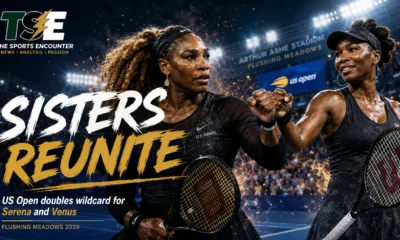

Serena, Venus Get Another Run at US Open Women’s Doubles Event
Serena and Venus Williams are returning to the US Open women’s doubles draw after receiving a 2026 wildcard. The 14-time...

Fan Support Gives Stan Wawrinka His Last Shot at the US Open Title
Stan Wawrinka will return to the US Open one final time after receiving a late main-draw wildcard following Patrick Kypson’s...
-

 Cricket4 weeks ago
Is The Hundred Losing Its Oomph Among English Cricket Fans?
-

 Editor's Choice3 weeks ago
Premier League 2026–27 Curtain Raiser: Fixtures, Teams, Title Contenders, Transfers and Season Predictions
-

 Editor's Choice4 weeks ago
US Open 2026 Curtain-Raiser: Players, Schedule, Title Contenders, New York Storylines and Everything Fans Need to Know