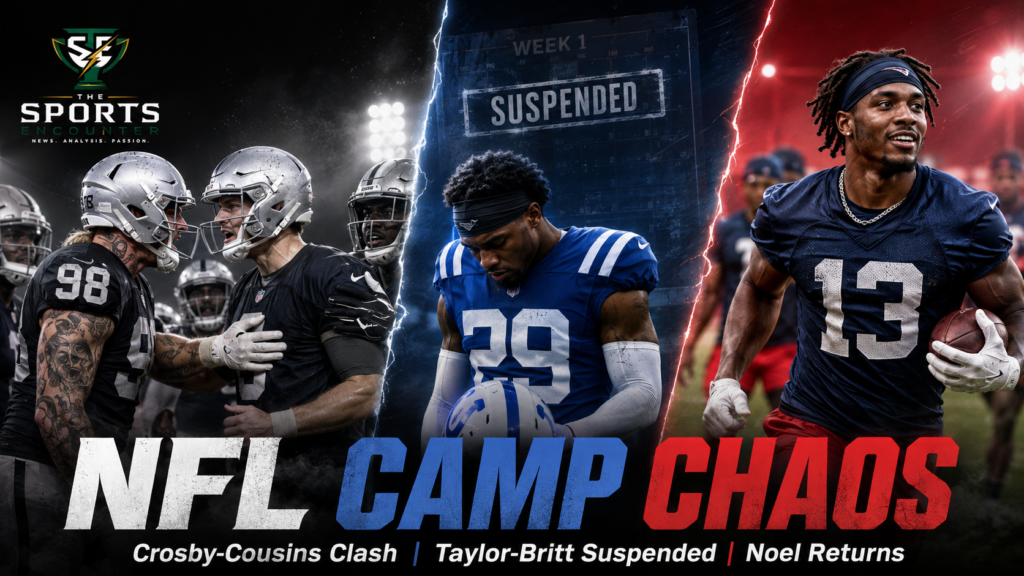
NFL Training Camp Heats Up: Crosby-Cousins Clash Erupts, Colts Lose Taylor-Britt and Texans Get Noel Back
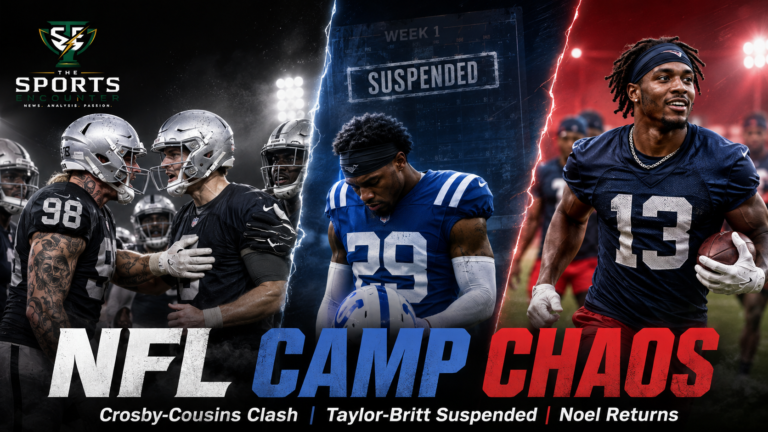
NFL training camp delivered three major developments as Maxx Crosby and Kirk Cousins clashed in Las Vegas, Cam Taylor-Britt received a one-game suspension, and Jaylin Noel returned to Texans practice.
Three very different developments across the NFL on Friday captured what August football has become: Maxx Crosby and Kirk Cousins clashed during a fiery Raiders practice, Indianapolis Colts cornerback Cam Taylor-Britt received a one-game suspension, and Houston Texans wide receiver Jaylin Noel returned from the non-football injury list.
The NFL regular season is still more than a month away, but training camp has already reached the stage where consequences are becoming real.
In Las Vegas, competitive intensity boiled over when Maxx Crosby’s pressure on Kirk Cousins resulted in a heated confrontation between two of the Raiders’ most experienced players.
In Indianapolis, the consequences came from outside football. The NFL suspended Cam Taylor-Britt for the Colts’ season opener after determining that the veteran cornerback violated the league’s personal conduct policy.
Houston received considerably better news. Jaylin Noel returned to the field after recovering from a finger injury that had kept the second-year receiver and return specialist on the non-football injury list since the start of training camp.
None of the developments alone will determine an NFL season.
Together, they illustrate what teams are managing every day in August: player discipline, physical readiness, roster competition, leadership and the difficult balance between preparing aggressively and reaching Week 1 intact.
Follow The Sports Encounter’s NFL coverage for continuing training-camp reports, roster moves, injuries, suspensions and analysis from across the league.
Friday’s NFL Training Camp Developments at a Glance
| Team | Player | Development | Immediate Impact |
|---|---|---|---|
| Las Vegas Raiders | Maxx Crosby / Kirk Cousins | Heated practice confrontation after contact on Cousins | Raises questions about camp discipline and quarterback protection |
| Indianapolis Colts | Cam Taylor-Britt | Suspended one game under NFL personal conduct policy | Unavailable for Week 1 against Baltimore |
| Houston Texans | Jaylin Noel | Activated from non-football injury list | Returns to receiving and return-game competition |
TL;DR
- Raiders quarterback Kirk Cousins and defensive end Maxx Crosby became involved in a heated exchange during Friday’s training-camp practice.
- The confrontation followed repeated pressure and contact from Crosby during live 11-on-11 work.
- Raiders coach Klint Kubiak said players must understand that throwing a punch in a game would result in an ejection.
- Indianapolis cornerback Cam Taylor-Britt has been suspended for one game for violating the NFL’s personal conduct policy.
- Taylor-Britt will miss the Colts’ September 13 season opener against the Baltimore Ravens.
- The suspension relates to reckless-driving and license-related charges stemming from traffic stops in 2025.
- Taylor-Britt remains eligible to practice and play during the preseason.
- Houston activated Jaylin Noel from the non-football injury list after he recovered from a right pinkie injury.
- Noel caught 26 passes for 292 yards and two touchdowns as a rookie in 2025.
- He also provided significant value as a punt and kick returner.
Maxx Crosby and Kirk Cousins Turn Raiders Practice Into Something More Serious
The most dramatic development of the day came in Las Vegas.
Friday’s Raiders practice featured enough physicality that quarterback Kirk Cousins eventually decided he had seen enough.
During live 11-on-11 work, Maxx Crosby made contact with Cousins around the throwing arm for the second time during the session.
Cousins responded verbally before pushing Crosby and grabbing his jersey.
Teammates quickly moved between them.
The Raiders described the exchange as a scuffle in their official training-camp report, but the incident carried more significance than an ordinary summer disagreement because of who was involved. Crosby is the emotional center of the defense. Cousins enters camp as the veteran quarterback currently positioned at the top of the depth chart while rookie Fernando Mendoza develops behind him. :contentReference[oaicite:0]{index=0}
Crosby’s Greatest Strength Can Also Create a Training-Camp Problem
The Raiders do not want Maxx Crosby practicing casually.
His relentless approach is central to what makes him one of the NFL’s premier edge defenders.
The problem is that quarterbacks wear different rules during practice.
A defensive end can finish through a running back or offensive lineman. Finishing through the quarterback creates unnecessary risk, particularly during camp when the objective is preparation rather than survival.
Raiders coaches have already spent time emphasizing boundaries with Crosby around contact near the quarterback’s arm and head.
Crosby has acknowledged the issue himself. His approach has always been built around completing the play rather than slowing down once he reaches the backfield.
That mentality creates exactly the paradox Klint Kubiak must manage.
The Raiders need Crosby’s intensity.
They cannot afford for that intensity to endanger the quarterback preparing to start their season.
Kubiak’s Reaction Focused on What Happens When September Arrives
Kubiak did not present the confrontation as a crisis.
He described Crosby and Cousins as two leaders competing against one another.
His warning instead focused on the habits being built.
A shove at practice can be separated by teammates.
A punch during an NFL game can remove a player from the contest and potentially lead to additional discipline.
That distinction becomes particularly important for a Raiders team trying to create a new identity under its first-year head coach.
Training-camp toughness has value only when players maintain enough control to use it on Sundays.
The wider league is dealing with similar questions about balancing preparation against risk. The Sports Encounter has been following those pressures in its latest NFL training-camp injury roundup, where teams are already adjusting workloads to protect important players.
Friday’s Practice Had Already Produced Another Fight
The Cousins-Crosby confrontation was not the only moment when Raiders practice became heated.
Earlier, offensive lineman Caleb Rogers and defensive lineman Jonah Laulu became involved in another confrontation.
That exchange escalated far enough to stop the practice briefly.
The two incidents suggest the Raiders have reached the familiar point in camp when repetition, heat, physical contact and roster competition begin testing patience.
Coaches generally welcome competitive practices.
They do not welcome losing players to injuries or discipline because teammates cannot stop before the whistle.
Cousins Is Also Fighting for More Than Respect in Practice
Cousins’ response should also be understood within the quarterback competition.
He enters the season as the likely starter, but Las Vegas used the No. 1 overall pick on Fernando Mendoza.
That automatically creates pressure.
Cousins cannot treat training camp as a ceremonial preparation period. Every practice helps determine how quickly Mendoza becomes a realistic alternative.
The Raiders’ own camp coverage has described Cousins as the opening QB1 while emphasizing that the competition remains worth monitoring. :contentReference[oaicite:1]{index=1}
Crosby’s pressure therefore does more than test the offensive line.
It forces the quarterback room to operate at NFL speed.
That is useful until someone crosses the boundary between competitive simulation and unnecessary contact.
Crosby’s Return Adds Another Layer to the Situation
Crosby himself is working through an important summer.
He has returned to the practice field after knee surgery and remains one of the most important players on Las Vegas’ roster.
The Raiders need him healthy enough to provide the disruptive pass rush around which much of their defensive identity is built.
They also need him disciplined enough to reach the regular season without creating preventable problems.
That tension will likely remain part of camp.
Crosby has never built his reputation by practicing at half-speed.
Kubiak’s challenge is not removing that mentality. It is directing it.
Cam Taylor-Britt Suspension Gives Indianapolis a Different Kind of Problem
While Las Vegas dealt with discipline inside practice, Indianapolis received an official disciplinary ruling from the league.
The NFL suspended cornerback Cam Taylor-Britt for one game for violating its personal conduct policy.
The Colts confirmed the suspension Friday. Taylor-Britt will miss Indianapolis’ regular-season opener against the Baltimore Ravens on September 13. :contentReference[oaicite:2]{index=2}
He can continue practicing during training camp and can participate in preseason games.
Once the regular season begins, however, he cannot be around the team during the week leading into the opener.
Why Taylor-Britt Was Suspended
The suspension stems from legal issues connected to two traffic stops during 2025.
On January 6, 2026, Taylor-Britt pleaded guilty to reckless driving and driving without a valid driver’s license.
He subsequently spent five days in jail.
The NFL’s personal conduct policy allows the league to impose discipline independently of whatever criminal penalties a player receives.
In Taylor-Britt’s case, the league determined that the conduct warranted a one-game suspension.
The Timing Is Poor for a Player Starting Over in Indianapolis
Taylor-Britt joined the Colts in March on a one-year contract after spending the first four seasons of his NFL career with Cincinnati.
He does not arrive in Indianapolis as an automatic starter.
The Colts project Sauce Gardner and Charvarius Ward as the primary outside cornerbacks, leaving Taylor-Britt to compete for an important depth role.
Missing Week 1 therefore matters differently than it would for an established star guaranteed to reclaim his position immediately.
Depth-chart roles are won through trust.
A new coaching staff needs to know which reserve corner can enter a game without forcing the defense to change its coverage structure.
Taylor-Britt now loses his first opportunity to demonstrate that reliability during regular-season football.
Taylor-Britt Still Brings Significant Starting Experience
Indianapolis did not sign an inexperienced reserve.
Taylor-Britt appeared in 47 games during four seasons with Cincinnati and started 40 of them.
His strongest stretch came across 2023 and 2024, when he started 29 games and recorded all seven of his career interceptions.
He returned an interception for a touchdown in each of those seasons.
His career production also includes 203 tackles, four tackles for loss and two forced fumbles.
That experience explains why Indianapolis considered him useful depth despite having Gardner and Ward ahead of him.
Cornerback depth rarely feels important in August.
It becomes extremely important once injuries, matchups and multiple-receiver formations begin testing a secondary during the regular season.
Week 1 Against Baltimore Makes the Absence More Noticeable
The suspension removes Taylor-Britt from a Colts opener against Baltimore.
Indianapolis would obviously prefer to enter that matchup with every experienced defensive back available.
The Ravens can force defenses into difficult personnel decisions through formation changes, route combinations and athletic skill players.
The Colts still possess their projected starting corners.
Taylor-Britt’s absence instead reduces the margin behind them.
One injury or matchup problem could force Indianapolis deeper into its cornerback rotation than planned.
The Colts Suspension Fits a Wider August Theme
NFL roster decisions increasingly involve considerations beyond pure talent.
Availability matters.
Reliability matters.
Off-field decisions matter.
A talented player who cannot dress for a game creates a different type of roster risk from someone who simply loses a camp competition.
The Sports Encounter recently examined similar value questions in its feature on the most underrated NFL offseason signings of 2026. Depth additions become valuable precisely because teams rarely reach September with every original plan intact.
Houston Receives the Best News of the Three Teams
The Texans’ Friday update carried a far more positive tone.
Houston activated wide receiver Jaylin Noel from the non-football injury list, putting the second-year player back on the practice field after he injured his right pinkie while working out before camp.
Noel had been placed on the NFI list when Houston opened training camp in late July. NFL records confirmed that initial designation. :contentReference[oaicite:3]{index=3}
Head coach DeMeco Ryans welcomed Noel’s return and praised the work he had completed during the offseason.
The timing gives Noel an opportunity to participate in the most important evaluation phase before preseason games begin deciding roster roles.
Jaylin Noel’s Value Goes Well Beyond 26 Receptions
Noel’s rookie receiving statistics were modest but useful.
He caught 26 passes for 292 yards and two touchdowns across all 17 regular-season games, making three starts.
Houston selected him with the 79th overall pick in the third round of the 2025 NFL Draft after a productive career at Iowa State. The Texans’ official player profile confirms those receiving totals. :contentReference[oaicite:4]{index=4}
His value becomes clearer once special teams enter the calculation.
Noel handled both punt and kickoff returns as a rookie.
He returned 31 punts for 335 yards, averaging 10.8 yards per return, and 29 kickoffs for 799 yards at 27.6 yards per return.
Including his offensive production, he finished with 1,438 all-purpose yards.
That type of versatility changes roster mathematics.
Return Specialists Create Extra Value on Game Day
NFL teams have only a limited number of active roster spots available on Sundays.
A receiver who can contribute offensively and handle both major return roles effectively becomes easier to dress than a specialist who performs only one task.
Noel gives Houston that flexibility.
He can provide receiving depth.
He can return punts.
He can return kickoffs.
He can contribute to field position even during games when the offense does not target him heavily.
That is particularly useful for a Texans team trying to extract small advantages from an already competitive roster.
Noel Has a Chance to Expand His Offensive Role
The next step involves becoming more than a return specialist who occasionally contributes on offense.
Noel showed flashes during his rookie campaign.
He recorded five catches for 63 yards against San Francisco and four catches for 77 yards against Seattle, while also producing a 54-yard receiving performance against the Chargers late in the season.
Those individual games suggested he can provide more than underneath utility when given opportunities.
Houston now has the remainder of camp to determine how much larger that role should become.
The Texans Already Understand the Value of Quiet Roster Strength
Houston entered the offseason with a roster strong enough that many of its important additions did not generate the league’s biggest headlines.
The Sports Encounter highlighted that theme when examining Reed Blankenship’s addition to the Texans as one of the offseason’s potentially underrated moves.
Noel’s return works in the same area of team building.
It will not dominate national television for several days.
It makes the roster more complete.
Three Stories, One Training-Camp Reality
Crosby, Taylor-Britt and Noel occupy completely different situations.
The connection between them is availability.
| Player | Question | What His Team Needs |
|---|---|---|
| Maxx Crosby | Can he maintain maximum intensity without creating unnecessary camp risk? | Controlled aggression |
| Cam Taylor-Britt | Can he rebuild trust and establish a role after his suspension? | Reliability and depth |
| Jaylin Noel | Can he turn a healthy return into a larger second-year role? | Receiving growth and special-teams production |
Every NFL team spends the spring assembling its ideal roster.
August starts dismantling the assumptions.
Injuries remove players.
Suspensions change depth charts.
Practice fights test discipline.
Young players return and reopen competitions coaches thought they understood.
The teams that navigate those changes best usually enter September with more answers than emergencies.
The Raiders Must Protect Competitive Edge Without Losing Control
The Cousins-Crosby incident will probably disappear quickly if Friday proves to be an isolated flashpoint.
Football teams fight during camp.
Tempers rise.
Veterans push one another.
The concern begins when the behavior repeats or threatens player health.
Kubiak’s job is therefore straightforward in principle and difficult in practice.
Keep Crosby playing like Crosby.
Keep Cousins upright.
Make sure neither goal compromises the other.
Recent NFL news has repeatedly demonstrated how one training-camp development can alter a team’s direction. The Sports Encounter’s coverage of Aaron Donald’s official Rams workout showed how dramatically a single personnel development can change expectations around a defense.
Indianapolis Must Absorb a Problem It Already Knows the Length Of
The positive side of Taylor-Britt’s suspension is clarity.
Indianapolis knows exactly how long he will be unavailable.
One game.
That allows the Colts to prepare the Week 1 secondary in advance rather than responding to a late injury.
The larger question belongs to Taylor-Britt.
He signed a one-year contract after leaving Cincinnati.
That type of agreement naturally creates a prove-it season.
Every missed opportunity therefore carries extra weight.
He has enough starting experience to become useful defensive depth.
He now needs the remainder of camp to ensure the suspension becomes a one-week complication rather than the defining story of his Indianapolis tenure.
Houston Can Start Asking a More Interesting Question About Noel
The Texans no longer need to ask when Jaylin Noel will return.
They can ask what he can become.
His rookie year proved he can survive an NFL season, contribute as a receiver and handle a heavy return workload.
The second season should determine whether his ceiling extends further.
A player who combines 400 to 500 receiving yards with high-level return production provides substantially more value than a player confined to special teams.
Noel now has enough camp remaining to compete for those additional snaps.
The NFL’s August News Cycle Is Accelerating
Friday’s developments also arrive during a particularly active stretch around the league.
Training camps are producing injuries and depth changes almost daily. The Sports Encounter has recently tracked Stefon Diggs’ move to Washington and Jalon Walker’s season-ending injury, as well as the latest injury concerns involving Josh Jacobs, Kenyon Sadiq and Elic Ayomanor.
Veteran careers are changing too.
Trystan Colon retired at 28 after six NFL seasons, while Aaron Donald’s workout has created genuine speculation about one of the most unlikely comeback stories of the year.
Even NFL front offices are changing around the football activity, with Detroit appointing Richard Haddad as its incoming president and CEO.
The regular season may still be weeks away.
The league has already started moving at regular-season speed.
What Happens Next for the Raiders?
Las Vegas must decide how aggressively to manage Crosby’s workload as preseason games approach.
The five-time Pro Bowl pass rusher does not need camp repetitions to prove that he can pressure quarterbacks.
He does need enough physical work to prepare his knee and body for a full season.
Cousins, meanwhile, needs repetitions with the first-team offense while Mendoza continues developing.
That makes their practice relationship important.
The Raiders benefit when Crosby forces Cousins to process pressure quickly.
They gain nothing if the same pressure turns into dangerous quarterback contact.
What Happens Next for Taylor-Britt?
Taylor-Britt remains eligible throughout the preseason.
That gives him several weeks to reinforce his value before serving the suspension.
The Colts can also use preseason snaps to determine which cornerback should take the additional Week 1 responsibilities created by his absence.
Once his suspension ends, Taylor-Britt will be eligible to return for Week 2.
The challenge will be ensuring his role remains meaningful when he does.
What Happens Next for Jaylin Noel?
Noel’s return restores competition to Houston’s receiver and special-teams rooms.
His immediate priority will be rebuilding timing after missing the opening portion of camp.
Finger injuries carry particular relevance for receivers because catching confidence matters almost as much as physical clearance.
Houston will therefore watch not merely whether Noel practices, but how naturally he catches, separates and handles return duties as his workload increases.
Final Verdict
August does not produce wins and losses in the standings.
It produces the conditions that influence them.
Las Vegas saw the dangerous side of competitive intensity when Maxx Crosby and Kirk Cousins crossed the line from football pressure into confrontation.
Indianapolis learned that Cam Taylor-Britt’s off-field conduct will cost the cornerback his first regular-season game with the franchise.
Houston finally received the type of camp news every team wants: an injured player returning rather than another one leaving.
The three developments carry different consequences.
Crosby’s situation requires control.
Taylor-Britt’s requires accountability.
Noel’s creates opportunity.
That is training camp in its most honest form.
Teams arrive with plans.
August begins changing them.
Frequently Asked Questions
Why did Maxx Crosby and Kirk Cousins fight at Raiders practice?
Cousins reacted after Crosby made contact around his throwing arm during live team work. The players exchanged words before Cousins shoved Crosby and grabbed his jersey, prompting teammates to separate them. The Raiders officially described the incident as a practice scuffle. :contentReference[oaicite:5]{index=5}
Did Maxx Crosby get suspended for the practice fight?
No suspension was announced. Raiders coach Klint Kubiak used the incident to remind players that fighting or throwing punches during games can result in ejection.
Is Kirk Cousins the Raiders’ starting quarterback?
Cousins entered training camp as the first-team quarterback, although No. 1 overall draft pick Fernando Mendoza remains part of the longer-term competition. :contentReference[oaicite:6]{index=6}
Why was Cam Taylor-Britt suspended?
The NFL suspended Taylor-Britt for one game for violating its personal conduct policy following reckless-driving and driver’s-license charges stemming from traffic stops in 2025.
Which game will Cam Taylor-Britt miss?
Taylor-Britt will miss the Indianapolis Colts’ season opener against the Baltimore Ravens on September 13. The Colts officially confirmed his one-game suspension. :contentReference[oaicite:7]{index=7}
Can Taylor-Britt play during the preseason?
Yes. He can practice and participate in preseason games before serving his suspension during Week 1.
Has Jaylin Noel returned to Texans practice?
Yes. Houston activated Noel from the non-football injury list after he recovered from a right pinkie injury suffered before training camp.
What were Jaylin Noel’s rookie receiving statistics?
Noel caught 26 passes for 292 yards and two touchdowns across 17 games during the 2025 season. :contentReference[oaicite:8]{index=8}
Where did Houston draft Jaylin Noel?
The Texans selected Noel in the third round with the 79th overall pick of the 2025 NFL Draft. :contentReference[oaicite:9]{index=9}
Why is Jaylin Noel important to Houston beyond receiving?
Noel contributes extensively on special teams as both a punt and kickoff returner, giving Houston additional game-day roster flexibility.
Editor's Choice
When Will Lionel Messi Retire? Argentina President Says Only Messi Has the Answer
Lionel Messi’s retirement remains an open question after his eight-goal 2026 World Cup. Argentina president Claudio Tapia says only Messi will decide when his international career ends.
Lionel Messi has finished another FIFA World Cup, turned 39, broken more records and lost another final with Argentina. Yet there is still no retirement announcement. Argentine Football Association president Claudio Tapia says there should not be one until Messi himself decides the time has come.
For most footballers, the question would already sound answered.
Lionel Messi is 39 years old.
He has played in six World Cups.
He has already won the trophy that defined so much of his international career.
He has won two Copa América titles, the Finalissima, Olympic gold, a record collection of individual awards and virtually every major club honor available to him.
He has nothing left to prove.
And yet, less than three weeks after Argentina lost the 2026 FIFA World Cup final to Spain, football is once again asking a familiar question:
When will Lionel Messi retire?
Claudio “Chiqui” Tapia, president of the Argentine Football Association, has given the clearest answer available.
Nobody knows.
More importantly, nobody else gets to decide.
Tapia said Messi’s retirement is a purely personal decision and urged people to allow the Argentina captain time to relax and continue enjoying football before deciding what comes next.
That position reflects something Argentina learned during the last four years.
After Qatar 2022, many assumed Messi had reached the natural ending of his international story.
He had finally lifted the World Cup.
He was 35.
There seemed little reason to ask his body for another four-year cycle.
Messi never promised 2026.
He approached the future match by match.
Then he arrived in North America at 39 and produced eight goals and four assists, carried Argentina to another World Cup final and forced the retirement conversation to begin again from an entirely different position.
The question is no longer whether Messi is too old to contribute.
The 2026 World Cup answered that.
The question is whether he still wants to continue.
Readers can revisit Messi’s latest World Cup journey through The Sports Encounter’s complete FIFA World Cup 2026 hub, including our coverage of Spain’s extra-time victory over Argentina in the final.
Inter Miami have already removed one piece of uncertainty. Messi is under contract with the MLS club through the end of the 2028 season, according to Inter Miami’s official announcement.
Lionel Messi Retirement: What We Actually Know
| Question | Current Answer |
|---|---|
| Has Messi announced his retirement? | No |
| Has he retired from Argentina? | No |
| Has the AFA set a deadline? | No |
| What does Claudio Tapia say? | The decision belongs entirely to Messi |
| Messi’s age | 39 |
| 2026 World Cup output | 8 goals, 4 assists |
| Argentina’s 2026 finish | World Cup runners-up |
| Inter Miami contract | Through the end of the 2028 MLS season |
| Possible next major Argentina tournament | 2028 Copa América |
| Age during 2030 World Cup | 43 |
| Will he play in 2030? | No indication at present |
TL;DR
- Lionel Messi has not announced when he will retire from club or international football.
- AFA president Claudio Tapia says the decision belongs entirely to Messi.
- Messi scored eight goals and recorded four assists at the 2026 World Cup.
- Argentina reached the final before losing 1-0 to Spain after extra time.
- Messi finished the tournament with 21 career World Cup goals.
- He surpassed Miroslav Klose’s old record of 16 during the tournament before Kylian Mbappé finished on 22.
- Messi remains contracted to Inter Miami through the end of the 2028 MLS season.
- A possible 2028 Copa América now looks like a more realistic retirement checkpoint than the 2030 World Cup.
- Messi would be 43 during the 2030 World Cup.
- Roger Milla was 42 years and 39 days old when he became the oldest non-goalkeeper to appear at a World Cup.
- Messi has already retired from Argentina once before, briefly stepping away after the 2016 Copa América final before returning.
Tapia Has Removed the Deadline
The most revealing part of Tapia’s comments is not praise for Messi.
Argentina officials have been praising him for years.
It is the absence of pressure.
The president of the AFA could have used the moment to talk about transition, succession planning or giving younger players space.
He did the opposite.
Tapia emphasized that Messi alone will determine when the journey ends.
He also pointed directly to the uncertainty that existed after 2022.
At that point, nobody knew whether Messi would play another World Cup.
Four years later, Argentina received one of the most productive World Cup campaigns of his career.
That experience has clearly changed how the federation views retirement predictions.
There is little value in forcing a timeline on a player who continues disproving the timelines created for him.
The 2026 World Cup Made Retirement Harder to Predict
If Messi had struggled badly in North America, the conversation would be simpler.
Age would provide an obvious explanation.
Argentina could frame the tournament as a dignified farewell.
The national team could begin the next cycle with an uncomplicated transition.
Instead, Messi scored eight goals.
FIFA’s official tournament record shows that he finished with 21 career World Cup goals after scoring against Algeria, Austria, Jordan, Cape Verde and Egypt during Argentina’s run.
He also supplied four assists.
His influence extended into the semifinal against England, where two late Messi-created goals helped Argentina overturn a deficit and reach the final.
The Sports Encounter broke down that extraordinary finish in Messi Engineers Argentina’s Late Escape as England Falter in Atlanta and later examined the tactical collapse from England’s perspective in our semifinal analysis.
Whatever retirement looks like, it cannot yet be explained through competitive irrelevance.
Messi remained decisive at 39.
Eight Goals at 39 Changes Everything
That number deserves more attention than a simple tournament stat.
Eight goals across a World Cup is elite production at any age.
Messi did it after turning 39 during the tournament.
He scored a hat-trick against Algeria.
He scored twice against Austria.
He added goals against Jordan, Cape Verde and Egypt.
By the knockout rounds, opponents knew Argentina’s attack still passed through him.
They still could not remove his influence consistently.
That matters to the retirement discussion because aging attackers normally become easier to manage once physical decline removes separation, recovery speed and repeated high-intensity movement.
Messi has already adapted around those losses.
He no longer needs to dominate every meter of the pitch.
He can disappear from stretches of a game, preserve energy and then decide a sequence through one pass, one dribble, one set piece or one finish.
That style creates the possibility of longevity that would have looked unrealistic for the younger Messi, whose game relied on relentless acceleration and repeated ball carries.
The Messi Argentina Need Today Is Different From the Messi of 2012
This is central to understanding why retirement cannot be assessed only through age.
Argentina are not asking Messi to play like he is 25.
They are asking him to solve specific moments.
His role has become more selective.
He receives the ball in areas where his vision matters.
Other players perform more of the running.
The midfield carries greater defensive responsibility.
Fullbacks and forwards create movement around him.
Messi chooses when to accelerate.
This is an important difference between physical decline and football decline.
His physical capacity has obviously changed.
His football intelligence has not.
The question becomes whether Argentina can continue designing a team that extracts the second without becoming excessively exposed by the first.
Argentina Have Already Proven They Can Carry the Physical Load Around Him
The 2026 squad offered evidence that the model still works.
Argentina reached another final.
Messi remained the creative reference point, but younger legs surrounded him.
The balance is why retirement cannot simply be discussed as an individual question.
It is also tactical.
If Argentina’s midfield and forward structure can keep providing enough defensive running, Messi’s unique creative contribution may remain worth accommodating.
If that balance changes, the calculation could change with it.
The Final Defeat Did Not Feel Like 2016
Messi has been here before.
Almost exactly ten years earlier, MetLife Stadium witnessed one of the lowest moments of his international career.
Argentina lost the 2016 Copa América Centenario final to Chile on penalties.
Messi missed his penalty in the shootout.
Afterward, emotionally exhausted by another final defeat, he announced that his international career was over.
He was only 29.
At the time, Argentina had lost the 2014 World Cup final and consecutive Copa América finals in 2015 and 2016.
The emotional pressure surrounding his national-team career had become enormous.
Messi eventually reversed the retirement decision and returned.
FIFA records his comeback in September 2016 against Uruguay.
That return ultimately changed Argentine football history.
Imagine If Messi Had Stayed Retired in 2016
The thought experiment demonstrates why retirement predictions around Messi require caution.
If his 2016 decision had remained permanent, Argentina would never have received the second half of his international story.
No Copa América 2021.
No Finalissima.
No Qatar 2022.
No second World Cup Golden Ball.
No 2024 Copa América title.
No 2026 World Cup final.
No 21 World Cup goals.
That is why the current AFA position makes sense.
Argentina once nearly lost Messi because emotional exhaustion convinced him the journey was over.
They have no reason to create that decision for him now.
Qatar 2022 Was Supposed to Be the Perfect Ending
There may never be a cleaner retirement moment than December 18, 2022.
Messi had just produced one of the great individual World Cup campaigns.
Argentina defeated France in perhaps the most dramatic final the tournament had seen.
Messi lifted the trophy.
The missing piece disappeared.
If football stories required neat endings, his international career would have stopped there.
Messi did not stop.
He continued through another Copa América cycle and another World Cup.
That tells us something about his motivation.
For years, outside observers assumed the World Cup was the finish line.
Messi appears to have viewed football itself as the reason to continue.
Tapia’s Message Is Really About Enjoyment
The AFA president repeatedly returned to the idea that Messi should continue enjoying football.
That may ultimately determine retirement more than statistics.
Messi no longer needs another trophy to validate his career.
He does not need another Ballon d’Or.
He does not need another goal record.
His decision can therefore become unusually personal.
Does he still enjoy training?
Does he still enjoy the travel?
Does his body recover well enough?
Does representing Argentina still give him energy rather than taking it away?
Does he want another tournament?
Those questions cannot be answered by the AFA, Inter Miami, sponsors, supporters or journalists.
Inter Miami Gives Us the Clearest Retirement Timeline
For all the uncertainty around Argentina, Messi’s club situation is far more concrete.
Inter Miami extended his contract through the end of the 2028 MLS season.
That agreement was announced in October 2025.
It means Messi has already committed contractually to professional football beyond his 41st birthday.
That does not guarantee he will complete every season of the agreement.
Contracts can change.
Players can retire while deals remain.
But it is the strongest available evidence that an immediate club retirement was not his plan when he signed.
Why the 2028 Contract Is So Important
The extension creates an obvious bridge between the 2026 World Cup and the next major international cycle.
If Messi remains healthy and continues playing regularly for Inter Miami through 2027 and into 2028, Argentina will naturally face another question.
Why would a still-active Lionel Messi automatically stop playing for the national team?
That does not mean he will continue.
Club football offers a different physical demand from international travel and tournament preparation.
But continued MLS football keeps the international door open.
Could Messi Play the 2028 Copa América?
This may be the most realistic next retirement checkpoint.
Messi would be 41 during the 2028 tournament.
He would also, based on his current contract, still be an active Inter Miami player.
That combination makes 2028 easier to imagine than 2030.
The host and full structure of the next Copa América have not yet been finalized publicly, although discussions about the tournament are already underway.
The AFA is clearly not closing the door.
Tapia’s latest remarks have been interpreted in Argentina as applying not only to retirement generally but also to Messi’s possible participation in the next Copa América cycle.
The important word remains possible.
No commitment has been made.
Why Copa América Could Be a More Natural Farewell Than the World Cup
Messi’s relationship with the Copa América is almost as important as his World Cup story.
For years, the tournament represented frustration.
Argentina lost finals.
Messi carried criticism.
His 2016 retirement followed a Copa América defeat.
Then the competition became the site of his international liberation.
Argentina won the 2021 title at the Maracanã.
That trophy changed the emotional atmosphere around the national team before Qatar.
Argentina then won again in 2024.
If Messi eventually chose 2028 as his final major international tournament, the symmetry would be remarkable.
The competition that once pushed him away from Argentina could become the one that allows him to leave on his own terms.
But Messi May Not Want a Farewell Tour
This is another narrative worth considering.
Retirement in modern sport often becomes a season-long ceremony.
Every stadium produces a tribute.
Every interview asks about the final game.
Every appearance becomes historical before it has even happened.
Messi has rarely seemed attracted to that kind of spectacle.
He may prefer to decide privately and announce the ending only when he is certain.
Tapia’s approach gives him that freedom.
What About the 2030 World Cup?
This is where possibility starts becoming fantasy, but not quite impossibility.
Messi would turn 43 during the 2030 World Cup.
The tournament will have special emotional meaning for South American football because Argentina, Uruguay and Paraguay will each stage centenary celebration matches before the competition continues primarily in Spain, Portugal and Morocco.
For Messi, the symbolism would be enormous.
Another World Cup.
A centenary edition.
A match connected to Argentina.
A chance to stretch one of football’s most extraordinary careers into a fourth decade of senior football.
None of that means it will happen.
Playing at 43 Would Require Messi to Break Another Age Barrier
Roger Milla appeared for Cameroon at the 1994 World Cup at 42 years and 39 days.
He remains the oldest non-goalkeeper to play in a World Cup.
Messi would be older than that during the 2030 tournament.
His participation would therefore require another piece of age history.
Even qualifying physically for a World Cup squad at 43 would be extraordinary.
Starting or playing decisive minutes would move into territory modern elite football has rarely seen.
Cristiano Ronaldo Has Changed the Longevity Conversation Too
Messi is not aging in isolation.
Cristiano Ronaldo played at the 2026 World Cup at 41.
The two players have spent almost two decades altering football’s understanding of what elite performance can look like.
Now they are altering assumptions about age.
The Sports Encounter recently examined Ronaldo’s complete tournament story in Cristiano Ronaldo’s World Cup Career: Goals, Records and Final Farewell.
Their careers remain different.
Their aging processes are different.
But Ronaldo playing into his 40s makes the concept of Messi continuing beyond 40 feel less absurd than it once would have.
Ronaldo Is Also a Warning Against Assuming Longevity Means 2030
Continuing professional football into your 40s and playing another World Cup are not the same achievement.
International tournaments demand different physical preparation.
National teams have limited squad spaces.
The competition level rises.
Managers must decide whether emotional and historical value still matches football value.
Messi will ultimately face those standards too.
His name cannot be the only reason for selection.
The 2026 tournament showed that it did not need to be.
Argentina Cannot Build Their Future Around a 43-Year-Old Messi
This is perhaps the most important distinction in the entire discussion.
Argentina can leave the door open for Messi.
They cannot postpone their own development while waiting for him to decide.
The next generation must develop regardless.
New creative responsibilities have to emerge.
New leaders have to form.
The national team must learn how to win matches when Messi is unavailable.
If he remains part of that structure, Argentina should treat him as an extraordinary additional weapon rather than the only architecture of the team.
Scaloni Already Started That Transition Years Ago
Lionel Scaloni’s greatest achievement may not simply be winning tournaments.
He built an Argentina team that allowed Messi to become more effective by requiring him to do less.
The younger generation absorbed defensive running.
The midfield developed technical security.
Multiple forwards became capable of scoring.
Leadership spread through the squad.
That process is why Argentina have a chance to manage Messi’s eventual exit without collapsing after it.
What Happens to Argentina When Messi Finally Leaves?
The emotional effect will be enormous.
The tactical effect may be even more complicated.
Argentina have spent nearly two decades possessing an automatic solution to the hardest problem in football.
When a match becomes stuck, give Messi the ball.
When a defense becomes compact, Messi sees the pass.
When a free kick appears, Messi can score it.
When pressure becomes overwhelming, Messi has already experienced something worse.
No replacement can reproduce that combination.
Argentina Should Not Search for the Next Messi
This is one of the traps national teams often fall into after losing a generational player.
There will not be another Lionel Messi.
The correct succession plan is collective.
More creativity from midfield.
More responsibility from wide players.
Greater tactical flexibility.
Shared leadership.
Different attacking structures.
Argentina’s post-Messi identity should not be a weaker imitation of the Messi era.
It should be something new.
The 2026 Final Already Offered a Glimpse of That Future Problem
Spain defeated Argentina 1-0 after extra time in the World Cup final.
Ferran Torres scored the decisive goal as Spain’s control eventually overwhelmed the defending champions.
The Sports Encounter’s full final report showed an Argentina side that remained competitive but increasingly struggled to escape Spain’s territorial pressure.
Messi could still create danger.
He could not solve every structural problem.
That is the reality Argentina must carry into the next cycle.
Messi’s 2026 World Cup Did Not Need Another Trophy to Matter
This tournament altered his legacy differently from Qatar.
2022 provided completion.
2026 provided longevity.
Messi showed that his international relevance was not dependent on nostalgia.
At 39, he remained one of the tournament’s dominant attacking players.
He scored eight times.
He created four assists.
Argentina reached the final.
The Sports Encounter’s 2026 World Cup Dream Team coverage reflected the scale of his tournament influence.
His World Cup Goal Record Became Another Retirement Argument
Messi entered the tournament with 13 World Cup goals.
He finished with 21.
That took him beyond Miroslav Klose’s long-standing record of 16.
Kylian Mbappé ultimately finished the tournament with 22 career World Cup goals, moving one ahead of Messi.
That creates an obvious temptation.
Could chasing Mbappé influence Messi’s decision?
Probably not in any decisive way.
At this stage of his career, one record is unlikely to justify another four-year World Cup cycle.
But it adds another layer to the mythology.
Messi vs Mbappé Is Now a Generational Handover
For years, football’s defining individual rivalry was Messi against Ronaldo.
The late stage of Messi’s international career now overlaps with Mbappé’s pursuit of World Cup history.
Messi leaves 2026 with 21 tournament goals.
Mbappé leaves with 22.
The record may eventually move far beyond both numbers if the French forward continues appearing at future tournaments.
That does not diminish Messi’s achievement.
It reinforces the generational transition taking place around him.
The Messi-Ronaldo Debate Has Also Reached Its Final Phase
Messi won the World Cup in 2022.
He returned to the final in 2026.
Ronaldo extended his own record-breaking career into a sixth tournament.
The Sports Encounter explored that era change in The Golden Generation Saying Goodbye After the FIFA World Cup 2026.
The title feels particularly appropriate now.
The generation is leaving.
It just has not left all at once.
Why Messi May Continue International Football Without Promising Another Major Tournament
There is another possibility that often gets overlooked.
Messi does not need to choose immediately between retirement and 2030.
He can continue playing selected matches.
He can assess his body.
He can reduce travel when necessary.
He can participate in friendlies or qualifiers selectively.
He can allow 2027 to determine whether 2028 remains realistic.
This is essentially the approach he used before 2026.
Game by game.
No grand declaration.
The AFA Can Afford to Give Him That Flexibility
Messi is not an ordinary veteran occupying a roster place.
His experience has sporting value.
Young Argentine players train alongside someone who has played virtually every type of match football can offer.
He understands finals.
He understands hostile crowds.
He understands losing.
He understands winning after losing.
That institutional knowledge has value even as his minutes eventually decline.
But Sentiment Cannot Become Selection Policy
This is the counterargument.
Argentina owe Messi respect.
They do not owe him unlimited minutes forever.
If his physical level drops substantially, Scaloni or whoever eventually coaches Argentina must make football decisions.
Tapia saying Messi controls his retirement does not mean Messi controls team selection.
Those are different responsibilities.
The healthiest arrangement would preserve both.
Messi decides when he wants to stop making himself available.
The coach decides how he fits into the team.
Would Messi Accept a Reduced Role?
This could eventually become the decisive question.
A player can remain physically capable of contributing without remaining capable of starting every major match.
Would Messi want to travel internationally as a substitute?
Would he accept selective minutes?
Would Argentina benefit from that arrangement?
No evidence currently tells us the answer.
But it may matter long before 2030 does.
Inter Miami Could Determine More Than Argentina
The clearest evidence about Messi’s future will probably come from weekly club football rather than international statements.
How many matches does he play?
How many minutes?
How often does he need rest?
Does he continue creating and scoring?
How does his body respond to travel?
Does he still enjoy the routine?
Inter Miami’s official 2026 statistics already show that Messi remains heavily involved in the team’s attack.
Those club performances will become the best guide to whether international football remains realistic.
Miami Also Gives Messi Control Over His Final Club Chapter
His move to MLS changed the rhythm of his career.
Barcelona existed inside relentless European expectation.
Paris Saint-Germain carried Champions League pressure.
Inter Miami offers competition, ambition and global attention but also greater control over lifestyle and workload.
That environment may extend his career.
His 2028 extension suggests both player and club believe there is still meaningful football ahead.
Could He Retire From Argentina Before Retiring From Club Football?
Yes.
That may actually be the most conventional outcome.
International football requires additional travel and short recovery windows.
Messi could theoretically continue at Inter Miami while stepping away from Argentina.
Many elite players have followed that route.
The question is whether representing Argentina remains too emotionally important for Messi to separate the two careers easily.
Could He Retire From Club Football and Still Play One Final Argentina Match?
That scenario is less likely but not impossible.
National associations sometimes organize ceremonial farewell appearances.
Messi’s eventual goodbye could become one of the largest sporting events Argentina has staged.
A final match in Buenos Aires would carry enormous emotional weight.
Whether Messi would actually want such a ceremony is another question.
The Farewell Venue Question Will Become Huge
Whenever retirement does come, Argentines will immediately ask where the final national-team match should be played.
Buenos Aires is the obvious answer.
But Messi’s international career has unfolded across the world.
He debuted in Hungary.
He experienced his greatest heartbreaks in Brazil, Chile and the United States.
He lifted the World Cup in Qatar.
He reached another final in New Jersey.
The final geography of his career could carry symbolic meaning.
Argentina’s Fans Have Already Experienced Losing Messi Once
The reaction to his 2016 retirement was extraordinary.
Supporters publicly called for him to return.
Argentina had spent years criticizing Messi for supposedly failing to reproduce his Barcelona form.
Then the prospect of actually losing him changed the emotional calculation.
That episode helped redefine his relationship with the country.
By 2022, that relationship had transformed completely.
Messi No Longer Needs Argentina’s Approval
This may be the biggest psychological difference between 2016 and 2026.
Ten years ago, Messi’s international legacy remained contested at home.
Now it does not.
He delivered the World Cup.
He delivered Copa América titles.
He returned to another World Cup final.
He owns the national team’s scoring and appearance records.
His relationship with Argentina has reached a point where retirement can be personal rather than defensive.
The 2026 Defeat Does Not Require Redemption
This matters enormously.
After 2014, Messi carried unfinished business.
After 2016, he carried unfinished business.
After 2026, there is disappointment but no existential failure.
Spain won the final.
Argentina did not surrender their legacy.
Messi does not need another tournament to correct what happened in New Jersey.
That freedom makes his decision harder to predict.
What Would Make Messi Retire?
No one outside his inner circle knows.
But several realistic triggers exist.
- A significant decline in physical recovery.
- Recurring injuries that prevent consistent training.
- A feeling that international travel has become too demanding.
- Reduced enjoyment of daily football.
- A desire to spend more time with family.
- A sense that Argentina’s next generation no longer needs him.
- The conclusion of his Inter Miami contract.
- A personally satisfying final tournament or farewell match.
None of those conditions has been publicly identified as the deciding factor yet.
What Probably Will Not Decide It
Public pressure.
Tapia has essentially removed that variable.
Argentina are not pushing Messi toward the exit.
They are not demanding another tournament either.
That may give him the rarest luxury available to a global sports icon.
Choice.
Three Realistic Messi Retirement Scenarios
Scenario 1: International Retirement Before 2028
Messi returns to Inter Miami, completes another MLS season and eventually decides that the World Cup final was his final major international chapter.
This remains entirely plausible.
At 39, even six months can change physical calculations dramatically.
Scenario 2: Copa América 2028 Becomes the Farewell
Messi remains healthy through his Inter Miami contract, stays connected to Argentina and reaches one final continental championship at 41.
Of the forward-looking scenarios, this currently feels the most realistic.
Scenario 3: Messi Keeps the 2030 Door Open
He never formally commits to another World Cup but continues playing long enough that the conversation refuses to disappear.
By 2029, Argentina evaluate his condition and role.
If he remains competitive at 42, the impossible conversation becomes a real selection discussion.
This is the least likely scenario, but Messi’s career has already made a habit of making improbable longevity look ordinary.
Probability Is Not the Same as Possibility
This distinction should guide all 2030 coverage.
Could Messi play at 43?
Technically, yes.
Is there evidence today that he plans to?
No.
Would it be unprecedented for an outfield player at the World Cup?
Yes.
That is why headlines declaring Messi “set for 2030” would be misleading.
The responsible framing is that 2030 remains theoretically possible only because Messi has not announced an ending.
The World Cup Generation Is Already Changing Around Him
Messi is not the only icon confronting the end.
The 2026 tournament featured a remarkable collection of veteran stars whose international careers are approaching or have reached their final stages.
The Sports Encounter explored that transition in our feature on the generation saying goodbye after the World Cup.
Football is moving toward a new era whether Messi retires tomorrow or two years from now.
Messi’s Legacy No Longer Depends on the Date
This is perhaps the most important point.
Whenever Messi retires, the date will not determine his place in football history.
The argument has already moved beyond accumulation.
Barcelona.
Argentina.
Eight Ballon d’Or awards.
World Cup 2022.
Two Copa América titles.
A second World Cup final in 2026.
Twenty-one World Cup goals.
More than two decades at elite level.
The ending can add emotion.
It cannot rewrite the scale of what came before.
What Retirement Would Mean for Global Football
Messi retiring will not feel like an ordinary player announcement.
Football has lived with him for more than two decades.
Entire generations have no memory of the sport before Messi and Ronaldo.
Broadcast economics changed around their rivalry.
Social media grew alongside their careers.
El Clásico became a global weekly event partly because both existed simultaneously.
MLS received unprecedented global attention after Messi moved to Miami.
Argentina’s international identity became inseparable from him.
His retirement will therefore represent the closing of an era rather than the departure of one player.
Inter Miami Will Feel the Impact Immediately
Messi’s influence in Miami extends beyond goals and assists.
His arrival changed the club’s profile, attendance, commercial reach and global relevance.
Inter Miami’s own contract-extension announcement described his presence as central to the club’s development and its move into Miami Freedom Park.
Whenever he leaves, the organization will face the same problem Argentina faces.
How do you build after the player who changed everything?
MLS Will Face Its Own Post-Messi Test
Messi’s American career has become part of the league’s growth story.
The 2026 World Cup also produced record-scale soccer audiences in the United States, which The Sports Encounter examined in our analysis of the World Cup final’s massive U.S. television audience.
MLS will eventually have to convert Messi-driven attention into long-term interest that survives after he stops playing.
That may become one of the defining business questions of the league’s next decade.
Would Messi Become a Coach?
Nothing in his current public plans suggests an immediate coaching career.
Great players do not automatically become coaches.
Messi’s football intelligence would obviously make the possibility fascinating, but his temperament and interests after retirement remain unknown.
Ownership, academy involvement, ambassadorial work or simply stepping away from professional football are all conceivable.
There is no reason to manufacture a post-playing role before Messi defines one himself.
Could He Remain Connected to Argentina?
This feels much easier to imagine.
Messi’s relationship with the national team is now permanent regardless of employment.
He could eventually become an ambassador, adviser or symbolic figure around the federation without holding a formal coaching role.
But again, that is future speculation.
The only current certainty is that he remains a player.
The Most Important Retirement Signal Will Come From Messi, Not Tapia
Tapia’s statement is important precisely because it refuses to become an announcement.
He is not predicting.
He is not pressuring.
He is not negotiating publicly.
He is telling everyone to wait.
That is probably the correct approach.
Final Verdict: Stop Trying to Write Messi’s Final Page for Him
Lionel Messi has already retired once.
Football learned from what happened next.
He returned.
He won the Copa América.
He won the World Cup.
He won another Copa América.
He reached another World Cup final.
He broke the World Cup goals record at 39 before Mbappé moved ahead.
He produced eight goals and four assists during a tournament many once assumed he would never play.
Now the sport wants another definitive answer.
Messi is not giving one.
Neither is Argentina.
Claudio Tapia’s position is therefore more meaningful than it initially sounds.
The AFA will not choose the ending.
Age will influence it.
Injuries may influence it.
Inter Miami may influence it.
The 2028 Copa América may influence it.
Perhaps even the distant possibility of 2030 will remain somewhere in the background.
But the final decision belongs to the player.
That seems appropriate.
For most of Lionel Messi’s international career, everyone else tried to define what he needed to accomplish.
Win a Copa América.
Win a World Cup.
Perform like Maradona.
Lead differently.
Score more.
Carry Argentina.
Then, eventually, know when to leave.
Messi has answered almost every demand football placed on him.
He has earned the right to ignore the last one until he is ready.
Frequently Asked Questions
When will Lionel Messi retire?
Messi has not announced a retirement date. Argentine Football Association president Claudio Tapia says the decision belongs entirely to Messi and that he should be allowed to continue enjoying football before deciding when to stop.
Has Lionel Messi retired from Argentina after the 2026 World Cup?
No. Messi has not announced his retirement from international football following Argentina’s defeat to Spain in the 2026 World Cup final.
How old is Lionel Messi?
Messi turned 39 on June 24, 2026.
How did Lionel Messi perform at the 2026 World Cup?
Messi scored eight goals and registered four assists as Argentina reached the final. FIFA lists his eight tournament goals as taking his career World Cup total to 21.
Who beat Argentina in the 2026 World Cup final?
Spain defeated Argentina 1-0 after extra time, with Ferran Torres scoring the decisive goal.
Is Lionel Messi still playing for Inter Miami?
Yes. Messi remains an Inter Miami player and is under contract through the end of the 2028 MLS season.
Could Lionel Messi play in the 2028 Copa América?
It is possible, but Messi has made no commitment. He would be 41 and, under his current contract, could still be playing for Inter Miami during that period.
Could Messi play in the 2030 World Cup?
There is no indication that Messi plans to play in 2030. He would be 43 during the tournament, making participation historically extraordinary for an outfield player.
How old would Messi be at the 2030 World Cup?
Messi would turn 43 during the tournament.
Who is the oldest outfield player to play at a World Cup?
Cameroon’s Roger Milla appeared at the 1994 World Cup at 42 years and 39 days old.
Did Lionel Messi ever retire from Argentina before?
Yes. Messi announced his international retirement after Argentina lost the 2016 Copa América Centenario final to Chile. He later reversed the decision and returned to the national team.
When did Messi return after his 2016 retirement?
He returned to international football in September 2016 and scored in Argentina’s 1-0 World Cup qualifying win over Uruguay.
How many World Cup goals does Lionel Messi have?
Messi finished the 2026 tournament with 21 career World Cup goals.
Who has more World Cup goals, Messi or Kylian Mbappé?
After the 2026 tournament, Mbappé had 22 career World Cup goals and Messi had 21.
How many World Cups has Messi played?
The 2026 tournament was Messi’s sixth FIFA World Cup.
What did Claudio Tapia say about Messi’s retirement?
Tapia said retirement is Messi’s personal decision and that Argentina should allow him to relax, continue enjoying football and choose the moment he believes is right.
Will Argentina pressure Messi to keep playing?
Tapia’s comments indicate the opposite. The AFA does not intend to publicly force either continuation or retirement and is leaving the decision to Messi.
What is the most realistic next major tournament for Messi?
If Messi remains with Argentina, the 2028 Copa América is a more immediate and realistic question than the 2030 World Cup because he is already contracted to play club football through 2028.
Breaking News
Meet NFL’s Highest-Paid Guard: Peter Skoronski
The Tennessee Titans have made Peter Skoronski the NFL’s highest-paid guard with a four-year, $100 million extension, locking in a 25-year-old offensive-line cornerstone during a major franchise rebuild.
The Tennessee Titans have committed $100 million to Peter Skoronski, making the 25-year-old the highest-paid guard in the NFL and turning one of the most reliable players on a struggling offensive line into a cornerstone of the franchise’s next era.
Offensive guards rarely become the loudest story of an NFL offseason.
Peter Skoronski just became one anyway.
The Tennessee Titans signed their 2023 first-round pick to a four-year, $100 million extension on Friday, with $88 million reportedly guaranteed.
The agreement resets the market at guard and moves Skoronski ahead of Dallas Cowboys star Tyler Smith, whose four-year, $96 million extension had previously established the top average annual salary at the position.
That headline number is significant.
The deeper story is what Tennessee believes it is buying.
The Titans are not paying Skoronski because their offensive line has already become elite.
They are paying him because they believe he is one of the few pieces around which it can become elite.
That distinction matters after a 2025 season in which Tennessee finished 3-14 and surrendered 56 sacks, the sixth-highest total in the NFL.
Skoronski was one of the rare constants inside that instability.
He started every game.
He did not miss an offensive snap.
He finished the season with one of the best pass-blocking grades among NFL guards.
And now Tennessee has made sure the one player it trusts most on that line is not going anywhere.
Readers can follow the latest roster, contract and training-camp developments through The Sports Encounter’s NFL coverage.
The Titans officially announced Skoronski’s extension through TennesseeTitans.com. :contentReference[oaicite:1]{index=1}
Peter Skoronski Contract at a Glance
| Detail | Information |
|---|---|
| Player | Peter Skoronski |
| Team | Tennessee Titans |
| Position | Left guard |
| Age | 25 |
| Contract extension | Four years, $100 million |
| Reported guarantees | $88 million |
| Average annual value | $25 million |
| Draft | No. 11 overall, 2023 NFL Draft |
| Career starts | 48 |
| Consecutive-start streak | 47 entering 2026 |
| Previous highest-paid guard | Tyler Smith, Dallas Cowboys |
TL;DR
- Peter Skoronski signed a four-year, $100 million extension with the Tennessee Titans.
- The deal reportedly includes $88 million guaranteed.
- Skoronski becomes the NFL’s highest-paid guard at $25 million per year.
- Dallas guard Tyler Smith previously held the position record with a four-year, $96 million extension.
- Skoronski has started all 48 games he has played since entering the NFL in 2023.
- He finished the 2025 season without missing an offensive snap.
- His 48 starts before turning 25 are the most by a Titan during the franchise’s Tennessee era.
- PFF graded him among the league’s best guards in 2025.
- Tennessee still allowed 56 sacks last season despite Skoronski’s strong individual performance.
- The extension gives the Titans a long-term offensive-line anchor as Robert Saleh’s rebuild develops.
The Titans Did Not Wait for the Market to Decide Skoronski’s Price
Tennessee could have delayed this decision.
Skoronski was a first-round pick in 2023, which gave the Titans contractual control beyond a standard rookie deal through the fifth-year option mechanism.
The club had already been expected to pick up that option earlier this offseason.
Instead, general manager Mike Borgonzi moved directly toward a long-term commitment.
That approach eliminates uncertainty before the market can rise further.
It also sends a clear message internally.
Tennessee knows which offensive lineman it wants to build around.
Skoronski is no longer merely a successful draft pick.
He is now part of the franchise’s financial core.
$100 Million Changes the Guard Market
The contract immediately establishes a new benchmark for elite guard pay.
Skoronski’s $25 million annual average moves ahead of the $24 million figure attached to Tyler Smith’s four-year, $96 million Cowboys extension.
That may sound like a relatively small annual difference.
Market records matter because every subsequent negotiation starts from them.
The next elite guard seeking an extension will not negotiate from Smith’s $24 million average.
He will point to Skoronski.
That is how positional markets move.
Quarterbacks have demonstrated it for decades.
Wide receivers, edge rushers and offensive tackles have followed the same pattern.
Interior offensive linemen are now doing it too.
Why Guards Are Becoming More Expensive
The traditional NFL salary hierarchy treated tackles as premium protectors and guards as replaceable interior pieces.
Modern defenses have made that distinction less useful.
Elite defensive tackles now attack quarterbacks directly through the shortest route to the pocket.
Chris Jones, Dexter Lawrence, Quinnen Williams and other interior disruptors can wreck an offense before a quarterback has time to escape.
That changes how teams value interior protection.
A guard who can consistently handle power, pass off stunts, anchor against bull rushes and remain available every week reduces structural risk across the entire offense.
Skoronski has increasingly become that player for Tennessee.
His 2025 Season Changed the Contract Conversation
Skoronski entered the NFL with considerable expectations.
His 2025 season pushed him toward the league’s top tier.
According to the data supplied in the original report, Pro Football Focus ranked him sixth among 81 qualifying guards overall.
His 84.5 pass-blocking grade ranked second at the position.
He also produced a 96 percent pass-block win rate, fourth among guards, while posting a 73.2 run-blocking grade.
Those numbers illustrate why Tennessee felt comfortable moving early.
Elite contracts normally require more than reputation.
They require evidence that a player’s best season represents a sustainable level rather than a temporary spike.
Skoronski’s combination of performance and availability gave Tennessee both.
Availability May Be His Most Underrated Asset
Offensive-line continuity is one of the most valuable and least glamorous advantages in football.
Skoronski has started all 48 games he has appeared in since Tennessee selected him 11th overall in 2023.
At the end of the 2025 season, he carried a streak of 47 consecutive starts.
The Titans’ official announcement noted that his 48 starts before his 25th birthday were the most by any player in the team’s Tennessee era, which began in 1999. :contentReference[oaicite:2]{index=2}
He was also the only Tennessee player who did not miss an offensive snap in 2025.
That type of durability affects everything.
Quarterbacks know who will be protecting them.
Centers know who will be beside them.
Running backs learn the movement of the blocker ahead of them.
Protection calls become faster.
Double teams become cleaner.
Communication improves through repetition.
For an offensive line undergoing constant reconstruction, one permanent piece can reduce chaos around everyone else.
The Titans’ Offensive Line Was Still a Major Problem
The extension does not mean Tennessee solved its protection issues.
Far from it.
The Titans surrendered 56 sacks in 2025.
That ranked among the worst totals in the NFL.
One strong guard cannot compensate for breakdowns elsewhere across the line, quarterback holding time, protection communication, coverage sacks or offensive structure.
This is why Skoronski’s contract should not be interpreted as Tennessee rewarding an elite offensive line.
It is protecting the strongest component of an unfinished one.
The Sports Encounter recently examined the importance of offensive-line depth in our report on the San Francisco 49ers signing Kion Smith during training camp.
The circumstances are different, but the principle is identical.
Offensive lines rarely survive an NFL season exactly as planned.
Reliable blockers matter before injuries begin and matter even more afterward.
Tennessee Is Building Around Certainty
Rebuilding teams often make the mistake of trying to solve every position simultaneously.
That becomes expensive and unstable.
A more sustainable approach identifies the pieces that already work and removes those questions from future offseasons.
Skoronski represents certainty.
Tennessee does not need to evaluate left guard next spring.
It does not need to enter free agency hoping to replace him.
It does not need to spend another premium draft pick there.
The Titans can direct those resources elsewhere.
That has strategic value beyond Skoronski himself.
From Northwestern Left Tackle to NFL Guard
Skoronski’s path to this contract contains an interesting positional transformation.
At Northwestern, he established himself as one of college football’s best offensive tackles.
He earned unanimous All-America recognition while playing left tackle.
His technique, balance and football intelligence made him one of the safest prospects in the 2023 draft class.
The primary scouting debate centered on arm length and whether his physical dimensions would be better suited to guard in the NFL.
Tennessee answered that question quickly.
It moved him inside.
Three seasons later, the positional switch has helped produce the richest guard contract in football.
The No. 11 Pick Is Now a Franchise Cornerstone
First-round picks create two different responsibilities for teams.
The first is identifying talent.
The second is keeping that talent once it succeeds.
Tennessee has now completed both stages with Skoronski.
The Titans selected him 11th overall.
He became an immediate starter.
He improved.
He stayed healthy.
Now they have extended him before his rookie contract reached its final stage.
That is the development cycle teams want from premium draft capital.
Mike Borgonzi Is Putting His Stamp on the Roster
General manager Mike Borgonzi’s statement emphasized Skoronski’s work ethic, talent and desire to win.
That language points toward the larger roster-building philosophy.
New leadership regimes often inherit players they did not draft.
They then decide which inherited players fit their own vision.
Skoronski has clearly passed that test.
Borgonzi is effectively telling the rest of the organization that this is the type of player Tennessee wants to reward.
Availability.
Improvement.
Preparation.
Performance.
Consistency.
Those characteristics become cultural signals when they are accompanied by $100 million.
Robert Saleh Now Has a Long-Term Offensive Anchor
Head coach Robert Saleh inherits a roster that still requires significant development.
Skoronski reduces one major uncertainty.
The Titans can construct offensive concepts knowing the left guard position should remain stable for years.
That becomes particularly important when a coaching staff is implementing new terminology, protection structures and run-game principles.
Continuity inside the offensive line can speed up the transition.
Tennessee’s training camp has already produced other roster questions, including the shoulder injury suffered by receiver Elic Ayomanor, which The Sports Encounter covered in its latest NFL injury roundup.
Locking down Skoronski ensures the offensive line does not add another long-term uncertainty to that list.
Why $88 Million Guaranteed Matters
The headline number attracts attention.
The guaranteed money reveals commitment.
Reports place Skoronski’s guarantees at $88 million.
That means 88 percent of the extension’s reported total value carries contractual protection.
Guaranteed structures can vary depending on signing, injury and vesting mechanisms, but such a large reported guarantee shows Tennessee is not treating this as a speculative extension.
The Titans expect Skoronski to remain central to the roster.
This Is Also a Bet on His Prime Years
Skoronski turned 25 on July 31.
That timing matters.
Tennessee is buying years that should overlap with the physical prime of an offensive lineman rather than paying heavily for declining seasons at the end of a veteran career.
Offensive linemen can remain productive well into their 30s, particularly when technique and durability are strengths.
The Titans have therefore positioned the contract around a player whose best football could still be ahead.
The Deal Looks Large Because Guard Economics Have Changed
$100 million for a guard would have sounded extraordinary only a few years ago.
It still sounds extraordinary now.
But NFL revenues, salary-cap growth and positional specialization continue pushing contract values upward.
The relevant question is not whether $25 million per year feels high compared with old contracts.
It is whether elite guard play is worth that amount in the current market.
Tennessee has answered yes.
Skoronski’s Contract Compared With Tyler Smith
| Player | Team | Extension | Reported Guarantees | Average Per Year |
|---|---|---|---|---|
| Peter Skoronski | Tennessee Titans | 4 years, $100M | $88M | $25M |
| Tyler Smith | Dallas Cowboys | 4 years, $96M | $81.2M | $24M |
The difference demonstrates how quickly NFL markets can reset.
Smith’s deal established the benchmark only last September.
Skoronski has already moved it another million dollars per season.
The Contract Is a Reward for Development, Not Rookie Hype
There is another important distinction.
Tennessee is not paying Skoronski based purely on what scouts thought of him in 2023.
His rookie status no longer matters.
His NFL tape does.
He has three seasons of evidence.
That body of work includes growing pass-protection efficiency, durability and increasing consistency.
The extension reflects the player he has become rather than the prospect he once was.
Skoronski’s Pass Protection May Be His Greatest Value
Modern NFL offenses collapse quickly when interior pressure arrives.
Quarterbacks can step away from edge pressure.
Pressure through the A and B gaps removes the pocket entirely.
That makes Skoronski’s reported 84.5 pass-blocking grade especially significant.
It suggests Tennessee has one blocker capable of consistently protecting the shortest path to the quarterback.
That has value regardless of who is taking the snaps.
Run Blocking Still Gives Him Room to Grow
The contract does not mean Skoronski has reached the ceiling of his development.
His reported 73.2 run-blocking grade ranked 13th among guards.
That is strong.
It is not dominant.
The next stage of his career could involve turning himself from an elite pass protector into a complete interior lineman who controls both phases consistently.
If he does that, the $100 million figure may look far less aggressive several years from now.
The Titans Need the Rest of the Line to Catch Up
This extension creates a new responsibility for the front office.
A $25 million guard surrounded by weak protection is not efficient roster construction.
Tennessee now needs to continue strengthening the rest of the line.
That means:
- Improving tackle consistency
- Developing younger linemen
- Building reliable reserve depth
- Reducing communication breakdowns
- Cutting down sacks and pressures
- Creating a run game that takes advantage of Skoronski’s movement ability
The contract becomes more valuable if the players around him improve.
Offensive-Line Spending Can Protect the Entire Rebuild
Quarterbacks receive most of the attention in rebuilding conversations.
The environment around the quarterback often decides whether development succeeds.
Young quarterbacks forced to operate behind unstable protection develop bad habits quickly.
They speed up reads.
They abandon clean pockets.
They anticipate pressure before it arrives.
They become less willing to let deeper concepts develop.
A stable offensive line cannot guarantee quarterback success.
It can remove one major obstacle.
Tennessee’s 56 Sacks Allowed Cannot Become Normal
The Titans’ 2025 sack total remains the clearest warning.
Fifty-six sacks represent more than individual blocking failures.
They reflect an offense repeatedly losing control of passing downs.
Tennessee cannot normalize that.
Skoronski’s extension guarantees one high-level blocker.
The organization now has to build a structure capable of translating that individual excellence into team protection.
The $100 Million Club Is Becoming Less Exclusive
NFL contracts have crossed $100 million at quarterback, wide receiver, edge rusher, offensive tackle and several other premium positions for years.
Interior offensive linemen have now reached that territory too.
That says something about how teams evaluate value.
Franchises no longer see protection as something that begins and ends at tackle.
Interior defenders have become too disruptive and passing games too important.
Elite guards are now being paid accordingly.
What Skoronski Said About the Extension
Skoronski described the agreement as a blessing and emphasized the work and support that helped him reach this point.
More importantly for Tennessee, he made clear that he wanted to remain with the franchise.
He thanked owner Amy Adams Strunk, Borgonzi and Saleh for their confidence and said his responsibility now is to earn that faith every day.
The tone fit the player’s reputation.
The contract is enormous.
His response focused on work.
The Titans Are Paying for Culture Too
Borgonzi specifically praised Skoronski’s desire to win and said the organization wants that mentality spread throughout the building.
That is another reason rebuilding teams extend foundational players early.
Money communicates organizational priorities.
When younger players see who receives long-term security, they understand what the franchise values.
A contract can therefore function as both roster management and cultural reinforcement.
Could the Contract Become a Bargain?
That depends largely on what happens to the salary cap and the guard market.
NFL contracts rarely remain record-setting for long.
Tyler Smith’s record lasted less than a year.
If the cap continues rising and other elite guards sign extensions over the next two seasons, $25 million annually could move from record-setting to merely top-tier.
That is one advantage of extending a young player early.
Today’s aggressive price can become tomorrow’s normal price.
Could the Deal Become a Problem?
Every large contract contains risk.
Injury is the obvious one.
Performance regression is another.
Guard value can also become difficult if the rest of the offensive line remains weak, because one elite interior blocker cannot prevent protection breakdowns elsewhere.
Tennessee is therefore betting on two things simultaneously.
Skoronski must remain elite.
The organization must improve the line around him.
Why This Extension Fits the Titans’ Timeline
Tennessee is not one expensive veteran away from a championship.
The franchise is trying to build a sustainable competitive core.
That makes young, durable players particularly valuable.
Skoronski should remain in his prime while the roster around him develops.
He therefore fits the timeline better than an older free-agent guard on a short deal.
The Broader Training-Camp Context
The Skoronski extension arrives during a week when NFL teams have been making decisions about availability, depth and long-term roster structure.
The Sports Encounter has recently covered San Francisco adding Kion Smith for offensive-line depth and Tennessee’s uncertainty around Elic Ayomanor’s shoulder injury.
Those stories sit at the other end of roster economics.
One concerns emergency depth.
One concerns injury risk.
Skoronski represents long-term certainty.
Five Reasons Tennessee Made the Deal Now
1. Elite Pass Protection
Skoronski’s pass-blocking performance has reached a level that justifies premium treatment.
2. Durability
He has started every NFL game he has played and finished 2025 without missing an offensive snap.
3. Age
At 25, Tennessee is paying for prime years rather than a late-career decline.
4. Market Inflation
Waiting could have made the deal more expensive once other guards reset the market.
5. Rebuild Stability
The Titans need foundational players who can remain in place while the roster develops.
What the Deal Means for Tennessee’s Draft Strategy
The extension does not eliminate offensive line from future draft consideration.
It changes the urgency.
Tennessee can now target tackles, centers or developmental linemen without worrying about replacing its best guard.
That flexibility is valuable.
Successful rosters rarely solve every offensive-line position through expensive free agency.
They combine premium players with draft development and affordable depth.
Skoronski becomes the premium piece around which the rest can be assembled.
What the Deal Means for Skoronski
The money changes expectations.
He is no longer merely a promising young guard.
He is now being paid to perform like the best player at his position.
That means average seasons will be evaluated differently.
Elite contracts bring elite scrutiny.
Skoronski must now sustain the level that produced the extension.
Final Verdict
Peter Skoronski’s $100 million extension is one of the clearest statements Tennessee has made about its future.
The Titans finished 3-14.
The offensive line allowed 56 sacks.
The roster still contains major questions.
Skoronski is no longer one of them.
He has started 48 games.
He has developed into one of the league’s strongest pass-blocking guards.
He played every offensive snap last season.
He turned 25 only days before signing the richest guard contract in NFL history.
The $100 million figure will dominate the headline.
The more important number may be 47.
That is the consecutive-start streak Tennessee is building around.
Rebuilding franchises need stars.
They also need players they never have to worry about.
The Titans have decided Peter Skoronski should be both.
Frequently Asked Questions
How much is Peter Skoronski’s new Titans contract worth?
Skoronski signed a four-year, $100 million extension with Tennessee. NFL Network reported that the agreement includes $88 million guaranteed. :contentReference[oaicite:3]{index=3}
Is Peter Skoronski the NFL’s highest-paid guard?
Yes. His $25 million annual average makes him the highest-paid guard in the NFL.
Who was the highest-paid guard before Peter Skoronski?
Dallas Cowboys guard Tyler Smith held the previous average annual salary record after signing a four-year, $96 million extension.
When was Peter Skoronski drafted?
Tennessee selected Skoronski with the 11th overall pick in the 2023 NFL Draft.
How many games has Peter Skoronski started?
Skoronski has started 48 NFL games. His 47 consecutive starts entering 2026 were the longest active streak on the Titans. :contentReference[oaicite:4]{index=4}
What position did Peter Skoronski play in college?
He played left tackle at Northwestern and earned unanimous All-America honors before moving inside to guard in the NFL.
How good was Peter Skoronski in 2025?
He graded among the NFL’s top guards, including one of the highest pass-blocking grades at the position, while playing every offensive snap for Tennessee.
How many sacks did the Titans allow in 2025?
Tennessee allowed 56 sacks during its 3-14 season.
Why did the Titans extend Skoronski early?
His age, durability, pass-blocking performance and positional market value made an early extension attractive. Locking him in also gives Tennessee one long-term certainty while rebuilding the rest of the offensive line.
Cricket
Andrew Flintoff Leaves England Job for a Bigger Ambition at Sydney Thunder
Andrew Flintoff has stepped down as England Lions head coach to focus on rebuilding Sydney Thunder, leaving behind a role the ECB credited with transforming its elite development environment.
Andrew Flintoff has resigned as England Lions head coach and committed himself to rebuilding Sydney Thunder, turning what initially looked like another coaching appointment into the biggest test yet of whether one of England cricket’s most magnetic figures can become an elite head coach in his own right.
Andrew Flintoff has spent much of his cricket life carrying something larger than the job written beside his name.
As an England player, he carried expectation.
During the 2005 Ashes, he carried an entire summer.
After retirement, he became a television personality whose fame reached well beyond cricket.
Then came the December 2022 Top Gear crash that changed the direction of his life and eventually brought him back toward the game that had first made him famous.
Cricket gave Flintoff a route back.
Now he appears ready to discover where that route leads.
The 48-year-old has resigned as head coach of the England Lions, ending a role he began in September 2024, and will concentrate on his new position as Sydney Thunder men’s head coach in Australia’s Big Bash League.
The decision is more significant than a simple change of employer.
When Sydney Thunder appointed Flintoff in June, the original plan was for him to retain his Lions position. The ECB had accepted that he would leave a scheduled Lions tour of South Africa early in order to join Thunder for the BBL season.
Two months later, Flintoff has chosen something more decisive.
He is leaving the England development structure completely.
In doing so, he is stepping away from one of the safest and most influential positions available to an emerging English coach and taking responsibility for a franchise that finished last in the previous Big Bash season.
That is why this move matters.
Sydney Thunder are not hiring a ceremonial celebrity coach.
They are asking Andrew Flintoff to rebuild them.
And Flintoff, for the first time in his coaching career, is moving outside English cricket to find out whether he can do it.
Readers can follow this developing story through The Sports Encounter’s Cricket coverage, including our recent analysis of Sydney Thunder’s looming leadership decision involving David Warner.
The England and Wales Cricket Board confirmed Flintoff’s departure, while Cricket Australia has detailed the two-year contract taking him back to the Big Bash League. :contentReference[oaicite:1]{index=1}
TL;DR: Why Flintoff Leaving the England Lions Matters
| Development | Why It Matters |
|---|---|
| Flintoff leaves England Lions | Ends a development role he held from September 2024 to August 2026 |
| Moves focus to Sydney Thunder | Becomes his first head coaching job outside the United Kingdom |
| Thunder contract | Two-year deal covering BBL|16 and BBL|17 |
| Original arrangement | He had initially planned to combine Thunder and Lions responsibilities |
| Thunder’s recent position | Finished last in BBL|15 with only two wins |
| Previous Thunder coach | Trevor Bayliss, who departed after five seasons |
| Flintoff’s franchise experience | Two seasons leading Northern Superchargers in The Hundred |
| England pathway experience | Head coach of England Lions plus earlier work with the senior white-ball setup |
| Immediate Lions replacement | Mike Yardy will lead the county select side against Pakistan |
| Bigger question | Can Flintoff convert leadership, presence and player development into sustained franchise success? |
This Was Supposed to Be Two Jobs
The detail that changes the entire interpretation of Flintoff’s resignation is simple.
He did not initially have to choose.
When Sydney Thunder unveiled him as their new men’s head coach in June, the expectation was that Flintoff would continue working with the England Lions.
The arrangements had already been discussed.
England’s development calendar and the Big Bash League created a clash, particularly around a planned Lions tour of South Africa. Flintoff was expected to leave that assignment early and travel to Australia to begin work with Thunder.
The ECB had accepted the compromise.
There was therefore no institutional requirement forcing him to resign.
He chose to.
That makes the decision far more revealing.
Flintoff appears to have decided that the next phase of his development requires concentration rather than accumulation. Instead of collecting coaching jobs and moving between environments, he will invest his energy in one major franchise project.
He said in the ECB announcement that he had made the decision to step away after taking great pride in helping young English players develop. His final sentence carried the clearest indication of where his attention now lies: he said he could not wait to start with Thunder and discover where coaching takes him. :contentReference[oaicite:2]{index=2}
England Are Losing More Than a Famous Name
Flintoff’s Lions appointment attracted skepticism when it was announced in 2024.
That was understandable.
His coaching résumé remained relatively short.
He had worked around England’s white-ball squads and taken charge of Northern Superchargers, but his reputation still came overwhelmingly from what he had achieved as a player.
The Lions job was different.
It involved identifying and developing players who could eventually represent England, creating an elite training environment, managing coaches around those players, and balancing short-term results against long-term development.
The ECB’s assessment of his tenure suggests Flintoff became considerably more than a figurehead.
Men’s Performance Director Ed Barney credited him with transforming the Lions environment, pushing young players toward higher standards while simultaneously allowing other coaches to develop alongside him. :contentReference[oaicite:3]{index=3}
That language matters.
The strongest coaches do not simply teach technique.
They create environments.
Players understand what is expected before the coach needs to repeat it. Staff members know their responsibility. Standards become collective rather than dependent on one personality.
If Flintoff succeeded in doing that with the Lions, Sydney Thunder have recruited something considerably more valuable than a famous former cricketer.
The Lions Role Was Never a Minor England Job
When Flintoff accepted the Lions position in September 2024, he described the program as a vital stepping stone for players attempting to reach international cricket.
His original schedule included assignments in South Africa and Australia before home series against India A and Zimbabwe. :contentReference[oaicite:4]{index=4}
The job therefore sat directly beneath the senior England structure.
That position creates a distinctive responsibility.
A Lions coach may work with a player who is several years from international cricket one month and someone who could be called into an England squad almost immediately the next.
Development cannot become detached from winning.
Results matter because the players need exposure to pressure.
But results cannot become the only measurement because the ultimate purpose of the program is to produce senior internationals.
Flintoff appeared suited to that tension.
His own career had been shaped by imperfection.
He knew what it was like to enter international cricket before becoming a finished player.
He knew injury.
He knew expectation.
He knew criticism.
He understood the strange space between immense talent and consistent international performance because he had lived inside it.
Why Young Players Could Listen to Flintoff
Many former stars struggle when they move into coaching because their playing greatness can become an obstacle.
They remember what came naturally to them and cannot always explain it to someone for whom the same skill is difficult.
Flintoff’s advantage may be different.
His cricket career was never technically pristine.
He became great through experience, physical development, resilience, tactical maturity and competitive force.
The raw career numbers show a fine all-rounder: 3,845 Test runs and 226 wickets across 79 Tests, plus 3,394 ODI runs and 169 wickets. :contentReference[oaicite:5]{index=5}
But statistics do not capture why English supporters remember him so vividly.
His peak was visceral.
Fast bowling, counterattacking batting, slips catching, hostile spells, crowd interaction and visible emotion combined into a player who could alter the atmosphere of a Test match.
The Sports Encounter recently compared that legacy with the careers of Ian Botham and Ben Stokes in our analysis of England’s greatest Test all-rounders.
That feature concluded that Flintoff’s overall career statistics sit behind Botham and Stokes, but his 2005 Ashes represented one of the most influential individual series produced by an England player.
That distinction explains part of his coaching appeal.
Flintoff knows what elite performance feels like when an entire sporting culture is watching.
The 2005 Ashes Still Follows Him Everywhere
Almost every discussion about Andrew Flintoff eventually arrives at 2005.
That summer remains impossible to remove from his identity.
England regained the Ashes after an 18-year wait by defeating one of Australia’s strongest teams 2-1, and Flintoff became the emotional center of the series.
He scored 402 runs and took 24 wickets.
He produced defining performances at Edgbaston, Trent Bridge and The Oval.
His sportsmanship toward Brett Lee after the extraordinary two-run victory in Birmingham became one of English cricket’s enduring images.
Cricket Australia still describes him as the Player of the Series from that landmark contest. :contentReference[oaicite:6]{index=6}
Twenty-one years later, he is returning to Australia carrying a completely different responsibility.
He will no longer be trying to break Australian resistance.
He will be trying to build an Australian team.
Sydney Thunder Are Giving Him a Real Rebuild
The context at Thunder could hardly be more different from the England Lions.
The Lions job involved talent development inside a national system.
Sydney Thunder need results.
They finished BBL|15 with only two victories and ended the season at the bottom of the standings. It was their second last-place finish in three seasons. :contentReference[oaicite:7]{index=7}
Trevor Bayliss left after five seasons.
Thunder then considered a coaching field that reportedly included former players Shane Watson and Dan Christian before choosing Flintoff. :contentReference[oaicite:8]{index=8}
This was therefore not an appointment made without alternatives.
Thunder actively chose him for a turnaround project.
General Manager Trent Copeland described Flintoff as a modern leader capable of establishing high-performance environments, connecting with players personally and creating standards designed to last beyond one season. :contentReference[oaicite:9]{index=9}
The phrase “sustained success” may be the most important part of Thunder’s public explanation.
They are not asking Flintoff merely to make the playoffs.
They want him to change the identity of the team.
Thunder Need an Identity More Than Another Tactical Adjustment
Franchise teams can become trapped in short-term thinking.
Change an overseas player.
Change the batting order.
Replace the captain.
Sign another bowler.
Move the powerplay strategy.
Each decision can help, but repeated failure usually indicates something broader.
Thunder finishing last twice in three years suggests the issue is bigger than one selection mistake.
Flintoff’s first challenge will therefore be cultural.
What does Sydney Thunder cricket look like?
Which players define it?
What behavior does the coaching group reward?
How aggressively should they play?
How should young players be developed?
How much responsibility belongs to experienced players?
Those questions become particularly important because Thunder also face uncertainty around David Warner’s captaincy.
The Sports Encounter has already examined why Thunder may reconsider Warner’s leadership ahead of BBL|16.
Flintoff could therefore arrive in Sydney and immediately find himself involved in one of the franchise’s most important leadership decisions.
David Warner and Flintoff Could Define the New Thunder Era
Warner remains one of the most accomplished T20 batters Australia has produced.
He was also Thunder’s leading run-scorer last season. Cricket Australia’s June announcement still listed him among the core players under contract for BBL|16. :contentReference[oaicite:10]{index=10}
That gives Flintoff an interesting challenge.
He inherits a team whose most famous player may still be its best batter but whose formal leadership position carries uncertainty.
There are obvious similarities between the two personalities.
Both played aggressively.
Both became national sporting celebrities.
Both experienced controversy.
Both understand what happens when a cricketer becomes bigger in public imagination than his immediate sporting role.
That shared experience could become useful.
Flintoff does not need Warner to become quiet.
He needs Warner’s cricket knowledge, competitive instinct and batting output to operate inside a structure that serves the entire team.
Flintoff Has Already Coached Franchise Cricket
Sydney will not be Flintoff’s first franchise dressing room.
Northern Superchargers gave him his first major head coaching role in The Hundred.
He led the team across the 2024 and 2025 seasons, finishing fourth in his first campaign before reaching the Eliminator in his second. :contentReference[oaicite:11]{index=11}
That progress matters because it offers evidence beyond reputation.
Flintoff inherited a team and improved its competitive position.
His exit from the Superchargers in 2025 came after a change in ownership and unsuccessful discussions over his future rather than a simple dismissal for poor performance. :contentReference[oaicite:12]{index=12}
His experience in The Hundred also exposed him to exactly the kind of compressed decision-making he will encounter in the Big Bash.
Franchise cricket offers almost no time for correction.
A losing sequence that might represent a temporary problem across a county season can destroy a short-format campaign.
Selection, matchups, player roles and dressing-room confidence all need rapid management.
Australia Is Also Where Flintoff’s Playing Career Ended
There is a useful symmetry in his return.
Flintoff last played professional cricket in Australia.
After initially retiring, he returned for Lancashire in domestic T20 cricket during 2014 and then joined Brisbane Heat for BBL|04.
He played seven matches for the Heat during what became the final chapter of his professional playing career.
The numbers were modest: 74 runs and three wickets. :contentReference[oaicite:13]{index=13}
At the time, the Big Bash represented an unusual epilogue for a player whose defining international battles had often come against Australia.
Now the competition becomes the beginning of something rather than the end.
Flintoff returns to the BBL not as a fading all-rounder trying to squeeze a few more performances from his body, but as a coach with enough institutional backing to shape an entire franchise.
The Top Gear Crash Changed the Meaning of His Return to Cricket
No serious account of Flintoff’s coaching journey can ignore December 2022.
He suffered severe injuries in a crash while filming Top Gear and spent considerable time away from public life.
His eventual return through cricket therefore carried significance far beyond employment.
He worked around England’s white-ball environment in 2023 before progressing into head coaching roles. Reuters noted that his Lions appointment came after his involvement with the senior white-ball setup and Northern Superchargers. :contentReference[oaicite:14]{index=14}
Coaching gave Flintoff a professional identity that was neither a recreation of his playing career nor a continuation of television celebrity.
That may explain why his next move feels particularly important.
He is no longer merely returning to cricket.
He is building a second career inside it.
Sydney Thunder Is Flintoff’s First Coaching Job Outside Britain
This is another reason the appointment carries weight.
Everything Flintoff has done as a coach so far has existed within English cricket.
England white-ball squads.
Northern Superchargers.
England Lions.
Sydney Thunder removes the familiarity.
Different domestic structures.
Different players.
Different support staff.
Different media environment.
Different expectations.
Different cricket culture.
Cricket Australia describes the role as his first coaching position outside the United Kingdom. :contentReference[oaicite:15]{index=15}
That distinction will provide a better measurement of Flintoff’s coaching ability than almost anything he has done so far.
If his methods work in Sydney, it becomes harder to explain his success purely through personality, English familiarity or the authority created by his playing reputation.
What Kind of Coach Is Andrew Flintoff Becoming?
Flintoff does not present as a conventional technical coach.
His value appears to sit more heavily in environment, psychology, competition and relationships.
That does not mean tactics are unimportant.
A modern franchise coach cannot survive without data, matchup planning, opposition analysis, bowling deployment and batting-order flexibility.
But elite coaching staffs increasingly divide those responsibilities.
A head coach does not need to be the greatest batting technician, bowling analyst and data scientist in the room.
He needs to make those specialists function together.
The ECB’s comments after his resignation are revealing in that regard.
Barney specifically praised Flintoff for maximizing the expertise of coaches around him. :contentReference[oaicite:16]{index=16}
That may be his coaching identity.
Not knowing everything.
Knowing how to make everyone useful.
Leadership Has Always Been Flintoff’s Strongest Currency
Flintoff’s England captaincy record was complicated.
He captained 11 Tests and also led the ODI side, but his leadership career included difficult tours and significant physical demands.
He was not Michael Vaughan tactically.
He was not Mike Brearley intellectually.
His influence came from visibility.
Players could see how much he was willing to give.
At his peak, he bowled long spells, batted under pressure and threw himself into the contest.
The characteristics that once made captaincy physically costly may suit coaching better.
A coach can establish emotional standards without bowling 25 overs himself.
The Lions Departure Also Creates a Problem for England
English cricket now needs to replace a coach the ECB publicly believes transformed one of its most important development environments.
Mike Yardy will take charge of the Professional County Club Select XI for Pakistan’s four-day warm-up match at Beckenham beginning August 12. :contentReference[oaicite:17]{index=17}
That addresses the immediate fixture.
It does not answer the longer-term question.
The Lions program sits at a particularly important point because England are navigating a generational transition across formats.
Development pathways become more valuable when senior teams are changing.
The coach needs to understand which young players can survive international cricket, not merely which players dominate domestic statistics.
Flintoff’s departure therefore removes continuity at exactly the level designed to connect those two worlds.
England’s Development System Cannot Depend on One Personality
The ECB will also need to prove that whatever Flintoff helped build can survive him.
This is one of the central tests of good leadership.
If an environment collapses when its leader leaves, it was never truly institutionalized.
Barney’s statement suggests the ECB believes Flintoff created standards and coaching development that will continue after his departure. :contentReference[oaicite:18]{index=18}
That claim will now be tested.
England need the Lions to remain demanding, innovative and connected to the senior setup without simply searching for another charismatic former international to reproduce Flintoff’s personality.
Rob Key’s Trust Was Central to Flintoff’s Rise
Flintoff specifically thanked Rob Key when announcing his departure, describing the Lions position as one of the most important roles in English cricket and acknowledging Key for trusting him with it. :contentReference[oaicite:19]{index=19}
That relationship deserves attention.
Key helped create opportunities for Flintoff during his return to professional cricket.
Only days before the resignation, Key had publicly defended Flintoff’s work amid criticism and reportedly described him as an unsung hero within the England structure. :contentReference[oaicite:20]{index=20}
That timing makes the departure surprising.
This does not resemble an unwanted coach being quietly moved aside.
England wanted him.
He chose another direction.
This Is Not Necessarily Goodbye to England
The ECB’s statement contained one particularly interesting sentence.
Barney said the board looked forward to a time when Flintoff returns to the English game. :contentReference[oaicite:21]{index=21}
That is not standard farewell language when a relationship has broken down.
It suggests this departure may be viewed internally as development rather than divorce.
If Flintoff succeeds in Australia, England could eventually regain a more experienced coach than the one leaving today.
That creates obvious long-term speculation.
Could Flintoff one day coach England’s senior side?
There is no current appointment to discuss and no reason to treat that outcome as inevitable.
But successful coaches with international playing authority, development experience and franchise success naturally enter those conversations.
Sydney will determine whether Flintoff deserves to.
Thunder Have Given Him Two Years, and That Matters
Flintoff has signed a two-year contract.
That provides enough time to distinguish a genuine rebuild from a single good or bad tournament. :contentReference[oaicite:22]{index=22}
The first season will reveal his immediate methods.
The second should reveal whether those methods create something sustainable.
Short franchise competitions contain considerable randomness.
An injury can change a season.
An overseas player can become unavailable.
A few close losses can destroy a playoff campaign.
Judging Flintoff solely on one BBL table would therefore be simplistic.
The stronger measures will include squad development, role clarity, retention, young-player improvement, bowling plans, batting identity and whether Thunder become a team opponents can understand but still struggle to stop.
Five Things Flintoff Must Fix at Sydney Thunder
1. Restore a Winning Identity
Two wins in BBL|15 and two last-place finishes in three seasons indicate a team that needs more than cosmetic change. :contentReference[oaicite:23]{index=23}
Thunder need to know what type of cricket they are trying to play before pressure arrives.
2. Resolve the Leadership Structure
David Warner’s captaincy situation cannot become background noise throughout the season.
Flintoff needs a captain whose authority aligns with the culture he wants to create.
3. Make Young Players Better
This is where his Lions experience should matter most.
Thunder cannot rebuild sustainably through overseas recruitment alone.
4. Build a Complete Bowling Plan
BBL seasons are often decided by how effectively teams control powerplays and death overs.
Flintoff will need specialists around him who can translate analysis into simple execution.
5. Make Thunder Attractive Again
Flintoff told Cricket Australia that he wants players to finish a season thinking Thunder was the best part of their year. :contentReference[oaicite:24]{index=24}
That ambition is strategic.
Players talk.
Agents talk.
A strong environment helps recruitment.
Why This Move Fits Modern Cricket
Flintoff’s decision also reflects how the coaching profession itself is changing.
Franchise cricket is no longer a secondary career for coaches waiting between international jobs.
The IPL, Big Bash League, SA20, ILT20, Major League Cricket and other competitions have created increasingly sophisticated coaching markets.
A successful franchise coach can work with international stars, build teams across auction or draft systems, develop younger players and gain experience under intense short-term pressure.
For Flintoff, Sydney Thunder may therefore offer something the Lions cannot.
Ownership.
The Lions were ultimately a development program serving England.
Thunder becomes his team.
The results belong to him.
The culture belongs to him.
The failures will belong to him too.
Flintoff Has Never Seemed Interested in a Quiet Cricket Life
That may be why this move feels natural despite the surprise.
Andrew Flintoff’s cricket career has rarely existed at low volume.
The Sports Encounter’s comparison of Flintoff, Botham and Stokes showed that his historical standing comes less from the largest cumulative numbers and more from the scale of his biggest moments.
He belonged to occasions.
The same was true of Sir Ian Botham, whose legacy we examined as another English all-rounder who became larger than the scorecard.
Flintoff now has an opportunity to discover whether that instinct translates into coaching.
From England’s Hero to an Australian Franchise Builder
There is undeniable irony in where this next chapter will unfold.
Australia helped create the myth of Freddie Flintoff.
The Ashes rivalry gave his playing career its largest stage.
Australian batters tested his body.
Australian bowlers tested his courage.
Australian crowds tested his temperament.
The defining image of his career involves an Australian opponent.
His final professional matches came in Australia’s domestic T20 competition.
Now an Australian franchise is trusting him with its future.
That is an extraordinary circle.
The Bigger BBL Context
Sydney Thunder’s decision should also be read within a Big Bash League that continues competing for players, coaches, relevance and attention inside an increasingly crowded global franchise calendar.
High-profile coaches matter commercially as well as technically.
Flintoff’s presence gives Thunder international recognition immediately.
But reputation will only carry the project through the announcement.
Once BBL|16 begins, all of that celebrity compresses into ordinary coaching questions.
Who opens?
Who bowls the difficult overs?
Who gets dropped?
Who captains?
Who develops?
Who performs under pressure?
The Sports Encounter recently examined another major BBL question in our analysis of David Warner’s future as Sydney Thunder captain.
For broader context on how modern T20 careers now stretch across multiple leagues and generations, our feature on Jos Buttler becoming T20 cricket’s leading run-scorer charts the evolution of the franchise era Flintoff is now entering as a coach.
Could Flintoff Become an Elite Franchise Coach?
This is the question Sydney Thunder will help answer.
His résumé already contains enough evidence to take seriously.
He improved Northern Superchargers across two seasons.
He worked around England’s senior white-ball program.
He led the Lions.
The ECB believes he improved that environment significantly.
Players appear to respond to him.
He understands elite pressure.
What has not yet been demonstrated is sustained success when the entire program belongs to him and results become the primary measurement.
Thunder provide that test.
What Success Would Look Like in Year One
Winning the Big Bash immediately would obviously represent extraordinary success.
It should not be the only standard.
After a last-place season, meaningful progress can be measured more broadly.
| Area | What Progress Could Look Like |
|---|---|
| League position | Return to genuine playoff contention |
| Team identity | Clear batting and bowling philosophy |
| Young players | At least two emerging players establish larger roles |
| Leadership | Captaincy question resolved without prolonged instability |
| Recruitment | Overseas and domestic players complement rather than duplicate each other |
| Close games | Improved tactical execution under pressure |
| Environment | Players publicly want to return and remain part of the project |
Flintoff Is Betting on Himself
This may ultimately be the simplest interpretation.
He had a respected role inside English cricket.
The ECB valued him.
The Lions gave him access to the country’s strongest emerging players.
He could have retained that position while testing himself in Australia.
Instead, he has cleared the calendar.
That is a bet.
Not necessarily a financial one.
A professional one.
Flintoff is choosing the uncertainty of building something over the security of remaining part of something already established.
England May Eventually Benefit From Losing Him
There is another possibility.
If Flintoff remained forever inside England’s system, the ECB might never discover how good he could become independently.
Sydney Thunder now become the laboratory.
He will work in another cricket culture.
He will recruit differently.
He will manage players who did not grow up viewing him as a national hero.
He will confront opposition coaches who know Australian conditions better than he does.
He will make mistakes without an England structure around him.
If he returns eventually, he may return better.
The ECB’s explicit reference to a future return suggests it recognizes that possibility. :contentReference[oaicite:25]{index=25}
Andrew Flintoff’s Coaching Journey
| Period | Role | Significance |
|---|---|---|
| 2023 | England white-ball support role | Major step back into professional cricket after his Top Gear accident |
| 2024 | Northern Superchargers head coach | First major franchise head-coaching role |
| September 2024 | Appointed England Lions head coach | Entered England’s elite development pathway |
| 2025 | Northern Superchargers | Reached The Hundred Eliminator after finishing fourth the previous year |
| October 2025 | Leaves Northern Superchargers | Ends two-season Hundred tenure |
| June 2026 | Appointed Sydney Thunder head coach | Signs two-year BBL contract and accepts first overseas coaching job |
| August 2026 | Resigns England Lions role | Chooses to focus on next stage of coaching career |
Why the Decision Feels Bigger Than Cricket Administration
Administrative language can make sporting decisions sound smaller than they are.
“Steps down.”
“Takes up another opportunity.”
“Focuses on franchise responsibilities.”
Those phrases describe the transaction.
They do not describe what Andrew Flintoff is actually doing.
A man once defined by what he could do with a bat and ball, then known to millions through television, has gradually reconstructed himself as a coach.
The Lions gave that transition credibility.
Sydney Thunder will test its ceiling.
Final Verdict: This Is Flintoff’s Biggest Coaching Gamble Yet
Andrew Flintoff could have remained comfortable.
He had standing inside English cricket.
He had Rob Key’s trust.
The ECB publicly valued his work.
Young players responded to him.
His Lions environment had been praised for developing not only cricketers but coaches.
And the original agreement meant he did not even need to sacrifice that role to coach Sydney Thunder.
He left anyway.
That decision tells us more than the resignation announcement.
Flintoff wants to find out what comes next.
Sydney Thunder provide the right level of danger.
They finished last.
The captaincy could change.
The squad needs direction.
The franchise needs an identity.
There is nowhere for the head coach to hide if the project fails.
There is also enormous upside if it works.
If Flintoff takes a struggling Thunder side and makes them competitive, improves young players, creates a strong dressing room and builds a recognizable cricket identity, the conversation around him will change.
He will no longer be Andrew Flintoff, former England star, trying coaching.
He will be Andrew Flintoff, coach.
Australia once helped turn Freddie Flintoff into an English sporting icon.
Twenty-one years after the Ashes series that defined his playing career, he is going back there to discover whether it can help define his second one.
Frequently Asked Questions
Why has Andrew Flintoff resigned as England Lions coach?
Flintoff has decided to step away from the England Lions and focus on the next stage of his coaching career, including his new position as Sydney Thunder men’s head coach. The ECB had originally expected him to combine the two roles. :contentReference[oaicite:26]{index=26}
When did Andrew Flintoff become England Lions coach?
The ECB appointed Flintoff in September 2024, with his first major assignments including tours of South Africa and Australia and home development fixtures. :contentReference[oaicite:27]{index=27}
Has Andrew Flintoff joined Sydney Thunder?
Yes. Sydney Thunder appointed Flintoff as men’s head coach in June 2026. :contentReference[oaicite:28]{index=28}
How long is Andrew Flintoff’s Sydney Thunder contract?
Flintoff signed a two-year deal covering the next two Big Bash League seasons. :contentReference[oaicite:29]{index=29}
Is Sydney Thunder Flintoff’s first overseas coaching job?
Yes. Cricket Australia confirmed that the Thunder position is his first coaching role outside the United Kingdom. :contentReference[oaicite:30]{index=30}
Who did Andrew Flintoff replace at Sydney Thunder?
He replaced former England coach Trevor Bayliss, who left Sydney Thunder after five seasons. :contentReference[oaicite:31]{index=31}
How did Sydney Thunder perform last season?
Thunder won only two matches in BBL|15 and finished at the bottom of the table, their second last-place finish in three seasons. :contentReference[oaicite:32]{index=32}
Did Flintoff previously play in the Big Bash League?
Yes. Flintoff played seven matches for Brisbane Heat during BBL|04 in what became the final phase of his professional playing career. He scored 74 runs and took three wickets. :contentReference[oaicite:33]{index=33}
Did Andrew Flintoff coach in The Hundred?
Yes. He coached Northern Superchargers during the 2024 and 2025 seasons, taking them from fourth place in his first campaign to the Eliminator in his second. :contentReference[oaicite:34]{index=34}
Who will replace Flintoff for England’s upcoming Pakistan warm-up match?
Mike Yardy will coach the Professional County Club Select XI in the four-day match against Pakistan beginning at Beckenham on August 12. :contentReference[oaicite:35]{index=35}
Could Andrew Flintoff return to England cricket?
The ECB has left that possibility open. Men’s Performance Director Ed Barney said the board looks forward to a time when Flintoff returns to the English game. :contentReference[oaicite:36]{index=36}
What were Andrew Flintoff’s career Test statistics?
Flintoff played 79 Tests for England, scoring 3,845 runs at 31.77 and taking 226 wickets. He remains most closely associated with England’s 2005 Ashes victory, when he was named Player of the Series. :contentReference[oaicite:37]{index=37}