India Tighten Screws on Sri Lanka as Colombo Test Battles Rain
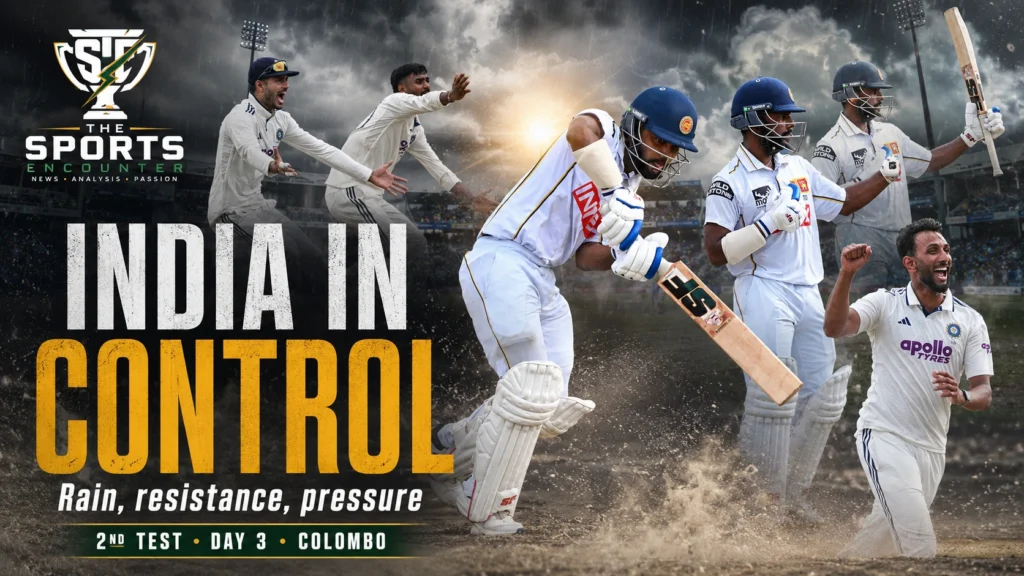
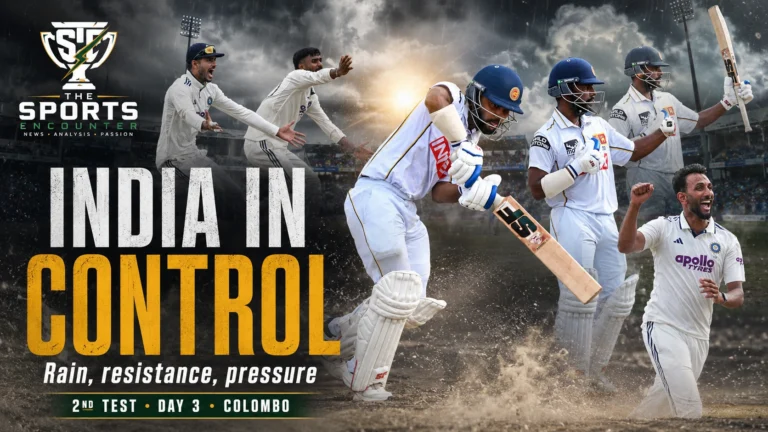
India remain 238 runs ahead after Sri Lanka closed Day 3 of the second Test on 265/8 in Colombo, where rain cut play short after strong resistance from Pasindu Sooriyabandara and Sonal Dinusha.
India remain firmly in control of the second Test in Colombo after Sri Lanka closed a rain-shortened third day on 265 for eight, still 238 runs behind the visitors’ imposing 503 for nine declared. Pasindu Sooriyabandara’s composed 80 and Sonal Dinusha’s unbeaten 85 gave the hosts their best resistance, but another weather-hit day still ended with Shubman Gill’s side holding the stronger hand.
The third day at the Sinhalese Sports Club produced 257 runs, six wickets and 80.4 overs before evening rain arrived again and forced an early finish. Sri Lanka began on eight for two and recovered enough to avoid complete collapse, but they remain 39 runs short of the follow-on mark of 304 with only two wickets in hand.
The scoreboard still belongs to India.
The more interesting story lies underneath it.
Sri Lanka have spent most of this series reacting to damage rather than dictating terms, yet Sooriyabandara and Dinusha gave them two performances with value beyond this match. One came from a batter playing only his second Test innings after a debut duck. The other came from a player who is starting to make the lower middle order look like the wrong place for him.
India, meanwhile, will know that the final 38 overs exposed one weakness in an otherwise dominant position. They claimed only one wicket during that period, and once the new-ball movement disappeared, the attack found it much harder to turn control into dismissals.
The ICC’s official Day 3 report described Sri Lanka’s late partnerships as a fightback but confirmed that India remain in control of the second World Test Championship contest.
Sri Lanka vs India 2nd Test: Day 3 Scorecard
| Match Detail | Situation at Stumps |
|---|---|
| Competition | ICC World Test Championship 2025-27 |
| Match | Sri Lanka vs India, 2nd Test |
| Venue | Sinhalese Sports Club, Colombo |
| India first innings | 503/9 declared |
| Sri Lanka first innings | 265/8 in 83.4 overs |
| Sri Lanka trail | 238 runs |
| Follow-on mark | 304 |
| Runs still needed to avoid follow-on | 39 |
| Top Sri Lanka scorer | Sonal Dinusha 85* |
| Pasindu Sooriyabandara | 80 from 133 balls |
| Best India bowling | Prasidh Krishna 3/47, Manav Suthar 3/83 |
| Overs bowled on Day 3 | 80.4 |
| Day 3 runs | 257 |
| Day 3 wickets | 6 |
India Started Day 3 Like a Team Ready to Finish the Job
Sri Lanka resumed on eight for two after losing Lahiru Udara and nightwatchman Prabath Jayasuriya late on the second evening. The danger was obvious. India had already put 503 on the board, and another early cluster of wickets could have turned the third day into a procession.
Prasidh Krishna made that threat immediate.
Kamil Mishara fell for 19, caught by Dhruv Jurel, leaving Sri Lanka 35 for three and exposing a middle order already under enormous scoreboard pressure.
India had seen almost exactly this type of situation in Galle. During the first Test, Sri Lanka also lost early wickets before their lower order was forced into rescue mode. The Sports Encounter’s Day 3 report from the first Test documented how Sonal Dinusha and Niroshan Dickwella had to rebuild from 90 for five simply to keep the follow-on out of play.
Colombo began threatening another version of the same story.
Sooriyabandara refused to let it repeat immediately.
Pasindu Sooriyabandara Turns a Debut Duck Into an 80 That Matters
Sooriyabandara’s 80 from 133 balls may eventually become one of the most important Sri Lankan innings of this short series, even if it does not save the Test.
His debut had produced a duck.
His second innings in Test cricket produced something completely different.
He played late against pace, resisted the temptation to reach for deliveries outside off stump and looked unusually comfortable when Siraj and Prasidh tried to push him backward with short balls.
That last detail mattered.
Young batters entering Test cricket in Sri Lanka are often judged first by how they handle spin. India deliberately tested another part of Sooriyabandara’s game. Once the early seam began fading, their quicks tried to create discomfort through bounce and body-line pressure.
Sooriyabandara kept finding ways to remain balanced.
His half-century came from 76 deliveries, and he built an 87-run fourth-wicket partnership with Kamindu Mendis that carried Sri Lanka from 35 for three to 122 for four.
For a team that entered this series with several batting absences, that matters beyond the current scorecard. The Sports Encounter’s Sri Lanka vs India series preview identified the hosts’ batting depth as one of the central concerns before the first ball was bowled.
Sooriyabandara has now supplied one possible answer.
India Break the Partnership Before Lunch, Then Suthar Hits the Middle Order
Kamindu Mendis made 32 from 58 balls and briefly gave Sooriyabandara the partner Sri Lanka needed.
The stand was not fast enough to change the match, but it was long enough to force India to work through a second phase of the ball rather than simply continuing their opening burst.
Prasidh ended it by removing Kamindu, his third wicket of the innings.
That dismissal reopened the middle order.
Manav Suthar then removed captain Dhananjaya de Silva for eight, leaving Sri Lanka 137 for five.
The left-arm spinner has now become one of India’s biggest stories of the series. He took ten wickets in Galle and entered Colombo with greater responsibility after India again backed a spin-heavy attack.
The first Test had already shown how quickly Suthar can alter a game. By Day 4 in Galle, India were six wickets away from victory after strangling Sri Lanka’s top order, with Suthar central to the control India established across the match.
His Colombo spell has been more expensive, but the wickets have again arrived at useful moments.
Sooriyabandara Falls at 80, and Sri Lanka Threaten to Unravel
Ravindra Jadeja eventually ended Sooriyabandara’s innings for 80.
The wicket came at 171, and Mohammed Siraj then removed Niroshan Dickwella for a three-ball duck two deliveries later.
Sri Lanka had gone from 137 for five to 173 for seven.
This was the moment India appeared ready to run through the remaining batting.
They did not.
That failure to finish the innings is the one part of Day 3 India may revisit critically before the fourth morning.
Sonal Dinusha Is Starting to Make No. 7 Look Too Low
Dinusha has now produced three consecutive scores of 50 or more in Test cricket.
That sequence includes his maiden century in Galle, another important second-innings contribution in the first Test, and this unbeaten 85 in Colombo.
At some point, Sri Lanka’s selectors have to ask whether a batter producing this level of control should continue walking in after so much of the innings has already disappeared.
His 85 has come from 137 deliveries with six fours and two sixes.
The innings did not begin as a counterattack. Dinusha absorbed the pressure first, particularly while wickets were still falling around him. Once India’s bowlers became less threatening, he expanded his scoring options.
He reached fifty from 82 balls.
That is a useful contrast with his century at Galle, where he and Dickwella had to rescue Sri Lanka from collapse. The Sports Encounter’s first-Test analysis showed how Dinusha’s ability to survive long pressure sequences helped Sri Lanka avoid the follow-on there.
He is now doing something similar again.
The pattern is becoming too consistent to dismiss as lower-order resistance.
TSE Analysis: Sri Lanka May Have Found a Batter Who Belongs Higher
Dinusha’s current role gives Sri Lanka insurance.
It may also be wasting part of his value.
A No. 7 batter often has to manage two conflicting jobs. If the top order succeeds, he may be required to accelerate with the tail approaching. If the top order fails, he becomes an emergency repair option.
Dinusha has spent much of this series doing the second job.
His technique suggests he may be capable of more.
He does not appear dependent on one scoring zone. He has shown patience against spin, enough judgment outside off stump to handle pace and the temperament to bat with weaker partners.
Sri Lanka’s recent batting problems make that worth exploring.
The same instability was visible during their Caribbean tour, where the final T20I series defeat again exposed how heavily the innings could depend on a small number of established players. The Sports Encounter examined that pattern after West Indies completed a series win over Sri Lanka.
Test cricket demands a different method, but the structural issue is familiar. Sri Lanka need more batters who can occupy time without becoming trapped.
Dinusha is increasingly looking like one of them.
Keshara Nuwantha Helps Dinusha Turn Survival Into Resistance
Keshara Nuwantha’s 18 from 74 balls will not dominate any scorecard.
It mattered enormously to the shape of the afternoon.
He added 57 with Dinusha for the eighth wicket and forced India to spend more than 20 overs trying to break a partnership that appeared vulnerable when it began.
Suthar eventually removed him at 230 for eight.
India expected that wicket to open the tail.
Lahiru Kumara had other ideas.
India Took Only One Wicket in the Final 38 Overs
This is the part of the day that should concern India most.
Dickwella fell at 173 for seven after 45.3 overs.
Sri Lanka reached stumps at 265 for eight after 83.4 overs.
Across those final 38 overs, India claimed only one wicket.
The problem was not effort.
The problem was declining threat.
Siraj and Prasidh had been dangerous while the ball moved through the air and off the surface. Once that movement disappeared, both quicks increasingly turned toward short-ball plans.
Those tactics produced discomfort without producing wickets.
The spinners also struggled to create sustained uncertainty.
Saransh Jain’s first spell on Test debut was genuinely encouraging. He bowled with flight and drift, repeatedly inviting batters forward rather than simply firing the ball into the surface.
His second spell offered less.
Jadeja and Suthar largely settled into flatter trajectories aimed at the stumps.
That produced control, but not enough chances.
It is the difference India will have to correct quickly on Day 4.
Saransh Jain Shows Enough on Debut to Keep India Interested
Jain finished the day wicketless after 18 overs for 51.
That figure does not tell the whole story.
His first spell contained enough drift and shape to suggest why India selected him for Colombo.
The challenge is maintaining those qualities after batters have seen him once.
Test cricket forces a spinner to solve the same batter several times.
The first spell is introduction.
The second becomes adaptation.
That is where Jain’s work begins.
India’s willingness to introduce another spinner also reflects the deeper transition taking place inside their Test squad. The Sports Encounter’s 19 straight days of Test cricket feature highlighted how this Sri Lanka series sits inside a demanding red-ball stretch where squad depth matters more than ever.
Prasidh Krishna Was India’s Most Effective Bowler
Prasidh’s 3 for 47 from 14 overs gave India the penetration they needed during the first half of the day.
He removed Mishara, broke the Sooriyabandara-Kamindu stand and repeatedly tested Sri Lanka with extra bounce.
His spell also demonstrated why India value him in conditions that do not necessarily scream fast bowling.
Height creates opportunities even when conventional seam movement fades.
The challenge is converting that bounce into dismissals once batters begin expecting it.
The repeated short-ball plan late in the day became increasingly predictable.
Prasidh had already done enough damage to finish as India’s joint-leading wicket-taker, but the final session showed where the attack still missed Jasprit Bumrah’s ability to create wickets from apparently neutral conditions.
Manav Suthar Has Three Wickets, but Colombo Has Been Harder Than Galle
Suthar’s 3 for 83 from 21 overs looks productive.
It has also cost almost four runs per over.
That difference from Galle matters.
The first-Test surface increasingly rewarded spin as the match developed. Colombo has offered less consistent assistance so far, particularly once the ball softened.
Suthar still removed Jayasuriya, Dhananjaya and Nuwantha.
He has therefore continued taking wickets even without dominating every over.
That may actually tell India something useful about his development.
Young spinners cannot expect every surface to behave like Galle.
Finding wickets on flatter days is a different test.
Rain Is Now Sri Lanka’s Most Useful Teammate
Evening rain arrived at 5:02 p.m. local time and ended play roughly an hour earlier than scheduled.
It was another interruption in a Test already shaped by weather.
The covers came on quickly as the light deteriorated and Colombo became increasingly overcast.
India would have preferred another hour with the second new ball.
They took it after 80.3 overs, immediately gaining the harder ball they had been waiting for during a long and increasingly frustrating final session.
Only a few deliveries were possible before the weather intervened.
That timing may have helped Sri Lanka more than anything else during the final hour.
Rain has already been the clearest variable capable of reducing India’s winning time. The same issue appeared during the first Test, when weather repeatedly threatened to interfere with a match India otherwise controlled. Our Galle Day 4 report showed how India had to manage both the scoreboard and the clock before completing the job.
Colombo is beginning to create a similar calculation.
The Follow-On Is Still Technically Alive
Sri Lanka need 39 more runs to reach 304 and remove the follow-on option.
Whether India would actually enforce it is another matter.
The visitors have already spent 80.4 overs in the field on Day 3.
If Sri Lanka are dismissed below 304 on the fourth morning, Gill would have to balance the attraction of making the hosts bat again immediately against the physical cost of asking his bowlers to continue without meaningful recovery.
Weather complicates the decision.
India lead the series 1-0 after winning the first Test in Galle by 165 runs. The ICC’s official first-Test report confirmed how important that result was for India’s World Test Championship position.
A draw in Colombo would still deliver the series.
A victory would provide more valuable WTC points.
That may encourage India to prioritize time over convention.
Would India Really Bat Again?
If Sri Lanka fall short of 304, Gill has three broad choices.
He can enforce the follow-on immediately.
He can bat again and try to create a massive fourth-innings target.
Or he can make the decision based almost entirely on the weather forecast and the condition of his bowlers.
The traditional logic of Test cricket would favor the follow-on when a team leads by more than 200.
Modern workload management makes the decision less automatic.
India’s quicks have already bowled long spells. The spinners have carried substantial workloads. Colombo’s heat and humidity add another physical layer.
The ICC World Test Championship schedule also reinforces why every result matters. India cannot simply think about winning the series. Championship points travel beyond Colombo.
The likely preference may therefore depend on how quickly the final two Sri Lankan wickets fall.
India’s 503 Has Made Every Sri Lankan Partnership Defensive
The central reason India remain so far ahead is still their first innings.
Devdutt Padikkal made 117.
Dhruv Jurel finished unbeaten on 115.
Rishabh Pant contributed 63, Shubman Gill made 50 and Ravindra Jadeja added 43.
That depth pushed India to 503 for nine before Gill declared.
The total means Sri Lanka have spent their entire innings measuring themselves against survival thresholds.
First came the need to avoid collapse.
Then came the follow-on.
Next comes the first-innings deficit.
India’s ability to generate runs from several parts of the order has been visible throughout their recent cricket. The Sports Encounter saw the same broader batting depth during India’s white-ball tour of England, including the ODI victory built around contributions from multiple experienced batters and Axar Patel.
The formats are different. The underlying advantage is familiar.
India are difficult to contain because the innings does not depend on one scorer.
SSC Has Already Produced Very Different Cricket This Summer
The Sinhalese Sports Club has seen plenty of high-level cricket during the Sri Lankan season, including the Lanka Premier League.
The Sports Encounter covered Galle Gallants’ five-wicket win over Colombo Kaps at the SSC, a match in which 379 runs were scored across 39.2 overs.
Test cricket has presented the same venue with a completely different problem.
The surface has been good enough for long partnerships, yet not so flat that wickets are impossible.
That balance explains why India’s first-innings total carries so much value.
They occupied enough time to remove much of Sri Lanka’s freedom.
The Bigger World Test Championship Picture Still Favors India
This series began with both teams needing points.
India arrived outside the top two in the World Test Championship standings.
Sri Lanka were also trying to keep themselves relevant after an inconsistent start to the cycle.
India’s victory at Galle strengthened their position.
A second consecutive win would change the conversation again.
The Sports Encounter’s original series analysis described these two Tests as a litmus test for two injured, evolving squads.
Three days into the second Test, India have handled that examination better.
TSE Verdict: India Own the Test, Sri Lanka Own the Best Individual Story
Day 3 belonged to India in the only measurement that ultimately decides Test matches.
They remain 238 runs ahead.
Sri Lanka have only two first-innings wickets remaining.
The follow-on remains possible.
India still possess enough time to force a result if the weather cooperates.
Yet the most encouraging individual developments belonged to Sri Lanka.
Sooriyabandara responded to a debut duck with an 80 that looked technically secure against both pace and spin.
Dinusha followed his first-Test century with another unbeaten innings that strengthens the argument for moving him higher in the batting order.
Those performances may matter considerably after this series ends.
India have fewer long-term questions arising from the day.
Their concern is narrower: once the ball became old and the pitch stopped offering movement, the attack struggled to finish the innings.
One wicket in the final 38 overs is a statistic Gill and the bowling group will notice.
The second new ball should give them another opportunity on Thursday morning.
Whether Colombo’s weather allows them to use it for long enough remains the larger uncertainty.
What India Need on Day 4
The immediate objective is straightforward.
Remove Dinusha before he converts another lower-order rescue into a century.
Dismiss Kumara and Asitha Fernando quickly.
Then decide whether the follow-on, another batting innings or an aggressive declaration offers the clearest route to victory.
The second new ball should make Siraj and Prasidh more dangerous than they looked during the final session.
India cannot afford another 30-over lower-order partnership if rain continues removing playing time.
What Sri Lanka Need on Day 4
Dinusha is the entire equation.
The hosts need 39 runs to avoid the follow-on and another 238 simply to draw level with India.
Those are very different objectives.
The first is realistic.
The second requires something extraordinary.
Dinusha must protect the tail without becoming so defensive that Sri Lanka stop moving toward 304.
Kumara has already survived 50 balls for his eight runs.
If he can continue occupying the crease, Dinusha has enough form to take Sri Lanka beyond the follow-on line.
From there, the weather and India’s tactical decisions become increasingly relevant.
Final Analysis
India have not produced a flawless third day.
They did not need one.
The 503 they built across the first two days gave them enough margin to absorb Sri Lanka’s best batting resistance and still finish Tuesday with control of the match.
Sooriyabandara’s 80 was a genuine Test innings from a player who needed one badly.
Dinusha’s unbeaten 85 was another piece of evidence that Sri Lanka may be batting one of their most composed players too low.
The hosts can take encouragement from both.
They cannot take much comfort from the scoreboard.
India remain 238 runs ahead, have the second new ball available and require only two wickets to end the innings.
The most effective resistance Sri Lanka received all day may ultimately have come from the Colombo sky.
Rain ended play early again.
If it stays away on Day 4, India still have more than enough control to turn this advantage into a series-clinching victory.
Frequently Asked Questions
What is the score in the Sri Lanka vs India second Test after Day 3?
Sri Lanka are 265 for eight in their first innings after India declared on 503 for nine. Sri Lanka trail by 238 runs.
How many runs does Sri Lanka need to avoid the follow-on?
Sri Lanka need another 39 runs to reach 304 and prevent India from having the option to enforce the follow-on.
Who top-scored for Sri Lanka on Day 3?
Pasindu Sooriyabandara made 80, while Sonal Dinusha remains unbeaten on 85 at stumps.
How many wickets did India take on Day 3?
India took six wickets during the 80.4 overs bowled on the third day.
Who is India’s leading wicket-taker in Sri Lanka’s first innings?
Prasidh Krishna and Manav Suthar have taken three wickets each. Prasidh has figures of 3 for 47, while Suthar has 3 for 83.
How did Saransh Jain bowl on Test debut?
Saransh Jain finished Day 3 wicketless with 0 for 51 from 18 overs. His first spell showed encouraging flight and drift, although he created fewer problems during his second spell.
Why did play end early in Colombo?
Rain arrived shortly after 5 p.m. local time and eventually forced stumps before the scheduled close.
Will India enforce the follow-on?
India will only have that option if Sri Lanka are dismissed below 304. Whether Shubman Gill uses it will likely depend on how quickly the innings ends, the condition of his bowlers and the weather forecast.
Who won the first Test between Sri Lanka and India?
India won the first Test in Galle by 165 runs and lead the two-match series 1-0.
When does Day 4 begin?
Day 4 is scheduled to begin at 9:45 a.m. local time in Colombo, weather permitting.

Cricket
Africa’s ICC World Cup 2027 Hosts Collide in T20 Tri-Series
South Africa, Zimbabwe and Namibia meet in Windhoek for a seven-match T20 tri-series that doubles as an early test of depth, form and regional strength ahead of the 2027 Cricket World Cup. Here is our full preview of the squads, key players, tactical battles and likely finalists.
South Africa, Zimbabwe and Namibia will spend the next ten days playing T20 cricket in Windhoek, but the importance of this tournament stretches well beyond seven matches and one trophy.
These are the three countries that will host the 2027 ICC Men’s Cricket World Cup.
They are neighbors with very different cricketing resources, very different expectations and, heading into this tri-series, very different reasons for needing a strong tournament.
South Africa arrive without most of their established first-choice players and with left-arm spinner Bjorn Fortuin leading an experimental group filled with emerging talent.
Zimbabwe bring considerably more senior experience through captain Sikandar Raza, Blessing Muzarabani, Ryan Burl, Brian Bennett and the returning Graeme Cremer, but also carry the uncomfortable memory of six consecutive T20I defeats following their opening win against Bangladesh last month.
Namibia may have the most interesting combination of all.
Gerhard Erasmus leads a squad built around experienced internationals such as JJ Smit, Jan Frylinck, Ruben Trumpelmann, Bernard Scholtz and Jan-Nicol Loftie-Eaton, but the hosts have also introduced a new generation led by Junior Taanyanda, Alex Busing-Volschenk, Max Heingo, Waldo Smith and JC Balt.
The tournament begins on August 28 at the Namibia Cricket Ground in Windhoek and runs through September 6. Each team plays the other twice before the top two meet in the final.
That format matters.
This is not a three-game series where one bad night can effectively end a campaign. Every team gets four round-robin matches and enough time to adjust after seeing its opponents once.
By the final weekend, we should know considerably more about South Africa’s next wave, Zimbabwe’s T20 direction and whether Namibia are ready to become something more dangerous than an occasional upset threat.
South Africa-Zimbabwe-Namibia T20 Tri-Series 2026 at a Glance
| Detail | Information |
|---|---|
| Tournament | FNB T20 Tri-Series 2026 |
| Teams | Namibia, South Africa, Zimbabwe |
| Dates | August 28 to September 6, 2026 |
| Venue | Namibia Cricket Ground, Windhoek |
| Format | Double round-robin followed by final |
| Matches | 6 league matches plus final |
| South Africa captain | Bjorn Fortuin |
| Zimbabwe captain | Sikandar Raza |
| Namibia captain | Gerhard Erasmus |
Complete T20 Tri-Series Schedule
| Date | Fixture | Venue |
|---|---|---|
| August 28 | Namibia vs South Africa | Namibia Cricket Ground, Windhoek |
| August 29 | South Africa vs Zimbabwe | Namibia Cricket Ground, Windhoek |
| August 31 | Namibia vs Zimbabwe | Namibia Cricket Ground, Windhoek |
| September 1 | Zimbabwe vs South Africa | Namibia Cricket Ground, Windhoek |
| September 3 | Namibia vs Zimbabwe | Namibia Cricket Ground, Windhoek |
| September 4 | Namibia vs South Africa | Namibia Cricket Ground, Windhoek |
| September 6 | Final | Namibia Cricket Ground, Windhoek |
All matches are scheduled to begin at 2:00 PM local time.
This Tournament Is Also About African Cricket’s Next Phase
The most important context may actually sit outside the T20 format.
South Africa, Zimbabwe and Namibia will jointly host the 2027 ODI World Cup, returning the tournament to Africa for the first time since 2003.
Namibia will host matches at a senior men’s ODI World Cup for the first time.
The tri-series therefore serves as an early demonstration of what closer cricketing cooperation among the three countries could look like.
Officials have already spoken about using this tournament as part of a broader attempt to strengthen regular international competition within Africa, including plans to develop an Africa Cup from 2027.
That idea deserves attention.
African cricket has historically been too dependent on bilateral schedules determined by larger cricket boards elsewhere.
A meaningful regional competition would create recurring fixtures, commercial opportunities and a clearer pathway for countries below Full Member level.
This tournament cannot create that system on its own.
It can show whether the concept has competitive value.
South Africa Arrive With a Development Squad, Not a Weak Squad
That distinction matters.
Aiden Markram is not here.
David Miller is not here.
Tristan Stubbs is not here.
Ryan Rickelton, Kagiso Rabada, Marco Jansen, Lungi Ngidi, Corbin Bosch and Keshav Maharaj are among the other established names being rested.
South Africa have a demanding schedule ahead and have deliberately used this trip to widen their international player pool.
The ICC’s official South Africa squad announcement confirms Bjorn Fortuin as captain and a group featuring Dewald Brevis, Lhuan-dre Pretorius, Tony de Zorzi, Kwena Maphaka, Nqaba Peter and several players receiving another opportunity at international level.
Calling this a second-string squad is technically understandable.
Calling it an easy opponent would be a mistake.
South Africa Squad
- Bjorn Fortuin, captain
- Eathan Bosch
- Dewald Brevis
- Tony de Zorzi
- Connor Esterhuizen
- Jordan Hermann
- Rubin Hermann
- Duan Jansen
- Kwena Maphaka
- Nqobani Mokoena
- Nqaba Peter
- Lhuan-dre Pretorius
- Lutho Sipamla
- Prenelan Subrayen
Jason Smith was originally named in the touring squad but has subsequently been ruled out of the T20 tri-series with a right adductor strain.
Bjorn Fortuin Gets a Different Kind of Opportunity
Fortuin’s captaincy is one of the most interesting South African stories.
He is not being promoted as the next permanent national captain.
This is about putting an experienced domestic leader in charge of a squad containing several players who still need to understand international cricket.
Fortuin has captained the Lions successfully and already knows the demands of senior international competition.
His own role also creates a tactical wrinkle.
South Africa will be led by a left-arm spinner in a T20 tournament where the opposition contains several right-handed middle-order batters who prefer pace.
If the Windhoek surface slows during repeated use across seven matches, Fortuin could become important both as captain and strike option.
Dewald Brevis Is the Player Namibia and Zimbabwe Will Fear Most
South Africa’s squad may be experimental, but Brevis is no experiment anymore.
His ability to change a match within three overs makes him the most obvious destructive batting threat in the tournament.
That is particularly important in a South African batting group without Miller, Markram or Stubbs.
Brevis may have to become the player around whom the rest of the innings is built.
His challenge will be discipline.
Namibia know their own conditions and have experienced spinners capable of slowing the middle overs.
Zimbabwe have Raza, Cremer, Wellington Masakadza and Ryan Burl available as slow-bowling options.
Brevis will get chances to attack.
The better test is whether he can identify when not to.
Lhuan-dre Pretorius Has Another Chance to Accelerate His Rise
Pretorius is another South African player with genuine long-term importance.
His attacking ability at the top of the order gives South Africa the possibility of dominating powerplays even without their established stars.
Windhoek provides a useful test because this will not necessarily be about perfect batting surfaces and predictable pace.
Namibia’s attack can change angles.
Zimbabwe can attack with height through Muzarabani and use spin extensively through the middle.
Pretorius needs to show that his aggression survives when opponents refuse to feed him pace in comfortable areas.
Kwena Maphaka Is the Bowling Headliner
Maphaka represents something neither Namibia nor Zimbabwe possess in quite the same form.
Genuine left-arm pace.
He can attack the stumps, rush batters with the short ball and create wickets even when conventional swing disappears.
That makes him particularly important because South Africa’s senior pace attack is resting.
Lutho Sipamla offers greater experience.
Nqobani Mokoena provides another seam option.
Duan Jansen offers the left-arm angle and all-round balance.
But Maphaka is the bowler most capable of producing a spell that changes a match in eight deliveries.
Nqaba Peter Gives South Africa a Middle-Overs Wicket-Taker
Peter may become as important as Maphaka.
T20 teams increasingly need one bowler whose job is not simply keeping the run rate under control but actually removing set batters between overs seven and fifteen.
Leg-spin provides that possibility.
Against Namibia, Peter could be particularly useful against Erasmus, Smit and Frylinck.
Against Zimbabwe, his contest with Raza and Burl could determine entire innings.
Duan Jansen Is Playing for More Than This Tour
Duan Jansen earned his first senior call-up after an excellent domestic season.
He was named South Africa’s Division 1 One-Day Cup Player of the Year after helping the Titans win the competition, including an unbeaten 61 in the final.
His selection reflects exactly what tours like this should accomplish.
Domestic performance has created an international opportunity.
Now Jansen needs to show whether his combination of left-arm seam and lower-order batting can survive at international level.
A strong tournament could move him much closer to South Africa’s wider white-ball group.
Namibia Should Not Be Treated as the Third Team
This may be the biggest mistake neutral observers make when assessing the tournament.
Namibia are at home.
They have a far more experienced squad than South Africa.
They have won five of their seven T20Is since the 2026 Men’s T20 World Cup.
And they have already demonstrated that the Namibia Cricket Ground can become uncomfortable for visiting teams.
The hosts dominated a June tri-series against Hong Kong and Nigeria, winning all four of their matches.
They scored 194 for three against Nigeria.
They later made 230 for six against Hong Kong.
Then they finished the competition with 220 for five against Nigeria.
Those numbers tell us something useful.
Windhoek is not automatically a low-scoring venue.
Teams that establish a platform can score heavily.
Namibia Squad
The ICC’s official Namibia squad announcement confirms a 16-player group built around captain Gerhard Erasmus and several players with more than 100 international appearances across formats.
- Gerhard Erasmus, captain
- Michael van Lingen
- Zane Green
- Bernard Scholtz
- Ruben Trumpelmann
- JJ Smit
- Jan Frylinck
- Louren Steenkamp
- Malan Kruger
- Jack Brassell
- Max Heingo
- Alex Busing-Volschenk
- Junior Taanyanda
- Jan-Nicol Loftie-Eaton
- JC Balt
- Waldo Smith
Gerhard Erasmus Remains Namibia’s Reference Point
Erasmus has spent years giving Namibia something every developing international team needs: stability.
He bats in difficult situations.
He can bowl useful off-spin.
He understands opposition planning.
Most importantly, he knows how Namibia win matches.
The Sports Encounter’s review of a decade of ICC individual awards includes Erasmus’ recognition as ICC Men’s Associate Cricketer of the Year, a reminder of how long he has operated among the leading players outside the traditional Full Member structure.
Against a young South African side, experience may be Namibia’s biggest advantage.
Junior Taanyanda Could Be Namibia’s Breakout Player
If Erasmus represents continuity, Taanyanda represents the next phase.
The 21-year-old only made his T20I debut in June.
He then finished Namibia’s tri-series against Hong Kong and Nigeria as the leading run-scorer with 165 runs at an average of 82.50.
He also shared the tournament lead for sixes with Erasmus.
That is not enough evidence to declare him an international star.
It is more than enough to make South Africa and Zimbabwe pay attention.
This tournament is the ideal next test.
Scoring runs against Nigeria and Hong Kong established his potential.
Doing it against Maphaka, Fortuin, Muzarabani and Raza would significantly strengthen the case.
Alex Busing-Volschenk Gives Namibia Another Young Attacker
Busing-Volschenk also impressed during the June tournament.
He scored 73 from 32 balls as Namibia piled up 220 for five against Nigeria.
That innings showed the kind of power Namibia increasingly possess outside their veteran core.
For years, Namibia’s batting reputation was built heavily around Erasmus, Frylinck, Smit and experienced top-order players.
The emergence of Taanyanda and Busing-Volschenk makes the lineup less predictable.
JC Balt, Max Heingo and Waldo Smith Represent the Bowling Future
The age profile of Namibia’s attack is particularly encouraging.
Heingo and Waldo Smith are both only 18.
JC Balt is another younger option and was Namibia’s leading bowler in their most recent T20I series.
Balt also took four wickets, including a hat-trick, against Nigeria in June.
They do not have to lead the attack yet.
That is the advantage Namibia possess.
Trumpelmann, Smit, Frylinck and Scholtz can carry the experienced workload while the younger bowlers develop around them.
Ruben Trumpelmann Gives Namibia a Weapon South Africa Must Respect
Trumpelmann’s left-arm angle has troubled stronger international batting units before.
He is particularly dangerous when he gets early movement because the angle across right-handed batters creates uncertainty around the front pad and outside edge simultaneously.
South Africa’s young top order will know him.
Knowing what is coming does not make it easier to play.
Zimbabwe Bring the Most Experienced Core but the Worst Recent Form
This is what makes Zimbabwe so difficult to predict.
The squad looks capable.
The recent results do not.
Zimbabwe began their July T20I series against Bangladesh with a convincing 32-run victory.
Richard Ngarava and Blessing Muzarabani took four wickets each as Bangladesh were bowled out for 138.
The Sports Encounter covered that performance in Zimbabwe’s opening T20I victory over Bangladesh.
Then things changed quickly.
Bangladesh won the second match after Zimbabwe dropped four catches during the powerplay, a collapse in fielding standards examined in our analysis of Bangladesh’s series-leveling victory.
Bangladesh then won the decider by four wickets, completing a 2-1 comeback. TSE’s report on the final T20I highlighted Zimbabwe’s recurring problems with catches, concentration and finishing discipline.
India arrived next.
The decline became more severe.
Zimbabwe’s Recent T20I Sequence
| Opponent | Result |
|---|---|
| Bangladesh | Won by 32 runs |
| Bangladesh | Lost by 34 runs |
| Bangladesh | Lost by 4 wickets |
| India | Lost by 7 wickets |
| India | Lost by 90 runs |
| India | Lost by 35 runs |
The first India match was particularly revealing.
Zimbabwe were restricted to 125 for seven before India chased the target in only 13.2 overs. The Sports Encounter’s match analysis showed how quickly Zimbabwe’s top order lost control after Brian Bennett fell to the first ball.
The second T20I was worse.
India made 219 for five and bowled Zimbabwe out for 129.
By the end of the third match, Zimbabwe had been swept 3-0.
They arrive in Windhoek needing more than a few individual performances.
They need to rediscover a functioning T20 identity.
Zimbabwe Squad
The ICC’s official Zimbabwe squad announcement confirms Sikandar Raza as captain and the return of veteran spinner Graeme Cremer.
- Sikandar Raza, captain
- Brian Bennett
- Ryan Burl
- Graeme Cremer
- Ben Curran
- Brad Evans
- Innocent Kaia
- Wessly Madhevere
- Tadiwanashe Marumani
- Wellington Masakadza
- Kundai Matigimu
- Blessing Muzarabani
- Dion Myers
- Newman Nyamhuri
- Tafadzwa Tsiga
Richard Ngarava is unavailable because of a lower-back problem, while Tanaka Chivanga has undergone surgery after suffering an Achilles injury.
Those absences matter.
Zimbabwe lose one of their most productive new-ball bowlers in Ngarava and another pace option in Chivanga.
Sikandar Raza Still Carries an Enormous Share of Zimbabwe’s T20 Burden
Few international players are asked to solve as many different problems as Raza.
He may be required to rebuild after early wickets.
He may have to accelerate at the death.
He may bowl in the powerplay.
He may bowl through the middle.
He captains.
He fields in important positions.
That versatility is one of Zimbabwe’s greatest strengths.
It can also become a structural weakness when too many match-winning jobs fall onto one player.
The Windhoek tournament should tell us whether Bennett, Burl, Myers and Madhevere can reduce that dependence.
Brian Bennett Needs to Turn Starts Into Tournament-Shaping Innings
Bennett has already shown he can score quickly at international level.
He made 44 from 30 balls in Zimbabwe’s victory over Bangladesh.
But the India series showed how vulnerable Zimbabwe become when the top order disappears early.
Bennett’s challenge is no longer simply demonstrating talent.
He has to become a batter Zimbabwe can build powerplays around.
Ryan Burl Is More Important Than His Batting Position Suggests
Burl provides Zimbabwe with one of their best matchup players.
He can attack spin.
He can finish.
His leg-spin can become useful against left-handers.
He also brings considerable franchise experience.
A productive tournament from Burl would solve several balance problems simultaneously.
The Return of Graeme Cremer Is Fascinating
Cremer’s inclusion gives Zimbabwe another experienced wrist-spin option after recovering from the arm injury that kept him out against Bangladesh and India.
That creates an intriguing potential spin combination with Raza, Burl and Wellington Masakadza.
Windhoek has already demonstrated that large totals are possible.
But as the same surface is used repeatedly across the tournament, slow bowling could become more influential.
Zimbabwe may be the team best equipped to exploit that change.
Blessing Muzarabani Has to Lead the Pace Attack
Ngarava’s absence increases Muzarabani’s responsibility significantly.
His height and release point make him an awkward T20 bowler because he can produce bounce from lengths that ordinarily invite attacking shots.
He took 4 for 17 against Bangladesh in July.
That performance helped Zimbabwe defend 170 and reminded everyone what their attack looks like when Muzarabani controls both line and pace.
South Africa’s young batters will face a very different problem against him than anything Namibia can offer.
The same applies to Namibia’s emerging top order.
The Biggest Tactical Question: What Will 170 Mean in Windhoek?
This tournament may be decided by how quickly teams understand the ground.
Namibia’s June results demonstrate that totals above 190 are entirely possible.
The hosts scored 194 for three, 230 for six and 220 for five across three matches.
That does not mean 200 becomes par automatically against stronger bowling attacks.
It does tell us that teams cannot arrive expecting slow associate-cricket surfaces where 145 is always competitive.
Windhoek can reward batting intent.
The afternoon starts could also make surface pace and moisture different from evening T20 cricket.
Captains will have to learn quickly whether batting first or chasing offers the more reliable route.
Why Spin Could Become More Important as the Tournament Progresses
Seven matches are being played at the same ground.
That creates a natural question around wear.
Even if multiple strips are prepared, repeated cricket can change the overall character of the square.
That favors teams with variety.
South Africa have Fortuin, Peter and Prenelan Subrayen.
Zimbabwe can use Raza, Cremer, Burl and Masakadza.
Namibia have Erasmus, Bernard Scholtz and other slow-bowling options.
The first weekend may favor pace more than the final weekend.
Selection has to remain flexible.
Namibia vs South Africa Could Immediately Define the Tournament
The opening match may be more important than it looks.
If South Africa win comfortably, the narrative immediately returns to depth.
The Proteas can rest most established players and still dominate their neighbors.
If Namibia win, everything changes.
The hosts then have an immediate advantage in a tournament where only two teams qualify for the final.
South Africa would enter the Zimbabwe match less than 24 hours later under genuine pressure.
Namibia have beaten South Africa in Windhoek before.
That history means the Proteas should not need reminding that reputation offers no runs.
South Africa vs Zimbabwe Is the Tournament’s Best Talent Test
The next day’s match presents an entirely different contest.
South Africa bring youth and athleticism.
Zimbabwe bring experience and a more settled leadership structure.
Brevis against Muzarabani could be spectacular.
Maphaka against Bennett will be aggressive.
Peter against Raza could become a middle-overs chess match.
If Zimbabwe cannot compete against this South African squad, their recent T20 problems will become much harder to dismiss as a temporary dip.
Namibia vs Zimbabwe May Decide Who Reaches the Final
On paper, South Africa still have the deepest collection of high-end talent.
That makes Namibia-Zimbabwe especially important.
The teams meet twice.
A 2-0 head-to-head result for either side could become decisive.
Zimbabwe cannot assume Full Member status creates superiority.
Namibia cannot assume home advantage eliminates the difference in international experience.
This is exactly the kind of contest the proposed wider African cricket structure needs more often.
Five Players Who Could Define the Tri-Series
| Player | Team | Why He Matters |
|---|---|---|
| Dewald Brevis | South Africa | Most destructive batter in South Africa’s experimental lineup |
| Kwena Maphaka | South Africa | Left-arm pace and genuine wicket-taking threat |
| Gerhard Erasmus | Namibia | Captain, senior batter and tactical reference point |
| Junior Taanyanda | Namibia | Young opener coming off a breakthrough June tri-series |
| Sikandar Raza | Zimbabwe | Zimbabwe’s most adaptable match-winner |
Five More Players Worth Watching
- Lhuan-dre Pretorius: South Africa’s aggressive top-order prospect has another chance to force himself deeper into national plans.
- Nqaba Peter: Leg-spin could become increasingly important as the tournament progresses.
- Ruben Trumpelmann: Namibia’s left-arm new-ball threat could expose South Africa’s inexperienced top order.
- Blessing Muzarabani: Zimbabwe need him to compensate for Ngarava’s absence.
- Graeme Cremer: His return gives Zimbabwe a tactical option they lacked during the recent losing run.
Namibia’s Experience May Be Underestimated
There is another reason the hosts should be taken seriously.
Erasmus, Frylinck, Smit, Trumpelmann and Scholtz have spent years playing major ICC events together.
They understand their own limitations.
That sounds like a negative statement.
It is often one of associate cricket’s biggest strengths.
Namibia rarely need several matches to discover what kind of team they are.
They know which bowlers handle which phases.
They know which batters can take risks.
They understand what defending a total requires.
South Africa’s more talented squad will still be discovering some of those combinations.
Zimbabwe’s Fielding Cannot Collapse Again
This deserves emphasis because it helped destroy their Bangladesh T20I series.
Zimbabwe dropped four catches during the powerplay of the second match.
Bangladesh responded by building a 120-run opening partnership.
The hosts later lost the decider as further fielding problems prevented sustained pressure.
The issue was not confined to T20 cricket either.
Earlier in the same tour, Zimbabwe dropped six catches in the third ODI, allowing Bangladesh to avoid a clean sweep. TSE’s report from Harare showed how rapidly poor fielding can erase excellent work from the bowlers.
Against South Africa and Namibia, those mistakes will be punished again.
South Africa’s Players Are Competing Against More Than Namibia and Zimbabwe
Every fringe Proteas player arrives with another opponent.
The established national team.
Brevis is competing for future batting responsibility.
Pretorius is competing against a deep group of top-order players.
Maphaka wants more than occasional opportunities when senior quicks are rested.
Duan Jansen needs to prove his domestic performance translates internationally.
Jordan Hermann, Rubin Hermann and Connor Esterhuizen need innings substantial enough to survive beyond this tour in selectors’ minds.
The Sports Encounter recently watched another South African batter, Reeza Hendricks, turn franchise opportunity into a major innings when he struck an unbeaten 87 for Dambulla in the Lanka Premier League.
That is the challenge facing this touring squad.
International depth only matters when players use the opportunities created by rotation.
This Tournament Matters for Namibia’s 2027 and 2028 Plans
Namibia occupy an unusual position.
They are co-hosting the 2027 ODI World Cup but still need to qualify for the tournament through the ICC Cricket World Cup League 2 pathway.
They are simultaneously developing toward the 2028 Men’s T20 World Cup.
That makes every international fixture valuable.
Playing South Africa and Zimbabwe four times in a week provides a level of repeated pressure that bilateral games against lower-ranked opposition cannot reproduce.
The senior group can prepare for 2027.
The younger group can begin preparing for what comes after it.
The Series Also Revives the Value of Tri-Nation Cricket
Cricket has lost some of its traditional appetite for tri-series.
That is unfortunate.
Three-team tournaments create tactical variety that bilateral cricket cannot.
A team can move from facing Maphaka and Fortuin one day to Muzarabani and Cremer the next.
Preparation changes quickly.
Points matter.
Net run rate can matter.
The Sports Encounter’s ongoing Celebration of 5000 ODIs series repeatedly returns to historic tri-nation tournaments because the format produced matches with consequences beyond a simple bilateral series score.
T20 cricket could benefit from more of the same.
What South Africa Need From the Tournament
Winning would be useful.
Finding two or three additional senior-level players would be more valuable.
If Maphaka dominates, South Africa know their pace depth remains extraordinary.
If Pretorius scores heavily, another top-order option becomes harder to ignore.
If Jansen contributes with bat and ball, another all-round pathway opens.
If Fortuin leads well, South Africa strengthen their leadership depth too.
The trophy is therefore only one measurement.
What Zimbabwe Need
Zimbabwe need results.
The development argument matters less for them because this is largely an experienced squad.
Six straight T20I defeats have created pressure.
Raza’s team need to show that the Bangladesh and India series did not reveal a deeper short-format decline.
They need better fielding.
They need more stable powerplays.
They need someone other than Raza to decide important matches.
And they need Muzarabani to lead an attack missing Ngarava.
What Namibia Need
Validation.
The hosts have been competitive for years.
They have beaten established teams before.
What they need now is evidence that those performances can become repeatable.
Reaching the final ahead of either South Africa or Zimbabwe would be significant.
Winning the tournament would be one of the strongest home statements Namibia have produced.
TSE Predicted Team Strengths
| Team | Biggest Strength | Biggest Concern |
|---|---|---|
| South Africa | Raw talent, athleticism, pace and batting power | Inexperience and unfamiliar combinations |
| Namibia | Home conditions, experience and settled roles | Whether younger players can reproduce recent form against stronger opposition |
| Zimbabwe | Senior international experience and spin variety | Recent losing run, fielding and missing pace depth |
Who Should Start as Favorites?
South Africa.
Even without most first-choice players, their talent ceiling remains the highest.
Brevis, Pretorius, Maphaka, Fortuin, Peter, de Zorzi and Sipamla give them quality across every department.
But this should be a narrower gap than the countries’ overall cricketing resources suggest.
Namibia are playing at home with a settled core.
Zimbabwe have far more senior international experience than South Africa’s touring group.
If either African neighbor beats the Proteas, it should not be treated as an unbelievable upset.
TSE Tournament Prediction
South Africa to reach the final.
The second place is much harder to call.
Zimbabwe possess the greater individual pedigree.
Namibia arrive with better recent T20 form, home advantage and a more settled sense of how they want to play.
That makes Namibia a genuine candidate to reach the final.
If the hosts take one of their two games against South Africa and split the Zimbabwe matches, net run rate could decide everything.
Our slight pre-tournament lean is therefore:
- South Africa
- Namibia
- Zimbabwe
That prediction comes with very little confidence between second and third.
Zimbabwe have enough quality to win the tournament if their senior players rediscover form.
TSE Analysis: This Is Exactly the Kind of Series African Cricket Needs
The best thing about this tournament may be that nobody needs to pretend all three teams are equal.
They are not.
South Africa have a vastly larger player pool and cricket economy.
Zimbabwe have Full Member infrastructure and a long international history.
Namibia operate with fewer resources and a much smaller population.
That imbalance is precisely why regular competition matters.
Namibia improve by playing stronger neighbors.
Zimbabwe gain meaningful fixtures close to home.
South Africa can expose emerging players to international cricket without sending them halfway around the world.
Everyone benefits if the games remain competitive.
That is how a regional cricket structure becomes useful rather than ceremonial.
The Sports Encounter Verdict
South Africa begin as favorites, but this tournament should reveal far more than which team lifts a trophy on September 6.
The Proteas are testing the depth beneath their established white-ball stars.
Zimbabwe are trying to stop a worrying run of T20 defeats before it becomes an identity problem.
Namibia are attempting to turn home advantage, experienced leadership and a promising young generation into repeatable success against Full Member opposition.
There are individual stories everywhere.
Can Bjorn Fortuin lead?
Can Dewald Brevis become the dominant batter in a South African team without its senior stars?
Can Lhuan-dre Pretorius and Kwena Maphaka move closer to permanent national roles?
Is Junior Taanyanda ready for a major jump in opposition quality?
Can Erasmus and Namibia make Windhoek uncomfortable for everybody?
Will Sikandar Raza once again have to carry Zimbabwe, or can Bennett, Burl and Myers share the load?
Can Muzarabani lead the attack without Ngarava?
And can Zimbabwe finally hold their catches?
Those questions make this far more interesting than a late-August development tournament.
It is an early meeting of the three nations that will welcome world cricket to southern Africa next year.
For South Africa, the future is being tested.
For Zimbabwe, the present needs repairing.
For Namibia, this is an opportunity to prove that the gap is getting smaller.
Windhoek should tell us plenty.
Frequently Asked Questions
When does the South Africa-Zimbabwe-Namibia T20 tri-series begin?
The tournament begins on August 28, 2026, with Namibia facing South Africa in Windhoek.
Where will the T20 tri-series be played?
All seven matches will be played at the Namibia Cricket Ground in Windhoek.
What is the tournament format?
Each team plays the other two twice in a double round-robin format. The top two teams qualify for the final on September 6.
Who is captaining South Africa?
Left-arm spinner Bjorn Fortuin will captain South Africa’s youthful touring squad.
Why are South Africa missing several senior players?
Cricket South Africa is resting many established players ahead of a demanding international schedule and is using the Namibia tour to give younger and fringe players additional international experience.
Who are the key South Africa players?
Dewald Brevis, Lhuan-dre Pretorius, Kwena Maphaka, Nqaba Peter, Tony de Zorzi and captain Bjorn Fortuin are among the main players to watch.
Who is captaining Namibia?
Gerhard Erasmus will lead the hosts.
How are Namibia performing in T20 cricket?
Namibia have won five of their seven T20Is since the 2026 Men’s T20 World Cup and dominated a home tri-series against Hong Kong and Nigeria in June.
Who is Namibia’s young player to watch?
Junior Taanyanda is one of the most exciting prospects. He scored 165 runs at an average of 82.50 during Namibia’s June T20 tri-series.
Who is Zimbabwe’s captain?
Sikandar Raza will captain Zimbabwe.
Is Graeme Cremer back in the Zimbabwe squad?
Yes. Cremer has returned after recovering from the injury that kept him out of Zimbabwe’s recent series against Bangladesh and India.
Why is Richard Ngarava not playing?
Ngarava is continuing his recovery from a lower-back problem. Tanaka Chivanga is also unavailable after Achilles surgery.
What is Zimbabwe’s recent T20I form?
Zimbabwe have lost six consecutive T20Is after beating Bangladesh in the opening match of their July series. Bangladesh won the next two matches before India swept Zimbabwe 3-0.
Who are favorites to win the tri-series?
South Africa remain favorites because of their overall talent depth, although their inexperienced squad makes Namibia and Zimbabwe far more dangerous than they would be against a full-strength Proteas team.
Why is this tournament important for the 2027 Cricket World Cup?
South Africa, Zimbabwe and Namibia will jointly host the 2027 ODI World Cup. The tri-series strengthens cooperation among the three boards and gives Namibia valuable high-level international competition ahead of the tournament.
Cricket
Can Pakistan Bounce Back in England? Babar Azam May Help, but Lord’s Demands Much More
Pakistan head to Lord’s 1-0 down and under pressure after their Headingley defeat. With Babar Azam’s fitness uncertain, questions over the openers, Salman Ali Agha, Mohammad Rizwan, bowling variety and fielding standards could decide whether Pakistan revive the series or fall further behind.
Pakistan need Babar Azam back at Lord’s.
They probably need him badly.
What they need even more, however, is a functioning Test team around him.
England’s innings-and-103-run victory at Headingley exposed problems that cannot be solved by inserting one elite batter into the middle order. Pakistan were bowled out for 171 and 135. They conceded 409. England’s seamers controlled both innings, Pakistan’s batting repeatedly lost shape after brief periods of resistance, and the visitors were beaten before tea on the third day.
Now comes Lord’s.
The second Test begins on August 27 with Pakistan 1-0 down in the three-match series and facing a simple mathematical reality. Another defeat ends their chance of winning the series. A draw keeps the contest alive. Victory would transform everything and send the teams to Edgbaston level at 1-1.
Pakistan have recovered from ugly Test defeats before. Only weeks ago, they lost the opening Test in the West Indies by 90 runs before making four changes, altering the balance of the XI and winning the second Test by eight wickets. That result ended an eight-match overseas losing streak and showed that this squad can respond when selection matches conditions. The Sports Encounter’s West Indies series review examined how radically Pakistan changed their approach between those two Tests.
Lord’s therefore presents a familiar question in a much harsher environment.
Does Pakistan react intelligently, or does it merely change names?
Babar’s fitness is the most obvious selection issue. Mohammad Rizwan’s place is being debated. Salman Ali Agha has gone too long without producing the sort of innings expected from a senior all-rounder. Imam-ul-Haq and Azan Awais have not established a convincing opening partnership. Shan Masood is still rebuilding confidence after injury. Abdullah Shafique is carrying an increasingly heavy burden.
Pakistan’s bowling attack, despite Ali Usman’s five wickets at Headingley, also lacks the range of threats that once made the country so difficult to prepare for overseas.
Those questions are connected.
Pakistan cannot solve Lord’s by answering them separately.
Headingley Explained the Size of Pakistan’s Problem
| Headingley Test | Pakistan | England |
|---|---|---|
| First innings | 171 | 409 |
| Second innings | 135 | Did not bat |
| Result | England won by an innings and 103 runs | |
The scoreline looks brutal because the match itself was brutal.
Abdullah Shafique made 61 in the first innings. Imam contributed 42. Their 91-run partnership briefly gave Pakistan something resembling stability after Azan Awais fell to the first ball of the match and Shan Masood followed for five.
Then the innings collapsed.
Saud Shakeel made five.
Salman Ali Agha made 21.
Mohammad Rizwan made 12.
Pakistan were dismissed for 171 in 48.1 overs.
Ollie Robinson took 5 for 51 and Josh Tongue 5 for 46, meaning England did not require a wicket from Jofra Archer or Gus Atkinson to destroy Pakistan’s first innings. The complete figures are available through the official PCB Headingley Test scorecard.
England then turned Pakistan’s weak total into a 238-run first-innings deficit.
Harry Brook made 91.
Jordan Cox scored 72.
Joe Root contributed 66.
Dan Lawrence made 51.
Ali Usman’s maiden Test five-wicket haul was a genuine achievement, while Khurram Shahzad took three wickets. But England still reached 409.
The second Pakistan innings was even more damaging.
Rizwan top-scored with 41 from 39 balls. Shan made 29. Abdullah followed his first-innings fifty with 15. Saud made 14. Salman made four.
Pakistan disappeared for 135 in 37.3 overs.
Robinson, Tongue and Archer took three wickets each, and Atkinson claimed the other dismissal. Robinson and Tongue therefore finished with eight wickets apiece across the match.
This matters when discussing selection because Headingley was not lost by one malfunctioning department.
England were better at batting.
England were better at seam bowling.
England were better in the field.
England handled the conditions better.
And England looked like a side with clearer individual roles.
Pakistan looked like a team still trying to discover what its best Test XI actually is.
Will Babar Azam Return at Lord’s?
This remains the biggest question before the second Test.
Babar missed Headingley after being struck on the right hand during Pakistan’s warm-up match in Beckenham. Head coach Sarfaraz Ahmed publicly expressed hope before the first Test that the captain would return at Lord’s.
That optimism has not yet produced a confirmed clearance.
According to The Express Tribune’s August 24 report, swelling in Babar’s injured finger was still present and he had not practised for four days. Pakistan planned further sessions in London before the Test, leaving his availability dependent on how the hand responds.
Before the series, The Sports Encounter examined why Pakistan had to make a medical decision rather than an emotional one over Babar’s hand injury.
That principle remains unchanged.
If Babar can grip the bat normally, field without protecting the hand and face short-pitched bowling without hesitation, he should play.
If he cannot, Pakistan should not send a compromised version of their captain into a Test merely because the series is slipping away.
Babar Would Improve Pakistan, but He Cannot Repair Everything
The temptation will be to frame his return as the missing ingredient.
That is too simplistic.
Babar would immediately strengthen three areas:
- Pakistan regain their most experienced specialist batter.
- They regain their designated Test captain.
- England have to prepare for the Pakistan batter most capable of producing a long innings under pressure.
His importance was visible during the West Indies tour. In the opening Test, Babar remained unbeaten on 58 while Pakistan collapsed to 120 chasing 211. Our analysis of that defeat showed how isolated Babar became while wickets disappeared around him.
That same problem would remain at Lord’s if the rest of the batting order does not improve.
Babar can transform a fragile middle order.
He cannot repeatedly rescue an entire innings without support.
If Babar Returns, Who Makes Way?
This is where Pakistan’s selection becomes complicated.
Babar should not be pushed into the opening role simply because Imam and Azan have struggled to establish themselves as a pair.
His greatest value remains in the middle order, preferably at No. 4.
Pakistan therefore have two broad routes.
Option One: Leave Out Azan and Move Abdullah Shafique Up
This is the cleaner batting solution.
Abdullah is a natural top-order player who has opened successfully in Test cricket before.
He also enters Lord’s with the strongest recent batting case in Pakistan’s squad.
Abdullah produced an unbeaten 160 in Trinidad after returning to the side, a performance that powered Pakistan’s series-leveling victory. That innings ended Pakistan’s eight-match overseas Test losing streak.
He then made 61 at Headingley.
If Pakistan want to restore Babar without disrupting the middle order unnecessarily, moving Abdullah to the top alongside Imam has considerable logic.
| Position | Batter |
|---|---|
| 1 | Imam-ul-Haq |
| 2 | Abdullah Shafique |
| 3 | Shan Masood |
| 4 | Babar Azam |
| 5 | Saud Shakeel |
| 6 | Mohammad Rizwan |
| 7 | All-rounder or seventh batter depending on conditions |
Azan would be unfortunate to lose his place after one Test in England, particularly when his first innings began with arguably the most difficult possible introduction.
But Test selection cannot be separated from the balance of the XI.
Option Two: Babar Replaces Salman Ali Agha
Pakistan could instead retain Azan and Imam while removing Salman.
That would protect the young opener from a one-Test judgment and leave Abdullah in the middle order.
The concern is balance.
Salman provides off-spin and has traditionally occupied the flexible No. 7 role.
If Pakistan remove him, the selectors need either enough bowling from the top six or an all-rounder capable of preventing the tail from beginning too early.
That is where Aamir Jamal becomes particularly relevant.
Are Imam-ul-Haq and Azan Awais Running Out of Time?
Imam’s 42 at Headingley was valuable.
It should not be described as a failure.
The concern is that Pakistan desperately need their opening combination to survive enough of the new ball that Shan, Babar, Saud and Rizwan are not constantly beginning against fresh seamers while the Dukes ball is still moving sharply.
Azan’s first-ball dismissal was the worst possible beginning.
He should not be discarded purely because Robinson trapped him lbw with the first delivery of the series.
He made nine in the second innings before Archer removed him.
Those scores are poor, but they remain a tiny sample in extremely difficult conditions.
The problem for Azan is not only his own output.
It is competition.
Abdullah is scoring runs.
Babar may return.
Saud is available.
Pakistan therefore have more specialist batters than positions if the captain is cleared.
If Babar plays, Azan becomes one obvious omission unless the management decides Salman’s lack of batting output has become the bigger problem.
Is Pakistan Asking Too Much From Abdullah Shafique?
Possibly.
Abdullah returned in the West Indies and responded with an unbeaten 160.
He then arrived at Headingley and made 61 while Pakistan’s first innings broke down around him.
Now he may be asked to change position again and help solve the opening problem.
That is a lot of responsibility for one batter.
The answer is not to protect Abdullah from responsibility. Test batters are supposed to carry it.
The answer is to stop making him responsible for everybody else.
If Abdullah opens at Lord’s, Pakistan should not expect another hundred merely because he currently looks like their most secure batter.
Imam needs to contribute.
Shan needs to contribute.
Babar, if fit, needs to contribute.
Saud needs to contribute.
Rizwan needs to contribute.
Pakistan’s recent batting problem has repeatedly been that one substantial innings becomes a substitute for collective output. Our analysis before the second West Indies Test examined how severely Pakistan’s batting had been deteriorating when pressure increased.
Headingley produced another version of the same problem.
Mohammad Rizwan or Muhammad Ghazi Ghori?
This debate needs perspective.
Muhammad Ghazi Ghori is an uncapped wicketkeeper-batter in Pakistan’s England Test squad. His presence means Rizwan no longer operates without a younger alternative behind him.
That does not mean Lord’s is automatically the right place to make the change.
Rizwan had a poor first innings at Headingley, making 12.
He then top-scored with 41 from 39 balls in the second innings while Pakistan collapsed around him.
Dropping the only Pakistan batter to reach 40 in that innings would be difficult to justify based purely on Headingley.
Rizwan also offers extensive wicketkeeping experience in conditions where late movement after the ball passes the bat can make standing behind the stumps unusually demanding.
Ghori should be viewed as a legitimate future competitor.
The PCB’s original Test squad announcement identified him among the uncapped players deliberately brought into Pakistan’s red-ball setup.
For Lord’s, however, wicketkeeper is not Pakistan’s most urgent problem.
Rizwan should retain his place.
Salman Ali Agha: How Much Longer Can Pakistan Wait?
This is a more serious selection question.
Salman made 21 in Pakistan’s first innings at Headingley and four in the second.
Those scores are disappointing, but the concern extends beyond one Test.
Pakistan increasingly require Salman to function as a senior middle-order batter, secondary spinner and leadership figure. That package only retains its value if the primary disciplines are producing enough.
At Headingley, captaincy added another responsibility.
If Babar returns, that burden disappears.
The selectors then have to ask a straightforward question:
Is Salman currently among Pakistan’s best seven batting options for Lord’s?
If the answer is no, part-time off-spin should not guarantee his position.
His place becomes particularly vulnerable if Pakistan retain Ali Usman as the frontline spinner or add Sajid Khan, because the XI already contains dedicated slow bowling.
Salman still offers flexibility.
He can bat at seven.
He can break partnerships.
He has international experience.
But versatility only matters when it produces tangible value.
Shan Masood Is Fighting Two Opponents at Once
Shan’s Headingley scores were five and 29.
The second innings offered more resistance, but he remains in a difficult phase.
He fractured his left index finger during the first West Indies Test, missed the second Test and only returned to full batting work shortly before the England series.
Physical recovery and batting confidence are not always the same thing.
A player can be medically cleared while still subconsciously protecting an injured hand.
That becomes particularly relevant in England, where the ball can climb unexpectedly and attack the gloves from a good length.
Shan’s challenge at Lord’s is therefore technical and psychological.
He needs to trust the hand.
He also needs to rediscover the decisive movement and controlled aggression that have helped him succeed in county cricket.
Pakistan should persist with him.
Replacing an experienced batter immediately after his return from injury would create another layer of instability.
Pakistan’s Bowling Problem Is More Complicated Than Mohammad Abbas
Headingley produced one apparently contradictory statistic.
Pakistan conceded 409, yet Ali Usman took five wickets and Khurram Shahzad took three.
Those figures might suggest the bowling attack worked reasonably well.
The 238-run first-innings deficit says otherwise.
Pakistan took wickets, but they did not control enough phases of England’s innings.
The problem was not only wicket-taking ability.
It was the absence of sustained pressure and variety.
Pakistan once arrived in England with attacks containing combinations of left-arm pace, high pace, reverse swing and wrist-spin, forcing batters to continually alter their methods.
The current squad contains competent seam bowlers.
Competence and variety are not the same thing.
The Sports Encounter previously examined this wider issue through Shaheen Shah Afridi’s red-ball career crossroads and Pakistan’s changing pace identity.
Mohammad Abbas: Has the Formula Become Too Predictable?
English conditions should theoretically suit Abbas better than almost anywhere else.
He bowls straight.
He attacks the edge.
He can maintain an excellent line when his rhythm is right.
At Headingley, however, he returned 1 for 78 from 25 overs.
When the ball stops moving, his lack of pace reduces the margin for error.
England’s batters can leave confidently, move down the pitch or wait for anything overpitched.
At 36, Abbas is not suddenly going to become a 145kph fast bowler.
Pakistan therefore have to judge whether his present version can still create enough uncertainty at Lord’s.
The reputation of English conditions should not make his selection automatic.
Khurram Shahzad Took Three Wickets, but at a Heavy Cost
Khurram’s three wickets complicate any decision to remove him.
Wickets matter.
So does conceding 133 runs from 21.5 overs.
Pakistan need at least one seamer capable of maintaining pressure while another attacks.
Khurram created chances and took wickets, but the scoring rate was too high to provide that control.
What Bowling Options Can Pakistan Use at Lord’s?
For this Test, the debate should stay within the resources Pakistan actually brought to England.
The selectors cannot redesign the entire national bowling pool three days before a Test match.
| Bowler | Type | What He Offers |
|---|---|---|
| Ubaid Shah | Right-arm fast | Youth, additional pace potential and a more attacking profile |
| Aamir Jamal | Right-arm fast-medium all-rounder | Seam option plus valuable lower-order batting |
| Sajid Khan | Right-arm off-spin | Experienced frontline spin and attacking temperament |
| Ali Usman | Slow left-arm orthodox | Different angle, control and a five-wicket haul at Headingley |
| Mohammad Ali | Right-arm medium-fast | Seam movement, persistence and control |
| Mohammad Abbas | Right-arm medium-fast | Experience and precision if the ball moves |
| Khurram Shahzad | Right-arm fast-medium | Wicket-taking ability but needs greater control |
The broader question about players such as Naseem Shah, Shaheen Afridi, Abrar Ahmed, Sufiyan Muqeem, Akif Javed, Ali Raza, Hunain Shah and Shadab Khan belongs in Pakistan’s longer-term Test planning after this series.
Lord’s is about making the best use of the squad already in England.
Should Ubaid Shah Play at Lord’s?
This would be the bold selection call.
Ubaid potentially gives Pakistan something Abbas cannot: greater pace and youthful aggression.
Lord’s can reward a fuller length with the new ball, but the ground’s slope and bounce can also help a bowler willing to attack the splice and body.
England already know what Abbas wants to do.
They know what Mohammad Ali wants to do.
Ubaid would at least pose a different examination.
The risk is obvious.
A young fast bowler can disappear quickly at Lord’s if his length is wrong.
But Pakistan are 1-0 down.
There comes a point when repeating the safer combination becomes more dangerous than trying something different.
Could Aamir Jamal Solve Two Problems at Once?
Aamir Jamal may be the most interesting balance option if Pakistan believe he is physically ready for a proper Test workload.
He offers seam bowling while strengthening the lower order.
That could allow Pakistan to remove Salman, retain a frontline spinner and still avoid a dangerously long tail.
Jamal also gives the captain greater flexibility if one specialist seamer struggles.
His inclusion should depend on bowling readiness, not merely his batting value.
A Test all-rounder has to be capable of contributing meaningful overs.
Ali Usman Has Earned Another Test
This should be one of the simpler calls.
Ali Usman took his maiden Test five-wicket haul at Headingley and became the first Pakistan left-arm spinner to take a Test five-for in England.
Pakistan cannot complain about a lack of bowling variety and then remove the bowler who provides the clearest different angle.
He can bowl long spells.
He can attack right-handers from around the wicket.
He gives Pakistan control when the pitch flattens.
Unless the Lord’s surface is so green that Pakistan decide on an extreme seam-heavy combination, Ali should retain his place.
What Is Pakistan’s Best XI at Lord’s?
Assuming Babar is fully fit and Aamir Jamal is ready to bowl a genuine Test workload, Pakistan can make meaningful changes without turning the XI upside down.
TSE Preferred Pakistan XI
| No. | Player | Role |
|---|---|---|
| 1 | Imam-ul-Haq | Opener |
| 2 | Abdullah Shafique | Opener |
| 3 | Shan Masood | Top-order batter |
| 4 | Babar Azam | Captain, specialist batter |
| 5 | Saud Shakeel | Middle-order batter |
| 6 | Mohammad Rizwan | Wicketkeeper-batter |
| 7 | Aamir Jamal | Seam-bowling all-rounder |
| 8 | Ali Usman | Left-arm spinner |
| 9 | Ubaid Shah | Fast bowler |
| 10 | Khurram Shahzad | Fast bowler |
| 11 | Mohammad Ali or Mohammad Abbas | Seamer |
That XI carries conditions-based assumptions.
If Jamal cannot handle a significant bowling workload, Salman becomes more difficult to leave out because Pakistan need a seventh batter and another bowling option.
If the pitch looks exceptionally green, another specialist seamer could replace the spinner.
If Lord’s looks dry, Sajid Khan enters the discussion.
The principles matter more than locking in the XI two days before the toss:
- Bring Babar back only if he is genuinely fit.
- Consider Abdullah for an opening role rather than moving Babar out of his strongest position.
- Retain Rizwan.
- Retain Ali Usman.
- Add more pace or all-round flexibility through Ubaid or Jamal if conditions support it.
- Do not select Abbas simply because the match is being played in England.
Could Pakistan Play Sajid Khan and Ali Usman Together?
Yes, but only if the Lord’s pitch justifies it.
Pakistan used Sajid and Ali together successfully in Trinidad. Both took four wickets in West Indies’ second innings as Pakistan won by eight wickets. That spin combination was central to Pakistan’s comeback in the Caribbean.
Lord’s is different.
Pakistan cannot pick a combination because it worked in Port of Spain.
If conditions demand seam, they need seam.
If the surface is dry enough to bring spin increasingly into the match, Sajid and Ali could offer England two very different challenges.
The decision should be made after inspecting the surface and considering the weather, not before.
Pakistan’s Fielding Has Become a Competitive Handicap
Fielding receives less attention than batting because a dropped catch is not recorded beside a batter’s name like a duck.
It can be equally damaging.
England’s fielding at Headingley was sharp and energetic.
Joe Root’s field placements also created wickets. Azan’s second-innings dismissal at leg slip gave Root his 219th Test catch as a fielder, taking him past Steven Smith’s 218 according to the PCB match report.
Pakistan’s standards have been less reliable.
That cannot continue at Lord’s.
English conditions produce edges. Every slip chance matters.
A seamer can spend six overs constructing a dismissal.
If the catch is dropped, much of that work disappears instantly.
Who Can Inspire the Fielding Improvement?
Babar’s return would help because leadership tone matters, but fielding excellence cannot belong to one man.
Rizwan remains one of the most energetic senior figures.
Abdullah is a strong catcher.
Saud and Salman need to raise their intensity.
The coaches should also settle the slip cordon instead of continually moving personnel.
Pakistan need specialists who know their positions and build familiarity with the angles produced by each bowler.
Fielding in England demands anticipation.
Reacting only after the edge is already travelling is often too late.
Pakistan Have Won at Lord’s Before
There is genuine historical evidence that Pakistan can compete at the ground.
According to the PCB, Pakistan have won five Tests at Lord’s: 1982, 1992, 1996, 2016 and 2018.
That history should not be treated as a prediction.
It is still relevant.
Lord’s has rewarded Pakistan teams that bowled with discipline and had enough batting resilience to survive difficult periods.
The 2016 side possessed something this current team is still searching for: clarity.
Misbah-ul-Haq knew his role.
Younis Khan knew his role.
Yasir Shah provided genuine wicket-taking spin.
Mohammad Amir and Rahat Ali offered contrasting seam angles.
The modern team does not need to reproduce those names.
It needs to reproduce that level of role definition.
Can Shan Masood Recover His Best at Lord’s?
Pakistan need him to.
Shan has county experience and understands the rhythm of batting in England better than most players in the touring group.
His second-innings 29 at Headingley was hardly a major score, but it represented greater resistance than his first-innings five.
Pakistan cannot afford Shan becoming trapped between survival and scoring.
His better Test innings usually involve controlled positive intent.
That does not mean chasing wide deliveries.
It means committing fully when the ball is there to score from and leaving decisively when it is not.
The injured finger cannot dominate his thinking.
If Shan is still mentally protecting his hand, England will notice quickly and attack his body and gloves.
The Real Question Is Whether Pakistan Can Score 300
Almost every other tactical debate becomes secondary if Pakistan continue producing totals of 171 and 135.
The first target at Lord’s should be straightforward:
Pakistan need a competitive first-innings total, preferably around or above 300.
The Sports Encounter’s pre-series analysis identified first-innings batting as one of the decisive areas of this tour.
Headingley demonstrated why.
Pakistan made 171.
England replied with 409.
The match was effectively broken before Pakistan started their second innings.
At Lord’s, Pakistan need to make England bat under scoreboard pressure at least once.
What Pakistan Must Do Differently at Lord’s
| Headingley Problem | Lord’s Response |
|---|---|
| Top-order instability | Consider Abdullah in the top two if Babar returns |
| Middle-order collapses | Restore Babar if medically fit and demand longer partnerships |
| Similar bowling profiles | Consider Ubaid or Jamal while retaining Ali Usman |
| Senior players underperforming | No automatic selection based solely on reputation |
| Weak fielding | Settle the slip cordon and demand higher catching standards |
| England controlling the game | Put a competitive first-innings total on the board |
| Reactive selection | Pick for the Lord’s pitch and weather rather than emotion after Headingley |
Can Pakistan Actually Beat England at Lord’s?
Yes.
That answer should not be confused with saying Pakistan are favorites.
England deserve that status after Headingley.
Robinson and Tongue took 16 wickets between them across the match.
England produced four individual scores above 50 in their only innings.
Root looked comfortable in his return to the captaincy.
The fielding was sharper.
The seamers understood how to exploit the conditions.
Pakistan’s situation is still not hopeless.
They have won at Lord’s five times.
They already recovered from a 1-0 deficit once this summer in the Caribbean.
Abdullah is in form.
Ali Usman has just taken a Test five-for.
Rizwan showed second-innings resistance.
Saud remains capable of occupying the crease.
Shan knows English conditions.
And Babar may return.
The ingredients exist.
The problem is that Pakistan have not yet put enough of them together in the same Test.
Babar Azam Is an Answer, Not the Answer
This distinction should frame Pakistan’s entire preparation.
Babar’s inclusion improves the XI.
It does not correct Imam’s judgment outside off stump.
It does not remove pressure from Abdullah.
It does not make Salman score runs.
It does not restore Shan’s confidence.
It does not add pace to Abbas.
It does not create bowling variety that is not present in the touring squad.
It does not take catches.
Pakistan returned to Babar as Test captain because the previous leadership cycle had failed to arrest the team’s red-ball decline. The Sports Encounter’s analysis of his captaincy return warned that changing the leader would not automatically repair Pakistan’s Test structure.
The same warning applies now.
Changing one batter will not repair the team unless the players around him take responsibility.
A Draw Would Matter More Than It Sounds
Pakistan should not walk into Lord’s playing for a draw.
That is different from understanding what a draw would achieve.
If Pakistan leave London still 1-0 behind, the third Test at Edgbaston remains alive.
England cannot treat the series as completed.
Babar receives more recovery time if the hand remains an issue.
The tourists gain another Test’s worth of experience in English conditions.
Most importantly, Pakistan halt the psychological damage caused by Headingley.
A competitive draw built around a substantial first-innings total, long partnerships and disciplined bowling could restore considerably more confidence than another reckless collapse in pursuit of a low-percentage victory.
Victory would obviously change the series completely.
But Pakistan first need to become competitive again.
The Lord’s Test Could Define Several Careers, Not Only the Series
Salman’s place is under pressure.
Azan’s opportunity could disappear if Babar returns.
Imam needs to turn starts into substantial innings.
Abbas has to prove that control still compensates for reduced pace.
Khurram must show that wickets can come without conceding runs at an unsustainable rate.
Shan needs runs after injury.
Rizwan has a younger wicketkeeper waiting in the squad.
Even Babar faces a personal test.
If he returns, he does so not only as Pakistan’s premier batter but as the captain being asked to help rescue a series immediately after injury.
That gives Lord’s considerably more weight than an ordinary second Test.
Pakistan Have Already Shown They Can Respond to a Heavy Defeat
The most encouraging precedent is recent.
Pakistan lost the first Test in the West Indies and then changed four players for the second.
Abdullah returned and made 160 not out.
Sajid Khan and Ali Usman combined to destroy West Indies in the second innings.
Pakistan won by eight wickets and ended an eight-match overseas losing sequence.
The turnaround came because the team changed according to conditions rather than simply asking the same combination to perform better.
The Caribbean tour had begun as the first major test of Babar’s restored red-ball leadership. It ended with evidence that Pakistan can still make intelligent corrections during a series.
Lord’s requires another correction.
This one will be harder.
England are stronger than West Indies and already possess detailed evidence of where Pakistan’s batters struggled at Headingley.
Robinson, Tongue, Archer and Atkinson give Root several different seam options.
Pakistan will have to adjust rather than simply hope conditions become easier.
TSE Verdict: Pakistan Can Come Back, but Selection Must Match Reality
Pakistan have enough cricketing ability to compete with England at Lord’s.
What they do not have is enough margin for another confused selection or another collective batting failure.
If Babar is fully fit, he should return in the middle order.
Abdullah Shafique should be considered for an opening role if that is the cleanest way to accommodate the captain.
Rizwan should keep his place.
Ali Usman should play again after his five wickets at Headingley.
Pakistan should seriously consider greater pace or all-round flexibility through Ubaid Shah or Aamir Jamal rather than automatically repeating the same seam combination.
Salman Ali Agha should face genuine selection pressure.
Shan Masood deserves another Test but now needs to convert experience into runs.
Fielding standards must improve immediately.
And the entire batting order needs to understand that Abdullah cannot be expected to keep rescuing innings because he happens to be Pakistan’s most convincing recent run-scorer.
The Sports Encounter’s review of the drawn West Indies series showed that Pakistan are capable of responding when the selectors identify the correct problem rather than merely replacing a player.
Lord’s now demands the same clarity.
Test series can change quickly.
A substantial opening partnership can change a morning.
A first-innings hundred can transform the scoreboard.
A new-ball spell can put England 30 for three.
A difficult catch can remove Root or Brook before either settles.
A Babar Azam innings can alter the emotional state of an entire dressing room.
Pakistan do have enough talent to win at Lord’s.
The uncomfortable question is whether enough of that talent can deliver at the same time.
Babar can help turn the series.
He cannot turn it alone.
Frequently Asked Questions
Can Pakistan still win the Test series against England?
Yes. England lead 1-0 with Tests remaining at Lord’s and Edgbaston. Pakistan need to avoid defeat at Lord’s to remain alive in the series and must win both remaining Tests if they want to win the series outright.
When is the second England vs Pakistan Test?
The second Test is scheduled at Lord’s from August 27 to 31, 2026.
Will Babar Azam play the second Test at Lord’s?
His participation has not yet been officially confirmed. As of the August 24 fitness update, swelling remained in his injured finger and he had not practised for four days. Pakistan are monitoring his recovery before making the final decision.
Who should Babar replace if he returns?
One logical option is to leave out Azan Awais, move Abdullah Shafique into the opening position with Imam-ul-Haq and restore Babar in the middle order. Pakistan could alternatively leave out Salman Ali Agha if they can maintain the bowling balance through Aamir Jamal or another combination.
Should Pakistan drop Mohammad Rizwan for Muhammad Ghazi Ghori?
Probably not for Lord’s. Rizwan scored 41 in Pakistan’s second innings at Headingley and remains the more experienced wicketkeeper in English Test conditions. Ghori should remain a genuine future competitor.
How many runs did Salman Ali Agha score at Headingley?
Salman scored 21 in Pakistan’s first innings and four in the second innings.
Should Salman Ali Agha retain his place?
His place should be under genuine pressure. His off-spin and lower-order flexibility remain useful, but Pakistan need substantially more batting output from a senior player occupying a top-seven position.
Who can replace Mohammad Abbas or Khurram Shahzad?
The alternatives already in Pakistan’s England squad include Ubaid Shah and Aamir Jamal. Mohammad Ali is another seam option, while Sajid Khan becomes relevant if Pakistan want an additional frontline spinner.
Should Ali Usman play the second Test?
Yes, unless the Lord’s pitch overwhelmingly demands an all-seam attack. Ali took five wickets in England’s first innings at Headingley and gives Pakistan an important left-arm spin angle.
How many Tests have Pakistan won at Lord’s?
Pakistan have won five Tests at Lord’s, in 1982, 1992, 1996, 2016 and 2018.
What does Pakistan need most at Lord’s?
Pakistan need collective batting responsibility. A competitive first-innings total around or above 300 would give the bowlers something meaningful to work with and prevent England from controlling the match immediately as they did at Headingley.
Breaking News
Brydon Carse Dropped by England as Police Incident Triggers Fresh Investigation
England have stood Brydon Carse down from the second Test against Pakistan after the Cricket Regulator opened an investigation into a Derby incident that saw the fast bowler briefly arrested and later de-arrested without charge.
England fast bowler Brydon Carse has been removed from the squad for the second Test against Pakistan at Lord’s after the Cricket Regulator opened an investigation into an incident outside a Derby city-centre venue on Saturday night.
Carse, 31, was briefly arrested on suspicion of being drunk and disorderly after celebrating Durham’s County Championship victory over Derbyshire. Derbyshire Constabulary subsequently confirmed that he was de-arrested shortly afterward after agreeing to leave the area. No criminal charge has been announced.
That has not ended the matter from cricket’s perspective.
The England and Wales Cricket Board referred the incident to the independent Cricket Regulator, which has now begun its own investigation. England responded by making Carse unavailable for the second Test while the facts are established.
Hampshire fast bowler Sonny Baker has been called into the squad as his replacement ahead of Thursday’s Test at Lord’s.
The decision lands at an awkward moment for an England team trying to establish a new culture under Joe Root following months of leadership change, disciplinary controversy and questions about players’ relationship with alcohol.
Root abolished England’s midnight curfew less than two weeks ago and publicly backed his players to behave like responsible adults away from cricket. Carse’s removal does not prove that Root’s approach has failed, but it ensures those words will be examined again before England attempt to seal the Pakistan series at Lord’s.
Brydon Carse Investigation: What We Know
| Detail | Confirmed information |
|---|---|
| Player | Brydon Carse |
| Age | 31 |
| County | Durham |
| Incident | Derby city centre, Saturday night, August 22 |
| Police action | Briefly arrested/detained on suspicion of being drunk and disorderly, then de-arrested |
| Criminal charge | No charge announced |
| ECB action | Incident referred to the Cricket Regulator |
| England status | Stood down from second Test squad |
| Replacement | Sonny Baker |
| Next Test | England vs Pakistan, Lord’s, August 27 |
| Series position | England lead 1-0 |
What Happened in Derby?
Carse had been released from England’s Test squad after missing selection for the first Test against Pakistan at Headingley.
That allowed him to return to County Championship duty with Durham, who completed a convincing victory over Derbyshire during the weekend.
Carse scored 26 and returned match figures of 2 for 82. Ben Stokes, now retired from international cricket but still playing county cricket for Durham, took five wickets in the victory.
Durham’s players later went out in Derby to celebrate.
Video subsequently circulated on social media showing Carse surrounded by police officers with his hands behind his back. Matthew Potts could be seen speaking to him, while Stokes was also visible nearby.
There is no suggestion that either Potts or Stokes committed any offence.
The footage quickly moved beyond social media after being published by British newspapers, including The Telegraph.
The important development came when police clarified what had happened.
Police Say Carse Was De-Arrested Shortly Afterwards
Derbyshire Constabulary confirmed that a man in his 30s had been arrested on suspicion of being drunk and disorderly in Derby city centre on Saturday night.
The force said the man was subsequently de-arrested after agreeing to leave the area.
That distinction matters.
Carse has not been charged with a criminal offence based on the information available at the time of publication.
England’s decision to remove him from the Test squad therefore should not be interpreted as a finding of criminal guilt.
It is an interim sporting decision while a separate regulatory investigation proceeds.
Why Can Cricket Investigate When Police Have Not Charged Carse?
This is where the story becomes more significant than the police footage alone.
The criminal process and cricket’s disciplinary process operate under different standards and serve different purposes.
The Cricket Regulator states that it investigates allegations of misconduct both on and off the field. Where appropriate, it can bring charges under cricket regulations and refer cases to the independent Cricket Discipline Panel.
A person therefore does not need to be convicted of a criminal offence before sporting authorities can examine whether conduct breached professional obligations.
The relevant question for the Regulator will not simply be whether Carse committed a criminal offence.
It may also examine whether his actions amounted to improper conduct, damaged cricket’s interests or brought the game into disrepute.
The Regulator has not announced a charge against Carse.
At this stage, it has announced an investigation.
ECB Removes Carse While “Full Facts Are Obtained”
The ECB confirmed the referral on Monday and immediately changed England’s squad.
“Brydon Carse will no longer be available for selection for the second men’s Rothesay Test match while this investigation is ongoing and the full facts are obtained.”
The governing body confirmed that Sonny Baker would replace him.
The wording is significant because England have not described the decision as a formal suspension following a disciplinary finding.
Carse has effectively been stood down as a precautionary measure while the investigation continues.
That protects the integrity of the investigation while also preventing England from carrying an unresolved disciplinary issue directly into a Test match at Lord’s.
Why the Timing Is So Difficult for Joe Root
The incident arrives barely days after one of Joe Root’s first major decisions since returning to the Test captaincy.
Root removed the midnight curfew that had been imposed during a turbulent period for England’s men’s teams.
The new captain argued that elite international cricketers should be treated as adults capable of managing their own behaviour.
British reporting quoted Root emphasizing personal responsibility rather than strict policing of players’ evenings.
That change reflected a broader shift away from the turmoil that followed Ben Stokes’ final months as England captain.
The Sports Encounter has followed that transition closely, from the curfew controversy that destabilized England during the New Zealand series to Stokes’ eventual retirement from international cricket.
Carse’s situation now creates the first major off-field challenge of Root’s restored captaincy.
Root’s “Adults” Policy Is Now Under Immediate Scrutiny
The easy reaction would be to declare that abolishing the curfew caused the incident.
The available facts do not support that conclusion.
Carse was not away with England when the Derby incident occurred.
He had been released to play for Durham.
The events therefore happened in a county-cricket setting rather than during an England team night out.
Still, perception matters.
Root publicly moved England toward greater personal freedom, arguing that responsible professionals should not require arbitrary bedtimes.
Within two weeks, another centrally contracted England player has appeared in footage involving police after a night out.
That does not automatically make the policy wrong.
It does make the discussion unavoidable.
The Guardian reported when Root scrapped the curfew that the captain wanted players to manage themselves sensibly while understanding the responsibilities attached to representing England.
The Carse investigation will become an early test of precisely that model.
England’s Problem Is Bigger Than One Night in Derby
This incident would probably have produced scrutiny under any circumstances.
The wider history of the past 12 months makes it more combustible.
England have faced repeated questions about off-field conduct, alcohol, curfews and the boundaries between team freedom and professional responsibility.
Harry Brook was fined following an altercation involving a nightclub bouncer in Wellington.
Stokes and Gus Atkinson were later stood down while England investigated events following a night out during the New Zealand series.
They were ultimately cleared of involvement in violent conduct but received written warnings relating to contractual obligations.
Those absences materially affected England on the field.
When New Zealand won the second Test, The Sports Encounter reported how England entered the match with a disrupted side shaped partly by curfew punishment.
The controversy eventually became part of a much broader period of instability.
The Post-Stokes Reset Was Supposed to Change the Conversation
England have spent the summer trying to move on.
Stokes retired from international cricket after the New Zealand series, ending the captaincy partnership that had defined England’s red-ball identity since 2022.
Brendon McCullum also left the Test setup.
Joe Root returned as captain.
Stephen Fleming is preparing to take over as England’s permanent Test coach after the Pakistan series.
The Sports Encounter examined why Fleming’s appointment represents more than a simple coaching change. England are attempting to preserve attacking cricket while adding greater structure, tactical control and institutional stability.
Carse’s incident drags part of the conversation back toward behaviour rather than cricket.
That is precisely what England wanted to leave behind.
Carse’s Previous Betting Ban Will Inevitably Return to the Conversation
The bowler also carries disciplinary history.
Carse served a three-month suspension in 2024 after admitting historical betting breaches involving 303 wagers placed between 2017 and 2019.
There was no allegation that he had bet on matches in which he participated.
English professional cricketers are nevertheless prohibited from betting on cricket.
That case was resolved, and the ECB publicly acknowledged Carse’s cooperation, remorse and subsequent development.
The current investigation is unrelated to those betting offences.
It would therefore be misleading to merge them into one allegation.
But his previous disciplinary history may influence the public discussion surrounding another investigation involving the same player.
Carse Had Been Fighting His Way Back Into England’s Test Plans
The timing is damaging for Carse professionally as well.
His international career had regained momentum before injuries interrupted his summer.
He has played 14 Tests and taken 58 wickets.
Carse was England’s leading wicket-taker during the previous Ashes campaign, establishing himself as a physically imposing quick capable of sustaining hostile spells.
Wrist and elbow problems then delayed his return this year.
England eventually recalled him for the Pakistan series after he demonstrated his fitness through domestic cricket.
He was not selected for the Headingley Test, but the three-match series gave England enough cricket to keep him firmly in consideration.
That opportunity has now been interrupted for reasons unrelated to bowling.
Sonny Baker Gets Another England Opportunity
Hampshire fast bowler Sonny Baker is the immediate beneficiary from a selection perspective.
Baker has already been around England’s plans during a year of unusual turnover among the fast-bowling group.
His pace has repeatedly put him on the selectors’ radar, while injuries and disciplinary absences elsewhere have accelerated his opportunities.
He now joins the squad preparing at Lord’s alongside Jofra Archer, Gus Atkinson, Josh Tongue, Matthew Fisher and Ollie Robinson.
England’s updated squad for the second Test is:
- Joe Root (captain)
- Gus Atkinson
- Jofra Archer
- Shoaib Bashir
- Sonny Baker
- Harry Brook
- Jordan Cox
- Ben Duckett
- Matthew Fisher
- Emilio Gay
- Dan Lawrence
- Ollie Pope
- Ollie Robinson
- Jamie Smith
- Josh Tongue
Carse had not played in the Headingley victory, so England are not being forced to replace a member of their winning XI.
That reduces the immediate tactical disruption.
It does not remove the wider distraction.
England Enter Lord’s With the Cricket Moving in the Right Direction
The irony is that England’s actual Test cricket has finally begun to look settled.
They crushed Pakistan by an innings and 103 runs in the first Test at Headingley.
Josh Tongue and Ollie Robinson led an attack that repeatedly exposed Pakistan’s batting, while Root began his second spell as permanent Test captain with a commanding victory.
The result arrived after one of the most chaotic stretches in recent English Test history.
The Sports Encounter documented the end of that previous era when New Zealand completed their comeback at Trent Bridge and the Stokes era ended in defeat.
Root’s team appeared to have turned a page at Headingley.
The Carse story guarantees the build-up to Lord’s will no longer focus exclusively on England’s cricket.
Pakistan Have Their Own Reasons to Welcome the Distraction
Pakistan travel to Lord’s under far greater competitive pressure.
They were dismantled in Leeds and need a response to prevent England taking an unassailable 2-0 lead.
Their red-ball problems did not begin at Headingley.
Pakistan entered the England tour after a difficult Caribbean series that finished 1-1, with The Sports Encounter’s West Indies-Pakistan series review highlighting continued questions around batting structure, selection and bowling combinations.
The return of Babar Azam to a leadership role was supposed to form part of a broader reset, explored in our analysis of Pakistan’s decision to go back to Babar.
England’s off-field noise offers Pakistan no runs or wickets.
It may, however, slightly change the atmosphere around a Test that otherwise threatened to become entirely about whether the visitors could survive England’s attack.
Lord’s Test Now Carries Two Parallel Stories
England versus Pakistan remains the cricket story.
Carse versus the disciplinary process is now the institutional story running beside it.
They should not be confused.
The Cricket Regulator’s job is to establish facts and determine whether cricket regulations were breached.
Root’s job is to prepare England to win at Lord’s.
Selectors must determine whether Baker or another seamer offers the best balance.
The ECB must decide how much team freedom can coexist with contractual standards.
Those separate responsibilities will now unfold at the same time.
Could Carse Face Further Punishment?
Possibly, but no outcome should be assumed.
The Cricket Regulator explains that allegations can be investigated and, where sufficient grounds exist, charges can be brought and referred to the independent Cricket Discipline Panel.
Possible disciplinary outcomes vary according to the offence and circumstances.
That process has not reached the charging stage publicly in Carse’s case.
He may be cleared.
He may face a regulatory charge.
The ECB could also consider contractual action separately depending on what the investigation establishes.
Anything more definite at this point would be speculation.
Why “No Criminal Charge” Does Not Automatically End the Sporting Case
This distinction is likely to cause confusion as the story develops.
Police action answers questions under criminal law.
Professional sport also imposes contractual and conduct obligations on participants.
A player can therefore avoid criminal prosecution while still facing questions about whether his behaviour met the standards expected by his sport or employer.
The same principle applies across many professional sports.
That is why the ECB could stand Carse down even after police allowed him to leave without charge.
The decision does not declare him guilty.
It preserves the disciplinary process.
England’s Alcohol Question Is Really a Governance Question
The repeated focus on alcohol risks oversimplifying the larger issue.
England are trying to determine how much responsibility elite players should manage themselves and how much structure governing bodies should impose.
Curfews represent one extreme.
Complete personal freedom represents another.
Root appears to prefer autonomy with accountability.
That model can work only if accountability remains credible when something goes wrong.
Standing Carse down while an independent body investigates may actually illustrate how such a system is supposed to function.
Players do not need to be locked into hotels every evening.
They also cannot assume freedom means the absence of consequences.
That distinction may ultimately prove more important to England’s new culture than whether the team reinstates a midnight deadline.
Why This Matters in England’s Wider Red-Ball Reset
England are currently changing almost every major part of their Test structure.
The captain has changed.
The coach has changed.
Selection is becoming more competitive.
The tactical philosophy is being reassessed.
England are simultaneously trying to recover from an unstable period without stripping away the freedom that made the previous regime attractive to players.
That tension is one reason the Carse story matters beyond one player’s availability.
It tests whether the new England can be more structured without becoming suffocating.
Our wider August Test cricket overview placed the Pakistan series inside one of the busiest stretches of red-ball cricket in years. England entered that period needing sporting stability after months of upheaval.
They have started finding it on the field.
The challenge is keeping the off-field environment from becoming the story again.
What Happens Next?
The immediate sequence is relatively clear.
- The Cricket Regulator will investigate the Derby incident.
- Carse will remain unavailable for the second Test while that process continues.
- Sonny Baker joins England’s squad at Lord’s.
- England will train before Thursday’s second Test against Pakistan.
- The Regulator will determine whether there is sufficient basis for any disciplinary charge.
- The ECB may then consider whether any additional contractual action is necessary.
There is currently no publicly confirmed timetable for the completion of the investigation.
The Sports Encounter Analysis
The temptation around this story is to race straight toward a verdict.
That would be premature.
Carse has not been convicted of anything, and police did not charge him after the Derby incident.
The Cricket Regulator is now doing what an independent disciplinary body is supposed to do: establish the facts and decide whether cricket’s own rules were breached.
England have also taken the sensible interim step.
Removing Carse from one Test squad is materially different from declaring him guilty or ending his international career.
The more interesting issue sits around him.
England have spent much of the past year arguing about freedom, alcohol, curfews, responsibility and professionalism.
Stokes and Atkinson were stood down.
Harry Brook faced sanctions after his own off-field episode.
Rob Key publicly defended the culture.
Brendon McCullum relaxed restrictions.
Root then removed the curfew altogether.
Now comes the first serious test of the philosophy Root has articulated.
Trusting adults does not mean pretending adults never make bad decisions.
It means allowing freedom while maintaining a clear mechanism for accountability when questions arise.
The next few weeks will reveal whether England have finally found that balance or whether another cycle of curfews, restrictions and cultural soul-searching is about to begin.
Frequently Asked Questions
Why has Brydon Carse been removed from England’s Test squad?
Carse has been stood down while the Cricket Regulator investigates an incident involving police in Derby on Saturday night.
Was Brydon Carse arrested?
Derbyshire Constabulary said a man in his 30s was arrested on suspicion of being drunk and disorderly but was de-arrested shortly afterward after agreeing to leave the area. Carse is understood to be that man.
Has Brydon Carse been charged with a crime?
No criminal charge has been announced at the time of publication.
Why is the Cricket Regulator investigating if Carse was not charged?
Sporting conduct rules are separate from criminal law. The Cricket Regulator can investigate alleged off-field misconduct and determine whether professional cricket regulations were breached.
Who has replaced Brydon Carse?
Hampshire fast bowler Sonny Baker has been called into England’s squad.
Will Carse play against Pakistan at Lord’s?
No. The ECB has confirmed that he is unavailable for selection for the second Test while the investigation continues.
When does England vs Pakistan second Test begin?
The second Test begins at Lord’s on Thursday, August 27, 2026.
What is the England-Pakistan series score?
England lead the three-match series 1-0 after winning the first Test at Headingley by an innings and 103 runs.
Were Ben Stokes or Matthew Potts arrested?
No allegation of wrongdoing has been made against either Stokes or Potts in relation to the incident. Both were visible in footage from the evening.
Did Joe Root recently remove England’s curfew?
Yes. Root abolished the team’s midnight curfew after returning to the Test captaincy, saying players should be trusted to behave responsibly as adults.
Has Brydon Carse faced disciplinary action before?
Yes. Carse served a three-month ban in 2024 for historical betting offences. That case is separate from the current Derby investigation.
Could Brydon Carse receive a suspension?
A suspension is one possible disciplinary outcome in cricket cases generally, but Carse has not publicly been charged under cricket regulations at this stage. The Regulator must first complete its investigation.
-
Cricket4 weeks agoIs The Hundred Losing Its Oomph Among English Cricket Fans?
-
Editor's Choice3 weeks agoPremier League 2026–27 Curtain Raiser: Fixtures, Teams, Title Contenders, Transfers and Season Predictions
-
Editor's Choice4 weeks agoUS Open 2026 Curtain-Raiser: Players, Schedule, Title Contenders, New York Storylines and Everything Fans Need to Know