

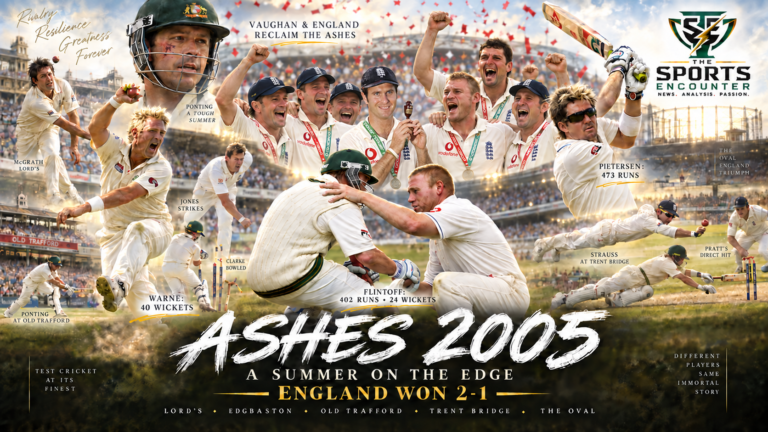
Brett Lee was still unbeaten when Australia ran out of wickets. He had absorbed the blows, survived the pressure and brought a seemingly lost Test within one scoring stroke of victory. Then Michael Kasprowicz gloved Steve Harmison to Geraint Jones, and England won by two runs.
Andrew Flintoff crouched beside Lee as teammates celebrated around them. The photograph became one of cricket’s most recognizable images because it held both sides of the result: the release of winning and the exhaustion of coming desperately close.
Yet the 2005 Ashes cannot fit inside one photograph.
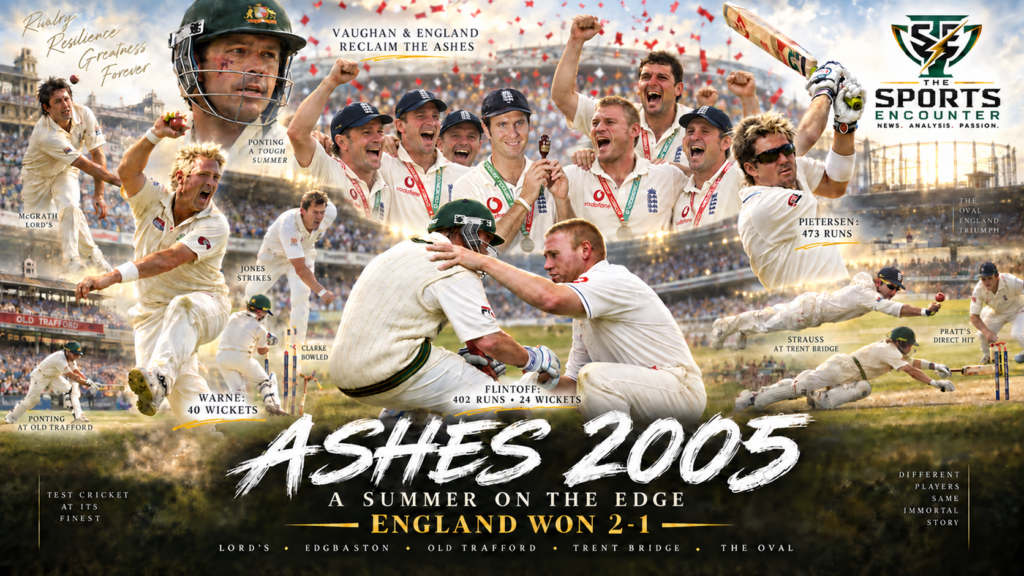
It also lives in Ricky Ponting’s bloodied cheek at Lord’s, Andrew Strauss suspended horizontally above the grass, Michael Clarke’s off stump flying out of the ground, and Shane Warne turning a ball past a disbelieving batter. It lives in a substitute fielder’s direct hit and a Test newcomer’s refusal to spend the final afternoon merely defending.
Story at a glance
Why the Ashes carries so much weight
The Ashes began with a defeat and a newspaper joke that outlived its authors.
The complete series at a glance
Series dates: July 21 to September 12, 2005Captains: Michael Vaughan, England; Ricky Ponting, AustraliaFinal result: England won 2–1Compton–Miller Medal: Andrew Flintoff
Lord’s: Harmison drew blood, but McGrath delivered the verdict
The photograph of Ponting with blood running down his cheek records England’s intent. Harmison’s short ball struck the Australian captain during a hostile opening spell, and England dismissed the tourists for 190.
Edgbaston: The injury, the decision and the two runs
Before the second Test, McGrath stepped on a cricket ball during the warm-up and injured his ankle. Australia lost their most reliable fast bowler before play began.
Shane Warne: Forty wickets and no permission to relax
The Instagram carousel describes Warne’s campaign in superlatives. The verified number underneath them is remarkable enough: 40 wickets at 19.92.
The images in Cricket With Forza’s Instagram retrospective capture those memories. Their deeper significance emerges when the moments are placed back inside the contest.
England won the five-Test series 2–1, ending eight consecutive Ashes series defeats. Australia made them fight for that outcome until the final day. Twenty-one years later, that combination of historical weight, individual brilliance and sustained uncertainty gives 2005 an exceptional claim to being the finest Ashes series of the post-2000 era.
TL;DR
- England reclaimed the Ashes for the first time since their 1986–87 series victory, ending Australia’s hold that began in 1989.
- Their two victories came by two runs at Edgbaston and three wickets at Trent Bridge.
- Shane Warne took 40 wickets, while Andrew Flintoff combined 402 runs with 24 wickets.
- Kevin Pietersen scored a series-leading 473 runs at 52.55, including the decisive 158 at The Oval.
- Simon Jones’s reverse swing, Strauss’s catching and Gary Pratt’s run-out supplied crucial support.
- The case for 2005 rests on the quality and persistence of the contest, rather than nostalgia alone.
Why the Ashes carries so much weight
The Ashes began with a defeat and a newspaper joke that outlived its authors.
After Australia beat England at The Oval in 1882, a mock obituary declared English cricket dead and proposed taking its ashes to Australia. England captain Ivo Bligh subsequently traveled there promising to recover them.
MCC’s account of the Ashes’ origins explains how a small terracotta urn became the rivalry’s symbol. The original remains at Lord’s; the teams compete for the honor represented by it.
The format gives that history room to develop. Across five Tests, the same opponents repeatedly examine each other’s weaknesses. A technical problem can follow a batter between cities. A bowler can establish a pattern, change it and exploit the expectation he has created.
For England in 2005, the pressure also came from accumulated failure. Australia had won every Ashes series since 1989. England’s last victory belonged to the winter of 1986–87.
Those dates describe two different waits: 16 years since losing possession of the Ashes and more than 18 years since their previous series win.
The complete series at a glance
| Test | Venue | England innings | Australia innings | Result |
|---|---|---|---|---|
| First | Lord’s, London | 155 and 180 | 190 and 384 | Australia won by 239 runs |
| Second | Edgbaston, Birmingham | 407 and 182 | 308 and 279 | England won by two runs |
| Third | Old Trafford, Manchester | 444 and 280/6 declared | 302 and 371/9 | Draw |
| Fourth | Trent Bridge, Nottingham | 477 and 129/7 | 218 and 387, following on | England won by three wickets |
| Fifth | The Oval, London | 373 and 335 | 367 and 4/0 | Draw |
Series dates: July 21 to September 12, 2005
Captains: Michael Vaughan, England; Ricky Ponting, Australia
Final result: England won 2–1
Compton–Miller Medal: Andrew Flintoff
The sequence explains why the series endured. A heavy defeat gave way to three consecutive matches decided by extremely narrow margins or last-wicket resistance. The final Test then demanded another escape.
Lord’s: Harmison drew blood, but McGrath delivered the verdict
The photograph of Ponting with blood running down his cheek records England’s intent. Harmison’s short ball struck the Australian captain during a hostile opening spell, and England dismissed the tourists for 190.
It would be misleading, however, to turn that image into evidence that England had already seized control.
Glenn McGrath answered with 5/53 and 4/29. Australia won by 239 runs.
His bowling exposed the difference between announcing a challenge and sustaining one. McGrath repeatedly forced England’s batters to decide whether to play at deliveries around off stump. His consistency made small errors costly.
Pietersen, making his Test debut, supplied resistance with 57 and an unbeaten 64. Much of England’s batting otherwise failed to support the attack.
The eventual series victory becomes more impressive when that opening defeat stays in the story. England had to improve while facing opponents who had just demonstrated how comprehensively they could win.
Edgbaston: The injury, the decision and the two runs
Before the second Test, McGrath stepped on a cricket ball during the warm-up and injured his ankle. Australia lost their most reliable fast bowler before play began.
Ponting nevertheless chose to bowl after winning the toss. England responded with 407 in 79.2 overs.
That scoring rate mattered tactically. Australia’s replacement attack could not settle into the same control McGrath had imposed at Lord’s. England attacked opportunities early and put the visitors under immediate pressure.
Flintoff scored 68 in the first innings and 73 in the second. He also took seven wickets in the match, including Langer and Ponting in an extraordinary opening over of his spell during Australia’s chase.
Still, Australia almost recovered.
Lee finished unbeaten on 43. Kasprowicz helped bring the target within reach before the final catch ended the match at 279.
The celebration contained a warning: even when England had played enough good cricket to deserve victory, Australia could drag them back toward defeat.
Cricket Australia’s Edgbaston documentary, featuring Lee and Flintoff, revisits the match and its aftermath. Their shared memory helps explain why the photograph remains powerful without needing invented dialogue about what either player said.
Shane Warne: Forty wickets and no permission to relax
The Instagram carousel describes Warne’s campaign in superlatives. The verified number underneath them is remarkable enough: 40 wickets at 19.92.
He finished 16 wickets ahead of England’s leading bowler, Flintoff.
Warne’s greatness in this series lay partly in his refusal to let a match follow its apparent direction. When England threatened to establish control, he kept producing another question.
His dismissal of Strauss at Edgbaston captured that ability. Strauss attempted to leave a delivery that turned sharply from outside off stump and bowled him. Calling it the series’ best delivery is a judgment, but its quality is clear: Warne defeated the batter’s assessment of where the ball could travel.
He offered more than spectacular turn. Changes of pace, flight and trajectory complicated decisions even when the ball moved less dramatically.
For England, batting against him meant accepting that a period of survival did not guarantee the next delivery would be manageable.
Australia’s defeat should never obscure his contribution. Warne made their resistance formidable.
Andrew Flintoff: The workload behind the legend
Flintoff finished with 402 runs at 40.20 and 24 wickets at 27.29, winning the inaugural Compton–Miller Medal.
Those figures describe a demanding combination of responsibilities. He supplied middle-order runs, long bowling spells, breakthroughs and a physical presence that helped England maintain pressure.
His influence also depended on timing. Edgbaston required counterattack. Trent Bridge required a first-innings century. At The Oval, his five wickets helped prevent Australia from converting a strong batting position into a substantial lead.
This was an all-round performance distributed across the series, rather than a reputation built from one afternoon.
It remains central to The Sports Encounter’s comparison of Botham, Flintoff and Stokes as England’s greatest Test all-rounders. Career totals and peak influence can produce different answers, and 2005 gives Flintoff an unusually strong argument on the latter measure.
Simon Jones: The ball that made leaving dangerous
The image of Clarke’s off stump being uprooted captures one of England’s most important weapons: reverse swing.
At Old Trafford, Jones brought the ball back into Clarke after the batter offered no stroke. The dismissal punished a judgment that might have been safe against a different delivery.
Reverse swing gave England a threat beyond the opening overs. Batters could not assume that surviving the new ball meant the innings would become progressively easier.
Jones took 18 wickets in four Tests, including 6/53 at Old Trafford. His contribution helped turn England’s attack into a group capable of applying different kinds of pressure.
Harmison offered bounce. Matthew Hoggard supplied swing and persistence. Flintoff combined pace with movement. Jones attacked with late swing at speed.
Vaughan could change the problem without abandoning the search for wickets.
Old Trafford: Ponting’s 156 deserves equal billing
A balanced account must give Australia’s survival at Old Trafford the same attention as England’s victories.
Vaughan’s 166 helped establish England’s advantage. Jones’s bowling strengthened it. Australia eventually faced a target of 423 and spent the final day trying to prevent defeat.
Ponting made 156.
His innings absorbed time, resisted an increasingly confident attack and gave the lower order a chance to finish the job. Australia ended on 371/9, with Lee and McGrath preserving the draw.
The result denied England a victory they had worked toward for much of the match. It also demonstrated why the series stayed compelling: excellent cricket from one side kept meeting a response from the other.
The draw carried its own climax. That remains relevant to our examination of why Test cricket is losing so many fifth days. Time can intensify a contest when both teams still have something meaningful to defend.
Strauss and Pratt: Fielding became a deciding skill
Two of the carousel’s strongest images concern players taking opportunities created by others.
At Trent Bridge, Strauss launched himself into a spectacular slip catch to dismiss Gilchrist off Flintoff. The photograph shows the athletic finish; the cricketing value lay in converting an edge from a batter capable of rapidly changing an innings.
Pratt’s intervention was different.
Fielding as a substitute, he ran out Ponting for 48 with a direct hit during Australia’s second innings. The ECB’s archive preserves the dismissal.
Ponting’s anger became part of the match’s history. He had concerns about England’s use of substitute fielders, but Pratt was replacing the genuinely injured Simon Jones on this occasion.
The slide’s suggestion that the substitute won the match compresses a complicated contest. His run-out was important, but England still had to finish Australia’s innings and complete their own chase.
Requiring 129, they fell to 116/7. Giles and Hoggard then carried them home.
That finish illustrated how much England depended on contributions beyond the headline names.
Continue the Cricket Story



Kevin Pietersen: A debut series finished with 158
The carousel’s Pietersen figures are correct: 473 runs at 52.55.
However, its description of a first sighting needs context. This was his first Test series, not his introduction to international cricket.
At The Oval, England required a draw to regain the Ashes. Australia needed a victory to level the series and retain them.
Pietersen’s 158 made the difference.
The innings included seven sixes, missed chances and periods of intense pressure. It was not an uninterrupted display of control. Its significance came from his response when Australia threatened to force a decisive opening.
He counterattacked and scored quickly enough to change what Australia could realistically achieve in the time remaining.
Giles’s 59 was essential support. Their partnership helped turn England’s vulnerable position into a series-winning draw.
Pietersen’s ability to influence tense finishes would feature again in matches such as England’s narrow victory during Brian Lara’s farewell. In 2005, he established that reputation against an exceptional attack.
The numbers behind the photographs
| Player | Verified series contribution | Why it mattered |
|---|---|---|
| Shane Warne | 40 wickets at 19.92 | Kept Australia dangerous across all five Tests |
| Andrew Flintoff | 402 runs and 24 wickets | Delivered substantial contributions in both disciplines |
| Kevin Pietersen | 473 runs at 52.55 | Led the batting and secured the final draw |
| Marcus Trescothick | 431 runs | Helped England challenge Australia early in innings |
| Simon Jones | 18 wickets in four Tests | Made the older ball a major attacking weapon |
| Glenn McGrath | 19 wickets in three Tests | Dominated at Lord’s and remained a threat when fit |
| Ricky Ponting | 156 in the Old Trafford chase | Underpinned Australia’s last-wicket escape |
Why 2005 stands apart from other modern Ashes series
The presence of famous players is only part of the explanation. Several Ashes series have featured outstanding cricketers.
The stronger case for 2005 rests on four connected qualities.
First, the balance lasted. England’s opening defeat did not settle the contest. Their recovery did not eliminate Australia’s threat. The final day still mattered.
Second, the resistance was credible. Australia could win through McGrath’s control, Warne’s invention, Ponting’s endurance or the lower order’s refusal to give up.
That capacity had hurt England before, as our retrospective on Bichel and Bevan’s 2003 World Cup rescue illustrates. In 2005, England finally held enough of those difficult positions.
Third, several skills influenced the outcome. Aggressive batting mattered, but so did defensive judgment, reverse swing, catching, run-outs and lower-order partnerships.
Fourth, the result changed a long-established rivalry. England broke Australia’s sequence of eight Ashes series victories. The emotional release reflected years of accumulated disappointment.
This does not make “greatest” an objective title. The 2019 and 2023 contests offer strong modern comparisons, and preferences will differ. But 2005 combines a sustained contest with a historical breakthrough unusually well.
What the nostalgia should leave intact
The series contained injuries, dropped catches, controversial decisions and players who struggled. England benefited from McGrath’s absences. They also lost Jones before the final Test.
Nor did every participant arrive as a legend. Pietersen was making his Test debut, and several England players were establishing the reputations through which the series is now remembered.
Preserving those details makes the achievement more convincing. England succeeded through preparation, adaptability and enough decisive contributions to overcome their mistakes.
The photographs endure because each contains a genuine point of uncertainty: a batter deciding to leave, a fielder committing to a catch, a captain attempting a single, an exhausted bowler trying to survive one more delivery.
Our A Celebration of 5000 ODIs archive explores similar moments in the shorter game. The 2005 Ashes sustained them across five Tests.
England
- Ashes 2005: How England Broke Australia’s 16-Year Hold And Why England’s Two-Run Escape Still Matters
- Liam Dawson, Tom Banton Muscle England to Series-Clinching Victory Over Sri Lanka
- A Celebration of 5000 ODIs Match 26: England Escape Elimination as West Indies Lose Four Wickets for Three Runs
- A Celebration of 5000 ODIs Match 25: England Defend 171 as South Africa Lose Their Grip
- Future Looks Bright: Pakistan U19 Seal England Series 3-1 as Jahangir Bilal Stars in 200-Run Rout