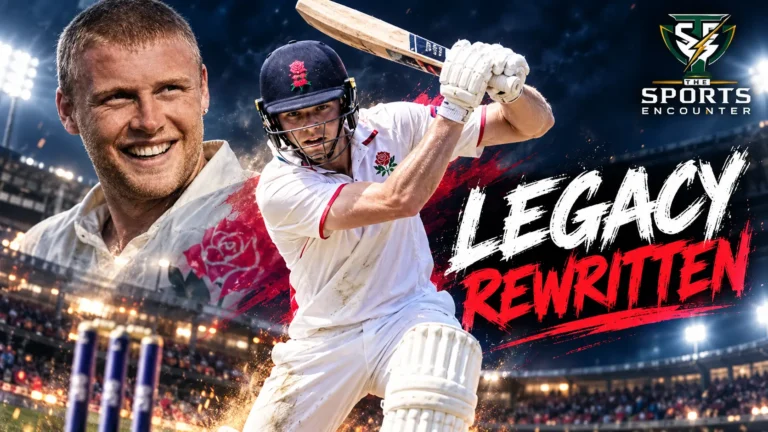
MANCHESTER, England, October 4, 2026: The easiest way to misunderstand Rocky Flintoff is to begin with his surname and never move beyond it.
The surname matters. It would be absurd to pretend otherwise.
Andrew Flintoff remains one of the defining English cricketers of the modern era, the all-rounder who produced 402 runs and 24 wickets during the 2005 Ashes series that transformed him into a national sporting figure. His physical presence, aggressive batting, fast bowling and ability to dominate the emotional center of a contest created a standard against which later English all-rounders were inevitably measured.
Rocky entered cricket with all of that history already attached to his name.
Story at a glance
Rocky Flintoff’s Career at a Glance
*Lancashire’s contemporaneous pathway reporting and later contract announcement list the debut age as 16 years and 113 days. One current club biography gives 111 days. The 113-day figure is used here because it is repeated in the contemporaneous record.
Rocky Flintoff’s Career Statistics Through the 2026 Season
The age records attract attention. The underlying numbers show where his development is actually strongest.
The Flintoff Name Arrived Before Rocky’s Own Numbers Did
English cricket has spent decades looking for players capable of performing multiple jobs at elite level.
From Lancashire Under-10s to the Academy
Rocky’s relationship with Lancashire did not begin when cameras arrived.
The 116 That Broke Andrew Flintoff’s 30-Year Lancashire Record
The first direct father-son record change came at Edgbaston.
Then he began changing the numbers.
At 16 years and 16 days, he became Lancashire’s youngest Second XI Championship centurion, taking a record his father had held for 30 years.
At 16 years and 102 days, he became the youngest player to make a century for England Under-19s, surpassing Ian Bell’s long-standing mark.
At 16 years and 137 days, he became Lancashire’s youngest first-class cricketer.
At 16 years and 291 days, he scored 108 for the England Lions and broke another age record held by Andrew, who had been more than three years older when he made his first Lions hundred.
Then, in August 2026, Rocky scored 123 from 76 balls against Somerset to become Lancashire’s youngest first-team centurion, breaking a county record that had survived for 136 years.
The chronology is extraordinary.
It also needs context.
Rocky is breaking age benchmarks. He is not yet approaching Andrew Flintoff’s senior career achievements. Andrew played 79 Tests, scored 3,845 Test runs, took 226 Test wickets and produced one of the defining all-round series performances in Ashes history.
Rocky, at 18, has nine first-class matches behind him. His first-class batting average remains 17.18. He has not yet made a first-class hundred. He has not played senior T20 cricket. Although officially listed as a right-arm fast-medium bowler, Lancashire notes that he has not yet bowled at first-team or Second XI level.
Those facts do not weaken his story.
They make it more interesting.
Rocky Flintoff has reached developmental landmarks extraordinarily early. The real question is what happens when being the youngest stops being the measurement and sustained senior performance becomes the standard.
Rocky Flintoff’s Career at a Glance
| Milestone | Date | Age | Performance | Significance |
|---|---|---|---|---|
| Lancashire Second XI century | April 2024 | 16 years, 16 days | 116 vs Warwickshire Second XI | Youngest Lancashire Second XI Championship centurion |
| First professional contract | June 2024 | 16 | Signed by Lancashire | Graduated from county pathway into professional squad |
| England U19 Youth Test century | July 2024 | 16 years, 102 days | 106 vs Sri Lanka U19 | Youngest England U19 centurion |
| Lancashire first-team debut | July 28, 2024 | 16 years, 113 days* | One-Day Cup vs Kent | Youngest Lancashire first-team player |
| First List A fifty | August 2024 | 16 | 88 vs Middlesex | First major senior batting breakthrough |
| First-class debut | August 22, 2024 | 16 years, 137 days | 32 vs Surrey | Youngest Lancashire first-class cricketer |
| England Lions century | January 2025 | 16 years, 291 days | 108 vs Cricket Australia XI | Youngest England A/Lions centurion |
| England U19 Youth ODI century | July 2025 | 17 | 107 vs India U19 | First Youth ODI hundred |
| Lancashire contract extension | March 2026 | 17 | Deal through end of 2027 | Long-term place in Lancashire development plans |
| First senior professional hundred | August 11, 2026 | 18 years, 126 days | 123 off 76 vs Somerset | Youngest Lancashire first-team centurion |
| First first-class fifty | September 2026 | 18 | 65 vs Gloucestershire | First substantial senior red-ball innings |
*Lancashire’s contemporaneous pathway reporting and later contract announcement list the debut age as 16 years and 113 days. One current club biography gives 111 days. The 113-day figure is used here because it is repeated in the contemporaneous record.
Rocky Flintoff’s Career Statistics Through the 2026 Season
The age records attract attention. The underlying numbers show where his development is actually strongest.
According to the latest CricketArchive career record, Rocky’s List A output is already materially stronger than his first-class record.
| Format | Matches | Innings | Runs | Average | Highest | 100s | 50s | Strike Rate |
|---|---|---|---|---|---|---|---|---|
| First-class | 9 | 16 | 275 | 17.18 | 65 | 0 | 1 | 47.33 |
| List A | 16 | 16 | 495 | 38.07 | 123 | 1 | 2 | 83.19 |
| England U19 Youth Tests | 6 | 10 | 381 | 42.33 | 106 | 1 | 2 | 64.14 |
| England U19 Youth ODIs | 11 | 11 | 424 | 42.40 | 107 | 1 | 3 | 79.54 |
That statistical split is central to any serious assessment of Flintoff.
He has already shown that he can score consistently at Under-19 level and convert that promise into senior 50-over cricket. List A cricket has produced 495 runs at 38.07, including a century and two fifties.
Red-ball cricket remains a different problem. Nine first-class matches have yielded 275 runs at 17.18.
The development case is therefore substantial, but unfinished.
The Flintoff Name Arrived Before Rocky’s Own Numbers Did
English cricket has spent decades looking for players capable of performing multiple jobs at elite level.
Ian Botham established one of the archetypes. Andrew Flintoff inherited the comparison. Ben Stokes later carried it into another generation.
Rocky’s surname therefore arrives with something heavier than ordinary sporting expectation.
His father was not simply a successful England cricketer.
Andrew became associated with a very specific form of English cricketing power: muscular counterattacks, hostile fast bowling, emotional intensity and the belief that a match could change rapidly once he became involved.
The resemblance between father and son naturally attracts attention, particularly when Rocky clears the front leg and hits powerfully through the leg side or straight down the ground.
Lancashire’s own player profile describes Rocky as tall and wiry and acknowledges that the power is present even though it does not appear in exactly the same physical form as his father’s.
Yet the most useful way to understand Rocky’s development is to stop asking whether he looks like Andrew long enough to examine when he has reached each competitive level.
That is where the unusual part of his career becomes visible.
From Lancashire Under-10s to the Academy
Rocky’s relationship with Lancashire did not begin when cameras arrived.
He first represented the county at Under-10 level and later entered Lancashire’s Academy in 2023.
The club’s official player profile describes a pathway that began when he was eight, progressed through county age-group cricket and eventually brought him into the Second XI while still at school.
That matters because famous parentage can distort the way young players are discussed.
A surname can create access to knowledge, coaching environments and an understanding of elite sport. It cannot make senior bowlers miss their lengths or place runs beside a player’s name on a scorecard.
By April 2024, Rocky had reached the stage where his own scores became impossible to treat as background noise.
The 116 That Broke Andrew Flintoff’s 30-Year Lancashire Record
The first direct father-son record change came at Edgbaston.
Rocky had only recently turned 16 when Lancashire Second XI faced Warwickshire Second XI in April 2024.
He scored 116 from 165 balls.
The innings contained 11 fours and three sixes and followed an unbeaten half-century against Durham Second XI the previous week.
He also shared a 39-run partnership with older brother Corey and a century partnership with England fast bowler Saqib Mahmood.
The score mattered on its own. The age attached to it made history.
Rocky: 16 Years and 16 Days
Rocky became Lancashire’s youngest Second XI Championship centurion at 16 years and 16 days.
The previous county record belonged to Andrew.
Andrew had made his own first Second XI Championship century in 1994 at 16 years and 266 days.
Rocky reached the benchmark approximately 250 days earlier in age terms.
This is the cleanest example of Rocky literally breaking one of his father’s records.
It was also a warning against treating his progress as a novelty.
A 116 from 165 balls in a multi-day second-team match required something different from a brief cameo built around inherited power. He batted long enough to move through phases of an innings and convert a start into three figures.
Why the Second XI Century Mattered Beyond the Family Record
Age-group cricket and senior development cricket create different tests.
Second XI sides can include experienced professionals returning from injury, fringe first-team players and young specialists several years older than a schoolboy batter.
Rocky’s 116 came in the same Lancashire side as Mahmood, an England international working back toward full fitness.
That environment gave the innings additional developmental value.
Within two months, Lancashire gave him a professional contract.
Lancashire Made the Investment Official in June 2024
Rocky signed his first professional contract during the 2024 summer.
He described playing for his home county as a dream and emphasized that he had represented Lancashire since childhood.
More revealing was the club’s approach.
Director of Cricket Performance Mark Chilton praised his performances and attitude while stressing that professional status represented the beginning of the work rather than the end of it.
That distinction has become increasingly important as Rocky’s profile has grown.
English cricket has many examples of exceptional youth players whose senior careers developed slowly. Under-19 success is useful evidence, not a guarantee.
TSE’s coverage of recent youth international cricket has repeatedly shown how quickly young players move through strong developmental systems. England’s narrow 2026 Youth ODI victory over Pakistan and Pakistan’s eventual 3-1 series win featured another group of teenagers trying to convert age-group performance into professional opportunity.
Rocky simply entered that process earlier than most.
Rocky Flintoff Becomes Lancashire’s Youngest First-Team Player
The next barrier fell on July 28, 2024.
Lancashire selected Flintoff for a One-Day Cup match against Kent at Blackpool.
At 16 years old, he became the youngest first-team player in the county’s history.
The most widely cited contemporaneous figure was 16 years and 113 days.
His first season was not built around one spectacular innings.
It was about exposure.
He played seven One-Day Cup innings and scored 167 runs.
The most important arrived against Middlesex at Emirates Old Trafford.
The 88 Against Middlesex Showed He Could Build a Senior Innings
Flintoff made 88 from 115 balls.
The strike rate was modest compared with the power-hitting display that would arrive two years later at Taunton.
That is precisely why the innings is useful when assessing his development.
It showed he could occupy the crease against senior bowling, absorb periods when scoring was slower and construct an innings beyond youth cricket.
The 2026 version of Flintoff would later demonstrate a much more violent acceleration pattern.
The 2024 innings provided a foundation.
First-Class Cricket Arrived Less Than a Month Later
Rocky’s List A debut is sometimes confused with his first-class debut.
The two records are separate.
His Championship opportunity came on August 22, 2024 against Surrey at The Oval.
He was 16 years and 137 days old.
That made him Lancashire’s youngest first-class cricketer.
A 32 That Was More Significant Than the Score Looks
Lancashire were inserted in difficult conditions against the reigning county champions.
They slipped to 33 for two before Flintoff arrived.
Surrey’s attack included experienced seamers Dan Worrall, Jordan Clark and Sam Curran.
Flintoff scored 32 from 64 balls.
He was dropped once and survived several uncomfortable moments, but the larger impression was one of competitive adjustment. He got through Worrall’s opening spell, contributed to a 40-run partnership with Josh Bohannon and looked capable of functioning in an environment several developmental levels above academy cricket.
He then drove at the first delivery after lunch and was caught.
The dismissal was instructive.
Senior cricket does not grade promise. One error can end an innings that had required an hour of concentration to build.
Lancashire were eventually beaten by an innings and 63 runs.
Rocky’s first-class career had begun with a useful 32 and an immediate demonstration of how demanding the format would be.
England Under-19s: Rocky Breaks Ian Bell’s Record
The most important age-group record of Rocky’s 2024 summer did not belong to his father.
It belonged to Ian Bell.
England Under-19s faced Sri Lanka Under-19s at Cheltenham in July.
Flintoff resumed one morning on 82 and moved to 106 from 181 balls.
He struck two sixes and became the youngest player to score a century for England Under-19s.
He was 16 years and 102 days old.
Bell had been 16 years and 313 days when he set the previous benchmark against New Zealand in 1999.
Rocky therefore moved the record forward by roughly seven months in age terms.
The Under-19 Record Was Part of a Larger Scoring Pattern
The Sri Lanka hundred was not an isolated youth score.
Lancashire records that Flintoff made two scores of 106 during the 2024 summer, including another century in a 50-over intra-squad match involving an England Young Lions Invitational XI.
His official England U19 numbers later grew to:
- 381 runs at 42.33 in Youth Tests;
- 424 runs at 42.40 in Youth ODIs;
- one official Youth Test hundred;
- one Youth ODI hundred;
- five official U19 fifties or hundreds across the two formats.
The Youth ODI century came against India in 2025, when Flintoff made 107 from 91 balls in a chase of 364 at Worcester.
England lost the match by 55 runs, but Flintoff’s innings provided another important data point. He could produce a hundred while chasing a large target against one of the deepest youth systems in world cricket.
Those pathway contests matter because the transition from youth cricket to senior cricket is increasingly international. TSE’s coverage of India and Australia’s Under-19 rivalry in Rajkot showed the same principle: high-level youth tours expose prospects to match situations, travel, unfamiliar opponents and tactical pressure before senior cricket decides whether the promise survives.
The England Lions Call-Up Accelerated Everything
Rocky’s progression took another unusual step during the winter of 2024-25.
He received a late call-up to the England Lions environment in South Africa and was then selected for the Lions tour of Australia.
The ECB’s official squad announcement placed a 16-year-old Flintoff alongside players who already had senior England experience.
There was an obvious complication to the story.
Andrew Flintoff was the Lions head coach.
The father-son relationship guaranteed scrutiny, but selection alone was not the event that changed the conversation.
The innings in Brisbane did.
The 108 at No. 9 That Broke Andrew Flintoff’s Lions Record
England Lions were in serious trouble against a Cricket Australia XI at Allan Border Field.
Rocky came in at No. 9 with the score at 161 for seven.
He responded with 108 from 127 balls.
The innings contained nine fours and six sixes.
England reached 319.
Flintoff was their top scorer.
It was a striking innings in any circumstances. Its place in the record book made the story larger.
Rocky Was 16 Years and 291 Days
He became the youngest player to score a maiden hundred for England A or the England Lions.
The previous record belonged to Andrew.
Andrew had made his first Lions hundred against Kenya in Nairobi in 1998 at 20 years and 28 days.
Rocky reached the same broad developmental landmark more than three years younger.
This was the second clear case of him taking a record directly from his father.
One Statistical Detail Is Often Missed
The 108 does not appear in Rocky’s first-class career record.
The four-day match against the Cricket Australia XI did not carry first-class status.
That distinction matters when his numbers are compared.
It explains how a player who has already scored a Lions hundred can still have a first-class highest score of 65.
The innings remains significant within the England development pathway. It simply belongs to a different statistical classification.
The Father Was Coach, but the Son Had to Rescue the Innings
The circumstances also limit how far any favoritism argument can reasonably travel.
Selection can create an opportunity.
It cannot manufacture 108 runs after arriving at 161 for seven.
Rocky had to solve the match himself.
Andrew later remained an important figure in England’s development structure until leaving the Lions role in 2026. TSE examined why Andrew’s decision to leave the Lions and concentrate on Sydney Thunder represented a major step in his own coaching career.
By then, Rocky’s pathway no longer depended on being in a team coached by his father.
Why 2025 Was an Important Interruption
Rapid development stories are often presented as uninterrupted climbs.
Rocky’s was not.
He did not play a Lancashire first-team match in 2025.
Injury played a role.
He continued appearing for England Under-19s and other representative sides, but the senior county progression that had moved so quickly in 2024 stalled.
That interruption is important for two reasons.
First, it prevents an exaggerated narrative in which every season produced another automatic promotion.
Second, it gives the 2026 return more meaning.
The Hundred Opportunity Never Became a Senior T20 Debut
Rocky was selected by Northern Superchargers in the 2025 Hundred wildcard draft.
He did not play in their first three matches and later withdrew from the squad because of an unspecified injury.
As of October 2026, he still has no senior T20 appearance.
That is significant when projecting his future.
Franchise cricket is an obvious possibility for a young English batter with power and profile. Serious IPL or global-franchise projections are premature while his senior T20 statistical record remains empty.
The more immediate evidence exists in List A and first-class cricket.
Lancashire’s Contract Extension Put Rocky Inside the Club’s Long-Term Plan
In March 2026, Lancashire extended Flintoff’s contract through the end of the 2027 season.
The club announced the deal alongside extensions for fellow academy graduates Tom Aspinwall and Charlie Barnard.
Mark Chilton described the trio as high-potential homegrown players whose development was central to Lancashire’s future plans.
The wording matters.
Lancashire did not frame Rocky as a finished first-team star.
They framed him as an investment.
The 2026 season then began to produce evidence supporting that investment.
Taunton 2026: The Innings That Changed Rocky’s Senior Record
Rocky had already made hundreds in second-team cricket, England age-group cricket and an England Lions fixture.
None counted as a senior professional century in his recognized first-class or List A record.
That changed against Somerset on August 11, 2026.
Lancashire arrived at Taunton needing a strong One-Day Cup result.
Somerset chose to bowl.
By the end of the innings, that decision had become extremely expensive.
Lancashire made 443 for six.
It was the highest List A total in the county’s history.
Rocky made 123 from 76 balls.
He Arrived at 138 for Three
Lancashire had a useful base rather than a crisis.
Keaton Jennings was established. The innings needed someone who could convert that platform into acceleration.
Flintoff did exactly that.
He and Jennings added 214 for the fourth wicket in just 21.1 overs.
Jennings eventually made 156 from 127 balls.
Rocky reached his own hundred from 65 deliveries.
His final 123 contained 10 fours and seven sixes.
Eighty-two of his runs came in boundaries.
The official Lancashire match report records how the partnership transformed 154 for three after 25 overs into a total beyond 440, with Lancashire scoring 289 runs from the final 25 overs.
Why the 123 Was Different From His Previous Hundreds
The innings did more than add another century to a teenage record list.
It changed his recognized senior statistics.
This one belonged to List A cricket.
It entered the official professional record as his first senior hundred.
The acceleration was also revealing.
His 2024 innings of 88 against Middlesex had come from 115 balls.
At Taunton, he scored 123 from 76.
The comparison shows range rather than a simple change in ability.
One innings required occupation and accumulation.
The other required a player to identify a favorable match state and attack it.
Jennings’ Assessment Explains the Tactical Improvement
Jennings praised the teenager’s tempo, shot selection and ability to take risks toward the correct areas of the ground.
That is a more useful technical clue than vague claims about Flintoff possessing a particular “X-factor.”
He did not simply hit hard.
He recognized that Lancashire had wickets available, a set batter at the other end and a Somerset attack under increasing pressure.
He accelerated without allowing the innings to become random.
That distinction is central to high-level white-ball batting.
Rocky Also Broke a 136-Year Lancashire Record
At 18 years and 126 days, Flintoff became Lancashire’s youngest first-team centurion.
That record did not belong to Andrew.
It had stood since 1890.
Archie MacLaren was 18 years and 256 days when he made 106 at Hove.
Rocky lowered the age benchmark by 130 days.
This is an important correction to the simplistic father-son narrative.
Some of Rocky’s records belonged to Andrew.
Others belonged to Lancashire history long before Andrew Flintoff was born.
The One-Day Cup Has Become an Important Development Laboratory
England’s domestic 50-over competition now regularly gives younger players opportunities while established internationals are occupied elsewhere.
That does not reduce the status of the runs.
It changes the developmental environment.
Young players face senior professionals, different surfaces and full 50-over innings while carrying more responsibility than they might receive in a first-choice county XI.
TSE saw another example during the same competition when Toby Albert hit six consecutive deliveries he faced for six for Hampshire.
Rocky’s 2026 One-Day Cup gave Lancashire something broader.
Across the competition he demonstrated that the 2024 promise had survived the injury interruption and could now produce sustained senior returns.
The 65 Against Gloucestershire May Matter More to His Test Ambitions
The Taunton century generated the headlines.
Rocky’s 65 against Gloucestershire in September answered a different question.
Lancashire were chasing 248 at Emirates Old Trafford.
They collapsed to 64 for five.
Flintoff resisted.
He reached the end of the third day unbeaten on 57 and eventually made a career-best 65 from 79 balls as Lancashire were dismissed for 142.
They lost by 105 runs.
There was no spectacular team outcome to amplify the innings.
That makes it useful evidence.
Red-Ball Runs Have Been Harder to Earn
Flintoff’s first-class average remains 17.18.
That number cannot be waved away because he is young.
It identifies the clearest gap between pathway promise and senior performance.
His 65 came in a failed chase, with wickets falling around him and Lancashire’s batting under severe pressure.
Head coach Steven Croft highlighted the fight, character and skill Flintoff showed in difficult circumstances.
The innings does not solve the red-ball question.
It is his strongest senior answer to it so far.
What Do Rocky Flintoff’s Numbers Actually Say About His Batting?
Any technical analysis of a teenage player requires discipline.
It is easy to watch several highlight clips, identify a backlift or trigger movement and present those observations as permanent traits.
Young batters change quickly.
Coaches alter setups. Strength develops. Bat paths evolve. Roles change according to format.
The match evidence provides a safer foundation.
1. He Can Bat at More Than One Tempo
The 88 from 115 balls against Middlesex and the 123 from 76 against Somerset belong to very different scoring environments.
That is encouraging.
A young batter who can only attack has a narrow route into first-class cricket.
A batter who can only survive can become difficult to accommodate in modern white-ball sides.
Rocky’s early record contains evidence of both gears.
2. His Power Is Already Senior-Level Relevant
Seven sixes in a 76-ball professional innings cannot be explained by surname or age-group dominance.
The Lions hundred contained six more sixes.
Those innings came against adult bowling attacks in competitive senior or development environments.
The raw power is therefore established.
The next question concerns repeatability against better plans.
Senior teams will bowl wider. They will change pace. They will use boundary dimensions deliberately. They will deny the areas from which he prefers to generate maximums.
The progression from powerful hitter to elite white-ball batter happens when a player keeps scoring after opponents know where the power comes from.
3. His Best Senior Innings Have Come From the Middle Order
Rocky has generally developed as a middle-order batter.
That role fits several early strengths.
He can enter after the new ball has softened, assess an existing match state and either rebuild or accelerate.
The Somerset hundred offered the clearest example.
He did not need to construct the first 20 overs.
He needed to recognize when Lancashire could move from a strong total toward a record total.
4. His Red-Ball Defensive Game Is Still Being Tested
The gap between a 38.07 List A average and a 17.18 first-class average deserves attention.
It does not mean Flintoff cannot become a strong red-ball player.
It means senior first-class attacks have so far created more problems than senior 50-over attacks.
Longer spells, moving balls, attacking fields and the absence of a required scoring rate create a very different examination.
The Surrey 32 and Gloucestershire 65 show periods of competence.
The overall record shows that converting those periods into substantial scores is now the next technical challenge.
5. Calling Him a Senior All-Rounder Is Premature
Rocky is officially listed as a right-arm fast-medium bowler and several profiles describe him as an all-rounder.
Lancashire’s own profile contains an important caveat: the club has not seen him bowl at first-team or Second XI level.
There is therefore no senior bowling sample to analyze responsibly.
Andrew Flintoff eventually became one of England’s great pace-bowling all-rounders.
Rocky’s current evidence base is overwhelmingly that of a batter.
Whether bowling becomes a serious component of his professional game remains open.
Rocky Flintoff vs Andrew Flintoff: Which Records Has He Actually Broken?
The father-son comparison becomes much clearer when the records are separated properly.
| Benchmark | Rocky Flintoff | Previous Benchmark | Whose Record? | What It Means |
|---|---|---|---|---|
| Lancashire Second XI Championship century | 16 years, 16 days | Andrew at 16 years, 266 days | Andrew Flintoff | Rocky reached the landmark about 250 days younger |
| England U19 century | 16 years, 102 days | Ian Bell at 16 years, 313 days | Ian Bell | Rocky became England’s youngest U19 centurion |
| Lancashire first-team debut | 16 years, 113 days | Previous Lancashire county record | County record | Youngest first-team player in Lancashire history |
| Lancashire first-class debut | 16 years, 137 days | Andrew debuted at 17 | Not specifically Andrew’s record | Rocky reached senior red-ball cricket substantially earlier |
| England A/Lions maiden century | 16 years, 291 days | Andrew at 20 years, 28 days | Andrew Flintoff | Rocky reached the landmark more than three years younger |
| Lancashire first-team century | 18 years, 126 days | Archie MacLaren at 18 years, 256 days | Archie MacLaren | Rocky broke a 136-year county record |
So Is Rocky Really Breaking Andrew’s Records?
Yes, but the wording needs precision.
He has directly taken at least two notable age records from Andrew: Lancashire’s Second XI Championship century benchmark and the England A/Lions maiden-century benchmark.
He has also reached first-class cricket younger than Andrew did.
Other records in Rocky’s rise belonged to different players.
Ian Bell held the England U19 century record.
Archie MacLaren held Lancashire’s first-team century record.
The complete story is therefore larger than a son chasing his father.
Rocky is moving through several layers of English cricket earlier than historical precedent expected.
Andrew Flintoff’s Career Shows Why Early Records Are Only the Beginning
Andrew’s career did not become legendary because he debuted at 17.
His first-class debut against Hampshire in August 1995 produced scores of seven and zero.
His maiden Championship hundred did not arrive until 1997.
His early Test career was uneven.
The player later remembered for the 2005 Ashes required years of physical development, technical improvement and international failure before becoming dominant.
That is a useful warning against interpreting Rocky’s age records as proof of an inevitable England career.
Andrew eventually became capable of influencing matches with both bat and ball at the highest level.
His 2005 Ashes campaign remains one of the clearest examples. He scored 402 runs at 40.20 and took 24 wickets at 27.29.
Those achievements belong to a completely different category from youth and development records.
The Father-Son Comparison Also Exposes How Cricket Development Has Changed
Rocky has access to structured age-group programs, academy systems, England Under-19 tours, Lions programs, sports science and format-specific competitions at a younger age than Andrew encountered during the 1990s.
That does not make Rocky’s records less meaningful.
It means chronological comparisons should not be treated as identical competitive journeys.
Modern pathways move elite teenagers toward higher levels faster.
The difficult part is what happens after arrival.
Andrew Was a Genuine Fast-Bowling All-Rounder. Rocky Is Currently a Batter First
This may be the most important difference between them.
Andrew’s eventual England value came from combining middle-order batting with fast bowling capable of taking Test wickets.
Rocky’s public senior record currently contains no comparable bowling body of work.
He is listed as right-arm fast-medium.
There is no meaningful first-team bowling sample.
As a result, projections that describe him as the next Andrew Flintoff all-rounder are several steps ahead of the evidence.
It is more accurate to evaluate him as one of England’s intriguing young batting prospects who may possess an additional bowling dimension later.
That distinction protects the player from a comparison he has not asked the numbers to support yet.
How Their Early Batting Paths Differ
| Area | Rocky Flintoff | Andrew Flintoff |
|---|---|---|
| Professional breakthrough | Age 16 | Age 17 |
| Early primary evidence | Middle-order batting | Batting plus developing pace bowling |
| England pathway | U19 century record, Lions hundred at 16 | U19 pathway, Lions hundred at 20 |
| Power profile | Seven sixes in maiden senior hundred | Later became one of England’s most destructive middle-order hitters |
| Current red-ball challenge | 275 first-class runs at 17.18 | Early career also required years before international consistency |
| Bowling role | Listed fast-medium, no meaningful senior sample | Developed into 226-wicket Test fast bowler |
Andrew’s eventual status within England’s lineage of great all-rounders places him alongside figures such as Botham and Stokes.
Rocky has not entered that conversation.
He is building a batting career.
The Weight of Being Andrew Flintoff’s Son
The comparison is unavoidable partly because the resemblance occasionally makes it visually irresistible.
The same surname appears on a Lancashire shirt.
The same broad family story runs through Old Trafford.
When Rocky hits a powerful six, television producers can cut instantly to archive footage of Andrew doing something similar.
That attention creates benefits.
It creates pressure too.
Every Normal Developmental Failure Becomes Public
A teenage batter without a famous surname can make 12, nick off and work on the problem largely outside national attention.
Rocky’s failures attract stories.
His selections attract stories.
His injuries attract stories.
His father being his Lions coach attracted another layer of scrutiny.
The only sustainable response is performance.
That is why the Taunton hundred mattered emotionally as well as statistically.
It entered a senior scorebook that required no family explanation.
Why Rocky’s Current List A Record Is the Strongest Evidence for the Hype
Of all his statistical categories, senior List A cricket currently provides the clearest argument.
Sixteen matches have produced 495 runs at 38.07.
The sample remains small, but it includes:
- a high score of 123;
- one hundred;
- two fifties;
- a strike rate above 83;
- significant runs in both accumulation and acceleration roles.
That is substantive senior performance for an 18-year-old.
It also places the Somerset century inside a wider record rather than leaving it as an isolated viral innings.
Why the First-Class Average Deserves Equal Attention
Good prospect analysis requires resisting the urge to select only flattering numbers.
Rocky’s first-class average of 17.18 is modest.
He has one fifty from 16 innings.
His highest score is 65.
Continue the Cricket Story
 A Celebration of 5000 ODIsA Celebration of 5000 ODIs Match 39: England Win the World Cup on Boundary Count After New Zealand Tie Them Twice
 CricketBanton’s First England Hundred Turns Sri Lanka Decider Into 223-Run Demolition Job
 A Celebration of 5000 ODIsA Celebration of 5000 ODIs Match 36: Malinga Turns 232 Into a Trap as England’s World Cup Certainty Suddenly Cracks
There is no hundred yet.
If senior Test cricket is the eventual ambition, this is the area that must change most.
The good news is developmental time.
He is 18.
Most county players are still establishing themselves years later.
The less useful response would be to treat age as a reason the numbers do not matter.
They matter because they identify the work.
What Must Rocky Flintoff Do Next?
Turn Red-Ball Starts Into Hundreds
The 65 against Gloucestershire should become a starting point.
The next stage is converting similar periods of control into innings of 80, 100 and beyond.
That requires managing the different phases of a Championship innings: the new ball, older-ball scoring, spin, second spells from seamers and concentration after breaks.
Establish a Permanent Lancashire Role
Lancashire have committed to him through the end of 2027.
The strongest route toward England is therefore straightforward.
Make himself difficult to leave out.
A player selected because he is developing eventually needs to become a player selected because the team is weaker without him.
Build a Senior T20 Record Before Franchise Projections Begin
The Hundred wildcard showed that franchises already know who he is.
Injury prevented the 2025 opportunity from becoming a debut.
Until he plays and succeeds in senior T20 cricket, discussion of IPL auctions or global-franchise value belongs more to projection than evidence.
Define Whether Bowling Is Part of the Professional Package
This could eventually alter his entire career profile.
If Flintoff becomes a legitimate fast-medium option, selection flexibility increases dramatically.
If he remains primarily a batter, that is not a failure.
It simply creates a different career.
The decision should emerge from development and physical suitability rather than the expectation that Andrew Flintoff’s son must bowl because Andrew did.
How Close Is Rocky Flintoff to Senior England Selection?
The answer depends on the format.
White-Ball Cricket Offers the Clearer Statistical Case
His List A record is already respectable and his trajectory is moving upward.
Another strong domestic 50-over season would deepen the argument.
T20 experience would broaden it.
Test Cricket Requires More Evidence
A first-class average below 20 does not support a senior Test selection case today.
The pathway credentials are exceptional.
The senior red-ball output is not yet there.
This distinction matters because fast-tracking can help a young player when the competitive level provides useful challenge, but it can also distort development if selection moves faster than performance.
The Lions Remain the Natural Bridge
Rocky has already shown he can perform in that environment.
The next value of Lions cricket lies in repetition.
One spectacular hundred at 16 demonstrated possibility.
A sequence of substantial innings against high-level developmental opposition would demonstrate readiness.
The England U19 Pathway Is Already Behind Him in One Sense
Rocky’s youth record is strong enough that proving he can dominate teenagers indefinitely serves little purpose.
England’s development structure exists to move players onward.
The current generation continues to show how competitive that process is. England’s young players were pushed hard by Pakistan during the 2026 series that Pakistan ultimately won 3-1.
The lesson applies to Rocky as much as anyone.
Youth records open doors.
Senior cricket decides how long they remain open.
The Most Useful Andrew Flintoff Comparison Comes From 2007, Not 2005
Andrew’s 2005 Ashes summer represents the finished icon.
A younger player learns more from the uneven parts of a great career.
Andrew’s later England years contained injuries, changing roles, captaincy pressures and matches in which his influence came in smaller bursts.
TSE’s reconstruction of England’s two-run World Cup defeat to Sri Lanka in 2007 and the dramatic victory during Brian Lara’s farewell show a player operating inside complicated teams and imperfect campaigns.
That is professional cricket.
Careers are rarely a straight line from record-breaking teenager to international greatness.
Rocky Flintoff’s Record-Breaking Timeline
| Year | Age | Development |
|---|---|---|
| 2023 | 15 | Joins Lancashire Academy after progressing through county age groups |
| April 2024 | 16 | Scores 116 for Lancashire Second XI and breaks Andrew’s county age record |
| June 2024 | 16 | Signs first professional Lancashire contract |
| July 2024 | 16 | Becomes England U19’s youngest centurion |
| July 2024 | 16 | Becomes Lancashire’s youngest first-team player |
| August 2024 | 16 | Scores 88 in One-Day Cup against Middlesex |
| August 2024 | 16 | Becomes Lancashire’s youngest first-class cricketer |
| January 2025 | 16 | Scores 108 for England Lions and breaks Andrew’s Lions age record |
| July 2025 | 17 | Scores 107 for England U19 against India |
| August 2025 | 17 | Hundred wildcard opportunity ends because of injury before senior debut |
| March 2026 | 17 | Extends Lancashire contract through 2027 |
| August 2026 | 18 | Scores maiden senior hundred, 123 off 76 against Somerset |
| September 2026 | 18 | Scores maiden first-class fifty and career-best 65 |
Why Rocky’s Story Is Already Bigger Than a Famous Surname
There is a temptation with second-generation athletes to choose between two simplistic positions.
One gives the parent all the explanatory power.
The other insists the family connection is irrelevant.
Neither describes elite sport particularly well.
Rocky grew up with access to knowledge most young players do not have.
He has a father who understands international cricket, pressure, injury, performance and failure at an unusually deep level.
He also had to face every ball himself.
The 116 at Edgbaston required his bat.
The 106 for England U19 required his concentration.
The Lions rescue at 161 for seven required his decision-making.
The 123 at Taunton required him to attack professional bowlers for 76 deliveries.
Family history explains why the world noticed so quickly.
Performance explains why it kept watching.
What Would Success Look Like by the End of 2027?
The most useful targets are not another collection of youngest-ever records.
Rocky is reaching the age when the benchmarks should gradually change.
A First-Class Hundred
This is the most obvious missing batting milestone.
It would not guarantee an England future, but it would show he can turn red-ball occupation into a complete innings.
A Full Senior County Season
Availability matters.
The interruption of 2025 demonstrated how quickly injury can reduce developmental momentum.
A sustained run across formats would generate a much stronger statistical sample.
A Defined T20 Role
Senior T20 cricket remains the major blank space in his record.
His power suggests potential.
Actual matches need to test it.
Further Lions Runs
The first Lions hundred came at 16.
The next important achievement is not being the youngest.
It is becoming one of the best batters in the team.
Selection on Output Rather Than Potential
This is the final transition every elite prospect must make.
At 16, selection can reasonably be about what a player may become.
By the early 20s, runs and wickets begin deciding the argument.
Rocky has bought himself time by reaching difficult environments early.
The next task is using it.
Final Assessment: Rocky Is Ahead of Andrew’s Timeline, Not Andrew’s Career
The distinction defines everything.
Rocky Flintoff has reached several cricketing milestones younger than Andrew Flintoff did.
He directly broke Andrew’s Lancashire Second XI century record.
He directly broke Andrew’s England A/Lions century age record.
He reached first-class cricket younger.
He also broke records belonging to Ian Bell and Archie MacLaren.
Those achievements make his early trajectory exceptional.
They do not make the eventual outcome inevitable.
Andrew’s legacy was built after the age records ceased to matter. It was built through Test wickets, international runs, injuries overcome, failures absorbed and matches changed against the best players in the world.
Rocky has not reached that part of the story.
He is 18.
His strongest senior format is currently List A cricket. His first-class record still needs substantial growth. His bowling remains largely theoretical at senior level. His T20 career has yet to begin.
That combination should make English cricket patient rather than disappointed.
There is already enough evidence to call Rocky Flintoff an unusual prospect without pretending he is a finished one.
The surname gave him a famous starting point.
The record book is beginning to contain his own entries.
What happens next will determine whether future comparisons continue to begin with Andrew Flintoff or whether, eventually, Rocky Flintoff becomes the reference point for someone else.
Rocky Flintoff FAQs
How old is Rocky Flintoff?
Rocky Flintoff was born on April 7, 2008, in Manchester. He is 18 years old as of October 2026.
Which Andrew Flintoff records has Rocky broken?
Rocky became Lancashire’s youngest Second XI Championship centurion at 16 years and 16 days, beating Andrew’s mark of 16 years and 266 days. He also became the youngest England A/Lions centurion at 16 years and 291 days, breaking Andrew’s previous benchmark of 20 years and 28 days.
What is Rocky Flintoff’s highest senior score?
His highest recognized senior score is 123 from 76 balls for Lancashire against Somerset in the 2026 One-Day Cup.
What is Rocky Flintoff’s first-class batting average?
Through the end of Lancashire’s 2026 season, Flintoff has scored 275 first-class runs at an average of 17.18, with a highest score of 65.
What are Rocky Flintoff’s List A statistics?
He has 495 runs from 16 List A matches at an average of 38.07, with a highest score of 123, one century and two fifties.
When did Rocky Flintoff make his Lancashire debut?
He made his Lancashire first-team debut against Kent in the One-Day Cup on July 28, 2024, becoming the youngest player to represent the county’s first team.
When did Rocky Flintoff make his first-class debut?
He made his first-class and County Championship debut against Surrey at The Oval on August 22, 2024, aged 16 years and 137 days. He scored 32 in his first innings.
What did Rocky Flintoff score for the England Lions?
He scored 108 from 127 balls against a Cricket Australia XI at Allan Border Field in Brisbane in January 2025. He batted at No. 9 and hit nine fours and six sixes.
Does Rocky Flintoff bowl like Andrew Flintoff?
Rocky is officially listed as a right-arm fast-medium bowler, but Lancashire has stated that he has not yet been seen bowling at first-team or Second XI level. His professional record so far should therefore be assessed primarily as a batter.
Has Rocky Flintoff played in The Hundred?
No. He was selected by Northern Superchargers in the 2025 wildcard draft but did not play before withdrawing from the squad because of injury.
Has Rocky Flintoff played senior T20 cricket?
No senior T20 appearance is recorded as of October 2026.
How long is Rocky Flintoff contracted to Lancashire?
His current Lancashire contract runs through the end of the 2027 season.
Is Rocky Flintoff ready for England?
His England Under-19, Lions and List A performances show exceptional pathway progress, but his first-class record remains early. Senior England selection, particularly in Test cricket, would require a stronger body of sustained senior domestic performance.
Andrew Flintoff
- How Rocky Flintoff Is Breaking Andrew Flintoff’s Records: Stats, Milestones, and Career Story
- Ashes 2005: How England Broke Australia’s 16-Year Hold And Why England’s Two-Run Escape Still Matters
- How England Cricket’s Drinking Scandals Keep Making the ECB a Laughing Stock
- Andrew Flintoff’s Son Announces His Arrival With First Senior Century for Lancashire
- Andrew Flintoff Leaves England Job for a Bigger Ambition at Sydney Thunder