Cricket
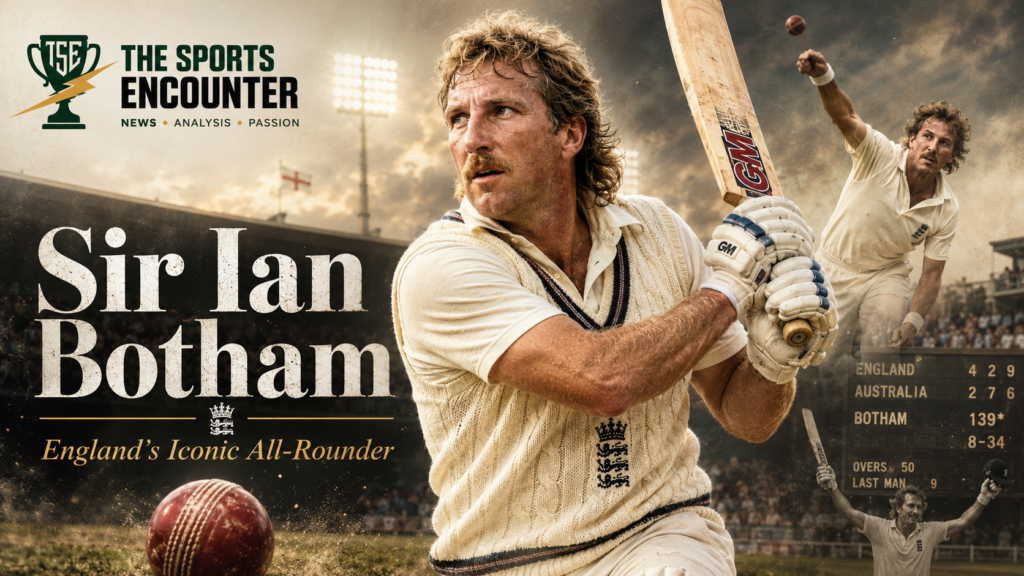
Sir Ian Botham: England’s Greatest All-Rounder and Cricket’s Ultimate Showman
Sir Ian Botham was more than England’s great all-rounder. He was a match-winner, disruptor, national icon, and controversial figure whose rivalry with Imran Khan and place among cricket’s greatest all-rounders still shape debate today.
Some cricketers are remembered for numbers. Some are remembered for moments. Sir Ian Botham belongs to a rarer class.
He is remembered for the feeling he created.
When Botham walked onto a cricket field, England did not just get an all-rounder. England got force, noise, risk, swagger, defiance, and theater in one body. He could change a Test match with a spell, a counterattack, a slip catch, or simply by making everyone around him believe that something was about to happen.
That was Botham’s gift.
READ MORE: West Indies’ innings win over Sri Lanka at North Sound
He was never cricket’s quiet craftsman. He was its disruptor. At his peak, he made England believe again at a time when belief often looked fragile. He became the man who could drag a match out of certain defeat and turn it into folklore. For English cricket, that mattered as much as the wickets and runs.
For more cricket stories, records, player profiles, and long-form analysis, follow The Sports Encounter’s cricket coverage.
The Career That Built the Legend
Ian Botham played 102 Test matches for England between 1977 and 1992. He scored 5,200 Test runs, took 383 wickets, and held 120 catches. Those numbers still place him among the finest all-rounders the game has produced.
He was the fastest player of his time to complete the Test double of 1,000 runs and 100 wickets. He also became Test cricket’s leading wicket-taker before later generations pushed the record forward.
But numbers only explain part of Botham.
His cricket was built on momentum. He bowled fast-medium with aggression, movement, and a natural feel for the big occasion. As a batter, he did not always play with textbook restraint, but that was never the point. Botham attacked pressure before pressure could settle on him. When he got going, fields spread, bowlers lost rhythm, and crowds woke up.
He was also an exceptional slip fielder. His hands were sharp, his anticipation strong, and his competitiveness visible. He played cricket as if every ball had a consequence.
That intensity made him a hero. It also made him combustible.
Ian Botham’s ODI Career: Useful, Aggressive and Built for Big Stages
Botham’s Test career owns most of the legend, but his One Day International record deserves space too.
He played 116 ODIs for England between 1976 and 1992, scoring 2,113 runs and taking 145 wickets. His batting average was 23.22, with a highest score of 79. With the ball, he averaged 28.54 and produced a best of 4/31.
Those numbers may not look overwhelming through the lens of modern white-ball cricket, but context matters. Botham played in an era when ODI cricket was still finding its shape. Batters were not operating with today’s powerplay freedom, bowling variations were less specialized, and all-rounders often carried multiple roles without the kind of data-led support modern players receive.
Botham’s ODI value came from balance. He could open up a game with the bat, deliver overs with the new ball or through the middle, and change the atmosphere in the field. He was part of England squads that reached the 1979 and 1992 World Cup finals, which also shows how long his international relevance lasted.
In ODIs, Botham was rarely the pure statistical monster he became in Test cricket at his peak. Still, he remained the kind of player captains wanted because he gave them options. He gave England wickets, lower-order hitting, presence, and experience.
That mattered in an age when one-day cricket was becoming more serious with every World Cup cycle.
The 1981 Ashes and the Birth of “Botham’s Ashes”
Every great cricketer has a defining chapter. Botham’s came in the 1981 Ashes.
England were struggling. Botham had resigned as captain after a poor run, and Australia were in control of the series. Then Mike Brearley returned as captain, and Botham was released from the burden of leadership. What followed became one of cricket’s most famous turnarounds.
At Headingley, England looked finished. Following on, with defeat almost certain, Botham produced an unbeaten 149 that changed the match, the series, and his own place in cricket history. Bob Willis finished the job with the ball, but the match became tied forever to Botham’s name.
At Edgbaston, Botham took five wickets for one run in a spell that destroyed Australia’s chase. At Old Trafford, he hit another dazzling hundred. By the end of that summer, England had turned disaster into triumph, and Botham had moved from star cricketer to national icon.
That series gave English cricket one of its strongest modern myths: when everything is lost, Botham can still happen.
Aura: Why Botham Felt Bigger Than Cricket
Botham’s aura came from the way he carried himself. He had the confidence of a man who did not seem interested in playing safe. He looked like he enjoyed pressure. He made cricket feel alive.
Fans loved him because he gave them emotion. Opponents respected him because he could hurt them in more than one way. Teammates responded to his energy because he could shift the mood of a dressing room.
He was not polished in the modern media-trained sense. That was part of the appeal. Botham belonged to a more raw cricket age, when personalities spilled out in interviews, rivalries, pubs, dressing rooms, and hard-fought Test series. He was direct, stubborn, funny, loyal to his friends, fierce with opponents, and rarely short of an opinion.
In today’s cricket world, Botham would have been a global franchise superstar. In his own time, he became something different: a national sporting figure who crossed beyond cricket.
Botham, Imran, Hadlee and Kapil: The Great All-Rounder Era
Botham’s career cannot be fully understood without the other great all-rounders of his era: Imran Khan, Richard Hadlee, and Kapil Dev.
This was one of cricket’s richest all-rounder generations.
Imran Khan’s 1980s peak brought pace, charisma, tactical intelligence, and leadership. He became Pakistan’s greatest cricketing figure, later leading them to the 1992 World Cup title. As a Test cricketer, Imran’s bowling average was outstanding, and his batting improved so much that he became a genuine top-six force.
Richard Hadlee was the most precise bowler of the group. He was New Zealand’s strike weapon, a master of swing and control, and the first bowler to reach 400 Test wickets. Hadlee’s batting was useful, but his greatness rested mainly on world-class bowling. New Zealand cricket has produced very different types of icons across eras, from Hadlee’s surgical aggression to Kane Williamson’s quiet authority, explored in this tribute to Kane Williamson’s legacy.
Kapil Dev was India’s great fast-bowling all-rounder, a tireless performer who carried a huge workload and captained India to the 1983 World Cup. He finished with more Test wickets than Botham and more Test runs too, and his value to Indian cricket was historic.
Botham was different from all three.
Imran had elegance and command. Hadlee had discipline and mastery. Kapil had endurance and inspirational national significance. Botham had chaos, instinct, and theater. He could produce stretches of cricket that felt almost impossible to script.
That is why comparisons between them remain so fascinating. Statistically, Imran and Hadlee often look cleaner in bowling terms. Kapil’s longevity was immense. Botham’s peak, however, especially from the late 1970s to the early 1980s, was explosive. At his best, he was arguably the most devastating match-winner among them.
Rivalries, Respect and Dressing Room Relationships
Botham played in an era when rivalries were personal, not just professional.
He was close to some teammates and clashed with others. His best cricket often came under Mike Brearley, whose calm intelligence seemed to understand how to unlock Botham without smothering him. Brearley gave Botham structure without draining his instinct. That partnership shaped the 1981 Ashes.
Botham also shared strong bonds with several England players, including Allan Lamb, who later stood beside him in the legal battle against Imran Khan. He was known as a loyal friend, but not always an easy personality. He could be blunt, impatient, and fiercely opinionated.
His rivalry with Ian Chappell became one of cricket’s most famous personal feuds. Their dislike stretched across decades and reflected the old-school hardness of England-Australia cricket. Botham never seemed built for polite neutrality. He preferred clear loyalties and clear enemies.
With Imran Khan, the relationship was more complex. They were competitors, icons, and later courtroom opponents. The rivalry carried cricketing, cultural, and personal layers. Both men were proud, charismatic, and certain of themselves. Neither was the type to retreat quietly.
The Imran Khan Legal Battle and Ball-Tampering Storm
The most public controversy around Botham’s post-playing life came through the 1996 libel case involving Imran Khan.
Botham and Allan Lamb sued Imran over remarks they said accused them of being racist, uneducated, and lacking class. Botham also took issue with a report linked to allegations of ball tampering. Imran denied libel and argued that his comments had been taken out of context.
The case became one of cricket’s most dramatic courtroom battles. It was not just about personal reputation. It reopened raw questions around reverse swing, ball condition, cricket culture, and the mistrust that often surrounded Pakistan’s mastery of the old ball during that era.
In the end, Imran won the case. Botham and Lamb lost, and legal costs were reported at around £500,000.
For Botham, it was a bruising public defeat. For Imran, it was vindication. For cricket, it showed how fiercely the game’s off-field battles could mirror its on-field rivalries.
The ball-tampering debate itself remains part of cricket’s complicated history. Reverse swing, once viewed with suspicion by many in England, later became accepted as a high skill when understood and practiced within the laws. That shift changed how many people looked back at the accusations and tensions of the 1980s and 1990s.
Did Botham and Imran Become Friends Again?
The Botham-Imran relationship after the courtroom drama should be handled carefully.
It would be too neat to claim they became close friends in the simple sense. Their 1996 legal battle was too public, too personal, and too expensive to disappear overnight. The case left scars, especially because it touched reputation, race, class, cheating accusations, and the wider suspicion around Pakistani reverse swing.
Still, cricket relationships rarely stay frozen in one moment.
During the case, Imran’s side argued that he had offered a “hand of friendship” and had no desire for the dispute to keep escalating. That detail matters because it shows the legal battle was never only about two men refusing to speak. It was also about pride, interpretation, media framing, and reputational damage.
In later years, the public tone around Botham and Pakistan softened in places. Botham worked as a broadcaster during England tours, including Pakistan-related coverage, and his larger cricket persona became easier to separate from the High Court image. He remained a sharp, opinionated figure, but the old hostility did not define every later mention of Imran or Pakistan cricket.
The best way to describe the post-courtroom relationship is this: Botham and Imran never became a famous friendship story, but time appears to have cooled the bitterness around their rivalry. They remained tied by shared greatness, a shared era, and a courtroom chapter neither man could erase.
That may actually make their relationship more interesting.
Some cricket friendships are built through warmth. Others are built through the strange respect that survives competition, anger, and history. Botham and Imran belonged closer to the second kind.
They were rivals first. Then courtroom opponents. Later, they became two aging giants from the same golden all-rounder age, remembered together whenever cricket debates its greatest competitors.
Controversies That Followed the Man
Botham’s life was never controversy-free.
In 1986, he was suspended after admitting he had smoked cannabis. It was a major scandal at the time and fed into the image of Botham as a brilliant but unruly figure. He also attracted attention for his outspoken views, public feuds, and refusal to soften his personality for comfort.
His critics saw arrogance. His admirers saw honesty.
That split followed him throughout his life. Botham was rarely neutral territory. People reacted to him. They cheered him, argued with him, defended him, criticized him, and watched him. That, in its own way, explains his status.
Great athletes do not always fit neatly into respectable packaging. Botham certainly did not.
Life Beyond Cricket
After retirement, Botham remained visible as a broadcaster, public figure, charity campaigner, and later as Lord Botham after receiving a life peerage. He was knighted in 2007, recognition not only for cricket but also for his charity work.
His long-distance charity walks for leukemia research became a major part of his public identity. For many people in Britain, Botham was not only the man who beat Australia in 1981. He was also the cricketer who used his fame to raise money and attention for a serious cause.
That second legacy matters. It gave his post-playing life purpose beyond commentary boxes and old highlights.
Botham’s Lasting Impact on England Cricket
Botham changed what England believed an all-rounder could be.
Before him, England had great players. After him, every dynamic English all-rounder had to live with the comparison. Andrew Flintoff carried it. Ben Stokes still carries it. Whenever England find a player who can bat, bowl, catch, intimidate, and lift a crowd, the question returns: is this the next Botham?
That question itself is his legacy.
He gave England a template for the heroic all-rounder: flawed, brave, physical, emotional, and capable of turning a match through force of will. He showed that cricket could be both skill and spectacle. He made English fans believe that one player could bend the direction of a Test match.
That belief has never fully left. Modern England cricket still lives with that demand for big moments, visible in the pressure around recent Test performances and milestones such as Joe Root’s climb into the 14,000-run club and England’s shifting red-ball story after New Zealand forced a series decider against England.
Final Word
Sir Ian Botham was not a perfect cricketer, and he was never a perfect public figure. That is partly why his story still holds power.
He was brilliant, difficult, magnetic, generous, controversial, and unforgettable. He played against giants and stood among them. Imran Khan, Richard Hadlee, and Kapil Dev gave his era historic depth, but Botham gave it thunder.
His greatness was not only in what he achieved. It was in how loudly he made cricket feel alive.
For England, he remains more than a former all-rounder. He remains a symbol of defiance, risk, and possibility.
When Botham was in the contest, the game never felt settled.
The Sports Encounter’s cricket coverage focuses on records, rivalries, player legacies, match analysis, tactical shifts, and the stories that keep the game alive beyond the scoreboard.
Breaking News
England Fall Apart at Trent Bridge as New Zealand Seal Historic Comeback and Stokes Era Ends in Defeat
New Zealand completed a memorable 2-1 Test series comeback against England at Trent Bridge, winning the third Test by 160 runs as Ben Stokes’ international career ended with a painful home defeat.
England needed one last act of control to send Ben Stokes into retirement with a series win. Instead, Trent Bridge gave English cricket a colder ending: another batting collapse, another failed chase, and a New Zealand side celebrating one of its finest away series victories.
New Zealand beat England by 160 runs in the third Test at Nottingham, closing the match on the final day and taking the three-match series 2-1. For England, the defeat hurt on several levels. It ended Stokes’ international career in loss, raised sharper questions about the team’s direction, and confirmed a second straight Test defeat after the heavy setback at The Oval.
For New Zealand, it became a series to remember. They lost the first Test at Lord’s by 115 runs, then fought back with a 253-run win at The Oval and a commanding finish at Trent Bridge. That kind of response, away from home, against an England side built on aggression and pressure, says plenty about the Blackcaps’ temperament.
For more cricket coverage and long-form match analysis, visit The Sports Encounter’s Cricket Hub.
Match Snapshot
| Detail | Information |
|---|---|
| Match | England vs New Zealand, 3rd Test |
| Venue | Trent Bridge, Nottingham |
| Result | New Zealand won by 160 runs |
| Series Result | New Zealand won 2-1 |
| Target | England needed 373 |
| England 2nd Innings | 212 all out |
| Player of the Match | Daryl Mitchell |
| Player of the Series | Nathan Smith |
New Zealand Built the Win Before the Final Day
The final scoreline tells only part of the story. New Zealand’s win came from pressure built across five days, not one final burst.
After winning the toss and batting first, New Zealand made 438. Devon Conway’s 157 and Tom Latham’s 151 gave the visitors the kind of first-innings base that makes chasing a Test match feel heavy from the start. England did respond through Ben Duckett’s 113, Jacob Bethell’s 74, and Harry Brook’s 58, but 354 still left them 84 behind.
That deficit mattered.
New Zealand then stretched the game through Daryl Mitchell and Rachin Ravindra. Mitchell’s unbeaten 100 from 241 balls was patient, stubborn, and perfectly suited to the situation. Ravindra’s 94 added fluency and control. When New Zealand declared on 288 for 9, England were left chasing 373.
That target was not impossible in modern cricket. England have built part of their identity around daring fourth-innings chases. Yet this was never only about the number. It was about New Zealand forcing England to bat with judgment after four days of pressure.
England could not do it.
England’s Chase Lost Shape Too Early
England began the final day already damaged at 103 for 4. Stokes had made 30 from 20 balls in his final international innings, but his dismissal on the fourth evening removed the emotional center of the chase. Ben Duckett made 36, Harry Brook 21, and Jacob Bethell fell without scoring.
The fifth morning demanded calm. England gave New Zealand more openings.
Emilio Gay edged Nathan Smith early. Joe Root, England’s best chance of a stabilizing innings, fell for 18 after a brilliant Henry Nicholls run-out. From there, England’s hopes narrowed to resistance rather than victory.
Jamie Smith fought hard for 60 from 90 balls and shared a 75-run stand with Gus Atkinson, who made 19 from 70 balls. That partnership showed England could still survive when they respected the situation. The problem was that too much damage had already been done.
Mitchell Santner helped finish the job, Zak Foulkes took three wickets, and Nathan Smith again showed why he became one of the defining players of the series.
Why England Lost Two Tests in a Row
England’s defeats at The Oval and Trent Bridge came from different match situations, but the pattern looked familiar.
At The Oval, New Zealand punished them with Matt Henry’s 11-wicket masterclass, Glenn Phillips’ century, and a ruthless final-day finish. The Sports Encounter covered that series-turning result in detail here: New Zealand Force Series Decider with a Crushing Win Over England in 2nd Test.
At Trent Bridge, England had Stokes back, Jofra Archer in the wickets, and enough batting depth to compete. Yet they lost key sessions through poor decision-making.
Their top order played too loosely in the chase. Their first innings had promise but never fully erased New Zealand’s advantage. Their second innings lacked the discipline required for a 373 chase. England seemed caught between instinct and responsibility, especially when the target required phases of patience rather than constant momentum.
That is the deeper issue. England’s aggressive style works best when players understand when to attack and when to absorb pressure. In this match, New Zealand handled those moments better.
New Zealand’s Comeback Was Built on Depth
New Zealand’s series comeback deserves serious respect because it came under pressure and without a fully fit attack in the decider.
Matt Henry, the hero of The Oval with 11 wickets, missed the third Test because of a calf injury. Glenn Phillips, who scored a crucial hundred in the second Test, was also unavailable. For many teams, losing two match-winners before a decider in England would become a built-in excuse.
New Zealand turned it into proof of depth.
Nathan Smith, Zak Foulkes, Will O’Rourke, and Santner all gave captain Tom Latham control in different phases. O’Rourke’s injury during the final day made the task even harder, but New Zealand never let the match drift. Their fielding stayed sharp. Their bowling plans stayed disciplined. Their batting partnerships kept England on the back foot.
Smith’s rise across the series was especially important. He took key wickets, carried responsibility, and finished as Player of the Series. In a series that began with New Zealand 1-0 down, his impact helped change the entire tone.
Stokes’ Farewell Leaves England With a Bigger Question
Ben Stokes’ retirement from international cricket gave the match an emotional layer England could not turn into performance.
His final game had moments that reflected his career: a four-wicket haul in the first innings, a brisk 30 in the chase, and the familiar sense that something dramatic might still happen while he was involved. But the ending belonged to New Zealand, not to Stokes.
The Sports Encounter covered the shock of his retirement announcement here: Ben Stokes Shocks World Cricket with Sudden Retirement.
Now England must solve two problems at once. They need a new captain, and they need clarity about their Test identity. Joe Root remains the experienced option, and Harry Brook looks like the natural long-term successor. Root’s continued excellence, including his return to the top of the Test batting rankings, remains central to England’s next phase. Read more here: Joe Root Reclaims No. 1 Test Ranking as England’s Modern Great Keeps Defying Time.
What This Series Means for New Zealand
This was not just a strong away win. It was a statement about New Zealand’s ability to regenerate.
Kane Williamson’s international farewell had already pushed the Blackcaps toward a new era. The Sports Encounter looked at that wider transition here: New Zealand Says Goodbye to Its Quietest Giant: Kane Williamson.
This series showed that New Zealand still have the structure, patience, and competitive nerve to win big matches away from home. Conway and Latham gave them old-school batting value. Mitchell and Ravindra controlled key middle phases. Smith and Foulkes showed the bowling group has fresh life beyond the established names.
They lost the first Test. They lost Henry before the decider. They lost Phillips too. Then they won the series.
That is why this comeback will sit high in New Zealand’s modern Test memories.
Final Verdict
England ended the series with too many questions and too little control. Their style still has power, but the last two Tests exposed the danger of turning aggression into habit. Stokes leaves behind a huge legacy, but he also leaves England at a difficult crossroads.
New Zealand leave England with something cleaner: a 2-1 series win, a historic comeback, and proof that their Test cricket still has steel.
At Trent Bridge, England wanted a farewell story.
New Zealand wrote a comeback story instead.
The Sports Encounter’s cricket coverage focuses on match reports, player performances, tactical analysis, selection debates, rankings, tournament trends, and the biggest stories shaping the modern game.
Breaking News
West Indies Crush Sri Lanka by an Innings as Jangoo, Chase and Roach Turn North Sound Into a Statement
West Indies crushed Sri Lanka by an innings and 217 runs at North Sound after Amir Jangoo’s 233, Roston Chase’s 194 and Kemar Roach’s 300th Test wicket.
West Indies produced one of their most complete Test wins in recent memory at North Sound, crushing Sri Lanka by an innings and 217 runs in the first Test after a match built on record-breaking batting, relentless fast bowling, and a milestone moment for Kemar Roach.
Sri Lanka made 308 after being sent in. West Indies replied with 626/9 declared, powered by Amir Jangoo’s 233, Roston Chase’s 194, and a 401-run sixth-wicket stand that rewrote both West Indies and Test cricket records. The hosts then dismissed Sri Lanka for 101 in the second innings to seal victory before tea on day four at the Sir Vivian Richards Stadium.
This was more than a big win.
It was a Test that gave West Indies a new batting story, a captain’s statement, a fast-bowling milestone, and a reminder of what their red-ball cricket can still look like when every part of the side clicks.
For more cricket coverage, follow The Sports Encounter’s Cricket section.
Key Facts: West Indies vs Sri Lanka, 1st Test
| Detail | Information |
|---|---|
| Match | West Indies vs Sri Lanka, 1st Test |
| Venue | Sir Vivian Richards Stadium, North Sound, Antigua |
| Dates | June 25-28, 2026 |
| Series | Sri Lanka tour of West Indies |
| WTC cycle | ICC World Test Championship |
| Toss | West Indies won and chose to field |
| Sri Lanka 1st innings | 308 all out |
| West Indies 1st innings | 626/9 declared |
| Sri Lanka 2nd innings | 101 all out |
| Result | West Indies won by an innings and 217 runs |
| Major batting record | Amir Jangoo and Roston Chase added 401 for the sixth wicket |
| Major bowling milestone | Kemar Roach reached 300 Test wickets |
Read Next
- Ireland Clean Sweep India in Historic T20I Series
- Ben Stokes to Retire from International Cricket After Trent Bridge Test
- Sir Ian Botham: England’s Greatest All-Rounder and Cricket’s Ultimate Showman
West Indies Turn the Toss Into Control
West Indies won the toss and chose to bowl first, backing their seam attack to make early use of the North Sound surface.
Sri Lanka were not blown away immediately. Captain Dhananjaya de Silva produced a strong first-innings 120 from 168 balls, hitting 17 fours and giving the visitors a serious base. Dinesh Chandimal added 54, while Sonal Dinusha contributed 43.
A total of 308 gave Sri Lanka something to defend.
West Indies shared the wickets well. Justin Greaves took 3/39, Kemar Roach, Alzarri Joseph and Shamar Joseph picked up two wickets each, and Jayden Seales added one. At that stage, the Test was still alive.
Then West Indies slipped to 168/5.
Sri Lanka had an opening. West Indies had pressure. The match needed someone to take ownership.
Amir Jangoo and Roston Chase did far more than that.
Jangoo’s 233 Announces a New West Indies Match-Winner
Amir Jangoo walked into this Test with something to prove and left it with one of the great modern West Indies batting performances.
His 233 from 373 balls was not a loose, carefree innings. It was a long act of control. He batted for 579 minutes, struck 19 fours and three sixes, and turned a vulnerable West Indies position into total command.
Jangoo became only the third West Indies batter to score a Test double century against Sri Lanka, joining Brian Lara and Chris Gayle.
That company alone tells the story.
The innings mattered because of where it started. West Indies were 168/5 when Justin Greaves fell. Sri Lanka were still in the match. One more wicket could have changed the tone completely.
Instead, Jangoo settled in, absorbed pressure, trusted his scoring areas, and gradually broke Sri Lanka’s resistance.
By the time he was dismissed for 233, West Indies were already beyond Sri Lanka’s reach.
Chase Misses 200, But Captains the Test With 194
Roston Chase fell six runs short of a double century, but his 194 was every bit as valuable as Jangoo’s double hundred.
The West Indies captain faced 324 balls, batted for 512 minutes, and hit 13 fours and two sixes. It was his highest Test score and one of the defining innings of his career.
Chase did not simply ride Jangoo’s momentum. He helped create it.
He arrived when West Indies were rebuilding. He left when the match was effectively gone for Sri Lanka.
That is captaincy with the bat.
West Indies eventually declared on 626/9 after 160.5 overs, taking a 318-run first-innings lead.
Sri Lanka were no longer chasing victory. They were fighting for survival.
The 401-Run Stand That Rewrote West Indies and Test History
Jangoo and Chase added 401 runs for the sixth wicket.
That partnership broke two major records.
First, it became West Indies’ highest sixth-wicket partnership in Test cricket, breaking the previous national record of 282 between Brian Lara and Ridley Jacobs.
Second, it broke the overall Test record for the highest sixth-wicket partnership or lower, passing the 399-run stand between Ben Stokes and Jonny Bairstow against South Africa in Cape Town in 2016.
It also became the first 400-plus stand for the sixth wicket or lower in Test cricket history.
That number is the spine of this match.
West Indies were five down and vulnerable. Sri Lanka had found a route into the innings. Then Jangoo and Chase batted them out of the contest, out of the day, and ultimately out of the Test.
Match-Defining Partnerships
| Partnership | Runs | Wicket | Record/Impact |
| Amir Jangoo and Roston Chase | 401 | Sixth wicket | West Indies’ highest sixth-wicket Test stand and the highest sixth-wicket stand or lower in Test history |
| Brian Lara and Ridley Jacobs | 282 | Sixth wicket | Previous West Indies sixth-wicket Test partnership record |
| Dhananjaya de Silva and Sonal Dinusha | 99 | Sixth wicket | Helped Sri Lanka recover in the first innings |
| Brandon King and John Campbell | 58 | First wicket | Gave West Indies a stable start before early wickets fell |
Roach’s 300th Test Wicket Gives the Win Its Historic Soul
Kemar Roach’s second-innings spell gave this Test its emotional centerpiece.
Roach finished with 4/51 in the second innings and six wickets in the match. His fourth wicket of the innings was also his 300th in Test cricket.
The milestone came when he bowled Asitha Fernando.
Roach came wide of the crease, angled a full ball into middle stump from round the wicket, and rattled the stumps as Asitha swung and missed. Roach looked skyward and absorbed the moment. Bowling coach Ravi Rampaul rose to his feet. Jayden Seales, Shamar Joseph and Alzarri Joseph rushed toward him. Roston Chase embraced him.
Everyone wanted a piece of Roach.
It was more than one wicket.
Roach became only the fifth West Indies bowler to reach 300 Test wickets, joining Courtney Walsh, Curtly Ambrose, Malcolm Marshall and Lance Gibbs.
For a team trying to rebuild its Test identity around a new generation of quicks, the scene carried real meaning. The younger fast bowlers mobbing Roach showed what the milestone represented. The old guard had delivered again, and he had shown the next generation what endurance looks like.
Top 5 West Indies Test Wicket-Takers
| Rank | Bowler | Test Wickets | West Indies Legacy |
| 1 | Courtney Walsh | 519 | West Indies’ all-time Test wicket leader |
| 2 | Curtly Ambrose | 405 | One of the greatest fast bowlers in Test history |
| 3 | Malcolm Marshall | 376 | Widely regarded among cricket’s finest quicks |
| 4 | Lance Gibbs | 309 | West Indies’ greatest Test spinner |
| 5 | Kemar Roach | 300 | Fifth West Indies bowler to reach 300 Test wickets |
Kemar Roach in All-Time Test Wicket Context
| Category | Bowler | Country | Test Wickets | Why It Matters |
| All-time leader | Muttiah Muralitharan | Sri Lanka | 800 | Highest wicket-taker in Test history |
| Second all-time | Shane Warne | Australia | 708 | One of cricket’s defining match-winning spinners |
| Most by a fast bowler | James Anderson | England | 704 | Highest Test wicket tally by a seamer |
| West Indies leader | Courtney Walsh | West Indies | 519 | First fast bowler to reach 500 Test wickets |
| West Indies modern great | Kemar Roach | West Indies | 300 | Enters the elite 300-wicket Test club |
Sri Lanka Collapse Under Seam Pressure
Sri Lanka began their second innings 318 runs behind. They needed long partnerships, soft hands, and hours of concentration.
They found none of them.
Jayden Seales struck early, removing Pathum Nissanka for 3. Roach trapped Nishan Madushka lbw for 2. Seales then removed nightwatcher Kasun Rajitha for 4.
Sri Lanka were 19/3 after 5.1 overs.
That left Dinesh Chandimal trying to delay the inevitable. He made 43 from 60 balls, but Sri Lanka kept losing wickets around him. Shamar Joseph bowled Kamindu Mendis for 9 and trapped Dhananjaya de Silva lbw for a duck. That second wicket mattered because Dhananjaya had been Sri Lanka’s first-innings pillar.
Alzarri Joseph then bowled Kusal Mendis for 8.
Roach removed Chandimal, Milan Rathnayaka and Asitha Fernando during the second-innings collapse. Sri Lanka slipped from 71/6 to 84/9, and the Test was nearly done.
Seales completed the job.
He knocked over Lahiru Kumara with a sharp full ball from around the stumps. Kumara backed away again, looking for room, but could not connect. Seales connected with the stumps instead, sealing West Indies’ innings-and-217-run victory and triggering celebrations across the home camp.
Sri Lanka were all out for 101 in 31.2 overs.
West Indies Bowling Card: Sri Lanka Second Innings
| Bowler | Overs | Runs | Wickets | Economy |
| Kemar Roach | 11 | 51 | 4 | 4.63 |
| Jayden Seales | 10.2 | 14 | 3 | 1.35 |
| Shamar Joseph | 5 | 19 | 2 | 3.80 |
| Alzarri Joseph | 5 | 11 | 1 | 2.20 |
The numbers show the balance of the attack.
Roach supplied the landmark and the cutting edge. Seales gave control and the final blow. Shamar Joseph and Alzarri Joseph added pace, hostility, and pressure.
That mix is exactly what West Indies want from their Test bowling future.
Sri Lanka’s Worrying Lessons
Sri Lanka had one major first-innings performance from Dhananjaya de Silva, one useful contribution from Chandimal, and too little else.
Their first innings total of 308 looked competitive only until West Indies batted. Once Jangoo and Chase took control, Sri Lanka needed a disciplined second innings to make West Indies bat again.
Instead, they collapsed.
The second innings tells the story:
| Score | Situation |
| 8/1 | Nissanka gone early |
| 19/3 | Top order broken |
| 48/5 | Dhananjaya dismissed for 0 |
| 71/6 | Kusal Mendis gone |
| 84/9 | Roach tears through the tail |
| 101 all out | Seales seals the win |
Sri Lanka were not only beaten by runs. They were beaten by pressure, scoreboard weight, and a West Indies pace attack that kept asking questions.
Their bowlers also paid the price for the Jangoo-Chase stand. Milan Rathnayaka worked hard for 5/124. Sonal Dinusha bowled 56 overs and conceded 234. By the time Sri Lanka came out for their second innings, they had already spent too much time chasing the game.
Why This Massive Victory Matters for West Indies
This was a statement win because every part of the West Indies side contributed.

Jangoo gave the batting order a new story. Chase led with authority. Roach reached 300 wickets. Seales looked sharp and controlled. Shamar Joseph and Alzarri Joseph brought energy. Greaves played an important first-innings role with the ball.
The scale of the victory matters too.
An innings-and-217-run win in a World Test Championship match gives West Indies more than points. It gives belief that their Test side can still produce complete performances when batting depth and fast-bowling discipline arrive together.
For supporters who have seen too many fragmented West Indies Test displays, this match offered something different: control from the middle of day two until the final wicket.
Roach Feature Earmarked
Kemar Roach’s 300-wicket milestone deserves its own full feature.
This match report captures the moment, but Roach’s career needs a deeper look. His brilliance has never been built on noise. He carried West Indies fast bowling across different eras, survived injuries, adapted as pace declined, stayed skilful enough to keep taking wickets, and now stands as the bridge between Walsh, Ambrose, Marshall, Gibbs and the new generation of Seales, Shamar Joseph and Alzarri Joseph.
That story deserves a standalone tribute.
Final Verdict
West Indies crushed Sri Lanka because they owned the decisive moments.
Jangoo and Chase turned 168/5 into 626/9 declared with a 401-run record stand. Roach gave the win its historic heartbeat with his 300th Test wicket. Seales delivered the final strike. The fast bowlers finished the job with a second-innings demolition.
Sri Lanka were beaten by an innings and 217 runs because West Indies never let them back into the contest.
At North Sound, West Indies found runs, records, wickets, rhythm, and legacy in the same Test match.
That is why this win feels bigger than the scorecard.
FAQs
What was the result of West Indies vs Sri Lanka 1st Test?
West Indies beat Sri Lanka by an innings and 217 runs at North Sound.
What were the final scores?
Sri Lanka made 308 and 101. West Indies made 626/9 declared.
Who scored the most runs in the match?
Amir Jangoo top-scored with 233 for West Indies.
What record did Amir Jangoo and Roston Chase break?
They added 401 for the sixth wicket, West Indies’ highest sixth-wicket Test partnership and the highest sixth-wicket stand or lower in Test history.
Whose West Indies sixth-wicket record did Jangoo and Chase break?
They broke the previous West Indies sixth-wicket Test record of 282 between Brian Lara and Ridley Jacobs.
Did Kemar Roach reach 300 Test wickets?
Yes. Roach became only the fifth West Indies bowler to reach 300 Test wickets.
Who took the final wicket?
Jayden Seales bowled Lahiru Kumara to complete West Indies’ innings-and-217-run win.
Who are the top five West Indies Test wicket-takers?
Courtney Walsh, Curtly Ambrose, Malcolm Marshall, Lance Gibbs and Kemar Roach.
The Sports Encounter’s cricket coverage focuses on match reports, player performances, tactical analysis, selection debates, rankings, tournament trends, and the biggest stories shaping the modern game.
Breaking News
Ireland Clean Sweep T20I World Champions India in Belfast
Ireland completed one of their greatest cricket weekends, beating India by one run in Belfast to seal a historic 2-0 T20I series sweep.
Ireland have delivered one of the greatest weekends in their cricket history.
Two days after beating India for the first time in any format, Lorcan Tucker’s side stunned the reigning T20 world champions again in Belfast, defending 154 to win the second T20I by one run and complete a historic 2-0 clean sweep.
India finished on 153/9 chasing 155, leaving Ireland’s players walking around Stormont to acknowledge a crowd that had just witnessed a landmark moment for the sport in the country.
This was a series Ireland entered as outsiders. They leave it with a first-ever series win over India in any format, a 2-0 sweep over the world champions, and a result that brought India’s 16-series undefeated T20I run to a grinding halt.
For more cricket coverage, visit The Sports Encounter’s Cricket section.
Key Facts: Ireland vs India, 2nd T20I
| Detail | Information |
|---|---|
| Match | Ireland vs India, 2nd T20I |
| Venue | Civil Service Cricket Club, Stormont, Belfast |
| Date | June 28, 2026 |
| Toss | India won and chose to field |
| Ireland score | 154/8 in 20 overs |
| India score | 153/9 in 20 overs |
| Result | Ireland won by 1 run |
| Series result | Ireland won 2-0 |
| Historic record | Ireland’s first-ever series win over India in any format |
| Major India streak ended | 16 consecutive undefeated T20I series or tournament run |
| First T20I result | Ireland won by 34 runs |
| Second T20I heroes | Harry Tector, Jai Moondra, Matt Hollard, Ben Calitz |
Read Next
- Vaibhav Sooryavanshi Too Young to Share Dressing Room
- Ben Stokes to Retire from International Cricket After Trent Bridge Test
- Sir Ian Botham: England’s Greatest All-Rounder and Cricket’s Ultimate Showman
Ireland Turn One Shock Into a Series Statement
The first win was historic. The second made it unforgettable.
Ireland had already shaken cricket by beating India by 34 runs in the opening T20I at the same ground. That result gave Ireland their first win over India in any format after years of one-way history between the two sides.
The challenge after that was emotional and tactical.
Could Ireland back it up?
Could they handle India’s response?
Could a side missing five first-choice players and working with a weakened attack produce the same discipline again?
By the end of Sunday, the answer had landed loudly.
Ireland defended another total India would have backed themselves to chase. They held their nerve through a chaotic final over. They trusted their bowlers. They kept attacking India’s confidence. They closed out the series with a clean sweep that will sit among the proudest weekends Irish cricket has known.
Harry Tector Gives Ireland a Fighting Total
Ireland’s 154/8 was not a runaway score, but it gave their bowlers something to work with.
Harry Tector held the innings together with 53 off 47 balls, hitting five fours and one six. It was not a flashy T20 innings. It was more important than that. Ireland had lost early wickets, and Tector’s job was to keep the innings alive long enough for someone to change the tempo.
That support came from Ben Calitz, whose 37 off 23 balls gave Ireland the acceleration they badly needed. Calitz struck three fours and two sixes, lifting the total after Ireland had slipped into a dangerous middle phase.
Ross Adair’s 16 off seven balls gave the innings early punch, while George Dockrell’s 19 off 14 added useful late runs.
Ireland’s innings followed a pattern that defined the whole series. They never looked entirely safe, but they kept finding enough.
That mattered because India’s bowlers had created opportunities.
Prince Yadav, on T20I debut, was India’s standout performer with 3/22 in four overs. He removed Lorcan Tucker, Harry Tector and Liam McCarthy, showing control and composure in his first international appearance.
Arshdeep Singh took 2/35, Shivam Dube claimed 2/25, and Harshit Rana kept things tight with 1/17 from three overs.
At the break, India needed 155. Against most sides, that would have looked manageable. Against Ireland in Belfast this weekend, it became a test of nerve.
India’s Chase Cracks in the First Five Overs
India lost the match long before the final ball.
The chase began with chaos. Sanju Samson fell lbw to Jai Moondra from the first ball of the innings. Abhishek Sharma followed for another duck before the first over was complete.
India were 0/1 after one ball, 1/2 after four balls, and 19/3 when captain Shreyas Iyer was bowled by Moondra for 10.
Then Ishan Kishan was run out for 12, leaving India 35/4 after 4.5 overs.
That was the moment Ireland’s belief turned into control.
Moondra had already damaged India in the first T20I. This time, he tore through the top order again. His 3/32 gave Ireland the dream start they needed and placed India’s chase under stress from the opening over.
India still had batting depth, but the early collapse changed the tempo of everything that followed. Every single became heavier. Every dot ball became louder. Every boundary carried the feeling of recovery rather than control.
Tilak Varma Fights, But Ireland Keep Finding Wickets
Tilak Varma gave India hope.
His 55 off 46 balls was the only true anchor in the chase. He absorbed pressure, rebuilt the innings with Axar Patel, and reached his half-century from 45 balls.
But Ireland kept breaking partnerships before India could breathe.
Axar Patel made 14 off 18 before Matt Hollard removed him. Shivam Dube threatened with 20 off 16, but Matthew Humphreys dismissed him at 109/6. Then came the wicket that tilted the match fully toward Ireland.
Tilak, set and dangerous, fell to Hollard for 55 in the 18th over.
India were 117/7.
Suryansh Shedge followed shortly after, also falling to Hollard, and India were 121/8 with their recognized batting almost gone.
Hollard finished with 3/26 from four overs. That mattered because this was not a one-off impact. He had already been central to Ireland’s first win in the series. In the space of one weekend, he became one of the defining figures of Ireland’s greatest T20I series result.
Final Over Chaos, One-Run Glory
India entered the final over needing 20 runs.

At 135/8 after 19 overs, Ireland were heavy favorites. But India still had Harshit Rana and Arshdeep Singh at the crease, and the final over turned into one last test of composure.
India found boundaries. Ireland conceded extras. The pressure climbed again. Harshit Rana’s late hitting dragged India back into a contest that had looked nearly done.
Then he fell for 21 off 10 balls.
Prince Yadav’s late six brought India painfully close, but Ireland held on by one run. India closed on 153/9.
The margin made the result even more dramatic. Ireland won the first game by 34 runs with authority. They won the second by one run with nerve.
Great weekends need both.
India’s 16-Series Run Ends in Belfast
This result carries major weight because of who Ireland beat and what they stopped.
India arrived in Ireland as reigning T20 world champions. They also carried a 16-series undefeated T20I run, a mark of consistency that had turned them into the benchmark side in the format.
Ireland ended that run in two matches.
The first win proved they could hurt India. The second proved they could handle India’s response.
That is why this clean sweep should be treated as a defining Irish cricket result, not a passing upset. India were expected to level the series after the first defeat. Instead, they lost the toss advantage, the chase, the series, and a major streak.
For India, the questions will be sharp.
Why did the top order collapse twice in Belfast? Why did the chase feel rushed after early wickets? Why did a lineup with enough experience fail to manage two chaseable totals? And why did Ireland look calmer in the pressure moments?
Shreyas Iyer’s side will now carry those questions into a demanding England series.
Lorcan Tucker’s Ireland Deserve Their Bow
This series belongs to Lorcan Tucker and his team.
Ireland were without several regulars. Their attack was weakened. Their squad carried fresh faces. Tucker had only recently taken over the T20I captaincy. Against India, that could have become a reason for survival mode.
Instead, Ireland played with clarity.
They used the conditions. They bowled into the pitch. They forced Indian batters to hit into bigger boundaries. They defended totals that demanded collective discipline rather than one superstar performance.
Across the two games, the pattern was striking.
In the first T20I, Ireland posted 182/9 and bowled India out for 148.
In the second, they posted 154/8 and restricted India to 153/9.
Two games. Two defended totals. Two Indian chases broken by Irish pressure.
The players’ lap around the ground after the match captured the scale of it. This was a thank-you to the crowd, but also a moment of recognition. Irish cricket had just given its supporters a weekend they will talk about for years.
What This Means for Ireland
Ireland now have proof they can beat elite opposition across a series, not only in isolated moments.
That matters for rankings, belief, selection pressure, sponsorship, public attention, and the next generation watching from the stands.
Harry Tector’s batting showed maturity. Tucker’s leadership passed a major early test. Moondra and Hollard gave Ireland new bowling identities. Calitz added punch. Dockrell offered experience. Humphreys and McCarthy gave the attack balance.
This was a team result in the truest sense.
Ireland did not win because India gifted them one bad hour. They won because they kept forcing India into bad decisions over two matches.
Final Verdict
Ireland’s 2-0 clean sweep over India in Belfast is one of the most important results in their cricket history.
They beat the reigning T20 world champions twice. They defended two totals India would have expected to chase. They ended a 16-series undefeated T20I run. They did it while short of key players and with a reshaped attack.
This was Ireland’s weekend.
Lorcan Tucker and his players deserve every step of that lap of honor.
FAQs
What was the result of Ireland vs India 2nd T20I?
Ireland beat India by one run in Belfast. Ireland scored 154/8, and India finished on 153/9.
Did Ireland win the series against India?
Yes. Ireland won the two-match T20I series 2-0.
Is this Ireland’s first series win over India?
Yes. This is Ireland’s first-ever series victory over India in any format.
Who starred for Ireland in the second T20I?
Harry Tector scored 53, Ben Calitz made 37, while Jai Moondra and Matt Hollard took three wickets each.
Who top-scored for India in the chase?
Tilak Varma top-scored for India with 55 off 46 balls.
What major India streak did Ireland end?
Ireland ended India’s 16-series undefeated run in T20I cricket.
The Sports Encounter’s cricket coverage focuses on match reports, player performances, tactical analysis, selection debates, rankings, tournament trends, and the biggest stories shaping the modern game.