


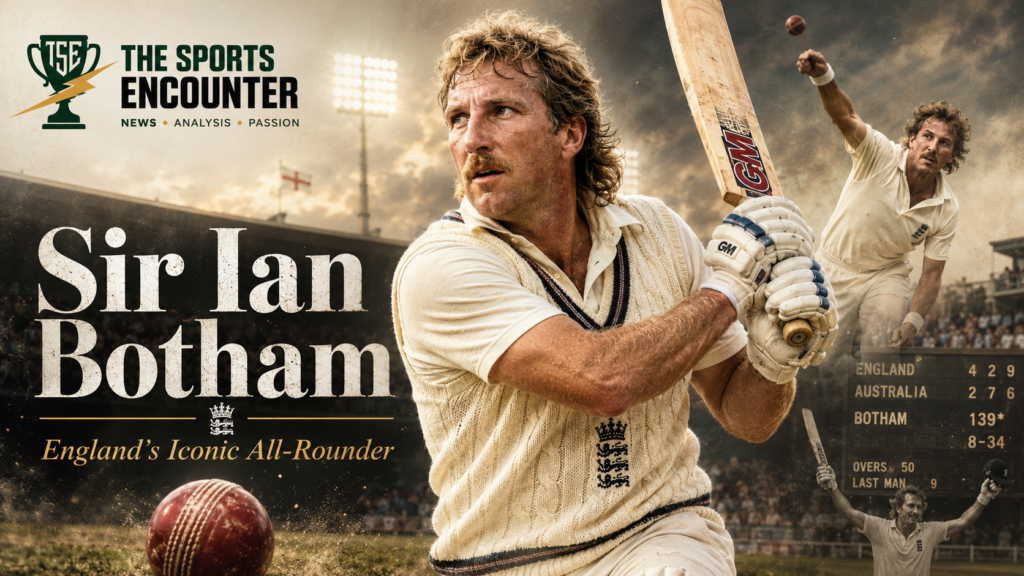
Some cricketers are remembered for numbers. Some are remembered for moments. Sir Ian Botham belongs to a rarer class.
He is remembered for the feeling he created.
When Botham walked onto a cricket field, England did not just get an all-rounder. England got force, noise, risk, swagger, defiance, and theater in one body. He could change a Test match with a spell, a counterattack, a slip catch, or simply by making everyone around him believe that something was about to happen.
That was Botham’s gift.
READ MORE: West Indies’ innings win over Sri Lanka at North Sound
He was never cricket’s quiet craftsman. He was its disruptor. At his peak, he made England believe again at a time when belief often looked fragile. He became the man who could drag a match out of certain defeat and turn it into folklore. For English cricket, that mattered as much as the wickets and runs.
For more cricket stories, records, player profiles, and long-form analysis, follow The Sports Encounter’s cricket coverage.
The Career That Built the Legend
Ian Botham played 102 Test matches for England between 1977 and 1992. He scored 5,200 Test runs, took 383 wickets, and held 120 catches. Those numbers still place him among the finest all-rounders the game has produced.
He was the fastest player of his time to complete the Test double of 1,000 runs and 100 wickets. He also became Test cricket’s leading wicket-taker before later generations pushed the record forward.
But numbers only explain part of Botham.
His cricket was built on momentum. He bowled fast-medium with aggression, movement, and a natural feel for the big occasion. As a batter, he did not always play with textbook restraint, but that was never the point. Botham attacked pressure before pressure could settle on him. When he got going, fields spread, bowlers lost rhythm, and crowds woke up.
He was also an exceptional slip fielder. His hands were sharp, his anticipation strong, and his competitiveness visible. He played cricket as if every ball had a consequence.
That intensity made him a hero. It also made him combustible.
Ian Botham’s ODI Career: Useful, Aggressive and Built for Big Stages
Botham’s Test career owns most of the legend, but his One Day International record deserves space too.
He played 116 ODIs for England between 1976 and 1992, scoring 2,113 runs and taking 145 wickets. His batting average was 23.22, with a highest score of 79. With the ball, he averaged 28.54 and produced a best of 4/31.
Those numbers may not look overwhelming through the lens of modern white-ball cricket, but context matters. Botham played in an era when ODI cricket was still finding its shape. Batters were not operating with today’s powerplay freedom, bowling variations were less specialized, and all-rounders often carried multiple roles without the kind of data-led support modern players receive.
Botham’s ODI value came from balance. He could open up a game with the bat, deliver overs with the new ball or through the middle, and change the atmosphere in the field. He was part of England squads that reached the 1979 and 1992 World Cup finals, which also shows how long his international relevance lasted.
In ODIs, Botham was rarely the pure statistical monster he became in Test cricket at his peak. Still, he remained the kind of player captains wanted because he gave them options. He gave England wickets, lower-order hitting, presence, and experience.
That mattered in an age when one-day cricket was becoming more serious with every World Cup cycle.
The 1981 Ashes and the Birth of “Botham’s Ashes”
Every great cricketer has a defining chapter. Botham’s came in the 1981 Ashes.
England were struggling. Botham had resigned as captain after a poor run, and Australia were in control of the series. Then Mike Brearley returned as captain, and Botham was released from the burden of leadership. What followed became one of cricket’s most famous turnarounds.
At Headingley, England looked finished. Following on, with defeat almost certain, Botham produced an unbeaten 149 that changed the match, the series, and his own place in cricket history. Bob Willis finished the job with the ball, but the match became tied forever to Botham’s name.
At Edgbaston, Botham took five wickets for one run in a spell that destroyed Australia’s chase. At Old Trafford, he hit another dazzling hundred. By the end of that summer, England had turned disaster into triumph, and Botham had moved from star cricketer to national icon.
That series gave English cricket one of its strongest modern myths: when everything is lost, Botham can still happen.
Aura: Why Botham Felt Bigger Than Cricket
Botham’s aura came from the way he carried himself. He had the confidence of a man who did not seem interested in playing safe. He looked like he enjoyed pressure. He made cricket feel alive.
Fans loved him because he gave them emotion. Opponents respected him because he could hurt them in more than one way. Teammates responded to his energy because he could shift the mood of a dressing room.
He was not polished in the modern media-trained sense. That was part of the appeal. Botham belonged to a more raw cricket age, when personalities spilled out in interviews, rivalries, pubs, dressing rooms, and hard-fought Test series. He was direct, stubborn, funny, loyal to his friends, fierce with opponents, and rarely short of an opinion.
In today’s cricket world, Botham would have been a global franchise superstar. In his own time, he became something different: a national sporting figure who crossed beyond cricket.
Botham, Imran, Hadlee and Kapil: The Great All-Rounder Era
Botham’s career cannot be fully understood without the other great all-rounders of his era: Imran Khan, Richard Hadlee, and Kapil Dev.
This was one of cricket’s richest all-rounder generations.
Imran Khan’s 1980s peak brought pace, charisma, tactical intelligence, and leadership. He became Pakistan’s greatest cricketing figure, later leading them to the 1992 World Cup title. As a Test cricketer, Imran’s bowling average was outstanding, and his batting improved so much that he became a genuine top-six force.
Richard Hadlee was the most precise bowler of the group. He was New Zealand’s strike weapon, a master of swing and control, and the first bowler to reach 400 Test wickets. Hadlee’s batting was useful, but his greatness rested mainly on world-class bowling. New Zealand cricket has produced very different types of icons across eras, from Hadlee’s surgical aggression to Kane Williamson’s quiet authority, explored in this tribute to Kane Williamson’s legacy.
Kapil Dev was India’s great fast-bowling all-rounder, a tireless performer who carried a huge workload and captained India to the 1983 World Cup. He finished with more Test wickets than Botham and more Test runs too, and his value to Indian cricket was historic.
Botham was different from all three.
Imran had elegance and command. Hadlee had discipline and mastery. Kapil had endurance and inspirational national significance. Botham had chaos, instinct, and theater. He could produce stretches of cricket that felt almost impossible to script.
That is why comparisons between them remain so fascinating. Statistically, Imran and Hadlee often look cleaner in bowling terms. Kapil’s longevity was immense. Botham’s peak, however, especially from the late 1970s to the early 1980s, was explosive. At his best, he was arguably the most devastating match-winner among them.
Rivalries, Respect and Dressing Room Relationships
Botham played in an era when rivalries were personal, not just professional.
He was close to some teammates and clashed with others. His best cricket often came under Mike Brearley, whose calm intelligence seemed to understand how to unlock Botham without smothering him. Brearley gave Botham structure without draining his instinct. That partnership shaped the 1981 Ashes.
Botham also shared strong bonds with several England players, including Allan Lamb, who later stood beside him in the legal battle against Imran Khan. He was known as a loyal friend, but not always an easy personality. He could be blunt, impatient, and fiercely opinionated.
His rivalry with Ian Chappell became one of cricket’s most famous personal feuds. Their dislike stretched across decades and reflected the old-school hardness of England-Australia cricket. Botham never seemed built for polite neutrality. He preferred clear loyalties and clear enemies.
With Imran Khan, the relationship was more complex. They were competitors, icons, and later courtroom opponents. The rivalry carried cricketing, cultural, and personal layers. Both men were proud, charismatic, and certain of themselves. Neither was the type to retreat quietly.
The Imran Khan Legal Battle and Ball-Tampering Storm
The most public controversy around Botham’s post-playing life came through the 1996 libel case involving Imran Khan.
Botham and Allan Lamb sued Imran over remarks they said accused them of being racist, uneducated, and lacking class. Botham also took issue with a report linked to allegations of ball tampering. Imran denied libel and argued that his comments had been taken out of context.
The case became one of cricket’s most dramatic courtroom battles. It was not just about personal reputation. It reopened raw questions around reverse swing, ball condition, cricket culture, and the mistrust that often surrounded Pakistan’s mastery of the old ball during that era.
In the end, Imran won the case. Botham and Lamb lost, and legal costs were reported at around £500,000.
For Botham, it was a bruising public defeat. For Imran, it was vindication. For cricket, it showed how fiercely the game’s off-field battles could mirror its on-field rivalries.
The ball-tampering debate itself remains part of cricket’s complicated history. Reverse swing, once viewed with suspicion by many in England, later became accepted as a high skill when understood and practiced within the laws. That shift changed how many people looked back at the accusations and tensions of the 1980s and 1990s.
Did Botham and Imran Become Friends Again?
The Botham-Imran relationship after the courtroom drama should be handled carefully.
It would be too neat to claim they became close friends in the simple sense. Their 1996 legal battle was too public, too personal, and too expensive to disappear overnight. The case left scars, especially because it touched reputation, race, class, cheating accusations, and the wider suspicion around Pakistani reverse swing.
Still, cricket relationships rarely stay frozen in one moment.
During the case, Imran’s side argued that he had offered a “hand of friendship” and had no desire for the dispute to keep escalating. That detail matters because it shows the legal battle was never only about two men refusing to speak. It was also about pride, interpretation, media framing, and reputational damage.
In later years, the public tone around Botham and Pakistan softened in places. Botham worked as a broadcaster during England tours, including Pakistan-related coverage, and his larger cricket persona became easier to separate from the High Court image. He remained a sharp, opinionated figure, but the old hostility did not define every later mention of Imran or Pakistan cricket.
The best way to describe the post-courtroom relationship is this: Botham and Imran never became a famous friendship story, but time appears to have cooled the bitterness around their rivalry. They remained tied by shared greatness, a shared era, and a courtroom chapter neither man could erase.
That may actually make their relationship more interesting.
Some cricket friendships are built through warmth. Others are built through the strange respect that survives competition, anger, and history. Botham and Imran belonged closer to the second kind.
They were rivals first. Then courtroom opponents. Later, they became two aging giants from the same golden all-rounder age, remembered together whenever cricket debates its greatest competitors.
Controversies That Followed the Man
Botham’s life was never controversy-free.
In 1986, he was suspended after admitting he had smoked cannabis. It was a major scandal at the time and fed into the image of Botham as a brilliant but unruly figure. He also attracted attention for his outspoken views, public feuds, and refusal to soften his personality for comfort.
His critics saw arrogance. His admirers saw honesty.
That split followed him throughout his life. Botham was rarely neutral territory. People reacted to him. They cheered him, argued with him, defended him, criticized him, and watched him. That, in its own way, explains his status.
Great athletes do not always fit neatly into respectable packaging. Botham certainly did not.
Life Beyond Cricket
After retirement, Botham remained visible as a broadcaster, public figure, charity campaigner, and later as Lord Botham after receiving a life peerage. He was knighted in 2007, recognition not only for cricket but also for his charity work.
His long-distance charity walks for leukemia research became a major part of his public identity. For many people in Britain, Botham was not only the man who beat Australia in 1981. He was also the cricketer who used his fame to raise money and attention for a serious cause.
That second legacy matters. It gave his post-playing life purpose beyond commentary boxes and old highlights.
Botham’s Lasting Impact on England Cricket
Botham changed what England believed an all-rounder could be.
Before him, England had great players. After him, every dynamic English all-rounder had to live with the comparison. Andrew Flintoff carried it. Ben Stokes still carries it. Whenever England find a player who can bat, bowl, catch, intimidate, and lift a crowd, the question returns: is this the next Botham?
That question itself is his legacy.
He gave England a template for the heroic all-rounder: flawed, brave, physical, emotional, and capable of turning a match through force of will. He showed that cricket could be both skill and spectacle. He made English fans believe that one player could bend the direction of a Test match.
That belief has never fully left. Modern England cricket still lives with that demand for big moments, visible in the pressure around recent Test performances and milestones such as Joe Root’s climb into the 14,000-run club and England’s shifting red-ball story after New Zealand forced a series decider against England.
Final Word
Sir Ian Botham was not a perfect cricketer, and he was never a perfect public figure. That is partly why his story still holds power.
He was brilliant, difficult, magnetic, generous, controversial, and unforgettable. He played against giants and stood among them. Imran Khan, Richard Hadlee, and Kapil Dev gave his era historic depth, but Botham gave it thunder.
His greatness was not only in what he achieved. It was in how loudly he made cricket feel alive.
For England, he remains more than a former all-rounder. He remains a symbol of defiance, risk, and possibility.
When Botham was in the contest, the game never felt settled.
The Sports Encounter’s cricket coverage focuses on records, rivalries, player legacies, match analysis, tactical shifts, and the stories that keep the game alive beyond the scoreboard.