


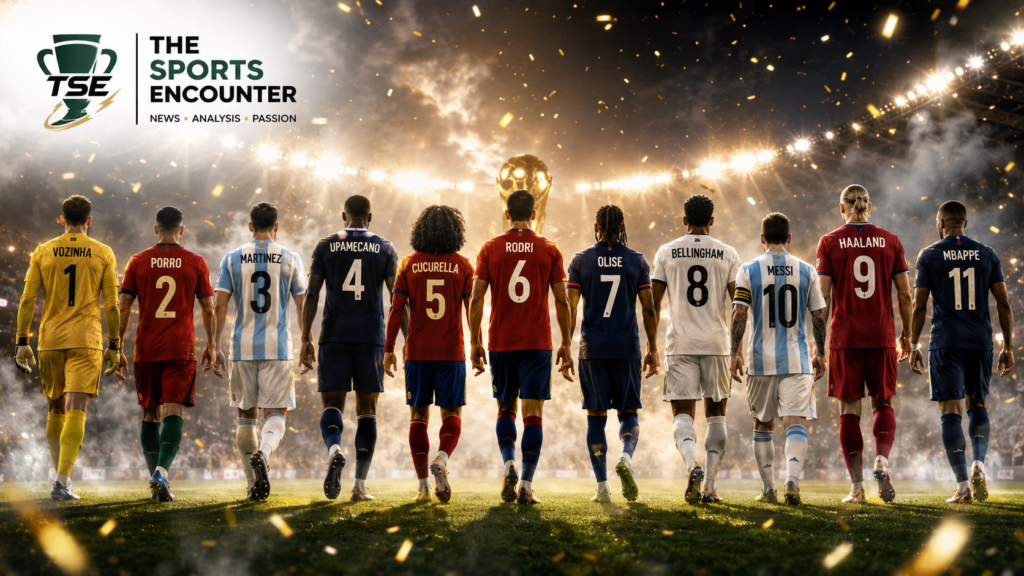
The fan-voted FIFA World Cup 2026 Dream Team brought together the tournament’s leading scorers, its most influential midfielders, three members of Spain’s championship-winning side, and one of the most unexpected heroes in World Cup history.
Cape Verde goalkeeper Vozinha earned more votes than Spain’s Golden Glove winner Unai Simón. Erling Haaland made the attack after carrying Norway into their first World Cup quarterfinal, while Lionel Messi, Kylian Mbappé and Jude Bellingham were rewarded for campaigns that placed them among the tournament’s most decisive players.
The final XI contained three players each from champions Spain and semifinalists France, two from runners-up Argentina, and one apiece from England, Norway and Cape Verde.
This was more than a statistical team.
The vote reflected the players who stayed in the memory. Some won official awards. Others became symbols of unexpected national journeys. Several selections also exposed the difference between a fan poll and a technical assessment of the tournament.
TL;DR
Vozinha, Pedro Porro, Lisandro Martínez, Dayot Upamecano, Marc Cucurella, Rodri, Michael Olise, Jude Bellingham, Lionel Messi, Erling Haaland and Kylian Mbappé made the fan-voted FIFA World Cup 2026 Dream Team.
Vozinha topped the goalkeeper poll with 39.6 percent of the vote, while Haaland received 27.5 percent among the forwards. Mbappé won the Golden Boot with 10 goals, Messi contributed eight goals and four assists, Bellingham scored seven times, and Olise produced a tournament-record seven assists. Rodri won the Golden Ball after controlling Spain’s title-winning campaign.
FIFA World Cup 2026 Fan-Voted Dream Team
| Position | Player | Country | Defining World Cup Contribution |
|---|---|---|---|
| Goalkeeper | Vozinha | Cape Verde | Inspired the debutants through the group stage and into extra time against Argentina |
| Right back | Pedro Porro | Spain | Added width, delivery and defensive stability for the champions |
| Center back | Lisandro Martínez | Argentina | Provided aggressive defending and buildup quality during Argentina’s run to the final |
| Center back | Dayot Upamecano | France | Used pace and recovery defending to protect France’s aggressive structure |
| Left back | Marc Cucurella | Spain | Brought relentless energy and tactical balance to Spain’s left side |
| Midfielder | Rodri | Spain | Won the Golden Ball and controlled the world champions’ tempo |
| Midfielder | Michael Olise | France | Produced a tournament-record seven assists |
| Midfielder | Jude Bellingham | England | Scored seven goals and repeatedly changed knockout matches |
| Forward | Lionel Messi | Argentina | Registered eight goals and four assists at age 39 |
| Forward | Erling Haaland | Norway | Scored seven goals and led Norway into their first quarterfinal |
| Forward | Kylian Mbappé | France | Won the Golden Boot with 10 goals and added four assists |
A Dream Team Shaped by Performance and Emotion
The most revealing name in the lineup is not Messi, Mbappé or Haaland.
It is Vozinha.
The Cape Verde goalkeeper entered the tournament at 40 years old and without a club after leaving Portuguese side Chaves. He departed as one of the faces of the World Cup.
His selection ahead of Unai Simón illustrated how supporters interpret tournaments differently from technical panels. Simón won FIFA’s Golden Glove after helping Spain complete one of the strongest defensive campaigns in World Cup history.
Vozinha received the public vote because his saves carried emotional weight beyond Cape Verde’s final position.
Fan voting often rewards performances that become stories.
Vozinha’s World Cup was exactly that.
Goalkeeper: Vozinha, Cape Verde
Cape Verde arrived at their first World Cup with one of the tournament’s smallest football populations and few expectations beyond their own support base.
Vozinha changed the way the team was viewed.
His defining performance came during Cape Verde’s goalless group-stage draw with eventual champions Spain. The veteran made seven saves as Spain controlled possession but could not find a way past him.
The result became one of the tournament’s most memorable group-stage surprises.
Vozinha remained influential when Cape Verde faced Argentina in the Round of 32. Argentina eventually advanced, but the underdogs forced the defending champions into extra time.
His 39.6 percent share of the goalkeeper vote was therefore about more than shot-stopping. Supporters recognized the player who gave Cape Verde belief against both World Cup finalists.
Simón had the stronger championship résumé.
Vozinha owned the more improbable story.
The fan vote chose the story.
Right Back: Pedro Porro, Spain
Pedro Porro was one of three Spanish players selected after Spain won their second World Cup.
Spain’s defense conceded only one goal during the tournament. Porro contributed to a structure that combined territorial control with exceptional resistance whenever opponents broke through midfield.
His value extended beyond defending.
Porro gave Spain an aggressive right-sided outlet, supported attacks without abandoning his recovery responsibilities and stretched opponents who tried to protect the center of the pitch.
That width became particularly important when teams narrowed their defensive shape to limit Rodri and Spain’s central creators.
Porro survived the physical and tactical demands of the knockout rounds, including Spain’s difficult path through Portugal, Belgium, France and Argentina.
The Sports Encounter followed that journey through its report on Spain ending Cristiano Ronaldo’s World Cup dream, the dramatic quarterfinal victory over Belgium, and the controlled semifinal defeat of France.
Center Back: Lisandro Martínez, Argentina
Lisandro Martínez gave Argentina the aggression and buildup confidence required to reach another World Cup final.
His selection reflected the way he influenced matches without relying on obvious attacking numbers.
Martínez defended forward. He stepped into midfield, challenged early, compressed space and tried to stop forwards before they could turn toward goal.
That approach carried risk, but it also allowed Argentina to sustain pressure higher up the pitch.
When opponents cleared the ball, Martínez often recycled possession before they could reorganize.
Argentina’s route to the final was driven by Messi’s eight goals and four assists, but Martínez helped provide the platform behind him.
Against Spain in the final, Argentina spent long periods defending without the ball. Martínez and the rest of the back line kept the game scoreless until extra time before Ferran Torres scored the decisive goal.
His fan selection recognized Argentina’s ability to remain competitive under sustained pressure throughout the knockout phase.
Center Back: Dayot Upamecano, France
France scored freely during the tournament, but their run also depended on Upamecano’s pace behind an adventurous team.
Michael Olise, Mbappé and France’s other attacking players frequently occupied advanced positions. That left the defenders responsible for protecting large spaces during transitions.
Upamecano’s recovery speed allowed France to defend higher than many teams would risk.
He could challenge physically, cover wide areas and protect against direct passes behind the defensive line.
France reached the semifinals before Spain defeated them 2-0. They later faced England in the bronze-medal match.
Upamecano’s selection may still draw debate because Spain’s Pau Cubarsí and Aymeric Laporte formed part of a title-winning defense that conceded only once.
Cubarsí also won FIFA’s Best Young Player award.
The vote favored Upamecano’s athletic visibility and France’s high-profile run over the quieter control of Spain’s central defenders.
That is one of the clearest examples of how the fan XI differs from a purely technical team.
Left Back: Marc Cucurella, Spain
Marc Cucurella’s tournament represented the value of tactical discipline.
He gave Spain energy on the left without constantly demanding possession. His runs created space for attackers, while his recovery work helped preserve the team’s defensive structure.
Cucurella also offered flexibility.
He could overlap, support central possession or remain deeper when Porro advanced from the opposite side.
Spain’s ability to concede only one goal across eight matches depended on collective balance. Simón, Cubarsí, Laporte and Rodri received much of the attention, but the fullbacks prevented opponents from finding easy routes around Spain’s midfield.
Cucurella’s inclusion alongside Porro showed that supporters recognized the importance of Spain’s width.
The champions did not win solely through central passing. Their fullbacks stretched defensive blocks and created more room for the midfield to operate.
Midfielder: Rodri, Spain
Rodri is the least debatable selection in the team.
FIFA named him the Golden Ball winner as the tournament’s best player. He also led the competition in passing volume while maintaining approximately 93 percent accuracy.
Numbers only capture part of his influence.
Rodri controlled where Spain played, how quickly they moved the ball and when they reduced the tempo. He protected the central defenders, positioned himself behind attacks and stopped matches from becoming chaotic.
Spain won because opponents rarely dictated the type of contest.
That control began with Rodri.
He was especially important during the knockout rounds, when Spain faced different tactical threats.
Portugal tried to survive and counter. Belgium caused problems through direct attacks and second balls. France carried elite pace. Argentina brought Messi, tournament experience and defensive resilience.
Rodri gave Spain the same reference point in every game.
The Sports Encounter’s detailed analysis of why Rodri won the World Cup Golden Ball explains why his tournament cannot be reduced to goals or assists.
Midfielder: Michael Olise, France
Michael Olise produced one of the greatest creative tournaments in World Cup history.
He finished with seven assists, the highest recorded total by a player at a single World Cup since detailed records began.
Five of those assists created goals for Mbappé.
Olise’s importance came from the variety of his creation.
He could deliver from wide areas, move inside as a playmaker, combine with Mbappé and produce the final pass against deep defensive blocks.
France did not leave the tournament with the trophy, but their attacking numbers ensured Olise could not be ignored.
His seven assists also changed his status within the national team.
Before the tournament, France still carried several established attacking names. By the end, Olise had become the clearest creative partner for Mbappé.
Midfielder: Jude Bellingham, England
Bellingham’s selection reflected goals, timing and emotional impact.
He scored seven times during the tournament, an extraordinary total for a midfielder.
Several of those goals arrived when England needed intervention rather than decoration.
Bellingham carried the ball through pressure, attacked the penalty area and gave England a central scorer beyond Harry Kane.
His physical power allowed him to affect matches in ways traditional playmakers could not.
England reached the semifinals and later contested the bronze-medal match against France. Their campaign remained uneven in places, but Bellingham repeatedly changed the direction of games.
His tournament strengthened the argument that he should no longer be described only by position.
He operated as a midfielder, runner, scorer and pressure player.
The Sports Encounter included him among the top players at the FIFA World Cup 2026 because his production had already become central to England’s run.
Forward: Lionel Messi, Argentina
Messi reached another World Cup final at 39 and still finished with eight goals and four assists.
Those totals gave him 12 direct goal contributions across the tournament.
His campaign differed from the version that led Argentina to the 2022 title.
Messi could no longer press, accelerate or repeat high-intensity actions at the same frequency. Argentina adapted by preserving his energy and giving him freedom to find the areas where he could still decide matches.
He responded with goals, assists and another collection of World Cup records.
His presence also shaped how opponents defended, often pulling midfielders toward him and creating space elsewhere.
The final ended in disappointment as Spain won 1-0 after extra time. That defeat did not weaken the scale of Messi’s tournament.
The Sports Encounter explored his wider place in sport through its analysis of whether Lionel Messi is the greatest athlete ever.
World Cup 2026 added another chapter to that debate.
Forward: Erling Haaland, Norway
Haaland turned Norway’s first major World Cup run into one of the stories of the tournament.
He scored seven goals in five appearances and led the country into its first World Cup quarterfinal.
His 27.5 percent share of the forward vote reflected both production and the scale of Norway’s achievement.
The defining result came against Brazil in the Round of 16.
Haaland scored twice as Norway eliminated the five-time champions 2-1.
The performance removed any suggestion that his goal total had been built only against weaker opponents.
Norway’s run ended against England in the quarterfinals, but Haaland had already changed the country’s World Cup history.
His movement was as important as his finishing.
Defenders remained occupied by his runs behind the line, his physical presence in the penalty area and his ability to turn imperfect service into shots.
The Sports Encounter’s guide to Haaland’s career, records and World Cup impact provides broader context for a campaign that moved him from prolific club scorer to proven international tournament force.
Forward: Kylian Mbappé, France
Mbappé finished the tournament with 10 goals and four assists.
He won the Golden Boot and produced 14 direct goal contributions, more than any other player.
His tournament reinforced an extraordinary World Cup record and strengthened his case as the greatest World Cup scorer of his generation.
Even when France failed to win the title, Mbappé remained the competition’s most productive attacker.
Olise created five of his goals, but Mbappé still had to provide movement, timing and finishing.
His ability to attack the left channel, run behind defenders and finish from tight angles gave France a threat that opponents rarely eliminated.
Spain managed it in the semifinal, defeating France 2-0 and denying Mbappé a place in the final.
That result highlighted the weakness in his Golden Ball case. His most important team match ended without a goal.
Rodri won the tournament and controlled its final stages.
Mbappé won the scoring race.
Both deserved recognition, but for different reasons.
Which Countries Dominated the Dream Team?
Spain and France placed three players each in the XI.
Spain contributed Porro, Cucurella and Rodri. France supplied Upamecano, Olise and Mbappé.
Argentina had Martínez and Messi, while England, Norway and Cape Verde provided one player each.
The distribution created an interesting contrast.
Spain won the World Cup and conceded only one goal, yet only one member of their central defensive core made the team.
Simón, Laporte and Cubarsí were absent despite winning the Golden Glove, producing a historically strong defensive campaign and collecting the Best Young Player award.
France placed the same number of players despite losing in the semifinals.
That outcome suggested the fan poll favored individually visible performance over collective achievement.
Spain’s system was the tournament’s best team.
France had more players whose contributions were easy to isolate through goals, assists, speed and defensive highlights.
The Biggest Omissions
Unai Simón
Seven clean sheets in eight matches and only one goal conceded would normally guarantee selection.
Vozinha’s story proved more powerful in the public vote.
Pau Cubarsí
The Best Young Player helped anchor the most successful defense in the competition.
His exclusion may be the hardest to justify on technical grounds.
Aymeric Laporte
Laporte gave Spain experience, positioning and calm distribution throughout their title run.
Lamine Yamal
Yamal influenced how opponents defended Spain and became one of the tournament’s most important attacking figures.
The three forward places went to players with extraordinary scoring totals.
The Sports Encounter’s feature on how Lamine Yamal came of age at World Cup 2026 explains why his influence reached beyond raw statistics.
Harry Kane
Kane scored heavily for semifinalists England, but Mbappé, Messi and Haaland produced stronger statistical or historical cases.
Fan Vote vs Official FIFA Awards
The Dream Team should not be confused with FIFA’s official individual awards.
FIFA’s technical group selected Rodri as Golden Ball winner, Mbappé as Golden Boot winner, Simón as Golden Glove winner and Cubarsí as Best Young Player.
Supporters chose the Dream Team.
That difference matters.
Technical awards usually emphasize consistency, tactical performance and tournament-wide evaluation.
Fan voting is more vulnerable to popularity, national voting blocs, social-media momentum and the emotional force of individual matches.
Neither process is meaningless.
They answer different questions.
The official awards ask who performed best according to FIFA’s technical assessment.
The Dream Team asks who the tournament’s global audience most wanted to remember.
Vozinha’s victory over Simón captured that distinction perfectly.
FIFA World Cup 2026 Dream Team Scorecard
| Category | Strongest Selection | Reason |
|---|---|---|
| Best statistical case | Kylian Mbappé | 10 goals and four assists |
| Best overall tournament | Rodri | Golden Ball and championship control |
| Best creative campaign | Michael Olise | Tournament-record seven assists |
| Best underdog story | Vozinha | Cape Verde hero at age 40 |
| Biggest national breakthrough | Erling Haaland | Led Norway to their first quarterfinal |
| Best midfield scoring campaign | Jude Bellingham | Seven goals |
| Best longevity achievement | Lionel Messi | Eight goals and four assists at 39 |
| Most debatable selection | Dayot Upamecano | Chosen ahead of Spain’s title-winning center backs |
| Harshest omission | Pau Cubarsí | Best Young Player and defensive champion |
Final Verdict
The FIFA World Cup 2026 Dream Team succeeded because it did not feel like a cold statistical exercise.
It contained the Golden Boot winner, the Golden Ball winner, the tournament’s record assist provider and three members of the world champions.
It also contained a 40-year-old goalkeeper who entered the competition without a club and left with more fan votes than the official Golden Glove winner.
That is how supporters remember World Cups.
They remember numbers, but they also remember resistance, surprise and the players who made unlikely teams feel dangerous.
Rodri represented control. Mbappé represented production. Messi represented history. Haaland represented a national breakthrough. Olise represented creativity. Bellingham represented decisive intervention.
Vozinha represented the tournament’s imagination.
The lineup was not flawless.
Simón and Cubarsí had strong reasons to feel overlooked, while Spain’s defensive dominance deserved more recognition.
Still, the team captured the personalities and performances that shaped the largest World Cup ever staged.
The final XI was Vozinha; Pedro Porro, Lisandro Martínez, Dayot Upamecano, Marc Cucurella; Rodri, Michael Olise, Jude Bellingham; Lionel Messi, Erling Haaland and Kylian Mbappé.
Supporters can review the tournament’s verified numbers through FIFA’s official World Cup 2026 player statistics and the governing body’s official World Cup awards report.
Readers can also explore The Sports Encounter’s complete FIFA World Cup 2026 coverage for match analysis, player rankings, records, fan stories and tournament debates.
The Sports Encounter’s World Cup 2026 coverage focuses on fixtures, team news, match analysis, fan stories, tournament trends, and the biggest talking points from football’s global stage.