



New Zealand did not just level the series at The Oval. They tore it open. After losing the first Test at Lord’s, the Blackcaps responded with a crushing 253-run win over England in the second Test in London, dragging the three-match series back to 1-1 and setting up a high-voltage decider at Trent Bridge.
Matt Henry was the headline act with the ball. Glenn Phillips and Henry Nicholls gave New Zealand the batting weight. Tom Blundell’s work behind the stumps quietly supported the entire plan. England, led by Joe Root in Ben Stokes’ absence, had moments of resistance but never enough control.
Now the final Test has a new edge.
England coach Brendon McCullum has confirmed Stokes will return as captain for the third Test, saying, “Ben will be back and be captain.” He also said England were excited to have him back after speaking to him daily since the incident that led to his omission from The Oval Test.
That means the series now moves to Nottingham with New Zealand carrying momentum and England preparing to welcome back their most influential figure.
For more cricket coverage, match reports, and long-form analysis, follow The Sports Encounter’s Cricket Hub.
New Zealand Turn The Oval Into a Series-Shaping Statement
New Zealand came to The Oval knowing the series could slip away if England backed up their Lord’s win. Instead, the Blackcaps produced one of their finest Test victories on English soil.
England were bowled out for 209 on the final morning while chasing 463. New Zealand needed only 48 minutes on Day 5 to take the last five wickets, turning what had begun as a faint English hope into a fast and brutal finish.
The 253-run margin was New Zealand’s largest Test victory over England by runs in England. It was also only their seventh Test win in England across 95 years, making the scale of the result even more meaningful.
Tom Latham called it “a fantastic week” for his side and framed the victory as a match won through repeated small moments. He pointed to New Zealand’s ability to do things “for a bit longer,” whether that meant batting through difficult passages or bowling relentlessly at the top of off stump.
That was the essence of New Zealand’s win. They did not chase miracle moments. They kept asking England hard questions until England ran out of answers.
Matt Henry Delivers a Historic 11-Wicket Masterclass
Matt Henry’s match figures of 11/109 were the best by a New Zealand bowler against England in Test cricket. They also gave him his first 10-wicket match haul in 35 Tests.
His final-day spell was ruthless.
England resumed at 182/5, with Root still there on 75 and the game not alive exactly, but not fully dead either. Henry removed that last trace of English possibility almost immediately. Root added only two runs before falling lbw for 77, beaten between bat and pad.
Once Root went, the innings folded quickly.
Henry finished with 6/29 in the second innings after taking 5/80 in the first. His final wicket, Jordan Cox, sealed the result and sent New Zealand’s players into celebration. Henry walked off with the ball in his hand, just as he had done after the first innings.
After the match, Henry said he did not expect the final morning to unfold so quickly, joking that the short finish “saved a hot day in the field.” But beneath the modesty was a clear explanation of New Zealand’s method.
Henry spoke about being effective rather than looking like a hero. His plan was simple: create pressure when the surface was not offering much, hit the right areas, and trust the bowling group. He also credited Tom Blundell’s wicketkeeping up to the stumps, saying New Zealand could only use that tactic because they had someone so good behind the stumps.
Latham echoed the same point. He said Henry’s method was to hit the top of off stump repeatedly, build pressure through dot balls, and use the surface’s variable bounce. In Latham’s words, it was “old-school cricket.”
Phillips Takes the Body Blows, Then Takes Control
New Zealand’s win was not built by Henry alone.
Glenn Phillips changed the tone of the match with a first-innings century that required courage before elegance. On the opening evening, Jofra Archer produced a hostile spell and struck Phillips with real venom. England sensed an opening. Root later admitted that if England had taken Phillips’ wicket during that passage, the game might have looked very different.
Phillips survived.
The next morning, he turned survival into command and reached his maiden Test hundred. His 100 was also the first century of the series. It gave New Zealand a base from which their bowlers could attack.
Root gave Phillips credit after the match, saying his innings during Archer’s fiery spell was a lesson for England’s younger batters. The message was clear: recognize the danger, get through it, and then cash in when conditions ease.
That is exactly what Phillips did.
For New Zealand, it was the kind of innings that changes more than a scorecard. It gave the team belief after the Lord’s defeat and showed England that the Blackcaps would not be bullied out of the series.
Henry Nicholls and Rachin Ravindra Bat England Out of the Game
If Phillips gave New Zealand the first major push, Henry Nicholls made sure England could not climb back.
Nicholls scored 121 in the second innings, producing a calm and important hundred while filling a role made heavier by Kane Williamson’s retirement. His innings carried more than runs. It showed New Zealand still had middle-order resilience in a new era.
His 161-run partnership with Rachin Ravindra was one of the decisive passages of the match. England needed early wickets in New Zealand’s second innings to keep the chase within imagination. Nicholls and Ravindra removed that possibility.
By the time New Zealand set England 463, the target was almost beyond the limits of Test history. It was 45 runs more than the highest successful fourth-innings chase ever achieved in Test cricket.
England were not just chasing a match. They were chasing the impossible.
England’s Makeshift XI Was Exposed at the Worst Time
England’s team selection told part of the story before the match even began.
The hosts made five changes from the side that won at Lord’s. Four were enforced by a mix of curfew punishment, injury, and paternity leave. Three players debuted. Two others had only one Test cap each. Root returned as captain for the first time since 2022 and suddenly became the stabilizing figure in a side missing its usual spine.
Stokes and Gus Atkinson were left out after breaking the team’s midnight curfew while celebrating England’s Lord’s win. Jamie Smith was unavailable because of the birth of his second child. Ollie Robinson missed the match with knee soreness. The result was an England XI that looked callow when the pressure peaked.
Root admitted the buildup had been “unsettling,” although he said he enjoyed stepping back into the captaincy space and working with McCullum. He also praised the younger players for giving everything in difficult circumstances.
But he did not hide England’s failings.
Root said England needed to be “more switched on in the field,” adding that missing eight chances was always going to hurt. That line should sting. Against disciplined opponents, dropped chances are not small details. They are match-shaping errors.
Joe Root Resists, Reaches 14,000 Test Runs, But England Fall Short
Root was England’s strongest batting figure across the match, making 46 in the first innings and 77 in the second.
His second-innings resistance carried personal history as well. During the match, Root became only the second man to reach 14,000 Test runs. It was another marker in a remarkable career, but it came in a losing cause.
England needed Root to turn 77 into something monumental. Henry made sure that did not happen.
Root’s dismissal early on the final morning ended England’s final thread of hope. Once he was gone, the rest of the innings moved quickly. The lower order did not have the technique, time, or conditions to survive Henry’s accuracy.
Root’s captaincy record also moved to 27 wins and 27 losses in Tests. That symmetry will matter less than the bigger question England now face: how quickly can they reset before Trent Bridge?
Brendon McCullum Confirms Ben Stokes Will Return as Captain
The story now turns sharply toward Ben Stokes.
After The Oval defeat, Brendon McCullum confirmed Stokes will return for the third Test at Trent Bridge. His message was direct: “Ben will be back and be captain.”
McCullum said his view had not changed and revealed he had spoken to Stokes every day since the curfew incident. He said his initial concern was for Stokes personally and that seeing him return to cricket and enjoy himself again was “really positive.”
That matters because Stokes is more than England’s captain. He is the emotional center of this Test side. His presence changes the dressing room, the selection balance, and the energy of the contest.
Stokes has already warmed up with 95 for his county side, while Atkinson took four wickets and is also expected to return to the selection picture. Jamie Smith’s availability may also become important after debutant wicketkeeper James Rew conceded the most byes by an England keeper in 12 years.
The third Test will not simply be England versus New Zealand. It will also be a test of England’s ability to restore order after a chaotic week.
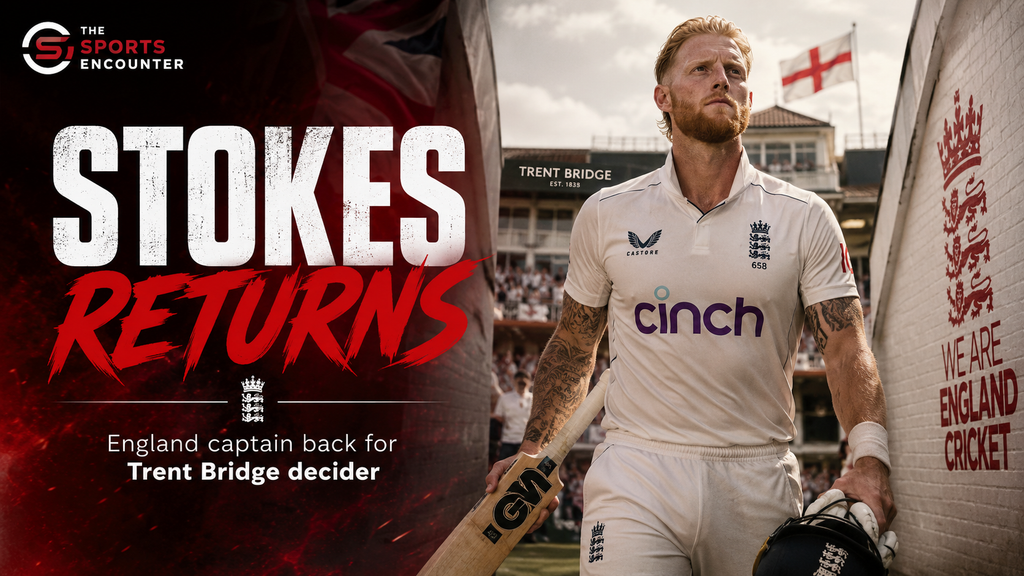
Why Stokes’ Return Changes the Decider
Stokes brings cricketing value, but his real influence is structural.
With Stokes back, England get their captain, an all-round option, a senior tactical voice, and a player who thrives in the exact kind of pressure Nottingham will bring. Even if his body is not always easy to manage, his presence gives England a harder edge.
New Zealand will know that too.
The Blackcaps dominated a weakened England side at The Oval, but Trent Bridge will likely bring a stronger, sharper opponent. Atkinson’s likely return strengthens the bowling group. Stokes’ return restores leadership. Jamie Smith, if available, improves the wicketkeeping and batting balance.
Still, New Zealand have earned the right to arrive in Nottingham with belief. Their bowlers have found rhythm. Phillips and Nicholls have hundreds behind them. Henry looks fit, hungry, and decisive.
The decider now has everything: a revived New Zealand, a wounded England, and the return of the juggernaut captain.
England vs New Zealad: 2nd Test Key Match Performers
Matt Henry: 11/109 in the match, including 6/29 in the second innings
Glenn Phillips: 100 in the first innings, his maiden Test century
Henry Nicholls: 121 in the second innings
Rachin Ravindra: Key 161-run partnership with Nicholls
Joe Root: 46 and 77, reached 14,000 Test runs
Jofra Archer: Five wickets in the match and a hostile first-innings spell
Matthew Fisher: Five wickets across both innings for England
Match Snapshot
Match: England vs New Zealand, 2nd Test
Venue: The Oval, London
Result: New Zealand won by 253 runs
Series: England and New Zealand level at 1-1
Player of the Match: Matt Henry
Decider: Third Test at Trent Bridge, Nottingham, starting Thursday, June 25
England vs New Zealand: What Comes Next at Trent Bridge?
The series now moves to Nottingham with both teams carrying very different emotions.
New Zealand will arrive with momentum and confidence. They have rediscovered their method after Lord’s and found a bowling performance that can travel. Their challenge will be backing it up on a short turnaround, especially with fast bowlers coming off a heavy workload.
England will arrive with reinforcements and pressure.
Trent Bridge has often been a happier hunting ground for England. But reputation will not fix missed chances, inconsistent fielding, and the instability caused by selection disruption. Stokes’ return gives England a lift, but it also raises expectations instantly.
The final Test now feels less like a routine decider and more like a stress test for two cricketing identities.
New Zealand have reminded everyone that they can still play tough, patient, old-school Test cricket. England now get their captain back and must prove that chaos has not cracked their method.
For another recent story about a team responding under pressure, read how Australia whitewashed Bangladesh in the T20I series as Mitchell Marsh joined the party.
Final Word: Time for New Zealand to Rejoice Victory
New Zealand’s win at The Oval was complete because it had layers.
Phillips absorbed hostility. Nicholls built authority. Ravindra supported the second-innings push. Blundell gave the bowlers options. Jamieson, O’Rourke and Smith kept pressure in rotation. Henry finished the job with a spell that entered New Zealand cricket history.
England had Root’s resistance, Archer’s bursts, and glimpses from a reshuffled side. But the missed chances, unstable buildup, and final-day collapse were too costly.
The series is level. The decider is set. Stokes is coming back.
That last line changes the temperature of everything.