



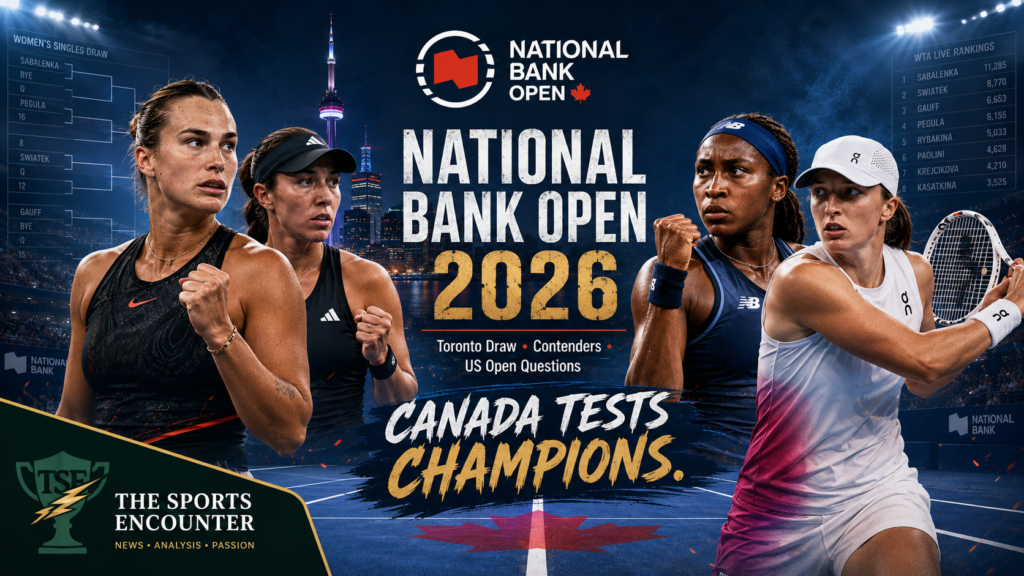
The National Bank Open 2026 brings the ATP Tour to Montreal and the WTA Tour to Toronto from August 2 to 13, with expanded 96-player draws, major ranking points and several US Open questions waiting to be answered.
The North American hard-court season has reached its first major examination.
The 2026 National Bank Open presented by Rogers is being staged across two Canadian cities, with the men competing at IGA Stadium in Montreal and the women playing at Sobeys Stadium in Toronto. Both tournaments carry 1000-level status, placing them among the most important events outside the four Grand Slams.
The event offers valuable ranking points, significant prize money and an early indication of which players have successfully moved on from Wimbledon. It also gives contenders a chance to test their fitness, timing and recovery before Cincinnati and the US Open.
Fans can follow official draws, schedules, scores and tournament updates through the official National Bank Open website.
For broader tournament news, player analysis and Grand Slam coverage, visit The Sports Encounter’s tennis section and our dedicated tennis hub.
National Bank Open 2026 at a Glance
| Category | ATP Tournament | WTA Tournament |
|---|---|---|
| City | Montreal | Toronto |
| Venue | IGA Stadium | Sobeys Stadium |
| Tour level | ATP Masters 1000 | WTA 1000 |
| Surface | Outdoor hard court | Outdoor hard court |
| Main-draw dates | August 2-13, 2026 | August 2-13, 2026 |
| Singles draw | 96 players | 96 players |
| Seeded-player byes | Top 32 seeds enter in Round 2 | Top 32 seeds enter in Round 2 |
| Champion’s ranking points | 1,000 | 1,000 |
| Singles final | August 13 | August 13 |
When Is the National Bank Open 2026?
Qualifying took place on August 1, with the main draws beginning on Sunday, August 2. Both singles finals are scheduled for Thursday, August 13.
The extended format gives most players a rest day between rounds. The top and bottom halves of the draws alternate until the semifinals, reducing the likelihood of players competing on several consecutive days during the early stages.
National Bank Open 2026 Round-by-Round Schedule
| Round | Dates |
|---|---|
| Qualifying | August 1 |
| First round | August 2-3 |
| Second round | August 4-5 |
| Third round | August 6-7 |
| Round of 16 | August 8-9 |
| Quarterfinals | August 10-11 |
| Semifinals | August 12 |
| Singles finals | August 13 |
How Does the 96-Player National Bank Open Draw Work?
The men’s and women’s singles competitions each contain 96 players. The top 32 seeds receive first-round byes and begin their campaigns in the second round.
The remaining positions are filled by direct entrants, qualifiers and wild-card recipients. This structure creates an added opening round while protecting the highest seeds from immediately having to compete after arriving from another event.
The expanded draw gives more players access to a 1000-level tournament, but it also creates a longer path to the title for unseeded competitors. A non-seeded player may need to win seven matches, while a seeded champion generally needs six.
The draw remains subject to change if a player withdraws before competing. Lucky losers may enter from qualifying when a main-draw place becomes available.
Men’s National Bank Open 2026 Seeds and Leading Contenders
Alexander Zverev leads the men’s field as the top seed. Montreal native Felix Auger-Aliassime is seeded second, while Alex de Minaur, Daniil Medvedev and defending champion Ben Shelton complete the top five.
| Seed | Player | Key Storyline |
|---|---|---|
| 1 | Alexander Zverev | Returns as a former Montreal champion and newly established Grand Slam winner. |
| 2 | Felix Auger-Aliassime | Chasing his first Masters 1000 title in his hometown. |
| 3 | Alex de Minaur | Seeking to turn consistency and movement into a major North American title. |
| 4 | Daniil Medvedev | A proven Canadian and US Open champion trying to recover his best hard-court rhythm. |
| 5 | Ben Shelton | Defending the first Masters 1000 title of his career. |
Alexander Zverev: The Favorite With More Pressure
Zverev arrives in Montreal with a stronger championship profile than at any previous stage of his career. His French Open breakthrough removed the long-running question about whether he could win a Grand Slam, while his run to the Wimbledon final confirmed that the result in Paris was not an isolated peak.
His serve and backhand should translate naturally to Montreal’s outdoor hard courts. The main tactical concern remains his second serve, especially against opponents willing to stand close to the baseline and attack early.
Zverev’s recent form can be viewed in the wider context of Jannik Sinner’s Wimbledon title defense against Zverev and Novak Djokovic.
Felix Auger-Aliassime: A Home Masters Title Still Missing
Auger-Aliassime has reached Masters 1000 finals before, but he has not yet won a title at this level. Montreal gives him a rare combination of opportunity and emotional pressure.
The Canadian crowd should support him strongly, yet that expectation can also make the opening rounds uncomfortable. His first serve and forehand offer enough power to dominate short exchanges, but he must avoid the loose service games that have interrupted several promising runs.
A deep performance would strengthen his US Open case and show that his North American hard-court game remains capable of troubling the leading contenders.
Ben Shelton: Can the Defending Champion Handle the Target?
Shelton won the 2025 National Bank Open in Toronto by defeating Karen Khachanov, securing his first Masters 1000 title.
He now enters as the defending champion rather than the explosive outsider. His left-handed serve, athleticism and crowd energy make him dangerous, but opponents will arrive with clearer plans for his preferred patterns.
The next step in Shelton’s development involves return consistency and better patience in neutral rallies. Montreal will show whether he can defend a major title while carrying expectation throughout the week.
Daniil Medvedev: Still Built for North American Hard Courts
Medvedev won this tournament in 2021 and later captured the US Open. His flat groundstrokes, deep return position and ability to disrupt attacking players remain well suited to outdoor hard courts.
His results have become less predictable, but dismissing him before the North American swing would be careless. Few active players understand these conditions better.
Alex de Minaur: The Draw’s Efficiency Test
De Minaur rarely gives away easy points. His speed, return quality and willingness to make opponents play one more ball can become increasingly valuable as the tournament progresses.
The concern is whether he can generate enough damage against the biggest servers and strongest first-strike players. A Masters 1000 title may require him to defeat several opponents who can shorten rallies before his movement becomes decisive.
Taylor Fritz and Jack Draper: Two Different Fitness Questions
Fritz remains one of the leading American hard-court players, but his workload will matter after the rain-delayed DC Open final. Montreal begins quickly, leaving little recovery time for anyone who played deep in Washington.
Draper received a Montreal wild card after withdrawing from the DC Open because of a left arm injury. His status should be monitored carefully because he has already endured an interrupted season.
The Sports Encounter examined how that latest setback turned Draper’s US Open preparation into a fitness race.
Why Are Jannik Sinner and Novak Djokovic Missing Montreal?
World No. 1 Jannik Sinner and 24-time Grand Slam champion Novak Djokovic withdrew before the tournament.
Sinner chose to protect his health after completing a physically demanding Wimbledon title defense. Djokovic’s absence fits the selective scheduling strategy he has increasingly used to preserve his body for the Grand Slams.
Their withdrawals reshape the men’s draw. Zverev becomes the leading seed, several contenders move into more favorable positions, and players outside the usual title conversation receive a clearer path into the final rounds.
The wider reasons behind both decisions are covered in our analysis of why Sinner and Djokovic skipped the National Bank Open.
Djokovic is expected to return later in the hard-court swing. His preparation is examined in our report on why his Cincinnati return could shape his US Open record chase.
Women’s National Bank Open 2026 Seeds and Leading Contenders
Aryna Sabalenka is the top seed in Toronto for the first time. Elena Rybakina is seeded second, with Jessica Pegula, Coco Gauff and Mirra Andreeva completing the top five.
| Seed | Player | Main Question in Toronto |
|---|---|---|
| 1 | Aryna Sabalenka | Can she reset after Wimbledon and begin another successful US Open defense campaign? |
| 2 | Elena Rybakina | Will her serve and first-strike tennis hold up across a long 1000-level draw? |
| 3 | Jessica Pegula | How quickly can she recover after the rain-delayed Washington final? |
| 4 | Coco Gauff | Can her serve and forehand remain stable under hard-court pressure? |
| 5 | Mirra Andreeva | Can the French Open champion transfer her major form to North America? |
| 6 | Linda Noskova | How will the Wimbledon champion handle greater expectation? |
| 7 | Iga Swiatek | Can she recover confidence after a turbulent grass season? |
| 8 | Amanda Anisimova | Can she turn powerful hard-court tennis into a sustained title challenge? |
Aryna Sabalenka: The US Open Preparation Starts Here
Sabalenka enters the North American swing as the defending US Open champion and one of the strongest hard-court players in the world.
Toronto should provide an immediate test of her serve, return timing and emotional reset following Wimbledon. Her loss to Naomi Osaka at the All England Club exposed how quickly an opponent can take control when Sabalenka’s first serve percentage drops and her forehand becomes rushed.
That upset formed part of a major Wimbledon shift covered in our report on Osaka’s victory over Sabalenka and Djokovic’s record-breaking day.
Elena Rybakina: A Natural Hard-Court Threat
Rybakina’s first serve gives her a straightforward path to control. When she lands enough first serves and takes the next ball early, she can remove time from almost any opponent.
Her challenge is maintaining that level across six matches in a long-format WTA 1000 event. Toronto will show whether she can combine short-point efficiency with the physical durability required for a deep US Open run.
Jessica Pegula: Recovery May Matter More Than the Draw
Pegula enters Toronto as a two-time National Bank Open champion and one of the most accomplished North American hard-court players of her generation.
However, her immediate concern is recovery. The DC Open women’s final was delayed by rain and completed on Monday, leaving Pegula with a tight turnaround before her Toronto campaign.
The issue is not only physical fatigue. Players must also process the emotional effect of a final before quickly entering a larger tournament with different courts, conditions and expectations.
Coco Gauff: A Familiar Technical Test
Gauff’s movement and backhand make her difficult to overwhelm, especially when matches become physical. Her Toronto campaign will again be judged by the stability of her serve and forehand.
If she controls double faults and prevents opponents from attacking the forehand wing too easily, she has the defensive and returning quality to reach the final stages.
Mirra Andreeva and Linda Noskova: Major Champions Under New Pressure
Andreeva arrives as the reigning French Open champion, while Noskova enters as the Wimbledon champion. Both now face the challenge of competing with elevated expectations.
Their opponents will study them more closely, crowds will expect deeper runs, and early-round defeats will attract more attention than they did before their Grand Slam breakthroughs.
Noskova’s Wimbledon rise was part of an extraordinary Czech run examined in our report on the all-Czech Wimbledon women’s final.
Iga Swiatek and Alexandra Eala: A Possible Rematch With Added Meaning
Swiatek is seeded seventh after an uneven grass-court period. Toronto gives her a chance to rebuild confidence on a surface where her return, movement and early forehand positioning can become more reliable.
Alexandra Eala is seeded 25th after her breakthrough run in Washington. Her rise adds another dangerous name to the middle section of the draw.
Eala already proved that she can defeat Swiatek when she produced one of Wimbledon’s biggest shocks. That result is covered in our Wimbledon report on Eala’s victory over Swiatek.
Who Has Withdrawn From the Women’s National Bank Open?
Defending champion Victoria Mboko is absent because of a continuing left-knee MCL injury that is expected to keep her out through the US Open.
Karolina Muchova has also withdrawn following a minor procedure. She is currently expected to return in Cincinnati.
Other listed withdrawals include Jasmine Paolini, Emma Raducanu, Jaqueline Cristian, Laura Siegemund and Petra Marcinko.
Those absences have allowed alternates and replacement players into the field, changing several potential draw paths before the first seeded players take the court.
National Bank Open 2026 Wild Cards
Toronto Women’s Wild Cards
- Venus Williams
- Bianca Andreescu
- Ariana Arseneault
- Cadence Brace
- Kayla Cross
- Rebecca Marino
- Katherine Sebov
- Carol Zhao
Andreescu’s return carries particular interest because she won the tournament in 2019 before going on to capture the US Open. Venus Williams brings experience, global interest and another chance to compete against a much younger field.
Montreal Men’s Wild Cards
Montreal wild-card recipients include Canadian players Gabriel Diallo, Alexis Galarneau and Liam Draxl, alongside established international names such as Gael Monfils and Jack Draper.
The wild cards create local interest while giving recovering or lower-ranked players access to a major tournament without having to pass through qualifying.
National Bank Open 2026 Prize Money and Ranking Points
The men’s tournament carries total prize money of approximately US$9.42 million. The ATP singles champion receives US$1,151,420 and 1,000 ranking points.
The women’s tournament offers a total financial commitment of approximately US$7.43 million. The WTA singles champion receives US$1,085,220 and 1,000 ranking points.
| Result | ATP Ranking Points | WTA Ranking Points |
|---|---|---|
| Champion | 1,000 | 1,000 |
| Finalist | 650 | 650 |
| Semifinalist | 400 | 390 |
| Quarterfinalist | 200 | 215 |
| Round of 16 | 100 | 120 |
How Does the National Bank Open Affect the US Open?
The National Bank Open does not decide the US Open, but it can expose problems that become much harder to fix once players reach New York.
Match Fitness
Players returning from injury need competitive points, long rallies and recovery days. Practice cannot fully reproduce the stress of serving at 5-5, defending break points or returning to court after a three-hour match.
Surface Adjustment
Moving from Wimbledon grass to North American hard courts changes footwork, rally height and return positioning. Some players adapt immediately. Others require several matches before their timing becomes reliable.
Workload Management
A deep Montreal or Toronto run can build confidence, but it can also create fatigue before Cincinnati. Leading players must decide whether to chase every available point or protect their bodies for New York.
Seeding and Ranking Pressure
The 1,000 points available can affect rankings, qualification for the year-end finals and future tournament seeding. Players defending points from the previous season may fall sharply if they lose early.
Confidence Against Elite Opposition
A victory over a top-five opponent can change how a player views the US Open draw. It also changes how future opponents prepare for them.
The broader New York picture is covered in The Sports Encounter’s complete US Open 2026 preview.
Five US Open Questions Canada Should Begin to Answer
1. Is Zverev Now the Most Reliable Challenger to Sinner?
With Sinner absent and Carlos Alcaraz not leading the Montreal field, Zverev has an opportunity to control a major draw. Winning would reinforce the idea that his French Open breakthrough changed his career rather than simply ending one long wait.
2. Can Auger-Aliassime Finally Win a Masters 1000 Title?
The Canadian has the ranking, experience and hometown support to reach the final. Montreal will test whether he can handle the decisive moments that have previously escaped him at this level.
3. Can Sabalenka Begin Another US Open Title Run Without Carrying Wimbledon Frustration?
Sabalenka remains the leading women’s hard-court force, but Toronto will show whether she has reset technically and emotionally after her grass-court disappointment.
4. How Much Does Washington Affect Pegula and Eala?
Both players arrive after a rain-delayed final. Pegula must recover from defeat, while Eala has to manage the attention and physical demands created by the biggest title of her career.
5. Are the Recent Grand Slam Champions Ready for a New Surface?
Zverev, Andreeva, Sinner and Noskova have all won majors during the current season. Canada will test whether those achievements translate into sustained dominance across different conditions.
National Bank Open 2026 Players to Watch Beyond the Top Seeds
Men
- Taylor Fritz: A proven North American hard-court player who can dominate with serve and forehand.
- Flavio Cobolli: A rising contender with growing confidence against elite opposition.
- Jack Draper: A dangerous left-hander if his arm allows him to compete freely.
- Gael Monfils: A wild-card attraction capable of producing a major upset when healthy.
- Gabriel Diallo: A Canadian player with home support and a chance to build ranking momentum.
Women
- Naomi Osaka: A former US Open champion whose power remains dangerous on hard courts.
- Belinda Bencic: A former National Bank Open champion with excellent timing and court awareness.
- Alexandra Eala: A rapidly rising player carrying confidence from Washington.
- Bianca Andreescu: A former Toronto and US Open champion returning as a wild card.
- Madison Keys: A powerful hard-court player capable of beating any seed when her timing settles.
How to Follow the National Bank Open 2026
Television and streaming availability vary by country. Fans should check their local sports broadcaster for live coverage.
The official tournament platform provides the latest order of play, live scores, completed results, draws, player information and ticket details. ATP and WTA platforms also provide rankings, match statistics and tour-specific updates.
Match schedules are normally confirmed each evening and may change because tennis matches do not have fixed durations. Weather can also affect start times and court assignments.
Who Are the National Bank Open 2026 Favorites?
Men’s Favorites
- Alexander Zverev: Top seed, former champion and strongest recent major performer in the field.
- Daniil Medvedev: Proven champion in Canada and New York with a game built for hard courts.
- Felix Auger-Aliassime: Hometown contender with a favorable seeding and a first Masters title within reach.
- Ben Shelton: Defending champion with one of the most dangerous serves in the draw.
- Alex de Minaur: Consistent, difficult to break down and capable of exploiting physical fatigue.
Women’s Favorites
- Aryna Sabalenka: The leading hard-court force and defending US Open champion.
- Elena Rybakina: Her serve and first-strike power can carry her through difficult sections.
- Jessica Pegula: A two-time champion with outstanding North American results, subject to recovery.
- Coco Gauff: A former US Open champion with elite movement and returning.
- Iga Swiatek: Seeded lower than usual but still capable of controlling the tournament through return pressure.
Final Outlook
The National Bank Open arrives at a useful point in the season because almost every leading contender carries a question.
Zverev must prove that he can control a Masters 1000 draw as the favorite. Auger-Aliassime is trying to convert home support into his first title at this level. Shelton has to defend the biggest championship of his career, while Medvedev wants to show that he remains one of the sport’s most reliable hard-court players.
Toronto offers even greater depth. Sabalenka, Rybakina, Pegula, Gauff, Andreeva, Noskova, Swiatek, Osaka and Eala enter with different combinations of form, fatigue and pressure.
The absence of Sinner, Djokovic, Mboko and Muchova changes the tournament, but it does not weaken its importance. Instead, it opens sections of the draws and gives other players a chance to claim the confidence, points and momentum that often shape the US Open build-up.
Canada will not provide every answer. It should reveal which questions are becoming urgent.
The Sports Encounter’s tennis coverage follows tournament draws, verified results, player news, tactical developments, rankings and the biggest stories across the ATP Tour, WTA Tour and Grand Slam tennis.
Frequently Asked Questions
When is the National Bank Open 2026?
The main draw runs from August 2 to August 13, 2026. Qualifying took place on August 1.
Where is the National Bank Open 2026 being played?
The ATP men’s tournament is being played at IGA Stadium in Montreal. The WTA women’s tournament is being held at Sobeys Stadium in Toronto.
What surface is used at the National Bank Open?
Both tournaments are played on outdoor hard courts.
How many players are in the National Bank Open draw?
Both singles draws contain 96 players. The top 32 seeds receive first-round byes.
Who is the top seed in Montreal?
Alexander Zverev is the top seed in the men’s tournament.
Who is the top seed in Toronto?
Aryna Sabalenka is the top seed in the women’s tournament.
Is Jannik Sinner playing at the National Bank Open 2026?
No. Sinner withdrew from Montreal after deciding to protect his health following Wimbledon.
Is Novak Djokovic playing in Montreal?
No. Djokovic withdrew and is expected to use a selective schedule before the US Open.
Is Alexandra Eala playing in Toronto?
Yes. Eala is seeded 25th following her breakthrough results during the 2026 season.
Is Jessica Pegula playing at the National Bank Open?
Yes. Pegula is the third seed and a two-time champion, although her recovery after the delayed Washington final will be closely watched.
Who are the defending National Bank Open champions?
Ben Shelton is the defending men’s champion. Victoria Mboko is the defending women’s champion, but she is unable to compete because of a knee injury.
How many ranking points does the champion receive?
The ATP and WTA singles champions each receive 1,000 ranking points.
When are the National Bank Open finals?
The men’s and women’s singles finals are scheduled for August 13.
How can fans watch the National Bank Open?
Broadcast rights vary by country. Fans should check their local sports networks and use the official tournament platform for schedules, scores and live updates.
Why is the National Bank Open important before the US Open?
It gives players hard-court match practice, ranking points and a chance to test their fitness before Cincinnati and the US Open.