


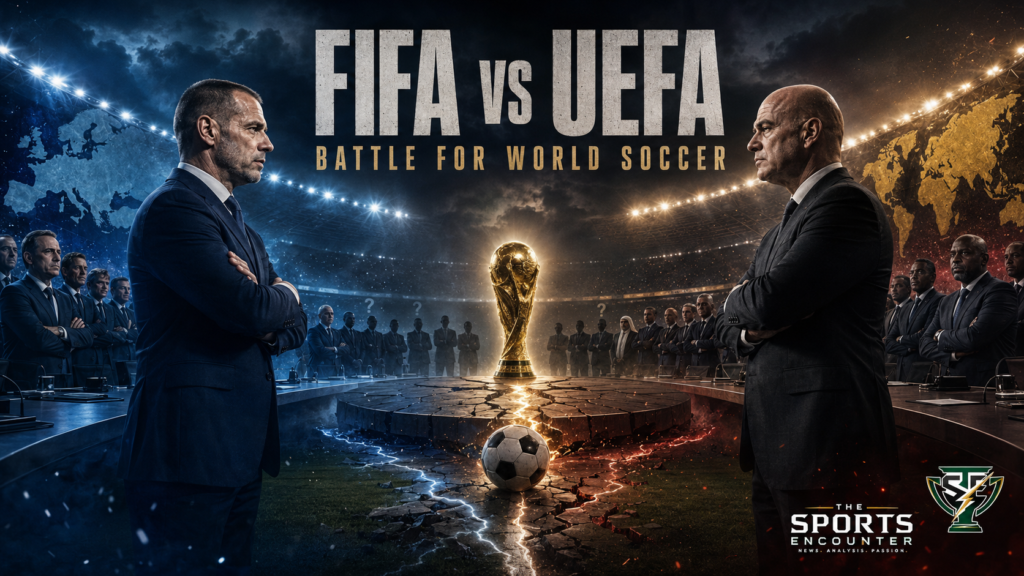
UEFA has declared that the World Cup is “not FIFA’s to sell.” FIFA says private investment will democratize the game. Behind those competing claims, Gianni Infantino and Aleksander Čeferin are entering a battle for the allegiance of national associations across every continent.
TL;DR: Why the FIFA-UEFA Conflict Matters
- FIFA plans to establish FIFA Forward Enterprise, a commercial subsidiary reportedly valued at approximately $20 billion.
- Private investors could purchase non-controlling stakes of up to 20%, potentially raising about $4.2 billion.
- UEFA says the proposal crosses an institutional red line and has urged national associations, leagues, clubs, players, supporters and governments to take the threat seriously.
- No confederation outside Europe has formally joined UEFA’s opposition at the time of publication.
- CONMEBOL could become the most influential swing bloc because of its competitive importance, cultural authority and recent strategic relationship with UEFA.
- CAF, AFC, Concacaf and OFC associations may find FIFA’s promise of up to $20 million in optional development capital difficult to reject.
- UEFA controls only 55 of FIFA’s 211 member-association votes, leaving it unable to defeat the proposal without substantial support from outside Europe.
- The immediate dispute concerns private investment, but the deeper struggle involves FIFA’s authority, UEFA’s influence and the future control of international soccer.
- A European World Cup boycott or breakaway competition remains an extreme and unsupported scenario. UEFA has announced no such plan.
FIFA’s World Cup Investment Plan at a Glance
| Issue | Current position | Why it matters politically |
|---|---|---|
| Proposed company | FIFA Forward Enterprise, or FFE | Would place FIFA’s commercial and event operations inside a dedicated corporate entity |
| Reported valuation | Approximately $20 billion | Creates a financial value around the business operating FIFA competitions |
| Outside investment | Minority, non-controlling stakes of up to 20% | Introduces private shareholders into FIFA’s tournament economy |
| Potential capital raised | Up to approximately $4.2 billion | Gives FIFA substantial resources to distribute across world soccer |
| Expected lead investor | Joshua Kushner’s Thrive Eternal | Adds political and governance scrutiny to an already controversial proposal |
| FIFA’s argument | Private capital can support sustainable and inclusive global development | Appeals strongly to smaller and less wealthy national associations |
| UEFA’s argument | Football’s soul and governance are not assets FIFA can sell | Frames the proposal as an institutional threat rather than a routine investment |
| Possible association benefit | Optional access to up to $20 million in one-off capital | Could make it difficult for UEFA to recruit opposition outside Europe |
| Approval | Expected to involve FIFA’s member associations and FIFA Council | Turns the dispute into a contest for influence across FIFA’s 211-member electorate |
The World Cup Ended, but the Fight for World Soccer Had Already Begun
Less than two weeks after Spain defeated Argentina in the 2026 FIFA World Cup final, the celebration surrounding the largest tournament in soccer history gave way to an institutional confrontation that could shape the sport for years.
FIFA announced plans to create FIFA Forward Enterprise, a new subsidiary that would oversee the commercial and event operations connected to the World Cup and its other competitions. The proposed company would reportedly be valued at approximately $20 billion, with outside investors permitted to purchase minority stakes of up to 20%.
UEFA’s response arrived quickly and carried little of the diplomatic restraint normally associated with disagreements between governing bodies.
European soccer’s leadership said FIFA had crossed a line that football institutions should never cross. Its statement argued that the game’s soul and governance could not become tradable assets and warned that FIFA had provided insufficient transparency about who might benefit financially.
The most important part of UEFA’s response was its intended audience. It did not speak only to European federations. UEFA directly addressed every national association, league, club, player, supporter, government and stakeholder concerned about the game’s future.
That language sounded like more than criticism. It resembled an invitation to organize.
FIFA has presented the proposal as a development initiative capable of channeling billions of dollars into facilities, coaching, grassroots competitions, national teams and women’s soccer. UEFA has recast it as a fight over whether any governing body possesses the moral authority to place an economic stake in the World Cup before private investors.
The confrontation has therefore moved beyond the accounting structure of one subsidiary. FIFA and UEFA are contesting who can legitimately speak for global soccer.
The dispute also follows a World Cup that produced enormous audiences, commercial opportunities and political controversy. The Sports Encounter’s examination of the record 2026 World Cup final viewership in the United States showed why FIFA’s tournament business has become so attractive to investors.
The emotions surrounding the World Cup remain public and communal. The commercial machinery surrounding those emotions is now valued in billions.
Why UEFA Treated FIFA’s Initiative as a Declaration of War
UEFA’s fury cannot be explained by private investment alone. European soccer already operates within a vast commercial system involving broadcasters, sponsors, investment funds, club owners, financial institutions and multinational corporations.
UEFA’s own competitions generate billions. The Champions League has repeatedly expanded its broadcasting inventory, sponsorship reach and match schedule. Europe cannot credibly argue that commercial money is inherently incompatible with soccer.
The difference lies in what FIFA wants to place inside the proposed company.
FIFA Forward Enterprise would reportedly oversee commercial and event operations associated with the World Cup and other FIFA competitions. Private shareholders would acquire an economic interest in the company managing the most valuable events under FIFA’s authority.
FIFA says those investors would remain passive. It would retain sole authority over sporting regulations, governance, competitions and the international match calendar. Outside capital would enter a FIFA subsidiary, not FIFA itself.
UEFA sees that distinction as too narrow.
A shareholder does not require direct control over team qualification, match rules or host selection to influence an organization’s commercial direction. Investors expect the value of their holdings to grow. That expectation can affect revenue targets, sponsorship strategies, event frequency, ticketing models and the commercial priorities surrounding future competitions.
UEFA’s wider concern is institutional. Allowing FIFA to complete the deal could strengthen Infantino’s influence over national associations for years. The billions raised through the transaction would give FIFA additional resources to distribute throughout Africa, Asia, the Caribbean, Oceania and other developing soccer regions.
Europe would retain its wealth, elite clubs and competitive importance. FIFA would strengthen the financial dependence of smaller associations on its development system.
From UEFA’s perspective, the proposal could therefore alter the balance of power between Zurich and Nyon. What FIFA describes as democratization may also consolidate the authority of FIFA’s leadership.
Infantino and Čeferin Are Fighting Over Two Different Visions of Soccer
The personal and institutional relationship between FIFA President Gianni Infantino and UEFA President Aleksander Čeferin has deteriorated through a series of disputes involving tournament expansion, the international calendar, player workload, governance, match operations and political influence.
The FFE proposal has brought those disagreements into one larger confrontation.
Infantino’s vision treats the World Cup as a powerful economic engine that can fund soccer in countries lacking Europe’s mature leagues, media markets and club infrastructure. FIFA argues that the game’s worldwide popularity should create meaningful opportunities throughout all 211 member associations.
Čeferin’s UEFA believes FIFA’s commercial expansion increasingly threatens the boundaries between governance and monetization. European officials fear that decisions affecting tournaments, players and the calendar will become harder to separate from FIFA’s revenue ambitions.
Both sides are defending institutional interests.
UEFA benefits from the most commercially successful club ecosystem in world soccer. Its leading teams attract international audiences, employ many of the world’s best players and generate recurring revenue that no other confederation can match.
FIFA’s power comes from its global electorate and the World Cup. Every national association receives a vote, placing small countries on the same formal electoral level as Germany, Brazil, England, Argentina or the United States.
Infantino’s development strategy speaks directly to that electorate. Čeferin’s strongest arguments involve governance, sporting autonomy, transparency and the cultural ownership of the game.
Their confrontation will be decided by which message national associations find more persuasive.
The political atmosphere surrounding Infantino was already tense before the proposal emerged. His recent defense of the tournament, political relationships and decision-making was examined in The Sports Encounter’s report on Infantino’s response to criticism of the 2026 World Cup.
UEFA Cannot Stop FIFA Alone
UEFA represents 55 national associations, making it one of the largest and most influential confederations within FIFA. Those associations include most of soccer’s wealthiest federations and many of its most successful national teams.
However, 55 votes cannot independently determine an outcome involving FIFA’s 211 members.
| Confederation | Approximate FIFA membership | Likely position at this stage | Political importance |
|---|---|---|---|
| UEFA | 55 | Institutionally opposed | Leads resistance but lacks enough votes to defeat FIFA alone |
| CAF | 54 | No formal collective opposition announced | Development funding gives FIFA a potentially strong position |
| AFC | 46 | No formal collective opposition announced | Large, diverse bloc containing wealthy and developing associations |
| Concacaf | 35 | No formal collective opposition announced | Recent World Cup partnership may reinforce ties with FIFA |
| OFC | 11 | No formal collective opposition announced | Small associations may place exceptional value on FIFA funding |
| CONMEBOL | 10 | No formal collective opposition announced | Small voting bloc with enormous sporting and symbolic importance |
The precise voting process and timetable must still be confirmed. FIFA has said the proposal will be presented to its member associations and the FIFA Council, which it identifies as the final decision-makers.
Whatever procedural route is used, UEFA needs allies.
Its first objective will be maintaining a united European position. That should not be taken for granted. Some UEFA members may share the governing body’s philosophical concerns while remaining interested in FIFA’s financial offer. Smaller European associations can face many of the same infrastructure and development challenges found elsewhere.
UEFA must then secure meaningful support beyond Europe. It could lose even with unanimous European resistance if FIFA preserves its traditional alliances across other confederations.
This explains why UEFA addressed every national association in its statement. The language was designed to move the issue beyond a FIFA-UEFA quarrel and turn it into a global test of governance.
Could CONMEBOL Join UEFA Against FIFA?
CONMEBOL is the most obvious potential partner for UEFA, although no formal South American opposition to FIFA’s proposal had been announced when this article was prepared.
The South American confederation has only 10 FIFA members. Its influence is much greater than that number suggests.
Argentina, Brazil and Uruguay have won multiple World Cups. South America continues to produce a huge share of the players who shape European club soccer. Its national teams carry historical authority that a purely numerical assessment cannot capture.
UEFA and CONMEBOL have also built a closer working relationship through the revival of the Finalissima and cooperation between the two confederations. That relationship gives UEFA a natural channel through which it can discuss a coordinated position.
Several factors could push CONMEBOL toward UEFA.
- Concern that private investment could change the commercial character of the World Cup
- A desire to protect the influence of traditional soccer regions
- Questions about investor rights, transparency and political relationships
- Shared concerns about the international calendar and player workload
- Existing institutional cooperation with UEFA
Other considerations could keep South America aligned with FIFA or at least prevent open confrontation.
CONMEBOL associations benefit from FIFA competitions and development programs. South American leaders may seek additional guarantees or financial concessions instead of joining a public rebellion. They may also hesitate to become dependent on a European strategy that ultimately protects UEFA’s own commercial position.
Infantino understands the symbolic importance of South America. Losing all 10 CONMEBOL votes would not automatically defeat the proposal, but a UEFA-CONMEBOL alliance would transform the narrative.
It would no longer look like wealthy Europe resisting development elsewhere. Two of soccer’s most historically powerful continents would be challenging FIFA together.
Such an alliance could encourage prominent associations in other confederations to demand more information, even if they stopped short of voting against the plan.
Why CAF May Be the Most Difficult Bloc for UEFA to Move
The Confederation of African Football represents 54 FIFA associations. Numerically, it is almost equal to UEFA and could become decisive in any broad vote.
UEFA may attempt to frame the dispute around football sovereignty, transparent governance and protection from private financial influence. Those principles could resonate with African administrators, players and supporters.
FIFA holds a powerful counterargument: money that can build actual soccer infrastructure.
Many African associations operate with limited domestic broadcasting revenue, unstable sponsorship markets and inadequate facilities. An optional program providing access to as much as $20 million could fund technical centers, women’s leagues, youth academies, coaching education and national-team programs.
For some federations, the proposal may feel less like an abstract privatization debate and more like a rare chance to transform their domestic game.
UEFA will struggle if its opposition appears designed to preserve European control over global soccer’s wealth. European clubs already benefit from African talent while many of the countries producing those players lack comparable infrastructure.
To win African support, UEFA would need to answer a practical question: what alternative development model can it offer?
Moral language may start the discussion. It will not automatically outweigh capital capable of building stadiums, training grounds and national academies.
Individual African associations could still demand better transparency. Governments, supporter groups and independent administrators may question the proposed investor structure. A small group could break ranks if legal protections and financial details remain unclear.
A unified CAF challenge to FIFA nevertheless appears difficult without a major change in the political environment.
AFC Contains Both FIFA’s Strongest Prospects and Its Most Complex Risks
The Asian Football Confederation is too diverse to be treated as a single political constituency.
It includes wealthy Gulf countries, major commercial markets such as Japan and South Korea, rapidly growing soccer economies, populous South Asian nations and smaller associations heavily reliant on development funding.
Several AFC members may welcome the commercial ambition behind FFE. Governments and investment institutions across Asia and the Middle East already use sports properties as part of wider economic, tourism and global-influence strategies.
FIFA’s promise to expand participation and fund infrastructure fits the ambitions of associations seeking a larger place within world soccer.
Others may share UEFA’s concerns about transparency and investor influence. Established federations with strong domestic resources have less immediate need for a one-off capital program and may examine the governance structure more critically.
Even then, public criticism remains politically difficult. An association may privately request stronger safeguards while avoiding direct alignment with UEFA.
The most realistic UEFA strategy in Asia may therefore involve encouraging abstentions, procedural delays or demands for disclosure. Persuading the AFC as an institution to lead a confrontation with FIFA would require far more than European outrage.
Concacaf Has Fresh Reasons to Remain Close to FIFA
Concacaf has just completed the largest World Cup ever staged, with the United States, Canada and Mexico sharing hosting responsibilities across 16 cities.
The tournament strengthened FIFA’s commercial position in North America and demonstrated the region’s importance to future soccer growth. It also produced enormous ticketing, tourism, sponsorship and broadcasting opportunities.
The Sports Encounter’s FIFA World Cup 2026 coverage hub documents the sporting and commercial scale of the competition.
Concacaf’s recent operational partnership with FIFA may make a confederation-wide break unlikely. FIFA can argue that FFE would extend the momentum created by the 2026 tournament and attract further investment into emerging soccer markets.
The bloc is not politically uniform.
The United States, Canada and Mexico possess resources and commercial opportunities unavailable to many Caribbean and Central American associations. Smaller members may value FIFA development funding far more than the region’s largest federations.
European lobbying could find a limited audience among associations concerned about governance or ticket affordability. Political leaders may also question whether a global sporting institution should permit private investors to profit from competitions built around national identity.
British Prime Minister Andy Burnham has already argued that the World Cup is not a product and does not belong to investors. Similar interventions from governments outside Europe would increase the political cost of the proposal.
At present, however, Concacaf appears more likely to seek guarantees within FIFA’s plan than to join a UEFA-led rebellion.
OFC’s Votes Could Matter More Than Its Commercial Size
Oceania has 11 FIFA member associations. The confederation commands only a small portion of global soccer revenue, but its votes carry the same formal weight as those of larger countries within the FIFA Congress.
That structure is central to Infantino’s development argument.
Associations across the Pacific face high travel costs, limited populations, small domestic markets and significant infrastructure challenges. FIFA assistance can sustain competitions and national programs that would otherwise struggle to operate.
An additional multimillion-dollar funding opportunity could make OFC one of FIFA’s strongest areas of support.
UEFA might argue that accepting the proposal could trade long-term institutional independence for immediate resources. Smaller associations may respond that soccer cannot develop through principles alone.
OFC illustrates the political genius and central controversy of FIFA’s proposal. The associations asked to judge the plan are also being offered direct access to its financial benefits.
The $20 Million Promise Is FIFA’s Strongest Political Weapon
FIFA says the capital raise could support an optional program allowing member associations to access up to $20 million in one-off funding. Eligible uses could include infrastructure, coaching, national teams, competitions, grassroots soccer and the women’s game.
That money gives Infantino more than a development policy. It gives him a persuasive case before the organizations that will evaluate the proposal.
UEFA will argue that voters should first receive complete information about the investors, shareholder rights, governance safeguards, valuation, financial returns and possible conflicts of interest.
FIFA can answer by asking associations what the funding could accomplish in their countries.
A federation without a national training center may see a route to building one. Another could establish its first sustainable women’s league. Smaller nations could improve coaching standards, pitches, medical facilities or youth competitions.
The political choice is therefore uneven. Wealthy federations can afford to prioritize long-term governance risks. Poorer associations must weigh those risks against immediate development needs.
UEFA’s campaign will gain traction only if it respects that reality. Lecturing smaller associations about the soul of soccer while Europe controls its richest leagues may produce the opposite result.
A more effective opposition would demand disclosure, independent valuation, spending audits, investor restrictions and enforceable protections against commercial interference. That approach could unite associations that want FIFA’s money but remain uncomfortable with its structure.
Could National Associations Break Away From Their Confederations?
Confederations do not always vote as unified blocs. Every national association has its own financial needs, political relationships and leadership priorities.
UEFA’s public position does not guarantee that all 55 European associations will oppose the proposal. Likewise, institutional silence from CAF, AFC, Concacaf, CONMEBOL or OFC does not mean every member supports FIFA.
Several types of association could become important:
- Wealthy federations that do not depend heavily on FIFA funding
- Associations with strong domestic governance requirements
- Countries where governments or parliaments demand scrutiny
- Federations worried about private control of sporting data and commercial rights
- Smaller associations that support development funding but want stronger legal safeguards
- National bodies whose leadership has an uneasy relationship with Infantino
A full rebellion may not be necessary to change the proposal. If enough associations express concern, FIFA could reduce the available stake, publish additional documents, introduce transfer restrictions or strengthen its control provisions.
The opposition’s first victory may therefore be delay rather than defeat.
Time would allow national associations, player unions, leagues, clubs, governments and supporter organizations to examine the plan. It would also give UEFA an opportunity to convert an emotional statement into a coordinated international campaign.
What a UEFA-Led Coalition Could Demand
A credible opposition campaign needs more than a declaration that football is not for sale. It needs specific institutional demands.
- Full investor disclosure: FIFA should identify every beneficial owner, intermediary and participating investment vehicle.
- Publication of shareholder rights: Member associations should see any board rights, vetoes, consent provisions and information privileges.
- An independent valuation: The $20 billion figure should be tested by advisers without a financial interest in completing the transaction.
- Restrictions on future transfers: Investors should not be allowed to sell shares to unidentified third parties without FIFA and member approval.
- Protection of the calendar: Commercial targets should have no role in determining additional competitions or matches.
- Fan-access guarantees: FFE should face enforceable rules around ticket affordability, allocations and official resale practices.
- Player-welfare safeguards: Tournament expansion should require independent medical and workload assessment.
- Audited development spending: Funding must reach soccer programs instead of disappearing through weak governance or political patronage.
- Conflict-of-interest rules: FIFA officials should not receive future employment, equity or financial benefits from the subsidiary without independent review.
- A review or exit mechanism: Member associations should retain a practical means of changing or terminating the structure if investor involvement harms the sport.
These demands could appeal beyond Europe because they do not require associations to reject development funding. They require FIFA to prove that the funding does not come with hidden institutional costs.
Player Workload Could Bring Clubs and Unions Into UEFA’s Camp
UEFA’s strongest potential allies may not be other confederations. Clubs, domestic leagues and player unions already fear that FIFA’s commercial ambitions will produce more fixtures.
The expanded 2026 World Cup featured 48 teams and 104 matches. FIFA can point to greater global representation and record demand. Critics can point to longer travel, increased workload, environmental pressure and a larger commercial inventory.
Private shareholders would benefit if FIFA competitions generated more broadcasting and sponsorship value. Even without formal control, investors would have an economic interest in expansion.
FIFA insists that all calendar and sporting decisions would remain exclusively under its authority. UEFA and player representatives may ask whether FIFA can make those decisions independently while also protecting the valuation of a partly investor-owned business.
The concerns are not theoretical. Even mandatory hydration breaks became part of the tournament’s commercial structure when broadcasters turned stoppages into advertising opportunities. The Sports Encounter explored the tension in its analysis of why World Cup hydration breaks divided players, fans and broadcasters.
UEFA has commercial conflicts of its own. Its expanded club competitions have added fixtures and media inventory. FIFA will use that record to challenge Europe’s moral authority.
Player unions can speak more convincingly. If they conclude that FFE creates further pressure for tournament growth, UEFA’s opposition could develop into a broader labor and governance campaign.
Supporters Could Turn an Administrative Fight Into a Political Crisis
The phrase “not FIFA’s to sell” resonates because supporters do not experience the World Cup as a corporate asset.
They experience it through national identity, family memories, public celebrations, disappointment and shared history. FIFA controls the commercial rights, but it did not independently create the emotional value supporting them.
UEFA has deliberately placed fans at the center of its argument. That strategy could prove effective if the dispute becomes connected to ticket prices, hospitality packages, broadcasting access or the use of supporter data.
The 2026 World Cup demonstrated the tension between enormous demand and affordability. Ticket values changed sharply during the tournament, while premium packages pushed access beyond the reach of many ordinary supporters. Our analysis of the World Cup ticket market and knockout-stage price changes showed how quickly commercial expectations can collide with actual fan demand.
Governments may become involved if supporter pressure grows. European political criticism has already begun. Similar interventions in South America, Africa or North America would make it harder for FIFA to present the dispute as UEFA protecting its own territory.
A global fan coalition would not possess a formal FIFA vote. It could still influence national associations through public pressure, sponsors and political oversight.
Could UEFA Challenge Infantino’s FIFA Presidency?
Infantino is expected to seek reelection, and the FFE dispute may become inseparable from the next FIFA presidential contest.
UEFA could support an alternative candidate, but defeating an incumbent FIFA president requires far more than European unity. A credible challenger would need relationships across Africa, Asia, the Americas and Oceania, along with a development program capable of competing with FIFA’s funding promises.
Opposing private investment would not provide a complete electoral platform. Smaller associations would want to know how the challenger intends to finance infrastructure, women’s soccer, youth programs and national competitions.
Infantino’s position remains strong if most associations view him as the leader who expanded World Cup participation and increased FIFA distributions.
The FFE controversy could weaken him if undisclosed terms, investor privileges or personal conflicts emerge. Reports that he might eventually hold a leadership role in the new enterprise would require particularly careful scrutiny if such a possibility became part of the formal proposal.
No allegation of personal wrongdoing should be inferred without evidence. FIFA still needs to address the potential perception that current officials could help create a valuable company and later benefit through appointments, compensation or influence.
UEFA may use the coming months to test whether dissatisfaction with Infantino extends beyond Europe. If the response remains limited, launching a challenger could expose UEFA’s political weakness. If concerns spread, the investment proposal could become the issue around which an opposition coalition forms.
Could Europe Boycott the World Cup?
A European boycott would be the most dramatic possible escalation. It is also highly speculative.
UEFA has not announced a boycott, threatened to withdraw its teams or proposed a breakaway international tournament. No responsible analysis should present those outcomes as established possibilities at this stage.
Europe supplies many of the World Cup’s leading national teams, commercial markets and star players. A tournament without UEFA members would suffer an enormous sporting and financial blow. European withdrawal would also harm players, supporters, broadcasters and sponsors while exposing national associations to potential disciplinary and legal consequences.
That makes a boycott extremely unlikely unless the dispute expands into a much deeper constitutional crisis.
More realistic forms of resistance include:
- Voting against the proposal
- Requesting a delay
- Demanding publication of the complete transaction documents
- Seeking independent legal and financial reviews
- Coordinating with player unions and domestic leagues
- Lobbying governments and sponsors
- Challenging specific provisions through soccer’s legal structures
- Backing an opponent to Infantino
The boycott scenario still matters as an illustration of the power UEFA holds. FIFA can defeat Europe in a member-association vote, but it cannot easily operate its most valuable tournament without European teams and audiences.
UEFA’s leverage comes from economic and competitive importance. FIFA’s leverage comes from global membership and development funding. Neither institution can fully dominate the other without damaging the game it governs.
Three Realistic Outcomes From the FIFA-UEFA Conflict
1. FIFA Wins Broad Approval
FIFA could secure enough support by emphasizing development funding, retaining formal sporting control and offering further governance assurances. UEFA would remain opposed but politically isolated beyond Europe.
This outcome would strengthen Infantino and demonstrate that FIFA’s global coalition can overcome resistance from its wealthiest confederation.
2. Opposition Forces FIFA to Rewrite the Plan
National associations may support the principle of new investment while demanding stricter controls. FIFA could reduce the stake, limit investor rights, publish more information and create independent monitoring.
This would allow both sides to claim partial success. FIFA would unlock capital, while UEFA could argue that its intervention protected soccer from an unchecked transaction.
3. A Wider Coalition Blocks or Delays the Proposal
If CONMEBOL aligns with UEFA and influential associations in other confederations demand further scrutiny, FIFA could struggle to move quickly.
A delay would push the dispute toward the next presidential election and deepen questions about Infantino’s authority. It could also encourage clubs, unions, governments and supporters to become more directly involved.
FIFA vs UEFA Power-Struggle Scorecard
| Category | FIFA advantage | UEFA advantage | Current edge |
|---|---|---|---|
| Member-association votes | Strong relationships across the global electorate | 55-member European bloc | FIFA |
| Development funding | Up to $20 million in optional capital per association | No comparable alternative announced | FIFA |
| Elite teams and players | Controls the World Cup | Represents many of soccer’s strongest nations and leagues | UEFA |
| Public messaging | Democratization and global participation | Football does not belong to investors | Even |
| Potential external allies | CAF, AFC, Concacaf and OFC associations benefit from funding | CONMEBOL, clubs, leagues, unions and governments could become partners | FIFA |
| Governance argument | Promises sole sporting control | Questions financial influence and lack of transparency | UEFA |
| Immediate political position | Controls the proposal and approval timetable | Has initiated public opposition | FIFA |
What Most Coverage of the FIFA-UEFA Fight Is Missing
The proposal is often described as a dispute over whether FIFA should sell part of the World Cup business.
The more consequential question involves the political structure of world soccer.
FIFA’s authority depends on its ability to represent every national association. UEFA’s influence comes from the economic, historical and competitive power concentrated in Europe. The FFE proposal touches both foundations.
If FIFA secures approval despite UEFA’s campaign, Infantino will have shown that European opposition cannot overcome his wider international coalition. FIFA would gain new capital and potentially deepen its importance to associations requiring development support.
If UEFA recruits CONMEBOL and dissenting associations elsewhere, the plan could become the first serious test of whether Infantino’s global alliance remains secure.
The decisive group may consist of associations that want the promised money but do not fully trust the structure. They do not need to adopt UEFA’s language or reject FIFA’s development goals. Their demands for documents, audits and enforceable safeguards could determine what survives.
The World Cup itself remains the source of everyone’s leverage. FIFA administers it. UEFA supplies many of its biggest teams and markets. Other confederations provide its global legitimacy. Players create its quality, while supporters create its meaning.
No single institution truly owns all of that value.
Final Verdict: UEFA Has Opened a Rebellion, but FIFA Still Holds the Votes
UEFA’s response to FIFA Forward Enterprise was stronger than a conventional objection. By calling on every association and stakeholder to react, it invited world soccer to challenge FIFA’s authority before private capital enters the World Cup’s commercial structure.
The rebellion is not yet global.
No other confederation has formally joined UEFA. FIFA’s promise of substantial development funding gives it a compelling advantage across associations that cannot reproduce Europe’s wealth. Infantino enters the confrontation with the proposal, the financial resources and the broader electoral network.
UEFA possesses different forms of power. European nations, clubs, players, broadcasters and supporters remain essential to the value FIFA wants investors to buy. If UEFA secures CONMEBOL’s support and brings leagues, unions and governments into the campaign, FIFA could face pressure that cannot be measured through votes alone.
The next stage will reveal whether UEFA’s fury becomes a coalition or remains a European protest.
National associations should demand the full investment terms before choosing either side. They need to know who owns the proposed shares, how investors will earn returns, what protections apply to the calendar and whether future FIFA officials could benefit from the company.
FIFA may be able to prove that FFE can fund global development without surrendering sporting authority. UEFA may be able to prove that economic influence can change soccer even when investors never receive formal control.
Until those details emerge, the strongest conclusion is also the simplest: FIFA has not sold a stake yet, UEFA has not built a global alliance yet, and the battle for world soccer’s 211 associations has only begun.
Readers can follow tournament announcements and institutional updates through the official FIFA platform and review European soccer’s position through the official UEFA institutional website.
For continuing reports on international soccer governance, competitions and global developments, visit The Sports Encounter’s soccer news and analysis hub.
Frequently Asked Questions
What is FIFA Forward Enterprise?
FIFA Forward Enterprise is a proposed subsidiary that would manage commercial and event operations connected to FIFA competitions. FIFA reportedly intends to offer private investors minority, non-controlling stakes of up to 20% while retaining authority over governance and sporting decisions.
Why is UEFA opposing FIFA’s $20 billion plan?
UEFA believes the proposal places the commercial future of the World Cup before private shareholders and crosses an institutional boundary. It has also raised concerns about transparency, investor influence and the principle that no governing body owns soccer’s cultural value.
Have other soccer confederations joined UEFA?
No other continental confederation had formally joined UEFA’s opposition at the time of publication. CONMEBOL appears to be the most plausible strategic partner, but any alliance remains unconfirmed.
Can UEFA stop FIFA from approving the plan?
UEFA cannot stop the proposal using its 55 member associations alone. It would need support from CONMEBOL and a meaningful number of associations within CAF, AFC, Concacaf or OFC.
Why could smaller national associations support FIFA?
FIFA says associations could receive optional access to as much as $20 million in one-off capital for infrastructure, grassroots programs, coaching, national teams, competitions and women’s soccer. That offer could have a transformative impact in countries with limited domestic resources.
Could European teams boycott the World Cup?
A boycott remains an extreme and speculative scenario. UEFA has not proposed withdrawing European teams. Voting opposition, legal scrutiny, demands for disclosure and political pressure are considerably more realistic responses.