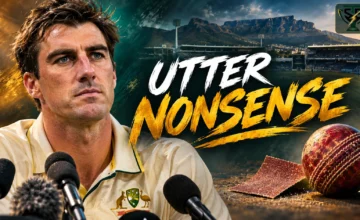
SYDNEY, Australia, November 19, 2026: Pat Cummins has spent much of his captaincy rebuilding Australia’s reputation after the ball-tampering scandal that disgraced the national team in 2018. He now faces a challenge to his own credibility from former teammates who dispute his account of what happened. Cameron Bancroft‘s detailed allegations, following Usman Khawaja’s disclosures, have reopened questions about the Australian bowling attack and the investigation that punished three players while leaving others untouched.
The renewed Sandpapergate scandal has moved beyond a disagreement about an eight-year-old incident. It has become a test of leadership, collective responsibility and institutional transparency. Former captains and fast bowlers, including Mike Atherton, Wasim Akram, Shoaib Akhtar, Shaun Pollock, Michael Vaughan and Mark Butcher, have contributed different perspectives on the affair. Their reactions reveal an important distinction: skepticism about Australia’s original explanation is not the same as proof that every player knew, participated or lied.
Key Takeaways
- Pat Cummins has spent much of his captaincy rebuilding Australia’s reputation after the ball-tampering scandal that disgraced the national team in 2018.
- The immediate controversy began with Khawaja’s account of the 2018 South Africa tour in his autobiography, Sabr.
- Cummins responded at a lengthy press conference on November 13, categorically rejecting claims of his knowledge or involvement.
- Bancroft’s intervention is particularly significant because he was the player filmed concealing sandpaper during the Cape Town Test.
Why the Sandpapergate Scandal Has Become a Captaincy Crisis
The immediate controversy began with Khawaja’s account of the 2018 South Africa tour in his autobiography, Sabr. The retired Australia opener challenged the conclusion that knowledge of the sandpaper plan was confined to Steve Smith, David Warner and Bancroft.
Story at a glance

Why the Sandpapergate Scandal Has Become a Captaincy Crisis
The immediate controversy began with Khawaja’s account of the 2018 South Africa tour in his autobiography, Sabr. The retired Australia opener challenged the conclusion that knowledge of the sandpaper plan was confined to Steve Smith, David Warner and Bancroft.
Cameron Bancroft Changes the Nature of the Evidence
Bancroft’s intervention is particularly significant because he was the player filmed concealing sandpaper during the Cape Town Test.
Wasim Akram Explains Why Bowlers Would Question the Ball’s Condition
Few former cricketers are better qualified to explain the technical importance of a cricket ball’s condition than Wasim Akram.
Shoaib Akhtar Offers a Contrasting View From Pakistan’s Fast-Bowling History
Shoaib Akhtar approached the controversy from a different perspective.
Mike Atherton Sees a Problem Bigger Than One Player
Former England captain Mike Atherton has approached the controversy primarily as a failure of team culture and institutional accountability.
Khawaja’s account suggested that awareness of the plan extended across the dressing room and that discussions about altering the ball had begun before Bancroft was caught at Newlands.
Cummins responded at a lengthy press conference on November 13, categorically rejecting claims of his knowledge or involvement. He described the wider allegations as “complete and utter nonsense” and maintained that he had not known sandpaper was being used.
The forcefulness of that denial became significant when Bancroft published a detailed personal account five days later.
Bancroft, who received a nine-month suspension in 2018, said he had withheld important information during Cricket Australia’s original investigation. He alleged that awareness of the ball-altering activity extended beyond the three sanctioned players and that members of the bowling group had provided feedback concerning the ball’s condition.
He identified Cummins’ press conference as the decisive reason for speaking publicly.
That sequence placed the Australian captain in a difficult position. He had rejected Khawaja’s account as fundamentally wrong, only for another central participant in the original incident to reinforce important elements of it.
Cummins has not withdrawn his denial. Through his representative, Neil Maxwell, he maintained that Bancroft’s claims contained nothing that had not already been addressed.
Consequently, the dispute remains one of conflicting testimony, not established findings against Cummins.
Three Questions the Sandpapergate Scandal Must Answer
| Question | Why it matters | What is established |
|---|---|---|
| Who knew the ball was being deliberately altered? | Determines the potential extent of awareness within the team | Khawaja and Bancroft allege wider knowledge; Cummins disputes the account |
| Who knew sandpaper specifically was being used? | Distinguishes general knowledge of ball work from awareness of the prohibited method | The original disciplinary findings concerned Smith, Warner and Bancroft; wider awareness remains disputed |
| Who directed, assisted or approved the operation? | Separates passive awareness from active responsibility | No new independent finding establishing additional individual responsibility has been announced |
This separation is essential. A player might know teammates are attempting to alter a ball without knowing the instrument being used. Another might recognize an unusual surface change without knowing who caused it. Direct involvement, authorization and subsequent concealment are further questions requiring specific evidence.
Those distinctions do not make Bancroft’s allegations unimportant. They explain why the competing accounts need more careful examination than a general claim that everybody knew.
Cameron Bancroft Changes the Nature of the Evidence
Bancroft’s intervention is particularly significant because he was the player filmed concealing sandpaper during the Cape Town Test.
He was directly involved in the incident and received a lengthy suspension. His new account is therefore not simply an observation from someone outside the dressing room.
In his extensive statement published by The West Australian, Bancroft challenged the notion that only three players knew about the use of sandpaper. He also discussed the pressures that shaped team behavior during the South African tour.
The statement introduced a second issue that is potentially as consequential as the alleged wider knowledge: whether Bancroft withheld information in 2018 because of the culture surrounding the team and the investigation.
His account suggests that the disciplinary process may not have captured every relevant participant’s knowledge or experience.
However, Bancroft’s new testimony must still be evaluated against the recollections of other players and the evidence available from the original inquiry.
His direct involvement makes his account important. It does not automatically establish every allegation against others.
The Australian Broadcasting Corporation’s examination of Bancroft’s account separates his specific allegations from the positions taken by Cummins and Cricket Australia.
The Sports Encounter previously covered the emergence of these disagreements in its analysis of the confrontation between Warner, Cummins and Khawaja.
Bancroft’s intervention has since increased the evidentiary stakes because two former teammates now publicly dispute essential aspects of the account defended by the captain.
Wasim Akram Explains Why Bowlers Would Question the Ball’s Condition
Few former cricketers are better qualified to explain the technical importance of a cricket ball’s condition than Wasim Akram.
The Pakistan great developed his reputation through the control, seam positioning and reverse swing that made him one of international cricket’s most dangerous fast bowlers.
Akram has questioned the plausibility of experienced bowlers failing to notice significant changes to the ball’s surface.
He explained that damage caused by sandpaper differs from ordinary abrasion generated when the ball strikes the pitch or outfield.
His argument is grounded in the practical experience of a bowler who must continuously monitor the ball’s condition, balance, seam and response through the air.
A fast bowler does not need to know precisely how an alteration occurred to notice that the ball is behaving differently.
That observation matters because Bancroft’s account refers to the bowlers receiving feedback about the work being done on the ball.
Akram’s technical analysis makes the claim of complete ignorance harder for some observers to accept. It is not, however, independent proof that Cummins knew sandpaper was being used.
There remains an evidentiary difference between recognizing an abnormal scratch, understanding its effect on swing and knowing that a teammate deliberately created it using a prohibited material.
Akram has also acknowledged his personal respect for Cummins, making his intervention a technical assessment rather than a direct accusation of dishonesty.
Why the Condition of the Ball Matters
Conventional swing and reverse swing involve airflow around the cricket ball. The ball’s seam, surface roughness, speed and asymmetry influence how that airflow develops and how the ball moves.
As a ball ages, one side may become more worn than the other through ordinary play. Bowlers and fielders have historically attempted to maintain a contrasting surface by polishing the ball within the Laws of Cricket.
Deliberately damaging the ball with sandpaper is different because it involves unauthorized artificial alteration.
| Action | Practical effect | Rules significance |
|---|---|---|
| Ordinary wear during play | Gradually changes surface condition | Natural part of a cricket match |
| Permitted polishing | Maintains a smoother surface within applicable restrictions | Allowed when conducted in accordance with playing conditions |
| Deliberate use of an abrasive object | Artificially damages or roughens the surface | Prohibited ball alteration |
| Bowler observes changed movement | May indicate altered aerodynamic behavior | Observation alone does not establish knowledge of the method used |
The technical distinction is central to evaluating the competing claims. Knowledge of swing conditions, awareness of artificial damage and participation in an illegal scheme are related but separate propositions.
Shoaib Akhtar Offers a Contrasting View From Pakistan’s Fast-Bowling History
Shoaib Akhtar approached the controversy from a different perspective.
Speaking to Wisden, the former Pakistan fast bowler suggested cricket should acknowledge past wrongdoing and move forward rather than continue extending the dispute.
He also referred to historic ball-tampering practices involving bottle tops, placing the Australian controversy within a wider history of illegal attempts to manipulate the ball.
Akhtar’s remarks are noteworthy because they challenge the assumption that the 2018 incident was an isolated example of unethical ball management.
At the same time, the historical existence of ball tampering elsewhere does not excuse Australia’s actions at Cape Town.
Nor does evidence that other teams used prohibited methods establish what individual Australian players knew in 2018.
Akhtar’s position raises a legitimate question about the purpose of revisiting old wrongdoing. Is the objective further punishment, an accurate public record, acknowledgement of institutional failures or reconciliation among former teammates?
Those objectives are not identical.
A governing body could reasonably conclude that additional punishment is inappropriate while still examining whether its previous public findings were complete.
That distinction is central to the current debate about Cricket Australia’s response.
Mike Atherton Sees a Problem Bigger Than One Player
Former England captain Mike Atherton has approached the controversy primarily as a failure of team culture and institutional accountability.
His recent analysis has emphasized the pressure that developed around Australia’s pursuit of victory and the environment in which the Cape Town incident occurred.
That argument shifts attention away from the narrow question of which individual carried the sandpaper onto the field.
If a team operates within a culture that tolerates extreme methods, responsibility may extend beyond the person caught executing a particular act.
That does not mean every member of the organization carries equal disciplinary responsibility. It means the conditions that encouraged wrongdoing deserve examination alongside the specific actions of individual players.
Atherton has also considered Cummins’ future, saying he does not expect the Australian captain to resign immediately despite the latest revelations.
The Sky Sports account of Atherton’s assessment details his concerns about dressing-room culture and the consequences for Cummins.
His distinction between immediate resignation and longer-term credibility matters.
Cricket Australia may continue supporting Cummins as captain while questions about the historical record remain unanswered. Whether that position is sustainable depends partly on how the conflicting testimony develops.
Michael Vaughan Questions Whether Australia Can Contain the Fallout
Michael Vaughan has been among the most persistent external critics of the Australian account.
The former England captain questioned why Australia expected the original explanation to permanently settle the matter when doubts about the wider team’s knowledge had continued circulating.
Vaughan has also warned that Khawaja’s disclosures and the subsequent disputes could destabilize Australia’s preparation for the next Ashes series.
His argument is partly about timing. Australia face a demanding period in which attention should ordinarily be directed toward selection, tactical preparation and performances against major opponents.
Instead, current and former players are publicly disputing what happened during a Test series eight years earlier.
That creates a leadership challenge even if no new disciplinary findings emerge.
Cummins must captain players whose names have again entered the controversy, while administrators attempt to prevent the dispute from dominating the team’s preparations.
Vaughan’s criticism does not establish additional wrongdoing. It identifies the practical danger of a controversy that cannot be settled through repeated denials alone.
Mark Butcher Raises the Question of Unequal Punishment
Former England batter Mark Butcher has taken a more confrontational position concerning the consequences suffered by the three sanctioned players.
Butcher has described the suggestion that Australia’s bowlers knew nothing about the operation as extremely difficult to believe.
He has also raised the possibility that Warner, Smith and Bancroft should consider pursuing compensation if the broader allegations establish that they were unfairly singled out for punishment.
This is a significant argument, but it requires careful qualification.
The fact that additional players may have known about a scheme would not automatically invalidate the sanctions imposed on those who were directly involved.
Nor would it automatically create a legal right to compensation.
Any such action would depend on the relevant agreements, disciplinary rules, available evidence and applicable law.
Butcher’s comments nevertheless expose an unresolved question of proportionality.
Smith and Warner received 12-month suspensions, while Bancroft was banned for nine months. Their reputations and careers were affected, and the consequences continued long after the suspensions ended.
If a fuller account demonstrated that responsibility was more widely distributed, Cricket Australia would face legitimate questions about why its disciplinary findings were limited to three players.
That possibility, rather than an established entitlement to compensation, is the important issue raised by Butcher’s intervention.
Shaun Pollock’s Perspective Connects the Controversy to Cape Town
Former South Africa captain Shaun Pollock offers a different perspective because he was working as a television commentator during the Cape Town Test when the original scandal erupted.
Pollock revisited that experience in an October discussion with Sky Sports, ahead of renewed Test competition between South Africa and Australia.
His recollection is relevant to understanding how quickly the incident developed from unusual television footage into an international crisis.
The Newlands controversy was distinctive because the suspected alteration was captured on camera and brought to the attention of viewers, commentators and match officials.
That visibility made the incident more difficult to dismiss as an ordinary disagreement about ball maintenance.
Pollock’s earlier contribution provides historical context. It should not be represented as a new accusation against Cummins following Bancroft’s November statement.
The distinction is important because a commentary recalling the 2018 match does not necessarily establish the speaker’s position on the latest allegations.
Nasser Hussain, Alastair Cook and Matt Prior Add to the Scrutiny
Other former England internationals have questioned the handling of the controversy.
Nasser Hussain has repeatedly criticized the contradictions between the accounts of the original incident and the treatment of the three sanctioned players.
He has asked why Australian cricket allowed the divisions created by the scandal to persist for so long without a resolution accepted by those involved.
TSE examined his intervention in its report on Hussain’s assessment of the unresolved Sandpapergate questions.
Former England captain Alastair Cook has drawn attention to the significance of Bancroft’s new account following Khawaja’s disclosures.
The important difference is Bancroft’s position as the player directly filmed tampering with the ball. His testimony potentially carries a different evidentiary weight from the recollections of someone who was not involved in the act.
Former England wicketkeeper Matt Prior has also expressed skepticism that Australia’s bowlers could have remained entirely unaware of the operation.
The combined reaction demonstrates the breadth of concern surrounding the original explanation.
However, multiple former players expressing doubt does not transform an allegation into an independently established fact.
Expert judgment can help identify inconsistencies and technical questions. Determining individual responsibility requires evidence.
David Warner and Chadd Sayers Challenge the Captain’s Response
David Warner’s role is particularly complicated.
He was one of the three players sanctioned in 2018 and has been a vocal supporter of Khawaja’s account.
Warner criticized Cummins’ response to Khawaja, arguing that the captain had treated a former teammate unfairly during his public denial.
He subsequently welcomed Bancroft’s decision to publish his account.
Former Test bowler Chadd Sayers has also challenged aspects of Cummins’ account, suggesting the broader dressing room was aware of ball tampering.
Sayers’ recollections add another voice from the Australian playing environment of that period, but they must be evaluated according to what he personally witnessed or heard.
The Sports Encounter previously documented the confrontation involving Warner and Cummins in its report on Cummins’ rejection of Khawaja’s allegations.
The debate is now more complex because Bancroft, Warner and Khawaja have presented accounts that challenge the captain’s public position, while Cummins and other members of the bowling group have maintained their denial.
The existence of that disagreement is established. Its resolution is not.
Cricket Australia’s Forum Is Not a New Investigation
Cricket Australia has responded to the growing controversy by announcing a forum through which players and staff involved in the 2018 tour can share their experiences.
Chief executive Todd Greenberg and interim chair David Boon presented the initiative as an opportunity to hear different accounts and begin addressing the divisions that have persisted since Cape Town.
The governing body has expressly distinguished the forum from a reopened investigation.
It has not committed to restarting the disciplinary process, and the information shared through the proposed forum may not necessarily become public.
That approach creates an immediate question about what the initiative is intended to achieve.
A confidential discussion could provide a setting in which participants speak more freely. However, confidentiality may also limit public understanding of the resulting evidence and any remaining contradictions.
The Reuters report on Cricket Australia’s proposed forum confirms that it is not being presented as a fresh disciplinary investigation.
Warner and Khawaja have expressed reservations about whether the initiative can deliver meaningful closure.
The Sports Encounter earlier examined the case for independent scrutiny in its analysis of Cricket Australia’s investigation and its unanswered questions.
What an Effective Accountability Process Would Need to Establish
| Issue | Question requiring examination | Why it matters |
|---|---|---|
| Scope of original inquiry | Which players and staff were interviewed, and what evidence was considered? | Tests whether relevant testimony was excluded or unavailable |
| Evidence of prior conduct | Was improper ball alteration discussed or undertaken before Cape Town? | Clarifies whether Newlands was an isolated act |
| Individual knowledge | Who knew of the proposed method, and when? | Separates awareness from direct participation |
| Disciplinary decisions | Why were sanctions imposed on the three identified players? | Tests the proportionality and basis of the original findings |
| Public accountability | Will any independently established findings be published? | Determines whether the process can address public concerns |
These are recommended areas for examination, not claims that Cricket Australia has already agreed to investigate them.
Did Australia’s Win-at-All-Costs Culture Create the Conditions?
The broader history of Australian cricket matters because the 2018 scandal occurred during a period when the national team faced criticism for its aggressive behavior and confrontational approach.
The Cape Town incident was not simply a technical breach involving the surface of a cricket ball. It became a crisis over the values of the national team and the behavior expected from international players.
Continue the Cricket Story



Cricket Australia subsequently undertook cultural reviews and introduced changes intended to restore trust.
Atherton’s emphasis on the environment surrounding the original incident raises a question about whether institutional pressure helped normalize conduct that should have been challenged.
The distinction between cultural responsibility and individual guilt is critical.
A high-pressure environment might help explain how misconduct becomes possible. It does not establish that every player participated, nor does it excuse those who did.
The same principle applies to Cricket Australia’s administration.
The governing body can acknowledge broader failures in leadership and culture without automatically determining the disciplinary responsibility of every person associated with the team.
But that acknowledgement must be meaningful if it is to restore confidence.
Why Cummins’ Reputation Is Central to Australia’s Next Chapter
Cummins has become closely associated with Australia’s modern leadership model.
As captain, he has overseen major achievements and helped establish an identity widely perceived as more measured than the confrontational approach associated with the 2018 team.
His leadership position therefore carries symbolic importance beyond match tactics and selection.
That is why the renewed allegations have attracted such attention.
The captain has presented an unequivocal denial, while multiple former teammates have advanced accounts that challenge essential elements of his position.
The resulting question is not simply whether Cummins will resign. It is whether he can continue commanding public confidence while an unresolved dispute concerns his own recollections of a major ethical failure.
The Sports Encounter previously examined the pressures on Australia’s leadership succession in its analysis of the national team’s aging squad and future leadership options.
That issue now has an additional dimension.
Australia must plan for the eventual transition from an experienced generation while addressing a controversy involving players who were part of that group.
There is no verified announcement that Cummins has been removed as captain or that Cricket Australia has initiated new disciplinary proceedings against him.
Predictions about his departure should therefore remain distinct from confirmed developments.
The Next Ashes Adds Urgency but Cannot Determine the Truth
The approaching Ashes series gives the controversy a competitive dimension.
England’s former players have already identified the potential for Australian cricket’s internal disagreements to become a distraction during preparations for the contest.
Public disputes involving leading players can place additional demands on administrators, coaches and the captain.
However, there is no reliable basis for claiming that the controversy has already caused a measurable decline in Australia’s on-field performance.
Equally, victories in upcoming matches would not resolve the historical questions.
Australia’s immediate cricketing commitments were examined in TSE’s preview of the England ODI series, which offers wider context for the team’s schedule and preparations.
Those matches may influence public discussion of Cummins’ leadership, but they cannot independently establish what happened inside the Cape Town dressing room in 2018.
What Would Actually Restore Trust in Australian Cricket?
The renewed dispute reveals the limitations of treating silence as resolution.
Smith, Warner and Bancroft served their suspensions years ago. The Australian team subsequently rebuilt its international standing and achieved major success.
Yet the passage of time did not eliminate competing recollections of the original incident.
Khawaja’s autobiography and Bancroft’s statement have shown that important disagreements remained beneath the surface.
The immediate priority for Cricket Australia should be to distinguish what can be established from what remains contested.
A credible process would preserve the right of every participant to respond, examine the specific differences between the accounts and avoid assuming that public pressure can substitute for evidence.
It would also explain, as far as confidentiality and legal obligations permit, what the organization has learned and whether any earlier public conclusions require qualification.
The goal need not be another round of punishment.
It should be an accurate account of the original wrongdoing, the organizational response and the limits of what can still be determined.
Why the Sandpapergate Scandal Remains Unfinished
The Sandpapergate scandal has become a dispute about the reliability of competing accounts and the ability of Australian cricket’s institutions to confront their own history.
Cummins maintains that he did not know sandpaper was being used. Bancroft and Khawaja have challenged the narrow account of team awareness. Warner and Sayers have supported aspects of the broader allegations. Former international players have raised technical, ethical and organizational questions without producing a definitive independent finding.
Akram’s expertise highlights why the ball’s condition matters. Atherton and Vaughan question the culture and credibility surrounding the incident. Butcher raises the issue of unequal punishment. Akhtar argues against endless controversy, while Pollock’s historical recollections help explain how the scandal originally became public.
Cricket Australia’s forum may help participants address their differences, but it will not automatically settle questions left unresolved by the original investigation.
The immediate issue is no longer whether Australia cheated at Cape Town. That misconduct was established in 2018.
The unresolved question is whether the original account established the full extent of responsibility, and whether Australian cricket is prepared to confront any evidence that it did not.
Pat Cummins
- Sandpapergate Scandal Puts Pat Cummins’ Captaincy and Cricket Australia’s Credibility on Trial
- Sandpapergate 2026: Cameron Bancroft’s Revelations Reopen Australian Cricket’s Deepest Trust Crisis
- Sandpapergate Tears Australian Cricket Apart as Warner and Cummins Turn on Each Other After Khawaja Unveils ‘Sabr’
- Sandpapergate Allegations: Cummins Calls Khawaja’s Claims Nonsense
- Decision Before Decider: Australia Face Dilemma After Gqeberha Collapse: Green, Inglis, and Lyon in Spotlight