

US Open 2026: Rain Creates Two-Speed Tournament as Keys, Fritz, Pegula, and Medvedev Advance
Rain delays are reshaping the US Open 2026 schedule as Jessica Pegula, Daniil Medvedev, Madison Keys and Taylor Fritz advance while other players face interrupted matches, compressed recovery and uneven preparation.

Rain has become one of the first significant competitive forces at the 2026 US Open, delaying outdoor matches across consecutive days while players fortunate enough to appear beneath the Arthur Ashe Stadium roof have continued almost untouched. Madison Keys, Taylor Fritz, Jessica Pegula and Daniil Medvedev have all taken advantage of that relative stability to move forward, but the wider draw is beginning to feel the effects of a schedule increasingly divided between protected stars and players waiting for New York’s weather to cooperate.
Keys and Fritz moved through the first round on Tuesday after rain delayed play on the outer courts by nearly four hours. Twenty-four hours later, more rain stretched unfinished first-round matches into a fourth day while Pegula and Medvedev were already securing places in Round 3.
The contrast is becoming difficult to ignore.
Inside the main stadiums, the tournament proceeds almost exactly as planned.
Elsewhere, players prepare, stop, restart, wait, warm up again and potentially return the following day.
That difference may eventually affect far more than scheduling.
Recovery time, practice routines, treatment, sleep and preparation for the next opponent can all change when one section of a Grand Slam draw remains on schedule and another falls behind.
By The Sports Encounter Editorial Desk
Published: September 2, 2026
Updated: September 2, 2026
US Open 2026: Key Results From the Rain-Affected Stretch
| Player | Opponent | Result | Round | Key Takeaway |
|---|---|---|---|---|
| Madison Keys | Alina Korneeva | 7-5, 6-4 | Round 1 | Composed return after first-round disappointment in 2025 |
| Taylor Fritz | Darwin Blanch | 6-3, 6-2, 6-4 | Round 1 | Controlled straight-sets opener with 14 aces |
| Elena Rybakina | Thea Frodin | 6-3, 6-2 | Round 1 | Strong return despite recent injury questions |
| Flavio Cobolli | Francisco Comesana | 3-6, 2-6, 6-3, 6-4, 6-4 | Round 1 | Recovered from two sets down |
| Jessica Pegula | Sofia Kenin | 6-3, 6-1 | Round 2 | Reached Round 3 in just 56 minutes |
| Daniil Medvedev | Sebastian Gorzny | 6-1, 6-3, 7-5 | Round 2 | Dominant despite unusual bird interruption |
| Taylor Townsend | Taylah Preston | 6-1, 6-1 | Round 2 | One of the first players through to Round 3 |
| Jasmine Paolini | Lucrezia Stefanini | 6-4, 6-1 | Round 2 | Controlled all-Italian contest |
| Diana Shnaider | Karolina Pliskova | 6-1, 7-6(4) | Round 2 | Withstood second-set resistance |
| Leylah Fernandez | Mananchaya Sawangkaew | 6-4, 6-1 | Round 2 | Earned a third-round meeting with Pegula |
The official US Open Day 3 results confirmed Keys, Fritz, Mirra Andreeva, Coco Gauff, Elena Rybakina and several other leading names among Tuesday’s winners.
Madison Keys Solved the First-Round Problem That Haunted Her a Year Ago
Keys’ 7-5, 6-4 victory over Russian teenager Alina Korneeva mattered because the score concealed the emotional history attached to the occasion.
A year earlier, Keys had suffered a first-round defeat in New York.
She openly acknowledged afterward how difficult opening rounds at Grand Slams can become when nerves, expectations and home-crowd pressure all arrive at once.
This time, she handled those tensions far better.
Korneeva made the opening set competitive, but Keys found enough control to avoid allowing the match to become chaotic.
She struck 21 winners compared with seven from her opponent and used her greater weight of shot to dictate the most important passages.
The closed roof also removed one variable from the afternoon.
Outside Arthur Ashe Stadium, players were waiting through a delay that approached four hours.
Keys could play.
That distinction may appear logistical, but at a Grand Slam it can become competitive.
The Sports Encounter had already followed Keys closely through the Cincinnati Open, where she reached the quarterfinals before falling to Sara Bejlek. Our Cincinnati Open final analysis identified Keys among the leading Americans entering New York with significant hard-court form.
Her US Open has now started with the kind of uncomplicated victory she needed.
Taylor Fritz Looked Like a Player Who Wanted to Finish Before the Weather Became Relevant
Fritz required only three sets to remove 18-year-old American wildcard Darwin Blanch.
The scoreline was clean: 6-3, 6-2, 6-4.
The No. 9 seed struck 14 aces and never allowed Blanch enough sustained pressure to make the contest uncomfortable.
That performance fits the broader trajectory of Fritz’s summer.
He arrived in New York having won the Mubadala DC Open, where he defeated Rafael Jodar in the final.
The Sports Encounter’s report on Fritz’s Washington title showed a player carrying confidence into the North American hard-court swing.
The weeks afterward were less smooth.
Fritz was eliminated early in Montreal and later lost to Brandon Nakashima in Cincinnati.
Our analysis of Nakashima’s Cincinnati quarterfinal victory over Fritz highlighted how vulnerable established contenders had become during the final stages of the US Open build-up.
Fritz looked far more settled against Blanch.
He reached the 2024 US Open final, still his deepest run at a major, so expectations at Flushing Meadows are no longer built around simply reaching the second week.
He is now judged as somebody capable of challenging for the title.
The Roof Has Quietly Become One of the Most Valuable Advantages in the Draw
Weather interruptions are part of outdoor tennis.
The difference at modern Grand Slams is that not everybody experiences them equally.
Arthur Ashe Stadium can continue under its roof.
Players assigned to exposed courts cannot.
That creates a two-speed tournament whenever persistent rain arrives.
Keys and Fritz completed their first-round matches while players elsewhere waited.
On Wednesday, the problem continued.
First-round matches were still being completed while players such as Pegula and Medvedev were already competing for places in Round 3.
The official US Open tournament schedule confirms that Wednesday was intended to mark the beginning of second-round play across the men’s and women’s draws.
Instead, unfinished first-round matches remained on the outer courts.
This creates several consequences.
Recovery windows become uneven
A player finishing a delayed first-round match Wednesday may need to return far sooner than somebody who completed the same round Tuesday afternoon.
Preparation becomes less predictable
Coaches cannot build the same routines when start times continually move.
Medical recovery can be compressed
Long five-set matches become more damaging when the next round arrives without the normal recovery interval.
Momentum becomes harder to manage
Some players may appreciate getting back on court quickly. Others lose the rhythm normally created by a predictable Grand Slam schedule.
None of this guarantees an outcome.
It creates another layer of inequality inside the draw.
Elena Rybakina Passed an Important Fitness Test
Rybakina’s 6-3, 6-2 victory over American teenager Thea Frodin also carried more significance than the score suggested.
Rybakina had entered the US Open with concerns surrounding her physical condition after an ankle issue disrupted the end of her Cincinnati campaign.
The Sports Encounter had highlighted that concern when Rybakina retired against Iga Swiatek in Cincinnati.
New York therefore needed to provide evidence that she could move and compete normally.
The delayed outer-court start was inconvenient.
Once the match began, the result was reassuring.
Rybakina controlled Frodin in straight sets and avoided the physical drain of a long opener.
For a player whose serve can carry her deep into a hard-court major, simply moving through the first round efficiently may prove important.
Flavio Cobolli Survived the Kind of Match Rain Can Make Even Harder
While several favorites progressed comfortably, Flavio Cobolli had to reconstruct his tournament from two sets down.
Francisco Comesana took the opening sets 6-3, 6-2.
Cobolli responded 6-3, 6-4, 6-4.
Five-set recoveries are physically demanding under normal circumstances.
A disrupted schedule adds another concern because recovery before the following round becomes more important.
Cobolli has already spent much of the American swing surviving difficult matches.
The Sports Encounter’s Cincinnati Round of 16 coverage documented his comeback against Rafael Jodar as the men’s draw continued producing unpredictable results.
New York has immediately demanded another recovery.
Jessica Pegula Needed Only 56 Minutes to Remove Sofia Kenin
If rain was making the tournament inefficient outside the show courts, Pegula was doing the opposite inside them.
The No. 3 seed defeated Sofia Kenin 6-3, 6-1 in only 56 minutes.
That is an extremely useful result at this stage of a major.
Grand Slam contenders rarely win titles because of one spectacular early-round performance.
They often help themselves by avoiding unnecessary physical and emotional expenditure in the first week.
Pegula did exactly that.
Kenin entered the match carrying confidence after defeating Venus Williams in the opening round, saving seven set points during the second set.
Pegula never allowed that momentum to develop into a contest.
She controlled the match quickly and earned a third-round meeting with Leylah Fernandez, who later defeated Mananchaya Sawangkaew 6-4, 6-1.
Pegula’s form should not surprise anyone who followed the final weeks before New York.
She reached the Cincinnati final after beating Amanda Anisimova and Iga Swiatek before losing to Coco Gauff.
The Sports Encounter’s Cincinnati championship analysis argued that Pegula’s wins on the way to the final mattered more than the defeat itself.
Her opening two rounds at Flushing Meadows have supported that view.
Pegula’s Route Is Becoming More Interesting Than Her Scores
The American has dropped relatively little energy through two rounds.
She beat Elena-Gabriela Ruse 6-3, 6-2 in her opener.
Then came the 56-minute demolition of Kenin.
The official US Open noted before Wednesday’s play that Pegula led the career series against Kenin 4-2 and had beaten her at the 2024 US Open during Pegula’s run to the final.
The matchup looked far less competitive this time.
Pegula now faces Fernandez.
That is where the draw begins asking a different question.
Fernandez has already experienced the pressure of a US Open final, reaching the championship match in 2021.
She is also comfortable feeding off New York crowds and using pace from opponents.
Pegula should enter as favorite.
She will probably encounter far more resistance than she received from Kenin.
Daniil Medvedev Turned a Potential Upset Story Into a Routine Victory
Sebastian Gorzny arrived in Round 2 with one of the best stories of the tournament.
The American wildcard, ranked far outside the established elite, had saved five match points during a marathon first-round victory over Raphael Collignon.
He had college-tennis pedigree, a loud American crowd and nothing obvious to lose against a former US Open champion.
Medvedev removed the romantic possibility quickly.
He won 6-1, 6-3, 7-5.
The first set lasted only 21 minutes.
Medvedev struck 14 aces and controlled the match from the baseline, forcing Gorzny to operate under pressure almost immediately.
This mattered because Medvedev had entered New York carrying recent evidence of vulnerability.
Brandon Nakashima had beaten him during the Cincinnati Open after Medvedev held match points.
The Sports Encounter covered that result in our Cincinnati analysis of Nakashima’s comeback against Medvedev.
Earlier in the summer, Medvedev had also been eliminated during a chaotic National Bank Open in Montreal, part of a day when several leading men’s contenders disappeared.
Our National Bank Open report examined how quickly the established hierarchy was being disrupted.
At the US Open, Medvedev has so far looked considerably more secure.
Then Two Birds Landed on the Net
New York always finds a way to make Medvedev matches feel slightly unusual.
Round 2 delivered its contribution when two birds landed on the net during a rally in the second set.
Play stopped for roughly 45 seconds before the point was replayed.
Medvedev, predictably, was not completely delighted.
The interruption briefly disturbed his rhythm and produced another interaction with the chair umpire later in the match.
The important part was what followed.
He did not allow the distraction to become the story of his tennis.
That has not always been guaranteed with Medvedev.
His relationship with the US Open crowd, officials and New York atmosphere has frequently produced emotional detours.
The official US Open preview of the Gorzny matchup revisited that complicated history before the match.
Medvedev responded to the birds, the crowd and Gorzny’s late resistance by returning to the scoreboard.
That was the more significant development.
The 33-Shot Rally Showed Why Gorzny Could Not Turn Resistance Into an Upset
Gorzny’s strongest period came during the third set.
He saved four break points in the ninth game and finally made Medvedev work through longer rallies.
One exchange stretched to 33 shots.
For a brief period, the match began to resemble the kind of emotional contest the American wildcard needed.
Medvedev refused to give him the opening.
He broke in the 11th game and then served out the match.
That sequence captured the difference between Gorzny’s first-round miracle and his second-round reality.
Against Collignon, survival created belief.
Against Medvedev, survival merely delayed the next problem.
That is what former Grand Slam champions do particularly well in early rounds.
They keep asking the opponent to produce another exceptional point.
Eventually, the level usually drops.
Brandon Nakashima’s Exit Adds Another Twist to the Men’s Draw
One of Wednesday’s notable results came when Alex Michelsen eliminated No. 16 seed Brandon Nakashima.
The timing is significant because Nakashima entered the US Open as one of the strongest American performers of the summer.
He had reached a final and two semifinals during the North American hard-court swing and beaten players including Medvedev and Fritz.
The Sports Encounter had tracked that ascent through his run to the Cincinnati semifinals.
New York immediately reminded everyone that summer form does not guarantee Grand Slam progression.
Michelsen’s win also strengthens the argument that the American men’s field is becoming deeper even while individual contenders remain vulnerable.
Taylor Townsend Is Quietly Moving Faster Than the Weather
Townsend defeated Taylah Preston 6-1, 6-1 to become one of Wednesday’s earliest players into Round 3.
Her result deserves attention because she has become increasingly dangerous in singles while remaining one of the world’s leading doubles players.
Townsend had already upset Roland Garros runner-up Maja Chwalinska in the opening round.
Two victories later, she has dropped very little energy.
That matters during a rain-affected major.
Players who finish quickly gain even more value from efficient matches because the surrounding schedule remains unstable.
Townsend has created exactly that advantage for herself.
The Rain Is Beginning to Distort Round Labels
Wednesday was officially a second-round day.
Yet some first-round matches were still unresolved.
Alex de Minaur’s match against qualifier Andrea Guerrieri was among the contests pushed around by the weather.
This creates a strange Grand Slam picture.
One player can already be preparing for Round 3 while another has yet to complete Round 1.
They may technically occupy the same tournament.
Their experience of it is completely different.
The Sports Encounter saw similar disruption during US Open qualifying, when rain prevented the full August 28 program from being completed as planned and forced a large number of qualifying places to be decided later.
Our final US Open qualifying wrap tracked how weather had already begun influencing the tournament before the main draw started.
The same problem has now followed the field into the championship proper.
The Protected Stars Are Beginning to Accumulate a Recovery Advantage
This is the factor worth monitoring over the next several days.
Keys finished under the roof.
Fritz finished under the roof.
Pegula moved through Round 2 in less than an hour.
Medvedev completed his match in straight sets.
None of those players can control the scheduling advantage.
They can benefit from it.
Consider the difference between two hypothetical third-round opponents.
One finishes a three-set match Tuesday afternoon and receives a predictable day of recovery.
The other completes a five-set first-round match Wednesday after repeated rain delays, then must play again with compressed preparation.
Those circumstances are not represented in rankings or seed numbers.
They still matter.
Grand Slam titles are frequently decided by cumulative physical expenditure.
Saving an hour on court in Round 2 can matter in a five-set quarterfinal six days later.
Pegula’s 56-minute victory therefore has value beyond qualification.
So does Medvedev’s straight-set efficiency.
Medvedev’s New York Relationship Is Becoming an Asset Again
Few active players have a stranger relationship with the US Open than Medvedev.
He has been booed.
He has antagonized crowds.
He has then used the same crowd energy to raise his level.
He won the tournament in 2021 by stopping Novak Djokovic’s attempt at a calendar Grand Slam.
He also reached the final in 2019 and 2023.
New York suits him because discomfort often seems to sharpen him.
Gorzny had the home support.
The birds interrupted play.
The umpire conversation created another potential distraction.
Medvedev still won in straight sets.
That is a healthier version of the chaos that often surrounds him.
The emotions were present.
The tennis remained in charge.
Pegula Is Building a More Conventional Contender’s Tournament
Pegula’s path looks completely different.
There is very little drama.
That may be exactly what she wants.
She reached the 2024 US Open final and enters this tournament with a legitimate chance to improve on that result.
Her Cincinnati run reinforced her ability to beat elite players across consecutive rounds.
The US Open has so far required something else: professional efficiency.
Ruse was dismissed in straight sets.
Kenin lasted 56 minutes.
Pegula has avoided extended physical battles while the wider tournament is becoming increasingly complicated by weather.
That is how championship runs often begin.
The spectacular tennis can come later.
Keys and Fritz Carry Different Types of American Pressure
Keys and Fritz both advanced comfortably enough.
The expectations attached to them are different.
Keys is trying to produce another deep run at a tournament where she reached the final in 2017.
Her challenge is emotional consistency.
She has enough power to beat almost anyone in the women’s draw when her timing settles.
Early-round tension can make that power harder to control.
Fritz carries a more immediate recent memory.
He was the men’s finalist in 2024.
He has already shown he can survive two weeks in New York and reach the final Sunday.
That changes the standard.
A second-round appearance no longer establishes progress.
He must stay deep in the tournament to satisfy the level he has already set for himself.
The Sports Encounter’s broader North American hard-court analysis showed how unstable the men’s hierarchy became throughout August.
Fritz now has an opportunity to turn that instability into a major run.
What Happens Next at the US Open?
The tournament’s immediate focus now shifts toward the remaining second-round matches and the attempt to clear the weather backlog.
Aryna Sabalenka continues her attempt to win a third consecutive US Open title.
Carlos Alcaraz continues his defense after returning from a four-month wrist layoff.
The Sports Encounter covered both stories in our US Open Day 2 analysis, while Alcaraz’s return received a separate examination in our feature on his New York comeback.
Pegula now faces Fernandez.
Medvedev will face the winner between Jaume Munar and Arthur Rinderknech.
Keys and Fritz must continue through the delayed lower half of the first-round schedule before the men’s and women’s draws finally reach something close to synchronization.
The forecast, scheduling and court assignments may continue to matter almost as much as the matchups.
The Sports Encounter Verdict: The Weather Is Creating Competitive Inequality Before the Second Week
Rain does not choose winners.
It changes conditions around them.
That distinction is important.
Keys did not beat Korneeva because Arthur Ashe had a roof.
Fritz did not defeat Blanch because other players were waiting outside.
Pegula did not need weather assistance to overpower Kenin.
Medvedev was significantly better than Gorzny.
Yet the tournament around those results is increasingly uneven.
Some players are finishing matches on schedule.
Others are losing hours to rain.
Some are entering Round 3.
Others are still finishing Round 1.
At the beginning of a Grand Slam, those differences usually feel temporary.
By the second week, they can become physical.
Recovery accumulates.
Fatigue accumulates too.
Pegula’s 56-minute victory and Medvedev’s three-set afternoon may look like routine early-round results now.
They could become important if either player reaches the second weekend with substantially fewer hours in the legs than opponents who endured rain delays, restarts and extended matches.
That is the developing story beneath the scores.
The 2026 US Open is already sorting players by results.
New York’s weather is beginning to sort them by circumstance as well.
Frequently Asked Questions About the US Open 2026 Rain Delays and Results
Did Madison Keys win her first-round match at the 2026 US Open?
Yes. Madison Keys defeated Alina Korneeva 7-5, 6-4 in the first round inside Arthur Ashe Stadium.
Who did Taylor Fritz beat at the 2026 US Open?
Taylor Fritz defeated American wildcard Darwin Blanch 6-3, 6-2, 6-4 in the first round.
How many aces did Taylor Fritz hit against Darwin Blanch?
Fritz struck 14 aces during his straight-sets victory.
What was the score in Jessica Pegula vs Sofia Kenin?
Pegula defeated Kenin 6-3, 6-1 in only 56 minutes to reach the third round.
Who will Jessica Pegula play next at the US Open?
Pegula is scheduled to face Leylah Fernandez, who defeated Mananchaya Sawangkaew 6-4, 6-1.
What was the Daniil Medvedev vs Sebastian Gorzny score?
Medvedev beat Gorzny 6-1, 6-3, 7-5 to advance to the third round.
Why were birds involved in the Medvedev match?
Two birds landed on the net during a rally in the second set, forcing a brief delay and replay of the point.
How many aces did Daniil Medvedev hit against Gorzny?
Medvedev struck 14 aces during his straight-sets victory.
Why has the US Open schedule been disrupted?
Repeated rain in New York delayed outdoor matches, while courts with retractable roofs were able to continue play.
Are some US Open players still finishing earlier rounds?
Yes. Persistent rain pushed some first-round matches into Wednesday even as other sections of the draw had already begun second-round play.


Breaking News
Rangers Bet on Tolvanen, Devils Buy Evangelista: Two Metro Rivals Reveal Very Different NHL Plans
The New York Rangers added Eeli Tolvanen on a low-risk one-year deal while the New Jersey Devils paid premium draft capital for Luke Evangelista, highlighting two very different approaches to roster building, cap flexibility and competitive timing.


Two Metropolitan Division rivals made meaningful forward additions within hours of each other, but the New York Rangers and New Jersey Devils reached for completely different tools.
The Rangers signed Eeli Tolvanen to a one-year, $1.5 million contract, adding a 27-year-old winger who brings shooting, physicality, defensive detail and enough recent scoring history to outperform a modest cap hit.
The Devils went much bigger.
New Jersey acquired 24-year-old Luke Evangelista from the Nashville Predators for a conditional 2028 first-round pick and the Devils’ 2028 second-round selection after Evangelista produced career highs of 44 assists and 56 points last season.
On the surface, both moves add another winger before training camp.
The roster-building logic could hardly be more different.
New York has purchased a short-term option with minimal contractual risk. Tolvanen can help immediately, and if the fit does not work, the commitment disappears after one season.
New Jersey has purchased upside and control. Evangelista is younger, coming off the best offensive season of his NHL career and remains eligible for restricted free agency after 2026-27, giving the Devils an opportunity to make him part of a longer competitive window.
Nashville, meanwhile, has chosen another direction entirely. The Predators willingly moved a 56-point winger before his age-25 season because two premium future draft selections, additional salary flexibility and opportunities for younger forwards were more valuable to the organization than keeping him.
These are not merely two September transactions.
They are three front offices revealing how they value time.
The Rangers are buying the present cheaply.
The Devils are paying for a player they believe can help now and still become more valuable.
The Predators are trading today’s production for tomorrow’s optionality.
That tension is one of the most important stories underneath the NHL’s 2026 offseason.
By The Sports Encounter Editorial Desk
Published: September 2, 2026
Updated: September 2, 2026
Rangers and Devils Moves at a Glance
| Category | Eeli Tolvanen to Rangers | Luke Evangelista to Devils |
|---|---|---|
| Age | 27 | 24 |
| Position | Forward / winger | Right wing |
| Transaction | Free-agent signing | Trade from Nashville |
| Contract | 1 year, $1.5 million | 1 year remaining at $3 million AAV |
| 2025-26 games | 78 | 81 |
| 2025-26 goals | 12 | 12 |
| 2025-26 assists | 24 | 44 |
| 2025-26 points | 36 | 56 |
| Acquisition cost | Cap space only | Conditional 2028 first-round pick plus 2028 second-round pick |
| Primary value | Physical two-way depth at low cost | Playmaking and age-curve upside |
| Long-term risk | Low | Higher because of draft capital surrendered |
The Rangers officially confirmed Tolvanen’s one-year agreement, while the Devils announced the Evangelista trade as New Jersey continued reshaping its forward group before the 2026-27 season.
Tolvanen Is the Kind of Contract Good Teams Should Keep Looking For
A one-year, $1.5 million contract is rarely expected to transform a contender.
That does not make it insignificant.
Tolvanen scored 12 goals and 24 assists in 78 games for Seattle last season. His 36 points were not enough to create a major payday, particularly after he had scored a career-best 23 goals in 2024-25.
The decline in finishing may have helped create New York’s opportunity.
The Rangers are not paying Tolvanen as though 23 goals are guaranteed to return.
They are paying him like a depth forward while retaining the possibility that his shooting rebounds.
That asymmetry is attractive.
If Tolvanen produces another season around 35 points while contributing physically and on special teams, $1.5 million is manageable value.
If his shooting percentage rebounds and he approaches 20 goals again, the contract becomes one of the cleaner bargains of the offseason.
If neither happens, the Rangers are not trapped.
That last part matters.
The NHL’s rising salary environment has encouraged teams to commit enormous money to premium players. The Sports Encounter’s ranking of the highest-paid NHL players in history shows just how far top-end annual values have moved.
Strong roster construction requires the opposite type of contract too.
Stars consume cap space.
Value contracts make the stars easier to support.
Tolvanen Brings More Than 36 Points
The Rangers’ own announcement reveals why the signing cannot be judged only by goals and assists.
Tolvanen recorded 178 hits last season, second on Seattle.
His 81 blocked shots led all Kraken forwards.
He also averaged a career-high 1:02 of penalty-kill ice time per game.
Across the past three seasons, Tolvanen is the only NHL player to combine at least 100 points, 600 hits and 200 blocked shots.
That statistical combination matters because it explains his utility.
He does not need to score every night to remain playable.
A winger who can forecheck, finish checks, block shots, contribute on the penalty kill and still produce secondary offense gives a coaching staff several ways to use him.
That is particularly useful during the regular season, when injuries force line combinations to change constantly.
The Rangers do not have to decide in September whether Tolvanen is a top-six scorer or a checking-line winger.
They can let his performance determine the role.
New York Has Been Building Depth Through One-Year Bets
Tolvanen does not arrive in isolation.
The Rangers have already added Pavel Dorofeyev, Oliver Bjorkstrand and Joe Veleno up front this offseason, while Sean Durzi and Marcus Pettersson strengthened the blue line.
That is a significant amount of roster turnover for a team attempting to reestablish itself as a serious Eastern Conference threat.
New York has also used short-term contracts elsewhere.
The strategy limits long-term exposure while preserving competition for lineup spots.
The Sports Encounter’s NHL Hub has repeatedly tracked how teams are balancing term, cap flexibility and competitive windows as salary growth changes the league’s market.
The Rangers’ approach with Tolvanen reflects a clear principle.
There is no need to pay tomorrow’s price for a player who can be evaluated today.
Tolvanen Also Gives the Rangers a Player With Something to Prove
One-year contracts create unusual motivational dynamics.
The player receives an NHL opportunity.
The team receives flexibility.
Both sides know another contract decision arrives quickly.
Tolvanen will effectively be playing for his next deal from the moment the season begins.
At 27, he is still young enough to rebuild his market value.
A strong season in New York could produce another multiyear opportunity next summer.
The Rangers benefit from that urgency without carrying the long-term financial risk.
The dynamic is very different from the eight-year development wager Pittsburgh recently made on Ville Koivunen.
The Sports Encounter’s analysis of Koivunen’s eight-year, $32 million Penguins contract examined what happens when a franchise commits early because it believes future player growth will outperform the cap hit.
New York has taken the reverse approach.
Prove the value first.
Decide the future later.
The Devils Are Making a Much More Aggressive Bet on Evangelista
New Jersey’s move requires more conviction.
A conditional first-round pick and a second-round pick represent meaningful future assets.
The Devils would not surrender that package for ordinary middle-six depth.
They are betting that Evangelista’s 56-point season reflects genuine growth.
The 24-year-old winger produced 12 goals and 44 assists across 81 games for Nashville.
The assists are the most revealing part.
Evangelista has developed into a creator rather than merely a finishing winger.
He can extend possession, find teammates through traffic and generate offense without requiring the puck to finish every play.
That kind of profile can scale well when placed beside better scorers.
New Jersey’s forward group already contains players capable of finishing chances.
The Devils are effectively betting that Evangelista’s distribution can raise the productivity of other players while his own offensive game continues developing.
New Jersey Is Buying the Age Curve
Evangelista turns the transaction into something larger than a one-season acquisition because of his age.
He is 24.
He has already played 253 NHL regular-season games.
He has produced 142 career points, including 45 goals and 97 assists.
Most importantly, his best NHL season came immediately before the trade.
That is the age-and-production combination teams frequently pay heavily to acquire.
The player is proven enough to reduce projection risk but young enough to suggest the ceiling may not have been reached.
This is why New Jersey was willing to sacrifice distant draft assets.
The Devils are not only buying last season’s 56 points.
They are buying the possibility that 56 becomes 60 or 65 while Evangelista remains inside his prime.
Evangelista’s Contract Gives New Jersey Another Decision After the Season
Evangelista enters the final year of the two-year, $6 million contract he signed with Nashville in October 2025.
His cap hit is $3 million.
He can become a restricted free agent after the season.
That structure gives New Jersey both control and pressure.
The Devils can evaluate him inside their own system before negotiating his next deal.
If he improves again, the next contract becomes more expensive.
If production declines, New Jersey still retains negotiating leverage as the player remains restricted.
The situation is quite different from unrestricted free agency, where a successful season could allow the player to simply leave.
This is why control carries real trade value.
The Devils have paid for the player and the contractual position.
Why Pay a First and a Second for a 56-Point Winger?
The price will inevitably create debate.
A first-round pick carries emotional weight because fans imagine the player it might become.
That imagination sometimes makes future draft assets feel more certain than they really are.
A late first-round selection may become a star.
It may become a useful NHL player.
It may never establish itself in the league.
Evangelista has already crossed that uncertainty threshold.
He is an NHL player now.
He has produced a 56-point season now.
New Jersey is operating within a competitive window where immediate contribution has more practical value than waiting several years for a 2028 selection to develop.
This logic appears throughout serious contenders.
Future assets are valuable.
Their value changes when a team believes its best opportunity to win exists in the present.
The First-Round Pick Is More Complicated Than It Looks
The first-round selection going to Nashville originated with Colorado and contains important conditions.
If Colorado’s 2027 first-round pick is not transferred to Toronto, or if Colorado’s 2028 first-round selection lands inside the top 10, Nashville will instead receive Colorado’s 2029 first-round pick.
The condition reduces one type of downside while creating another form of uncertainty.
Nashville knows it will receive a first-round asset.
It does not know with complete certainty which year that selection will arrive.
The Predators accepted that ambiguity because the wider package strengthens an increasingly deep reserve of premium picks.
Nashville Now Owns Seven Picks in the First Two Rounds of the Next Two Drafts
This is where the trade becomes as much about Nashville as New Jersey.
The Predators’ official announcement emphasized that Nashville now owns seven selections across the first two rounds of the next two drafts, including three first-round picks.
That is not accidental stockpiling.
Draft capital creates options.
Nashville can use the picks.
It can package them in future trades.
It can use one to move up a draft board.
It can acquire established NHL players when the organization’s competitive timeline changes.
It can retain salary flexibility while younger prospects fight for roster positions.
General manager Chris MacFarland has effectively traded certainty at right wing for organizational maneuverability.
Nashville Is Betting That Flexibility Can Be More Valuable Than a Good Player
This is the uncomfortable part of rebuilding or retooling.
Evangelista is good.
The Predators know that.
MacFarland publicly acknowledged that the winger had become popular with supporters and that moving him was not an easy decision.
The logic was broader.
Nashville wanted additional high draft picks, salary-cap flexibility and an open path for younger wingers in the organization.
This is how front offices have to think when a roster is not yet positioned where management wants it.
Keeping every useful player can feel safe.
It can also freeze a team in the middle.
The Sports Encounter examined a similar roster-timeline problem in our analysis of Tommy Novak’s three-year extension in Pittsburgh, where the Penguins are trying to remain functional while building beyond an aging championship core.
Nashville is making a more aggressive choice.
It is willing to remove current NHL production to increase future options.
This Trade Gives Younger Nashville Wingers a Real Opening
Roster opportunity is often discussed abstractly during the offseason.
Trading a player who appeared in 81 games creates an actual opening.
Those minutes have to go somewhere.
Power-play time has to go somewhere.
Offensive-zone starts have to go somewhere.
The Predators now get a cleaner evaluation of younger forwards who might otherwise have spent another season fighting for limited NHL usage.
That can accelerate development.
It can also expose whether the prospect pool is truly ready.
If a young winger takes the opening and produces, Nashville receives both the picks and a cheaper replacement.
If nobody does, Evangelista’s absence becomes more obvious.
That is the risk MacFarland has accepted.
The Rangers and Devils Are Solving Different Problems
Comparing the two moves only by player quality misses the point.
The Rangers and Devils are not shopping under the same conditions.
New York needed low-cost functional depth
Tolvanen offers physicality, defensive responsibility and enough scoring to move around the lineup.
The Rangers surrendered no draft capital and accepted no contractual risk beyond one season.
New Jersey wanted another offensive creator
Evangelista gives the Devils playmaking, youth and the possibility of further development.
That ceiling required a far higher acquisition cost.
The decisions therefore cannot be graded using one standard.
Tolvanen can be a very good Rangers signing without being a better player than Evangelista.
Evangelista can become a very good Devils trade even though New Jersey surrendered far more to acquire him.
Value depends on price, role and timeline.
Tolvanen May Become More Useful in the Playoffs Than His Contract Suggests
The Rangers will eventually care less about Tolvanen’s regular-season scoring total than whether his game survives playoff hockey.
Physical forwards who can remain defensively responsible become valuable when space contracts.
Blocking shots matters more.
Forechecking matters more.
Possession battles become harder.
Special teams can decide a series.
Tolvanen has 21 games of Stanley Cup Playoff experience, recording four goals and five assists.
That is not a huge sample.
It is enough to suggest he understands the demands of postseason hockey.
The Rangers are effectively giving themselves another possible playoff tool without paying a playoff premium in September.
New Jersey Needs Evangelista’s Playmaking to Survive Better Competition
Evangelista’s challenge will be different.
Regular-season assists matter.
Contenders need creators who can generate offense when defensive pressure increases.
New Jersey’s trade will look far better if Evangelista’s playmaking holds against top defensive pairs and structured playoff opponents.
That will determine whether he is simply a productive regular-season winger or a genuine piece of a championship lineup.
The Devils are paying enough that the second outcome has to be part of the expectation.
The Metropolitan Division Is Becoming an Arms Race of Small Margins
The Rangers and Devils already operate in one of the NHL’s most emotionally charged rivalries.
Moves such as these add another layer.
Neither Tolvanen nor Evangelista is being introduced as the player who single-handedly wins the division.
Contending rosters are rarely separated by one superstar transaction alone.
They are separated by whether the third line scores.
Whether the penalty kill survives.
Whether a winger can move up the lineup during injuries.
Whether the cap permits another trade in February.
Whether one prospect develops while another team is stuck carrying an expensive veteran.
Those margins explain why September roster moves deserve more analysis than their headline size suggests.
Cap Efficiency Is Becoming More Important as NHL Salaries Rise
The NHL’s salary environment is changing quickly.
Macklin Celebrini’s record-setting deal, Leo Carlsson’s offer-sheet saga and enormous commitments to stars across the league have moved the top end of the market sharply upward.
The Sports Encounter’s salary rankings show that elite annual values now live in financial territory that would have seemed unrealistic only a few seasons ago.
When stars cost more, the rest of the roster must be built more efficiently.
This is why Tolvanen at $1.5 million matters.
It is also why Evangelista at $3 million still carries appeal even after New Jersey paid heavily in assets.
Neither contract consumes star-level cap space.
The Devils’ expense came through draft capital.
The Rangers’ expense came almost entirely through a small piece of the cap.
Both teams are trying to turn efficient contracts into competitive depth.
The NHL Is Showing Three Ways to Think About the Future
These transactions also fit a broader pattern visible throughout the league.
Pittsburgh recently committed eight years to Koivunen because the Penguins believe future growth can make a $4 million cap hit increasingly valuable.
The Penguins retained Novak for three additional seasons because versatility and stability fit their transition.
The Chicago Blackhawks brought Patrick Kane home on a two-year agreement, combining competitive usefulness with franchise identity. The Sports Encounter examined that move alongside Jet Greaves’ new contract in our Patrick Kane and Jet Greaves analysis.
Winnipeg faces a completely different question after Connor Hellebuyck requested a trade.
Our report on Hellebuyck’s request and the Jets’ franchise crossroads showed how even a long-term contract cannot guarantee that a competitive window remains aligned.
Every front office is managing time.
The Rangers shortened their risk.
New Jersey paid for several possible prime seasons.
Nashville pushed value into future drafts.
Winnipeg is deciding whether a franchise icon still fits its next chapter.
Tolvanen’s Finnish Connection Adds Another Layer to the Rangers
Tolvanen also arrives after helping Finland win bronze at the 2026 Winter Olympics.
He recorded three points in five games during the tournament.
International performance does not automatically translate into NHL production.
It does reinforce the fact that Tolvanen remains a trusted player in high-level competitive environments.
The NHL continues to lean heavily into its international identity as well.
The Sports Encounter recently examined the league’s growing commitment to Germany in our analysis of Leon Draisaitl and JJ Peterka returning to their home cities for future NHL Global Series games.
Players such as Tolvanen are part of that wider international talent structure.
What Would Make the Tolvanen Signing a Success?
New York does not need a career year to justify this contract.
A successful season could look like:
- 15 to 20 goals;
- 35 to 45 points;
- continued physical impact;
- reliable penalty killing;
- lineup flexibility;
- useful secondary power-play minutes;
- playoff contributions if the Rangers qualify.
Anything above that would represent substantial surplus value at $1.5 million.
The key is that Tolvanen’s floor does not depend entirely on scoring.
That makes the signing safer than a low-cost offensive specialist whose usefulness disappears when the goals stop.
What Would Make the Evangelista Trade a Success?
New Jersey’s standard has to be higher because the acquisition cost was higher.
A successful Evangelista season probably requires more than repeating 56 points.
The Devils should be looking for evidence that he can:
- remain around or above the 55-point level;
- create offense against stronger matchups;
- contribute to an effective power play;
- develop chemistry with New Jersey’s core forwards;
- improve his goal production;
- establish himself as a long-term top-six or high-end middle-six winger.
If those things happen, a first-round pick becomes easier to surrender.
If Evangelista stagnates as a useful but replaceable winger, the price will look more uncomfortable.
What Would Make Nashville Regret the Trade?
Trades involving young productive players often take years to judge.
Nashville will regret this move if Evangelista becomes a consistent 70-point player while the acquired draft picks fail to produce meaningful NHL value.
The opposite outcome is equally possible.
If the Predators convert those selections into core players or use them in a trade that materially improves the team, moving Evangelista could become a critical step in a larger reconstruction.
This is why grading Nashville today is premature.
The Predators have not finished spending the value they received.
The return exists partly as possibility.
September Transactions Can Matter in April
Major July free-agent signings dominate offseason attention.
Late-summer moves can become equally important once the season begins.
Depth becomes valuable after injuries.
Cap flexibility becomes valuable at the trade deadline.
A 24-year-old acquired in September may become part of a top-six line by January.
A $1.5 million winger may become indispensable on a penalty kill in April.
This is why The Sports Encounter’s NHL coverage focuses on roster logic rather than only headline contract size.
The NHL section tracks trades, contracts, player development and the decisions that eventually shape the Stanley Cup race.
The Sports Encounter Verdict: New York Bought Value, New Jersey Bought Belief, Nashville Bought Options
The Rangers’ Tolvanen signing may be one of the easiest transactions of September to defend.
One year.
$1.5 million.
A player with a 23-goal season in his recent past.
Physicality.
Penalty-killing experience.
Shot blocking.
Enough offense to play above the fourth line.
There is little structural downside.
New Jersey’s Evangelista deal requires much more confidence.
A first-round pick and a second-round pick are meaningful assets. The Devils surrendered them because a 24-year-old who just produced 56 points is closer to their current competitive timeline than players who may not enter the NHL until the end of the decade.
That is a reasonable contender’s calculation.
It is still a gamble.
Evangelista now has to demonstrate that last season represented another step upward rather than his finished level.
Nashville may have made the most revealing decision of all.
The Predators were willing to trade a productive young forward because they value draft capital, cap flexibility and internal opportunity more than continuity.
That tells us the organization is thinking beyond 2026-27.
Three teams looked at roughly the same part of the roster and saw three different problems.
The Rangers wanted affordable depth.
The Devils wanted another creator for the present.
The Predators wanted future leverage.
There is no universal roster-building formula capable of proving which philosophy is correct in September.
The season will supply part of the answer.
The drafts may take years to supply the rest.
What we already know is that both New York-area rivals have become better equipped for the immediate season, while Nashville has deliberately sacrificed some of today’s certainty to increase what it can do tomorrow.
That is why these moves matter beyond the transaction wire.
They reveal how three NHL organizations currently value the most important asset in team building: time.
Frequently Asked Questions About Eeli Tolvanen and Luke Evangelista
How much did the Rangers sign Eeli Tolvanen for?
The New York Rangers signed Eeli Tolvanen to a one-year contract worth $1.5 million.
How many points did Eeli Tolvanen score last season?
Tolvanen recorded 36 points, including 12 goals and 24 assists, in 78 games for the Seattle Kraken in 2025-26.
How many goals has Eeli Tolvanen scored in his NHL career?
Tolvanen has 92 goals and 98 assists for 190 points in 423 regular-season NHL games.
Who did the Devils trade for Luke Evangelista?
New Jersey acquired Luke Evangelista from the Nashville Predators.
What did the Devils give Nashville for Evangelista?
The Devils traded a conditional Colorado first-round pick in the 2028 NHL Draft and New Jersey’s 2028 second-round pick.
How many points did Luke Evangelista score in 2025-26?
Evangelista recorded career highs of 44 assists and 56 points while playing 81 games for Nashville.
What is Luke Evangelista’s contract?
Evangelista has one season remaining on a two-year, $6 million contract carrying a $3 million average annual value.
Can Luke Evangelista become a free agent after this season?
He can become a restricted free agent after the 2026-27 season, meaning New Jersey retains greater control than it would with an unrestricted free agent.
Why did Nashville trade Evangelista?
The Predators said the trade adds premium draft capital, increases salary-cap and roster flexibility, and creates NHL opportunities for younger wingers in the organization.
How many high draft picks does Nashville now have?
The Predators say they own seven selections across the first two rounds of the next two NHL drafts, including three first-round picks.
Athletics
Tara Davis-Woodhall Crash Puts Budapest 2026 Return in Doubt as Ultimate Championship Faces Its First Human Test
Olympic and world long jump champion Tara Davis-Woodhall is unsure whether she will compete at the 2026 World Athletics Ultimate Championship after a car crash left her with a severe concussion and unable to resume normal training.


Tara Davis-Woodhall has spent 2026 looking almost untouchable in the long jump. A car accident has now created the one obstacle no competition format, ranking advantage or training plan can solve quickly.
The Olympic and world champion is uncertain whether she will compete at the inaugural World Athletics Ultimate Championship in Budapest from September 11 to 13 after suffering a severe concussion in a head-on collision while driving to training.
Davis-Woodhall has said she avoided life-threatening injuries but has been unable to train since the accident and is still dealing with the mental effects of what happened.
That leaves one of the championship’s biggest stars facing a decision with unusually complicated stakes.
She is not simply a leading medal contender.
Davis-Woodhall is ranked No. 1 in the women’s long jump, owns the 2026 world-leading mark of 7.20 meters and had been selected by World Athletics as one of the faces of its new championship.
She is also serving as the event’s lead content creator, a role specifically designed to help the Ultimate Championship connect athletes more directly with younger audiences.
The collision therefore arrives at a particularly difficult moment for both athlete and event.
World Athletics wants Budapest to feel different from a conventional global championship. Davis-Woodhall was supposed to embody that difference by competing at the highest level while also helping tell the story of the event from inside the athlete experience.
Now the first major test of that athlete-first philosophy is whether everyone involved can accept that the right decision may be for one of the championship’s most marketable stars to step away.
By The Sports Encounter Editorial Desk
Published: September 2, 2026
Updated: September 2, 2026
Tara Davis-Woodhall Car Crash: What We Know
| Detail | Current Information |
|---|---|
| Athlete | Tara Davis-Woodhall |
| Age | 27 |
| Event | Women’s long jump |
| Injury | Severe concussion |
| How accident occurred | Head-on collision while driving to training |
| Training status | Has not trained since the crash |
| Budapest status | Still undecided |
| Ultimate Championship dates | September 11-13, 2026 |
| 2026 world ranking | No. 1 women’s long jump |
| 2026 best | 7.20m |
| Ultimate Championship role | Competitor and lead content creator |
Davis-Woodhall said the crash occurred when another vehicle turned into her path as she entered a parking area on the way to a training session.
Both vehicles were reportedly traveling at relatively low speed, yet the collision was still strong enough to total both cars and leave Davis-Woodhall with a severe concussion.
She has emphasized that she did not suffer life-threatening injuries.
That distinction should not minimize the seriousness of the concussion.
Concussion recovery cannot be reduced to whether an athlete can walk, jog or look physically normal.
Davis-Woodhall herself has described the mental side of the recovery as the more difficult part.
She has been working with doctors and physiotherapists but has not resumed normal training.
With Budapest only days away, she has said the decision will be taken day by day.
The Timing Could Hardly Be Worse
Davis-Woodhall was approaching Budapest in some of the strongest form of her career.
World Athletics lists her as the current No. 1 women’s long jumper, and her 7.20-meter performance at the Los Angeles Grand Prix in June remains the best legal mark of the 2026 season. Her wind-assisted 7.25m at the same competition demonstrated that the 7.20 performance was not an isolated jump. World Athletics’ official report from Los Angeles confirmed that the 7.20m jump improved her outdoor personal best and moved her equal 19th on the world all-time list.
Davis-Woodhall said this week that she felt as fast and strong as she had ever been before the accident.
That makes the interruption especially cruel from a sporting perspective.
Elite jumping programs are built around timing.
Speed on the runway, takeoff mechanics, strength work, nervous-system freshness and competition rhythm are all managed toward a target date.
A major championship that arrives immediately after an enforced period without training disrupts all of those elements simultaneously.
The Sports Encounter has spent much of the summer tracking how small changes in timing and preparation can decide elite athletics.
Our coverage of Weltklasse Zurich’s extraordinary night of world records and championship-level performances showed how athletes such as Mondo Duplantis, Masai Russell and Alison dos Santos have been sharpening their form specifically toward Budapest.
Davis-Woodhall had been doing the same.
The crash interrupted that process at the worst possible point.
Budapest Was Supposed to Be the Next Showcase of Davis-Woodhall’s Peak
The long jump field in Budapest was already shaping up as one of the clearest opportunities for World Athletics to showcase its new championship concept.
Davis-Woodhall was expected to arrive as Olympic champion, world champion, world No. 1 and owner of the year’s best jump.
That is exactly the type of athlete the Ultimate Championship was designed around.
World Athletics has promoted the event as a meeting point for Olympic champions, world champions, Diamond League winners and the year’s best-ranked performers.
The Sports Encounter examined the format in detail when World Athletics unveiled its radical new Ultimate Championship rules.
The championship compresses elite athletics into three evenings, uses smaller fields, introduces new competition mechanisms and offers the largest prize pool ever seen in track and field.
Field events will be contested as straight finals.
That makes every jump more important.
There is less room to build gradually into a championship.
Athletes have to arrive ready.
That makes Davis-Woodhall’s lost training time especially relevant if she does attempt to compete.
The $10 Million Ultimate Championship Raises the Stakes
The inaugural event carries a record $10 million prize fund.
Individual champions will receive $150,000, the largest first-place prize in the sport’s championship structure.
Second place earns $75,000, while third is worth $40,000.
The original World Athletics announcement described the competition as a major attempt to create a premium season-ending championship in years without an Olympic Games or World Championships.
Money matters.
For Davis-Woodhall, though, the decision cannot sensibly be reduced to prize money.
No athlete preparing for a championship wants to surrender an opportunity worth $150,000.
No reigning champion wants to withdraw while believing she might still be capable of winning.
Competitive instinct creates its own pressure.
The more important question is whether competing is medically appropriate.
That answer belongs to Davis-Woodhall and her medical team, not the prize structure, television schedule or promotional needs of the championship.
This Is Where the Ultimate Championship’s Athlete-First Promise Gets Tested
World Athletics has spent months emphasizing that Budapest will be built around athletes differently.
Competitors will receive greater access to their own footage.
They will have more control over digital storytelling.
Media Day has been redesigned.
There will be special family access.
There will be athlete-led entertainment and new commercial opportunities.
World Athletics even redesigned the traditional medal ceremony concept for the event.
Davis-Woodhall’s lead content-creator role sits directly inside that philosophy.
The official announcement naming her an Ultimate Star praised her ability to combine elite performance with authentic athlete-led storytelling.
That makes her current situation an uncomfortable but important test.
An athlete-first championship has to remain athlete-first when the athlete may not be able to compete.
The commercial logic of wanting Davis-Woodhall in Budapest is obvious.
The sporting logic of wanting the world’s top-ranked jumper is equally obvious.
Neither should outweigh medical readiness.
Davis-Woodhall’s Role Was Bigger Than the Long Jump
The collision also affects one of the event’s central marketing experiments.
Davis-Woodhall was not simply invited to appear in promotional videos.
World Athletics gave her a formal storytelling role as lead content creator.
That reflects a broader shift in how athletics is trying to market itself.
For decades, many athletes became visible to mainstream audiences only during Olympic Games or World Championships.
Social media has changed that relationship.
Athletes can now build their own audiences, tell their own stories and create commercial value independent of the traditional broadcast cycle.
Davis-Woodhall is particularly effective at that.
World Athletics specifically selected her because her personality and digital reach give the championship a way to connect sport and entertainment without removing the seriousness of competition.
The Sports Encounter has been tracking this athlete-centered direction throughout the summer.
Our report on new camera guidelines for female athletes at the European Championships examined how broadcasters are increasingly being asked to consider athlete dignity and agency alongside traditional production goals.
The Ultimate Championship moves that idea further by giving athletes more direct control over content.
Davis-Woodhall was supposed to become one of its clearest examples.
The Long Jump Field Changes Immediately If She Withdraws
Any Davis-Woodhall withdrawal would materially alter the women’s long jump.
The American owns the leading legal mark of the season at 7.20m.
Italy’s Larissa Iapichino is next on the 2026 world list at 7.12m.
Alyssa Jones has jumped 7.09m, while Malaika Mihambo remains one of the most experienced championship performers in the field.
The difference between facing Davis-Woodhall and competing without her is significant.
A 7.20m athlete changes the psychology of a final.
Competitors know that a jump around 7.00m may not be enough.
They may need to attack the board more aggressively.
They may take greater technical risk.
Remove that benchmark and the competition becomes more open.
This is similar to what The Sports Encounter has observed elsewhere in field events this season.
Our analysis of Mondo Duplantis and Emmanouil Karalis pushing each other beyond 6.20 meters in Zurich showed how one exceptional athlete can change the behavior of everyone around him.
Davis-Woodhall has become that athlete in the women’s long jump.
Budapest Was Already Building Toward a High-Level Field-Event Showcase
The inaugural championship arrives at the end of a remarkable summer for field events.
Duplantis has continued operating at heights that would have seemed extraordinary only a few years ago.
Karalis has closed the gap.
Miltiadis Tentoglou won another major long jump title in Birmingham.
The men’s long jump at the European Championships became another example of how championship experience can matter even when several athletes arrive with similar physical capacity.
The Sports Encounter’s European Athletics Day 2 coverage examined Tentoglou’s fourth consecutive European crown and the pressure created by elite field-event consistency.
Davis-Woodhall was supposed to bring a similar sense of inevitability to Budapest.
Her participation is now uncertain.
The field will prepare for both possibilities.
Her 7.20m Season Has Already Changed the Standard
Whatever happens in Budapest, Davis-Woodhall’s 2026 season has already moved the women’s long jump forward.
The 7.20m mark in Los Angeles established a new personal best and the top legal distance of the year.
She also produced a wind-assisted 7.25m in the same competition.
Those numbers matter because women’s long jump has spent several seasons searching for consistent seven-meter performers.
Davis-Woodhall has increasingly made that territory normal.
The most dangerous version of her game combines elite runway speed with a takeoff that allows her to preserve horizontal velocity rather than sacrificing it for height.
That is why her comment about being faster and stronger than ever before the accident deserves attention.
She believed her physical development was still moving forward.
The crash has interrupted that progression.
It does not erase it.
The Mental Side of the Crash Should Not Be Treated as Secondary
Davis-Woodhall has been unusually open about the mental impact of the collision.
That matters because athletes are often expected to frame recovery entirely through physical milestones.
Can she run?
Can she lift?
Can she jump?
Can she compete?
A severe concussion complicates that progression.
An athlete may look physically capable while still experiencing symptoms that affect concentration, reaction, confidence, sleep or emotional stability.
Davis-Woodhall has said the mental side remains difficult even though she is physically okay in a broader sense.
That should be taken seriously.
Long jump is a high-speed technical event.
Athletes sprint down a runway at near-maximal velocity and must coordinate takeoff position precisely at the board.
Any hesitation or compromised concentration can affect performance.
There is no responsible way to predict from outside whether Davis-Woodhall will be ready.
Her doctors and recovery response over the coming days will determine that.
The Decision Does Not Need to Be Heroic
Elite sport often rewards narratives of competing through adversity.
Sometimes those stories are genuinely inspiring.
Sometimes the wiser decision is not competing.
Davis-Woodhall has nothing to prove about her courage.
She has already won the Olympic title.
She is the reigning world champion.
She leads the world this year.
A decision to withdraw would not diminish any of those achievements.
Similarly, if her medical team clears her and she feels ready to compete, returning would be understandable.
The point is that neither outcome should be framed as a test of toughness.
This is a recovery decision.
That framing matters in a sport that increasingly presents its athletes as complete people rather than only medal-producing bodies.
The Ultimate Championship Needs Stars, but It Also Needs Credibility
World Athletics has invested heavily in Budapest because the event is intended to fill a structural gap in the athletics calendar.
There is no traditional World Championships or Olympic Games in 2026.
The Ultimate Championship gives athletes another global target.
Mondo Duplantis has publicly backed that logic.
Letsile Tebogo has praised the new competition mechanisms.
The event is also using new media concepts, athlete-generated content and a faster three-night format.
The Sports Encounter’s coverage of Masai Russell’s 12.09 world record in Zurich showed how Budapest is already benefiting from athletes arriving in historically strong form.
The women’s 100m hurdles now features the fastest woman ever.
The men’s 400m hurdles will feature a new world-record holder after Alison dos Santos ran 45.80 in Zurich.
Duplantis remains the central figure in pole vault.
The event will have stars even if Davis-Woodhall cannot compete.
What it cannot afford is a perception that a star was pressured to return before she was ready.
World Athletics Has Designed Budapest Around Athlete Visibility
Many of the event’s innovations are built around making athletes more visible.
That includes competition footage that athletes can publish themselves.
World Athletics photography will be made available to competitors.
A redesigned Media Day will create direct content opportunities.
There will be an athlete-only post-event experience.
Davis-Woodhall’s role was intended to connect all of those elements.
The strategy reflects a larger reality inside modern sport.
Fans increasingly connect to personalities before they connect to events.
Track and field historically struggles with this because major championship cycles are separated by long stretches where athletes disappear from mainstream coverage.
The Ultimate Championship is trying to shorten that distance.
Davis-Woodhall, Noah Lyles, Duplantis, Tebogo and other recognizable personalities give World Athletics direct routes into younger audiences.
The athlete becomes the entry point.
The event becomes the destination.
Davis-Woodhall’s Absence Would Be a Marketing Loss, but the Event Can Survive It
The championship would unquestionably lose something if Davis-Woodhall withdraws.
She is one of the most marketable athletes in global track and field.
She combines performance, personality and social reach unusually well.
Her husband, Paralympic champion Hunter Woodhall, has also helped make the couple one of athletics’ most recognizable partnerships.
That visibility creates crossover interest beyond traditional track audiences.
World Athletics knew exactly what it was doing when it placed her near the center of the Ultimate Championship’s promotional strategy.
The event is also deeper than one athlete.
Duplantis, Tebogo, Russell, dos Santos and many other major champions are already positioned as central attractions.
The structure itself is part of the story.
The $10 million prize fund is another.
The shortened competition format is another.
Budapest does not collapse without Davis-Woodhall.
It becomes a slightly different championship.
Budapest Is Part of a Bigger Athletics Reinvention
The Ultimate Championship should also be viewed within the wider reinvention taking place across athletics.
European broadcasters are changing camera practices.
World Athletics is experimenting with competition rules.
Athletes are receiving greater digital rights.
Prize money is increasing.
Future World Championships are being pursued by cities with larger economic and legacy arguments.
The Sports Encounter has followed that changing landscape through Nairobi’s bid to become the first African host of the World Athletics Championships and London’s £400 million legacy case for 2029.
Budapest represents the competition-design side of the same movement.
Track and field is trying to become easier to follow, more commercially attractive and more centered on recognizable athletes.
Davis-Woodhall is exactly the kind of athlete that strategy needs.
Her current situation also reminds the sport that athletes cannot simply be treated as content assets.
LA28 Adds Another Reason Not to Rush the Decision
Davis-Woodhall’s career extends well beyond September 2026.
The Los Angeles Olympics are less than two years away.
She will be competing on home soil if she qualifies.
The Sports Encounter’s coverage of LA28’s early media and operational preparations demonstrates how quickly the next Olympic cycle is already becoming real.
For Davis-Woodhall, Los Angeles offers an unusually important long-term target.
She could arrive as defending Olympic champion.
The opportunity to compete for another Olympic title in the United States carries obvious significance.
That broader career horizon makes one point particularly clear.
Budapest matters.
Her health matters more.
What Happens If Davis-Woodhall Competes?
If she is medically cleared and chooses to compete, several questions immediately become relevant.
How much training has she lost?
Long jump performance depends heavily on runway rhythm. Even a short interruption can affect timing at the board.
Can she reproduce full-speed approach work?
Athletes may feel generally healthy before they are ready for maximal sprinting and jumping loads.
How many competition jumps can she tolerate?
The Ultimate Championship’s straight-final format reduces rounds but increases the importance of every attempt.
How does the concussion affect concentration?
That cannot be assessed from public appearances or social media.
Can she compete without compromising longer-term recovery?
That is ultimately the most important question.
What Happens If She Withdraws?
The long jump title immediately becomes more open.
Iapichino moves closer to favorite status based on seasonal marks.
Mihambo’s championship experience becomes more valuable.
Other seven-meter threats gain a clearer path.
World Athletics also has to adjust its content strategy around one of its lead personalities.
Davis-Woodhall could potentially remain involved in a non-competing media capacity if her recovery allows, but that should not be assumed.
Her role may need to change completely.
The championship would lose one of its strongest competitive storylines.
It would gain another opportunity to demonstrate that athlete welfare is not merely promotional language.
The Sports Encounter Verdict: The Right Decision Is the One That Protects the Athlete
Davis-Woodhall entered September as the strongest women’s long jumper in the world.
She owns the 2026 world lead.
She is Olympic champion.
She is world champion.
She was positioned as one of the central faces of the first World Athletics Ultimate Championship.
Every competitive instinct will tell her to find a way onto the runway in Budapest.
Every commercial instinct around the event will hope she can.
Neither instinct should decide this.
A severe concussion deserves time, medical judgment and honesty about how the athlete actually feels.
Davis-Woodhall has already said the physical and mental sides of the recovery are not identical.
That may be the most important detail in the entire story.
The inaugural Ultimate Championship was created to put athletes closer to the center of track and field’s future.
The first meaningful demonstration of that philosophy may have nothing to do with prize money, new rules or television innovation.
It may simply be allowing one of its biggest stars to make the safest decision for herself.
If Davis-Woodhall competes, Budapest will gain one of its most compelling storylines.
If she withdraws, the championship will continue without her.
The 2026 season has already shown what she can do when healthy.
There is no reason to demand that she prove it again before she is ready.
Frequently Asked Questions About Tara Davis-Woodhall and Budapest 2026
What happened to Tara Davis-Woodhall?
Davis-Woodhall suffered a severe concussion in a head-on car collision while driving to a training session ahead of the World Athletics Ultimate Championship.
Was Tara Davis-Woodhall seriously injured?
She has said she suffered no life-threatening injuries, but the severe concussion has prevented her from training and has affected her mentally as well as physically.
Will Tara Davis-Woodhall compete in Budapest?
As of September 2, she had not made a final decision and said she was taking the recovery day by day with her medical team.
When is the World Athletics Ultimate Championship?
The inaugural championship will take place in Budapest from September 11 to 13, 2026.
What is Tara Davis-Woodhall’s best jump in 2026?
Her legal world-leading mark is 7.20 meters, achieved at the Los Angeles Grand Prix on June 14.
Is Tara Davis-Woodhall the world No. 1?
Yes. World Athletics currently lists Davis-Woodhall as the No. 1-ranked women’s long jumper.
What is the World Athletics Ultimate Championship prize money?
The event has a total prize fund of $10 million, the largest in track and field history, with individual champions earning $150,000.
Why is Davis-Woodhall important to the Ultimate Championship?
She was selected as both a leading competitor and the event’s lead content creator, making her one of the central figures in World Athletics’ athlete-led promotional strategy.
Who could challenge for the women’s long jump if Davis-Woodhall withdraws?
Larissa Iapichino, Malaika Mihambo and other leading seven-meter jumpers would become more prominent contenders if the world No. 1 does not compete.
Has Tara Davis-Woodhall won an Olympic gold medal?
Yes. She is the reigning Olympic women’s long jump champion and also the reigning world champion.
Breaking News
NFL Wants Its Next 50 Million Fans Abroad: Why 2026 Could Change American Football’s Global Future
The NFL is targeting roughly 50 million additional fans outside the United States, using a record international schedule, the Global Markets Program, flag football and new markets such as Australia, France and Brazil to build year-round fandom.


The NFL enters the 2026 season already operating from a position almost every sports league would envy. Its franchises are worth billions, its domestic television product remains enormously valuable, stadiums are full, sponsors compete for access and American football continues to dominate the U.S. sports economy.
Yet the league is looking increasingly far beyond the United States for its next major growth phase.
The target is ambitious: roughly 50 million additional international fans.
That ambition explains why the 2026 NFL season will feature a record nine regular-season games outside the United States, spread across four continents, seven countries and eight stadiums.
London remains the most mature overseas market. Madrid and Munich continue European expansion. Mexico City returns. Melbourne introduces regular-season NFL football to Australia. Paris joins the map. Rio de Janeiro gives the league another major Brazilian stage.
This is not simply an exercise in exporting nine football games.
The NFL is trying to build habits.
It wants fans in Australia to wake up for games even when the Rams are back in Los Angeles. It wants children in Germany to learn flag football before they understand every detail of an NFL playbook. It wants clubs such as the Kansas City Chiefs, Miami Dolphins, Philadelphia Eagles, San Francisco 49ers and Los Angeles Rams to develop meaningful identities thousands of miles away from their home markets.
Most importantly, it wants casual curiosity to become durable fandom.
That is much harder than selling 80,000 tickets for one spectacular international event.
The Sports Encounter’s analysis finds that the NFL’s real international challenge is therefore no longer proving that overseas audiences will attend a game. It is building enough year-round connection that international fans eventually subscribe, watch weekly, buy merchandise, follow individual franchises, play the sport and introduce another generation to American football.
If that conversion succeeds, the NFL will have created a growth engine that could reshape the economics of the league well beyond 2030.
By The Sports Encounter Editorial Desk
Published: September 2, 2026
Updated: September 2, 2026
NFL Global Expansion in 2026: Key Numbers
| Metric | 2026 Position | Why It Matters |
|---|---|---|
| International growth ambition | Roughly 50 million additional overseas fans | Shows the scale of the league’s long-term target |
| International regular-season games | 9 | Record for a single NFL season |
| Countries hosting games | 7 | Broadest geographic schedule in league history |
| Continents | 4 | Moves international strategy beyond Europe and the Americas |
| International stadiums | 8 | Creates multiple local entry points into the NFL product |
| New 2026 host cities | Melbourne, Paris, Rio de Janeiro | Extends NFL regular-season football into new major markets |
| Global Markets Program countries/markets | 22 international markets | Allows clubs to build year-round identities abroad |
| NFL teams in Global Markets Program | All 32 | International growth is now league-wide rather than experimental |
| Regular-season games outside U.S. before 2026 | 62 | Provides two decades of international-game experience |
| Australia self-identified NFL fan estimate | About 8.8 million | Explains why Australia has become a strategic priority |
The NFL’s official international-games program confirms that 2026 will feature nine games across Melbourne, Rio de Janeiro, London, Paris, Madrid, Munich and Mexico City.
The league has already played 62 regular-season games outside the United States heading into this season.
The important change is the acceleration.
The NFL Has Already Won America
The economics behind the overseas strategy are easier to understand when viewed from the league’s domestic position.
The NFL is not expanding internationally because its American business is weak.
It is expanding because the U.S. business has become so mature that the largest untapped audience sits elsewhere.
The Sports Encounter recently examined this financial dominance when the Dallas Cowboys reached an estimated $15.5 billion valuation while the average NFL franchise climbed to $9.34 billion.
Nine teams were valued at $10 billion or more.
Even the league’s lowest-valued franchise stood at approximately $7.4 billion.
Those numbers reveal something fundamental about the NFL’s international strategy.
The league has the financial capacity to be patient.
It does not need Melbourne, Paris or Rio to become profitable football markets overnight.
It can spend years building awareness, youth participation, sponsor relationships, streaming habits and club identities because the domestic business provides extraordinary financial stability.
This is why league executives repeatedly describe international expansion as a long game.
The Next 50 Million Fans Are More Valuable Than Nine Sold-Out Stadiums
A sold-out international game creates an impressive photograph.
It does not necessarily create a lasting NFL fan.
That distinction may be the most important issue in the entire international strategy.
A supporter can buy a ticket because the event is rare.
They may want to experience an American spectacle once without following the league every Sunday afterward.
The NFL needs something deeper.
A commercially valuable long-term fan might:
- watch multiple games every week;
- subscribe to an NFL streaming product or local rights partner;
- follow one franchise throughout the season;
- buy jerseys and other merchandise;
- attend future games or fan events;
- consume NFL content on social platforms;
- participate in fantasy football;
- introduce children to flag or tackle football;
- follow the draft, free agency and offseason;
- remain engaged even when no NFL game is being played locally.
That is where the next 50 million fans become economically meaningful.
They are not simply 50 million people who have heard of Patrick Mahomes.
The NFL needs millions of them to move deeper down the fandom funnel.
Australia Is the NFL’s Biggest New Experiment
No 2026 market captures the scale of the league’s ambition better than Australia.
The Los Angeles Rams and San Francisco 49ers will meet at the Melbourne Cricket Ground in the first NFL regular-season game staged in Australia.
The setting matters.
The MCG is one of the world’s great sporting venues and is deeply embedded in Australian sporting culture.
Bringing a regular-season NFL game there makes a different statement from staging an exhibition.
The game matters in the standings.
The players matter.
The result matters.
The Sports Encounter has already examined the football consequences surrounding the matchup following Aaron Donald’s sensational return to the Rams ahead of their Melbourne opener against San Francisco.
That development gives the Australian game another layer of star power.
Yet the NFL’s interest in Australia extends far beyond one Thursday night.
League research cited by international executives estimates approximately 8.8 million self-identified NFL fans in the country.
The challenge is defining what those 8.8 million people actually represent.
Some may watch the Super Bowl once a year.
Some may already follow a team every week.
Others may know several stars but rarely watch a complete game.
Turning that broad audience into habitual consumers is the real objective.
Why Australia Makes Strategic Sense Despite the Time-Zone Problem
Australia is both attractive and difficult.
Its sports culture is unusually strong.
Australian football, rugby league, rugby union and cricket already compete intensely for attention.
That means the NFL does not have to teach Australians why sport matters.
It must convince them that American football deserves a regular place within an already crowded sporting week.
The obstacle is time.
Most NFL Sunday games take place during difficult Australian viewing hours.
A fan in London can follow large sections of the Sunday schedule during the evening.
An Australian fan often faces games early Monday morning.
This limits the usefulness of conventional television habits.
Digital platforms become more important.
Highlights become more important.
On-demand viewing becomes more important.
Team-specific social media becomes more important.
The NFL’s international success in Australia may therefore depend on developing a different fan-consumption model than the one used in Europe.
London Shows What the NFL Wants Every New Market to Become
London provides the clearest model for long-term international development.
The first modern NFL regular-season game in London was played in 2007.
The league kept returning.
One game became multiple games.
Wembley became familiar territory.
Tottenham Hotspur Stadium provided a venue specifically designed to accommodate NFL football.
Fans stopped treating the league’s arrival as a one-off curiosity.
Different franchises developed local followings.
The Jaguars established an especially strong London presence through repeated games.
That is the model the NFL wants to reproduce elsewhere.
Not necessarily the exact number of games.
The habit.
Melbourne becomes strategically important only if Australian fans expect the NFL to return.
Paris becomes more valuable if the first game leads to another.
Rio becomes a true market when supporters begin planning NFL weekends before the schedule is announced.
Scarcity creates excitement.
Consistency creates culture.
The Global Markets Program May Matter More Than the International Games
The international schedule receives most of the attention because games are visible.
The NFL’s Global Markets Program may ultimately create the deeper structural change.
The official NFL Global Markets Program now gives all 32 franchises international marketing rights across 22 overseas markets.
That means teams no longer have to wait for the league office to build their international identities.
They can create local events.
They can build sponsorship relationships.
They can run fan experiences.
They can develop social content.
They can support NFL Flag programs.
They can build databases of supporters.
Most importantly, they can compete for emotional ownership of overseas fans.
That matters because generic NFL fandom has a commercial ceiling.
Team fandom is deeper.
A person who “likes the NFL” may watch the Super Bowl.
A person who considers himself a Packers fan may watch Green Bay in Week 5, follow an injury update in November, buy a jersey at Christmas and discuss the draft in April.
The Global Markets Program is designed to create more of the second type.
The UAE Is Already Part of the NFL’s International Map
For The Sports Encounter’s Middle East audience, one detail deserves particular attention.
The United Arab Emirates is now one of the NFL’s designated Global Markets Program territories.
The Las Vegas Raiders, Los Angeles Rams, San Francisco 49ers and Washington Commanders hold international marketing rights in the UAE in 2026.
That places the Gulf inside the league’s formal international-growth structure even though no regular-season NFL game has yet been announced there.
The move follows a familiar pattern.
Build the fan base first.
Develop franchise recognition.
Create commercial relationships.
Expand grassroots participation.
Then assess whether the market can support larger live events.
The UAE’s position as a global sports and events hub makes that development worth monitoring closely.
A future NFL game in the Gulf has not been confirmed.
The commercial infrastructure required to make the conversation credible is beginning to appear.
The NFL Is Learning From European Soccer’s Global Club Model
European soccer clubs have spent decades building international fan bases without playing domestic league matches abroad.
Manchester United supporters exist in Singapore.
Real Madrid shirts appear throughout the Middle East.
Barcelona has enormous support in Latin America, Asia and Africa.
Those relationships developed through television, iconic players, trophies, preseason tours, academies, sponsorships and repeated cultural exposure.
The NFL faces a harder challenge because American football historically travels less naturally.
The rules are more complicated.
The equipment creates participation barriers.
The sport has fewer deeply established professional leagues abroad.
Yet the NFL possesses one advantage soccer clubs do not.
It controls an entire league-wide international strategy.
The competition can coordinate franchises, television windows, international games, youth participation and commercial rights through one structure.
That central control gives the NFL unusual power to build markets deliberately.
Flag Football Could Become the NFL’s Most Powerful International Recruitment Tool
The NFL understands that watching a sport and playing it create very different emotional connections.
Tackle football is difficult to export at scale.
It requires helmets, pads, specialized coaching, large rosters and significant infrastructure.
Flag football removes many of those barriers.
The Sports Encounter’s detailed guide to how Olympic flag football works ahead of LA28 explains why the five-on-five format is easier for new sporting nations to adopt.
Players need less equipment.
Teams need fewer athletes.
The physical entry barrier is lower.
Schools can introduce the sport more easily.
Girls and boys can participate through similar developmental structures.
This matters commercially because participation often precedes fandom.
A child who plays flag football in Germany or Australia begins learning positions, routes, passing concepts and defensive reads.
Watching the NFL then becomes easier.
The sport stops looking like 22 players colliding unpredictably.
It begins to make tactical sense.
LA28 Gives the NFL a Global Marketing Opportunity Money Cannot Buy
Flag football will make its Olympic debut at the Los Angeles 2028 Games.
That gives American football exposure through a global sporting platform the NFL does not control.
The Olympics can introduce the game to viewers who would never deliberately select an NFL broadcast.
The Sports Encounter recently examined the intersection between the NFL and Olympic flag football when the league ended the traditional Pro Bowl game while preparing for a future in which NFL stars may chase Olympic medals.
More than 200 NFL players representing over 25 countries have reportedly expressed interest in potential Olympic participation.
If internationally recognizable NFL stars appear in national colors at LA28, the marketing effect could be enormous.
A player representing Germany, Australia, Mexico or another nation could connect NFL stardom directly to local national identity.
That is a much stronger emotional bridge than asking an overseas supporter to care about a random American franchise.
The NFL’s International Strategy Needs Players, Not Only Logos
Sports leagues become global more easily when overseas audiences can identify with individual athletes.
Basketball had Michael Jordan, Kobe Bryant, LeBron James and generations of international stars.
Soccer has always been driven by globally recognizable players.
The NFL traditionally sells teams and quarterbacks extremely well inside the United States.
Internationally, it may need to sell personalities more aggressively.
Patrick Mahomes is useful because extraordinary quarterback play translates across language.
Internationally connected players are even more valuable.
Australian-born Philadelphia Eagles tackle Jordan Mailata offers a direct cultural bridge into Australia.
Players with Nigerian, German, British, Mexican or Pacific backgrounds can create similar connections elsewhere.
The story becomes easier for a new fan to enter.
Instead of explaining the entire NFL immediately, introduce one player.
Then one team.
Then one rivalry.
Deep fandom can follow later.
The NFL Cannot Assume International Fans Will Copy American Fan Culture
One mistake would be expecting every overseas market to behave like the United States.
Fan cultures develop differently.
A German supporter may discover the NFL through a local broadcast.
A Brazilian teenager may first encounter it through social video.
An Australian fan may follow one star rather than one franchise.
A British supporter may attend London games every year without caring which teams appear.
A UAE fan may choose a franchise because it actively markets in Dubai or Abu Dhabi.
The league needs enough flexibility to allow those pathways to develop naturally.
Trying to force every fan immediately into the American model of inherited regional loyalty would be unrealistic.
The international market has no geographic draft.
A supporter in Paris can choose Kansas City, Philadelphia, San Francisco or Miami with no hometown obligation.
That creates enormous opportunity for franchises willing to earn that loyalty.
Merchandise Is Useful, but Media Rights Are the Bigger Prize
Jerseys create visible evidence of fandom.
Media consumption creates recurring economics.
If the NFL adds millions of genuine fans across Europe, Australia, Latin America, the Middle East and Asia, those audiences eventually affect the value of international broadcasting and streaming rights.
This is where international expansion can materially alter long-term league revenue.
A local broadcaster pays more when NFL audiences become reliably large.
A streaming platform values subscriptions differently when football drives retention.
Sponsors pay more when one NFL partnership reaches consumers across multiple continents.
Franchises gain additional opportunities through local commercial rights.
The financial upside compounds.
This connects directly to the extraordinary franchise valuations The Sports Encounter examined in our analysis of the NFL’s $9.34 billion average team value.
Investors are not valuing franchises purely on today’s ticket revenue.
They are paying for expectations around future media, commercial and global growth.
International Growth Could Raise the NFL’s Financial Floor Even Further
The Cowboys are already valued at $15.5 billion.
The Rams sit near the top of the league’s financial hierarchy.
The 49ers are another $10 billion-plus franchise.
These teams do not need international expansion to survive.
International growth can increase the value of the entire league ecosystem.
A larger global audience strengthens television demand.
It strengthens sponsorship.
It increases the scarcity value of NFL intellectual property.
It creates new event markets.
It creates commercial opportunities that may not exist today.
Even teams with relatively modest international profiles benefit because national league revenue is shared extensively.
This is one reason NFL owners can support a strategy that requires patience.
Growing the league internationally eventually increases the size of the economic pie.
Nine Games Are Only the Beginning
The 2026 schedule is historic because nine international regular-season games is a record.
The NFL is already thinking beyond nine.
League owners have authorized the possibility of increasing the international schedule further, and international executives have discussed ambitions that could eventually move substantially beyond today’s number.
That does not mean 16 international games are guaranteed by 2030.
It demonstrates the direction of travel.
The league wants international football to become a regular part of the NFL calendar rather than a special October side project.
That creates a fascinating future question.
At what point does an “international game” stop feeling unusual?
London has already moved some distance toward that point.
Munich may eventually get there.
Melbourne is beginning the process now.
More International Games Create a Competitive Problem the NFL Must Manage Carefully
The business case for global expansion is strong.
The football cost is real.
Teams traveling internationally face longer flights.
Players experience time-zone disruption.
Training schedules change.
Recovery routines change.
Families and support staff travel differently.
A team flying to Melbourne faces a challenge far beyond traveling from New York to London.
This matters because the NFL regular season offers very little room for competitive disadvantage.
Seventeen games can determine playoff qualification through one result.
The league therefore has to convince players and coaches that overseas assignments are competitively fair.
That requires careful scheduling, bye-week management, travel planning, medical support and facility quality.
Fans may see an international showcase.
Coaches see a football week that still has to produce a win.
The Rams-49ers Melbourne Game Will Test the Competitive Model Immediately
The NFL could hardly have chosen a more revealing Australian opener.
Los Angeles and San Francisco are NFC West rivals.
The result directly affects a division race.
The Rams enter the game with extraordinary expectations following Aaron Donald’s comeback.
The 49ers travel with a veteran roster containing players accustomed to postseason football.
The Sports Encounter has also been following San Francisco’s roster preparation, including the 49ers’ late-summer addition of offensive lineman Kion Smith.
This is precisely what makes the Melbourne experiment credible.
The NFL is not exporting a meaningless preseason exhibition.
It is asking two real rivals to begin their regular-season campaigns on another continent.
The Australian audience gets consequence.
The league gets its toughest possible operational test.
The NFL Must Avoid Becoming a Traveling Circus
There is a risk in rapid international expansion.
If every market receives one spectacular game and then waits years for another, the NFL can become an event brand rather than a local sporting culture.
People may attend because it is unusual.
That does not guarantee they will watch Tennessee against Indianapolis three months later.
The league appears aware of this problem.
Its push for recurring games in markets such as Australia reflects the belief that repetition matters.
London succeeded because the NFL kept coming back.
Germany has built momentum because games are now part of a longer strategy.
Spain has moved toward a multiyear relationship.
Australia will need something similar.
The event gets attention.
The calendar creates expectation.
Expectation helps build habit.
Youth Participation May Be the Best Measure of Whether a Market Is Really Working
Television ratings can fluctuate.
Ticket demand for rare international events can exaggerate long-term interest.
Youth participation provides another signal.
Germany offers an instructive example.
NFL Flag participation there has grown to more than 110,000 girls and boys, according to the league.
That number represents something different from an Instagram follower.
Those young players are learning football terminology.
They understand routes and positions.
Their families become exposed to the sport.
Schools interact with the NFL ecosystem.
Some will become lifelong supporters even if they never play tackle football.
The NFL’s international platform now connects games, tickets and local market activity across its expanding schedule.
The next stage is making that connection permanent between game weekends.
The NFL Is Also Exporting Its History
Global expansion becomes easier when a sport can sell more than its current season.
The NFL has a century of personalities, dynasties, rivalries and iconic moments available to new audiences.
The Sports Encounter’s coverage of the 2026 Pro Football Hall of Fame class featuring Drew Brees, Larry Fitzgerald, Luke Kuechly, Adam Vinatieri and Roger Craig illustrated how much narrative depth exists behind modern NFL fandom.
A new fan may arrive because of Mahomes.
Once engaged, that fan can discover Montana, Rice, Brady, Manning, Brees, Fitzgerald and decades of Super Bowl history.
This historical depth is commercially useful.
It gives supporters something to explore year-round.
It also helps franchises develop identity outside geography.
A 49ers supporter in Australia can connect to San Francisco history without ever having visited California.
The 2026 Preseason Shows Why the NFL Can Sell New Stars Every Year
International growth also benefits from the league’s constant renewal.
Every season creates new names.
Rookies become quarterbacks worth following.
College stars arrive.
Undrafted players become improbable success stories.
The Sports Encounter’s NFL preseason coverage of Fernando Mendoza, Drew Allar and Cam Ward showed how quickly new player narratives emerge before the regular season even begins.
This constant turnover is useful internationally because new fans do not need decades of knowledge before joining.
They can enter through the current generation.
A teenager discovering the NFL in 2026 can grow alongside the league’s new stars.
That creates emotional ownership.
The NFL’s Greatest Global Obstacle Is Still Complexity
American football is not immediately intuitive.
First down.
Third-and-seven.
Offside.
False start.
Holding.
Pass interference.
Two-minute warning.
Touchback.
Nickel defense.
Play action.
New viewers face a significant vocabulary before the tactical beauty of the sport becomes obvious.
This is a major difference from soccer.
A first-time soccer viewer understands the basic objective almost immediately.
Put the ball in the net.
An NFL broadcast often assumes the viewer already understands why a three-yard run on second-and-two can be a successful play.
International expansion therefore requires better educational content.
Short explainers, local-language commentary and beginner-friendly broadcasts may prove as important as celebrity marketing.
The League Must Localize Without Diluting the NFL Product
Global sports brands face a difficult balance.
Too little localization makes the product feel imported.
Too much can weaken what attracted people in the first place.
International fans want the NFL.
They also want an accessible version of it.
That means local-language commentary.
Local creators.
Local sponsors.
Locally relevant social content.
Regional fan events.
Local players and ambassadors.
What should remain intact is the competitive product.
The NFL’s greatest export is still an NFL game played at full intensity.
That is why real regular-season games matter more than exhibitions.
Player Health Could Become the Limit on International Expansion
Commercial appetite is unlikely to be the biggest constraint.
Player welfare may be.
The NFL already asks athletes to survive an extraordinarily physical schedule.
International travel adds another physiological burden.
The Sports Encounter’s continuing training-camp coverage has repeatedly shown how quickly injuries can change a team’s season.
A long-haul flight does not cause a torn ligament by itself.
Recovery quality matters across an entire season.
The league therefore cannot allow global growth to appear as though commercial ambition is outrunning concern for the athletes producing the product.
This is particularly important if the number of international games continues increasing.
International Growth and Franchise Values Are Becoming Connected Stories
The NFL’s commercial future is ultimately reflected in what investors believe teams will earn years from now.
That explains why global growth and franchise valuations should be analyzed together.
The Sports Encounter’s NFL valuation analysis found that the average franchise rose approximately 31% in one year.
Investors are effectively pricing future scarcity and future revenue.
International expansion enlarges both ideas.
There will still be only 32 franchises unless the league eventually expands.
Yet those 32 teams may one day serve an audience dramatically larger than today’s American-centered fan base.
A fixed supply of franchises serving a growing global audience is an attractive economic proposition.
This helps explain why owners remain willing to support international investment even when individual games create logistical complexity.
Could the NFL Eventually Put a Franchise Outside the United States?
This is the inevitable question whenever international expansion accelerates.
The league has not announced an overseas expansion franchise.
There are also enormous practical obstacles.
Travel would be difficult.
Player relocation becomes complicated.
Tax systems differ.
Competitive scheduling becomes harder.
Training facilities must meet NFL standards.
Medical support must be equivalent.
A London team would be easier geographically than an Australian franchise but still far more complicated than adding another U.S. market.
For now, international games provide the league with many of the commercial advantages without requiring permanent relocation.
The NFL can build fans in London, Germany, Spain, Mexico, Brazil, France and Australia while keeping all 32 franchises based in the United States.
That structure gives the league enormous flexibility.
Australia Could Tell the NFL Whether the Global Model Travels Beyond Europe
The strategic significance of Melbourne extends beyond Australia.
If the NFL can successfully build a durable market in a time zone far removed from the American broadcast schedule, it proves the international model is more flexible than previously assumed.
That matters for Japan.
It matters for South Korea.
It matters for other parts of Asia-Pacific.
It may eventually matter for the Middle East.
Europe is geographically easier.
Australia is the harder test.
If the harder test works, the map becomes much larger.
The Sports Encounter Verdict: The NFL Is No Longer Testing International Expansion
For years, overseas NFL games could reasonably be described as experiments.
That description is becoming outdated.
All 32 teams now hold rights through the Global Markets Program.
Twenty-two international markets are formally connected to NFL franchises.
Nine regular-season games will be played abroad in 2026.
Melbourne, Paris and Rio de Janeiro are entering the regular-season map.
London has already established a mature annual presence.
Germany has developed a meaningful football audience.
Spain is moving toward continuity.
Australia has become a strategic investment rather than a novelty.
The objective of approximately 50 million additional overseas fans reveals how far the league’s ambition now extends.
The next phase will be harder than the first.
Selling an NFL event is relatively easy when the product is rare, spectacular and surrounded by months of anticipation.
Creating a fan who watches Week 11 at 3:00 a.m. local time is much harder.
That requires emotional connection.
It requires team identity.
It requires accessible broadcasts.
It requires participation.
It requires recognizable players.
It requires the NFL to return often enough that fans stop wondering whether the league will come back.
The league has the money, the product and the patience to attempt it.
Its domestic business is already extraordinarily strong. Franchise values continue climbing. Live sports remain premium media inventory. Flag football creates a grassroots gateway. LA28 will expose the sport to another global audience.
What the NFL does not yet have is 50 million additional deeply committed international supporters.
The 2026 season may represent the point when finding them stopped being an aspiration and became one of the central business strategies shaping the future of American football.
Frequently Asked Questions About the NFL’s Global Expansion
How many international NFL games will be played in 2026?
The NFL will stage a record nine regular-season games outside the United States during the 2026 season.
Which countries will host NFL games in 2026?
International games are scheduled in Australia, Brazil, the United Kingdom, France, Spain, Germany and Mexico.
How many new international fans does the NFL want?
NFL international leadership has discussed an ambition to add roughly 50 million fans outside the United States as part of the league’s long-term global growth strategy.
Where is the first NFL regular-season game in Australia?
The Los Angeles Rams and San Francisco 49ers will play at the Melbourne Cricket Ground in Melbourne.
How many NFL fans are estimated to be in Australia?
League research referenced by NFL executives estimates approximately 8.8 million self-identified NFL fans in Australia, although levels of engagement vary substantially within that audience.
What is the NFL Global Markets Program?
The Global Markets Program grants NFL clubs international marketing rights in specific countries, allowing them to build fandom, commercial partnerships, events and grassroots football programs outside the United States.
How many countries or markets are part of the NFL Global Markets Program?
All 32 NFL teams now participate, with international rights held across 22 markets in 2026.
Does the NFL have marketing rights in the UAE?
Yes. The Las Vegas Raiders, Los Angeles Rams, San Francisco 49ers and Washington Commanders hold Global Markets Program rights in the United Arab Emirates in 2026.
Why is flag football important to NFL international growth?
Flag football requires less equipment and fewer players than tackle football, making it easier for schools and youth programs around the world to introduce the sport. It will also make its Olympic debut at Los Angeles 2028.
Will the NFL expand to 16 international games?
NFL executives have discussed significant further international growth, but a 16-game international schedule by 2030 is an ambition rather than a confirmed annual schedule.


FIFA Hits Argentina with Heavy World Cup Sanctions as Paredes Gets 10-Game Ban
FIFA has handed Argentina major disciplinary sanctions after the 2026 World Cup final brawl, including a 10-game suspension for Leandro...

Can FIFA Oust Gianni Infantino? Regional Powerhouses Now Weigh Historic No-Confidence Vote
Gianni Infantino is facing the most serious political challenge of his FIFA presidency as UEFA, the AFC and CONCACAF discuss...


AFC-Qatar Rift Deepens as Infantino Crisis Divides Asian Football
AFC President Sheikh Salman bin Ebrahim Al-Khalifa has hit back at Qatar after its football federation challenged the confederation’s stance...


Why FIFA COO Kevin Lamour Was Shown the Exit Way
FIFA COO Kevin Lamour has left the organization weeks after accusing staff of being deceived over the abandoned FIFA Forward...


Ireland Turns on Infantino as FIFA Election Revolt Spreads Beyond Europe’s Heavyweights
Ireland has withdrawn its support for Gianni Infantino’s re-election as FIFA president, adding another national association to a widening governance...


Donald Trump Comes to Gianni Infantino’s Rescue as FIFA Crisis Turns Political
Donald Trump has thrown his support behind Gianni Infantino as UEFA, AFC and CONCACAF deepen their challenge to the FIFA...


UEFA, AFC and CONCACAF Turn on Infantino as FIFA Crisis Becomes a Fight for His Presidency
UEFA, the AFC and CONCACAF have jointly accused FIFA President Gianni Infantino of breaking trust over the abandoned World Cup...


FIFA Says Infantino Is Being Undermined as Leadership Crisis Turns Into a Battle Over Legitimacy
FIFA has escalated its defense of Gianni Infantino, warning of a concerted effort to undermine its president as the fallout...


When Will Lionel Messi Retire? Argentina President Says Only Messi Has the Answer
Lionel Messi’s retirement remains an open question after his eight-goal 2026 World Cup. Argentina president Claudio Tapia says only Messi...


English FA Turns Its Back on Gianni Infantino, Withdraws Support for Re-Election
The English FA has formally withdrawn its support for Gianni Infantino’s bid for another term as FIFA president, adding major...


FIFA President Apologizes to Member Nations After FIFA World Cup Selloff Plan Fails to Inspire
FIFA has apologized to its member associations after abandoning a controversial plan to sell a 20% stake in a new...


Infantino in Survival Mode After World Cup Stake Sale Idea Results in Global Revolt
Gianni Infantino’s abandoned World Cup commercial rights proposal has triggered an internal FIFA revolt, lost European support, and drawn a...


Crisis Plagues FIFA as Wenger, Grafstrom and Federations Break Ranks
Gianni Infantino’s grip on FIFA is under growing pressure after senior officials, European federations and former allies distanced themselves from...


Infantino Looks to Smaller Nations After UEFA, CONCACAF Snub
Gianni Infantino’s FIFA future may depend on smaller and emerging nations after UEFA and CONCACAF lost confidence in his leadership....


FIFA’s World Cup Stake Plan Failed in Three Days. The Damage to Gianni Infantino May Last Much Longer
FIFA’s attempt to sell a 20% stake in a new World Cup commercial entity collapsed within days after a global...


Cristiano Ronaldo’s World Cup Career: Goals, Records and Final Farewell
Cristiano Ronaldo became the first man to score in six FIFA World Cups, but football’s greatest tournament never gave him...


The Golden Generation Saying Goodbye After the FIFA World Cup 2026
The 2026 World Cup did more than crown a champion. It marked the emotional farewell of a generation that shaped...


Neymar’s World Cup Career: Skill, Pain, and the Rainbow Flick Legacy
Neymar carried Brazil’s World Cup hopes across four tournaments, producing unforgettable goals while enduring injuries, criticism and elimination heartbreak. His...


Is the FIFA World Cup 2030 Not for Sale Anymore?
FIFA’s proposal to sell a minority stake in a $20 billion World Cup commercial company appears to have collapsed after...


FIFA Explores 64-Nation World Cup for 2030: Is Another Expansion Worth It?
FIFA is examining whether the 2030 World Cup should expand from 48 to 64 teams. The proposal could increase global...

Vietnam Survive Thailand’s Best Fightback to Retain ASEAN Championship 2026
Thailand pushed Vietnam into their most uncomfortable night of the tournament, but a missed penalty and two own goals helped...


Vietnam Hold the Lead, but Thailand Still Have 90 Minutes to Change the ASEAN Final
Vietnam carry a 2-0 lead into the ASEAN Championship final second leg, but Thailand still have attacking weapons capable of...


ASEAN Championship 2026 Top 10 Players: The Performers Who Shaped the Road to the Final
From Nguyễn Xuân Son’s semifinal goals to Ilhan Fandi’s decisive strikes and Ubaidullah Shamsul’s defensive work, these 10 players have...


Premier League’s £3.46 Billion Summer: Why Record Spending Is Reshaping English Football
Premier League clubs spent approximately £3.46 billion in the summer 2026 transfer window, with Manchester City alone committing around £458...


Man City Agree £125m Enzo Fernández Deal as Deadline Day Redraws Premier League’s Midfield Power
Manchester City have agreed a £125 million fee with Chelsea for Enzo Fernández in a deadline-day move that would equal...

Bukayo Saka Punishes Aston Villa as Arsenal Win 1-0 and Leave Emery Searching for Answers
Bukayo Saka’s 59th-minute goal gave Arsenal a 1-0 win at Aston Villa, keeping the defending champions perfect through two Premier...


Cherki Ends Crystal Palace Revival as Haaland Brace Sends Manchester City Top
Manchester City beat Crystal Palace 4-1 at Selhurst Park as Erling Haaland and Rayan Cherki struck twice each. Palace briefly...


Carabao Cup: Bradford Stun Burnley as Everton, Spurs and Brentford Light Up the Night
Bradford City knocked Burnley out on penalties, Thierno Barry hit a hat-trick for Everton, Tottenham scored five and Brentford struck...


Rangers Bet on Tolvanen, Devils Buy Evangelista: Two Metro Rivals Reveal Very Different NHL Plans
The New York Rangers added Eeli Tolvanen on a low-risk one-year deal while the New Jersey Devils paid premium draft...


Draisaitl and Peterka Are Going Home as NHL Expands Germany Push
The NHL is expanding its push into Germany with four regular-season games in 2027-28. The Edmonton Oilers will play in...


Ron Duguay Walks Without a Walker as Stage 4 Cancer Fight Enters a New Treatment Phase
Ron Duguay has reached an encouraging rehabilitation milestone after his recent hospitalization, walking without a walker as his Stage 4...


Anze Kopitar Becomes Immortal in Los Angeles as Kings Retire No. 11 and Build His Statue
The Los Angeles Kings will retire Anze Kopitar’s No. 11 and unveil a bronze statue outside Crypto.com Arena, cementing the...


Ville Koivunen’s Eight-Year, $32M Penguins Deal Is a Bet on Pittsburgh’s Next Era
The Pittsburgh Penguins have committed to their future by signing 23-year-old forward Ville Koivunen to an eight-year, $32 million contract...


Tim Seifert Sets the Stage Before Liam Dawson Seals The Hundred 2026 Final
Tim Seifert powered Manchester Super Giants toward the title before Mohammad Amir’s late burst created panic and Liam Dawson settled...


Crawley’s Costly Blunder Helps Super Giants Reach The Hundred Final
Paul Walter and Heinrich Klaasen powered Manchester Super Giants to 186 before Josh Tongue’s four wickets and Zak Crawley’s costly...


MI London Beat Birmingham Phoenix by Two Runs but Miss Hundred Eliminator on Net Run Rate
MI London survived a remarkable Birmingham Phoenix comeback to win by two runs at Edgbaston, but the victory was nowhere...


Tim Seifert Blows Sunrisers Leeds Away as Manchester Super Giants Surge Toward Hundred Eliminator
Tim Seifert hammered an unbeaten 80 from 40 balls as Manchester Super Giants chased 128 in just 67 legal deliveries,...


Stubbs Spoils Trent Rockets’ Lord’s Party as Southern Brave Win by Six Wickets
Tristan Stubbs hit an unbeaten 52 from 28 balls as Southern Brave chased 159 in 97 balls to beat Trent...


Wimbledon 2026 Withstands FIFA World Cup Clash, Breaks Attendance Record
Wimbledon attracted a record 550,151 spectators and generated 4.8 billion social media impressions in 2026. Dry weather, Arthur Fery’s semifinal...


Wimbledon Men’s Singles Champions: How Triumph on Grass Changed Their Careers
From Spencer Gore and William Renshaw to Roger Federer, Novak Djokovic, Carlos Alcaraz, and Jannik Sinner, discover how every Wimbledon...


Guo Hanyu and Kristina Mladenovic Turn Trust Into Wimbledon 2026 Glory
Guo Hanyu and Kristina Mladenovic turned a new partnership into Wimbledon glory, defeating Gabriela Dabrowski and Luisa Stefani in a...


Jannik Sinner’s Wimbledon Defense Against Novak Djokovic and Alexander Zverev
Jannik Sinner’s Wimbledon 2026 defense began with a five-set escape and ended with victories over Novak Djokovic and Alexander Zverev....


Muchova, Noskova Turn Wimbledon Women’s Singles Final Into an All-Czech Affair
Karolina Muchova saved match point to beat Coco Gauff in a Centre Court thriller, while Linda Noskova handled Marta Kostyuk...


Swiatek Sweeps Aside Rybakina to Claim Toronto Crown Ahead of US Open
Iga Swiatek swept aside Elena Rybakina 6-2, 6-3 to claim the 2026 National Bank Open title in Toronto, securing her...

Brandon Nakashima Beats Jodar to Reach First Masters 1000 Final
Brandon Nakashima held off Rafael Jodar 7-6(3), 6-4 to reach the first Masters 1000 final of his career at the...

National Bank Open: Iga Swiatek, Elina Svitolina Reach Semifinals as Montreal Enters QF Stage
Iga Swiatek and Elina Svitolina became the first confirmed National Bank Open 2026 semifinalists in Toronto, while Montreal’s men’s draw...


When Paris Welcomed Two New French Open Champions
Paris, France – June 9, 2026: There are days at Roland Garros when tennis feels like a sport. Then there...


French Open 2026: Mirra Andreeva Becomes a Grand Slam Reality
Mirra Andreeva relived the memories of Monica Seles on Super Sunday at Roland Garros to lift her maiden French Open...


Galle Gallants Are LPL 2026 Champions After 5-Wicket Revenge Win Over Jaffna Kings
Galle Gallants are the 2026 Lanka Premier League champions after defeating Jaffna Kings by five wickets, chasing 124 in 15.5...


LPL 2026 Final Preview: Galle Seek Revenge as Jaffna Chase a Fifth Crown
Galle Gallants and Jaffna Kings meet in the Lanka Premier League 2026 final after three dramatic clashes this season, with...


Harper and Asalanka Punish Colombo’s Chaos as Galle Reach LPL Final
Sam Harper’s commanding 77 and Charith Asalanka’s composed 59 carried Galle Gallants past Colombo Kaps and into the LPL 2026...


McDermott and Neesham Set the Trap Before Sahan Ends Kandy’s LPL Run
Colombo Kaps eliminated Kandy Royals by 68 runs after McDermott and Neesham powered them past 200 before Sahan and Dahani...


Mishara’s Unbeaten 108 Sends Jaffna Kings Into LPL Final After 470-Run Assault
Kamil Mishara’s unbeaten century carried Jaffna Kings into the LPL 2026 final after Galle Gallants fell 14 runs short in...


Guyana Amazon Warriors Defend 85 to Break San Francisco Hearts and Retain Global Super League Title
Guyana Amazon Warriors recovered from 29 for eight, defended a total of 85, and defeated San Francisco Unicorns by six...


Tim Robinson Explodes as Unicorns Thump Vipers to Enter the Global Super League Final
Tim Robinson struck an unbeaten 68 as San Francisco Unicorns defeated Desert Vipers by eight wickets in the Global Super...


Perth Find Their Missing Finish as Spin Silences Guyana
Brody Couch rescued Perth Scorchers XI with 43 before five spin options dismantled Guyana Amazon Warriors for 121 in a...


Akeal Hosein Nearly Steals It, but Desert Vipers Escape in Final Over
Rilee Rossouw mastered a difficult Providence pitch before Desert Vipers survived Akeal Hosein’s four-wicket fightback to beat Perth Scorchers XI...


Shadab Khan and Zachary Carter Rescue Desert Vipers’ GSL Campaign
Shadab Khan dismantled San Francisco’s middle order before 19-year-old Zachary Carter launched a fearless chase, helping Desert Vipers secure their...


LeBron James Partners With PGA Tour for Akron Golf Event as Firestone Gets New Life
LeBron James is bringing professional golf back to Akron through a new PGA Tour-backed Invitational at Firestone Country Club, combining...


Lakers’ $12.5B Sale Confirms a New Reality: This Is Luka Dončić’s Team Now
The Lakers are entering another major transition, with a reported $12.5 billion ownership deal arriving as LeBron James departs and...

NBA 2026-27 Schedule Is Here: Opening Night, Christmas Games and Biggest Dates to Watch
The NBA has released its full 2026-27 schedule, with LeBron James opening his 76ers career against the defending champion Knicks,...


LeBron James to Challenge NBA Champions Knicks to Kick Off His 76ers Era
LeBron James will begin his Philadelphia 76ers era against the defending champion New York Knicks at Madison Square Garden before...


LeBron James Says No to LA 2028, but Team USA Is Reportedly Saving Him a Seat
LeBron James says he plans to watch the 2028 Los Angeles Olympics, but USA Basketball is reportedly prepared to give...


NFL Wants Its Next 50 Million Fans Abroad: Why 2026 Could Change American Football’s Global Future
The NFL is targeting roughly 50 million additional fans outside the United States, using a record international schedule, the Global...


Aaron Donald Changes the Rams’ Super Bowl Math as Will Levis Hits Free Agency in NFL Roster Reset
Aaron Donald’s comeback has strengthened the Rams’ Super Bowl case, while Will Levis has cleared waivers and entered free agency...


Connor Hellebuyck Trade Request Puts Winnipeg Jets at a Franchise Crossroads
Connor Hellebuyck has confirmed that he asked the Winnipeg Jets for a trade months ago. The three-time Vezina winner’s request...



US Open 2026: Rain Creates Two-Speed Tournament as Keys, Fritz, Pegula, and Medvedev Advance
Rain delays are reshaping the US Open 2026 schedule as Jessica Pegula, Daniil Medvedev, Madison Keys and Taylor Fritz advance...


Carlos Alcaraz Returns with a Win as Travis Scott and Nike Turn His US Open Comeback Into a Cultural Event
Carlos Alcaraz returned to singles after four months out and beat Roman Safiullin in straight sets while debuting a Travis...
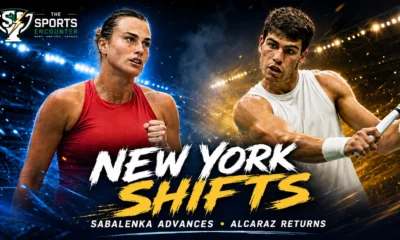

Sabalenka Restores Order at US Open as Alcaraz Begins Long-Awaited New York Comeback
Aryna Sabalenka began her bid for a third straight US Open title with a 6-4, 6-4 win over Camila Osorio,...
-

 Editor's Choice4 weeks ago
Premier League 2026–27 Curtain Raiser: Fixtures, Teams, Title Contenders, Transfers and Season Predictions
-
Editor's Choice4 weeks ago
When Will Lionel Messi Retire? Argentina President Says Only Messi Has the Answer
-

 Editor's Choice3 weeks ago
Which of Last Season’s Premier League Top 10 Can Actually Win the 2026-27 Title?