
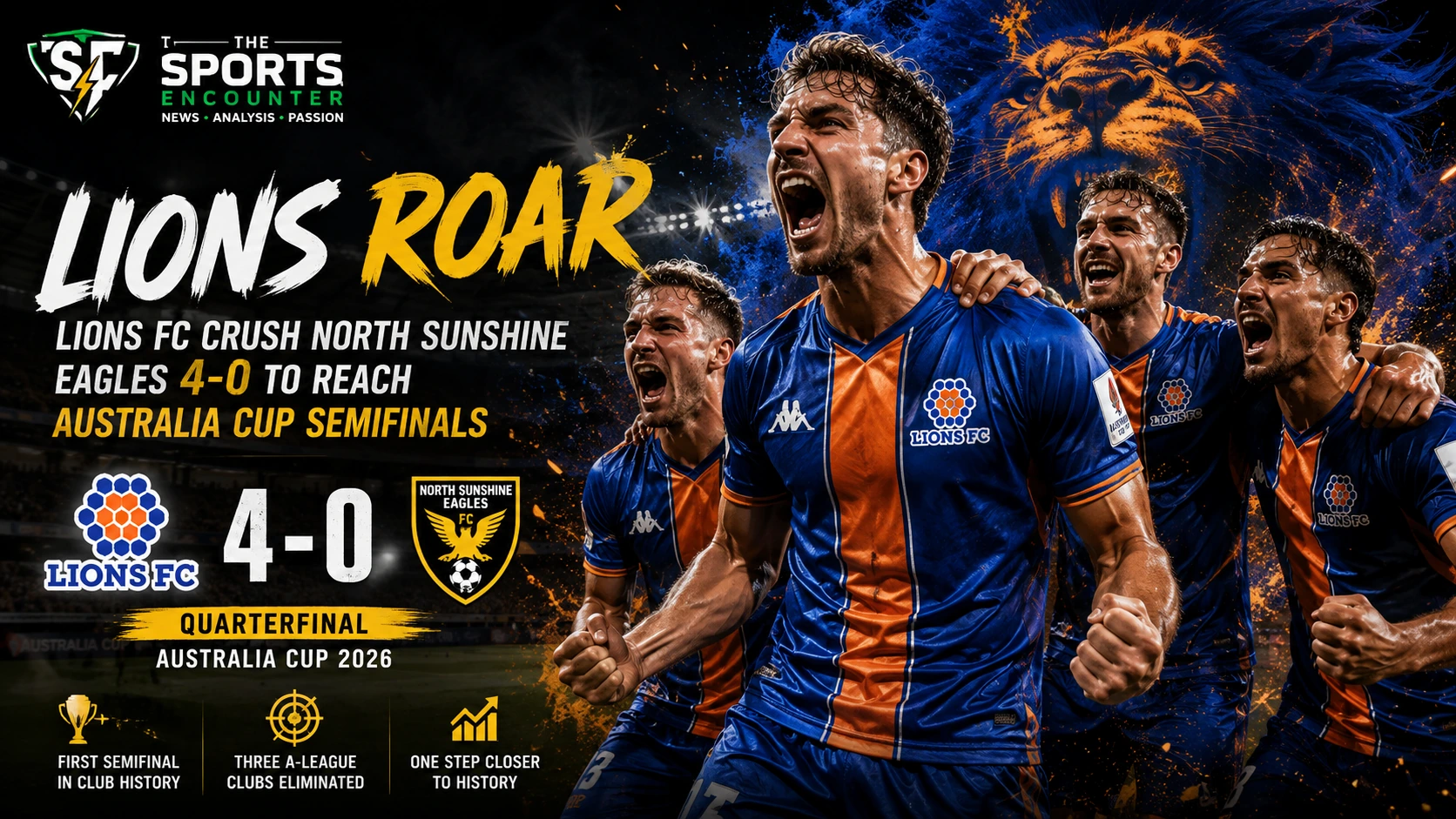
Lions FC Destroy North Sunshine Eagles 4-0 as Australia Cup Fairytale Ends
Lions FC powered into the Hahn Australia Cup 2026 semifinals with a 4-0 win over North Sunshine Eagles, ending the tournament’s standout underdog run.

Lions FC are through to the Hahn Australia Cup 2026 semifinals after overwhelming North Sunshine Eagles 4-0 at Luxury Paints Stadium, ending one of the competition’s great underdog runs and moving the Queensland club within one victory of the final.
North Sunshine Eagles had spent the past month proving that knockout football could bend around them. They won away from home on their national-stage debut, survived 120 scoreless minutes against the previous season’s finalists and watched goalkeeper Rory Brian repeatedly rescue their campaign when elimination appeared close.
Lions FC never allowed this quarterfinal to develop into that kind of contest.
The NPL Queensland side attacked the match aggressively, converted their superiority into a commanding advantage and completed a 4-0 victory that sends them into the Australia Cup semifinals for the first time.
Football Australia’s official Australia Cup match report confirmed the comprehensive victory and Lions’ progression to the final four.
For readers who followed this matchup from the beginning, The Sports Encounter’s Lions FC vs North Sunshine Eagles quarterfinal preview identified the central danger before kickoff: if North Sunshine could survive the early pressure, the psychology of the match might begin shifting toward the underdogs.
Lions made sure that never happened.
Lions FC 4-0 North Sunshine Eagles: Match at a Glance
| Detail | Information |
|---|---|
| Competition | Hahn Australia Cup 2026 |
| Round | Quarterfinal |
| Result | Lions FC 4-0 North Sunshine Eagles |
| Venue | Luxury Paints Stadium, Queensland |
| Lions FC level | NPL Queensland |
| North Sunshine Eagles level | VPL1 |
| Outcome | Lions FC advance to Australia Cup semifinals |
| Semifinal opponent | Winner of Preston Lions vs South Melbourne |
The Cup Match North Sunshine Needed Never Developed
The most revealing part of the result is not simply that Lions scored four goals.
It is how completely they removed the conditions that had allowed North Sunshine to become one of the stories of the tournament.
The Eagles’ Round of 16 victory against Heidelberg United had been built around survival, patience and the gradual accumulation of belief.
They remained scoreless for 120 minutes against the 2025 finalists, survived an 80th-minute penalty and eventually won 4-3 in the shootout after Rory Brian produced an extraordinary goalkeeping performance.
The official Australia Cup account of the Heidelberg upset recorded Brian saving the regulation-time penalty and another two during the shootout.
That victory gave North Sunshine a psychological blueprint for the quarterfinal.
Stay alive. Absorb pressure. Let the favorite become frustrated. Give Brian opportunities to make saves. Wait for the game to become emotionally uncomfortable.
Lions destroyed that blueprint by making their superiority count early enough that North Sunshine never reached the stage where belief could begin influencing the contest.
TSE Analysis: Lions Learned the Most Important Lesson From Heidelberg
The warning signs were available before kickoff.
Heidelberg had discovered what happens when a stronger side allows North Sunshine to remain alive.
Even after the Eagles failed to create sustained attacking pressure, the longer the score remained level, the more dangerous the tie became for the favorite. By the time penalties arrived, North Sunshine were competing in precisely the environment they wanted.
Lions approached the problem differently.
They did not treat possession as control by itself. They used territorial pressure to force North Sunshine deeper and then turned that pressure into goals rather than allowing the visitors to settle into another defensive marathon.
That distinction explains why this quarterfinal became so different from the Heidelberg match.
The Eagles could survive without much of the ball.
They could not survive while conceding repeatedly.
Lions FC Are No Longer a Cute Australia Cup Story
There is another reason this 4-0 result deserves attention.
Lions FC have now eliminated Perth Glory, Melbourne City and North Sunshine Eagles during their national-round campaign.
The first victory required penalties.
The second was a 2-0 win against Melbourne City.
The third has produced four unanswered goals in an Australia Cup quarterfinal.
That progression matters.
Lions initially demonstrated that they could survive against professional opposition. They then showed they could beat an A-League side in regulation. Now they have handled the pressure of entering a national quarterfinal as favorites.
Those are three very different knockout tests.
The Sports Encounter highlighted that development in our quarterfinal analysis before the match, noting that the 2-0 victory over Melbourne City had changed the meaning of Lions’ campaign.
This result changes it again.
Being Favorites Created a Different Kind of Pressure
Against Perth Glory and Melbourne City, Lions could embrace the role normally occupied by Member Federation clubs in the Australia Cup.
The professional team carried the expectation.
Lions could attack the opportunity.
North Sunshine reversed that dynamic.
Suddenly Lions were the established NPL leaders playing at home against a club from Victoria’s second state tier. Their previous Cupsets meant very little once they became the team expected to progress.
That can be an uncomfortable transition for an underdog.
Some teams thrive when they have nothing to lose but become hesitant once they are asked to control a knockout match.
Lions showed no such hesitation.
The 4-0 scoreline is therefore evidence of more than attacking quality. It shows a team capable of changing psychological roles without losing its football identity.
North Sunshine’s Fairytale Deserves More Than the Final Score
A four-goal defeat is a brutal ending, but it should not become the defining image of North Sunshine’s tournament.
The Eagles were making their first appearance on the national stage.
They opened by traveling to South Australia and defeating FK Beograd 3-2 in a match where all five goals arrived after halftime.
Football Australia’s official Round of 32 review documented that breakthrough victory, which immediately gave North Sunshine a place in the national tournament’s wider story.
Then came Heidelberg.
The Eagles faced the 2025 finalists, survived extra time and became only the second second-tier Member Federation club in Australia Cup history to reach the final eight.
That achievement cannot be erased by what happened in Queensland.
North Sunshine arrived at the quarterfinal because they repeatedly earned the right to be there.
Rory Brian Finally Met a Problem Goalkeeping Could Not Solve
Brian entered the quarterfinal as arguably the most important individual player in North Sunshine’s run.
Against Heidelberg, he had saved a penalty during regulation and another two in the shootout.
That performance created a fascinating question before the Lions match.
Could he keep North Sunshine alive long enough for doubt to creep into the home side?
The answer was no, but that should not be interpreted as a failure of the goalkeeper.
A keeper can rescue a team from individual chances. It becomes considerably harder when the opponent establishes sustained attacking control and repeatedly reaches dangerous areas.
North Sunshine needed the entire defensive structure to survive.
Lions broke it.
The 4-0 Result Stands Apart From the Other Quarterfinals
The first three Australia Cup quarterfinals have produced three very different routes into the semifinals.
Sydney FC became the first team through after Takahiro Sekine’s goal secured a tense 1-0 victory over SD Raiders. The Sports Encounter covered how the NPL NSW side made the A-League club work for almost every minute in our Sydney FC vs SD Raiders quarterfinal report.
Melbourne Victory required even more patience.
APIA Leichhardt kept them scoreless through 90 minutes before substitute Harry Sawyer finally found the breakthrough in extra time. Our Melbourne Victory vs APIA Leichhardt report examined how Victory survived a genuine knockout test before securing their semifinal place.
Lions have taken the opposite route.
They have produced the most emphatic quarterfinal result of the tournament so far.
Australia Cup 2026 Semifinal Picture
| Quarterfinal | Result/Status | Semifinal Outcome |
|---|---|---|
| SD Raiders vs Sydney FC | Sydney FC won 1-0 | Sydney FC advanced |
| APIA Leichhardt vs Melbourne Victory | Melbourne Victory won 1-0 after extra time | Melbourne Victory advanced |
| Lions FC vs North Sunshine Eagles | Lions FC won 4-0 | Lions FC advanced |
| Preston Lions vs South Melbourne | August 26 | Winner faces Lions FC |
The semifinal bracket has therefore begun taking shape.
Sydney FC and Melbourne Victory will meet in one semifinal, creating a heavyweight A-League contest after both professional clubs survived difficult quarterfinals.
Lions FC will face the winner of Preston Lions vs South Melbourne in the other semifinal.
Lions Are Guaranteed a Member Federation Semifinal
The structure of the remaining bracket makes Lions’ achievement even more interesting.
Preston Lions and South Melbourne are both Member Federation clubs.
Whoever emerges from that final quarterfinal will meet Lions rather than an A-League opponent.
That guarantees a Member Federation club a place in the 2026 Australia Cup final.
For Lions, the opportunity is enormous.
They have already beaten two professional opponents, but their route to the final will now run through another club outside the A-League.
That does not make the semifinal easy.
It makes it historic.
Preston Lions vs South Melbourne Now Carries Another Layer
The final quarterfinal on August 26 will determine who travels into the other side of the semifinal bracket.
Preston have already produced one of the tournament’s major Cupsets by eliminating 2025 Australia Cup winners Newcastle Jets before later defeating Brunswick Juventus 4-1.
South Melbourne have their own giant-killing credentials after eliminating Adelaide United.
Either opponent will arrive against Lions with evidence that they can survive national knockout football.
That means Lions cannot interpret the 4-0 quarterfinal as proof that the semifinal will follow the same pattern.
The challenge changes again.
The Sydney FC-Melbourne Victory Semifinal Creates a Fascinating Contrast
One half of the bracket will contain two of Australia’s biggest professional clubs.
The other will guarantee a Member Federation finalist.
That is close to an ideal Australia Cup semifinal structure.
Sydney and Victory bring A-League history, professional squads and one of Australian football’s most recognizable rivalries.
The Sports Encounter’s APIA vs Melbourne Victory quarterfinal preview had already identified the possibility of a Sydney-Victory semifinal before Victory survived at Leichhardt Oval.
Now it is confirmed.
On the opposite side, Lions and either Preston or South Melbourne will carry the Member Federation game to within 90 minutes of the trophy match.
Why Lions’ Route Matters to the Australia Cup
The Australia Cup works best when the national hierarchy becomes temporarily negotiable.
That does not mean every A-League club needs to lose.
It means clubs from different levels need a credible route to competing with one another.
Lions have provided one of the clearest examples in 2026.
Perth Glory could not eliminate them.
Melbourne City could not eliminate them.
North Sunshine could not turn the quarterfinal into another underdog survival story.
Now Lions are one match away from the final.
The tournament’s official fixtures and results center will confirm the final semifinal matchup once Preston Lions and South Melbourne complete the quarterfinal stage.
The Continental Prize Is Getting Closer
The stakes also extend beyond the Australia Cup trophy.
The competition provides a pathway into Asian football, which gives the later rounds unusual significance for Member Federation clubs.
For an A-League team, continental competition is part of the professional ecosystem.
For a club such as Lions FC, the possibility of reaching that environment would carry an entirely different scale of sporting significance.
The Sports Encounter has followed Asian soccer beyond Australia throughout the season, including the growing influence of the AFC within global football’s changing power structure.
Lions are still several steps away from turning their Cup run into continental football.
After Tuesday night, however, those steps no longer feel theoretical.
TSE Verdict: Lions Solved the Problem Before It Became Dangerous
The most impressive part of Lions’ quarterfinal was their refusal to allow North Sunshine’s previous achievements to dictate the emotional shape of the match.
The Eagles had already demonstrated that they could survive pressure.
They had shown they could win away from home.
They had beaten the previous year’s finalists.
They had a goalkeeper who had already changed one knockout tie almost single-handedly.
All of that became dangerous only if Lions allowed the game to remain close.
They did not.
That is the difference between simply being the stronger team and performing like one when elimination is possible.
Lions have now survived penalties against Perth Glory, beaten Melbourne City in regulation and demolished North Sunshine while carrying the expectation of favoritism.
Three knockout rounds have asked three different questions.
So far, Lions have answered every one.
What Happens Next?
Lions FC can now watch Wednesday’s final quarterfinal knowing exactly what awaits.
Preston Lions or South Melbourne will stand between them and the Australia Cup final.
Sydney FC and Melbourne Victory occupy the other side of the semifinal bracket.
For North Sunshine Eagles, the national run ends after two victories, one unforgettable penalty shootout and a first appearance that took them further than almost anyone could reasonably have expected.
The Sports Encounter will continue following the tournament through the final quarterfinal and both semifinals as the 2026 Australia Cup moves toward its decisive stage.
Frequently Asked Questions
Who won Lions FC vs North Sunshine Eagles?
Lions FC defeated North Sunshine Eagles 4-0 in the Hahn Australia Cup 2026 quarterfinal at Luxury Paints Stadium.
Did Lions FC reach the Australia Cup semifinals?
Yes. The victory sends Lions FC into the Australia Cup semifinals for the first time.
Who will Lions FC play in the semifinal?
Lions FC will face the winner of the Preston Lions vs South Melbourne quarterfinal.
Who are the other Australia Cup semifinalists?
Sydney FC and Melbourne Victory have already qualified and will face each other in one semifinal.
How did North Sunshine Eagles reach the quarterfinal?
North Sunshine defeated FK Beograd 3-2 in the Round of 32 before eliminating 2025 finalists Heidelberg United 4-3 on penalties following a 0-0 draw after extra time.
Was this North Sunshine Eagles’ first Australia Cup national-stage campaign?
Yes. The Eagles won two matches during their first appearance on the national stage before their run ended against Lions FC.
Which A-League clubs have Lions FC beaten in the 2026 Australia Cup?
Lions eliminated Perth Glory on penalties in the Round of 32 and then defeated Melbourne City 2-0 in the Round of 16.
What was the biggest Australia Cup quarterfinal win so far in 2026?
Lions FC’s 4-0 victory over North Sunshine Eagles is the largest winning margin through the first three quarterfinals.
When is Preston Lions vs South Melbourne?
The final Australia Cup 2026 quarterfinal is scheduled for August 26, with the winner advancing to face Lions FC.





Breaking News
LA28 Press Accreditation Opens August 31 as Global Media Race for 6,000 Olympic Places Begins
The LA28 Olympic press accreditation process opens on August 31, 2026, with a global quota of 6,000 “E” press accreditations. Media organisations have until October 23 to submit an expression of interest through the IOC process, with National Olympic Committees responsible for assessing and allocating places in their territories.


LOS ANGELES: The first serious global competition connected to the Los Angeles 2028 Olympic Games will begin long before athletes start chasing medals.
On August 31, media organisations around the world will begin competing for something equally important to their work: access.
The International Olympic Committee has confirmed that the press accreditation process for the LA28 Olympic Games will open on August 31, 2026, with written press, photographers and non-rights-holding television and radio organisations given until October 23 to submit an expression of interest.
According to the IOC’s official LA28 press accreditation announcement, only 6,000 “E” press accreditations will be available globally.
That number immediately gives the process wider significance.
The Olympics attract thousands of news organisations, agencies, photographers, broadcasters and specialist publishers from almost every corner of the world. Six thousand press places may sound substantial by ordinary sporting standards, but LA28 will bring together one of the largest international media operations in sport.
There is another important distinction. Media organisations will not simply submit an application to the IOC and wait for approval. Expressions of interest will be handled by the National Olympic Committee in the country or territory where each organisation is based. Those NOCs will assess applications and allocate available press accreditations within their respective territories.
Submitting an expression of interest does not guarantee accreditation.
For publishers hoping to report from Los Angeles in 2028, the Olympic journey therefore begins almost two years before the Opening Ceremony.
LA28 Press Accreditation: Key Dates and Details
| Item | Detail |
|---|---|
| Expression-of-interest process opens | August 31, 2026 |
| Deadline | October 23, 2026 |
| Olympic Games dates | July 14-30, 2028 |
| Available “E” press accreditations | 6,000 globally |
| Eligible media | Written press, photographers and non-rights-holding television and radio organisations |
| Initial process | Expression of interest through the Press Registration Portal |
| Who manages applications? | National Olympic Committee in the organisation’s country or territory |
| Does submission guarantee accreditation? | No |
| Who provides application updates? | The relevant National Olympic Committee |
| Olympic Main Press Center | NFL Los Angeles at Hollywood Park, Inglewood |
The First LA28 Race Is a Media Race
The Olympic Games do not begin in Los Angeles until July 14, 2028, but international sports journalism cannot operate on that calendar.
Publishers hoping to cover the Games from inside competition venues have to begin planning now.
The IOC’s accreditation process creates one of the first major institutional deadlines of the LA28 cycle. Media organisations have fewer than two months, from August 31 through October 23, to register their interest in covering an Olympic Games still almost two years away.
That long lead time reflects the scale of Olympic journalism.
Accredited media need access to competition venues, press tribunes, mixed zones, interview areas, press conferences, photography positions, transportation systems and Games-time working facilities.
Thousands of journalists will arrive in Southern California representing different countries, languages, audiences and publishing models.
The IOC therefore has to begin allocating that access long before many Olympic qualification campaigns are complete and before most national teams are known.
The IOC Has Set a Global Quota of 6,000 Press Accreditations
The number likely to attract the greatest attention from publishers is 6,000.
The IOC has established a quota of 6,000 “E” press accreditations for LA28.
Those places will be distributed to press organisations through National Olympic Committees across their respective territories.
🚨Information for the media 🚨
— IOC MEDIA (@iocmedia) August 26, 2026
With less than 2 years to go until @LA28, the press accreditation process begins next week.
Applications open 31 Aug and close 23 Oct 2026. Key information and details are available on the dedicated webpage. 👇
🔗https://t.co/AKIS7Hai14 pic.twitter.com/MaSiLiny9U
The figure is large compared with almost any ordinary sporting event, but the Olympics operate on a completely different scale.
International news agencies will apply. National newspapers and broadcasters will apply. Specialist sports publications, photographers, digital publishers and other established media organisations will also seek access.
That creates competition even before the allocation process begins.
The IOC says its objective is to create a fair and efficient accreditation system that supports comprehensive global coverage while maintaining a professional working environment for accredited press.
For publishers, however, the practical reality is simple: there are more organisations capable of covering the Olympic Games than there are available press accreditations.
National Olympic Committees Hold the Key
One of the most important operational details in the IOC announcement concerns who actually makes the territorial allocation decisions.
Expressions of interest submitted through the Press Registration Portal will be received and managed by the National Olympic Committee in the country or territory where the media organisation is based.
The NOCs remain responsible for assessing applications and allocating available press accreditations.
That means there is no single global queue where every publisher competes under exactly the same circumstances.
A Pakistani sports publisher will enter the process through the relevant Olympic structure in Pakistan. A British publisher will work through its own NOC system. The same principle applies across every participating territory.
National demand, available allocations and local procedures may therefore vary.
The IOC has specifically advised media organisations to contact their relevant NOC for information about the process, territorial timelines and updates on individual applications.
The IOC and LA28 Organising Committee will not provide individual application-status updates.
An Expression of Interest Is Not an Accreditation
This distinction deserves particular attention because it can easily disappear in headlines about the process opening.
August 31 does not begin an automatic registration system in which every eligible publisher receives access.
It begins the expression-of-interest stage.
The IOC explicitly states that submitting an expression of interest does not guarantee accreditation for the LA28 Olympic Games.
Media organisations should therefore approach the process as a competitive allocation exercise rather than an administrative formality.
The IOC has published further guidance through its dedicated LA28 press accreditation page, which will serve as the central reference point for accreditation guidelines, timelines and deadlines.
LA28 Coverage Has Already Started Long Before 2028
For sports publishers, there is another reason the accreditation process feels timely.
The LA28 story is already developing.
Olympic qualification has begun in some sports, while others are establishing competitive structures, qualification pathways and international rivalries that will eventually lead directly into Los Angeles.
Flag football provides one of the clearest examples.
The Sports Encounter has already mapped the qualification pathway for Olympic flag football, where only six men’s and six women’s teams will ultimately compete at LA28.
The 2026 IFAF Flag Football World Championships also changed the competitive landscape, with Canada, Mexico, Italy, American Samoa and other nations showing why Team USA cannot assume Olympic dominance.
Those are LA28 stories even though the Games remain almost two years away.
The same will increasingly become true across cricket, squash, lacrosse, baseball, softball and established Olympic sports as qualification systems develop.
New Olympic Sports Will Demand Specialist Knowledge
Los Angeles 2028 will be particularly demanding for newsrooms because several sports will either debut or return to the Olympic program.
Flag football and squash will make their Olympic debuts. Cricket will return to the Games after an absence of more than a century, while baseball, softball and lacrosse will also appear on the LA28 program.
That creates an obvious challenge for generalist media organisations.
Readers will need more than medal results.
They will need rules explained, qualification systems understood, athletes introduced and tactical differences clarified before competition begins.
The Sports Encounter has already started developing that knowledge base around flag football through its complete beginner’s guide to Olympic flag football rules, scoring and positions.
We have also examined why NFL experience will not automatically translate into Olympic flag football success, because the five-on-five format demands a different tactical skill set.
That is the type of reporting that establishes expertise before an Olympic event suddenly attracts a global audience.
Accreditation Gives Access, but Expertise Has to Come First
An Olympic accreditation can take a journalist closer to the story.
It cannot create knowledge overnight.
This may become particularly important for specialist and independent sports publishers seeking a place within the Olympic media ecosystem.
A newsroom that has followed an Olympic sport for two years will arrive with context that cannot be recreated by reading a briefing document on the morning of competition.
It will already understand the athletes, qualification battles, tactical evolution and major international rivalries.
For example, TSE’s tactical analysis of Olympic flag football goes beyond the basic absence of tackling and examines spacing, blitz structures, no-run zones, motion and route combinations.
Our guide to the international players already shaping Olympic flag football similarly focuses on the athletes building the sport before NFL stars fully enter the LA28 conversation.
That editorial groundwork matters whether a publisher ultimately receives accreditation or covers the Games remotely.
The Main Press Center Is Already Confirmed
LA28 has also decided where much of the Games-time media operation will be based.
NFL Los Angeles at Hollywood Park in Inglewood will serve as the Main Press Center for the 2028 Olympic Games.
The facility is the NFL’s West Coast headquarters and will become a central working hub for thousands of accredited media professionals.
According to LA28’s official Main Press Center announcement, the venue will support media workspaces while also handling operational services including accreditation, transportation and ticketing support.
The location places the Olympic press operation inside one of Southern California’s major sports and entertainment districts.
For journalists who receive accreditation, Hollywood Park will effectively become one of the largest temporary sports newsrooms in the world during the Games.
Los Angeles Will Host the Olympics for the Third Time
LA28 will also carry unusual historical weight.
Los Angeles previously hosted the Olympic Games in 1932 and 1984. When the Games return in 2028, the city will become only the third to stage the Summer Olympics three times.
The Olympic competition is officially scheduled for July 14-30, 2028.
The location adds another layer to the media interest.
Los Angeles sits at the intersection of elite sport, entertainment, technology and global celebrity culture. The region already hosts major franchises across the NFL, NBA, MLB, NHL and MLS, while Hollywood gives the city a media infrastructure unlike almost any previous Olympic host.
LA28 storylines are already reaching beyond traditional Olympic sports.
The question of whether LeBron James could appear at another Olympic Games has already generated debate, despite the basketball tournament remaining two years away.
Meanwhile, Ben Simmons has identified LA28 as part of his longer-term international basketball ambitions with Australia.
Those stories demonstrate how quickly the next Olympic cycle is taking shape.
The Accreditation Deadline Arrives Before Most Olympic Teams Exist
There is an interesting contradiction built into the process.
Press organisations must register their interest by October 23, 2026.
Many of the athletes they may ultimately travel to cover will not qualify for the Olympics until 2027 or 2028.
Some national teams will not be finalized until only weeks before the Games.
Injuries, rankings, qualification tournaments and selection decisions will dramatically change which athletes and sports generate the greatest interest.
Publishers are therefore entering the accreditation process based on their institutional case for covering LA28 rather than a fully known Games-time editorial plan.
That places greater value on a demonstrable history of sports journalism, consistent publication, professional standards and relevant Olympic coverage.
Why the August 31 Date Matters for Independent Sports Publishers
For established international agencies and national broadcasters, Olympic accreditation is a familiar institutional process.
For growing specialist publishers, the situation can be more consequential.
The 6,000-place quota means access cannot be determined by interest alone.
Smaller organisations have to show why their presence contributes something useful to Olympic coverage.
That contribution can come through specialist expertise, audiences underserved by larger publications, geographical relevance, strong digital reach or a consistent editorial record around particular sports.
Scale therefore matters, but it is not the only measure of journalistic value.
A specialist publication that understands a sport deeply can produce coverage that a much larger general newsroom may struggle to replicate.
That is particularly true at an Olympics containing more than 30 sports and hundreds of separate medal events.
Olympic Journalism Will Extend Far Beyond Accredited Venues
Publishers that do not receive one of the 6,000 accreditations will still have substantial opportunities to cover LA28.
Qualification tournaments, rankings, national-team selections, injuries, athlete interviews, tactical analysis, records and broader Olympic developments can all be reported without Games-time venue accreditation.
Accreditation provides physical access.
Editorial authority comes from the reporting itself.
The distinction matters because the modern Olympic audience does not consume coverage through one traditional channel.
Fans discover individual stories through search engines, social media, Google News, newsletters, video platforms and increasingly through AI-assisted search and discovery systems.
A publisher that establishes authority around an Olympic sport before 2028 can therefore become part of the global conversation even without matching the scale of the world’s largest media organisations.
What Media Organisations Need to Do Now
The immediate process begins on August 31.
Eligible organisations seeking LA28 press accreditation should submit an expression of interest through the IOC Press Registration Portal before October 23.
They should also consult the official IOC press release and dedicated accreditation guidance before submitting.
Media organisations should then communicate with the relevant National Olympic Committee about local procedures, timelines and the status of their application.
The IOC and LA28 will not provide individual application updates.
Most importantly, organisations should remember the wording used by the IOC itself.
An expression of interest is the beginning of the process. It is not a guarantee of Olympic accreditation.
The Final Word: LA28 Has Already Started for the World’s Newsrooms
The Olympic flame will not be lit in Los Angeles until July 2028, but for the world’s sports media, LA28 is already becoming an operational reality.
The IOC will open the expression-of-interest process on August 31 and close it on October 23. A global quota of 6,000 “E” press accreditations will be distributed through National Olympic Committees, with those committees responsible for assessing applications within their respective territories.
That process tells us something important about modern Olympic coverage.
The journalism cannot begin when the Opening Ceremony does.
Publishers have to understand qualification systems, identify emerging athletes, build expertise in new Olympic sports and establish credible coverage long before their reporters arrive in Los Angeles.
For the biggest international media organisations, this is part of a familiar Olympic cycle.
For specialist and growing sports publishers, it is an opportunity to demonstrate that meaningful Olympic journalism also comes from publications that identify stories early, understand individual sports deeply and serve audiences that deserve comprehensive coverage.
The athletes are already trying to reach LA28.
Starting August 31, the media organisations hoping to tell their stories from inside the Games begin their own journey toward Los Angeles.
Frequently Asked Questions
When does LA28 press accreditation open?
The IOC’s expression-of-interest process opens on August 31, 2026.
When is the LA28 press accreditation deadline?
Eligible media organisations must submit their expression of interest by October 23, 2026.
How many LA28 press accreditations are available?
The International Olympic Committee has established a global quota of 6,000 “E” press accreditations for the 2028 Olympic Games.
Who can apply for LA28 press accreditation?
The process announced by the IOC covers written press, photographers and non-rights-holding television and radio organisations.
How do media organisations apply?
Eligible organisations must submit an expression of interest through the IOC Press Registration Portal during the August 31 to October 23 application window.
Does submitting an expression of interest guarantee accreditation?
No. The IOC explicitly states that submitting an expression of interest does not guarantee accreditation for LA28.
Who decides which media organisations receive LA28 accreditation?
The National Olympic Committee in the country or territory where the press organisation is based will assess applications and allocate available press accreditations.
Who should media organisations contact about their application?
They should contact their relevant National Olympic Committee. The IOC and LA28 Organising Committee will not provide updates on individual applications.
When will the Los Angeles 2028 Olympic Games take place?
The LA28 Olympic Games are scheduled for July 14-30, 2028.
Where will the LA28 Olympic Main Press Center be located?
NFL Los Angeles at Hollywood Park in Inglewood will serve as the Main Press Center for the 2028 Olympic Games.
What does an “E” accreditation mean at the Olympics?
The “E” category is the Olympic press accreditation category referenced by the IOC for press organisations covering the Games. The IOC has allocated 6,000 of these accreditations for LA28.
Breaking News
First Brydon Carse, Now Raheem Sterling: What’s Wrong with English Sportsmen?
Brydon Carse ended up in police handcuffs while Raheem Sterling now faces dangerous-driving and other charges. Their cases are legally different, but together they raise a wider question about whether professionalism among elite English sportsmen is carrying far enough beyond the playing arena.


LONDON: Brydon Carse should have been preparing for England’s second Test against Pakistan at Lord’s. Instead, images of the 31-year-old fast bowler in police handcuffs outside a Derby nightclub became one of the biggest stories surrounding the team.
Three days later, another 31-year-old English sports star appeared in a very different kind of headline.
Former England footballer Raheem Sterling was charged with dangerous driving, possession of nitrous oxide for wrongful inhalation and failing to provide a specimen following a single-vehicle collision involving a Lamborghini on the M3 in May.
No injuries were reported in Sterling’s crash. Carse was released without charge after the Derby incident. Their legal situations are therefore very different and must be treated that way.
The professional question connecting them is harder to avoid.
Two high-profile English sportsmen, both old enough and experienced enough to understand the consequences of their actions, have within days become the subject of serious off-field stories that raise legitimate questions about judgment, personal responsibility and what professionalism actually means once an athlete leaves the stadium.
Carse ended a celebration in handcuffs and lost his place in an England Test squad while the Cricket Regulator investigates. Sterling now faces three criminal charges and a court appearance on September 15.
These are not academy teenagers learning how fame works.
They are established international sportsmen who have spent years inside some of the most sophisticated professional environments in world sport.
That is precisely why the question deserves asking.
Brydon Carse and Raheem Sterling: Two Very Different Cases, One Professional Question
| Issue | Brydon Carse | Raheem Sterling |
|---|---|---|
| Age | 31 | 31 |
| Sport | Cricket | Football |
| Latest incident | Seen in police handcuffs outside a Derby nightclub | Charged following an M3 motorway collision |
| Legal status | Released without charge | Charged with three offences, not convicted |
| Professional consequence | Removed from England squad for second Pakistan Test | Faces court hearing while currently without a club |
| Next step | Cricket Regulator investigation | Basingstoke Magistrates’ Court on September 15 |
Carse Managed to Turn an England Victory Into Another Conversation About Behaviour
The timing of the Carse episode made it especially damaging.
England had just beaten Pakistan by an innings and 103 runs at Headingley, giving Joe Root a commanding victory at the beginning of his second spell as permanent Test captain.
The cricket should have dominated the build-up to Lord’s.
Instead, Root found himself answering questions about another late-night incident involving an England player.
Carse had been released from the England group to represent Durham against Derbyshire in the County Championship. Durham won comfortably, and the players went out afterward.
Footage then emerged showing Carse outside a Derby nightclub with his hands cuffed behind his back while police officers surrounded him.
Reports subsequently confirmed that he was released without charge.
The ECB responded by referring the matter to the Cricket Regulator and making Carse unavailable for the second Test against Pakistan while the facts are established. Sonny Baker replaced him in the squad.
That response matters.
Carse may ultimately face no criminal consequences from what happened in Derby. England still decided that the circumstances were serious enough to remove a centrally contracted international player from Test selection.
Professional sport has standards that extend beyond criminal law.
A player does not have to be convicted of an offence before an employer or governing body decides that his conduct has become damaging, distracting or inconsistent with the standards expected of an international representative.
Joe Root Said What Many Supporters Were Already Thinking
Root’s reaction stripped away any attempt to treat Carse’s situation as a harmless night out that simply attracted too much attention.
The England captain said he was “hacked off” and disappointed.
More importantly, he identified the wider problem.
“We continually keep making stupid mistakes away from the game and it’s detracting from what we’re doing on the field.”
That sentence should sit at the center of this discussion.
Root was not complaining about hostile journalists, social media or intrusive cameras.
He was talking about the decisions being made by his own players.
England had already spoken internally about standards. Root had publicly emphasized the importance of building a culture people could respect. The team had entered the Pakistan series attempting to reset after the turmoil that ended the previous leadership era.
The Sports Encounter’s England vs Pakistan series preview framed Root’s return around the need to restore judgment and stability after England’s cricket had become increasingly chaotic.
Our Headingley first-Test analysis made the same point more directly: England had enough talent, but could no longer afford to waste credibility.
They then won emphatically.
Within hours, Carse gave Root another off-field problem.
Being Off Duty Does Not Remove Professional Responsibility
One defense has appeared repeatedly around the Carse incident: he was not representing England when it happened.
That is factually true.
He had played for Durham and was celebrating a county victory.
It does not make the professional issue disappear.
Carse remains an England international and centrally contracted cricketer whose next scheduled assignment was an international Test match.
The standards attached to elite sport cannot realistically switch on at the dressing-room door and disappear when a player changes clothes.
A doctor remains responsible for serious professional misconduct outside a hospital. A senior executive can damage a company through behavior that happens away from the office. A politician does not become completely detached from public standards because Parliament has finished for the evening.
Elite athletes occupy a similar space.
They deserve private lives. They deserve holidays, dinners, celebrations and nights out.
Personal freedom still carries consequences when private choices develop into police involvement, disciplinary investigations or headlines that drag teammates and national organisations into the story.
Carse’s loss of selection demonstrates that reality more clearly than any lecture on professionalism could.
Carse Had Already Received One Serious Lesson About Responsibility
The Derby incident also carries extra weight because Carse has previously been through a formal disciplinary process.
In 2024, he received a 16-month suspension, with 13 months suspended, after admitting to placing 303 bets on cricket between 2017 and 2019.
The regulator found no evidence that he bet on matches in which he participated and found no wider integrity concerns. Carse cooperated with the investigation and served three months away from cricket.
The Cricket Regulator’s official ruling made clear that his cooperation and remorse were considered in determining the sanction.
The betting case has no factual connection to what happened in Derby and should not be presented as though it does.
It remains relevant to the question of professional judgment.
Carse already knows what it feels like for an off-field decision to remove cricket from his life.
He rebuilt his standing, returned to the England side and developed into an important bowler.
Only weeks ago, Carse was producing one of The Hundred’s strongest bowling performances for SunRisers Leeds.
Now another non-cricket episode has again removed him from an England squad.
At some point, experience has to become judgment.
Carse Is Hardly the First Warning England Cricket Has Received
This would be easier to dismiss if Carse’s case existed by itself.
England cricket has spent much of the past year discussing behaviour away from the field.
Harry Brook was fined around £30,000 and placed on a final warning after an incident involving a nightclub bouncer in Wellington during England’s tour of New Zealand.
Brook later acknowledged that he had stayed out too late and accepted responsibility for putting himself in the situation.
Ben Stokes and Gus Atkinson were subsequently suspended after breaking England’s midnight curfew following another nightclub episode during the New Zealand Test series.
The ECB later introduced additional player-behaviour guidelines covering curfews, public intoxication and the requirement to inform management when players remain away from the hotel late at night.
Stokes himself has acknowledged the wider cultural issue. Speaking after his retirement, he argued that cricket has retained a deeply embedded relationship with alcohol even as almost every other aspect of the game has become more professional.
That is a significant admission from someone who spent years leading England.
Our recent look at Stokes’ potential future as an England coach focused heavily on leadership and responsibility because those questions have become impossible to separate from England’s next era.
The end of his playing career had already arrived alongside wider questions over direction and discipline, as explored when New Zealand completed its series comeback at Trent Bridge.
Carse’s handcuffs therefore landed in a dressing room that had already been warned, disciplined, briefed and given new rules.
That makes the incident harder to excuse as simple naivety.
Then Raheem Sterling Put English Football Into the Same Conversation
Sterling’s situation is legally more serious.
Hampshire and Isle of Wight Constabulary said the former England forward has been charged following a single-vehicle collision involving a Lamborghini on the M3 southbound near the Minley Interchange on May 28.
The 31-year-old faces charges of dangerous driving, possession of nitrous oxide for wrongful inhalation and failing to provide a specimen.
No other vehicle was involved and no injuries were reported.
Sterling is due to appear at Basingstoke Magistrates’ Court on September 15.
Those remain allegations until the court process determines otherwise. Sterling has not been convicted of the offences.
The reported police charges against Sterling nevertheless create a legitimate professionalism issue before any verdict is reached.
Dangerous driving is not a football mistake.
Failing to provide a specimen is not a tactical decision.
Possession of nitrous oxide for wrongful inhalation has nothing to do with a poor first touch or a badly timed run.
These are allegations concerning an adult’s choices away from football.
That is exactly why the case belongs in a broader discussion about athletes and personal responsibility.
Sterling Has Spent Most of His Adult Life Inside Elite Football
Sterling has experienced professional sport at its highest level since he was a teenager.
He came through Queens Park Rangers, made his senior Liverpool debut at 17, moved to Manchester City and developed into one of the Premier League’s leading attackers under Pep Guardiola.
He won four Premier League titles with City and became one of Gareth Southgate’s most important England players.
Sterling earned 82 senior England caps and scored 20 international goals. He played a major role in England’s run to the 2018 World Cup semifinal and the Euro 2020 final.
His career later took him to Chelsea, Arsenal and Feyenoord.
He is now without a club.
Few footballers have spent more time surrounded by elite-level support systems.
Premier League players receive access to coaches, doctors, nutritionists, psychologists, analysts, security advisers, player-liaison staff and professional guidance that would have been unimaginable a generation ago.
The modern competition itself has become an enormous global operation. Our 2026-27 Premier League curtain-raiser reflects the scale, wealth and sophistication now surrounding England’s leading clubs.
Yet all of that professional structure eventually reaches a limit.
A club can provide advice.
It cannot make every adult decision for a player.
These Men Are 31, and That Matters
Age should be part of this discussion because the usual explanation of young athletes struggling with sudden fame does not comfortably fit either case.
Carse and Sterling are both 31.
They have each spent years inside professional sport.
They have travelled internationally, operated in dressing rooms full of senior players, worked with coaches and media teams, signed professional contracts and lived through the intense scrutiny attached to representing England.
They know cameras exist.
They know police involvement becomes news.
They know national-team selection and commercial reputations can be affected by what happens away from competition.
They also know that athletes are judged differently because their careers come with extraordinary visibility and privilege.
None of that means they should live like prisoners inside their homes.
It does mean that the excuse of youthful inexperience becomes increasingly difficult to sustain.
Elite Athletes Show Extraordinary Discipline When Sport Demands It
This is perhaps the strangest contradiction in professional sport.
An elite cricketer will spend months strengthening hamstrings, monitoring workload, analysing bowling footage, weighing meals and altering sleep patterns to gain a tiny competitive advantage.
A Premier League footballer will structure an entire week around recovery, hydration, tactical preparation and physical output.
These athletes understand discipline.
They understand delayed gratification.
They understand that small decisions can produce enormous consequences.
Then some step outside the sporting environment and appear capable of abandoning exactly those principles.
The issue is therefore deeper than education alone.
Professional athletes have already demonstrated that they can live disciplined lives when performance requires it.
The challenge is carrying the same judgment into ordinary adult situations where nobody is timing a sprint, checking a GPS vest or preparing a recovery plan.
Professionalism Cannot End at the Stadium Gate
Sport has traditionally separated the athlete from the person.
Supporters care about goals, wickets, records and trophies. What happens away from competition is often treated as irrelevant unless it affects performance.
That separation becomes impossible once off-field conduct begins affecting the sport itself.
Carse is missing a Test match because of an incident that happened outside cricket.
Root has had to spend preparation time discussing behaviour instead of Pakistan.
The ECB has had to open another disciplinary process.
Sterling’s legal proceedings will inevitably become part of the public conversation around a player whose career already sits at a crossroads.
These consequences have entered their professional lives because personal decisions created them.
That is why “what players do in their own time” cannot become an automatic shield against criticism.
Private life deserves privacy.
Conduct that ends with police handcuffs, criminal charges or disciplinary investigations has already crossed into a different category.
Fame and Money Can Create a Dangerous Buffer From Ordinary Consequences
Elite athletes live inside unusually protected environments.
Someone arranges travel.
Someone books accommodation.
Someone manages media.
Someone handles contracts.
Someone schedules medical treatment.
Someone can often solve logistical problems before the player even realizes they exist.
That support is necessary because professional sport demands enormous amounts of time and focus.
It can also create insulation.
The more successful an athlete becomes, the more people appear around him whose professional interest is keeping him available, comfortable and performing.
That creates a risk if sporting importance begins to feel like immunity from ordinary standards.
The overwhelming majority of athletes handle that environment responsibly.
The ones who do not can cause damage far beyond themselves because their visibility turns individual mistakes into institutional problems.
English Cricket’s Relationship With Alcohol Needs More Than Another Curfew
Carse’s case makes the cricket issue particularly difficult because the ECB has already tried rules.
England introduced a midnight curfew.
Players were told they should not appear publicly intoxicated.
Management expected to know when players stayed out late.
Disciplinary action followed previous breaches.
Carse still ended up in handcuffs outside a nightclub.
A curfew can establish a boundary.
It cannot provide judgment.
Stokes’ comments about cricket’s wider drinking culture deserve serious attention here. The sport has modernised almost everything around performance while retaining a social relationship with alcohol that belongs to another era.
That does not mean every post-match beer creates a problem.
It means cricket has to decide whether the old romantic image of players drinking hard after competing hard still belongs inside a game that otherwise treats professional preparation almost scientifically.
Root clearly wants his players to make adult decisions without being permanently controlled.
Carse has just shown why that approach requires the players to meet him halfway.
English Football Moved Away From the Old “Bad Boy” Culture for a Reason
Football has undergone its own cultural change.
Stories about drinking, nightclubs and reckless behaviour once formed a routine part of the mythology surrounding English footballers.
The modern Premier League largely demands something different.
Players compete more often, cover greater distances, follow detailed recovery schedules and operate inside a global commercial environment where clubs protect multimillion-pound assets.
Diet, sleep and conditioning are now career issues.
The old sporting idea that exceptional performance could excuse almost anything away from the pitch has gradually lost credibility.
Sterling belongs to the generation that benefited from that professional evolution.
That makes the allegations against him more striking.
A player who spent his career inside Liverpool, Manchester City, Chelsea and Arsenal cannot reasonably claim ignorance of the standards surrounding elite football.
The case will decide whether he committed the offences alleged against him.
The broader question of professional judgment already exists.
Personal Problems Can Explain Behaviour Without Excusing It
Elite athletes are human beings dealing with pressure, injuries, career uncertainty, family issues, mental-health challenges and the psychological difficulty of watching sporting status disappear.
Sterling’s career has changed dramatically since his Manchester City peak.
Carse has experienced injury setbacks and a previous suspension.
Those circumstances deserve empathy when they are relevant.
They cannot become automatic explanations for every poor decision.
Understanding why somebody makes a mistake and holding that person responsible for making it are compatible positions.
Professional sport sometimes becomes uncomfortable with that balance.
Criticism can become cruel and personal very quickly. The opposite extreme treats athletes as permanently vulnerable figures whose choices must always be explained through pressure or fame.
Neither approach helps.
Adult athletes deserve support.
Adult athletes also carry responsibility.
Teams Pay the Price for Individual Decisions
Carse’s case provides the clearest example.
England selected him because he could help win Test matches.
His pace and bounce gave Root another option against Pakistan. Our pre-series analysis identified England’s pace depth as one of its biggest advantages.
Carse is now unavailable for reasons unrelated to fitness, form or cricketing ability.
Sonny Baker receives the opportunity.
Root loses an option.
The coaching staff modifies plans.
The captain answers questions.
The governing body investigates.
Supporters debate culture instead of bowling.
One person’s night out becomes everybody else’s problem.
That is why professional teams care about off-field conduct.
It is not primarily about controlling private lives.
It is about preventing avoidable personal decisions from disrupting collective objectives.
England’s Young Players Are Watching How Senior Men Are Treated
There is another reason consistency matters.
Every dressing room teaches through example.
A young player watches what senior teammates do, what coaches tolerate and what consequences follow when standards are breached.
If established internationals receive endless exceptions because they are useful, the written code of conduct becomes meaningless.
If every mistake leads to public humiliation and career destruction, players learn to hide problems instead of seeking help.
The right standard sits between those extremes.
Clear expectations.
Real support.
Proportionate consequences.
No special immunity for star performers.
Root’s response to Carse suggests he understands that balance. England removed the bowler while the investigation proceeds, rather than pretending nothing happened or publicly deciding the outcome before the evidence is complete.
Role Model May Be an Uncomfortable Phrase, but Influence Is Real
Some athletes reject the idea that they should be role models.
They did not become professional sportsmen to raise strangers’ children.
That argument has some merit.
No footballer or cricketer should be expected to live a flawless life because a child owns his shirt.
Influence still exists whether the athlete asks for it or not.
Millions of young supporters watch how elite players train, celebrate, dress, speak and behave.
National teams actively use players to promote participation, community values and sporting ideals.
Clubs build marketing campaigns around personalities.
Sponsors pay for association with reputation as well as athletic skill.
Once sport commercialises a player’s public image, conduct naturally becomes part of that image.
English Sport Has Too Much Professional Infrastructure to Keep Calling These Things Naive Mistakes
This is the larger frustration.
English sport is among the best-resourced sporting systems on earth.
The Premier League generates extraordinary wealth.
The ECB runs professional pathways from academy cricket through domestic competitions and international teams.
Players receive media training.
They receive welfare support.
They receive security advice.
They receive education on gambling, drugs, anti-corruption rules and public conduct.
They work with experienced coaches and senior professionals who have already seen careers damaged by off-field choices.
The information is available.
The support is available.
What no system can manufacture is personal judgment.
That part eventually belongs to the athlete.
English Sportsmen Do Not Need More Parenting
The instinct after every controversy is to create another restriction.
Earlier curfews.
Alcohol bans.
More chaperones.
Additional conduct clauses.
Mandatory check-ins.
Some safeguards may be useful, particularly on international tours.
There is a limit to how far professional organisations should go in supervising grown adults.
Carse and Sterling are 31.
If elite sportsmen approaching the later stages of their careers require somebody to monitor every social decision, the system has already failed at a more basic level.
Professionalism should eventually become internal.
The athlete understands the standard and acts accordingly because he recognizes consequences, not because a team manager is checking his location.
The Standard Should Be Simple: Freedom, Responsibility and Consequences
English sport does not need puritanism.
Players should celebrate victories.
They should have social lives.
They should enjoy the money they have earned.
They should be free to spend time away from sport without every photograph becoming evidence of misconduct.
That freedom works only when responsibility travels with it.
When decisions bring police, courts or disciplinary bodies into the picture, sporting organisations have every right to respond.
When the same type of problem keeps returning, leaders have every right to question culture.
When senior athletes create avoidable distractions, supporters have every right to ask why professionalism appears to stop once competition ends.
What English Sport Should Learn From Carse and Sterling
The first lesson is that behavioural education has to begin early and continue after players become established.
The second is that consequences should remain consistent regardless of status.
The third is that player welfare must continue during injury, deselection, transfers and career decline, periods when athletes can lose much of the structure that once organized their lives.
The fourth is that sporting culture should stop romanticizing recklessness as personality.
The fifth is the most important.
Players themselves have to own the final decision.
No academy curriculum can stop every bad night.
No captain can control every teammate.
No club can occupy the passenger seat of every car.
The purpose of professional development should be to produce adults capable of making decisions after the institutional support disappears from view.
The Final Word: Professionalism Has to Follow the Athlete Home
First Brydon Carse.
Now Raheem Sterling.
Two sports.
Two very different legal situations.
Two experienced English internationals whose actions away from competition have become bigger stories than anything they were doing inside it.
Carse was shown in handcuffs after a late-night incident and has been removed from England’s Test squad while the Cricket Regulator investigates. He was released without charge, and the final facts still matter.
Sterling faces charges of dangerous driving, possession of nitrous oxide for wrongful inhalation and failing to provide a specimen. He has not been convicted, and the court will decide the case.
The professional lesson does not require us to prejudge either process.
English sport invests enormous sums teaching athletes how to make the right decision under pressure.
A bowler learns when to attack the stumps and when to pull his length back.
A footballer learns when to accelerate, when to release the ball and when to manage the game.
Those same men eventually step outside the arena, where the decisions become more important than a scoreboard.
That is where professionalism is being tested.
Joe Root has already identified the damage when players repeatedly make “stupid mistakes away from the game.” His frustration should resonate well beyond the England cricket dressing room.
Sporting talent creates opportunity, money and status.
It does not remove ordinary adult responsibility.
Carse and Sterling are the latest reminders that an athlete’s personal life remains his own until his choices begin affecting police, courts, teammates, employers and the reputation of the sport that made him famous.
At that point, the question becomes entirely legitimate.
What is the value of behaving like a consummate professional for 90 minutes or five days if the discipline disappears once the playing arena is left behind?
English sport has become extraordinarily good at producing elite performers.
It now needs more of them to carry elite judgment with them when they go home.
Follow The Sports Encounter’s football coverage and our wider reporting across cricket and global sport for the stories shaping competition both inside and outside the arena.
Frequently Asked Questions
What happened to Brydon Carse?
Brydon Carse was shown in police handcuffs outside a nightclub in Derby following Durham’s County Championship victory over Derbyshire. He was subsequently released without charge. The Cricket Regulator is investigating the incident.
Why was Brydon Carse dropped by England?
The ECB made Carse unavailable for England’s second Test against Pakistan while the Cricket Regulator investigates the Derby incident and establishes the full facts.
Has Brydon Carse been charged by police?
No charge was brought against Carse following the Derby incident.
What has Raheem Sterling been charged with?
Sterling has been charged with dangerous driving, possession of nitrous oxide for wrongful inhalation and failing to provide a specimen following a single-vehicle collision on the M3 on May 28, 2026.
Was anyone injured in Raheem Sterling’s motorway collision?
Police said no other vehicle was involved and no injuries were reported.
Has Raheem Sterling been convicted?
No. Sterling has been charged and is due to appear at Basingstoke Magistrates’ Court on September 15. The allegations remain to be determined by the court.
Why are the Carse and Sterling incidents being discussed together?
The legal circumstances are different, but both involve experienced England internationals becoming the subject of serious off-field incidents within days of each other. That creates a wider discussion around professionalism, judgment and personal responsibility among elite athletes.
Breaking News
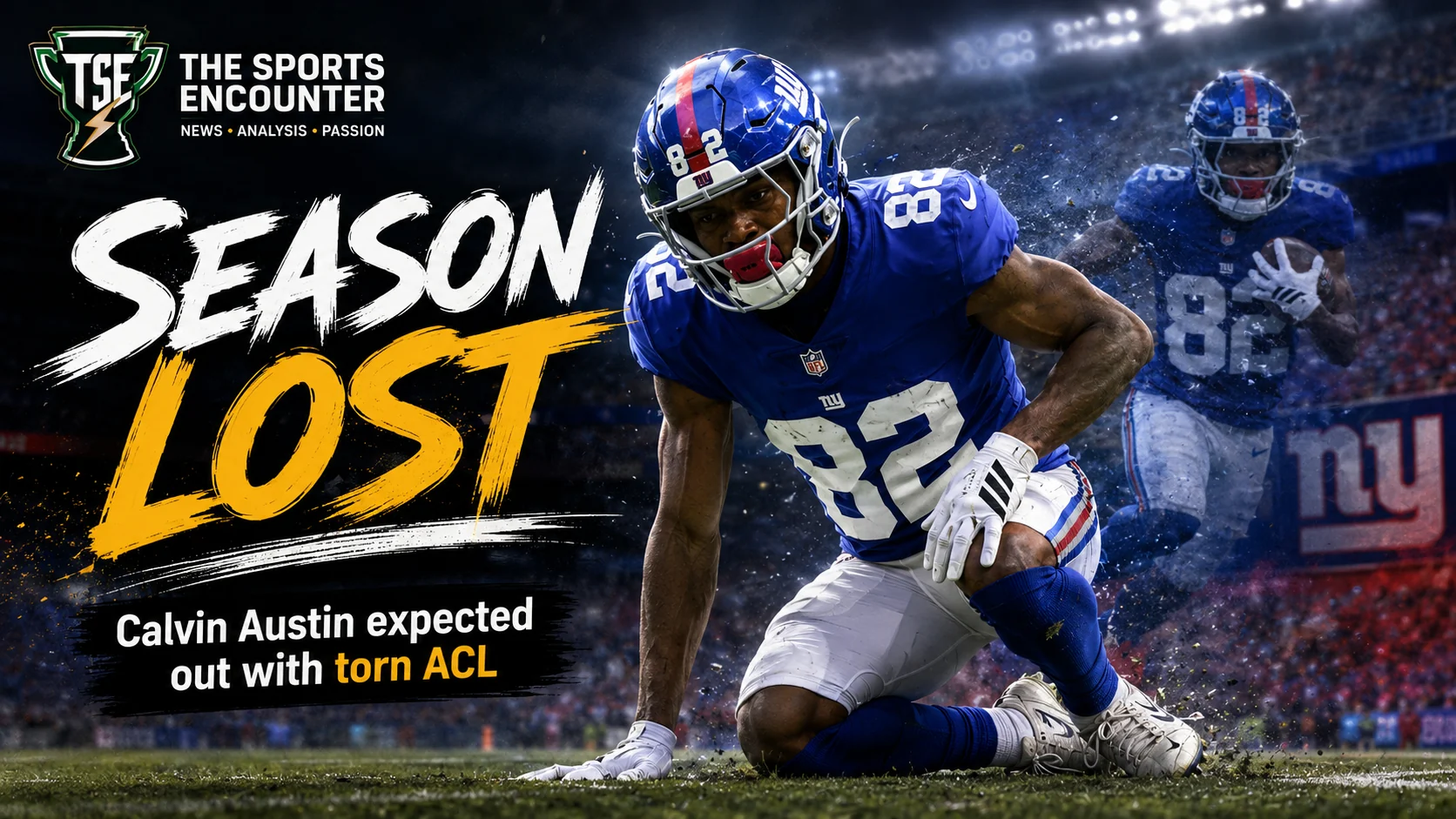
Calvin Austin Torn ACL: Giants Receiver Expected to Miss 2026 Season
New York Giants wide receiver Calvin Austin III is expected to miss the 2026 NFL season after reportedly tearing the ACL in his right knee during practice. His absence reshapes the receiver battle around Jaxson Dart, Malik Nabers and several veterans competing for larger roles.

EAST RUTHERFORD: Calvin Austin III arrived in New York with a modest one-year contract, elite speed and a genuine opportunity to become an important part of Jaxson Dart’s second season as the Giants quarterback.
That opportunity appears to have ended before the regular season began.
Austin tore the ACL in his right knee during Tuesday’s practice and is expected to miss the entire 2026 NFL season, according to a person with knowledge of the injury who spoke to The Associated Press. NFL.com subsequently listed Austin as out for the season with the torn ACL.
The New York Giants had not publicly announced the full medical diagnosis at the time of publication, so the injury should remain attributed to those reports until the club provides its own formal update.
What is already clear is the impact.
Austin had been enjoying one of the strongest training camps among New York’s receivers, had developed a productive connection with Dart and appeared to be earning a meaningful role in an offense that already entered the summer managing Malik Nabers’ return from his own ACL reconstruction.
Losing Austin therefore affects considerably more than one place on the depth chart. It changes the competition for slot snaps, removes another vertical speed option, affects punt-return depth and creates additional pressure on a receiver group that the Giants spent much of the offseason rebuilding.
For continuing roster, injury and preseason coverage from across the league, readers can follow The Sports Encounter’s NFL coverage.
Calvin Austin ACL Injury: What We Know
| Detail | Latest Information |
|---|---|
| Player | Calvin Austin III |
| Team | New York Giants |
| Position | Wide receiver |
| Age | 27 |
| Injury | Reported torn ACL in right knee |
| How it happened | Non-contact injury during a 1-on-1 practice drill |
| Reported prognosis | Expected to miss the 2026 season |
| Giants status | Team had not formally announced the diagnosis at publication |
| Contract | One-year deal signed during 2026 free agency |
| Previous team | Pittsburgh Steelers |
| 2025 receiving | 31 catches, 372 yards, 3 touchdowns |
| Giants season opener | September 13 vs Dallas Cowboys |
TL;DR
- Calvin Austin III reportedly tore the ACL in his right knee during Giants practice on Tuesday.
- The 27-year-old wide receiver is expected to miss the entire 2026 NFL season.
- The Giants had not formally announced the diagnosis at the time of publication.
- Austin suffered the injury without contact during a 1-on-1 drill and was carted from the field.
- He had been one of the strongest performers in Giants training camp and developed chemistry with quarterback Jaxson Dart.
- Austin caught two passes for 24 yards during New York’s preseason victory over Miami.
- He joined the Giants this offseason after three active seasons with Pittsburgh.
- Austin recorded 84 regular-season receptions for 1,100 yards and eight touchdowns with the Steelers.
- His absence creates more opportunity for Darnell Mooney, Braxton Berrios, Odell Beckham Jr., Malachi Fields and other Giants receivers.
- New York has also signed rookie wide receiver Kobe Prentice as roster decisions approach.
- Malik Nabers continues working back from the ACL injury that ended his 2025 season.
- The Giants open the regular season against the Dallas Cowboys on September 13.
A Non-Contact Practice Rep Changed Austin’s Season
The injury occurred during a 1-on-1 drill at the Giants’ training facility on Tuesday.
Austin went down without contact while working against cornerback Deonte Banks. Practice stopped as teammates and staff gathered around him, and he was eventually taken from the field on a cart.
Offensive coordinator Matt Nagy acknowledged afterward that the situation looked serious and spoke warmly about both Austin’s character and the quality of the camp he had produced.
The following day brought the news the Giants had feared.
NFL.com’s August 26 injury roundup listed Austin with a torn ACL and said he would miss the 2026 season.
For Austin, the timing makes the injury especially cruel because his summer had been building toward a larger role.
Austin Was Winning His Place Rather Than Simply Filling a Roster Spot
When New York signed Austin in March, the move carried relatively little attention compared with the Giants’ larger offseason additions.
He arrived after three active seasons with Pittsburgh as a 5-foot-9, 162-pound receiver whose speed could stretch defenses vertically and create separation from several alignments.
The Giants’ official announcement of Austin’s signing highlighted 84 regular-season catches for 1,100 yards and eight touchdowns across 48 games with the Steelers.
He also brought established special-teams value. Austin returned 72 punts for 639 yards and a touchdown during his Pittsburgh career, including a 73-yard score against the Giants in 2024.
That combination made him useful in several different ways.
New York did not need Austin to become its No. 1 receiver. The roster already contained players with larger offensive profiles.
The Giants needed him to create speed, spacing, favorable matchups and reliable depth behind them.
Training camp suggested he was capable of doing considerably more than simply surviving the final roster cut.
Jaxson Dart Was Developing Trust With Austin
The most consequential part of Austin’s summer may have been his work with Dart.
AP reported that Austin had become one of the second-year quarterback’s most frequent targets during team periods.
That chemistry matters because NFL passing offenses depend heavily on timing established through repetition.
A receiver can understand the playbook and still require weeks of work with a quarterback to establish when a route will break, where a pass should arrive against different coverage leverage and how each player reacts when the original route changes after the snap.
Austin had spent the spring and summer accumulating those repetitions.
His preseason work offered further evidence. He caught two passes for 24 yards against Miami and also produced a 21-yard rushing gain as the Giants beat the Dolphins 26-3.
The wider NFL preseason has already demonstrated how quickly these August opportunities can reshape depth charts. The Sports Encounter’s Week 1 preseason analysis examined several players who used live game repetitions to strengthen their cases before roster decisions.
Austin appeared to be doing the same.
The ACL tear removes those accumulated gains from New York’s immediate plans.
Why Austin’s Speed Mattered to the Giants Offense
Speed becomes most valuable when it changes what a defense is willing to do.
Austin possesses enough of it to force defensive backs to respect vertical routes even when he is not the primary target.
That can create space underneath for tight ends, running backs and possession receivers.
It can discourage safeties from cheating aggressively toward another side of the field.
It can also create opportunities through motion, jet sweeps and manufactured touches because defenders cannot afford to lose leverage before Austin reaches full speed.
The Giants have other fast players.
Replacing Austin’s exact combination of speed, experience, slot capability and return value is harder.
This is the broader roster problem created by late-summer injuries. Teams rarely replace one injured player’s entire role with one healthy player.
They redistribute it.
That same pattern has appeared throughout August, something TSE examined in its recent NFL injury and signing roundup. A significant injury changes practice repetitions, roster probabilities and the acceptable level of risk elsewhere on the depth chart.
New York is now making those calculations at receiver.
The Malik Nabers Situation Makes the Timing More Important
The Giants were already approaching the regular season with one major receiver health story.
Nabers tore his ACL during New York’s Week 4 victory over the Los Angeles Chargers in September 2025, ending his second NFL season after only four games.
His rehabilitation has progressed throughout the summer.
Nabers returned to team periods in August while wearing a red non-contact jersey, and John Harbaugh said he looked good during that stage of the recovery.
The Giants have remained careful about attaching a firm date to his full return. Harbaugh has publicly expressed hope that Nabers can play in the September 13 opener against Dallas while emphasizing that the process will depend on how his knee continues responding.
That caution now becomes more relevant.
Austin’s injury should not change the medical timetable for Nabers. The Giants have every reason to continue managing their star receiver according to his own rehabilitation rather than accelerating the process because another player is unavailable.
It does, however, remove insurance around him.
If Nabers experiences any delay or workload limitation early in the season, New York now has one fewer experienced receiver available to absorb those snaps.
Darnell Mooney Could Gain More Responsibility
Mooney was already one of the important additions to the Giants offense.
His experience, speed and ability to work from different alignments give Nagy several options when replacing Austin’s snaps.
Mooney has played both outside and inside during his NFL career, which makes him a logical candidate for increased slot work depending on how New York structures its personnel.
The advantage is flexibility.
The disadvantage is that moving Mooney around can affect another role elsewhere in the offense.
Every redistribution creates a second decision.
If Mooney takes more inside snaps, somebody else must handle more work outside. If the Giants keep him primarily in his intended role, another receiver must win Austin’s slot opportunities.
This is why preseason injuries become questions of roster architecture rather than simple replacement.
Braxton Berrios Now Has an Obvious Opening
Berrios may have one of the clearest paths to additional work.
The veteran has extensive experience operating from the slot and brings his own return background.
Those traits overlap with two areas where Austin’s absence creates uncertainty.
Berrios also understands what an ACL rehabilitation requires after suffering the injury himself in 2024.
His place in the receiver competition therefore becomes more valuable than it appeared 48 hours earlier.
He does not need to reproduce Austin’s vertical speed to help New York.
Reliable route execution, short-area separation and special-teams usefulness could be enough to earn a meaningful role.
Odell Beckham Jr. Has Another Opportunity in a Crowded Room
Odell Beckham Jr.’s return to the Giants already carried obvious history.
The more important question during August has been how much he can still contribute to the current offense.
Austin’s injury creates more available snaps but does not automatically hand them to Beckham.
The veteran still has to demonstrate that he can separate consistently, stay healthy and provide enough weekly value to justify his place on the 53-man roster.
His experience does give New York an alternative few teams would possess this late in the preseason.
Beckham has played through almost every type of coverage and high-pressure environment an NFL receiver can encounter.
If his body allows him to contribute, the Giants now have an additional reason to keep exploring how he fits alongside Nabers, Mooney and Darius Slayton.
Malachi Fields May Be the Biggest Developmental Beneficiary
Rookie Malachi Fields enters a different stage of the competition.
He has shown enough during camp to suggest he can contribute earlier than some young receivers normally would.
Austin’s absence creates more practice opportunities and potentially more game snaps for the rookie.
That can accelerate development quickly.
Young receivers improve by seeing NFL coverage at full speed, learning how physical defensive backs become at the top of routes and discovering how small the throwing windows become once regular-season game plans are installed.
Fields now has a clearer route toward those experiences.
The situation resembles other receiver competitions around the league where injuries have increased opportunities for younger players. TSE recently examined how a training-camp injury to Saints rookie Jordyn Tyson affected New Orleans’ receiver planning.
New York now faces its own version of that calculation.
The Giants Have Already Added Kobe Prentice
New York did not wait long to reinforce the room.
The Giants announced Wednesday that they had signed rookie wide receiver Kobe Prentice along with veteran tight end Josiah Deguara.
The team did not state that Prentice was signed specifically because of Austin’s injury, so the two developments should not be presented as an officially confirmed cause-and-effect transaction.
The timing nevertheless gives New York another receiver for the final days of preseason and the closing roster evaluation.
According to the Giants’ official transaction announcement, Prentice is a 5-foot-10, 184-pound undrafted rookie who spent his final college season at Baylor after three years at Alabama.
He recorded 26 catches for 380 yards and six touchdowns in 11 games during his senior season.
Prentice had most recently been with New England after the Patriots claimed him from Carolina, and he became available when the Patriots released him Monday.
His arrival gives the coaching staff another body to evaluate.
It does not replace the chemistry Austin had already established with Dart.
The Punt-Return Competition Changes Too
Austin’s special-teams history should not disappear from the analysis.
He returned 72 punts during his three active Steelers seasons and averaged 8.9 yards per return.
His 73-yard touchdown in 2024 demonstrated the explosive possibility he could provide when space opened.
That role may not have been the primary reason New York signed him, but special-teams versatility helps determine the bottom of NFL rosters.
Berrios has extensive return experience and becomes an obvious option.
Other receivers and defensive backs could also receive more opportunities as the Giants decide how many players they can carry primarily for special teams.
The broader league has dealt with similar August depth questions throughout camp. Our NFL injury roundup on Josh Jacobs, Kenyon Sadiq and Elic Ayomanor highlighted how apparently isolated injuries often create secondary decisions elsewhere on a roster.
Austin Had Already Experienced a Lost Season
The rehabilitation challenge carries another layer for Austin because this will not be the first NFL season taken away by injury.
Pittsburgh selected him in the fourth round of the 2022 NFL Draft out of Memphis.
A foot injury prevented him from playing during his entire rookie season.
He eventually made his NFL debut in 2023 and gradually expanded his role over the following three years.
The 2024 season became his most productive as a receiver, when he recorded career highs of 36 receptions, 548 receiving yards and four touchdowns.
He followed with 31 catches for 372 yards and three touchdowns in 2025 before entering free agency.
New York represented a fresh opportunity.
Another long rehabilitation process now stands between Austin and the next stage of his career.
Why the Injury Hurts Austin Beyond 2026
The immediate consequence is the lost season.
The longer-term issue is contractual timing.
Austin joined the Giants on a one-year agreement, reportedly worth $1.5 million.
This season therefore represented an opportunity to establish his value inside a new offense before returning to free agency.
A productive year could have strengthened his case for a larger role or another contract in 2027.
The injury removes that platform.
His next negotiation may now depend heavily on rehabilitation progress, medical evaluations and whether teams believe his speed has fully returned.
ACL surgery and rehabilitation have become common across professional football, and many receivers return to high-level play. Speed-based players still face an especially important physical question because acceleration, cutting and sudden changes of direction sit at the center of their value.
Austin’s recovery will therefore matter far beyond simply receiving clearance to practice again.
The Giants Have Seen How Quickly ACL Injuries Reshape Plans
New York does not need a reminder of the disruption created by major knee injuries.
Nabers’ 2025 ACL tear changed Dart’s rookie season almost immediately.
The quarterback lost his most dangerous receiver during his first NFL start.
New York then spent months planning for Nabers’ rehabilitation while adding Mooney, Austin, Beckham and Berrios to strengthen the position.
Now one of those additions is gone before Week 1.
That sequence reflects the harsh side of NFL roster building.
Front offices can improve depth during free agency and the draft, yet every plan remains exposed to the physical nature of the sport.
The Sports Encounter has followed that reality throughout this preseason, including Atlanta losing Jalon Walker for the season with another ACL tear.
Those injuries affect different positions and teams, but the roster consequence is familiar.
A carefully designed rotation has to be rebuilt almost overnight.
New York’s Final Preseason Game Now Carries More Weight at Receiver
The Giants close their preseason against the New York Jets on Friday at MetLife Stadium.
Preseason finales often become evaluation games for players fighting over the final few roster places.
Austin’s absence raises the stakes considerably for the receivers behind the established names.
Berrios, Beckham, Fields and the other depth options now have more than roster survival at stake.
They are competing for snaps that may exist when the regular season begins.
Prentice has only just arrived and faces the difficult task of learning enough of the offense to make an impression quickly.
The coaching staff also has to determine which receivers provide enough special-teams value to dress on game day.
August football regularly produces this kind of compressed evaluation. Our wider training-camp coverage has tracked teams making similar depth adjustments as injuries force new players into larger roles.
The 53-Man Roster Decision Just Became More Complicated
The timing could hardly be more consequential.
New York’s initial 53-man roster must be finalized shortly after the preseason finale.
Before Austin’s injury, the receiver competition involved determining which players offered enough offensive and special-teams value behind the leading group.
The equation now includes a missing player who had been expected to contribute.
The Giants have to decide how many receivers they need, which skill sets overlap, whether younger players are ready and how much special-teams coverage they can preserve.
Those decisions become especially difficult when Nabers is still completing his return to full contact.
A healthy receiver room offers coaches the luxury of choosing complementary skill sets.
An injured one forces them to protect against scenarios they hope never occur.
What Austin’s Absence Means for Jaxson Dart
Dart remains the player through whom all of these decisions eventually connect.
The second-year quarterback needs a receiver group that gives him reliable answers against different defensive structures.
Nabers can become the focal point when healthy.
Slayton provides established vertical experience.
Mooney adds speed and positional flexibility.
Isaiah Likely strengthens the passing game from tight end.
Fields represents developmental upside, while Beckham and Berrios offer veteran alternatives.
Austin had been creating another useful layer within that group.
His loss does not leave Dart without weapons.
It reduces the margin for something else to go wrong.
That distinction becomes important during a 17-game NFL season, when receiver rooms are rarely completely healthy from September through January.
The Cowboys Opener Will Provide the First Real Answer
New York opens its regular season against Dallas at MetLife Stadium on September 13.
By then, the Giants expect to have a much clearer picture of Nabers’ availability and the hierarchy behind him.
The Cowboys will provide an immediate test because regular-season defenses disguise coverages and pressure quarterbacks in ways preseason games rarely reproduce.
Dart will need receivers who understand sight adjustments and can separate when his first read disappears.
Austin appeared to be developing toward precisely that type of trust.
The Giants now have a little more than two weeks to redistribute that responsibility.
The Final Word: Austin’s Injury Changes More Than One Line on the Depth Chart
The easiest interpretation of Calvin Austin’s injury is that New York lost a depth receiver.
His summer suggests the consequences go further.
Austin was developing into a player Dart trusted, offered legitimate vertical speed, could work from multiple receiving alignments and carried meaningful punt-return experience.
Those responsibilities now have to be divided among several teammates at exactly the point when the Giants are finalizing their regular-season roster.
Mooney can absorb some offensive work. Berrios has a clearer route into slot and return snaps. Fields receives an opportunity to develop faster. Beckham’s experience becomes more useful. Prentice arrives with a chance that did not exist earlier in the week.
The Giants have enough options to adjust.
The real question is whether those options can collectively replace the role Austin was creating for himself.
There is also a human cost behind the depth-chart discussion.
Austin had already lost his rookie season to injury, worked his way into a productive three-year run in Pittsburgh and came to New York attempting to establish the next stage of his career. A strong camp suggested he was doing exactly that.
Now another rehabilitation begins.
For the Giants, the season moves forward without one of the players who had done the most this summer to earn a place in it.
For more NFL injury developments, roster moves and preseason analysis, readers can also revisit The Sports Encounter’s broader training-camp coverage.
Frequently Asked Questions
What happened to Calvin Austin III?
Austin reportedly tore the ACL in his right knee after going down without contact during a 1-on-1 drill at New York Giants practice on August 25.
Will Calvin Austin play during the 2026 NFL season?
He is expected to miss the entire season, according to AP and subsequent NFL reporting. The Giants had not formally announced the full diagnosis at the time this article was prepared.
When did Calvin Austin join the Giants?
Austin signed with New York during free agency in March 2026 after spending his first four NFL years with the Pittsburgh Steelers organization.
What were Calvin Austin’s career numbers with Pittsburgh?
He recorded 84 receptions for 1,100 yards and eight touchdowns across 48 regular-season games. Including postseason play, AP lists his Pittsburgh totals at 89 catches, 1,140 yards and nine touchdowns in 51 games.
How did Calvin Austin perform during Giants preseason?
Austin caught two passes for 24 yards against Miami and had impressed throughout training camp while building chemistry with quarterback Jaxson Dart.
Who could replace Calvin Austin in the Giants offense?
Darnell Mooney, Braxton Berrios, Odell Beckham Jr., rookie Malachi Fields and other receivers could receive additional snaps. New York has also signed rookie Kobe Prentice.
Is Malik Nabers healthy?
Nabers is continuing his return from the ACL injury that ended his 2025 season. He has returned to team periods in a non-contact jersey, but the Giants have not guaranteed that he will play in Week 1.
When do the Giants begin the 2026 regular season?
New York opens its season at home against the Dallas Cowboys on September 13.
Who is the Giants quarterback in 2026?
Jaxson Dart enters his second NFL season as the central quarterback in the Giants offense after showing encouraging signs during his rookie campaign.
Did the Giants sign another receiver after Austin’s injury?
The Giants announced the signing of rookie wide receiver Kobe Prentice on August 26. The team did not officially state that the move was made specifically because of Austin’s injury.

FIFA Hits Argentina with Heavy World Cup Sanctions as Paredes Gets 10-Game Ban
FIFA has handed Argentina major disciplinary sanctions after the 2026 World Cup final brawl, including a 10-game suspension for Leandro...

Can FIFA Oust Gianni Infantino? Regional Powerhouses Now Weigh Historic No-Confidence Vote
Gianni Infantino is facing the most serious political challenge of his FIFA presidency as UEFA, the AFC and CONCACAF discuss...

AFC-Qatar Rift Deepens as Infantino Crisis Divides Asian Football
AFC President Sheikh Salman bin Ebrahim Al-Khalifa has hit back at Qatar after its football federation challenged the confederation’s stance...

Why FIFA COO Kevin Lamour Was Shown the Exit Way
FIFA COO Kevin Lamour has left the organization weeks after accusing staff of being deceived over the abandoned FIFA Forward...


Ireland Turns on Infantino as FIFA Election Revolt Spreads Beyond Europe’s Heavyweights
Ireland has withdrawn its support for Gianni Infantino’s re-election as FIFA president, adding another national association to a widening governance...


Donald Trump Comes to Gianni Infantino’s Rescue as FIFA Crisis Turns Political
Donald Trump has thrown his support behind Gianni Infantino as UEFA, AFC and CONCACAF deepen their challenge to the FIFA...


UEFA, AFC and CONCACAF Turn on Infantino as FIFA Crisis Becomes a Fight for His Presidency
UEFA, the AFC and CONCACAF have jointly accused FIFA President Gianni Infantino of breaking trust over the abandoned World Cup...


FIFA Says Infantino Is Being Undermined as Leadership Crisis Turns Into a Battle Over Legitimacy
FIFA has escalated its defense of Gianni Infantino, warning of a concerted effort to undermine its president as the fallout...


When Will Lionel Messi Retire? Argentina President Says Only Messi Has the Answer
Lionel Messi’s retirement remains an open question after his eight-goal 2026 World Cup. Argentina president Claudio Tapia says only Messi...


English FA Turns Its Back on Gianni Infantino, Withdraws Support for Re-Election
The English FA has formally withdrawn its support for Gianni Infantino’s bid for another term as FIFA president, adding major...


FIFA President Apologizes to Member Nations After FIFA World Cup Selloff Plan Fails to Inspire
FIFA has apologized to its member associations after abandoning a controversial plan to sell a 20% stake in a new...


Infantino in Survival Mode After World Cup Stake Sale Idea Results in Global Revolt
Gianni Infantino’s abandoned World Cup commercial rights proposal has triggered an internal FIFA revolt, lost European support, and drawn a...


Crisis Plagues FIFA as Wenger, Grafstrom and Federations Break Ranks
Gianni Infantino’s grip on FIFA is under growing pressure after senior officials, European federations and former allies distanced themselves from...


Infantino Looks to Smaller Nations After UEFA, CONCACAF Snub
Gianni Infantino’s FIFA future may depend on smaller and emerging nations after UEFA and CONCACAF lost confidence in his leadership....


FIFA’s World Cup Stake Plan Failed in Three Days. The Damage to Gianni Infantino May Last Much Longer
FIFA’s attempt to sell a 20% stake in a new World Cup commercial entity collapsed within days after a global...


Cristiano Ronaldo’s World Cup Career: Goals, Records and Final Farewell
Cristiano Ronaldo became the first man to score in six FIFA World Cups, but football’s greatest tournament never gave him...


The Golden Generation Saying Goodbye After the FIFA World Cup 2026
The 2026 World Cup did more than crown a champion. It marked the emotional farewell of a generation that shaped...


Neymar’s World Cup Career: Skill, Pain, and the Rainbow Flick Legacy
Neymar carried Brazil’s World Cup hopes across four tournaments, producing unforgettable goals while enduring injuries, criticism and elimination heartbreak. His...


Is the FIFA World Cup 2030 Not for Sale Anymore?
FIFA’s proposal to sell a minority stake in a $20 billion World Cup commercial company appears to have collapsed after...


FIFA Explores 64-Nation World Cup for 2030: Is Another Expansion Worth It?
FIFA is examining whether the 2030 World Cup should expand from 48 to 64 teams. The proposal could increase global...

Vietnam Survive Thailand’s Best Fightback to Retain ASEAN Championship 2026
Thailand pushed Vietnam into their most uncomfortable night of the tournament, but a missed penalty and two own goals helped...

Vietnam Hold the Lead, but Thailand Still Have 90 Minutes to Change the ASEAN Final
Vietnam carry a 2-0 lead into the ASEAN Championship final second leg, but Thailand still have attacking weapons capable of...


ASEAN Championship 2026 Top 10 Players: The Performers Who Shaped the Road to the Final
From Nguyễn Xuân Son’s semifinal goals to Ilhan Fandi’s decisive strikes and Ubaidullah Shamsul’s defensive work, these 10 players have...

Bruno Fernandes Wins PFA Player of the Year After Record-Breaking Manchester United Season
Bruno Fernandes has been named the 2026 PFA Men’s Players’ Player of the Year after producing a historic 21-assist Premier...

Bunny Shaw Wins PFA Players’ Player of the Year After Historic Manchester City Season
Khadija “Bunny” Shaw has been named the 2025/26 PFA Women’s Players’ Player of the Year after another dominant Manchester City...

Manchester United Sign Carlos Baleba From Brighton as Carrick’s Midfield Rebuild Accelerates
Manchester United have completed the signing of Carlos Baleba from Brighton, adding the 22-year-old Cameroon midfielder to Michael Carrick’s rebuilt...

Chelsea Beat Fulham 3-2 as Palmer, Rogers and João Pedro Launch Xabi Alonso Era
Chelsea opened the Xabi Alonso era with a dramatic 3-2 win at Fulham as João Pedro scored inside the first...

Premier League Opening Weekend: Arsenal Start Strong, United Stumble, and Brighton Set the Early Pace
The Premier League’s opening weekend delivered 25 goals across nine matches, with Arsenal starting strongly, Hull stunning Manchester United, Brighton...


Draisaitl and Peterka Are Going Home as NHL Expands Germany Push
The NHL is expanding its push into Germany with four regular-season games in 2027-28. The Edmonton Oilers will play in...

Ron Duguay Walks Without a Walker as Stage 4 Cancer Fight Enters a New Treatment Phase
Ron Duguay has reached an encouraging rehabilitation milestone after his recent hospitalization, walking without a walker as his Stage 4...


Anze Kopitar Becomes Immortal in Los Angeles as Kings Retire No. 11 and Build His Statue
The Los Angeles Kings will retire Anze Kopitar’s No. 11 and unveil a bronze statue outside Crypto.com Arena, cementing the...


Ville Koivunen’s Eight-Year, $32M Penguins Deal Is a Bet on Pittsburgh’s Next Era
The Pittsburgh Penguins have committed to their future by signing 23-year-old forward Ville Koivunen to an eight-year, $32 million contract...


Tommy Novak’s $13.95M Penguins Extension Reveals Pittsburgh’s Plan Beyond the Crosby Era
The Pittsburgh Penguins have secured versatile forward Tommy Novak on a three-year, $13.95 million extension. After recording 42 points in...

Tim Seifert Sets the Stage Before Liam Dawson Seals The Hundred 2026 Final
Tim Seifert powered Manchester Super Giants toward the title before Mohammad Amir’s late burst created panic and Liam Dawson settled...

Crawley’s Costly Blunder Helps Super Giants Reach The Hundred Final
Paul Walter and Heinrich Klaasen powered Manchester Super Giants to 186 before Josh Tongue’s four wickets and Zak Crawley’s costly...

MI London Beat Birmingham Phoenix by Two Runs but Miss Hundred Eliminator on Net Run Rate
MI London survived a remarkable Birmingham Phoenix comeback to win by two runs at Edgbaston, but the victory was nowhere...


Tim Seifert Blows Sunrisers Leeds Away as Manchester Super Giants Surge Toward Hundred Eliminator
Tim Seifert hammered an unbeaten 80 from 40 balls as Manchester Super Giants chased 128 in just 67 legal deliveries,...

Stubbs Spoils Trent Rockets’ Lord’s Party as Southern Brave Win by Six Wickets
Tristan Stubbs hit an unbeaten 52 from 28 balls as Southern Brave chased 159 in 97 balls to beat Trent...


Wimbledon 2026 Withstands FIFA World Cup Clash, Breaks Attendance Record
Wimbledon attracted a record 550,151 spectators and generated 4.8 billion social media impressions in 2026. Dry weather, Arthur Fery’s semifinal...

Wimbledon Men’s Singles Champions: How Triumph on Grass Changed Their Careers
From Spencer Gore and William Renshaw to Roger Federer, Novak Djokovic, Carlos Alcaraz, and Jannik Sinner, discover how every Wimbledon...

Guo Hanyu and Kristina Mladenovic Turn Trust Into Wimbledon 2026 Glory
Guo Hanyu and Kristina Mladenovic turned a new partnership into Wimbledon glory, defeating Gabriela Dabrowski and Luisa Stefani in a...


Jannik Sinner’s Wimbledon Defense Against Novak Djokovic and Alexander Zverev
Jannik Sinner’s Wimbledon 2026 defense began with a five-set escape and ended with victories over Novak Djokovic and Alexander Zverev....


Muchova, Noskova Turn Wimbledon Women’s Singles Final Into an All-Czech Affair
Karolina Muchova saved match point to beat Coco Gauff in a Centre Court thriller, while Linda Noskova handled Marta Kostyuk...


Swiatek Sweeps Aside Rybakina to Claim Toronto Crown Ahead of US Open
Iga Swiatek swept aside Elena Rybakina 6-2, 6-3 to claim the 2026 National Bank Open title in Toronto, securing her...

Brandon Nakashima Beats Jodar to Reach First Masters 1000 Final
Brandon Nakashima held off Rafael Jodar 7-6(3), 6-4 to reach the first Masters 1000 final of his career at the...

National Bank Open: Iga Swiatek, Elina Svitolina Reach Semifinals as Montreal Enters QF Stage
Iga Swiatek and Elina Svitolina became the first confirmed National Bank Open 2026 semifinalists in Toronto, while Montreal’s men’s draw...


When Paris Welcomed Two New French Open Champions
Paris, France – June 9, 2026: There are days at Roland Garros when tennis feels like a sport. Then there...


French Open 2026: Mirra Andreeva Becomes a Grand Slam Reality
Mirra Andreeva relived the memories of Monica Seles on Super Sunday at Roland Garros to lift her maiden French Open...

Galle Gallants Are LPL 2026 Champions After 5-Wicket Revenge Win Over Jaffna Kings
Galle Gallants are the 2026 Lanka Premier League champions after defeating Jaffna Kings by five wickets, chasing 124 in 15.5...

LPL 2026 Final Preview: Galle Seek Revenge as Jaffna Chase a Fifth Crown
Galle Gallants and Jaffna Kings meet in the Lanka Premier League 2026 final after three dramatic clashes this season, with...


Harper and Asalanka Punish Colombo’s Chaos as Galle Reach LPL Final
Sam Harper’s commanding 77 and Charith Asalanka’s composed 59 carried Galle Gallants past Colombo Kaps and into the LPL 2026...

McDermott and Neesham Set the Trap Before Sahan Ends Kandy’s LPL Run
Colombo Kaps eliminated Kandy Royals by 68 runs after McDermott and Neesham powered them past 200 before Sahan and Dahani...

Mishara’s Unbeaten 108 Sends Jaffna Kings Into LPL Final After 470-Run Assault
Kamil Mishara’s unbeaten century carried Jaffna Kings into the LPL 2026 final after Galle Gallants fell 14 runs short in...


Guyana Amazon Warriors Defend 85 to Break San Francisco Hearts and Retain Global Super League Title
Guyana Amazon Warriors recovered from 29 for eight, defended a total of 85, and defeated San Francisco Unicorns by six...


Tim Robinson Explodes as Unicorns Thump Vipers to Enter the Global Super League Final
Tim Robinson struck an unbeaten 68 as San Francisco Unicorns defeated Desert Vipers by eight wickets in the Global Super...

Perth Find Their Missing Finish as Spin Silences Guyana
Brody Couch rescued Perth Scorchers XI with 43 before five spin options dismantled Guyana Amazon Warriors for 121 in a...


Akeal Hosein Nearly Steals It, but Desert Vipers Escape in Final Over
Rilee Rossouw mastered a difficult Providence pitch before Desert Vipers survived Akeal Hosein’s four-wicket fightback to beat Perth Scorchers XI...


Shadab Khan and Zachary Carter Rescue Desert Vipers’ GSL Campaign
Shadab Khan dismantled San Francisco’s middle order before 19-year-old Zachary Carter launched a fearless chase, helping Desert Vipers secure their...


LeBron James Partners With PGA Tour for Akron Golf Event as Firestone Gets New Life
LeBron James is bringing professional golf back to Akron through a new PGA Tour-backed Invitational at Firestone Country Club, combining...


Lakers’ $12.5B Sale Confirms a New Reality: This Is Luka Dončić’s Team Now
The Lakers are entering another major transition, with a reported $12.5 billion ownership deal arriving as LeBron James departs and...

NBA 2026-27 Schedule Is Here: Opening Night, Christmas Games and Biggest Dates to Watch
The NBA has released its full 2026-27 schedule, with LeBron James opening his 76ers career against the defending champion Knicks,...

LeBron James to Challenge NBA Champions Knicks to Kick Off His 76ers Era
LeBron James will begin his Philadelphia 76ers era against the defending champion New York Knicks at Madison Square Garden before...


LeBron James Says No to LA 2028, but Team USA Is Reportedly Saving Him a Seat
LeBron James says he plans to watch the 2028 Los Angeles Olympics, but USA Basketball is reportedly prepared to give...
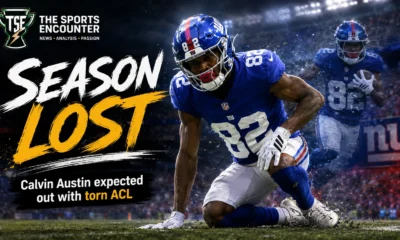

Calvin Austin Torn ACL: Giants Receiver Expected to Miss 2026 Season
New York Giants wide receiver Calvin Austin III is expected to miss the 2026 NFL season after reportedly tearing the...

NFL 2026: Trey Moore Set for Surgery, Brian Thomas Avoids Major Scare as Lions Meet Kareem Hunt
The NFL’s final preseason stretch brought injury concerns, roster moves and a major off-field honor, with Trey Moore set for...

NFL Injury Blow: Seahawks Lose Jake Bobo as Ravens Face Center Crisis After Danny Pinter Tear
The Seahawks may be without Jake Bobo for an extended period after a serious knee injury, while the Ravens face...


US Open 2026: Zverev’s Opening, Djokovic’s Record Chase and Shelton’s American Moment
The US Open 2026 men’s title race has opened up after Jannik Sinner’s withdrawal. Alexander Zverev brings Grand Slam confidence,...

Serena, Venus Get Another Run at US Open Women’s Doubles Event
Serena and Venus Williams are returning to the US Open women’s doubles draw after receiving a 2026 wildcard. The 14-time...

Fan Support Gives Stan Wawrinka His Last Shot at the US Open Title
Stan Wawrinka will return to the US Open one final time after receiving a late main-draw wildcard following Patrick Kypson’s...
-
 Cricket4 weeks ago
Is The Hundred Losing Its Oomph Among English Cricket Fans?
-

 Editor's Choice3 weeks ago
Premier League 2026–27 Curtain Raiser: Fixtures, Teams, Title Contenders, Transfers and Season Predictions
-

 Editor's Choice4 weeks ago
US Open 2026 Curtain-Raiser: Players, Schedule, Title Contenders, New York Storylines and Everything Fans Need to Know