
Djokovic’s Cincinnati Fall Exposes the Biggest Question Before the US Open
Novak Djokovic’s first match since Wimbledon ended in a heat-affected defeat to Thiago Tirante in Cincinnati. The result now raises fresh questions about his match sharpness, physical readiness, and pursuit of a 25th Grand Slam at the US Open.

Novak Djokovic arrived in Cincinnati looking for answers.
He left after one match with more questions than he brought.
Thiago Agustin Tirante’s 2-6, 6-4, 6-4 victory over Djokovic at the Cincinnati Open would have been a major upset under any circumstances. The concern grew because of how the match changed.
Djokovic controlled the opening set.
Then the Ohio heat and humidity began to matter.
The 39-year-old dropped to his knees during an exhausting 18-minute service game early in the second set, required medical attention to cool down and increasingly appeared to be managing his energy rather than imposing his tennis.
He recovered enough to compete more effectively in the deciding set, but the match slipped away at 4-4 when a sequence of uncharacteristic errors handed Tirante the decisive break.
The Argentine served it out.
Djokovic’s first competitive match since his Wimbledon semifinal defeat ended before he could build the sequence of hard-court matches that Cincinnati was supposed to provide.
That is why the defeat matters beyond one ATP Masters 1000 result.
Djokovic is still chasing a 25th Grand Slam singles title. He remains one of the most accomplished hard-court players in tennis history. His experience in New York means nobody sensible should remove him from the US Open conversation because of one August defeat.
But Cincinnati was meant to test something different.
Could Djokovic sharpen his movement, serve, return timing and physical tolerance before the final Grand Slam of the year?
Instead, the only match he completed produced a physical warning.
The Sports Encounter had already identified Cincinnati as a key checkpoint in our analysis of Djokovic’s return and his pursuit of Grand Slam No. 25. The tournament did not need to end with a trophy to be successful preparation. A few competitive matches without a physical setback would have been enough.
He got neither.
Novak Djokovic’s Cincinnati Open Defeat at a Glance
| Tournament | Cincinnati Open 2026 |
| Opponent | Thiago Agustin Tirante |
| Djokovic ranking | World No. 5 |
| Tirante ranking | World No. 50 |
| Result | Tirante won 2-6, 6-4, 6-4 |
| Key physical issue | Djokovic struggled with heat and humidity and required treatment |
| Previous competitive match | Wimbledon semifinal loss to Jannik Sinner |
| Next major target | US Open 2026 |
| Grand Slam target | Record-extending 25th singles major |
The First Set Looked Like the Cincinnati Djokovic Needed
For roughly one set, there was very little reason for concern.
Djokovic won the opener 6-2 and looked like the superior player.
His return position was controlled. His timing off the ground appeared sharp enough for a first match after several weeks away. Tirante struggled to protect the court once Djokovic established neutral rallies.
That opening phase supported the reason Djokovic had chosen Cincinnati as his return point.
He had skipped the National Bank Open in Montreal following his demanding Wimbledon campaign, a scheduling decision The Sports Encounter examined in our analysis of why Djokovic and Jannik Sinner withdrew from Montreal.
The logic was clear.
At 39, Djokovic does not need the volume of tournament play younger contenders often chase. His remaining priorities increasingly revolve around arriving at Grand Slams healthy enough to survive seven best-of-five-set matches.
Cincinnati could therefore serve as a controlled return.
One or two early matches to reconnect with hard-court speed.
A deeper run if the body responded well.
Then recovery before New York.
The opening set against Tirante looked compatible with that plan.
The second set changed the conversation.
The 18-Minute Game Was the Moment the Story Changed
The most concerning passage came early in the second set.
Djokovic endured an 18-minute service game containing nine deuces and 24 points.
He eventually held.
The physical cost appeared substantial.
At one stage, Djokovic dropped to his knees.
He later received treatment intended to cool him down, with the stifling humidity becoming as important to the match as Tirante’s tennis.
What followed was revealing.
Djokovic offered relatively little pressure in Tirante’s service games for much of the remainder of the set.
That could be interpreted as tactical conservation.
Once the body is struggling in best-of-three tennis, an experienced player may decide that fighting through every return game is counterproductive. Preserving energy for his own serve and trying to reach a deciding set can become the smarter calculation.
Djokovic has spent his career understanding match economy better than almost anyone.
The problem is that New York will not offer the same escape route.
The US Open Can Turn Heat Into a Competitive Weapon
The US Open is not played in a controlled indoor environment.
Late August and early September in New York can produce heat, humidity and long periods of direct sun.
Players may also move between afternoon and night sessions across the tournament, forcing the body to repeatedly adapt to different temperatures and recovery windows.
The Sports Encounter’s complete US Open 2026 preview identified physical preparation as one of the defining themes of the men’s draw. The tournament’s singles main draw begins on August 30, leaving Djokovic time to recover from Cincinnati but limited competitive opportunity to test himself again before New York.
That is the distinction that makes Cincinnati relevant.
Djokovic is not facing an immediate injury crisis based on the information available.
He is facing a preparation question.
Can he enter a best-of-five major confident that his body will respond if a match turns into three or four hours of heavy conditions?
One Hot Day Does Not Mean Djokovic Has a Conditioning Problem
There is an important danger in overreacting.
Djokovic has competed successfully in extreme heat throughout his career.
His physical reputation was not always so strong early in his career, but he transformed himself into one of the most durable players tennis has seen.
He has won marathon Grand Slam matches.
He has recovered from brutal semifinals to play finals.
He has repeatedly survived environments that physically broke younger opponents.
One difficult afternoon in Cincinnati does not erase that history.
It also does not prove the same issue will happen in New York.
Players can react differently to specific combinations of temperature, humidity, hydration, travel, sleep and match rhythm.
Djokovic was also playing competitively for the first time since July 10, when Sinner defeated him in the Wimbledon semifinals 6-4, 6-4, 6-4.
There is a difference between fitness developed through training and fitness tested through live match stress.
Cincinnati supplied that first stress test.
The result was mixed.
Djokovic Looked Better After the Locker-Room Break
The deciding set is why the defeat should not be reduced to “Djokovic physically collapsed.”
He changed clothes between sets and returned looking sharper.
The movement improved.
The rallies became more competitive.
He stayed with Tirante until 4-4.
That recovery matters.
If Djokovic had continued deteriorating physically, the US Open concern would be more serious.
Instead, he demonstrated an ability to reset within the match.
The defeat was ultimately completed by errors rather than complete physical incapacity.
At 4-4, Djokovic produced several mistakes he would normally expect to control in a major match, including the volley into the net that surrendered the decisive break.
Tirante then held serve to complete the biggest win of his career.
The physical struggle therefore created the conditions for the upset.
It did not entirely explain it.
Tirante Deserves More Credit Than the Heat Narrative Gives Him
Whenever a legend struggles physically, the opponent can disappear from the story.
That would be unfair to Tirante.
The Argentine lost the first set heavily and could have accepted the expected outcome.
Instead, he stayed emotionally stable.
He made Djokovic continue working.
When Djokovic’s physical level dipped, Tirante did not rush.
When the Serbian returned with more energy in the third, Tirante remained attached to the score.
Then came 4-4.
Djokovic made the errors.
Tirante had put himself in position to benefit from them.
His reward was the biggest victory of his career and a place in the next round against Martin Landaluce.
That younger generation has been one of the wider themes of the North American hard-court season. Landaluce had already eliminated Jack Draper, a result The Sports Encounter examined in our look at Draper’s difficult road toward the US Open.
Tirante has now supplied Cincinnati with an even bigger result.
The Bigger Concern Is Djokovic’s Lack of Competitive Repetition
The heat will dominate headlines.
The lack of matches may be more important.
Djokovic’s 2026 schedule has been deliberately selective.
That approach has worked at majors.
He reached the Australian Open final without extensive competitive preparation.
He reached the Wimbledon semifinals after another carefully managed build-up.
The Sports Encounter’s earlier Cincinnati preview argued that Djokovic no longer needs to prove he can survive early Grand Slam rounds without warm-up matches.
He has already proved that.
The concern comes later.
Sinner and Carlos Alcaraz increasingly force elite opponents to play at a very high physical and technical level immediately.
There is little time to discover rhythm during a semifinal.
Cincinnati was supposed to provide some of that rhythm beforehand.
Instead, Djokovic played three sets.
Wimbledon Already Showed the Current Gap Against Sinner
Djokovic’s last match before Cincinnati came against Sinner.
The Italian won 6-4, 6-4, 6-4.
Wimbledon’s official report showed a match in which Sinner repeatedly protected his own service games and prevented Djokovic from turning the contest into the kind of tactical battle he has historically dominated.
The Sports Encounter explored that match in our complete review of Sinner’s Wimbledon title defense.
The issue was not that Djokovic suddenly forgot how to play elite tennis.
He remained competitive.
The problem was the margin.
Sinner’s movement was a little quicker.
His ball speed remained higher for longer.
His second-serve pressure was relentless.
Djokovic understood the tactical problems but could not consistently execute the solutions across three sets.
That is why Cincinnati mattered.
He needed opportunities to raise the hard-court version of his game before potentially seeing Sinner again in New York.
The Serve Becomes Even More Important at 39
Djokovic’s greatest physical adaptation may now need to happen through his serve rather than his legs.
He cannot approach every hard-court match as though extending rallies indefinitely remains cost-free.
Free points matter more.
A strong first-serve percentage shortens service games.
Unreturned serves remove physical exchanges entirely.
Accurate body serves prevent aggressive returners from taking full swings.
Wide serves create immediate openings for the next ball.
The serve does not need to become the biggest on tour.
It needs to reduce the number of physically expensive neutral rallies Djokovic is required to play.
That becomes especially important at the US Open, where a player may need to win seven best-of-five matches over two weeks.
The Return Still Gives Djokovic a Way Into Every Match
The good news remains the return of serve.
Djokovic’s anticipation has not disappeared.
His ability to read patterns, absorb pace and redirect the first ball after serve remains exceptional.
That skill can protect him from physical decline in another way.
A great return can create shorter points.
If Djokovic immediately places an opponent under pressure, the server often has to attack earlier than intended.
That can produce mistakes before a rally becomes physically expensive.
His return is one reason Djokovic remains dangerous even when his legs are not at their absolute peak.
The Cincinnati Loss Also Changes the Psychological Build-Up
Confidence in tennis is rarely as simple as wins and losses.
Djokovic does not need an August Masters title to believe he can win a major.
He has too much evidence from his own career for that.
But preparation creates smaller forms of confidence.
Confidence in movement.
Confidence in recovery.
Confidence in serving at 4-4 in a deciding set.
Confidence that a physically difficult service game will not affect the next 30 minutes.
Cincinnati did not provide those reassurances.
It provided uncertainty.
New York Has Been Both a Sanctuary and a Pressure Chamber for Djokovic
Djokovic has won the US Open four times.
He understands Arthur Ashe Stadium better than almost anyone still competing.
He has played finals there under enormous historical pressure.
He has won championships and experienced some of the most painful defeats of his career in the same building.
That experience matters.
New York’s crowd can create emotional turbulence.
Night sessions can stretch late.
Wind can change inside the stadium.
Humidity can become oppressive.
The schedule can demand repeated physical recovery.
Djokovic knows all of it.
Experience cannot remove physical demands.
It can help manage them.
The 25th Grand Slam Chase Makes Every Physical Warning Feel Bigger
If Djokovic were chasing an ordinary ranking goal, Cincinnati would be easier to dismiss.
He is chasing history.
Grand Slam title No. 25 would move him beyond Margaret Court’s all-time singles total and give Djokovic sole possession of one of tennis’ most recognizable records.
That pursuit has followed him through multiple majors.
The Sports Encounter’s Wimbledon analysis of Djokovic’s 25th-major pursuit showed how close he remains to the top even at 39.
He reached another semifinal.
He also encountered the same obstacle increasingly defining the closing phase of his career.
The sport’s younger elite can now demand a physical level that experience alone cannot neutralize.
Sinner and Alcaraz Have Their Own Problems Before New York
Djokovic’s Cincinnati defeat should also be evaluated within an unusually unsettled men’s US Open picture.
Sinner withdrew from Cincinnati because of a knee problem.
The Sports Encounter examined the implications in our report on Sinner’s injury and US Open preparation.
Alcaraz also skipped Cincinnati while recovering from a wrist injury, a situation explored in our analysis of the defending US Open champion’s fitness concerns.
That changes the context.
Djokovic is not the only major contender arriving in New York with questions.
Sinner has a knee issue.
Alcaraz has lacked competitive continuity.
Alexander Zverev has had a stronger major season but still has to translate his Roland Garros breakthrough onto the New York hard courts.
Ben Shelton has built momentum through North America.
The field feels less settled than it might have several months ago.
Djokovic May Still Benefit From Losing Early
This is the counterintuitive possibility.
An early Cincinnati defeat can become useful if Djokovic responds correctly.
He avoided the physical cost of playing five or six matches in oppressive conditions.
He now has additional recovery time before the US Open.
His team has specific information to work with.
Hydration.
Heat management.
Match-intensity training.
Serve efficiency.
Shorter points.
Recovery between long games.
An athlete sometimes learns more from the exact way a match went wrong than from cruising through early rounds.
Cincinnati exposed the issue early enough to address it.
The Question Is Whether Training Can Replace Missing Matches
That will now define Djokovic’s remaining preparation.
Training can recreate pace.
Practice sets can simulate score pressure.
Fitness sessions can recreate heat stress to some extent.
Nothing completely reproduces a tournament match.
A live opponent makes different choices.
The scoreboard changes decision-making.
A service game at 4-4 in a deciding set produces tension practice cannot fully manufacture.
Djokovic has enough experience to compensate for some of that missing repetition.
At 39, though, physical information may matter more than tactical information.
Could Djokovic Play Another Tournament Before the US Open?
Theoretically, another competitive appearance could provide the matches Cincinnati failed to deliver.
Practically, the calculation is difficult.
The wider US Open schedule begins on August 23, with qualifying and Fan Week leading into the singles main draw on August 30. The official US Open platform provides the current event schedule and tournament information.
Adding another tournament could improve match sharpness.
It could also reduce recovery time.
Djokovic’s recent scheduling philosophy suggests rest may remain the preferred option.
His official website already lists the US Open as the next central target following the Cincinnati defeat.
The US Open Draw Could Matter More Than Ever
Djokovic’s opening week in New York may determine whether the Cincinnati loss becomes relevant.
A favorable early draw would allow him to build rhythm while conserving energy.
Three efficient victories could function almost like the competitive preparation he missed in Ohio.
A brutal opening section would create a different problem.
Long five-set matches during the first week could force Djokovic to spend physical reserves before reaching the players most capable of beating him.
At this stage of his career, draw efficiency matters.
That does not mean avoiding quality opponents forever.
It means reaching the second week without unnecessary physical debt.
Djokovic Has Already Proven He Can Peak Without Perfect Preparation
This is the strongest argument against panic.
Djokovic’s career is full of tournaments where preparation looked incomplete until the major began.
Even in 2026, he reached the Australian Open final and Wimbledon semifinal despite limited warm-up schedules.
He knows how to use early Grand Slam rounds to improve.
He understands when to conserve energy and when to extend.
He can win matches without producing his best tennis.
Very few players possess that skill.
It keeps his US Open chances alive regardless of Cincinnati.
But the Margin for Error Is Smaller Than It Used to Be
This is the part nostalgia cannot solve.
Djokovic does not need to be the player he was at 30 to win another major.
He does need to be close enough physically that his tactical advantages still matter.
A small drop in movement changes the backhand.
A small drop in recovery affects the second serve.
One long match can influence the next round.
Sinner and Alcaraz do not require Djokovic to decline dramatically.
A few percentage points can be enough.
Cincinnati therefore matters because it showed how quickly conditions can remove those percentage points.
TSE Analysis: What Cincinnati Really Means for Djokovic’s US Open Chances
| Area | Cincinnati Signal | US Open Meaning |
|---|---|---|
| Baseline timing | Strong early, less consistent later | Still capable, but needs sustained sharpness |
| Heat tolerance | Major concern during second set | Needs careful management in New York |
| Recovery within match | Improved in third set | Encouraging sign |
| Match sharpness | Only one competitive match since Wimbledon | Potential first-week vulnerability |
| Serve | Not efficient enough to fully shorten physical load | Critical weapon for preserving energy |
| Return | Still capable of controlling stretches | Remains a major advantage |
| Pressure execution | Errors at 4-4 in deciding set | Needs cleaner late-set tennis |
| Overall outlook | Concern, not crisis | Still a genuine US Open contender |
This Loss Should Change Expectations, Not Eliminate Djokovic
Before Cincinnati, there was a reasonable argument that Djokovic could use the event to build momentum and enter New York as one of the clearest alternatives to Sinner and Alcaraz.
That argument now requires adjustment.
Djokovic still belongs among the contenders.
He should no longer be treated as though Cincinnati proved his preparation was on schedule.
It did not.
The match exposed a conditioning issue under difficult weather, limited his competitive repetition and ended with mistakes during a decisive service game.
Those are legitimate warning signs.
They are not proof that he cannot win the US Open.
What Djokovic Needs Before New York
The next two weeks need to be practical.
1. Recover fully from the heat stress
There is little value in immediately compensating for the Cincinnati defeat through excessive training.
Recovery comes first.
2. Build match intensity without adding unnecessary miles
Practice needs to reproduce long service games and sustained baseline pressure without creating the physical cost of another tournament.
3. Increase first-serve efficiency
Djokovic needs more short service games at the US Open.
Every free point matters.
4. Prepare specifically for afternoon heat
His team now has a clear warning from Cincinnati.
Hydration, cooling and scheduling preparation should be tailored accordingly.
5. Accept that early US Open rounds may function as preparation
Djokovic may have to build his tournament level while already inside the major.
He has done it before.
TSE Verdict: Cincinnati Was a Warning, Not a Verdict
Novak Djokovic did not lose his US Open chances when Tirante served out the final game in Cincinnati.
He lost an opportunity.
Cincinnati was supposed to give him several matches between Wimbledon and New York.
Instead, it gave him one.
He looked excellent for a set.
He struggled badly with the heat for a period of the second.
He recovered enough to compete in the third.
Then he made errors at the moment the match demanded precision.
That sequence tells us more than the upset itself.
Djokovic’s tennis is still present.
The question is how consistently his body can support it.
That question has become central because the final Grand Slam of the year demands more than one good afternoon.
It requires seven matches.
Potentially 21 or more sets.
Heat.
Humidity.
Night sessions.
Recovery days.
Younger opponents.
And, if Djokovic reaches the final weekend, potentially Sinner, Alcaraz, Zverev or another player capable of forcing him into the most physically expensive version of modern hard-court tennis.
The Sports Encounter’s tennis coverage will follow Djokovic’s preparation and the wider US Open field as the final weeks before New York reshape the title picture.
At 39, Djokovic no longer needs perfect preparation to be dangerous.
He may need something more difficult.
Perfect management.
Frequently Asked Questions
Who beat Novak Djokovic at the 2026 Cincinnati Open?
Thiago Agustin Tirante defeated Djokovic 2-6, 6-4, 6-4 in the second round.
Why did Djokovic struggle in Cincinnati?
Djokovic appeared badly affected by the heat and humidity during the second set and required medical treatment to cool down. He recovered somewhat in the third set but made costly errors late in the match.
Was Djokovic injured in Cincinnati?
No specific new injury was publicly confirmed from the match. The main visible issue was his physical reaction to the heat and humidity.
When did Djokovic last play before Cincinnati?
His previous competitive match was the Wimbledon 2026 semifinal, where Jannik Sinner defeated him 6-4, 6-4, 6-4.
Is Novak Djokovic playing the US Open 2026?
Djokovic is expected to compete in New York as he continues his pursuit of a 25th Grand Slam singles title.
When does the US Open 2026 singles main draw begin?
The men’s and women’s singles main draws begin on August 30, 2026.
How many US Open titles has Djokovic won?
Djokovic has won four US Open men’s singles championships.
How many Grand Slam titles does Djokovic have?
Djokovic enters the 2026 US Open period with 24 Grand Slam singles titles and is attempting to win a record-extending 25th.
Does the Cincinnati loss mean Djokovic cannot win the US Open?
No. The defeat raises legitimate concerns about heat tolerance and match sharpness, but Djokovic has repeatedly performed well at Grand Slams after limited preparation. He remains a serious contender if he arrives healthy and manages his physical workload effectively.
Who are Djokovic’s biggest rivals at the 2026 US Open?
Jannik Sinner, defending champion Carlos Alcaraz and Alexander Zverev remain among the strongest men’s contenders, although both Sinner and Alcaraz have entered the US Open build-up with fitness concerns of their own.
The Sports Encounter’s tennis coverage follows Grand Slams, ATP and WTA tournaments, player fitness, records, rivalries and the tactical details that explain why the biggest matches turn.


Cincinnati Open
Cincinnati Open 2026: Bejlek Shocks Sabalenka, Paul Stuns Zverev as QFs Take Shape
The Cincinnati Open lost both top singles seeds on August 19 as Sara Bejlek stunned Aryna Sabalenka and Tommy Paul saved match point to beat Alexander Zverev. Swiatek, Rybakina, Gauff, Pegula, Fritz and Tiafoe also advanced as the quarterfinal fields took shape.

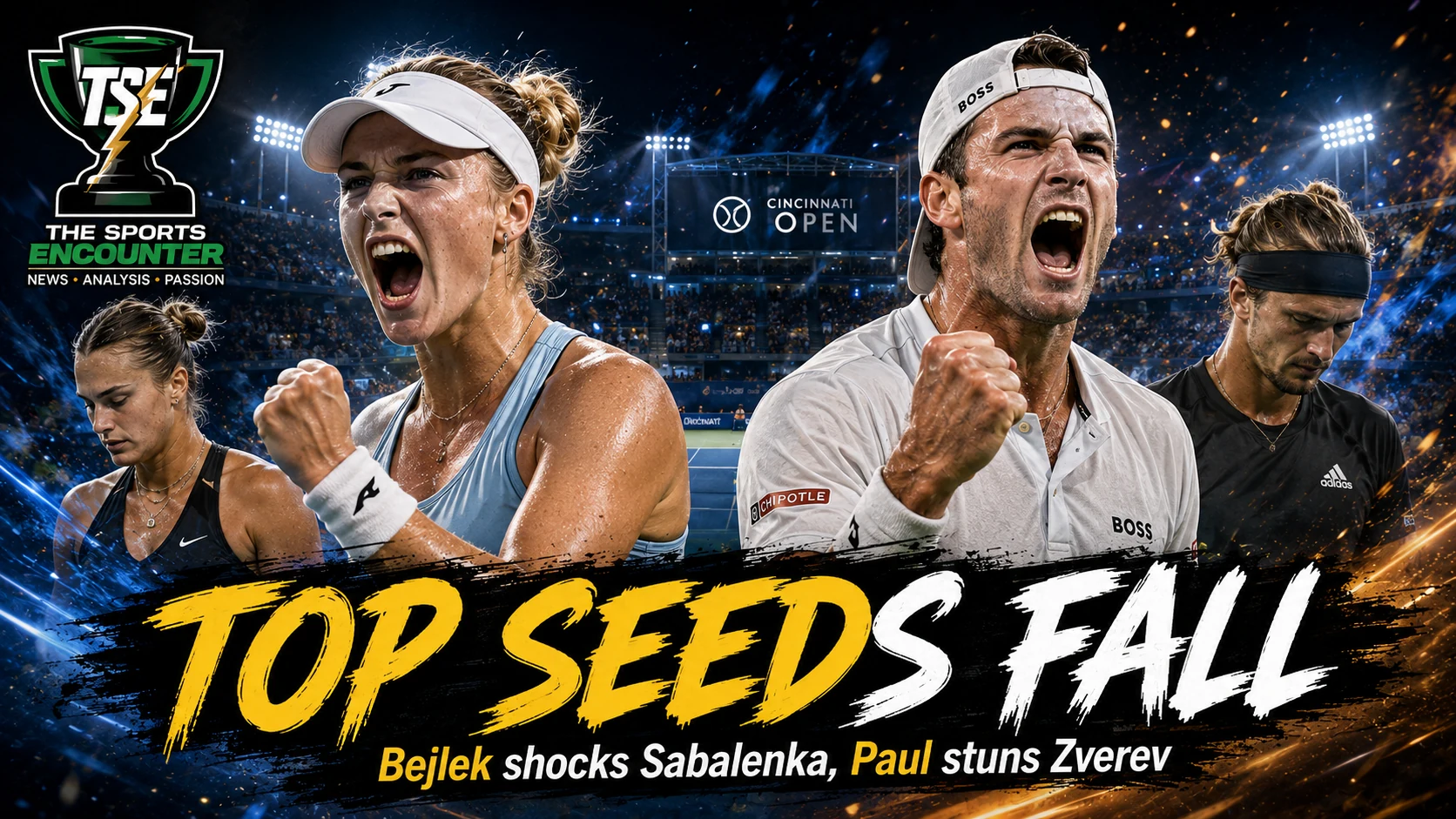
The Cincinnati Open needed one day to lose both of its top singles seeds.
By the end of the August 19 round-of-16 schedule, Aryna Sabalenka and Alexander Zverev were gone, Sara Bejlek had produced the biggest win of her young career, Tommy Paul had saved a match point to knock out the men’s No. 1 seed, and the American challenge had grown considerably stronger across both draws.
What began as a full day of fourth-round tennis at the Lindner Family Tennis Center gradually became a tournament reset.
Bejlek stunned Sabalenka 7-6(7), 6-4 to reach her first Cincinnati quarterfinal and record her first Top 10 win. Paul recovered from a set down and saved a match point before beating Zverev 4-6, 7-6(6), 6-4. Coco Gauff, Jessica Pegula, Madison Keys, Amanda Anisimova, Taylor Fritz and Frances Tiafoe all advanced as the home contingent survived one of the most important days of the tournament.
Iga Swiatek and Elena Rybakina also moved through comfortably, keeping alive one of the most significant women’s quarterfinals of the week and leaving the world No. 1 ranking in play.
The August 19 schedule was officially devoted entirely to the round of 16, with both the men’s and women’s draws playing for quarterfinal places. The tournament runs through August 23 and remains the final combined ATP and WTA 1000 stop before the US Open.
For continuing scores, player stories and tournament analysis, follow The Sports Encounter’s tennis coverage.
Cincinnati Open August 19 Results at a Glance
Women’s Round of 16
| Winner | Opponent | Score |
|---|---|---|
| Iga Swiatek | Diane Parry | 6-3, 6-3 |
| Jessica Pegula | Sorana Cirstea | 6-2, 4-6, 7-5 |
| Marta Kostyuk | Mirra Andreeva | 4-6, 6-0, 6-2 |
| Amanda Anisimova | Linda Noskova | 6-1, 6-4 |
| Elena Rybakina | Diana Shnaider | 6-4, 6-4 |
| Coco Gauff | Marie Bouzkova | 6-3, 6-2 |
| Madison Keys | Wang Xiyu | 7-6(3), 6-4 |
| Sara Bejlek | Aryna Sabalenka | 7-6(7), 6-4 |
Men’s Round of 16
| Winner | Opponent | Score |
|---|---|---|
| Flavio Cobolli | Rafael Jodar | 4-6, 7-6(3), 6-3 |
| Thiago Agustin Tirante | Jakub Mensik | 5-7, 6-4, 6-4 |
| Tommy Paul | Alexander Zverev | 4-6, 7-6(6), 6-4 |
| Arthur Fils | Alex de Minaur | 6-3, 6-4 |
| Brandon Nakashima | Nuno Borges | 6-3, 6-7(5), 6-3 |
| Taylor Fritz | Christopher O’Connell | 6-4, 6-3 |
| Frances Tiafoe | Felix Auger-Aliassime | 6-3, 6-4 |
| Lorenzo Musetti | Jaime Faria | 7-5, 6-2 |
Sara Bejlek Turns the Women’s Draw Upside Down
Sara Bejlek entered Wednesday’s match against Aryna Sabalenka without a Top 10 victory.
She left Center Court having defeated the world No. 1.
The 20-year-old Czech won 7-6(7), 6-4 in a performance that carried far more maturity than her ranking or experience suggested.
Sabalenka had opportunities in both sets.
Bejlek absorbed them.
The opening set demanded a tiebreak, where the younger player refused to retreat when the pressure increased. She then stayed composed in the second set and completed the biggest victory of her career without allowing the occasion to become bigger than the tennis itself.
The result has immediate consequences beyond one quarterfinal berth.
Sabalenka arrived in Cincinnati having occupied the No. 1 ranking for 96 consecutive weeks and 104 weeks overall. Her defeat now leaves Elena Rybakina with a potential route to the top ranking if the Kazakh wins the Cincinnati title.
That ranking story had been developing before Wednesday. The Cincinnati Open had already detailed the pressure surrounding Sabalenka’s No. 1 position, with Rybakina steadily closing the gap.
Bejlek has now turned that theoretical possibility into an immediate tournament storyline.
Her run is also another reminder of how quickly the North American hard-court swing can change a player’s trajectory. Only weeks earlier, Swiatek defeated Bejlek 6-0, 6-3 in Toronto. In Cincinnati, the Czech has produced the biggest win of her career.
Tommy Paul Saves Match Point and Sends Zverev Home
Tommy Paul’s victory over Alexander Zverev carried a different kind of drama.
The American spent much of the match chasing the top seed.
Zverev won the first set 6-4 and later reached match point in the second. Paul survived, forced a tiebreak and took it 8-6 before completing the comeback 6-4 in the third.
The match was interrupted by rain and momentum shifted repeatedly, but Paul’s ability to remain attached to the contest eventually became the difference.
Zverev served 14 aces, yet nine double faults repeatedly undermined that advantage. A costly foot fault also arrived during the deciding set as Paul’s pressure increased.
The victory sends Paul into his first Cincinnati quarterfinal and gives him one of the biggest wins of his season.
According to the ATP Tour’s official report, Paul became the first American man to record a Top 3 win in Cincinnati since John Isner defeated Novak Djokovic in the 2013 quarterfinals.
The result also reinforces a wider pattern that has defined the summer.
Zverev had already suffered an early exit in Canada during a National Bank Open that saw many leading men’s seeds disappear. The Sports Encounter documented that instability in our National Bank Open first-week wrap-up.
Cincinnati has now removed another major favorite.
Bejlek and Paul Make August 19 the Day of the Upset
The two headline results came from different positions in the draw, but they carried the same message.
Seedings are losing power quickly in Cincinnati.
Sabalenka was the leading woman in the tournament.
Zverev was the leading man.
Neither reached the quarterfinals.
Their exits created opportunities throughout both draws, particularly for players who have already found momentum on North American hard courts.
Paul now faces Flavio Cobolli.
Bejlek will meet Madison Keys.
Neither quarterfinal existed in the obvious pre-tournament script.
That unpredictability is exactly what makes the final Masters 1000 week before New York so valuable. Cincinnati does not simply prepare players for the US Open. It exposes who has actually adjusted to the surface, heat, schedule and pressure of late summer.
Iga Swiatek Keeps Winning and the Title Defense Gets More Serious
Iga Swiatek had one of the cleaner days among the leading women’s contenders.
The defending Cincinnati champion defeated Diane Parry 6-3, 6-3 and extended her hard-court winning streak to nine matches.
That streak began in Toronto, where Swiatek recovered from a difficult summer and eventually won the National Bank Open.
Her title there ended a year-long championship drought and gave her a 12th WTA 1000 trophy. The Sports Encounter followed that Canadian run throughout the tournament, including the day Sabalenka and Pegula fell while Swiatek survived.
Cincinnati has so far looked like continuation rather than reset.
Swiatek has appeared calmer, cleaner and increasingly comfortable on hard courts again.
The next test is considerably harder.
Elena Rybakina awaits in the quarterfinals.
Elena Rybakina Keeps the No. 1 Dream Alive
Rybakina defeated Diana Shnaider 6-4, 6-4 without needing the kind of recovery required elsewhere in the draw.
That result was already significant because it moved her into another WTA 1000 quarterfinal.
Sabalenka’s later defeat made it much bigger.
Rybakina can now potentially leave Cincinnati as world No. 1 if she wins the tournament.
Her quarterfinal against Swiatek therefore carries three layers at once.
It is a meeting between two of the strongest hard-court players in the women’s game.
It is a collision between the Toronto champion and the woman chasing the top ranking.
It is also the match most likely to define the lower half of the women’s title race.
Swiatek recently defeated Rybakina 6-2, 6-3 in the Toronto final to win her first title of 2026. Cincinnati now offers Rybakina an immediate chance to reverse that result.
Coco Gauff Looks Increasingly Comfortable in Familiar Territory
Coco Gauff handled Marie Bouzkova 6-3, 6-2 and moved into another Cincinnati quarterfinal with relatively little drama.
The setting matters for Gauff.
Cincinnati was the tournament that helped change her career in 2023. She won the title here and followed it by winning the US Open weeks later.
The official tournament has highlighted Cincinnati’s long history of launching players toward US Open success, with Gauff among the clearest recent examples.
Her current run carries a similar opportunity.
Gauff has moved through the draw while several major threats have disappeared, and her next opponent will be Marta Kostyuk.
The American has looked increasingly settled after surviving a more difficult opening earlier in the event.
Marta Kostyuk Turns One Lost Set Into a Statement
Marta Kostyuk’s victory over Mirra Andreeva may have been the most emphatic reversal of the women’s session.
Andreeva won the first set 6-4.
Kostyuk then won 12 of the next 14 games.
The Ukrainian took the second set 6-0 and the third 6-2, completely changing the physical and tactical balance of the match.
Andreeva entered Cincinnati as one of the leading young players in the sport and a major contender after a strong 2026 season.
Kostyuk refused to let the opening set define the match.
The result gives her a quarterfinal against Gauff and another opportunity to build on a North American swing that has repeatedly featured difficult, physical matches.
Jessica Pegula Survives the Match She Could Easily Have Lost
Jessica Pegula needed three sets to get past Sorana Cirstea 6-2, 4-6, 7-5.
The first set suggested a routine afternoon.
The next two did not.
Cirstea changed the rhythm of the contest, took the second set and pushed Pegula deep into the decider before the American finally separated herself at 5-5.
Winning ugly carries real value at this stage of a 1000-level tournament.
Pegula now moves into an all-American quarterfinal against Amanda Anisimova, guaranteeing at least one U.S. woman in the semifinals from that section.
The matchup also continues an American resurgence across the draw on a day when Gauff and Keys advanced as well.
Amanda Anisimova Removes the Wimbledon Champion
Amanda Anisimova produced one of the sharpest women’s performances of the day by defeating Linda Noskova 6-1, 6-4.
Noskova entered Cincinnati as the reigning Wimbledon champion and one of the players carrying the most obvious momentum from the grass season.
Anisimova gave her almost no time to settle.
The American dominated the opening set, then protected the advantage when the second became more competitive.
That victory strengthens Anisimova’s own US Open case.
She has the power to shorten points on hard courts and now has another deep WTA 1000 run immediately before New York.
Madison Keys Keeps Bejlek’s Next Test Very Real
Madison Keys defeated Wang Xiyu 7-6(3), 6-4 to secure her place in the quarterfinals.
The former Cincinnati champion needed patience in the opening set before taking control of the tiebreak and carrying that momentum into the second.
Keys now gets the player everyone will be watching.
Bejlek’s upset of Sabalenka creates enormous attention, but the next round will show whether the Czech can reproduce that emotional and physical level against another proven hard-court hitter.
Keys has seen every version of pressure Cincinnati can provide. Bejlek is experiencing this stage of the tournament for the first time.
Taylor Fritz Keeps the American Men’s Push Moving
Taylor Fritz defeated Christopher O’Connell 6-4, 6-3 and moved into the quarterfinals without allowing the match to become complicated.
Fritz entered Cincinnati carrying significant hard-court confidence after winning the Mubadala DC Open earlier this month.
The Sports Encounter covered that title when Fritz defeated Rafael Jodar in the Washington final.
His Cincinnati quarterfinal will be another all-American contest, this time against Brandon Nakashima.
That guarantees one American man a semifinal place from their section.
With Paul and Tiafoe also through, the home challenge suddenly looks far stronger than it did earlier in the tournament.
Frances Tiafoe Removes Felix Auger-Aliassime in Straight Sets
Frances Tiafoe produced one of the cleaner men’s upsets of the evening by beating second seed Felix Auger-Aliassime 6-3, 6-4.
The result denied Cincinnati a potential late-round meeting between two of the highest seeds and gave Tiafoe another important hard-court win in front of an American crowd.
Auger-Aliassime had looked convincing in the previous round, but Tiafoe prevented him from establishing the first-strike rhythm that normally makes the Canadian dangerous.
Tiafoe now meets Lorenzo Musetti.
That quarterfinal presents a sharp stylistic contrast between Tiafoe’s aggressive hard-court instincts and Musetti’s greater variety.
Brandon Nakashima Refuses to Leave Quietly
Brandon Nakashima needed three sets to defeat Nuno Borges 6-3, 6-7(5), 6-3.
The American had already survived one of the matches of the tournament in the previous round, saving three match points before eliminating Daniil Medvedev.
Wednesday demanded a different form of resilience.
Nakashima won the first set, lost the second in a tiebreak and then reset rather than allowing the missed opportunity to consume him.
He now faces Fritz for a semifinal place.
That quarterfinal also gives the American men’s game another guaranteed deep run at a Masters 1000 event immediately before the US Open.
Arthur Fils Looks Healthy Again
Arthur Fils defeated Alex de Minaur 6-3, 6-4 in one of his most convincing wins since returning from the lower-back stress fracture that cost him much of the previous year.
The Frenchman controlled the match against one of the tour’s best movers and reached his fifth Masters 1000 quarterfinal of the season.
That total puts him alongside Jo-Wilfried Tsonga for the most Masters 1000 quarterfinals reached by a Frenchman in a single season.
More important than the record is the way Fils is moving again.
His physical problems interrupted what had looked like a rapid rise. Cincinnati has offered evidence that his explosive first-strike tennis is returning without obvious restriction.
His quarterfinal opponent will be Thiago Agustin Tirante.
Tirante’s Giant-Killing Run Is Still Alive
Thiago Agustin Tirante recovered from a set down to defeat Jakub Mensik 5-7, 6-4, 6-4.
The Argentine has become one of Cincinnati’s least expected quarterfinalists.
His run already includes the tournament’s earlier shock victory over Novak Djokovic, who returned to Cincinnati hoping to sharpen his preparation for another US Open record chase.
The Sports Encounter had examined that objective before the event in our preview of Djokovic’s Cincinnati return and pursuit of a 25th Grand Slam title.
Tirante has now followed that result by beating Mensik and will face Fils with a semifinal place available.
At this point, calling him a one-match upset story no longer fits.
Flavio Cobolli Ends Rafael Jodar’s Latest Breakthrough Run
Rafael Jodar’s excellent North American summer finally met its limit against Flavio Cobolli.
Jodar won the opening set 6-4 and came within one set of another major quarterfinal.
Cobolli responded by winning the second-set tiebreak 7-3 and taking the decider 6-3.
The defeat ends another deep tournament for the 19-year-old Spaniard, whose rise has accelerated dramatically throughout 2026.
Only weeks earlier, Jodar reached the Washington final before losing to Fritz. He has also climbed rapidly through the ATP rankings and continued proving that his results are no longer isolated breakthroughs.
Cobolli’s reward is a quarterfinal against Paul.
Lorenzo Musetti Completes the Men’s Final Eight
Lorenzo Musetti defeated Jaime Faria 7-5, 6-2 and secured the final men’s quarterfinal position.
The Italian had to work through a competitive opening set before taking control.
His reward is Tiafoe, another match that should tell us plenty about how Musetti’s game translates to quicker North American hard courts under pressure.
The American Presence Is Becoming the Story of Cincinnati
Wednesday began with several U.S. contenders scattered through both draws.
It ended with an unmistakable home presence.
Among the women, Gauff, Pegula, Anisimova and Keys all reached the quarterfinals.
Among the men, Paul, Fritz, Nakashima and Tiafoe advanced.
Two quarterfinals are guaranteed all-American affairs:
- Amanda Anisimova vs Jessica Pegula
- Taylor Fritz vs Brandon Nakashima
That guarantees at least one American woman and one American man in the semifinals before the other U.S. contenders even play.
For a tournament positioned immediately before the US Open, that matters.
Confidence built in Cincinnati can travel quickly to New York.
The tournament’s own historical record supports that connection. Players including Gauff, Novak Djokovic, Rafael Nadal, Andy Roddick, Kim Clijsters and Serena Williams have all used Cincinnati success as part of major US Open runs.
Cincinnati Open 2026 Quarterfinal Lineup
Women’s Quarterfinals
| Quarterfinal | Matchup |
|---|---|
| QF1 | Amanda Anisimova vs Jessica Pegula |
| QF2 | Iga Swiatek vs Elena Rybakina |
| QF3 | Sara Bejlek vs Madison Keys |
| QF4 | Coco Gauff vs Marta Kostyuk |
Men’s Quarterfinals
| Quarterfinal | Matchup |
|---|---|
| QF1 | Tommy Paul vs Flavio Cobolli |
| QF2 | Thiago Agustin Tirante vs Arthur Fils |
| QF3 | Taylor Fritz vs Brandon Nakashima |
| QF4 | Lorenzo Musetti vs Frances Tiafoe |
What August 19 Changed Before the US Open
The obvious answer is the Cincinnati draw.
The larger answer is confidence.
Sabalenka now heads toward the final stages of US Open preparation with another unexpected defeat and her No. 1 ranking vulnerable.
Zverev leaves Ohio without the Masters 1000 title many expected him to challenge for.
Paul has added a Top 3 victory.
Bejlek has discovered that she can beat the best player in the world.
Swiatek has extended a winning streak.
Rybakina can see the No. 1 ranking.
Gauff, Pegula, Keys and Anisimova are all still alive on home soil.
Fritz, Nakashima, Tiafoe and Paul have given American men’s tennis multiple routes into the semifinals.
That is why Cincinnati matters so much at this point of the calendar.
Players are not merely chasing another trophy.
They are learning what their games look like two weeks before the final Grand Slam of the season.
Our broader North American hard-court coverage has followed that process from Washington through Canada, including the National Bank Open tournament guide and the subsequent wave of upsets that reshaped both tours.
Cincinnati is now supplying its own warning.
Very little about the hierarchy is secure.
TSE Verdict: Cincinnati Lost Its Top Seeds and Found a Better Tournament
August 19 was supposed to reduce two large draws into manageable quarterfinal fields.
Instead, it changed the personality of the tournament.
Bejlek removed the women’s No. 1 seed.
Paul removed the men’s No. 1 seed.
The American contingent grew stronger.
Swiatek and Rybakina moved closer to a quarterfinal carrying championship and ranking implications.
Fils showed that his body and game are finally moving in the same direction again.
Tirante proved his Djokovic upset was part of something larger.
Jodar lost, but another deep Masters run strengthened the evidence around his rapid rise.
By the time the final round-of-16 match ended, Cincinnati had become substantially harder to predict than it had been that morning.
That is exactly what the week before the US Open needed.
For official scores, schedules and tournament information, readers can follow the Cincinnati Open results center, the ATP Tour’s official Cincinnati results, and the WTA’s official Cincinnati draw.
Breaking News
Elina Svitolina’s Ankle Injury Raises US Open 2026 Fitness Concerns After Cincinnati Withdrawal
Elina Svitolina has withdrawn from the Cincinnati Open because of a right ankle injury carried over from Toronto. The world No. 9 now faces a crucial recovery window before the US Open after building strong hard-court form this summer.

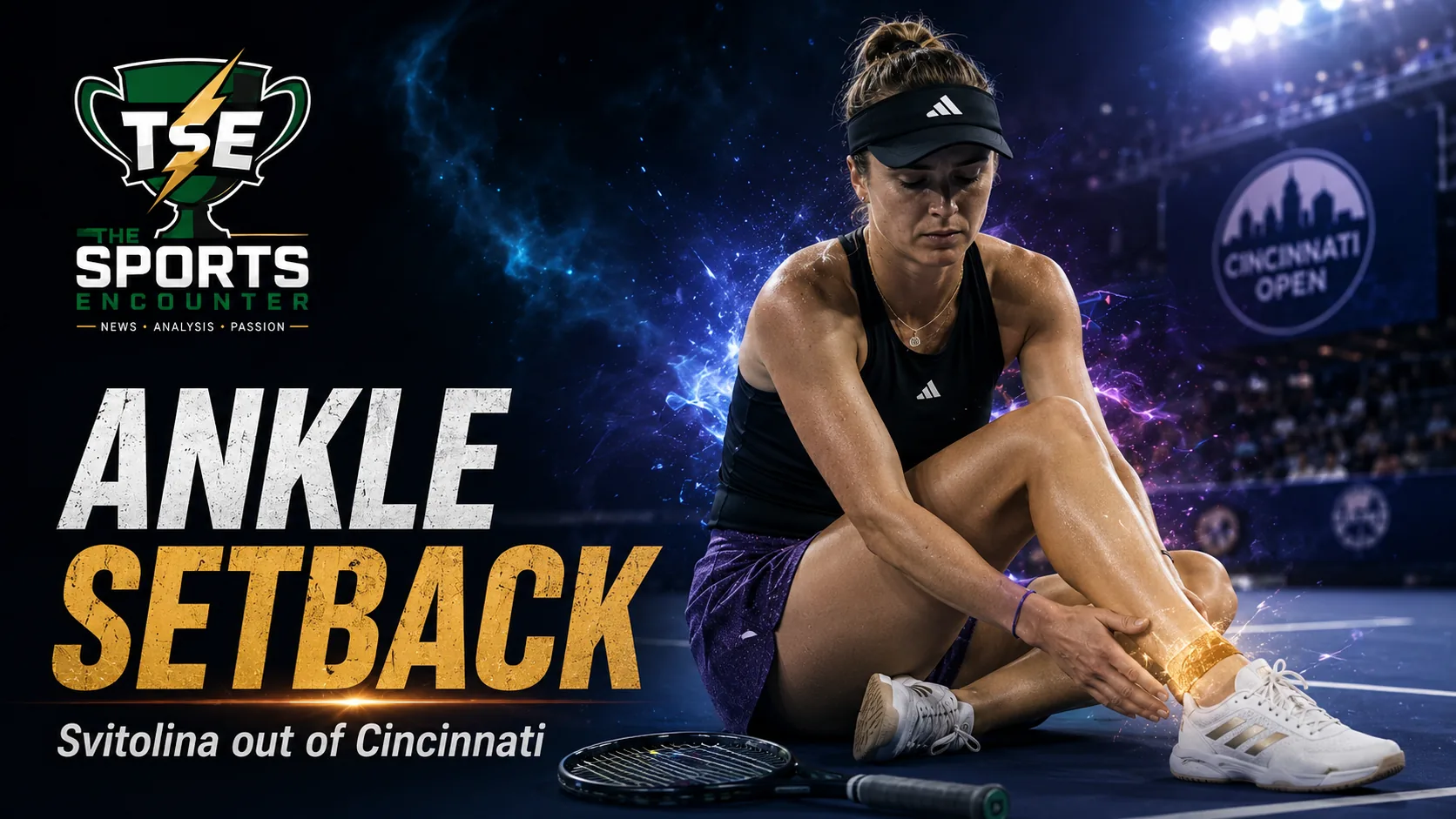
CINCINNATI, August 19, 2026: Elina Svitolina’s Cincinnati Open campaign has ended because of a right ankle injury, leaving the world No. 9 facing an uncomfortable race against time before the US Open 2026.
Svitolina withdrew before her third-round match against China’s Wang Xiyu after failing to recover sufficiently from an ankle problem carried over from the National Bank Open in Toronto.
The withdrawal sends Wang into the Round of 16 by walkover, where Madison Keys awaits. For Svitolina, however, the consequences extend well beyond one lost Cincinnati match.
The Ukrainian is scheduled to turn her attention toward New York, where the US Open singles main draw begins on August 30. That gives her limited time to reduce inflammation, regain confidence in the ankle and determine whether she can handle the repeated changes of direction required across potentially seven best-of-three-set matches at a Grand Slam.
The Sports Encounter already noted the withdrawal in our August 18 Cincinnati Open wrap. The more important question now is what the injury means for Svitolina’s US Open preparation after one of her strongest stretches of tennis this season.
Elina Svitolina Injury: Key Facts
| Player | Elina Svitolina |
| Current ranking | World No. 9 |
| Injury | Right ankle |
| Tournament | Cincinnati Open 2026 |
| Withdrawal stage | Third round |
| Scheduled opponent | Wang Xiyu |
| Previous match | Beat Tereza Valentova 3-6, 7-6(5), 6-0 |
| Next scheduled major | US Open 2026 |
Svitolina Tried to Recover, but Cincinnati Came Too Soon
Svitolina made clear that withdrawing was not her preferred option.
She had attempted to recover from the ankle problem after Toronto and then pushed through another demanding match in Cincinnati.
Her body did not respond quickly enough.
The official WTA announcement on Svitolina’s Cincinnati withdrawal confirmed the right ankle injury and her decision to pull out before facing Wang.
That timing matters.
A routine early-tournament withdrawal in April or May would provide weeks to recover.
This one comes directly before the final Grand Slam of the season.
The Injury Was Visible Against Tereza Valentova
Svitolina’s physical discomfort had already become apparent during her second-round victory over Tereza Valentova.
The Ukrainian lost the opening set 6-3 before forcing a second-set tiebreak.
During that set, she required a medical timeout to address the right foot and ankle area.
She nevertheless stayed on court.
The response was impressive.
Svitolina took the tiebreak 7-5 and then overwhelmed Valentova 6-0 in the deciding set.
From a competitive perspective, it looked like another demonstration of the resilience that has defined much of her career.
From a physical perspective, the match carried a cost.
She was unable to recover sufficiently for the next round.
The Problem Did Not Start in Cincinnati
Svitolina said the injury had originally troubled her in Toronto.
That makes the timeline more concerning than a single awkward movement in Cincinnati.
She enjoyed a superb National Bank Open run, reaching the semifinals after producing some of her best hard-court tennis of the season.
The Sports Encounter followed that progression when Svitolina and Iga Swiatek secured their Toronto semifinal places.
Svitolina had recovered from a set down against Ekaterina Alexandrova in the quarterfinal, winning 3-6, 6-0, 6-3.
That performance required considerable physical effort.
She then faced Swiatek in another demanding three-set contest.
Toronto Showed Why Svitolina Still Matters at the Biggest Events
Svitolina’s semifinal against Swiatek was one of the strongest matches of the Toronto tournament.
She lost 6-3, 1-6, 6-3, but the scoreline does not fully explain how close she came to turning the match around.
After being controlled in the opening set, Svitolina dismantled Swiatek 6-1 in the second.
She then broke early enough in the deciding set to establish a 3-2 advantage.
Swiatek had to win the final four games to escape.
Our full Swiatek-Svitolina semifinal analysis showed that Svitolina actually won more total points in the match despite losing it.
That performance matters when assessing her US Open prospects.
Svitolina was not entering Cincinnati out of form.
Quite the opposite.
Her tennis looked increasingly dangerous.
The concern is whether her body can support that level.
Momentum Was Building at Exactly the Right Time
The North American hard-court swing is often less about collecting trophies than arriving in New York with rhythm, confidence and physical stability.
Svitolina had two of those three.
Her Toronto results supplied confidence.
The number of competitive matches supplied rhythm.
The ankle now threatens the third component.
That creates a frustrating contrast with players such as Swiatek, who left Toronto with the title after beating Elena Rybakina in the final.
The Sports Encounter’s Toronto final report examined why Swiatek’s championship immediately strengthened her US Open credentials.
Svitolina’s own Toronto run had created a similar, if quieter, sense of momentum.
Cincinnati has interrupted it.
How Much Recovery Time Does Svitolina Actually Have?
The official US Open 2026 tournament schedule runs from August 23 through September 13, with the singles main draw beginning on August 30.
That gives Svitolina fewer than two weeks between her Cincinnati withdrawal and the start of singles competition.
In tennis terms, that is enough time for a minor ankle problem to improve.
It is not enough time to casually manage anything more serious.
The challenge also goes beyond becoming pain-free.
A Grand Slam requires repeated high-intensity movement over two weeks.
Players sprint forward, stop abruptly, slide laterally, recover toward the center of the court and repeatedly load the ankles when serving and changing direction.
An athlete can feel comfortable walking and still be far from ready to compete at Grand Slam intensity.
Svitolina Cannot Afford to Rush the Recovery
The temptation is obvious.
The US Open is one of four tournaments every elite player builds a season around.
Missing it would be painful.
Playing before an ankle is properly ready can create a different problem.
A player protecting one side unconsciously can alter movement patterns and increase stress elsewhere in the body.
There is also the psychological element.
A player who does not trust an ankle cannot move freely.
That hesitation can be enough to change rallies at the highest level.
Svitolina therefore faces a difficult calculation.
How much fitness can she safely rebuild before August 30?
Her Playing Style Makes Full Movement Essential
Svitolina is not a player who can comfortably compensate for reduced movement simply by shortening points with overwhelming power.
Her greatest strengths include defensive coverage, court positioning, transition play, counterpunching and the ability to make opponents hit an additional ball.
All of those require trust in the lower body.
Her Toronto run demonstrated exactly that.
Against Alexandrova, she absorbed power and changed the match through consistency.
Against Swiatek, she survived long exchanges and repeatedly forced the world-class Pole into uncomfortable patterns.
An ankle restricting lateral acceleration would directly weaken the areas that make Svitolina difficult to beat.
Cincinnati Withdrawal Could Still Be the Smart Decision
There is another way to interpret Tuesday’s news.
Leaving Cincinnati may actually improve Svitolina’s US Open prospects.
She could have attempted to play through the injury against Wang.
A victory would then have produced another match against Madison Keys.
That would mean additional running, additional recovery demands and potentially several more days of competitive stress.
By withdrawing now, Svitolina removes that workload.
The priority shifts entirely to rehabilitation.
That may prove the more valuable outcome if she arrives in New York healthy enough to compete properly.
What the Walkover Means for Wang Xiyu
Wang advances without having to contest the third-round match.
Her reward is a Round of 16 meeting with Madison Keys.
Keys reached that stage by defeating Katerina Siniakova 6-1, 6-3.
The official Cincinnati Open player and tournament information from the WTA reflects the altered progression after Svitolina’s withdrawal.
For Wang, the walkover means fresh legs before one of the toughest matches of her tournament.
For Keys, the matchup changes from the experienced and highly defensive Svitolina to a very different opponent.
The Women’s Cincinnati Draw Has Already Been Shaped by Fitness
Svitolina is hardly the only leading player dealing with physical concerns during the final weeks before New York.
The Cincinnati Open arrived during a North American swing filled with withdrawals and interrupted preparation.
Belinda Bencic withdrew from Toronto before her semifinal against Coco Gauff because of a hip issue.
Several players have arrived in Ohio managing workloads after deep Canadian runs.
The Sports Encounter examined that broader instability in our National Bank Open analysis of falling favorites and emerging contenders.
The lesson becomes increasingly clear as New York approaches.
Form matters.
Availability matters more.
Svitolina Had Already Played a Heavy Toronto Schedule
The Toronto tournament required Svitolina to negotiate several demanding rounds against high-level opposition.
Her victory over Amanda Anisimova in the Round of 16 moved her into the quarterfinals, where Alexandrova pushed her to three sets.
That sequence was part of a tournament in which Svitolina advanced while Aryna Sabalenka and Jessica Pegula were eliminated.
She then played another physical three-set semifinal against Swiatek.
Recovery windows become increasingly important when tournaments arrive almost back-to-back.
Players can survive one difficult match.
The cumulative effect is harder to predict.
The US Open Picture Has Become Increasingly Complicated
Cincinnati began as one of the final major opportunities to assess the leading contenders before New York.
Instead, the tournament has produced almost as many fitness questions as answers.
The Sports Encounter’s Cincinnati Open tournament preview highlighted how heavily US Open preparation would influence the event.
That has proven accurate.
Players are balancing ranking points against recovery.
Every deep run brings confidence but also workload.
Every withdrawal creates rest but also removes match practice.
Svitolina now sits firmly inside that dilemma.
Her Ranking Gives Her Some Protection
Being ranked inside the world’s top 10 gives Svitolina one important advantage if she is fit enough to play the US Open.
She should enter as one of the leading seeds, helping her avoid other elite-ranked players in the earliest rounds.
That does not guarantee an easy path.
Women’s tennis has repeatedly demonstrated this season that rankings alone provide limited protection in major draws.
Still, a favorable early matchup could provide Svitolina with valuable time to play herself back into full competitive rhythm.
Experience Could Become Her Biggest Asset
Svitolina has spent years dealing with the physical and emotional demands of Grand Slam tennis.
She knows how her body responds to treatment.
She understands the difference between manageable discomfort and a problem likely to worsen over five sets of movement intensity across several rounds.
That experience should influence whatever decision she makes before New York.
This is not a young player terrified of missing a first opportunity.
Svitolina has enough perspective to recognize that arriving at 90 percent healthy may be more valuable than forcing another tournament while compromised.
Toronto Suggests She Could Still Be Dangerous in New York
If the ankle settles, Svitolina should not be dismissed as merely a participant.
Her Toronto performances demonstrated that she can still compete with the best players in the women’s game.
She defeated Anisimova.
She came through Alexandrova.
She pushed Swiatek to the limit.
The National Bank Open semifinals had already positioned her among the players arriving late in the summer with meaningful hard-court form.
Our Toronto and Montreal semifinal roundup captured how Svitolina remained part of an increasingly competitive group of contenders as the US Open approached.
The injury has introduced uncertainty.
It has not erased the tennis she played before it.
What Svitolina Needs Before the US Open
The next several days matter more than Cincinnati ranking points ever could.
First, inflammation and pain need to settle.
Then comes movement testing.
Linear running is only the beginning.
Svitolina needs to be able to push laterally, recover from wide defensive positions, change direction explosively and serve without protecting the injured side.
Practice intensity can then increase.
The final test is confidence.
A player cannot spend Grand Slam rallies thinking about whether the ankle will hold.
When Svitolina reaches that stage, New York becomes realistic.
No Reason to Panic Yet, but No Reason to Ignore It Either
Ankle injuries vary enormously in severity.
Svitolina has not announced that she will miss the US Open.
Her current schedule still points toward New York as the next destination.
That is encouraging.
At the same time, withdrawing from a WTA 1000 event during the final major tune-up of the summer is meaningful.
She had already attempted to recover.
She had already played through discomfort.
Eventually the body forced a different decision.
TSE Verdict: Cincinnati Was Sacrificed to Protect the Bigger Prize
Svitolina’s Cincinnati Open is over.
Her North American hard-court summer is not.
The withdrawal is disappointing precisely because her tennis had been trending in the right direction.
Toronto produced a semifinal.
Swiatek needed three sets to stop her.
Cincinnati began with another comeback victory.
The competitive evidence suggested Svitolina was moving toward the US Open as a credible second-tier title threat capable of troubling almost anyone in the draw.
The ankle is now the variable.
Pulling out before facing Wang may ultimately prove wise if several days without tournament stress allow the injury to heal properly.
There is little value in reaching another Cincinnati round if doing so compromises the year’s final Grand Slam.
New York begins soon enough that Svitolina cannot waste recovery time.
Yet it remains far enough away that this should not automatically be treated as a US Open crisis.
The next week will tell us much more.
For now, one of the women’s game’s most resilient competitors has made the sensible choice.
She stopped.
The next challenge is making sure that when she starts again, the ankle is ready to follow.
Frequently Asked Questions
Why did Elina Svitolina withdraw from the Cincinnati Open?
Svitolina withdrew because of a right ankle injury that had initially troubled her during the National Bank Open in Toronto and continued affecting her in Cincinnati.
Who was Svitolina supposed to play in Cincinnati?
She was scheduled to face China’s Wang Xiyu in the third round.
Who advances after Svitolina’s withdrawal?
Wang Xiyu advances to the Round of 16 by walkover.
Who will Wang Xiyu play next?
Wang is scheduled to face Madison Keys in the Cincinnati Open Round of 16.
Did Svitolina play with the ankle injury before withdrawing?
Yes. She required medical treatment during her second-round match against Tereza Valentova but continued and won 3-6, 7-6(5), 6-0.
Did Elina Svitolina reach the Toronto semifinals?
Yes. Svitolina reached the National Bank Open semifinals before losing to Iga Swiatek 6-3, 1-6, 6-3.
Is Elina Svitolina expected to play the US Open?
The US Open remains her next scheduled tournament. No withdrawal from New York has been announced.
When does the US Open 2026 singles main draw begin?
The men’s and women’s singles main draws begin on August 30, 2026.
What is Elina Svitolina’s current ranking?
Svitolina is ranked world No. 9.
How serious is Svitolina’s ankle injury?
The exact severity has not been publicly detailed. She withdrew from Cincinnati after being unable to recover sufficiently, but she has not announced that she will miss the US Open.
Where can readers follow official Cincinnati Open updates?
The WTA provides official tournament results, player information and withdrawal updates, while the US Open website carries the official New York schedule.
Cincinnati Open
Cincinnati Open 2026: Nakashima Stuns Medvedev as Sabalenka and Gauff March On
Brandon Nakashima produced the standout result of August 18 at the Cincinnati Open 2026, saving three match points to defeat Daniil Medvedev. Aryna Sabalenka, Coco Gauff, Madison Keys and Mirra Andreeva also advanced as both singles draws reached the Round of 16.
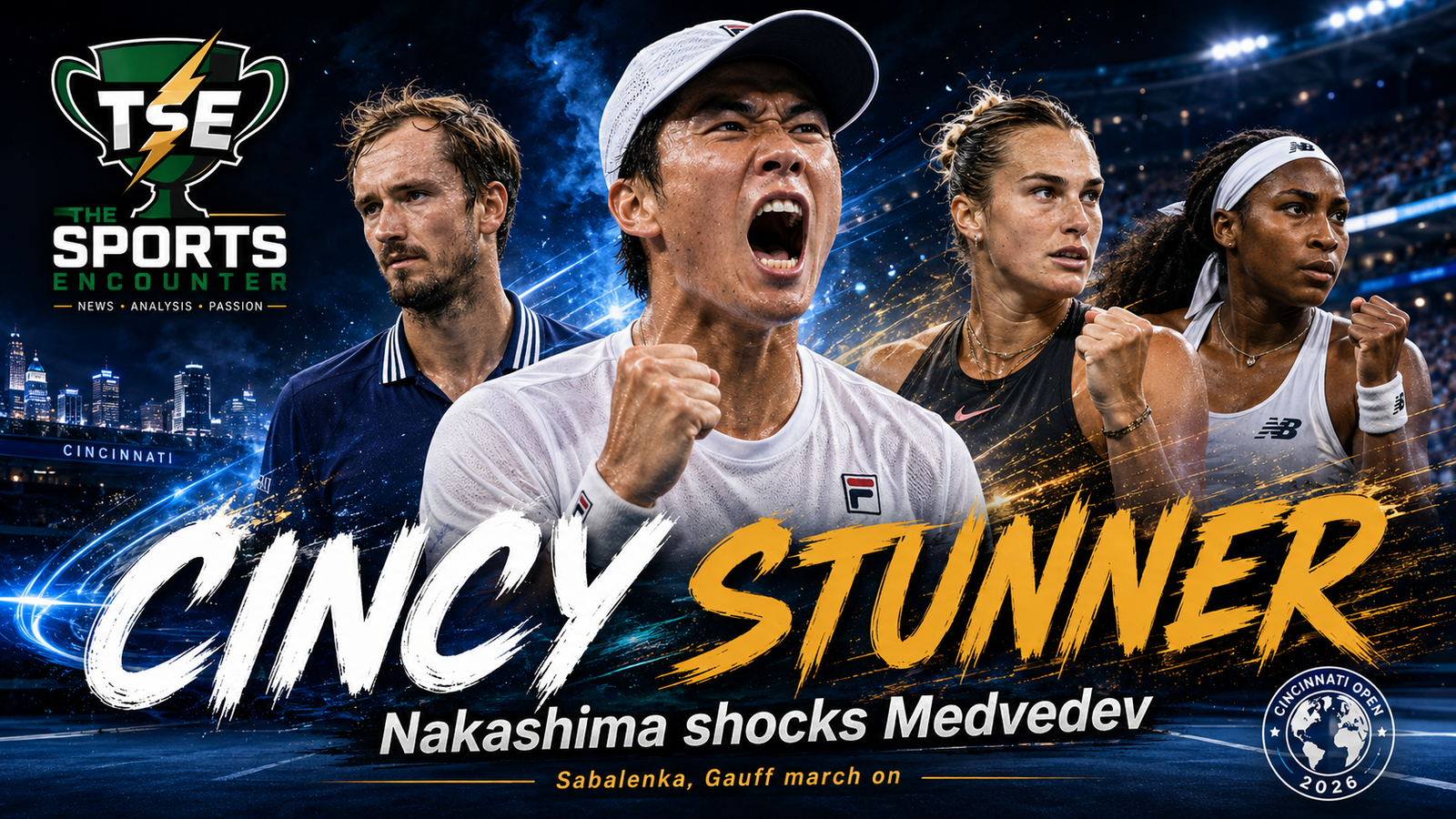
CINCINNATI, August 18, 2026: Brandon Nakashima saved three match points to knock out Daniil Medvedev, Aryna Sabalenka needed only 54 minutes to reach the last 16, Coco Gauff kept her Cincinnati run alive, and Elina Svitolina withdrew with an ankle injury as the Cincinnati Open 2026 moved decisively toward its knockout endgame on Tuesday.
The men’s third round delivered another significant upset when Nakashima recovered from the brink against fourth seed Medvedev. Nuno Borges removed Andrey Rublev, Taylor Fritz and Frances Tiafoe strengthened the American presence in the Round of 16, and Lorenzo Musetti continued quietly building his own run.
On the women’s side, Sabalenka produced the day’s most dominant performance, Gauff defeated fellow American Ann Li, Madison Keys cruised through, Mirra Andreeva survived a more demanding challenge, and Marta Kostyuk eliminated Sloane Stephens.
By the end of the session, Cincinnati had stopped looking like an early US Open warm-up tournament and started resembling a serious form test for New York.
The Sports Encounter’s previous Cincinnati Open daily wrap tracked Alexander Zverev, Iga Swiatek, Jessica Pegula and Elena Rybakina into the Round of 16. Tuesday completed most of the other half of both singles draws.
Cincinnati Open 2026: August 18 Key Results
Men’s Singles
| Match | Result |
|---|---|
| Brandon Nakashima vs Daniil Medvedev | Nakashima won 6-7(3), 7-6(4), 6-1 |
| Nuno Borges vs Andrey Rublev | Borges won 6-3, 6-4 |
| Taylor Fritz vs Daniel Merida | Fritz won 6-3, 6-4 |
| Lorenzo Musetti vs Michael Zheng | Musetti won 6-1, 6-3 |
| Jaime Faria vs Adam Walton | Faria won 4-6, 6-4, 7-6(3) |
| Felix Auger-Aliassime vs Juan Manuel Cerundolo | Auger-Aliassime won 7-5, 6-1 |
| Frances Tiafoe vs Learner Tien | Tiafoe won 6-4, 4-6, 6-4 |
Women’s Singles
| Match | Result |
|---|---|
| Aryna Sabalenka vs Wang Xinyu | Sabalenka won 6-1, 6-3 |
| Coco Gauff vs Ann Li | Gauff won 6-1, 7-6(3) |
| Madison Keys vs Katerina Siniakova | Keys won 6-1, 6-3 |
| Mirra Andreeva vs Janice Tjen | Andreeva won 6-1, 7-6(5) |
| Marta Kostyuk vs Sloane Stephens | Kostyuk won 7-5, 7-5 |
| Sara Bejlek vs Ekaterina Alexandrova | Bejlek won 4-6, 6-1, 6-2 |
| Marie Bouzkova vs Iva Jovic | Bouzkova won 7-6(0), 7-6(5) |
| Wang Xiyu vs Elina Svitolina | Wang advanced by walkover after Svitolina withdrew |
Brandon Nakashima Saves Three Match Points and Refuses to Let His Summer End
If one match defined Tuesday in Cincinnati, it belonged to Brandon Nakashima.
Daniil Medvedev had beaten him in all three of their previous meetings. The Russian had also won six of the seven sets they had played before Tuesday and defeated Nakashima in the Brisbane final earlier this season.
That history appeared ready to repeat itself.
Nakashima broke for a 4-2 lead in the opening set and had four set points, but Medvedev escaped, broke back and won the tiebreak 7-3.
The second set then developed into the real test.
Nakashima faced three match points. Any one of them would have ended another respectable tournament run and sent Medvedev into the fourth round.
He saved all three.
The American then took the second-set tiebreak 7-4 and, with the emotional balance of the contest transformed, overwhelmed Medvedev in the decider.
Two breaks followed. So did a 6-1 final set.
The 6-7(3), 7-6(4), 6-1 victory was Nakashima’s first against Medvedev and extended what has become one of the strongest North American hard-court stretches on the ATP Tour.
His summer has included a Washington semifinal and a first Masters 1000 final in Montreal. The Sports Encounter followed that breakthrough when Nakashima defeated Rafael Jodar to reach the National Bank Open final, before Ben Shelton stopped him in the Montreal championship match.
Nakashima has not treated that defeat as the end of a hot run. He has carried it directly into Cincinnati.
His summer hard-court record improved to 10-2 with Tuesday’s victory.
Next comes Nuno Borges.
Nuno Borges Removes Another Seed
Borges made Nakashima’s next assignment considerably more interesting by beating 13th seed Andrey Rublev 6-3, 6-4.
The Portuguese player did not need the kind of escape Nakashima produced.
He established control early, protected it, and eliminated one of the more experienced Masters-level players remaining in a men’s draw that has already lost Novak Djokovic, Ben Shelton, Stefanos Tsitsipas and several other recognizable names.
The Sports Encounter ranked those early exits in our analysis of the biggest Cincinnati Open disappointments so far.
Rublev now joins that expanding list.
Nakashima against Borges offers something different in the next round: two players who entered Cincinnati outside the very top tier but have played themselves into a legitimate Masters quarterfinal opportunity.
Taylor Fritz Keeps the American Challenge Moving
Taylor Fritz avoided the drama around him and handled Daniel Merida 6-3, 6-4.
The sixth seed controlled the match with the kind of performance that tends to disappear beneath louder upsets: strong serving, clean first-strike tennis and enough pressure on return to prevent Merida from settling.
There was no third set, no match-point escape and no late collapse.
Fritz simply advanced.
That matters because the American men’s presence in Cincinnati remains substantial even after Shelton’s surprising early exit.
Nakashima is through. Fritz is through. Tiafoe advanced later Tuesday. Tommy Paul had already booked his place in the fourth round.
The United States therefore enters the final 16 with multiple realistic quarterfinal candidates on home hard courts.
Fritz will next face Christopher O’Connell, who progressed after Joao Fonseca withdrew because of an abdominal problem.
Fonseca Withdrawal Adds Another US Open Fitness Concern
Joao Fonseca’s anticipated third-round meeting with O’Connell never took place.
The Brazilian withdrew after experiencing discomfort on the left side of his abdomen during training.
That sends O’Connell directly into the Round of 16 and adds another name to the growing injury list ahead of the US Open.
Cincinnati began without Jannik Sinner and Carlos Alcaraz, while Jack Draper’s difficult comeback ended immediately. Novak Djokovic then struggled physically in the Ohio heat before losing his opening match.
TSE has been tracking that wider fitness problem throughout the swing, including Jannik Sinner’s Cincinnati withdrawal with a knee injury and Jack Draper’s difficult road back toward the US Open.
Fonseca’s situation now belongs in the same conversation until the extent of the abdominal issue becomes clearer.
Lorenzo Musetti Takes Care of Business
Lorenzo Musetti defeated qualifier Michael Zheng 6-1, 6-3 in one of Tuesday’s most controlled men’s performances.
The Italian surrendered only four games and prevented Zheng’s surprise run from gathering another layer of momentum.
Musetti’s Cincinnati campaign has attracted less attention than Nakashima’s surge, Djokovic’s exit or the injury stories surrounding the tournament.
That may suit him.
He is through to face Jaime Faria, who needed three sets to overcome Adam Walton 4-6, 6-4, 7-6(3).
Faria has already removed defending Canadian champion Ben Shelton from the tournament. A victory over Musetti would turn his Cincinnati campaign from an upset story into something more substantial.
Frances Tiafoe Survives Learner Tien
Frances Tiafoe needed three sets to beat Learner Tien 6-4, 4-6, 6-4 in an all-American third-round contest.
Tien forced the match into a decider and made Tiafoe work for his place in the fourth round, but the more experienced American found enough at the finish.
His reward is a meeting with Felix Auger-Aliassime.
The Canadian advanced 7-5, 6-1 against Juan Manuel Cerundolo, turning a competitive opening set into a much more comfortable second.
That creates one of Wednesday’s more attractive Round of 16 matchups.
Tiafoe brings home-crowd support and an attacking hard-court game. Auger-Aliassime has already eliminated Stefanos Tsitsipas and is beginning to build something more convincing than a couple of isolated wins.
Aryna Sabalenka Sends the Clearest Message of the Women’s Session
Aryna Sabalenka spent only 54 minutes on court against Wang Xinyu.
That was enough.
The world No. 1 won 6-1, 6-3 and reached the Cincinnati Round of 16 for the latest time in a career increasingly defined by consistency at the biggest hard-court tournaments.
The numbers behind the victory underline the scale of her WTA 1000 record.
Sabalenka has now reached the Round of 16 or better at 45 WTA 1000 tournaments, the most among active players. Tuesday also gave her a 50th WTA 1000 victory while ranked world No. 1, joining Serena Williams and Iga Swiatek among the players to reach that benchmark since the format was introduced.
Her next opponent is Sara Bejlek.
That matchup exists because Bejlek produced one of the women’s surprises of the day, recovering from a set down to beat Ekaterina Alexandrova 4-6, 6-1, 6-2.
Sabalenka’s path therefore looks favorable on paper.
Cincinnati has already provided enough evidence to make paper predictions dangerous.
Coco Gauff Finds the Finish Against Ann Li
Coco Gauff opened her third-round match against Ann Li with authority, winning the first set 6-1.
The second set was a much better contest.
Li forced Gauff into a tiebreak, but the 2023 Cincinnati champion closed it 7-3 to complete a 6-1, 7-6(3) victory and reach the Round of 16.
It was another useful step after Gauff had needed three sets to escape Liudmila Samsonova in the previous round.
More important is what Cincinnati is beginning to do for her confidence.
Gauff arrived in Ohio after losing to Elena Rybakina in the Toronto semifinals, a match we analyzed in detail when Rybakina came from behind to beat Gauff at the National Bank Open.
She now has consecutive victories in Cincinnati and a fourth-round meeting with Marie Bouzkova.
Marie Bouzkova Ends Iva Jovic’s Run in Two Tiebreaks
Bouzkova had to earn that Gauff matchup.
The Czech defeated Iva Jovic 7-6(0), 7-6(5) in a match decided by composure in the tightest moments.
The first tiebreak was completely one-sided, with Bouzkova taking it 7-0.
Jovic responded in the second set and pushed the veteran into another breaker, but Bouzkova again handled the pressure better.
Gauff will present a different physical and tactical challenge, particularly on serve and in extended baseline exchanges.
Madison Keys Cruises, but Her Next Opponent Arrives Without Playing
Madison Keys needed only 78 minutes to beat Katerina Siniakova 6-1, 6-3.
The American won 55.6% of all points in the match and controlled both serve and return often enough to avoid any extended danger.
Her next opponent will be Wang Xiyu.
Wang reached the fourth round without playing Tuesday because Elina Svitolina withdrew with a right ankle injury.
Svitolina’s Withdrawal Matters Beyond Cincinnati
Svitolina’s exit is one of the day’s most consequential developments because the US Open is approaching quickly.
The Ukrainian had already been managing the ankle problem after suffering the injury in Toronto.
She aggravated the issue during her Cincinnati victory over Tereza Valentova, requiring medical attention before recovering to win 3-6, 7-6(5), 6-0.
Recovery did not come quickly enough for Tuesday.
Svitolina withdrew before facing Wang and will now turn her attention toward New York.
Her Cincinnati exit also changes the women’s draw because Keys avoids what could have been one of the more experienced fourth-round matchups.
Svitolina had been one of the strongest players during the Canadian swing, reaching the semifinals in Toronto. TSE covered that phase in our National Bank Open semifinal report featuring Swiatek and Svitolina.
Her immediate challenge is no longer Cincinnati.
It is whether the ankle can recover in time for a best-of-three-set Grand Slam campaign.
Mirra Andreeva Gets the Test She Needed
Mirra Andreeva’s 6-1, 7-6(5) victory over Janice Tjen looked comfortable for one set and considerably more complicated after that.
Andreeva dominated the opener before Tjen raised her level and forced the second set into a tiebreak.
The teenager eventually closed the match on her fourth match point.
That type of contest may serve her better than another routine win.
Andreeva now faces Marta Kostyuk, who defeated former US Open champion Sloane Stephens 7-5, 7-5.
Kostyuk’s scoreline tells the story well. Both sets remained competitive deep into the finish, and she won both without needing a tiebreak.
Sabalenka, Gauff, Swiatek and Rybakina Are All Still Here
The women’s tournament is developing differently from the men’s draw.
While Cincinnati has removed or lost numerous leading ATP names, most of the primary women’s contenders remain alive.
Sabalenka advanced Tuesday.
Gauff advanced.
Keys and Andreeva are through.
Swiatek, Pegula and Rybakina had already secured fourth-round places during Monday’s session.
Swiatek is also carrying the momentum of her Toronto title, where she defeated Rybakina 6-2, 6-3. Our report on Swiatek’s National Bank Open championship examined why that performance strengthened her US Open credentials.
The possibility of several heavyweight quarterfinals therefore remains very real.
The Men’s Draw Is Producing a Different Kind of Opportunity
The men’s Cincinnati Open has become increasingly democratic.
Djokovic is out after his heat-affected defeat to Thiago Tirante, a result that raised important questions before New York. TSE examined those concerns in our analysis of what Djokovic’s Cincinnati defeat could mean for his US Open preparation.
Sinner and Alcaraz never entered the tournament.
Shelton lost early.
Medvedev and Rublev joined the casualty list Tuesday.
Zverev therefore remains the highest-profile established contender in one half of the bracket, while Fritz, Musetti, Auger-Aliassime, de Minaur and several emerging names now have unusually open pathways.
Nakashima may be the most interesting of them all.
He arrived in August as a good ATP player.
He is beginning to leave August looking like someone capable of becoming a regular factor at Masters 1000 tournaments.
Cincinnati Open 2026 Round of 16: Key Matchups
The completed third-round results have produced an intriguing last-16 schedule.
Men
- Alexander Zverev vs Tommy Paul
- Arthur Fils vs Alex de Minaur
- Rafael Jodar vs Flavio Cobolli
- Thiago Agustin Tirante vs Jakub Mensik
- Brandon Nakashima vs Nuno Borges
- Lorenzo Musetti vs Jaime Faria
- Taylor Fritz vs Christopher O’Connell
- Frances Tiafoe vs Felix Auger-Aliassime
Women
- Iga Swiatek vs Diane Parry
- Jessica Pegula vs Sorana Cirstea
- Elena Rybakina vs Diana Shnaider
- Amanda Anisimova vs Linda Noskova
- Mirra Andreeva vs Marta Kostyuk
- Coco Gauff vs Marie Bouzkova
- Madison Keys vs Wang Xiyu
- Aryna Sabalenka vs Sara Bejlek
Fans can follow the complete schedule, scores and tournament information through the official Cincinnati Open website. Men’s results and draw progression are available through the ATP Tour’s official Cincinnati results center, while the WTA’s official Cincinnati scores page provides the women’s results and match progression.
What August 18 Told Us Before the US Open
Cincinnati is beginning to divide the US Open field into three groups.
The first contains players building genuine momentum.
Nakashima belongs there. Sabalenka does too. Gauff has started to stabilize after Toronto, while Fritz, Musetti and Keys are progressing without wasting excessive energy.
The second group contains players whose Cincinnati campaigns have already ended but whose New York prospects remain intact.
Medvedev belongs in that category despite Tuesday’s defeat. Rublev may as well.
The third group is more concerning.
Sinner, Alcaraz, Draper, Djokovic, Fonseca and now Svitolina have all entered the final weeks before the US Open carrying some combination of injury, limited match play or physical uncertainty.
That does not predict the champions in New York.
It does tell us who currently has fewer questions to answer.
For continuing tournament coverage, player analysis and US Open build-up, follow The Sports Encounter’s tennis coverage.
Cincinnati Open August 18: TSE Verdict
Brandon Nakashima owned Tuesday because three match points separated him from elimination and he saved every one of them.
The victory over Medvedev was bigger than another upset. It continued a North American hard-court run that is beginning to change expectations around the 25-year-old American.
Sabalenka delivered the cleanest warning to the women’s field. Gauff, Keys and Andreeva advanced. Svitolina’s ankle created another health concern before New York.
Most importantly, both Cincinnati draws are now compressed into 16-player fields where every match carries genuine consequence.
The warm-up phase is effectively over.
From here, Cincinnati becomes a fight for a Masters title, a WTA 1000 crown, ranking points, momentum and one final psychological advantage before the tennis world moves to Flushing Meadows.
Frequently Asked Questions
Who produced the biggest win at the Cincinnati Open on August 18, 2026?
Brandon Nakashima produced the standout men’s result, saving three match points before defeating fourth seed Daniil Medvedev 6-7(3), 7-6(4), 6-1.
Who will Brandon Nakashima play next?
Nakashima will face Nuno Borges in the Round of 16 after Borges defeated Andrey Rublev 6-3, 6-4.
Did Aryna Sabalenka win in Cincinnati?
Yes. Sabalenka defeated Wang Xinyu 6-1, 6-3 in only 54 minutes to reach the Round of 16.
Did Coco Gauff advance?
Yes. Gauff defeated Ann Li 6-1, 7-6(3) and will face Marie Bouzkova in the fourth round.
Why did Elina Svitolina withdraw from Cincinnati?
Svitolina withdrew before her third-round match against Wang Xiyu because of a right ankle injury that had initially troubled her during the National Bank Open and continued affecting her in Cincinnati.
What happened to Joao Fonseca?
Fonseca withdrew before facing Christopher O’Connell because of an abdominal problem. O’Connell advanced to the Round of 16.
Did Daniil Medvedev get eliminated?
Yes. Medvedev won the opening set against Nakashima and held three match points in the second before losing 6-7(3), 7-6(4), 6-1.
Who are the leading Cincinnati Open women’s contenders still in the draw?
Aryna Sabalenka, Iga Swiatek, Coco Gauff, Elena Rybakina, Jessica Pegula, Madison Keys, Mirra Andreeva and Amanda Anisimova are among the leading players still competing in the Round of 16.
When does the Cincinnati Open 2026 end?
The combined ATP Masters 1000 and WTA 1000 tournament runs through August 23, 2026, in Mason, Ohio.


Can FIFA Oust Gianni Infantino? Regional Powerhouses Now Weigh Historic No-Confidence Vote
Gianni Infantino is facing the most serious political challenge of his FIFA presidency as UEFA, the AFC and CONCACAF discuss...


AFC-Qatar Rift Deepens as Infantino Crisis Divides Asian Football
AFC President Sheikh Salman bin Ebrahim Al-Khalifa has hit back at Qatar after its football federation challenged the confederation’s stance...


Why FIFA COO Kevin Lamour Was Shown the Exit Way
FIFA COO Kevin Lamour has left the organization weeks after accusing staff of being deceived over the abandoned FIFA Forward...


Ireland Turns on Infantino as FIFA Election Revolt Spreads Beyond Europe’s Heavyweights
Ireland has withdrawn its support for Gianni Infantino’s re-election as FIFA president, adding another national association to a widening governance...


Donald Trump Comes to Gianni Infantino’s Rescue as FIFA Crisis Turns Political
Donald Trump has thrown his support behind Gianni Infantino as UEFA, AFC and CONCACAF deepen their challenge to the FIFA...


UEFA, AFC and CONCACAF Turn on Infantino as FIFA Crisis Becomes a Fight for His Presidency
UEFA, the AFC and CONCACAF have jointly accused FIFA President Gianni Infantino of breaking trust over the abandoned World Cup...


FIFA Says Infantino Is Being Undermined as Leadership Crisis Turns Into a Battle Over Legitimacy
FIFA has escalated its defense of Gianni Infantino, warning of a concerted effort to undermine its president as the fallout...


When Will Lionel Messi Retire? Argentina President Says Only Messi Has the Answer
Lionel Messi’s retirement remains an open question after his eight-goal 2026 World Cup. Argentina president Claudio Tapia says only Messi...


English FA Turns Its Back on Gianni Infantino, Withdraws Support for Re-Election
The English FA has formally withdrawn its support for Gianni Infantino’s bid for another term as FIFA president, adding major...


FIFA President Apologizes to Member Nations After FIFA World Cup Selloff Plan Fails to Inspire
FIFA has apologized to its member associations after abandoning a controversial plan to sell a 20% stake in a new...


Infantino in Survival Mode After World Cup Stake Sale Idea Results in Global Revolt
Gianni Infantino’s abandoned World Cup commercial rights proposal has triggered an internal FIFA revolt, lost European support, and drawn a...


Crisis Plagues FIFA as Wenger, Grafstrom and Federations Break Ranks
Gianni Infantino’s grip on FIFA is under growing pressure after senior officials, European federations and former allies distanced themselves from...


Infantino Looks to Smaller Nations After UEFA, CONCACAF Snub
Gianni Infantino’s FIFA future may depend on smaller and emerging nations after UEFA and CONCACAF lost confidence in his leadership....


FIFA’s World Cup Stake Plan Failed in Three Days. The Damage to Gianni Infantino May Last Much Longer
FIFA’s attempt to sell a 20% stake in a new World Cup commercial entity collapsed within days after a global...


Cristiano Ronaldo’s World Cup Career: Goals, Records and Final Farewell
Cristiano Ronaldo became the first man to score in six FIFA World Cups, but football’s greatest tournament never gave him...


The Golden Generation Saying Goodbye After the FIFA World Cup 2026
The 2026 World Cup did more than crown a champion. It marked the emotional farewell of a generation that shaped...


Neymar’s World Cup Career: Skill, Pain, and the Rainbow Flick Legacy
Neymar carried Brazil’s World Cup hopes across four tournaments, producing unforgettable goals while enduring injuries, criticism and elimination heartbreak. His...


Is the FIFA World Cup 2030 Not for Sale Anymore?
FIFA’s proposal to sell a minority stake in a $20 billion World Cup commercial company appears to have collapsed after...


FIFA Explores 64-Nation World Cup for 2030: Is Another Expansion Worth It?
FIFA is examining whether the 2030 World Cup should expand from 48 to 64 teams. The proposal could increase global...


FIFA Revolt Moves Inside Infantino’s Office as Cordeiro Quits and Kevin Lamour Condemns World Cup Selloff
FIFA’s World Cup stake crisis has moved inside the organization. Carlos Cordeiro has resigned in protest, while chief operating officer...


Vietnam Break Malaysia’s Resistance as Xuân Son Double Sets Up Thailand Final Rematch
Nguyễn Xuân Son came off the bench to score twice as defending champion Vietnam completed a 4-0 aggregate semifinal victory...


Singapore Win the Night, Thailand Win the Tie as Bangkok Tension Ends in Another ASEAN Final
Singapore ended a 14-year wait for victory over Thailand, but the War Elephants protected their first-leg advantage to reach another...

Vietnam Leave Malaysia With a Two-Goal Problem and a Semifinal Still to Finish
Vietnam survived Malaysia’s best pressure before Xuân Son’s spectacular header and Faris Danish’s late own goal created a commanding ASEAN...


Arsenal Defend the Crown as Guardiola, Salah, and the Old Premier League Order Disappear
Arsenal begin their first Premier League title defense in more than two decades as a reshaped league opens around them....


Rashford Is Back in the Picture as Manchester United Prepare One Final Transfer Push
Marcus Rashford is back in Manchester United’s first-team plans after 18 months away, with Michael Carrick praising his fitness, attitude...


Premier League 2026: Villa Sign Suzuki and Ruggeri as Arsenal Land Konsa, and Man Utd Close on Baleba
Aston Villa have completed deals for Zion Suzuki and Matteo Ruggeri, Arsenal are moving for Ezri Konsa, and Manchester United...


Rodri Joins Barcelona After 14-Trophy Manchester City Era
Rodri has left Manchester City after 298 appearances and 14 major trophies to join Barcelona on a deal through 2030....


Premier League Opens VAR Decisions to Public Scrutiny in Major Transparency Push
The Premier League is opening refereeing decisions to greater public scrutiny in 2026-27, with weekly KMI Panel reviews, direct VAR...


Draisaitl and Peterka Are Going Home as NHL Expands Germany Push
The NHL is expanding its push into Germany with four regular-season games in 2027-28. The Edmonton Oilers will play in...


Ron Duguay Walks Without a Walker as Stage 4 Cancer Fight Enters a New Treatment Phase
Ron Duguay has reached an encouraging rehabilitation milestone after his recent hospitalization, walking without a walker as his Stage 4...


Anze Kopitar Becomes Immortal in Los Angeles as Kings Retire No. 11 and Build His Statue
The Los Angeles Kings will retire Anze Kopitar’s No. 11 and unveil a bronze statue outside Crypto.com Arena, cementing the...


Ville Koivunen’s Eight-Year, $32M Penguins Deal Is a Bet on Pittsburgh’s Next Era
The Pittsburgh Penguins have committed to their future by signing 23-year-old forward Ville Koivunen to an eight-year, $32 million contract...


Tommy Novak’s $13.95M Penguins Extension Reveals Pittsburgh’s Plan Beyond the Crosby Era
The Pittsburgh Penguins have secured versatile forward Tommy Novak on a three-year, $13.95 million extension. After recording 42 points in...


Tim Seifert Sets the Stage Before Liam Dawson Seals The Hundred 2026 Final
Tim Seifert powered Manchester Super Giants toward the title before Mohammad Amir’s late burst created panic and Liam Dawson settled...


Crawley’s Costly Blunder Helps Super Giants Reach The Hundred Final
Paul Walter and Heinrich Klaasen powered Manchester Super Giants to 186 before Josh Tongue’s four wickets and Zak Crawley’s costly...


MI London Beat Birmingham Phoenix by Two Runs but Miss Hundred Eliminator on Net Run Rate
MI London survived a remarkable Birmingham Phoenix comeback to win by two runs at Edgbaston, but the victory was nowhere...


Tim Seifert Blows Sunrisers Leeds Away as Manchester Super Giants Surge Toward Hundred Eliminator
Tim Seifert hammered an unbeaten 80 from 40 balls as Manchester Super Giants chased 128 in just 67 legal deliveries,...


Stubbs Spoils Trent Rockets’ Lord’s Party as Southern Brave Win by Six Wickets
Tristan Stubbs hit an unbeaten 52 from 28 balls as Southern Brave chased 159 in 97 balls to beat Trent...


Wimbledon 2026 Withstands FIFA World Cup Clash, Breaks Attendance Record
Wimbledon attracted a record 550,151 spectators and generated 4.8 billion social media impressions in 2026. Dry weather, Arthur Fery’s semifinal...

Wimbledon Men’s Singles Champions: How Triumph on Grass Changed Their Careers
From Spencer Gore and William Renshaw to Roger Federer, Novak Djokovic, Carlos Alcaraz, and Jannik Sinner, discover how every Wimbledon...

Guo Hanyu and Kristina Mladenovic Turn Trust Into Wimbledon 2026 Glory
Guo Hanyu and Kristina Mladenovic turned a new partnership into Wimbledon glory, defeating Gabriela Dabrowski and Luisa Stefani in a...


Jannik Sinner’s Wimbledon Defense Against Novak Djokovic and Alexander Zverev
Jannik Sinner’s Wimbledon 2026 defense began with a five-set escape and ended with victories over Novak Djokovic and Alexander Zverev....

Muchova, Noskova Turn Wimbledon Women’s Singles Final Into an All-Czech Affair
Karolina Muchova saved match point to beat Coco Gauff in a Centre Court thriller, while Linda Noskova handled Marta Kostyuk...

Swiatek Sweeps Aside Rybakina to Claim Toronto Crown Ahead of US Open
Iga Swiatek swept aside Elena Rybakina 6-2, 6-3 to claim the 2026 National Bank Open title in Toronto, securing her...

Brandon Nakashima Beats Jodar to Reach First Masters 1000 Final
Brandon Nakashima held off Rafael Jodar 7-6(3), 6-4 to reach the first Masters 1000 final of his career at the...

National Bank Open: Iga Swiatek, Elina Svitolina Reach Semifinals as Montreal Enters QF Stage
Iga Swiatek and Elina Svitolina became the first confirmed National Bank Open 2026 semifinalists in Toronto, while Montreal’s men’s draw...


When Paris Welcomed Two New French Open Champions
Paris, France – June 9, 2026: There are days at Roland Garros when tennis feels like a sport. Then there...

French Open 2026: Mirra Andreeva Becomes a Grand Slam Reality
Mirra Andreeva relived the memories of Monica Seles on Super Sunday at Roland Garros to lift her maiden French Open...


Galle Gallants Are LPL 2026 Champions After 5-Wicket Revenge Win Over Jaffna Kings
Galle Gallants are the 2026 Lanka Premier League champions after defeating Jaffna Kings by five wickets, chasing 124 in 15.5...


LPL 2026 Final Preview: Galle Seek Revenge as Jaffna Chase a Fifth Crown
Galle Gallants and Jaffna Kings meet in the Lanka Premier League 2026 final after three dramatic clashes this season, with...


Harper and Asalanka Punish Colombo’s Chaos as Galle Reach LPL Final
Sam Harper’s commanding 77 and Charith Asalanka’s composed 59 carried Galle Gallants past Colombo Kaps and into the LPL 2026...

McDermott and Neesham Set the Trap Before Sahan Ends Kandy’s LPL Run
Colombo Kaps eliminated Kandy Royals by 68 runs after McDermott and Neesham powered them past 200 before Sahan and Dahani...


Mishara’s Unbeaten 108 Sends Jaffna Kings Into LPL Final After 470-Run Assault
Kamil Mishara’s unbeaten century carried Jaffna Kings into the LPL 2026 final after Galle Gallants fell 14 runs short in...


Guyana Amazon Warriors Defend 85 to Break San Francisco Hearts and Retain Global Super League Title
Guyana Amazon Warriors recovered from 29 for eight, defended a total of 85, and defeated San Francisco Unicorns by six...


Tim Robinson Explodes as Unicorns Thump Vipers to Enter the Global Super League Final
Tim Robinson struck an unbeaten 68 as San Francisco Unicorns defeated Desert Vipers by eight wickets in the Global Super...


Perth Find Their Missing Finish as Spin Silences Guyana
Brody Couch rescued Perth Scorchers XI with 43 before five spin options dismantled Guyana Amazon Warriors for 121 in a...


Akeal Hosein Nearly Steals It, but Desert Vipers Escape in Final Over
Rilee Rossouw mastered a difficult Providence pitch before Desert Vipers survived Akeal Hosein’s four-wicket fightback to beat Perth Scorchers XI...


Shadab Khan and Zachary Carter Rescue Desert Vipers’ GSL Campaign
Shadab Khan dismantled San Francisco’s middle order before 19-year-old Zachary Carter launched a fearless chase, helping Desert Vipers secure their...


Lakers’ $12.5B Sale Confirms a New Reality: This Is Luka Dončić’s Team Now
The Lakers are entering another major transition, with a reported $12.5 billion ownership deal arriving as LeBron James departs and...


NBA 2026-27 Schedule Is Here: Opening Night, Christmas Games and Biggest Dates to Watch
The NBA has released its full 2026-27 schedule, with LeBron James opening his 76ers career against the defending champion Knicks,...


LeBron James to Challenge NBA Champions Knicks to Kick Off His 76ers Era
LeBron James will begin his Philadelphia 76ers era against the defending champion New York Knicks at Madison Square Garden before...


LeBron James Says No to LA 2028, but Team USA Is Reportedly Saving Him a Seat
LeBron James says he plans to watch the 2028 Los Angeles Olympics, but USA Basketball is reportedly prepared to give...


A Documentary on LeBron James in the Making?
ESPN is reportedly close to securing unprecedented access to LeBron James’ final NBA chapter, combining his Philadelphia title chase with...


NFL Bulletin: Woody Johnson Expands Sports Empire, Colts Get Warren Relief, Broncos Add Rapp
Woody Johnson expands his sports portfolio with an Aston Martin F1 stake, while the Colts receive encouraging Tyler Warren injury...


NFL Stars vs Flag Football Specialists: Who Should Make Team USA’s 10-Man LA28 Roster?
NFL superstars have been cleared to pursue Olympic flag football, but Team USA has only 10 roster spots for LA28....


NFL Injury Update: Jayden Higgins Lost for 2026 as Chargers and Eagles Face Major Week 1 Questions
The Texans have lost Jayden Higgins for the entire 2026 season, while the Chargers wait for clarity on Tyler Biadasz’s...



US Open Smashes Prize Money Record as Grand Slams Finally Give Players a Seat at the Table
The US Open has raised its 2026 player compensation to a record $108 million, including $5.5 million for each singles...

Carlos Alcaraz Returns at US Open After Four Months Away, but Can He Defend His Crown?
Carlos Alcaraz has confirmed his return to competitive tennis at the 2026 US Open after more than four months out...
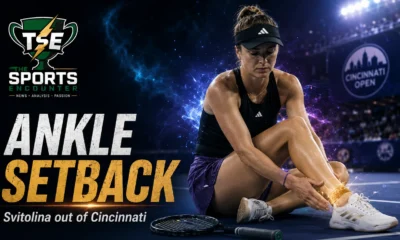

Elina Svitolina’s Ankle Injury Raises US Open 2026 Fitness Concerns After Cincinnati Withdrawal
Elina Svitolina has withdrawn from the Cincinnati Open because of a right ankle injury carried over from Toronto. The world...
-

 Cricket3 weeks ago
Is The Hundred Losing Its Oomph Among English Cricket Fans?
-

 Editor's Choice2 weeks ago
Premier League 2026–27 Curtain Raiser: Fixtures, Teams, Title Contenders, Transfers and Season Predictions
-

 Editor's Choice3 weeks ago
US Open 2026 Curtain-Raiser: Players, Schedule, Title Contenders, New York Storylines and Everything Fans Need to Know