Can Jack Draper Turn It Around at US Open 2026?
Jack Draper’s injury-hit comeback took another blow with a first-round Cincinnati Open loss to Martin Landaluce, leaving the former world No. 4 facing a difficult path toward the US Open 2026.
Jack Draper once looked like Britain’s next settled answer at the top of men’s tennis. Now, two weeks before the US Open 2026, his season has become a test of patience, pain, confidence and survival.
Draper’s comeback suffered another setback at the Cincinnati Open, where the 24-year-old lost 6-3, 7-5 to Spain’s Martin Landaluce in the first round. The scoreline hurt. The manner of defeat hurt more.
Draper led 5-2 in the second set and looked ready to force a decider. Instead, Landaluce won five straight games, turning a possible reset into another difficult night for a player still trying to rebuild after arm and knee problems dragged him far away from the version that once reached world No. 4.
For a player who made the US Open semifinals in 2024, the timing could hardly feel more painful. New York is not just another tournament for Draper. It is the place where he first proved his game could stand up inside a Grand Slam pressure chamber.
Now he may have to fight through qualifying just to return there.
Jack Draper’s US Open 2026 Problem at a Glance
| Detail | Current Situation |
|---|---|
| Latest result | Lost 6-3, 7-5 to Martin Landaluce at the Cincinnati Open |
| Second-set position | Led 5-2 before losing five straight games |
| Current ranking | Reported at No. 143 |
| Career-high ranking | No. 4 in 2025 |
| Recent injuries | Arm bone injury and knee injury |
| US Open background | Semifinalist in 2024 |
| US Open 2026 issue | Likely qualifying route unless entry circumstances change |
The Cincinnati Loss Was About More Than One Bad Match
Early-round losses happen in tennis. Even elite players have days when timing disappears, the serve misfires and confidence drains from the racket.
Draper’s Cincinnati defeat felt heavier because it continued a pattern.
He returned at the Canadian Open after missing Wimbledon, then broke down emotionally during a first-round defeat to Terence Atmane. Cincinnati was supposed to offer a cleaner step forward. Instead, it exposed the gap between where Draper wants to be and where his body and game currently stand.
The Sports Encounter had already framed this North American swing as a fitness race after Draper’s DC Open withdrawal turned his US Open build-up into another injury story. Cincinnati has now made the question sharper.
Can Draper recover fast enough to compete in New York, or does the comeback need more time than the calendar is willing to give him?
Draper’s Own Words Tell the Real Story
Draper did not hide from the problem after losing in Cincinnati.
He admitted that the fight and competitive edge he normally relies on feel absent. He also spoke about the size of the climb back from where he was last year.
That honesty matters because Draper’s issue is no longer only physical.
The arm injury changed his availability. The knee injury disrupted his movement and schedule. The ranking fall changed his tournament access. The emotional strain now appears to be changing how he feels on court.
When a player says the mountain looks “very, very big,” it is not a throwaway line. It is the sound of someone trying to process how quickly elite sport can move from control to uncertainty.
From World No. 4 to No. 143: How Fast Tennis Can Turn
Draper reached a career-high ranking of No. 4 in 2025, according to his official ATP rankings breakdown. That number placed him among the genuine elite.
It also changed expectations.
Once a player reaches that level, every loss is interpreted differently. Every withdrawal becomes a bigger warning sign. Every ranking drop feels like a public measurement of private struggle.
The fall to No. 143 is not a normal dip. It is a collapse driven by injury, missed tournaments and limited match rhythm. It affects seeding, draws, confidence and the practical reality of entering major events.
For more context on how player health has shaped this North American swing, TSE previously analyzed why Jannik Sinner and Novak Djokovic skipped Montreal before the US Open. Draper’s situation sits at the harsher end of the same wider problem: modern tennis gives players very little space to recover without paying a ranking price.
Why the US Open Still Matters So Much
The US Open is the tournament that gives Draper’s comeback story its emotional edge.
In 2024, Draper reached his first Grand Slam semifinal in New York. The official US Open player profile still carries that background as part of his major-tournament identity.
That run changed the way people saw him.
Before it, Draper was a talented British left-hander with obvious upside and recurring physical questions. After it, he looked like a player who could damage elite opponents on a hard court, absorb pressure and build a Grand Slam fortnight around his serve, forehand and athletic power.
That is why this year’s return feels so loaded.
New York remembers his best version. Draper is trying to find it again.
Qualifying Would Change the Whole Emotional Texture
If Draper has to come through US Open qualifying, the story becomes more complicated.
Qualifying is not an insult. Many strong players have used it as a route back into rhythm. But for a recent Grand Slam semifinalist and former world No. 4, it would be a stark reminder of how far injuries have dragged him down.
Qualifying also creates a practical problem.
Draper needs matches, but he also needs protection. Extra rounds can rebuild timing, confidence and competitive instincts. They can also increase physical load before the main draw even begins.
That is the central tension of his US Open bid.
He needs court time to rediscover himself, but too much court time could deepen the very problems that put him here.
The Arm Injury Has Changed the Entire Equation
Draper’s game depends on aggression.
His left-handed serve opens the court. His forehand can dictate. His best patterns rely on taking time away from opponents and forcing them to defend before rallies settle.
An arm problem affects more than one shot. It can alter serve speed, forehand confidence, return timing and even shot selection under pressure.
That is why the injury story cannot be separated from the tennis story. Draper is not merely rusty. He is trying to rebuild the mechanics and belief behind the shots that made him dangerous.
When TSE covered Wimbledon 2026 Day 1, Draper’s injury withdrawal was already part of a rough opening blow for British tennis. The concern has now followed him across the Atlantic.
The Knee Problem Added Another Layer
The arm injury became the main storyline because it affected his serve and forehand. The knee issue added a different type of damage.
Hard-court tennis demands repeated braking, pushing, sliding, recovery steps and explosive changes of direction. A player can sometimes protect an arm through tactical adjustments. Protecting a knee in long baseline exchanges is far harder.
That matters at the US Open, where heat, humidity and best-of-five-set matches punish anything less than full physical trust.
Draper does not need to be perfect in New York. He does need enough confidence in his body to compete without constantly negotiating with it.
British Tennis Needs Draper, But Draper Needs Time
British tennis has had a difficult 2026 Grand Slam rhythm. Injuries and early exits have repeatedly shaped the narrative, and Draper’s absence from Wimbledon removed one of the home crowd’s biggest singles hopes.
The Sports Encounter tracked that wider British frustration during our Wimbledon 2026 schedule and key details guide, then again through the Wimbledon 2026 curtain raiser, where injuries, form swings and power shifts shaped the tournament before the first ball was struck.
Draper’s importance to British tennis is obvious. He has the game, ranking history and Grand Slam proof to carry major expectations.
But that expectation cannot heal an arm or stabilize a knee.
Can Draper Still Be Dangerous in New York?
Yes, but only if the body cooperates.
Draper’s best tennis still translates beautifully to the US Open. The surface rewards his first-strike game. His left-handed serve can pull right-handed opponents wide. His forehand gives him a way to finish points quickly. His 2024 semifinal run proves he can manage the conditions when fit.
The problem is that current evidence points toward uncertainty rather than momentum.
Losses to Atmane and Landaluce do not erase his ceiling, but they do reveal his floor right now. His competitive instincts look dulled. His confidence looks fragile. His ranking has forced pressure into places where a top-five player would normally have protection.
That is why New York could go in either direction.
A soft early draw, a strong serving day and a few clean wins could revive him quickly. A physical opening match, a long qualifying route or another tight loss could deepen the spiral.
The Mental Rebuild May Be as Important as the Technical One
Draper’s comment about the missing fight stood out because it touched the core of comeback tennis.
Players returning from injury often focus first on the body. Can they serve? Can they move? Can they recover? Can they train two days in a row?
But the mind has its own recovery timeline.
A player has to trust that pain will not return every time he accelerates. He has to trust that a lead can be protected. He has to trust that a bad service game is only a bad service game, not the start of another collapse.
Draper led 5-2 in the second set against Landaluce. That lead should have given him a platform. Instead, the match slipped away.
That is not only a scoreline problem. It is a confidence problem.
What Needs to Change Before the US Open?
Draper does not need a complete reinvention before August 30. He needs three things.
First, he needs clarity about his body. Playing through uncertainty may be possible in a regular tournament. It becomes dangerous across a Grand Slam campaign.
Second, he needs serve reliability. His serve does not have to be at peak speed, but it must give him enough free points and enough confidence to hold under pressure.
Third, he needs one competitive win that feels earned rather than survived.
Momentum can return quickly in tennis. One match can change a week. One week can change a season. Draper has enough quality for that to remain possible.
TSE Analysis: The US Open Is a Test of Patience, Not Just Form
The temptation is to frame Draper’s US Open 2026 story as a simple comeback question.
Can he turn it around?
The better question is whether he can turn it around without forcing the process.
Draper has already shown he can play top-four tennis. He has already made a Grand Slam semifinal. He has already proved that his game belongs on hard courts. The issue is not imagination. The issue is timing.
He wants the old level back now. His body may demand a slower route.
That is difficult for any elite athlete, especially one who has already touched the upper tier of the sport. But sometimes the mature comeback is the one that protects the next two years rather than chasing one desperate fortnight.
The US Open begins on August 30, and official tournament updates are available through the US Open. Official player rankings and records are available through the ATP Tour.
Draper can still make noise in New York. His talent has not disappeared. His hard-court history has not vanished. His ceiling remains real.
But this version of Draper is no longer fighting only opponents.
He is fighting time, trust, ranking damage, physical caution and the emotional weight of knowing exactly how high he once stood.
That is why the mountain looks so big.
And that is why climbing even part of it at the US Open would matter.
Frequently Asked Questions
What happened to Jack Draper at the Cincinnati Open?
Draper lost 6-3, 7-5 to Martin Landaluce in the first round. He led 5-2 in the second set before losing five straight games.
What is Jack Draper’s current ranking?
Reuters reported Draper at No. 143 after his injury-hit slide from a career-high world No. 4.
What was Jack Draper’s career-high ranking?
Draper reached a career-high ATP ranking of No. 4 in 2025.
Why has Jack Draper fallen so far in the rankings?
His ranking has dropped because injuries limited his schedule, reduced his match rhythm and cost him ranking points across several major events.
Did Jack Draper reach the US Open semifinals?
Yes. Draper reached the US Open semifinals in 2024, which remains the strongest Grand Slam result of his career.
Will Jack Draper have to qualify for the US Open 2026?
His ranking and early exits from Montreal and Cincinnati mean he will likely need to come through qualifying unless entry circumstances change.
Can Jack Draper still do well at the US Open 2026?
He can still be dangerous if he is physically ready. His left-handed serve, hard-court game and 2024 US Open record give him a real ceiling, but his current form and injury history make the path uncertain.
The Sports Encounter’s tennis coverage follows Grand Slam contenders, injury comebacks, ranking swings, player form, ATP and WTA storylines, and the biggest moments shaping the road to the US Open.

Cincinnati Open
Luz and Matos Make History, Noskova and Bouzkova Lift Cincinnati Doubles Titles
Orlando Luz and Rafael Matos completed a rare Canada-Cincinnati Masters sweep, while Linda Noskova and Marie Bouzkova captured the women’s doubles crown as New York’s US Open doubles story comes into focus.
Cincinnati’s singles champions took most of the headlines, but the doubles courts produced two of the most consequential stories of the entire North American hard-court swing.
Orlando Luz and Rafael Matos completed one of the rarest Masters doubles achievements of the Open Era by winning Cincinnati immediately after capturing Montreal.
Linda Noskova and Marie Bouzkova needed only their third tournament together to win a WTA 1000 title, overwhelming Magali Kempen and Alexandra Panova in a final that lasted only one hour.
The men’s championship was built on survival, match-tiebreak pressure and a Brazilian partnership playing the best tennis of its life.
The women’s title followed a different path. Noskova and Bouzkova became increasingly dominant as the tournament progressed and lost only three games in the championship match.
Together, the two title runs created an important final doubles checkpoint before the US Open.
There is also an important distinction for readers following all three doubles disciplines: Cincinnati did not stage mixed doubles in 2026.
The tournament featured separate ATP and WTA doubles competitions. Mixed doubles now becomes a distinctly New York story, with the US Open staging its redesigned championship during Fan Week before the singles main draw begins.
That makes Cincinnati an unusually useful bridge. Traditional doubles specialists leave Ohio with rankings, momentum and tactical evidence, while several of the sport’s biggest singles stars prepare to enter a much shorter and more volatile mixed-doubles format in New York.
Cincinnati Open 2026 Doubles Champions
| Event | Champions | Finalists | Final Score |
|---|---|---|---|
| Men’s Doubles | Orlando Luz / Rafael Matos | Constantin Frantzen / Robin Haase | 6-4, 3-6, 10-7 |
| Women’s Doubles | Marie Bouzkova / Linda Noskova | Magali Kempen / Alexandra Panova | 6-1, 6-2 |
| Mixed Doubles | No mixed doubles competition was staged in Cincinnati in 2026 | ||
The official Cincinnati Open report confirms Luz and Matos became only the fifth men’s team in the Open Era to win Canada and Cincinnati in the same season.
Men’s Doubles: Luz and Matos Complete a North American Double Almost Nobody Achieves
Before August, Orlando Luz had never progressed beyond the second round of an ATP Masters 1000 tournament.
Within a matter of weeks, he had won two of them.
Luz and Rafael Matos defeated Constantin Frantzen and Robin Haase 6-4, 3-6, 10-7 in the Cincinnati final to complete a Canada-Cincinnati sweep achieved by only five teams during the Open Era.
| Team | Year of Canada-Cincinnati Sweep |
|---|---|
| Bruce Manson / Brian Teacher | 1980 |
| Bob Bryan / Mike Bryan | 2010 |
| Ivan Dodig / Marcelo Melo | 2016 |
| Pierre-Hugues Herbert / Nicolas Mahut | 2017 |
| Orlando Luz / Rafael Matos | 2026 |
The Sports Encounter had already documented the first half of the achievement when Luz and Matos became the first all-Brazilian team to win an ATP Masters 1000 title in Montreal.
Montreal could have been treated as the breakthrough.
Cincinnati transformed it into something larger.
One Masters title can emerge from one extraordinary week. Back-to-back Masters championships require a partnership to survive accumulated fatigue, tactical adjustments, different opponents and the psychological change that occurs when every team in the next draw knows exactly how well you are playing.
Men’s Doubles Quarterfinals
| Match | Result |
|---|---|
| Marcel Granollers / Horacio Zeballos vs Luciano Darderi / Tomas Martin Etcheverry | Granollers / Zeballos 6-3, 7-6(8) |
| Constantin Frantzen / Robin Haase vs Theo Arribage / Albano Olivetti | Frantzen / Haase 7-6(1), 7-6(3) |
| Hugo Nys / Edouard Roger-Vasselin vs Sadio Doumbia / Fabien Reboul | Nys / Roger-Vasselin 4-6, 7-6(5), 11-9 |
| Orlando Luz / Rafael Matos vs Simone Bolelli / Andrea Vavassori | Luz / Matos 7-6(7), 6-3 |
The last eight revealed two very different routes toward the final weekend.
Frantzen and Haase advanced without dropping a set against Arribage and Olivetti, although both sets required tiebreaks.
Granollers and Zeballos, one of the most experienced partnerships in the draw, also survived a tight second-set breaker.
Nys and Roger-Vasselin survived the most dramatic quarterfinal. After losing the opening set to Doumbia and Reboul, they won the second-set tiebreak and escaped the match tiebreak 11-9.
Luz and Matos produced the cleaner statement by defeating fourth seeds Bolelli and Vavassori in straight sets.
The result deserves context. Bolelli and Vavassori had already won Masters titles in Miami and Rome during 2026 and entered Cincinnati among the most accomplished partnerships of the season.
Luz and Matos removed them without requiring another match tiebreak.
The Brazilian Pair Had Already Removed Zverev and Melo
Their path had been demanding even before the quarterfinals.
Luz and Matos defeated Marcelo Melo and Alexander Zverev 7-6(4), 6-3 in the round of 16.
Melo remains one of Brazil’s most accomplished doubles players, while Zverev’s serve makes almost any partnership dangerous in a short-format match.
The Brazilians handled that combination and then defeated Bolelli and Vavassori.
The official ATP Cincinnati doubles results provide the complete tournament path and match scores.
Men’s Semifinal: Luz and Matos Take Control of the Match Tiebreak
Hugo Nys and Edouard Roger-Vasselin forced Luz and Matos into another momentum reversal in the semifinal.
The Brazilians won the first set 6-4.
Nys and Roger-Vasselin responded 6-2.
The entire match was suddenly reduced to a 10-point decider.
Luz and Matos won it 10-2.
That margin is particularly striking because match tiebreaks are normally volatile. A few loose returns or one strong serving sequence can completely change the outcome.
The Brazilians never allowed that randomness to develop.
Frantzen and Haase Remove Granollers and Zeballos
The other semifinal also required a deciding match tiebreak.
Frantzen and Haase took the opening set 6-3 before Granollers and Zeballos answered with the same score in the second.
The German-Dutch partnership then won the decider 10-5.
That victory carried significant weight because Granollers and Zeballos possess years of elite Grand Slam and Masters experience.
Frantzen and Haase compensated through execution and earned their place in the final.
The Men’s Final: Ten Points for History
Luz and Matos began the championship match in control and won the first set 6-4.
Frantzen and Haase responded 6-3.
That produced the most appropriate possible conclusion to a Cincinnati doubles tournament dominated by match-tiebreak pressure.
Ten points would decide a Masters 1000 title.
Luz and Matos won the decider 10-7.
The match lasted one hour and 17 minutes.
Luz fell to his knees after match point.
The emotion made sense.
Only weeks earlier, he had never progressed beyond the second round of a Masters tournament. Now he and Matos had won two consecutively.
The official Cincinnati Open says the partnership has now collected five tour-level titles together, with four arriving in 2026.
Why Luz and Matos Are So Difficult to Break
Their strength is not based around one overwhelming serve or one player dominating every exchange at the net.
The partnership works because responsibilities remain balanced.
They communicate constantly.
They reset after losing sets.
They generate energy for each other rather than waiting for the other player to solve the problem.
That emotional stability has become especially valuable in the shortened deciding format used on the ATP Tour.
A doubles team can possess two excellent players and still collapse if one player’s difficult service game changes the other’s body language.
Luz and Matos currently appear unusually resistant to that problem.
What the Canada-Cincinnati Sweep Means for the US Open
New York creates a different challenge.
At Masters level, the deciding match tiebreak can compress an entire contest into a handful of points.
Grand Slam doubles demands longer stretches of sustained concentration, gives opponents more time to identify tactical patterns and places greater physical demands on partnerships across multiple rounds.
Still, no traditional men’s doubles pair leaves the North American Masters swing with stronger momentum.
Montreal proved Luz and Matos could win a Masters title.
Cincinnati proved they could immediately do it again.
That makes them impossible to ignore when the US Open doubles draw begins.
Women’s Doubles: Noskova and Bouzkova Find Chemistry Almost Immediately
Linda Noskova had already transformed her 2026 season before arriving in Cincinnati.
She had won Wimbledon singles.
Now she owns a WTA 1000 doubles title too.
Noskova partnered fellow Czech Marie Bouzkova and defeated Magali Kempen and Alexandra Panova 6-1, 6-2 in the Cincinnati final.
The match lasted exactly one hour.
That level of domination would be impressive for a partnership with years of shared experience.
Noskova and Bouzkova were competing together for only the third time.
The official Cincinnati Open women’s doubles report confirms the Czech pair’s 6-1, 6-2 victory and their remarkably quick development as a team.
Why the Partnership Works
The most interesting part of the partnership is how naturally their strengths divide the court.
Noskova provides greater raw power.
Bouzkova offers coverage, anticipation and defensive stability.
That balance allows Noskova to attack aggressively without requiring Bouzkova to play the same style.
They complement one another rather than duplicate one another.
Noskova’s extraordinary season has also made her one of the central names in the women’s US Open discussion. The Sports Encounter’s Cincinnati women’s singles wrap and US Open race analysis examined how Coco Gauff’s title, Noskova’s rise and several other developments changed the landscape entering New York.
TSE also followed the women’s doubles major season when Guo Hanyu and Kristina Mladenovic won the Wimbledon women’s doubles championship.
Women’s Doubles Quarterfinals
| Match | Result |
|---|---|
| Magali Kempen / Alexandra Panova vs Hao-Ching Chan / Maya Joint | Kempen / Panova 1-6, 6-4, 10-2 |
| Iva Jovic / Caty McNally vs Xinyu Jiang / Zhang Shuai | Jovic / McNally 7-6(8), 3-6, 10-6 |
| Hsieh Su-Wei / Jelena Ostapenko vs Guo Hanyu / Kristina Mladenovic | Hsieh / Ostapenko 6-3, 6-4 |
| Marie Bouzkova / Linda Noskova vs Erin Routliffe / Aldila Sutjiadi | Bouzkova / Noskova 7-5, 7-5 |
Noskova and Bouzkova Remove a Defending Cincinnati Champion
Erin Routliffe entered Cincinnati chasing a third consecutive title at the tournament.
She had won in 2024 with Asia Muhammad and again in 2025 with Gabriela Dabrowski.
In 2026 she partnered Aldila Sutjiadi.
Bouzkova and Noskova defeated them 7-5, 7-5.
That was the point at which their run stopped looking like an interesting new partnership experiment and started looking like a genuine championship campaign.
Jovic and McNally Remove the No. 1 Team
The women’s doubles draw had already opened considerably before the quarterfinals.
Iva Jovic and Caty McNally eliminated top-ranked Katerina Siniakova and Taylor Townsend 5-7, 6-4, 10-8 in the round of 16.
The upset carried additional significance because Siniakova entered Cincinnati immediately after winning Toronto alongside Zhang Shuai.
The Sports Encounter covered that Canadian title in our National Bank Open doubles finals report.
Siniakova and Townsend were among the obvious Cincinnati favorites.
They were gone before the last eight.
Kempen and Panova Produce the Most Unexpected Final Run
Magali Kempen and Alexandra Panova were not the partnership most expected to reach championship Saturday.
Their quarterfinal initially looked likely to end quickly when Chan and Joint won the first set 6-1.
Kempen and Panova completely reversed the match.
They won the second set 6-4 and then dominated the match tiebreak 10-2.
The comeback became part of a wider story for a partnership that had spent months trying to make doubles financially and competitively sustainable.
A WTA 1000 final therefore represented far more than one strong tournament.
Hsieh and Ostapenko Remove the Wimbledon Champions
Another quarterfinal carried major pedigree.
Guo Hanyu and Kristina Mladenovic had won Wimbledon only weeks earlier.
Hsieh Su-Wei and Jelena Ostapenko beat them 6-3, 6-4.
Hsieh remains one of doubles tennis’s most difficult players to read because she rarely attempts to overpower opponents conventionally.
She changes pace, redirects the ball early and manipulates positioning.
Ostapenko provides the opposite energy through explosive returning and first-strike aggression.
The combination appeared dangerous enough to win Cincinnati.
Kempen and Panova stopped them in the semifinal.
Women’s Semifinals
| Match | Result |
|---|---|
| Magali Kempen / Alexandra Panova vs Hsieh Su-Wei / Jelena Ostapenko | Kempen / Panova 6-3, 7-5 |
| Marie Bouzkova / Linda Noskova vs Iva Jovic / Caty McNally | Bouzkova / Noskova 6-3, 6-2 |
By the semifinals, much of the original power structure had disappeared.
Siniakova and Townsend were gone.
Routliffe was gone.
Wimbledon champions Guo and Mladenovic were gone.
Hsieh and Ostapenko then disappeared too.
Kempen and Panova defeated them 6-3, 7-5.
Noskova and Bouzkova took an even more direct route, defeating Jovic and McNally 6-3, 6-2.
The Women’s Final: One Hour of Czech Control
The championship match was essentially decided by how Noskova and Bouzkova handled the first pressure point.
They broke for 3-1 in the opening set.
From there, the match accelerated.
The first set finished 6-1.
Another early break arrived in the second.
Kempen and Panova never generated enough return pressure to disrupt the Czech rhythm.
Noskova’s power opened the court.
Bouzkova’s anticipation closed it.
The final finished 6-1, 6-2 in exactly one hour.
Thirteen games were played.
The champions won eleven of them.
Czech Tennis Keeps Producing Depth
Noskova’s Cincinnati success also belongs inside a larger Czech tennis story.
Her Wimbledon singles championship had already given the country another major champion.
Karolina Muchova had reached the same final.
Now Noskova and Bouzkova have added a Cincinnati doubles title.
This looks increasingly less like a short cycle built around one exceptional player and more like a system producing women capable of succeeding in both singles and doubles.
That versatility becomes particularly relevant at a Grand Slam, where schedules, fatigue and tactical adaptability can determine whether players continue in multiple disciplines.
What About Cincinnati Mixed Doubles?
There was none.
That distinction matters because the US Open has made mixed doubles unusually prominent in 2026.
Cincinnati staged men’s and women’s doubles, but no mixed championship.
Rather than treating that absence as a gap, it helps explain the calendar.
Mixed doubles moves directly into New York, where the US Open has transformed the discipline into a separate Fan Week showcase.
US Open Mixed Doubles Runs From August 24 to 26
The 2026 US Open Mixed Doubles Championship begins with qualifying on August 24.
Eight qualifying teams compete for two remaining main-draw places.
The main competition then contains 16 teams.
First-round and quarterfinal matches are scheduled for August 25, with the semifinals and championship match taking place at Arthur Ashe Stadium on August 26.
The official US Open Mixed Doubles Championship page provides the current schedule, draw information and event details.
US Open 2026 Mixed Doubles Format
| Stage | Format |
|---|---|
| Qualifying through semifinals | Best of three sets, sets to four games, no-ad scoring, 10-point match tiebreak instead of a full third set |
| Final | Best of three sets to six games, no-ad scoring, 10-point match tiebreak instead of a full third set |
The Sports Encounter’s complete US Open 2026 preview examines Fan Week, the singles fields, mixed doubles and the major storylines surrounding the final Grand Slam of the season.
The Official Mixed Doubles Draw Brings Together Stars and Specialists
The US Open’s final mixed-doubles field is deliberately constructed to place world-class singles names and elite doubles specialists inside the same shortened competition.
Top seeds Aryna Sabalenka and Novak Djokovic were drawn against Leylah Fernandez and Frances Tiafoe in the opening round.
Serena Williams and Carlos Alcaraz received a wild card, while Taylor Townsend and Alexander Zverev, Sara Errani and Andrea Vavassori, Emma Navarro and Tommy Paul, Alex Eala and Felix Auger-Aliassime, Elina Svitolina and Gael Monfils, and several other high-profile combinations are also part of the championship.
The official US Open draw announcement also underlines how dramatically this version differs from traditional Grand Slam mixed doubles.
Doubles specialists such as Townsend, Errani and Vavassori bring positioning, communication and return instincts developed specifically for the discipline.
Players such as Sabalenka, Djokovic, Alcaraz and Zverev bring overwhelming singles firepower.
The shortened scoring system reduces the time available for either style to recover from a poor game.
Wimbledon Provides the Traditional Mixed-Doubles Counterpoint
Only weeks ago, traditional Grand Slam mixed doubles produced one of the season’s most compelling partnership stories.
Jelena Ostapenko and Marcelo Arevalo came from a set down to win Wimbledon, a championship covered in our Wimbledon 2026 mixed doubles final report.
That match unfolded over conventional sets and allowed tactical adjustments to develop gradually.
The US Open’s compact mixed format is designed around the opposite idea.
There is very little recovery time.
A poor return game can decide a four-game set.
A match tiebreak can decide everything.
That makes doubles instincts potentially even more valuable.
Luz and Matos Carry the Strongest Traditional Men’s Doubles Momentum
The Brazilians have now won Montreal and Cincinnati consecutively.
The championships required different paths.
In Montreal, Luz and Matos defeated Marcelo Arevalo and Mate Pavic after losing the opening set.
In Cincinnati, Frantzen and Haase again forced them into a deciding match tiebreak.
That means their biggest titles repeatedly required emotional recovery.
For the US Open, that matters because Grand Slam doubles will expose partnerships to longer stretches in which one player can lose timing.
Luz and Matos have shown they can survive those periods without destabilizing as a team.
Noskova and Bouzkova Carry a Different Kind of Momentum
The Czech pair arrive with less shared history but greater tactical surprise.
Opponents have relatively little material from which to establish long-term patterns against them.
Noskova also enters New York with enormous singles confidence after her Wimbledon championship.
The physical question is workload.
Players competing deep in singles and doubles face a completely different recovery problem during a Grand Slam.
The women’s singles race is already loaded with contenders. The Sports Encounter’s Coco Gauff Cincinnati title analysis examines how Gauff, Jessica Pegula, Iga Swiatek, Aryna Sabalenka and other contenders now approach New York.
Cincinnati Also Changed the Singles Momentum Entering New York
The doubles championships did not happen in isolation.
Arthur Fils won the men’s singles title and enters the US Open with the biggest trophy of his career. Our Arthur Fils Cincinnati championship analysis examines how his title changed the men’s US Open conversation.
Brandon Nakashima also continued one of the strongest North American hard-court stretches of any American player, reaching the Cincinnati semifinals after previously making the Montreal final.
The Sports Encounter covered his quarterfinal breakthrough when Nakashima defeated Taylor Fritz to reach the Cincinnati semifinals.
That wider singles context matters because some of the same names involved in the mixed event are entering New York with very different levels of physical and competitive momentum.
The Established Doubles Hierarchy Leaves Cincinnati With Warnings
The teams that failed to reach the finals matter too.
Harri Heliovaara and Henry Patten were eliminated in the round of 16.
Marcelo Arevalo and Mate Pavic also disappeared before the quarterfinals.
Rajeev Ram and Joe Salisbury were eliminated by Frantzen and Haase.
On the women’s side, Siniakova and Townsend fell before the quarterfinals.
Defending Cincinnati champion Routliffe was beaten in the last eight.
Wimbledon champions Guo and Mladenovic also stopped at the quarterfinal stage.
There is no dominant doubles partnership entering New York with complete protection from the draw.
That could make the US Open doubles events unusually open.
The Match-Tiebreak Question Changes at a Grand Slam
This may be the most important tactical difference between Cincinnati and the traditional US Open doubles competitions.
ATP and WTA tour doubles frequently uses a 10-point match tiebreak instead of a full deciding set.
That rewards fast resets and makes brief bursts of momentum extremely valuable.
Grand Slam men’s and women’s doubles demands longer set management.
A partnership that dominates match tiebreaks does not automatically possess the same advantage over longer deciding stretches.
Luz and Matos therefore have something else to prove.
Cincinnati showed they can handle condensed pressure.
New York will test whether they can sustain their quality for longer.
Why Doubles Specialists Still Matter
Cincinnati’s finals offered an important reminder.
The men’s championship was not decided by two celebrity singles pairings.
The women’s final was not won by the highest-ranked singles players in the draw.
The trophies went to partnerships that understood positioning, communication, return placement and transition play.
Doubles remains its own discipline.
Singles ability helps.
It does not replace doubles instinct.
That distinction will become especially interesting when the US Open mixed event puts stars and specialists on the same court under a format designed to make every mistake more expensive.
TSE Analysis: Cincinnati Changed the Doubles Conversation Before New York
Luz and Matos leave Cincinnati with the clearest traditional doubles momentum of the North American summer.
Their two Masters titles demonstrate more than form. They show emotional resilience across multiple deciding match tiebreaks and against established partnerships.
Noskova and Bouzkova present almost the opposite problem for opponents.
They are new enough that scouting remains limited, yet their complementary games already look organized enough to win at WTA 1000 level.
The established hierarchy also leaves Ohio with fewer guarantees.
Major champions, No. 1 teams and defending Cincinnati winners all disappeared before the finals.
That creates a wide-open traditional doubles picture.
Mixed doubles then adds another layer entirely.
New York is deliberately turning the discipline into a high-profile Fan Week event built around short sets, rapid pressure and superstar combinations.
The result is that doubles enters the US Open through two very different doors.
Luz, Matos, Noskova and Bouzkova arrive carrying evidence from the traditional game.
Sabalenka, Djokovic, Alcaraz, Williams, Townsend, Zverev and the mixed field arrive for something designed almost as a separate product.
Both stories begin in New York this week.
Frequently Asked Questions
Who won the Cincinnati Open 2026 men’s doubles title?
Orlando Luz and Rafael Matos defeated Constantin Frantzen and Robin Haase 6-4, 3-6, 10-7.
Who won the Cincinnati Open 2026 women’s doubles title?
Linda Noskova and Marie Bouzkova defeated Magali Kempen and Alexandra Panova 6-1, 6-2.
Did Cincinnati stage mixed doubles in 2026?
No. Cincinnati staged separate ATP and WTA doubles events but did not hold a mixed-doubles championship.
What record did Luz and Matos achieve?
They became only the fifth men’s partnership in the Open Era to win Canada and Cincinnati in the same season.
How many ATP titles have Luz and Matos won together?
They have won five tour-level titles together, with four coming during 2026.
How long had Noskova and Bouzkova been playing together?
Cincinnati was only their third tournament as a partnership.
When is the US Open 2026 Mixed Doubles Championship?
Qualifying began on August 24. The first round and quarterfinals are scheduled for August 25, with the semifinals and final on August 26.
How many teams are in the US Open mixed-doubles main draw?
The main championship contains 16 teams, including two teams advancing from qualifying.
What is the US Open mixed-doubles scoring format?
Qualifying through the semifinals uses sets to four games with no-ad scoring and a 10-point match tiebreak instead of a full third set. The final uses sets to six games, also with no-ad scoring and a 10-point deciding match tiebreak.
Who are the top seeds in US Open mixed doubles?
Aryna Sabalenka and Novak Djokovic are the top seeds in the 2026 US Open Mixed Doubles Championship.
Cincinnati Open
Arthur Fils Conquers Cincinnati as US Open Race Opens Up
Arthur Fils claimed his first Masters 1000 title by beating Frances Tiafoe in Cincinnati, while Brandon Nakashima, Flavio Cobolli and a deep American group strengthened their cases ahead of the 2026 US Open.
Arthur Fils arrived in Cincinnati still trying to prove that the best season of his career could survive the physical problems that had already taken months away from him.
He left Ohio as an ATP Masters 1000 champion, the highest-ranked Frenchman in the world, one of the hottest players entering the US Open and perhaps the clearest symbol of how quickly the hierarchy of men’s tennis is changing beneath Carlos Alcaraz, Jannik Sinner and the established Grand Slam contenders.
Fils defeated Frances Tiafoe 6-3, 1-6, 6-0 in Sunday’s Cincinnati Open final, producing one of the strangest championship scorelines of the season and one of its most revealing performances. He controlled the opening set, lost the second almost completely, then responded by handing Tiafoe a deciding-set bagel with the biggest title of his career at stake.
The trophy made the 22-year-old the youngest French Masters 1000 champion since the category was introduced and the first Frenchman to win at this level since Jo-Wilfried Tsonga captured Toronto in 2014. Fils also became only the second French men’s champion in Cincinnati during the Open Era after Guy Forget in 1991.
Those records are impressive. The timing makes them more important.
The US Open men’s singles draw will be released on August 27, with the main draw beginning August 30 at the USTA Billie Jean King National Tennis Center. Fils will arrive at a career-high No. 11 with no ranking points to defend in New York because a back injury kept him out of the 2025 tournament.
He is therefore entering the final Grand Slam of 2026 with freedom, form and considerably more belief than he possessed when the North American hard-court swing began.
Cincinnati also strengthened the American challenge.
Tiafoe reached his second final here in three seasons. Brandon Nakashima followed his first Masters 1000 final in Montreal by reaching another semifinal. Taylor Fritz pushed Nakashima deep into three sets. Tommy Paul removed top seed Alexander Zverev before losing a three-set quarterfinal to Flavio Cobolli.
At the same time, Novak Djokovic lost in his opening match to Thiago Agustin Tirante, Montreal champion Ben Shelton disappeared early, Daniil Medvedev fell to Nakashima after holding three match points, while Jannik Sinner did not play and has since withdrawn from the US Open because of his knee injury.
Cincinnati therefore became much more than the last Masters 1000 tournament before New York.
It changed the shape of the men’s US Open race.
Cincinnati Open 2026 Men’s Final Eight
| Round | Match | Result |
|---|---|---|
| Quarterfinal | Tommy Paul vs Flavio Cobolli | Cobolli 2-6, 6-3, 6-4 |
| Quarterfinal | Thiago Agustin Tirante vs Arthur Fils | Fils 6-3, 6-2 |
| Quarterfinal | Taylor Fritz vs Brandon Nakashima | Nakashima 7-6(9), 4-6, 6-3 |
| Quarterfinal | Lorenzo Musetti vs Frances Tiafoe | Tiafoe 7-6(2), 7-5 |
| Semifinal | Flavio Cobolli vs Arthur Fils | Fils 6-3, 6-4 |
| Semifinal | Brandon Nakashima vs Frances Tiafoe | Tiafoe 7-5, 6-3 |
| Final | Arthur Fils vs Frances Tiafoe | Fils 6-3, 1-6, 6-0 |
Official results, draws and tournament statistics are available through the ATP Tour Cincinnati results page and the Cincinnati Open draw.
The Final: Fils Wins Three Different Matches in 88 Minutes
The final score tells you almost everything about the instability of Sunday’s championship match.
6-3.
1-6.
6-0.
The advantage changed dramatically twice.
Fils began like the player who had spent the entire closing weekend imposing his forehand on opponents. He broke Tiafoe early, immediately established superior court position and repeatedly pushed the American toward his backhand side before looking for space with the next shot.
Fils did not face a break point in the opening set and won 13 of 15 points behind his first serve.
That is near-total service control in a Masters 1000 final.
Tiafoe changed the match in the second.
The American attacked earlier, took time away from Fils and started using the crowd rather than reacting to it. Suddenly the Frenchman’s first-strike patterns disappeared. Tiafoe raced through the set 6-1, and the title match appeared to have reversed completely.
Fils then disappeared briefly before the third set and later explained that he looked at himself in the mirror and challenged himself to compete even if the match was going to end in defeat.
The response was devastating.
He won six consecutive games.
Tiafoe never recovered after taking a medical timeout before the deciding set, although the American refused afterward to use his physical condition as an excuse.
Fils finished the final with 11 aces against only one double fault and converted four of eight break opportunities.
The match lasted one hour and 28 minutes.
What began as a tactical battle became a test of emotional recovery, and Fils won it decisively.
Fils Has Turned 2026 Into a Comeback Season Few Expected
The title becomes more impressive when placed beside what Fils has already endured.
A serious back injury kept him out for nearly eight months and removed him from the 2025 US Open. His return this year was also interrupted enough that he missed the Australian swing and Roland Garros.
Yet his 2026 record now stands at 32-10.
He has won Barcelona.
He reached Masters 1000 semifinals in Miami and Madrid.
Cincinnati finally converted that consistency into the biggest trophy of his career.
Only Guy Forget had previously reached three Masters 1000 semifinals in the same season for France, doing so in 1991, before Fils matched that achievement this year.
The championship also moved Fils 10 ranking places to a career-high No. 11.
He sits only 335 points outside the Top 10 and jumped to fifth in the ATP Race to Turin after the Cincinnati title.
That ranking movement is particularly striking because his season has been shortened by injury.
Two Numbers Explain Fils’ Mental Progress
Fils is now 9-0 in deciding sets this season.
He has also won eight consecutive matches against American opponents dating back to the start of 2025.
Those are useful numbers before New York.
The first tells us that extended matches have increasingly favored him rather than exposed him.
The second becomes relevant at a US Open where the United States has 14 men already guaranteed direct entry and where Shelton, Fritz, Tiafoe, Nakashima, Paul and several younger Americans will carry legitimate expectations.
Fils has repeatedly shown he is comfortable playing against American opponents and American crowds.
He proved it again in the final.
Quarterfinal: Fils Ends Tirante’s Extraordinary Cincinnati Run
Thiago Agustin Tirante arrived in the quarterfinal having already done something that reshaped the tournament.
He beat Novak Djokovic.
The Argentine recovered from losing the opening set to defeat Djokovic 2-6, 6-4, 6-4 in the second round, producing one of the biggest wins of his career and immediately removing Cincinnati’s most experienced Grand Slam champion.
Tirante continued winning after the upset rather than treating it as the destination.
He defeated Martin Landaluce and then Jakub Mensik to reach his first Masters 1000 quarterfinal.
His ranking rose toward the low 40s after beginning 2026 outside the Top 100.
Fils ended the run clinically.
The Frenchman won 6-3, 6-2 in only 64 minutes and never faced a break point.
His forehand repeatedly prevented Tirante from constructing the longer rallies that had helped him survive earlier rounds.
The match was arguably Fils’ cleanest performance of the tournament until the semifinal.
It also delivered his third Masters 1000 semifinal of the year.
Semifinal: Fils Removes Cobolli Before Another Three-Set Escape Can Begin
Flavio Cobolli reached the semifinal through one of the strangest patterns of the tournament.
Every one of his first four Cincinnati matches went three sets.
Miomir Kecmanovic pushed him three.
Alexander Blockx pushed him three.
Rafael Jodar pushed him three.
Tommy Paul pushed him three.
Cobolli kept surviving.
He called himself a warrior, a label that matched a season in which the Italian had already reached the Roland Garros final and climbed into the Top 10.
Fils refused to let another escape develop.
The Frenchman won 6-3, 6-4 in 67 minutes, striking six aces and controlling enough forehand exchanges that Cobolli rarely reached the grinding scoreboard positions he had exploited in earlier rounds.
Fils had also beaten Alex de Minaur during the tournament, meaning his Cincinnati championship included multiple victories over Top 20 opponents.
ATP ranking updates after the event confirmed that Fils defeated three Top 20 players during his title run.
Cobolli Still Leaves Cincinnati at a Career-High No. 6
The semifinal defeat should not obscure Cobolli’s progress.
He climbed four more ranking positions to a career-high No. 6.
His rise has accelerated rapidly since entering the Top 10 for the first time in June.
The most interesting part of his Cincinnati run was not the ranking.
It was his ability to remain emotionally functional when matches became uncomfortable.
That quality matters at Grand Slams, where the best-of-five format can transform temporary trouble into a completely different match.
Cobolli’s question in New York will be physical rather than psychological.
Four consecutive three-set matches in Cincinnati showed how much energy his survival style can consume.
Quarterfinal: Cobolli Turns Tommy Paul’s Dream Week Around
Paul had already produced one of Cincinnati’s biggest results before reaching the quarterfinal.
He eliminated top seed Alexander Zverev 4-6, 7-6(6), 6-4 after saving a match point.
The match endured a lengthy rain interruption and further brief stoppages, but Paul repeatedly recovered from difficult positions.
He trailed 4-2 in the deciding set.
Then he won four straight games.
Zverev finished with 14 aces but also nine double faults, and Paul repeatedly attacked second serves when the German’s confidence dipped.
The victory took Paul into his first Cincinnati quarterfinal.
Against Cobolli, he started even better.
Paul won the opening set 6-2.
Cobolli gradually extended the rallies, found more depth and reversed the physical balance of the match to win 2-6, 6-3, 6-4.
The Italian later joked that M&M’s had provided an energy boost during the turnaround.
The humor should not obscure the tennis.
Cobolli had survived another match after losing control early, something he did repeatedly throughout Cincinnati.
Nakashima’s North American Summer Has Become a Serious US Open Story
Brandon Nakashima did not reach the Cincinnati final.
He may still leave the tournament with one of the strongest US Open cases outside the obvious favorites.
Consider his North American sequence.
Semifinal in Washington.
Final in Montreal.
Semifinal in Cincinnati.
Across Montreal and Cincinnati alone, he repeatedly defeated opponents who would normally be expected to stop players before the closing weekend.
The Sports Encounter documented Nakashima’s Canadian breakthrough when he reached his first Masters 1000 final against Ben Shelton in Montreal.
Rather than suffering the emotional drop that often follows a breakthrough final, Nakashima arrived in Cincinnati and kept winning.
He defeated Daniil Medvedev after saving three match points.
He then beat Nuno Borges.
Next came Taylor Fritz.
That victory sent him into his second consecutive Masters semifinal.
Quarterfinal: Nakashima Beats Fritz in the Match American Tennis Needed
Taylor Fritz entered Cincinnati having already won Washington earlier in the summer, where he defeated Rafael Jodar in the final. The Sports Encounter covered that title in our analysis of Fritz’s Washington championship run.
His Cincinnati quarterfinal against Nakashima therefore matched two Americans carrying genuine hard-court momentum.
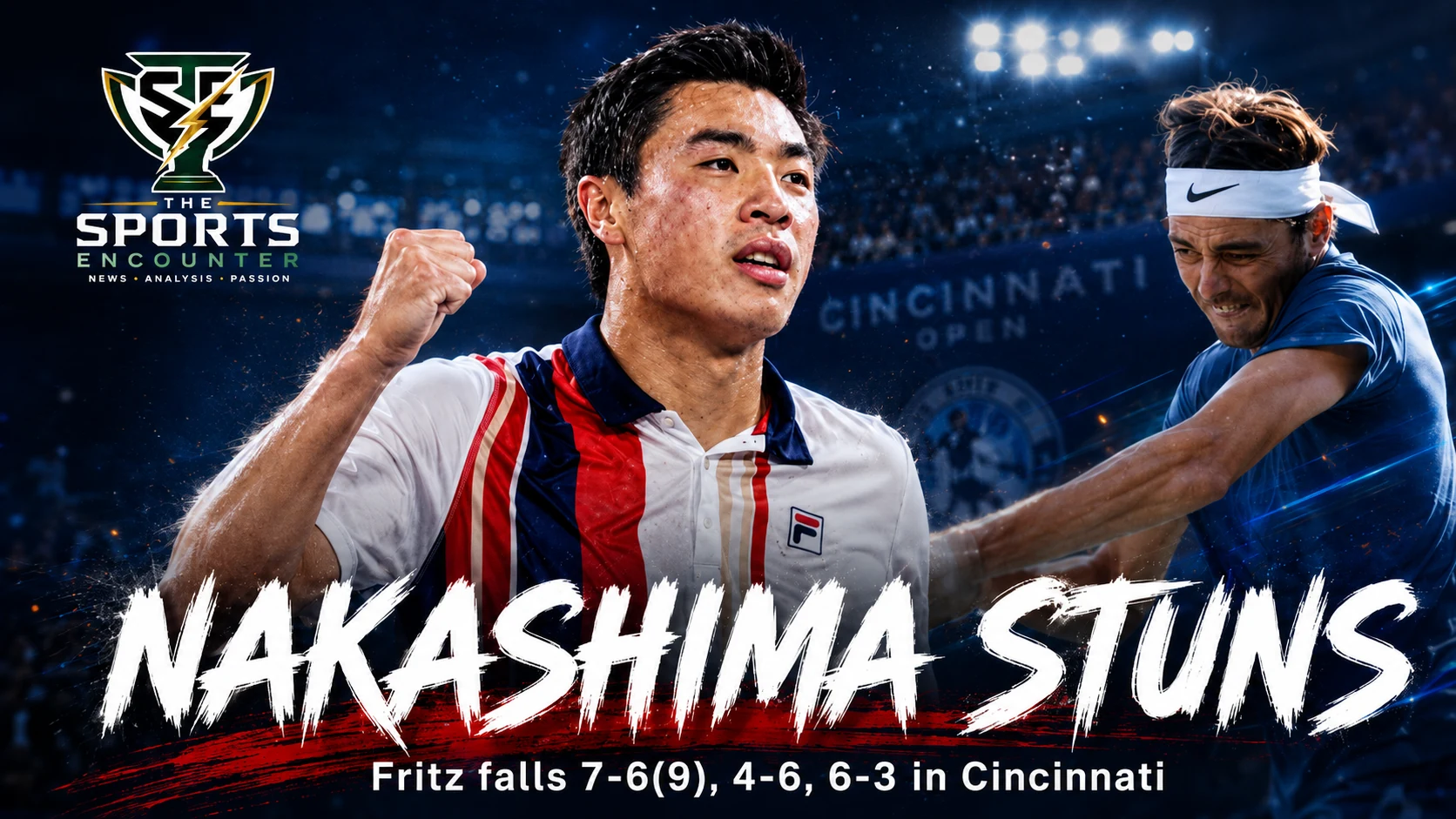
Nakashima won 7-6(9), 4-6, 6-3.
The opening-set tiebreak went to 11-9.
Fritz recovered to force a deciding set.
Nakashima still found the cleaner finish.
The victory was his fourth Top 10 win of the season and moved him into back-to-back Masters 1000 semifinals.
There was another layer.
Fritz had beaten Nakashima in Washington.
Cincinnati became the payback match.
This type of immediate adjustment against a familiar opponent is one of the best indicators of a player improving beyond ranking points.
Nakashima Is Now a Top-20 Player for the First Time
His Cincinnati run moved him five places to a career-high No. 17.
He entered the summer outside the established American top tier.
He now has a legitimate argument for being the most consistent American hard-court player of the last month.
Nakashima finished Cincinnati with a 12-3 record across the Washington, Montreal and Cincinnati stretch.
He also led the ATP Tour with 22 hard-court wins when he reached the Cincinnati semifinal.
The Sports Encounter had already identified the younger American shift during the National Bank Open semifinals, when Nakashima, Shelton, Learner Tien and Rafael Jodar transformed Montreal into a tournament dominated by a new generation.
Cincinnati showed that Montreal was not an isolated week.
Tiafoe Stops Nakashima and Finds His Cincinnati Comfort Zone Again
Frances Tiafoe has an increasingly unusual relationship with Cincinnati.
His season can fluctuate.
His ranking can fluctuate.
His confidence can fluctuate.
He keeps finding his way deep into this tournament.
Tiafoe beat Nakashima 7-5, 6-3 to reach his second Cincinnati final in three years.
The first set included four consecutive breaks during the opening six games and then one of the most important holds of Tiafoe’s tournament.
Serving at 4-5, he faced three set points.
He saved them.
Two disappeared through forehand winners.
Tiafoe eventually held after an 11-minute game and then shifted the pressure completely.
He won the set 7-5.
Nakashima never recovered sufficiently to force a deciding set.
Tiafoe Joins Roddick and Fish in a Cincinnati Record
By reaching another final, Tiafoe became only the third American man this century to make multiple Cincinnati championship matches.
The others were Andy Roddick and Mardy Fish.
Roddick reached the final in 2003, 2005 and 2006.
Fish did so in 2003 and 2010.
Tiafoe now has 2024 and 2026.
That is meaningful Cincinnati history.
It is also another reminder of the unresolved American Masters drought carried by the current generation.
Tiafoe was chasing his first Masters 1000 title on Sunday.
Fils denied him.
Quarterfinal: Tiafoe Holds His Nerve Against Musetti
Lorenzo Musetti gave Tiafoe one of his most tactically demanding matches.
The Italian’s variety forced Tiafoe to generate his own pace rather than simply redirecting the ball, while Musetti’s movement repeatedly extended points that appeared finished.
Tiafoe won 7-6(2), 7-5 in two hours and 17 minutes.
The first set was decided by a dominant tiebreak.
The second became messy.
Tiafoe held a match point while serving at 5-4 and failed to close.
Earlier versions of Tiafoe might have carried that frustration into the next game.
He immediately broke Musetti again and then served out the match on his fourth match point.
Despite landing only 44 percent of his first serves, Tiafoe lost just five points behind the first delivery.
That statistic says a great deal about how aggressively he played once the serve landed.
Tiafoe’s Final Defeat Should Not Erase His US Open Signal
Tiafoe’s final scoreline looks brutal because of the deciding-set bagel.
His tournament does not.
He defeated Felix Auger-Aliassime.
He defeated Musetti.
He defeated Nakashima.
Those were three Top 20 victories on the road to the final.
He finished the event with 37 tour-level wins for the season, the most among American men at that stage.
The ranking reward was significant.
Tiafoe jumped 11 places to No. 12.
He is suddenly one strong New York run away from returning to the Top 10 for the first time in three years.
That matters because the US Open has always suited his personality and tennis.
Tiafoe reached the semifinal in New York in 2022 and has repeatedly produced some of his best Grand Slam performances in front of American crowds.
Cincinnati suggests the emotional energy around home tennis is working for him again rather than becoming pressure.
The American Men Leave Cincinnati With More Depth Than Certainty
American tennis has spent more than two decades searching for another men’s Grand Slam champion.
Andy Roddick remains the last, having won the US Open in 2003.
The current group is deeper than anything the country has possessed for years.
Ben Shelton successfully defended the Canadian Masters title earlier this month, a championship The Sports Encounter examined in our Montreal final report.
Fritz won Washington.
Nakashima reached finals weekend in Montreal and Cincinnati.
Tiafoe reached the Cincinnati final.
Paul beat Zverev.
Learner Tien has already reached a Masters 1000 semifinal.
The United States also leads all nations with 14 men receiving direct entry into the US Open singles draw.
The problem is no longer a lack of candidates.
The problem is identifying which one can defeat four or five world-class opponents over two weeks.
Ben Shelton’s Cincinnati Exit Changes the US Open Conversation Slightly
Shelton arrived after producing arguably the best tournament of his career in Montreal.
He won the National Bank Open without dropping a set and defeated Nakashima in the final.
The Sports Encounter’s complete Montreal final analysis showed how effectively Shelton protected both his first and second serves throughout the championship run.
Cincinnati ended quickly.
Jaime Faria beat Shelton 6-4, 6-4 in his opening match.
That should not erase the Canadian title.
It does illustrate the physical and emotional challenge of the modern two-week Masters schedule.
Shelton had barely completed a six-match title defense before needing to reset for another major tournament.
From a US Open perspective, the early Cincinnati loss may even provide recovery time.
His form was proven in Montreal.
His body now gets additional days away from tournament play.
Djokovic’s Cincinnati Return Ends Before It Can Become a US Open Launchpad
Novak Djokovic returned to competition in Cincinnati after skipping Montreal.
The expectations were obvious.
With Sinner and Alcaraz absent, the 24-time major champion entered one of the most open Masters draws he had seen in years.
Tirante ended the opportunity immediately.
Djokovic won the first set 6-2 and looked comfortable.
The Argentine then took the next two 6-4, 6-4.
The Sports Encounter had previewed Djokovic’s Cincinnati return and the unusually open draw in our Cincinnati main-draw analysis.
The defeat does not make Djokovic irrelevant in New York.
He has won 24 Grand Slam singles titles for a reason.
It does mean he enters the US Open without the extended hard-court match sequence he probably wanted.
Zverev’s Defeat May Be More Concerning Than Djokovic’s
Alexander Zverev entered Cincinnati as the top seed and one of the strongest players of 2026.
He had won Roland Garros.
He reached the Wimbledon final.
At the start of the Cincinnati round of 16, he led the ATP Tour with 46 match victories for the year.
Paul still found a way through him.
The German served 14 aces.
He also hit nine double faults.
He held a match point in the second-set tiebreak.
He led 4-2 in the deciding set.
He lost.
That type of defeat can be more damaging than an ordinary straight-sets loss because Zverev had multiple opportunities to end the match.
The US Open will test whether Cincinnati was an isolated failure to close or evidence of pressure returning in decisive moments.
Fritz Remains an Important US Open Contender Despite the Nakashima Loss
Taylor Fritz should not disappear from the New York conversation because of one quarterfinal.
He has already won Washington this summer.
His Cincinnati loss came in three sets against arguably the hottest American player of the last several weeks.
The 2024 US Open finalist knows what it takes to reach championship weekend in New York.
His challenge remains similar to Tiafoe’s.
Can he defeat multiple elite players during the same Grand Slam rather than producing one marquee victory?
Cincinnati did not answer that question.
It did confirm that the American field beneath Alcaraz and the leading Europeans is unusually deep.
Sinner’s US Open Withdrawal Changes Everything
The largest development around the men’s tournament did not happen on a Cincinnati court.
Jannik Sinner has withdrawn from the US Open because of the right knee injury that had already forced him to miss both Montreal and Cincinnati.
The Sports Encounter first examined the issue when Sinner pulled out of Cincinnati and his New York participation came into doubt.
His subsequent US Open withdrawal removes the Wimbledon champion and former New York champion from the draw completely.
That dramatically increases opportunity elsewhere.
Carlos Alcaraz, the defending US Open champion, now enters as the leading favorite provided his wrist is fully recovered.
Zverev remains a major candidate despite Cincinnati.
Djokovic retains enormous Grand Slam credibility.
Shelton, Fritz, Tiafoe and Nakashima give the United States unprecedented depth.
Fils enters with the hottest Masters title on the tour.
Cobolli is ranked No. 6.
The Sports Encounter’s original US Open 2026 preview was written before Sinner’s withdrawal and before Cincinnati reshaped several contenders. The men’s title picture now needs to be read through a very different lens.
The US Open Race After Cincinnati
| Player | Cincinnati / Recent Result | US Open Signal |
|---|---|---|
| Carlos Alcaraz | Skipped Cincinnati with wrist issue | Defending champion and leading favorite if fully fit |
| Arthur Fils | Cincinnati champion | Career-high No. 11, 9-0 in deciding sets, major momentum |
| Alexander Zverev | Lost R16 after holding match point | Elite 2026 season but closing concerns resurfaced |
| Novak Djokovic | Lost opening match to Tirante | Limited hard-court preparation but unmatched major experience |
| Ben Shelton | Early Cincinnati exit after Montreal title | Form already proven, extra recovery could help |
| Frances Tiafoe | Cincinnati finalist | Home-court confidence and return toward Top 10 |
| Brandon Nakashima | Cincinnati semifinalist | 12-3 summer hard-court stretch and new career-high No. 17 |
| Taylor Fritz | Cincinnati quarterfinalist | Washington champion and proven US Open finalist |
| Flavio Cobolli | Cincinnati semifinalist | Career-high No. 6 and growing Grand Slam belief |
| Jannik Sinner | Did not play | Withdrawn from US Open because of knee injury |
TSE US Open Power Read After Cincinnati
1. Carlos Alcaraz Remains the Reference Point
Sinner’s absence shifts the balance immediately toward the defending champion.
Alcaraz’s wrist remains the issue worth monitoring, but nobody else combines his Grand Slam experience, athleticism, variety and ability to create offense from defensive positions as consistently.
The question is whether his lack of Cincinnati match play creates rust or useful freshness.
2. Arthur Fils Is the Hottest New Threat
Calling Fils a favorite would move too quickly.
Ignoring him would be worse.
He is 32-10 this year despite missing major portions of the season.
He has reached three Masters semifinals and won one.
He is 9-0 in deciding sets.
His Cincinnati forehand repeatedly overwhelmed players ranked above him.
He has no US Open ranking points to defend.
His biggest uncertainty is best-of-five durability after the injury history.
3. Shelton Still Has the Strongest Recent American Trophy
Montreal matters more than the Cincinnati loss.
Shelton won six matches there without dropping a set.
That level of serve control can take a player deep in New York, where the crowd will magnify every momentum shift.
4. Tiafoe Has Rediscovered His New York Ingredient
Tiafoe performs at his best when confidence and crowd energy reinforce each other.
Cincinnati looked like that version again.
His movement was sharper, his forehand held under pressure, and he repeatedly recovered after failing to close games cleanly.
The final collapse is a concern.
The six matches before it are evidence.
5. Nakashima May Be the Most Underestimated Player in the Draw
His game does not generate the same noise as Shelton or Tiafoe.
The results are becoming difficult to ignore.
Washington semifinal.
Montreal final.
Cincinnati semifinal.
Wins over Medvedev and Fritz.
A career-high ranking.
There are few players entering New York with more hard-court match confidence.
The Most Important Cincinnati Trend Was Generational
The final four included Fils, Cobolli, Nakashima and Tiafoe.
Zverev had disappeared.
Djokovic had disappeared.
Medvedev had disappeared.
Shelton had disappeared.
Fritz did not survive the quarterfinals.
The tournament was eventually won by a 22-year-old who spent much of last year unable to play.
This follows Montreal, where every men’s quarterfinalist was born in the 2000s, a generational shift The Sports Encounter examined during our National Bank Open final-eight coverage.
The significance is becoming harder to dismiss.
Men’s tennis is no longer waiting for a future generation.
It is already competing against it.
Cincinnati Also Exposed the Limits of Pre-US Open Form
There is another lesson worth carrying into New York.
The player with the best Masters result does not automatically become the best Grand Slam bet.
Cincinnati uses best-of-three sets.
The US Open asks men to win seven best-of-five matches.
Fils’ injury history therefore matters.
Nakashima’s accumulated summer workload matters.
Tiafoe’s physical discomfort in the final matters.
Alcaraz’s wrist matters.
Djokovic’s age and limited preparation matter.
Zverev’s ability to close difficult matches matters.
Shelton’s explosive style becomes more physically demanding over five sets.
The final Grand Slam will reward more than form.
It will reward recovery.
Why Fils’ Cincinnati Title May Matter Beyond New York
France has spent years waiting for another male player capable of sustaining elite results across surfaces.
Tsonga reached a Grand Slam final and won Masters titles.
Gaël Monfils spent years inside the world’s elite.
Richard Gasquet accumulated longevity.
None produced the major title French tennis has chased since Yannick Noah won Roland Garros in 1983.
Fils is nowhere near solving that history yet.
Cincinnati changes the scale of the conversation.
He now owns an ATP 500 title, a Masters 1000 championship, a Roland Garros final appearance and a career-high ranking just outside the Top 10 before turning 23.
The ceiling has moved.
The Camera Message Said Almost as Much as the Trophy
After winning the final, Fils wrote a message on the courtside camera:
“WHO’S GONNA TALK NOW?”
The line was directed toward people who had questioned him during his long injury absence.
It was emotional without being manufactured.
Fils had spent months listening to questions about whether his progress had stalled.
His response came through tennis.
That may be the most compelling narrative of the entire men’s tournament.
Cincinnati did not create Arthur Fils.
It showed what remained underneath the injuries.
What Cincinnati Means for the US Open Draw
The men’s singles draw will be released Thursday, August 27, according to the official US Open website.
Main-draw singles begin Sunday, August 30.
The draw will matter enormously because Cincinnati has created dangerous names outside the very highest seed lines.
Fils at No. 11 could land inside the section of a Top 4 seed.
Tiafoe at No. 12 is dangerous anywhere.
Nakashima enters the Top 20 for the first time.
Paul remains capable of removing elite players.
Tirante has already beaten Djokovic.
Young players such as Rafael Jodar continue to improve faster than rankings alone can describe.
A favorable quarter could dramatically alter the championship probabilities.
The American Men Have Their Best Collective Chance in Years
No American man has won a Grand Slam singles title since Roddick’s 2003 US Open championship.
Every year the statistic gets heavier.
This year the depth is unusually credible.
| American | 2026 North American Hard-Court Signal |
|---|---|
| Ben Shelton | Defended Montreal Masters title without dropping a set |
| Taylor Fritz | Won Washington |
| Frances Tiafoe | Cincinnati finalist |
| Brandon Nakashima | Montreal finalist and Cincinnati semifinalist |
| Tommy Paul | Beat top seed Zverev in Cincinnati |
| Learner Tien | Reached first Masters semifinal in Montreal |
That does not guarantee an American champion.
It means the country no longer needs everything to depend on one player.
The Sports Encounter Verdict
Cincinnati began without Sinner and Alcaraz and appeared to offer Zverev, Djokovic, Shelton, Medvedev and Fritz a valuable opportunity to seize control of the final Masters tournament before the US Open.
None reached the semifinals.
Arthur Fils took the opportunity instead.
He beat Tirante.
He beat Cobolli.
He beat Tiafoe.
When the final threatened to disappear after a 1-6 second set, he responded by winning the deciding set 6-0.
That is the most valuable detail to carry toward New York.
Fils’ Cincinnati title was built as much on response as dominance.
Tiafoe leaves without the trophy but with renewed evidence that his hard-court game remains dangerous when confidence returns.
Nakashima has turned one breakthrough Masters run into two.
Cobolli continues climbing.
Paul proved Zverev remains vulnerable under closing pressure.
Tirante removed Djokovic and announced himself as another potential early-round problem.
The established favorites still deserve respect.
The distance beneath them has narrowed.
Sinner’s withdrawal makes that narrowing even more consequential.
Carlos Alcaraz may begin the US Open as the clearest favorite, but Cincinnati has ensured that the tournament underneath him will be crowded with players carrying genuine reasons to believe.
Arthur Fils now has the biggest reason of all.
He arrives in New York as a Masters 1000 champion.
Frequently Asked Questions
Who won the 2026 Cincinnati Open men’s singles title?
Arthur Fils defeated Frances Tiafoe 6-3, 1-6, 6-0 to win his first ATP Masters 1000 title.
How old is Arthur Fils?
Fils is 22 and became the youngest Frenchman to win an ATP Masters 1000 title since the series began.
What is Arthur Fils’ ranking after Cincinnati?
Fils climbed 10 places to a career-high world No. 11 after winning the title.
How many ATP titles has Arthur Fils won?
Cincinnati was the fifth ATP Tour singles title of his career and his first at Masters 1000 level.
Who did Fils beat in the semifinals?
Fils defeated Flavio Cobolli 6-3, 6-4 in 67 minutes.
Who did Frances Tiafoe beat to reach the final?
Tiafoe defeated Lorenzo Musetti in the quarterfinals and Brandon Nakashima in the semifinals.
How many Cincinnati finals has Frances Tiafoe reached?
Tiafoe has reached two Cincinnati finals, in 2024 and 2026.
How did Brandon Nakashima perform?
Nakashima reached the semifinals after beating Taylor Fritz in three sets. The result followed his Masters 1000 final in Montreal and moved him to a career-high No. 17.
Who eliminated Alexander Zverev?
Tommy Paul defeated Zverev 4-6, 7-6(6), 6-4 after saving a match point.
Who beat Novak Djokovic?
Thiago Agustin Tirante defeated Djokovic 2-6, 6-4, 6-4 in the second round.
Did Ben Shelton go deep in Cincinnati?
No. Shelton lost his opening match to Jaime Faria shortly after successfully defending his Masters 1000 title in Montreal.
Is Jannik Sinner playing the 2026 US Open?
No. Sinner has withdrawn because of the right knee injury that also forced him to miss Cincinnati and Montreal.
When is the 2026 US Open men’s singles draw?
The official US Open website says the men’s singles draw will be released on Thursday, August 27.
When does the US Open 2026 singles main draw begin?
Men’s and women’s main-draw singles begin Sunday, August 30 at the USTA Billie Jean King National Tennis Center in New York.
Cincinnati Open
Coco Gauff Conquers Cincinnati as Women’s US Open Race Takes a Dramatic Turn
Coco Gauff captured her second Cincinnati title by beating Jessica Pegula, while Sara Bejlek stunned the field and Iga Swiatek, Aryna Sabalenka and Elena Rybakina left Ohio with very different US Open questions.
Cincinnati began as the final major examination before the US Open.
It ended by changing the questions New York will have to answer.
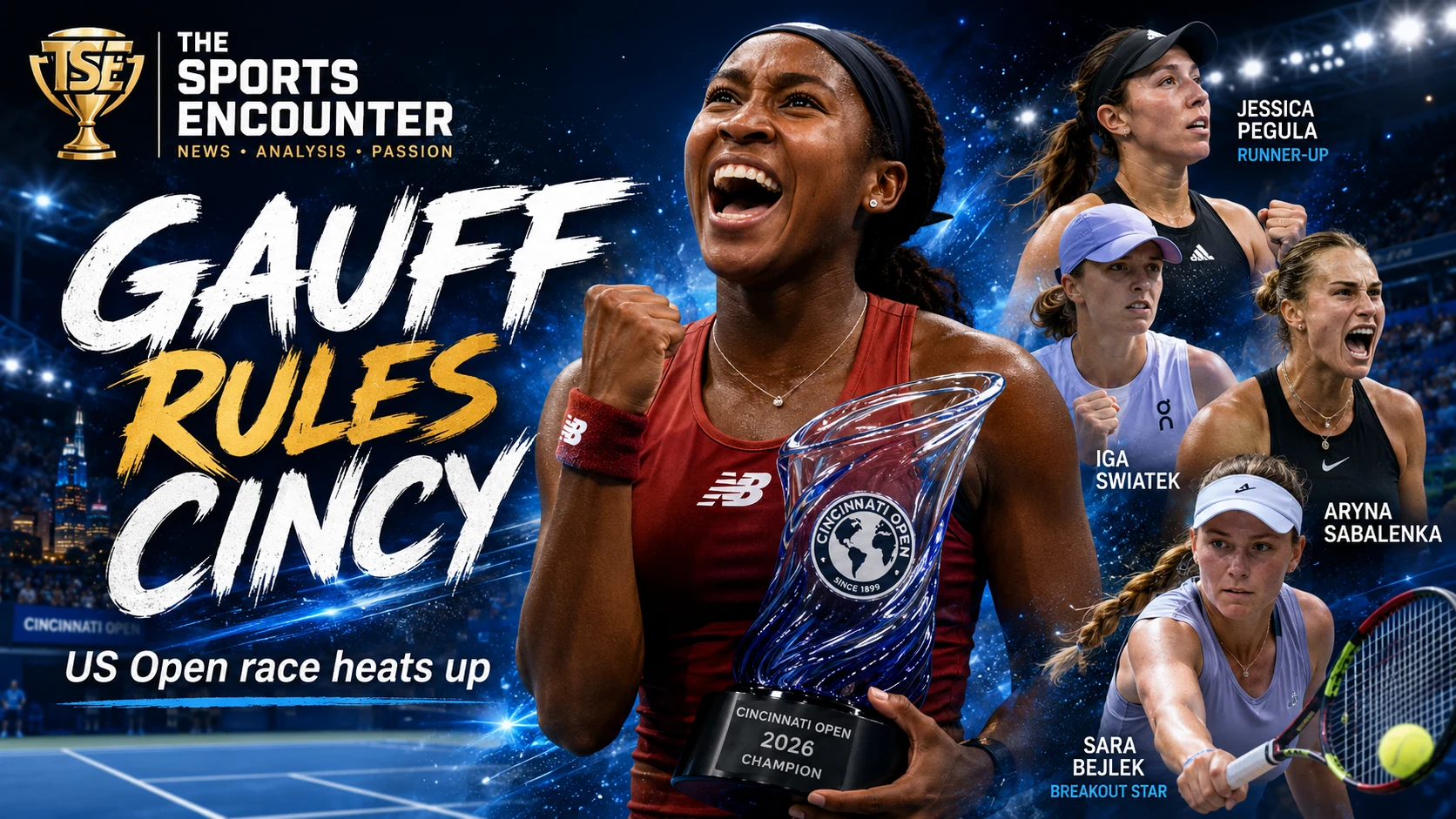
Coco Gauff defeated Jessica Pegula 6-2, 6-4 in Sunday’s women’s singles final to win her second Cincinnati Open title, completing a tournament in which the American gradually transformed from another dangerous contender into arguably the most convincing player of the final three rounds.
The trophy matters.
The timing matters more.
The 2026 US Open main draw begins on August 30, barely one week after Cincinnati’s conclusion, leaving almost no time for the leading women to rebuild confidence, recover from injuries or correct weaknesses exposed in Ohio.
Gauff leaves Cincinnati with a trophy, seven consecutive straight sets won to close the tournament and renewed evidence that the aggressive tactical changes in her game are beginning to hold up when the stakes rise.
Pegula leaves without the title but with victories over Amanda Anisimova and defending champion Iga Swiatek, two results that should matter considerably more than a disappointing final.
Swiatek leaves after a 10-match winning streak was finally stopped.
Elena Rybakina leaves with an ankle problem hanging over her US Open preparation.
Aryna Sabalenka leaves after being beaten by one of the most extraordinary breakout performers of the North American summer.
And 20-year-old Sara Bejlek leaves Cincinnati having transformed her reputation in less than a week.
This was not simply another WTA 1000.
It became the last serious stress test before New York.
Cincinnati 2026 Women’s Final Eight
| Round | Match | Result |
|---|---|---|
| Quarterfinal | Jessica Pegula vs Amanda Anisimova | Pegula 6-4, 2-6, 7-6(4) |
| Quarterfinal | Iga Swiatek vs Elena Rybakina | Swiatek led 4-1 when Rybakina retired |
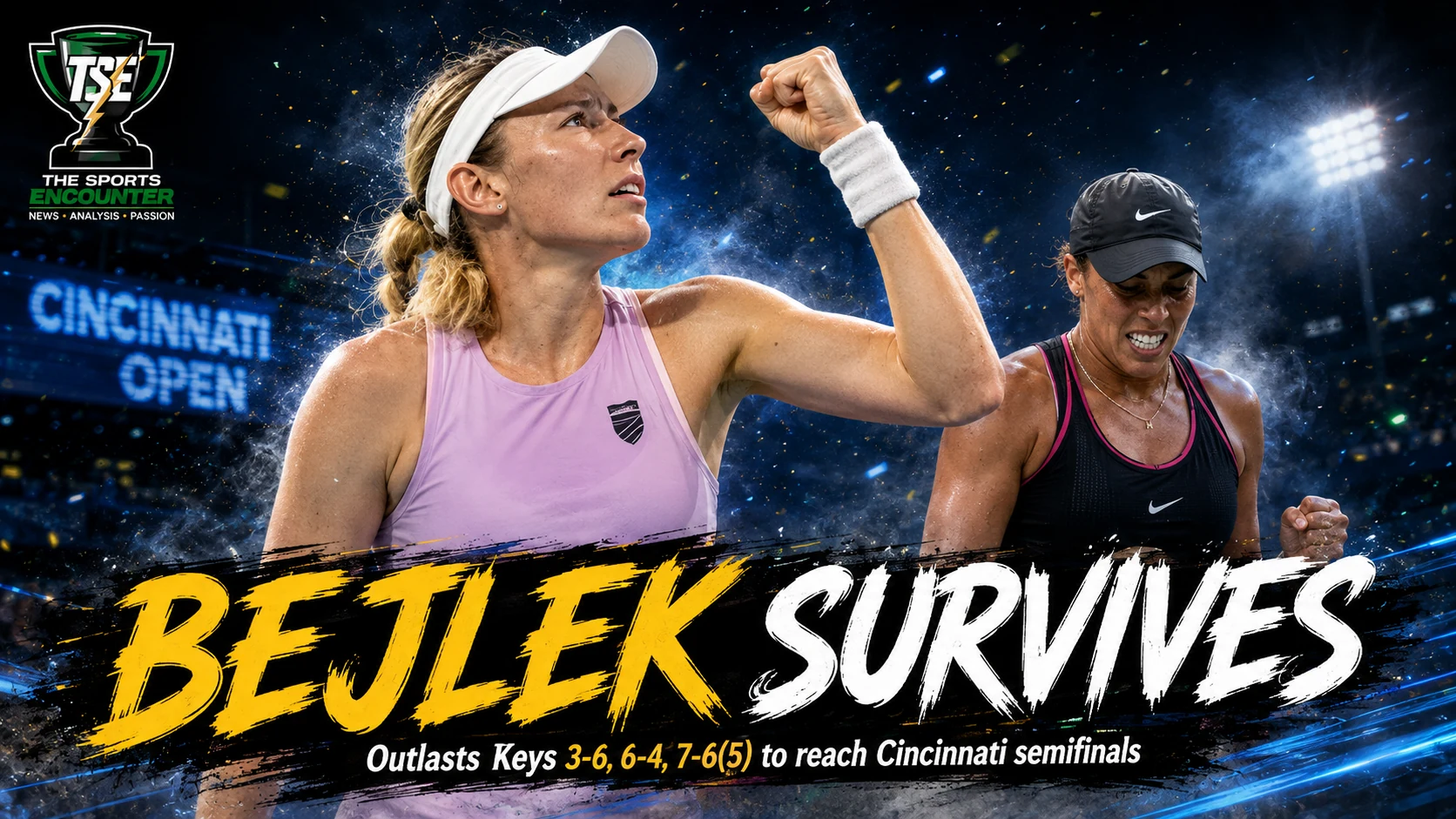
| Quarterfinal | Sara Bejlek vs Madison Keys | Bejlek 3-6, 6-4, 7-6(5) |
| Quarterfinal | Coco Gauff vs Marta Kostyuk | Gauff 6-2, 6-2 |
| Semifinal | Jessica Pegula vs Iga Swiatek | Pegula 7-5, 4-6, 6-4 |
| Semifinal | Coco Gauff vs Sara Bejlek | Gauff 6-4, 6-1 |
| Final | Coco Gauff vs Jessica Pegula | Gauff 6-2, 6-4 |
The complete tournament draw and official results are available through the WTA Cincinnati Open tournament page.
The Final: Gauff Turns an All-American Occasion Into Her Match
The Cincinnati final carried more history than the scoreline eventually suggested.
Gauff and Pegula became the first two Americans to contest the women’s singles final here since Rosemary Casals defeated Nancy Richey in 1970.
No all-American Cincinnati women’s final had occurred during the WTA 1000 era, which began in 2009.
The symbolism was impossible to miss.
Two Americans.
Two Top 4 players.
Two former doubles partners.
One week before the US Open.
Yet once the match began, Gauff did not allow the occasion to become complicated.
She raced to a 5-0 lead in the first set.
Pegula briefly slowed the momentum, but the opening set had already been structurally decided. Gauff was controlling return games, attacking with more authority from the forehand side and preventing Pegula from consistently establishing the compact baseline patterns she prefers.
The second set was tighter.
Pegula began finding cleaner first-strike combinations and forced Gauff to defend more frequently.
Gauff still found the decisive break.
She closed the championship 6-2, 6-4 and collected the 12th singles title of her career.
According to the WTA, it was also Gauff’s eighth title on outdoor hard courts and seventh at WTA 1000 level.
Those numbers are beginning to define her more accurately than age does.
Gauff is still only 22.
Her résumé increasingly belongs to someone who has already been operating near the top of the sport for years.
Two Cincinnati Titles Put Gauff in a Different Category
Her first Cincinnati championship came in 2023.
That tournament became the launching pad for her first US Open title weeks later.
Three years later, the comparison is impossible to avoid.
The circumstances are different.
The player is different too.
In 2023, Cincinnati represented a breakthrough.
In 2026, it represents validation.
Gauff is no longer discovering whether she can win a major North American hard-court tournament.
She is demonstrating that she can return to the same event, navigate a completely different draw and win it again.
There is also a useful contrast with what happened only days earlier in Canada.
Gauff reached the National Bank Open semifinals before losing to Elena Rybakina 7-5, 2-6, 2-6.
The Sports Encounter’s analysis of that Toronto semifinal showed how Rybakina increasingly controlled the match once Gauff’s second serve and forehand came under pressure.
Cincinnati offered the response.
Gauff did not abandon aggression after Toronto exposed the risk.
She refined it.
The Most Important Change Was Not Her Serve
Gauff’s serve will always dominate discussion because double faults can become highly visible when her timing disappears.
The more interesting development in Cincinnati was her court position.
She came forward more frequently.
She looked for opportunities to finish points before opponents could reset.
Her quarterfinal against Marta Kostyuk provided perhaps the clearest example.
Gauff won 6-2, 6-2 in only 70 minutes.
The WTA noted that she broke serve six times and used increasingly assertive net play as part of a tactical shift that had been developing throughout the week.
That matters enormously before the US Open.
Gauff’s defensive ability is already among the best in women’s tennis.
Her movement allows her to survive points that most players lose.
The next step in her evolution has always been finding ways to shorten points when she has created an advantage.
Cincinnati suggested that process is accelerating.
During Toronto, our National Bank Open quarterfinal analysis highlighted how Gauff’s return game could carry her even when other parts of the performance fluctuated.
In Cincinnati, she added another layer.
She started turning good returns into forward movement.
That is a far more dangerous version of Coco Gauff.
Quarterfinal: Gauff Removes Kostyuk Before the Match Can Become Complicated
Marta Kostyuk entered the quarterfinal after one of the more impressive recoveries of the tournament.
She had beaten Mirra Andreeva 4-6, 6-0, 6-2 in the previous round.
That result mattered because Kostyuk had absorbed an opening-set loss against one of the game’s most talented young players and then completely reversed the match.
Gauff never allowed her that opportunity.
The American attacked the return immediately and prevented Kostyuk from gaining scoreboard security.
Once Gauff established control of the baseline exchanges, Kostyuk had to hit closer to the lines to shorten points.
Errors followed.
The match lasted 70 minutes.
Gauff lost only four games.
More importantly, she entered the semifinal without carrying unnecessary physical or emotional damage.
Sara Bejlek Was the Tournament’s Real Discovery
Gauff won Cincinnati.
Sara Bejlek changed her career there.
The 20-year-old Czech began the tournament ranked No. 35.
She left with her first Top 30 ranking.
Between those points came one of the most remarkable runs produced by any player on the WTA Tour this summer.
Bejlek defeated former French Open champion Barbora Krejcikova.
She recovered from a set down to beat Ekaterina Alexandrova.
Then came Aryna Sabalenka.
World No. 1.
One of the biggest hitters in tennis.
The player most opponents spend entire matches trying to prevent from attacking.
Bejlek beat her 7-6(7), 6-4.
It was Bejlek’s first career victory over a Top 10 player.
It was also her first victory against a world No. 1.
The significance became even greater because of how she won.
Bejlek Refused to Accept the Scoreboard Against Sabalenka
Bejlek trailed 5-1 in the first-set tiebreak.
Against Sabalenka, that normally feels terminal.
The Czech kept playing.
She turned the breaker around and won it 9-7.
Sabalenka then had opportunities to establish control in the second set.
Again, Bejlek refused to disappear.
The 7-6(7), 6-4 victory sent her into the first WTA 1000 quarterfinal of her career.
It also removed the No. 1 player in the world from the final major preparation tournament before New York.
For readers who followed The Sports Encounter’s coverage of Sabalenka and Pegula exiting early in Toronto, Cincinnati created a remarkable continuation.
Sabalenka arrived in Ohio looking for a reset.
Instead, another opponent outside the obvious championship group found a way through her.
Quarterfinal: Bejlek Somehow Escapes Again
The Sabalenka victory could easily have become the emotional summit of Bejlek’s tournament.
Madison Keys made sure she had no time to celebrate it.
Keys took the opening set 6-3.
Bejlek responded 6-4 in the second.
The deciding set became another psychological test.
Bejlek fell behind 4-2 in the third-set tiebreak.
Once again, the scoreboard told her she was close to elimination.
Once again, she ignored it.
Bejlek won five of the final six points and defeated Keys 3-6, 6-4, 7-6(5).
That sent her into her first WTA 1000 semifinal.
Two consecutive matches.
Two former major champions or world-class names across the net.
Two situations in which Bejlek appeared to be slipping toward defeat.
Two recoveries.
The quality that distinguished her run was not simply shotmaking.
It was emotional refusal.
Gauff Ends the Bejlek Run Before It Becomes Another Escape
The semifinal was the first time during the closing stages that Bejlek could not extend the match once it began moving away from her.
Gauff won 6-4, 6-1 in 76 minutes.
The first set remained competitive.
That was enough for Gauff to understand the danger.
Bejlek had already proven that leaving the door open was risky.
Gauff closed it.
The second set became progressively one-sided as Bejlek’s unforced errors increased and Gauff’s return pressure intensified.
The loss does almost nothing to reduce what Bejlek achieved.
Her ranking moved into the Top 30 for the first time.
She arrived in Cincinnati as an interesting young player.
She leaves as someone nobody in the US Open draw will want to see early.
Pegula’s Cincinnati Was Better Than the Final Makes It Look
Finals distort tournaments.
A player can spend 10 days producing elite tennis and have the entire run reduced to the final score.
Jessica Pegula should not be assessed that way.
Her route to the championship match was arguably more difficult than Gauff’s.
She beat Amanda Anisimova in one of the most competitive quarterfinals of the tournament.
Then she defeated Iga Swiatek in a nearly three-hour semifinal.
Both victories required problem-solving under pressure.
That is excellent preparation for New York.
Quarterfinal: Pegula Survives Anisimova and Herself
Pegula entered her quarterfinal against Amanda Anisimova with a perfect 5-0 career record against her fellow American.
For long stretches, that history appeared to matter very little.
Pegula took the first set 6-4.
Anisimova responded by dominating the second 6-2.
The deciding set became increasingly tense.
Pegula moved ahead 5-3 and appeared ready to close the match.
She could not.
Anisimova fought back and forced a tiebreak.
That is where Pegula recovered her composure.
She won the breaker 7-4 to complete a 6-4, 2-6, 7-6(4) victory.
The result extended her perfect record against Anisimova to six victories.
It also gave Pegula the kind of match a player often needs before a Grand Slam.
She was tested physically.
She lost control.
She rebuilt it.
Anisimova Remains One of the Most Dangerous Players in New York
The loss should not remove Amanda Anisimova from the US Open conversation.
She remains a Top 10 player and reached the 2025 US Open final.
Her Cincinnati run included a 6-1, 6-4 victory over Wimbledon champion Linda Noskova.
That was an important result.
Noskova entered the North American swing as a newly crowned Grand Slam champion after her historic Wimbledon run, which The Sports Encounter covered throughout the second week, including the all-Czech semifinal story that created the Wimbledon final.
Anisimova dismantled her.
That level remains dangerous even if Pegula ultimately survived.
Swiatek Reached Cincinnati Carrying a Nine-Match Winning Streak
Iga Swiatek arrived in Cincinnati directly after winning Toronto.
Her 6-2, 6-3 victory over Elena Rybakina in the National Bank Open final gave her a 26th career title and 12th WTA 1000 crown.
That championship also moved her ahead of Sabalenka for the second-most WTA 1000 titles since the category was introduced in 2009, behind only Serena Williams.
The Sports Encounter tracked Swiatek’s progression throughout Toronto, including her dominant quarterfinal victory over Diana Shnaider and the increasingly controlled tennis that replaced the instability of her earlier rounds.
Cincinnati initially looked like a continuation.
Swiatek defeated Diane Parry to reach the 30th WTA 1000 quarterfinal of her career.
She had reached at least the quarterfinal stage in 30 of the first 48 WTA 1000 tournaments she had played.
That level of consistency is extraordinary.
Then her quarterfinal against Rybakina ended before it truly began.
Rybakina’s Ankle Is Now One of the US Open’s Biggest Unknowns
Rybakina retired while trailing Swiatek 4-1 in the first set because of a left ankle injury.
The retirement ended her Cincinnati run and stopped a potential challenge for the world No. 1 ranking.
More importantly, it created an immediate US Open concern.
Rybakina had been one of the strongest players of the North American hard-court swing.
She reached the Toronto final.
Her route there included a comeback against Naomi Osaka and a three-set victory over Gauff.
The Sports Encounter’s Toronto semifinal preview highlighted how her serve and first-strike tennis were becoming increasingly difficult to contain.
She then beat Gauff to reach the final.
Swiatek stopped her there.
Cincinnati was supposed to provide another opportunity.
The ankle changed that calculation entirely.
The US Open begins too quickly for recovery questions to be treated casually.
Semifinal: Pegula Ends Swiatek’s 10-Match Winning Streak
Pegula’s 7-5, 4-6, 6-4 victory over Swiatek was probably the best women’s match of Cincinnati’s final weekend.
It lasted close to three hours.
It changed direction repeatedly.
Swiatek won the second set and moved ahead 3-1 in the decider.
At that stage, the Toronto champion seemed ready to extend a winning streak that had reached 10 matches.
Pegula refused.
She recovered the break.
She began winning more of the exchanges in which Swiatek normally establishes control through depth.
At 5-4, Pegula completed the comeback.
The victory gave her another Cincinnati final and one of the best wins of her season.
That should matter greatly before New York.
Beating Swiatek after falling behind in a deciding set requires more than clean ball-striking.
It requires the ability to keep adjusting when the opponent has already found a successful pattern.
Pegula showed that.
The Final Exposed the Difference Between Surviving and Dictating
Pegula survived almost everything Cincinnati threw at her.
Gauff dictated the final.
That difference produced the championship.
Pegula’s compact strokes work best when she can take the ball early and establish predictable court geometry.
Gauff prevented that.
She returned with enough depth to move Pegula backward.
She defended when necessary.
She attacked sooner than she often has in the past.
The first five games were particularly important.
Gauff’s 5-0 lead removed the possibility of a patient opening.
Pegula was forced to chase almost immediately.
Against one of the fastest defenders in the sport, chasing the score can become tactically expensive.
Cincinnati’s Final Was Also an American Tennis Statement
Gauff and Pegula contesting the first all-American Cincinnati women’s final since 1970 carries additional significance because of what comes next.
The US Open field is unusually deep with American women.
Gauff is ranked No. 4.
Pegula is No. 3.
Anisimova is inside the Top 10.
Iva Jovic has climbed into the Top 20.
Sloane Stephens, Sofia Kenin and Venus Williams are also part of the New York field through direct entry or wild cards.
The US Open’s official entry information lists the United States as the nation with the most direct entrants, including 14 women.
The question is therefore no longer whether America has enough players capable of producing a deep run.
The question is whether one of them can finish it.
Gauff already has.
She won New York in 2023.
Pegula reached the final in 2024.
Anisimova reached the final in 2025.
Cincinnati has now produced another all-American championship match.
That is a significant three-year pattern.
The US Open Race Has Changed in One Week
The Sports Encounter’s original US Open 2026 women’s preview identified Sabalenka, Swiatek, Gauff, Rybakina and the wider American group as central contenders.
Cincinnati has altered the weight of those arguments.
| Player | Cincinnati Outcome | US Open Signal |
|---|---|---|
| Coco Gauff | Champion | Momentum, improved attacking intent and second Cincinnati title |
| Jessica Pegula | Finalist | Elite hard-court form and wins over Anisimova and Swiatek |
| Iga Swiatek | Semifinalist | Toronto champion, 10-match winning streak ended narrowly |
| Sara Bejlek | Semifinalist | Breakout threat after beating Sabalenka and Keys |
| Elena Rybakina | Quarterfinal retirement | Form remains strong but ankle fitness becomes critical |
| Amanda Anisimova | Quarterfinalist | Still dangerous after beating Wimbledon champion Noskova |
| Aryna Sabalenka | Round of 16 | Another early North American exit creates questions |
| Madison Keys | Quarterfinalist | Competitive but unable to close Bejlek after winning first set |
Gauff Might Be the Most Complete US Open Candidate Right Now
That statement would have been much harder to make after Toronto.
Cincinnati changed it.
Gauff’s case rests on more than winning the trophy.
She already possesses several of the qualities most useful at the US Open.
Elite movement.
Elite returning.
Experience inside Arthur Ashe Stadium.
A major title in New York.
The ability to survive physical matches.
Now there is evidence of more purposeful front-foot tennis.
If that development survives the pressure of a Grand Slam, opponents may have fewer obvious routes into her game.
Her forehand can still be attacked.
Her second serve can still become vulnerable.
Those problems have not vanished.
The difference is that Gauff appears increasingly capable of preventing opponents from spending enough time attacking them.
Pegula May Have Lost the Final and Improved Her US Open Case
That sounds contradictory.
It is not.
Pegula already knows how to reach a US Open final.
The question has been whether she can consistently defeat multiple elite opponents during the same two-week major.
Cincinnati offered evidence.
Anisimova pushed her into three sets.
Pegula survived.
Swiatek pushed her into three sets.
Pegula came from behind in the decider and won.
Gauff was one challenge too many.
That does not erase the previous two.
After the final, Pegula’s message was essentially to clear the disappointment quickly and move toward New York.
That is probably exactly the correct approach.
Swiatek’s Loss Should Be Viewed in Context
Swiatek did not leave Cincinnati badly.
She lost an excellent semifinal to the world No. 3 after arriving directly from a title run in Toronto.
That combination matters physically.
Extended WTA 1000 tournaments followed by another WTA 1000 create an unusual workload before a Grand Slam.
Swiatek still won 10 consecutive matches across Toronto and Cincinnati before Pegula stopped her.
Her Toronto performance had already repaired some of the uncertainty created by a turbulent grass season.
The Sports Encounter followed that transformation throughout the Canadian event, including her early hard-court reset and later progression into the semifinals.
New York will now test whether the accumulated workload becomes a problem or whether the match rhythm creates an advantage.
Sabalenka Suddenly Has the Most Complicated Favorite’s Case
Aryna Sabalenka remains world No. 1.
She remains the defending US Open champion after beating Amanda Anisimova in the 2025 final.
She remains one of the two or three most intimidating hard-court players in women’s tennis when her first strike is working.
Cincinnati still matters.
Bejlek did more than catch her on a poor day.
The Czech recovered from difficult scoreboard positions and forced Sabalenka to keep playing under pressure.
This followed another premature exit in Toronto.
Two tournaments do not erase Sabalenka’s status.
They do remove the assumption that she enters New York with irresistible North American momentum.
Rybakina Could Become the Draw’s Biggest Fitness Variable
If healthy, Rybakina belongs near the top of any US Open contender list.
Her hard-court tennis before the ankle issue supported that conclusion.
She reached the Toronto final.
She beat Gauff.
She repeatedly survived difficult matches.
She entered Cincinnati as the world No. 2.
The ankle now changes everything.
The problem with injuries immediately before Grand Slams is that even recovery creates uncertainty.
Rest protects the body.
Rest also removes match repetitions.
The US Open draw will not provide extra time for a player to rediscover confidence.
Bejlek Has Become the Early-Round Opponent Nobody Wants
The official WTA rankings after Cincinnati move Sara Bejlek into the Top 30 for the first time.
That ranking jump is the statistical summary.
Her tennis provides the more interesting explanation.
She can defend.
She can redirect.
She does not appear intimidated by scoreboard deficits.
Most importantly, Cincinnati proved she can absorb the pace of elite opponents without becoming passive.
Her first Top 10 victory came against the No. 1 player in the world.
That is unusual.
Following it by beating Madison Keys makes it much harder to dismiss the Sabalenka result as an isolated upset.
Cincinnati Also Revealed the Cost of the Expanded Hard-Court Calendar
There was another storyline running beneath the results.
Fatigue.
Rybakina retired injured.
Swiatek entered after winning Toronto.
Pegula endured multiple long three-set matches.
Gauff had already played a deep Canadian run before Cincinnati.
Elina Svitolina withdrew earlier in Cincinnati because of an ankle issue after aggravating a problem carried from Toronto.
The modern North American swing is becoming as much about managing load as collecting ranking points.
Cincinnati is officially the biggest tune-up before the US Open, but the best preparation is no longer automatically the deepest possible run.
There is a point where match sharpness becomes fatigue.
Every contender now has less than a week to decide where that line sits.
What Cincinnati Means for the US Open 2026
The 2026 US Open singles main draw begins Sunday, August 30 at the USTA Billie Jean King National Tennis Center.
The women’s draw will be revealed on Thursday, August 27, according to the official US Open website.
That draw could become unusually important.
Cincinnati has created several dangerous players outside the very top seeds.
Bejlek is now one of them.
Anisimova is another.
Keys remains capable of beating almost anyone if her first-strike game catches fire.
Noskova is the reigning Wimbledon champion despite her Cincinnati defeat.
Naomi Osaka continues rebuilding.
Mirra Andreeva remains one of the most talented young players on tour.
A contender’s championship probability may depend heavily on which combination appears in her quarter.
TSE US Open Power Read After Cincinnati
| Tier | Player | Why |
|---|---|---|
| Hottest contender | Coco Gauff | Cincinnati champion, home major experience, improved attacking patterns |
| Most battle-tested | Jessica Pegula | Beat Anisimova and Swiatek in consecutive three-set matches |
| Most consistent recent elite form | Iga Swiatek | Toronto champion and Cincinnati semifinalist with 10 straight wins before losing |
| Highest ceiling with unanswered concern | Elena Rybakina | Toronto finalist whose Cincinnati run ended through ankle injury |
| Champion under pressure | Aryna Sabalenka | Defending US Open champion but early exits in Toronto and Cincinnati |
| Breakout danger | Sara Bejlek | Beat Sabalenka and Keys, reached first WTA 1000 semifinal |
| Dangerous second tier | Amanda Anisimova | 2025 US Open finalist and powerful hard-court game remains intact |
The Hidden Cincinnati Story: Women’s Tennis Has Become Harder to Predict
The easiest mistake before New York would be to reduce the women’s tournament to four names.
Cincinnati argues against that.
Sabalenka lost to Bejlek.
Keys then lost to Bejlek.
Wimbledon champion Noskova lost convincingly to Anisimova.
Rybakina was injured.
Swiatek was beaten from a break up in the deciding set.
The eventual final featured two Americans who know each other extremely well.
The hierarchy exists.
It is increasingly vulnerable.
That is what could make the 2026 US Open women’s draw exceptional.
Gauff Has Recreated a Familiar Cincinnati-to-New York Path
There is one final piece of history that tennis fans will immediately recognize.
In 2023, Gauff won Cincinnati.
She then went to New York and won the US Open.
Three years later, she has won Cincinnati again.
The temptation will be to treat the sequence as destiny.
Tennis rarely works that neatly.
The useful comparison is psychological rather than mystical.
Gauff will enter New York knowing she has already beaten several different styles on American hard courts.
She will arrive with a recent trophy.
She will arrive with evidence that tactical adjustments are working.
And unlike 2023, she arrives knowing exactly what Arthur Ashe Stadium feels like on championship night.
That makes her dangerous in a completely different way.
The Sports Encounter Verdict
Cincinnati did not give us a guaranteed US Open champion.
It gave us a much better map of the women’s field.
Gauff leaves Ohio with the strongest momentum.
Pegula leaves with perhaps the most valuable sequence of difficult victories.
Swiatek leaves with defeat but little reason for alarm after a title and a semifinal in consecutive WTA 1000 tournaments.
Sabalenka remains the defending champion and world No. 1, yet her North American preparation has produced more questions than expected.
Rybakina’s tennis belongs among the favorites.
Her ankle must now cooperate.
Bejlek has become the player every seeded contender will quietly hope appears somewhere else in the draw.
And the American women arrive in New York with something they have rarely possessed simultaneously: depth, form and multiple proven championship candidates.
The Cincinnati trophy belongs to Coco Gauff.
The tournament’s larger consequence belongs to the US Open.
New York looked competitive before Cincinnati.
Now it looks volatile.
That may be the best possible setup for the final Grand Slam of 2026.
Frequently Asked Questions
Who won the 2026 Cincinnati Open women’s singles title?
Coco Gauff defeated Jessica Pegula 6-2, 6-4 to win the 2026 Cincinnati Open women’s singles championship.
How many Cincinnati titles has Coco Gauff won?
Gauff has won Cincinnati twice, in 2023 and 2026.
How many career singles titles does Coco Gauff have?
The Cincinnati championship was Gauff’s 12th career WTA singles title.
How many WTA 1000 titles has Gauff won?
Cincinnati gave Gauff her seventh WTA 1000 singles title.
Who did Jessica Pegula beat to reach the final?
Pegula defeated Amanda Anisimova in the quarterfinals and Iga Swiatek in the semifinals.
What happened in Pegula vs Swiatek?
Pegula defeated Swiatek 7-5, 4-6, 6-4 after recovering from 3-1 down in the deciding set. The loss ended Swiatek’s 10-match winning streak.
Who was the breakout player at Cincinnati?
Sara Bejlek produced the biggest breakthrough, defeating world No. 1 Aryna Sabalenka and Madison Keys before losing to Gauff in the semifinals.
What ranking did Sara Bejlek reach after Cincinnati?
The 20-year-old Czech entered the Top 30 for the first time after reaching her maiden WTA 1000 semifinal.
Why did Elena Rybakina retire?
Rybakina retired from her quarterfinal against Iga Swiatek because of a left ankle injury while trailing 4-1 in the first set.
Is Aryna Sabalenka still the US Open favorite?
Sabalenka remains world No. 1 and defending US Open champion, but early exits in Toronto and Cincinnati have strengthened the cases of Gauff, Swiatek, Pegula and other contenders.
When does the 2026 US Open women’s singles tournament begin?
Main-draw singles play begins Sunday, August 30, 2026, at the USTA Billie Jean King National Tennis Center in New York.
When will the 2026 US Open women’s draw be released?
The official US Open website says the women’s singles draw will be revealed Thursday, August 27.
-
Editor's Choice4 weeks agoWhen Will Lionel Messi Retire? Argentina President Says Only Messi Has the Answer
-
Editor's Choice4 weeks agoWhich of Last Season’s Premier League Top 10 Can Actually Win the 2026-27 Title?
-
CPL 20263 days agoCan TKR Still Qualify for the 2026 Playoffs? Qualification Scenarios Explained