


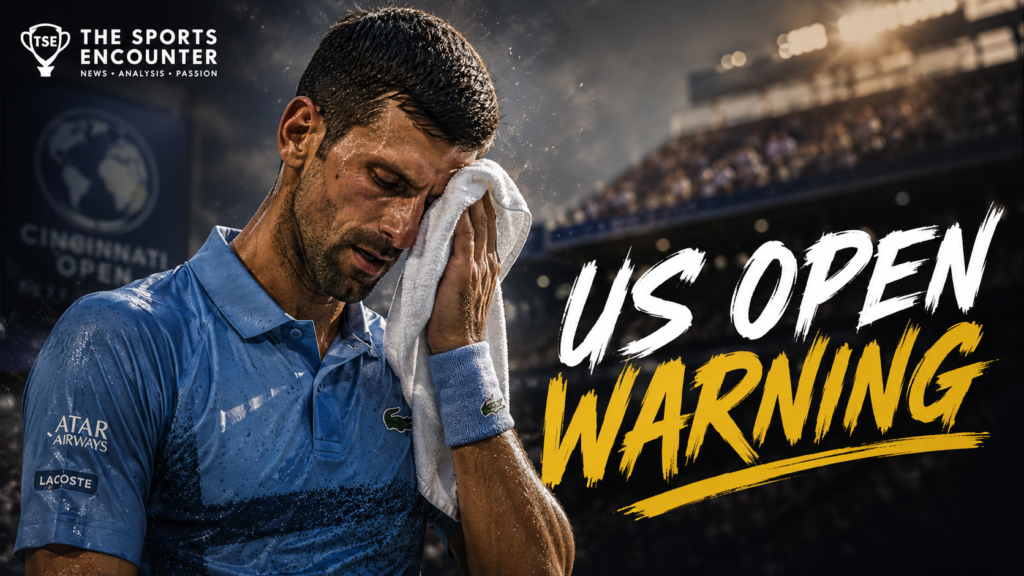
Novak Djokovic arrived in Cincinnati looking for answers.
He left after one match with more questions than he brought.
Thiago Agustin Tirante’s 2-6, 6-4, 6-4 victory over Djokovic at the Cincinnati Open would have been a major upset under any circumstances. The concern grew because of how the match changed.
Djokovic controlled the opening set.
Then the Ohio heat and humidity began to matter.
The 39-year-old dropped to his knees during an exhausting 18-minute service game early in the second set, required medical attention to cool down and increasingly appeared to be managing his energy rather than imposing his tennis.
He recovered enough to compete more effectively in the deciding set, but the match slipped away at 4-4 when a sequence of uncharacteristic errors handed Tirante the decisive break.
The Argentine served it out.
Djokovic’s first competitive match since his Wimbledon semifinal defeat ended before he could build the sequence of hard-court matches that Cincinnati was supposed to provide.
That is why the defeat matters beyond one ATP Masters 1000 result.
Djokovic is still chasing a 25th Grand Slam singles title. He remains one of the most accomplished hard-court players in tennis history. His experience in New York means nobody sensible should remove him from the US Open conversation because of one August defeat.
But Cincinnati was meant to test something different.
Could Djokovic sharpen his movement, serve, return timing and physical tolerance before the final Grand Slam of the year?
Instead, the only match he completed produced a physical warning.
The Sports Encounter had already identified Cincinnati as a key checkpoint in our analysis of Djokovic’s return and his pursuit of Grand Slam No. 25. The tournament did not need to end with a trophy to be successful preparation. A few competitive matches without a physical setback would have been enough.
He got neither.
Novak Djokovic’s Cincinnati Open Defeat at a Glance
| Tournament | Cincinnati Open 2026 |
| Opponent | Thiago Agustin Tirante |
| Djokovic ranking | World No. 5 |
| Tirante ranking | World No. 50 |
| Result | Tirante won 2-6, 6-4, 6-4 |
| Key physical issue | Djokovic struggled with heat and humidity and required treatment |
| Previous competitive match | Wimbledon semifinal loss to Jannik Sinner |
| Next major target | US Open 2026 |
| Grand Slam target | Record-extending 25th singles major |
The First Set Looked Like the Cincinnati Djokovic Needed
For roughly one set, there was very little reason for concern.
Djokovic won the opener 6-2 and looked like the superior player.
His return position was controlled. His timing off the ground appeared sharp enough for a first match after several weeks away. Tirante struggled to protect the court once Djokovic established neutral rallies.
That opening phase supported the reason Djokovic had chosen Cincinnati as his return point.
He had skipped the National Bank Open in Montreal following his demanding Wimbledon campaign, a scheduling decision The Sports Encounter examined in our analysis of why Djokovic and Jannik Sinner withdrew from Montreal.
The logic was clear.
At 39, Djokovic does not need the volume of tournament play younger contenders often chase. His remaining priorities increasingly revolve around arriving at Grand Slams healthy enough to survive seven best-of-five-set matches.
Cincinnati could therefore serve as a controlled return.
One or two early matches to reconnect with hard-court speed.
A deeper run if the body responded well.
Then recovery before New York.
The opening set against Tirante looked compatible with that plan.
The second set changed the conversation.
The 18-Minute Game Was the Moment the Story Changed
The most concerning passage came early in the second set.
Djokovic endured an 18-minute service game containing nine deuces and 24 points.
He eventually held.
The physical cost appeared substantial.
At one stage, Djokovic dropped to his knees.
He later received treatment intended to cool him down, with the stifling humidity becoming as important to the match as Tirante’s tennis.
What followed was revealing.
Djokovic offered relatively little pressure in Tirante’s service games for much of the remainder of the set.
That could be interpreted as tactical conservation.
Once the body is struggling in best-of-three tennis, an experienced player may decide that fighting through every return game is counterproductive. Preserving energy for his own serve and trying to reach a deciding set can become the smarter calculation.
Djokovic has spent his career understanding match economy better than almost anyone.
The problem is that New York will not offer the same escape route.
The US Open Can Turn Heat Into a Competitive Weapon
The US Open is not played in a controlled indoor environment.
Late August and early September in New York can produce heat, humidity and long periods of direct sun.
Players may also move between afternoon and night sessions across the tournament, forcing the body to repeatedly adapt to different temperatures and recovery windows.
The Sports Encounter’s complete US Open 2026 preview identified physical preparation as one of the defining themes of the men’s draw. The tournament’s singles main draw begins on August 30, leaving Djokovic time to recover from Cincinnati but limited competitive opportunity to test himself again before New York.
That is the distinction that makes Cincinnati relevant.
Djokovic is not facing an immediate injury crisis based on the information available.
He is facing a preparation question.
Can he enter a best-of-five major confident that his body will respond if a match turns into three or four hours of heavy conditions?
One Hot Day Does Not Mean Djokovic Has a Conditioning Problem
There is an important danger in overreacting.
Djokovic has competed successfully in extreme heat throughout his career.
His physical reputation was not always so strong early in his career, but he transformed himself into one of the most durable players tennis has seen.
He has won marathon Grand Slam matches.
He has recovered from brutal semifinals to play finals.
He has repeatedly survived environments that physically broke younger opponents.
One difficult afternoon in Cincinnati does not erase that history.
It also does not prove the same issue will happen in New York.
Players can react differently to specific combinations of temperature, humidity, hydration, travel, sleep and match rhythm.
Djokovic was also playing competitively for the first time since July 10, when Sinner defeated him in the Wimbledon semifinals 6-4, 6-4, 6-4.
There is a difference between fitness developed through training and fitness tested through live match stress.
Cincinnati supplied that first stress test.
The result was mixed.
Djokovic Looked Better After the Locker-Room Break
The deciding set is why the defeat should not be reduced to “Djokovic physically collapsed.”
He changed clothes between sets and returned looking sharper.
The movement improved.
The rallies became more competitive.
He stayed with Tirante until 4-4.
That recovery matters.
If Djokovic had continued deteriorating physically, the US Open concern would be more serious.
Instead, he demonstrated an ability to reset within the match.
The defeat was ultimately completed by errors rather than complete physical incapacity.
At 4-4, Djokovic produced several mistakes he would normally expect to control in a major match, including the volley into the net that surrendered the decisive break.
Tirante then held serve to complete the biggest win of his career.
The physical struggle therefore created the conditions for the upset.
It did not entirely explain it.
Tirante Deserves More Credit Than the Heat Narrative Gives Him
Whenever a legend struggles physically, the opponent can disappear from the story.
That would be unfair to Tirante.
The Argentine lost the first set heavily and could have accepted the expected outcome.
Instead, he stayed emotionally stable.
He made Djokovic continue working.
When Djokovic’s physical level dipped, Tirante did not rush.
When the Serbian returned with more energy in the third, Tirante remained attached to the score.
Then came 4-4.
Djokovic made the errors.
Tirante had put himself in position to benefit from them.
His reward was the biggest victory of his career and a place in the next round against Martin Landaluce.
That younger generation has been one of the wider themes of the North American hard-court season. Landaluce had already eliminated Jack Draper, a result The Sports Encounter examined in our look at Draper’s difficult road toward the US Open.
Tirante has now supplied Cincinnati with an even bigger result.
The Bigger Concern Is Djokovic’s Lack of Competitive Repetition
The heat will dominate headlines.
The lack of matches may be more important.
Djokovic’s 2026 schedule has been deliberately selective.
That approach has worked at majors.
He reached the Australian Open final without extensive competitive preparation.
He reached the Wimbledon semifinals after another carefully managed build-up.
The Sports Encounter’s earlier Cincinnati preview argued that Djokovic no longer needs to prove he can survive early Grand Slam rounds without warm-up matches.
He has already proved that.
The concern comes later.
Sinner and Carlos Alcaraz increasingly force elite opponents to play at a very high physical and technical level immediately.
There is little time to discover rhythm during a semifinal.
Cincinnati was supposed to provide some of that rhythm beforehand.
Instead, Djokovic played three sets.
Wimbledon Already Showed the Current Gap Against Sinner
Djokovic’s last match before Cincinnati came against Sinner.
The Italian won 6-4, 6-4, 6-4.
Wimbledon’s official report showed a match in which Sinner repeatedly protected his own service games and prevented Djokovic from turning the contest into the kind of tactical battle he has historically dominated.
The Sports Encounter explored that match in our complete review of Sinner’s Wimbledon title defense.
The issue was not that Djokovic suddenly forgot how to play elite tennis.
He remained competitive.
The problem was the margin.
Sinner’s movement was a little quicker.
His ball speed remained higher for longer.
His second-serve pressure was relentless.
Djokovic understood the tactical problems but could not consistently execute the solutions across three sets.
That is why Cincinnati mattered.
He needed opportunities to raise the hard-court version of his game before potentially seeing Sinner again in New York.
The Serve Becomes Even More Important at 39
Djokovic’s greatest physical adaptation may now need to happen through his serve rather than his legs.
He cannot approach every hard-court match as though extending rallies indefinitely remains cost-free.
Free points matter more.
A strong first-serve percentage shortens service games.
Unreturned serves remove physical exchanges entirely.
Accurate body serves prevent aggressive returners from taking full swings.
Wide serves create immediate openings for the next ball.
The serve does not need to become the biggest on tour.
It needs to reduce the number of physically expensive neutral rallies Djokovic is required to play.
That becomes especially important at the US Open, where a player may need to win seven best-of-five matches over two weeks.
The Return Still Gives Djokovic a Way Into Every Match
The good news remains the return of serve.
Djokovic’s anticipation has not disappeared.
His ability to read patterns, absorb pace and redirect the first ball after serve remains exceptional.
That skill can protect him from physical decline in another way.
A great return can create shorter points.
If Djokovic immediately places an opponent under pressure, the server often has to attack earlier than intended.
That can produce mistakes before a rally becomes physically expensive.
His return is one reason Djokovic remains dangerous even when his legs are not at their absolute peak.
The Cincinnati Loss Also Changes the Psychological Build-Up
Confidence in tennis is rarely as simple as wins and losses.
Djokovic does not need an August Masters title to believe he can win a major.
He has too much evidence from his own career for that.
But preparation creates smaller forms of confidence.
Confidence in movement.
Confidence in recovery.
Confidence in serving at 4-4 in a deciding set.
Confidence that a physically difficult service game will not affect the next 30 minutes.
Cincinnati did not provide those reassurances.
It provided uncertainty.
New York Has Been Both a Sanctuary and a Pressure Chamber for Djokovic
Djokovic has won the US Open four times.
He understands Arthur Ashe Stadium better than almost anyone still competing.
He has played finals there under enormous historical pressure.
He has won championships and experienced some of the most painful defeats of his career in the same building.
That experience matters.
New York’s crowd can create emotional turbulence.
Night sessions can stretch late.
Wind can change inside the stadium.
Humidity can become oppressive.
The schedule can demand repeated physical recovery.
Djokovic knows all of it.
Experience cannot remove physical demands.
It can help manage them.
The 25th Grand Slam Chase Makes Every Physical Warning Feel Bigger
If Djokovic were chasing an ordinary ranking goal, Cincinnati would be easier to dismiss.
He is chasing history.
Grand Slam title No. 25 would move him beyond Margaret Court’s all-time singles total and give Djokovic sole possession of one of tennis’ most recognizable records.
That pursuit has followed him through multiple majors.
The Sports Encounter’s Wimbledon analysis of Djokovic’s 25th-major pursuit showed how close he remains to the top even at 39.
He reached another semifinal.
He also encountered the same obstacle increasingly defining the closing phase of his career.
The sport’s younger elite can now demand a physical level that experience alone cannot neutralize.
Sinner and Alcaraz Have Their Own Problems Before New York
Djokovic’s Cincinnati defeat should also be evaluated within an unusually unsettled men’s US Open picture.
Sinner withdrew from Cincinnati because of a knee problem.
The Sports Encounter examined the implications in our report on Sinner’s injury and US Open preparation.
Alcaraz also skipped Cincinnati while recovering from a wrist injury, a situation explored in our analysis of the defending US Open champion’s fitness concerns.
That changes the context.
Djokovic is not the only major contender arriving in New York with questions.
Sinner has a knee issue.
Alcaraz has lacked competitive continuity.
Alexander Zverev has had a stronger major season but still has to translate his Roland Garros breakthrough onto the New York hard courts.
Ben Shelton has built momentum through North America.
The field feels less settled than it might have several months ago.
Djokovic May Still Benefit From Losing Early
This is the counterintuitive possibility.
An early Cincinnati defeat can become useful if Djokovic responds correctly.
He avoided the physical cost of playing five or six matches in oppressive conditions.
He now has additional recovery time before the US Open.
His team has specific information to work with.
Hydration.
Heat management.
Match-intensity training.
Serve efficiency.
Shorter points.
Recovery between long games.
An athlete sometimes learns more from the exact way a match went wrong than from cruising through early rounds.
Cincinnati exposed the issue early enough to address it.
The Question Is Whether Training Can Replace Missing Matches
That will now define Djokovic’s remaining preparation.
Training can recreate pace.
Practice sets can simulate score pressure.
Fitness sessions can recreate heat stress to some extent.
Nothing completely reproduces a tournament match.
A live opponent makes different choices.
The scoreboard changes decision-making.
A service game at 4-4 in a deciding set produces tension practice cannot fully manufacture.
Djokovic has enough experience to compensate for some of that missing repetition.
At 39, though, physical information may matter more than tactical information.
Could Djokovic Play Another Tournament Before the US Open?
Theoretically, another competitive appearance could provide the matches Cincinnati failed to deliver.
Practically, the calculation is difficult.
The wider US Open schedule begins on August 23, with qualifying and Fan Week leading into the singles main draw on August 30. The official US Open platform provides the current event schedule and tournament information.
Adding another tournament could improve match sharpness.
It could also reduce recovery time.
Djokovic’s recent scheduling philosophy suggests rest may remain the preferred option.
His official website already lists the US Open as the next central target following the Cincinnati defeat.
The US Open Draw Could Matter More Than Ever
Djokovic’s opening week in New York may determine whether the Cincinnati loss becomes relevant.
A favorable early draw would allow him to build rhythm while conserving energy.
Three efficient victories could function almost like the competitive preparation he missed in Ohio.
A brutal opening section would create a different problem.
Long five-set matches during the first week could force Djokovic to spend physical reserves before reaching the players most capable of beating him.
At this stage of his career, draw efficiency matters.
That does not mean avoiding quality opponents forever.
It means reaching the second week without unnecessary physical debt.
Djokovic Has Already Proven He Can Peak Without Perfect Preparation
This is the strongest argument against panic.
Djokovic’s career is full of tournaments where preparation looked incomplete until the major began.
Even in 2026, he reached the Australian Open final and Wimbledon semifinal despite limited warm-up schedules.
He knows how to use early Grand Slam rounds to improve.
He understands when to conserve energy and when to extend.
He can win matches without producing his best tennis.
Very few players possess that skill.
It keeps his US Open chances alive regardless of Cincinnati.
But the Margin for Error Is Smaller Than It Used to Be
This is the part nostalgia cannot solve.
Djokovic does not need to be the player he was at 30 to win another major.
He does need to be close enough physically that his tactical advantages still matter.
A small drop in movement changes the backhand.
A small drop in recovery affects the second serve.
One long match can influence the next round.
Sinner and Alcaraz do not require Djokovic to decline dramatically.
A few percentage points can be enough.
Cincinnati therefore matters because it showed how quickly conditions can remove those percentage points.
TSE Analysis: What Cincinnati Really Means for Djokovic’s US Open Chances
| Area | Cincinnati Signal | US Open Meaning |
|---|---|---|
| Baseline timing | Strong early, less consistent later | Still capable, but needs sustained sharpness |
| Heat tolerance | Major concern during second set | Needs careful management in New York |
| Recovery within match | Improved in third set | Encouraging sign |
| Match sharpness | Only one competitive match since Wimbledon | Potential first-week vulnerability |
| Serve | Not efficient enough to fully shorten physical load | Critical weapon for preserving energy |
| Return | Still capable of controlling stretches | Remains a major advantage |
| Pressure execution | Errors at 4-4 in deciding set | Needs cleaner late-set tennis |
| Overall outlook | Concern, not crisis | Still a genuine US Open contender |
This Loss Should Change Expectations, Not Eliminate Djokovic
Before Cincinnati, there was a reasonable argument that Djokovic could use the event to build momentum and enter New York as one of the clearest alternatives to Sinner and Alcaraz.
That argument now requires adjustment.
Djokovic still belongs among the contenders.
He should no longer be treated as though Cincinnati proved his preparation was on schedule.
It did not.
The match exposed a conditioning issue under difficult weather, limited his competitive repetition and ended with mistakes during a decisive service game.
Those are legitimate warning signs.
They are not proof that he cannot win the US Open.
What Djokovic Needs Before New York
The next two weeks need to be practical.
1. Recover fully from the heat stress
There is little value in immediately compensating for the Cincinnati defeat through excessive training.
Recovery comes first.
2. Build match intensity without adding unnecessary miles
Practice needs to reproduce long service games and sustained baseline pressure without creating the physical cost of another tournament.
3. Increase first-serve efficiency
Djokovic needs more short service games at the US Open.
Every free point matters.
4. Prepare specifically for afternoon heat
His team now has a clear warning from Cincinnati.
Hydration, cooling and scheduling preparation should be tailored accordingly.
5. Accept that early US Open rounds may function as preparation
Djokovic may have to build his tournament level while already inside the major.
He has done it before.
TSE Verdict: Cincinnati Was a Warning, Not a Verdict
Novak Djokovic did not lose his US Open chances when Tirante served out the final game in Cincinnati.
He lost an opportunity.
Cincinnati was supposed to give him several matches between Wimbledon and New York.
Instead, it gave him one.
He looked excellent for a set.
He struggled badly with the heat for a period of the second.
He recovered enough to compete in the third.
Then he made errors at the moment the match demanded precision.
That sequence tells us more than the upset itself.
Djokovic’s tennis is still present.
The question is how consistently his body can support it.
That question has become central because the final Grand Slam of the year demands more than one good afternoon.
It requires seven matches.
Potentially 21 or more sets.
Heat.
Humidity.
Night sessions.
Recovery days.
Younger opponents.
And, if Djokovic reaches the final weekend, potentially Sinner, Alcaraz, Zverev or another player capable of forcing him into the most physically expensive version of modern hard-court tennis.
The Sports Encounter’s tennis coverage will follow Djokovic’s preparation and the wider US Open field as the final weeks before New York reshape the title picture.
At 39, Djokovic no longer needs perfect preparation to be dangerous.
He may need something more difficult.
Perfect management.
Frequently Asked Questions
Who beat Novak Djokovic at the 2026 Cincinnati Open?
Thiago Agustin Tirante defeated Djokovic 2-6, 6-4, 6-4 in the second round.
Why did Djokovic struggle in Cincinnati?
Djokovic appeared badly affected by the heat and humidity during the second set and required medical treatment to cool down. He recovered somewhat in the third set but made costly errors late in the match.
Was Djokovic injured in Cincinnati?
No specific new injury was publicly confirmed from the match. The main visible issue was his physical reaction to the heat and humidity.
When did Djokovic last play before Cincinnati?
His previous competitive match was the Wimbledon 2026 semifinal, where Jannik Sinner defeated him 6-4, 6-4, 6-4.
Is Novak Djokovic playing the US Open 2026?
Djokovic is expected to compete in New York as he continues his pursuit of a 25th Grand Slam singles title.
When does the US Open 2026 singles main draw begin?
The men’s and women’s singles main draws begin on August 30, 2026.
How many US Open titles has Djokovic won?
Djokovic has won four US Open men’s singles championships.
How many Grand Slam titles does Djokovic have?
Djokovic enters the 2026 US Open period with 24 Grand Slam singles titles and is attempting to win a record-extending 25th.
Does the Cincinnati loss mean Djokovic cannot win the US Open?
No. The defeat raises legitimate concerns about heat tolerance and match sharpness, but Djokovic has repeatedly performed well at Grand Slams after limited preparation. He remains a serious contender if he arrives healthy and manages his physical workload effectively.
Who are Djokovic’s biggest rivals at the 2026 US Open?
Jannik Sinner, defending champion Carlos Alcaraz and Alexander Zverev remain among the strongest men’s contenders, although both Sinner and Alcaraz have entered the US Open build-up with fitness concerns of their own.
The Sports Encounter’s tennis coverage follows Grand Slams, ATP and WTA tournaments, player fitness, records, rivalries and the tactical details that explain why the biggest matches turn.