


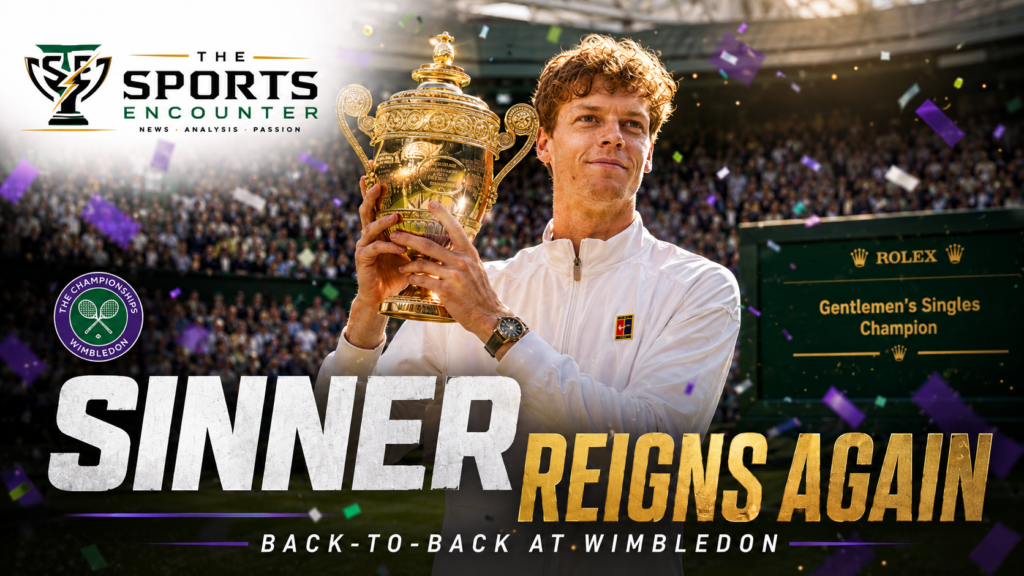
Jannik Sinner’s second Wimbledon title began with uncertainty and ended with authority.
The defending champion arrived at the All England Club after a damaging second-round exit at the French Open, no competitive grass-court warm-up event, and a first-round draw that pushed him to five sets. By the end of the fortnight, he had defeated Novak Djokovic in straight sets, outlasted French Open champion Alexander Zverev in a thunderous final, and secured the fifth Grand Slam title of his career.
Sinner beat Zverev 6-7(7), 7-6(2), 6-3, 6-4 on Centre Court, completing the victory after three hours and 46 minutes. The result made him the first Italian man to win two Wimbledon singles titles and one of only 10 men in the professional era to defend the championship successfully.
The final also delivered Sinner’s 100th Grand Slam match win.
His Wimbledon 2026 campaign demanded more than clean ball-striking. Sinner had to manage physical uncertainty, rebuild his confidence after Paris, resist Zverev’s best serving performance of the tournament, and remain composed when the final stayed balanced deep into the third set.
By the time he lifted the pineapple-topped Challenge Cup, Sinner had shown why he remains the world’s top-ranked player.
TL;DR
Jannik Sinner successfully defended his Wimbledon men’s singles title by beating Alexander Zverev in four sets.
The 24-year-old Italian:
- Won his fifth Grand Slam title
- Claimed his second consecutive Wimbledon crown
- Recorded his 100th Grand Slam match victory
- Beat Novak Djokovic in straight sets in the semifinal
- Extended his winning run against Zverev to 10 matches
- Became the 10th man in the professional era to retain the Wimbledon title
- Recovered from a five-set struggle in the opening round
- Finished the semifinal and final without losing a service game
Jannik Sinner at a Glance
| Category | Detail |
|---|---|
| Age | 24 |
| Nation | Italy |
| ATP ranking | No. 1 |
| Wimbledon seeding | No. 1 |
| Wimbledon titles | 2025, 2026 |
| Grand Slam titles | Five |
| Australian Open titles | 2024, 2025 |
| US Open titles | 2024 |
| Wimbledon titles | 2025, 2026 |
| Final opponent | Alexander Zverev |
| Final score | 6-7(7), 7-6(2), 6-3, 6-4 |
| Grand Slam match wins | 100 |
| Consecutive wins over Zverev | 10 |
The Road to the Wimbledon 2026 Title
| Round | Opponent | Result |
|---|---|---|
| First round | Miomir Kecmanovic | 4-6, 6-3, 6-7, 6-2, 6-3 |
| Second round | Nuno Borges | 7-6, 7-6, 6-4 |
| Third round | Jenson Brooksby | 6-4, 6-3, 6-4 |
| Fourth round | Shintaro Mochizuki | 6-3, 7-6, 6-3 |
| Quarterfinal | Jan-Lennard Struff | 7-5, 7-6, 6-3 |
| Semifinal | Novak Djokovic | 6-4, 6-4, 6-4 |
| Final | Alexander Zverev | 6-7(7), 7-6(2), 6-3, 6-4 |
Sinner dropped two sets in the opening round and one in the final. Every other opponent fell in straight sets.
That progression became the story of his championship. The tournament began with survival, moved into control, and ended with Sinner producing his most complete tennis when the title demanded it.
Paris Created the Doubt That Followed Him to London
Sinner entered Wimbledon with an unusual level of pressure for a player who had dominated most of the 2026 season.
He had won all five Masters 1000 tournaments he contested, becoming the first man to claim five consecutive Masters titles. Yet his Grand Slam results told a different story.
Two of his three defeats during the season came at the first two majors. His Australian Open campaign ended before the title match, while the French Open produced a far more surprising result.
Juan Manuel Cerundolo defeated Sinner in the second round in Paris, ending the Italian’s tournament far earlier than expected. The loss came in punishing heat and raised questions about his physical condition, preparation, and ability to reset quickly before Wimbledon.
Sinner responded by skipping the traditional grass-court warm-up tournaments.
Instead, he returned to Monaco for a demanding training block. Some sessions took place on hard courts as his team focused on preparing his body rather than chasing match practice.
“We put in a lot of workdays in Monaco, very, very long,” Sinner said after winning the Wimbledon title.
“Definitely sacrificing a lot of my time and everything to be in this position. Having this achievement, it means a lot to me. Yeah, it was an amazing day today.”
The decision appeared risky at the beginning of Wimbledon. Grass demands precise footwork, sharp reactions, and confidence in movement. Competitive preparation usually helps players adjust to the lower bounce and faster points.
Sinner accepted that risk because he believed physical preparation mattered more than tournament rhythm.
“Every Grand Slam is different,” he said. “Different story, different environment, different feelings before the tournament.”
“For me, this one means a lot, because it was tough after Paris. Last year was also tough. But coming here, I tried to put myself in the best position to be as competitive as possible.”
The first round tested that preparation immediately.
Miomir Kecmanovic Nearly Ended the Title Defense Before It Began
Sinner’s opening match became his greatest scare before the final.
Miomir Kecmanovic took the first set and then won a third-set tiebreak, leaving the defending champion two sets to one down. Sinner struggled to control the rallies with his usual precision and briefly appeared concerned after slipping near the baseline.
Kecmanovic played with confidence and forced Sinner into a physical, uncomfortable contest.
The Italian eventually recovered to win 4-6, 6-3, 6-7, 6-2, 6-3.
The match showed that Sinner had arrived without his best rhythm. It also revealed the mental quality that later shaped the final.
He remained patient.
Sinner stopped forcing points, improved his return position, and gradually reduced his unforced errors. Once the fifth set began, he looked more secure than he had earlier in the match.
The defending champion escaped, but the performance gave his rivals reason to believe he remained vulnerable.
That impression did not last long.
Borges and Brooksby Help Sinner Find His Rhythm
Sinner’s second-round victory over Nuno Borges marked the beginning of a more controlled phase.
He won 7-6, 7-6, 6-4, handling two tight sets before closing the match without allowing it to develop into another long physical battle.
The match sharpened his serve and return patterns. Sinner began taking the ball earlier, protecting the baseline, and creating pressure without overhitting.
Jenson Brooksby presented a different challenge in the third round. The American’s movement, court craft, and ability to disrupt rhythm can frustrate aggressive baseliners.
Sinner stayed composed and won 6-4, 6-3, 6-4.
By this stage, the opening-round instability had begun to disappear. His movement looked cleaner, his first serve became more reliable, and he started controlling rallies with depth rather than chasing quick winners.
The tournament was beginning to move at his pace.
Mochizuki Tests Sinner’s Patience
Shintaro Mochizuki entered the fourth round with freedom and confidence.
His varied game, low ball trajectory, and willingness to change direction gave Sinner a different kind of problem. The Japanese player competed well during the second set and forced a tiebreak.
Sinner dominated that breaker without losing a point.
He won 6-3, 7-6, 6-3 and reached the quarterfinals without wasting energy.
The performance reflected his growing comfort on the surface. Sinner attacked when the opportunity appeared, but he did not become impatient when Mochizuki extended rallies or changed the pace.
The world No. 1 had moved beyond survival. He was now managing matches.
Struff Brings Power, but Sinner Controls the Important Points
Jan-Lennard Struff entered the quarterfinal as an experienced and dangerous grass-court opponent.
At 36, the German had reached his first Grand Slam quarterfinal. His serve, forehand, and aggressive court positioning offered the kind of direct tennis that can shorten points and remove rhythm from a favorite.
Sinner won 7-5, 7-6, 6-3.
The match remained competitive across the first two sets, but Sinner controlled the closing stages of each.
He broke late to take the opening set, then held his nerve during another tiebreak. Once he established a two-set lead, Struff could no longer sustain the pressure required to reverse the match.
Sinner’s return game did not overwhelm Struff from the first ball. It worked through accumulation.
He forced the German to play extra volleys, made him hit difficult first shots after serve, and waited for the small drop in accuracy that eventually arrived.
The victory sent Sinner into a semifinal against Novak Djokovic.
Sinner Solves Djokovic in Straight Sets
The semifinal carried more history than any other match in Sinner’s campaign.
Djokovic entered Wimbledon chasing an eighth men’s singles title and a 25th Grand Slam crown. His Centre Court record, experience, and ability to survive difficult matches made him the greatest threat remaining in the draw.
Sinner gave him almost no opportunity to change the contest.
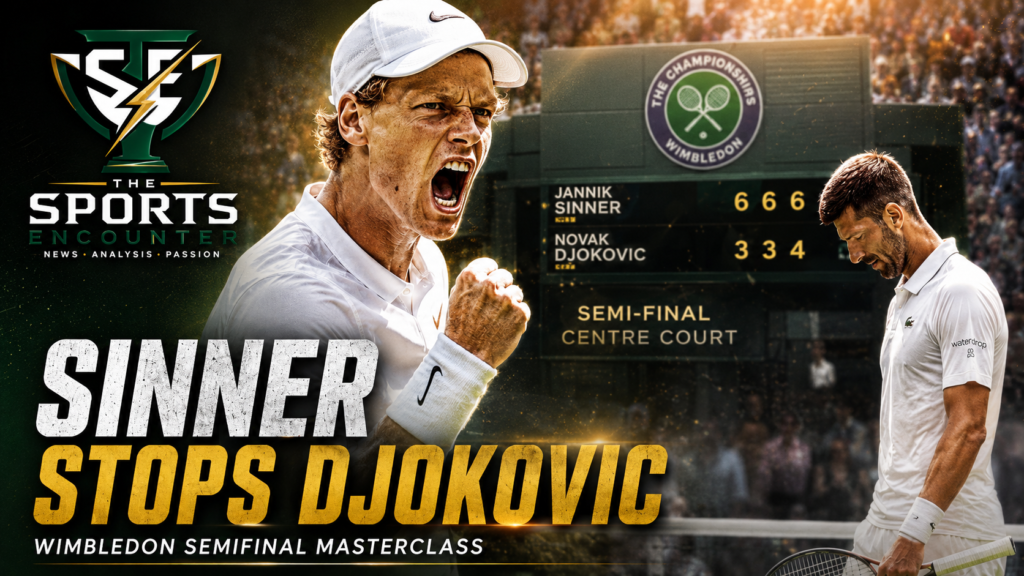
He won 6-4, 6-4, 6-4.
The Italian served with exceptional control and did not lose a service game. His return position allowed him to attack Djokovic’s second serve, while his depth prevented the Serbian from controlling rallies through changes of direction.
Sinner also refused to allow the match to become emotionally complicated.
Djokovic often turns major matches by extending points, changing tempo, and creating doubt. Sinner stayed close to the baseline and kept striking through the court.
Each set followed a similar pattern. The rallies remained competitive, but Sinner produced the cleaner tennis when the decisive moment arrived.
The straight-set result placed him back in the Wimbledon final and reinforced the sense that the world No. 1 had found his highest level at the right time.
The Sports Encounter has followed the wider debate around whether Novak Djokovic can still win another Wimbledon title, and Sinner’s semifinal performance offered a clear answer about the current balance of power.
Djokovic remains capable of reaching the final stages. Sinner currently gives him almost no room for error.
Zverev Arrives With Momentum and Belief
Alexander Zverev reached the final in the strongest stretch of his career.

The German had finally won his first Grand Slam title at the French Open and arrived at Wimbledon with renewed confidence. Before 2026, he had never progressed beyond the fourth round at the All England Club.
Now he stood one win away from completing the French Open-Wimbledon double.
Zverev’s game had also changed.
He played closer to the baseline, trusted his forehand under pressure, and attacked rather than waiting for Sinner to dictate. His first serve became the central weapon of the final.
For much of the match, Zverev’s first-serve percentage remained close to 80 percent.
The quality of his serving allowed him to shorten points and protect his weaker second serve. His forehand, often vulnerable during the biggest moments of his career, became a weapon.
“That’s the tennis I want to play,” Zverev said after the final.
“That’s the game style I want to play. The more I do it, the better I’ll become hopefully.”
His level gave Sinner the most difficult test of the tournament.
A First Set Decided by Tiny Margins
The opening set lasted 65 minutes and featured intense, heavy ball-striking from both players.
Only one break point appeared across the first 12 games.
Sinner created it at 4-3 but framed a forehand wide. The miss became costly because Zverev continued moving through his service games with remarkable efficiency.
The German dropped only eight points on serve during the set.
The tiebreak remained just as tight.
Zverev reached set point but lost it when Sinner passed him after a drop-shot exchange. He then saved a set point with an ace before earning another opportunity.
This time, he attacked with his forehand and closed the breaker 9-7.
The set ended Sinner’s run of 14 consecutive sets won against Zverev.
It also placed the defending champion behind for the first time since his opening match.
Sinner Levels the Match Without Losing Control
Sinner’s frustration became visible early in the second set.
He struggled to make an impact on Zverev’s service games, while the German continued moving around the court with confidence.
The Italian could have tried to force the issue. Instead, he protected his own serve and waited.
The set reached another tiebreak.
Zverev’s level dropped for the first time, and Sinner responded immediately. He increased his return pressure, took control of the baseline, and won the breaker 7-2.
The final was level.
That outcome mattered psychologically. Zverev had played close to his highest level for two sets and still held only half the match.
Sinner had survived the strongest phase of his opponent’s performance without losing serve.
Zverev’s Fall Changes the Third Set
The third set remained balanced at 3-3.
After two hours and 42 minutes, Zverev earned his first break point of the match.
Sinner answered with a delicate drop shot. Zverev chased it, slipped behind the dusty baseline, and fell awkwardly.
The Italian walked around the net to check on him.
Zverev said he was fine, but his movement looked less comfortable afterward. Sinner held serve and then broke in the following game.
The German threw his racket across the grass in frustration.
Sinner closed the set 6-3.
The fall became an important moment, but it did not fully explain the shift. Zverev still had a break opportunity before the slip. Sinner saved it through skill, held his nerve, and then converted the first clear opening on the other side.
The contrast came down to execution.
Sinner Completes the Title Defense
Zverev recovered enough to compete strongly in the fourth set.
Sinner had already reached another level.
His serve remained secure, his movement became more assertive, and his groundstrokes pushed Zverev farther behind the baseline. At 3-3, Sinner broke again.
The final still needed a memorable finish.
Sinner produced one.
During a 23-shot rally, both players defended, attacked, changed direction, and tested every part of the court. Sinner ended it with a sharp angled touch that brought up match point.
A forehand winner completed the victory.
The final point became Sinner’s 100th win in Grand Slam competition.
He had also completed the semifinal and final without dropping serve.
“There’s No Better Place”
Sinner’s reaction after the match reflected how deeply he valued the moment.
“There’s no better place, honestly, to play tennis,” he said while holding the trophy.
“I’m standing here. You can feel the nerves in a Sunday morning when you wake up, that this is a very special day, and you never know how many times you can come back. So I never take things for granted.”
The quote captured the emotional weight of his title defense.
Sinner entered the tournament carrying the disappointment of Paris. He survived a five-set opening match, rebuilt his level across the middle rounds, defeated Djokovic, and then faced Zverev at his most aggressive.
The trophy had never felt inevitable.
“It always takes two players,” Sinner said.
“We try to give everything we have. I’m very happy about the win but mostly very happy also about the level we played.”
Why Sinner Rejected the Language of Failure
Sinner had gone 12 months without winning another Grand Slam, despite controlling the Masters circuit.
Wimbledon could have been described as relief.
He rejected that interpretation.
“Sometimes you have a tournament with a good outcome, and sometimes you just don’t,” Sinner said.
“There is no failure if you don’t win a Grand Slam.”
“Now I have five in my whole life. But it’s five days of so many other days. You just want to enjoy it. Today was a very tough day. If I lose, it’s still a great day.”
“I never take things for granted.”
That perspective helps explain his emotional stability.
Sinner did not treat defeat as a collapse of identity. The French Open result hurt, but it became part of the preparation for Wimbledon rather than a verdict on his season.
His words also reflected the discipline behind his success. The five Grand Slam title days represent only a small part of the work, training, travel, recovery, and sacrifice that built them.
Sinner Welcomes the Growing Competition
Zverev’s performance confirmed that the German has become a more dangerous major opponent.
Sinner welcomed that development.
“That’s exactly what’s good, because you have always someone who’s pushing you to the limit,” he said.
“We hope that Carlos Alcaraz is coming back from injury, as well, because tennis needs him. Having Novak Djokovic still around, having all the young players coming, it’s really nice.”
“At the same time, you always need to work hard and have moments like this.”
The men’s game now contains several overlapping eras.
Djokovic still competes for history. Zverev has finally become a Grand Slam champion. Alcaraz remains central to the future of the sport. A younger group continues to rise.
Sinner currently stands above them as world No. 1 and back-to-back Wimbledon champion.
From Skiing and Soccer to the Top of Tennis
Sinner’s path to Wimbledon greatness began in Innichen, a small town in northern Italy.
He started playing tennis at the age of seven, but the sport did not immediately become his main focus. Skiing and soccer interested him more during his childhood.
At 13, he committed fully to tennis.
That decision changed Italian sporting history.
Sinner began his professional career on the ITF circuit in 2018. His rise accelerated in 2019 when he won the Next Gen ATP Finals by defeating Alex de Minaur.
He finished that year ranked No. 78 and received the ATP Newcomer of the Year award.
In 2020, Sinner won the Sofia Open, becoming the youngest Italian man to claim a tour-level title during the Open Era. He ended the season ranked 37th.
His progress continued in 2021 with titles at the Great Ocean Road Open, Washington Open, Sofia Open, and European Open. By the end of the year, he had entered the world’s top 10.
Wimbledon 2023 Signals the Next Stage
Sinner reached his first Grand Slam semifinal at Wimbledon in 2023.
That run confirmed his potential on grass and marked the beginning of his development into a genuine major contender.
Later that year, he won his first Masters 1000 title at the Canadian Open and rose to world No. 4, becoming only the second Italian man to enter the ATP top five.
His impact extended beyond individual tournaments.
In November 2023, Sinner helped Italy win the Davis Cup for the first time in 47 years. His performances under national pressure strengthened his reputation as a player capable of delivering in emotionally demanding environments.
The following season brought the breakthrough.
The 2024 Season Changes Sinner’s Career
Sinner won his first Grand Slam title at the 2024 Australian Open, defeating Daniil Medvedev in the final.
He later reached the French Open semifinal and became the world No. 1 in June.
At the US Open, Sinner defeated Taylor Fritz to claim his second major title. He also won the Shanghai Masters and completed the year by capturing his first ATP Finals crown.
His 2024 season also included a complicated anti-doping case.
Sinner tested positive for clostebol in two samples taken in March. The International Tennis Integrity Agency accepted that the substance entered his system through contamination linked to treatment by a member of his support team and initially imposed no suspension.
The World Anti-Doping Agency later challenged that outcome. A settlement followed in 2025.
The case remained part of the public discussion around Sinner, but his competitive rise continued.
Australian Open Defense and the Alcaraz Rivalry
Sinner retained the Australian Open title in 2025, confirming that his first major victory had begun a sustained period of dominance.
The French Open that year brought disappointment when Carlos Alcaraz defeated him in the final.
Sinner answered weeks later at Wimbledon.
He beat Alcaraz in the 2025 final to win his first title at the All England Club, becoming the first Italian man to claim the Wimbledon singles championship.
That victory added another dimension to his rivalry with Alcaraz.
The Sports Encounter’s wider Wimbledon coverage has followed how Sinner, Alcaraz, Djokovic, and Zverev are reshaping the men’s game across different surfaces and major tournaments.
One year after beating Alcaraz, Sinner returned to Centre Court and defeated Zverev to retain the crown.
Five Grand Slam Titles by Age 24
Sinner’s major record now includes:
- Australian Open 2024
- US Open 2024
- Australian Open 2025
- Wimbledon 2025
- Wimbledon 2026
The balance of those titles matters.
Sinner has won on hard courts and grass, defended two major championships, and defeated several of the strongest players of his generation in Grand Slam finals.
His Wimbledon defense also strengthened his case as the most complete active player across conditions.
He can overpower opponents from the baseline, serve with precision, defend with balance, and adjust his position when the match changes.
The 2026 final showed all of those qualities.
What Made Sinner’s Wimbledon Campaign Special
The defining feature of Sinner’s campaign was his ability to adapt without losing his identity.
Against Kecmanovic, he survived.
Facing Borges and Brooksby, he restored rhythm.
Mochizuki required patience.
Struff demanded precision against power.
Djokovic tested his ability to dominate an experienced champion.
Zverev forced him to absorb a first-set assault, manage two tiebreaks, and wait nearly three hours for the first break of serve.
Sinner answered every challenge.
He did not need the same version of his tennis in every round. His base level remained strong enough to survive the difficult days, while his highest level arrived for the semifinal and final.
That is the pattern of a mature champion.
Final Verdict
Jannik Sinner’s Wimbledon 2026 title defense strengthened his position at the top of men’s tennis.
The campaign began with a five-set escape and ended with a four-set victory over the reigning French Open champion.
Between those matches, Sinner won five consecutive contests in straight sets, including a controlled semifinal against Djokovic.
His fifth Grand Slam title carried the weight of his entire journey.
The child who preferred skiing and soccer became Italy’s first Wimbledon men’s singles champion. One year later, he returned and defended the title.
The player who left Paris disappointed committed to long training days in Monaco and arrived in London without a warm-up tournament.
The world No. 1 then survived the uncertainty, trusted his preparation, and produced his best tennis when Centre Court demanded it.
“There’s no better place,” Sinner said.
For the second consecutive year, there was no better player there either.
Jannik Sinner’s Wimbledon 2026 Campaign Scorecard
| Category | Rating | Assessment |
|---|---|---|
| Mental resilience | 10/10 | Recovered from a five-set opening match and losing the first set of the final |
| Serving | 9.5/10 | Went unbroken across the semifinal and final |
| Return game | 9/10 | Increased pressure as matches developed |
| Baseline control | 9.5/10 | Dictated without forcing unnecessary risks |
| Tactical adjustment | 10/10 | Solved different styles across all seven rounds |
| Physical management | 9/10 | Recovered from a difficult opening match and sustained his level |
| Semifinal performance | 10/10 | Defeated Djokovic in straight sets |
| Final performance | 9.5/10 | Outlasted an inspired Zverev in four sets |
| Overall campaign | 9.8/10 | A complete title defense built through resilience, patience, and elite execution |
FAQs
Who did Jannik Sinner beat in the Wimbledon 2026 final?
Sinner defeated Alexander Zverev 6-7(7), 7-6(2), 6-3, 6-4.
How many Wimbledon titles has Jannik Sinner won?
He has won two Wimbledon men’s singles titles, in 2025 and 2026.
How many Grand Slam titles does Sinner have?
The 2026 Wimbledon title gave him five Grand Slam singles championships.
Which Grand Slam titles has Jannik Sinner won?
Sinner won the Australian Open in 2024 and 2025, the US Open in 2024, and Wimbledon in 2025 and 2026.
Who did Sinner beat in the semifinal?
He defeated Novak Djokovic 6-4, 6-4, 6-4.
Did Sinner lose serve in the semifinal or final?
No. Djokovic and Zverev failed to break his serve across both matches.
How old was Sinner when he defended Wimbledon?
He was 24.
Where was Jannik Sinner born?
He was born in Innichen, a small town in northern Italy.
Which sports did Sinner prefer as a child?
He initially preferred skiing and soccer before committing fully to tennis at age 13.
What was Sinner’s first ATP title?
He won the Sofia Open in 2020.
When did Sinner become world No. 1?
He became the top-ranked men’s player after reaching the French Open semifinal in June 2024.
Why did the 2026 Wimbledon title mean so much to him?
Sinner said it carried extra meaning because of his early French Open defeat, the demanding preparation that followed, and his awareness that opportunities to play Wimbledon finals cannot be taken for granted.